Alabama v. Pruitt Reply Brief and Argument of Graddick
Public Court Documents
December 17, 1984
28 pages
-
Case Files, Garner Working Files. Alabama v. Pruitt Reply Brief and Argument of Graddick, 1984. a388ed57-35a8-f011-bbd3-000d3a53d084. LDF Archives, Thurgood Marshall Institute. https://ldfrecollection.org/archives/archives-search/archives-item/c20e6a7f-3c93-43ea-a5a2-4deea5ae50fa/alabama-v-pruitt-reply-brief-and-argument-of-graddick. Accessed September 26, 2026.
Copied!
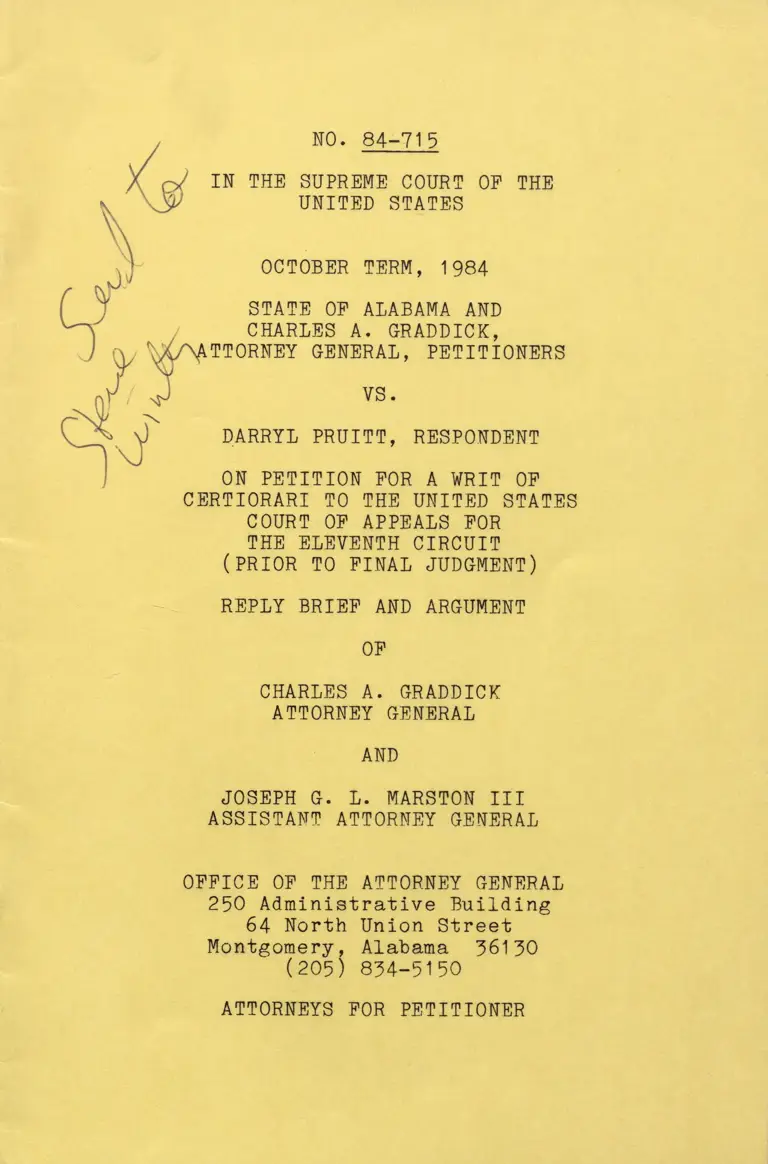
NO. 84-713
IN THE SUPREME COURT OP THE
UNITED STATES
OCTOBER TERM, 1984
STATE OP ALABAMA AND
CHARLES A. CRADDICK,
X / Y ^ torney g e n e r a l, petitioners
VS.
DARRYL PRUITT, RESPONDENT
ON PETITION POR A WRIT OP
CERTIORARI TO THE UNITED STATES
COURT OP APPEALS POR
THE ELEVENTH CIRCUIT
(PRIOR TO PINAL JUDGMENT)
REPLY BRIEP AND ARGUMENT
OP
CHARLES A. GRADDICK
ATTORNEY GENERAL
AND
JOSEPH G. L. MARSTON III
ASSISTANT ATTORNEY GENERAL
OPPICE OP THE ATTORNEY GENERAL
250 Administrative Building
64 North Union Street
Montgomery, Alabama 36150
(205) 834-5150
ATTORNEYS POR PETITIONER
V
;3̂ ;‘‘v- ;;■
P51
•; “ ’''■. •!<>
•ii?irr/y '-' -
■■-'■ -̂ ŷy
--- " V- -.-T̂iTf '•...̂. ■■Kv.:,p
: _- : ■ ; ■
̂=-(--;SKSV'* - ■ ’ -.
......■ '"« *
,T*\ '-'Tv" !
<. f V-. , i
n-
^ ' P s k ' ^T-rf’- ‘ k ^ ■'̂
^ “ -v - < K W ’-t Jirj?
, * - 'ft .‘ 'f ,rV ' r ■
v‘s > ^ 'i * v '- - “ - '- - - ‘>- '<'.1 •'.4^6*5 :■•■•- ' J
, ,̂' t* ^ ^ J , M “v - V„
■ fs?̂
NO. 84-71^
IN THE SUPREME COURT OP THE
UNITED STATES
OCTOBER TERM, 1984
STATE OP ALABAMA AND
CHARLES A. CRADDICK,
ATTORNEY GENERAL, PETITIONERS
VS.
DARRYL PRUITT, RESPONDENT
ON PETITION FOR A WRIT OP
CERTIORARI TO THE UNITED STATES
COURT OP APPEALS FOR
THE ELEVENTH CIRCUIT
(PRIOR TO PINAL JUDGMENT)
REPLY BRIEF AND ARGUMENT
OP
CHARLES A. GRADDICK
ATTORNEY GENERAL
AND
JOSEPH G. L. MARSTON III
ASSISTANT ATTORNEY GENERAL
OFFICE OP THE ATTORNEY GENERAL
250 Administrative Building
64 North Union Street
Montgomery, Alabama 36130
(205) 834-5150
ATTORNEYS FOR PETITIONER
a
. ijr «■: a, m ::
, -î .- ■• - - V . ̂ f .4 ■-..^. ..
q : m . - A m & R i l h . .■■ 'A -
j s ' ^ ' u . < r ' i i v f f i ' ' .... A:
-vm ^: : ; U r ' ' V U ' « - 5 | ;
V ̂ * a f - /A . 'H
V . i : H l A f O f ' t'- - .
T “s r a a r - r - n
■ S 'l' , - ^ ,;? V '^ 4 . ;,,,i.
,a ”'■ " :.' A \-f A'*?, *'- ASf
A • „.;u .•; V •̂ •>-- '- '.v
! i ' r e /•'V ;•'■ V 'A -- f-'- '.- 'i '
. , J ' ■ v A l ,4 .. ,?• j
i r D s t f f c A a A t i - 7 r ? :
r |K ~ c ^ ' 7 ^
■4 A? ? A; '-AA'KA.i' a
■'T-.,, -ir 'r̂ ~r-
' ' ’ A.-- r - | r - . ; :^a ;
t T . ■ ■̂ ' i -
J r ^
tA c-A ^ ^
* - ' . r A ' - i r ' A ^ ' a E- ; A, i ■
. -*• 7
*r ' “i ' ' • ■ ■ ■ =̂ - 5 . . ; , ' 7 T -
-' A 5 , - <1^3 > 13 , j; A •<• v \ ' - . -
A' - |vl
r ^ r r ( « a '-•■ ■ : i ■ - /
• ' T ; -4 . ; - ;: A A- - .
■m
Sft
■̂ 5 V
TABLE OF CONTENTS
PAGE
TABLE OP CASES------------------- ii
TABLE OF STATUTES---------------- ii
RESPONSE TO THE RESPONDENT'S
STATEMENT OP THE PACTS--------- 1
SUMMARY OP THE REPLY ARGUMENT--- 2
REPLY ARGUMENT------------------- 3
I. THE IMPACT OP GARNER ON
THIS CASE------------------- 3
II. IT IS IMPERATIVE THAT THE
CONFUSION CREATED BY THE
DISTRICT COURT BE RESOLVED— 7
CONCLUSION----------------------- 15
CERTIFICATE OP SERVICE----------- 16
TABLE OP CASES
PAGE
Ayler v. Hopper,
P.Supp. 198
(M.D.Ala., 1981)-------
Memphis Police Department v.
Garner,
___ U.S.
L.Ed.2d ,
104 S.Ct. 1589,
52 U.S. L. Wk. 3687
(1984)-----------------
Tennessee v. Garner,
U.S.
L.Ed.M“
104 S.Ct. 1589,
52 U.S.L.Wk. 3687
(1984)-----------------
6,8
2,4
2,4
TABLE OP STATUTES
Code of Alabama, 1975
PAGE
Section 13A-3-27---------- 1,6,7
United States Code
Title 28,
Section 1254-
11
RESPONSE TO RESPONDENT’S
STATEMENT OF THE FACTS
The Respondent's statement of the
facts seems to suggest that it was un
necessary for Officer Kidd to shoot in
order to effect the arrest of the
Respondent, or, to put it another way,
the Respondent suggests that Officer Kidd
acted improperly under Section 13A-3-27,
Code of Alabama, 1975- The Petitioners
point out that, without in anywise
conceding its validity, such a suggestion
contradicts nothing in the Petition. The
Petitioners are not here to defend
Officer Kidd, the City of Montgomery, or
anyone or anything, except the constitu
tionality of Section 13A-3-27, Code of
Alabama, 1975«
SUMMARY OF THE REPLY ARGUMENT
1. The Respondent's argument on the
significance of Tennessee v. Garner (No.
83-1035) and Memphis Police Department v.
Uarner ( No.83-1070) to this case is
contradicted by the position he takes in
the Court of Appeals. See the Petition,
Appendix "E". The Alabama statute has,
through no fault of the People or
officials of Alabama, been in constitu
tional limbo for nearly five years. This
untenable situation will prevail until
this Honorable Court acts authoritative
ly*
2. The Common Law Rule and the
Alabama Statute balance the rights and
protection of society, arrestees, and
officers with a clear and practical rule.
In striking down that Rule, the District
Court established a confusing rule, which
is primarily concerned with protecting
resisting arrestees. It is universally
recognized that the resisted arrest
situation creates a risk to life and
limb; why should officers and society
assume that risk rather than the felon
who creates it? The District Court
established a rule which creates doubt
and confusion in life threatening
situations. This Honorable Court ought
to act now to establish a workable rule
governing the use of deadly force in
arrests.
REPLY ARGUMENT
I.
THE IMPACT OP GARNER ON THIS CASE
This Honorable Court clearly has
jurisdiction to entertain the instant
Petition. 28U.S.C. 1254(1). The issue
here is: Should the Court exercise its
jurisdiction?
As pointed out in the Petition, this
case meets all of the criteria for the
granting of the writ prior to final
judgment in the Court of Appeals. Peti
tion, pages 21-27* However, the most
important consideration in the Petiton-
ers’ opinion and apparently also that of
the Respondent, is the pendency of
Tennessee v. G-arner (No. 83-1035) and
Memphis Police Department v. G-arner (No.
83-1070) in this Honorable Court. The
Respondent argues that Garner is of
little significance in this case. Yet,
the Respondent took the exact opposite
position in his motion to stay in the
Court of Appeals. Appendix "E" to the
Petition. The first sentence of each
paragraph of Respondent’s motion clearly
demonstrates the importance of Garner to
this case.
"1 . The G-arner litigation,
pending in the TJ. S. Supreme
Court, presents an issue which
controls the disposition of
this case---" (Appendix "E",
p. 29; emphasis supplied).
"2. The decision of the
district court challenged in
the instant case rests on the
same legal proposition at issue
in Garner (Appendix "E" ,
p. 30; emphasis supplied).
"3. Because the outcome of
Garner will have a profound
impact on the law that controls
this case, plaintiff submits
that it would be appropriate
for this Court to stay the
instant appeal until a decision
is issued in Garner___"
(Appendix "E", p. 32-33).
Having so argued in the Court of Appeals,
how can the Respondent argue the opposite
way in this Court? It seems that the
Respondent’s primary interest is in
preventing the People of Alabama from
defending their statute anywhere.
The Respondent asked the District
Court to declare the Statute unconstitu
tional. The District Court did so and on
that basis and that basis alone, granted
summary judgment for the Respondent
against Officer Kidd and the City on the
issue of liability. Now, the Respondent
argues:
"...’[P]ew propositions are
better established than that
constitutional adjudication
should be avoided whenever
possible.' Life Insurance Co.
of North America v. Reichardt,
591 P.2d 499, 506 (9th Cir.,
1979)*•••" (Respondent's
Brief, p. 19)-
This is good law, but it is a principle
the Respondent should have embraced in
the District Court. The Alabama statute
should not have been declared unconstitu
tional, but it was at the insistance of
the Respondent. Section 13A-5-27 Code of
Alabama, 1975> has been in constitutional
limbo since Ayler v. Hopper (532 P.Supp.
198 [m.D.Ala., 1981]) (See the Petition,
pp. 4-7), and this has been through no
fault of the People or Officers of the
state of Alabama. At the present time,
Alabama officers have no clear law to
guide them in the use of deadly force in
making arrests, and this untenable
situation will prevail until this
Honorable Court either upholds the
Statute or provides a clear and workable
alternative.
IT IS IMPERATIVE THAT THE
CONFUSION CREATED BY THE DISTRICT
COURT BE RESOLVED
The Respondent argues that a
resolution of the constitutionality of
Section 15A-3-27 is not imperative, since
the District Court allegedly gave Alabama
officers a workable alternative role. It
is interesting to notice that in making
this argument, the Respondent "cleans up"
the District Court’s Rule considerably.
Respondent’s Brief, p.34*
7
The Rule of the District Court in
the instant case would allow the use of
deadly force only "...to prevent
imminent, or at least a substantial
likelihood of death, or great bodily
harm...." Ayler v. Hopper, 532 P.Supp.
198, 201 (M.D.Ala., 1981); Petition,
Appendix "A", pages 6-7« What exactly is
"a substantial likelihood of death or
great bodily harm...."? An unarmed,
youthful, 220 lb., six feet tall
resisting arrestee could no doubt pose
"...a substantial likelihood of death or
great bodily harm..." to a diminutive or
elderly police officer but would pose
little such likelihood to his or her more
burly colleague. Of course, the size,
age and state of health, of a resisting
arrestee is usually impossible to judge
at the time. Would such a rule allow an
officer to use deadly force to stop a
8
mass murderer or an escapee from death
row, who presented no imminent danger to
anyone? Maybe, but probably not.
The Respondent argues that the Rule
established by the District Court does
not call for hindsight review. This
assertion is made in the face of the fact
that the District Court applied its Rule
and granted judgment for the Respondent
on the basis of numerous facts (e.g. the
Respondent’s being unarmed; the fact that
no burglary had occurred), which were
unknown and unknowable to the officer
when he acted.
If the Rule established by the
District Court on June 12, 1984
(Petition, Appendix "A", pp. 1-11) was
difficult to apply, it was made
impossible by the amendment of July 26,
1984. (Petition, Appendix "A", pp.
12-13)* This amendment concludes:
"...Although Kidd testified
that he initially feared an
attack from Pruitt, his deposi
tion testimony repeatedly
indicates that Kidd’s own
subjective concern was for
effecting Pruitt’s arrest, and
not for his own or another's
safety...." (Appendix "A",
page 13f emphasis supplied).
In the District Court's view, Kidd was
unjustified in using deadly force,
because his "heart was in the wrong
place."
The District Court’s Rule is utterly
unworkable. As with all of the rules
advanced in the place of the Common Law
Rule, the justification for the use of
deadly force is to an undefined degree
subjective and is a function of numerous
factors which would normally be
impossible for the officer to judge at
the time. The rules advanced in the
place of the Common Law Rule are designed
to guide courts in after-the-fact review
10
of officers’ actions. They are entirely
impractical in guiding officers at the
time of the action.
The Common Law Rule, on the other
hand, has for centuries provided officers
with clear and easily applied guidance in
resisted arrest situations. The Common
Law Rule looks to objective factors, such
as the legality of the arrest, the nature
of the crime and the necessity of the
force. In order to make a lawful arrest,
an officer must have a warrant or pro
bable cause to believe that the arrestee
has committed some crime. Distinguishing
between felonys and misdemeanors is a
simple matter of familiarity with the
criminal code. Determing the force
necessary to effect an arrest is a simple
matter of gradually escalating the force
until the arrest is complete. Just as
1 1
officers can, under the Common Law Rule,
know quickly and clearly what their
duties and immunities are, so can an
arrestee ascertain the risk he would he
running should he choose to resist.
As stated in the Petition, the
Common Law Rule always comes before the
Courts in worst case senarios. It is,
therefore, not surprising that the
controversary over the Common Law Rule is
grounded primarily on sympathy. The
critics of the rule sympathize with
resisting arresteesj their concern for
society and police officers arises as
almost as an afterthought. For example,
these critics would bar an officer from
using his or her firearm, unless the
resisting arrestee is armed. Yet, in
most of the situations where the problem
arises, a muzzel-flash in the dark may be
the first and perhaps the last, indica-
12
tion an officer has that a resisting
arrestee is armed. The Common Law Rule,
on the other hand, reflects balanced
concern for society, the arrestee and the
officer: Society is assured that if
there is any way that the officer can
effect a lawful felony arrest, he or she
will do so. The arrestee can fully
protect himself from both deadly and
non-deadly force by obeying the law and
submitting to lawful arrest. Finally,
the Common Law Rule minimizes the risk
run by an officer who must pursue an
unknown lawbreaker, who may or may not be
dangerous to the officer and who may or
may not be armed.
The danger inherent in any resisted
arrest situation is universally
recognized. The District Court, in
common with others who condemn the Common
Law Rule, would allow the resisting
13
arrestee the first move toward deadly
force. Given that the resisted arrest
situation creates danger to life and
limb, why should officers and society
assume that risk, rather than the felons
who unlawfully create it?
In this case the District Court
struck down a ancient rule which for
centuries has promoted safety, the law
and justice. In the place of this sound
and practical rule, the District Court
created confusion and doubt in life
threatening situations. This untenable
state of affairs will continue until this
Honorable Court acts. It is imperative
that the Alabama statute be either upheld
or replaced with a practical rule, and
only this Court can do that authorita
tively.
14
CONCLUSION
In conclusion, the Petitioners
point out that this proceeding may as, a
practical matter, he the only opportunity
the People of Alabama have to defend
their Statute. For this reason and those
stated in their Petition, the Petitioners
pray that this Honorable Court grant
their petition.
Respectfully submitted.
ATTORNEY GENERAL
: L. MARSTON III
TANT ATTORNEY GENERAL
ATTORNEYS FOR PETITIONERS
15
CERTIFICATE OF SERVICE
I, Joseph C. L. Marston III, an
Assistant Attorney General of Alabama, a
member of the Bar of the Supreme Court of
the United States and one of the
Attorneys for Charles A. Graddick,
Attorney General and the State of
Alabama, Petitioners, do hereby certify
that on this of December, 1984, I
did serve the requisite number of copies
of the foregoing on the Attorneys for all
of the other parties in the Court of
Appeals, by mailing the same to them
first-class postage prepaid and addressed
as follows:
Honorable Robert C. Black
Attorney at Law
P. 0. Box 1 16
Montgomery, Alabama 36195-2401
Honorable N. Gunter Guy
Attorney at Law
City of Montgomery
P. 0. Box 1111
Montgomery, Alabama 36192
16
Honorable
Honorable
Honorable
Attorneys
P. 0. Box
Ira B.
Dennis
Morris
at Law
2087
Burnin &
Charles Sweet
S. Dees
III
Montgomery, Alabama 36102-2087
ANT ATTORNEY GENERAL
ADDRESS OP COUNSEL:
Office of the Attorney General
250 Administrative Building
64 North Union Street
Montgomery, Alabama 36130
(205) 834-5150
17
a . V * 7 . ^
r.o
rit:
s '• s s-w6» -i-W
Ss7 .,
>"■
^ ^ * YS.'* I
-li* '■V’A' H
6t.
- *>
1
I
■ '-.-H