Board of Supervisors of Louisiana State University & Agricultural & Mechanical College v Ludley Supplemental Brief on Behalf of Appellants
Public Court Documents
December 31, 1957
-
Brief Collection, LDF Court Filings. Board of Supervisors of Louisiana State University & Agricultural & Mechanical College v Ludley Supplemental Brief on Behalf of Appellants, 1957. c94349da-bb9a-ee11-be36-6045bdeb8873. LDF Archives, Thurgood Marshall Institute. https://ldfrecollection.org/archives/archives-search/archives-item/c29d2552-9d31-4882-af6b-5deffaa0f271/board-of-supervisors-of-louisiana-state-university-agricultural-mechanical-college-v-ludley-supplemental-brief-on-behalf-of-appellants. Accessed October 06, 2026.
Copied!
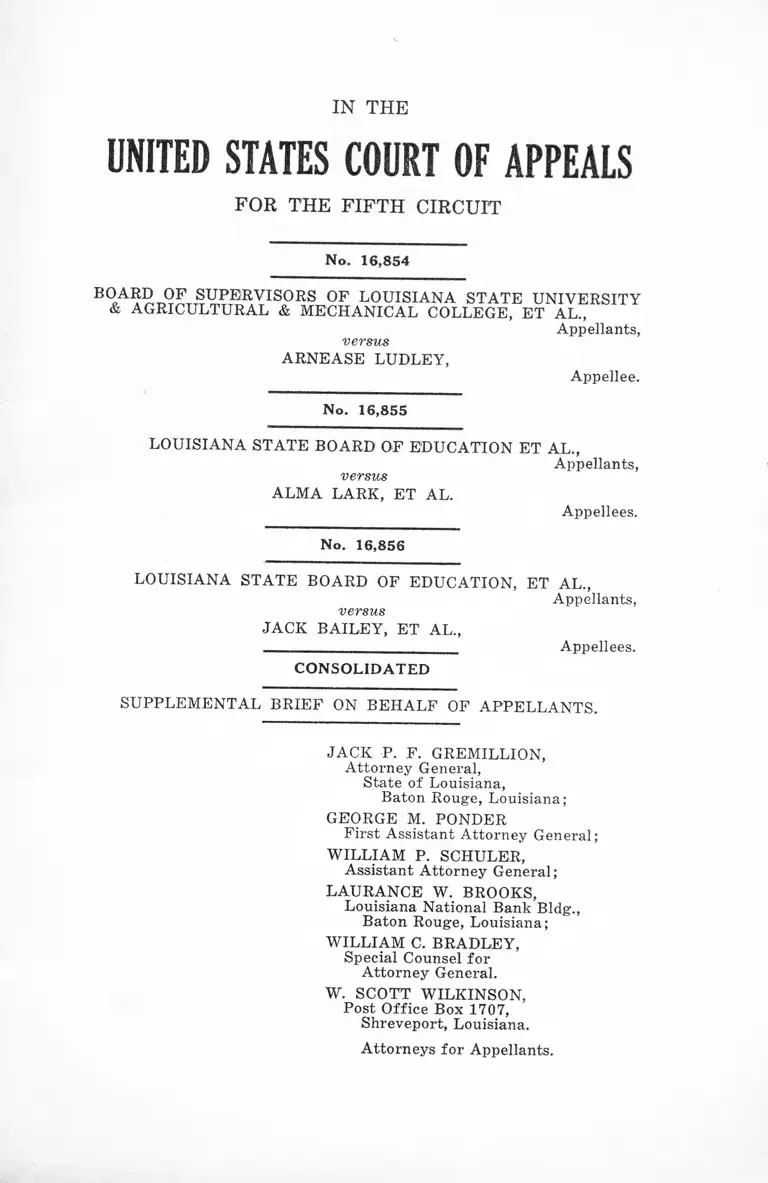
IN THE
UNITED STATES COURT OF APPEALS
FOR THE FIFTH CIRCUIT
No. 16,854
LOUISIANA STATE UNIVERSITY
& AGRICULTURAL & MECHANICAL COLLEGE, ET AL.,
Appellants,
versus
ARNEASE LUDLEY,
Appellee.
No. 16,855
LOUISIANA STATE BOARD OF EDUCATION ET AL.,
Appellants,
versus
ALMA LARK, ET AL.
Appellees.
No. 16,856
LOUISIANA STATE BOARD OF EDUCATION, ET AL.,
Appellants,versus
JACK BAILEY, ET AL.,
_______ ______ __________ Appellees.
CONSOLIDATED
SUPPLEMENTAL BRIEF ON BEHALF OF APPELLANTS.
JACK P. F. GREMILLION,
Attorney General,
State of Louisiana,
Baton Rouge, Louisiana;
GEORGE M. PONDER
First Assistant Attorney General;
WILLIAM P. SCHULER,
Assistant Attorney General ;
LAURANCE W. BROOKS,
Louisiana National Bank Bldg.,
Baton Rouge, Louisiana;
WILLIAM C. BRADLEY,
Special Counsel for
Attorney General.
W. SCOTT WILKINSON,
Post Office Box 1707,
Shreveport, Louisiana.
Attorneys for Appellants.
IN THE
UNITED STATES COURT OF APPEALS
FOR THE FIFTH CIRCUIT
No. 16,854
BOARD OF SUPERVISORS OF LOUISIANA STATE UNIVERSITY
& AGRICULTURAL & MECHANICAL COLLEGE, ET AL.,
Appellants,
versus
ARNEASE LUDLEY,
.________________ _ Appellee.
No. 16,855
LOUISIANA STATE BOARD OF EDUCATION ET AL-,
Appellants,
versus
ALMA LARK, ET AL„
No. 16,856
Appellees.
LOUISIANA STATE BOARD OF EDUCATION, ET AL.,
Appellants,
versus
JACK BAILEY, ET AL.,
Appellees.
CONSOLIDATED
MOTION FOR LEAVE OF COURT TO FILE SUPPLEMENTAL BRIEF
NOW comes JACK P. F. GREMILLION, Attorney Gen
eral of the State of Louisiana, on behalf of the State of
Louisiana, and with respect represents:
1.
That the decision of the Lower Court was erroneous in
that the Court did not properly apply the Federal law, as
well as the law of the State of Louisiana.
a
That the State of Louisiana asks leave of this Honorable
Court to file a supplemental brief in support of its original
brief, for the reason that the issues involved herein are of
grave concern to the State; and that a copy of this brief
has been transmitted to the Clerk of this Court for filing
in the event this motion is allowed;
WHEREFORE, premises considered, appearer prays
that this Honorable Court grant petition leave to file a sup
plemental brief in this proceeding and that an order be duly
entered to this effect.
Further prays for all orders and decrees necessary and
for full, general and equitable relief.
Respectfully submitted,
JACK P. F. GREMILLION
Attorney General
State of Louisiana
Baton Rouge, Louisiana
GEORGE M. PONDER
First Assistant
Attorney General
WILLIAM P. SCHULER
Assistant Attorney General
LAURANCE W. BROOKS
Louisiana National Bank
Building
Baton Rouge, Louisiana
WILLIAM C. BRADLEY
Special Counsel for
Attorney General
W. SCOTT WILKINSON
Post Office Box 1707
Shreveport, Louisiana
Attorneys for Appellants
Ill
C E R T I F I C A T E
I hereby certify that a copy of the foregoing Motion has
been mailed all counsel of record in this case on this the-------
day of____________, 1957.
of Counsel
IN THE
UNITED STATES COURT OF APPEALS
FOR THE FIFTH CIRCUIT
No. 16,854
BOARD OF SUPERVISORS OF LOUISIANA STATE UNIVERSITY
& AGRICULTURAL & MECHANICAL COLLEGE, ET AL„
Appellants,
versus
ARNEASE LUDLEY,
Appellee.
No. 16,855
LOUISIANA STATE BOARD OF EDUCATION ET AL.,
Appellants,
versus
ALMA LARK, ET AL.,
Appellees.
No. 16,856
LOUISIANA STATE BOARD OF EDUCATION, ET AL.,
Appellants,
versus
JACK BAILEY, ET AL.,
Appellees.
CONSOLIDATED
O R D E R
Considering the foregoing petition of Jack P. F. Gremil-
lion, Attorney General of the State of Louisiana, for leave
of Court to file a supplemental brief in this proceeding:
IT IS HEREBY ORDERED that Jack P. F. Gremillion,
Attorney General of the State of Louisiana, be and he is
hereby granted leave of Court to file a supplemental brief
in this proceeding.
THUS DONE AND SIGNED at New Orleans, Louisiana,
on this the____ day of------------------ , 1957.
J U D G E
United States Court of Appeals
Fifth Circuit
SUBJECT INDEX.
ARGUMENT:
That acts 15 and 249 of 1956 are constitutional both
on their face and in application................................ 1
That the Court attempted to use rules of statutory
construction where said rules were not ap
plicable ............................................................ 11
CONCLUSION................. ......................................................... 20
CERTIFICATE OF SERVICE................................................. 22
AUTHORITIES CITED.
Aldredge v. Williams, 44 U. S. 9, 11 L. Ed. 469............. 14,16
Anniston Mgf Co. v. Davis, 301 U. S. 337, 81 L. Ed. 1443. 18
Ark. Nat. Gas Co. v. Ark R.R. Comm., 261 U. S. 379,
67 L. Ed. 705 ...... ..................... ..................................18, 19
Bush v. New Orleans Parish School Board, 242 F. 2d 156.. 11
Campbell v. Aldridge, 79 Pac 2d 257, 159 Or. 208, appeal
dismissed 305 U. S. 559, 83 L. Ed. 352.......................... 7
Carey v. S.D., 250 U. S. 118, 63 L. Ed. 886.......................... 18
Chippwa Indians v. U. S., 301 U. S. 358, 81 L. Ed. 1156.. 18
Cumberland T & T Co. v. La. Pub. Service Comm., 260
U. S. 216, 67 L. Ed. 223,-...--...........-.................. 20
District of Columbia v. Gladding, 263 Fed. 628.................. 11
Duplex Printing Press Co. v. Deering, 254 U. S. 474, 65
L. Ed. 360........... ...........................................................13,15
Ex parte Collett, 337 U. S. 55, 93 L. Ed. 1207............... ...... 14,
Fairport P & ER. Co. v. Meredith, 292 U. S. 589, 78 L. Ed.
1446 ............................................ ....................................... 14,
Foley v. Benedict, 55 S.W. 2d 805, 86 ALR 477.................. 7
AUTHORITIES CITIED— (Continued)
Hopkins Fed S & L Assn v. Cleary 296 U. S. 315, 80 L. Ed.
251 ................................................................................. ...... 18
In re Walling, 324 U. S. 244, 89 L. Ed. 921.............. ........... 14
Kuchner v. Irving Trust Co., 299 U. S. 445, 81 L. Ed. 340 . 14
Lapina v. Williams, 232 U. S. 90, 58 L. Ed. 519........ 15
Manchester v. Leiby, 117 F 2d 661, 665 Cert Den. U. S.
562, 85 L. Ed. 1522........................................... ............... 19
Maxwell v. Dow, 176 U. S. 601-2, 44 L. Ed. 605..... ............ 14
Mayo v. Lakeland Co., 309 U. S. 318-19, 84 L. Ed. 780..... 19
Mo. Pac. Ry Co. v. Boone, 276 U. S. 466, 70 L. Ed. 688..... 18
N.L.R.B. v. Jones & Laughlin, 301 U. S. 1, 81 L. Ed.
893 ____ ________ _____ ______ __________ _______ ______ 18
No. Pac. Ry. Co. v. U. S., 156 F. 2d, 346, affirmed 330
U. S. 248, 91 L. Ed. 876...... ........................................... 11
R.R. Comm. v. C B & Q. R. Co., 257 U. S. 589, 66 L. Ed.
383 _________________ __ ________ ____________ _______ 13
South Utah Mines v. Beaver County, 262 U. S. 331, 67 L.
Ed. 1008............................ .................... .............................. 18
Texas v. E. Tex. R. Co., 258 U. S. 204, 66 L. Ed. 566..... 18
Trustees of the University of Mississippi v. Waugh, 105
Miss. 623, 62 So. 827, ALR 1915D 588__________ __ _ 5
U. S. v. Colo, and N. W. Ry. Co. 157 Fed. 321, 330........... 11
U. S. v. Kung Chen Fur Corp., 188 F 2d 577...................... 14
U. S. v. Rice, 327 U. S. 753, 90 L. Ed. 989............................. 12
Walling v. McKay, 70 Fed. Sup. 160 affirmed 164 F. 2d
40 - ........... ................. .............................. ......................... i i
Waugh v. Mississippi University, 237 U. S. 589, 59 L. Ed.
1131....................................................................................... 5
LOUISIANA STATUTES:
Act 249 of 1956 (La. R.S. 17:443)... ...................................... 3
Act 15 of 1956 (La. R.S. 17:2131-2135).............................. 2
Act 555 of 1954........ ....................................... ........................ . 11
MISCELLANEOUS:
American Jurisprudence, Vol. 55, p. 10............................... . 5
Corpus Juris Secundum;
Vol 14, p. 1359................................................................... 7
Vol 16, pp. 375-382.................. 18
Vol. 16, pp. 383-4. 17
Vol 16, pp. 383-4. 17
Vol 16, pp. 387-8........... 18
Vol 78, pp. 624, 626, 630.................................................. 7, 8
Corpus Juris Secundum;
Vol 78, p. 631........... .................. ......................... ..............8, 9
Vol 82, p. 527..... ................... ............................. ............. . 12
Vol 82, pp. 544-5......... ........................................................ . 16
Vol 82, pp. 813-814............................................................ 10
Vll
IN THE
UNITED STATES COURT OF APPEALS
FOR THE FIFTH CIRCUIT
No. 16,854
BOARD OF SUPERVISORS OF LOUISIANA STATE UNIVERSITY
& AGRICULTURAL & MECHANICAL COLLEGE, ET AL.,
Appellants,
ARNEASE LUDLEY,
Appellee.
No. 16,853
LOUISIANA STATE BOARD OF EDUCATION ET AL.,
Appellants,
versus
ALMA LARK, ET AL.,
Appellees.
No. 16,856
LOUISIANA STATE BOARD OF EDUCATION, ET AL.,
Appellants,
versus
JACK BAILEY, ET AL.,
Appellees.
CONSOLIDATED
May it please the Court:
That Acts 15 and 249 of 1956 are constitutional
both on their face and in application.
In 1956 the Legislature of Louisiana enacted Act No.
15 of 1956 (La. R.S. 17:2131 - 2135) and Act 249 of 1956
(La. R.S. 17:443). These statutes are attacked by the plain
tiffs and appellees as being in violation of the Fourteenth
Amendment of the United States Constitution on the ground
that they deny the plaintiffs and others similarly situated
of rights, privileges and immunities secured by the Consti
tution and laws of the United States. Plaintiffs are negroes
who have sought admission to the Louisiana State University,
and to other institutions of higher learning maintained by
2
the State of Louisiana. They were refused admission because
they failed to present the Certificate of Eligibility required
by Act 15 of 1956 (R.S. 17:2131 - 2185).
Act 15 of 1956 hereafter referred to as Act 15, or as
the Eligibility Statute, provides in Section 1:
“ § 2131. Certificate; requirement; contents
No person shall be registered at or admitted to any
publicly financed institution of higher learning of this
state unless he or she shall have first filed with said
institution a certificate addressed to the particular in
stitution sought to be entered attesting to his or her
eligibility and good moral character. This certificate
must be signed by the superintendent of education of
the parish, county, or municipality wherein said appli
cant graduated from high school, and by the principal
of the high school from which he graduated. Act 1956,
No. 15, § 1.”
The remaining sections of this statute merely provide
for the form of the certificate, notice of the requirements
of the law, penal provisions for its violation, and permits
the State Board of Education and the Board of Supervisors
of Louisiana State University to adopt other entrance re
quirements including aptitude tests and medical examina
tions. The Act makes no mention of race or color, and in
its terms applies to all students who seek admission to all
institutions of higher learning maintained by the State of
Louisiana. There is nothing ambiguous about the statute, its
meaning is quite clear, and there is nothing in the Act which
would discriminate against any qualified students seeking
admission to these institutions.
3
The other Act of the Legislature attacked by the plain
tiffs in these consolidated cases, namely; Act 249 of 1956
(La. R.S. 17:443) relates to the grounds on which a perma
nent teacher in the public schools of the state may be re
moved from office. This Act provides in part:
“ A permanent teacher shall not be removed from
office except upon written and signed charges of wilful
neglect of duty, or incompetency or dishonesty, or of
being a member of or of contributing to any group,
organization, movement or corporation that is by law or
injunction prohibited from operating in the State of
Louisiana, or of advocating or in any manner perform
ing any act toward bringing about integration of the
races within the public school system or any public in
stitution of higher learning of the State of Louisiana,
and then only if found guilty after a hearing by the
school board of the parish or city, as the case may be,
which hearing may be private or public, at the option
of the teacher . . .”
The remaining provisions of this Act provide for the
procedure to be taken including the service of written
charges on the teacher in advance of the hearing and afford
ing him the right to counsel. Provision is made for a right
of appeal in the event of an adverse decision to a court of
competent jurisdiction. The Act also provides that if the
finding of the school board is reversed by the Court, the
teacher shall be entitled to full pay for any loss of time or
salary.
The plaintiffs in these cases do not allege that they are
teachers or that the provisions of this Act have in any way
been applied to them. The validity of the Act has been ques
tioned on the tenuous ground that this Act would prevent
plaintiffs from securing the Certificate of Eligibility pro
4
vided for in Act 15. It may here be noted that Act 249
applies to teachers in the public schools and has no applica
tion whatever to school superintendents or school principals
who are the officers designated in the Eligibility Statute as
the persons who are to furnish such certificates. School
superintendents and school principals are not forbidden to
issue such certificates nor are they required to discriminate
against any person on account of race in the issuance thereof.
No penalty would be incurred by such officials if they were
to issue to a negro a Certificate of Eligibility to attend any
college of his choice in this State. The plaintiffs are there
fore unaffected by any of the provisions contained in the
teachers removal statute. The latter statute is utterly unre
lated to the Eligibility Statute.
It may here be noted that Section 2 of Act 249 of 1956
provides that in case any part of the Act shall be held to be
unconstitutional, this shall not have the effect of invalidat
ing any part of it that is constitutional. If therefore the
Court should invalidate the clause in this Act which permits
the school board to discharge a teacher who advocates inte
gration of the races within the public school system, this
would cut away the only connection that judicial imagina
tion could supply between Act 15 and Act 249. Nevertheless,
as pointed out hereinabove the teacher removal statute applies
only to Superintendents and principals and has nothing to
do with the present case.
In determining the rights of these plaintiffs to demand
admission to any institution of higher learning in Louisiana
they must be considered as ordinary citizens of this State
who possess no greater right than other citizens by virtue
of their color. No Court has yet decided that negroes have
any greater rights to attend the public schools or the colleges
and universities of the State than members of any other
5
race. Their rights are determined by the general principles
of law and of right which apply to all who seek admission
to these schools.
To begin with no one has a natural right to attend any
educational institution maintained by the State, as stated in
55 American Jurisprudence 10:
§ 14. State Universities.— The right to attend the
educational institutions of a state is not a natural one,
but is a benefaction of the law. One seeking to become
a beneficiary of this gift must submit to such conditions
as the law imposes as a condition precedent thereto.
Hence, where a legislature, acting under a constitutional
mandate, establishes a university, it may also legislate
as to what persons are entitled to be admitted to its
privileges and to instruction therein . . .”
The foregoing statement is taken almost verbatum from
the text of the decision of the Supreme Court of Mississippi
in the case of Trustees of the University of Mississippi v.
Waugh, 105 Miss. 623, 62 So. 827, ALR 1915D 588 which
decision was affirmed by the Supreme Court of the United
States in Waugh v. Mississippi University, 237 U. S. 589, 59
L. Ed. 1131. The Supreme Court affirmed the following rul
ing of the Supreme Court:
“ . . . The right to attend the educational institu
tions of the state is not a natural right. It is a gift of
civilization, a benefaction of the law. If a person seeks
to become a beneficiary of this gift, he must submit to
such conditions as the law imposes as a condition pre
cedent to this right . . .
We can see nothing in the act which is violative
of any section of the Constitution. Whether the act was
6
a wise one or an unwise one, was a question for the
legislature to determine . .
The Legislature of Louisiana undoubtedly has the right
to prescribe the conditions under which students may be
admitted to the colleges and universities of the State. In
affirming the decision of the State Court the Supreme Court
of the United States said: (237 U. S. 595-6, 59 L. Ed. 1136-7)
“ The next contention of complainant has various
elements. It assails the statute as an obstruction to his
pursuit of happiness, a deprivation of his property and
property rights, and of the privileges and immunities
guaranteed by the Constitution of the United States.
Counsel have considered these elements separately and
built upon them elaborate and somewhat fervid argu
ments, but, after all, they depend upon one proposition;
whether the right to attend the University of Missis-
is an absolute or conditional right. It may be put more
narrowly,— whether, under the Constitution and laws
Mississippi, the public educational institutions of the
state are so far under the control of the legislature that
it may impose what the supreme court of the state calls
‘disciplinary regulations.’
To this proposition we are confined, and we are not
concerned in its consideration with what the laws of
other states permit or prohibit. Its solution might be
rested upon the decision of the supreme court of the
state. That court said: ‘The legislature is in control of
the colleges and universities of the state, and has a right
to legislate for their welfare, and to enact measures for
their discipline, and to impose the duty upon the trus
tees of each of these institutions to see that the require
ments of the legislature are enforced; and when the
legislature has done this, it is not subject to any control
7
by the courts.’ (105 Miss. 635, L.R.A. 1915D, 588, 62
So. 827.)
This being- the power of the legislature under the
Constitution and laws of the state over its institutions
maintained by public funds, what is urged against its
exercise to which the Constitution of the United States
gives its sanction and supports by its prohibition? . . .”
In the original brief herein filed authority is quoted to
the effect that the Legislature may regulate the conditions
on which students may be admitted to a University main
tained by the State.
14 C.J.S. 1359
Foley v. Benedict, 55 S. W. 2d 805, 86 ALR 477
Waugh v. Miss., supra
Furthermore, the State has the right to control and pre
scribe the limits to which it will go in supplying education
at public expense as stated in 78 C.J.S. 624:
“ The power to establish and maintain systems of
common schools, to raise money for that purpose by
taxation, and to govern, control, and regulate such schools
when established is one of the powers not delegated to
the United States by the federal Constitution, or pro
hibited by it to the states, but is reserved to the states;
respectively or to the people, and the people through the
legislature and the constitution have the right to con
trol and prescribe the limits to which they will go in
supplying education at public expense . . .”
Public education and the control thereof are proper sub
jects for the exercise of the State’s police power.
78 C.J.S. 626
Campbell v. Aldridge, 79 Pac. 2d 257, 159 Or. 208,
appeal dismissed 305 U. S. 559, 83 L. Ed. 352.
8
The following statement in 78 C.J.S. 627 is supported by
numerous citations of authority:
“ The state in legislating concerning education is
exercising its broad sovereign power, and, subject, only
to any requirements or restrictions prescribed by the
constitution, the legislature has a large discretion as to
the manner of accomplishing its purpose . .
In this connection, the following statement in 78 C.J.S.
630 is pertinent:
“ Regulation of education and of the school system
is a governmental function, and generally the police
power extends to such regulation. The management and
administration of the public schools and of the school
system, like their establishment and maintenance, are
primarily affairs of the state, and the legislature has
full authority, subject to constitutional restrictions, to
enact such laws as it may deem necessary and expedient
for the proper administration and regulation of the pub
lic schools and the promotion of their efficiency . . .”
In view of the above the Courts have uniformly held
that the exercise of powers by the school authorities will
be interfered with by the Courts only in the case of a clear
abuse of authority and that the burden of showing such an
abuse is a heavy one. The authorities on this subject are
sumed up in 78 C.J.S. 631, as follows:
“ . . . While the courts have power in a proper pro
ceeding to determine what the powers of school authori
ties are, and whether or not the authorities have ex
ceeded them, the exercise of discretion by school authori
ties will be interfered with only when there is a clear
abuse of discretion or a violation of law, and the burden
9
of showing such an abuse is a heavy one. In other words,
the courts are not concerned with the wisdom of the
policy of school authorities, and they are without power
to interfere with the policies of such authorities as long
as they act in good faith within their statutory powers.”
In their original brief the appellants point out that no
where in the complaint does the plaintiff avow that the acts
of the Legislature attacked in this case have been adminis
tered unfairly or in a discriminatory manner. On the other
hand, the affidavits of various college officials appearing on
pages 32-38 of the transcript in this case show affirmatively
that the Eligibility Certificate law has been uniformly applied
to all applicants for admission to the colleges involved in
this proceeding, and without regard to race or color.
All that the eligibility statute requires is a certificate
that the applicant is qualified for admission to an institu
tion of higher learning which he seeks to enter and that he
is of good moral character. Surely the State cannot be ex
pected to furnish higher education to unqualified students,
and in the exercise of its police power it can certainly deny
admission to applicants who are morally unfit to attend a
college or university. Attendance as a student in our colleges
and universities is a privilege given by the State which must
be zealously guarded. The students in such institutions are
intimately associated with one another in the classrooms,
dormitories and in social contacts. To say that a State may
not require of an applicant a certificate as to his moral
character, regardless of his race, is to assert that in the
realm of education the State has no authority to promote
morality of its young people. This power of the State finds
it most important exercise in all matters that relate to the
morality and well-being of its youth. The Judgment of the
District Court would deny the State of Louisiana this right
solely on the supposition that the eligibility statute might
10
be used as a means of discrimination against negroes in this
State.
The plaintiffs have contended and the lower Court has
apparently ruled that although the Eligibility Statute is not
of itself objectionable on its face it is nevertheless uncon
stitutional because it is a part of a statutory system to
discriminate against negroes. However, as pointed out in the
original brief this Act is complete within itself and depends
upon no implementation from any other acts of the Legis
lature which were in effect at the time it was passed or
which was passed at the same session of the Legislature.
Since this is true, the Act must be considered alone and on
its own merits. There is no ambiguity in its terms and there
is nothing uncertain or obscure about its verbage. There is
therefore no need for interpretation on the part of the Court.
As pointed out on page 21 of appellant’s brief, the Supreme
Court of the United States has in numerous decisions held
that none of the rules of statutory construction may be
used to ascertain the meaning or application of a statute
where there is no ambiguity or doubt as to the meaning of
the words employed by the Legislature. The Court therefore
has no right to refer to other statutes in pari materia, or to
import the provisions of such statutes into an act whose
meaning is not doubtful. The general rule on the subject is
thus stated in 82 C.J.S. 813-814:
“ • • • It must not be overlooked that the rule re
quiring statutes in pari materia to be construed to
gether is only a rule of construction to be applied as an
aid in determining the meaning of a doubtful statute,
and that it cannot be invoked where the language of a
statute is clear and unambiguous. So, the rule of in pari
materia does not permit the use of a previous statute to
control by way of former policy the plain language of
subsequent statutes, or to add a restriction thereto found
11
in the earlier statute and excluded from the later statute;
nor has the rule any application in construing an act
intended to be complete in itself. In other words, the rule
of construction may not be applied to narrow the com
pass of one statute by reference to another nonconflict
ing and nonrepealing act, and restrictions placed on a
power in one instance cannot be extended to another
case for which they were not intended and for which
another provision is made.”
The foregoing text is supported by numerous decisions
of State and Federal Courts including No. Pac. Ry. Co. v. TJ.
S., 156 F. 2d. 346, affirmed 330 U. S. 248, 91 L. Ed. 876, Wall
ing v. McKay, 70 Fed. Sup. 160 affirmed 164 F. 2d 40, District
of Columbia, v. Gladding, 263 Fed. 628, U.S. v. Colo, and
NW Ry. Co., 157 Fed. 321, 330.
As a matter of fact there are no statutes in pari materia
which in any way relate to the subject matter of the statutes
in question. Certainly there are none on the subject of segre
gation. The Federal Courts have written o ff all of Louisiana’s
legislation pertaining to segregation in public schools and
colleges. The provisions of the Constitution of Louisiana re
quiring segregation have been held invalid by this Court
and the Acts of the Legislature, particularly Act 555 of 1954,
which require separate schools for the races have been nulli
fied. (Bush v. New Orleans Parish School Board, 242 F. 2d
156) If these acts are dead letter material they can hardly
be revived as implements of interpretation for a statute such
as the Eligibility Statute which nowhere refers to segregation
or racial differences.
That the Court attempted to use rules of statutory
construction where said rules were not applicable
Although the Eligibility Act clearly and distinctly evi
12
dences a lawful purpose that lies within the police power of
the State, and there is nothing arbitrary, unreasonable, or
discriminatory either in its expressed object or in the means
to be employed to achieve such object, the District Judge
imported into the Act a legislative intent which he discovered
in some press reports regarding the Act. These press reports
reflected ideas gained by some newspaepr reporter who inter
viewed the Chairman of the Joint Legislative Committee
which is not the committee that acted on the bill in the
Legislature. From statements made by this individual mem
ber of the Legislature the Court below found only a nefarious
purpose in the Act and disregarded the moral aspects of the
law. To say that the Legislature had no regard for the health
and morals of its young people and that it acted only to
discriminate against a minority race is to arbitrarily malign
a coordinate branch of the government and to judicially usurp
its legislative functions. The District Judge wrote into the
Act a legislative intent that is nowhere expressed in the
Act. He resorted to unreliable extraneous hearsay to create
doubt and suspicion as to the constitutionality of the law and
refused to attribute to the State of Louisiana any good pur
pose that such a law can and will undoubtedly serve. If the
Federal Courts intend to import doubt and to interpret with
suspicion by Acts of the State Legislature regulating public
schools, and if they propose to strike down all laws on the
subject that carry any possibility of wrongful execution, the
State will be deprived of sovereignty in a field where it, and
method of interpreting a clear and unambiguous statute
is contrary to every principle of Judicial power.
Rules of Construction are useful only in cases of doubt.
They should never be used to create it, but only to remove it.
(82 CJS 527 and cases cited)
In the case of U. S. v. Rice, 327 U. S. 753, 90 L. Ed. 989
the Supreme Court said:
13
. . Statutory language and objective, thus ap
pearing with resonable clarity, are not to be overcome
by resort to a mechanical rule of construction, whose
function is not to create doubts, but to resolve them
when the real issue or statutory purpose is otherwise
obscure. United States v. California, supra (297 U. S. 186,
80 L. Ed. 573, 56 S. Ct. 421.)”
The rule just stated has been applied by the Supreme
Court to prohibit the use of Committee Reports and explana
tory statements made by members of Congress regarding the
purpose of a law which is not therein expressed. So in R.R.
Comm. v. C B & Q.R. Co., 257 U. S. 589, 66 L. Ed. 383 the
court ruled:
“ . . . Committee reports and explanatory state
ments of members in charge, made in presenting a bill
for passage, have been held to be a legitimate aid to the
interpretation of a statute where its language is doubtful
or obscure. Duplex Printing Press Co. v. Deering, 254
U. S. 443, 475, 65 L. Ed. 354, 16 A. L. R. 196, 41 Sup.
Ct. Rep. 172. But when, taking the act as a whole the
effect of the language used is clear to the court, ex
traneous aid like this cannot control the interpretation,
Pennsylvania R. C. v. International Coal Min. Co. 230 U.
S. 184, 57 L. Ed. 1446, 1451, 33 Sup. Ct. Rep. 893, Ann.
Cas 1915A, 315; Caminetti v. United States, 242 U. S.
470, 490, 61 L. Ed. 442, 445, L.R.A. 1917B, 1168. Such
aids are only admissible to solve doubt, and not to
create it. . . .”
The District Judge under the pretense of conturing a
clear and unambiguous Act of the Legislature resorted to
extraneous hearsay statements to nullify a state law that
14
clearly evinces a lawful object. He committed a grievous error
in so doing.
See also:
U. S. v. Rung Chen Fur Corp., 188 F 2d 577,
Aldredge v. Williams, 44 U. S. 9,11 L. Ed. 469
Ex parte Collett, 337 U. S. 55, 93 L. Ed. 1207
In re Walling 324 U. S. 244, 89 L. Ed. 921
Kuchner v. Irving Trust Co., 299 U. S. 445, 81 L. Ed. 1446
Fairport P. & ER. Co. v. Meredith, 292 US 589, 78 L. Ed.
1446
Even when it may be necessary to interpret a doubtful
statute the courts attach little or no importance to the state
ments of individual legislators as to the purpose of the law.
We quote from Maxwell v. Dotu, 176 U. S. 601-2, 44 L. Ed. 605:
“Counsel for plaintiff in error has cited from the
speech of one of the Senators of the United States,
made in the Senate when the proposed Fourteenth
Amendment was under consideration by that body,
wherein he stated that among the privileges and im
munities which the committee having the amendment in
charge sought to protect against invasion or abridgment
by the states were included those set forth in the first
eight amendments to the Constitution; and counsel has
argued that this court should therefore give that con
struction to the amendment which was contended for by
the Senator in his speech.
. . . It is clear that what is said in Congress upon
such an occasion may or may not express the views of
the majority of those who favor the adoption of the
measure which may be before that body, and the ques
tion whether the proposed amendment itself expresses
the meaning which those who spoke in its favor may
15
have assumed that it did, is one to be determined by the
language actually therein used, and not by the speeches
made regarding it.
What individual Senators or Representatives may
have argued in debate, in regard to the meaning to be
given to a proposed constitutional amendment, or bill, or
resolution, does not furnish a firm ground for its proper
construction, nor is it important, as explanatory of the
grounds upon which the members voted in adopting it.
United States v. Trans-Missouri Freight Asso. 166 U. S.
290, 318, 41 L. Ed. 1007, 1019, 17 Sup. Ct. Rep. 540; Dun
lap v. United States, 173 U, S. 65, 75, 43 L. Ed. 616, 19
Sup. Ct. Rep. 319.”
Again in Lapina v. Williams, 232 U. S. 90, 58 L. Ed. 519,
the Court said:
“ Counsel for petitioner cites the debates in Congress
as indicating that the act was not understood to refer
to any others than immigrants. But the unreliability of
such debates as a source from which to discover the
meaning of the language employed in an act of Congress
has been frequently pointed out ( United States v. Traris-
Missouri Freight Asso. 166 U. S. 290, 318, 41 L. Ed. 1007,
1019, 17 Sup. Ct. Rep. 540, and cases cited), and we are
not disposed to go beyond the reports of the committees.
Church of the Holy Trinity v. United States, 143 U. S.
457, 463, 36 L. Ed. 226, 229, 12 Sup. Ct. Rep. 511; Binus
v. United States, 194 U. S. 486, 495, 48 L. Ed. 1087, 1090,
24 Sup. Ct. Rep. 816; Johnson v. Southern P. Co. 196
U. S. 1, 19, 49 L. Ed. 363, 370, 25 Sup. Ct. Rep. 158, 17
Am. Neg. Rep. 412).”
We quote the following from Duplex Printing Press Co.
v. Peering, 254 U. S. 474, 65 L. Ed. 360:
“By repeated decisions of this court it has come to
16
be well established that the debates in Congress expres
sive of the views and motives of individual members are
not a safe guide, and hence may not be resorted to, in
ascertaining the meaning and purpose of the lawmaking
body. Aldredge v. Williams, 3 How. 9, 24, 11 L. Ed. 469,
475; United States v. Union P. R. Co. 91 U. S. 72, 79, 23
L. Ed. 224, 228; United States v. Trans-Missouri Freight
Asso., 166 U. S. 290, 318, 41 L. Ed. 1007, 1019, 17 Sup Ct.
Rep. 540. But reports of committees of House or Senate
stand upon a more solid footing, and may be regarded as
an exposition of the legislative intent in a case where
otherwise the meaning of a statute is obscure. Binns v.
United States, 194 U. S. 486, 495, 48 L. Ed. 1087, 1090, 24
Sup. Ct. Rep. 816. . . .” (Emphasis supplied)
It is not to be presumed that the Legislature intended to
exceed its powers or that it sought to achieve an unlawful
objective. To the contrary every presumption must be in
dulged that it intended to enact a valid statute for a bene
ficial purpose. The courts all agree with the following state
ment made in 82 C.J.S. 544-5:
“ It is presumed that the legislature acted from hon
orable motives, in accordance with reason and common
sense, and with a full knowledge of the constitutional
scope of its powers, and that it did not intend to ex
ceed its powers, or to give its enactments an extra
territorial operation. It is also presumed that it intended
to enact a valid, effective, and permanent statute which
would have a beneficial effect, favoring the public inter
est, and which would achieve the purpose for which the
statute was adopted; and there is a presumption against
a construction which would render a statute ineffective
or inefficient, or which would cause grave public injury
or even inconvenience. . . .”
The words and phrases of the Eligibility Act manifest
17
clearly a lawful purpose. The statements imputed to one of
the Legislators who passed the Act indicate a purpose which
the District Judge concluded to be unlawful. Even if the Act in
and of itself was susceptible to either interpretation the Lower
Court should have adpoted the construction which would
have upheld the validity of the law— as stated in 16 C.J.S.
“ If a statute is susceptible of two constructions, one
of which will render it constitutional and the other of
which will render it unconstitutional in whole or in part,
or raise grave and doubtful constitutional questions, the
court will adopt that construction of the statute which,
without doing violence to the fair meaning of language
employed by the legislature therein, will render it valid,
and give effect to all of its provisions, or which will free
it from doubt as to its constitutionality, even though the
other construction is equally reasonable, or seems the
more obvious, natural, and preferable, interpretation,
The above rule, followed in all jurisdictions, furthermore
adds, quoting 16 C.J.S. 383-4:
“As a consequence of the rule of construction favor
ing validity, the courts will not adopt a strained, doubtful,
restricted, narrow, rigid, strict, or literal interpretation
in order to condemn a statute or resolution as uncon
stitutional, nor may they change or add to, the wording
of the statute, or resort to implication, or innuendo, in
order to destroy it. Also, the courts will not sustain an
attack on a statute if it may be constitutionally upheld
on any reasonable or sound theory, or any reasonable
construction, or any reasonable or rational ground, or any
reasonable, rational, or legal basis, or if any rational
basis of fact can reasonably be conceived to sustain it . . . ”
These rules have been consistently followed by the
18
Supreme Court of the United States. See:
Note 6,16 C. J. S. 376 and cases cited
Chip-pica Indians v. U. S., 301 U. S. 358, 81 L. Ed. 1156
Anniston Mfg Co. v. Davis, 301 U. S. 337, 81 L. Ed. 1443
N.L.R.B. v. Jones & Laughlin, 301 U. S. 1, 81 L. Ed. 893
Hopkins Fed S & L Assn v. Cleary, 296 U. S. 315, 80 L.
Ed. 251
Mo. Pac. Ry Co. v. Boone, 276 U. S. 466, 70 L. Ed. 688
South Utah Co. v. Beaver, 262 U. S. 325, 67 L. Ed. 1004
Ark Nat. Gas Co. v. Ark R. R. Comm, 261 U. S. 379, 67 L.
Ed. 705
Texas v. E. Tex. R. Co., 258 U. S. 204, 66 L. Ed. 566
Carey v. S. D., 250 U. S. 118, 63 L. Ed. 886
There is another rule of law that would preclude the
federal courts from invalidating the Act of the Legislature
of Louisiana. That is the rule that federal courts should not
hold a State law unconstitutional unless such a conclusion
is unavoidable. See 16 C. J. S. 387-8 and cases cited.
In South Utah Mines v. Beaver County, 262 U. S. 331,
67 L, Ed. 1008 plaintiff argued that a State statute would
produce an unjust and discriminatory result, and should
therefore be held unconstitutional as a violation of the 14th
Amendment. The Court rejected this argument, saying:
“ These statutory provisions, so far as we are in
formed, have not received the consideration of the state
courts, and we will not assume, in advance of such consid
eration, that they will be so construed as to produce that
result. See Plymouth Coal Co. v. Pennsylvania, 232 U. S.
531, 58 L. Ed. 713, 720, 34 Sup. Ct. Rep. 359; Missouri
K. & T. R. Co. v. Cade, 233 U. S. 642, 650, 58 L. Ed. 1135,
1138, 34 Sup. Ct. Rep. 678. Clearly, they are sus
ceptible of a construction which will preclude their ap
19
plication to the case now under consideration and as that
construction will resolve all doubt in favor of their con
stitutionality, it is our duty to adopt it. Plymouth Coal Co.
v. Pennsylvania, Supra, p. 546; St. Louis Southwestern
R. Co. v. Arkansas, 235 U. S. 350, 369, 59 L. Ed. 265, 274,
35 Sup. Ct. Rep. 99; Arkansas Natural Gas Co. v. Arkan
sas R. Commission, 261 U. S. 379, ante, 705, 43 Sup. Ct.
Rep. 387, decided March 19, 1923.”
In any event, the federal courts should not invalidate a
state law on the suppostion that it will be given an uncon-
al application by the state courts or by State officials charged
with its enforcement, as stated in Manchester v. Leiby, 117
F 2d 661, 665, Cert. Den. 313 U. S. 562, 85 L. Ed. 1522:
“ If, conceivably, the ordinance might be given an
interpretation of broader sweep and more doubtful con
stitutionality, the notable and altogether proper reluct
ance of federal courts to issue injunctions against state
and city officials, restraining their enforcement of crim
inal laws and ordinances, would lead us to adopt the
most innocent interpretation until the state courts have
ruled otherwise, or at least until the local officials have
proceeded to act on an interpretation which brings the
law or ordinance in conflict with constitutional guaran
tees. . . .”
In this class of cases where an injunction is sought
challenging the constitutionality of state laws the Su
preme Court has insisted that there be a clear and persuasive
showing of unconstitutionality and of irreparable injury. So
in Mayo v. Lakeland Co., 309 U. S. 318-9, 84 L. Ed. 780,
the Court said:
“ The legislation requiring the convening of a court
of three judges in cases such as this was intended to
20
insure that the enforcement of a challenged statute
should not be suspended by injunction except upon a
clear and persuasive showing of unconstitutionality and
irreparable injury. Congress intended that, in this class
of suits, prompt hearing and decision shall be afforded
the parties so that the states shall be put to the least
possible inconvenience in the administration of their
laws. . .”
As Chief Justice Taft stated in Cumberland T & T Co.
v. La. Pub. Service Comm. 260 U. S. 216, 67 L. Ed. 223,
“ conflict between Federal and State authority (is) always
to be deprecated.”
CONCLUSION
From the foregoing discussion and the authorities cited,
the following principles are established:
1. The two Acts of the Legislature challenged by Plain
tiffs in this proceeding are in no way related to one another.
In fact, Act 249 of 1956 relating to the removal of teachers
has no application whatever to this case.
2. If the Court were to find that Act 249 of 1956 is
unconstitutional in its clause relating to integration of the
races in the public school system it would thereby remove
any objection that might be made to Act 15 of 1956, the
Eligibility Act, since this clause furnishes the only con
nection that the District Judge found to exist between the
two statutes.
3. Plaintiffs have no inherent right to attend any col
lege or university maintained by the State, and must sub
21
mit to such conditions as the Legislature may impose as a
condition precedent to their admission to such an institution.
4. The power to establish and maintain colleges and uni
versities is a broad sovereign power reserved by the states
and constitutes and exercise of the police power of the state.
5. The courts have no right to resort to rules of construc
tion in ascertaining the meaning or the application of a
statute where there is no ambiguity or doubt as to the mean
ing o f the words employed by the Legislature. The District
Judge therefore erred in importing into the Eligibility Act
the provisions of other State statutes on the subject of segre
gation, and also erred in determining the purpose of the
statute to be unlawful because of statements made by an
individual of the Legislature as to its purpose.
6. Statements of individual members of the Legislature
as to the meaning or purpose of a law are unreliable as a
source from which to discover their true meaning or pur
pose of such a law, and are entitled to consideration only
where the language of a statute is doubtful or obscure.
7. If a statute is susceptible to two constructions, one
of which will render it constitutional and the other of which
will render it unconstitutional in whole or in part, the court
will adopt that construction which will render it valid, and
will uphold it only on reasonable or legal basis which might
sustain it.
8. The Federal Courts should not hold a State law un
constitutional unless such a conclusion is unavoidable. Since
the Eligibility Act is clear and certain in its terms
and has a lawful object the District Judge erred in nulli
22
fying the statute on the basis of extraneous hearsay state
ments regarding its purpose.
Respectfully submitted,
JACK P. F. GREMILLION,
Attorney General,
State of Louisiana,
Baton Rouge, Louisiana;
GEORGE M. PONDER
First Assistant Attorney General;
WILLIAM P. SCHULER,
Assistant Attorney General;
LAURANCE W. BROOKS,
Louisiana National Bank Bldg.;
Baton Rouge, Louisiana,
WILLIAM C, BRADLEY,
Special Counsel for
Attorney General.
W. SCOTT WILKINSON,
Post Office Box 1707
Shreveport, Louisiana
Attorneys for Appellants.
CERTIFICATE OF SERVICE
I hereby certify that on this day I have served copies
of the forgoing supplemental brief on behalf of appellants on
counsel to appellees by placing the same in the United States
Mail with sufficient postage affixed thereto.
Dated this------ day of December, 1957.
GEORGE M. PONDER
Attorney for Appellant