Philadelphia v. Dortort Brief for Appellee
Public Court Documents
October 5, 1964
-
Brief Collection, LDF Court Filings. Philadelphia v. Dortort Brief for Appellee, 1964. 801b422c-c19a-ee11-be36-6045bdeb8873. LDF Archives, Thurgood Marshall Institute. https://ldfrecollection.org/archives/archives-search/archives-item/c37394b4-f646-42c5-8480-c234299c72a5/philadelphia-v-dortort-brief-for-appellee. Accessed October 08, 2026.
Copied!
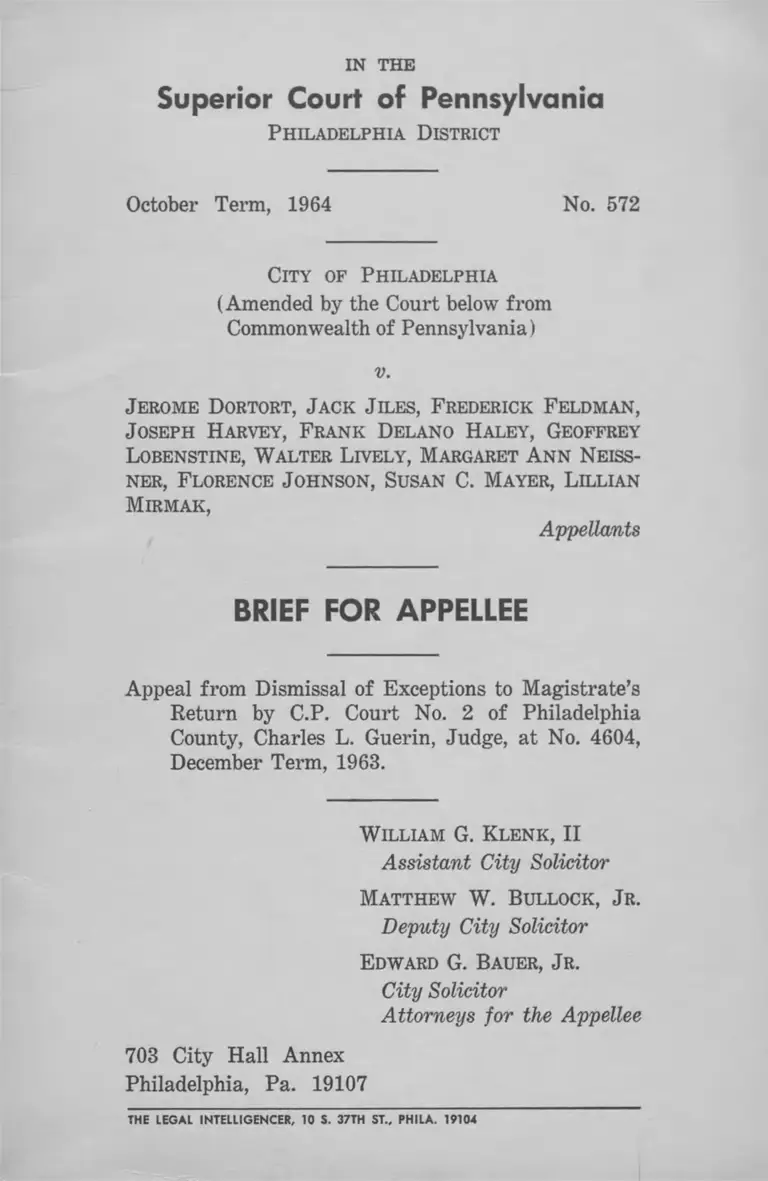
IN THE
Superior Court of Pennsylvania
Philadelphia District
October Term, 1964 No. 572
City of Philadelphia
(Amended by the Court below from
Commonwealth of Pennsylvania)
v.
Jerome Dortort, Jack Jiles, F rederick Feldman ,
Joseph Harvey, F rank Delano H aley , Geoffrey
Lobenstine, W alter L ively, Margaret A n n N eiss-
ner, F lorence Johnson, Susan C. Mayer, L illian
M irm ak ,
Appellants
BRIEF FOR APPELLEE
Appeal from Dismissal of Exceptions to Magistrate’s
Return by C.P. Court No. 2 of Philadelphia
County, Charles L. Guerin, Judge, at No. 4604,
December Term, 1963.
W illiam G. Klen k , II
Assistant City Solicitor
Matthew W. Bullock, Jr.
Deputy City Solicitor
E dward G. Bauer, Jr.
City Solicitor
Attorneys for the Appellee
703 City Hall Annex
Philadelphia, Pa. 19107
THE LEGAL INTELLIGENCER, 10 S. 37TH ST.. PHILA. 19104
INDEX
Page
Counter-Statement of Questions Involved ............ 1
Counter-History of the C a se ..................................... 2
Argum ent....................................................................... 5
I. The Superior Court Is Without Juris
diction to Entertain an Appeal from an
Order of the Court of Common Pleas Sus
taining a Conviction by a Magistrate
for Violation of a Municipal Ordinance . 5
II. Assuming Arguendo That This Court
Has Jurisdiction to Hear This Appeal,
It May Be Heard Only on Narrow Cer
tiorari ........................................................... 10
III. Regardless of How the Action Is Initi
ated, an Action for Violation of a Munici
pal Ordinance Is a Civil Proceeding . . . 12
IV. The Magistrate’s Court Had Jurisdic
tion over the Persons of the Appellants . 13
a. Two separate acts of legislature pro
vide for the institution of process for
the violation of a Municipal Ordin
ance of cities of the First Class . . . 13
b. Appellants were properly before the
Magistrate’s Court for violation Of
Sec. 10-501(2) (h) of The Philadel
phia Code ............................................... 16
1. The action was properly instituted
pursuant to the Act of May 3,1876,
P. L. 99, §1, 53 P.S. §13349 . . . . 16
l
INDEX— Continued
Page
2. The action was properly instituted
pursuant to the Act of March 15,
1858, P. L. 114, §1, 53 P.S.
§17082 ............................................ 18
3. Appellants have waived all rights
to object to alleged defects of serv
ice of process by appearing with
out objection and proceeding to
trial without ob jection ................. 18
V. Enforcement of Section 10-501(2) (h)
of the Philadelphia Code Is Within the
Jurisdiction of the Magistrates’ Courts
When the Penalty Sought and Imposed
Is One Hundred Dollars or L e s s ........ 20
VI. The Magistrate’s Return Is Regular
on Its Face and Fulfills the Require
ments of the Act of March 20, 1810,
P. L. 208, §22, 42 P.S. §497 ................. 24
VII. The Plea of Autrefois Acquit Is Inap
plicable to the Case at Bar ................. 28
Conclusion ......................................................... 32
n
TABLE OF CITATIONS
Cases: Page
Appeal of Glidding, 81* Pa. Superior Ct. 72
(1872) ............................................................... 24
Baldali v. Hartman, 410 Pa. 652 (1963) . . . 10, 24
Battles v. Nesbit, 149 Pa. Superior Ct. 134 (1943) 25
Bedford v. Kelly, 61 Pa. 491 (1869)............... 24, 26
Bell Appeal, 396 Pa. 592 (1959) ....................... 7, 9
Chester v. McGeoghegan, 6 Pa. Superior Ct. 358
(1898) ............................................................... 22
Collins v. Collins, 37 Pa. 387 (1 8 6 0 )................. 21, 22
Colwyn Borough v. Tarbotton, 1 Pa. Superior Ct.
179 (1896) ....................................................... 19
Commonwealth v. Ashenfelder, 413 Pa. 517 (1964)
12, 14, 18, 21, 24, 28
Commonwealth v. Bishop, 182 Pa. Superior Ct.
151 (1956) .......................................... 29, 30, 31
Commonwealth v. Comber, 374 Pa. 570 (1953) 29, 31
Commonwealth v. Evans, 45 Pa. Superior Ct. 174
(1911) ............................................................... 30
Commonwealth v. Greene, 410 Pa. I l l (1963) . . . 28
Commonwealth v. Hanzlik, 191 Pa. Superior Ct.
460 (1960) Certified to Supreme Court 400
Pa. 134 (1960) .................................... 5, 6, 7, 9
Commonwealth v. Hindin, 88 D. & C. 292 (1944) . 16
Commonwealth v. Rubin, 82 Pa. Superior Ct. 315
(1923) ............................................................... 13
in
TABLE OF CITATIONS— Continued
Cases: Page
Edwards v. South Carolina, 372 U. S. 229, 83 S. Ct.
680 (1963) ..................................................... 28
Field Enterprises Ed. v. Golatt, 199 Pa. Superior
Ct. 422 (1962) ............................................ 21, 22
Lynch v. Hickey, 152 Pa. Superior Ct. 129 (1943)
24, 25
McGinnis v. Vernon, 67 Pa. 149 (1870) ............... 24
Mineo v. Eureka Security and Fire Marine Ins.
Co., 182 Pa. Superior Ct. 75 (1956) ....... 31
Pleasant Hills Boro Council v. Carroll, 182 Pa.
Superior Ct. 102 (1 9 5 6 )................................ 13
Reid v. Wood, 102 Pa. 312 (1883) ....................... 13
Shoup v. Mannino, 188 Pa. Superior Ct. 457
(1959) ............................................................... 31
Sweitzer v. Emert, 55 Pa. Superior Ct. 176 (1913)
18, 19
United States v. Glidden Co., 78 F. 2d 639 (6th
Cir. 1935) ......................................................... 31
United States v. Kessler, 213 F. 2d 53 (3rd Cir.
1954) ................................................................. 13
York v. Baynes, 188 Pa. Superior Ct. 581 (1959)
12, 14
Weidenhamer v. Bertie, 103 Pa. 448 (1883) . . 18, 19
Constitutions:
Constitution of Pennsylvania, Article V, § 1 2 ___ 21
IV
TABLE OF CITATIONS— Continued
Statutes: Page
Act of March 20, 1810, P. L. 208, §22, 42 P.S.
§957 .................................................. 5, 10, 24, 26
Act of March 15, 1858, P. L. 114, §1, 53 P.S.
§17082 .................................................. 15, 18, 23
Act of May 3, 1876, P. L. 99, §1, 53 P.S. §13349..
15, 16, 17, 23
Act. of June 24, 1895, P. L. 212, §7 (c ) , 17 P.S.
§184 ................................................................... 8
Act of June 24, 1939, P. L. 872, §406, 18 P.S.
§4406 ............................................................. 13, 28
Act of April 21, 1949, P.L. 665, Art. II, §17, 53
P.S. §13131 ....................................................... 20
Act of September 18, 1961, P. L. 1464, 19 P.S.
§12.1 ............................................................... 13-14
Act of August 14, 1963, P. L. 401, §1 (c ) , 17
P.S. § 1 8 4 ........................................................... 8
Charters:
Philadelphia Home Rule Charter, §1 -100 ........... 20
Ordinances:
Philadelphia Code of General Ordinances—
§10-501(2) (h) ................................ 2 et seq.
§10-502(1) ................................................ 4
Miscellaneous:
Black’s Law Dictionary, 4th Ed., 1951, p. 236 . . 29
v
Counter-Statement of Questions Involved 1
COUNTER-STATEMENT OF QUESTIONS
INVOLVED
1. Does the Superior Court have jurisdiction to
entertain an appeal from a decision of a court of com
mon pleas discharging a petition of certiorari to a
magistrate’s court?
(Not decided by the Court below.)
2. Assuming arguendo that the Superior Court
has jurisdiction over such an appeal is the scope of
review limited to narrow certiorari?
(Not decided by the Court below.)
3. Does a magistrate of Philadelphia County have
jurisdiction to hear an action for the violation of a
municipal ordinance which provides for a penalty in
excess of one hundred dollars, where the City specifi
cally limits its claim for penalty to one hundred dollars
or less?
(Answered in the affirmative by the Court below.)
4. Does the defense of autrefois acquit bar an
action for violation of a municipal ordinance where
the elements of the prior criminal prosecutions are
different from the elements necessary to make out a
violation of the municipal ordinance?
(Answered in the negative by the Court below.)
COUNTER-HISTORY OF THE CASE
On September 20, 1963, the appellants herein were
arrested in Room 210, City Hall, Philadelphia, by police
officers of the City of Philadelphia. They were forth
with taken to the Sixth District Police Station and
charged with disorderly conduct and breach of the
peace.
The appellants came before Magistrate William
Hagan on September 21, 1963, at which time testi
mony was taken. The Magistrate continued the hear
ing until September 30, 1963, so that other witnesses
might be produced. The appellants were summarily
convicted of disorderly conduct from which an appeal
was taken on October 4, 1963. There was no disposition
of the charge of breach of the peace. On January 24,
1964, Judge Charles L. Guerin of Common Pleas Court
No. 2 of Philadelphia County, sitting in Quarter Ses
sions Court found all the defendants not guilty of dis
orderly conduct.
On January 31, 1964, pursuant to a complaint
filed by Deputy Police Commissioner Prank Rizzo
charging breach of the peace and violation of Section
10-501 (2) (h) of The Philadelphia Code of Ordinances,
summonses were issued by Magistrate Hagan to each
of the appellants and served thereon. Section 10-501-
(2) (h) provides as follows:
“ (2) No person shall:
* * * * *
(h) use any City facility or enter into any
City property without authority.”
Pursuant to said summonses, appellants appeared
before Magistrate Hagan on February 4, 1964, at 2:00
o’clock P. M. At that time, counsel for appellants ad
vised the Magistrate that a complaint had been filed
2 Counter-History of the Case
Counter-History of the Case 3
in the District Court of the United States for the East
ern District of Pennsylvania at the behest of the said
appellants against the District Attorney of Philadel
phia County, the City Solicitor of Philadelphia, Magis
trate William Hagan, the Commissioner of Police of
Philadelphia and Frank Rizzo, Deputy Commissioner
and complainant herein, seeking to enjoin the said
persons from “ proceeding with” the hearing set for
February 4, 1964. At the same time, counsel for appel
lants herein threatened Magistrate Hagan with the
institution of contempt proceedings against him in the
event that he proceeded with the hearings set for that
date. The said Magistrate thereupon, “ turned over”
the cases to the United States District Court and con
tinued the hearings.
Thereafter, the appellants herein filed a petition
with the United States District Court for removal of
the instant matters pending before Magistrate Hagan
to the said District Court. On motion of the Common
wealth of Pennsylvania, and after hearing, the Peti
tion for Removal was dismissed (February 6, 1964,
Criminal No. 21631), and the matter was remanded to
the State Court for further proceedings (Hon. John
W. Lord, Jr.). An appeal to the Circuit Court of Ap
peals from this order was dismissed (April 10, 1964,
No. 14,772).
Upon remand, the cases were thereupon relisted
by Magistrate Hagan for hearing in Central Police
Court on February 14, 1964, at which time and place
all appellants appeared with counsel who examined
and cross-examined all witnesses testifying in the
cause. None of the appellants testified, nor did they
offer any evidence in their behalf.
After considering all the evidence presented, the
Magistrate adjudged all appellants guilty of violating
4 Counter-History of the Case
the provisions of Section 10-501(2) (h) of the Phila
delphia Code and adjudged them not guilty of the
charge of breach of the peace. On the charge of violat
ing Section 10-501(2) (h), the Magistrate imposed on
each appellant a fine of $50.00 and costs of $2.50, or in
the event of non-payment of fine and costs, imprison
ment for 10 days in County Prison, pursuant to Section
10-502(1) which states:
“ The penalty for violation of any provision of this
Chapter shall be a fine not less than $50. nor more
than $300. together with imprisonment not ex
ceeding 90 days if the fine and costs are not paid
within 10 days.”
Appellants did not appeal from these convictions
to the Court of Quarter Sessions or the Court of Com
mon Pleas. They did, however, file a Petition for Writ
of Certiorari in the Court of Common Pleas and pur
suant to the writ subsequently issued, the Magistrate
filed his return and certified his record. To this return
of the Magistrate, appellants filed Exceptions. The
Exceptions were heard by Hon. Charles L. Guerin of
Common Pleas Court No. 2 of Philadelphia County on
May 22, 1964. In an oral opinion of the same day, the
Court dismissed the Exceptions and the Petition. The
Court further authorized an amendment of the caption
of the case to eliminate the Commonwealth of Pennsyl
vania and substitute the City of Philadelphia as party
plaintiff.
On June 19, 1964, appellants filed a Petition for
Writ of Certiorari from the Supreme Court pursuant
to Rule 68-V2 of that Court. On July 29, 1964, the
Petition for Writ of Certiorari to the Supreme Court
was denied without prejudice to appeal to the Superior
Court. Appellants then filed an appeal to this Court on
August 3, 1964.
ARGUMENT
Argument 5
I. T he Superior Court Is without Jurisdiction to
Entertain an A ppeal from an Order of the
Court of Common Pleas Sustaining a Convic
tion by a Magistrate for V iolation of a
Municipal Ordinance.
In Commonwealth v. Hanzlik, 191 Pa. Superior
Ct. 460 (1960) the Court reviewed its power to hear
“appeals from orders of either the court of quarter
sessions or the court of common pleas in reviewing
judgments of courts not of record” and concluded that
it had no such jurisdiction whatever. This Court spe
cifically referred to actions for penalties for violation
of municipal ordinances as included in the category
of cases which this Court has no power to review.
In reaching its conclusion this Court made refer
ence to the Act of March 20, 1810, P.L. 208, 42 P.S.
§957, which provides as follows:
“ In all cases, either party shall have the privilege
of removing the cause by writ of certiorari from
before any justice, whose duty it shall be to certify
the whole proceeding had before him, by sending
the original precepts, a copy of the judgment and
execution or executions, if any be issued: provided
always, That the proceedings of a justice of the
peace shall not be set aside or reversed on cer
tiorari for want of formality in the same, if it
shall appear on the face thereof that the defend
ant confessed a judgment for any sum within the
jurisdiction of a justice of the peace, or that a
precept issued in the name of the commonwealth
of Pennsylvania, requiring the defendant to ap
pear before the justice on some day certain, or
6 Argument
directing the constable to bring the defendant or
defendants forthwith before him, agreeably to
the provisions and directions contained in this
act, and that the said constable having served the
said precept, judgment was rendered on the day
fixed in the precept, or on some other day to which
the cause was postponed by the justice, with the
knowledge of the parties; and that no execution
issued by a justice shall be set aside for infor
mality, if it shall appear on the face of the same
that it issued in the name of the commonwealth of
Pennsylvania, after the expiration of the proper
period of time, and for the sum for which judg
ment had been rendered, together with interest
thereon and costs, and a day mentioned on which
return is to be made by the constable, and that
the cause of action shall have been cognizable
before a justice of the peace; and that the judg
ment of the court of common pleas shall be final
on all proceedings removed as aforesaid, by the
said court, and no writ of error shall issue
thereon.”
The Hanzlik case involved an appeal from an
order of a court of quarter sessions finding certain
defendants not guilty of violating a township ordi
nance. This Court certified the case to the Supreme
Court because of its own lack of jurisdiction. In so
doing it stated (pp. 462,463) :
“ Section 22 of the Act of March 20, 1810, P.L.
208, 5 Sm. L. 161, 42 PS §957 provides for re
moving the cause by writ of certiorari from before
a justice of the peace to the court of common
pleas. The section also provides ‘that the judgment
of the court of common pleas shall be final on all
Argument 7
proceedings removed as aforesaid, by said court
[of common pleas], and no writ of error shall
issue thereon.’
“ The only way such case may be reviewed, there
fore, is on narrow certiorari emanating from the
Supreme Court. This Court cannot grant appel
late review in such cases. Bell Appeal, supra.
“ This provision relates not only to ordinary civil
proceedings in contract or tort, but also to actions
to recover a penalty for the breach of a municipal
ordinance prohibiting an act not a public offense
or indictable. Mahanoy City Borough v. Wad-
linger, 142 Pa. 308, 21 A. 823 (1891). Colwyn
Borough v. Tarbotton, 1 Pa. Superior Ct. 179
(1896). It applies to alderman, magistrates and
burgesses. See cases under 42 PS §957.
* * * * *
“ The action in this case brought against the de
fendant for violation of an ordinance was a suit
for a penalty and it should have been appealed
to the court of common pleas. York v. Baynes, 188
Pa. Superior Ct. 581, 149 A. 2d 681 (1959). How
ever, this is not important here, for we have no
jurisdiction to entertain appeals from either the
court of common pleas in suits for penalties to
enforce ordinances or the court of quarter sessions
in summary proceedings.”
The decision in Hanzlik is consistent with the well
settled and oft stated rule that this Court may hear
only those matters which it is specifically authorized
to hear. This rule is precisely stated by the Supreme
Court in Bell Appeal, 396 Pa. 592, 608 (1959) as
follows:
8 Argument
“ To summarize: Where a right of appeal from
the action of a lower court is not authorized by
statute, or is expressly denied, or the statute pro
vides that the action of the court below shall be
final, appellate review of the proceeding can be
had only on a writ of certiorari. Authority to issue
such a writ is reposed in the Supreme Court by
the Act of May 22, 1722 which conferred upon it
the powers of the Court of King’s Bench. The Su
perior Court is not clothed with such powers and
is, therefore, without jurisdiction to review the
proceedings of a lower court on certiorari. The
Superior Court’s appellate jurisdiction rests ex
clusively in direct appeal to it when expressly au
thorized by statute.”
Appellants contend that the Act of August 14,
1963, P.L. 401, Sec. 1 (c ), 17 P.S. §184, has enlarged
the jurisdiction of this Court so as to create jurisdic
tion over this matter. The aforecited Act is an amend
ment to the Act of June 24, 1895, P.L. 212, §7 (c), as
amended, which stated:
“ Any action, claim, distribution, or dispute of
any kind in the common pleas, at law or in equity,
whether originating therein or reaching that
court by appeal or certiorari from some other
court or tribunal, if the subject of the controversy
be either money, chattels, real or personal, or the
possession of or title to real property, and if also
the amount or value thereof really in controversy
be not greater than five thousand dollars, exclu
sive of costs, and if also the action be not brought,
authorized or defended by the Attorney General
in his official capacity.”
Argument 9
The Act as amended by the above Act now states:
“All actions and proceedings at law in the courts
of common pleas and in the County Courts of
Allegheny County and Philadelphia County and
all similar courts, whether originating therein or
reaching that court by appeal or certiorari from
some other court or tribunal, if the subject of the
controversy be either money, chattels, real or per
sonal, or the possession of or title to real property,
and if also the amount or value thereof in con
troversy be not greater than ten thousand dollars,
exclusive of costs.”
It is obvious that the Act of August 14, 1963 did
not broaden the jurisdiction of this Court as it relates
to this case under the above cited decisions. In fact,
it could be argued that the legislature has “ affirmed”
the judicial interpretations of the various acts con
strued in the Bell Appeal, supra, and Commonwealth
v. Hanzlik, supra.
The present case is clearly one on which, under
the above authorities this Court may not hear. It is
an appeal from the order of the Court of Common
Pleas of Philadelphia County dismissing exceptions
to the judgment of a Philadelphia magistrate who had
found the appellants guilty of violating a Philadelphia
ordinance.
For the reasons stated, it is submitted that this
Court should sustain the appellees within Motion to
Dismiss the appeal herein.
10 Argument
II. A ssuming A rguendo T hat T his Court Has
Jurisdiction to Hear T his A ppeal, It May Be
Heard Only on N arrow Certiorari.
Even if we may assume arguendo that this Court
has jurisdiction to hear the present appeal its scope
of review is limited to narrow certiorari since under
the Act of March 20, 1810, 42 P.S. §957:
“ . . . the judgment of the court of common pleas
shall be final on all proceedings removed as afore
said, by the said court, and no writ of error shall
issue thereon.”
The Supreme Court has repeatedly held that
where a statute specifically provides that the decision
of a lower court is final or that no appeal lies there
from appellate review may only be had on narrow
certiorari. The scope of narrow certiorari is clearly
set forth in Baldali v. Hartman, 410 Pa. 652, 653
(1936) as follows:
“ Where a statute expressly denies the right of
appeal, or provides that the action of the court
below shall be final, then review may be had only
by the Supreme Court by means of narrow certio
rari. Under narrow certiorari our scope of re
view is limted to a determination of whether the
court had jurisdiction; whether the proceedings
were regular; whether the court exceeded its
power and authority; and, whether there was a
violation of constitutional rights. Meell Appeal,
405 Pa. 184, 174 A. 2d 110 (1961); Devito v.
Civil Service Commission, 404 Pa. 354, 172 A.
2d 161 (1961).”
Argument 11
Thus, the magistrate’s verdict must be sustained
if (1) the magistrate had jurisdiction of the parties
and the action, (2) the proceeding was regular on its
face, and (3) no violation of appellants’ constitutional
rights appear on the record. It is submitted that the
record discloses the propriety of the proceedings in
all these respects.
The exceptions of the appellants to the proceed
ings before the Magistrate raise the following issues
(R. 1 0 a ):
(1) The proceeding before the magistrate
was actually a criminal proceeding when it should
have been a civil proceeding (Exceptions 1, 2, 3).
(2) The magistrate lacked jurisdiction be
cause the ordinance in question authorizes penal
ties up to $300 and because the record fails to
show service of a summons on any appellant (Ex
ceptions 4 and 6).
(3) The magistrate’s return was defective
because it failed to furnish certain specific infor
mation about the proceedings before him (Ex
ceptions 7, 8, 9, 10).
(4) The magistrate’s return shows that the
conviction was not supported by the evidence (Ex
ceptions 11, 12).
(5) The magistrate’s return shows that ap
pellants’ plea of autrefois acquit should have been
sustained. (Exception 13).
Exception 5 which states that summonses were
issued for one date and a hearing held on another has
apparently been abandoned by the appellants.
The above issues are specifically discussed in the
following sections of the brief.
12 Argument
III. Regardless of H ow the A ction Is Initiated, an
A ction for V iolation of a Municipal Ordi
nance Is a Civil Proceeding.
There was for a long time confusion and disagree
ment among the lower courts of the Commonwealth as
to whether there can be instituted criminal proceedings
for the violation of ordinances passed by the various
political subdivisions of the Commonwealth. However,
the Supreme Court in a recent decision, Commonwealth
v. Ashenfelder, 413 Pa. 517 (1964), clarified the law
and squarely held that an action for violation of an
ordinance is civil in nature and no appeal lies to the
Court of Quarter Sessions from a judgment entered
against a defendant for the violation of a municipal
ordinance. The Court in its decision quoted from York
v. Baynes, 188 Pa. Superior Ct. 581, 585 (1959) where
in Judge Woodside stated:
“ It is our opinion that an action brought against
a defendant for the violation of a municipal ordi
nance is a suit for the recovery of a penalty due
the municipality, and is a civil proceeding. It is
not a summary proceeding which is a criminal
proceeding, even though it may be started by war
rant. A judgment entered against a defendant for
the violation of a municipal ordinance is for a
penalty even though it may be referred to by the
legislature and the magistrate as a ‘fine’.”
Therefore, as above stated, regardless of the terms
used any “ conviction” for the violation of a municipal
ordinance is civil. Appellants contend, however, in the
face of the Ashenfelder case that they were convicted
in a criminal action. They base this, in part, on the
process used (or alleged lack thereof) in instituting
the within action, an issue hereinafter discussed, and
Argument 13
partly on the fact that the action was brought in the
name of the Commonwealth represented by the Dis
trict Attorney, that “ warrants” were issued and a
“ fine” was imposed, thus necessitating a finding that
a criminal conviction was had.
It has been the holding of this Court and the Su
preme Court of this Commonwealth that, while it is
technically error to bring an action in the name of the
Commonwealth for the violation of a municipal ordi
nance, it does not constitute reversable error. Pleasant
Hills Boro Council v. Carroll, 182 Pa. Superior Ct. 102
(1950); Reid v. Wood, 102 Pa. 312 (1883). Further,
in the case at bar, the Commonwealth was, in fact a
proper party in that there were originally two other
charges preferred against appellants as a result of
the same acts on their part, i.e., disorderly conduct and
breach of the peace. Both such actions must be brought
in the name of the Commonwealth. Disorderly conduct
clearly must be so instituted because it is a violation
of the Act of June 24, 1939, P.L. 872, §406, 18 P.S.
§4406. Breach of the peace, it has been held, is a com
mon law indictable offense. United States v. Kessler,
213 F. 2d 53 (3 Cir. 1954) ; Commonwealth v. Rubin,
82 Pa. Superior Ct. 315 (1923). Further, at the hear
ing February 14, 1964 before Magistrate Hagan at
which evidence as to the violation of the ordinance
was received, the charge of breach of peace was still
open and, in fact, defendants were found not guilty
thereof.
With regard to appellants’ contention that “war
rants” were issued to institute this action thus making
it a criminal proceeding, it should be noted that no
warrants were ever issued in this matter. Process was
originally instituted by sight arrest and later criminal
summonses were issued pursuant to the Act of Sep
14 Argument
tember 18, 1961, P.L. 1464, 19 P.S. §12.1 (which actu
ally prohibits the issuance of warrants as to the crim
inal proceedings herein involved) for breach of the
peace. Included therein was a recital of the charge that
Section 10-501(2) (h) of The Philadelphia Code had
been violated. However, even if warrants had been
issued, both Commonwealth v. Ashenf elder, supra, and
York v. Baynes, supra, specifically hold that institution
of process by warrant does not change the civil nature
of the matter. The same position was taken by the
Courts with regard to the imposition of a “ fine.” As
stated at page 525 of Commonwealth v. Ashenf elder,
supra:
“ Even though this action was instituted by the
issuance of a warrant— which the record before
us does not disclose— and even though the penalty
under the provisions of the ordinance is termed a
‘fine’, this is fundamentally an action instituted
for the violation of a township ordinance and an
appeal from the judgment entered in such action
should have been taken to the court of common
pleas and not the court of quarter sessions.”
The mere fact that the District Attorney who was
properly before the Court as to the breach of peace
charge also conducted that part of the hearing involv
ing the violation of the ordinance would not seem rele
vant in determining whether the action was civil or
criminal.
Argument 15
IV. The Magistrate’s Court Had Jurisdiction Over
the Persons of the A ppellants.
a. Two Separate Acts of Legislature Provide for the
Institution of Process for the Violation of a Muni
cipal Ordinance of Cities of the First Class.
Appellants contend that there is but a single
method of instituting process for the violation of a
municipal ordinance in Philadelphia; this is clearly in
correct.
Unquestionably, as cited by appellants, one method
of bringing such an action set forth in the Act of March
15, 1858, P.L. 114, §1, 53 P.S. §17082, which provides:
“ For all breaches of the ordinances of the City of
Philadelphia where the penalty demanded is fifty
dollars and upwards, actions of debt shall be
brought in the corporate name of the City of
Philadelphia.”
However, the Act of May 3, 1876, P.L. 99, §1, 53
P.S. §13349, provides a second method of instituting
an action for the violation of a Philadelphia ordinance;
it provides:
“ Any police officer or constable, upon view of the
breach of any ordinance of any city of the first
class, is authorized to forthwith arrest the person
or persons so offending without any process, and
to take said person or persons forthwith before
any police magistrate or alderman of said city,
who shall thereupon require bail for the appear
ance of said person at a time to be fixed for the
hearing of said charge, and in default of bail to
commit for a hearing; and at said hearing the
case shall be proceeded with as if the parties were
appearing before said magistrate or alderman
16 Argument
upon a summons duly issued and returned served,
or if both parties desire it the case may be en
tered and determined by the magistrate or aider-
man in like manner, without requiring bail or
further continuance.”
Thus, clearly, appellants contention that an action
for debt or assumpsit is the exclusive method of insti
tuting an action for violation of a municipal ordinance
is clearly in error. Actions brought pursuant to the
above Act of May 3,1876, are civil; as Judge Levinthal
stated in Commonwealth v. Hindin, 88 D. & C. 292
(1944) at page 297:
“ In our opinion, the fact that this statute author
izes arrests on sight, in case of breach of ordi
nances, does not require us to hold that the pro
ceeding are criminal in their nature. The com
mencement of certain civil proceedings by arrest
is common in tort actions begun through writs of
capias ad respondum. All that the legislature has
done by the aforesaid Act of 1876 was to authorize
the actions for the recovery of penalties for breach
of ordinance by arrests without any other process.
This cannot have the effect of converting what
would be otherwise be a civil suit for the collec
tion of a penalty into a criminal prosecution re
sulting in a summary conviction.”
b. Appellants Were Properly Before the Magistrate's
Court for Violation of Section 10-501(2) (h) of
the Philadelphia Code.
1. The Action Was Properly Instituted Pursuant
to the Act of May 3, 1876, P. L. 99, %133^9.
As has been set out in appellee’s Counter-History
of the Case, defendants were initially arrested on sight
Argument 17
and brought before a magistrate and charged with
breach of the peace and disorderly conduct. There
after, a hearing was held by Magistrate Hagan on
September 21, 1963, and continued until September
30, 1963, at which time appellants were found guilty
of disorderly conduct and fined $7.50 plus costs. No
disposition of the charge of breach of the peace was
made. Appellants appealed the conviction to the Court
of Quarter Sessions and on January 24, 1964, Judge
Guerin reversed the convictions as to the disorderly
conduct charge and specifically held that the charges
of breach of the peace remained open and undeter
mined before Magistrate Hagan. For the purpose of
having Magistrate Hagan enter a decision on the open
charges of breach of the peace the District Attorney
caused to be issued what purport to be criminal sum
monses. Contained within these “ criminal summons”
was a recital that the defendants were charged with
having violated Section 10-501(2) (h) of The Phila
delphia Code and were directed to appear before Mag
istrate Hagan for the disposition of both charges.
Under the Act of May 3, 1876, the defendants
could have been properly arrested on sight, brought
before a magistrate and charged with a civil violation
of the ordinance without any further process. In the
instant case the defendants were in fact properly ar
rested for breach of the peace and disorderly conduct
and the allegation of an admittedly civil violation add
ed after the initial hearing but prior to conclusion of
the subsequent hearings regarding the above charges.
Indeed, no objection was raised by defendants’ counsel
to the addition of the violation at the time nor was any
statement entered on record that the initial arrests
were illegal. The process by which the violation of the
ordinance was instituted was, therefore, within the
purview of the aforecited Act of May 3,1876.
18 Argument
2. The Action Was Properly Instituted Pursuant
to the Act of March 15, 1858, P. L. 1H, §1,
53 P. S. 117082.
Judge Guerin, sitting as a Judge of Quarter Ses
sions Court specifically held that the charge of breach
of peace was still open and undecided. Thus, the “ crim
inal summonses” issued by Magistrate Hagan were
unnecessary with regard to that charge and the re
cital thereof in the summonses was surplusage. Fur
thermore, since pursuant to the Ashenfelder decision,
no criminal action was possible as to the ordinance, the
“ criminal summonses” were in fact civil summonses
for violation of the municipal ordinance. As such they
fulfilled the requirement of the Act of March 15, 1858,
before cited, requiring institution of such proceedings
to be in debt (or assumpsit). Here the initial proceed
ing could be regarded as the issuance of a summons.
Under the circumstances, the defendants were prop
erly before magistrate and charged with the violation
of the ordinance.
3. Appellants Have Waived All Rights to Object
to Alleged Defects of Service of Process by
Appearing Without Objection and Proceed
ing to Trial Without Objection.
It has long been the law of this Commonwealth
that where the institution of process before a magis
trate or justice of the peace is in some manner defec
tive the appearance of the defendant and the proceed
ing to trial on the merits without objection constitutes
a waiver of the defect in that such appearance gives
the magistrate jurisdiction over the person. Weiden-
hamer v. Bertie, 103 Pa. 448 (1883); Sweitzer v.
Emert, 55 Pa. Superior Ct. 176 (1913).
Argument 19
The appellants appeared before Magistrate Hagan
on February 14, 1964, and proceeded to trial solely on
the issue of whether there was a violation of Section
10-501(2) (h) of The Philadelphia Code as shown by
the Magistrate’s return. Counsel for the defendants
made this abundantly clear by continuously objecting
to evidence which was offered regarding the charge of
breach of the peace on the grounds that the Common
wealth had rested its case as to that charge. No objec
tion was made by appellants to the hearing on the ordi
nance violation nor to the manner in which the ap
pellants came before the court.
Thus, in the words of the Supreme Court in
Weidenhamer v. Bertie, supra, at page 450:
“ The transcript shows the defendant below ap
peared and went to trial without objection. This
was a waiver of all questions relating to the re
turn of summons and the time of service. It gave
the justice jurisdiction of his person.”
Similarly, the Superior Court in Sweitzer v.
Emert, supra, at page 178 stated:
“ In the present case the record does not show lack
of jurisdiction either of the parties or the subject
matter. It is contended that the constable’s return
does not show legal service. But the defendant ap
peared before the justice and the case was tried
on its merits. This gave the justice jurisdiction
of the person of the defendant beyond any con
troversy; . . .”
See also Borough of Colwyn v. Tarbotton, 1 Pa. Su
perior Ct. 179 (1896), wherein the exceptions pertain
ing to the jurisdiction of the justice were dismissed.
It is submitted that the appellants were validly
before the Court under either of the aforementioned
20 Argument
acts of legislature. However, if the Court should find
a defect in process the appellants, on the record, have
conclusively waived their rights to object by appearing
before the Magistrate and going to trial on the merits
without objection.
V. E nforcement of Section 10-501(2) (h) of the
Philadelphia Code Is W ithin the Jurisdiction
of the Magistrates’ Courts W hen the Pen
alty Sought and Imposed Is One Hundred
Dollars or Less.
Appellants contend that since the municipal ordi
nance herein at issue provides for a minimum fine of
fifty dollars and a maximum fine of three hundred
dollars and in default of payment thereof the imposi
tion of jail sentences that the magistrates’ courts of
Philadelphia have no jurisdiction to hear violations
thereof and that it is particularly unconstitutional
when there is a criminal conviction.
The First Class City Home Rule Act of April 21,
1949, P.L. 665, Article II, Section 17, 53 P.S. §13131,
and the City Charter, Section 1-100 provide that the
City may enact ordinances imposing penalties up to
three hundred dollars and further, the City has, in fact,
enacted numerous ordinances providing for maximum
penalties of three hundred dollars. Literally twenty
thousand suits were brought before the magistrates’
courts this year by the City pursuant to such ordi
nances. If the appellants’ contention were accepted all
of these cases would have to be instituted in the County
Court. The impossible situation which would be created
if this were the case is apparent.
That the civil jurisdiction of the magistrates’
courts in Philadelphia is limited to one hundred dollars
in civil actions is not the issue; appellee concedes that
Argument 21
this is the case. Field Enterprises Ed. v. Golatt, 198
Pa. Superior Ct. 422 (1962) 1 Appellee, however, de
nies that the mere fact that an ordinance provides for
a maximum penalty of three hundred dollars is suffi
cient under the Constitution to oust jurisdiction from
the magistrates’ courts where in fact the maximum
penalty demanded by the City was limited to one
hunder dollars and the court, in fact, imposed a penalty
of fifty dollars. The summons issued by the magistrate
and specifically made part of his return states:
“ . . . you are liable to a fine not exceeding one hundred
dollars ($100).” The magistrate’s transcript states
that . . all defendants . . . were adjudged guilty
of violating the provisions of Section 10-501 (2) (h) of
The Philadelphia Code of City Ordinances and were
sentenced to pay a fine of $50.00 and costs of $2.50 or
imprisonment for 10 days in County Prison.”
Appellants’ position rests on the proposition that
the present action was criminal. As stated before, Com
monwealth v. Ashenfelder, supra, has determined that
actions such as now before the Court are civil proceed
ings. Thus, appellants’ objection resolves itself to the
following question: does a magistrate of Philadelphia
County have constitutional and legislative authority
to hear and determine actions for violation of a muni
cipal ordinance wherein the penalty demanded is one
hundred dollars or less and judgment is entered for
said sum or less but where the municipal ordinance
under which the action was instituted authorizes a
penalty in excess of one hundred dollars?
This precise question has never been decided by
this Court or the Supreme Court of Pennsylvania. Since
the early decision of Collins v. Collins, 37 Pa. 387, 390
1 This jurisdictional limitation is established by Art. V,
Sec. 12 of the Pennsylvania Constitution.
22 Argument
(1860), it has been held that the jurisdiction in a
contract action depends on the following test:
“ ‘The sum demanded’ is the test of jurisdiction.
To get at that, we look at the transcript of the
justice and the narr. on the appeal, and the prac
tice is to receive parol testimony also; and from
all these sources to determine the jurisdiction by
the matter of fact. If it appear that the plaintiff’s
demand really exceeded $100, and that he involved
the justice in litigation beyond his jurisdiction by
remitting the excess, it is of great importance to
declare against the jurisdiction, . . .”
The above case was cited and followed by this
Court in Field Enterprises Ed. v. Golatt, supra. As be
fore stated, the sum demanded by the summons as in
the present case was one hundred dollars or less. Ap
pellants’ position appears to be since the ordinance au
thorizes a maximum penalty of three hundred dollars
that, by analogy to the “ sum demand” test of the Col
lins case that the “ sum demanded” in this litigation
must be three hundred dollars. There would be merit
in such a position if the ordinance demanded a mini
mum fine of three hundred dollars. Here, however, the
minimum demanded is fifty dollars. An action for vio
lation of an ordinance is unlike a contract claim where
the amount of the claim is determinable to the penny.
The penalty sought will vary as to the enormity of the
violation in the eyes of the City which institutes the ac
tion. Thus the situation is analogous to Chester v. Mc-
Geoghegan, 6 Pa. Superior Ct. 358, 360 (1898) where
in this Court stated:
“ The appellants argue, however, that the city be
cause it is a municipality having its powers and
Argument 23
duties defined by statute, cannot legally sue for
less than the principal, with the interest and pen
alty attached. To this we cannot assent. The
proper municipal officers may compromise claims,
or remit them in whole or in part, when delay and
expense may be saved by so doing, being responsi
ble at the proper time and place for any breach of
duty. The appellants are not in court as citizens
defending the rights of the city, but as mere debt
ors refusing to pay a just debt, on the sole ground
that the plaintiff might have sued for more. They
cannot be heard to object in this proceeding, that
the city authorities have done what any private
suitor might lawfully do, to secure a standing in
the alderman’s court.”
Appellee is entitled in the first instance to deter
mine the amount of penalty sought and, in a proper
case, to elect to bring the action before a magistrate or
the County Court. All the City must do is affirmatively
to throw off, before the hearing, that amount of the
penalty which would be in excess of the jurisdiction of
the inferior court. To hold otherwise would be to allow
defendants to avoid liability on the sole ground that
the City could have sought a greater penalty.
That suits for penalty may be brought before a
magistrate is above question. Act of March 15, 1858,
P.L. 114, §1, 53 P.S. §17082; Act of May 3, 1876, P.L.
99, §1, 53 P.S. §13349.
The magistrate had jurisdiction over the appel
lants in accordance with the above cited acts since the
penalty demanded was not in excess of one hundred
dollars as both the summonses and the Magistrate’s
transcript show.
24 Argument
VI. T he Magistrate’s Return Is Regular on Its
Face and Fulfills the Requirements of the
A ct of March 20, 1810, P.L. 208, §22, 42 P.S.
§497.
As stated before, the action before the Court is a
civil proceeding, Commonwealth v. Ashenf elder, supra.
As such it is governed by the Act of March 20, 1810,
P. L. 208, 5 Sm. L. 161, §22, 42 P.S. §957, and is re-
viewable on narrow certiorari. Baldali v. Hartman,
supra. Therefore, as set out in the Baldali case at page
653 such review is limited to :
“ . . . whether the court had jurisdiction; whether
the proceedings were regular; whether the court
exceeded its power and authority; and whether
there was a violation of constitutional rights.”
The questions of jurisdiction and power and au
thority have been dealt with in preceeding sections of
this brief. Thus, the only questions remaining are
whether the proceedings were regular and whether
there was a violation of constitutional rights.
A writ of certiorari brings up for review nothing
but the record. Bedford v. Kelly, 61 Pa. 491 (1869) ;
Appeal of Glidding, 81* Pa. 72 (1872).
Although appellants argue that no evidence of any
kind was adduced at trial to support their “ conviction,”
is is clear that the evidence need not be set out in the
return as is the case of a summary conviction; all that
is necessary is that the return show that the findings of
fact made by the magistrate are based on the evidence
adduced at the trial and this may be inferred by refer
ence to the allegations of the complaint. McGinnis v.
Vernon, 67 Pa. 149 (1870); Bedford v. Kelly, supra;
Lynch v. Hickey, 152 Pa. Superior Ct. 129 (1943).
There is a presumption that the facts found by the
magistrate were based on evidence. Bedford v. Kelly,
Argument 25
supra; Lynch v. Hickey, supra. All that is required is
that the docket show that witnesses were sworn and
testified. Battles v. Nesbit, supra.
In the case before the Bar the transcript states
that:
“ Defendants, Jerome Dortort, Jake Jiles, Frede
rick Feldman, Frank Delano Haley, Geoffrey Lo-
benstine, Walter Lively, Margaret Ann Neissner,
Florence Johnson, Susan Mayer, and Lillian Mir-
mak, as well as one Joseph Harvey, were charged
in a sworn complaint, executed by and sworn to
under the oath of Frank Rizzo, Deputy Commis
sioner of Police of the City of Philadelphia, an at
tested copy of which complaint is hereunto at
tached and made part hereof, with breaches of the
peace and with violating the provisions of Chapter
10-500, Section 10-501(2) (h) of the Philadelphia
Code in that each of the defendants did use a City
facility, namely, the office of the Development Co
ordinator, Room 210, City Hall, Philadelphia,
Pennsylvania, and entered into said City Property,
and remained therein, without authority, and re
fused to leave the same when lawfully requested
so to do, the said offenses being committed on the
20th day of September, 1963 at and in Room 210,
City Hall, Philadelphia, Pennsylvania. “ Pursuant
to said sworn complaint and information, which
was filed with me on January 31,1964, summonses
were duly issued by me, under my hand and seal
and served upon each of said defendants, together
with copies of the complaint, summoning each of
the defendants to appear before me at Room 625
City Hall, Philadelphia, Pennsylvania on Febru
ary 4, 1964. The original summonses and precepts
as to each defendant are hereunto attached and
made part hereof.
26 Argument
“ Also attached hereto and made part hereof, are
copies of the docket entries as to each defendant,
showing, inter alia, the names of the witnesses
who appeared, at the hearing held before me on
February 14, 1964, and who, after being duly
sworn according to law, testified.
“ All of the defendants, with the sole exception of
defendant, Joseph Harvey, appeared and were
represented by counsel and were given an oppor
tunity to examine all witnesses. None of the de
fendants testified nor did they offer any witnesses
in their behalf.
“ After considering all evidence presented, all de
fendants, with exception of defendant Joseph Har
vey, who did not appear, were adjudged guilty of
violating the provisions of Section 10-501(2) (h)
of the Philadelphia Code of City Ordinances and
were sentenced to pay a fine of $50.00 and costs of
$2.50 or imprisonment for 10 days in County
Prison. As to the charge of breach of peace, each
defendant was discharged.”
(R. 4a, 5a, 6a)
The docket entries show that the same four wit
nesses, Richard R. Buford, Deputy Commissioner
Frank Rizzo, Loretta Logan, and Inspector Frank No
lan testified as to each deefndant and both the tran
script and complaint show the acts complained of.
Thus, the return shows that evidence was adduced
from sworn witnesses, that there was service upon the
defendants (or service was unnecessary as hereinbe
fore discussed), and that a judgment was entered.
Such a return fulfills the mandate of the Act of March
20, 1810, P.L. 208, 42 P.S. §957, which provides only
that
Argument 27
. . the proceedings of a justice of the peace
shall not be set aside or reversed on certiorari for
want of formality in the same, if it shall appear
on the face thereof that the defendant confessed
a judgment for any sum within the jurisdiction of
a justice of the peace, or that a precept issued in
the name of the commonwealth of Pennsylvania,
requiring the defendant to appear before the jus
tice on some day certain, or directing the constable
to bring the defendant or defendants forthwith
before him, agreeably to the provisions and direc
tions contained in this act, and that the said con
stable having served the said precept, judgment
was rendered on the day fixed in the precept, or
on some other day to which the cause was post
poned by the justice, with the knowledge of the
parties; . .
Appellants’ objections 7, 9, 10, 11 and 12 go to the
merits of the case and the sufficiency of the evidence.
Clearly, from the above act, certiorari is improper to
raise such questions. Bradford v. Kelly, supra. How
ever, it is clear that the return, including the tran
script and the complaint, shows that the magistrate
found facts based upon evidence of how the offense was
committed (Objection 7) ; that the defendants were
identified at the place of the offense (Objection 9) and
the time of the offense (Objection 10).
Objection 12 goes to the application of the ordin
ance to the appellants, claiming, it would seem, that
once having properly entered onto city property the
refusal to leave on proper request does not constitute a
violation of Sectionl0-501 (2) (h) of The Philadelphia
Code of Municipal Ordinances. While such an asser
tion is not properly before the Court on certiorari, it
28 Argument
is sufficient to note that the Courts of this Common
wealth have long held that proper entry is vitiated
when the permission is terminated by the proper party
and, further, that the United States Supreme Court
has specifically upheld the right of a state (or munici
pality) to reasonably limit periods of time during
which public facilities are open to the public. Edwards
v. South Carolina, 372 U.S. 229, 238, 83 S. Ct. 680, 684
(1963).
VII. T he Plea of A utrefois A cquit Is Inapplicable
to the Case at Bar.
As hereinbefore discussed the violation of a mu
nicipal ordinance gives use to a civil proceeding only.
Commonwealth v. Ashenf elder, supra. Nothing in the
record indicates that the appellants were ever charged
with trespassing; they were charged with breach of
peace and disorderly conduct, criminal offenses. The
elements of these crimes by their very definition do not
include the elements necessary to find a violation of
Section 10-501(2) (h) of The Philadelphia Code.
Disorderly Conduct is defined by the Act of June
24, 1939, P.L. 872, §406,18 P.S. §4406, as:
“ Whoever wilfully makes or causes to be made
any loud, boisterous and unseemly noise or dis
turbance to the annoyance of the peaceable resi
dents near by, or near to any public highway, road,
street, lane, alley, park, square, or common, where
by the public peace is broken or disturbed or the
traveling public annoyed, . . .”
The gravamen of such an offense is noise and disorder.
Commonwealth v. Greene, 410 Pa. I l l (1963). By the
words of statute it need not be physically on public
property. Likewise, breach of the peace envisions “ . . .
Argument 29
a disturbance of the public tranquility and order.”
Black’s Law Dictionary, 4th Ed., 1951, page 236.
Section 10-501(2) (h) prohibits, “ . . . use [of]
any city facility or enter into any city property with
out authority.” No disturbance is required. The act
punishable is the unauthorized use or entrance on city
property. The elements required are clearly different
from those involved in disorderly conduct and breach
of the peace.
Appellants rely on two cases, Commonwealth v.
Comber, 374 Pa. 570 (1953) and Commonwealth v.
Bishop, 182 Pa. Superior Ct. 151 (1956) to sustain
their position. It is submitted that both of these de
cisions enunciate rules which are contrary to appel
lants’ contention.
In Commonwealth v. Comber, supra, one of the
questions before the Court was whether the plea of
autrefois acquit bars a conviction for assault and bat
tery and/or aggravated assault and battery when there
has been a previous acquittal for involuntary man
slaughter. On the facts of that case the Court allowed
such a plea and at page 584 reviewed and cited with
approval earlier cases touching on this issue; the Court
stated:
“ In ‘Commonwealth ex rel. Moszcyzynski v. Ashe,
343 Pa. 102, 21 A. 2d 9 2 0 , . . . we said: “ The true
test of whether one criminal offense has merged
in another is not (as is sometimes stated) whether
the two criminal acts are ‘successive steps in the
same transaction’ but it is whether one crime nec
essarily involves another, as, for example, rape
involves fornication, and robbery involves both as
sault and larceny . . : Com. v. McCusker, 363
Pa. 450, 457, 70 A. 2d 273.”
(Emphasis by the Court)
30 Argument
“ In Commonwealth v. Forney, 88 Pa. Superior Ct.
451, 465, the Court said: ‘ “ The test in the plea of
autre-fois acquit is whether the evidence neces
sary to support the second indictment would have
been sufficient to convict [defendant] on the first
[indictment, of the lesser offense charged in the
second] : Commonwealth v. Hazlett, 16 Pa. Su
perior Ct. 534; Commonwealth v. Brown, 28 Pa.
Superior Ct. 296; Commonwealth v. Allegheny V.
Railway, 14 Pa. Superior Ct. 336” . . . A former
acquittal is only a bar where the defendant could
have been convicted on the first indictment of the
charge preferred in the second: Hilands v. Com
monwealth, 114 Pa. 372.’ Accord: Com. v. Trim
mer, 84 Pa. 65, 70; Com. v. Moon, 151 Pa. Supe
rior Ct. 555, 560, 30 A. 2d 704; Com. v. Bardolph,
123 Pa. Superior Ct., 35,186 A. 421.”
(Emphasis by the Court.)
In Commonwealth v. Bishop, supra, the question
arose as to whether a defendant could be convicted of
operating a motor vehicle while under the influence of
a narcotic or habit forming drug after having been
acquitted of operating a motor vehicle while under the
influence of intoxicating liquor under the same factual
circumstances. In upholding the plea the Court cited
Commonwealth v. Evans, 45 Pa. Superior Ct. 174
(1911) and quoted the following language of that case
at page 157:
“ . . . a conviction of fornication was held to be a
bar to a subsequent prosecution for bastardy
growing out of the same unlawful sexual act. The
court therein emphasized that the act of unlaw
ful intercourse was the essential fact upon which
the offense was based; and that, depending upon
Argument 31
the circumstances, an act of unlawful intercourse
might constitute simple fornication, fornication
and bastardy, seduction, or adultery. It was
pointed out that there might be more than one
count but not more than one prosecution.”
Without question under the facts of this case the
evidence necessary to convict appellants of the criminal
acts charged would not have shown a violation of a
municipal ordinance.
Further, the violation of the ordinance gives rise
to a civil action only and as such can not be subject
to the defense of autrefois acquit in that form of ac
tion, the burden of proof and parties being different.
Cf. Shoup v. Mannino, 188 Pa. Superior Ct. 457
(1959); Mineo v. Eureka Security Fire and Marine
Ins. Co., 182 Pa. Superior Ct. 75 (1956).
Appellants further contend at page 25 of their
brief that several federal cases have held “ that a crimi
nal prosecution bars a later suit for penalty which
arises out of the same act.” This is not an accurate
statement of the test applied by the cases cited. Al
though the decisions do hold that the defense of autre
fois acquit may be available in a suit for a penalty, the
test applied is the same as in the Comber and Bishop
cases above. For example, in United States v. Glidden
Co., 78 F. 2d 639, 642 (1935) contains the following
statement:
“ The answer here alleges that the offense or of
fenses charged in the indictment consisted of a
series of acts extending over and including the
same period of time as charged in the petition in
the case at bar, and that every fact alleged in the
present petition might have been proved under the
indictment.”
32 Argument
In all of the federal cases cited a civil suit for pen
alty was brought by the United States for the same of
fense for which there had been a previous criminal
determination instituted by the federal government.
In the case before the bar not only are the parties and
burden of proof different but the acts complained of are
different. The gravamen of the disorderly conduct and
breach of peace charges is noise and disturbance. The
mere fact that appellants refused in an orderly and
quiet manner to leave city property is insufficient and
would be by itself inadmissable to show breach of peace
or disorderly conduct. So also would be evidence of
loud or boisterous behavior be inadmissable to show
unauthorized entrance onto or use of city property.
It is submitted, therefore, that the defense of
autrefois acquit is inapplicable to the present action.
Conclusion
The defendants have been adjudged to be in viola
tion of Section 10-501(2) (h) of the Philadelphia Code
of General Ordinances after notice and a fair hearing.
The judgment of the Court below should be affirmed.
Respectfully submitted,
W illiam G. Klen k , II
Assistant City Solicitor
Matthew W . Bullock, Jr.
Deputy City Solicitor
Edward G. Bauer
City Solicitor
Attorneys for the Appellee