Luevano v. Campbell Appendix to Background Memorandum Regarding the Settlement of the Pace Case
Public Court Documents
January 1, 1981
-
Brief Collection, LDF Court Filings. Luevano v. Campbell Appendix to Background Memorandum Regarding the Settlement of the Pace Case, 1981. 7bb4d404-bc9a-ee11-be36-6045bdeb8873. LDF Archives, Thurgood Marshall Institute. https://ldfrecollection.org/archives/archives-search/archives-item/c396fc39-93b2-407d-9823-e411fda5837e/luevano-v-campbell-appendix-to-background-memorandum-regarding-the-settlement-of-the-pace-case. Accessed October 06, 2026.
Copied!
V
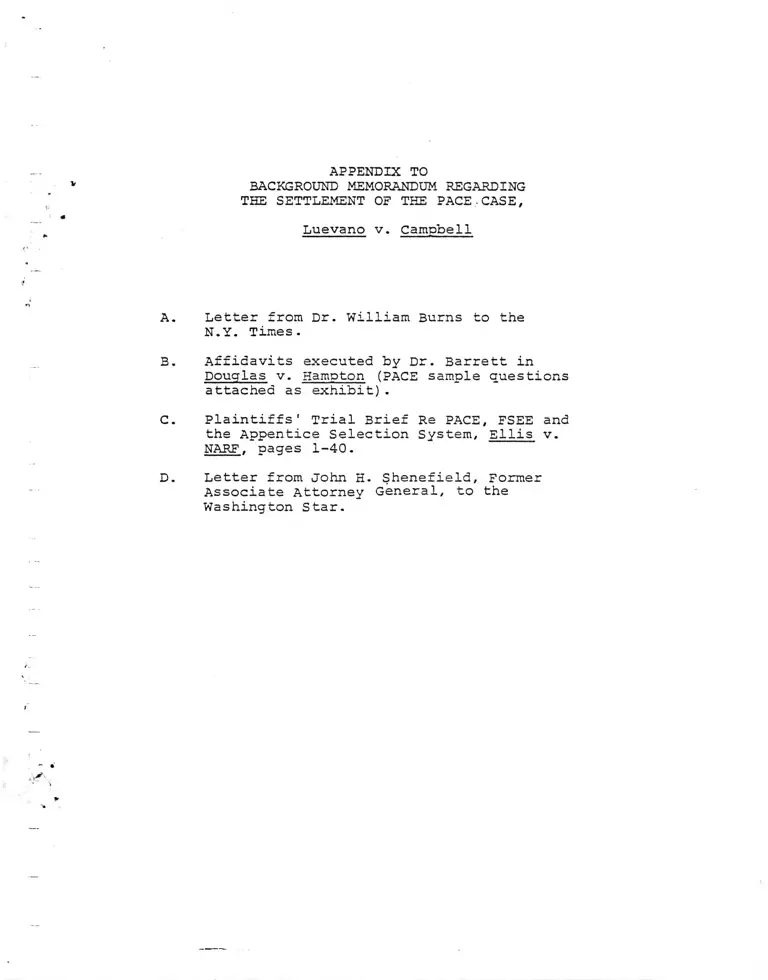
APPENDIX TO
BACKGROUND MEMORANDUM REGARDING
THE SETTLEMENT OF THE PACE-CASE,
Luevano v. Campbell
A. Letter from Dr. William Burns to the
N.Y. Times.
B. Affidavits executed by Dr. Barrett in
Douglas v. Hampton (PACE sample questions
attached as exhibit).
C. Plaintiffs' Trial 3rief Re PACE, FSEE and
the Appentice Selection System, Ellis v.
NARF, pages 1-40.
D. Letter from John H. Shenefield, Former
Associate Attorney General, to the
Washington Star.
A P P E N D I X A
Letter from Dr. William Burns to the N.Y. Times
A P P E N D I X A
-AZ2s
THE NEW YORK TIMES, TUESDAY, FEBRUARY 10, 1981 ,
To the Editor:
eraMTnv* SaJbre's P " * * tor the Fed-
ent’s Professional and
? P ^ f S d Vh ^^ denunciation of the
proposed legal settlement that would
^ Z aU T ? f t CE (COIUmnatg so wide of the marir r -i l
whether he reviewed either the exami*
nation or the settlement exaau-
Far from being "a fair test stress.
nfrit qUeStions msû ng ! . .. ’ . ̂ C E is an affront tO' the
ment principle. Like many other over
broad tests that have b e J e S S S
& w e !lK b 7 d £ nSCiOUS corP°rattons
“ Z l “ ^crimination-conscious
Ĉ ses toe best general
test taxers, not necessarily the best-
workers for specific jobs. 7 ^
A single test can’t be exoected to
“^ e n f ’T l i f d i f -
J from Bond Sales .
Promotion through Digital Computer
Administration to Outdoor
P A C E ^ th SpeClaIjst' The use o(
for Si T w mSlgmflcaat variations,
£ u X P08100135 15 Patently
skduCo,o^rp° rtS t0 test a "umber of
deth^mJ!^ “ numerical ability and
reasoning, yet its different
questions all come “ packaged" ir.
complex verbal p uzz l^ itS^ “
S similarity to the G radate
t0 admit students
programs than to employ-
The Times welcomes letters from '
readers. Letters for publication must
include the writer's name, address
and telephone number. Because of the
to^ge volume of mail received, we re
gret that we are unable to acknowl
edge or to return unpublished letters
Thl the pnvate sector.
The PACE is the kind of test that dis
criminates most severely; if I were to
set out to construct a test that maxi-
mired scoring differences to the detri
ment of minorities, I don’t know how I
could improve on the PACE.
Mr. Safire’s casual treatment of the
proposed settlement is equally inaccu
rate. He neglects to mention that the
basic principle is to apply to the Fed-
Government the same standards
that the Government has for years im
posed on all other employers. His
charge that the settlement requires
quotas is simply name-calling. It
merely establishes a new method for
devising and implementing job-
related hiring standards, in exactly
the way the Supreme Court requires. y
Finally, the charge that Justice De
partment lawyers “surrendered”
denigrates their hard, two-year strug-
r ! .“ I. turn a potentially'disastrous
legal defeat into a viable, administra
tively desirable compromise
Anyone interested in trymg to make
the Federai bureaucracy more effi
cient should welcome the chance to
PAGE replace it w ^ U
S^cific tests that give the Gov«££
ment a wayto find the most qualified
fr°m aU ^ P 5- 1 made the
^ ^ f ! inendation m 1966 as a
Foree on ° ffP ° verT10r Ragan ’s Task'
to sLte cJt?' ^ “ d Cost CoHtrol m State Government. The new Admin- ’
istration should welcome the settle -
ment as a positive step. ' 6‘
If ‘‘PACE did not discriminate t»-
would be merely foolish £ ? £ S . £
continues to defend '
testing practices that most of private--
mdustry has rejected on econom i™ d
productivity grounds. But PACE does -
discriminate, and Mr. Safire’s enthu- -
siasm for it is therefore deeply dis
turbing. WrruAM C. Burns •
ban Francisco, Feb. 3, 19g i ..
The writer is a member of the Ameri '
con Psychological Association’s Advi-
ory Panel on Personnel Selection
Procedures, Division of Industrial-
Organizational Psychology.
A P P E N D I X B
Affidavits executed by Dr. Barrett in Douglas v.
Hampton (PACE sample questions attached as exhibit)'
APPENDIX B
IN THE UNITED STATES DISTRICT COURT
EOR THE DISTRICT OF COLUMBIA
JESSE DOUGLAS, et a l . , )
P la in t if fs , )
)
v* . ) C iv il Action No. 313-71
ROBERT E. HAMPTON, et a l . , )
)
Defendants. )
____________ __________________ _ _J
AFFIDAVIT OF RICHARD S. BARRETT
says:
Rienard S. Barrett, being l i r s t duly sworn, deposes and
1. My name is Rienard S. Barrett. I liv e at Five River-
view Place, Hastings-On-Hudson, New York.
2. I received a B.S. in Administrative Engineering
from Cornell on 19^8, an M.A. (Ed) from Syracuse in 1932, and a
Fh.D in Industrial Psychology from Western Reserve University (now
Case-Western Reserve) .
3. I am the Richard S. Barrett'who file d affidavits in this
case on July 1^, 1971 and November 22, 1971.
Since that time, I have joined Stevens Institute of
Technology, Hobokki, New Jersey, as Professor o f Applied Psycho
logy in the Department of Management Science. I am also tne Direc
tor of tne Laboratory of Psychological Studies and of the Division
of Applied Psychology.
5. In addition to the documents tnat I reviewed for
the earlier a ffidavits, I havt. read An Evaluation o f the Federal
c -2-
Service Entrance Examination. try- Ellison, R.L. ; Fox, D.G.; and
Taylor, C.W.; January 31, 1372, C ivil Service Commission Announce
ment No. 429 ("Professional and Administrative Career Examination”) ,
attacfled hereto as Exhibit A and C ivil Service Commission Supple
ment to Announcement No. 429 ("Professional and Administrative
Career Examination — Sample Questions") , atfacned nereto as
Exnihit 3. X have also re-examined similar documents relating
to the FSEE, namely, C iv il Service Commission Announcement No. 4-10,
attached nereto as Exhibit C, and Supplement to Announcement No. 410,
attacned nereto as Exhibit D.
6. Comparison o f the sample questions is FSEE and PACE
shows that botn tests measure essentially tne same verbal and
quantitative sk ills . Despite the difference in organization, the
tests are similar in format, content, d ifficu lty , and emphasis cn
verbal and numerical material. Tne only major difference is that
tnere are no items in the FSEE sample questions similar to those
of type IV in PACE whicn are spatial analogies. Nevertheless, tne
tests are so similar that I believe that they would be highly
correlated with eacn otner, and would nave an adverse impact on
blacks similar to that found in The Validity and Discriminatory
Impact of tne Federal Service Entrance Examination published by
the Urban Institute in September, 1371.
7. The PACE test has eight question types having to do
with vocaoulary and tne an ility to analyse, understand and inter
pret written material, to understand relations and analogies both
symnolic and spatial, to analyze facts to discover their implica
tions, to analyze charts and tables, to do arithmetic, and to solve
kj
c -3- .
problems witn some facts missing.' Such a verbal., numerical
spatial test, witn a large component o f abstraction is likely to
have an adverse impact on niacks and otner minorities wno nave not,
as a group, had access to equal educational opportunities. There
is a long history of d ifficu lty among blacks on this kind o f test.
See Kirkpatrick, Ewen, Barrett and Katzell, Testing and ?air
Employment.
8. The PACE, like the FSEE, can and should be tne subject
of val idation studies. Botn are basically college level intelligence
tests. Altnough there 1 s l i t t le doubt that intelligence is a valu
able attribute, tne history of the predictive value of intelligence
tests does not argue for tne assumption of va lid ity without evidence.
Robert L. Thorndike in Ten Thousand Careers followed up ten tnousand
veterans o f the Army A ir Corps about twenty years after tney had
taken intelligence tests as part of their induction into the ser
vice. Ke found l i t t le relationship between the test scores and
career success, although he tried several measures. The Air Corps
tests, like intelligence tests in general, were quite successful
in predicting what they were inrended to predict, success in
training, but success in training has only a modest relationship,
at best, with job performance.
9. A fundamental d ifficu lty in the acceptability of
PACE as i t is now ‘used can be illustrated by sampling the t it le s of
the jobs for which i t is required. They include customs inspectors,
revenue o fficers, tax technicians, computer specialists, claims
examiners, educational specialists, writers and economists. It is
c
'c • ,<' ....
unlikely that a single test w ill be successful in identifying the
better performers in so many diverse occupations.
I
10. There is no technical reason vny exaninations such
as the Federal Service Entrance Examination (FSEE) and PACE cannot
be subject to criterion related validity studies. A major problem
leading to the lack of feas ib ility of validation studies is the
lack of subjects. The enormous work force or the federal government
not only makes such validation studies feasible, but also opens the doer
to sophisticated analyses that are often denied private employers
with smaller sta ffs . The larger numbers of potential subjects
lends sta tistica l stab ility to the results, and permits a more
precise definition of the population and an exploration of subtle
influences on the value of tests. For | example, a study may be
limited to subjects who are similar in. age, race and sex to the
applicants; regional difference may bê examined; and the effects of
difference in training or local organization may be studied.
11. A second common source of lack of feas ib ility is tne
difficu lty in developing tne criterion*, that is , a measure of the
quality of the work performance which the' tests are designed to
predict. Since so many of the activities of c iv i l service employees
are strictly controlled by law and regulation, tne opportunity
exists to develop'more meaningful and proadly applicable criterion
measures than is generally possible in private employment. To the
extent that the c iv i l service already jengages in job analysis and
work measurement, these data can be uJed to develop a set of
I
measures which can be used as criteria . Tnere is no a, p riori
reason why satisfactory c riteria cannot be developed.
12. The argument is sometimes raised in C iv il -Service ------
C'
-5-
jurisdictions that, even where validation studies are technically
feasib le, the cost is prohibitive. This argument is totally with
out merit and ignores the very history of industrial testing. The
larger and better run private enterprises originally developed
and validated tests only because their analyses have shown that it
is economically desirable to do 'so. The cost of a w ell conducted
test development and validation study is more than outweighed by
the improved service gained by selecting better people. A profes
sional or administrative employee who spends his entire career in
C iv il Service can easily cost the government $500,000 in salary,
fringe benefits, training, supervision and overhead and is often
in a position to cost many times that in the errors he may make.
Making the basic decision on his employment on an unvalidated
test is a classic example of being penny wise and pound foolish.
13. The task of validating the FSEE or PACE is no d if
ferent from the validation of any other test. The same basic steps
must be followed. The jobs must be analyzed and described witn a
view toward the evaluation of performance. Then the evaluation
instrument and procedures must be developed and administered.
Current employees are tested or the records or those who took the
test as applicants are evaluated and the 'relationships between their
scores on FSEE or PACE are compared with the performance measures.
Because of the large size or some of the samples, i t is possible to
partition them on relevant dimensions such as age, sex, race, length
of service, and location, to improve the quality of the prediction.
Finally, the fact that in PACE e lig ib le candidates are "referred
to Federal agencies for consideration in the order or their ratings
under the ab ility partem appropriate for the positions to be f i l le d
. . ." (Exhibit A, page 4) , does not relieve the Commission of
c
-6-
respons ab ility for validating the test. It merely means tnat eacn
section must be snown to be statistica lly related to the group of
jobs for which i t is used.
l*t. Dr. Albert Maslov's argument (Maslow A ffidavit,
September , 1371, p. 12) that, "Because relatively few persons are
selected out of those examined (for example, approximately 10,000
out o f 150,000 in fis ca l year 1970) and selection, by law, is from
the best qualified, the resultant level o f ab ility is very nigh and
the range of ab ility is very narrow," invites misinterpretation on
two counts. F irst, i t assumes that which remains to be proven,
namely, tnat the nigh test scorers are in fact qualified and that
their level of ab ility is high. His statement would be made more
accurate i f i t were amended to read tnat "the range of ab ility to
'tskg f es~ts is narrow." Second, even when thus amended, the statement
is s t i l l misleading because it implies tnat the 10,000 who are hired
come from the top test scorers. Many people, especially in hard
times, take c iv il service tests as insurance against the possibility
that they w ill not get the job they really want. Many others turn
down offers of employment, both public and private, because they
come at the wrong time, in the wrung place, or for the wrong job.
IS . Restriction of range is a chronic problem in valida
tion studies, but i t has not halted validation studies which are
reported in profusion in the professional literature. Dr. Maslow's <
statement, "Without an effective range of test scores for cnployees
in an occupation, empirical validity is in feasib le ,* would take on
meaning only i f he supplied the mean and standard deviation o f tne
test scores for each occupation. Without this information, there
is no evidence that there is a significant restriction of range on
some jobs, since in a given job, there may be few candidates for
many openings. Appendix B of my A ffidavit of November 22, 1971 pre-
c : t
sents data which show that there is reasonable variab ility of test
scores among incumbents.
15. The only government sponsored valid ity study I nave
been shown in relation to the FSEE is An Examination ox the Federal
Service Entrance Examination, prepared for the Labor Department,
Working with limited data, the authors attempted to show a relation
between the FSEE scares and later progress through the C iv il Service
System. They conclude that thcs e who performed well on tne FSEE
"were not promoted any more rapidly than others who had obtained
somewnat lower scores," and reconmend that "extended use at the
instrument be based upon empirical evidence of valid ity that was
not obtained u i the present study." I f , as I have been informed,
this is the only completed governmental validity study of the FSEE,
and that the only study that has been conducted by tne C iv il Service
Commission is an uncompleted study referred to by Dr. Maslow on
page 437, the Commission has shown a flagrant disregard for tne
most rudimentary professional standards o f test validation.
17. A topic o f considerable debate in the fie ld of
testing psychology is the possibility of difference in the validity
or fairness or tests for minorities and women. Since professional
attention was f ir s t seriously directed to this question only after
the passage of the C iv il Rights Act of 1964, insufficient data have
been accumulated to provide' an answer. Tne federal government, with
its huge work force, is in the best position of any organization in
the country to contribute meaningful data bearing on this issue. It
is essential, therefore, that the C iv il Service co llect data on minor
ity status and incorporate i t into a l1 ox their studies.
18. Construct validation is not acceptable in and of i t s e l f
under the AFA Standards for Educational and Psychological Tests.
Construct validity is of most use in the development and verification
(
/ )
-8-
of psychological theories which may help to build better tests,
but even in the best of situations, the linkage between the theoreti
cal construct, the test which more or less imperfectly measures i t ,
and job performance is so tenuous that verification with a criterion
related test is essential.
SgMPftgY
Based on the foregoing, I conclude that PACE probably has
a disproportionate impact on minority candidates, and that neither
PACE nor the ESEE have heen properly validated in accordance with
professionally acceptable standards. Unlike the C iv il Service
Commission, private industry, the armed forces and educational
institutions have a l l made substantial progress towards proper
test validation and there is no professionally acceptable reason why
the C iv il Service Con-mission cannot do the same. It should be
required immediately to undertake a planned program in which PACE
is validated for the more significant positions. As I have mentioned
above, the development and use of valid tests wiul more than pay
for the increased effo rt, i f the effort is applied wisely.
came before me Richard S. Barrett, to me known, and known to me to be
tne person described in and who executed the foregoing instrument,
and he acknowledged that he executed the same.
Richard S. Barrett
State of New York, County of New York, ss.
On this / day of ft ______ , 197S, personally
Notary Public
.. p.t.r* ̂ r;n:n
.... . ; t. -I r;-..- Vor*: n
[SEAq
^PROFESSIONAL * TO
AND QUALIFY
ADMINISTRATIVE .
CAREER
EXAMINATION
The Federal Government needs
persons with potential for ad
vancement into responsible ad
ministrative and professional
jobs. If you have a college
degree or equivalent experience,
this examination offers you the
opportunity to compete for a wide
variety of jobs in Federal agen
cies across the country. About
85 percent of these positions are
filled outside the Washington,
D.C. area. Most positions are
filled at grade GS-5 and do not
require specialized education or
experience.
*
To be eligible for employment
consideration under this exami
nation you must meet the experi
ence and/or education require
ments outlined below and score
sufficiently high on those parts
of the written test battery which
are most related to the type of
job being filled.
Experience and Education
Requirements
1. For grade GS-5 positions:
A bachelor’s degree; or 3
years of responsible experi
ence; or an equivalent
combination of education
and experience.
2. For grade GS-7 positions—
One of these:
a. A bachelor's degree plus one
year of graduate study; or an
LL.B. or J.D. degree from a
recognized law school; or 4
years of responsible experi
ence; or an equivalent combi
nation of education
and experience.
b. A bachelor’s degree, an
earned rating of 90 or above
in the written test, and
either a 2.9 grade-point
average on a 4.0 scale in all
undergraduate courses, or
rank in the upper third of your
class, or membership in a
national honorary scholastic
society (other than freshman
societies) recognized by the
Association of College Honor
Societies.
Written Test Requirements
All applicants must take a bat
tery of written tests designed to
measure abilities required for the
various kinds of jobs covered
by this examination. The written
test battery requires approxi
mately 4 Vi hours.
3
EXHIBIT A
BASIS OF
RATING
GENERAL
INFORMATION
Ratings will be based upon
your scores on the written tests
and an evaluation of your experi
ence and education. Six basic
ratings will be assigned, one for
each pattern of tested abilities
appropriate for a particular group
of jobs to be filled. You must
achieve a rating of 70 or above
for any one of these six ability
patterns to be considered for
Jobs requiring those abilities.
Extra credit will be given in
each of the basic ratings to appli
cants who present evidence of
outstanding scholarship, as de
fined under “ General informa
tion."
Test results: You will receive
your rating about 4 to 6 weeks
after you take the written test
Equal Employment Opportunity.
You will receive consideration
without regard to race, religion,
color, national origin, sex, politics,
or age.
Responsible Experience. In this
announcement, responsible ex
perience is experience in a pro
fessional, administrative, or other
field which provides evidence of
an ability to learn and perform
at the required level the duties
of positions filled through this
examination. Routine clerical ex
perience or experience in the
trades and crafts is not qualifying.
Equivalent Combination. One
academic year of full time under
graduate study (30 semester
hours credit or 45 quarter hours
credit) is equivalent to 9 months
of responsible experience. A
bachelor’s degree equals
three years of experience.
Outstanding Scholarship. To ob
tain credit under this provision,
applicants must have a 3.50
grade-point average on a 4.0
scale for all undergraduate
courses completed toward a
baccalaureate degree; or must
stand in the upper 10 per
cent of their graduating class of
the college or university attended,
or a major subdivision of the uni
versity, such as the College of
Business Administration, or the
College of Liberal Arts. Class
standing or grade-point average
must be based on all courses
which have been completed at
the time of selection. This pro
vision applies to applicants who
have graduated within the last 2
years, or who are currently
seniors. Candidates claiming
outstanding scholarship will be
required to furnish proof of
their scholastic achievement
at time of selection.
4
Quality Graduates. Applicants
with a 2.S0 or higher grade-point
average on a 4.0 scale, or who
rank in the upper third of
their class, or have membership
in a national honorary scholastic
society (other than freshman
societies) recognized by The
Association of College Honor
Societies will be eligible for
grade GS-7 for those job
patterns in which they receive
test scores of 90 or higher. All
candidates qualifying for Grade
GS-7 on this basis will be
required to furnish proof of
their scholastic achievement
at the time of selection.
Positions at GS-9 and Above.
Applicants with advanced de
grees (master's or higher) or
more experience than is required
to qualify under this examination
may also wish to file under the
Mid-level Positions Announce
ment, which covers most of the
same occupations at grades GS-9
through GS-12. Information is
available at any U.S. Civil Service
Commission Office.
Nonaccrcdited Schools. Success
ful completion of college study
in nonaccredited institutions will
be accepted to the extent that
(1) the courses are accepted for
advanced credit at an accredited
institution: or (2) the institution is
approved by a State education
agency or a State university; or
(3) the school is listed in the
most recent edition of the
Education Directory (Higher
Education), published by the
U.S. Office of Education.
i r
Students. Applications will be
accepted from students who ex
pect to complete, within nine
months, courses which would
permit them to meet the require
ments of this examination.
Consideration tor Employment.
Eligible candidates will be re
ferred to Federal agencies for
consideration in the order of their
ratings under the ability pattern
appropriate for the positions to
be filled, with the highest stand
ing eligibles referred first. For
some positions requiring special
skills, only persons possessing
the necessary qualifications will
be referred.
Salary. Federal salary levels are
comparable to those for equiva
lent jobs in the private sector,
and are reviewed and adjusted
at regular intervals to maintain
comparability. Current salary
rates can be obtained at Federal
Job information Centers.
For additional information
about Federal employment,
see Civil Service Commission
Pamphlet BRE-37 "Working
for the U.S.A."
JOBS FILLED
THROUGH
THIS
EXAMINATION
Most positions filled through
this examination do not require
education or experience in a
specific field. Training for the
specific duties of the position is
provided by the employing
agency. Over 90 percent of the
jobs are in the occupational cate
gories listed below.* All offer
good opportunities for promotion
and preparation for other posi
tions, depending upon the quality
and effectiveness of your per
formance. Where appropriate,
major employers of each occupa
tion are noted.
* Positions described here are
grouped by broad subject matter
category rather than by the
“ability patterns” described above.
A. Regulation/Compliance
The Federal Government has
responsibility for activities
such as taxation, immigration,
importing/exporting, and regu
lation of various industries
and businesses to insure their
adherence to terms of laws
affecting their operations.
Customs Inspectors (Depart
ment oI Treasury) work at
major points of entry to inspect
cargo, baggage, and mail
entering or leaving the United
States. Their activities involve
continual contact with the
traveling public, import/export
firms, and employees of
shipping companies.
Revenue Officers (Department of
Treasury) arrange settlement of
tax obligations owed to the
Government by individual tax
payers and business concerns.
Immigration Inspectors (Depart
ment of Justice) interview per
sons seeking to enter the United
States and examine their docu
ments to determine the terms
under which they are eligible
to enter. This work is performed
primarily at major air terminals
and ports.
Import Specialists (Department
of Treasury) appraise and exam
ine merchandise and analyze
import entry documents to deter-
• mine the applicability of tariff
schedules and restrictions.
Financial Institution Examiners
audit banks and savings and
loan associations to determine
their compliance with regulations
of the Federal Deposit Insurance
Corporation and the Federal
Home Loan Bank Board.
Tax Technicians (Department of
Treasury) examine tax returns for
inaccuracies, determine which
provisions of law are applicable
in each situation, and meet with
taxpayers to acquire information
concerning settlement of the
case. Preferred Qualifications:
College-level education which
has included 6 semester hours
in accounting; or appropriate
experience.
B. Administration/Management
Support
Effective functioning of an
organization’s programs requires
the contribution of people work
ing in a wide range of activities.
Persons in this field provide the
coordination, support, and
advice in specialized areas
that together make an agency's
overall work possible.
Computer Specialists develop
systems and programs utilizing
automated data processing
equipment. Persons hired tor this
occupation receive extensive
training in the field of computer
programming and systems
analysis.
5
(
JOBS FILLED
THROUGH
THIS
EXAMINATION
Personnel Specialists deal with
the manpower needs of their
organization. Among the many
activities in this field are recruit
ing and assigning employees,
planning and administering
training programs, analyzing
manpower needs, and
formulating personnel man
agement polices and programs.
Management Analysts study the
way an organization operates
and seek ways to increase its
effectiveness and efficiency. They
advise management on setting
up and improving patterns of
work assignments, organizational
structure, and management
techniques.
Contract and Procurement Spe
cialists negotiate and regulate
contracts between Government
and the private sector of the
economy for supplies and
services.
Supply Specialists are con
cerned with managing the
materials used by the govern
ment. Their activities include
development of supply require
ments, maintenance of property
accounts, and distribution of
material.
Budget Specialists study the
needs and priorities of their
agency and advise management
on allocation and use of its re
sources.
Administrative Specialists coordi
nate work in two or more of the
specialties listed above. Agencies
ordinarily conduct specialized
training programs to
prepare employees for
administrative work.
C. Claims and Benefits
Examining
The Federal Government oper
ates a number of pension, insur
ance, disability, and other benefit
services. Persons employed in
this field receive and review
claims applications, determine
claimants’ eligibility, and author
ize settlement.
Social Insurance Claims
Examiners work on retirement,
unemployment compensation,
medicare/medicaid, and old-
age insurance claims filed
under programs administered
by the Department of Health,
Education and Welfare.
Civil Service Claims Examiners
perform claims work under the
benefit program for retired
Federal employees.
Veterans Claims Examiners
process claims for education/
training benefits, retirement,
disability, and special benefits
tor veterans.
Passport and Visa Examiners
review applications for passports
and visas from U.S. and foreicn
citizens travelling abroad and'
authorize issuance of travel
documents.
D. Investigations/Law
Enforcement
Federal duties in this field in
volve investigations of persons,
activities, or records in connec
tion with possible violations of
laws or regulations.
Special Agents with the
Department of Justice's Drug
Enforcement Agency conduct
investigations of criminal activity
concerning violations of Federal
drug laws. The investigations
may involve surveillance, partici
pation in raids, interviewing
witnesses, interrogating sus
pects, searching for evidence,
seizures of contraband and
equipment, making arrests and
inspecting records and docu
ments. Strict physical Standards
must be met. Persons selected
may be stationed anywhere in
the United States or locations
overseas, after completing an
intensive training program.
Criminal Investigators gather
Information concerning violation
of Federal statutes to build a
case tor Government prosecution
of suspected criminals.
Positions in this field may
require strict physical
standards and proficiency
with firearms.
General Investigators perform
non-criminal type investigations
such as examination of private
Industry files to insure compli
ance with wage and hour laws,
end background and security
checks of applicants for Federal
employment
6
/
r
'E. Social Services
. The Federal Government
. operates or sponsors programs
which extend various services
and benefits to citizens.
Persons working in this field
are involved in providing these
services to the public or in
studying programs the
Government sponsors.
Social Insurance Representatives
are the primary contact
between the Social Security
5 _ Administration and the people
it serves. They counsel persons
;; concerning the benefits they
are eligible to receive, and
j / personally process particularly
i complicated or urgent claims.
Educational Specialists do re
search and planning for educa
tional, recreational,-and rehabili
tative training programs in
hospitals, agencies, and military
installations. Special require
ments: A bachelor's degree with
a major in education or a subject
field appropriate tor the position.
Contact Representatives (Veter
ans Administration) extend the
VA's service programs to the
public. They counsel veterans on
their entitlement to benefits, help
applicants file their claims, and
give personal attention to urgent
cases.
F. Other Positions
Writers and Editors work primar
ily in public relations functions.
They are responsible for prepar
ing news releases, articles for
periodicals, pamphlets and other
informational materials on
Federal activities.
Economists analyze and evaluate
data and prepare reports which
include recommendations on vari
ous phases of major economic
problems. Work may also include
compiling and interpreting sta
tistical information on economic
conditions or problems. Special
requirements: A bachelor’s
degree with at least 21 semester
hours (32 quarter hours) in
economics and 3 semester hours
(5 quarter hours) in statistics,
accounting, or calculus.
7
i .
c
OCCUPATIONS
NOT COVERED
BY THIS
EXAMINATION
Many occupations at the GS-5
and GS-7 levels are not filled
through this examination. These
occupations are ones for which
specific types of education or
experience are necessary to
qualify. A written test is not
usually required. Applicants in
terested in these positions should
file a separate application ac
cording to the instructions in the
appropriate announcement. For
more information and copies of
announcements about these
positions, contact the nearest
Federal Job Information Center.
Accountant
Aerospace Technologist
Architect
Cartographer
Chemist
Computer Specialist
(experienced or trained)
Engineer
Guidance Counselor
Illustrator/Graphic Arts
Specialist
Librarian
Mathematician
Metallurgist
Nurse
Physicist
Recreation Specialist
Scientist
Statistician
Teacher
GOVERNMENT
AGENCIES
NOT COVERED BY
THIS EXAMINATION
The United States Civil Service
Commission does not accept ap
plications for employment with
the Government'agencies listed
below, each of which has a
separate system for hiring
personnel.
For more information about
employment with these agencies,
write to the addresses indicated:
Atomic Energy Commission
Division of Personnel
Washington, D.C. 20545
Central Intelligence Agency
Office of Personnel
P.O. Box 1925
Washington, D.C. 20013
Federal Bureau of Investigation
Room 4306
Department of Justice
Washington, D.C. 20535
National Security Agency
Fort Meade, Maryland 20755
Department of State
Foreign Service Employment
Division
Washington, D.C. 20520
United States Postal Service
(contact your local Post Office
for information)
I
I
{
Ii
it
v. j
HOW
TO APPLY
See the enclosed supplement
for information on application
procedures and more detailed
information on employment op
portunities. If a supplement is
not enclosed, a copy can be
obtained from the office listed
below which has jurisdiction over
the area in which you wish to
take the written test
8
c
U.S. CIVIL
SERVICE
COMMISSION
AREA OFFICES
\
i
ASIanta Area Office
U.S. Civil Service Commission
Federal Office Building
275 Peachtree Street. N.E.
Atlanta. Georgia 30303
Boston Area Office
U.S. Civil Service Commission
John W. McCormack Post Office and
Courthouse
Boston. Massachusetts 02109
Chicago Area Office
U.S. Civil Service Commission
Steger Building. 18lh Floor
28 E. Jackson Boulevard
Chicago. Illinois 60604
Dallas Area Office
U.S. Civil Service Commission
1100 Commerce Street. 6th Floor
Dallas, Texas 75202
Denver Area Office
U.S. Civil Service Commission
U.S. Post Office Building
18th and Stout Streets
Denver. Colorado 80202
Honolulu Area Office
U.S. Civil Service Commission
1000 Bishop Street
Honolulu, Hawaii 96813
New York Area Office
U.S. Civil Service Commission
26 Federal Plaza
New York, New York 10007
Philadelphia Area Office
U.S. Civil Service Commission
William J. Green, Jr. Federal Building
600 Aren Street
Philadelphia, Pennsylvania 19106
San Francisco Area Office
U.S. Civil Service Commission
P.O. Box 36122
450 Golden Gate Avenue
San Francisco. California 94102
San Juan Area Office
U.S. Civil Service Commission
PAN AM Building
255 Ponce De Leon Avenue
Hato Rey. Puerto Rico 00917
Seattle Area Office
U.S. Civil Service Commission
Federal Office Building
1st Avenue and Madison Street
Seattle. Washington 93104
St. Lours Area Office
U.S Civil Service Commission
1520 Market Street
St. Louis. Missouri 63103
Washington. D.C. Area Office
U.S. Civil Service Commission
1900 E Street. N.W.
Wasnington, D.C. 20415
Geographical Area Covered.
Alabama: Florida: Georgia: Kentucky (except Boyd. Henderson. Boone,
Campbell, and Kenton Counties): Mississippi: North Carolina: South
Carolina: Tennessee: Crittenden County, Arkansas: Floyd and
Clark Counties, Indiana.
Connecticut: Maine; Massachusetts; New Hampshire; Rhode Island;
Vermont.
Illinois (except Madison and St. Clair Counties): Indiana (except Clark
and Floyd Counties): Scott County, Iowa: Micnigan: Minnesota (except
Clay County): Ohio (except Belmont. Jefferson and Lawrence Counties);
Wisconsin; Henderson, Boone, Campbell, and Kenton Counties, Kentucty.
Arkansas (except Crittenden County); Louisiana; New Mexico- Oklahoma-
Texas.
Colorado: Montana: North Oakota; South Dakota; Utah; Wyoming;
Clay County, Minnesota.
Hawaii; Guam; Pacific Ocean Area.
New York; New Jersey (except Camden County).
Delaware: Maryland (except Prince Georges. Charles, and Montgomery
Counties); Pennsylvania; Virginia (except Arlington, Fairfax. Loudoun,
Stafford, Prince William and King George Counties): West Virginia;
Belmont, Jefferson and Lawrence Counties, Ohio; Boyd County,
Kentucky; Camden County. New Jersey.
Arizona; California; Nevada.
Puerto Rico; Virgin Islands.
Alaska; Idaho; Oregon; Washington.
Iowa (except Scott County): Kansas; Missouri; Nebraska; Madison and
St. Clair Counties, Illinois.
Washington Metropolitan Area (District of Columbia. Charles. Montgomery
and Prince Georges Counties. Maryland: Arlington, Fairfax. Loudoun,
Stafford. Prince William, and Kmq George Counties. Virginia; overseas
areas except Pacific Ocean Area).
L 9
c
SPECIAL
PROCEDURES
FOR
SOME
APPLICANTS
1. Persons Who Are Handi
capped: Applicants who are
blind, deaf, or otherwise
handicapped are urged to
take advantage of special
testing arrangements. The
nature of your disability
should be indicated on the
test scheduling card so that
the appropriate arrangements
may be made.
2. Applicants Claiming 10-Point
Veterans Preference: These
applicants should submit a
Standard Form 15, with proof
required therein, along with
the regular application forms
at the time of the written
examination. This form is
available at Federal Job
Information Centers.
3. Outstanding Scholar and
Quality Graduate Applicants:
Those applicants who are
claiming credit based upon
grade-point average or stand
ing in their graduating class
must submit to the hiring
agency a transcript or official
letter from their school as
verification.
10
EMPLOYMENT
OUTLOOK
Lists of eligible candidates are
maintained by.each of the Civil
Service Commission offices
shown on page 9 . Each makes
referrals to Federal agencies
within a defined geographical
area. When you take the written
test you will be asked to indicate
where you wish to be considered
for employment. Remember, in
making your choices, that you
must pay your own expenses in
moving to your first duty location.
Within any given area your
employment opportunities will be
best if you are available for most
or all occupations.
For the past several years em
ployment opportunities have
been best in the New York and
Chicago regions. Opportunities
are most limited in the Boston,
Denver, and St. Louis regions.
Competition is very heavy for
positions in Washington, D.C.
» c r o : 1*14 O - 151- 100
V.
Preparing for the
PROFESSIONAL AND ADMINISTRATIVE
CAREER EXAMINATION
INTRODUCTORY NOTE
The information in this pamphlet supplements that provided by the Announcement for this
examination which can be obtained from Job Information Centers and other places where Federal
employment information is distributed, such as college placement offices. The Announcement
'should be read carefully since it gives specific information as to examination requirements and
the nature of the work and opportunities in some of the jobs. It also lists several booklets that
contain additional information on job opportunities in the Federal government.
THE W RITTEN TEST
The written test makes it possible for an appli
cant to be considered for several different occu
pations through a single examination by meas
uring a number of abilities common to these
occupations. Scores in each area of ability will
be weighted according to job requirements.
The test includes j measures of the ability to
understand and use written language; the abil
ity to derive general principles from particular
data; the ability to analyze data and derive
conclusions; the ability to understand, interpret
and solve problems presented in quantitative
terms; the ability to derive conclusions from
incomplete data supplemented by general
knowledge; and the ability to discover the log
ical sequence of a series of eventsT]
TAKING THE TEST
Competitors should give themselves every fair
advantage in preparing for and taking the writ
ten test by following the practices and tech
niques suggested below:
1. Since the test is not a knowledge test
such as the ones given in school, study
ing for the examination the night before
will not be helpful. A good night’s rest is
a better idea.
2. The sample questions included in this
pamphlet should be studied carefully.
Also, the instructions included in each
section of the actual test should be read
as carefully as time will allow. A reason
able amount of time is allotted for this pur
pose in the examination room.
3. Each competitor should bring two medium
No. 2 pencils already sharpened. Also,
although the examiner will periodically in
dicate the time, it may be advisable to
bring a watch as an aid in keeping track
of the time during the examination.
■ 4. Competitors should take into considera
tion possible difficulties in finding a park
ing place or in locating the examination
room. Extra time should be allowed to
avoid running the risk of arriving too late
to be admitted to the examination.
5. Competitors must have all required forms
completely filled out or they will not be
admitted to the examination.
Following the above recommendations should
help competitors to be relaxed and ready to
concentrate fully on the test material.
Time lim its
A definite time limit has been set for each part
of the test. These time limits are ample but will
not be enough if competitors waste their time
on questions for which they do not know the
answer. Before each part the examiner will
announce the number of questions in that part
and the length of time allowed. When the time
is announced competitors should check their
watches or the room clock, if there is one, so
that they know when the time will be up. While
competitors are taking the test they should
occasionally check the time. The examiner will
mention the time 10 minutes before it is up.
After this reminder competitors should finish
the questions in that section and try to allow a
few. minutes for making final decisions and
checking their answers before the time is up.
1
EXHIBIT B
How to mark the answer sheet
Competitors will be instructed to select the best
choice of the suggested alternative answers tor
each question and to record this choice on a
separate answer sheet. The question numbers
on the answer sheet run across the page. Each
answer must be shown by completely darkening
the space corresponding to the letter that is the
same as the letter of the correct answer. To
avoid inaccurate scoring, the mark MUST be
kept within the space and marks that have to
be erased should be completely erased. Only
one answer should be marked for each ques
tion since the scoring machine scores double
answers as errors. All answers must be marked
on the answer sheet; answers in the test book
let do not count. On the other hand, any figuring
that needs to be done in answering a question
should be done in the test booklet, NOT on the
answer sheet.
How to answer the questions
If competitors first answer the questions that
they know, they will not risk having time called
before they have answered those questions
for which they know the answers. When the
answer is known after the first careful readina
of a question, that answer should be marked
on the answer sheet and the competitor should
proceed to the next question without pausing.
When a question appears especially difficult
and is left untiMater, care should.be taken that
the corresponding number on the answer sheet
is left unmarked.
Guessing
In this test the examiner will tell the competi
tors, “ It will be to your advantage to answer
every question you can since your score will be
the number of questions you answer correctly."
This statement means that guessing is not
penalized and that the score is the actual num
ber of right answers. It is advisable therefore
to make an intelligent guess about the answer
to a difficult question.
Additional suggestions
Oral directions by the examiner and written
directions in the test booklet are given to help
the competitor and should be followed closely.
When the examiner is giving directions before
the test, competitors should feel free to call
for an explanation if they need one. They
should not risk making mistakes because the
directions are not clear to them. Those com
petitors who have taken certain courses in edu
cation and psychology may have been warned
by their instructors to avoid using words such
as "none," “ always,” “ every” and “ all” in mak
ing test questions for prospective students. It
is often difficult to write an answer in such
terms and a consensus exists that the correct
answer usually contains words like “ mostly."
may be. often ’ and other indefinite expres
sions. The wrong choices are popularly sup
posed to be tipped off by “ always,” “ every,"
etc. This is not the case in Civil Service exami
nations. If a choice seems good it should not
be ruled out simply because it contains a word
that is not “ supposed” to be in a correct
answer.
SAM PLE QUESTIONS
i his section illustrates the different types of
questions found in the written test. None of
these sample questions are used in a current
test but they are similar to actual questions in
difficulty, content and form. Competitors should
carefully study every question so that they are
prepared for questions of the same type in the
examination. Some difficult questions are in
cluded in the sample material and competitors
should not be discouraged if they miss some of
them. No applicant is expected to answer all
questions correctly on the written test.
The written test consists of several sections
which measure the abilities that are considered
essential in carrying out the duties of the jobs
filled through this examination. Since certain
sections of the test apply more to some occupa
tions than to others, part scores on the written
test will be weighted and combined under dif
ferent weighting patterns to obtain six basic
ratings, each representing the combination of
abilities appropriate for certain occupations.
Question-type i
Many Federal jobs require the ability to analyze
understand and interpret written material of
varying levels of complexity and to retain the
content for at least a limited period of time.
Question-type I is primarily designed to test
these comprehension and retention abilities.
The following questions therefore require com
petitors to understand a given paragraph and
to select an answer based on their comprehen
sion of the conceptual content of the paragraph.
fnrm,,7ffhtw ant w, f r is either a repetition, formulated in different terminology, of the main
concept or concepts found in the paragraph, or
r .a P rolusion Whose inherence in the con-
ent of the paragraph is such that it is equiva
lent to a restatement. H
2
c
1. Through advertising, manufacturers exer
cise a high degree of control over consum
ers’ desires. However, the manufacturer as
sumes enormous risks in attempting to
predict what consumers will want and in
producing goods in quantity and distributing
them in advance of final selection by the
consumers.
The paragraph best supports the statement
that manufacturers
A) can eliminate the risk of overproduction
by advertising
B) completely control buyers’ needs and
desires
C) must depend upon the final consumers
for the success of their undertakings
D) distribute goods directly to the con
sumers
E) can predict with great accuracy the suc
cess of any product they put on the
market
The conclusion derived by the correct alterna
tive, C, is inherent in the content of the para
graph; although it acknowledges that advertis
ing plays an important role in determining con
sumers’ desires, it affirms that final selection
rests with the consumers and that manufactur
ers therefore take enormous risks in attempting
to predict final selection. Alternative B contra
dicts the opening sentence of the paragraph
which refers only to a “ high degree of control.”
Alternatives A and E likewise affirm the oppo
site of what the paragraph postulates, i.e., that
the manufacturer’s predictions entail enormous
risks. Alternative D is almost irrelevant to the
paragraph since 'distribution techniques have
not been considered.
2. The function of business is to increase the
wealth of the country and the value and
happiness of life. It does this by supplying
the material needs of men and women. When
the nation’s business is successfully car
ried on, it renders public service of the high
est value.
The paragraph best supports the statement
that
A) all businesses which render public serv
ice are successful
B) human happiness is enhanced only by
the increase of material wants
C) the value of life is increased only by the
increase of wealth
• D) the material needs of men and women
are supplied by well-conducted business
E) business is the only field of activity
which increases happiness
The correct alternative, D, restates the main
idea in the original paragraph that business
increases the value and happiness of life by
#
supplying the material needs of men and
women. Alternative A derives its conclusion
incorrectly, i.e., the proposition that all success
ful businesses render public service, cannot
be logically reversed to “ all businesses which
render public service are successful." Alterna
tives B and C assume an equation between hap
piness and wealth which is not supported by
the content of the paragraph. Alternative E like
wise equates happiness with business endeav
ors or their products, which the content of the
paragraph does not warrant.
3. Honest people in one nation find it difficult
to understand the viewpoints of honest peo
ple in another. Foreign ministries and their
ministers exist for the purpose of explaining
the viewpoints of one nation in terms under
stood by the ministries of another. Some
of their most important work lies in this di
rection.
The paragraph best supports the statement
that
A) people of different nations may not con
sider matters in the same light
B) it is unusual for many people to share
similar ideas
C) suspicion prevents understanding be
tween nations
D) the chief work of foreign ministries is
to guide • relations between nations
united by a common cause
E) the people of one nation must sympa
thize with the viewpoints of the people
of other nations
The conclusion derived by the correct alterna
tive, A, is inherent in the content of the para
graph; if honest people in one nation find it diffi
cult to understand the viewpoints of honest peo
ple in another, it is because they often see
matters in different lights. Alternatives B, C and
D find little or no support in the paragraph: B
is concerned with "many people” whereas the
paragraph refers to people of different nations;
C assumes that nations are suspicious of each
other and that suspicion prevents understand
ing; D contradicts- the main idea expressed by
the paragraph since foreign ministries should
work towards mutual understanding between
nations having discrepant viewpoints whether
or not they have a common cause. Alternative E
sets forth an ethical command which to an ex
tent stems from the content of the paragraph
but which is not completely warranted by it as
is the conclusion of alternative A.
3
V
4. Education should not stop when the indi
vidual has been prepared to make a liveli
hood and to live in modern society. Living
would be mere existence were there no ap
preciation and enjoyment of the riches of
art, literature and science.
The paragraph best supports the statement
that true education
A) is focused on the routine problems of
life
B) prepares one for a full enjoyment of life
C) deals chiefly with art, literature and
science
D) is not possible for one who does not en
joy scientific literature
E) disregards practical ends
TJ1® ®orrect, alternative, B, restates the main
idea presented in the paragraph that living is
mere existence for those individuals who lack
the enjoyment of art, literature and science.
Alternative A directly contradicts this main idea,
and alternatives C and E also contradict the
paragraph which acknowledges that education
should prepare the individual to make a liveli
hood although it shouldn't stop there. Alterna
tive D goes beyond the paragraph in that it
affirms that each individual must enjoy scien
tific literature whereas the original statement
simply suggests that life in general would be
limited if the riches of science, art and litera
ture were not available for appreciation and
enjoyment.
Question-type II
Many Federal jobs require the use of clear and
succinct verbal and written expression. Basic
vocabulary limitations impede the precise cor-
respondence_ of words and concepts and thus
hinder effective language communication. Ac
cordingly, the following questions present a
key word and five suggested answers. The
competitor s task is to find the suagested an
swer that is closest in meaning to the key word.
The wrong alternatives may have a more or less
valid connection with the key word. In some
cases, therefore, the right choice differs from
a wrong choice only in the degree to which its
meaning comes close to that of the key word.
1. Subsume means most nearly
A) understate
• B) absorb
C) include
D) belong
E) cover
To subsume means to include within a laroer
class or order (alternative C). Alternative A is
unrelated in meaning. Alternatives D and E are
somewhat related since an element included
in a group or class can be said to belong to it
nd to be covered by it. To a degree, likewise,
it may be said that an element included in a
group or class is absorbed (alternative B) by
e group or class, although strictly speaking,
a subsumed element partially preserves its in
dividual identity whereas an absorbed element
does not.
2. Notorious means most nearly
. A) condemned
B) unpleasant
C) vexatious
D) pretentious
E) well-known
Notorious means being or constituting some
thing commonly known. Thus alternative E is
almost synonymous in meaning. Alternatives B,
w and D are unrelated in meaning, since a no
torious individual may or may not be unpleas
ant, vexatious or pretentious. Alternative A
hinges on a secondary nuance of the word no
torious: being widely and unfavorably known
However, being unfavorably well-known does
not necessarily imply being condemned.
3. Novices means most nearly
A) volunteers
B) experts
C) trainers
D) beginners
E) amateurs
Novice designates one who has no training or
experience in a specific field or activity and is
hence a beginner (alternative D). An expert
(alternative B) is therefore the exact opposite.
A tramer (alternative C) may or may not be an
expert but must certainly have a certain amount
of knowledge. Volunteers (alternative A) are in
most cases not novices since they usually vol
unteer for something they are knowledgeable
in. An amateur (alternative E) is one who en
gages in a particular pursuit, study or science
as a pastime rather than as a profession. Thus
an amateur may be a novice in the initial stages
of tormal training, but more often than not will
be an expert who has acquired expertise in a
particular field through" the consistent pursuit
of a pastime or pleasure.
4. To succumb means most nearly
A) to aid
B) to oppose
C) to yield
D) to check
E) to be discouraged
To succumb is to cease to resist or contend
before a superior or overpowering force or de
sire hence to yield (alternative C). Alterna
tive B expresses the stage prior to succumbing.
4
Alternative A is not related except perhaps
accidentally an individual who succumbs may
involuntarily serve the purpose of the over
powering force. Alternative D is unrelated in
meaning, and alternative E is related only
vaguely in the sense that the succumbing party
may be susceptible to discouragement.
Question-type III
The ability to discover the underlying relations
or analogies existing among specific data is im
portant in many Federal jobs where solving
Droblems involves the formation and testing of
hypotheses. The questions in this section test
this ability. Each question consists of a serfes
of letters arranged in a definite pattern. The
competitor must discover what the pattern is
and decide which alternative gives the next let
ter in the series.
1. b c d b c e b c f b c g
A} b B) c C) h D) i E) e
The answer is A. The sequence maintains two
etters (b c) in the same order while the third
letter is in consecutive alphabetical order
(d e f g). The pattern b e g has been completed
and the next letter should begin the pattern
b e n .
2. b c c c d e e e f g g g h l i
A) g B) h C) i D) j E) f
The answer is C. i he pattern consists of letters
written in alphabetical order with every second
letter repeated three times. Since the last letter
in the sequence, -the i, is only repeated twice
it should be repeated a third time.
3. b n c d n e f g n h l j k
A) n B) I C) m D) I E) j
The answer is A. The sequence consists of a
fixed letter (n) placed after consecutive letter
periods. These periods acquire an additional
letter each time and begin with the letter which
alphabetically follows the last letter in the pre
ceding period, i.e., bn edn elgn hijk. The letter
n must therefore be placed after the last period.
4. b e d b e f g e h i j h k l m
A) k B) h C) I D) n E) o
The answer is A. The series is an alphabetical
progression of four-letter sequences where
each fourth letter repeats the first letter of each
sequence: bedb elge hijh klmk.
Question-type IV
As in the previous section the questions in this
section measure the ability to discover the un-
erlying relations or analogies existing among
specific data Each question consists of two sets
of symbols where a common characteristic ex
ists among the symbols in each set and where
an analogy is maintained between the two sets
of symbols. The competitor must discover which
alternative gives the symbol that simultaneously
preserves the characteristic common to the
symbols in the second set and the analogy with
the symbols in the first set.
1.
The answer is C. An analogy is established here
between a circle and a square. Therefore a cir-
B
I I ... ?
I I ■
D
r
cle split into two halves is the same as a square
split into two halves. H
The answer is B. In this case the form of the
symbols is irrelevant. The critical feature is
found in the lines included within the symbols.
The lines in the first three symbols are all
slanted lines. The lines in the second two sym
bols are all vertical lines. Of the five alterna
tives, symbol B is the only one with vertical
imes. „
5
3.
c
A B D
w
The answer is E. The symbols in the first box
are made up of straight lines. The symbols in
the second box are made ud of curved lines.
The symbol in alternative E is the only one that
preserves the pattern.
4.
J \ l o
I H 7 (
The answer is C. The first three symbols are
identical except for their orientation— the orien
tation of the second symbol is a 90° rotation of
the first symbol. Likewise the third symbol is a
90 rotation of the second symbol. The symbols
in the second box follow the same 90° rotation
pattern. Alternative C is the only one that pre
serves the pattern.
Question-type V
The development of plans, systems and proce-
dures is an essential function of many Federal
jobs. This function entails the ability to analyze
given facts and discover their implications, as
well as ihe ability to reason from general prin
ciple^ to the implications of these principles in
specific situations. Question-type V tests these
analytical abilities. Accordinaly, each of the
following questions consists" of a statement
which is to be accepted as true and should not
be questioned for the pumose of this test. Fol
lowing the statement are 'five alternatives. The
correct alternative MUST derive from the infor
mation given in the original statement without
drawing on additional information. By contrast
the four incorrect alternatives rest, to varying
degrees, on the admission of new information.
1. No substantial alterations in the age struc
ture took place between 19S0-70 and life
expectancy remained the same. A slight
drop, nonetheless (from 38 to 37 per cent)
is noted in the proportion of the pooulation
20 years of age and younger. \
Therefore, between 1960-70
A) the proportion of the productive-age pop
ulation increased
B) .there was a slight decrease in fertility
rates ’
- C) there was a decrease in emigration
D) there was a slight increase in infant mor
tality
E) production remained substantially the
same
The correct alternative, A, follows from the data
that there was a slight drop in the proportion
of the population under 20 years of age and
that life expectancy remained the same. Alter
natives B and D are_ possible explanations of
tne slight decrease in the proportion of the
younger population but do not derive from the
original statement and would require additional
e^,̂ f-nCe* Alternative C would likewise require
additional information and would seem to apply
more as a partial and possible explanation of a
decrease in the productive-aae population Al
ternative E in no way derives from the aiven
data since many factors affect production be
sides the age structure of the population.
2. A robot can take a walk in order to mail a
letter; it can play chess, build other ma
chines and generally exhibit rule-governed
behavior. A robot can kill a person but, un
like a person, it cannot be ashamed. It can
n°t annoyed. It can perhaps
exhibit behavior as it it were ashamed or
annoyed.
A) Robots are capable of thought.
B) Robots can do things that people do but
cannot be what people are.
C) Robots and people are outwardly the
same.
D) Robots can make conscious decisions
but have no moral consciousness.
E) Robots never exhibit their inner thouqhts
and realities.
6
c
The correct alternative, B, derives its conclu
sion from the joint consideration of the actions
enumerated in the original statement as ac
tions that a robot can perform— mailing a letter,
playing chess, killing a person— and the con
scious states that are enumerated as impossi
ble in a robot, i.e., being ashamed or annoyed.
Furthermore, the last sentence in the original
statement contrasts outward behaviors with the
actual conscious states they represent. Alter
native A rests on the assumption that thought
can be equated with exhibited behavior and not
with inner consciousness. Alternative C as
sumes not only that all exhibited behavior is
the same but that the outward appearance of a
robot and a person is the same. Alternative D
correctly derives a section of its conclusion—
the lack of moral consciousness—from the
stated fact that a robot cannot be ashamed, but
assumes that a robot can kill a person after
making a conscious decision, which contradicts
the original stalement. Alternative E likewise
affirms, in contradiction of the original state
ment, that robots have inner consciousness.
3. The Thirty Years’ War, 1618 to 1648, estab
lished the principle of religious toleration
among the German states, but it also re
duced the German population by at least
one-third, and much of the cultivated land
became wilderness.
Therefore, the Thirty Years’ War
A) altered the geographical boundaries of
the German states
B) was generally beneficial to the German
states
C) was fought on German soil
D) established a large number of religions
within the German states
E) caused the German population to be
come widely scattered
The correct alternative, C, derives its conclu
sion from the given facts that the German popu
lation was reduced by one-third and much of
the cultivated land became wilderness. Alter
native A, on the other hand, assumes the estab
lishment of new borders from the extraneous
information that borders are usually changed
by wars. Alternative B derives its conclusion
from the assumption that religious tolerance
creates a surrounding influence beneficial to all
aspects of national life. Alternative D assumes
an' equation between religious tolerance and
religious pluralism, and alternative E likewise
assumes an equation between the reduction of
the population and. the scattering of the popu
lation.
4. Though easy to learn, backgammon is a sur
prisingly subtle and complex game to play
very well. It is a game that calls for mastery
of the laws of probability and the ability to
weigh and undertake frequent shifts in
strategy.
Therefore, a necessary quality for playing
backgammon very well is
A) the ability to deceive the opponent
B) a willingness to take calculated risks
C) a high degree of manual dexterity
D) the ability to make quick decisions
E) a mastery of advanced mathematics
The correct alternative, B, derives its conclu
sion from the given fact that the game is based
on decisions of probability. Thus the player
must take calculated risks. The four incorrect
alternatives, on the other hand, rest on assump
tions that, to varying degrees, go beyond the
original statement. Alternative E, for example,
assumes that a mastery of the laws of probabil
ity entails a more generic mastery of advanced
mathematics. Alternative D assumes that fre
quent shifts in strategy cannot be carried out
slowly.
7
c
M anyFedeS jobs require the ab ili^ 'to under-
stand and utilize information presented in chan
or table form. The following questions require
competitors to deduce the missing values in a
table of figures from the information in the rest
of the table.
TABLE .• GENERAL REVENUE OF STATE AND LOCAL GOVERNMENTS STATES: 1970
IAB Hypothetical data
STATE
Taxes
All Property
taxes tax Other
258 39 219
417 102 31 5
426 166 26 0
252 65 187
559 262 297
419 179 240
484 238 246
450 84 366
517 169 348
347 118 229
Charges
and
miscel-
Total Taxes laneous
140 98 42
915 H 815
168 132 35
131 98 33
165 134 31
158 122 36
125 107 18
150 112 38
120 104 16
139 105 34
1 B a«d on resident population
1. What is the value of I?
A) 800
B) 600
C) 499
E) None of these, or cannot be calculated
from data provided
The answer is C. The figure represents the
total Revenue per Capita which is . y.
adding the three major columns therein.
Charges and miscellaneous All taxesjmd Fed
eral Government: 110 + 258 + 131 4“ ~- ,
ternative D represents an erroneousdoublead:
dition of the Property tax and Other subcol
umns the amounts corresponding to which were
already included in the All taxes column. Al-
ternatives A and 3 are irrelevant values.
2. What is the value of II? <
A) 392
B) 828
C) 100
E) None of these, or cannot be calculated
from data provided
The answer is C. it is obtained by subtracting
Charges and miscellaneous from the Tota
Revenue from own sources: 915 - 815 - iuu.
Alternatives A. B and D are irrelevant values.
3. What is the value of III?
A) 124
B) 141 *
C) 176
E) None of these, or cannot be calculated
from data provided
The answer is A. It is obtained by adding the
two major columns for which values are given
in the Revenue per Capita subdivision. All axes
and Charges and miscellaneous, and subtract-
ina the result from the total Revenue per Capita.
i l 9 + 123 - 542; 655 - 542 = 124. Alternatives
B, C and D are irrelevant values.
4. What is the value of IV?
A) 725
B) 687
C) 71D
n i 1144
E) None of these, or cannot be calculated
from' data provided
The answer is E. The Total General Revenue
cannot be calculated, since the *otal p° pu|®f JP
figure is missing. This figure should be multi
plied by the Per Capita Income to obtain the
Total Revenue. Alternative D erroneously adds
the totals for Revenue per Capita and Revenue
oer $1,000 of Personal Income: 192_+95J
1145. Alternatives A, B and C are irrelevant
values.
8
c
Question-type VII
Many Federal jobs require employees to per
form or check arithmetic operations involving
fractions, percentages, etc. and to solve quanti
tative problems of varying complexity, where
the approach to be utilized is not specified. The
questions in this section test these abilities.
Although the arithmetical processes involved
are simple, the figuring should of course be
done with care.
1 . 1 1 3 1 % 2 - 2 3 5 4 3 -
A) 79<%a
B) 80%a
C) 80i%..
D) 804%,
E) None of these
The answer is A. First of all fractions are re
duced to a common denominator. Additionally,
since the fraction being subtracted is larger
than the one it is to be subtracted from, a unit
must be taken from the whole number. 113,
reducing it ito 112. The borrowed unit is con
verted into fraction form and added to 17/52,
1. e., 5%, + iy54 - <!%,. The subtraction is then
carried out: 112s%, - *33-%, - 794%,,.
2. 16 X 17
(57 + 79) 4 “
A) .50
B) .72
C) 1.9 • •
D) 8.0
E) None of these
The answer is A. The numbers in parentheses
are added, 57 + 79 = 136 and 136 is then
broken into 1 7 x 2 x 4 . Common factors are
eliminated:
1 6 x 1 7 16 x 17 1 6 x 1 7
(57 + 79)4 " (136)4 = (17 X 2 X 4)4 “
16 X 17 1
------------------------- - - - .50
1 7 X 2 X 4 X 4 2
3. 221 i/j9 x 1011/33 -
A) 80.3
B) 2510.0
C) 2510.1
D) 2280 ^
E) None of these
The answer is D. Whole numbers are reduced
4200 361 • ,
to fractions:------ x ------- . Fractions are broken
19 35
into their component factors and common fac
tors are eliminated: 7 x 6 x 100 19 x 19
------------------ x ------------ -
19 7 x 5
7 x 6 x 5 x 20 x 19 x 19
4. (418 + 56 - 8)313
77 + (50 + 9)7 - 24
A) - 12378
B) 310
C) 313
D) 1246.649
E) None of these
The answer is C.
(466)(313) (466)(313)
77 + (59)7 - 24 = 77 + 413 - 24 *
(466)(313) (466)(313)
490 - 24 = 465
Common factors are eliminated and the result
is 313.
5. An office supply store buys 100 reams of
special quality paper for $400. If 1 ream *=
500 sheets of paper, how much must the
store receive per 100 sheets to obtain a 20%
gain on its cost?
A) 83d
B) 85b
C) 96b
D) 98b
E) None of these
The answer is C. Since 1 ream = 500 sheets,
100 reams = 50000 sheets. To discover the cost
of 100 sheets we set up a proportion:
50000 400
50000 X = 40000; X
40000
100 X ' 50000
0.80. The cost of 100 sheets is 80b. To discover
the amount that the store must receive per 100
sheets to obtain a 20% gain on the 80b cost,
we find what 20% of 80b is and add the result:
80 + (0.20)(80) - 80 + 16 = 96b-
6. A vase is packed in a carton with a 10'
diameter and is surrounded by packing 2 '
thick at the mouth. If the diameter of the
base is V2 the diameter of the mouth, what
is the diameter of the base?
A) 3 '
B) 4 '
C) 6 '
D) 8 '
E) None of these
The answer is A. Since the vase is surrounded
by packing 2" thick at the mouth and the
diameter -of the carton is 10", we subtract:
10 - (2 + 2) ~ 10 — 4 = 6 ' which is the diam
eter of the mouth. Since the diameter of the
base is V2 the diameter of the mouth: 1/2(6)“ 3".
19 X 7 X 5
6 X 20 X 19 - 2280.
9
7. Seventy 58' x 34' desks must be stored in
a warehouse. If as many desks as possible
are stored on the floor of a 15' x 25' room,
how many desks will still require storage?
A) 46
B) 25
C) 45
D) 43
E) None of these
The answer is C. First of all, the feet are reduced
to inches: 15 x 12 - 180 and 25 X 12 - 300.
Next we determine how many times the length
of a desk fits into the length of the room and
how many times the width of a desk fits into
180 10 300 10
the width of the room :---- = 5 — and -— = 5 — .
34 34 d8 58
We then multiply the whole numbers, which
means multiplying the number of desks per row
by the number of rows: 5 x 5 = 25. Since 25
desks fit in the room, 45 desks will still require
storage (70 - 25 — 45).
Alternative D is obtained by multiplying the
width and length of the room and the width and
length of a desk and dividing the total storage
area by the total area of a desk: 180 x 300 -
54000 and 58 X 34 = 1972; 54000 - 1972 -
18927-----. Since 70 - 27 = 43, more desks would
493
fit in the same area. However, this solution is
incorrect because it does not take into account
that the storage space cannot be filled com-
, pletely with desks. The shape of the desks is
'no t adjustable to the shape of the room and
there would always be unfilled spaces. Alter
native A is. obtained by determining how many
times the width of a desk fits into the length of
the room and the length of a desk fits into the
300 14 180 3
width of the room: — - 8 — and —— - 3 — .
34 17 Do 410
The multiplication of the whole numbers yields
24, and 70 - 24 » 46. One more desk actually
fits into the storage area if we follow the
process used to obtain the correct answer,
alternative C.
8. A mechanic repairs 16 cars per 8-hour day.
Another mechanic in the same shop reoairs
11/2 times this number in % the time. Theo
retically, how long will it takfe to repair 16
cars in the shop?
A) 2% hours
B) 2’/io hours
C) 3 hours
D) 2V2 hours
E) None of these
The answer is A. For the second mechanic we
obtain IV2 of 16 cars: V2 x 16 = 24 and 3/> of 8
hours: 2U x 8 = 5 hours. The second mechanic
therefore repairs 24 cars per 6-hour day. Sec
ondly we determine how many cars each me
chanic repairs per hour— the First mechanic:
2 cars/hr. and the second mechanic 4 cars/hr.
Therefore 6 cars are repaired every hour if both
outputs are added. Lastly we determine how
many hours are required to repair 16 cars: we
divide the 16 cars by the 6 cars/hr. which yields
2% hrs.
Question-type VIII
Many Federal jobs require the ability to solve a
presented problem when all the necessary facts
to solve the problem are not given. Solution to
the problem involves making some reasonable
assumptions or anticipating what the most
likely of several possible occurrences might be.
This ability becomes especially important when
decisions must be reached based on incomplete
evidence. Accordingly, the questions in this
section require competitors to select the best
or most reasonable answer from five alterna
tives. In order to do so, competitors are re
quired to use general knowledge not included
in the original statement. Since the correct
alternative consists of the best or most reason
able answer, it is essential to keep in mind that
some alternatives may be plausible, although
not as plausible as the correct alternative.
1. The development of a country’s water power
is advocated as a means of conserving
natural resources CHIEFLY because such a
hydroelectric policy would tend to
A) stimulate the growth of industries in
hitherto isolated regions
B) encourage the substitution of machinery
for hand labor
C) provide a larger market for coal
D) make cheap electricity available in rural
areas
E) lessen the use of irreplaceable fuel
materials
Of the five alternatives, the correct alternative,
E, derives from the fundamental or most essen
tia! reason for the endorsement of a hydro
electric policy, i.e., water is not a depletable
energy resource. Alternatives A and D are
plausible but are not as determinative as E.
Alternative C is easily discarded since coal
would have a larger market in the absence of
hydroelectric power. Alternative B is also easily
discarded since hydroelectric energy would in
crease the availability of both the fuel and/or
electricity needed to run machinery.
10
2. Complaints by the owners of large cars that
they cannot see an already-parked small car
in a parking lot until thev have begun to
pull into a space, are BEST justified if
A) there are few empty parking spaces in
the lot
B) the small car has been parked for a long
time
C) the owners of large cars have poor vision
D) there is a designated parking area for
small cars
E) there are few other small cars in the lot
The correct alternative, D, hinges on the fact
that strict justification for a complaint is more
firmly rooted in legality than in individual situa
tions or attitudes. Thus, for example, the owner
of a large car who happens to find few empty
parking spaces in a lot (alternative A), or who
knows or assumes that a small car has been
parked in a certain space for a long time (alter
native B), can justify his or her annoyance only
on the subjective level. On the other hand if a
small car is parked in a space designated for
large cars, the individual's annoyance and com
plaint acquire objective and formal justification.
3. A country that is newly settled usually pro
duces verv little art, music or literature. The
MOST REASONABLE explanation of this
fact is that
A) its people have had few experiences to
draw on
B) there is little use for such work
C) suitable materials for such work must be
imported
D) the physical development of the country
absorbs most of the interest and energy
of the people
E) there is as yet no governmental encour
agement of the arts
The correct alternative, D, presents the most
basic explanation for the lack of artistic produc
tion in a newlv-settled country. The develooment
of a newly-settled country necessitates the un
divided attention of its people, and manpower is
thus basically unavailable for the production of
art, music or literature. Alternative A is im
plausible since newly-settled people have many
experiences which are eventually represented
in the art, music and literature ofMater genera
tions. Alternatives B, C and E make assump
tions about conditions necessary for the pro
duction of art, music and literature which are
only partially valid. Alternative B incorrectly
assumes that art is always produced for utili
tarian purposes. Alternative C partially applies
to art and music but not at all to literature.
Alternative E is only partially plausible. The
government of a newly-settled country is likely
to encourage the production of goods rather
than the production of art, music or literature.
However, artistic production can occur without
governmental encouragement.
4. The CHIEF reason why every society has
certain words and concepts that are never
precisely translated into the language of
another society is that
A) the art of good translation is as yet not
sufficiently developed
B) there is too great a disparity between the
intellectual levels attained by different
societies
C) every society possesses cultural ele
ments which are unique to itself
D) words and concepts never express the
true nature of a society
E) every society has some ideas which it
does not wish to share with other so
cieties
The correct alternative, C, is the most basic
reason why certain concepts are never pre
cisely translated. Languages express the socio
political contexts in which they are spoken and
are bound to have expressions that are unique
to these contexts. Alternative A fails to dis-
tinquish between the qualitative and the quan
titative. Whereas the art of good translation
appears to be as yet not sufficiently widespread,
it is indeed available. Furthermore its total
unavailability would still constitute a secondary
explanation, over and against alternative C, for
the impossibility of the precise translation of
certain words. Alternative B rests on the as
sumption that all existing societies are substan
tially disparate in their level of development,
which is known not to be the case. Alternative
D assumes the truth of the postulate expounded
by some philosophical theories that words and
concepts have no referential value. Alternative
E presents a farfetched ethical judgment whose
plausibility rests on the assumption that social
groups are secretive and that the function of
language is to exclude communication beyond
the social group.
Question-type IX
As in the previous section the questions in this
section measure the ability to solve a problem
when_ all the facts relevant to its solution are
not aiven. More specifically, many Federal jobs
require the employee to discover connections
between events sometimes apparently un
related. In order to do this the employee will
find it necessary to correctly infer that unspeci
fied events have probably occurred or are likely
to occur. This ability becomes especially im-
portant when action must be taken on incom
plete information. Accordingly, these questions
11
require competitors to choose among five sug
gested alternatives, each of which presents a
different sequential arrangement of five events.
Competitors must choose the MOST logical of
the five suqaested sequences. In order to do so,
they MAY be required to draw on general
knowledge to infer missing concepts or events
that are essential to sequencing the five given
events. Competitors should be careful to infer
only what is essential to the sequence. The
plausibility of the wrong alternatives will always
require the inclusion of unlikely events or of
additional chains of events which are NOT
essential to sequencing the five given events.
1. 1. a body was found in the woods
2. a man proclaimed innocence
3. the owner of a gun was located
4. a gun was traced
5. the owner of a gun was questioned
A) 4-3-5-2-1 D) 1-3-5-2-4
B) 2-1-4-3-5 E) 1-2-4-3-5
C) 1-4-3-5-2
The correct alternative, C, interrelates the
events in the simplest and most logical
sequence: if a body is found (1), it is probable
that a weapon will be found and traced (4), that
its owner will then be located (3) and ques
tioned (5) and that he will proclaim his inno
cence (2). The plausibility of alternatives A and
B rests on a more involved and less logical
sequence because it requires the inclusion of an
additional chain of events in order to make the
discovery of a bodv (1) follow from a proclama
tion of innocence (2). The plausibility of alterna
tive D likewise requires the inclusion of an addi
tional chain of'events to explain why a man
would be located and questioned before the gun
was traced. Sequence E rests on the assump
tion that the owner of the gun and the man pro
claiming innocence are two persons. In this
case the man proclaiming innocence loses his
relation to the other events and becomes super
fluous unless additional events are included.
2. 1. a man was in a hunting accident
2. a man fell down a flight of steps
3. a man lost his vision in one eye
4. a man broke his leg
5. a man had to walk with a cane
A) 2-4-5-1-3 D) 1-3-5-2-4
B) 4-5-1-3-2 E) 1-3-2-4-5
C) 3-1 -4-5-2
The correct alternative, E, provides the most
likely causal relationship for the five events. Ac
cidents with weapons such as those used when
hunting (1) can result in a loss of vision (3).
One-eyed vision impedes depth perception and
could result in a fall down a flight of steps (2)
causing a broken leg (4) and necessitating the
use of a cane (5). Alternatives A and B are less
plausible because they establish a causal rela
■ c
tionship between walking with a cane and hav
ing the type of hunting accident that results in
loss of vision. In addition, it is less likely that a
man with a broken leg would go hunting than
that a man with impaired vision would have to
go up or down steps. Alternative D is less plaus
ible than E because a broken leg rather than im
paired vision is likeiy to necessitate the use of a
cane. Alternative C is less plausible than E be
cause it is likely that a loss of vision will follow
rather than precede a hunting accident. Also, a
broken leg is more likely to result from a fall
than from a hunting accident.
3. 1. a man is offered a new job
2. a woman is offered a new job
3. a man works as a waiter
4. a woman works as a waitress
5. a woman gives notice
A) 4-2-5-3-1 D) 3-1-4-2-5
B) 4-2-5-1-3 E) 4-3-2-5-1
C) 2-4-5-3-1
The correct alternative, B, provides the best
temporal sequence for the five events by estab
lishing a causal relationship where the three
events concerning the woman trigger the two
events concerning the man. A woman works as
a waitress (4); she is offered a new job (2);
gives notice to her employer (5); who offers her
job to a man (1); who begins work as a waiter
(3) when the woman leaves. The other four al
ternatives describe plausible situations but do
not establish a causal relationship between the
two sets of events. Thus if the new job that is
offered to the man is not the one vacated by the
woman, there is no way to determine whether a
woman works as a waitress (4) before a man
works as a waiter (31 or vice versa unless addi
tional events are included.
4. 1. a train left the station late
2. a man was late for work
3. a man lost his job
4. many peoole complained because the
train was late
5. there was a traffic jam
A) 5-2-1-4-3 D) 1-5-4-2-3
B) 5-1-4-2-3 E) 2-1-4-5-3
C) 5-1 -2-4-3
The correct alternative. A, follows from the in
ference that the man who is late for work is es
sential to the deoarture of the train. This is the
only assumotion that leads to a loaical and in
terrelated sequence for the five events. The
other four alternatives do not reallv interrelate
the events and become Dlausible only if numer
ous assumptions are made. In addition, the four
alternatives sever the connection between the
numerous complaints (4) and the lost job (3).
Without this connection event 4 becomes super
fluous.
« V l COvtt**«UM r*«*4l* « G o r f C l l* ?4— 4 /4 3 3 4 3 t t G O * NO. «
12
. . . is the primary avenue of entry into the Fed
eral service for people with potential for responsi
bility and leadership. If you have a college
education or equivalent experience, the FSEE offers
you the opportunity to bo considered for.over 200
occupations in some 50 Federal agencies all over
the country. However, SO percent of the jobs filled
* — m•—* |— -• •»' • <**V * *• //>- %j*\
l . j i. « J J -i. mi ^ L m
are in the occupations listed under Career Briefs
on page 3.
Starting salaries for these positions begin at $545
per month (GS-5) and $575 per month (CS-7),
with excellent opportunities for advancement based
on individual performance.
ci: • m w* r '
Dncic FZZZ n e ru iro n io rits
Lduulioo ind LxperUnct n Minimum FSEE
Test Rating
Combined Srcrt \
In Graduate Record j
Lxtm Aptitude leit !
For Grade 5 positions ( 5 5 ,5 4 3 )— One of these:
1 .) A bachelor’s degree; or three years of responsible experience:
or an equivalent combination. At ,’D 70* or 1 ,0 0 0
2.) A bachelor's degree w ith in the past two years and either a 3.50
grade-point average on a 4.0 scale in all undergraduate courses
or rank in the upper 10 percent of your class. No test required
For Grade 7 positions (US.023)— One of these:
1 .) A bachelor’s degree plus one year of graduate study; or an LL.B. or
J.D. degree from a recognized law school; or fou r years of respon
sible experience: or an equivalent combination.
1
1
1
1
AND 70 * or 1 ,0 0 0
2.) A bachelor's degree and either a 2.90 grade-point average on a
4.0 scale in all undergraduate courses, or rank in the upper th ird
of your class, or membership in a national honorary scholastic
society (other than freshman societies) recognized by the Associa
tion of College Honor Societies.
i
i
ii
i
AND 90 * or 1 ,2 0 0
3.) A bachelor’s degree; or three years of responsible experience, or
an equivalent combination.
{
AND 95* or i,3 0 0 j
H w L M U d .! , u W U Vl* U ij vJ
w
. . . bring candidates with outstanding potential
into responsible management positions at an ac
celerated pace. Starting salaries for internships
begin at $675 per month (GS-7) and $S24 per
month (GS-9). Training programs generally include
agency orientation, rotating assignments, special
projects, individual counseling and special assist
ance in planning career development. These formal
training programs generally range in length from
12 to 18 months. Competition is keen for intern
ships. Although most internships are located in the
Washington, D.C. area, some oppoVtunities exist
in other parts of the country. For maximum con
sideration, students should apply early in the
school year.
To Qualify
. . . you must attain a score of 95* or better in
*Last year, 3 7 9/ e of the FZZZ eligibles received ratings of 90 or
points will be added to the above scores, if applicable.
the FSEE or a combined score of at least 1300 in
the Graduate Record Examination Aptitude Test,
be highly recommended by people who have direct
knowledge of your education and experience, pass
an oral examination in the form of a group dis
cussion, and meet one of the following education
or experience requirements:
experience requirements:
For GS-7 positions: bachelor’s degree; or
four years of responsible experience: or a
combination of such education and experi
ence.
For GS-9 positions: bachelor's degree plus
one year of graduate study; or an LL.B., J.D.,
or higher' degree from a recognized law
school; or five years of responsible experi
ence; or a combination of such education and
experience.
above and 20% had ratings of S5 or above. Veterans preference
EXHIBIT C
r
F . . V
L L •- J C .
See the endcscd supplement for information on
how to take the written test. If a supplement is not
endcscd. a copy may bo obtained from the office
listed on pci-’e 15 havine jurisdiction over the area
in v.hich you wish to take the test. Please fill out
the enclosed Qualifications Griefs and the Educa
tion and Experience Questionnaire and bring them
with you to the examination. Only one copy of the
Qualification Grief is required if you wish to estab
lish your eligibility on one list; both copies if you
wish to establish eligibility on two lists.
tf you wish to establish your eligibility based on
an outstanding scholastic record or your Graduate
Record Examination Aptitude Test part scores,
complete the application form on the back cover
of this brochure and mail it to the address shown
on that form.
If you v/ish to be considered for Management Intern
positions, be sure to circle No. 5 on the Education
and Experience Questionnaire.
You will receive your rating approximately 3 weeks
after taking the test or submitting the necessary
forms.
C r-. r 4 r i X ̂Q
C*J l! Ni-V m L-W Li L
Eighty percent of the jobs filled from the FSEE are
in the occupations listed below. You may v/ish to
refer to this list when answering Questions 32 and
33 in the Qualifications Brief. Unless otherwise
indicated, no specialized training is required.
Ac!: i : r r , . r : r . i A ; » ' f i r \ r ,..-0 .'“ r«5c— Adm inistrative work
typically concerns two or more of the following areas:
Budget and fiscal, personnel, management analysis,
organization, supply and record-keeping. Agencies conduct
specialized tra in ing programs to develop employees for
adm inistrative work.
Jobs in this field ore numerous and varied, and exist in all
Government agencies. Opportunities for advancement to
positions at G S -11 and above are excellent.
Eon!-, and T .-v r - ; ," loan Examiner— Examiners as
semble inform ation essential to the appraisal and clas
sification cf assets, verify cash on hand, prepare bank
reconcilements, verify and lis t bonds and scour,tics, make
test audits and prepare schedules of earnings and ex
penses. The positions require extensive travel? Examiners
are employed by the Federal Deposit insurance Corpora
tion and the Federal Home Loan Bank Board. O pportune '
ties for aovancement to positions at GS-11 and above
are good.
Special Requirements: Colie.re-level education in
accounting. banking, finance, business adm in istra
tion, economics, or appiopriate experience.
Cud- -t Sp-ciel -♦— Budget work involves assisting man
agement in planning tne use ol financial and other
resources needed to carry out agency programs. Oppor
tun ities fo r advancement *o positions at GS-11 and above
are excellent.
Claims Examiner— Claims examiners perform work In
volved in developing, examining, adjusting, reconsidering,
or authorizing the settlement of claims involving disability,
death, land, Government checks, passport applications,
retirem ent and old-age insurance, veterans and unem
ploym ent compensation.
Opportunities exist prim arily in the Departments of Health
Education, and Welfare, Stale and Treasury, the Civii
Service Commission and the Railroad Retirement Board.
Opportunities for advancement to positions at GS-9 are
excellent, as are opportunities for tra in ing and prom otion
to o ther jobs.
Computer Specialist— The specialist supervises or per
form s work involved in the conversion of generalized
or detailed plans into "p rogram s," or machine languages
receivable by computers. Computer specialists are en
gaged in developing new program languages and program
ing techniques necessary for the expansion of the uses
of com puters.
The Federal Government is currently the largest single
user of d ig ita l com puter equipment, employing specialists
in approxim ately 800 Government activities and organiza
tions. There is a continual need for com puter specialists
especially in Washington, D.C., Boston, Chicago, Denver,'
Indianapolis, Joliet, Kansas City and St. Louis. Oppor
tun ities for advancement to positions at GS-11 and above
are excellent.
Contract and Procurement Specialist— Persons in these
positions are concerned with the negotiation and ad
m in istra tion of contracts between Government and
industry. Contract adm in istra tors or negotiators assure
compliance with the terms of the contract and negotiate
with contractors to resolve problems concerning the extent
of contractual obligations. O pportunities for advancement
to positions at GS—11 and above are excellent.
Special Requirements: A college degree in law, eco
nomics, business adm in istra tion, accounting, pro
duction management. industria l management or
appropriate experience is preferable.
Customs Inspector-----As the fron t line against sm ug
gling and the illegal im porting and exporting of
merchandise, uniform ed customs inspectors inspect
cargo, baggage, mail, articles worn or carried by persons,
and carriers entering or leaving the United States. The
work of the inspector requires continual contact w ith the
traveling public, importers, crew members and carrier
employees.
Opportunities for advancement to positions at GS-9 are
excellent, os are opportunities fo r tra in ing and prom otion
to o ther jobs.
E d n n r .n : :V ir tu a l ly all areas of economic study are
utilized in Government, including business in terna
tional trade, transportation, labor, forestry, fiscal, finan
cial and the ngriru lU ira l segments cf the economy
Government econom ics analyze and evaluate expository
data and prepare reports which include recommendations
on various phases ol motor economic problems. Work m a y
also include the com piling and in terpreting of statistica l
in form ation on economic conditions or pronlems Most
economist openings are in Washington. D.C. Opportunities
for advancement to positions at GS-11 and above are
excellent.
3
rIV
Special Requirements: A bachelor's degree, includ
ing at least 21 semester or 32 quarter hours in
economics and three semester or five quarter hours
in statistics, accounting, or calculus.
information Specialist— Public in form ation specialists col
lect and disseminate inform ation about Government pro
grams. Writers and editors prepare m aterials for the press,
radio, TV. periodicals and pamphlets which present in for
mation about Government programs and agency missions.
Jobs exist in all Federal agencies. Opportunities for
advancement to positions at GS-11 and above are
excellent.
Investigator— Investigative v/ork in Government is pri
m arily concerned with determ ining compliance w ith laws
and regulations. For example, investigators examine
records of business concerns fo r compliance w ith wage-
and-bour laws: conduct suitability, loyalty and qualifica
tions investigations of persons seeking Federal employ
ment: investigate guardianship, guarantee, insurance and
vocational rehabilita tion cases of veterans; or investigate
violations of the im m igration and naturalization laws.
There are a wide variety of investigative assignments in
several agencies: including the Civil Service Commission,
Veterans Adm inistration, and the Deportments of Labor
and Agriculture. Opportunities fo r advancement to posi
tions 2 t GS-11 and above are excellent.
Special Agent— Special agents fo r the Department of
Justice's Bureau of Narcotics and Dangerous Drugs plan
and conduct crim inal and certain noncrim inal investiga
tions relating to violations of Federal narcotics and drug
laws. These investigations may involve surveillance, par
tic ipation in raids, interviewing witnesses, interrogating
suspects, searching fo r evidence, seizures of contraband
and equipment, making arrests and inspecting records
8nd documents. S trict physical standards must be met.
The Washington, D.C. list is used fo r filling all special
agent positions. If you wish to be considered for these
positions, you must establish your e lig ib ility on the Wash
ington list of eligibles. Persons selected may be stationed
anywhere in the United States or locations overseas, after
com pleting an intensive tra in ing program. Opportunities
for advancem ent-to positions at GS-11 and above are
excellent.
I.lar.apemcnt Analyst— Management analysts assist top
officials in developing and im proving the organization of
the ir offices and the methods and procedures fo r accom
plishing the work.
They study management policies and practices in order
to recommend improvements and develop work s im p lifi
cation programs, work measurement systems, com m uni
cations control, and filing, correspondence and records
systems. Opportunities for advancement to positions at
GS—11 and above are excellent.
Personnel Specialist— The duties of personnel specialists
are many and varied, offering contact with persons in
many occupations. They may recruit, assign, counsel, or
train employees; classify nnd evaluate positions: perform
wage analysis; or carry out a com bination of these func
tions. Opportunities for advancement to positions at GS-11
and above are excellent.
r.xycT.Haolst— Psychologists in the Federal service gen
erally work in a specialized field such as clinical,
counseling, physiological and experimental, personnel
measurement and evaluation, engineering, or social
psychology- Most of the positions are in the Veterans
Adm inistration and the Departments of the Air Force.
Army, Navy, and Health, Education, and Welfare. Oppor
tun ities for advancement to positions at G S -11 and above
are good; however, in most of the specialized fields,
advanced study and tra in ing are needed for performance
of the work of higher grade positions.
Special Requirements: A degree in psychology w ill
qualify you.
Public lle.'.uh P .- '- rm i £•„: cia iis l— Public health specia l
ists advise and assist States, com m unities, and various
private and service groups in m atters concerning public
health adm inistration. All positions are in the Public Health
Service o( the Department of Health, Education, and
Welfare. Opportunities for advancement to positions at
GS—11 and above are excellent.
Quality Control Specialist— The quality contro l program
places emphasis on preventing defects and unnecessary
variab ility in m anufacturing and processing factors, assur
ing tha t acceptable quality is bu ilt in to the product at
every stage of production. Quality contro l jobs exist in
a ircraft, ordnance equipment, nuclear power components,
missiles, mechanical equipm ent, petroleum, c loth ing,
leather and textiles. Opportunities for advancement to
positions at GS-9 are excellent, as are opportunities for
tra in ing and promotion to o ther jobs.
Revenue Officer— Revenue officers cal! on taxpayers from
all walks of life— the individual wage earner, the sm all
businessman, the corporation executive, the professional
man— to discuss the satisfaction of de linquent tax o b li
gations. When the situation demands it, revenue officers
take whatever enforcement action may be necessary to
protect the Government's interests. Opportunities fo r ad
vancement to GS-9 in these positions are excellent, as
are opportunities for tra in ing and prom otion to other jobs.
Social Service Representative— Social insurance repre
sentatives of the Social Security Adm inistra tion perform
a wide range of complex functions through face-to-face
contact w ith individuals of all socio-economic levels and
occupations. They develop and evaluate the fu ll range of
claims for social security benefits to retired workers, dis
abled workers, and survivors of workers. Opportunties fo r
advancement to GS-9 in these positions are excellent,
as are opportunities for tra in ing and prom otion to other
jobs.
Supply Specialist— The task of providing the vast Govern
ment establishment, both the civilian and m ilita ry
branches, w ith all the materials necessary for its effective
functioning is the prim ary responsibility of supply special
ists. They develop supply procedures, analyze and propose
solutions to supply problems, m aintain property accounts,
publish supply catalogues and utilize or dispose of surplus
property. Opportunities for advancement to GS-9 in these
positions are excellent, as are opportunities fo r tra in ing
and prom otion to other jobs.
Special Requirements: A bachelor's degree in one
of the following w ill qualify you: Business adm in is
tra tion . commerce, marketing, industria l manage
ment, engineering, economics, law, accounting, s ta
tistics, or closely-related fields; or appropriate
experience.
Other rSEE Positions
The following is a list of positions also filled through
the Federal Service Entrance Examination. Vacan
cies in these positions occur less frequently than
those previously described in detail.
4
c 'l.,
Accounting Technician
Archivist
Food and Drug Inspector
Historian
Intelligence Specialist
Labor Management
Relations Examiner
Legal Aid
Park Ranger
Psychologist
Public Relations Specialist
Printing Specialist
Sociologist
Transportation Specialist
Urban Planner
VJriler-Editor
And many more . . .
available in college placement offices and libraries,
or for sale ($1.25) from the Superintendent ol
Documents, U.S. Government Printing Office,
Washington, D.C. 20402. For information of a
general nature about Federal employment, see Civil
Service Commission Pamphlet No. 4, Working tor
the U.S.A.
The Federal Service Entrance Examination is not
used to fill jobs in the professional positions listed
below. Applicants interested in these positions
should file a separate application in accordance
with instructions in the appropriate announce
ments (see your college placement office or the
nearest Federal Job Information Center for de
tails). A written test is not usually required for
these positions.
Accountant
Aerospace Technologist
Architect
Cartographer
Chemist
Computer Specialist
(experienced or trained)
Engineer
Guidance Counselor
Illustra to r
Librarian
M athematician
M etallurgist
Nurse
Physicist
Scientist
S tatistician
Teacher
The U. S. Civil Service Commission does not accept
applications for Federal employment with the Gov
ernment agencies listed below, since these agen
cies are outside the competitive service.
These agencies offer career opportunities in most
of the same fields covered by the FSEE. For addi
tional information on opportunities with these
agencies write to the address indicated.
Atomic Er,»rpy Commission
Division ol Personnel
Washington, D. C. 20SJ5
Central Intelligence Agency
OKict ol Personnel
P. 0. Bex 1525
Washington, D. C. 20013
Federal Bureau of Investigation
Room <305
Department of Justice
Washington, D. C. 20535
National Security Agency
Fort M::de, Maryland 20755
Peace Corps Volunteers
Washington, D. C. 20525
Department of State
Foreign Service Employmenl
Division
Washington, D. C. 20520
VISTA Volunteers T
Recruitment Division
12C0 ICth St. h'W.
Washington, D.C. 20505
. . . For additional information on job opportuni
ties in the Federal Government, refer to the Federal
Career Directory— A Guide for College Students,
Equal Employment Opportunity: You will receive
consideration without regard to race, religion,
color, national origin, sex, politics or any other
non-merit factor.
Nonaccreoited Schools: Successful completion of
college study in nonaccredited institutions will be
accepted to the extent that (1) the courses are
accepted for advanced credit at an accredited in
stitution; or (2) the institution is approved by a
State education agency or a State university.
Students: Applications will be accepted from stu
dents who expect to complete within nine months
courses which would permit them to meet Federal
Service Entrance Examination requirements.
Basis of Rating: Ratings are based on the FSEE
test score or Graduate Record Examination Apti
tude Test score, or successful completion of a
cooperative work-study program with a Federal
agency, and an evaluation of your education and
experience.
•-onuiceppcd Applicants: Special arrangements
will be made for applicants who are blind, deaf or
otherwise handicapped. The nature of the dis
ability should be furnished, along with the appli
cant s name and address to the examining office
listed on page 15 which has jurisdiction over the
area where the applicant wishes to be tested.
x .n \: r .s j 'jY ” ; n you nave more
education (a master's degree or better) and experi
ence than is required for positions filled from the
FSEE, you may want to file under the Mid-Level
Positions announcement, which is used to fill
many of the same kinds of jobs at GS-9 through
GS-12, other than Management Internships.
Positions ?t G$— If your education and experience
is not qualifying, you may apply for positions at
GS—4 ($5,£53 per year) through the Junior Federal
Assistant examination, which offers career oppor
tunities in support jobs in many of the same
occupational areas covered by the FSEE.
5
r. n,* r r ^ r
Candidates should study the instructions and sample questions below before reporting fo r the examination, which
will last approximately 2 ‘/ : hours. The sample questions show the types of questions in the test. No samples w ill be pro
vided in the examination room.
It is impossible to show the complete range of d ifficu lty of the test questions in the lim ited space available here In
the test itself there will be questions easier than some of the samples and a number of questions harder than the most
difhcuh samples. For additional in form ation about the test, refer to Preparing for (he Federal Service Entrance Examma-
f-on, which is available in your college placement office, library or the nearest Federal Job Inform ation Center.
Each question has five suggested answers lettered A, B, C, D, and E. Decide which one is the best answer to a ques-
tion. Compare your answers w ith the correct answers shown on the follow ing page.
Reading Read each quotation and base your answer on the m aterial contained therein. The answer wiU require close
and careful reading of the quotation. s
1. "One of the primary steps in the development of management In any enterprise Is proper organization. A fter the
business has been conceived and the broad policies that are to be pursued hBve been established, before any operat
ing methods may be devised, at least a skeleton organization m ust ba developed."
Select the alternative that is best supported by the quotation, in industry, some kind of organization is neoessary In
order tha t * 1 2
A) the type of enterprise may be decided upon D) capital may be invested
B) policies may be established E) a manager may be selected
C) routine work may bo planned
2. .he division of labor into the categories of physical and mental labor is not s tric tly accurate. The labor o< even
the m ost unskilled workman calls fo r the exorcise of certain mental qualities, like attention, memory, and prudence-
and on the other hand, the in te llectual effort of the great captains of industry is associated w ith a certain am ount
of waste of tissue ."
Select the alternative that is best supported by the quotation.
A) There is no real d istinction between physical and m ental labor.
B) Manual labor does not call fo r so great a waste of tissue as Intellectual effort does.
C) The exercise of mental qualities remains the most im portan t feature of labor.
D) Physical and mental labor require use of the same mental qualities.
E) The difference between various form s of labor is one of degree.
Vocabulary,— These samples show the form o f the vocabu
lary questions in the test.
3. Conciliatory means most nearly
A) pacific D) obligatory
B) contentious E) offensive
C) disorderly
A. Pragmatic means m ost nearly
A) subtle D) illogical
B) practical E) complacent
C) terse
Grammar— Select the most gram m atically correct sen
tence. These sentences ore always to ba considered as if
they were part of a formal le tter or report.
5. A) The paper we use for this purpose m ust be light,
glossy, and stand hard usage well.
B) For th is purpose, paper tha t is light, glossy, end
durable is essential.
C) For th is purpose, we want a paper tha t is lig h t
glossy, but that w ill stand bard wear.
D) Only a light and a glossy, but durable, paper m ust
be used fo r th is purpose.
E) Light and glossy paper, as well as standing hard
usage, is necessary fo r th is purpose.
6. A) Neither the editor nor his assistant w ill approve
tha t type of report.
B) That kind of a report is not acceptable to either
the ed itor or his assistant.
C) A report of tha t kind is acceptable to neither the
ed itor or his assistant.
D) Beth the editor and his assistant are sort of un
w illing to approve a report like that.
E) Neither the editor nor his assistant are w illing to
approve that type of report.
V
6
(
Quantitat ive Ahihthz— r ;r p'.,., problems. *
7. The safety rules of Factory X require tha t the operator o f e certain machine take s rest period of 15 m inutes after
working 2 consecutive hours. If the workday consists o f 33/, hours in the morning, 30 m inutes fo r lunch and 4 %
hours in the afternoon, a job tha t requires 29 machine hours to complete w ill take the operator of th is machine
A) less than 3 days D) between 3 % and 4 days
D) between 3 and 3 % days E) 4 days 'o r longer
C) 3 Va days
E. The weight of water is 62.4 pounds per cubic foot. W hat is the weight of the water tha t fills a rectangular container
6 inches by 6 inches by 1 foot?
A) 1.7 pounds D). 249.6 pounds
R) 10.4 pounds E) none of these
C) 31.2 pounds
Since the correct answer, 15.6 pounds, is not given as one o f the suggested answers lettered A. B, C, and D the
answer Is E. none of these. ’ e
Quantitative Abilities— Tables and Charts.
VALUES OF SELECTED MACHINERY EXPORTS: 1963-1958
(In m illions of dollars)
1963 1954 1965 1966 1967 1968
Metalworking machinery
M etaicuttinn machines..........
Textile and leather machinery...
Construction, excavating, and maintenance
e q u ip m e n t__ ___
347
133
190
322
408
191
228
383
332
159
207
323
338
145
227
319
339
162
206
349
334
141
203
355
9. In which one of the following years did the values of
all but one of the listed exports increase over the ir
values fo r the preceding year—
A) 1954 D) 1967
B) 1SS5 w E) 1968
C) 1966
10. From 1953 to 1964 the export value of m etalcutting
m achinery increased by approxim ately what percent?
A) 17 .6% D) 36 .5%
B) 20 .0% E) -43.6% '
C) 30 .0% „ '• • . .
■ UMM" Cf
fmsohs
► OVULATION M O V C V fN T TO AND FROM CDUNTT X
TO 1 9 7 0
M OVING TO COUNTY __________
MOVING FROM COUNTY •------------- —
11. The graph at the left indicates that, w ith respect to
County X. m igratory activ ities during the period from
1949 to 1970 tended m ostly to result in
A) population gains
B) population losses
C) gradual stabilization of population
D) irregular fluctuations in population w ithou t con
sistent direction
E) cycles of alternating losses and gains in popula
tion which tended to balance each other
12. The ratio of the number o f persons who left to the
num ber who entered County X in 1970 is approxi
mately
A) 5 to 1 D) 4 to 1
B) 1 to 5 E) 1 to 4
C) 5 to 2
Correct Answers to Sample Questions:
1-C ; 2 -E : 3 -A ; 4 -B ; 5 -B ; 6-A ;
7 -D ; S-E; 9 -D ; 10-E ; 11-B ; 12-D .
7
r r r ^ r" r ''C
L V . w.. . _3 , » ~ f ----*•• *- v —' vc „ s. 7 k. J l*_» : ^ n-ry***.
• ’ ^ J -•• ^ *■ - V*' :i L v o
The information requested on the following pages will be used to complete the processing of your appli
cation in the shortest time possible. Your cooperation in completing the following forms is appreciated.
You may find it easier to complete the Qualifications Briefs and the Education & Experience Questionnaire
if you first tear them out of this booklet. ^ n e n c e questionnaire
Qualifications Brief Instructions
* " te - * * " » « « , to Federa,
IF YOU WISH TO HAVE YOUR NAME PLACED ON TWO LISTS OF ELIGIBLES SUBMIT
TWO QUALIFICATIONS BRIEFS. ' bUBMIl
pcsilbJe31* pr° vld# '•Quasiad information at conclatiy at
JC. Veterans Preference
ing Number JO. ■“^ * * * * ' • • £ the following befor* answer*
F l r t - p o l n t preference fa g r a n t e d to vaferans i f t h e y a r e h o n o r ■
a b l y t r p s r a t e d from t h e A r m e d F o r c o x : ( a ) attar a c t t v a d u t y
r r t i f r ' K 1 ysiy:,° ^ \ n r z o g X J W .1 9 4 1 . . 0 J u l y 1 , l i d b ; ( b ) a l t e r mi>rc tnan I S O c o n s e c u t i v e flay*
° a p t w e d u l y BJ l t ! j D n u b r Y ^-• 3255 ( n e t counting service u n d e r
an mllul pcr.cS of active d u t y t o r t r a i n i n g u n d e r me " s i x - m o n t h "
Reserve or N at iona lG u e r d p r o g r a m s ) ; o r ( c ) a f t e r service I n a
c a m p a i g n t o r which c c a m p a . g n C a O g c hat been a u t h o r , t e d .
■ L f f t claim five-point preference. y o u a r t n o t r e o u i r t d to
P^IntmaMCOrtf* <0 t u p p o n y o u r c l , i m untI I t h e t l m a o t ep-
Ten-point preference Is granted In t o m e ca ia i to d i a e b l e d v e t -
• ra.u I n c l u d i n g v e t e r e n t a w a r d e d t h e P u r p l e H e a r t , to w i d o w s
o f veterans, to wives ot d i s a b l e d v e t e r a n s , a n d to mother* ot
t U m n l V i a m 0 i y l u ' t y o u c ,a ,n 1 I O ' P o i n t p r e l e r e n c t .
c o m p l e t e S t a n d a r d f o r m I S . C l a i m t o r 1 0 - P o i n t Veteran p r e f e r
e n c e . e n d a t t a c h I t . t o g e t h e r w i t h the p r o d c a l l e d t o r i n that
f o r m , to y o u r Q u a l i f i c a t i o n s B r t a / .
U r i ib l » Pl0* t * pTOVIde the r' 0 uosted Informstlon a* conelie ly at
ethlePISn!t,'wP.rf,V,dt thr rr!’ u« ' ' :, information as concisely as pos- atble. Show all experience u s e d to qualify, including military.
t Y ^ r i v : ' , ; ^ % jis £ s js z : , 'n »«•
'lA r . , 1 su,“ 7 ,f "N°” *-•
The f o l l o w i n g i n f o r m a t i o n a p p l i e s t o a u e s t l o n s I B a n d 1 9
fcelow. A n s w e r each of thoio cucstions e a r t l u l l y . A d m i t t e d m e m -
t J > k ' m * " ' p ’ r l , : , a ' t l0 '1 I n a n y or.-.mir.Mion of the type to
Government T '-V T T * Oc-l nef hy irsetf d i r . Q u a l l l y y o u t o r
e . , . .y . on.. C e n a t d era:.on wifi po yivon t o t h e n a
t u r e r e f i n e o \ : o n : . - . - t , o n . the e x t e n t e l y o u r participation end
f . T m ' l g W ' A ' " - ’. ,:rJ ’ * nd c.'cumsrerfces. If y o u r a n s w e r .5
I t e m l a or .9 is tos. answer the f o l l o w i n g I n I t e m SO t o r on a
. W . I . * ? , " C’ p i p ' n : (e) !he n i ;n ' of The organisation; t b ) the d a l e s o f y o u r membership; fc) your unoeret.nd.ng of the
beTahfp * pu,pt’ ‘ * , ° r t h ’ o r £ a n i 2 a t l o n a t the lima of your mam-
1?; * re yT V nPT ' or wi,hln the l , , t 10 y “ n H»ve you been a
ConTmunist r T n y . ^ , - n,it P* ^ ' US^ Pr - 0 0 ,vision of ih .
i Sm.Am l )' 0U, npw or wi,hin ,ht >**l 30 years have you been.
i n T n bf L 0, * n ? rr ;>n't.'Jion th.tt to your present knowleoce seeks
Ln.tJflV,«r.^mW n° .,ne cor,»<"utional term ot government of lha
UmteO Stales by force or violence or other unlawful means.?
TmnJu T * ’ y °u " r* not r l , r » d ,n • petition which mtrhtImpair your her th. o r which mu-in ps e harare to you o r t „ ethors
n W e-out th. tolln.inn; Do vou have, or have you'
had. heart Cisteae. a nervous br.akoown, e p i l e p t y . tub.rcutovrtror
o iu lT .Tn ! ! . ym US 0 , n t W t r “ “ Y ‘ i r any on. ot thaea. c ,y.
n n l , J ri ° u r * n ‘ w ‘ r t o 2 1 or 2 2 b e l o w I t ~yes " r i v e d e l . I I . I n n .m
" • .S h o w t h e name and a o d r e s , of employer,' a b p r o i !m * t . L o t ?
Z n u r a en ' a n t M each ease. Thu I n f o r m a t i o n thou/d a g r e e w i t h
y o u r a n s w e r s in (tarn J 6, Q U A L I F Y I N G £XP£RI£NC£. 8
• i y Y . « o n ? , h “ 5 y ‘ " n h * v * y o u t>* ‘ n f , , r d , r c m » n y Job lo r
fh . ty o T w o T d L V ftf.d ? * '’ h * V‘ y° “ 5U!‘ * ,Db * n , r b* ir>* " p‘ lr‘* d
I f y o u r .newer to 2 3 o r 2.4 I s ~ Y c i ~ g i v e d e t a i n I n Item 3D
a X ° ^ ! k \ T ‘ : U1 UJ ' h‘ ^ f3> pl*P*''
i?rfehnd'rnhU,*V*r b ' ’ " 1 convl!:‘ ed o( * " offente against the law or
m . r . W 0f ” rc y°u how under charCes lor any otlTn*.
p a i d a i r n n n, e ™ ° U violations for which you
vou? J ]< L L S3° ° r ‘ “ s: * Pt! <2 > * nT otlens, commlned btf'ora
o? unli??;oum ^ . hnCd.r^won*'ly >0'u0'=*’" 1 ip 4
? f ; , T ’,hill ln,the T llit,ry tervi=e w»re you ever convicted by general
hon^rathe*'conditions? b" n
A f o X ”' * ! 1} : m PX ? ^ ? x 7 n ,i? fta n ^ •? ? . n̂Sybc• , h7,•
relatrve. or r e c o m m e n d them for appointment ,T e ? ?eat??J
T h Z r i . ‘, Z P<> n U d n ,y l B l s t l a n ° f ' h'» r e s t r i c t i o n ccnnc! be paid There ere e/so re?fr/c!»oni fn mefime e career o r c a r e e r . m n r i i
t i o n a l c p p o i n t m a n t i n t h e c o m p e t i t i v e s o r v i c e when a person it
h,°. fnnm . ' i Z ' ). ' i ° T ' * r: n ' Pd d n . d c m e m b e r , ofhit family are a l r e a d y s e r v i n g I n I he c o m p e t i t i v e s e r v i c e u n d e r
pr P n r r e r - c o r d l t i o n n i a p p o i n t m e n t T h u s l i i s n e e . t a a Z ,
t o h a v e i n f o r m a t i o n a b o u t y o u r r e l . stives who arr workfr- for the
Government. If your answer to 25 ,1 " Y e s , " n w . ^ n I t e m 3 0 f o r
C o d he l ' Cr ‘ ) " y V :, l ( 1 > i ! ' " n ? m r : ( 2 > P ' a s c n t address ( i n c l u d i n g Z I P
A r m e d F o r ce s . ^ ^ y c u r ’ e n s w e r * t ™ 2*0 I t ’ ‘ y c s r d s o ^ h t l i n ' d
^ ^ < -d
P oet United State* Government employ In » civilian e» .
,P0 yCbrooOd o T A . ^ e , r O' ,h* Arm‘ a FOrC“ " y relative o i ^ p ^
wrthD? n r ’nUf ! h ' . W,,tl ? : wlth,n th* p« ' month, have you lived the. any of these relalrves who ara ampioyad Jn a civilian capacity?
o r ' n ? h n Z ° n n C C e l v e 0 r h‘ v* ypu * r> ce 11 a d» for retirement pay penalon
2E. Are you an official or employee of any state territr>rv> wHIII>au
?9. Are you now or have you aver been emoloyed by tha Faderat
Government (other than your military service)? If •'Yes5** ple»%« rive
flam To° r* CBn‘ POMl' ° n * rp0« ' • " « •> * « « n l amp?oyment Tn
31. Ra l.r to page IS. WHERC WILL YOU WORK?
32-33. Rater to pages J-S. CAREER BRIEFS.
Attention: Read the following parncraph carefu lly before signing this statem ent
^ y p : 7 e Z n̂ \ n ^ S« " 00!? AH^!, " '°r
your r.gh, ,0 annutty when you ................... ... age In add,,ton IT. ? A ê a ^ e ’ * m ‘ >8 ^ 6* P' i’ * y~ » '
8
(
rcL ir-i service E?frr.'::cE or.wttTiori
CwALiriL’JIEES L::!ZF
Basis for Qualifying (Applicants m ust complete all
appropriate boxes— see page 2 of announcement)
0 FSEE written test (date te s te d ______________)
0 Graduate Record Examination Aptitude Test
Scores (indicate combined score___________ _
verbal........... ........ qu a n tita tive _______________ ),
□ Grade-point average on 4.0 scale (Indicate
ave rage--------------- ).
0 Rank In class (indicate rank.________ _ No. In
c la s s --------------- ).
0 Membership In National Honor Society (Indicate
so c ie ty_______________________ ),
IDENTIFICATION NUMBER:
• To be m l g n m d )
form ADproved
Budget Bureau No. 50-R039A
P0 HOT WRITE IN THIS EtOCy.—FOR L'SE BT DCAMIHIK5 OFFICE O.MT
X» •* *©
If I-
- i l - => •
! . -
J *
?
x _—. o§ Z DDO *»
£•2 - - c ̂ oow
U. © © ^~v O
z
c- p- o• - T3
v •» x>
£ 3= £ S:5-y C
- x r
n ■
ip
©
f s
1. Kama (Lait, Fint. Middle) fM ild in, If any) Q Mr. □ M i l l □ Mn.
z » © •r *
2. Milling »ddren , Including ZIP codi ( I I not p e r m a n e n t e t i d r a t i .
•ddretx until— date___________ __________ j #
3. Telephone number (include area code)
H0ME; OFFICE:
l . P e r m a n e n t i d d r . i i , Including 21P Coda (If dlttarant Irom 2J
E. Phone number i t permanent a d d r e t t :
—
□ □
?l.-Gl
C F
?>
— C
m
6 . Legal or voting raiidance (el i te ) :
7. Earliest date you will be auailabli (or full-
lime pormenent employment: E. Birth Date
(Month, Day, Y « t r )
S. Date* of Military Sirvica
From: To:
Branch of Service:
Serial Number:
30. Veteran Preference
(See instructions)
□ S-point
n 30-point
" • llst^har*-111 * “ ept * i0b ° nly in c t r t t i n locations or aBenciei. p le i i e
12. Indlcati foreign languages In which you have a working knowledge:
N a m e a n d location (city «nd i t i t i ) ol eollaga or
umvemty. w • co urse: studied
W»)or Minor Fro m 7o Semexttr Qtr.
— t° complete within
title or COURSES r
Yeer of
Degree
(Over)
CSC 95J, September 1970*”
» • • —
r
*ocicncSw (Include any office). r.ho* pamci-
or other
)6 . Qu.*Wiping f x p r n » n c » O n ly ( Q u . i l . f ; _____
A Dales of employment (month, year)
i From
N*me and title of immediate supervisor
Reason for wanting to leave
Kind of business or or
ganization (manufacture
• n p . accounting, insur
ance, etc.)
N *m t of .m p lo y e r f« rm . o rc . n /x» tion , e tc.) ,n d » O d r« , (m d u d c ZIP C od .)
Description of worts
!
0ntwcC,taantW- r <’ u» “ ont 17 ,h ,e ' ^ h 29 by pl.c int .n - » " in the proper column. See Ins.rvcl.on, on p, gc 8 ,0f qu« t ~ ^ 7
I
FEoaai srn-icE nrrr;,r.:cE teiraTiON
QL:;.u."!:rj;c::s chief
Basis for Qualifying (Applicants m ust complete all
appropriate Por.cs— sec po£c 2 of announcement)
Q rSL'E written test (date te s te d ______________ )
0 Graduate Record Examination Aptitude Test
Scores (indicate combined score___________ ,
verbal................. . q u a n tita tive _______________ ).
0 Grade-point average on 4.0 scale (indicate
Evoraae _________ ).
0 Rank in class (indicate rank_________ _ No. In
c la s s --------------- ).
0 Membership in National Honor Society (indicato
so c ie ty .......... .....................................v
’T 5b .T incx.T ib~ numdepT",7o assignee?)
F’orm Approved
HueJ*'*:t t in rc.su No
t)0 NOT tvti'iu Iff Hits clock—top vzz CY rx;:.;ni;:;; uirjc'r*HT
1. CLiis r i n l Middle) (Maiden, l( »ny) □ Mr. □ M lt i 0 Mr*.
2. M a iling eddrees, Inc lud ing ZIP code ( If not pe rm enent .d d re c t,
e d d re it u n t il— d« te ______________ ______ j_
6 . Legal or voting residence (ttete)
3. Telephone number (include area code)
H0,/£: OFFICE:
7. Eerliect date you will be available for full-
Tirne permanent employment:
<• Permanent eddrexs. Including ZIP Code ( H different from 2.)
S. Dates Of Military Service
From: t d:
Branch of Service;
Sariat Number:
8 . Birth Date
(Month, Day, Year)
1 0 . Veteran Prefereneo
(See instruction*)
□ 5-point
D 10-point
n . » you eccep, a job only in certain locations or agencies. p . . „
5. Phone number at permanent address 12. Indicate foreign language* In which you have . working knowledge:
u n ive rs ity .
K'.ijor
OATES
attended okedhs completed
Semriter qVTT
Tyne cf
V e g i c t
Tei r of
Carr*
you c r p c c ^ T ^ l V n ^ q
c-^dumV"!
title or COURSES
account rrt/j
• S'tfuiture
anthre
- . . . . _ i _ r ‘ m
U.XOEr.Sr.AD GRADUATE
Sfm.‘ [ Qtr. ~~p Srrn.~[ Qu7
arch*.*..- rture
b'Clr£:c.sl sciences
^buvmris adrn«n«itrat»on
CC r.p .le.f iz- .e^CC
* ' ; /
erono s*»rt
koucati»n
er»£*n»**?nn£
TITLE OF COURSES
hom e econom ics
industrial management
_ UNC I HE. RAD
$er \ . 1 Q*r.
international relations
I law
S'CM.’ CU. i
j i ib r a r y scicnco
| mathematics
• j park manr.;~ement
1 personnel
| pharmacy
|__®_r r*vh L Icumal jam
l*/:e i, *»>•».. * ar!,
l management
languages
(<e»C.«,y
phys ica l sciences
polei*c..sl science
psychology
pubhc health
r + c t m * l i o r \
f e Sr.'aphy
KisSory
sociology
statistics
trefftc management
urban planning
other
(Over)
5S2, September 1<J70
r
“ * ' inquiry be made of your present employer regard,ng yqur character. pu.lif,cations. and record of emp,oym.n,?
□ Yes Q No
Dates of employment (month, year)
Frorn____________________ To PRESENT TIME
Salary or earnings
Starting $
Present 5
per
per
Lxad title of position
Arc. hrv
per week
Name and title of immediate supervisor
P l a c e of employment
City:
State:
Number and kind of
employees supervised
I f Federal service, classift*
cabon series and grade
Kind of business or or*
ganization ( m a n u f a c t u r e
m g . a c c o u n t i n g , i n s u r •
•nee, ate.)
Nam , Of employer (firm. orgamzatron, etc.) and address ( Indu s . ZIP Co3 . )
Area Code and Phone No. ff known
Nam. of employer (firm, organization, t i c . ) and addre.a (include ZIP Code)
Area Code and Phone No. If known
Reason for wanting to leave
c
Salary
Dates of employment (month, year)
F rom •w’
or earnings
Starting J p*,
Final J per
Name and title of immediate supervisor
To
Avj. hrv
per week
Area Code and Phone No. if known
Reason for wanting to leave
Cxact title of position
Place of employment
City:
State:
Number and kind of
employees s u p e r v i s e d
If Federal service, dassifi
cation s e r i e s a n d grade
Kind of business or or
ganization ( m a n u f a c t u r e
m g , a c c o u n t i n g , i n s u r
a n c e , a t e , )
Name of employer (firm, organizalion. etc.; and address (include ZIP Code)
Description of work
IMPORTANT— Please^ janswer quest.ons 17 through 29 by placing an
in the proper column. See instructions on page e (or questions to be
i n 1 is 19 2 0 2 1 22 23 24 25 26 27 28 29
TES 1 1
NO |
ed answers to quesl.ons 17 h ?<>■
31. List, on which you w,»h to establish . l a b i l i t y (shew, city— see p . g . i 5); B.
o°lbp.,. '; ; , : ^ .you w,‘h »° •* c°ni* o - ^ - * - PaS« Un orocr
(A)
___(D)
34. I CtR
33. Jobs lor which you oo not wish to be consioereO— see pages 3—f.
(A)
(B)
a,it T̂ ŝ ! ; r T?0« ^ ' v w z
K N J V H I U u C A U l ) U L L l l f- A N D A»U. M AD E IN FAI TH.
Stgnatuia (atgn m ink) Date
11 i f . t L ^ L i »e iL U 0 * . . S i l ' i LCUAL O^rOKTUniTY EUfLOYESIS Ai J
CSC Form 953A
'emb< " " “ )
T S ■
cncrm
INFORMATION
OJ
II.
EXPERIENCE
e c u s a i io n a n d Er'-v-rnzprcG
Review the following questions carefully end circle the numbers corresponding to the statements tha t apply to you. The
answers you eive In this questionnaire w ill be used to match your qualifications w ith appropriate Job requirements.
IF NONE OF THE STATEMENTS IN A SECTION APPLY TO YOU, DO NOT CIRCLE A NUMBER IN THAT SECTION. UNLESS
OTHERY/ISE INDICATED, CIRCLE ONLY ONE RESFONSE TO EACH QUESTION ON THIS FORM.
A. Sex: E.
>• M . l . 2 . T e n r e l e
B. t o w f . i e c c e p t e b l e e e l e r y :
3. 154 5 p e r monlh (GS-5| r.
1675 p e r month (GS-7)
*. 1524 p e r month (GS-9, Ml only) a.
C. Are you I n t e r e s t e d I n a M a n a g e m e n t I n t e r n s h i p :
(The number of Management Internship* available I*
limited, and only outstanding candidate* ere rated
eligible. Competition for these position* I* Keen. A* a
further step In obtaining eligibility, candidate* Inter-
• s!ed In Management Intern positions who have a
sufficiently high score on the test or Ihe Graduate
Record Examination Combined Aptitude Tests will be
scheduled for a group oral examination.)
6 . Yes
D. W i l l y o u accept t e m p o r a r y o r p a r t t i m e w o r k :
7 . Yes
or more of y o u r time:
0. Yes
F. Are y o u n o w n F e d e r a l e m p l o y e e :
10. An existing componsabfe service-connected dls-
ability of 10 percent or more.
11. Your status as: (1) a disabled voteran who wai
nwardod the Purple Heart for wounds or In
juries received In action; (2) a veteran's widow
who has not remarried; (3) the wife of an ex-
• serviceman who has a service-connected dis
ability which disqualified him for civil service
appointments; or (4) the widow, divorced, or
separated mother of an ex-serviceman or woman
who died In action or who Is totally end
permanently disabled.
12. Active duty In the Armed Forces of the United
States during wartime; active duty (other than
for training) after January 2 ), 1 9 5 5 , for . period
of more than 1 0 0 consecutive days; or award of
a campaign badge for service during peacetime.
M. S e l e c t not more t h a n t w o l i s t s o n w h i c h y o u w o u l d
l i k a t o e s t a b l i s h y o u r e l i g i b i l i t y f r o m t h e c i t i e s b e l o w .
S e e p a g e 15 of t h e a n n o u n c e m e n t f o r t h e a r e a s
c o v e r e d b y t h e s a c i t i e s . D o n o t c i r c l e m o r e t h a n t w o .
13. Atlanta 2 0 . Philadelphia
14. Doston 21. St. Louis
15. Chicago 22. San Francisco
16* Dallas 2 3 . San Jujin
17. Denver 24. Seattle
15. Honolulu 25. Washington, D.C.
19. New York
1. In d i c t , f o r e i g n l e n g u e g e , I n w h i c h y o u h ive
w o r k i n g k n o w l e d g e :
2 6 . French 29. Ch inn .
27. Spanish 30. nu, , l .n
23. German 3 1 . other
m.'J ’ l " pP7 Sr” V ,Ve,y ry < ’ ° n " b " * ’' P' r,' " C# »<fnnlnl,(r,uve. p ro fedona l . lnve,lleM lv«. or olher re,p
nr ' I k . . r r - ' I 0nB y* ar ° ' ', 'Jallfyln* experience. Experlenc. In Ihe trade,, crall,. laboratory te,
a sa es clerk Is not qualifying. Circle the number corresponding to the length of your qualifying experience
32. Less than 1 year
31. 1 to less than 2 years
34. 2 to less than 3 years
33. 3 to lass than 4 years
responsible work. Nine months of teaching experience
sting, drafting, operation of machines, office clerical
xperlence.
35. 4 to less than 5 years
37. 5 years or more
B. T y p e of e x p e r i e n c e (tndlcat. up to 2 occupation, below In which you ora b e t qualified A N D h e v e e l l e e , I o n e year of n u l l i f y i n g e x p e r i e n c e ) :
3 8 . Accounting
39. Appraising A Assessing
40. Claims Examining
41. Contract A Procurement
42. Criminology
43. Computer Science
44. Economics
43. Education
45. Engineering, Math 8, Physical Sciences
47. Financial Management
48. General Administration & Management
49. Health 8* Medical Management
50. History
51. Invesllgntlons. Intelligence A Security
52. Legal
53. Library A Archives
54. Loon Specialist
55. Management Analysis
56. Personnel A Industrial Relations
57. Production Control
51). Property Management
59. Purchasing A Retailing
60. Safety Management
61. Social Sciences. Piychology A Welfare
62. Statistics
63. Store Management
64. Supply
65. Transportetlon
6 6 . Urben Planning
67. Visual Information
60. Writing and Editing
69. Other
I
u
I
I
I I I .
ujucatioi
A. Highest Level of E d u c a t i o n — Circle only on e
IV .
CCV-DI.'IIMO
(3vC.*. 110.1 /l')9
ixrtoitr.cE
T»/u"\vii||,|;;r,VnEr|iLXT''9 M O N T H S ^ C0MrLcrED o n WILL COMPLETE ANY
70. M m l i rT d ' j r M or Mclii.r
»tlcnO?iLr/wTchoordo«lnorcoum"',U,,e (" rtf,lnfd b7 »'• Collin
77. LL.O. or J O., from a recognlied l « school
73. flacN'Ior' ) (Jcr;rc«
7 * . Three yea^, Of college (90 , e m „ t e r or 135 quarter hour,)
75. Two year, of college (GO . ™ „ | „ or 90 quart, , hour,)
76. On, y e a r of co llcg, (30 aemeiter or 45 quarter hour,)
77. l » , , (h»n ono ye»r of college
m.ijnr, Add.WmaPmSjo?, ^mny " b i f ' i t f T j "rn” ° r ® n dl'M<! m i l n r - Circle only on*
70. None
79. Accounting
80. Agriculture
0 1 . A n th ro p o lo g y
07. Archeology
8 J. Biology (Including Botany,
Zoology, » (c .)
» « . Buslno,, Admlnlstrallon
03. Criminology
8 6 . Computer Science
07. Economics
00. Education
09. Engineering
90. English A Journalism
91. Fine A Applied Arts
97. fish * Wildlife Management
foreign Languages
91. F o r e s t r y
95. Geography
9G. History
97. Home Economics
90. International Relations
99. Law
100. Library Sciences
1 0 1 . Mathematics
107. Personnel & Industrlnl Relations
103. Pharmacy
104. Physical Sciences
105. Political Science
I0G. Psychology
107. Public Health
1 0 0 . Recreation
109. Social Sciences
1 1 0 . Statistics
111. Traffic Management
112. Urban Planning
113. Other Majors
C. S p e c i a l i z e d C o u r s e t__Cirri# ft,# „,, . ,
Physical Science , & Engineering
Psychology
Statistics
D. Scholastic Achievement-C ircle one. If appropriate:
139‘ 7 9 0 'T V b ' " ' r *" Und" Rr’ ',u- fbesed on . 4.0 acale).
' 4:o0sc8a7eT"P° ln' ° r b" " r » ' ^ d e r g r o d u . t . course, ( b t „ d on a
HO. Ranh In upp,r 10 percent your underg r. du. „ ^
■ n " n " UPP" ° n* ,h,' d V O - undergraduate g r .du ., lnE c , a „ .
or scphpmoro ' iVl’. r " * ' wh"ch' ’ mr J ( h | c' y ( c " ' r ,han freshman
Assuci,Iron ol College Honor Societies, 1 *h ,nlnlrnurT’ requirement, ol tha
E. Student Statu,:
143. flow a graduate student
144. Now a college senior
145. Neither o l (he above
/
r . When Did You Receive Your Bachelor's Degree:
14G. Will complete wllhln next 9 month,
147. Completed wllhln last year
145. Completed wllhln last 7 year,
149. Completed wllhln lest 3 year,
150. Completed more than 3 year, ego
.......... * - - — - ■ — — - — »■«
To combine H u r * i u „ ____ .
^ “ w n p u i Ig flL B ,
152. < 8 to 59 months 1
753. 3G to 47 months
151. 21 to 3 5 month
. . , _ (
r 7 ; rs —s. r i ̂r 7 r *? •:
w. U ip w %..* J v , / 'kp «/ p U U
You may hove your name placed on any two lists of eligibles. Indicate in Question No. 31 of your Qualifications
B iiti the location of the list(s) on which you wish to establish your eligibility. If you choose two lists, you should
submit two copies of the Qualifications Brief. Generally, new Federal employees must pay their moving expenses
to their first work location.
n n T.rb J G . ■J
w U
Locations of Lists
Atlanta, Ga.
Arc3 Office
"275 Peachtree SL NE.
7.IP 30303
Boston, Mass.1
Area Office
Post Office £ Courthouse Bldg.
ZIP 02109
Chicago, III.*
Area Office
Sieger Building Office, 19th Floor
28 E. Jackson Blvd.
ZIP 60604
Dallas, Texas
Area Office
113 4 Commerce Street
ZIP 75202
Denver, Colo.’
Area Office
3£th and Stout Streets
21P 80202
New York, N.Y.:
Area Office
26 Federal Plaza
ZIP 30007
Philadelphia, Pa.=
Area Office
12S North Broad St.
ZIP 19302
St. Louis, Mo. w
Area Office
3 520 Market St.
ZIP 63103
San Francisco, Calif.
Are3 Office
4 5U Golden Gate Ave.
ZIP 24102
Seattle. Wash.i
i Area Office
1st Avenue and Madison Street
; _ ZIP 9S104
Honolulu, Hawaii 1
Area Office
Federal eidg.
ZIP S6S13
San Juan, P„R.f
Area Office
H3to Key Bldg.
225 Ponce de Leon Ave.
ZIP 00917
y/dShington, D.C.-'
An j l! f i cc
3 900 E St. NW.
ZIP 20435
Areas Covered
Alabama; Florida; Georgia; Mississippi; North Carolina; South Carolina;
Tennessee, C rittendcp County, Arkansas; and Christian County, Kentucky
Connecticut; Maine; Massachusetts; New Hampshire; Rhode Island- end
Vermont ’
Illinois (except Madison and St. Clair Counties); Scott County, Iowa; Indiana;
Kentucky (except Christian County); Michigan; Ohio (excluding Belm ont
Jefferson, and Lawrence Counties);' and Wisconsin (except Douglas County)
Arkansas (except Crittenden County); Louisiana; Oklahoma; Texas; and Dona
Ana and Otero Counties, New Mexico
Arizona; Colorado; New Mexico (excluding Dona Ana and Otero Counties)-
Utah; and Wyoming
New Jersey (except Camden County) and New York
Delaware; Maryland (except Prince Georges, Charles, and Montgomery
Counties), Pennsylvania; Camden County, New Jersey; Virginia (except
Arlington, Fairfax, Loudoun, Stafford, Prince W illiam, and'K ing George Coun
ties, and the cities of Alexandria, Fairfax, and Falls Church); West Virginia;
Belmont, Jefferson, and Lawrence Counties, Ohio; and Boyd County’
Kentucky
Iowa (except Scott County); Kansas; Minnesota; Douglas County, W isconsin:
Missouri; Madison and St. C lair Counties, Illinois; Nebraska; North Dakota’
and South Dakota
California and Nevada
Alaska; Idaho; Montana: Oregon; and Washington
Hawaii and Pacific Overseas Area
Puerto Rico and the Virgin Islands -s
District of Columbia; Prince Georges, Charles, and M ontrom ery Counties
Maryland: Arlington, Fairfax, Loudoun. Prince W illiam. King Georrc and
Stafford Counties, the cities of Alexandria, Fairfax, and Falls Church Virginia-
and overseas except Pacific Area.
■ Very few FSul ; tb cpoo itun ilios exist in these areas.
; FZEE jcb oppurtuntie -; are Lest in these areas.
i
i
I
15
-D
_}
APPLICATION BASED ON OUTSTANDING SCHOLASTIC RECORD
OR GRADUATE RECORD EXAMINATION SCORE
NO WRITTEN TEST (see page 2 for requirements)
! i
i '
i
t
i .|
i
j
j>
i.
i;
j
i
i
■i
Basis for applying w ithout taking the written test (check one):
□ Graduate Record Examination Aptitude Test Score.
Indicate Score on Verbal Test:--------------- -
Indicate Score oh Quantitative Test:.............— .
Combined Aptitude Test Scores:................. -
Are You Interested in a Management Internship:---------
Date of th is application:
Indicate College or University Where You
Received (or w ill receive) Your Under
graduate Degree:
Location of Above School:
□ 3.5 or better undergraduate Grade-Point Average on 4.0 Scale.
Indicate Average:_________
□ Rank in Upper 10 percent of Graduating Class.
Indicate Rank:....... ........... and Number in Class............ ......
Year Undergraduate Degree Received:
Indicate Lowest Acceptable Salary: FSEE □ $6,548 (GS-5) Q $8,098 (GS—7)
Management Intern □ $8,098 (GS-7) □ $9,881 (GS-9)
Send this application to:
FSEE Desk
U.S. Civil Service Commission
Washington, D.C. 20415
Do not send in Q ua lifica tions B rie f and E d u c t io n & E xperience
Quatl»onn*ir« e< tm» Itmc.
First, M idd le. Lest Name
Street Address
C»ty. Stats. ZIP Coda (required)
Announcement No 4 10, September 1970 •j
v A * ̂
p r -
a v-r* a
" • r * *■ m* r * .**» f * r- — ’ re c*“ ■ /*> *>■*M » U M V* ./ W * w k ŝr >*.»7 v 4 * k J w l tl V ‘ - » W k £ i
*1
■* * c ' fcwx toni»w«ort tmg i
%w\/- /
\ V S r i ' ’4
1
i
]
i
IN T R O D U C T IO N
This supplement is written to introduce you to the written test of the Federal Service Entrance Examination.
It provides sample questions, explains how to answer each type of question, and suggests ways for you to use your
abilities to your best advantage in talcing the test. The information in this supplement is in addition to thar in the
official announcement of the examination. You should read carefully the Federal Service Entrance Examination
announcement that can be obtained from any Federal Job Information Center and other places where Federal
employment information is distributed, such as college placement offices. The announcement gives specific informa
tion as to basic FSEE requirements and nature of the work and opportunities in some of the jobs. It also lists
several pamphlets that contain additional information on job opportunities in the Federal Government.
TH E W R IT T E N TE S T
One of the goals of the Federal Service Entrance Examination is to make it possible for an applicant to be
considered for many different jobs through a single examination. To make this program work, it is necessary to
have a single written test for all jobs covered by the program. Such a test must necessarily be general in nature
and measure abilities common to the bulk of the positions to be filled. The test does not relate specifically to the
duties of any one job. Rather it measures genera! abilities common to many of the occupations, with an emphasis
on career potential. W e use a genera! learning ability test including measures of ( I ) the ability to understand
and use written language; and (2 ) the ability to understand, interpret, and solve problems presented in quanti
tative terms. W e have found that these abilities are the most important in learning to perform well in the positions
filled through this examination.
The language level of the test questions is in line with
be expected to handle.
V •
T A K IN G THE TEST
Some competitors have learned to give themselves
every fair advantage in preparing for and taking a rest
by following certain practices and techniques. These arc
presented in some detail as a kind of checklist below.
Since the test you will take is not a subject matter
test such as you have taken in school, cramming for the
examination the night before it is given is not helpful.
Getting a good night’s rest is a better idea. In addition,
wc recommend you do these things: \
1. Read over the directions and sample questions for the
examination so tliat you will be familiar with what
'you arc expected ro do.
2. Eat a good breakfast since you will be in the examina
tion room for approximately three hours.
3. Wear comjortable clothing. Then, having lud enough
sleep anj breakfast, you should have no physical dis
comforts to distract you.
the language level demands that a job incumbent would
. 4. Make certain before you leave home that you have at
least two medium No. 2 pencils, already sharpened, as
well as such things as your glasses. W e advise chat
you bring a watch as an aid in watching the rime dur
ing the examination.
5. Allow yourself extra time in getting to the place of
the examination. Difficulties in finding a parking
place or in locating the examination room are less
frustrating when you are not worried about the
possibility of arriving too late ro be admitted to the
examination.
By following the above advice, you should report ro
the examination room relaxed and ready ro concentrate
fully on the test questions.
XX'atch t b e t im e
A definite time limit has been set for each parr of
the lest. These time limits are ample, but even a
generous amount of time will not be cnisugh if you
waste time on questions for which you do not know
the answer.
2
EXHIBIT D
Before each part, the examiner will tell you the
number of questions in that part and the length of time
allowed. When the time is announced, check your watch
or the room dock ( i f there is one) so that you will
know when the time will be up. While you are taking
the test, you should occasionally check the time. For
example, when the time is half gone, you should have
completed more than half the questions since the mote
difficult questions are near the end of the test. The
examiner will mention the time 10 m inute: before it is
up. After this reminder, finish your paper and try to
allow a few minutes for making final decisions and
checking your answer sheet before the time is up.
H o w to m ark th e a n sw e r sh eet
In this test you will be instructed to select the best
choice of the suggested alternative answers for each
question and record your choice with a medium No. 2
pencil on a separate answer sheet. The numbers on the
answer sheet run across the page. You must show your
answer to a question by darkening completely the box
corresponding to the letter that is the same as the
lerter of your answer. You MUST keep your mark
within the box. If you should have to erase a made, be
sure to erase it completely. You should mark only one
answer for each question. Any figuring you may need
to do in answering a question should be done in the
test booklet, N O T on the .answer sheer. Be sure to mark
all answers on thr“ answer sheer; answers in the test
booklet do not count.
A n sw e r th e easie st q u estio n s first
If you answer first the questions that you know, you
will not risk having time called before you have covered
the materia! about which you are sure. I f you know the
answer after first reading a question, mark that answer
on your answer sheet. Without pausing, go to the next
question. If a question gives you trouble, put a check
beside the test question in the test booklet (done maiK
the answer sheet) and leave it until later.
I f you skip any question, be sure to skip that same
number on your answer sheet. Be sure each answer you
mark is in the space numbered the same as the question
you arc answering in your test.
Guess, if you wish
You have probably wondered whether or nor you
should guess when you are not sure of an answer. In
this test, the examiner will tel! you, "It will be to your
advantage to answer ever)' question you can since your
score will be the number of questions you answer
correctly." This statement means that guessing is not
penalized; that the score is the number right, and the
number wrong is not subtracted from it. Therefore, if
you have time, it is good to make an intelligent guess
when you are not sure of an answer. There is no weight
ing of questions, cither; each separate question counts
as much as any other.
Follow directions
Oral directions by the examiner and written direc
tions in the test booklet are given to help you. Follow
them closely. When the examiner is giving directions
before he begins the test, don't hesitate to call for an
explanation if you need one. This is your chance to
have the procedures made plain to you while there is
still time. Don't risk making mistakes because the
directions ate not clear to you.
P
Don’t be misled
If you have taken courses in education and psychology
your instructors may have warned you to avoid using
words such as "none," "always," "every," and “all" in
nuking rest questions for prospective students. It is
often difficult to write an answer in such terms, and a
general opinion exists that the correct answer usually
3
(
contains words like “mostly,” "may be," "often," and
other indefinite expressions. The wrong ciioices arc
popularly supposed to be tipped off by "always," "every,”
and so on. Don'i Oiitn: on tbcic rips in a Civil Service
examination. If a choice seems good to you, don't rule it
out simply because it contains a word that you have
been told isn't supposed to be in a correct answer.
C heck y o u r p a p e r
During the written test, the examiner will notify you
when there is only ten more minutes to work on the
test. When the examiner announces that you will have
10 more minutes to finish, complete all the questions
that you can in the remaining time. Be sure to mark all
answers on the answer sheet; answers in the test booklet
do no: count. If you have already finished the questions,
recheck your answers. Write in the test booklet if you
need to. Do not make any stray marks on the answer
sheet.
Whether you aje finishing test questions or recheck
ing them, you should allow a few minutes to check for
the following:
j- .f i \ !
1. D ouble answ ers.— Make sure that your answer sheet
has only one answer for each question. If two choices
are market.!, you will receive no credit even though
one of them is right.
2. Consistency o j answer sheet end lest booklet.— If you
skip around on your answer sheer to answer those
questions that you know immediately, you may some
times put an answer in a space on your answer sheet
that belongs to another question. Then if you go on
marking more answers, you could lose credit for right
answers. A right answer won't even show if it is put
down on the answer sheet after the wrong question
number. Make certain you have marked the answer
sheet as intended, so that you will receive full credit
for your answers.
J. Blanks.— If you have blanks on your answer sheet for
questions you have skipped, complete them with the
answer that seems most logical to you even though
you may no: be sure of the answer.
SAM PLE Q U ESTIO NS
Tnis section analyzes test questions of the types found in the written test. Tnesc sample questions are from
pas: examinations that are no longer in use. None of these sample questions ate used in a current test, but they
are like actual questions in difficulty, content, and form. Some of the questions may seem hard. They are meant to
be hard, for we are giving you samples that arc typical of rhe various levels of difficulty found in the written test.
Be sure that you understand every question so that you will know' what to do with questions of the same type in
the examination. s
Because difficult questions arc included in the sample material, you should no: be discouraged if you miss
* " some of the practice questions. No applicant is expected to answer every question correctly on the written test.
, The written test measures verbal ability and quantitative reasoning. The rest of verbal abilities is made up
of questions covering vocabulary, grammar, and reading comprehension. Research lus shown that these arc three of
the types of questions particularly suitable for measuring verbal ability. The test of quantitative reasoning includes
single problems as well as small groups of questions based on the same table or chart.
If you are confident of your jhiliry in either verbal or quantitative skills, and hesitant about the other part of
the tesr, do not feel too discouraged. Many competitors find that a very good score on one part of the test compen
sates for a psHir score on the other part, and results in a passing score on the test as a whole.
A
VOCABULARY
Many approaches are used to test knowledge of
words. In this test you are given a key word, which is in
italics, and five suggested answers. Your task is to find
the suggested answer that is closest to the key word in
meaning. The wrong choices may sound or look like the
key word or have some vague but incorrect connection
with it. Here is a vocabulary question that is estimated
to be fairly easy.
Harm ony means roost nearly
A) rhythm
B) pleasure
C) discord
D) tolerance
E) agreement
The answer is E; agreement means harmony between
people, thoughts, and ideas. None of the other choices
are as dose to harmony in meaning. Choice A, rhythm,
like harmony, has something to do with music. But
rhythm represents time, the pattern of light and heavy-
beats. That is not what harmony means. Pleasure (choice
B) may be brought about by harmony, but is not har
mony. Choice C, discord, is the opposite of harmony.
Choice D, tolerance, means getting along, but there is a
difference between just barely getting along and being
in complete agreement as in harmony.
Here is a question estimated to be difficult for the
general population, but that has been answered correct
ly by about half of a college sample.
Salient means most nearly
A) prominent
B) vain
C) salry
D) liquid
E) clever
s
The correct answer is A; prom inent, like salient,
means standing out. The answer is not b , although vain
may remind you of someone who is conceited, who
thinks he stands out. but vain does not mean salient.
Salt) (choice C) may remind one of saline which looks
like salient but doesn't mean anything like it. The an
swer is nor D, since l i .ju iJ doesn't have any meaning in
common with salient. Clever (choice F.) means showing
deftness, skill, wit, or ingenuiry— not necessarily stand
ing out.
H O W TO IMPROVE YO U R VO CABULARY
One of the best ways to increase vocabulary is to read
widely in many kinds of materials such as newspapers,
books, and magaiincs, and on a number of levels of
difficulty— for example, no: only news stories but also
editorials. A useful habit is to use a dictionary to learn
about words w-ith which you arc not familiar. In the
examples in the dictionary notice how the use of the
exact word makes the sentence dearer and better rhan
a less exact word may make it. One of the best ways to
remember the meaning of an unfamiliar word is to use
it in writing letters, reports, etc., as well as in
conversation.
Be on the lookout for new and useful words in your
reading. The words in the examination are of varying
degrees of difficulty, but they are not obsolete, foreign,
or technical words.
ENGLISH USAGE
W e include questions in this examination to test
your knowledge of English usage because ability to
communicate clearly is one of the job requirements of
all positions under this examination. Employees in
administrative, professional, and technical jobs prepare
reports, issue instructions, and write letters. The public
probably knows the Federal Government best through
reports and directives issued by its agencies. When writ
ing such materials, employees must be able to state
their message in good English.
The instructions in the test booklet for the English
usage questions tell you to select the sentence that is
preferable w-ith respect to grammar and usage such as
would be suitable in a formal letter or report. Remem
ber the directions say " form al letter or report.” You
may find some expressions in the test that you have
heard people use in casual conversation, but such ex
pressions are not considered correct if they would not
be used in form a! writing. There is only one correct
sentence in each question. Let us try a question that
was answered correctly by about 70 percent of college
graduates.
A ) No other city anywheres in the State has grown
so fas: as rhis city.
B) This dry has grown more rapidly rhan any
other dry in the State.
C) No other city in the State has grown as fast
or faster than this city.
D) The growth of rhis city has been more rapid
than any other city in the State.
E) This city has grown the fastest of all the others
in the State.
\. j
5
Let us examine this, sentence by sentence. Sentence B
is correct. Note that the comparison is a logical one.
Sentence A contains the word “anywheres"— incorrect
no matter where you ftnc! it. Sentence C contains the
incomplete expression "as fast or faster than.- It should
be "as fast as or faster than." Sentence D, on first reading,
may sound correct to you; but stop to analyze it. ’The
growth of this city has been more rapid than any other
city in the State." Growth is being compared with city.
Growth must be compared to growth to make the com
parison logical. For sentence D to be correct, it would
have to read:
The growth of this city has been more rapid than
the growth of any other city in the State,
or
Tne growth of this city has been more rapid than
that of any other city in the State.
In these versions, growth is compared either with growth
or with a w'ord standing for it. Sentence E contains an
illogical statement. The expression "fastest of all the
others” purs the city outside of the group in which
it is supposed to be the fastest. To be correct, sentence E
would have to read:
This city has grown the fastest of all the cities in
the State.
READING COMPREHENSION
Questions testing -“your ability to understand what
you have read are included in this test because this
ability is essential in carrying out the duties of admin
istrative, professional, and technical jobs. To do such
jobs, employees must be able to read and interpret
Government manuals and carry out various assignments
in accordance with them.
Here is a reading comprehension question. This
sample is fairly difficult; it was answered correctly by
less than half of a college sample. To answer this
question, read the quoted paragraph and find the
choice that is best supported by the paragraph.
"Most tropical forests arc composed of a wide
variety of species of trees, intermingled in great
confusion. They can be exploited economically
only if practically all the important species can be
utilized. Only a few of them are now known on
the world's markets, and those are chiefly cabinet
wixxls, of which the supply and the possibilities
for utilization are mote or less limited. To market
large quantities of tlte less-known timbers, par
ticularly those which are more suited (or common
lumber and construction, a long process of educa
tion and economic pressure will be necessary to
overcome the established habits and idiosyncrasies
of the consuming nations."
Select the alternative that is best supported b) the
(/notation. The trees that grow in tropical forests
A) furnish many rare woods that arc in great
demand on world markets
B) are in great part unsuited to genera! construc
tion uses
C) defy profitable economic marketing because
of the profusion and confusion of their growth
D) are susceptible of considerably wider use on
world markers
E) furnish the major part of the total amount of
cabinet woods consumed in industry
The first part of the sentence, "The trees that grow
in tropica! forests," precedes every one of the five
choices, and you must decide which of the choices
lettered A, B, C, D, or E to use in completing the sentence.
D) " . . . are susceptible of considerably xvider use
on world markets" is the best choice. This sentence
seems to mean that more tropical trees could be used in
other countries. The last sentence in the paragraph
says that under certain conditions there would be a
market for large quantities of lesser known timbers.
D is the answer.
A) " . . . furnish many rare woods that are in great
demand on world markets” is wrong. The paragraph
says, "Only a few of them are now known on the
world's markets."
B) " . . . are in great part unsuited to general con
struction uses" is wrong. Tne paragraph states that
more education and economic pressure are needed be
fore wood from tropical trees can be marketed for
general construction use, but it docs not say that the
trees arc unsuitable for such use.
C) " . . . defy profitable economic marketing because
of the profusion and confusion of their growth" is
wrong. Although the paragraph docs state some of the
difficulties of profitably marketing wood from tropical
forests, it docs not say that the problem defies solution
because of the profusion and intermingling of many
species of trees.
E) ". . . furnish the major part of the total amount
of cabinet woods consumed in industry" is wrong. E is
not supported by the paragraph; it is a misinterpretation
of a statement in the paragraph. Tlte paragraph stares
that the tropical woods now known and used arc chiefly
cabinet wtxxJs (o f which fine furniture is made); it
does not say or imply that the greatest proportion of the
wixxl used in cabinetmaking is tropical wood.
6
c
Q U A N TITA TIV E REASONING
Tne two kinds of quantitative reasoning problems
in the Federal Service Entrance Examination— single
questions and groups of questions based on a chart
or table— rest your ability to solve a problem when
numbers arc involved. Although you must do your
figuring with care, the numbers and arithmetical
processes involved arc simple. If your arithmetic has
become rusty, get out your high school math books
(don't bother with algebra and geometry, just arith
metic) and review some of the problems on percent
ages, ratios, fractions, and decimals, and any other
types on which you need review. You will benefit
by a moderate amount of this review, especially if
you don’t try to cram it all into one evening.
Ability to reach a proper conclusion based on the
facts given is important to any job. Ability to read
and correctly interpret tables and charts is necessary
to many jobs filled through this examination, since
employees often need to consult information tables
and draw cotrecr conclusions from them when they
are preparing reports and when they are answering
questions having to do with the work of their particu
lar agency.
Several problems are reviewed below. The first, 2
relatively e2 sv one, was answered correctly by three-
quarters of FSEE competitors.
A certain kind of stencil can be bought for 20
cents each or in packages of 12 for $2. How much
more would it cost to buy 240 stencils singly than
to buy them in the 12-stencil packages?
a ) S 0.40 d ) $48.00
b ) $ S.00 E) none of these
C) $40.00
"How viitch more would it cost to buy 240 stencils
singly than to buy them in the 12-stencil packages?”
asks the question, and you arc given clues to work
with. The first step is ro figure rhe cost of born methods
and find the difference. Buying 240 stencils singly at
20 cents each would cost $4S ($0.20X2^0 -= $-iS).
Buying the stencils in packages of 12 would mean buy-
ing 20 packages (240-e 12 ** 201; at $2 a package they
would cost $40 ( $2 X 20 ■= $40). The difference is
$S ($4S— S40= 58 j. and the answer is B.
The following problem is of a rype often used. The
difficulty of this question depends on how it is solved,
and there arc several approaches.
If X can check 80 records in 8 hours and Y can
check 80 in of that time, how many hours will
it take them working together to check the SO
records?
A) 3'A hours d) 5 hours
B) 3?r hours e ) none of these
C) 41; hours
One approach that is rather easy to apply is the
following: W e know Y can check SO in 6 hours (3/4 of
8 hours). W e know X can check 60 in 6 hours. (H e
does 80 in 8 hours or 10 records an hour.) Together,
then, X and Y can check 140 (SO-t-60) in 6 hours.
Then, to find out how Jong it would take them to
check 80 records, we can say 80 is of 140 j ^ 1 . If
*- J40
they do 140 in 6 hours, they can do 80 in Sh of 6 hours
or in 3?: hours.
I f you prefer to use ratios, you can say:
S0:l40 = x:6
140x = 430
x = 3?t
Another way to solve this problem gives the same
result, of course, but also takes a number of steps.
Consider the fraction of the total task performed by
each man in 1 hour. Y can do the whole job in 6 hours,
so he can do Vo in an hour. X can do U in an hour.
Together they can perform His or ‘/t* of the task in an
hour ( V*;+ Vs**t!bs-r<Iis= H 4s). Dividing one job by rhe
fraction of it performed in an hour results in the num
ber of hours required (1 ■+■ r= lX -- , f = 3 ?7 ).
A fourth method, based on the rates at which the
men work, takes relatively little computation. Let
the rate at which X works equal 1. Y , who can do
rhe job in n4 as much time, works at a rate of ■<(,.
The task which took X 8 hours at a rate of 1 can
be done by both X and Y together at a rate of l- r% ,
or Tf,. Thus, since the task takes X alone 8 hours
ro complete at a rate of 1, then the time required by
both is 8 divided'b) their combined rate of T,. g-j-7$
equals B X 3; or .V-1̂ hours. Or, beginning with Y
this time, let his rate equal 1. X can work only
as fast, since lie can do only 60 of the SO records
in tlie 6 hours Y takes for the entire 80. The com
bined rare, using this approach, is and the
job which took 6 hours for Y takes 3:,r hours for
both (6-*-*.4»‘ 6 X i ; - 3 » : ) .
7
\
I
Tlic ncxr three Questions arc bused on the following chart!
LUMBER PRODUCTION, BY KIND OF WOOD
UNITED STATES, 19 6 2
SOFTWOODS
HARDWOODS
1. Of die two kinds of pine (pondetosa and
southern yellow) shown in 1962, yellow pine
constituted, to the nearest whole percent,
A) 21%
B) 35% c) 60%
VOd) 65
E) 80%
To compare these figures, which are in the same "pie
chart, you oo not need to calculate the number of
board feet. Instead you add the two percentages
^7 L4 ~r 122 .— H.C) ), and calculate what percentaee of
that total is represented by yellow pine. Of the choices
given, the answer is closest to D. This Question is esti
mated to be easy for FSEE examinees.
2. In 1962 yellow poplar and sweet gum produc
tion was, in millions of board feet, '
A) 947.9 d ) 94,794
B> 1,170.6 e ) 947,938,000
. C) 3,994.9
Look at the pic charrs. Yellow poplar and sweet gum
lumbers arc on the hardwoods chart. To compute the
production tif yellow poplar and sweet gum, add their
percentages as found on the diarr (9.7%-}■ 5.2% •=
l-t.9r, ). 77k- total production of hardwoods is 6.362
million Kurd feet; yellow poplar and sweet gum make
up 14.99, of rhis total. Multiply the total by the per
centage (6.362 X 14.9% 6.362 X 0.149 - 947.9 mil-
8
too*/. * 6,3S2 m illion BOARD FEET
lions of board feet). Choice A is 947.9 and the answer.
A similar question based on the chan for another year
was answered correctly by about half of an FSEE
sample.
Notice some of the wrong choices; D will be chosen
if you forget that 14.9% is 0.149 and you multiply
by 14.9. E will be chosen if you forget that the chan
is already expressed in millions of board feet and you
multiply the correct answer by 1 million. B and c might
be chosen if you use.total production of softwoods in
stead of hardwoods. C is 14.9% of the softwoods. B is
the total amount of softwoods divided by approximately
3. In 1962 the amount of pondcrosa pine lumber
pioduced was most nearly equal to
A) the total of maple and rupclo and black
gum production
B) one-fourth the amount of oak production
C) rwice the amount of sweet gum production
D) the production of all hardwoods shown as
"other"
E) 10 percent of the total lumber production
Look at the charts and compute the amount of pon-
demsa pine produced (26,812X12.2% or 26,812
X 0 .122 *= 3.271.06 i ). Now each answer choice must
be considered and all bur one rejected. A, B, c, and
I> are all based on the hardwoods chart. Notice that
the iota! amount of hardwoods is only 6,362 million
board feet. Pondcrosa pine is almost half that amount.
Therefore, only hardwoods that equal almost 50 per
cent of the total amount of all hardwoods would be in
equal supply with pondcrosa pine. A, It. C and D are out.
Oak production, -IS percent of the total, at first looks
potxl, but H is "one-fourth the amount of oak produc
tion," so It is eliminated. Only E is left. Let us sec
whether it is the answer. Tnc total lumber production
is the total amount of hardwoods plus the total amount
of softwtx>ds ( 26,S12 million board feet 4-6,562 mil
lion board feet), or 33,174 million board feet. Ten per
cent of this amount (0.10X33,174) is 3,317.4, This
is very nearly the same amount that you figured for
pondcrosa pine. E is the best choice as an answer.
This question is estimated to be difficult; a similar
comparison problem based on another chart was an
swered correctly by only one-fifth of an FSEE sample.
The next five questions are based on the following table:
C O N S U M P T IO N OF F U E L S FOP. PP .O D UCTIO N OF E LE C T R IC E N E R G Y
(7959-64)
1959 2960 196] 29G2 2963 2964
Bituminous and iignite coal (thousands of
short tons) .................
Anthracite coal (thousands of short tons)....
Fuel oil (thousands of barrels)
Gas (millions of cubic feet)
105,704
2.G29
88,203
1,028,500
173,882
2,751
8545-JO
1,724,702
170,612
2,509
85,730
1,825,117
100,041
2,297
85,708
1,955,974
200,193
2,139
93,314
2,144,473
223.162
2,239
101.162
2,321,889
1. In which year did the greatest number of kinds
of fuel show an increase in consumption over
that of the preceding year?
a ) I960 D) 1963
b ) 1961 e ) 1964
c ) 1962
The table shows some increases and some decreases
from one year to the next. What is requested here is
the year in which there were more increases rhan in
other years— not the amount of increased use, simply
the number of increases. You should use the blank
columns and margins in the test booklet as scratch
paper. You can jot down the numbers I960, 1961, and
so on, in a column, and beside each date set down a
plus for each increase you find. Three kinds of fuel (all
but fuel oil | showed an increase in I960. You will
find three increases in 1961. 1962, and k%3, also.
There were four increases in 196 i, however, and E
is the answer to the question. A similar question was
answered correctly bj- half of an FSEE sample.
2. For the period shown, the approximate average
amount of gas consumed annually for the pro
duction of electric energy was, in millions of
cubic feet,
A) i-°53 ii) 1.933.500
* 1.597 E) 1,932,833,000
C) 1.890,045
To find the average amount of gas consumed annual
ly, find the row on the table marked "Gas.” Add the
amount of gas consumed each year and divide by the
number of years (6 ). The exact figure by this method
is 1,933,454. Since you have been asked for an app rox i
mate average, you could have skipped the las: three
digits in each number and considered them zeros. Tnis
xvould give a total of 11,597,000, or an annua! average
of something over 1.932.000 (you do nor need to
diviac into the last three zeros of the approximate
total to get the approximate average).
It is im portant to check the question to see whether
the units asked fo r in the question arc the sam e units
you h are found in )o u r answer. If they arc not, make
the necessary changes. In this question, you are asked
the amount in millions of cubic feet and your answer
is in the same units. Therefore, you have finished the
problem. Look at your choices. I) is closest to the
amount you have computed and should be selected as
your answer. A question like this was answered cor
rectly by three-quarters of an FSEE sample.
9
3. In 1962, approximately what percentage of
the total amount of coal used in production of
electric energy was anthracite coal?
a ) 19?. d ) 49?
b ) 29? E) 59?
C ) 39?
Before you do any figuring, think how you would
solve this problem. First, you must find the total amount
of coal consumed in 1962, and then you will have to
find what percent of that whole amount was an
thracite coal. The percent of anthracite coal will be
the amount of anthracite coal divided by the total
amount of coal consumed and multiplied by 100. Now
you are ready to do the problem. Look at the table
and note that there are two rows giving amounts of coal
used. Look under 1962 and add the amounts for these
two rows for that year ( 190,941 + 2,297 - 193.23S
thousands of short tons). The amount of anthra
cite coal used was 2,297 thousands short tons. The
percentage of the total amount of coal that was an
thracite would be 2,297 divided by 193,23S or 0.011.
Since the question asks for percent and your computa
tion has given you a decimal, you must multiply the
decimal by 100 (0.011 X 100*=1.1 percent). The closest
answer in the choices given is A. (In this question,
as in question 2, you could have computed an ap
proximate answer by working with round numbers.
Dropping the layt three zeros, you could have divided
2 by 193; and you could have seen that the percent
age is just over 1 percent and not nearly 2 percent.) A
similar question was answered correctly by 70 percent
of an FSEE sample.
4 .In which year did the gas consumed in produc
ing electric energy show the greatest increase
in cubic feet over that of the preceding year?
a ) 1960 r>) 1963
b ) 1961 e ) 1964c) 1962
The last row of the table will gb e the numbers
needed to answer a_ question of gas consumption.
When you have to make several computations, you can
often save time by using shortcuts.
Try rounding the figures by disregarding the last
three digits. The 1960 increase was about 96 thousand
(1,724 — 1.62S *= 96). In succeeding years it was 101
thousand, 130 thousand, 1S9 thousand, and 177 thou
sand. Tne greatest increase over the preceding year
occurred in 1963, and the answer is D. About rwo-
thirds of FSEE competitors answered a similar question
correctly.
5. The total amount of coal consumed in the pro
duction of electric energy in 1964 was approxi
mately-what percent of that consumed in 1959?
A) 579? D) 1509?.
e ) 759? E) 16S9?
C) 1349?
The total amount of coal is computed by adding the
amounts in the first two rows of the table for each of
the 2 years involved in the question. Rounding the
figures to the nearest hundred, you will get 223,200-f
2,200 or 225,400 thousands of short tons for 1964.
The 1959 total, rounded in the same way, is 168,400.
Since you have been asked what percent the 1964
rota! was of that consumed in 1959, you would divide
225,400 by 168,400. (Since the 1964 total is larger
than the 1959 total, you know that your answer must
be over 100 percent. You can eliminate choices A
and B before you compute.) The number 225,400 di
vided by 168,400 equals approximately 1.34. Remem
ber that the question asks for percent. Therefore mul
tiply 1.34 by 100. Your product is 1349?, which is
choice C Problems like this are somewhat more diffi
cult and are answered correctly by fewer than one-half
of FSEE competitors.
The next four questions are based on the following
chart:
FARM INCOME FROM CROPS AND PRODUCTS
1940 - 1960
MILLIONS OF
DOLLARS
1540 (945 IS 50 IS55 (960
10
In working on this type of chart you are permitted to
use the edge of a sheer of paper, or your pencil, as a
straightedge to help you in making estimates. For
example, in the chart shown you might want to esti
mate the amount of income from dairy products in
1950. You would want to know how much of the
distance between the lines marked 3000 and 4000 is
below the point where the dotted line marked "D A IR Y
PRODUCTS" crosses the dateline marked "1950."
Laying your pencil across that point, parallel to the
4000 line, would help you to sec that it is about
three-fourths of the way up from 3 0 0 0 — in other
words, the income from dairy products is about 3,750
millions of dollars for 1950.
1. The total farm income from crops and prod
ucts in I960 was, in millions of dollars, approxi
mately
a ) 4,700 D) 4,700,000
b ) 13,500 e ) 13,500,000
c ) 14,500
This is a fairly easy question. In an FSEE popula
tion it was answered correctly by about 50 percent.
To compute the total income from a chan like this,
it is necessary to estimate the income from each item
shown on the chart for the year mentioned and add
all the estimates. The chart shows figures in millions
of dollars, and since the question asks for the same,
it will not be necessary to 3dd any zeros to the fig
ure you obtain. Use the blank space in the test book
let for figuring. Be sure you are looking at the cor
rect year. Estimate the amount where each of the
product lines meets the 1960 line at the extreme right
of the chart. Tobacco seems to be about 1200, grain
is easily estimated to be 2500, cotton a little lower—
perhaps 2-iOO. hogs about 2S00, and dairy products
about 4700. Adding these estimates gives a total of
13.600. Among the answer choices you have 13,500
and 14.500. It is most unlikely that you have under
estimated by as much as S00, so you can discard
1-1.500 as a possible answer and mark 13,500, or U.
The wrong alternative E. which adds fhree zeros to
this, might be chosen if you had not noticed that
the required answer is in millions tif dollars and
doesn't need more zeros. Alternatives A and t> might be
selected if you thought that the top line in the chart
represented the total of all the amounts. Since dairy
products brought in the greatest amount of income.
•i.?00 million dollars in l ‘ )f>0, that error would give
you answer A. and n would be the choice if you nude
an additional error of adding three zeros to the esti
mate, which was already in millions.
2. In which, if any, of the following years did
farm income from all crops and products ex
cept one show an increase over the income of
the preceding year shown on the chart?
A)' 1945 D) I960
n) 1950 E) none of these
C) 1955
No estimating is necessary to answer this quesron,
which was answered correctly by about 60 percent
of an FSEE population. What you are looking for is
a date on the chart that shows all the lines but one
slanting up to it— that is, all of the items of income
increasing excepr one. The year 1945 shows increases
in all five kinds of income; so docs 1950. Tne year I960
shows a decrease in the income from tobacco and from
cotton, both lines slanting down from 1955 toward
I960. But 1955 shows increases in everything excepr
the income from hogs, which took a sharp dip down
from 1950. The answer is C, Therefore. If there had
not been any year that showed an increase in every
type of income except one, the answer to this ques
tion would have been E, "none of these.”
3. O f the crops and products shown, the one
which yielded the next to the smallest income
in 1940 was
A) hogs D) tobacco
B) grain E) cotton
C) dairy products
Again, no estimating is necessary for this fairly
easy question, which was answered correctly by about
three-fourths of an FSEE population. All you need to
find is the line that is the second from the bottom
where they meet the 1940 dateline. Since the lines
arc not labeled at the point where they begin, you
must trace this line upward until you find where it is
labeled "G R AIN .".
4. Farm income in 1960 from the sale of hogs
showed a percentage decrease from the 1950
income of approximately
A) SS97 D) 2597.
D) 6697 E) 1297c) 3397
First estimate the 1950 income from the sale of hogs,
where the line crosses the 1950 line. It appears to be
about 3250 on the chart. It is not necessary to work
with the figure 5 3.250,000.000 (as 53,250 million
would ltx>k written out). The figures read from the
chart can be handled so as to give results in percent
ages. The I960 income is about 2SOO. where the line
1 1
c
r
meets the right-hand edge of the chart. The decrease
front the 1950 income, in terms of percentage, is found
by calculating what percentage of the 1950 income is
the amount by which it dropped. The drop between
1950 and I960 is about 450 (3250— 2S00). Dividing
this by 3250 gives a quotient of 0.138 or 13-8 percent.
Different persons will, no doubt, make different
estimates in reading figures from a chart, but the final
computations from estimates that are made from the
proper place in the chart will be closer to the correct
answer than to any of the other answer choices given.
In this question, the approxim ate percentage is required,
and the best answer is E. This question, tried out on
an FSnn population, was answered correctly by about
60 percent.
Things to rem em ber when doing problem : based or.
tables, charts, or graphs:
1. Understand what you are being asked to do before
you begin figuring.
2. Check the dates and types of information required.
Be sure that you are looking in the proper columns,
and on the proper lines, for the information you
need.
3. Check the units required. Be sure that your answer
is in thousands, millions, or whatever the question
calls for.
4. In computing averages, be sure that you add the
figures you need and no otners, and that you divide
by the correct number of years or other units.
5. Be careful in computing problems asking for per
centages.
(a ) Remember that to convert a decimal into a
percent you must multiply it by 100. For ex
ample 0.04 is 4 % .
( b ) Be sure that you can distinguish between such
quantities as 1% (1 percent) and .01% (one-
hundredth of 1 percent), whether in numerals
or in words.
(c ) Remember that if quantity X is greater than
quantity Y , and the question asks what percent
quantity X is of quantity Y, the answer must be
greater than 100 percent.
PRACTICE QUESTIONS T Y P IC A L OF THE FSEE TEST
(Correct Answers Are Found at the End of This Section)
This section includes 15 additional questions for
ficulty for a group of typical FSEE competitors. "Easy
the group. 1 Difficult" questions arc answered correctly
all practice questions are listed after question 15.
VOCABULARY
MEDIUM IN' DIFFICULTY
1. Consensus means most nearly
A ) accord d ) quota
f>) abridgment E ) exception
C) presumption
practice purposes. Above each is a notation as to its dif-
questions are those answered correctly by well over half
' r about one-fourth of the group. Correct answers to
DIFFICULT
2. Laconic means most nearly
A ) slorhful d ; melancholy
®) in c ise £ ) indifferent
C ) punctual
12
DIFFICULT
3. Im perturbability means most nearly
A ) obstinacy D) confusion
B) serenity H) anxiety
C ) sagacity
DIFFICULT
4. Trenchant means most nearly
A ) urgent D) sharp
B) witty E) merciless
C ) decisive
ENGLISH USAGE
Select the sentence that is preferable with respect to
grammar and usage such as would be suitable in a
formal letter or report.
MEDIUM
5. A ) There are less mistakes in her work since
she took the training course.
B) The . training course being completed, she
makes very few mistakes in her work.
•WC) After she completed the training course,
she seldom ever made any mistakes in
her work.
D) After taking the training course, her work
was found to contain hardly any mistakes.
E) Since she has completed the training
course, she has made few mistakes in her
work.
MEDIUM
6. A ) Tiie manager tol̂ i Miss Jones and I that
we were expected to attend the meeting.
B) Miss Jones and 1 were told by flic man
ager that it was necessary for both of us
to have attended the meeting.
C) In his talk with Miss Jones and I, the
manager explained that otir attendance at
the meeting was expected.
D) The manager said that he expected Miss
Jones anil me to attend the meeting.
E) The manager explained to M bs Jones and
myself that it was necessary for us to be
present at the meeting.
MEDIUM
7. A ) The personnel office has charge of employ
ment, dismissals, and employee's welfare.
3) Employment, together with dismissals an.
employees’ welfare, are handled by the per
sonncl department.
C) The personnel office takes charge of employ
ment, dismissals, and etc.
D) The personnel office hires and dismissc
employees, and their welfare is also its re
sponsibility.
E ) The personnel office is responsible for th-
employment, dismissal, and welfare of era
ployees.
DIFFICULT
8. A ) He had scarcely finished studying the pia:
than he began to recommend changes.
b ) N o sooner had he finished studying th.
plan than he recommended a number c
changes.
C ) The moment he finished studying th
plan, he had recommended a number c
changes.
D) His study of the plan was hardly finishe
than his recommendation of a number c
changes was made.
E) The moment he finished studying the plar
a number of changes were recommendc
by him.
READING COMPREHENSION
EASY
9. "To legislate is to create a rule. A rule of ac
tion implies a continuity in its applicacio
and a repetition of the results which it pre
scribes for a scries of situations which arc nc
materially variant."
Select the alternative that it best supported b
the tjnotation. A rule involves the princip!
that
A ) every act must be judged on its own met.
B) similar conditions produce similar result
C) similar conditions are the exception rathe
than the rule
C) repetition increases the seriousness of a.-
act
E) every action musr be follow til by som
result
c
MEDIUM
10. "Balsam wood does no: equal spruce as raw
material for either the sulfttc or the mechanical
process of making pulp. It gives a smaller
yield of pulp per cord of wood and produces
a fiber of an altogether different character. A l
though the balsam fibers are of a length about
equal to the spruce fibers, they carry more
pithy material, are much softer and more
flexible, and, when made up into a sheet of
paper are very easily identified."
Select the alternative that is best supported by
the quotation. In pulp making,
A ) spruce is considered the best raw material
for the sulfite and mechanical processes
B) the pith in balsam fibers causes them to
be extremely flexible
C) balsam and spruce fibers, although equal
in length, are unequal in texture
D) spruce wood is characterized by wide,
coarse fibers
H) the suitability of wood depends largely
upon its yield per cord
DIFFICULT
11. "Quite often the decisive factor in a new
invention is the precedent created by a pre
vious invention. For example, the discovery
that certain molds in the earth secreted a
chemical called penicillin, which killed off
certain kinds of disease germs, provided a key
idea that led to the discovery of a whole
series of antibiotics."
Select the alternative that is best supported by
the quotation.
A ) The fact that many inventions are inter
related has narrowed the field of dis
cover)-.
n) Penicillin was the first, but certainly not
the best, antibiotic discovered.
C) Once a new invention has been accepted,
related inventions readily win accept
ance.
D) The discovery of penicillin in mold led
to the development of numerous other
molds.
E) Current antibiotics stemmed from the
knowledge of mold properties.
DIFFICULT
12. "Proper supervision of play involves a rec
ognition of the fact that a happy childhood
through play is essential to a child's normal
growth and personal development. Self-
discipline and right conduct are natural re
sults of a situation in which a child engages
in activities of absorbing interest under wise
guidance."
Select the alternative that is best supported by
the quotation. The proper supervision of play
A ) is of greater benefit to some children than
to others
B ) has as its chief purpose training for self-
discipline
C ) helps a child to obtain satisfactory re
sults from his recreation
D) is less essential as a child becomes more
absorbed in his play
£ ) provides for the natural development of
differences in personalities
Q U A N TITA TIV E REASONING
EASY
13- Mr. Wise, Mr. Vail, and Mr. Todd invested
$7,000, $3,000, and $2,000, respectively, in a
partnership. If the annual profit of $6,000 is
divided among them in proportion to their
original investments, Mr. Wise will receive
A ) $500 D) $3,500
B) $2,000 e ) none of these
C) $2,500
MEDIUM
14. The safety rules of factory X require that the
• operator of -a certain machine take a rest
period of 15 minutes after working 2 consecu
tive hours. If the workday consists of 3-54
hours in the morning, 30 minutes for lunch,
and 4**4 hours in the afternoon, a job thar
requires 20 machine hours to complete will
take the operator of this machine
A ) less than 3 days
B) between 3 and 31; days
C) 31; days
D) between 31: and 4 days
E ) 4 days or longer
1 4
e a s y ; c a n be so lved by s h o r t c u t
15. An operator ran 2,790 sheets of paper through
a mimeograph machine in 45 minutes. Ac
the same rate, how many sheets could be put
through tiic machine in 2 Va; hours?
A ) 6,9S0
b ) 11,160
c ) 13,950
D) 18,600
E) none of these
The correct answer to the computation in the last
problem is 9,300 sheets. Since this is not one of the
choices, the answer to be marked on your answer shecc
is E. Instead of dividing by 45 minutes and multi
plying by 150 minutes, a competitor might notice
that the number of sheets run in three-quarters of an
hour is given. Using quarter-hours as units of rime,
he would then divide by 3 and multiply by 10 (quar
ter-hours in 2Ve hours) and get the same answer in less
time.
CORRECT ANSWERS TO PRACTICE QUESTIONS
1. A 6. D 11. E
2. B 7. E 12. c
3. B 8. B 13. D
4. D 9. B 14. D
5. E io. c 15. E
Do noc try to memorize these practice questions.
None of them will be used in an acrual test. But be
sure that you understand every one of them, so that
you will know what to do with questions of the same
type in the examination.
s
it U.S. C0VESNMENT PSIN1ING OFFICE: 1970, 0— J9M 3S
1 5
I
c
UNITED STATES DISTRICT COURT
FOR THE DISTRICT OF COLUMBIA
JESSE DOUGLAS, et a l . , )
P la in tiffs , )
CIVIL ACTION NO. ' 313-71 .
)
ROBERT E. HAMPTON, et a l . , )
)
Defendants. )
........................... ...................1
SUPPLEMENTAL AFFIDAVIT OF
" DR. RICHARD BARRETT
Dr. Richard S. Barrett,, f ir s t being duly sworn, deposes
and says:
1. I an the Richard Barrett who submitted an affidavit
in this matter dated November 1, 1975.
2. I have reviewed the Affidavit of Dr. William A. Gorham
filed in this matter and dated December IS, 1975. Nothing set
forth therein causes me to alter in any way my opinion detailed
in my earlier affidavit that the FSEE and PACE are likely to have
a similar adverse impact on minority candidates.
A. The Need For Additional Evidence
3. -Dr. Gorham's basic position, namely, that The content
of Test 700 [FSEE] d iffers from Test 500 [PACE] to a degree that they
must be considered as discrete and separate instruments” ‘ [Gorham
Affidavit, p. 3) is reminiscent of the letter written by Galileo to
Kepler, quoted in Reichenbach, From tooemicus to Einstein, Philo
sophical Library, 1942 p. 23:
"But what w ill you say to the noted philosophers
of our University who, despite repeated invita
tions, s t i l l refuse to take a look either at the
moon or the telescope and close their eyes to the
light of truth? This type of people regard philo
sophy as a book like Aeneid or Odyssey and believe
that truth w ill be discovered, as they themselves
assert, through the comparison of texts rather than
through the study of the world of nature.”
r ~
I
' I
'\
I
I
n ■ ;
2 - ’
U. The "world o f nature” Is readily available- .to the
C iv il Service Cormission, yet Dr. Gorham persists in the comparison
of "texts" to settle the issue of whether the FSEE and PACE are the
same or different. Since it is necessary to reply to the', asser
tions of Dr. Gorham's affidavit of December 18, 1975, I w ill do so.
below, but before undertaking that exercise, I f ir s t discuss the
"world of nature." :
5. Dr. Gorham argues, through his comparison o f "texts,"
that FSEE and PACE are different. A definitive procedure - - factor
analysis — has been in use for over a generation to make’ just such
comparisons on a more scientific basis. It was developed because
psychologists are aware that their intuitive methods of c lassi
fication are d ifficu lt to substantiate and prone to error. Farther
they permit no sound basis for settling the issues brought up by
differences in classifications between two experts.
6. Factor analysis is an empirical classification technique
which is based not on the opinion of psychologists, but on the
responses of subjects who-take the tests. To achieve the best
results in this instance, both the PACE and FSEE should be adminis-
. .• my « .t.
tered to a representative sample of subjects. The results can be
analyzed by standard statistica l procedures available to every
statistica lly oriented psychologist. Comparison of the factors
that result either from one administration of both tests ' to the same
subjects or separate administration of the-tests to different sub
jects would provide empirical proof or refutation of Dr. -Gorham's
assertions. The raw data for the latter analysis are immediately
available to the C ivil Service Coirmission since both tests have been
administered to large nunbers of candidates. It is unthinkable,
and professionally indefensible, for the C ivil Service Commission
to replace a test of the FSEE's' importance with the PACE without
conducting a study to compare the factor structures of both tests.
With a sta ff of S7 personnel research psychologists, of whom 23 have
doctorate degrees (Gorham Affidavit, p. 1) , the Civil Service Com
mission abviously has the talent and the capacity to conduct such
an ' in q u i r y ’ .
B. Comparison of Sample Questions
7. Even in the absence of evidence from the world of nature,
i t is possible to reach some preliminary conclusions with respect
to the extent to which the FSEE and PACE are similar by the compari
son o f texts. I must point out that in this analysis I am badly
hampered by my lack of-access to the tests themselves;. I am forced
to rely on the sample items attached to Dr. Gorham's affidavit.
pix-st, by Dr. Gorham's own admission, 30 percent of PACE is similar
to questions contained on the FSEE. Even i f the remainder of PACE
were totally non-discriminatory (which has not been shown- to be the
case) , blacks would s t i l l perform less well than whitss on PACE
by virtue of the fact that 30 percent of i t is similar to. the FSEE.
Second, a close analysis of Dr. Gorham's affidavit together with the
sample questions indicates that the differences are not nearly as-sub
stantial as Dr. Gorham claims. As he acknowledges, the tests have
Vocabulary, Reading Comprehension and Arithmetic Reasoning in com
mon (Gorham Affidavit, p. 3) . However, he asserts that the remainder
of PACE is different from FSEE. Specifically, the chart .on page 3
ox his affidavit would lead one to conclude that PACE questions
Letter Series, Figure Classification, Table Interpretation.and
Inference are different from FSEE questions. ' However, a close exam-’
ination of .the sample questions indicates that PACE questions re
lating to Comprehension, Inference and Table Interpretation are
substantially similar to question types included in' the FSEE.
(a) Inference (Tvoe V ). The category of questions on
PACE relating to "Inference” ( T y P e V) are virtually identical to
the category of questions on the FSEE relating to Reading Compre- '
hension. For example, PACE item number 4- (p. 7, Exhibit A*) states:
■ "4. Though easy to learn, backgammon is a
surprisingly subtle and complex game
to play very well. It is a game that
calls for mastery of the laws of pro
bability and the anility to weigh and
undertake frequent shifts in strategy.
Therefore, a necessary quality for •
playing backgannion very well is
(A) the ab ility to deceive the opponent
(IS) a willingness to take calculated risks
(C) a high degree of manual dexterity
(B) the ab ility to make quick decisions
(E) a mastery of advanced mathematics"
The foregoing PACE item is closely similar to item number 9 of the
FSEE (p. 2, Exhibit B) which states:
”9. ''Proper supervision of play involves a
recognition of the fact that a happy child- •
hood through play is essential to a
child 's normal growth and personal
development. Self-discipline and right
conduct are natural results of a situa- ; '
tion in which a child engages in activi
ties -of absorbing interest under wise
guidance. ’
Select the alternative that is best
supported bv the quotation. The proper
supervision of play
(A) is of greater benefit to some child
ren than others
measuring Computation, Comprehension, Logical Order of Events,
* References to exhibits are to Exhibits A and 3 of Dr
Affidavit.
Gorham's
c
-5-
C)
(B) has as its chief purpose training
for self-d iscip line
(C) helps a child to obtain satisfactory :
results from his recreation ;
(D) is less essential as a child becomes
more absorbed in his play i
(E) provides for the natural development
of differences in personalities"
(b) Comprehension (Type VIP . The PACE category of
questions considered to measure "Comprehension" are also quite
simila r to the PSEE Reading Comprehension category. For example,
PACE item number 3 (Exhibit A, p. 11) states: ;
"3. A country that is newly settled usually
produces very l i t t le art, music or
literature. The MOST REASONABLE explana- •
tion of this fact is that
(A) its people have had few experiences
to draw on
(B) there is l i t t le use for such work
(C) suitable materials for such work
must be imported
(D) the physical development of the
country absorbs most of the interest
and energy of the people
(E) there is as yet no governmental en
couragement of the arts" ■:
By comparison, PSEE item number 8 (Exhibit B, p. 2) states^:
”8 . 'The division of labor into the categories
of physical and mental labor is not strictly
accurate. The labor of even the most unskil
led workman calls for the exercise of cer
tain mental qualities, like attention, memory,
and prudence; and on the other hand, the
intellectual effort of the great captains
of industry is associated with a certain
amount of waste of tissue .' .
Select the alternative that is supported
by the Quotation. /
(A) There is no real distinction between
physical and mental .labor.
(B) Manual labor does not ca ll for so great
a waste of tissue as intellectual effort
does. '
(C) The exercise of mental qualities remains
the most important feature of labor.
(D) Physical and mental labor require use of
the same mental qualities.
(E) The difference between various forms of
labor is one of degree."
-6-
The only major difference between these two item types is that the
PACE question requires "general knowledge not included in the
original statement." (Exhibit A, p. 10). The latter difference w ill
certainly not reduce the discriminatory impact of PACE.
(c) Table Interpretation fTvoe VT) . This category on
PACE is quite similar to the "Quantitative A b ilities - Table and
Charts" category on the FSEE. For example, the PACE i t an included
in the sample questions (Exhibit A, p. 8) is closely similar to
item number 1U on the FSEE (Exhibit B, p. 3) . Both require similar
verbal sk ills and the ab ility to make calculations based oh infor
mation contained in the chart.
8 . The only items on PACE which do not have equivalent
counterparts on the FSEE are Computation, Logical Order of Events,
Letter Series and Figure Classification. However, items of this
category are no less discriminatory than the highly verbal ques
tions which characterize the rest of PACE and virtually a ll of the
FSEE.
9. Based on the foregoing comments, I have revised the
table on page 3 of Dr. Gorham's affidavit as follows:*
* Dr. Gorham lis ts ten question types for the PACE in the table,
but there are only nine listed in Exhibit A and in his a ffidavit.
I can only conclude that both Arithmetic Reasoning and Computation
are in fact Question Type VII.
• ( o
-7 -
PSEE , PACE
# of Items Question Tvoe # of items Question Type
2 0 Vocabulary IS . I I Vocabulary
2 0 Reading Comprehension IS
IS
15
I Reading Compr
hension
V III Comprehension
V Inference
2 0 Grammar
IS Arithmetic Reasoning IS VII Arithmetic
Reasoning
2 0 Charts and Graphs i_5 VI Table Inter
pretation
--------------------------- 15 VII Computation
-------------- .-------------• 15 IX Logical Order
Of Events
------------------- --------- IS I I I Letter Series
15 IV Figure Clas
sification
Thus, Dr. Gorham is simply not correct when he states that only
Vocabulary, Reading Comprehension and Arithmetic Reasoning questions
are common to both tests. In fact, Comprehension, Table Interpre
tation and Inference questions on PACE are also similar to PSEE items.
Thus, instead of 70 percent of PACE, being different, as.Dr. Gorham
asserts, in actuality only 40 percent of the new test is different.
In other words, 50 percent of PACE is similar to or virtually
■identical to TSEE items. Dr. Gorham also states:
-8- u
"With regard to the common item types, they i
represent 58 percent of the Test 700 content,
and only 30 percent Test 500 content."
(Gorham Affidavit, p. 3). :
As recalculated based on the foregoing analysis, this statement.
should have indicated that the common item types represent 79 percent
of the “SEE and 50 percent of PACE.
C. Other Matters
10. Dr. Gorham states that "An individual’ s score on
Test 500 cannot be inferred from his score on Test 700."- (Gorham
Affidavit, p. 3 ). The only conceivable scientific basis for such a
statement is an empirical comparison, which is best accomplished by
means of the correlation coefficient. I f Dr. Gorham has the rele
vant correlation coefficient, le t him report it . I f he does not,
he has no foundation for the assertion which is absurd in any case,
since even by his own calculation, there is substantial overlap in
the content .of the two tests.
11. His statement continues, "A person who gets'a low
score on Test 700 may get a high score on Test 500 and vice versa."
(Gorham Affidavit, p. 3 ). This is a meaningless comment, since no
one asserts that the tests are perfectly correlated. In the absence
af a perfect correlation, there must be some people who get a hign
score on one test and a 4nw score on the other. /
12. Dr. Gorham makes several other assertions without
/
presenting adequate evidence. After a characterization or Test 700
as measuring ab ilit ies in two. general areas (a claim which can,
and should be proven by the results of a factor analysis, as I stated
-9-
aboye) he goes on to assert, "These ab ilities have been determined
to be important for successful performance in the jobs covered by
the examination." (Gorham Affidavit, p . U) . Such a claim'can'be -
substantiated only by a series of validation studies, one for each
job covered by the examination. No such studies have been•presented
-in evidence. He continues in the same vein further on in the same
paragraph when he characterizes the alleged three additional ab ilities
as "job related," once again assuming that which he has never proved.'
13. Dr. Gorham hints at the existence of a factor ‘
analysis of PACE when he describes the five ab ilit ies that.are
tested by the nine Question Types. (Gorham Affidavit, p. h)'. I f ,
as seems logical the nine Question Types were designed to tap nine
separate sk ills , there is no way in which one can reduce than to
five without recourse to .factor analysis or to some similar technique
for clustering the data. Once again, i f Dr. Gorham has the data
analysis to substantiate his claim, let him produce it . I f there
is no supporting evidence, he has no scientific justification for
his statement.
1*4-. Finally, Dr. Gorham points to the existence of five
specially devised weighting procedures that yield five separate
scores for five separate occupational groups. (Gorham Affidavit, p . 5 ) .
He does not give any indication of how the scores were derived, the
effect.that they have on a candidate's relative position compared to
his competitor, o r ,-o f course, their possible adverse impact on the
-10-
minority candidates. He also states that the two tests d iffer in
administration time (Gorham Affidavit, p. 5) , but never explains
how this di .xerence might affect the performance of minority and
non-minority candidates.
/ ? • •7
Richard S. Barrett
State of New York, County of New York, ss.
On this day of J •* -* i - _______ , 197£ , personally
came before me Richard S. Barrett, to me known, and known to me to
be the person described in and who executed the foregoing instrument,
and he acknowledged that he executed the same.
fcUZAIETH T. IAS XOW ITl
H r4»rr Ruofc. Slw« c l N*— f o r i
H a . 6 0 -5 I6 S 3 S 0
A ppo in t kw W ciickit—■ Courtv
Cc— Msi ' 1 ‘ /.*
[SEAL]
'1^ z/Notary Public^
APPENDIX C
Plaintiffs' Trial Brief Re PACE, FSEE and
the Appentice Selection System, Ellis v.
NARE, pages 1-40
L
•L
L
r?:
1
2
3
5
c r
7
:
3
9 r
: o .
:
i : j
12 |
13 l
r
14 I
35 ;•
i s ;
17 i
zr: .. m x z r . b^s t i z t t
*333331 a . CAHCV.'AY, 3?..
SC 21.-. A. CLAY, 3?..
, sz s iz i.sc :: pacss -scx
r c i i l " : s i i i i i c c i
3 25" 3 5 -*- Facia Avenue
Caulaed, Caldt'anulA ?Acl2
(4 1= ) 3c5—:37c
33.il 1 ; ZFJZCZSCX
AL1C1 BIAS111
13113_33 U S 131
1 2 Saary Seresa
Sir; F ra n c is a a , CA = 4103
TelsaL-.ar.s: C- 1 5 ) 7 = c -o 7 3 o
H31AHSJ ZQCF.Z, 3?..
Saai; lc.-c.ar. Sauare
153 ~ r H r . S crsac
C a l l i e d , CaLAi'arnia 14 = 37
T e isad cus : (4 1= ) 431-0134
APPENDIX C
'-u u .i.:
/
/
.iam z. mm-iAi
c c x a z z z , c m : , z l z s n
2SCC Z l Ca-.lr.a Z e a l , S u it s 3Co
FsJLa A lt c , C a l i r a r r S i 3433c
T e le tnau e : ( - 1 5 ) 325-1141
i A t t a n s y s 3ar ? lz lr .td3 3s
IS i
. IS '
>
20 •
21
22
22
2-
2:
22
27
23
29
■ B E T Z STAHLS 1ISTZ1CT C31132
NC3THZ33I SISTZZCT C l CALTFCZIZA
3 , s t )
F lam tASSs,
V2 .
1A7A1 A3
a t i l . ,
-S 3 ir .t i - .t j .
7.SZS
NO. C - 7 3 - 1 7 ;
?ACZ, FSZu ANT 1ZZ AFFZZNTIC
SZ1ZCT1CM S~~— v
I
ii
l.
1
2
2
4
5
6
7
a
9
10
11
12
13
14
15
16
17
13
19
20
21
22
23
24
25
26
27
23
29
20:
21
22
TABLE 0? CONTENTS
I . IN T P .O D U C T IQ N .............................................................................................................................
I I . STATEMENT 0? RELEVANT LEGAL PRINCIPLES ................
A. 3urden o f P roof or. the Issue of V a lid ity . . .
3. Standards or. the Issue o f V a lid ity ................
1. Need fo r proper Job analysis ....................
2. Cn ission o f c r i t i c a l job requirements . .
3- Im propriety o f construct v a lid a t io n
as so le v a lid a t io n strategy ......................
4. Need to consider the e f fe c t o f the
tests on d if fe re n t ethnic groups ............
5. Need to Insure that "te s t w iseness" is
not a reason fo r success or. the test . . .
I I I . DISCUSSION 0? THE PACE, THE PSEE AND THE
APPRENTICE TEST 3ATTEP.E .......... _ ..................................
A. Defendants' Use c f the PACE W ritten Test
V io la te s the C iv i l E ights Act c f 1=64 ..........
1 . Saclcgrour.d ............................................. ............
a. What the PACE w ritten test measures
b. What the PACE w ritten tes t is
used f a r .....................................................
c. How the PACE w ritten test is
assembled, adm inistered and scored .
d. How PACE scores are used to rank
app lican ts .................................................
2. The PACE w ritten test has a d ra s t ic
adverse impact on ethnic m inorities
a. Results o f the race-coded
adm in istration o f PACE in the San
Prar.cisco area in ea rly 1 = 7 7 ............
b. The adverse impact c f the PACE
w ritten test w i l l be corroborated
by expert testimony ..............................
c. Admissions o f CSC personnel ..............
3. Defendants cannot carry th e ir burden to
show that the PACE w ritten test Is
Jo c -re la ted .......................................................
Page
1
2
2
3
4
4
ij
4
5
5
6
6
5
7
I
9
10
10
14
14
13
TABLE 0? CONTENTS
2
3
4
5
6
C3) In v a lid ity o f the CSC'a
theory .............................. 34
d. A d d ition a l arguments concerning
the- f a i lu r e o f the CSC to denon
s tra ta the v a l id it y of the PACE
w ritten tes t .............................................. 3 S
7
a
9
10
3. The Menders o f the P la in t i f f s ' C lass Are
E n tit led to P.enedial Orders Designed to
Correct the E ffe c ts o f Defendants' Past
Use o f the Federal Serv ice Entrance
Examinaticn (FSEE) , a Test T.fnich Adversely
A ffected M in o rit ie s and was Never
Va lidated ..................................................................... 4 1
11 D escrip tion c f the PSEE 41
12
13
14
2. The ?S is w ritten tes t had adverse
e ffe c t on ethnic m inorities ......................... 42
3. The v a l id i t y o f the FSEE was never
estab lish ed ......................................................... 4 3
15
15
17
13
19
20
4. P.emedies based upon the past use
o f the- -FSEE ........................................... 46
C. The System Used fo r S e lectin g Apprentices
at NARF V io la te s the C iv i l Rights Act o f
1964 ................................................................................ 4 6
1. Background .............................. 46
a . Structure o f NARF's apprenticeship
program ................................................... 46
21
22
23
2 4
25
26
27
23
29
30
31
32
b. Structure o f the apprentice
se le c t io n system .................................... 4 7
(1 ) The genera l ru le : use o f the
C iv i l Service Apprentice
R eg iste r ............................................. 4 7
(2 ) The exception: in te rn a l com
p e t it io n fo r apprenticesh ip
p o s it ion during 1577 ............. 5 G
2. The apprentice se le c t io n system used at
NARF d isp rop o rtion a te ly excludes black
and Hispanic persons .................................... 5 2
a. U n d eru tilisa tio n c f m inorities in
the NARF apprenticeship programs
Cl)
(2)
U n d eru tilisa tion c f blacks
U n d eru tiliza tio n
32
33
1 TABLE 0? CONTENDS
2 Page
3
A
5
6
b. D isproportionate, exc lusion o f
m ino rities iron the CSC' K egister
car. be in fe r re d iron the ethnic
composition o f the apprentices
hired by Mare Is lan d Naval Ship
yard during 1576 ....................................... 57
7
S
9
10
11
12
13
14
15
16
17
ia
19
20
21
22
23
26
27
,c . MAE? o f f i c i a l s invo lved in the
in te rn a l competition admit that
m inorities are d isp rop o rtion ate ly
excluded from the upper le v e ls of
the CSC apprentice r e g is t e r from
which se le c t io n s are a c tu a lly made . . . 53
d. The re s u lts o f the in te rn a l con-
p e t it io n fo r apprenticeship positions
at NAEF show adverse impact ........ . 50
The w ritten tests used in ra t in g
apprentice app licants have adverse
impact on m inorities .................... .. 5 i :
(1 ) .Background ........................................... 61
(20 The te s t battery us ed during
the in te rn a l competition at
NAEF ...................... 52
(3 ) Test 1CQD .............................................. 53
(4 ) Test 100E .............................................. 65
(5 ) le s t 10OB .............................................. 57
(5 ) Test 100C .............................................. 53
(7 ) Test 101? .............................................. 55
(3 ) Test 101G .............................................. £3
(5 ) Test 54b ................................................ 71
(10) Testimony o f expert w itnesses . . . 71
3. Defendants cannot carry th e ir burden to
show that the apprentice se le c tion system
i s le g a l desp ite i t s adverse e f fe c t on
m inorities ............................................................. * 71
23
29
a. Lack o f v a l id it y of the apprentice
test cattery ......................................... 72
30 Cl) o f sa t is fa c to ry
y stud ies ........... 72
(2 ) Ose o f Test 10CD (a r ith m etic ) to
measure learn ing a b i l i t y and
in te re s t ............................................... 73
i
iv I
.:«
n
I TA3LH: 0? CONTENTS
2
3
i
5
6
7
3
9
10
11
12
13
1*
15
16
17
13
19
20
21
22
23
U
25
26
27
28 |
29
201
31
(3.) F a ilu re to cocply w ith the
CSC's own procedures fo r
se le c t in g apprentice tests . . .
b . Lack o f business necessity to
support the ether components o f the
apprentice se le c t io n process ..........
CONCLUSION .....................................................................
22
I
■|,
i
1 TABLE 0? AUTHORITIES
2
3
4
5
CASES
Albemarle Paper Co. v . Mood7 ,
422 U.S. 4C5 (1975) .................
6
7
Arzstead v. S ta rk e v ille Municipal
Seoarate School List-.
325 F. Supp., 5=0 CO- M iss. 1=71)
3 B ridgeport C-uardians, In s . , v . Members o f
Bridgeoorc C iv i l S erv ice Commission,
9 432 ?.2d 1333 (2d C ir . 1S73) .......................
Page
2,3,4
3,43
10
11
12
13
U
15
16
17
13
19
20
21
22
23
24
25
Castro v. Beecher
459 ?.2d 725 Cist C ir . 1972) ................................ 2,4
Chance v . Board o ' Examiners
F.2d 1167 (2d C ir . 1972) ......................................... 2,5
Douglas v . Hampton
512 F. 2d 976 (D .C . C ir . 1975) ............................... 2 ,4,42,43
F ire f ig h te rs In s t itu te fo r R acia l E qu a lity v .
C it 7 o f S t. Lou is , 13 EFD 11, 476 ( 8 th C ir .
1977) ................................................................................ 4,27
Fowler v . Schwarrwalder,
351 F. Supp. 721 CD. Minn. , 1972) ....................... 3,4
Griggs v . Duke Power Co .,
401 U.S. 424 (1974) ................................................... 2 ,73
NAAC? v. Beecher
371 F. Sups. 507 ( I . Mass. 1971)
a f f 'd 504 ?.2d 1017, c e rt , denied,
421 i/.S. 910 ................................................................. 4
MISCELLANEOUS
Standards fo r Educational 4 Psycho logica l Tests
(Washington, D .C .: American Psycho logica l A s s ’r.,
Inc . 1974) ........................................................................... ' - 3
25
27
23
29
30
31
32
1
2
3
4
5
6
7
8
9
10
11
12
13
14
15
15
17
13
19
20
21
22
23
24
25
24
27
23
29
30
31
I . IU T H O D C J C T IO N
T i ls rather lengthy b r ie f is being submitted in order to
provide the court with a f u l l explanation concerning the back
ground, evidence and contentions re levant to the three w ritten
tests invo lved in th is case. The danger invo lved in such a long
b r ie f i s that the court w i l l simply re fu se to read i t . On the
other hand, a f u l l and d e ta iled explanation nay be very h e lp fu l
to the court. Without a system atic in troduction to the is su es ,
the court nay have great d i f f ic u lt y in grasp ing the s ign ific an ce
o f the complex s t a t i s t ic a l and th eo re t ic a l evidence and argu
ments that the p a rt ie s are ce rta in to submit. ?or th is reason,
p l a i n t i f f s ' counsel have decided to make a f u l l statement in
the hope Chat i t w i l l a id the court.
P la in t i f f s w ish to emphasize as stroc
they a re not seeking to en jo in the fe d e ra l
w ritten employment t e s t s . As the evidence
do have serious adverse e f fe c t and they ha^
th e re fo re , as p resen tly used, they v io la te the C iv i l E ights Act
o f 1964. The rem edies, however, need not invo lve a t o ta l
:gly as p o ss ib le t.
govern
w i l l show, the tes
*e nor been va lidac
p ro h ib it io n against the use o f the t e s t s . What p la i ^ r t C Q a i /
is the creation ox" mechanisms which w i l l insure that . d^sr ”1 z a
the continued use of the t e s t s , a su ff ic ie n t .number 0 - n in o r ir is s
are h ired to o f fs e t the adverse e ffe c t o f the tests and e rad icars
wke . a m n t in s e »_ects o f oast test use. There are a va rie tv
that th is can be none. To c ite only the most obvious
example, defendants can be ordered to set aside a ce rta in ce r-
n-a^,e o. -he openings in the a ffe c ted Job categories fd r in -
house promotions. Or, i f other a lte rn a tiv e s do not war'-", p'-«
C iv i l Service Commission (h e re in a fte r CSC) can be ordered to
use "s e le c t iv e c e r t i f ic a t io n " — i . e . , c e r t i f ic a t io n c -” only
-.ority test scorers — fo r a lim ited number o f openings,
32
’ !*■. : . "-’/Vv •* V-'̂ i -C’ -"i ■ .'•r i r.;-a .- ;• ' •. ■ : . . - .
1
2
3
l
5
6
7
3
9
10
11
12
13
U
15
16
17
IS
19
20
21
22
23
2*
25
26
27
23
29
30
31
32
as has been done In S e a tt le , Washington. P la in t i f f s want the
court to be aware from the s ta rt that they are ashing only fo r
a narrowly and c a re fu lly t a i lo re d remedy that w i l l e lim inate ths
i l l e g a l featu res o f the te s t in g program without otherwise d is
lo catin g or destroy ing that program.
I I . STATEMENT 07 RELEVANT LEGAL PRINCIPLES
A. Burden o f P roof on the Issue o f V a l id i t y .
P la in t i f f s , in T it le VXI cases, have the i n i t i a l burden c f
proof on the issue c f adverse e f fe c t o f ’w ritten te s ts , n .g . ,
i r i s Paner Co. v. Moody, 422 U.S. 405 (1S75).* At t r i a l ,Alb
p la in t i f f s w i l l demonstrate that the w ritten te s t components o f
the P ro fe ss io n a l and A dm in istrative Career Examination (h e re in
a f t e r PACE), the Federal Serv ice Entrance Examination (h e re in -
h fte r PScuO , and the apprentice se le c t io n system have
severe adverse e f fe c t , i . e . , th a t 'm in o rit ie s (b lack s , E ispanics
and F il ip in o s ) are d is q u a li f ie d at a su b s tan t ia lly higher rate
than whites on the b a s is o f th e ir test sca res . M inorities con
s is te n t ly get lower scares than whites on these tests and are
therefore d isp rop o rtion a te ly excluded from the jobs fa r which
these tests are used.
Once a f in d in g is made that employment tests have adverse
Impact, a burden passes to the users o f te s ts tc e s tab lish that
the tests are demonstrably job re la te d , i . e . , are p red ic tive c f
successfu l job performance. Albemarle Pacer Cc. v . Moody. '~ZZ
C.S. 405 (1975); Griggs v. Duke Power Co. , 401 C .S. 424 (1=74 );
Douglas v. Earn? tor., 512 7.2d 57= (D .C . C i r . 1575); Bridgeport
Guardians, Inc._______ v. Members c f B ridgeport C iv i l Service
Commission, 432 7.2d 1 2 5 3 (2d C ir. 1573); Castro v. Beecher,
̂= 5 •" • i t 1 2 z i -s c C ir . 1 = 72 ); Chance v. Beard c f L.rers , =55
7.2d 11:7 (2d C ir. 1=72 5 ; Triced Scat* Jacksonville Terminal
Co., 4=1 ?.2d 415, (5th C ir . 1571), =erc. denied, 4C5 -j.e . o: £ ;
-2-
i
1
-* .-3? r>... ' ■•'2' : v . V - ' V - ' ' 1: • V'VT-r.~.. V : .
• ' "• . " r ' ‘ • •:? ' • . . ' • . - - *■
,«
i
1 Powler v . Schvartwalder. 351 ?. Sup?. 721 CD. M in-. 1 9 7 2 ) ;
2 Arastead v. S ta rk e v iile Municipal Separate School D"st
: i - 3 ?. Supp. 5^0 (D. M iss. 1971), a i i * d in pari and r e v ’d in ^ a r t ,
.r
4 461 ?.2d 276 C5th C ir . 1572).
■i
j .
5
6
3. Standards or. Z ssu* c ' v a '-,J -'*v
i 7 Standards ap p licab le to the issue c f v a lid ity ~37 o» d °— v —’
- 3 fre e a v a rie ty o f sources. The so -c a lle d Triform Impioye-
9 Selection Guidelines J o in t ly promulgated Sy the Detartme"*- o '
■i 10 Ju stice , the Department o f la b o r and the C iv i l Service Con-
11 m ission are , o f course, re le v an t . Another very important set
1 12 ° - su lde lir .e s which are w idely recognised w ith in the psycho log ica l
13 3/
p ro fess ion as the most au th o rita tiv e are the A3A S tandards,-
I U which are incorporated by reference at c r i t i c a l p laces in the CSC’ 5
If g u id e lin e s . A th ird important set o f gu ide lin es are these t - c -
\ C/
1 16 3 7 -he iiO C . The .i~i.CC te s t in g regu lation s have been
i 17 held by the C.S. Supreme Court in Albemarle racer Co. v. Moody,
1 ia su tra , to be e n t it le d to great weight and should be ss—'o u s ’ y
1 19 considered by th is court. ? in a lly , standards on the is s u - 0 '
VJ
20 can. be derived ire n Che runerous cases which have co r-
21 sidered te s t in g is su es .
vj
22 A complete exposition o f the re levan t p r in c ip le s on the
23 issue o f v a lid ity w i l l not be p o ss ib le u n t i l defendants have
( -
24 presented th e ir evidence and theories to the court. I t is
25 i ? ossxb ls , however> Co po ire our a iev c£* the standards which
26! p la in t i f f s expect to p lay a ro le in the case.
27 //
' 23 //
29
(
l
301 A/ 41 ?ed. Peg. 51734 (Nov. 23 , 1575).
V . ■ 31
g/_ -C ancans fo r educational i Psychologica l Tests (Vash i.-rtor
32 American Psychologica l Ass 'r., In c ., 1574).
' £/ 29 Crr. Part 1 = 07.
-3-
1 Need f o r t r o o e r job a n a ly s i s .
Before a te s t ray be adm inistered, a thorough Job
analysis must be done to determine a l l the elements which are
part o f the job fo r which the tes t is used as a se le c t io n device.
Albem arle, s u rra ; Ca s t r o , sur r a ; ?cw ler, su rra ; NAACB v. Beecher, !
371 ?. Supp. 507 CD. Mass. 1971), a f f ' d_, 50U ?.2d 1017, c e r t ,
denied, 421 U.S. 910.
2. Omission o f c r i t ic a l Job recu lrem ents.
Tests which do not tes t an a p p lic a n t 's a b i l i t y to
f u l f i l l a l l requirements o f the job are suspect, f i r e f ig h t e r s
In s t itu te fo r Racia l E oua llty v. City o f St. Louis, 13 BBC 11, 475
(8th C ir . 1977). The court in f i r e f ig h te r s found that the Job
an a ly s is done to determine the c r i t i c a l duties o f the job in
question revea led that supervisory a b i l i t y was a c r i t i c a l a b i l i t y
needed on the p a r t ic u la r Job. The tes t designers found that
supervisory a b i l i t y was too d i f f i c u l t to test and there fo re did
not tes t th is a b i l i t y . The court found th is fa i lu r e to be a
f a t a l flaw in the t e s t .
3. I r r r a c r ia t y c f construct v a lid a t io n
as' sole va iicac lc r. s : r a : e r ~
Test adm in istrators nay not re ly so le ly on construct
v a lid a t io n to meet th e ir burden s i proving that th e ir t e s t (s )
pred ict su ccess fu l performance or. the Job. Douglas . s u r ra ;
fo w le r , su rra .
A. Need to consider the
gn-.- 1.- - 2 - - i
e ffe c t o f the tests
ro u e s .
Both the ABA Standards and the HBOC
that test users consider how th e ir tests
opportun ities o f ethnic m in o ritie s . The
regu la tion s requ ire
a ffe c t the employment
BBOC regu la tion s require
1
i
i that d i i i e r e n t ia l v a l id i t y stud ies, be undertaker,. The A?A
f - 2 Standards repeated ly req u ire that race be taken into account
i ' 3 in order to consider such issues as tes t ia ir r .e s s , d i i ie r e n t ia l
. i - 4 v a l id it y , reduction o i adverse inpact and existence o i le ss
i
- 1 5 onerous a lte rn a t iv e s .
. 1 6
5. Need to' insure that "te s t v iser.ess" is
7 •not a reason Tor success on the te s t .
.i 8
9
In Chance, su rra , the court wandered i i d c ir r aoorly on
I 10
on the exan in question meant poorer Job q u a ii i ic a t io n or i i
11
doing poorly was in d ic a t iv e o i the iac t that one does r.ot take
i 12
tests very w e l l . "The a i i id a v it s o i p l a i r . t i i i 's hair, expert
!
13
ce rta in ly suggest that i a r . l i i a r i t y with eso te ric words, general
1 14 c u ltu ra l knowledge, expe rtise ir. current events and i la w le ss
15
English grander n ight have Car le ss to do w ith exce llen t Job
15
periorrar.ee as a sunerv isor than ether c u a lit ie s net adequately
i 17 te s te d ." Chance, su rra .
ia //
! 19 //
i 20 //
'i 21 //
22
Li 23
24
i
25
26
27 •
, • ■ 28
29
f * 30;
i 31
32
J.L
l
VMv-'ih . > :r. *.
1
2
3
l
5
6
7
3
9
10
11
12
13
U
15
16
17
IS
19
20
21
22
23
21
25
26
27
28
29
30
31
32
I I I . DISCUSSION OF TEE PACE, THE RSEE AND THE APPRENTICE TEST
BATTERS.
A. Def ar.dar.:s ’ Use of the PACE W ritten Test V io lates
the C iv i l Rights Act c f 1 9 od.
I . Background.
a- Vhat the PACE w ritten tes t m easures.
The w ritten te s t component c f the P ro fe ss io n a l and
Adm inistrative Career Examination (PACE) is a cogn itive a b i l i
t ie s te s t . I t is e x p l ic i t ly designed to measure the fo llow in g
y
f iv e cogn itive a b i l i t i e s :
A b i li ty
1. Deduction
Induction
3• Judgment
D e fin it ion
The a b i l i t y to reason from
p r in c ip le s to the im plication
o f these p r in c ip le s in s p e c if ic
s itu a t io n s . The a b i l i t y to
reason from given premises to
th e ir necessary conclusions.
The ’a b i l i t y to think c le a r ly
about the im plications o f given
fa c t s . This a b i l i t y would be
very important in developing
a system, p lan , or procedure.
The a b i l i t y to generalime from
sp e c if ic data tc general fa s ts .
The a b i l i t y to examine sp ec if ic
fac ts and to a rr iv e at an under
standing o f th e ir underlying
r e la t io n s . This type of reason
ing includes the formation and
tes tin g o f hypotheses. It
would be important in so lv ing
problem s.
The a b i l i t y to solve a presented
problem when a l l the facts for
so lu tion necessary are net
given . Solution to the problem
invo lves making some reasonable
assumptions or an tic ip atin g what
the most lik e ly o f severa l
po ss ib le occurrences might be.
This is the a b i l i t y to make good
decisions in such circum stances.
I t is important when decisions
must be reached based on incom
p le te evidence.
1/ The d e fin it io n s are taken verbatim from p l a in t i f f s ' Exhibit
!03 , "Tr.e P ro fe ss ion a l and Adm inistrative Career Examination:
Research and Develccment” (C iv i l Service Commission, A c r il
- 3 . 11-12. Many o f the fao ts stated in th is b r ie : were _ater in
corporated in the Statement of Tndisputed Facts. It was too la t e ,
however, tc rev ise this b r ie f , so there is now a large amount of
overlap in the two documents.
f
tiI
4. Number F a c i l i t y in m anipulating num
bers in any 'o r e . This a b i l i t y
i s important where numbers are
u t i l iz e d . They are e ith e r c a l
cu lated or numerical, problems
are so lved .
4
5
5
7
3
5. Verbal
Comprehension
Knowledge o f , understanding o f ,
and the a b i l i t y to manipulate
the English language. E ffe c t iv e
command o f the English language.
This a b i l i t y is important when
the duty requ ires use o f the
English language.
b . What the FACE w ritten test is used f o r .
10
11
12
13
H
15
15
17
13
19
20
21
22
23
The'FACE w ritten t e s t , which was f i r s t used in 197-,
i s the successor o f the Federa l Serv ice Entrance Examination
(FSEE). I t i s used to rank app lican ts fo r Jobs w ith in the en tire
universe o f roughly 120 occupaticnai se r ie s form erly covered by
2/
the FSuu. The Jobs are considered to be "p ro fe s s io n a l, admin
is t r a t iv e and tech n ic a l" and they invo lve entry at the C-S-5 or
GS-7 le v e l and f u l l performance at le v e ls o f GS-9 or above. The
universe o f occupations fo r which FACE is used is extremely
d ive rse . I l lu s t r a t iv e occupations about which the court w i l l
hear su b stan tia l testimony are customs in specto rs , personnel
s t a f f in g s p e c ia l i s t s , s o c ia l security claims examiners, produc
t io n con tro l s p e c ia l i s t s , in te rn a l revenue o f f ic e r s and qu a lity
assurance s p e c ia l is t s .
24
25
25
27
23
29
30
31
32
c . now the FACE w ritten test is assembled.
acn in iscarsc and scored .
The FACE w ritten test is normally adm inistered at
roughly the same time throughout the nation . When th is occurs,
the sane form c f the t e s t , i . e . , the id e n t ic a l c o lle c t io n c f
questions, is used wherever the test is adm inistered. These
2/ T-.ver.ty-seven c f these occupations are l i s t e d in p l a in t i f f s '
Exhibit 203, ?. 7; the remaining occupations, in P la in t i f f s '
Exhibit 20t.
-7-
■•■■' ■■■ ■ ■ v--: ••‘iv:-
. . ' . . /.'.VC V •
2
3
4
5
6
7
a
9
10
11
12
13
14
15
16
17
is
19
20
21
22
23
24
25
26
27
23
29
30
31
32
1 IS ens are w ritten by She Test S erv ices Section o f t ie Personnel
Research and Development Censer (PP.DC) at She C iv i l S erv ice
Commission In .W ashington, D .C. They are then sent to the CSC’ s
Denver o f f i c e , where the a c tu a l te s t fc m s are p repares . - In a l
versions o f the te s t are d is t r ib u te d by the Denver o f f ic e to
regional, o f f ic e s o f the CSC throughout the nation fo r te s t ad -
:ie n . A fte r the ap p lican ts have taken *-• ^ *» cs t , the
score sheets are retu rned to Washington, D.C. fo r sc a rin g .
An inpartan t po in t fo r the court to note is that a l l
app lican ts fo r entry le v e l jo b s w ith in the 120 occupational
se r ie s covered by the PACE P .egister ru st take the i :
tes t re g a rd le ss c f the p a r t ic u la r Job c r jo b s in which they are
in te re s te d . S in i la r ly , the i t e r s cn the w r it te n tes t are s e le c
ted on the b a s is o f the e n t ire u n iverse c f 12Q occupations
rath e r than cn the b a s is o f the p a r t ic u la r Job fo r which an
app lican t w i l l u lt im ate ly be s e le c ted . Moreover, the te s t i t e r s
are se le c ted s o le ly fo r th e ir supposed re levance to one o f the
f iv e cogn itive a b i l i t i e s , not cn the b a s is c f any d irec t ob
se rvation o f the a p p lic a n t 's a c tu a l du ties c n ‘the job f o r which
he is u lt im ate ly se le c ted . Imdeed, at the time the items are
w ritte n , the CSC has no id e a what s p e c if ic 'J o b an app lican t
w i l l u lt im ate ly be considered fo r .
Zach app lican t is giver, s in d if fe r e n t scores on the PACT
w ritten t e s t . These scores are derived simply by givimg
d i f fe r e n t weights to the a p p lic a n t 's subscores cn the components
c f the te s t dea lin g w ith the f iv e separate cogn it ive a b i l i t i e s .
The f i r s t score Is derived by givim g equal weights to deduction ,
induction , Judgment and v e rb a l comprehension and only h a l f as
nuch weight tc number; the second sccre Is derived by g iv in g
equal weights to a l l f iv e c f the cogn itive a b i l i t i e s ; e tc . The
CSC seems tc be very proud c f th is w eighting system, but the
court should be •..•arr.ei in advance not tc p lace much stcck in i t
3
r
. V-"' . '• ;■ . / v • -V-•
1
2
3
4
■ 5
i
7
8
9
10
11
12
13
14
15
16
17
18
19
20
21
22
23
24
25
26
27
28
29
20
31
32
fa r at le a s t tvo major rea so n s . F i r s t , a l l but fou r o f the
roughly 120 occupations fo r which- FACE Is used are assigned to
e ith e r the f i r s t or the second w eigh ting p a tte rn ; the other fou r
weighting patterns have o n l7 one occupation each. Second-, the
CSC’ s own stud ies show that the use c f the w eigh ting patterns
does not Improve the p re d ic t iv e power o f the t e s t .
d . How FACE scores are used to rank a sn llc a r .t s .
As a g en e ra l r u le , app lican ts are p laced on the
C S C s FACE re g is te r in rani: order based so le ly upon th e ir scores
on the FACE w ritten t e s t . This means th a t , in most cases , the
order in which app lican ts are considered fo r oter.lncs in the
ta r re t occutaticr.s is based e n t ir e ly on the le v e l o f s o r t i t iv e ------------------------------------------------------------------------------------------------------------------------
a b i l i t y demonstrated or. a s in g le w ritten t e s t . Other a b i l i t i e s
which may be re levan t to the Job are simply ignored .
When a federa l, agency determ ines that i t w ishes to f i l l an
opening '0 7 ob ta in in g ap p lican ts iro n the CSC FACE r e g i s t e r , i t
sends a "request f o r c e r t i f i c a t e " to the app rop riate lo c a l CSC
o f f ic e , d e s ign atin g the occupationa l s e r ie s in which the opening
e x is t s . CSC s t a f f them determine the w eighting pattern which
ap p lies to that p a rt ic u l co; seuect ocse persons on
the FACE-F.egister 1 r in g the lest score cn the appropriate
w eighting p a tte rn . These persons are l i s t e d , ir. rani: order
according to th e ir sco re s , cn a " c e r t i f i c a t e " , which is sent
to the agency. S e le c t io n i s name b7 the agency or. the b a s is cf
the P.ule c f Three. The ap p lican ts l i s t e d cn the c e r t i f ic a t e are
2 / There are s e v e ra l excep tion s,
graduated in the tap 105 c f h is c r her c o lle g e c la ss cr had a
co lle ge GFA o f 3-5 cr b e t t e r , he cr she rece ives the "Outstanding
Scholar" p re feren ce . In such cases , the in d iv id u a l has t r a d i
t io n a lly rece ived an autcnatic 103 r a t in g . There is evidence
that the ra t in g o f Outstanding Scholars is new derived by adding
133 to the re levan t FACE te s t score and d iv id in g by two.
i
Iti
I
L
I-
L
--- SSA'
1
2
3
4
5
6
7
3
9
10
11
12
13
U
15
14
17
13
19
20
21
22
23
U
25
24
27
28
29
30
31
32
n o t if ie d to appear fo r ar. In te rv iew . The f i r s t se le c t io n Is rads
f r o r the three persons who have the h ighest score among those who
respond. The second s e le c t io n Is rade f r c r the three re g a i ning
persons who have the h igh est sco re . And so on, u n t i l a l l open
ings are f i l l e d .
2. The PACT w r it ten te s t has a d ra s t ic adverse
pact on ethnic n in o r lt le s ocr.er soar .Asians.
a . R esu lts o f the race -c sd ed _a d r ln ls t r a t lo n
' c f PACE In t.-.e Ear. Francis co area lr.
e a r lv 1977.
The court w i l l r e c a l l that the CSC re lu c ta n t ly
agreed to request PACT ap p lican ts In the San Pranc'lsoo area
to provide ethn ic id e n t i f ic a t io n when the te s t was, given e a r ly
th is yea r. As expected , the r e s u lt s show that the hlaolc and
Hispanic ethnic groups are e s s e n t ia l ly shut cut fro n any chance
to ob ta in fe d e ra l e re loT ren t In the ta rge t Jobs as a r e s u lt o fV
the use o f the PACT w r it ten t e s t . The ex tren e ly severe ad-
• 1 /
verse i r r a o t o f the te s t can be shewn In a v a r ie ty o f ways.
F i r s t , the court shou ld consider the ethnic c c rp o s it io n o f
the app lican ts who achieved scores o f 50 or h igher on the- t e s t .
Given the ex tren e ly h igh number o f persons who apply fo r the
PACT P .egister and the U n i t e d number o f openings, i t i s n c m a lly
necessary fo r an Ind iv idua l, to score at le a s t 50 in order to
obta in a 'high enough p lace on the r e g is t e r so that he or she
w i l l a c tu a lly be r e fe r re d to an employing agency fo r an In te rv ie s .
Thus 90 car. be viewed as a de_ facto c u t -o f f score fo r PATH
ap p lican ts .
When the San Pranoisco data are examined, i t heccres
V P la in t i f f s ' E xh ib it 212 is a oenputer p rintout which sets
fo rth the re s u lts o f the study.
5/ A l l data presented lr. th is section are derived fron scores
cased cr. the f i r s t w e igh ting form ula, la t a based cr. the other
w eighting formulas w i l l be presented ao t r i a l . The pattern is
e s s e n t ia l ly the sane fo r a l l s ix form ulas.
-1 C -
PACE
2
3
i
5
6
7
3
9
10
11
12
13
U
15
16
17
13
19
20
21
22
23
2 4!
25
26
27
28
29
30
31
32
1 apparent that the PACT w r it te n te s t p laces e s s e n t ia l ly the en
t i r e blaoh and H ispanic ap p lican t pee l out o f coaten tien . Out
e l cne hundred r.ln tv -dour C19'1 ) persons whs e tta in sd scenes a i
90 or h igher, only cr.e (11 was b lack and none ( 0) was e ith e r
Hisaar.ic a r F i l ip in o !
2ab le 1. Ethnic D is t r ib u t io n od A pp lica
With PACE Scores of 90 or Hirh er CSF Study)
Ethnic Grout
T o ta l Who T o ta l Who OStait
Too!c Test Scares o f 90 or
White S33 172 (2 5 /2 3 )
31acic 93 1 C l . IS )
H ispanic 42 o (a.os.)
F il ip in o 46 o (a .o s )
T o ta l 1019 194 CIS.OS)
1 VC
,• analyses od data coteenting the r.unher od
dot-ra lly dec la red to be in e l i g i b le dor the
sen!leant;
-c. r e g is t e r as a
r e s u lt od th e ir w r itten te s t scores shows e x t r e r e l 7 severe ad -
:a c t . It i s u rd isou ted that an apu lican t ru st obta in
at lean t a 70 on the w r it te n te s t
the r e g is t e r . Persons sco rin g below 70 arc excluded d re r the
PACE R eg iste r and cannot even be considered dor eroioyttent in
the ta rge t jo b s . The San Francisco data show that tw o -th ird s
cd the white app lican ts achieved scores cd 70 or b e tte r and ar'
theredore e l i g i b l e . Tn co n tra s t , roughly one-tenth od the t l a
ap p lican ts , o n e -th ird od the H ispanic app lican ts and cne-
didteer.tr. cd the F i l ip in o ap p lican ts a tta in ed scenes o f 73 or
b e tte r . In other words, n ear ' » — o -
1 cognitive abilities test The following tables illustrate .ese
4 Table 2. Zthai c D is tr ib u t io n o f A c c li cants With
PACT Scores o f 70 or Higher (37 Study)
5
6
Ethnic C-rsut
T o ta l Who
Took Test
T ota l W
Scares
ho Obtained
^^ ir-»
7
3 White S33 460 (67 .35 )
9 31a ale S3 11 (11 .35 )
10 E isn a ric 42 14 (33-35 )
11 F il ip in o 46 3 ( Sr 55)
12 T o ta l 1019 55S (54 .95 )
13
U
15
16
17
13
15
20
21
22
23
2*
25
26
27
23
29
30
31
32
re su lts In graphic ra re .
Table 3- Percentage o f Applicants Declared
I n e l i g i b le as a Result a f the PACT
W ritten Test ( S~ Stud7) __________
i t ; Lc Grout
White
Black
H ispanic
F il ip in o
Percent In e l ig ib le
33-75
- 83.25
S o .75
S3.55
ie fa llo w in g tab le shews, in a serewhat n:
scare ranges.
/ /
/ /
/ /
/ /
/ /
: t a i le d e a rn e r ,
1
2
3
4
5
6
7
8
9
10
11
12
13
14
15
16
17
18
19
20
21
22
23
24
25
26
27
23
29
30
31
32
Table ft. Percen.ra.gs o f A to lic an ts Earing Sco
In Ranges 90-100, 30-39 , 70-79 , o0-
50-59 ar-d U j-ao ( s ? 5 tu r~ )_____________
Score Percent
Range White Black H istar.io f i • 4
90-100 25-25 1.12 02 02
80-39 20.35 4.32 14.32 2.32
70-79 21.55 5.52 19-02 4.72
60-59 1 7 .U 8.62 21. 42 5.32
50-59 9.12 16.12 16.72 20.92
40-49 5.32 63.42 27-92 70.02
' T V ' * — A 3 — 3 7 average a r* ̂ ^
groups provides another iv e cn the adverse
PACE w ritten t e s t . Among the San T ra rc lsco a p p lic a n ts , the
average scare f o r w h ites was 75.5 ; Cor b la c k s , 50.3 ; f
E ispan ios, 61.6 ; f o r F i l ip in o s , 48.5
Table 5. Average Scores on the PACE W ritten .Test
by Race (SF S tu dy ).__________________________
Ethnic Grout
White
Black
F il ip in o
Avertre Score
75.5
50.3
6 l.o
48.5
Umber
=95
94
43
46
0\
• |
vXi
(»
1 Table 6. Ethnic C c rp cs iticn o f Top 100 and
Batten 100 Scorers an the PACE
2 W ritten Test (37 Study)
3
X Ethnic Grout Tco 100 B atte r 100
5
i 31aek 0 31
7 H ispanic 0 c
3 ?4 M ; i t s o 17
9 A l l Others 100 46
10
11
b . The adverse in ta c t o f the ?ACE w ritten
te s t w i l l he c c rrccc ra tec c7 erccerc Tsstlr.cn
12
13
IX
15
16
17
13
19
30
21
22
23
21
25
26
27
23
29
30
31
32
/•->
There Is a r a s s iv e body aS p sy ch o lo g ica l l i t e r a t u r e
which ccndim s that renders cdT r i r c r i t y ethnic groups i i c r e ,
on t ie average , s u b s ta n t ia l ly le v e r than whites on - ? - . j hinds
s i w r itten t e s t s , in c lu d in g n otab ly cogn it ive a b i l i t y t e s t s .
?—ti t t i i i s ' expert w itnesses w i l l t e s t i ly that the PACT w ritten
te s t is p re c is e ly the hind c l te s t that is known to have adverse
in p act. This tasc ircr.y w i l l be based not only cr. the genera l
l i t e r a tu r e but a lso cn the p s r ic r ra rc e o f d i f fe r e n t ethnic
groups on ccnparable cogn it iv e a b i l i t y te s ts such as the P3ZZ,
the Graduate P.eccrd E x a r ir a t ic n , e tc .
c. Admissions c f CSC pe rson n e l.
Although CSC o f f i c i a l s have heer. ro s t re lu c tan t
to acknowledge the ex istence c f the body c l l i t e r a tu r e e s ta b lis h
I t g that n in c r ity et.tnic groups to not score as w e ll as whites
cn cogn itive a b i l i t y t e s t s , even they have had tc sd r it th is
- a c t . Therefore i t w i l l be p c s s ib le tc introduce at le a s t sene
deposition cesoir.c.-.y con ta in ing admissions s ' CSC c i f i c i a l s cr.
the issue c l adverse in ta c t .
/ /
_1 a -
"•~y-r«-. ■ ' • y.'-.
r ;v ' * J . v •v 0 ;• • • 4. - r-.v‘ i..; { * . ■ "7■■ -
1
2
3
4
5
6
7
3
9
10
11
12
13
H
15
16
17
13
19
20
21
22
23
24
25
26
27
2S
29
301
31
32
3. Defendants cajr.-cz carry th e ir burden to show
that PACT tes t Is c c -r e ia r e d .
a . Background: the CSC’ s e f fo r t s
Che PACT w r it te n t e s t .
:c v a lid a te
■ The court should be aware frcn Che oucsec ..cf dels
case ChaC Che CSC w i l l p resen t a r ig o ro u s defense based cn Che
conCenCicn ChaC 1C has v a lid a te d Che ?ACl w r it ten t e s t . th is
contention w i l l be based on s u b s ta n t ia l ansunts o f dccuner.tary
gnrf o r a l testimony^. Moreover, Che evidence w i l l inc lude sene
ra th e r conplex s t a t i s t i c a l data as w e ll as sene d i f f i c u l t
evidence in the f i e l d c f t e s t in g theory . In sp ite o f the conplex—
i t y o f the n a t e r ia l and the la rg e ansunts o f neney and energy
that the CSC has thrown at the is s u e , p l a in t i f f s are con fident
that the court w i l l be ab le to penetrate the screen and see
that the claim o f v a l i d i t y i s not. sound.
In o rder to develop a s o l id foundation fo r eva lu atin g the
v a l id i t y is s u e , the court needs to have an understanding o f how
the PACT w ritten te s t was developed and what the CSC claim s to
have dons to e s ta b l is h i t s v a l id i t y . The purpose o f the next
few paragraphs Is to p rov ide an in tro d u o to ry 'e xp lan a t io n on both
these o c in t s .
1 /
The develctr.er.t c f the PACT 'w ritten t e s t . In la t e 1572,
a d ec is ion wan made to develop a te s t to supersede the .
The task was assigned to the P.esearch Section c f the CSC’ s
Personnel P.esearch and Tevelcprsr.c Ca:
D.C. Serious work began in January :
ca rr ie d out n a in ly by Marvin T rattner
head o f the Pesearc:
c la s s i f ic a t io n standards fa r 27 o f the roughly 12C
Richard MeMill
reviewed t.
.ter CPPIC) in Mas hi:
.373 • The f i r s t ste;
under the su p e rv is i
. S ection . Tr. T rat
fo r 27 c f the rough
:s were
5/ General d e sc rip tion s o f the test develtrner.t troo
: i f : s ' ux;fs r th in olaJ
o f .Richard K. Me M il l i p ,
: i t s 222 and 2 0 3
ur.e 23, 157c.
ess are sa:
the deposition
15-
!
i
i
i
i
1
2
3
i
S
5
7
3
9
10
11
12
13
U
15
15
17
13
19
20
21
22
23
2*
25
25
27
23
29
20
31
22
occupations to be covered by the proposed te s t ar.d, cn the b a s is
o f th is rev iew and a rev iew o f gen era l p sy ch o lo g ic a l l i t e r a t u r e ,
developed (1 ) a l i s t o f du tie s included in each c f the 27 occupa
tions and (2 ) a l i s t o f 31 knowledges, s h i l l s , a b i l i t i e s and
y
other a tt r ib u te s (IS A O 's ) which he b e lie v ed to be irp crtan o
fo r perfom ar.se c f jo b s in the 27 occupations. IZ '- i l su b ject
3/
n atte r experts (S M I's ) f r s n the 27 occupations rated the
importance o f the du ties and ISAO 's fo r o v e r a l l Job perfsm ance
w ith in th e ir p a r t ic u la r occupations.
At th is po in t — in the la t e sp rin g cr s u n ; : o f 1=73 —
Dr. T ractner ar.d Dr. K c S i l l ip reached the nutual conclusion that
the ?ACl w ritten te s t should cover s in cogn it ive a n i l i t i e s : the
f iv e which u lt in a t e ly were chosen (deduction , in d u c t io n , ju d g
ment, number and v e rb a l comprehension)and one which was la t e r
dropped (nem cry). I t i s im portant fo r the court to note that
th is conclusion was reached be fo re the s t a t i s t i c a l data regard ing
t - * ea tin gs c f the. SM I's were a v a i la b le . There was then a
hiatus c f se v e ra l months during which Dr. T rattner was i l l and
D an ie l Certs werkad up the s t a t i s t i c a l data cr. the SMI r a t in g s .
The next step in the development c f the te s t occurred ,
C—so in 13 > when s_x t sy c n c le g is ts were asked to ra te
the importance c f the s ix cogn it iv e a b i l i t i e s fe r performance
o f each duty inc luded in Dr. T r a t m e r ’ s duty I t s
the 27 occupations. I t is inpertan
the psycho log ists were net asked to ra te the inpcrtar.ee c f the
c*u~~ss wnich the SM I's f e l t were nest in p e rtan t . In stead the
eat of
7/ The CSC us
the 31 knowledges, s k i l
31 15AC's are v
o f ?ACI, sc i t
o f th is ooir.t r
the a b b re v ia t itn "ISAO" to
s k i l l s , a b i l i t i e s s >2, ether
in p ertan t in the d iscu ssion o f the
worthwhile fo r the court to take sp
3/ SMI is another a b b re v ia t io n that w i l l be used fre q u en tly .
- 15-
it
M
!
1 stamina, a ls r t r .e s s , in t e g r it y and perseversnce j r * a function o f
2 inductive a b i l i t y is p reposte rou s , but the CSC vas w i l l in g to
3 make the c la in in order to g ive the appearance that the fa c to rs
4 ratched the f iv e con stru c ts .
5 S in i la r ly , the CSC has cade a tremendous ancunt o f noise
4 about i t s s ix w eighting p a tte rn s . This is presumably designed
7 to g ive the in p rs ss ian that the PACT is su p e r io r to the PSPP
3 in that i t i s ncrs s p e c i f i c a l ly adapted fc r use in s e le c t in g
9 app lican ts f a r p a r t ic u la r ,1cbs. Y et, when the v e irh t ir .r sv s te -
10 is examined c lo s e ly , i t becomes apparent that i t i s la r g e ly a
11 smokescreen. Par e x = -c ie , w ith a l l i t s emphasis cn the d i f f e — - t
12 weighting p a tte rn s , the CSC g ives l i t t l e notice that fou r o f the
13 w eighting patterns apply cn ly to a s in g le occupation each and that
U aTl c f the rem aining 115 c r so occupations f a i l w ith in two
15 w eighting pattern s whose on ly d if fe re n c e is in the weight given
16 to the "number" a b i l i t y . Pven more to the p o in t , the CSC has
17 made no e f fo r t to point out to the cou rt , the p u b lic c r i t s
13 users that i t s own stud ies show that use c f w eigh ting patterns
19 does not improve the p re d ic t iv e power o f the t e s t . This t y p i f ie s
' 20 the CSC's w illin g n e ss to use fancy wrappings tc conceal the fa c t
21 ■***“■” ---- - «C_ _s rea^._y Jus- a jau t tne same as the PSmo, a s in g le
22 cogn itive , a b i l i t i e s tes t which, f a r beyond any reasonable claim
23 v a l id i t y , is being asked to do se rv ice in rough ly 120 h igh ly
24 d iverse occupations.
25 //
25 / /
27 / /
23 / /
29 / /
30 / /
31 / /
32 / /
1!Jt1{111
01
i11!i1
iII
<
JJ
■ \
J
l
‘ i
i
i
i
j
ii
i
i
j
L_
ji
r
i
i
" S:
1 SKI ra t in gs were ignored , and tbs psycho log ists were asked to
2 rate only tbs Importance o f tbs s ix a b i l i t i e s se lec ted by Dr.
3 Trattner and Dr. M c Z i l i i p .
4 The next step In the development o f the PACE w r it ten tes t
5 Involved the s t a t i s t i c a l combination o f (1 ) the SKE ra t in g s r e -
4 gard lng the importance o f du t ies f o r job performance ?-d ( 2 ) the
7 p sy c h o lo g is ts ' ra t in g s rega rd ing the importance o f the s ix
3 2J3i 1 4 t i s s f c r du-y —a—*ra*-— 3 . ,yu,4s c^a— stt4 -i-*
9 bas is fo r developing the s ix PACE weighting pa t te rn s , i . e . , the
10 formulas f o r determining hew much weight an a p p l ic a n t 's score
1 1 an the sub te s t d ea l in g with a p a r t ic u la r cogn it ive a b i l i t y should
12 be given with regard to a p a r t i c u la r occupation.
13 During la t e 1573, a PACE tank fo rce was se lec ted composed
U o f employees o f the C S C s Personnel P.esearch and Develcnment
15 Center. In December 1573, th is group, made a f in d in g that the
14 PACE w r it ten t e s t had been v a l id a ted and proposed that i t be
17 adopted as a replacement f o r PSEE. At roughly the same time,
13 the group formulated a s e r ie s o f model questions designed to tes t
19 the f iv e cogn it ive a b i l i t i e s . E h is , according to Dr. K c E i l l i p ,
20 constituted the end o f phase 1 in the development and v a l id a t io n
2 1 o f PACE.
2 2 T h erea fte r , during 1574, the CSC made i t s f i n a l dec is ion
23 to implement the PACE w r it ten t e s t . The model item tyres de -
74 veloped by the PACE task fo rce were d e l iv e red to the l e s t Services
25 Section o f the Personnel* P.esearch and Develcnment Center so that
26 actua l tes t questions could be w r it ten . The te s t package ’was
27 assembled and, in the f a i l o f 1574, the PACE w r it ten tes t was
22 administered fo r the f i r s t time.
29 The CSC's claim re ta rd in g the var ' --- -•-» e ; * r ___
30 tes t . The CSC bases i t s contention that 3 iC~ • «t
31 ( 1 ) the argument that the fo rego in g test development trccass
32 i t s e l f comprised a .'’ construct v a l id a t io n " o f the test and
-17 -
• ; T- - ■ •- -r
- . :• ••• : •; •: •••:; V*
1
2
3
■t
5
6
7
3
9
10
11
12
13
U
15
16
17
13
19
20
21
22
23
2*
25
26
27
23
29
30
31
32
J~\
( 2 ) the r e s u l t s o f four " c r i t e r i o n - r e l a t e d v a l i d i t y s tu d ie s ”
ca rr ied out subsequently . I t i s nov necessary to descr ibe the
c r i t e r io n - r e la t e d v a l i d i t y stud ies b r i e f l y .
During the 197^-1377 per iod the CSC has ca rr ied out con
current c r i t e r i o n - r e la t e d v a l i d i t y stud ies with regard to four
jo b s : ( 1 ) s o c ia l insurance claims examiners (Bureau o f Retire
ment and Survivors Insurance, S oc ia l Security A d m in is t ra t io n ) ,
(2 ) s o c ia l insurance claims examiner t ra in ees (Bureau o f D is
a b i l i t y Insurance, S o c ia l S ecurity A d m in is t ra t io n ) , ( 9 ) customs
2 /
inspectors and (i4) in t e rn a l revenue o f f i c e r s . I t Is und is
puted that no other c r i t e r i o n - r e l a t e d v a l i d i t y stud ies have been
undertaken with regard to the ?ACB w r it ten t e s t .
In each case, the ?ACI w r it ten te s t was administered to
current government employees and the scares compared to the
scores o f the same employees on c e r ta in " c r i t e r i o n instrum ents”
designed to measure job performance. The r e s u l t s were then sub
jec ted to s t a t i s t i c a l a n a ly s i s , and the CSC determined the degree
d f c o r re la t io n between performance on the PACE w r it ten te s t and
. the c r i t e r ion Ins ttmnen.ts. In the case o f customs
s ig n i f ic a n t ccr■relation wa.s Zound between c a r -
e PACE w r it ten best and e ith e r supervisory ra t ing s
rank-' - g s . Zn a l l other cases, p o s it iv e co r -
*~=—— *—-ns were fount, oe.ween PACE scores and scores cn the
c r i t e r io n instruments.
Absence o f evidence d e m o n s t - i : i - r
c r i t e r i c n - r e l a t e c v a - i d l t v of t T T T T * -
w ritten tes t .-----:ooutations at SA-5-MAEP.
(1 ) Ana lys is o f evidence cor, terming
c r i t e r i o n - r e la t e d va lid ity*.
I . Absence rf studies o f ‘ cos at MAS.
A f a t a l f law in the CSC’ s claim that the PACE
;e four occupations?/ The court should note that none o f these
is represented in the work fo rce at MAS-.'iAn?.
-IS -
r-‘&-
C/Wd: V
1
J- v-Tit-en. Case is va l id i 3 th.e ut ter absence c>f any cri.terior.-
2 lj re la ted va l id i t y studi.££ CCr.cernir.g jobs ir. the worn :'cr:= a:
3 ■ MAS or MATT. I t is ur.,dispu ted 'that the CSC has ccndu cted or.lv
,\ -our c r i ~ e r i 3 n - r e l 2.“ ed
j
v a l i d lt y stud ies . As rent!one d before ,
5;
I• these studies concern ( 1 ) s ocia:1 secur ity cl a i~s ena- Jrs rs
6 j (Bureau o f P.et iren en t ) , ( 2 ) socb.a l secur ity C l=<-s SJ.arir.er
7 •■ tra inees (Bur e-u o f Di sac 1 1 .- - 7 ) ; i ( 2 ) ousters ir.spectc rs and
3 ] (4 ) in te rn a l :revenue c f f ic e : r s . There is not a s ing le r = : r t i
9 j dative o f any o f these four job c l a s s i l l c a r i ens in the werhforte
10
11
12
13
14
15
16
17
12
19
20
21
22
23
24
25
26
27
2 3;
29
20
2’:
22 j
s.z MAS or MAR?. There are a v a r ie ty o f d i f f e r e n t ; c : u : = ; ' : - -
ir. the MAS-MART -.-/crahrce that are w ith in the universe of =
ricr-s Tor which PACT is u sed ,— but r.cr.e o f these occupations
has beer, the sub ject o f a c r i t e r io n - r e la t e d v a l i d i t y studv.
“ f a c t , i t i s undisputed that, apart fron the four studiej
described above, no c r i t e r i o n - r e la t e d v a l id i t y studies of th-
PACT w ritten tes t have gotten o f f the ground. According to the
nest recent testincr.y o f CSC o f f i c i a l s , a study focusing on con-
outer s p e c ia l i s t s was tab led short ly a f t e r i t was begun, ar.d no
ooner studies have even begun.
- 2-— ”- ------ s seuieve tr.ao the cc rp le te absence o f c r i t e r io n -
re la ted v a l i d i t y stud ies showing that the PACT w ritten test
ac tu a lly pred icts perfernsnoe on the jobs fo r which i t is used
at MAS i s f a t a l to de fendants ’ case.
— * - - " - - " l e i f rer.era l l t l n r f r e r the
:cu r s t u p l e s . ------------------------
—te fa c t m at c r i t e r io n - r e la t e d v a l i d i t y studies ;
been ^d e r tah en fo r other jobs does not provide a som e basis
v ! u_r.g t.tat t.-.e PACT w ritten tes t is v a l id fo r jobs at
-'•A- =-' Toth the APA standards and the CSC i t s e l f recogn:
1 1 / 2 ee P l a i n t i f f s ’ In h ib i t 2 Co.
1
2
3
i
5
6
7
3
9
IQ
11
12
13
U
15
15
17
13
19
20
21
22
23
2-t
25
25
27
23
29
30;
31
32
that g e n e ra l iz in g from c r i t e r i o n - r e l a t e d v a l i d i t y s tad ias is
extremely dar.gercus and h igh ly suspect. Hare are s e v e ra l r e l ;
vant p rcv is iar .s from the AHA standards cm th is i s su e :
Where v a l i d i t y stud ies have been,
confined tc a U n i t e d range o f s i tu a
t io n s , the manual should r e r i r d the
reader o f the r i sk s invo lved In
gen e ra l in in g to ctner types o f s i tu a —
.cions. sec t ion Z 5 - 2 , 0 . 3 6 (Hnphasis added . )
V a l i d i t y c o e f f i c ie n t s are s p e c i f ic to
the s i tu a t io n s ir. which they are ob
ta ined . Section H3-2.1.
I f the te s t u se r wishes to claim that
the v a l i d i t y g en e ra l ise s beyond the
evidence f o r the kinds c f s i tu a t io n s •
s p o n s ib i l i t y to demonstrate i t .
Section E2.2 (comment), p-33-
In a December 1973 memorandum in which CSC s t a f f made the
proposa l to su b s t itu te HACH f a r PSHH, the same p r in c ip le was
sta ted tw ice:
The new te s t i s not to be used as a
catena!.! s e le c t io n procedure f a r
occupations f e r which there i s in
s u f f i c i e n t documentation c f Job .re—
la ted re s s and v a l i d i t y . P l a i n t i f f s '
E xh ib it 2G2, p -3 - T
P in a l dec is ions rega rd ing the us=e c f
the te s t f e r any o f these ether jobs
[ i - e . , Jobs ether than the 27 included
in the i n i t i a l job a n a ly s i s ] must be
made on the b a s is o f the j c b - r e l a t e d -
vaJLidity o f the te s t fo r
s e le c t io n fo r each Jcb. jv, r • -
Even more tc the point i s the fo l lo w in g statement which
was made by the lead ing th e o r is t s in the PACE development in
attempt to support a construct v a l id a t io n s t ra te gy . The stat
nenr c le a r ly a r t ic u la t e s the case against g en e ra l iz in g cn the
oasis o f c r i t e r i o n - r e la t e d v a l i d i t y s tu d ie s .
The case
was more
: r i t e r i s n - r e : ! *“ a <** ‘/a " ■* f* J *- •
■ ----- * ------------— - J
- 2 0-
ny
f
• ' ' . V.
2
3
4
5
6
■ 7
3
9
10
11
12
13
14
15
16
17
18
19
20
21
22
23
24
25
26
27
23
29
30
31
32
1 accepted as the so le s tra tegy e i th e r ,
f o r tvo r e a so n s . The f i r s t I s the
technical, I n f e a s i b i l i t y c f c o l l e c t in g
enough Jos incumbents together to p e r
form s a - - l s fa c to ry s t a t i s t i c a l s tu d ie s .
The occupations to he -covered are h i r e r s e .
For nose, onere are r e l a t i v e ly few in
cumbents; these workers are o ften scatte red
anong nar.y geograph ica l areas and Federa l
i n s t a l l a t i o n s . Cccucaciors with career
nunhers c f incuncer.cs mirnc cr mirnt esc
emphasise she sar.e curies depending upon the
requirements c f or.ear enploying agencies .
The second r e a so n , nnch none c r i t i c a l ,
i s chao th is v a l id a t ic n strategy .-.as
l i a i s e d r a n e r a i i z s s l l i s v . . . . iS juch
• would sav l i c c l e i fso
m
T ____
anythin:: accu: o r .e orccer use cr
w r it ten res: occupations where c r io e r lc n
re la t e d stud ies were not f e a s ib le
F l a ln s i f l ^ d = i i 20 3, ?■ (£nphasl5 le d . )
Fin a l l y , CSC o f f i c i a l s have admitted that they have no
evidence to support an argument that the fou r c r i t e r i o n - r e la t e d
v a l i d i t y s tud ies can he g e n e ra l i s ed to other occupations w ithin
the universe covered by the ?AC3. The fo l lo w in g testimony fron
the depos it ion c f Carrie! 3. C erts , June 23, 1977, p . 36, is
i l l u s t r a t i v e :
Does the Cc Lssion generate any
in form ation regard ing the g e n e r a l i -
t a b l l i t y or lack c f g e n e r a l i z a h i l i t y
o f i t s c r i t e r i o n - r e l a t e d v a l i d i t y
stud ies to ether occupations severed
b7 Che FACT w r it ten test?
A. No.
Cf. Deposition c f Marvin T ra t tn e r , June 23, 1577, pp . 51-32;
Deposition o f Bryan S .O ’ Deary, June 27, 1=77, ??. 50-51.
i l l . Weaknesses c f the CSC'; c r i t e r io n -
r e la te d v a l i d i t y s tud ies .
L n t i f f s - .f i l l ask the court , ir
persuasiver.ess a f the CSC's fou r c r i t e r i o n - r e la t e d va; * A * — —
stud ies , to consider a number of weaknesses which detract f r :
tae force cl
s tu d ied .
gs ever, with regard tt the Jobs d i r e c t ly
21-
I
I
1
I
i
]
i
1
2
3
4
5
6
7
3
9
10
11
12
13
U
15
l i
17
13
19
20
21
22
23
2 4
25
2 6
27
28
29
30 i
311
32
F i r s t , the court should be aware o f the danger Involved
In r e ly in g too heav ily on a s in g le c r i t e r i o n - r e la t e d v a l i d i t y
study to demonstrate the v a l i d i t y o f a tes t even fo r the p a r t i
cu lar Job invo lved in the study. l r r .e s t P r in o f f has given
the fa l lo w in g v iv id statement about the u n r e l i a b i l i t y o f
c o r re la t io n c o e f f i c ie n t s ( r ' s ) generated during c r i t e r io n - r e la t e d
v a l id i t y s tud ies :
Tou w i l l see why they c a l l them
[ v a l i d i t y c o e f f i c i e n t s ] the bounc
ing r 1s because they bounce. One
time you do a study i t wi.
the next time 2 0 , but i f ;
a lo t o f them the average
be meaningful. Decositio:
Ernest r r i r o i i , June 30,
Second, the c r i t e r i o n measures used by the CSC in i t s
stud ies are su b jec t to c r i t ic i s m . The nest obvious example is
the f a s t that w r it ten t e s t s ( e i t h e r Job information
t ra in in g t e s t s ) were used as measures o f Job perfet
four c f the s tu d ie s . . The danger invo lved 1
obvious. Persons who do w e l l on w r it ten te s ts g ene ra l ly w i l l
form ation tes ts c r
« r n performance on a l
A th is troesd. •ore is
:end to scor V. A —Uh on both PACT and, fo r example, a w ritten
Job information t e s t . Persons who do pcc r ly on w r it ten tes ts
w i l l tend to score low an both t e s t s . As a r e s u l t , the c o r re la
t ion c o e f f i c ie n t i s l i k e l y to be in f l a t e d in a way that r e f l e c t s
test-ta ic ing a b i l i t y ra th e r than simply a b i l i t y to perform the Job.
S im i la r ly , superv iso ry r a t in g s and rankings — which the CSC
admits are so c lo s e ly r e la t e d as to comprise only one r e a l p e r -
- j n . -ed to oe
dubious c r i t e r io n measure. F i n a l l y , when Job samples are used
as c r i t e r io n instruments, g reat care must be taken to insure
that the sample covers a l l aspects o f Job performance rather
than merely the duties which invo lve the same a b i l i t i e s as the
te s t .
The A? A standards lapose a duty cn te s t developers to be
su r - that the c r i t e r io n measures used to v a l id a t e tes ts are
11/
themselves v a l i d . Where, as here, the c r i t i e r i o n measures
are sub ject to su b s ta n t ia l daubt, i t i s p a r t i c u l a r I 7 important
that the te s t deve loper comply w ith th is duty. The evidence •
•will show that the CSC has not net th is requirement.
There are a number o f a d d it io n a l weaknesses invo lved in
the CSC' s c r i t e r i o n - r e la t e d v a l i d i t y s tu d ie s . I t i s not p o s s ib le
to exp la in a l l o f these c r i t ic ism s in a t r i a l memorandum.
S u ff ic e i t to say that there w i l l be su b s tan t ia l expert testimony
at t r i a l on the adequacy o f the methods 'used in the Tour s tud ies .
im F a i lu re to show " su b s t a n t ia l
r e la t lo r . s n io 11 to Job performance.
F in a l l y , p l a i n t i f f s do not b e l ie v e that defendants
can show, on the b a s is o f the r e s u l t s o f th e i r c r i t e r i o n - r e la t e d
v a l i d i t y s tu d ie s , that performance on the PACT w r it ten te s t i s
su b s ta n t ia l ly r e la t e d to Job performance. P l a i n t i f f s w i l l urge
the court to adopt a " s l i d in g s c a le " approach to the su b s tan t ia l
re la t io n sh ip standard enunciated in t r i e r cases . Where a w ritten
tes t has very l i t t l e adverse impact cn ethnic m in c r i t i e s , i t ma
te appropriate to a l low i t s use on the bas is c f somewhat thin
evidence of v a l i d i t y . Where, as in th is case , the test has the
e f fe c t c f shutting the e n t i re b lack and Hispanic ethnic groups
almost completely out c f thousands o f government Jobs throughout
the nation , then the courts should i n s i s t upon concrete proof
that persons who perform w e l l on the tes t a c tu a l ly perform sub
s t a n t i a l ly b e tte r cr. the Job than persons with lower test scores.
In support c f i t s c la in that the PACT w r it ten tes t is
11/ "A c r i t e r io n measure should i t s e l f be studied fo r evidence
of v a l i d i t y . . . . " A? A C-uidelir.es, section IS , 0 . 3 s. y=r
fu rther stater.ents cn th is p o in t , see A? A Cuidelir.es , pp . 3, 27.
I
—\
1 v a l i d , the CSC o i l e r s " c o r r e l a t io n c o e l l l c i e n t s " derived Iren
2 I t s four c r i t e r i o n - r e la t e d v a l i d i t y s tu d ie s . In the l l r s t p la ce .
3 these c o r re la t io n c o e l l l c i e n t s are equ ivoca l. The nest s t r ik in g
X evidence, o f course, i s the fa c t that no sirr .ifica .-.t c o r re la t io n
5 was found between ?AC! scores o f custers ' ir .stectors ar.d the
6 rat ines and rankir.rs r iven by th e i r su p e rv is o r s .. This f in d in g
7 should radss ar. drr0 2 cd2.de red d l 2-g dn t s rz s ad 2-0.7 general, con—
3 elus ion that the te s t I s v a l i d l o r a l l Jobs w ith in the universe
9 o f 1 2 0 occupations i t purports to cover, e qu a l ly irp c rc a r . t ,
10 however, i s the absence c f any c le a r evidence regard ing what the
1 1 s t a t i s t i c a l abstractions der ived by the CSC a c tu a l ly near, in
12 terns c f Job perfom ar.ee . Does a v a l i d i t y c o e f f i c ie n t c l .32
13 nean that persons with SO cn the PACT w i l l p e r lc r— su b s tan t ia * ly
IX bette r cn the Job than persons with an SO? To da te , the CSC has
15 not provided an answer to th i s question . In s t e a d , i t s
16 o f f i c i a l s have taken the p o s it io n that as long as there i s a
17 " s t a t i s t i c a l l y s i g n i f i c a n t p o s i t iv e c o r re la t io n " between scores
13 cn the PACE and scores cn the CSC' s c r i t e r io n ir.scrursnts , the
19 test i s v a l id and can be used f r e e ly desp ite i t s e x t ra o rd in a r i ly
20 severe adverse in ta c t . SLrpert testimony w i l l be introduced at
2 1 drd2..1 do shew that the c e r r s la t io n coedddcdeads eddered d7 ths
22 CSC r e a l l y t e l l cna very l i t t l e abcut who w i l l p e r f e m bette r
23 on the job and how touch b e t t e r that p e r fc m a rc s w i l l be. More-
2X over, p l a i n t i f f s w i l l =-gue that the CSC’ s s t a t i s t i c a l c roo fs
25 f a l l f a r short o f e s t a b l i s h in g the kind o f su b s tan t ia l r e la t io n
26 to job performance requ ired by the courts .
27
23
(2 ) The CSC1 s curler, to show
crdderdca -re lEdec v a l l ld T T .
29
30 The A?A standards rake i t qu ite c le a r that
31 evidence c f c r i t e r i o n - r e la t e d v a l i d i t y is randalc rv Lr. order to
32 i s -aouisn v a l i d i t y t f ar. enplcynent t e s t . At the very s ta rt
- 2 - -
• ..
1
2
3
4
5
6
7
3
9
10
11
12
*13
H
15
14
17
15
19
20
21
22
23
24
25
24
27
28
29
30
31
32
o f the section on v 2 5 .id.it7 , the Standards sta te that questions
concem ias v a l i d i t y b o i l down to the accuracy o f two bas ic in
ferences which ar-e frequ en t ly cade concerning t e s t s : ( 1 ) that the
tes t accurate ly neasures the t r a i t which i t purports to c sastre
and C2) that tes t performance i s an in d ica to r o f sane v a r ia b le
externa l to the t e s t . The Standards then con s is ten t ly s ta te
that where the second in fe rence i s the one in question , i . e . ,
ce i s be ing used to p red ic t perfect
i s necessary . P l a i n t i f f s b e l ie ve that any f a i r and
ob jec t ive reader o f the APA Standards w i l l f in d that th is s t a t e - !
t e s t is co r re c t . Here are a few exanples of prov is ions in the
APA Standards which con f irn th is p rop os it ion .
As e a r ly as page 1** o f the Standards, in the n a te r ia l s
deal with r a ru a ls r e p o r t s . fo l lo w in g p ropos it ion 1
set fo r th : " I f , on the ether hand, i t i s reccmer.ded as a d ia
gnostic te s t or one that p re d ic ts performance, data on i t s r e
la t ionsh ip with cne or so re c r i t e r i a are r e q u i r e d .” APA Stand
ards , section H2 ( concent ), p . l b .
As stated above, the thane i s taker, up in earnest r ig h t at
the s t a r t o f the s ta r : rds de: with va Ity. At page 25,
the following- statener.t i s rada : "C r i t e r io n - r e la t e d v a l i d i t i e s
apply when one wishes to i n f e r fron a tes t score an in d iv id u a l 's
nest probable standing on sene ether v a r ia b le c a l le d a c r i t e r i o n . '
This is fo llow ed
statener.t :
immediately by the fo l lo w in g
Ql deji..f ; — s_p f v a l i d i t y are not sub-
t - tu te s : : r : r l t er_l c n - r s _ s : ; o v a l i d i t y .
cr*ccsl-r = :e s : - — .r - -— ~ - - e • : :if
a Job, f o r ex ancle , =r. abundance o f
evidence o f the construct v a l i d i t y of a
te s t o f f l e x i b i l i t y i t d ivergent th in k !
cr o f the content v a l i d i t y of a tes t o f
elerer .tary o a lc u lu s , is of r.o c re d ic t iv e
value without reason to b e l ie ve that
f l e x i b i l i t y o f thinking cr knowledge o '
k in g ,
-25-
!5
i
ij
j
i
1
2
3
i
5
6
7
3
9
10
11
12
13
U
15
16
17
13
19
20
21
22
23
2A
25
26
27
23
29
30
31
32
ca lcu lus a ids perfcruar.ce c f that
Job. . . . Whatever other v a l i d i t y
i n io m a t io n a sauna! say Inc lude ,
one or r.ore s tud ies c l c r i t e r i o n -
r*^l2.“ sc v2.1 lei. n*-5~ oi iTr.ziuced.
- . . ; ocr .er.c ie , suer. ~5 5 :s car,
only be rerarc.ec as eucerbrsr .cz i.
A? A Standards , p . 2 7 .
Statecients to the sane e f f e c t nay be fcur.d at pages 30-31- a t the
A?A Standards.
c . Rebutta l c f the thecry that thf
deve lccrent c f the PACT vrrltter
t s s ; c c r . 2 " i i u i 3 c 2. c c r . s i r * u 2 -
vaildETlcr. c? E3Ti : 2 s : .
CD The CSC s ic r v .
The CSC personnel who played the la r g e s t r a le s
In the dsvelopnent o f the PACT w r it ten
the c la lr . In d ep os it ion te s t ln sn y and i
tha t , wholly apart f;
:est nave put fcrwarc
1 t h e i r 1 4 « e
the c r i t e r i o n - r e la t e d v a l i d i t y s tud ies ,
the very nethed by which the te s t was deveieped proves that i t
i s v a l i d . The essence c f the theory i s t h i s : i f you get (1 ) a
l i s t o f inpertant Job du t ie s f ren sub ject n a tte r e z te rts who
:ests which teasers
are f a _ i l i a r with the Jobs in question and (2 ) statenents fren
a £=■=«? c f p sycho log ists that ce rta in a b i l i t i e s are inportant
u se a b i l i t i e s have "construct v a l i d i t y , "
i . e . , v a l id ly neasure the te s t t a h e r s ' a b i l i t y to t e r f e m these
Jobs .
The CSC s theory i s in c o r re c t . As -will be exp lained below,
the nere fac t that sin p sycho log ists be l ieve that deduction is
inportant to the perfernanoe o f a job duty does net e s tab l is h
that b e l i e f as a f a c t . F i r s t , however, the court should recognize
that the PACT w r it ten tes t was
rent process.
// -26-
-2-tec upon a c a re fu l deva lue-
\
I
1 As p rev ious ly nticned the CSC, during the ea r ly stages
2 o f the PACE development, put together a l i s t o f 31 ESAO's
3 (knowledges, s k i l l s , a b i l i t i e s and other a t t r ib u t e s ) be lieved
to be important to per: o f the duties in the 27 occupa
tions invo lved in. the study. The 1241 SHE' s (su b jec t natte r
experts ) were then asked to ra te the importance o f these 31
ESAO's to overall. Job performance. The fo l lo w in g tab le shows
3 the near, (average ) importance ra t in g s o f the 31 ESAO's by the
9 SMS’ s :
10
11
12
Table 7. Average Importance Eatings o f 31 ESAO's
by SHE'S in Hank Order Earned or. Scale of
0 to 7.12/ ‘
13 llame o f ESAO Aver are Hatir.r
H
15
16
17
.13
1?
20
21
22
23
24
25
26
27
23
29
30
ft In te g r i t y 5-98ft Deal, w ith People 5-78
General Reasoning 5.75
Judgment' 5.72ft Tact 5 . 5 9ft L is ten in g 5 . 5 2ft Pex*3 eversnc* 5 . 5 1
Reading Comtrehension 5 . 4 3ft O ra l Communication 5.41ft "-atio^aT. Hat’UZT— 5 . 3 2ft Fund o f In formation 5 . 2 7ft A d ao tab i l i ty 5.25ft S e l f Control 5 . 2 5ft O b je c t iv i ty 5.22
W ritten Communication 5.22ft 5-11
A la r t 5.02ft Memory 1.58ft G-amnzr 4.90ft r. rr.p 2. b d y 4.82
Planning 4.70ft Porce fu lness 4.53ft Persuasiveness 4.49ft C u r io s ity 4.42
O r ig in a l i t y 4.40ft S p e l l in g 4.37
L e tte r W rit in g 4.31
3.96
Quantitat ive Reasoning 3.43ft Object Perception 3.1=ft Physical Scar ' 3-14
31
32
I V
Table are c e r i
which p l a i n t i f f s be lieve are not neasur ed by
test are narked with ar. a a . e n a k . .re d = ~a.
sd f rcn -r.e I 2.3 - page of P l a i n t i f f s ' In - 203
2
3
4
5
4
7
a
9
10
11
12
13
14
15
14
17
18
19
20-
21
22
23
24
25
24
27
28
29
30
31
32
1 Anayls is o f t i e fo rego in g t ab le leads to s o : ; su rp r is in g
conclusions. O f ’ t i e 17 ESAO's rated as very important (5 or
above ), 13 are not tes ted by t i e PACE w r it ten t e s t . Of the
highest 10 ESAO's, 7 are not covered by t i e PACE. Indeed, the
two ESAO's rated as zost important are not covered by t ie PACE!
In short , t i e evidence i s c le a r that the CSC did not base
i t s s e le c t ion o f the a b i l i t i e s to be included in the PACE w ritten
test on a c a re fu l job a n a ly s i s . To t ie contrary , the CSC Itr.ored
the in fo m a t ic n generated during the tes t development and de
cided to include in the t e s t p re c is e ly and c r ly those a b i l i t i e s
a lready se lec ted p r io r to the t in e when the r e s u l t s o f the SEE
evaluations were a v a i l a b l e .
The CSC, both in i t s o f f i c i a l documents and in t ie t e s t i
mony o f i t s respon s ib le o f f i c i a l s , has admitted that a dec is ion
was made to exclude a l l non -cogn itive a b i l i t i e s from the t e s t .
This dec is ion was based on t i e conclusion that other a b i l i t i e s
cannot be tested as conveniently and v a l i d l y as cogn it ive
a b i l i t i e s . This reason , however, i s not adequate under the APA
Standards and the cases.
CSC w i l l undoubtedly contend that these fa c ts are at le a s t
p a r t i a l l y o f f - s e t by a fa c to r an a ly s is which surgssts that the
14/
31 ESAO's could perhaps be reduced to eight underlying fa c to r s .
A c tu a l ly , the fa c to r an a ly s is merely supports the conclusion
that the PACE f a i l s to cover the a b i l i t i e s which are most in u o r t -
att fo r su ccess fu l Job -performance. The most important fa c to r
( c a l l e d " in te ra c t in g with p eop le " ) is not tested at a l l . The
15/
second most important fa c to r is a lso not tested at a l l . •
.Moreover, the e ighth fa c to r was recognised as r.ot d i r e c t ly r e
la ted to any o f the a b i l i t i e s measured by the PACE.
14/ The fa c to r an a ly s is is
=?. 25-25.
.cussed at P l a i n t i f f s I= It 23],
15/ The CSC1s p la in ly specious a sse r t ion that th is f a t t c - is
" r e la te d to the a b i l i t y construct of induction" w i l l be discussed
be low ,
-2=-
1
2
3
4
5
6
7
3
9
10
11
12
13
U
15
15
17
13
19
20
21
22
23
2 4
25
26
27
28
29
30
31
32
Tie s ig n id ic a rc e cd Ch.fi CSC’ s dec is ion Co emit Che nose
in?arcane ESA.0' s and dactors iron Che PACT w r it ten Case is
apparent id Che court considers an i l l u s t r a t i o n s i re n by Ernest
15/
P r in o f f concerning sa lesnen . As Mr. Prinodd exp la ined , ever.
Chough ve rba l conpreher.sion nay be inporCanC with regard Co a
salesnar. ' s read ing od rederence boohs, a v e rb a l ccngrshension
CesC nay be er.c ire ly in v a l id dor se leccir .g salesnen since Che
nost inparcanc dacccr Co Job success is a b i l iC y Co dea l with
people . The i l lu s C ra c ic n i s d i r e c t ly analogous Co Che Jobs
covered by Che PACE. According Co Che CSC' s dacccr a n a ly s is ,
" in te ra c t in g with peop le" i s Che nose inpcrCar.C dacCor dor Job
perdomance. Tec ChaC dacCor i s cniCCad, and Che -case U n i t e d
to cogn it ive a b i l i t i e s l ik e v e rb a l ccnprehension. 'i~'
In sh o rt , Che CSC’ s d a i lu re Co include Che E3A0' s raced
as nost inpcrtanC by Che SME’ s dedeats i t s c la iu regard ing
> -*■ d i t 7 dcr two reasons . P irsC , i t p laces Che tes t
in d i re c t opposit ion to a p p l ic a b le le g a l a u th o r i t ie s . Second,
i t undercuts Che C S C s own lo g ic s in ce , as explained by Mr.
r r i r e d d , Che nere dact chat a CesC covers a b i l i t i e s which are
irpcrtanc Co sone Job duties does not e s tab l ish v a l i d i t y where
Che CesC e x it s Che a b i l i t i e s nose Important Co o v e r a l l Job
i i . In c lu s ion cd cuar.oitaCive
i t s low
sub ject natte r extents.
The in v a l id i t y cd the PACE w r it ten tes t is a lso
suggested by whs fa c t Chat the CSC *? ~ ■» — ..
- • * * '— J — * — '
od Che subje ct matter experts and d s c l i e ! tc in:
a b i l i t y as a cenpensn c c * th“ PACE w ritten test
" — i ̂
----
15/ . — - - ' j
30
!
I
f
I
1
2
3
l
5
6
7
3
9
10
11
12
13
U
15
16
17
13
19
20
21
22
23
2-*
25
26
27
28
29
30
31
32
In I t s form al report e n t i t l e d "The P ro fe s s io n a l and Ad
m in is t ra t ive Career Examination: P.esearch and Development"
( P l a i n t i f f s ' I n d i t i t 203), the CSC tas e x p l i c i t l y stated that
lew ra t ings by the SMI's were considered to be the bas is fo r
dropping ISAO’ s fro n the PACE. Here is the re levan t statenent
o f th is p r in c ip le : "C erta in other HSAO's, such as ob ject per
ception and ph ys ica l stan ina , were given r e l a t i v e l y low import-
ance ra t in g s by the S M I 's , and were there fo re not considered
fu r t h e r . " Id . at 10.
I f th is p r in c ip le had been con s is ten t ly app lied , the r e s u l t
would have been to exclude the number a b i l i t y from, the PACE
w ritten t e s t . Of the 31 HSAO's, the two which r e la t e to number
(a r ithm etic computation and qu an t ita t iv e reason ing ) were rated
28th and 29th r e s p e c t iv e ly , Just above the two that were dropped
because o f low ra t in g s (o b je c t perception and p h ys ica l s t a n in a ) .
Ihe in c lu s io n o f the number a b i l i t y , desp ite i t s low ra t in g by
the S M I 's , cants grave doubts upon the v a l i d i t y of the te s t
and a lso t o t a l l y b e l i e s the CSC’ s claim that the te s t was the
r e s u l t o f c a re fu l Job an a ly s is and tes t development.
i i i . The ultim ate content o f the
PACE wrltcen z s s z was non the
r e s u l t of c a re fu l Too s is----------—-------------------- :..................................... ...........ana r e s : c s v - .c z re r . : ; n : : . t r
i t was decided in advance and
a l l contra—• evfoer.ee v.-as frr .c red .
.. . The coverage c f the PACE w r it ten te s t was
"w ired from the to p . " The CSC’ s claim that the te s t content was
the r e s u l t c f c a re fu l tes t development is simply not supported
by the f a c t s . This can be seer, from seve ra l l in e s o f ev idsroe .
F i r s t , the CSC admits that the o r ig in a l ob.-'eotive o f the
test development was to prepare a "cogn it ive a b i l i t i e s t e s t " , so
the dec is ion to exclude a l l a b i l i t i e s other than cogn it ive
a b i l i t i e s was na.de r igh t at the s z a r : . Here is one t y p ic a l CSC
-31-
t
admission arsons nan7 or. dials poind:
The' a b je c t iv e o f the research, was
Che i d s r t l f i c a r i o r . o f a c o n s n c c :
v a l id sec o f cosn ic ive a b i l iC ie s
CesCs appropria te f o r Che seieoCior.
o f app lican ts f o r entry l e v e l p o s i
tions in Federa l p r o fe s s io n a l , ad
m in is t ra t iv e and tech n ica l occupa
t ion s . "The P ro fa s s ic r .a l and Ad
m in is t ra t iv e Career anamination:
Research and Development", A bstrac t , p . i .
Second, both resp on s ib le CSC o f f i c i a l s have admitted that
the dec is ion to te s t the s ix ( l a t e r f i v e ) cogn it ive a b i l i t i e s
was reached be fore the data from the tes t development process
was a v a i l a b le . As the court w i l l r e c a l l , the s e le c t io n o f the
o r ig in a l s i x cogn it ive a b i l i t i e s was made by Dr.- HmZillip (the
head o f the PRDC Research Sec t ion ) and Dr. T rattner (the in
d iv id u a l who had l in e r e s p o n s ib i l i t y fo r the i n i t i a l phase o f
the development), and i t was mace be fo re the pe r iod in 1973
when Dr. T rattner was i l l and Dr. Certs worked up the s t a t i s t i c s
on the SIDE ra t in g s . Here are the admissions o f Dr. M cE il l ip
and Dr. T rattner tha t , even at th is ea r ly da te , they had a lready
decided that these were the a b i l i t i e s that would take up the PACT
w ritten t e s t :
Q. New is i t your testimony that the
hypothesis that the s ix a b i l i t i e s
should b e -in c lu ded in the PACH
w rit ten t e s t was f i r s t generated
as a r e s u l t o f the matching process
that you have Just described?
A. W e ll , i t was more tear, a hypo th es is ,
i t was a conclusion t.-.at o.-.ese were
the a b i l i t i e s that snculd be inc luded . -
D eocsit icn o f Marvin H. D rattner ,
June 23, 1977, c. 1 3 .
Q. And I remember that you had se le c ted ,
you and Mr. T rattner had se le c ted s ix
that you hypothesised should be included
in PACE. And I ju s t want to f in d cut
in what way the conclusions o f the SHE
e ith e r supported or d id n ’ t support the
s ix — w e l l , the f iv e . . . .
-32-
1
2
3
A. The s e le c t io n o f the s i t a b i l i t i e s ,
and even tu a l ly the f iv e a b i l i t i e s ,
was not a n a tte r o f hypothesis ing
the importance, that was a conclu
sion r e a l l y . We had accepted that
these were important a b i l i t i e s .
Q. That was based on the previous part
o f the study?
A. Y e s .
D eoos it icn o f Richard H. H c K i l i i p ,
June 2 5 , 1976, pp. 99-100-
S
9
10
11
12
13
H
15
15
17
13
19
20
21
22
23
Th ird , the fa c t that the dec is ion rega rd ing the a b i l i t i e s
to be measured by the RACY w r it ten tes t was made before rather
than as a r e s u l t o f the s o - c a l l e d te s t development process can
be demonstrated by examining the procedure in which s ix psycho
lo g i s t s were asked to r a te the importance o f a b i l i t i e s fo r per
formance o f s p e c i f i c Job d u t ie s . This i s a key stage in the CSC's
so—ca l l ed construct v a l id a t io n since i t i s the process which
purported ly e s tab l ish e s the l in k between the a b i l i t i e s and the
ac tu a l performance o f j e t s . F i r s t , i t should be noted that the
psycho log ists were only asked to ra te the a b i l i t i e s a lready
chosen by the CSC; the other SSAO's were Ignored . Second, the
s ix psycho log ists were in -house CSC personnel who knew that the
entire purpose o f the exe ro ise was to provide a ba s is fo r the
CSC’ s c l a i r of construct v a l i d i t y . Here i s the testimony of
Danie l C o rt s , one o f the s i x p sy c h o lo g is ts , which shows very
21
25
25
27
31
32
c le a r ly the p re d isp o s it io n that ta in ted the en t ire process:
I think that the a b i l i t i e s were se lec ted ■
’very c a r e fu l ly so that i f the r a t in g pro
cess that we p a r t ic ip a te d in d id n ’ t pan
out, l e t ' s say, there probably would not
have beer, anything v re rg with the a b i l i -
t ie s but night have been senething wr = - -
23 with the process tha t we were going t
p o ss ib ly the r a t in g s k i l l would have beer.
29 inadequate. I f the duty d e f in i t io n s ver*
30
not p rec ise enough, why we could not 1-3.TS
caerated with th e - cr sc on, but the s o i l
t ie s were se lec ted r e r r c a r e fu l ly :c ce
that were re levan t across the P.-.C1 r : : ;
cccut at ions and 1 think i t
a la r re settack ce fcre we w ate a :a r c t r e t
I
23-
-- -..J' ' ?;
-v >~
1
2
3
k
5
6
7
3
9
ia
11
t e l a b i l i t i e s, as d id happen:i^_or.e
casa da " s s cess c f wise ac_u—.ŵ ^ ssc ry -
D eposit ion o f D anie l 3. Certs , June 27 ,
1977, ?a. 11-12.
Fourth., the CSC's t o t a l f a i l u r e to pa? an? a tten tion to the
actua l r e s u l t s o f I t s a l le g e d " c a r e fu l tes t development" nocks
the c l a i r that the te s t development I t s e l f e s tab l ish e s construct
v a l i d i t y . This f a i l u r e has beer, s p e l le d cut In the preceding
sections . The CSC chase to c r i t these a b i l i t i e s id e n t i f i e d b?
the SHE'S as nost inportant fo r job perfcm ar.ee . And i t chase
to. Include at le a s t one a b i l i t y (runner) that was giver, low
Inpcrtance ra t in g s b? the SHE's.
12
13
lk
15
16
17 ■
18
19
20
21
22
23
2k
25
26
27
23 i
29
30
31
22
In the l i g h t c f a l l t h i s evidence taken f ra n the CSC’ s own
documents and testimony, p l a i n t i f f s b e l ie v e that the claim con
cerning c a re fu l t e s t development f a l l s b? i t s own weight.
Cl) I n v a l i d i t y c f the CSC’ s theo ry . '
iCSC's theory that c a r e fu l t e s t development alcr.e
es tab l ish es construct v a l i d i t y i s in v a l id and should be f l a t l y
re je c ted by the court f o r a v a r ie ty c f reasons . F i r s t , i t is
w
d i r e c t ly contrary to the AFA Standards. As the d iscuss ion
in section I X I ( A ) ( 3 ) ( b ) ( 2 ) , s u r r a . demonstrates, where a test
i s used to p red ic t performance on a Job, the AFA Standards r e
qu ire that i t be supported by c r i t e r i o n - r e la t e d v a l i d i t y s t u d ie s .
Moreover, the CSC's p o s it io n is contrary to the d e f in i t io n of the
tern "construct v a l i d i t y " in the AFA Standards. As mentioned
be fo re , the AFA Standards or. v a l i d i t y s t a r t r ig h t o f f w ith the
proposit ion that questions rega rd ing v a l i d i t y b o i l down'to ques
tions regard ing the accuracy o f two in f e r e n c e s : (1 ) that the test
17/ These standards are e x p l i c i t l y adopted as c o n t ro l l in g by the
new ’uniform ta s t in g g u id e l in e s . " [T j s e r s choosing to v a l id a te a
se lec t ion procedure by use o f th is s t ra tegy [construct v a l i d i t y ]
should be c a re fu l to fo l lo w p r o fe s s io n a l ly accepted standard s ,
such as t.-.ose contained in the AFA Standards. . . . ” CSC Employe
Selection Procedure Guidelines § 1 2 (d ) .
-34-
i
■ ; • , .- •••• o. ••• T* - •-■•:
■ • . • rr : . * . ..... ■-■-‘■g:
1
2
3
i
5
6
.7
a
9
10
11
12
12
U
15
16
17
is
19
20
21
22
23
71
25
26
Z7
23
29
30
31
32
a c tu a l ly a e a s t r t s ti:at which I t purparts to aeasurs and (2 ) that
perfcrciar.ee on tha te s t I s a u s e fu l in d ic a to r c f perfcrrar.ee in
sane sx .s rr .a l s i tu a t io n suen as a Job. A review o f pages 25—31
c f the A2A standards w i l l d errors c ra te to the court that the te —
"construct v a l i d i t y " r e f e r s or.lv to the Question whether the
?-g-3j=_actuall7 -ea su res that which i t currents t c - r e a s u - - . r -
other words, I f a te s t purports to neasure v e rb a l co-prehension,
that tes t has "construct v a l i d i t y " i f i t accurate ly nsasures v e r
b a l ccnprehensicn. Construct v a l id a t io n r e f e r s to e f fo r t s to in
sure that the tes t a c tu a l ly neasures ve rba l ccnprehensicn. Such
va l id a t io n is n c m a l ly c a r r ie d cut by s inu ltaneau s ly a d r i r i s t e r -
~ S tii= tes t and cne cr nare standard tes ts that are known to
neasure v e rba l ccnprehensicn and then checkins the -degree o f
co r re la t io n o f the sco res . In sh o rt , the d e f in i t io n c f c o - s i —u-v
v a l ic a t ic n urgsd by the CSC f inds no support in the A2A Standards.
At a n in inun, in order to support i t s theory o f construct
v a l i d i t y , the CSC should be requ ired to show that there i s a very
strong convergence c f e n p i r i c a l evidence supporting the v a l i d i t y
o f the 2ACu w r it ten te s t f o r the p a r t i c u la r jobs f o r which i t
15 be~ s C e r ta in ly , the opinions c f s in in-heuse
psycho log ists do not s a t i s f y
The court should r e j e c t the CSC's theory regard ing s o -c a l le d
construct v a l id a t io n o f enploynent oasts net only because io
v io la te s the A2A Standards, but a lso because i t is a_- -x o re re ly
dangerous doctr ine . According to the CSC’ s theory, w r it ten enplcy
=ent tests can be v a l id a ted s i r p ly be p repar ing duty l i s t s fo r a
group o f Jobs and then having a r-cup o f psycho log ists d “ •
a tte s t that the a b i l i t i e s covered^-/ the te s t are inpertant to
the perfer: tte c f those d u t ie s . ' Given such a t r i v i a l
- I
2
3
4
5
6
7
3
9
10
11
12
13
14
15
16
17
13
1 requirement, i t would be p o s s ib le to v a l id a te almost any standard
cognitive ' a b i l i t y te s t fo r almost ar.y white c o l l a r j o b . ' I t is
obvious, fo r example, that C-er.eral Motors or ar.y other la rge
corporation , could e a s i l y f in d s ix psycho log ists who would a f
firm that v e rb a l comprehension, judgment, deductive reasoning or
any other standard co gn it iv e a b i l i t y recognized in the t e s t in g
l i t e r a tu r e i s important f o r performance o f p ro fe s s io n a l ,
Cn th is b a s i s , the en t ire array o f w r it ten employment tes ts could
be re in s ta ted throughout the p r iva te sec to r , and a i l p o s s i b i l i t y
̂f 4 r* — * fci « — ** ~ m
23
24
25
26
27
23
29
30
31
32
o f i t s w r it ten tes ts would a lso d isappear .
The court should r e j e c t the CSC's n<
construct v a l id a t io n of employment tes ts fo r s t i l l a th i rd r e a
son, namely because i t i s based upon a f a l l a c y . The lo g ic of
Che theory i s that the " l i n k " between tes t performance and job
performance i s provided by the judgments o f p sycho log ists that
certa in a b i l i t i e s are important f o r ca rry ing out duties acknow-
19 l ar<;red. Ca be L~oartant job s e r f or- - T,ce —---*- pT* — + }
20 : a s : J-en r ecne»7r»J * 3 CSC's accrentice
21 explained *.U J — 1 ro—-4 i s i n v a l id . He nan given two eX2JZ
19/
22 invo lv ing a s t r ip p e r and a salesman.
Coasider, f i r s t , the
- - V— O—
Le o f the s t r ip p e r . According
ixperm cn sc r ip p in g would id e n t i fy
dancing an cr.e o f the important duties c f a s t r ip p e r . A psycho
lo g i s t would id e n t i fy a b i l i t y to keep time to music as an a b i l io y
that is important to dancing. There fore , according os rhe CSC's
theory, a test fo r keeping t ine to music is construct v a l id fo r
s t r ip p e rs . l e t a s c r ip p e r 's a b i l i t y to keep tine to music may
have ns re la t io n sh ip whatever to her success as a s t r ip p e r .
L£/ exposit ion o f Ernest P r im e ff , June 30, 1=77, op. 25 -27 ,35 -= !
'4
1
2
3
4
5
6
7
S
9
10
11
12
13
14
15
16
17
13
19
20
21
22
23
24
25
26
27
23
29
30
31
32
Wh7 ? Because su ccess fu l performance a c tu a l ly depends much, more
on sex appeal than dancing a b i l i t y . Thus, even though a b i l i t y
to keep tine to music Is important f o r the '5erfortar.es o f an
Important component o f a s t r i p p e r ' s Job (d an c in g ) , a tes t o f th is
a b i l i t y may not p red ic t Job success.
Now consider Mr. P r im o f f 's salesman example. An important
part o f a sa lesman 's Job in vo lves the use o f re ference books. I f !
you asked a psycho log ist whether v e rba l comprehension i s import
ant to the performance o f th is duty, he would say yes. Therefore ,
according to the CSC's theory , a te s t fo r ve rba l comprehension
would be v a l id f o r p re d ic t in g success as a salesman. But, Mr.
Prim eff points out, a b i l i t y to use reference bocks-may have no
r e la t io n whatever to success as a salesman. Why? Because success
as a salesman a c tu a l ly depends much mare on tact and a b i l i t y to
persuade. A t a c t f u l , pe rsuas ive person w i l l o u t s e l l a t a c t le s s ,
unpersuasive person even though the l a t t e r may have a much
greater a b i l i t y to use re fe ren ce books.
In sh o rt , even though you nay be te s t in g a b i l i t i e s which
appear to be important in performing important Job d u t ie s , you
cannot be sure the tes t i s v a l i d . The reason is that the r e
la t io n sh ip between Job success and other a b i l i t i e s not tested
may o f f s e t the expected r e la t io n sh ip between the tes t and the
Job performance. In order to be sure , you must have actua l
em pirica l data ccmcerr.img the r e la t io n sh ip between tes t scores
and Jcb success, i . e . , c r i t e r i o n - r e la t e d v a l i d i t y data.
In th is context, the court should note that the ?ACI
written test has not beer, shown to be "construct v a l i d , " in the
c la s s i c a l sense used ir. the ABA Standards. Construct v a l i d i t y
concerns whether the te s t accurate ly measures that which it. pur
ports to measure. ' The normal method o f determir.img whether a
test has construct v a l i d i t y i s to administer the tes t and a
"market t e s t " ( e x i s t in g tes t known to measure the construct in
question ) and determine whether the scores are co r re la ted . This
-37-
1
2
3
4
5
4
7
3
9
10
11
12
13.
14
15
14
17
13
19
20
21
22
22
24
25
24
27
23
29
30
31
32
CSC o f f i o ia ls have admitti
tten test have been m o d if i
em types set fa r th in the ;
sou rce . Given the fa c t th.
has never been done Tar the PACE w r it ten t e s t . Moreover, as
used in the
. ---- --------------- . . . . . . ------ f - = = t h e
»1 item types set f o r th in the s o -c a l le d "Pr:
was
I
and no construct v a l id a t io n has beer, c a r r ied cut, the CSC cannot
even be c e rta in that the ?ACa'terirten tes tr -ac tua lly measures the 1»
f iv e constructs -that i t purports to measure (deduction , induction,j
Judgment, number, v e rb a l comprehension). The f a i l u r e to perform j
a c l a s s i c a l construct v a l id a t io n makes the CSC's claim that the \
development c f the PACE w r it te n tes t comprised a construct v a l i d a
t ion even weaker.
d. A d d it ion a l armaments c o n c e r n ! " the
fa iau r
v a l i c i t v c f the rACs w r it ten t=
In order to avo id excessive length , p l a i n t i f f s w i l l
simply ind ica te that there are a number o f a d d it io n a l arguments
that w i l l be presented on the v a l i d i ty i
describe the major arguments very b r i e f 1'
Perhaps the most important of1 these
upon the CSC’'s v io la t io n c f i t s duty ur.di
mer.ts w i l l focus
e APA Standards
to consider the e f fe c t Gf i t s tes t on m inority ethnic groups.
The CSC has taken what o l a i n t i f f s b e l ie v e to be an ind e fen s ib le
p o s it ion invo lv in g a complete r e fu s a l to acknowledge the obvious
adverse impact t f the PACE w r it ten t e s t , to obta in any r a n ia l
data -w hatever , to determine whether the tes t has d i f f e r e n t i a l
v a l i d i t y and to consider le ss onerous a lt e rn a t iv e s that would
Tsd’-ic — idvsrss
Another important argument concerns the CSC's t o t a l f a i l u r e
to warn the f e d e ra l agencies which would be using the tes t r e
garding 7 * A J .. _5 -r.i - i n t s cr :r .2 e v i 22r.ce cr. v a . - lT i t y .
- 2 5 -
t e s t vas
i d
r \
1
‘ .
1 bean undertaker— No subsequent e f f o r t has been na.de to advise use
2 concerning the fa c t that no c o r re la t io n was found between super-.
i 2 visory ra t in g s and rankings and FACE scores fo r custom insnectcrs
i Instead , in v io la t io n c f the A? A Standards, the CSC has taken the
5 pos it ion ever since Eecenber 1573 that the ?ACE w r it ten te s t has
6 been v a l id a ted f o r a l l uses w ith in the en t ire un iverse .
7 F in a l ly , p l a i n t i f f s w i l l contend that the CSC has engaged
3 in a. pattern o f sn a g s -r a t io n , concealment and h a i r - t r u t h with
J 9 regard to the FACE w r it ten te s t that su b s t a n t ia l ly undercuts i t s
l
10
\ 11 One o f the nest s t r ik in g examples invo lves the fa c to r
,! 12 ana lys is c f the 31 ~^AO's mentioned above. The fa c to r an a ly s is
' 13 was apoarer.tly c a r r ie d cut in an e f f e r t to ccnvey the 4— ressior.
.! U that the 31 ESAO's a c tu a l ly b a i l dawn to very l i t t l e r a re than
15 the sane f iv e cogn it ive , a b i l i t i e s measured by the FACE w r it ten
| 1<£ test. . The CSC's treatment o f the second fa c to r i l l u s t r a t e s i t s
] 17 w i l l in g n e ss to d i s t o r t and’ m isrepresent data to provide apparent
i
i
13 support fo r i t s e on onus'* a m . The second fa c to r included the
f 19 fo l lo w in g f iv e ESAO's:- -
' ! 20-
21
Object oerceot icn
| P h y s ica l s c a r in ’
l A lertness
22 In te g r i t y
"Femaveramce
f 23
i . I t Is obvious that th is f a c t o r does not correspond to any o f the
25 f iv e FACE a b i l i t i e s (deduction , induction , Judgment, number, v e r -
■* 26 i ca l comprehension). In stead c f admitting t h i s , however, the CSC
27 reported , "This fa c to r war considered r e la te d to the j;-'-' ' ct - c - -
23 struct c f induction as de f ined in th is resea rch . 7t
A 29 the examination c f s p e c i f ic data , recogn iz ing r e l a t io r . s h iz s , and
20/30! so lv ing problem s." (Emphasis added.) The notion that physica l
31
32 20/ P l a i n t i f f s ' --chicle 2 0 C, c.25.
T
APPENDIX D
Letter from John H. Shenefield, Former
Associate Attorney General, to the
Washington Star
APPENDIX D
f
5 i ^ r j f z k r U a . r y
• Merit Still Reigns
' In Federal Hiring
; ' William Safire, normally so care-
“ ful in his use of the language, let his
poltiics run away with Jiis logic m
his column on the litigation con-
cemin17 the PACE exam for federal
- employment (“Carter's Good Deed,
■ Jan. 29). Charging a “political cave-
: in " which is Safire-ese for any ac-
■ tion with which he disagrees, he has
written a column that is — to give
him the benefit of the doabt — mis
informed on every crucial point;
( 1) No quota is imposed by the pro
posed consent decree. Exactly the
opposite is true. The decree explicit-.
ly guarantees that merit will contin-
-ue°to be the essential component of
federal hiring. Because of my own
.. strong personal convictions, I would
never have approved a settlement
involving any mandatory hiring
quota-. r. - ~ <'
(2) Exams to test competence are
neither banned by the .consent de
cree nor required to be changed un
til some specified proportion of
minorities passes. Rather, the con
sent decree contemplates the use of
written exams that are properly vali-
. dated under settled Title VD law to
• test for competence to do the job for
' which application is made.
(3) The’consent decree breaks no
“ - new ground in agreeing to give up
. the PACE exam for entry-level pro
fessional jobs. I was advised that pri-
or even to the filing of the lawsuit,
the Office of Personnel"Management
had decided to move away from a
single examination for the 118 cov
ered occupations to a more decen
tralized hiring system, a flexibility
preserved by the consent decree. ^
(4) The PACE exam, contrary to'
Mr. Satire’s suggestion, is unlikely to
withstand legal attack. That was the
unanimous professional judgment
of the staff lawyers who were most
expert in this case, a judgment with
which I concurred.
So the question you have to an
swer is this; Which is better — loss,,
after a lengthy and expensive trial,
perhaps an assessment of many mil
lions of dollars of back pay and the
imposition of a real quota or, as I
thought, settlement now, agreement
not to use an already abandoned
exam, only a very minor back pay
award and, most importantly, reten
tion of the merirprinciple in federal
hiring?
John H. Shenefield,
F A s s o c i a t e Attorney General.
Arlington, Va. / /