Plaintiffs' Memorandum in Opposition to the Convening of a Three Judge District Court
Public Court Documents
10 pages
-
Case Files, Norwood v. Harrison - Hardbacks. Plaintiffs' Memorandum in Opposition to the Convening of a Three Judge District Court, b1f8939d-732e-f111-88b4-7c1e526962fd. LDF Archives, Thurgood Marshall Institute. https://ldfrecollection.org/archives/archives-search/archives-item/c3cbc737-f818-4ad5-8b03-851f018bbf69/plaintiffs-memorandum-in-opposition-to-the-convening-of-a-three-judge-district-court. Accessed October 16, 2026.
Copied!
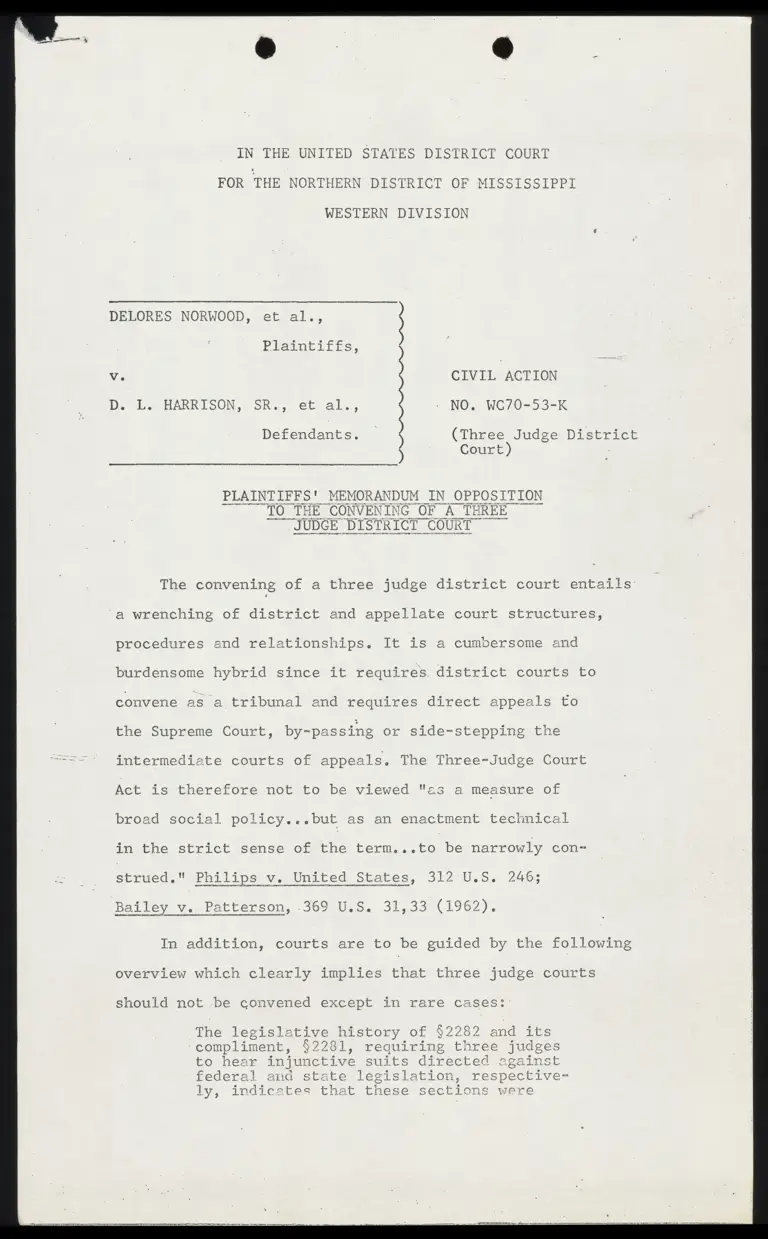
     [||a71bb981-9fb7-4961-966b-1f2955926b24||] IN THE UNITED STATES DISTRICT COURT

FOR THE NORTHERN DISTRICT OF MISSISSIPPI

WESTERN DIVISION


DELORES NORWOOD, et al.,

Plaintiffs,

v, CIVIL ACTION

D. L. HARRISON, .SR., et al., NO. WC70-53-K

(Three Judge District
Court) :

Defendants.

N
a
”


Na
e”


at

?”

a
”


at
”

a


a
”


No
”

a


ut


a
”


|


PLAINTIFFS! MEMORANDUM IN OPPOSITION
TO THE CONVENING OF A THREE

JUDGE DISTRICT COURT

The convening of a three judge district court entails

‘a wrenching of district and appellate court structures,

procedures and relationships. It is a cumbersome and

burdensome hybrid since it requires district courts to

convene as a tribunal and requires direct appeals to

the Supreme Court, by~passing or side-stepping the

intermediate courts of appeals, The Three-Judge Court

Act is therefore not to be viewed "z3 a measure of

broad social policy...but as an enactment technical

in the strict sense of the term...to be narrowly Cons


ap strued." Philips v, United States, 312 U.S. 246;

Bailey v, Patterson, 369 U.S. 31,33 (19562).


In addition, courts are to be guided by the following

overview which clearly implies that three judge courts

should not be convened except in rare cases:

The legislative history of $2282 and its
compliment, §2281, requiring three judges
to hear injunctive suits directed ~galnst
federal and state legislation, respective-
ly, indicate<« that these sections were


enacted to prevent a single federal judge
from being able to paralyze totally the
operation of an entire regulatory scheme,
state or federal, by issuance of a broad
injunctive order.... 'The crux of the busi-
ness is procedural protection against an
improvident state-wide doom by a federal
court of a state legislative policy,


Kennedy v, Mendoza-Martinez, 372 U.S. l44,
154 (1963) (Emphasis Added).


It is, therefore, not surprising that several

distinctions have been drawn by the federal judiciary

which have led to a reduction in the number of cases

and issues subject to three-judge district court

resolution, Plaintiffs depend upon three distinctions

which support remand of this case to a single district

1/ court judge.=’ First, we do not challenge the textbook

statute in its entirety, but rather we challenge aid to

a limited and clearly defined class of schools; i.e.,

we do not attack an "entire regulatory [or statutory]

scheme," Kennedy, supra. Secondly, defendants have


interpreted the state textbook law as permitting the

withholding of textbook aid to certain schools, and


therefore at issue in this case is an administrative

decision to grant textbook aid to a certain class

of schools; there is no meed to hold the statute un-

constitutional. Finally, we ask this Court to recognize

that " a distinction exists between That de sought as a

form of relief within the power of a court of equity and

what 1s sought as a matter of primary constitutional

right irrespective of the legality of past conduct by

the parties sued," Bradley v, School Board of the City


1/
“In this Circuit it is necessary to convene a three-

judge district court which conditionally determines whether
the matter is properly before the special tribunal. Irrespective
of the outcome of that threshold inquiry, it is necessary
for a single district court judge and the three judge court
to separately determine the case on the merits. Jackson v.
Choate, 404 7,24 910, 912," 913 (5th Clr. 19638),

Plaintiffs never maintained that a three-judge court
was required in this case; our Complaint makes no mention
of such a court. Rather we subsequently moved for the
special tribunal because we understand Jackson to hold
that, whenever there is the slightest doubt, only a three-
judge district court can determine whether a three-judge
district court is necessary.


of Richmond, Va,, 324 7. Supp. 396, 400 (E.D. Va. 1971).


Plaintiffs paramount theory is that this Court should

enjoin any and all state aid to private academies formed

in the wake of public school desegregation and in competition

with public schools for students and teachers as part

of an equity court's broad power to fashion an effective

remedy for the state's past dual racial system of public

education. Essentially we ask this Court to protect

the integrity of its orders establishing unitary school

systems and eliminating state support for racial

segregation. (Plaintiffs! Brief, Argument II, pp.27-29.)

I

The Statute is Not Challenged
in its Entirety.


The courts have been relunctant to convene three-

judge district courts whenever plaintiffs may be

accorded relief without the necessity for undermining

the broad framework of state legislative enactments.

This approach to the issue has appeared in a variety

of cases.


In Maison v., Confederated Tribes, 314 F.2d. 169

(9th Civ. 1063). the Oregon State Game Commission

had promulgated regulations prohibiting fishing

on certain rivers out of season, Plaintiffs were

indians who were admittedly fishing in violation

of the Commission's regulations, But plaintiffs

claimed that the regulations were inconsistent with

an 1855 Indian Treaty assuring unimpeded fishing rights

in the rivers, The Court held that the regulation was

admittedly valid and that the real issue was whether

the statute could be invoked against plaintiffs' class.

Since the statute could be left essentially in tact

while providing plaintiffs relief, there was no

need to convene a three-judge court.

3


“ £5 wo - hy \ 3 ¢ 7 ¥ Fn)  ( 4 f + 21 Y £ § H ) Pan $ Y H AY
P ESE fe 0 AT TE Ee 1 IER Ss BN SPRL al Luks hel dll gic Cullis ck LULL]

. case, plaintiffs sought admission to a white junior

college arguing that the exclusion of blacks violated

Equal Protection. Plaintiffs sought a three-judge district

court arguing that Texas statutes, requiring racial

segregation, were at issue. The trial court refused

to convene a three-judge court. The Fifth Circuit

affirmed, noting that the issue was whether, in the

particular locality; hinch and white junior colleges

were in all respects "separate but equal." When

the district court held that black and white facilities

were not equal, and granted plantiffs admission to

to the white junior college, the court was not

‘holding the Texas statutes unconstitutional but rather

was merely resolving a factual question; and a three-

judge district court was not necessary or proper.

Witchita Falls Junior College v. Battle, 204 F,2d


832° (5th Cir. 1933), cert, den. 347 U.S, 974. Blacks

were admitted to a white junior college in Witchita

Falls, but Texas racial segregation statutes were

otherwise left intact.

The same principle with a different twist was

announced in Benoit v, Garder, 351 F.2d 846 (1st Cir.


1965). There plaintiff sought an injunction enjoining

the Massachusetts Crime Commission from further activi-

ties directed against him and argued that the legislation

creating the Commission violated Sie process and equal

protection. The Court held that a three-judge district

court was not required because the suit was not a challenge

to the constitutionality of the statute but rather

involved a charge that a "valid statute or order

«oo|was| being executed in a manner prejudicial to

constitutional rights."


.

And still another variation on what we believe to be

the same theme, can be found in Philips v. United States,


312 U.8.. 245 (1941). There the Governor of Oklahoma,

acting under authority of a state statute, declared

martial law in an effort to frustrate the construct fon

of a federally Fintonaed Dam, A unanimous court, speaking

through Justice Frankfurter, held that an injunction

enjoining the Governor from interfering with the pro-

ject should be issued by a single district court judge.

The statute did indeed confer authority upon the Governor

to declam martial law, But the issue before the trial

court was whether a constitutional statute could be

exploited by the Governor to accomplish an unlawful

end. Again, the thrust of the state statute cculd

be essentially left in tact, and the Governor enjoined,

and so a three judge district court was not hotens ry.

Some courts and commentators have svtuned these

cases as exceptions to §2281 and have emphasized that

an unconstitutional result differs from an unconstitu~

tional statute; or that in some cases the controversy

is factual and not related to the constitutionality of

a state statute. They foie that these distinctions are

"sometimes difficult fo apply.” Amo, 15 1, B4 24d,

904, 917. But in plaintiffs view the essential and

Will an injunction issued by the court "paralyze totally

the operation of an entire regulatory scheme;" if the

answer is "no%, if relief can De afforded plaintiffs

without seriously undermining a legislative scheme

or policy, then there is no need f

district court. This is the thread which runs through

19)
 11 of ‘the cases.

sc


It is easy to apply these principles to the case

at bar. There are 154 public school districts, over

1000 public schools and over 40 private schools un-

touched by this litigation. The state's textbook

program is only challenged insofar as it has resulted

in the distribution of textbooks to 107 schools enrolling

only a small fraction of the state's one-half million

students. In addition, it is clear that the 1940 legis-

lature contemplated free textbooks to public, Catholic

and other true parochial schools; those were the

only schools in existence at the time. For these

reasons it is apparent that an order of this Court

enjoining state textbook aid to a limited and clearly

defined class of schools, not even in existence at

the time the statute was enacted, would leave the

state's textbook program essentially in tact: a three-

judge district court is without Surtsdionton to deter=-

mine this controversy.

11.
An Administrative Decision of the
Textbook Board, and not the Statute,
1s under Attack.


Admittedly, Section 6656 of the Miss, Code, 1942,

provides that state owned textbooks "shall be"

distributed to pupils in "all elementary and high

schools of Mississippi." The statute appears to

mandate distribution subject only to the limitation

that only schools "which maintain standards equivalent

to the standards established by the state department

of education" are eligible for aid under the program.

However, defendant Textbook Board has read the

statute as permitting the exclusion of certain schools

from the program notwithstanding the statute. The Board


has excluded the Gulf Coast Military Academy from the

program primarily Yecoiase it operates at a profit,

(See Plaintiffs' Brief, p. 13). The Executive

Secretary to the Board, Mr. Snowden, testified

at a deposition taken subsequent to the filing

of plaintiffs! brief, that the Textbook Board has

a policy against providing aid to schools which

operate at a profit despite the clear language

of the statute making such schools eligible,

With this in mind, plaintiffs maintain that the.

decision of the Textbook Board to afford private racist

academies with free textbooks, primarily entails an

administrative decision under a state statute which

affords the Board considerable latitude in deter-

mining eligibility under the program. Administrative

decisions, not mandated by statute, are reviewable

before a single district court judge. Sweeny v.


State Board of Public Assistance, 36 F. Supp.


171,172 (M.D, Pa, 1940); Fx Parte Branford, 310


U.S. 354 (1940); Philips v. United States, supra.

aC 111
This is an Action to Assure
A Remedy for Past Discrimin-
ation,


A three-judge district court should not be

convened when the state statute at issue has been

interposed to frustrate Equity's duty to remedy

past racial discrimination or is at odds with

a judgment or decree previously entered by a

single district court judge. The distinction relied

upon is between what is sought "as a form of relief

within the power of a court of equity and what is sought

as a matter of primary constitutional right..."

Bradley, supra, 324 F, Supp. at 400.

¥y


In Cooper v. Aaron, 261 F.2d 97, 106 (8th Cir.


1958), defendants, members of the Board of Education

and Superintendent of the Little Rock School System,

were enjoined to open Little Rock High School to

black applicants. The Arkansas legislature thereupon

enacted measures which resulted in Little Rock High

becoming a private school. Defendants then claimed

that state statutes prevented the integration of

the high school. The court held that a three judge

district court was not required to determine the

constitutionality of the state statutes:

The propriety and legality of the [School
Board's | acts and threatened actions have
been viewed simply in relation to the ob-
ligation imposed upon them by the previously
existing federal court decree, without re-
gard to whether the statutes mentioned are
in themselves constitutional or unconstitu-
tional.

A similar approach was taken by the court in

another Little Rock episode. Governor Fgubus was

suclned by the district court from using the National

Guard to preserve segregation at Little Rock High,

Faubus argued in the Eighth Circuit that the

district court was without jurisdiction to enter

the injunction except as a three judge court. The

appeals court disagreed holding, in part, that a

single district court judge had authority to protect

the integrity of its orders requiring the integration

of Little Rock High School; the injunction entered against

the Governor was part of the remedy for racial segregation,

Fagbus v. United States, 254 F, 24 797, 805 (8th Cir.


1958).

In the same vein are decisions of the Fifth Circuit

holding that state statutes which interfere with the

disestablishment of dual racial faculty assignments must

yield when a remedy for past discrimination is in the

balance. No mention of three-judge district courts is

“Gm


made in any of these opinions. United States v. Greenwood,

406 F, 24 1086, 1094; U.S, v, Indianola Municipal


Separate School District, 410 F.2d 626,630 (5th Cir.


1969); United States v. Bessemer Board of Education,


396 F.2d 44, 51. (5th Cir, 1968). Rather the

side-stepping of state statutes occurs as a result

of the district court's duty to fashion a remedy

which will "eliminate the discriminatory effects

of the past as well as bar like discrimination in

the future." Louisiana v. United States, 380 U.S.


145 (1965). And under such circumstances a three=

judge district court is not required.

Plaintiffs! Complaint makes it clear that our

primary objective is to protect the integrity of

orders entered by the district courts of the state

establishing unitary public school systems. The

relief we seek is a facet of the remedy for the

state's past policies of racial discrimination

and as such, the case falls squarely within the


principle announced in Louisiamv., United States,

and Cooper v. Aaron, supra.


The named plaintiffs herein...are students
in attendance at the public schools of the
Tunica County School District. Their right to
a racially integrated and otherwise non-
discriminatory public school system, vindi=-
cated by order of this Court dated January
23,1970, ...20d their right to the elimination
of state support for racially segregated
schools, [have] been frustrated and/or abridged
by the creation of the racially segregated
Tunica Institute of Learning and the policies
and practices of defendants as set forth be-
low. (Complaint, paragraph 3)

The defendants have provided these racially
segregated schools and academies and the
students attending such schools, ...textbooks
purchased and owned by the State of Mississ~-
ippi ...and have thereby impeded the establish-
ment of racially integrated public schools in
violation of plaintiffs! rights assured and
protected by the Fourteenth Amendment to the
Constitution of the United States, (Complaint,
paragraph 9)


CONCLUSION


For the foregoing reasons this Court of three

judges should hold that Er without jurisdiction

to hear this case. Similarly, a single district court

judge should determine that the matter is properly before

him alone. Thereafter, both the three judge court and

the single district court judge should enter an

opinion and order on the merits.

Respectfully submitted,

nts
MELVYN R. LEVENTHAL
FRED 1. BANKS, JR.

538% North Farish St.
Jackson, Miss. 39202


ROBERT J. KELLY

113 Wood Street
Batesville, Miss. 38606

JACK GREENBERG
NORMAN CHACHKIN

Suite 2030
10 Columbus Circle
New York, New York 10019

Counsel for Plaintiffs.

+10 [||a71bb981-9fb7-4961-966b-1f2955926b24||]