Dent v. St. Louis-San Francisco Railway Company Record on Appeal
Public Court Documents
May 12, 1967
This item is featured in:

-
Brief Collection, LDF Court Filings. Dent v. St. Louis-San Francisco Railway Company Record on Appeal, 1967. 757d339c-af9a-ee11-be37-00224827e97b. LDF Archives, Thurgood Marshall Institute. https://ldfrecollection.org/archives/archives-search/archives-item/c3cbdfc7-0b9d-4967-873a-21355afe671e/dent-v-st-louis-san-francisco-railway-company-record-on-appeal. Accessed September 19, 2026.
Copied!
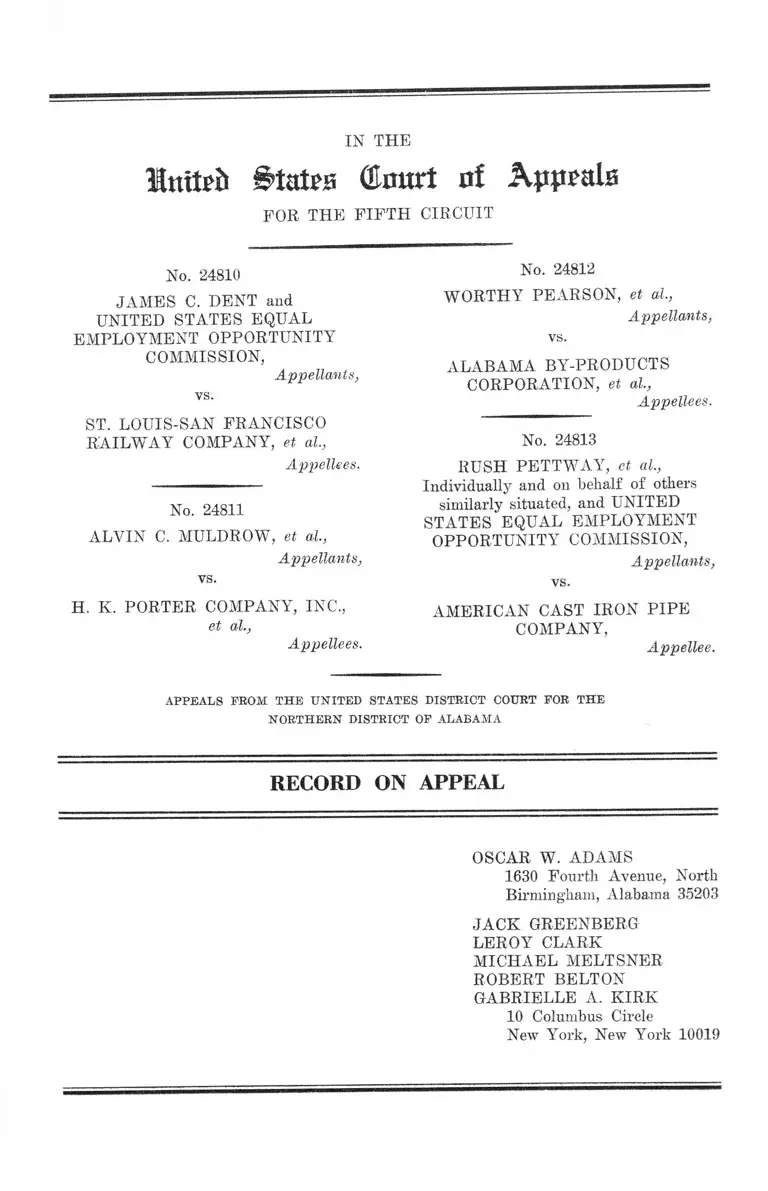
IN THE
Unitefc ^tatea (tart of Appeals
FOB THE FIFTH CIRCUIT
No. 24810
JAMES C. DENT and
UNITED STATES EQUAL
EMPLOYMENT OPPORTUNITY
COMMISSION,
Appellants,
vs.
ST. LOUIS-SAN FRANCISCO
RAILWAY COMPANY, et al,
Appellees.
No. 24811
ALVIN C. MULDROW, et al,
Appellants,
vs.
No. 24812
WORTHY PEARSON, et al,
Appellants,
vs.
ALABAMA BY-PRODUCTS
CORPORATION, et al,
Appellees.
No. 24813
RUSH PETTWAY, et al,
Individually and on behalf of others
similarly situated, and UNITED
STATES EQUAL EMPLOYMENT
OPPORTUNITY COMMISSION,
Appellants,
vs.
H. K. PORTER COMPANY, INC.,
et al,
Appellees.
AMERICAN CAST IRON PIPE
COMPANY,
Appellee.
APPEALS FROM THE UNITED STATES DISTRICT COURT FOR THE
NORTHERN DISTRICT OF ALABAMA
RECORD ON APPEAL
OSCAR W. ADAMS
1630 Fourth Avenue, North
Birmingham, Alabama 35203
JACK GREENBERG
LEROY CLARK
MICHAEL MELTSNER
ROBERT BELTON
GABRIELLE A. KIRK
10 Columbus Circle
New York, New York 10019
Papers on Appeal in C.A. No. 66-65
Complaint ............................................. 1
Motion to Dismiss by Brotherhood, etc............ ............ 10
Motion to Dismiss by St. Louis-San Francisco Rail
way Co....... ....................................................................... 12
Amended Motion to Dismiss by St. Louis-San Fran
cisco Railway Co. _____ ____-....................... — ........ 15
Pleading in Intervention ......................................— 18
Motion by St. Louis, etc. in Opposition to Motion to
Intervene, etc............................................................ - 22
Order ......... ...... ..... ............................................-...... -........ 24
Amended Motion to Dismiss by St. Louis, et al............. 25
Amended Motion to Dismiss by Brotherhood, etc. ....... 27
Decree ... ............................................................................... 28
Opinion ................................. ...........-................-....... ....... 29
Order on Motion to Dismiss ............................................. 42
Notice of Appeal by Plaintiff ........................- ............... 43
Plaintiff’s Designation of Record ------- --- -.........-........ 45
Notice of Appeal by Intervenor ..................................— 46
Clerk’s Certificate ...................................................... -.... 48
I N D E X
PAGE
XI
Papers on Appeal in C.A. No. 66-206
Complaint ........................................................................... 49
Motion to Dismiss by H. K. Porter Company, Inc......... 56
Exhibit A— (Not Printed) Agreement .................. 66
Exhibit B—Complaint ............... ................... ......... 67
Exhibit C—Complaint ........................................ 68
Exhibit D—Charge of Discrimination .................. 69
Exhibit E—Charge of Discrimination .................. 72
Exhibit F Amendment to Charge ........................ 75
Exhibit Gr—Charge of Discrimination .................. 76
Order ..... 79
Amended Complaint ........... 80
Order Enlarging Time for Motion, etc............................ 89
Motion to Dismiss by United States Steelworkers, etc. 90
Motion to Dismiss by H. K. Porter Company, Inc......... 92
Motion for Order Requiring Intervention, etc............... 98
Plaintiffs’ Motion in Opposition to Defendant Porter’s
Motion to Dismiss ......................... ........ ................ ..... 100
Plaintiffs’ Motion in Opposition to Defendants’ Mo
tion to Dismiss ........................................... ........ ......... 105
PAGE
Order 108
Plaintiffs’ Notice of Appeal .... 109
Designation of Record .................................................... I l l
Clerk’s Certificate ............................................................ 112
I ll
PAGE
Papers on Appeal in C.A. No. 66-320
Complaint .................................. -..............--------------------- 113
Motion to Dismiss by Alabama By-Prodncts Corpo
ration ............................................................................... 120
Exhibit A— (Not Printed) Agreement .............. 125
Exhibit B—Memorandum of Understanding, etc. .. 126
Order .......................................................................... 128
Amended Complaint ........................................................ 129
Motion to Dismiss by Alabama By-Products Corpo
ration .................................. .................................... —. 137
Exhibit A—Arbitrator’s Opinion and A w ard....... 145
Motion to Dismiss by International Union, etc............. 151
Amended Motion to Dismiss by Alabama By-Products
Corporation ........ 153
Plaintiffs’ Motion for Order Requiring Intervention,
etc............................ 154
Plaintiffs’ Motion in Opposition to Motion to Dismiss,
etc.............................................................................. 156
Order ................................................................................... 158
Opinion ............................................................................... 159
Plaintiffs’ Notice of A ppeal............................................. 159
Designation of Record............................................. 161
Clerk’s Certificate ............................................................ 162
iv
PAGE
Papers on Appeal in C.A. No. 66-315
Complaint ........................................................................... 163
Defendant’s Motion to Dismiss ..................................... 170
Exhibit A—Charge of Discrimination ............... . 176
Exhibit B—Affirmation Form ................. ...... ....... 179
Motion for Leave to Intervene .............................. 180
Pleading in Intervention ................................................ 182
Order ............................................................ 186
Opinion ............................................................................... 187
Plaintiffs’ Notice of Appeal ........................................... 187
Plaintiffs’ Designation of Record ......... .......................... 189
Intervenor’s Notice of Appeal ....... 190
Clerk’s Certificate 191
VOLUME I
I n the
MmUb Btntzb iiatrirt CEmtrt
F ob the Northern District of A labama
Southern Division
Civil A ction No. CA 66-65
J ames C. Dent,
-v.-
Plaintiff,
S t . L ouis-San F rancisco R ailway Company, a Missouri
Corporation; B rotherhood of R ailway Carmen of
A merica, an unincorporated association; Clarence
Mann , General Chairman of Brotherhood of Railway
Carmen of America; Clyde V inyard, Chairman of
Local 60 of Brotherhood of Railway Carmen of
America,
Defendants.
Complaint
(Filed February 7, 1966)
J urisdiction
1. Jurisdiction of this Court is invoked pursuant to
28 U.S.C. §1343(4). This is a suit in equity authorized
and instituted pursuant to Title VII of the Act of Con
gress known as the “Civil Rights Act of 1964,” 42 U.S.C.
§§ 2000e et seq., and pursuant to 42 U.S.C. § 1983. The
jurisdiction of this Court is invoked to secure protection
2
of and to redress deprivation of rights secured by said
42 U.S.C. §§ 2000e et seq., providing for injunctive and
other relief against racial discrimination in employment,
and by 42 U.S.C. § 1981, providing for the equal rights
of citizens and all persons within the jurisdiction of the
United States.
Complaint
R elief
2. This is a suit for a preliminary and permanent in
junction restraining defendants from continuing to limit,
segregate, classify or otherwise discriminate against plain
tiff and his class in ways which deprive or tend to deprive
them of employment opportunities, limit such employment
opportunities or otherwise adversely affect their status
as employees because of their race or color.
Class A ction
3. Plaintiff brings this action of the Federal Rules of
Civil Procedure under Rule 23(a)(3) on his own behalf
and on behalf of other Negroes who are employed by
defendant St. Louis-San Francisco Railway in the East
Thomas Yards in Birmingham, Alabama, and who are
members of Local 750 of defendant Brotherhood of Rail
way Carmen of America. There are common questions
of law and fact affecting the rights of such other Negroes
who are and have been limited, classified, segregated or
otherwise discriminated against in ways which deprive
and tend to deprive them of employment opportunities,
limit such employment opportunities, or otherwise ad
versely affect their status as employees because of their
race or color. These other Negroes are so numerous as
to make it impractical to bring them all before this Court.
3
A common relief is sought. The interests of this class are
adequately represented by plaintiff.
F oe, a Cause of A ction
4. Plaintiff James C. Dent is a Negro citizen of the
United States and of the State of Alabama residing in
the City of Birmingham, Alabama.
Plaintiff is employed by defendant St. Louis-San Fran
cisco Railway Company and has been so employed for
more than twenty-one (21) years. Plaintiff is a member
of Local 750, commonly known as Parker Lodge #750,
a chartered, dues-paying, racially segregated local of de
fendant Brotherhood of Railway Carmen of America hav
ing a solely Negro membership.
Plaintiff in his employment with the defendant Railway
Company has been classified as carmen helper. This classi
fication means generally that such employee repairs and
maintains passenger and freight railroad cars. The classi
fication of “first class carmen” , or “carmen” , is superior
to that of the other carman classifications in both com
pensation and responsibility. Plaintiff is qualified by ex
perience to do the work of a first class carman, a classi
fication to which he has not been promoted.
5. Defendant St. Louis-San Francisco Railway Com
pany is a corporation incorporated under the laws of the
State of Missouri, doing business in the State of Alabama
and in the city of Birmingham and having a place of
business of 30 South 18th Street in said city. Defendant
operates and maintains the East Thomas Yards for ser
vicing passenger and freight cars in said City of Birming
ham, Alabama. Defendant is an employer engaged in the
railroad industry, which industry affects interstate com
Complaint
4
merce. Defendant employs more than one hundred em
ployees on a full-time basis.
Defendant Brotherhood of Railway Carmen of America
is an unincorporated association with its national office
located in Kansas City, State of Missouri. Defendant does
business and has members residing in the State of Ala
bama and in the City of Birmingham, Alabama. Defen
dant is a labor organization engaged in the railroad in
dustry, which industry affects interstate commerce. De
fendant has more than one hundred (100) members and
is the certified representative of carmen, carmen helpers
and upgraded carmen under the provisions of the Railway
Labor Act, as amended.
Defendant Clarence Mann is the General Chairman of
the defendant Brotherhood of Railway Carmen of America.
Defendant Clyde Vineyard is Chairman of Local 60,
commonly known as Iron City Lodge #60, a chartered
dues-paying racially segregated local of Railway Carmen
of America, having a solely white membership.
6. Plaintiff by reason of his knowledge and experience
has been, is, and continues to be qualified for promotion
to the position or classification of first class carman.
During the period of plaintiff’s employment white carmen
helpers with less knowledge, experience and seniority than
plaintiff were permitted to advance to the position of
first class carman.
7. Prior to 1962 persons of both the Negro and white
race have been employed as carmen helpers. The method
of advancement from carman helper to first class carman
was by accumulating a certain amount of experience as
first class carman by filling in for vacancies created in
Complaint
5
the first class positions (hereinafter referred to as “up
grade” positions). During the period of plaintiff’s em
ployment upgrade positions were filled in a preferential,
discretionary and discriminatory manner so as to preclude
and prevent Negro carmen helpers from accumulating
sufficient “upgrade” experience so as to qualify for first
class status. The method of upgrading conducted by
defendant employer individually or in concert, collusion
and acquiescence of defendant labor union was and is
with the design, purpose and intent of excluding Negro
carmen helpers from first class carmen positions because
of their color or race. Consequently advancement of Negro
carmen helpers to positions with first class status has
been only on a token basis, if at all.
8. Notwithstanding the pattern, practice, usage and
custom of denying Negro carmen helpers their right to
accumulate upgrade experience plaintiff and others simi
larly situated have, through long years of training and
experience, acquired the needed qualifications to do first
class carmen work. In 1962, to further prevent and avoid
the inevitable upgrading of qualified Negro carmen helpers,
defendant employer individually or in collusion with and
acquiescence of defendant labor union eliminated the job
classification of carmen helper. Consequently plaintiff and
others similarly situated, that is Negro carmen helpers
who had not accumulated sufficient upgrade time to be
promoted to first class carmen, were laid off or furloughed.
The intent, purpose, and design of eliminating the helper
classification was to further prevent and preclude quali
fied high seniority Negro helpers from advancing to first
class positions because of their color or race.
Complaint
6
9. Since the elimination of carmen helper positions
defendant employer individually or in collusion with de
fendant labor union has initiated an apprenticeship pro
gram ostensibly to train apprentices to do first class work
but which in fact has discriminated against Negroes be
cause of their race or color in admission to and employ
ment in such program. Newly hired apprentices with far
less seniority and experience than plaintiff and the class
he represents are performing work which would otherwise
be performed by the furloughed carmen helpers.
10. The method of hiring apprentices is designed to
perpetuate the exclusively white first class carman classi
fication. From its inception to the present time the ap
prenticeship program has been conducted on a “white
only” basis.
As presently constituted only employees who have served
apprenticeship time can advance to the position of first
class carmen. The method of hiring apprentices has as
its intent and design the exclusion of members of the
Negro race because of their race or color and is calculated
to accomplish that purpose. Thus the present apprentice
ship program is just one more of a series of acts or ploys
intended to frustrate, prevent, exclude and deny plaintiff
and persons similarly situated from advancing to the
position of first class carman because of their race or
color.
11. Defendant St. Louis-San Francisco Railway Com
pany maintains segregated locker rooms, rest rooms and
lunch room facilities at the East Thomas Yards, by means
of cinder blocks which separate the white employees from
the Negro employees. Such segregation of facilities by
Complaint
7
race adversely affects the status of an plaintiff and other
Negroes as employees. The absence of signs denoting the
presence of segregated facilities has not precluded the
continuation of the custom and practice of separate white
and Negro facilities.
12. Defendant Brotherhood of Railway Carmen of
America and defendant General Chairman of the Brother
hood, Clarence Mann, and defendant Local Chairman,
Clyde Vineyard, have operated dual locals numbers 60
and 750 which are based on race. Such segregation of
Union membership deprives or tends to deprive plaintiff
and other Negro members of employment opportunities.
13. Neither the State of Alabama nor the City of
Birmingham has a law prohibiting the unlawful practices
alleged herein. On September 10, 1965 plaintiff filed a
complaint with the Equal Employment Opportunity Com
mission alleging denial by defendant St. Louis-San Fran
cisco Railway Company and defendant Brotherhood of
Railway Carmen of America of plaintiff’s rights under
42 TJ.S.C. §§ 2000e et seq., commonly known as Title VII
of the “ Civil Rights Act of 1964” . On December 8, 1965
said Commission found reasonable cause to believe that
these defendants had violated Title VII of such Act.
Subsequently, the Commission notified plaintiff that de
fendants’ compliance with Title VII had not been accom
plished within the maximum period allowed to the Com
mission by 42 U.S.C. §§ 2000e et seq., and that plaintiff
is entitled to maintain a civil action for relief in a District
Court of the United States.
14. Plaintiff has no plain, adequate or complete remedy
at law to redress the wrongs alleged, and this suit for a
Complaint
8
preliminary and permanent injunction is Ms only means
of securing adequate relief. Because of the nature of Ms
claim and the failure of defendant Brotherhood of Bailway
Carmen of America to institute any grievance on his
behalf, the remedies, if any, provided by grievance ma
chinery in the Collective Bargaining Agreement, the griev
ance machinery in the constitution of the Brotherhood
of Railway Carmen of America, and the procedure before
the National Railroad Adjustment Board are wholly in
adequate. Plaintiff and the class he represents are now
suffering and will continue to suffer irreparable injury
from defendants’ unlawful practices as set forth herein.
W herefore, plaintiff respectfully prays this Court to
advance this case on the docket, order a speedy hearing
at the earliest practicable date, cause this case to be in
every way expedited, and upon such hearing to:
Grant plaintiff and the class he represents a prelim
inary and permanent injunction enjoining the defendants
from continuing the practices which deprive or tend to
deprive the plaintiff and others similarly situated from
equal employment opportunities secured by 42 U.S.C.
§§ 2000e et seq. and 42 U.S.C. § 1981 without discrimina
tion on the basis of race or color, including but not limited
to the maintenance of any collusive or non-collusive prac
tice of refusing to promote or to recommend for promo
tion, Negro carmen helpers to the grade of carmen, or of
avoiding to call out, or recommending not to call out,
Negro carmen helpers to work as carmen, in the City of
Birmingham, Alabama, and in the State of Alabama;
Grant plaintiff back pay from the date of defendant
St. Louis-San Francisco Railway Company wrongfully re
fused to promote plaintiff, to the present date;
Complaint
9
Enjoin defendant St. Louis-San Francisco Railway Com
pany from maintaining segregated locker rooms, rest rooms
and lunch room facilities;
Enjoin defendant Brotherhood of Railway Carmen of
America, its General Chairman Clarence Mann, and the
Chairman of Local 60, Clyde Vinyard, from maintaining
segregated locals;
Allow plaintiff his costs herein, including reasonable
attorney’s fees and such other additional relief as may
appear to the Court to be equitable and just.
Respectfully submitted,
/ s / Oscab W . A dams, Jb.
Oscab W . A dams, Jb.
1630 Fourth Avenue, North
Birmingham, Alabama 35203
J ack Gbeenbebg
L eboy Clabk
10 Columbus Circle
New York, New York 10019
Attorneys for Plaintiff
Complaint
10
Motion to Dismiss by Brotherhood, etc.
(Filed March 23, 1966)
Come now the defendants Brotherhood of Railway Car
men of America, an unincorporated association, and
Local 60 of Brotherhood of Railway Carmen of America,
an unincorporated association, and separately and severally
move to dismiss the complaint, and as grounds therefor
show:
1. The plaintiff fails to state a claim upon which relief
can be granted against defendants or either of them.
2. The plaintiff’s complaint complains of matters over
which Congress has delegated exclusive jurisdiction to the
National Railroad Adjustment Board.
3. The plaintiff’s complaint reveals on its face that
the plaintiff has failed to exhaust available administrative
and/or contractual remedies.
4. The complaint fails properly to allege Federal juris
diction. It fails to allege a violation of the Civil Rights
Act of 1964 within the operative period of that Act.
5. There is a lack of diversity of citizenship between
all the parties in that defendant Brotherhood of Railway
Carmen of America and Local 60, Brotherhood of Rail
way Carmen of America, are unincorporated associations
and each has individual members resident in the State
of Alabama, the residence of plaintiff.
11
Motion to Dismiss by Brotherhood, etc.
6. The plaintiff failed to institute his action within
the time allowed by law. 42 TJ.S.C, § 2000e-5(e).
Mulholland, H ickey & Lyman
741 National Bank Building
Toledo, Ohio
By / s / Mulholland, H ickey & L yman
Cooper, M itch, J ohnston &
Crawford
1025 Bank for Savings Bldg.
Birmingham, Alabama
By /s / George C. L ongshore
12
Motion of St. Louis-San Francisco Railway Company
To Dismiss
(Filed April 5, 1966)
Comes now St. Lonis-San Francisco Railway Company,
one of the defendants in the above styled cause, and
moves the Court to dismiss the complaint on the follow
ing grounds, separately and severally:
1. The complaint fails to state a claim against this
defendant upon which relief can be granted.
2. The complaint is barred by the statute of limitations
applicable thereto in that the complaint fails to allege
that this action was instituted within the thirty day period
prescribed by Section 706(e) of Title VII of the Civil
Rights Act for the institution of actions thereunder fol
lowing notification from the Equal Employment Oppor
tunity Commission.
3. The action is barred by the statute of limitations
applicable thereto in that the plaintiff was notified by
the Equal Employment Opportunity Commission by letter
of January 5, 1966 that he was entitled to maintain a
civil action under Title VII of the Civil Rights Act and
in that this action, having been instituted by the filing
of the complaint more than thirty days thereafter on
February 7, 1966, was not brought and commenced within
the period of thirty days prescribed by Section 706(e)
of Title VII of the Civil Rights Act for the institution of
actions thereunder following notification from the Equal
Employment Opportunity Commission.
4. The complaint complains of and seeks to bring into
issue and litigation matters which are the subject of a
13
Motion of St. Louis-San Francisco Railway Company
to Dismiss
prior action pending in which this same plaintiff is a
party plaintiff and this defendant is a party defendant
and which is presently pending in this same Court under
the style of James G. Glover, et al. v. St. Louis-San Fran
cisco Railway Company, et al., Case No. 65-477.
5. The complaint complains of and seeks to bring into
issue and litigation matters which are within the exclu
sive jurisdiction of the National Railroad Adjustment
Board.
6. The complaint shows on its face that the plaintiff
has failed to exhaust the administrative remedies avail
able to him through the procedures of the National Rail
road Adjustment Board.
7. The complaint shows on its face that the plaintiff
has not requested co-defendant Brotherhood of Railway
Carmen of America to pursue on his behalf the claim
asserted in the complaint through any grievance proce
dures embodied in agreement between the defendants.
8. The complaint fails to allege that the plaintiff has
exhausted the contractual grievance procedure remedies
available to him.
9. The institution of this action as a class action is
contrary to and prohibited by the provision of Section
706(e) of Title VII of the Civil Rights Act which limits
actions thereunder to “the person claiming to be ag
grieved.”
10. The institution of this action as a class action is
contrary to and prohibited by the fact that Title VII of
14
Motion of St. Louis-San Francisco Railway Company
to Dismiss
the Civil Rights Act provides for suits thereunder only
by persons who have first filed a complaint with the Equal
Employment Opportunity Commission and the complaint
shows on its face that only the plaintiff, and not the
class claimed to be represented by him, has filed such a
complaint with such Commission.
11. The provisions of Rule 23(a) of the Federal Rules
of Civil Procedure are not applicable to and do not au
thorize the institution and maintenance of this action as
a class action in that the requirement of such Rule of a
common question of law or fact is not present.
12. There is an absence of indispensable parties defen
dants in that the complaint seeks a result which would
adversely affect the interest of employees of this defen
dant who are not named as parties to the action.
/ s / Drayton T. S cott
Drayton T. Scott
/ s / W illiam F. Gardner
W illiam F. Gardner
/ s / P aul R. Moody
P aul R. Moody
Attorneys for the St. Louis-San
Francisco Railway Company
Cabaniss, J ohnston, Gardner & Clark
902 First National Building
Birmingham, Alabama
Of Counsel
15
(Filed April 13, 1966)
Comes now St. Louis-San Francisco Railway Company,
one of the defendants in the above styled cause, and
amends its motion to dismiss heretofore filed by adding
thereto the following additional separate and several
grounds:
13. The complaint is barred by the statute of limita
tions applicable thereto in that the complaint shows on
its face that the action was not instituted within the period
of time required by Section 706(e) of Title VII of the
Civil Rights Act for the institution of civil actions there
under.
The provisions of Section 706(e) of Title VII of the
Civil Rights Act provide a maximum period of time of
sixty days after a charge is filed with the Equal Employ
ment Opportunity Commission for the Commission to at
tempt to secure voluntary compliance and, upon the ex
piration of such sixty day period, to notify the person
filing the charge that he may then institute a civil action.
The provisions of Section 706(e) of Title VII of the Civil
Rights Act further provide and require that the civil
action must be instituted within thirty days following
such notification from the Commission upon the expiration
of the sixty day period.
The complaint in this action shows on its face and
alleges that the charge which the plaintiff filed with the
Commission concerning the subject matter of the complaint
was filed on the date of September 10, 1965. The sixty
Amended Motion to Dismiss by St. Louis-San Francisco
Railway Co.
16
day period provided by Section 706(e) accordingly ex
pired on or before November 10, 1965, and this civil
action was accordingly required by Section 706(e) to be
instituted on or before December 10, 1965. Therefore,
this action, not having been instituted by the filing of the
complaint until February 7, 1966, was not instituted within
the statute of limitations of thirty days as required by
Section 706(e) and is barred.
14. The complaint is barred for the reason that while
the provisions of Section 706(a) and 706(e) of Title VII
of the Civil Rights Act provide for and require “methods
of conference, conciliation, and persuasion” by the Com
mission with respect to the subject matter of a charge
filed with the Commission and such methods and proce
dure are a prerequisite and condition to the institution
of a civil action thereunder, there were no such methods
or procedures followed within the period of time pro
vided therefor with respect to the subject matter of the
charge filed by the plaintiff or of the subject matter of
the complaint in this action.
15. The allegations of Paragraph 11 of the complaint
were not made the subject of any charge filed by the
plaintiff with the Equal Employment Opportunity Com
mission as is required by Sections 706(a) and 706(e) of
Title VII of the Civil Rights Act as a prerequisite to the
institution of a civil action thereunder.
16. The Court is deprived of jurisdiction and pre
cluded by the provisions of the Norris-LaGuardia Act,
Amendedl Motion to Dismiss by St. Louis-San Francisco
Bailway Co.
17
29 TJ.S.C. §§101-115, from granting the injunctive relief
sought by the complaint.
/ s / Drayton T. S cott
Drayton T. Scott
/ s / W illiam F. Gardner
W illiam F. Gardner
/ s / P aul E. Moody
P aul E. Moody
Attorneys for the St. Louis-San
Francisco Railway Company
Cabaniss, J ohnston, Gardner & Clark
901 First National Building
Birmingham, Alabama
Of Counsel
Amended, Motion to Dismiss by St. Louis-San Francisco
Railway Co.
18
(Filed May 5, 1966)
The United States Equal Employment Opportunity Com
mission (hereinafter referred to as EEOC), as intervenor
herein, by the Attorney General of the United States,
alleges:
1. This is a pleading in intervention filed by the EEOC
pursuant to Rule 24(c) of the Federal Rules of Civil
Procedure. The EEOC is an agency of the United States
charged with administering Title VII of the Civil Rights
Act of 1964, 42 U.S.C. §§ 2000e et seq.
2. On February 7, 1966, the plaintiff filed this class
action seeking injunctive relief to restrain defendants from
continuing practices which deprive the plaintiff and others
similarly situated of equal employment opportunities, as
secured by 42 U.S.C. §§ 1981, 1983, and 2000e et seq.,
without discrimination on the basis of race or color.
3. On March 23, 1966, defendants Brotherhood of Rail
way Carmen of America and Local 60 of Brotherhood
of Railway Carmen of America filed a motion to dismiss,
the sixth ground of which states that plaintiff failed to
institute his action within the time allowed by law under
42 U.S.C. § 2000e-5(e).
4. On April 6, 1966, defendant St. Louis-San Francisco
Railway Company filed a motion to dismiss, the second
and third grounds of which state that plaintiff is barred
by the statute of limitations prescribed in 42 U.S.C.
§ 2000e-5(e).
5. On April 13, 1966, defendant St. Louis-San Francisco
Railway Company filed an amended motion to dismiss,
the thirteenth ground of which states that plaintiff is
Pleading in Intervention
19
barred by the statute of limitations prescribed in 42 U.S.C.
§ 2000e-5(e), not having filed his complaint within 30 days
after the expiration of the 60-day period provided for
the Commission to secure compliance, and the fourteenth
ground of which states that the action is barred because
the EEOC failed to complete the “methods of conference,
conciliation, and persuasion” within the time prescribed
by 42 TJ.S.C. § 2000e.
6. The facts material to the issues raised by these
contentions are as follows:
a. On September 10, 1965, James C. Dent filed a sworn
statement with the EEOC, charging the St. Louis-San
Francisco Railway Company and the Brotherhood of Rail
way Carmen of America with violations of Title VII of
the Civil Rights Act of 1964;
b. On October 8, 1965, copies of Mr. Dent’s charges
were served on the Company and the Brotherhood;
c. On December 8, 1965, Commissioner Holcomb of the
EEOC issued a decision finding reasonable cause to believe
the Company and the defendant unions were in violation
of Title VII of the Civil Rights Act of 1964;
d. By letter dated January 5, 1966, the EEOC, by
Alfred W. Blumrosen, Chief of Conciliation, advised Mr.
Dent that EEOC had engaged in methods of conciliation
but had been unable to conciliate the case and notified
him of his right to bring a judicial action within the time
prescribed by the Act.
7. Pursuant to section 716(b) of Public Law 88-352
(note following 42 TJ.S.C. 2000e), the EEOC began to
function on July 2, 1965. Between that date and Decern-
Pleading in Intervention
20
ber 31, 1965, the EEOC received a large number of com
plaints which made excessive demands upon its small staff.
During that period, EEOC’s staff, which did not exceed
25 part-time investigators and two conciliators, processed
3,263 charges of which 1,384 were recommended for in
vestigation.
8. The EEOC follows the practice of utilizing the full
60 days provided by 42 U.S.C. 2000e-5(e) to investigate
and to attempt to eliminate by conciliation all meritorious
charges of unlawful employment practices.
9. Because of the EEOC’s extremely heavy workload
and small staff and its practice of utilizing the full 60 days
to investigate and to attempt to eliminate by conciliation
all meritorious charges of unlawful employment practices,
it is not possible for the EEOC to notify each aggrieved
person within 60 days after any such person has filed a
charge of unlawful employment practice. Nor is it pos
sible in every case for the EEOC to complete its investi
gation and informal methods of conference, conciliation,
and persuasion within that 60-day period.
10. The public interest would be seriously prejudiced
if the EEOC terminated all investigations of and efforts
to conciliate unfair employment practices within 60 days
of the receipt of charges; and if aggrieved parties were
precluded from initiating civil actions under 42 IJ.S.C.
2000e-5(e) unless the EEOC completed its investigation
and conciliation and gave notice of its disposition of
charges within said period.
W h e b e f o e e , the United States Equal Employment Op
portunity Commission prays that this Court issue an
order denying the motions to dismiss filed by the defen
dants insofar as they contend that the plaintiff failed to
Pleading in Intervention
21
institute this action within the time period afforded by
42 U.S.C. §2000e-5(e) and insofar as said motions are
based upon the failure of the EEOC to initiate or com
plete informal methods of conference, conciliation, and
persuasion within 60 days after the filing by plaintiff of
a charge under 42 U.S.C. § 2000e-5(e).
It is further prayed that this Court grant such other
relief as the facts and law may warrant.
/ s / Nicholas deB. K atzenbach
Nicholas deB. K atzenbach
Attorney General
/ s / J ohn D oae
J ohn Doar
Assistant Attorney General
/ s / Macon L. W eaver
Macon L. W eaver
United States Attorney
/ s / S t . J ohn B arrett
S t . J ohn B arrett
Attorney
Department of Justice
Washington, D. C. 20530
/ s / Charles T. D uncan
Charles T. D uncan
General Counsel
Equal Employment
Opportunity Commission
Of Counsel
Pleading in Intervention
22
Motion by St. Louis, etc. in Opposition to Motion to
Intervene and Pleading in Intervention
(Filed May 6, 1966)
Comes now the St. Lonis-San Francisco Railway Com
pany, one of the defendants in this cause, and files this
motion in opposition to the motion of the Equal Employ
ment Opportunity Commission, by the Attorney General
of the United States, to intervene filed and served upon
this defendant in late afternoon of May 5, 1966.
As grounds therefor, this defendant shows to the Court
as follows:
1. The provisions of Title VII of the Civil Rights Act
govern the intervention of the Attorney General in civil
actions under Title VII by the following provision of Sec
tion 706(E) of the Act (42 U.S.C. §2000E 5(e)):
“Upon timely application, the court may, in its
discretion, permit the Attorney General to intervene
in such civil action if he certifies that the case is of
general public importance.”
2. None of the pleadings and documents filed by the
Equal Employment Opportunity Commission, by the At
torney General, to intervene in this case set forth any
certification by the Attorney General “that the case is of
general public importance” as required by Section 706(e)
of the Act.
3. The Act provides for intervention by the Attorney
General and not by the Equal Employment Opportunity
Commission.
23
4. The petition for intervention is for these reasons
not in compliance with the plain and explicit requirement
of the statute and should be denied.
/ s / D rayton T. S cott
D rayton T. S cott
/ s / W illiam F. Gardner
W illiam F. Gardner
Attorneys for Defendant St. Louis-
San Francisco Railway Company
Cabaniss, J ohnston, Gardner & Clark
901 First National Building
Birmingham, Alabama
Of Counsel
Motion by St. Louis, etc. in Opposition to Motion to
Intervene and Pleading in Intervention
24
Order
(Filed May 16, 1966)
This cause, coming on to be heard on a regular motion
docket on May 6, 1966, was submitted on motion of the
United States Equal Employment Opportunity Commis
sion for leave to intervene in this action pursuant to
Eule 24(b) of the Federal Eules of Civil Procedure. Upon
consideration of the motion and for good cause shown:
It is hereby Ordered, A djudged and Decreed by the
court that said motion to intervene be and the same hereby
is granted and that the United States Equal Employment
Opportunity Commission he and it is hereby impleaded as
a party hereto.
It is further Ordered by the court that all other pending
motions filed in this action be and they hereby are con
tinued to be reset for hearing on September 2, 1966.
The defendants are hereby required to file briefs on such
motions within 30 days from and after the date of this
order; plaintiff, and intervening plaintiff, are required
to file their reply briefs within 15 days after receipt of
defendants’ briefs.
Done, this the 16th day of May, 1966.
/ s / Seybourn H. L ynne
Seybourn H. L ynne
Chief Judge
25
Amended Motion to Dismiss by St. Louis, etc.
(Filed July 15, 1966)
Comes now St. Louis-San Francisco Bailway Company,
one of the defendants in the above styled cause, and
pursuant to Rule 15(a) of the Federal Rules of Civil
Procedure and with leave of Court amends its motion
to dismiss filed on April 5, 1966 and its amended motion
to dismiss filed on April 13, 1966 as follows:
By adding to paragraph 14 of the amended motion to
dismiss of April 13, 1966 the words “or at any time”
following the phrase “within the period of time provided
therefor” and preceding the phrase “with respect to” so
that, as thus amended, paragraph 14 of the amended
motion to dismiss of April 13, 1966 shall read as follows:
14. The complaint is barred for the reason that
while the provisions of Section 706(a) and 706(e) of
Title VII of the Civil Rights Act provide for and
require “methods of conference, conciliation, and per
suasion” by the Commission with respect to the sub
ject matter of a charge filed with the Commission
and such methods and procedure are a prerequisite
and condition to the institution of a civil action there
under, there were no such methods or procedures
followed within the period of time provided therefor
or at any time with respect to the subject matter
26
Amended Motion to Dismiss by St. Louis, etc.
of the charge filed by the plaintiff or of the subject
matter of the complaint in this action.
/ s / Drayton T. S cott
Drayton T. S cott
/ s / W illiam F. Gardner
W illiam F. Gardner
Attorneys for the Defendant,
St. Louis-San Francisco Railway
Company
Cabaniss, J ohnston, Gardner & Clark
901 First National Building
Birmingham, Alabama
Of Counsel
Order of Court
The foregoing amended motion to dismiss having been
exhibited to the Court and request having been made for
leave of the Court to amend in accordance therewith, the
Court has considered the same and is of the opinion that
such leave to amend is due to be given. It is accordingly
so ordered this the 15th day of July, 1966.
/s / Seybourn H. L ynne
Seybourn H. L ynne
United States District Judge
27
Amended Motion to Dismiss by Brotherhood, etc.
(Filed July 25, 1966)
Come defendants Brotherhood of Railway Carmen of
America, an unincorporated association, and Clyde Yin-
yard, and respectfully move the Court to dismiss this
action as to them for the following additional grounds:
7. The complaint fails to set out or attach copies of
(i) a charge under oath filed with the Commission naming
these defendants; (ii) a determination by the Commission
of reasonable cause; (iii) notice from the Commission of
its inability to obtain voluntary compliance, all as provided
in Section 706 of the Act.
8. As to individual defendant Clyde Vinyard, the com
plaint does not allege that he is an employer, employment
agency or labor organization subject to and as set forth
in Section 706(a) of the Act, and the Court is therefore
for that reason without jurisdiction of this complaint as
against him.
Mtjlholland, H ickey & L yman
741 National Bank Building
Toledo, Ohio
Cooper, Mitch & Crawford
By / s / J erome A. Cooper
J erome A. Cooper
1025 Bank for Savings Building
Birmingham, Alabama
28
Decree
(Filed August 10, 1966)
Upon request of the plaintiff, and for good cause shown,
the time for plaintiff to file a reply brief in the above-
styled cause is hereby extended to August 22, 1966.
Done this the 10th day of August, 1966.
/ s / Clarence W . A llgood
District Judge
29
(Filed March 13, 1967)
Invoking the provisions of Title VII of the Civil Rights
Act of 1964,1 the plaintiff has brought this action against
his employer and his collective bargaining representative
alleging racial discrimination in terms and conditions of
employment against himself and the class which he claims
to represent in this suit.
By motions to dismiss, the jurisdiction of the court
and the plaintiff’s right to maintain the action in its
present posture have been brought into question. The
Equal Employment Opportunity Commission in turn re
sponded with its petition to intervene for the purpose
of presenting its views regarding the questions raised by
the motions. The court granted its petition and has wel
comed the benefit of its views.
One of the questions before the court concerns the
necessity of the plaintiff first pursuing remedies available
under the collective bargaining agreement or before the'
National Railroad Adjustment Board. The court agrees
with the position, taken by the plaintiff and the Comis
sion, that the principle of Republic Steel Corp. v. Maddox2
should not be applied to actions brought under Title VII
of the Act and therefore holds that remedies under the
collective bargaining agreement or before the Adjustment
Board need not be pursued prior to the institution of an
action under this title.3
142 U.S.C. §§ 2000e et seq. The provisions governing the procedure
before the Equal Employment Opportunity Commission and in the courts
are set forth in section 706 of the Act and will be referred to by such
section in this opinion.
2 379 U.S. 650 (1965).
8 Compare McKinney v. M-K-T Railroad Co., 357 U.S. 265 (1958).
Opinion
30
A second question before the court is whether the suit
was timely filed. Pointing to the fact that section 706
provides a 60 day period for the investigation and con
ciliation functions of the Commission and a 30 day period
for the filing of suit, the defendants have argued that this
establishes a period of 90 days from the filing of the charge
within which suit must be instituted in order to be timely.
However, the court agrees with the plaintiff and the
Commission that the 60 day time period provided for the
investigation and conciliation of charges is properly to be
accorded a directory rather than a mandatory construction
and that the Commission is not required to undertake con
ciliation of charges within the 60 day period in order for
a civil action based on the charge to be timely filed
thereafter.
There remains the fact that this action, as well as several
similar suits under Title VII pending in this court,4 were
instituted without there having been any conciliation efforts
by the Commission, either within or beyond the 60 day
period. The court is therefore faced with the critical issue
as to whether it is a prerequisite to the institution of a
civil action under Title VII that there be compliance by
the Commission with the direction of section 706(a) that
it “shall endeavor to eliminate any such unlawful em
ployment practice by informal methods of conference,
conciliation, and persuasion.”
4 The other Title VII suits pending in this court which were instituted
without conciliation having been undertaken are as follows:
C.A. No. 66-206-S, Muldrow, et al v. H. K. Porter Co., Inc.;
C.A. No. 66-315-S, Pettway, et al v. American Cast Iron Pipe
Co.;
C.A. No. 66-320-S, Pearson, et al v. Alabama By-Products Corp.,
et al:
C.A. No. 66-402-S, Reese v. Pullman, Inc., et al;
C.A. No. 66-641-NW, Hyler, et al v. Reynolds Metal Co., et al.
Opinion
31
The court has devoted the most careful and studied
consideration to the resolution of this issue. It lias in
this study had the benefit of complete and exhaustive
briefs, both original and supplemental; the issue has been
argued orally as well, and the court has independently
researched all available pertinent material. Having done
so, the court is firmly of the opinion that conciliation was
intended by Congress to be and is a jurisdictional pre
requisite to the institution of a civil action under Title VII
and that the actions instituted without this prerequisite
must accordingly be dismissed.
I.
This is the only result which could be reached con
sistent with the congressional intent, for the legislative
history establishes conclusively and beyond doubt that
Congress intended that conciliation be preferred to coercion
and that the conciliation step would be a prerequisite to
the institution of a civil action under this title.
From the outset and continuously throughout the legis
lative process which produced this statute, emphasis was
placed on the conciliation step and on the fact that en
forcement proceedings would not be initiated without an
effort having been made to resolve the matter through
conciliation.
At an early day in this legislative history, the Report
of the House Education and Labor Committee on the bill
providing for adjudication by the Commission stated that
“It is the intent of the Committee that maximum efforts
be concentrated on informal and voluntary methods of
eliminating unlawful employment practices before com
mencing formal procedures” and that “Formal proceed
Opinion
32
ings leading toward an order of the Commission should be
pursued only when informal methods fail or appear futile.
The bill reported by the House Judiciary Committee,
providing for adjudication by the district couits, was
explained in equally emphatic terms as requiring concilia
tion before the institution of the civil action.6
Moreover, while the bill originally contained a clause
which would have permitted the institution of a civil
action “in advance” of conciliation,7 this clause was
eliminated from the bill through amendment in the House
for the express purpose of insuring that civil actions would
not be brought until there had been conciliation.8
The explanations for the deletion of the “in advance
thereof” clause can permit of no question concerning this
intent. The amendment to delete the clause was offered
by Representative Celler, who not only introduced the bill
but was Chairman of the Judiciary Committee which re
ported it as well, and he explained that “ the language is
stricken out to make certain that there will be a resort
by the Commission to conciliatory efforts before it resorts
to a court for enforcement.” 9
6 House Report No. 570 on H.R. 405, 88th Cong., 1st Sess. (1963).
6 For example: “ The procedures are carefully spelled out. . . . Those
procedures are designed to give due protection to everyone. They com
mand that there first be voluntary procedures.’' 110 Cong. Record 1638
(February 1, 1964).
i The bill as reported to the House provided that the Commission
should bring the civil action if it had not eliminated the unlawful em
ployment practice through conciliation “or in advance thereof if cir
cumstances warrant.” H.R. 7152, 88th Cong., 1st Sess.
8110 Cong. Record 2567.
9110 Cong. Record 2566 (February 8, 1964). This was reiterated by
another congressman as follows: “We thought that the striking out of
the language would make it clear that an attempt would have to be
made to conciliate in accordance with the language . . . before an action
could be brought in the district court.” 110 Cong. Record 2566.
Opinion
33
II.
It is conceded, as necessarily it must be, that “ the effect
of deleting the clause was to make Commission-initiated
conciliation a condition precedent to the Commission’s
right to bring suit.” 10 Instead, the court is asked to dis
tinguish this chapter of the legislative history on the
theory that the Dirksen compromise measure,11 in sub
stituting the “person aggrieved” for the Commission as the
party authorized to bring the civil action, eliminated the
conciliation step as a prerequisite to the institution of
the action.
The court cannot agree, for the adoption of this argu
ment would be entirely contrary to logic and to the legis
lative intent regarding the procedure under the Dirksen
compromise.
This measure was not only a compromise in terms and
effect but was as well described as “a further softening
of the enforcement provisions of Title VII” 12 and as
placing “greater emphasis . . . on arbitration and volun
tary compliance than there was in the house bill.” 13 It
would therefore be most anomalous and contrary to logic
to construe this measure as permitting the institution of
a civil action without conciliation and thus as providing
less protection to potential defendants and as placing
less emphasis on voluntary compliance than did the House
bill.
Such a construction would require an equally patent dis
regard for the fact that the procedure under the com
Opinion
10 Original brief for plaintiff at pp. 4-5.
11110 Cong. Record 11936 (May 26, 1964).
12110 Cong. Record 12595 (June 3, 1964).
13110 Cong. Record 15876 (July 2, 1964).
34
promise was explained, just as was the House bill, as
authorizing the institution of the civil action only after
conciliatory efforts by the Commission.
This intent was once again emphasized. For example,
it was explained that by the conciliation step, “we have
leaned over backward in seeking to protect the possible
defendants” ,14 that “If efforts to secure voluntary com
pliance fail, the person complaining of discrimination may
seek relief in a federal district court” ,15 and that “The
point of view of this section is to permit one who believes
lie has a valid complaint to have it studied by the Com
mission and settled through conciliation if possible. The
court procedure can follow.” 16
It was further explained in a similar vein that “If the
procedures before the Commission are unsuccessful, the
complainant may seek relief in the federal courts” , that
“ Section 706(e) provides for suit by the person aggrieved
after conciliation has failed” , that “those of us who have
worked upon the substitute package have sought to simplify
the administration of the bill . . . in terms of seeking a
solution by mediation of disputes, rather than forcing
every ease before the Commission or into a court of law” ,
and that “We have placed emphasis on voluntary concilia
tion—not coercion.” 17
14 Senator Morse at 110 Cong. Record 14190 (June 17, 1964).
16 Senator Muskie at 110 Cong. Record 12617 (June 3, 1964).
16 Senator Saltonstall at 110 Cong. Record 14191 (June 17, 1964).
17 Senator Humphrey at 110 Cong. Record 12708-12709, 12723, 13088,
14443 (June 4-9, 1964).
It should be added that it would be most unrealistic to take the in
consistent comments by Senators Humphrey and Javits at 110 Cong.
Record 14188 and 14191 as an accurate reflection of the legislative intent,
both because they were addressed to the situation where the Commission
finds no reasonable cause and hence has no occasion to undertake con
Opinion
35
To incorporate all the expressions of legislative intent
which the court has reviewed would unduly extend this
opinion. It is enough to say that this sampling provides
ample illustration of the unmistakable congressional intent
that conciliation efforts would be a prerequisite to the
institution of a civil action and, by so doing, to achieve
the ends of protecting charged parties against being-
brought into court without the opportunity to resolve the
matter through conciliation and of promoting voluntary
compliance in preference to coercion. To hold otherwise
would be to sterilize and disregard the clear intent of the
Congress which enacted this statute.18
III.
The plaintiff and the Commission have urged the view
that the bypassing of the conciliation step should be dis
regarded because “the EEOC received a large number of
complaints which made excessive demands upon its small
staff.” 19
The court cannot accept the view that a statutory re
quirement may be disregarded because of the caseload of
an administrative agency. As the Court of Appeals for
Opinion
ciliation and because they can hardly detract from the force of the ex
pressions of the legislative intent regarding conciliation as a prerequisite
to suit where there is a finding of reasonable cause. It may further be
noted that the plaintiff has characterized one of these inconsistent re
marks as “ Senator Humphrey’s discredited statement. . . (Original
brief for plaintiff, p. 6.)
18 Compare Michael I. Sovern, Legal Restraints on Racial Discrimina
tion in Employment (1966) at p. 82: “That the structure of section
706, with its linkage of the individual suit to Commission conciliation,
leads naturally to the conclusion that a complainant cannot sue until the
Commission takes the steps specified could not have been lost in Congress,
for the bill’s opponents made much of this.”
19 Commission’s pleading in intervention, p. 3.
36
this circuit recently said of the due process requirement,
“administrative convenience or necessity cannot override
this requirement.” 20
Moreover, the arguments which the plaintiff and the
Commission have presented with respect to the timely
filing of the suit, and which the court has agreed with,
provide the answer to their argument regarding the Com
mission’s caseload as an excuse for bypassing concilia
tion. The court agrees with the Commission’s view, ad
dressed to the time periods provided by the Act, that “The
public interest would be seriously prejudiced if the EEOC
terminated all investigations of and efforts to conciliate
unfair employment practices within 60 days of the receipt
of charges,” 21 and consistent with the intent of the
statute and this public interest consideration, it was the
Commission’s obligation to have undertaken conciliation
before this suit was filed, whether within or beyond the
60 day period.
The court should further point out that during the
pendency of this case, the Commission amended its pro
cedural rules both to free the conciliation step from the
limitations of the 60 day time period22 and, even more to
the point of this case, to provide that the notice to the
charging party advising him that he may file the civil
Opinion
20 Russell-Newman Mfg. Co. v. NLRB, ------ F.2d ----- - (5th Cir. Dec.
27, 1966, No. 22955).
21 Commission’s pleading in intervention, p. 4.
22 While the Commission’s procedural rules formerly provided that it
would undertake conciliation “within the limitations of time set forth
in section 706(e) of the Act” (29 C.F.R. §1601.21), this has now been
deleted (31 Fed. Reg. 10269-10270; July 29, 1966) so that its rules
now provide that it “shall endeavor to eliminate such practice by informal
methods of conference, conciliation and persuasion” without the limita
tions of the time period.
action will not be issued “prior to efforts at conciliation
with respondent.” 23
Accordingly, the Commission has by administrative con
struction now adopted the procedure which is consistent
with the intent of the statute and which should have been
followed with respect to this case.
It is of further relevance to this case that the position
that the civil action is not to be brought until after
conciliation has not only been adopted by the Commission
through amendment of its procedural rules but has as
well been accepted informally as the proper interpreta
tion by its legal office.24
Section 706(e) provides that if “ . . . the Commission
has been unable to obtain voluntary compliance with this
title, the Commission shall so notify the person aggrieved
and a civil action may, within 30 days thereafter, be
brought against the respondent named in the charge.”
To read this clear language by interpolating after “unable”
the phrase “because of its caseload,” as plaintiff and in-
tervenor have urged at oral arguments and on briefs
would be the grossest distortion. For the purpose of this
opinion it is sufficient to observe that absent some effort
or attempt to obtain voluntary compliance, however mini
mal, it cannot be said realistically that the Commission
has been unable to do so.
Opinion
23 31 Fed. Reg. 14255 (Nov. 4, 1966).
24 The plaintiff has attached to his brief, as authority applicable to
the time periods of the Act, a copy of a letter from the office of the
Commission’s General Counsel stating that “ it is the intent of the statute
to require the aggrieved person to delay his suit until the Commission
has exercised its function of conciliation. . . .”
38
IV.
The court has also been urged by the plaintiff and the
Commission to overlook the defect in this case by resort
to section 706(e) which provides for a stay of proceed
ings “ for not more than sixty days pending the termina
tion of . . . the efforts of the Commission to obtain volun
tary compliance.”
This argument has a certain appeal from the practical
standpoint, but it cannot cure the fact that the action
was brought without there having been any attempted
conciliation whatsoever.
In the first place, it would strain the stay clause beyond
its reasonable limits to apply it to a case brought before
there has been any conciliation effort at all. It not only
speaks of “ the termination” of conciliation but was like
wise explained in Congress as authorizing a stay pending
“ further efforts at conciliation by the Commission,” 25 and
it therefore is to authorize a stay for the termination or
continuation of conciliation efforts, not for their initia
tion.
In the second place, it is not neceessary to go beyond
the Act itself to demonstrate that Congress was well
aware of the way to provide for the institution of a civil
action and then for a stay for the initiation of conciliation
when this was the intended procedure. This is the pro
cedure established by section 204 for suits under Title II
of the Act, and the court cannot disregard the fact that a
different procedure was established for actions under
Title VII.
In the third place, it is of even more fundamental im
portance that “Federal jurisdiction depends on the facts
Opinion
25110 Cong. Record 15866 (July 2, 1964).
39
at the time suit is commenced, and subsequent changes
neither confer nor divest it.” 26 It would be entirely im
permissible to cure jurisdictional defects by ex post facto
action, and the court will not do so in this case.
This principle has a particularly compelling applica
tion here, for it was one of the purposes of the concilia
tion step to provide “due protection” to parties against
whom charges are filed, and protection which comes too
late is no protection at all.
Opinion
V.
While the congressional intent is conclusive without
more, it should further be said in the interest of complete
analysis that the court does not read District Judge
Gray’s decision in Hall v. Werthan Bag Co., 251 F. Supp.,
184 (M.D. Tenn. 1966) as authority for the proposition
that conciliation may be bypassed. Rather the court be
lieves that case is in agreement that conciliation is a pre
requisite to a civil action.
The holding of the case allowed the intervention of
another employee with respect to the plaintiff’s allega
tions of discrimination in training, wages, and transfers,
the court reasoning that these matters had been the sub
ject of conciliation and that it was not necessary to con
ciliate again on these matters common to all the Negro
employees. At the same time, the court further held that
matters which were personal to the intervening employee
and which had not been the subject of conciliation would
not be heard in the case, “ for the Commission has not
attempted conciliation in regard to rectifying any alleged
26 E.g., Ford, Bacon & Davis v. Volentine, 64 F.2d 800, 801 (5th Cir.
1933).'
40
injuries which other Negro employees or would-be em
ployees may claim to have suffered as a result of the
defendant’s alleged discrimination.” 27
VI.
While much has been said in argument to the court
regarding considerations of fairness to the plaintiffs, it
has never been the function of the courts to disregard
statutory requirements on the basis of which side can
present the most moving emotional argument.
Moreover, the claims of unfairness rest upon surface
appearances belied by the actual facts. The plaintiff is
not being deprived of his day in court, for he will be
entitled to proceed with a civil action once the prere
quisite of conciliation has been satisfied, if, indeed, con
ciliation should not resolve the dispute. Furthermore,
Congress did not lose sight of the unfairness which would
result to parties against whom charges are filed if they
could be brought into court without the conciliation step,
and the courts certainly should not lose sight of this fact.
Even so, this is to some extent a hard case from the
standpoint of the plaintiff, and it is appropriate enough
that he would ask that the court make bad law by utter
disregard of a clear congressional purpose.
Therefore, having carefully considered and weighed the
arguments and the authorities, the court holds that this
action, and the similar actions filed in this court without
conciliation efforts having been undertaken, are properly
to be and must be dismissed. No other result could con
ceivably be reached consistent with the procedure intended
Opinion
27 251 P. Supp. at 188.
Opinion
by Congress, and the court is firm and clear in so holding.
This the 10th day of March, 1967.
S eyboijrn H . L y n n e
Chief Judge
A True Copy
W illiam E. Davis, Clerk
United States District Court
Northern District of Alabama
By: / s / M aby L. T obtoeici
Deputy Clerk
[seal]
42
Order on Motions to Dismiss
(Filed March 13, 1967)
This cause came oil to be heard on the defendants mo
tions to dismiss and was heard and submitted following
briefing and argument by counsel for the plaintiff, the
defendants, and the intervenor.
In conformity with the opinion of the court filed con
temporaneously herewith, it is Ordered, A djudged and
Decreed by the court that the complaint in this case be
and the same is hereby dismissed without prejudice.
Done, this the 10th day of March, 1967.
Seybourn H. L ynne
Chief Judge
A True Copy
W illiam E. Davis, Clerk
United States District Court
Northern District of Alabama
By: / s / Mary L. T ortorici
Deputy Clerk
[seal]
43
Notice of Appeal by Plaintiff
(Filed April 7, 1967)
IN THE UNITED STATES DISTRICT COURT
F oe the Northern District of A labama
Southern D ivision
Civil A ction No. 66-65
James C. Dent,
— v.—
Plaintiff,
St. L ouis-San F rancisco R ailway Company, a Missouri
Corporation; B rotherhood op R ailway Carmen op
A merica, an unincorporated association; Clarence
Mann , General Chairman of Brotherhood of Railway
Carmen of America; Clyde V inyard, Chairman of
Local 60 of Brotherhood of Railway Carmen of
America,
Defendants.
Notice is hereby given that James C. Dent, the plaintiff
herein, hereby appeals to the United States Court of
Appeals for the Fifth Circuit from an order of the
United States District Court for the Northern District
of Alabama, Southern Division dismissing plaintiff’s com-
44
Notice of Appeal by Plaintiff
plaint, said order dated March 10, 1967 and filed in the
clerk’s office on March 13, 1967.
Dated: April 6, 1967
/sj Oscar W . A dams, J r.
Oscar W. A dams, J r.
1630 Fourth Avenue, North
Birmingham, Alabama
J ack Greenberg
Leroy D. Clark
10 Columbus Circle
New York, New York 10019
Attorneys for Plaintiff
45
Plaintiff’s Designation of Record
(Filed April 25, 1967)
Plaintiff, through his undersigned attorneys, designate
the entire record as the Record on Appeal in the above
styled matter in which notice of appeal was filed April 6,
1967.
/ s / Oscab W . A dams, J k.
Oscab W . A dams, Jb.
1630 Fourth Avenue, North
Birmingham, Alabama
Jack Greenberg
Leboy D. Clark
10 Columbus Circle
New York, New York 10019
Attorneys for Plaintiff
46
Notice of Appeal by Intervenor
(Filed May 8, 1967)
IN THE UNITED STATES DISTRICT COURT
F ob the Northern District of A labama
S outhern D ivision
Civil A ction No. 66-65
J ames C. Dent,
— v .
Plaintiff,
St. L ouis-San F rancisco R ailway Company, et al.,
Defendants,
E qual E mployment Opportunity Commission,
Intervenor.
Notice is hereby given that the United States Equal
Employment Opportunity Commission, Intervenor above
named, hereby appeals to the United States Court of
Appeals for the Fifth Circuit from the Order of Dismissal
47
Notice of Appeal by Intervenor
of this Court of March 10, 1967, dismissing for lack of
jurisdiction the complaint in the above named case.
Signed: R ichard K. B erg
Attorney for
Equal Employment Opportunity
Commission
Address: 1800 G Street, N. W.
Washington, D. C. 20506
48
Clerk’s Certificate
U nited States of A merica,
Northern D istrict op A labama,
I, W illiam E. Davis, Clerk of the United States District
Court for the Northern District of Alabama do hereby
certify that the foregoing pages numbered from one (1)
to forty-six (46), both inclusive, comprise the original
pleadings in this case and are herewith attached as a full,
true and correct transcript of the record on appeal in the
Matter of J ames C. Dent, Plaintiff-Appellant, and U nited
States E qual E mployment Opportunity Commission, In-
tervenor-Appellant, vs. St. L ouis-San F rancisco R ailway ̂
Company, a Missouri Corporation, et al., Defendants-Ap-
pellees, Civil Action No. 66-65—Southern Division, as fully
as the same appears of record and on file in my office.
In W itness W hereof, I have hereunto subscribed my
name and affixed the seal of said Court in Birmingham,
Alabama, in said District, on this the 12th day of May,
1967.
/ s / W illiam E. Davis
W illiam E. Davis, Clerk
United States District Court
[seal]
49
VOLUME II
IN THE UNITED STATES DISTRICT COURT
F oe the Northern District op A labama
Southern D ivision
Civil A ction No. CA 66-206
A lvin C. Muldrow, Henry Smith , Council O’Neil J ackson,
individually and on behalf of others similarly situated,
Plaintiffs,
H. K. P orter Company, I nc., a Delaware Corporation,
Defendant.
Complaint
(Piled March 31, 1966)
I
Jurisdiction of this Court is invoked pursuant to
28 U.S.C. Sec. 1343. This is a suit in equity authorized
and instituted pursuant to Title VII of the Act known as
“The Civil Rights Act of 1964,” 42 U.S.C. Sections 2000e
et seq. (sometimes hereinafter referred to as the “ Civil
Rights Act of 1964” ) and 42 U.S.C. Sec. 1983. The juris
diction of this Court is invoked to secure protection of
and to redress deprivation of rights secured by (a) Title
VII of the Civil Rights Act of 1964, providing for injunc
tive and other relief against racial discrimination in em
ployment, and (b) 42 U.S.C. Sec. 1981, providing for the
50
equal rights of citizens and all persons witihn the juris
diction of the United States.
II
Plaintiffs bring this action on their own behalf and on
behalf of others similarly situated pursuant to Buie 23(a)
(3) of the Federal Rules of Civil Procedure. There are
common questions of law and fact affecting the rights of
other Negroes seeking equal employment opportunity with
out discrimination on the ground of race or color who are
so numerous as to make it impracticable to bring them
all before this Court. A common relief is sought. The
interests of said class are adequately represented by
plaintiffs.
Complaint
III
This is a proceeding for a preliminary and permanent
injunction restraining defendant from maintaining a policy,
practice, custom and usage of (a) discriminating against
plaintiffs and others similarly situated because of race
or color with respect to compensation, terms, conditions
and privileges of employment, and (b) limiting, segregating
and classifying its employees in ways which deprive and
tend to deprive plaintiffs and others similarly situated of
employment opportunities and otherwise adversely affect
and tend to affect their status as employees because of
race or color at the mills, plants and/or manufacturing
facilities owned and operated by defendant.
IV
Plaintiffs Alvin C. Muldrow, Henry Smith and Council
O’Neil Jackson are Negro citizens of the United States
51
and the State of Alabama residing in the City of Birming
ham, Alabama.
Complaint
V
Defendant, IT. K. Porter Company, Inc., is a corporation
incorporated under the laws of the State of Delaware,
doing business in the State of Alabama and the City of
Birmingham. Defendant operates and maintains mills,
plants and/or manufacturing facilities in the City of
Birmingham, State of Alabama.
VI
Defendant is an employer engaged in an industry which
affects interstate commerce and defendant employs more
than one hundred employees.
VII
A. Plaintiffs are employed in Defendant’s Conners Steel
Division, located at 5000 Powell Avenue, Birmingham,
Alabama.
B. Despite numerous requests by each of the plaintiffs
for assignments of seniority, defendant failed and refused
and continues to fail and refuse to assign such seniority,
while in the meantime assigning seniority to white em
ployees who were and have been in defendant’s employ
for substantially shorter periods of time. Defendant’s
regulations require written requests for assignments of
seniority; but while plaintiffs have each submitted a
written request, most of the aforesaid white employees
have been assigned seniority without written requests.
As a consequence of such discrimination, plaintiffs have
been assigned to a pool, called the “extra board” , of men
52
of lesser seniority who are employees not regularly sched
uled to work, and plaintiffs have lost substantial wages.
C. Defendant maintains in the plant racially segregated
bathhouses and locker and restroom facilities.
D. Defendant maintains badge numbers assigned on
the basis of race and color, which has the consequence
of racially segregating defendant’s time clocks.
E. Defendant maintains higher pay rates in the plant
for jobs performed by white employees than for sub
stantially equivalent jobs performed by Negro employees.
The job of “layover” in the Eolling Mill, is a job tradi
tionally occupied by whites, pays substantially more than
the job of “catcher” in the Auxiliary Mill, a job tradi
tionally occupied by Negroes. The men employed in these
jobs do substantially the same work.
VIII
Plaintiffs have been discriminated against because of
their race and color with respect to compensation, terms,
conditions and privileges of employment, and defendant
has limited, segregated and classified its employees in
ways which deprive and tend to deprive plaintiffs of
employment opportunities and otherwise adversely affect
and tend to adversely affect their status as employees
because of race and color, all in violation of Title VII of
the Civil Eights Act of 1964 and 42 U.S.C. Sec. 1981.
IX
Neither the State of Alabama nor the City of Birming
ham has a law prohibiting the unlawful practices alleged
herein. On November 22, 1965, plaintiffs filed a charge
Complaint
53
with, the Equal Employment Opportunity Commission al
leging denial by defendant of their rights under Title VII
of the Civil Rights Act of 1964. On January 11, 1966,
the Commission found reasonable cause to believe that
violations of Title VII of the Civil Rights Act of 1964
had occurred by defendant. Subsequently, the Commission
notified plaintiffs that defendant’s compliance with Title
VII had not been accomplished within the maximum period
allowed to the Commission by Title VII of the Civil Rights
Act of 1964 and that plaintiffs are entitled to maintain
a civil action for relief in a United States District Court.
X
Plaintiffs have no plain, adequate or complete remedy
at law to redress the wrongs alleged, and this suit for a
preliminary and permanent injunction is their only means
of securing adequate relief. Plaintiffs and the class they
represent are now suffering and will continue to suffer
irreparable injury from defendant’s policy, practice, cus
tom, and usage as set forth herein.
W herefore, plaintiffs respectfully pray this Court ad
vance this case on the docket, order a speedy hearing
at the earliest practicable date, cause this case to be in
every way expedited, and upon such hearing to :
1. Grant plaintiffs and the class they represent a prelim
inary and permanent injunction enjoining the defendant,
its agents, successors, employees, attorneys, and those
acting in concert with them and at their direction, from
continuing or maintaining the policy, practice, custom and
usage of denying, abridging, withholding, conditioning,
C omplaint
54
limiting or otherwise interfering with the right of plain
tiffs and others similarly situated that:
(a) defendant maintain a seniority system free from
discrimination on the basis of race or color;
(b) defendant maintain bathhouses and locker and rest
room facilities which are not segregated on the basis
of race or color;
(c) defendant maintain badge number assignments free
from discrimination on the basis of race or color and
time clocks free from segregation on the basis of
race or color; and
(d) defendant maintain equivalent pay rates for sub
stantially equivalent jobs without discrimination on
the basis of race or color.
2. Grant plaintiffs and the class they represent a prelim
inary and permanent injunction enjoining defendant, its
agents, successors, employees, attorneys, and those acting
in concert with them and at their direction, from con
tinuing or maintaining the policy, practice, custom and
usage of denying, abridging, withholding, conditioning,
limiting or otherwise interfering with the rights of plain
tiff and others similarly situated to enjoy equal employ
ment opportunities as secured by Title VII of the Act
known as “ The Civil Rights Act of 1964,” 42 U.S.C. Sec
tions 2000e et seq., and 42 U.S.C. Sec. 1981 without dis
crimination on the basis of race or color, including but
not limited to the maintenance of any policy, practice,
custom, or usage o f :
(a) maintaining a seniority system which is discrim
inatory on the basis of race or color;
Complaint
55
(b) maintaining bathhouses and locker and restroom
facilities which are segregated on the basis of race
or color;
(c) maintaining badge number assignments on the basis
of race or color and maintaining time clocks segre
gated on the basis of race or color; and
(d) maintaining discriminatory pay rates for substan
tially equivalent jobs on the basis of race or color.
3. Grant plaintiffs, Alvin C. Muldrow, Henry Smith
and Council O’Neil Jackson, back pay for each day that
they did not work by virtue of having been assigned to
the “extra board” from the time of having been so wrong
fully assigned to the present.
4. Allow plaintiffs their costs herein, including reason
able attorney’s fees and such other additional relief as may
appear to the Court to be equitable and just.
/ s / Oscab W. A dams, Jr.
Oscar W . A dams, J r.
1630 Fourth Avenue, North
Birmingham, Alabama 35203
J ack Greenberg
Leroy D. Clark
Michael Meltsner
10 Columbus Circle
New York, New York 10019
Attorneys for Plaintiff
Complaint
56
Motion to Dismiss by H. K. Porter Company, Inc.
(Filed April 22, 1966)
Comes now H. K. Porter Company, Ine., named as the
defendant in the above styled cause, and moves the Court
to dismiss the complaint on the following grounds, sepa
rately and severally:
I .
The complaint fails to state a claim upon which relief
can be granted.
II.
The complaint fails to name and to join an indispensable
party defendant to this action in that the United Steel
workers of America, AFL-CIO, and its Local Union No.
2250 (hereinafter referred to as “ the Union” ) has a mate
rial and substantial interest in the subject matter of the
complaint which would be directly and vitally affected by
any decree in this action, in that this action could not be
completely determined without the presence of the Union
as a party to this action, in that this complaint seeks to
annul, hinder, or affect contracts between this defendant
and the Union, and in that the maintenance of this action
without the presence of the Union would leave the action
in such a condition that its final termination would be
inconsistent with equity.
The status of the Union as an indispensable party to
this action is shown in more detail by the following sepa
rate and several reasons:
(1) The plaintiffs and the class which they claim to
represent in this action are now and have at all times
material to this action been employees of the Connors
57
Works, Connors Steel Division of defendant and as such
employees have been represented by the Union for pur
poses of collective bargaining for all matters regarding
their compensation, terms, conditions, and privileges of
employment.
(2) All matters regarding the compensation, terms, con
ditions, and privileges of employment of the plaintiffs and
of the class which they claim to represent are now and
have at all times material to this action been governed
and controlled by collective bargaining agreements entered
into on their behalf by the Union with the Connors Works,
Connors Steel Division of defendant (hereinafter referred
to as “the Union contract” ). The most recent and the
current such Union contract was entered into on Octo
ber 1, 1965 and is attached hereto and made a part hereof
as Exhibit “A” .
(3) Under both the provisions of the National Labor
Relations Act, 29 U.S.C. §§ 151-168, and the provisions of
the Union contract, the defendant is obligated to recog
nize, negotiate, and contract exclusively with the Union
for matters regarding the compensation, terms, conditions,
and privileges of employment of the plaintiffs and of the
class which they claim to represent in this action, the
Union is established as the sole and the exclusive bar
gaining representative of the plaintiffs and of the class
which they claim to represent in this action for matters
regarding their compensation, terms, conditions, and priv
ileges of employment, and the plaintiffs and the class
which they claim to represent in this action are obligated
to allow the Union, as their collective bargaining repre
sentative, to handle, discuss, negotiate, adjust, and con-
Motion to Dismiss by II. K. Porter Company, Inc.
58
tract on. their behalf with respect to matters regarding
their compensation, terms, conditions, and privileges of
employment.
(4) The claims, matters, and allegations which the com
plaint in this action seeks to bring into issue and litigation
are substantially and materially governed and controlled
by provisions of the Union contract and by the status of
the Union under law and contract as the sole and exclusive
bargaining representative of the plaintiffs and of the class
which they claim to represent in this action. For example:
(a) The allegations of the complaint regarding al
leged discrimination against the plaintiff s and the class
which they claim to represent are specifically governed
and controlled by the provisions of Section 1(C) of
the Union contract, which provides that “It is the
continuing policy of the Company and of the Union
that the provisions of this agreement shall be applied
to all employees without regard to race, color, religious
creed, national origin or sex. The representatives of
the Company and of the Union in all steps of the
grievance procedure and in all dealings between the
parties shall comply with this provision.” (Pp. 21-22).
(b) The allegations of the complaint regarding pay
rates are specifically governed and controlled by the
provisions of Section 4 of the Union contract and
by the appendices to the Union contract setting forth
the negotiated and agreed upon pay rates of all em
ployees, including the plaintiffs and the class which
they claim to represent in this action (Pp. 23-33 and
85-88).
Motion to Dismiss by II. K. Porter Company, Inc.
59
(c) The allegations of the complaint regarding al
leged differences in the pay rates for “ substantially
equivalent jobs” are specifically governed and con
trolled by the provisions of Sections 4(D) and 4(E)
of the Union contract, which provide for the proce
dure and criteria applicable to claims of inequities or
differentials in and among pay rates of the employees
represented by the Union, including the plaintiffs and
the class which they claim to represent in this action
(Pp. 25-29).
(d) The allegations of the complaint regarding as
signments of seniority are specifically governed and
controlled by the provisions of Section 8 of the Union
contract, which set forth the procedures and criteria
for the promotion, assignment, and transfer of the
employees represented by the Union, including the
plaintiffs and the class which they claim to represent
in this action (Pp. 46-54).
(e) The allegations of the complaint regarding as
signments of seniority are further and even more
specifically governed and controlled by the provisions
of Paragraph 5 of Section 8 of the Union agreement
(Pp. 49-52). Such provisions of the Union contract
not only govern specifically the assignments of senior
ity but further were negotiated, agreed upon, and
entered into between the defendant and the Union
and embodied in the Union contract as the means of
handling and adjusting the seniority assignments of
the Negro employees, including the plaintiffs and the
class which they claim to represent in this action.
(5) The maintenance of this action without the presence
of the Union and any final decree in this action without
Motion to Dismiss by II. K. Porter Company, Inc.
60
the presence of the Union would not and could not settle
the matters that are the subject of the complaint, could
result in an adjudication regarding the provisions of the
Union contract in the absence of the Union, and could
further place this defendant in the position of being di
rected by Court decree to take action contrary to or in
consistent with the provisions of the Union contract.
(6) The substantial, material, and indispensable interest
of the Union in the subject matter of the complaint in
this action has been recognized by the plaintiffs them
selves and is emphasized by the fact that the charges
which the plaintiffs filed with the Equal Employment Op
portunity Commission regarding the subject matter of the
complaint were filed against the Union as well as the
Company.
(7) The substantial, material, and indispensable interest
of the Union in this action is further emphasized by the
fact that there are two other actions filed under Title VII
of the Civil Rights Act which are pending in the United
States District Court for the Northern District of Alabama
and that the complaints in both actions, filed by the same
attorneys filing this complaint, have named and joined
as parties defendants the Unions which represent the
plaintiffs (Dent v. St. Louis-San Francisco Railway Com
pany, et al., No. 66-65, Hall et al., v. United States Pipe
and Foundry Company, et al., No. 66-212).
(8) United Steelworkers of America, AFL-CIO and its
Local Union No. 2250, above referred to collectively as the
Union, are each a necessary and indispensable party to
this action.
Motion to Dismiss by H. K. Porter Company, Inc.
61
III.
The plaintiffs and the class which they claim to represent
in this action have failed to exhaust the administrative
and the contractual remedies provided for them by the
Union contract for the redress of any grievances or claims
which they may have regarding their compensation, terms,
conditions, or privileges of employment.
IV.
(1) The institution and maintenance of this action as a
class action is contrary to and prohibited by the provision
of Section 706(e) of Title VII of the Civil Rights Act
which limits the institution of civil actions thereunder to
“the person claiming to be aggrieved.”
(2) The institution and maintenance of this action as a
class action is contrary to and prohibited by the fact that
the provisions of Section 706(a) and 706(e) of Title VII
of the Civil Rights Act provide for a civil action thereunder
only by a person who has first filed a charge with the Equal
Employment Opportunity Commission, and the complaint
shows on its face that only the plaintiffs, and not the
class which they claim to represent in this action, have
filed such charges with the Commission.
(3) The complaint shows on its face that the members
of the class claimed to be represented in this action have
not exhausted, or even attempted to pursue, the admin
istrative remedies before the Equal Employment Oppor
tunity Commission as provided by Sections 706(a) and
706(e) of Title VII of the Civil Rights Act as a prere
quisite to the institution of a civil action thereunder.
Motion to Dismiss by H. K. Porter Company, Inc.
62
(4) The provisions of Rule 23(a) of the Federal Rules
of Civil Procedure are not applicable to and do not author
ize the institution and maintenance of this action as a
class action in that the requirement of such rule of a com
mon question of a law or fact is not present in and with
respect to this action.
Motion to Dismiss by H. K. Porter Company, Inc.
V.
(1) The complaint is barred by the statute of limitations
applicable thereto in that this action was not instituted
within the period of time required by Section 706(e) of
Title YII of the Civil Rights Act for the institution of
civil actions thereunder.
Specifically, the provisions of Section 706(e) of Title
YII of the Civil Rights Act provide a maximum period
of time of sixty days after a charge is filed with the
Commission for the Commission to attempt to secure volun
tary compliance and, upon the expiration of such sixty
day period, to notify the person filing the charge that he
may institute a civil action. The provisions of Section
706(e) further provide that the civil action must be insti
tuted within thirty days following such notification from
the Commission upon the expiration of the sixty day
period.
Here, charges regarding the subject matter of the com
plaint were filed with the Commission by the plaintiffs
Smith and Muldrow on September 27, 1965 and by the
plaintiff Jackson on October 11, 1965. There is attached
hereto and made a part hereof marked as Exhibit “B”
the charge filed by the plaintiff Smith, as Exhibit “ C” the
charge filed by the plaintiff Muldrow, and as Exhibit “D”
the charge filed by the plaintiff Jackson.
63
The sixty day period provided by Section 706(e) ac
cordingly expired on or before November 27, 1965 with
respect to the charges filed by the plaintiffs Smith and
Mnldrow and on or before December 11, 1965 with respect
to the charge filed by the plaintiff Jackson. Therefore,
this action, not having been instituted by the filing of the
complaint until March 31, 1966, was not instituted within
the statute of limitations of thirty days as required by
Section 706(e) and is barred.
(2) The plaintiffs filed amended charges with the Com
mission on November 30, 1965, true and correct copies of
which are attached hereto and made a part hereof as Ex
hibits “E” , “F” , and “ Gf” , but the filing of such amended
charges did not and could not extend the sixty day period
and the thirty day statute of limitations provided by Sec
tion 706(e) or initiate another sixty day period or thirty
day statute of limitations for the reason that such pro
visions of Section 706 of Title VII of the Civil Rights Act
relate only to the periods of time following the filing of
the charge.
(3) The complaint is barred by the statute of limita
tions applicable thereto for the further and separate rea
son that while the complaint alleges that the plaintiffs
were notified by the Equal Employment Opportunity Com
mission that they were entitled to maintain a civil action
in a United States District Court, the complaint fails to
allege that this action was instituted by the filing of the
complaint within thirty days following such notification
as required by Section 706(e) of Title VII of the Civil
Rights Act for the institution of civil actions thereunder.
Motion to Dismiss by II. K. Porter Company, Inc.
64
VI.
The complaint is barred for the reason that while the
provisions of Section 706(a) and 706(e) of Title VII of
the Civil Rights Act provide for and require “methods of
conference, conciliation, and persuasion” bv the Commis
sion with respect to the subject matter of charges filed
with the Commission and such methods and procedure1
are a prerequisite and condition to the institution of a
civil action thereunder, there were no such methods or
procedures followed with respect to the subject matter of
the charges filed by the plaintiffs and the subject matter
of the complaint in this action.
VII.
The Court is deprived and precluded by the provisions
of the Norris-LaGuardia Act, 29 U.S.C. §§ 101-115, from
granting the injunctive relief sought by the complaint in
this action.
Motion to Dismiss by H. K. Porter Company, Inc.
/ s / L u cien D . G ardner, Jr.
L u cien D . Gardner, Jr.
/ s / W illiam F. Gardner
W illiam F. Gardner
Attorneys for Defendant
H. K. Porter Company, Inc.
Cabaniss, J ohnston, Gardner & Clark
901 First National Building
Birmingham, Alabama
Of Counsel
65
State of A labama,
J effebson County,
This day personally appeared before me B. Campbell
Blake, who being first duly sworn, deposes and says on
oath that he is Vice President and General Manager of
the Connors Steel Division of H. K. Porter Company, Inc.,
that he is authorized to execute this affidavit, that the
collective bargaining agreement attached to the foregoing
Motion as Exhibit “A” is a true and correct copy of the
collective bargaining agreement which is currently in effect
between the United Steelworkers of America and its Local
Union No. 2250 and the Connors Works, Connors Steel
Division of the H. K. Porter Company, Inc., and that
the charges and the amended charges attached to such
Motion as Exhibits “B” through “G” are true and correct
copies of such charges and amended charges as received
by the Connors Steel Division of the H. K. Porter Com
pany from the Equal Employment Opportunity Commis
sion.
/ s / B. Campbell Blake
B. Campbell B lake
Motion to Dismiss by II. K. Porter Company, Inc.
Subscribed and sworn to before
me this 21 day of April, 1966.
/ s / Oscar L. H uett
Notary Public
[ s e a l ]
66
A G R E E M E N T
BETWEEN
CONNORS WORKS
CONNORS STEEL DIVISION
H. K. PORTER COMPANY, INC.
AND
UNITED STEELWORKERS OF AMERICA,
AFL-CIO
October 1, 1965
Birmingham, Alabama
Exhibit A
[Not Printed]
67
Exhibit B
5-9-1372
September 27, 1965
COMPLAINT against H. K. Portor Company, Conner
Steel Division, Birmingham, Alabama and AFL-CIO
Union Local #2250
I have worked in the Electric Furnace Department a
total of about three years out of the four years I have
worked for this company. I requested departmental senior
ity several times, but it was not granted until after 36 new
employees were hired with a total seniority ranging from
one and a half to two years (not departmental seniority).
They were placed in the department ahead of me. I feel
that being a senior employee and working in the depart
ment before any of these new men were hired, my transfer
request should have been granted first. As a result of
being transferred last, I am now working a lower paying
job than the newer employees.
I filed a grievance with AFL-CIO Local 2250 with Mr.
Calvin Parker, president, Mr. Joe Frost, vice-president,
and Mr. Henry Robinson, committeeman-at-large. They
took no action on the grievance.
/ s / Henry S mith
H enry Smith
608 Avenue Z, Pratt City
Birmingham, Alabama
Phone: 871-2132
/ s / L uvandy Sheppard
M y Com m ission E xpires January 5, 1968
68
Exhibit C
5-9-1371
September 27, 1965
COMPLAINT against H. K. Portor Company, Conner
Steel Division, Birmingham, Alabama and AFL-CIO
Union Local #2250
I have worked in the Electric Furnace Department a
total of 2% years out of the 4 years I have worked for
this company. I made three requests for departmental
seniority, but it was not granted until after 36 new em
ployees were hired with a total seniority ranging from
one and a half to two years (not departmental seniority).
They were placed in the department ahead of me. I feel
that being a senior employee and working in the depart
ment before any of these new men were hired, my transfer
request should have been granted first. As a result of
being transferred last, I am now working a lower paying
job than the newer employees.
I filed a grievance with AFL-CIO Local 2250 with Mr.
Calvin Parker, president, Mr. Joe Frost, vice-president,
and Mr. Henry Robinson, committeeman-at-large. They
took no action on the grievance.
/ s / A. C. M uldrow
A. C. M uldrow
1415 12th Avenue, North, Apt. 8
Birmingham, Alabama
Phone: 324-9734
/ s / L uvandy Sheppard
M y Com m ission E xpires January 5, 1968
69
E xh ib it D
Form approved
Bureau of the Budget
No. 124-R001
E qual E mployment Oppobtunity Commission
Washington, D. C. 20506
Chabge of D iscrimination
F ill Out T his F orm :
(Please print or type)
Y our Na m e :
Council O’Neil Jackson
Telephone Number: 323-7437
A ddress :
2510 21st Avenue North
Birmingham, Alabama
1. Were you discriminated against in connection with
employment because of
jX] Race or Color
□ Religion
□ Sex
□ National Origin
2. Who discriminated against you? Give the name and
address of the employer, labor organization, employ
ment agency, or apprenticeship committee.
Name :
H. K. Porter Company
Conner Steel Division
AFL-CIO Local 2250
A ddress :
5000 Powell Avenue
Birmingham, Alabama
5-10-1772
70
3. When did this discrimination take place!
Over a period of time
4. Please tell your story of discrimination. Explain what
unfair thing was done to you.
After working for this company for a while, I was
placed on the seniority list for the Mill Auxiliary
Dept. About 2/3rds of the four years I have worked
for this company, I have been in the Furnace Dept.
I requested several times that my seniority be trans
ferred to the Furnace Dept, but the request was de
nied. During that same time they were hiring new
men and giving them seniority in this department
ahead of me. When my seniority was finally trans
ferred I was behind the approximately 25 men who
had been hired within the last year.
I filed a grievance with the union but they took
no action.
(The law requires that your charge be made under oath.
You may take this paper for notarization to a notary
public or other official who is authorized to administer
oaths. If this is impractical, send this paper to the Com
mission without having it notarized. The Commission will
arrange to have the oath administered to you.)
I S wear or A ffirm T hat I Have B ead the A bove and
T hat It Is T rue to the B est of My K nowledge
Date: 10/11/65
/ s / Council O’Neil J ackson
Subscribed and sworn to before me
this 11th day of October, 1965.
/ s / L uvandy Sheppard
My Commission Expires January 5, 1968
Exhibit D
71
You need not be able to answer the questions below, but
if you do know the answers, it will help the Commission
to handle your complaint more quickly.
1. Have you filed a complaint about this discrimination
with a State or local government agency?
□ Yes
M No
If you checked yes, please give the following informa
tion:
Name op A g en cy ..... .............................................................. ~
A ddress .......................................................................................
Exhibit I)
Date Y oxj F iled Com plaint ..................................................
2. If your charge is against a company or a union, does
it have more than one hundred (100) employees or
members ?
(Xj Yes
□ No
□ Do not know
Mail to:
Franklin D. Roosevelt, Jr., Chairman
Equal Employment Opportunity Commission
Washington, D. C. 20006
Received: October 14, 1965
72
Exhibit E
Form approved
Bureau of the Budget
No. 124-R001
E qual E mployment Opportunity Commission
Washington, D. C. 20506
Charge op D iscrimination
F ill Out T his F orm :
(Please print or type)
Y our Na m e :
A. C. Muldrow
Telephone Number: 324-9734
A ddress :
1415 12th Ave., N
Birmingham, Alabama
1. Were you discriminated against in connection with
employment because of
|Xl Race or Color
□ Religion
□ Sex
□ National Origin
2. Who discriminated against you? Give the name and
address of the employer, labor organization, employ
ment agency, or apprenticeship committee.
Nam e :
H. K. Porter and Local 2250
U.S.W.A.
A ddress :
5000 Powell Ave.
Birmingham, Ala.
73
3. When did this discrimination take place!
Prior to and since July 2, 1965
4. Please tell your story of discrimination. Explain what
unfair thing was done to you.
A mendment to Original Charge
The company and the union maintain differential
pay scales which are disguised by the subterfuge of
different job names. The company maintains racially
separate bath houses and locker rooms. Time cards
and time clocks have historically been racially sepa
rated.
(The law requires that your charge be made under oath.
You may take this paper for notarization to a notary
public or other official who is authorized to administer
oaths. If this is impractical, send this paper to the Com
mission without having it notarized. The Commission will
arrange to have the oath administered to you.)
I Swear or A ffirm T hat I H ave R ead the A bove and
T hat It Is T rue to the B est of My K nowledge
Date : November 30, 1965
/%/ A. C. Muldrow
Exhibit E
Subscribed and sworn to before me
this 30 day of November, 1965.
/ s / Calvin D. Banks EEOC Repr.
74
You need not be able to answer the questions below, but
if you do know the answers, it will help the Commission
to handle your complaint more quickly.
1. Have you filed a complaint about this discrimination
with a State or local government agency?
□ Yes
jx] No
If you checked yes, please give the following informa
tion:
Name of A g en cy .......................................................................
A ddbess ........................................................................................
Exhibit E
Date Y ou F iled Com plaint ..................................................
2. If your charge is against a company or a union, does
it have more than one hundred (100) employees or
members ?
□ Yes
□ No
□ Do Not Know
Mail to:
Franklin D. Roosevelt, Jr., Chairman
Equal Employment Opportunity Commission
Washington, D. C. 20006
75
Exhibit F
5-10-1772
AMENDMENT TO CHARGE
After the number of stackers was reduced, I was rolled
back to a laborer, working only when called. Several
white employees, having less seniority, continue to rank
above me. Their employment was accomplished at my
disadvantage and I continue to be deprived of my rights
because I am a Negro.
Signature Council O’Neil J ackson
November 30, 1965
Subscribed and sworn to before me
this 30th day of November 1965
/s / Calvin D. B anks
EEOC Repr.
76
Exhibit G
Form approved
Bureau of the Budget
No. 124-R001
E qual E mployment Opportunity Commission
Washington, D. C. 20506
Charge op D iscrimination
F ill Out T his F orm :
(Please print or type)
Y our Na m e :
Mr. Henry Smith
Telephone Number: 205-871-2132
A dbress :
608 Avenue Z, Pratt City
Birmingham, Alabama
1. Were you discriminated against in connection with
employment because of
jxl Race or Color
□ Religion
□ Sex
□ National Origin
2. Who discriminated against you! Give the name and
address of the employer, labor organization, employ
ment agency, or apprenticeship committee.
Name :
H. K. Portor Company, Conner Steel Division
and AFL-CIO Union Local #2250
A ddress :
5000 Powell Avenue
Birmingham, Alabama
77
3. When did this discrimination take place!
4. Please tell your story of discrimination. Explain what
unfair thing was done to you.
A mendment to Original Charge (5-9-1372)
After the number of stackers was reduced, I was
rolled-back to crane-follower. Several white employees,
having less seniority, continued to rank above me.
The personnel director, of the plant, promised to
correct his mistake but nothing was done by the griev
ance procedure and I continued at a disadvantage be
cause I am a Negro.
(The law requires that your charge be made under oath.
You may take this paper for notarization to a notary
public or other official who is authorized to administer
oaths. If this is impractical, send this paper to the Com
mission without having it notarized. The Commission will
arrange to have the oath administered to you.)
I Swear or A ffirm T hat I H ave R ead the A bove and
T hat It Is T rue to the B est of My K nowledge
D a t e : November 30, 1965
/ s / H en ry S m it h
Exhibit G
Subscribed and sworn to before me
this 30 day of November, 1965.
/ s / Calvin I). Banks EEOC Repr.
78
You need not be able to answer the questions below, but
if you do know the answers, it will help the Commission
to handle your complaint more quickly.
1. Have you filed a complaint about this discrimination
with a State or local government agency!
□ Yes
□ No
If you checked yes, please give the following informa
tion:
Name op A g en cy ....................... ...............................................
A ddress ............................................... -......................................
Exhibit G
Date Y oxj F iled Com plaint ..................................................
2. If your charge is against a company or a union, does
it have more than one hundred (100) employees or
members ?
□ Yes
□ No
□ Do Not Know
Mail to:
Franklin D. Roosevelt, Jr., Chairman
Equal Employment Opportunity Commission
Washington, D. C. 20006
79
Order
(Filed May 16, 1966)
This cause, coming on to be heard, was submitted on
defendant’s motion to dismiss the complaint on the ground
that it fails to join indispensable parties defendant.
It appearing’ to the court that the United Steelwoikers
of America, AFL-CIO and its Local Union No. 2250 have
a material and substantial interest in the subject matter
of the complaint which would be directly and vitally
affected by any decree in this action and that this action
could not be completely determined without the presence
of the United Steelworkers of America, AFL-CIO and
its Local Union No. 2250 as parties to this action:
It is, therefore, Ordered, A djudged and Decreed by
the court that defendant’s said motion to dismiss the
complaint be and the same hereby is sustained and that
the complaint be and it hereby is dismissed, with leave,
however, to plaintiffs to amend their complaint, if so
advised, within 30 days after the date of this order, tô
bring in said indispenable parties.
Done, this the 16th day of May, 1966.
/ s / Seyboubn II. L ynne
Chief Judge
80
Amended Complaint
(Filed July 15, 1966)
Come now the plaintiffs herein pursuant to the order
of this Court of May 16, 1966, and as enlarged by oral
order granting plaintiffs leave to file an amended com
plaint for the purpose of adding as party defendants:
United States Steelworkers of America, AFL-CIO; Local
Union No. 2250 of the United Steelworkers of America
under the Presidency of defendant Calvin L. Parker.
I.
Jurisdiction of this Court is invoked pursuant to
28 U.S.C. Sec. 1343 (4) and 42 U.S.C. Sec. 2000e-5(f).
This is a suit in equity authorized and instituted pur
suant to Title VII of the Act of Congress known as “The
Civil Rights Act of 1964,” 42 U.S.C. Sections 2000e et seq.
Jurisdiction of this Court is invoked to secure the pro
tection of and redress the deprivation of rights secured
by 42 U.S.C. Sections 2000e et seq., providing for in
junctive and other relief against racial discrimination in
employment.
II.
Plaintiffs bring this action on their own behalf and on
behalf of others similarly situated pursuant to Rule 23(b)
(2) of the Federal Rules of Civil Procedure. There
are common questions of law and fact affecting the rights
of other Negroes seeking equal employment opportunity
without discrimination on the ground of race or color
who are so numerous as to make it impracticable to bring
them all before this Court. A common relief is sought.
The interests of said class are adequately represented by
plaintiffs.
81
Amended Complaint
III.
This is a proceeding for a preliminary and permanent
injunction restraining the defendants from maintaining a
policy, practice, custom and usage of (a) discriminating
against plaintiffs and others similarly situated because of
race or color, with respect to compensation, terms, condi
tions and privileges of employment and (b) limiting,
segregating and classifying its Negro employees, by agree
ment and otherwise, in ways which deprive and tend to
deprive plaintiffs and others similarly situated of employ
ment opportunities and otherwise adversely affect and
tend to affect their status as employees of defendant
H. K. Porter Company, Inc. because of race or color at
the mills, plants, and/or manufacturing facilities owned
and operated by defendant Ii. K. Porter Company, Inc.,
in Birmingham, Alabama.
IY.
Plaintiffs Alvin C. Muldrow, Henry Smith and Council
O’Neil Jackson are Negro citizens of the United States
and the State of Alabama residing in the City of Birming
ham, Alabama.
V .
A. Defendant H. K. Porter Company, Inc., (hereinafter
referred to as “the Company” ) is a corporation incor
porated under the laws of the State of Delaware, doing
business in the State of Alabama and the City of Birming
ham. The Company operates and maintains mills, plants
and/or manufacturing facilities in the City of Birming
ham, State of Alabama. The Company is an employer
engaged in an industry which affects interstate commerce
82
and the Company employs more than one hundred em
ployees.
B. Defendant United Steelworkers of America, AFL-
CIO (hereinafter referred to as “ the Steelworkers” ) is
a labor organization engaged in an industry affecting
commerce and exist in whole or in part for the purpose
of dealing with the Company concerning grievances, labor
disputes, wages, rates of pay, hours and other terms or
conditions of employment of employees of the Company
at its mills, plants and/or manufacturing facilities in the
City of Birmingham in the State of Alabama. The Steel
workers have more than one hundred members.
C. The defendant Local 2250 of the United Steelworkers
of America, AFL-CIO (hereinafter referred to as “Local
2250” ), is an affiliate of the Steelworkers. Local 2250 is a
labor organization engaged in an industry affecting inter
state commerce and exists in whole or in part for the
purpose of representing the Steelworkers and members
of Local 2250 by dealing with the Company concerning
grievances, labor disputes, wages, rates of pay, hours,
and other terms or conditions of employment of employees
of the Company not covered under the collective bargain
ing agreement entered into by the Steelworkers and the
Company at the Company’s mills, plants, and/or manu
facturing facilities in the City of Birmingham in the
State of Alabama. Local 2250 has more than 100 members.
Defendant Calvin L. Parker is the principal officer of
Local 2250.
Amended Complaint
VI.
A. Plaintiffs and the class they represent are employed
in the Company Conners Steel Division located at 500
83
Powell Avenue, in the City of Birmingham and the State
of Alabama. Plaintiffs and the class they represent have
been at all times material to this action, members of
Local 2250, and by virtue of their membership in Local
2250 are members of the Steelworkers.
B. All matters regarding compensation, terms, condi
tions and privileges of employment of the plaintiffs and
the class they represent have been at all times material
to this action, governed and controlled by collective bar
gaining agreements entered into between the Steelworkers
and the Company and/or local supplemental agreements
(hereinafter referred to as “Agreements” ) entered into
between Local 2250 and the Company. Under and pur
suant to the terms of the Agreements, the defendants have
established a promotional and seniority system, the design,
intent and purpose for which is to continue and preserve,
and which has the effect of continuing and preserving, the
defendants’ long standing policy, practice, custom and
usage of limiting the promotional and seniority rights of
Negro employees of the Company because of race or color.
C. Pursuant to the terms of said Agreement an em
ployee does not acquire seniority rights until he has served
a probationary period in a department and subsequent
thereto has requested, in writing, to have seniority as
signed to him. While plaintiffs, and other members of the
class they represent, have submitted written requests for
assignment of seniority, the Company, with full acqui
escence and condonation by the Steelworkers and Local
2250, has failed and refused, and continues to refuse to
assign senority to Negro employees on the same basis as
the Company has assigned seniority to white employees.
Amended Complaint
84
1. The Company, with full acquiescence and condona
tion by the Steelworkers and Local 2250, has assigned
seniority to many white employees without such em
ployees first having submitted a written request.
2. The Company, with full acquiescence and condona
tion by the Steelworkers and Local 2250, has assigned
seniority to some white employees who have been in
the Company’s employ for substantially shorter periods
of time than the plaintiffs and other members of the
class they represent.
As a consequence, with the failure of the Company to
assign seniority to Negro employees on the same basis
as the white employees, plaintiffs and other members of
the class they represent, have been assigned to a labor
pool referred to as “Extra Board” . The “Extra Board”
consists of employees who are not regularly scheduled to
work. Plaintiffs by virtue of having been assigned to the
“Extra Board” have lost and are losing substantial wages.
D. Under and pursuant to said Agreements the defen
dants have established a pay rate schedule the purpose,
design, and intent of which is to continue and preserve
and which has the effect of continuing and preserving,
the Company’s long standing policy, practice, custom and
usage of paying Negro employees a lesser rate of pay
than white employees, even though the Negro employees
perform substantially the same job as white employees:
The job of “layover” in the Rolling Mill is a job which
has been traditionally limited to whites and pays more
than the job of “catcher” in the Auxiliary Mill, a job
which has traditionally been limited to Negroes. Employees
Amended Complaint
85
in both the job of “layover” and “catcher” do substan
tially the same work.
E. The Company maintains racially segregated bath
houses, locker and rest room facilities.
F. The Company maintains badge numbers assigned on
the basis of race and color which has the consequence of
racially segregating the Company’s time clocks.
VII.
All of the discriminatory practices herein alleged existed
prior to July 2, 1965 and have continued to exist subse
quent to July 2, 1965. Plaintiffs have been discriminated
against because of their race and color with respect to
compensation, terms, conditions and privileges of employ
ment and the defendants have limited, segregated and
classified the Negro employees in ways which deprive, and
tend to deprive plaintiffs and others similarly situated,
of employment opportunities because of race and color,
all in violation of Title VII of the Act known as “ The
Civil Rights Act of 1964” 42 U.S.C. §§2000e et seq.
VIII.
Neither the State of Alabama nor the City of Birming
ham has a law prohibiting the unlawful practices herein
alleged. On November 22, 1965, plaintiffs filed a charge
with the Equal Employment Opportunity Commission al
leging denial by the Company of their rights under Title
VII of “The Civil Rights Act of 1964,” 42 U.S.C. §§2000e
et seq. On January 11, 1966, the Commission found rea
sonable cause to believe that violations of Title VII of
the Civil Rights Act of 1964 had occurred by the Com
Amended Complaint
86
pany. Subsequently, the Commission notified plaintiffs
that compliance with Title VII had not been accomplished
within the maximum period allowed to the Commission
by Title YII of “The Civil Rights Act of 1964,” and that
plaintiffs are entitled to maintain a civil action for relief
in a United States District Court.
IX.
Plaintiffs have no plain, adequate or complete remedy at,
law to redress the wrong alleged herein, and this suit for
a preliminary and permanent injunction is their only
means of securing adequate relief. Plaintiffs and the
class they represent are now suffering and will continue
to suffer irreparable injury from defendants’ policy, prac
tice, custom and usage as set forth herein.
W hebeeobe, plaintiffs respectfully pray that this Court
advance this case on the docket, order a speedy hearing
at the earliest practicable date, cause this case to be in
every way expedited, and upon such hearing to :
1. Grant plaintiffs and the class they represent, a pre
liminary and permanent injunction enjoining defendants,
H. K. Porter Company, Inc., United Steelworkers of
America, AFL-CIO, and Local 2250 of the United Steel
workers of America, AFL-CIO, their agents, successors,
employees, attorneys and those acting in concert with them
and at their direction from continuing or maintaining the
policy, practice, custom and usage of denying, abridging,
withholding, conditioning, limiting or otherwise interfer
ing with the rights of the plaintiffs and others similarly
situated to enjoy equal employment opportunities as se
cured by Title VII of the Act known as “The Civil Rights
Act of 1964,” 42 U.S.C. §2000e et seq. without discrimina
Amended Complaint
87
tion on the basis of race or color, including but not
limited to maintenance of any policy, practice, custom or
usage o f :
(a) maintaining a seniority system which is discrimi
natory on the basis of race or color;
(b) maintaining discriminatory pay rates for substan
tially equivalent jobs on the basis of race or
color;
(c) maintaining badge number assignments on the
basis of race or color; and maintaining time
clocks segregated on the basis of race or color;
(d) maintaining bathhouses, locker rooms and rest
room facilities which are segregated on the basis
of race or color.
2. Grant plaintiffs and the class they represent a pre
liminary and permanent injunction and enjoining the de
fendants, H. K. Porter Company, Inc., United Steelworkers
of America, AFL-CIO, and Local 2250 of the United Steel
workers of America, AFL-CIO, their agents, successors,
employees, attorneys, and those acting in concert with
them and at their direction, from continuing or maintain
ing the policy, practice, custom and usage by agreement
or otherwise of denying, abridging, withholding, condi
tioning, limiting or otherwise interfering with the rights
of the plaintiffs and other similarly situated and cause;
(a) Defendants to establish a seniority system free
from discrimination on the basis of race or color;
(b) Defendants to establish a pay rate schedule for
substantially equivalent jobs without discrimina
tion on the basis of race and color;
Amended Complaint
88
(c) The Company to establish a badge number assign
ment free from discrimination on the basis of race
and color, and;
(d) The Company to establish bathhouses, locker
rooms and rest room facilities which are not
segregated on the basis of race or color.
3. Grant plaintiffs Alvin C. Muldrow, Henry Smith,
and Council O’Neil Jackson back pay for each day they
did not work by virtue of having been assigned to the
“Extra Board” from the time of having been so wrong
fully assigned to the present.
4. Allow plaintiffs their costs herein, including reason
able attorney fees and other additional relief as may
appear to the Court to be equitable and just.
/ s / Oscar W . A dams, Je.
Oscae W . A dams, Je.
1630 Fourth Avenue, North
Birmingham, Alabama 35203
Jack Greenberg
Leeoy D. Clark
Michael Meltsner,
10 Columbus Circle
New York, New York 10019
Attorneys for Plaintiff
Amended Complaint
89
Order Enlarging Time for Motion or Response to
Plaintiffs’ Amended Complaint
(Filed July 27, 1966)
Upon the request of the defendants and the agreement
of the plaintiffs and for good cause shown, it is hereby
ordered that the time for the motion or response of de
fendants to the plaintiffs’ Amended Complaint be and
the same is hereby extended and enlarged for a period
of thirty (30) days from the date hereof.
This the 27th day of July, 1966.
/ s / Seyboukn H. L ynxe
Seybourn H. Lynne
United States District Judge
90
Motion to Dismiss by United Steelworkers, etc.
(Filed August 15, 1966)
Come now the defendants United Steelworkers of
America, AFL-CIO, an unincorporated association; Local
Union No. 2250 of the United Steelworkers of America,
an unincorporated association; and Calvin L. Parker,
President of Local 2250 of the United Steelworkers of
America, and separately and severally move to dismiss
the complaint, and as grounds therefor show:
1. The plaintiff fails to state a claim upon which relief
can be granted against defendants or either of them.
2. The plaintiff’s complaint reveals on its face that
the plaintiff has failed to exhaust available contractual
remedies.
3. The complaint fails properly to allege Federal juris
diction. It fails to allege a violation of the Civil Rights
Act of 1964 within the operative period of that Act.
4. The plaintiff failed to institute his action within the
time allowed by law. 42 U.S.C. §2000e—5(e).
5. The complaint fails to set out or attach copies of
(i) a charge under oath filed with the Commission naming
these defendants; (ii) a determination by the Commission
of reasonable cause; (iii) notice from the Commission
of its inability to obtain voluntary compliance, all as
provided in Section 706 of the Act.
6. The complaint is barred for the reason that while
the provisions of Section 706(a) and 706(e) of Title VII
of the Civil Rights Act provide for and require “methods
91
of conference, conciliation, and persuasion” by the Com
mission with respect to the subject matter of a charge
filed with the Commission and such methods and pro
cedure are a prerequisite and condition to the institution
of a civil action thereunder, there were no such methods
or procedures followed within the period of time pro
vided therefor or at any time with respect to the subject
matter of the charge filed by the plaintiff or of the sub
ject matter of the complaint in this action.
7. The persons constituting the alleged class are not
sufficiently described to indicate that they are so numerous
as to make it impracticable to bring them all before the
court; and, accordingly, no sufficient basis for treating
this as a class action under Rule 23 is alleged.
8. As to individual defendant Calvin L. Parker, the
complaint does not allege that he is an employer, employ
ment agency or labor organization subject to and as set
forth in Section 706(a) of the Act, and the Court is there
fore for that reason without jurisdiction of this complaint
as against him.
Motion to Dismiss by United Steelworkers, etc.
Cooper, Mitch & Crawford
By /s / J erome A. Cooper
Jerome A. Cooper
1025 Bank for Savings Bldg.
Birmingham, Alabama
92
Motion to Dismiss by H. K. Porter Company. Ine.
(Filed August 25, 1966)
Comes now H. K. Porter Company, Inc., one of the
defendants in the above styled cause, and moves the Court
to dismiss the Amended Complaint filed in this action on
the following grounds, separately and severally:
I.
The complaint as amended fails to state a claim upon
which relief can be granted against this defendant.
II.
The complaint as amended is barred for the reason
that while the provisions of Section 706(a) and 706(e) of
Title VII of the Civil Eights Act provide for and require
“methods of conference, conciliation, and persuasion” by
the Equal Employment Opportunity Commission with re
spect to the subject matter of charges filed with the Com
mission and such methods and conciliation procedure are
a prerequisite and condition to the institution of a civil
action thereunder, there were no such methods or proce
dures followed with respect to the subject matter of the
charges filed by the plaintiffs or the subject matter of the
complaint and amended complaint in this action prior to
the institution of such action by the filing of the complaint.
III.
The complaint as amended shows on its face that the
plaintiffs and the class which they claim to represent in
this action have failed to exhaust the administrative and
the contractual remedies provided for them by the Union
contract for the redress of any grievances or claims which
93
they may have regarding their compensation, terms, con
ditions, or privileges of employment.
IV.
The complaint as amended fails to allege conduct by
this defendant in violation of the provisions of Title VII
of the Civil Rights Act within the effective and operative
period of such Title on and after July 2, 1965 but to the
contrary shows on its face that it seeks to bring into issue
and litigation alleged matters averred to have occurred
or existed prior to the effective date of Title VII on
July 2, 1965.
Motion to Dismiss by II. K. Porter Company, Inc.
V.
(1) The complaint as amended is barred by the statute
of limitations applicable thereto in that this action was
not instituted within the period of time required by Sec
tion 706(e) of Title VII of the Civil Rights Act for the
institution of civil actions thereunder.
(2) The provisions of Section 706(e) of Title VII of
the Civil Rights Act provide a maximum period of time of
sixty days after a charge is filed with the Commission for
the Commission to attempt to secure voluntary compliance
and, upon the expiration of such sixty day period, to
notify the person filing the charge that he may institute
a civil action. The provisions of Section 706(e) further
provide that the civil action must be instituted within
thirty days following such notification from the Commis
sion upon the expiration of the sixty day period.
Here, charges regarding the subject matter of the
amended complaint were filed with the Commission by
94
the plaintiffs Smith and Muldrow on September 27, 1965
and by the plaintiff Jackson on October 11, 1965.
The sixty day period provided by Section 706(e) ac
cordingly expired on or before November 27, 1965 with
respect to the charges filed by the plaintiffs Smith and
Muldrow and on or before December 11, 1965 with respect
to the charge filed by the plaintiff Jackson. Therefore,
this action, not having been instituted by the filing of the
complaint until March 31, 1966 and of the amended com
plaint on July 15, 1966, was not instituted within the
statute of limitations of thirty days as required by Sec
tion 706(e) and is barred.
(3) The plaintiffs filed amended charges with the Com
mission on November 30, 1965, but the filing of such
amended charges did not and could not extend the sixty
day period and the thirty day statute of limitations pro
vided by Section 706(e) or initiate another sixty day period
or thirty day statute of limitations for the reason that
such provisions of Section 706 of Title VII of the Civil
Rights Act relate only to the periods of time following
the filing of the charge.
(4) The complaint as amended is barred by the statute
of limitations applicable thereto for the further and sepa
rate reason that while the complaint as amended alleges
that the plaintiffs were notified by the Equal Employment
Opportunity Commission that they were entitled to main
tain a civil action in a United States District Court, the
complaint as amended fails to allege that this action was
instituted within thirty days following such notification
as required by Section 706(e) of Title VII of the Civil
Rights Act for the institution of civil actions thereunder.
Motion to Dismiss by II. K. Porter Company, Inc.
95
VI.
The complaint as amended fails to allege that the charges
filed by the plaintiffs with the Equal Employment Oppor
tunity Commission were filed within the period of ninety
days after the alleged unlawful employment practices oc
curred as provided and required by Section 706(d) of the
Civil Eights Act.
Motion, to Dismiss by H. K. Porter Company, Inc.
VII.
The complaint as amended fails to allege that the charges
filed by the plaintiffs with the Equal Employment Oppor
tunity Commission and the finding of reasonable cause
relate to or are the same as or similar to the allegations
of unlawful employment practices set forth in the com
plaint as amended.
VIII.
The complaint as amended is barred for the reason that
a finding of reasonable cause by the Commission itself, or
at least by a quorum of three members of the Commission
(Section 705(b) of the Act), is required by the provisions
of Title VII of the Act as a prerequisite to the institution
and maintenance of a civil action thereunder and that the
only finding of reasonable cause as to any of the plaintiffs
was made by only one member of the Commission.
IX.
(1) The institution and maintenance of this action as
a class action is contrary to and prohibited by the provision
of Section 706(e) of Title VII of the Civil Rights Act which
limits the institution of civil actions thereunder to “ the
person claiming to be aggrieved.”
96
(2) The institution and maintenance of this action as a
class action is contrary to and prohibited by the fact
that the provisions of Section 706(a) and 706(e) of Title
VII of the Civil Rights Act provide for a civil action there
under only by a person who has first filed a charge with
the Equal Employment Opportunity Commission, and the
complaint as amended shows on its face that only the
plaintiffs, and not the class which they claim to represent
in this action, have filed such charges with the Com
mission.
(3) The complaint as amended shows on its face that
the members of the class claimed to be represented in this
action have not exhausted, or even attempted to pursue, the
administrative remedies before the Equal Employment Op
portunity Commission as provided by Sections 706(a) and
706(e) of Title VII of the Civil Rights Act as a prerequisite
to the institution of a civil action thereunder.
(4) While the provisions of Rule 23 of the Federal
Rules of Civil Procedure require the presence of the
prerequisites of both subdivisions (a) and (b) of such
rule for the maintenance of a class action, the complaint
as amended fails to allege the presence of the prerequisite
of subdivision (a) and instead shows on its face that it
purports to be brought only under subdivision (b) of
such rule, which is not sufficient.
(5) The provisions of Rule 23 of the Federal Rules
of Civil Procedure are not applicable to and do not au
thorize the institution and maintenance of this action as
a class action in that there is not present in and with
respect to this action the requirements of such rule that
there be questions of law or fact common to the class and
Motion to Dismiss by Ii. K. Porter Company, Inc.
97
that the claims asserted by the plaintiffs be typical of the
claims of the class which they claim to represent.
X.
The Court is deprived and precluded by the provisions
of the Norris-LaGuardia Act, 29 U.S.C. §§ 101-115, from
granting the injunctive relief sought by the complaint as
amended.
Motion to Dismiss by H. K. Porter Company, Inc.
/ s / L u cien I). G ardner, Jr.
L u cien D. Gardner, Jr.
/ s / W illiam F. G ardner
W illiam F. G ardner
Attorneys for Defendant
H. K. Porter Company, Inc.
Cabaniss , J o h n sto n , G ardner & Clark
901 First National Building
Birmingham, Alabama
Of Counsel
98
Motion for Order Requiring Intervention, etc.
(Filed September 8, 1966)
Come now the plaintiffs and move this court to enter
an order requiring the Equal Employment Opportunity
Commission to intervene in this action or to file an amicus
curiae brief for the limited purpose of informing the court
as to the propriety of actions taken by the Commission
prior to the filing of suit by the plaintiffs. As grounds
for such relief, plaintiffs allege the following:
1. Defendants in their Motions to Dismiss have asserted
that the conditions precedent to a suit under Title VII
of the Civil Rights Act of 1964 have not been satisfied.
The defendants challenge the propriety of actions taken
by the Equal Employment Opportunity Commission (here
inafter called the Commission) in connection with plain
tiffs’ complaint before that body prior to the institution
of this action. Defendants alleges, inter alia, (1) that the
Commission was without power to entertain plaintiffs’
complaint prior to the exhaustion by plaintiffs of admin
istrative and contractual remedies, (2) that the Commis
sion failed to undertake conciliation efforts, (3) that the
commission failed to notify the plaintiffs of their right to
institute a civil action within the period required by statute.
2. The defendants’ motion to dismiss, therefore, raises
questions of law and fact concerning the jurisdiction of
the Commission and the manner in which said Commission
processed plaintiffs’ complaint.
3. The Commission is most privy to the factual allega
tions in defendants’ Motion to Dismiss and has an interest
in preserving the authority for their proceedings, and has
99
Motion for Order Requiring Intervention, etc.
sought to intervene on a prior occasion when like issues
were presented to the court.
4. The Commission, pursuant to Section 705 (h) of the
Civil Rights Act of 1964, has authority to direct their at
torneys to appear for and represent the Commission in any
case in court.
Dated: September 7, 1966
Respectfully submitted,
/ s / L eroy D. Clark
J ack Greenberg
L eroy D. Clark
R obert B elton
10 Columbus Circle
New York, New York 10019
O scar W. A dams, Jr.
1630 Fourth Avenue, North
Birmingham, Alabama
Attorneys for Plaintiffs
100
Plaintiffs’ Motion in Opposition to Defendant Porter’s
Motion to Dismiss
(Filed September 28, 1966)
Come now the plaintiffs by their attorneys and move the
Court to overrule and dismiss the Motion to Dismiss filed
by the defendant, H. K. Porter Company, Inc., and cite
as grounds therefor the following:
I
Plaintiffs’ complaint sets forth a claim upon which relief
can be granted as provided by Rule 8 of the Federal Rules
of Civil Procedure and Title VII of the Civil Rights Act
of 1964, 42 U.S.C. § 2000e-2(a) (1) (2) and 42 U.S.C.
§ 2000e-2(c)(1)(3).
II
Title VII of the Civil Rights Act of 1964 does not require
conciliation as a prerequisite to the maintenance of a civil
suit.
I l l
In Paragraph IX of plaintiffs’ amended complaint, plain
tiffs indicate that they filed a charge with the Equal Em
ployment Opportunity Commission, that the Commission
found reasonable cause and that the union’s and com
pany’s compliance with Title VII had not been accom
plished within the maximum period allowed to the Com
mission by Title VII of the Civil Rights Act of 1964.
Plaintiffs need not exhaust contractual remedies, if any,
prior to seeking enforcement of rights under Title VII.
101
IV
In Paragraphs III, VII C, D, E and F, and VIII of
plaintiffs’ amended complaint, plaintiffs allege that defen
dant has engaged in discriminatory practices in violation
of Title VII of the Civil Rights Act of 1964, prior and
subsequent to July 2, 1965 (the effective date of Title VII).
V
The plaintiffs’ amended complaint is not barred by the
statute of limitations since plaintiffs filed their original
complaint against H. K. Porter Co., Inc. within thirty (30)
days after the receipt of the letter from EEOC advising
them of their right to bring a civil action. The amended
complaint was only filed after the Id. K. Porter Company
filed a motion to dismiss for failure to join the United
Steelworkers as an indispensable party. Since the allega
tions which plaintiffs make concerning H. K. Porter Com
pany in their amended complaint arose out of the conduct,
transaction or occurrence which was set forth in their
original complaint, the amended complaint will relate
back to the time of the filing of the original complaint for
the purposes of the statute of limitations. Any defense
which the United Steelworkers may have concerning the
statute of limitations is personal to them and cannot prop
erly be asserted by the II. K. Porter Company. The alle
gations made by plaintiffs in the amended complaint are
sufficient to indicate that the plaintiffs have complied with
all conditions precedent to the filing of this suit.
Plaintiffs’ Motion in Opposition to Defendant Porter’s
Motion to Dismiss
102
VI
Section 706(d) of Title VII of the Civil Rights Act does
not require the plaintiffs in their complaint to allege that
the charges filed by them with the EEOC were filed within
the period of ninety (90) days after the unlawful employ
ment practices occurred. However, as a matter of fact,
plaintiffs did file their charge with the EEOC within ninety
(90) days after the occurrence of the unlawful employ
ment practices herein alleged.
VII
The plaintiffs have set forth the finding of reasonable
cause by the EEOC with sufficient specificity to withstand
a motion to dismiss.
Plaintiffs’ Motion in Opposition to Defendant Porter’s
Motion to Dismiss
VIII
Although Section 705(b) of Title VII of the Civil Rights
Act of 1964 states that three members of the Commission
shall constitute a quorum, it does not make a finding of
reasonable cause by a quorum of three members a pre
requisite to the institution and maintenance of a civil ac
tion under Title VII. However, in the instant case a finding
of reasonable cause preceded plaintiffs’ institution of this
suit.
IX
A. The most logical and meaningful interpretation of
Title VII would support the maintenance of a class action.
See Hall v. Werthan Bag Corp., 251 F.Supp. 184 (M.D.
103
Term. 1966) in which a class action was held to be proper
under Title VII of the Civil Rights Act of 1964.
B. The very nature and purpose of a class action is to
obviate the necessity for all members of the class to file
charges and utilize administrative processes with the EEOC
which would be a burdensome if not insurmountable task.
C. At the time of the filing of the amended complaint,
plaintiffs’ maintenance of a class action pursuant to Rule
23(a)(3) [see Paragraph II of the amended complaint]
was allowable. Rule 23 of the Federal Rules of Civil
Procedure as amended, if that is what defendant makes
reference to in Paragraph IX (4) of its Motion to Dismiss,
was not effective until July 1, 1966, which was after the
plaintiffs filed their amended complaint.
D. There are questions of law or fact common to the
class which plaintiffs represent and the claims asserted
by the plaintiffs are typical of the claims of the class they
represent.
Plaintiffs’ Motion in Opposition to Defendant Porter’s
Motion to Dismiss
X
A simple reading of Section 706(h) of the Civil Rights
Act of 1964 clearly indicates that the Norris-LaGuardia
104
Act, 29 U.S.C. §§ 101-115, does not apply with respect to
civil actions brought under that section of Title VII.
Respectfully submitted,
/ s / O scar W . A dams, J e .
O scar W. A dams, Jr.
1630 Fourth Avenue, North
Birmingham, Alabama
J ack Greenberg
L eroy D. Clark
R obert B elton
10 Columbus Circle
New York, New York 10019
Plaintiffs’ Motion in Opposition to Defendant Porter’s
Motion to Dismiss
105
Plaintiffs’ Motion in Opposition to Defendants’
Motion to Dismiss
(Filed September 28, 1966)
Come now the plaintiffs by their attorneys and move the
Court to overrule and dismiss the Motion to Dismiss filed
by defendants United Steelworkers of America, Local
Union No. 2250 and Calvin L. Parker, and cite as grounds
therefor the following:
1. Plaintiffs’ complaint sets forth a claim upon which
relief can be granted, as provided under Rule 8 of the
Federal Rules of Civil Procedure and Title VII of the
Civil Rights Act of 1964, 42 U.S.C. § 2000e-2(a) (1) (2) and
42 U.S.C. § 2000e-2(c) (1) (3).
2. Plaintiffs need not exhaust contractual remedies, if
any, prior to seeking enforcement of rights under Title VII.
3. In Paragraph I of their amended complaint, plain
tiffs properly invoked the jurisdiction of this Court. In
Paragraphs III, VII C, D, E and F, and VIII of their
amended complaint, plaintiffs allege that defendants have
engaged in discriminatory practices in violation of Title
VII of the Civil Rights Act of 1964, prior and subsequent
to July 2, 1965 (the effective date of Title VII). Plaintiffs
therefore have properly invoked the jurisdiction of this
Court and have alleged a violation of Title VII within the
operative period of that Title.
4. Plaintiffs instituted this action within the time al
lowed by Title VII of the Civil Rights Act of 1964.
5. Plaintiffs allege in their complaint the proceeding
before the Equal Employment Opportunity Commission in
106
accordance with Rule 9(c) and 9(d) of the Federal Rules
of Civil Procedure. In Paragraph IX of plaintiffs’ amended
complaint, plaintiffs indicate that they filed a charge with
the Equal Employment Opportunity Commission, that the
Commission found reasonable cause and that the Union’s
and Company’s compliance with Title VII had not been
accomplished within the maximum period allowed to the
Commission by Title VII of the Civil Rights Act of 1964.
6. In compliance with Section 706(a) of Title VII of the
Civil Rights Act of 1964 (42 U.S.C. § 2000e-5(a)), on
January 21, 1966, the EEOC informed defendants that
“after investigation” they had determined that reasonable
cause existed to believe that defendants had engaged in
an unlawful employment practice within the meaning of
Section 703 of the Civil Rights Act of 1964. Section 706(1)
(42 U.S.C. § 2000e-5(l)) states that after a period of time
if “ the Commission has been unable to attain voluntary
compliance with this Title,” the Commission shall notify
the charging party that a civil action may be initiated
by him within thirty (30) days. A plain reading of this
latter section does not support the Steelworkers’ and
Union 2250’s Motion to Dismiss. Section 706(e) of the
Civil Rights Act of 1964 does not make conciliation or
even attempted conciliation by the EEOC a prerequisite
to filing a complaint under Title VII.
7. A class action is properly stated in plaintiffs’ com
plaint as provided under Rule 23 of the Federal Rules of
Civil Procedure and Hall v. Werthan Bag Corp., 251
F.Supp. 184 (M.D. Tenn. 1966). In Paragraph II of their
amended complaint, plaintiffs allege that a common ques
tion of law and fact affect the rights of other Negroes
Plaintiffs’ Motion in Opposition to Defendants’
Motion to Dismiss
107
seeking equal employment opportunity without discrimina
tion on the grounds of race or color. This description is
sufficient to indicate that the members of the class are
too numerous to bring them all before the Court.
8. Calvin L. Parker is named a defendant in his capacity
as the President of Local 2250 of the United Steelworkers
of America. The Court has jurisdiction of this complaint
against him since as the principal officer of Local 2250
he must be joined as a defendant to enable the Court to
properly proceed in a case which names Local 2250 as a
defendant.
Plaintiffs’ Motion in Opposition to Defendants’
Motion to Dismiss
Respectfully submitted,
/ s / O scar W . A dams, J r .
O scar W . A dams, J r .
1630 Fourth Avenue, North
Birmingham, Alabama
J ack Greenberg
L eroy D. Clark
R obert B elton
10 Columbus Circle
New York, New York 10019
108
Order
(Filed March 13, 1967)
This cause came on to be heard on the defendants’
motions to dismiss and was heard and submitted following
briefing and argument by counsel for the plaintiff and
the defendants.
In conformity with the opinion of the court in the case
of James C. Dent v. St. Louis-San Francisco Railway Co.,
et al, Civil Action No. 66-65, a copy of which is attached
hereto:
It is Ordered, A djudged and D ecreed by the court that
the complaint in this case be and the same is hereby dis
missed without prejudice.*
Done, this the 10th day of March, 1967.
S eybourn H. L y n n e
Chief Judge
A True Copy
W il l ia m E. D avis, Clerk
United States District Court
Northern District of Alabama
By: / s / M ary L. T ortorici
Deputy Clerk
* In tlie event a notice of appeal is filed in D en t or in any case re
ferred to in footnote 4 to the opinion in that ease, counsel for plaintiff
in each case may file a motion for a rehearing which will be held under
submission pending disposition of such appeal.
Opinion
(Filed March 13, 1967)
[Printed heretofore at page 29 et seq.]
109
Plaintiffs’ Notice of Appeal
(Filed April 7, 1967)
IN THE UNITED STATES DISTRICT COURT
F ob th e N orthern D xstbict of A labam a
S ou th ern D ivision
C iv il A ction N o . 66-206
A lvin C. M ulurow , H en ry S m it h , C o uncil O ’N eil J ack so n ,
individually and on behalf of others similarly situated,
Plaintiffs,
H . K. P orter C o m pan y , I n c ., a Delaware corporation,
Defendant.
Notice is hereby given that Alvin C. Muldrow, Henry
Smith, Council O’Neil Jackson, individually and on behalf
of others similarly situated, the plaintiffs herein, hereby
appeal to the United States Court of Appeals for the
Fifth Circuit from an order of the United States District
Court for the Northern District of Alabama, Southern
Division dismissing plaintiffs’ complaint, said order dated
110
Plaintiffs’ Notice of Appeal
March 10, 1967 and filed in the clerk’s office on March 13,
1967.
Dated: April 6, 1967.
/ s / O scar W . A dams, J r .
Oscar W . A dams, J r .
1630 Fourth Avenue, North
Birmingham, Alabama
J ack G reenberg
L eroy D. Clark
10 Columbus Circle
New York, New York 10019
Attorneys for Plaintiffs
I l l
Designation of Record
(Filed April 25, 1967)
Plaintiffs, through their undersigned attorneys, designate
the entire record as the Record on Appeal in the above
styled matter in which notice of appeal was filed April 6,
1967.
/s / O scar W. A dams, Jr.
O scar W . A dams, J r .
1630 Fourth Avenue, North
Birmingham, Alabama
J ack G reenberg
L eroy D. Clark
10 Columbus Circle
New York, New York 10019
Attorneys for Plaintiffs
112
Clerk’s Certificate
U n ited S tates op A m erica ,
N orthern D istrict op A labam a ,
I, W illiam E. D avis, Clerk of the United States District
Court for the Northern District of Alabama do hereby
certify that the foregoing pages numbered from one (1)
to seventy-five (75), both inclusive, comprise the original
pleadings in this cause and are herewith attached as a
full, true and correct transcript of the record on appeal
in the Matter of A lv in C. M tjldrow, H en r y S m it h , C o uncil
O ’N eal J ackson , individually and on behalf of others simi
larly situated, Appellants, vs. H. K. P orter C o m pan y , I n c .,
a Delaware Corporation, et al ., Appellees, Civil Action
No. 66-206, Southern Division, as fully as the same appears
of record and on file in my office.
I n W itness W hereof , I have hereunto subscribed my
name and affixed the seal of said Court at Birmingham,
Alabama, in said District, on this the 12th day of May, 1967.
/ s / W illiam E. D avis
W illiam E. D avis, C lerk
United States District Court
[ s e a l ]
113
VOLUME III
IN THE UNITED STATES DISTRICT COURT
Foe t h e N orthern D istrict of A labam a
S o u th ern D ivision
C ivil A ction N o. CA 66-320
W o rth y P earson , H erm an T rout , L evert V in c e n t ,
N a t h a n ie l L. J e n k in s , individually and on behalf
of others similarly situated,
Plaintiffs,
A labam a B y -P roducts C orporation , A Corporation;
L ocal 12136, D istrict 50, U n ited M in e W orkers
of A m erica ,
Defendants.
Complaint
(Filed May 17, 1966)
I
Jurisdiction of this court is invoked pursuant to 28 U.S.C.
Sec. 1443 (4). This is a suit in equity authorized and
instituted pursuant to Title VII of the Act of Congress
known as “The Civil Rights Act of 1964,” 42 U.S.C. Sec
tions 2000e et seq., and pursuant to 42 U.S.C. Sec. 1983.
The jurisdiction of this court is invoked to secure pro
tection of and to redress the deprivation of rights secured
by 42 U.S.C. Sections 2000e et seq., providing for injunc-
114
tive and other relief against racial discrimination in em
ployment, and by 42 U.S.C. Sec. 1981, providing for the
equal rights of citizens and all persons within the juris
diction of the United States.
II
The plaintiffs bring this action on their behalf and on
behalf of others similarly situated pursuant to Rule 23
(a) (3) of the Federal Rules of Civil Procedure. There
are common questions of law and fact affecting the rights
of other Negroes seeking equal employment opportunity
without discrimination on the ground of race or color who
are so numerous as to make it impracticable to bring
them all before this court. A common relief is sought.
The interests of the class are adequately represented by
plaintiffs.
III
This is a suit for a preliminary and permanent injunc
tion restraining defendants from continuing to limit, segre
gate, classify or otherwise discriminate against plaintiffs
and their class in ways which deprive or tend to deprive
them of employment opportunities, limit such employment
opportunities or otherwise adversely affect their status
as employees because of their race or color.
IV
This is a proceeding for a preliminary and permanent
injunction restraining defendants from maintaining a
policy, practice, custom or usage of (a) discriminating
against plaintiffs and others similarly situated because
of race or color with respect to compensation, terms, con
Complaint
115
ditions and privileges of employment, and (b) limiting,
segregating and classifying its employees in ways which
deprive and tend to deprive plaintiffs and others similarly
situated of employment opportunities and otherwise ad
versely affect and tend to affect their status as employees
because of race or color.
Complaint
V
The plaintiffs, Worthy Pearson and Herman Trout are
Negro citizens of the United States and the State of Ala
bama residing in the City of Birmingham, Alabama. The
plaintiff, Nathaniel L. Jenkins is a Negro citizen of the
United States and the State of Alabama residing in Fair-
field, Alabama. The plaintiff, Levert Vincent is a Negro
citizen of the United States and the State of Alabama
residing in Tarrant, Alabama.
VI
Defendant, Alabama By-Products Corporation is a cor
poration incorporated under the laws of the State of
Alabama. The defendant is an employer engaged in an
industry which affects interstate commerce and employs
more than 100 employees.
VII
The defendant, Local 12136, District 50, United Mine
Workers of America, is a labor union and plaintiffs are
members of said union.
Plaintiffs are discriminated against by the defendants in
that:
A. Separate lines of progression are maintained by the
defendants for Negro and white employees.
116
B. Plaintiffs and the class that they represent have
been denied an opportunity by defendants to gain ex
perience on jobs by the defendants that is essential to
being promoted to better employment.
C. The defendant, Alabama By-Products Corporation,
has pursuant to Sec. 20 of the Labor-Management Agree
ment entered into by defendant company and defendant
union, arbitrarily determined that because of the previous
limited job opportunities for Negroes, none are qualified
for promotion to jobs that were previously held by whites
when compared to a white person that bids for the vacancy.
D. The defendants have ignored the seniority of plain
tiffs in making promotions and have promoted white em
ployees who had less seniority than plaintiffs to jobs
which plaintiffs were entitled to because of their superior
seniority status.
E. The defendant, Alabama By-Products Corporation
maintains segregated facilities in that the rest rooms,
locker rooms, showers, and credit union activities are
operated on a racially-designated basis.
F. Defendant union has failed to represent plaintiffs
with the end toward eliminating the above discriminatory
practices.
Complaint
VIII
Plaintiffs are qualified for promotions and training for
promotions that could lead to better paying positions with
the defendant company.
117
IX
Neither the State of Alabama nor the City of Birming
ham has a law prohibiting the unlawful practices alleged
herein. Plaintiffs filed a complaint with the Equal Em
ployment Opportunity Commission alleging denial by de
fendants of their rights under Title VII of “The Civil Rights
Act of 1964,” 42 U.S.C. Sections 2000e et seq. On April 1,
1966, the Commission found reasonable cause to believe
that a violation of the Act had occurred by the defendants.
On April 18, 1966, the Commission notified plaintiffs that
the defendants compliance with Title VII had not been
accomplished within the maximum period allowed to the
Commission by Title VII of “ The Civil Rights Act of
1964,” 42 U.S.C. Sections 2000e et seq., and that plaintiffs
are entitled to maintain a civil action for relief in a United
States District Court.
Complaint
X
Plaintiffs have no plain, adequate or complete remedy
at law to redress the wrongs alleged and this suit for a
preliminary and permanent injunction is their only means
of securing adequate relief. Plaintiffs and the class they
represent are now suffering and will continue to suffer
irreparable injury from defendant’s policy, practice, cus
tom and usage as set forth herein.
W herefore , plaintiffs respectfully pray this Court ad
vance this cause on the docket, order a speedy hearing
at the earliest practicable date, cause this case to be in
every way expedited and upon such hearing to :
1. Grant plaintiffs and the class they represent a prelim
inary and permanent injunction enjoining the defendants,
118
Alabama By-Products Corporation, a corporation, Local
12136, District 50, United Mine Workers of America, their
agents, successors, employees, attorneys, and those acting-
in concert with them and at their direction from continuing
or maintaining a policy, practice, custom and usage of
denying, abridging, withholding, conditioning, limiting or
otherwise interfering with the right of plaintiffs to a single
line of progression, equal application of seniority rights,
admission to employee training programs for better jobs
and the use of the facilities of the company such as rest
rooms, locker rooms, shower rooms, and credit union ac
tivities on an equal basis with white employees at defen
dants firm in Birmingham, Alabama.
2. Grant plaintiffs and the class they represent a prelim
inary injunction enjoining defendants, Alabama By-Prod
ucts Corporation, Local 12136, District 50, United Mine
Workers of America, its agents, successors, employees,
attorneys, and those acting in concert with them and at
their direction from continuing or maintaining the policy,
practice, custom and usage of denying, abridging, with
holding, conditioning, limiting or otherwise interfering with
the rights of the plaintiffs and others similarly situated to
enjoy equal employment opportunities as secured by Title
VII of the Act known as “ The Civil Rights Act of 1964,”
42 U.S.C. Sections 2000e et seq., and 42 U.S.C. Sec. 1981,
without discrimination on the basis of race or color, in
cluding but not limited to a single line of progression, equal
application of seniority rights, admission to employee train
ing programs for better jobs and the use of the facilities
of the company such as rest rooms, locker rooms, shower
rooms, and credit union activities on an equal basis with
Complaint
119
white employees at defendants firm in Birmingham, Ala
bama.
3. Grant plaintiffs, Worthy Pearson, Herman Trout,
Levert Vincent and Nathaniel L. Jenkins back pay from
the time that they were wrongfully denied equal employ
ment opportunities by the defendants.
4. Grant plaintiffs their costs herein, including reason
able attorneys fees and other additional relief as may
appear to the Court to be equitable and just.
/ s / O scar W. A dams, Jr.
O scar W. A dams, Jr.
1630 Fourth Avenue, North
Birmingham, Alabama 35203
J ack G reenberg
L eroy D . Clark
10 Columbus Circle
New York, New York 10019
Attorneys for Plaintiffs
Complaint
120
Motion to Dismiss by Alabama, etc.
(Filed June 14, 1966)
Comes now Alabama By-Products Corporation, one of
the defendants in the above-styled cause, and moves the
Court to dismiss the complaint on the following grounds,
separately and severally:
I.
The complaint fails to state a claim upon which relief
can be granted.
II.
The complaint fails to name and to join an indispensable
party defendant to this action in that the complaint names
only Local Union 12136 of District 50, United Mine Workers
of America (hereinafter referred to as “the Local Union” )
but has not named or joined District 50, United Mine
Workers of America (hereinafter referred to as “the In
ternational Union” ), and the International Union has a
material and substantial interest in the subject matter of
the complaint which would be directly and vitally affected
by any decree in this action, this action could not be com
pletely determined or complete relief accorded among
those already parties without the presence of the Inter
national Union as a party to this action, this complaint
seeks to annul, hinder, or affect contracts between this
defendant and the International Union, and the mainte
nance of this action without the presence of the Interna
tional Union would leave the action in such a condition
that its final termination would be inconsistent with equity.
The status of the International Union as an indis-
121
pensable party to this action is shown in more detail by
the following separate and several reasons:
(1) The plaintiffs and the class which they claim to
represent in this action are now and have at all times
material to this action been represented for purposes of
collective bargaining for all matters regarding their com
pensation, terms, conditions, and privileges of employment
not by the Local Union alone but rather by both the In
ternational Union and the Local Union.
(2) This defendant is obligated both by law and con
tract to recognize, negotiate, and contract with the Inter
national Union as well as the Local Union for all matters
regarding the compensation, terms, conditions, and priv
ileges of employment of the employees employed at the
defendant’s By-Products plant, including the plaintiffs and
the class which they claim to represent in this action.
(3) The collective bargaining agreements which govern
and control the compensation, terms, conditions, and priv
ileges of employment of the employees at the defendant’s
By-Products plant, including the plaintiffs and the class
they claim to represent, are and have at all times material
to this action been entered into and maintained by and
between this defendant and the International Union acting
on behalf of the Local Union.
The most recent and the current such collective bargain
ing agreement (hereinafter referred to as “the Union
contract” ) was entered into on July 1, 1965 and is attached
hereto and made a part hereof as Exhibit “A” . The status
of the International Union as the contracting party to this
contract is shown by the provision that the contract is
made and entered into between the Alabama By-Products
Motion to Dismiss by Alabama, etc.
122
Corporation and “International Union of District 50, United
Mine Workers of America, on behalf of its affiliated Local
Union No. 12136 as party of the second part (herein
called ‘Union’ ).” (Page 3).
(4) There has further been negotiated and entered into
an agreement which was specifically designed to handle
and adjust the promotions, the promotional opportunities,
and the training of employees employed at the defendant’s
By-Products plant, including the plaintiffs and the class
which they claim to represent in this action, and such
agreement was entered into between this defendant and
both the International Union and the Local Union.
A copy of such agreement is attached hereto and made
a part hereof as Exhibit “B” , and the status of the Inter
national Union as a contracting party to such agreement
is shown by the recital of the meetings with “the local
union committee and District 50 officials” and by the ex
ecution of the agreement by the International Union.
(5) The claims, matters, and allegations which the com
plaint in this action seeks to bring into issue and litigation
are substantially and materially governed and controlled
by provisions of the Union contract entered into with this
defendant by the International Union on behalf of the
Local Union, by the agreement governing the promotion
and training of employees entered into with this defen
dant by both the International Union and the Local Union,
and by the status of both the International Union and the
Local Union under law and contract as the sole and ex
clusive bargaining representative of the plaintiffs and of
the class which they claim to represent in this action.
For example:
Motion to Dismiss by Alabama, etc.
123
(a) The allegation of the complaint regarding ac
tion allegedly taken by this defendant “pursuant to
Sec. 20 of the Labor-Management Agreement entered
into by defendant company and defendant union” obvi
ously seeks an adjudication regarding a provision of
the contract which has been entered into with this
defendant by the International Union on behalf of the
Local Union.
(b) The allegation of the complaint regarding the
alleged denial to the plaintiffs of “an opportunity by
defendants to gain experience on jobs” could not be
adjudicated without construction or application of the
agreement concerning the promotion and training of
employees which has been negotiated and entered into
with this defendant by both the International Union
and the Local Union.
(c) The allegation of the complaint that the “defend
ant union has failed to represent plaintiffs” could not
be adjudicated without the presence of the Interna
tional Union as a party to this action in that the Inter
national Union as well as the Local Union is the repre
sentative of the plaintiffs and the class which they
claim to represent and in that the “ Settlement of Dis
putes” article of the Union contract provides for the
adjustment and handling of claims, grievances, and
disputes by the International Union as well as the
Local Union in Step Three of the Grievance Procedure
and in Arbitration (Pages 36-37).
(6) The Local Union is a subordinate body and subject
to the policies and the directions of the International Union.
Motion to Dismiss by Alabama, etc.
124
(7) The maintenance of this action without the presence
of the International Union and any final decree in this ac
tion without the presence of the International Union would
not and could not settle the matters that are the subject of
the complaint, could result in an adjudication regarding
the provisions of the Union contract and the agreement
concerning the promotion and training of employees with
out the presence of the International Union as a party to
such contract and agreement, and could place this defend
ant in the position of being directed by Court decree to
take action contrary to or inconsistent with the provisions
of the Union contract and the agreement concerning the
promotion and training of employees without the presence
of the International Union as a party to such contract and
agreement.
/ s / Drayton T. S cott
Drayton T. S cott
/ s / W illiam F. Gardner
W illiam F. Gardner
Attorneys for Defendant
Alabama By-Products Corporation
Cabaniss , J o h n sto n , G ardner & C lark
901 First National Building
Birmingham, Alabama
Of Counsel
Motion to Dismiss by Alabama, etc.
125
A G R E E M E N T
BETWEEN
ALABAMA BY-PRODUCTS CORPORATION
AND
INTERNATIONAL UNION OF DISTRICT 50
UNITED MINE WORKERS OF AMERICA
Exhibit A
LOCAL UNION NO. 12136
Dated as of July 1, 1965
[Not Printed]
126
TARRANT, ALABAMA
March 14, 1966.
MEMORANDUM OE UNDERSTANDING O F POLICY AND PRACTICE
REGARDING IN -PLA N T TRAINING FOR PROMOTION AND
PROGRESSION IN JOB CLASSIFICATIONS.
In recent meetings between management and the local
union committee and District 50 officials seniority rights
and job opportunities of our employees were discussed in
an effort to clarify the company’s current procedure of fill
ing temporary vacancies, determining successful bidders
in the awarding of advertised jobs, and the training of
employees for job advancement.
In order to have available qualified men to fill vacant
jobs during vacations, sickness, etc., it is necessary to
retain additional men and train them plant-wide to work
wherever needed. These men make up a group which has
been designated as the Labor Department and who do not
hold bid-in jobs. It is agreed that the training and qualifica
tions gained by these men while in the Labor Department
will not be given precedence over departmental seniority
in determining the successful bidder on advertised jobs, as
follows:
“A senior employee with departmental seniority bidding
on an advertised job in his own department will be
given preference over any qualified employee in the
Labor Department bidding on the same job.”
“A senior employee with departmental seniority bidding
on an advertised job in a department in which he holds
no seniority will be given preference over any qualified
employee in the Labor department bidding on the
same job.”
Exhibit B
Company Copy
127
In regard to the opportunities of the senior men to ad
vance upward in job rates and classifications in their own
department, it is recognized that we now have a number of
men in each department holding regular bid-in jobs who are
trained and qualified to work the higher rated jobs. In fill
ing vacancies in the higher rated jobs, qualifications will be
given precedence over departmental seniority.
When it becomes necessary to train additional men, senior
employees will be given the opportunity to so train and
qualify. The selection of employees by the company will be
determined by physical fitness and ability to qualify for
additional training. If and when necessary, employees so
selected will alter their work schedules in order to train in
higher classifications. Selectees for training will be from
the lower rated job groups in the lines of progression as
illustrated by departments on the attached charts.
This memorandum of understanding in no way changes
or modifies the agreement between the company and the
Union.
For the Company:
/ s / H . J. H ager
For District 50:
/ s / C. W . M cC oleman
Reg. Dir. Reg. 29
/ s / W alter M cCarty
A pproved :
/ s / E lwood M offett
President
District #50, U.M.W.A.
Exhibit B
For the Local Union:
/ s / T hom as E . W alden
/ s / H . V . H igginbotham
/ s / L. 0. Guthrie
/ s / R. F. T aylor
/ s / M. J. S coggin, Jb.
/ s / P. H. D u k e , Jr.
/ s / A l J em ison
128
Order
(Filed July 6, 1966)
This cause, coming on to be heard on June 30, 1966, was
submitted to the court on motion filed in behalf of defend
ant Alabama By-Products Corporation to dismiss the com
plaint herein. Upon consideration of the motion, and it
appearing to the court that the complaint fails to join the
International Union of District 50, United Mine Workers
of America, an indispensable party defendant hereto, it is
the opinion of the court that the motion to dismiss is due
to be sustained.
It is, accordingly, O rdered, A djudged and D ecreed by the
court that the motion to dismiss the complaint filed in be
half of defendant Alabama By-Products Corporation be
and the same hereby is granted, and said complaint is here
by dismissed, with leave, however, to plaintiffs to amend
their complaint, within twenty days from and after the date
of this order, to include the indispensable party.
Done, this the 5th day of July, 1966.
S eybourn H . L y n n e
Chief Judge
129
Amended Complaint
(Filed July 25, 1966)
Come now the plaintiffs herein pursuant to the order
of this Court of July 5, 1966, granting plaintiffs leave to
file an amended complaint to add as an indispensable party
defendant the International Union of District 50 of the
United Mine Workers of America.
I
Jurisdiction of this Court is invoked pursuant to 28
U.S.C. § 1343 (4) and 42 U.S.C. §2000e-5(f). This is a
suit in equity authorized and instituted pursuant to Title
VII known as “ The Civil Rights Act of 1964” 42 U.S.C.
§ 2000e et seq. Jurisdiction of this Court is invoked to
secure the protection of and to redress the deprivation of
rights secured by 42 U.S.C. § 2000e et seq., providing for
injunctive and other relief against racial discrimination in
employment.
II
Plaintiffs bring this action on their own behalf and on
behalf of others similarly situated pursuant to Rule 23 (b)
(2) of the Federal Rules of Civil Procedure. There are com
mon questions of law and fact affecting the rights of other
Negroes seeking equal employment opportunity with de
fendant, Alabama By-Products Corporation, and who are
members of defendant International Union of District 50,
United Mine Workers of America and Local Union No.
12136 of International Union of District 50, United Mine
Workers of America, without discrimination on the ground
of race or color who are so numerous as to make it im
practicable to bring them all before this Court. A common
130
relief is sought. The interests of said class are adequately
represented by the plaintiffs.
I ll
This is a proceeding for a preliminary and permanent in
junction restraining the defendants from maintaining a
policy, practice, custom or usage of': (a) discriminating
against plaintiffs and others similarly situated because of
race or color with respect to compensation, terms, condi
tions or other privileges of employment; and (b) limiting,
segregating or classifying Negro employees of defendant
Alabama By-Products Corporation in ways which deprive
and tend to deprive plaintiffs and others similarly situated
of employment opportunities or otherwise adversely affect
and tend to affect their status as employees because of race
or color.
Amended Complaint
IV
A. Plaintiffs Worthy Pearson and Herman Trout are
Negro citizens of the United States and the State of Ala
bama residing in the City of Birmingham, Alabama. Plain
tiff Nathaniel L. Jenkins is a Negro citizen of the United
States and the State of Alabama residing in Fairfield, Ala
bama. Plaintiff Levert Vincent is a Negro citizen of the
United States and the State of Alabama residing in Tar
rant, Alabama.
B. Plaintiffs and the class they represent are presently
employed by defendant Alabama By-Products Corporation
at the Tarrant Coke Plant Division located in the City of
Birmingham, Alabama.
131
C. Plaintiffs and the class they represent have been at
all times material to this action members of Local Union
No. 12136, International Union of District 50, United Mine
Workers of America, and by virtue of their membership in
Local Union No. 12136, are members of International Union
of District 50, United Mine Workers of America.
V
A. Defendant Alabama By-Products Corporation (here
inafter referred to as “the Company” ) is a corporation do
ing business in the State of Alabama and the City of
Birmingham. The Company is an employer engaged in an
industry affecting interstate commerce. The Company
operates and maintains mills, plants and/or other manufac
turing facilities in the State of Alabama and the City of
Birmingham for the production of coke and other by
products of coal. The Company employs more than 100
persons.
B. Defendant International Union of District 50, United
Mine Workers of America (hereinafter referred to as “ the
Mine Workers” ) is a labor organization engaged in an
industry affecting interstate commerce and exists in whole
or in part for the purpose of dealing with the Company con
cerning grievances, labor disputes, wages, rates of pay,
hours and other terms or conditions of employment of em
ployees of the Company at its mills, plants and/or other
manufacturing facilities located in the City of Birmingham,
Alabama.
C. Defendant Local Union No. 12136, International
Union of District 50, United Mine Workers of America
(hereinafter referred to as “Local 12136” ) is a labor or
Amended Complaint
132
ganization engaged in an industry affecting interstate
commerce and exists in whole or in part for the purpose
of representing the Mine Workers and members of Local
12136 by dealing with the Company concerning grievances,
labor disputes, wages, rates of pay, hours and other terms
or conditions of employment of employees of the Company
where not covered under collective gargaining agreements
entered into by the Mine Workers and the Company. Local
12136 has more than 100 members.
VI
A. All matters regarding compensation, terms, condi
tions and privileges of employment of the plaintiffs and
the class they represent have been, at all times material to
this action, governed and controlled by collective bargain
ing agreements entered into by the Mine Workers and the
Company and/or supplemental agreements entered into
between Local 12136 and the Company (hereinafter referred
to as “Agreement” )- Nothwithstanding the terms of the
Agreements the plaintiffs and the class they represent have
been and are discriminated against by the defendants in
that:
(1) Separate lines of progression based solely on race
or color are maintained by defendants for Negro and white
employees. If a Negro employee is in a so-called “white”
line of progression, such employment is on a token basis
only.
(2) Plaintiffs and the class they represent have been
denied the opportunity by the defendants to gain experience
on jobs which could lead to better paying and more desir
able positions.
Amended Complaint
133
(3) The Company has arbitrarily determined that be
cause of previous limitations placed on Negroes because
of race or color, none is qualified for promotions to jobs
previously limited to white persons.
(4) The defendants have ignored the seniority rights of
plaintiffs and other members of the class they represent in
making promotions, and have promoted white employees
who had less seniority than plaintiffs to jobs which plain
tiffs were entitled to because of their superior seniority
status.
(5) The Company maintains segregated facilities in that
the rest rooms, locker rooms, shower rooms, and credit union
activities are operated on a racially segregated basis.
(6) The Mine Workers and Local 12136 have failed to
adequately represent the plaintiffs for the purpose of
eliminating the aforementioned discriminatory practices.
B. All of the practices herein alleged existed prior to,
and continued to exist subsequent to, July 2, 1965, all in
violation of Title VII of “ The Civil Bights Act of 1964” 42
U.S.C. § 2000e et seq.
Amended Complaint
VII
Plaintiffs are qualified for promotions and training for
promotions which could lead to better paying and more
desirable job classifications with the Company.
VIII
A. Neither the State of Alabama nor the City of Birm
ingham has a law prohibiting the unlawful practices herein
134
alleged. Pursuant to the provisions of Title Y II of the
Civil Rights Act of 1964, the plaintiffs filed a complaint
with the Equal Employment Opportunity Commission al
leging denial by the Company and Local 12136 of their
rights under Title YII. On April 1, 1966, the Commission
found reasonable cause to believe that a violation of the
Act had occurred by the Company and Local 12136. On
April 18, 1966, the Commission notified plaintiffs that the
Commission had not achieved voluntary compliance by the
Company and Local 12136 within the maximum period al
lowed to the Commission by Title VII of the Civil Rights
Act of 1964, and that plaintiffs were entitled to initiate a
civil action for relief in a United States district court.
B. On May 17, 1966 plaintiffs filed a complaint against
the Company and Local 12136 in the United States District
Court for the Northern District of Alabama, Southern Divi
sion. On June 16, 1966, the Company filed a motion to
dismiss for failure to join the Mine Workers. By order of
the court of July 5, 1966, the court granted leave to file an
amended complaint to add the Mine Workers as a party
defendant.
Amended Complaint
IX
Plaintiffs have no plain, adequate or complete remedy at
law to redress the wrongs alleged herein and this suit for a
preliminary and permanent injunction is their only means
of securing adequate relief. Plaintiffs and the class they
represent are now suffering and will continue to suffer ir
reparable injury from the defendants’ policies, practices,
customs and usages as set forth herein.
W herefore plaintiffs respectfully pray this court ad
vance this case on the docket, ordering a speedy hearing at
135
the earliest practicable date, cause this case to be in every
way expedited and upon such hearing to :
(1) Grant the plaintiffs and the class they represent a
preliminary and permanent injunction enjoining the de
fendants, Alabama By-Products Corporation, International
Union of District 50, and Local Union No. 12136, their
agents, successors, employees, attorneys, and those acting
in concert with them and at their direction from continuing
or maintaining a policy, practice, custom or usage of deny
ing, abridging, withholding, conditioning, limiting or other
wise interfering with the rights of the plaintiffs as pro
vided under Title VII of “The Civil Rights Act of 1964” 42
U.S.C. § 2000e et seq.
(2) Grant the plaintiffs and the class they represent a
preliminary and permanent injunction enjoining the de
fendants, Alabama By-Products Corporation, International
Union of District 50 United Mine Workers of America, and
Local Union No. 12136, District 50, United Mine Workers
of America, their agents, successors, employees, attorneys
and those acting in concert with them and at their direction
from continuing and maintaining a policy, practice, custom
or usage of denying, abridging, withholding, conditioning,
limiting or otherwise interfering with the rights of the
plaintiffs to a non-discriminatory application of seniority
rights; admission to employee training programs which
can lead to better jobs; and the use of facilities of the
Company such as rest rooms, locker rooms, shower rooms,
and credit union activities on an equal basis with white
employees.
(3) Grant plaintiffs Worthy Pearson, Herman Trout,
Levert Vincent and Nathaniel L. Jenkins back pay from
Amended Complaint
136
the time they were wrongfully denied equal employment
opportunities by the defendants to the present.
(4) Grant plaintiffs their costs herein including reason
able attorneys’ fees and other additional relief as may ap
pear to the court to be equitable and just.
Bespectfully submitted,
/ s / Oscar W . A dams, J r .
O scar W . A dams, J r .
1630 Fourth Avenue, North
Birmingham, Alabama 35203
J ack Greenberg
L eroy D . Clark
10 Columbus Circle
New York, New York 10019
Attorneys for Plaintiffs
Amended Complaint
137
Comes now Alabama By-Products Corporation, one of
the defendants in the above-styled cause, and moves the
Court to dismiss the Amended Complaint filed in this
action on the following grounds, separately and severally:
I.
The complaint as amended fails to state a claim upon
which relief can be granted.
Motion to Dismiss by Alabama, etc.
(F iled August 5, 1966)
II.
The complaint as amended is barred for the reason
that while the provisions of Section 706(a) and 706(e) of
Title VII of the Civil Bights Act provide for and require
“methods of conference, conciliation, and persuasion” by
the Commission with respect to the subject matter of
charges filed with the Commission and such methods and
conciliation procedure are a prerequisite and condition to
the institution of a civil action thereunder, there were no
such methods or procedures followed with respect to the
subject matter of the charges filed by the plaintiffs or the
subject matter of the complaint and amended complaint
in this action prior to the institution of such action by
the filing of the complaint.
III.
The action is barred by the statute of limitations appli
cable thereto in that it was not instituted within the
period of time required by Section 706(e) of Title VII
of the Civil Bights Act for the institution of civil actions
thereunder.
138
Specifically, the provisions of Sections 706(e) of Title
VII of the Civil Rights Act provide a maximum period
of time of sixty days after a charge is filed with the Com
mission for the Commission to attempt to secure voluntary
compliance and, upon the expiration of such sixty day
period, to notify the person filing the charge that he may
institute a civil action. The provisions of Section 706(e)
further provide that the civil action must be instituted
within thirty days following such notification from the
Commission upon the expiration of the sixty day period.
Here, charges regarding the subject matter of the com
plaint were filed with the Commission by the plaintiff
Worthy Pearson on September 30, 1965, by the plaintiff
Levert Vincent on December 20, 1965, by the plaintiff
Nathaniel Jenkins on December 8, 1965, and by the plain
tiff Herman Trout on December 6, 1965.
The sixty day period provided by Section 706(e) of
the Act accordingly expired, at the latest, on or before
February 20, 1966 with respect to the charges filed by all
the plaintiffs. Therefore, this action, not having been
instituted by the filing of the complaint within thirty days
thereafter and not until May 17, 1966, was not instituted
within the statute of limitations as required by Section
706(e) of the Act and is therefore barred.
IV.
The allegations of and the relief sought by the com
plaint as amended regarding promotions, qualifications for
promotion, promotional opportunities and lines of progres
sion (Paragraphs V I-A -(1)(5)) are barred and should
properly be dismissed for the following separate and
several reasons:
Motion to Dismiss by Alabama, etc.
139
(1) The plaintiff Worthy Pearson elected his remedy
regarding such allegations and matters by the filing of a
grievance concerning his claimed right to promotion and
by agreeing to the submission of such claim for decision
by an Arbitrator.
Specifically, the plaintiff Pearson filed a grievance pur
suant to the grievance procedure of the contract between
this defendant and the Union claiming that he had been,
wrongfully denied promotion and, through the Union as
his collective bargaining representative, submitted for de
cision by an Arbitrator such claim that he had been wrong
fully denied promotion. Following the holding of a hearing
for the taking of testimony and the introduction of ex
hibits, the Arbitrator rendered his Opinion and Award on
November 26, 1965, a true and correct copy of which is
attached hereto as Exhibit “A” . The Arbitrator, in such
Opinion and Award, found and held that the plaintiff
Pearson had not wrongfully been denied promotion, that
he was not qualified for the job, and that “There was no
discrimination on account of race in awarding the job to
MeClung over Pearson.”
(2) The Award of the Arbitrator rendered pursuant to
the grievance and arbitration procedure of the contract
finding and holding that the plaintiff Pearson had not
been wrongfully denied promotion and that there was no
racial discrimination against him is binding and conclusive
of the issue and bars the attempted re-litigation of such
issue and matter in this action.
(3) The allegations of and relief sought by the com
plaint as amended with regard to the plaintiff Worthy
Pearson are further barred by the statute of limitations
Motion to Dismiss by Alabama, etc.
140
provided by Title YII of the Act for the filing of charges
thereunder.
Specifically, Section 706(d) of the Act provides and re
quires that charges under Title YII shall be filed within
ninety days after the alleged unlawful employment prac
tice occurred. . . .” As shown by the Opinion and Award
of the Arbitrator, the alleged unlawful employment prac
tice of denying promotion to the plaintiff Pearson oc
curred in March of 1965, and the charge filed by the plain
tiff Pearson with the Equal Employment Opportunity Com
mission on September 30, 1965 was accordingly not filed
within the period of ninety days following the occurrence
of the alleged unlawful employment practice and is there
fore barred.
(4) The allegations of and relief sought by the com
plaint as amended with respect to the plaintiff Worthy
Pearson are not authorized and are barred for the further
reason that such allegations and relief sought arise from
and relate to the denial of promotion to him in March of
1965 and that such event was prior to the effective and
operative date of Title VII of the Civil Rights Act on
July 2, 1965.
(5) Even if the Award of the Arbitrator regarding the
plaintiff Worthy Pearson were not binding and conclusive
of the claim asserted by the complaint as amended in this
action concerning promotion and promotional oppor
tunities, the Court should decline to re-hear and decide
again such claim in the interest of avoiding a multiplicity
of litigation and in the interest of providing for the settle
ment of claims and disputes through the grievance and
arbitration procedure of collective bargaining agreements.
Motion to Dismiss by Alabama, etc.
141
(6) The plaintiffs Herman Trout, Levert Vincent, and
Nathaniel Jenkins filed grievances pursuant to the griev
ance procedure of the contract between this defendant and
the Union claiming that they had been wrongfully denied
promotions and thereby elected their remedies regarding
such allegations and matters and are barred from the
attempted re-litigation of such matters in this action.
V.
The allegations of and the relief sought by the com
plaint as amended as to the plaintiffs Herman Trout,
Levert Vincent, and Nathaniel Jenkins are barred and
should be dismissed for the further reason that a finding
of reasonable cause by the Equal Employment Oppor
tunity Commission as provided by Section 706(a) of the
Act constitutes a prerequisite to the institution and main
tenance of a civil action thereunder and no finding of rea
sonable cause was made as to such plaintiffs.
Specifically, this defendant was advised by the Equal
Employment Opportunity Commission that a finding of
reasonable cause had been made with respect to the charge
filed by the plaintiff Worthy Pearson and that charges
had since been filed by the plaintiffs Herman Trout,
Nathaniel Jenkins, and Levert Vincent, and, “ Since the
Commission cannot undertake the coxiciliation of a case
in the absence of a finding of probable cause,” this defen
dant was requested by the Commission to submit to a
finding of reasonable cause as to these plaintiffs so that
“The conciliation of all cases could then proceed.”
This defendant accordingly agreed to submit to such
finding of reasonable cause for the sole purpose, as re
quested by the Commission, of permitting the eases to be
conciliated.
Motion to Dismiss by Alabama, etc.
142
However, this action was then instituted without there
having been any effort at conciliation by the Commission
and, having been instituted without a finding of reasonable
cause as to the plaintiffs Trout, Jenkins, and Vincent for
any purpose except that of conciliation, is accordingly
barred as to each of such plaintiffs.
VI.
The complaint as amended fails to allege that the charges
filed by the plaintiffs with the Equal Employment Oppor
tunity Commission were filed within the period of ninety
days after the alleged unlawful employment practice oc
curred as provided and required by Section 706(d) of the
Civil Rights Act.
Motion to Dismiss by Alabama, etc.
VII.
The complaint as amended fails to allege that the
charges filed by the plaintiffs with the Equal Employment
Opportunity Commission and the finding of reasonable
cause by the Commission as to the charge filed by the
plaintiff Worthy Pearson relate to or are the same as or
similar to the allegations of unlawful employment prac
tices set forth in the complaint as amended.
VIII.
The complaint as amended is barred for the reason
that a finding of reasonable cause by the Commission itself,
or at least by a quorum of three members of the Com
mission (Section 705(b) of the Act), is .required by the
provisions of Title VII of the Act as a prerequisite to the
institution and maintenance of a civil action thereunder
and that the only finding of reasonable cause as to any
143
of the plaintiffs was made neither by the Commission itself
nor by members of the Commission but was signed by the
Secretary of the Commission.
IX.
(1) The institution and maintenance of this action as a
class action is contrary to and prohibited by the provision
of Section 706(e) of Title VII of the Civil Rights Act
which limits the institution of civil actions thereunder
to “the person claiming to be aggrieved.”
(2) The institution and maintenance of this action as a
class action is contrary to and prohibited by the fact that
the provisions of Section 706(a) and 706(e) of Title VII
of the Civil Rights Act provide for a civil action thereunder
only by a person who has first filed a charge with the Equaj
Employment Opportunity Commission, and the complaint
as amended shows on its face that only the plaintiffs, anu
not the class which they claim to represent in this action,
have filed such charges with the Commission.
(3) The complaint as amended shows on its face that
the members of the class claimed to be represented in this
action have not exhausted, or even attempted to pursue,
the administrative remedies before the Equal Employmen
Opportunity Commission as provided by Sections 706(a)
and 706(e) of Title VII of the Civil Rights Act as a pre
requisite to the institution of a civil action thereunder.
(4) The provisions of Rule 23 of the Federal Rules
of Civil Procedure are not applicable to and do not author
ize the institution and maintenance of this action as a
class action in that there is not present in and with re
Motion to Dismiss by Alabama, etc.
144
spect to this action the requirements of such rule that there
be questions of law or fact common to the class and that
the claims asserted by the plaintiffs be typical of the claims
of the class which they claim to represent.
X.
The Court is deprived and precluded by the provisions
of the Norris-LaGfuardia Act, 29 U.S.C. §§ 101-115, from
granting the injunctive relief sought by the complaint as
amended.
/ s / D rayton T. S cott
D rayton T. S cott
/ s / W illiam F. G ardner
W illiam F. Gardner
Attorneys for Defendant
Alabama By-Products Corporation
Cabaniss , J o h n sto n , G ardner & C lark
901 First National Building
Birmingham, Alabama
Motion to Dismiss by Alabama, etc.
Of Counsel
145
Arbitrator’s Opinion and Award in the Grievance o f :
Worthy Pearson
Exhibit A
In the Matter of Arbitration
between
A labam a B y -P roducts C orporation
and
L ocal U nion 12136, I n tern atio n al U nion of D istrict 50,
U nited M in e W orkers of A m erica .
Arbitrator:
Evans Dunn
Hearing:
This hearing in arbitration was held in Room 533 Frank
Nelson Building, Birmingham, Alabama, at 10 A. M., on
the 13th day of October, 1965.
Appearing for Alabama By-Products Corp.:
H. J. Hager
Appearing for International Union, District 50:
C. W. McColeman
Nature of grievance:
Grievant, Worthy Pearson, has been employed by Ala
bama By-Products Corporation, hereinafter called ABC,
since August 1, 1946. For the past several years he has
been a brakeman, until July, 1965, when the job was re
classified and termed a switchman. His work has been in
the transportation Department and his brakeman and
146
switchman duties were in connection with the Company’s
rail operations in and about their plants. In the same de
partment the Company operates a locomotive crane. In
March, 1965, the job of crane operator became vacant and
was posted for bids in keeping with the contract between
ABC and the Union. Grievant, Worthy Pearson, was
among the bidders. The job was awarded to one McClung,
whose seniority dated back only from April 15, 1960.
Grievant contends that because of his seniority he should
have been awarded the job. ABC, on the other hand, con
tends that McClung was qualified for the job and Pearson
was not.
The contract provides in Article 2, Section 9,
“The senior man in each department shall be allowed
to exercise his seniority rights in the event of a vacancy
in his department * * * ”
Section 20 of said Article 2 provides:
“It is further agreed that in case of promotion the
employee having the record of longest continuous ser
vice will be given preference, provided that he is quali
fied. Qualifications as herein used shall cover such
items as knowledge, ability, skill, training, efficiency
and physical fitness.”
There is no provision in the contract for a training
period.
Exhibit A
B ackground
According to the testimony, there has always been in the
Transportation Department, two lines of promotions or
progressions,—one leading up to locomotive engineer and
the other leading up to crane engineer (operator). Testi
147
mony was to the effect that promotions as to the locomotive
job came up by route of hostler, brakeman, switchman, head
switchman and then locomotive engineer, while the other
line of promotion came up by the crane fireman route to
the crane operator route. Prior to the year 1961 it was
understood that the negro employees could not get as
high up on the crane line of promotion as crane firemen,
nor could they get further than that of switchman on a
locomotive line of progression. There was no fast and
firm rule in that regard, but it was a custom that was
understood by the Company, the employees and the Union.
In other words, the jobs of head switchman, locomotive
fireman and locomotive engineer could be held only by
white employees, and the position of crane fireman and
crane operator could be held only by white employees.
After 1961 this practice was discontinued and all jobs be
came open for bidding by any employee within the rules
of the contract, there being no discrimination or separa
tion as regards different races.
In addition to the matters just above discussed, ABC
introduced in evidence as Exhibits the Minutes from vari
ous meetings with the Union Committee over the past year
or two having to do with grievances in instances where
seniority was not recognized, but where jobs wTere awarded
on the basis of qualification. These records indicate that
uniformly grievances had been denied where the employee
receiving or being awarded the job was thought to be, or
was, better qualified than the senior bidder.
C on tentions of t h e P arties
The Union contends that seniority should have been
recognized and that the senior bidder, even though not at
the moment qualified for the job, should have been given
Exhibit A
148
the opportunity to show his ability to perform it with
some training and that a person with the experience and
education of Pearson, he having had twelve years of grade
school and two years of college work, should have been
able to fill the job with little difficulty, and further that
Section 20 of the Contract had more to do with promo
tions to foreman or management positions, although in
this respect there was no particular evidence that it had
been used only for that purpose. The Company contended
that Section 20 definitely applied, that there was no provi
sion in the contract to train an employee for the job,—
that the job as a crane operator was a particularly danger
ous and hazardous job. The locomotive crane is a crane
with a long boom operating up and down the rail tracks
and picking up heavy objects from time to time and mov
ing them about the plant. That in the handling of the
crane and the swinging of the boom, and in the picking up
of various objects, damage could easily occur to property
and employees could be seriously injured if the operation
was in charge of a man unskilled in that job. They fur
ther pointed out that Section 20 had been uniformly ap
plied to vacancies in jobs within the bargaining unit and
not as regards promotions to management jobs. The man
agement cited several arbitration decisions in other parts
of the Country in line with its position. One was the
case of American Bakeries <& Confectionary Workers, Local
Union 612. This decision was reported in Commerce Clear
ing House Arbitration decisions, Volume 1964 (2), para
graph 8592. There the contract provided:
“When an employee force is increased or decreased, or
promotions or demotions are made, the oldest em
ployee in term of service will be given preference for
any job he is qualified to fill.”
Exhibit A
149
Exhibit A
The Arbitrator held:
“ The grievant himself proposes that he receive a period
of training. He readily admitted he was not qualified
in a number of things a mechanic would have to do.
If he were promoted to the job of mechanic, in time
he probably would become proficient. The parties,
however, have negotiated that the person be qualified
to do the work at the instant of appointment.”
Another case cited by the Company was that of Christy
Vault Workers and Greens Attendants Union, Local 265.
This is reported in the same volume of Commerce Clear
ing House in paragraph 8774. It was there held:
“A Company did not violate the seniority provisions of
its agreement when it gave a junior employee, in length
of service, a job assignment over a senior employee
who lacked equal ability.”
A third decision cited by the Company was that of
Wilson Jones Company—Local 148-E, United Paper Makers
& Papers Workers Union. This decision was in the same
volume of Commerce Clearing House, paragraph 8842.
The Arbitrator there held:
“ Under contract the Company was not required to fur
nish a trial period to senior bidders for a new job.”
In answer to the question propounded to the grievant
by a representative of the Company,
“Are you qualified for the job of crane operator?”
the grievant’s answer was,
“No, sir.”
150
C onclusions
Your Arbitrator finds as follows:
1. Section 20 of the contract must be construed accord
ing to its language, and requires preference to be given
to a bidder qualified for the job over a bidder who is
not qualified for the job regardless of seniority.
2. Section 20 is not restricted or confined in its applica
tion to promotions into management, but is and has been
applied for jobs within the bargaining unit.
3. There was no discrimination on account of race in
awarding the job to MeClung over Pearson.
4. That the job of a crane operator is a hazardous job
insofar as damage to property and personnel is concerned,
and the crane needs to be operated only by one properly
qualified to do so.
5. That MeClung to whom the job was given was quali
fied by reason of prior training and experience.
6. That grievant, Worthy Pearson, by his own admis
sion, was not qualified.
7. That the contract does not require a training period.
O pin io n
Based upon the testimony, exhibits and findings of fact,
as above set forth, and the lack of authority in the Arbi
trator to modify or change the terms of the contract be
tween the parties, as it is written, and being under the
duty to give to the contract the meaning the ordinary
words imply, it is the decision of your Arbitrator that
the grievance be denied.
Done at Birmingham, Alabama, this 26th day of Novem
ber, 1965.
/ s / E vans D u n n
Evans Dunn
Exhibit A
151
Motion to Dismiss by International Union, etc.
(Filed August 12, 1966)
Come now the defendants, International Union of Dis
trict 50, United Mine Workers of America; Local Union
12136, District 50, United Mine Workers of America, un
incorporated associations and Thomas E. Walden as Presi
dent of Local Union No. 12136, District 50, United Mine
Workers of America and move the Court to dismiss the
complaint and as grounds therefor show:
1. The complaint fails to state a claim upon which
relief can be granted against defendants.
2. The complaint fails to allege that this action was
timely instituted after a finding of reasonable cause and
a period of attempted voluntary compliance as provided
in the Civil Rights Act of 1964, particularly § 706 (e).
3. The complaint fails to set out or attach copies of
(i) a charge under oath filed with the Commission naming
these defendants; (ii) a determination by the Commission
of reasonable cause; (iii) notice from the Commission of
its inability to obtain voluntary compliance, all as pro
vided in § 706 of the Act.
4. The complaint fails to allege facts sufficient to es
tablish the existence of a class and to allow the plaintiffs
to maintain this action as a class action within the mean
ing of Rule 23, Federal Rules of Civil Procedure.
152
5. The complaint fails to allege that plaintiffs have
exhausted available contractual remedies under the col
lective bargaining agreement upon which they rely.
C ooper, M it c h & Crawford
B y / s / W illiam E. M itch
1025 Bank for Savings Bldg.
Birmingham, Alabama
Attorneys for Defendants
Motion to Dismiss by International Union, etc.
153
Amended Motion to Dismiss by Alabama, etc.
(Filed August 12, 1966)
Comes now Alabama By-Products Corporation, one of
the defendants in the above-styled cause, and amends its
motion to dismiss heretofore filed on August 5, 1966, by
adding thereto the following additional separate and
several ground:
XI.
The plaintiffs and the class which they claim to repre
sent in this action have failed to exhaust the administra
tive and contractual remedies provided for and available
to them by the Union contract for the redress of any
grievances or claims which they may have regarding their
compensation, terms, conditions, or privileges of employ
ment.
/ s / D rayton T. S cott
Drayton T. Scott
/ s / W illiam F. G ardner
William F. Gardner
Attorneys for Defendant
Alabama By-Products Corporation
Cabaniss, J o h n sto n , Gardner & Clark
901 First National Building
Birmingham, Alabama
Of Counsel
154
(Filed September 8, 1966)
Come now the plaintiffs and move this court to enter
an order requiring the Equal Employment Opportunity
Commission to intervene in this action or to file an amicus
curiae brief for the limited purpose of informing the
court as to the propriety of actions taken by the Commis
sion prior to the filing of suit by the plaintiffs. As grounds
for such relief, plaintiffs allege the following:
1. Defendants in their Motions to Dismiss have as
serted that the conditions precedent to a suit under Title
VII of the Civil Rights Act of 1964 have not been satisfied.
The defendants challenge the propriety of actions taken
by the Equal Employment Opportunity Commission (here
inafter called the Commission) in connection with plain
tiffs’ complaint before that body prior to the institution
of this action. Defendants allege, inter alia, (1) that the
Commission was without power to entertain plaintiffs’
complaint prior to the exhaustion by plaintiffs of adminis
trative and contractual remedies, (2) that the Commission
failed to notify the plaintiffs of their right to institute a
civil action within the period required by statute, (3) that
the commission failed to find probable cause as to some of
the plaintiffs but sought to conciliate their cases without
such a finding.
2. The defendants’ Motions to Dismiss, therefore, raise
questions of law and fact concerning the jurisdiction of
the Commission and the manner in which said Commission
processed plaintiffs’ complaint.
Plaintiffs’ Motion for Order Requiring Intervention, etc.
155
3. The Commission is most privy to the factual allega
tions in defendants’ Motions to Dismiss and has an in
terest in preserving the authority for their proceedings,
and has sought to intervene on a prior occasion when like
issues were presented to the court.
4. The Commission, pursuant to Section 705 (h) of the
Civil Rights Act of 1964, has authority to direct their
attorneys to appear for and represent the Commission
in any case in court.
Dated: Sept. 7, 1966
Respectfully submitted,
/ s / L eroy D. Clark
J ack Greenberg
L eroy D. Clark
R obert B elton
10 Columbus Circle
New York, New York 10019
O scar W . A dams, J r .
1630 Fourth Avenue, North
Birmingham, Alabama
Plaintiffs’ Motion for Order Requiring Intervention, etc.
Attorneys for Plaintiffs
156
Plaintiffs’ Motion in Opposition of Motion to Dismiss
of Defendant Alabama By-Products Corporation
(Filed September 8, 1966)
Come now the plaintiffs and move this Court to overrule
the Motion to dismiss (and as amended) of defendant
Alabama By-Products Corporation and cite as grounds
therefor, the following:
1. Plaintiffs’ complaint sets forth a claim for relief un
der the Act of Congress known as “ Title VII of The Civil
Bights Act of 1964,” 42 U.S.C. §2000e, et seq.; and plain
tiffs plead this claim in their complaint in accordance with
the provision of Buie 8(a) of the Federal Buies of Civil
Procedure.
2. The complaint was timely filed since plaintiffs insti
tuted this action within thirty (30) days of a receipt of a
letter, under date of April 18, 1966, from the Equal Em
ployment Opportunity Commission advising that a civil
action may be brought as provided by Title VII of The
Civil Bights Act of 1964, 42 U.S.C. §2000e-5(e). Plaintiffs
filed their complaint on May 17, 1966.
3. Plaintiffs allege in their complaint the proceedings
before the Equal Employment Opportunity Commission
in accordance with Buie 9(c) and 9(d) of the Federal Buies
of Civil Procedure. There is nothing in the language of
Title VII which even suggests that plaintiffs are barred
from maintaining an action in a federal court because of
the Commission’s conduct upon receipt of their complaint.
4. Plaintiffs need not exhaust any contractual remedies
prior to seeking enforcement of rights under Title VII.
That one of the plaintiffs may have pursued the grievance
157
Plaintiffs’ Motion in Opposition of Motion to Dismiss
of Defendant Alabama By-Products Corporation
procedure under a collective bargaining agreement does
not preclude seeking relief under Title VII since rights
created under Title VII are distinct from whatever rights
may exist under the terms of a collective bargaining agree
ment.
5. A class action is properly stated as provided under
Rule 23 of The Federal Rules of Civil Procedure. See
Hall v. Werthan Bag Corp., 251 F.Supp. 184 (M.D. Tenn.
1966).
W herefore , plaintiffs pray this Court to overrule and
dismiss defendant’s motion to dismiss.
/ s / O scar W . A dams, J r,
O scar W . A dams, Jr.
1630 Fourth Avenue, North
Birmingham, Alabama
J ack G reenberg
L eroy D. Clark
10 Columbus Circle
New York, New York 10019
Attorneys for Plaintiffs
158
Order
(Filed March 13, 1967)
This cause came on to be heard on the defendants’ mo
tions to dismiss and was heard and submitted following
briefing and argument by counsel for the plaintiff and the
defendants.
In conformity with the opinion of the court in the case
of James C. Dent v. St. Louis-San Francisco Railway Co.,
et al., Civil Action No. 66-65, a copy of which is attached
hereto:
I t is Ordered, A djudged and D ecreed b y the cou rt that
the com pla in t in th is case be and the sam e is hereby dis
m issed w ith ou t p re ju d ice .*
Done, this the 10th day of March, 1967.
Seybourn H. Lynne
C h ie f J udge
A True Copy
W illiam E. D avis, Clerk
United States District Court
Northern District of Alabama
By: , / s / M ary L. T ortorici
Deputy Clerk
[ s e a l ]
* In the event a notice of appeal is filed in Dent or in any case re
ferred to in footnote 4 to the opinion in that case, counsel for plaintiff
in each other case may file a motion for a rehearing which will be
held under submission pending disposition of such appeal.
159
Opinion
(Filed March 13, 1967)
[Printed heretofore at page 29 et seq.]
Plaintiffs’ Notice of Appeal
(Filed April 7, 1967)
I n th e
UNITED STATES DISTRICT COURT
F or th e N orthern D istrict of A labam a
S ou th ern D ivision
Civil Action No. 66-320
W o rth y P earson , et al.,
—vs.
Plaintiffs,
Al abama B y -P roducts C orporation , et al.,
Defendants.
Notice is hereby given that Worthy Pearson, Herman
L. Trout, Lnvert Vincent, Nathaniel L. Jenkins, the plain
tiffs herein, hereby appeal to the United States Court of
Appeals for the Fifth Circuit from an order of the United
States District Court for the Northern District of Alabama,
Southern Division dismissing plaintiffs’ complaint, said
160
Plaintiffs’ Notice of Appeal
order dated March 10, 1967 and filed in the clerk’s office
on March 13, 1967.
Dated: April 6, 1967
/ s / Oscar W . A dams, J r.
Oscar W . A dams, Jr.
1630 Fourth Avenue, North
Birmingham, Alabama
J ack Greenberg
L eroy D. Clark
10 Columbus Circle
New York, New York 10019
Attorneys for Plaintiffs
161
Designation of Record
(Filed April 25, 1967)
Plaintiffs, through their undersigned attorneys, designate
the entire record as the Record on Appeal in the above
styled matter in which notice of appeal was filed April 6,
1967.
/ s / O scab W. A dams, Je.
O scab W . A dams, J r .
1630 Fourth Avenue, North
Birmingham, Alabama
J ack G reenberg
L eroy D. Clark
10 Columbus Circle
New York, New York 10019
Attorneys for Plaintiffs
162
Clerk’s Certificate
U n ited S tates op A mebica )
N o rthern D istrict op A labam a )
I, W illiam E. D avis, Clerk of the United States District
Court for the Northern District of Alabama do hereby
certify that the foregoing pages numbered from one (1)
to sixty-five (65), both inclusive, comprise the original
pleadings in this action and are herewith attached as a
full, true and correct transcript of the record on appeal
in the Matter of W o rth y P earson , H erm an T rou t ,
L evert V in c e n t , N a t h a n ie l L . J e n k in s , individually and
on behalf of others similarly situated, Plaintiffs-Appel-
lants, vs. A labam a B y -P roducts C orporation , a Corpora
tion; L ocal 12136, D istrict 50, U nited M in e W orkers of
A m erica , Defendants-Appellees, Civil Action 66-320, South
ern Division, as fully as the same appears of record and
on file in my office.
In w itn ess w h ereo f , I have hereunto subscribed my
name and affixed the sale of said Court at Birmingham,
Alabama, in said District, on this the 12th day of May,
1967.
/ s / W illiam E. D avis
W illiam E. D avis, Clerk
United States District Court
[ seal]
163
VOLUME IV
IN THE UNITED STATES DISTRICT COURT
P oe t h e N orthern D istrict of A labama
S ou th ern D ivision
Civil Action No. CA 66-315
R u sh P ettw ay , P eter J. W ren n , A lex F it t s , D avis J ordon,
individually and on behalf of others similarly situated,
Plaintiffs,
A merican Cast I ron P ipe C o m pan y , a Corporation,
Defendant.
Complaint
(Filed May 13, 1966)
I
Jurisdiction of this Court is invoked pursuant to 28
U.S.C. Section 1343. This is a suit in equity authorized
and instituted pursuant to Title VII of the Act known as
“ The Civil Rights Act of 1964,” 42 U.S.C. Sections 20003
et seq., and 42 U.S.C. Sec. 1983. The jurisdiction of this
court is invoked to secure protection of and to redress de
privation of rights secured by (a) Title VII of the Act
known as “The Civil Rights Act of 1964,” 42 U.S.C. Sec
tions 2000e et seq., providing for injunctive and other re
lief against racial discrimination in employment and (b)
42 U.S.C. Sec. 1981, providing for the equal rights of citi
164
zens and all persons within the jurisdiction of the United
States.
Complaint
II
Plaintiffs bring this action on their own behalf and on
behalf of others similarly situated pursuant to Rule 23 (a)
(3) of the Federal Rules of Civil Procedure. There are
common questions of law and fact affecting the rights of
other Negroes seeking equal employment opportunity with
out discrimination on the ground of race or color who are
so numerous as to make it impracticable to bring them all
before this court. A common relief is sought. The inter
ests of said class are adequately represented by plaintiffs.,
III
This is a pi’oceeding for a preliminary and permanent
injunction restraining defendant from maintaining a policy,
practice, custom and usage of withholding, denying or at
tempting to withhold or to deny, and depriving or attempt
ing to deprive, or otherwise interfering, with the rights of
the plaintiffs and others similarly situated of equal em
ployment opportunities at the American Cast Iron Pipe
Company, without discrimination on the ground of race
or color.
IV
Plaintiff Rush Pettway, Peter J. Wrenn and Alex Fitts
are Negro citizens of the United States residing in Birming
ham, Alabama. Plaintiff Davis Jordon is a Negro citizen
of the United States residing in the City of Bessemer,
Alabama.
165
V
Defendant, American Cast Iron Pipe Company is a cor
poration incorporated under the laws of the State of
Alabama, doing business in the State of Alabama and the
City of Birmingham. Defendant maintains and operates
a facility in the City of Birmingham, Alabama for the
purpose of manufacturing and producing cast iron pipes.
VI
Defendant is an employer engaged in an industry which
affects interstate commerce and defendant employs more
than one hundred employees.
VII
A. Defendant limits the employment opportunity of its
Negro employees in the apprenticeship and journeyman
programs because of race and color. If Negroes are in
these programs, such inclusion is only on a token basis.
B. Defendant maintains racially segregated rest rooms,
lunch rooms, medical and dental facilities in violation of
Title VII of the Civil Eights Act of 1964.
C. Defendant maintains and sponsors racially segre
gated employee recreational and charitable activities.
D. All of the above stated unlawful employment prac
tices existed prior to July 2, 1965, and have been con
tinued by the defendant since July 2, 1965. Plaintiffs al
lege that under the defendant’s present organizational
structure the company is organized and set up with the
purpose, intent, and design to perpetuate the above stated
Complaint
166
discriminatory practices and to limit employment oppor
tunities of Negro persons. On information and belief, the
company was willed in trust by the founder to a Board
of Management and a Board of Operatives which serves
jointly as the Board of Trustees of the defendant company;
that membership on the Board of Trustees is limited to
“white male employees over 21 years of age;” and that
membership of Negroes on the management and policy
making level is restricted to an “Auxiliary Board” . The
present organizational structure of the defendant’s com
pany allows the defendant to continue the above stated dis
criminatory practices against Negro persons in violation
of Title VII of the Civil Rights Act of 1964. Plaintiffs
and other Negroes have been denied employment oppor
tunity because of the defendant’s unlawful practices pur
suant to the defendant’s long standing policy, practice, cus
tom and usage of hiring Negroes only in certain designated
job classifications and/or refusing to give Negroes promo
tions and training for promotions out of these racially re
stricted job classifications and/or categories on the same
basis as white employees.
Complaint
VIII
Plaintiffs are qualified for promotions and training for
promotions that could lead to better paying positions with
the defendant company.
IX
Neither the State of Alabama nor the City of Birming
ham has a law prohibiting the unlawful practices alleged
herein. On November 22, 1965, plaintiffs filed a complaint
with the Equal Employment Opportunity Commission al
167
leging denial by defendant of their rights under Title VII
of the “ Civil Rights Act of 1964,” 42 U.S.C. Sections 2000e
et seq. On February 3, 1966, the Commission found reason
able cause to believe that a violation of the Act had oc
curred by defendant. On April 13, 1966, the Commission
notified plaintiffs that defendant’s compliance with Title
VII had not been accomplished within the maximum period
allowed to the Commission by Title VII of the “ Civil Rights
Act of 1964,” 42 U.S.C. Sections 2000e et seq., and that
plaintiffs are entitled to maintain a civil action for relief
in a United States District Court.
X
Plaintiffs have no plain, adequate or complete remedy
at law to redress the wrongs alleged and this suit for a
preliminary and permanent injunction is their only means
of securing adequate relief. Plaintiffs and the class they
represent are now suffering and will continue to suffer
irreparable injury from defendant’s policy, practice, cus
tom and usage as set forth herein.
W herefore, plaintiffs respectfully pray this Court ad
vance this case on the docket, order a speedy hearing at
the earliest practicable date, cause this case to be in
every way expedited, and upon such hearing to :
1. Grant plaintiffs and the class they represent a pre
liminary and permanent injunction enjoining the defen
dant, American Cast Iron Pipe Company, its agents, suc
cessors, employees, attorneys, and those acting in concert
with them and at their direction, from continuing or main
taining the policy, practice, custom and usage of denying,
abridging, withholding, conditioning, limiting or otherwise
Complaint
168
interfering with the right of plaintiffs to employment pro
motion, admission to the apprenticeship and journeyman
programs, and the nse of the medical, dental, recreational,
lunch room, shower, locker room, and rest room facilities
on an equal basis with white employees at defendant’s
firm in Birmingham, Alabama.
2. Grant plaintiffs and the class they represent a pre
liminary and permanent injunction enjoining defendant,
American Cast Iron Pipe Company, its agents, successors,
employees, attorneys, and those acting in concert with them
and at their direction from continuing or maintaining the
policy, practice, custom and usage of denying, abridging,
withholding, conditioning, limiting or otherwise interfer
ing with the rights of the plaintiffs and others similarly
situated to enjoy equal employment opportunities as se
cured by Title VII of the Act known as “ The Civil Eights
Act of 1964” , 42 U.S.C. Sections 2000e et seq., and 42
U.S.C. Sec. 1981 without discrimination on the basis of
race or color, including but not limited to promotional
opportunities, admission to the apprenticeship and journey-
manship programs, equal opportunity to participate in the
management of the company and the use of the medical,
dental, recreational, lunch room, shower, locker room and
rest room facilities on the equal basis with white em
ployees without consideration of race or color.
3. Grant plaintiffs, Rush Pettway, Peter J. Wrenn, Alex
Fitts and Davis Jordon, back pay from the time they were
wrongfully denied equal employment opportunities by the
defendant.
Complaint
169
4. Allow plaintiffs their costs herein, including reason
able attorneys fees and other additional relief as may ap
pear to the Court to be equitable and just.
/ s / O scar W . A dams, J r .
O scar W . A dams, Jr.
1630 Fourth Avenue, North
Birmingham, Alabama 35203
J ack Greenberg
L eroy D. C lark
10 Columbus Circle
New York, New York 10019
Attorneys for Plaintiffs
Complaint
170
Comes now American Cast Iron Pipe Company, named
as the defendant in the above-styled cause, and moves the
Court to dismiss the complaint on the following separate
and several grounds:
Defendant’ s Motion to Dismiss
(F iled June 2, 1966)
1 .
The complaint fails to state a claim upon which relief
can be granted.
2.
Said complaint fails to apprise this defendant with suffi
cient certainty how or in what manner this defendant
denied to the plaintiffs any of their rights under Title VII
of the Civil Rights Act of 1964, 42 U.S.C. §§ 2000e et seq.
3.
Said complaint fails to aver that the plaintiff or any
of them have complied with the conditions precedent set
out in Title VII of the Civil Rights Act of 1964 to the
maintenance and institution of a suit by a person claiming
to be aggrieved under said Act.
4.
Said complaint fails to aver that the plaintiffs or any
one of them filed a complaint under oath with the Equal
Employment Opportunity Commission prior to the in
stitution of this suit.
171
For aught appearing from the allegations of the com
plaint, none of the plaintiffs herein filed with the Equal
Employment Opportunity Commission, prior to the insti
tution of this suit, a written charge under oath, charging
that the plaintiffs or any of them had been aggrieved by
any alleged unlawful employment practice of this defen
dant.
Defendant’s Motion to Dismiss
5.
6.
Said complaint fails to aver with sufficient certainty
what charge of discrimination, if any, was filed with the
Equal Employment Opportunity Commission by the plain
tiffs or any of them as a “person claiming to be aggrieved”
prior to the institution of this suit.
7.
Said complaint fails to set out in haec verba or in sub
stance any charge of discrimination which may have been
filed by the plaintiffs or any of them with the Equal Em
ployment Opportunity Commission prior to the institu
tion of this suit.
8.
For aught appearing from the allegations of the com
plaint, the “complaint” filed by the plaintiffs with the
Equal Employment Opportunity Commission alleging de
nial by defendant of their rights under Title VII of the
Civil Eights Act of 1964, was neither in writing nor under
oath nor filed by the person claiming to be aggrieved, all
as required by the Civil Eights Act of 1964 as conditions
precedent to the institution and maintenance of this suit.
172
9.
For aught appearing from the allegations set out in
the bill of complaint, the “complaint” allegedly filed by
the plaintiffs on November 22, 1965, with the Equal Em
ployment Opportunity Commission was wholly unrelated
to any charge of unlawful employment practice alleged in
the bill of complaint in this suit.
10.
For aught appearing from the allegations of the com
plaint, the alleged finding by the Equal Employment Op
portunity Commission of “reasonable cause to believe that
a violation of the Act had occurred by defendant” is wholly
unrelated to any charge set forth in the bill of complaint.
11.
The complaint is barred by the statute of limitations
applicable thereto in that the complaint shows on its face
that the action was not instituted within the period of
time prescribed by Section 706(e) of Title VII of the
Civil Rights Act of 1964 for the institution of civil actions
thereunder.
Defendant’s Motion to Dismiss
12.
For aught appearing from the allegations of the bill of
complaint, the complaint allegedly filed with the Equal
Employment Opportunity Commission was not filed within
the period of time specified by Section 706(d) of Title VII
of the Civil Rights Act of 1964.
173
13.
The institution of this action as a class action is con
trary to and prohibited by the provision of Section 706(e)
of Title VII of the Civil Rights Act of 1964 which limits
actions thereunder to “the person claiming to be aggrieved.”
14.
The provisions of Rule 23(a) of the Federal Rules of
Civil Procedure are not applicable to and do not authorize
the institution and maintenance of this action as a class
action in that the requirement of such rule of a common
question of law or fact is not present.
15.
This action is improperly brought as a class action in
that the complaint shows on its face that no common
question of law or fact is presented.
16.
The institution and maintenance of this action are un
authorized for that the allegations of the complaint fail
to show compliance with all of the conditions precedent
required to be met by Title VII of the Civil Rights Act
of 1964 before a suit may be instituted and maintained by
a person or persons claiming to be aggrieved under said
Act.
Defendant’s Motion to Dismiss
17.
The institution and maintenance of this action are con
trary to and prohibited by the provisions of Section 706(a)
of Title VII of the Civil Rights Act of 1964 in that no
174
charge was filed with the Equal Employment Opportunity
Commission in writing and under oath by any of the
plaintiffs herein as a person claiming to be aggrieved
prior to the institution of this suit, but defendant is in
formed and believes and on such information and belief
avers that a written charge in the form attached hereto
as Exhibit “A” was filed with the Equal Employment
Opportunity Commission by a committee self-styled as
“Committee for Equal Job Opportunity,” to which was
later attached a separate sheet in the form attached
hereto as Exhibit “B” upon which appears the signature
of plaintiff Bush Pettway, and this defendant avers that
said alleged written charge failed to meet the require
ments specified therefor in Section 706(a) of Title YII of
the Civil Bights Act of 1964.
18.
Said complaint fails to aver that the Equal Employ
ment Opportunity Commission made, prior to the institu
tion of this suit, a determination that there is reasonable
cause to believe that any charge of discrimination made
by the plaintiffs or any of them against this defendant
with said Commission is true.
19.
The complaint fails to aver with sufficient certainty what
charge, if any, filed, in writing, under oath, with the Equal
Employment Opportunity Commission by the plaintiffs or
any of them, was determined by the Commission prior
to the institution of this action as having reasonable cause
to believe it to be true.
Defendant’s Motion to Dismiss
175
For aught appearing from the allegations of the bill
of complaint, the Equal Employment Opportunity Com
mission, prior to the institution of this suit, determined
after investigation that there was no reasonable cause to
believe that any written charge of unlawful employment
practice made by the plaintiffs or any of them with the
Commission and now alleged as a basis of recovery in this
action was true.
Defendant’s Motion to Dismiss
20.
/&/ J am es R . F orm an , J r .
James R. Forman, Jr.
/ s / S am u e l H. B urr
Samuel H. Burr
Attorneys for
American Cast Iron Pipe Company
T h om as , T aliaferro, F orm an , B urr & M urray
1130 Bank for Savings Building
Birmingham, Alabama 35203
Of Counsel
176
Exhibit “ A”
Form approved
Bureau of the Budget
No. 124-R001
E qual E m plo ym e n t O ppo rtu n ity C omm ission
Washington, D. C. 20506
C harge of D iscrim ination
F ill O ut T h is F orm :
(Please print or type)
Y our N a m e :
Committee For Equal Job Opportunity
A ddress :
P. 0. Bos 2241
Birmingham, Alabama 35203
1. Were you discriminated against in connection with
employment because of
fx] Race or color
□ Religion
□ Sex
□ National Origin
2. Who discriminated against you? Give the name and
address of the employer, labor organization, employ
ment agency, or apprenticeship committee.
N am e :
American Cast Iron Pipe Company
A ddress :
2930—16 Street North
Birmingham, Alabama 35204
177
3. When did this discrimination take place!
2 7 1965
4. Please tell your story of discrimination. Explain what
unfair thing was done to you.
We are being discriminated against in bathhouse
facilities, and Employees Representation. The testing-
policy has limited the job opportunity of Employees
with 15 and 20 years of continuous service with the
company. We don’t believe it is right for management
to set limits on Employees because of their race, color,
creed, sex, or national origin, when these employees
have the necessary age and experience with the com
pany to prove their worth.
(The law requires that your charge be made under oath.
You may take this paper for notarization to a notary
public or other official who is authorized to administer
oaths. If this is impractical, send this paper to the Com
mission without having it notarized. The Commission will
arrange to have the oath administered to you.)
I S w ear or A ffirm T hat I H ave R ead th e A bove and
T h a t It Is T rue to th e Best of My K nowledge
Date: 10/25/65
/ s / Com m ittee F or E qual J ob Oppo rtu n ity
Subscribed and sworn to before me
this 24 day of October, 1965.
/ s / J esse B lockm on Notary Public
My Commission Expires April 4, 1968
Exhibit A
178
You need not be able to answer the questions below, but
if you do know the answers, it will help the Commission
to handle your complaint more quickly.
1. Have you filed a complaint about this discrimination
with a State or local government agency!
□ Yes
jx], No
If you checked yes, please give the following informa
tion:
N am e of A g e n c y ...............................................................................
A ddbess .................................................................................................
Exhibit A
D ate Y ou F iled C o m plain t .....................................................
2. If your charge is against a company or a union, does
it have more than one hundred (100) employees or
members!
jx] Yes
□ No
□ Do not know
Mail to:
Franklin D. Roosevelt, Jr., Chairman
Equal Employment Opportunity Commission
Washington, D. C. 20006
179
I S w bab ob A ffirm T h a t I H ave R ead th e F oregoing and
T h a t It Is T rue to t h e B est op My K nowledge
D ate November 22, 1965 S ignature / s/ R ush P ettw ay
Exhibit “ B”
D ate ...................................... S ignature .........................................
D ate ..................... ............... S ignature ........ ......... .......................
D ate ..................................... S ignature .........................................
D ate ..................................... S ignature .........................................
D ate .................................—■ S ignature .............................. -.........
D ate .................................... S ignature .............................. -.........
D ate ..................... -.............. S ignature .........................................
S ubscribed and S w orn to B efore Me
T h i s ...... ...........D ay of ...................................... , 196.
(N am e) (T itle )
180
Motion for Leave to Intervene Under
Rule 24 (b) F.R.C.P.
(Filed September 8, 1966)
IN THE UNITED STATES DISTRICT COURT
F oe th e N orthern D istrict of A labam a
S outhern D ivision
Civil Action No. 66-315
R u sh P e ttw a y , et al.,
-v.-
Plaintiffs,
A merican C ast I ron P ipe C o m pa n y , a Corporation,
Defendant.
U nited S tates E qual E m plo ym e n t
O ppo rtu n ity C o m m ission ,
Intervenor.
The United States Equal Employment Opportunity Com
mission, by the Attorney General of the United States,
moves this Court for an order granting leave to intervene
in this action, and to file the attached Pleading In Inter
vention. This motion is made pursuant to Rule 24(b) of
the Federal Rules of Civil Procedure, and is based upon
the attached Pleading In Intervention, and upon the follow
ing considerations.
1. The United States Equal Employment Opportunity
Commission is an agency of the United States charged
with the responsibility of administering and giving effect
to section 706(a) and (e) of Title YII of the Civil Rights
Act of 1964 (42 U.S.C. 2000e-5(a) and (e)).
181
Motion for Leave to Intervene Under
Buie 24 (b) F.R.C.P.
2. The present action is brought under sections 706(e)
and (f) of Title VII of the Civil Eights Act of 1964 and
presents for decision by this Court issues of fact and law
which could affect the authority and responsibility of the
Equal Employment Opportunity Commission and the pub
lic interest.
3. Intervention by the Equal Employment Opportunity
Commission is necessary in order adequately to represent
its interests as an agency of the United States, and to
present its position to this Court.
4. The Commission’s claims or defenses with respect to
the interpretation and administration of Section 706(a)
and (e) of the Act present questions of law or fact which
are common to the main action.
5. The Commission’s participation as a party to this
action will in no way delay or prejudice the adjudication
of the rights of the original jiarties.
/s / N icholas deB. K atzenbach
Nicholas deB. Katzenbach,
Attorney General
/ s / Charles T . D un can
Charles T. Duncan,
General Counsel
Equal Employment
Opportunity
Commission
Of Counsel
/ s / J o h n D oar
John Doar,
Assistant Attorney General
/ s / M acon L. W eaver
Macon L. Weaver,
United States Attorney
Granted
September 8, 1966
/ s / S eybourn H . L yn n e
/ s / D avid L. N orm an ,
David L. Norman,
Judge
Attorney,
Department of Justice,
Washington, D. C. 20530
182
(Filed September 8, 1966)
The United States Equal Employment Opportunity Com
mission (hereinafter referred to as EEOC), as intervenor
herein, by the Attorney General of the United States, al
leges :
1. This is a pleading in intervention filed by the EEOC
pursuant to Buie 24(c) of the Federal Buies of Civil Pro
cedure. The EEOC is an agency of the United States
charged with administering Title VII of the Civil Bights
Act of 1964, 42 U.S.C. § 2000e et seq.
2. On May 13, 1966, the plaintiffs filed this class action
seeking injunctive relief to restrain defendant from con
tinuing practices which deprive the plaintiffs and others
similarly situated of equal employment opportunities, as
secured by 42 U.S.C. §§ 1981, 1983, and 2000e et seq., with
out discrimination on the basis of race or color.
3. On June 7, 1966, defendant American Cast Iron Pipe
Company filed a motion to dismiss, the third and sixteenth
grounds of which are that the allegations of the complaint
fail to show compliance with all of the conditions precedent
to the filing of a complaint under Title VII of the Civil
Bights Act of 1964, 42 U.S.C. 2000e et seq.; the eleventh
ground of which is that the plaintiffs are barred by the
statute of limitations prescribed in 42 U.S.C. § 2000e-5(e),
not having filed their complaint within thirty days after
the expiration of the sixty day period provided for the
EEOC to secure compliance and the seventeenth ground
of which is that the “ Committee For Equal Job Opportu
nity” was not a proper party to file a charge with the EEOC
and that consequently no charge was ever filed with the
Pleading in Intervention
183
EEOC which could supply the appropriate condition prece
dent to an action under Section 706(e) of Title VII.
4. The facts material to the issues raised by these con
tentions are as follows:
(a) On November 22,1965, Bush Pettway filed his charge
with the EEOC, charging the defendant with viola
tions of Title VII of the Civil Bights Act of 1964;
(b) On the same date, November 22, 1965, a copy of Mr.
Pettway’s charge was served on the defendant;
(c) On February 3, 1966, Commissioner Holcomb of the
EEOC issued a decision finding reasonable cause to
believe the defendant was in violation of Title VII of
the Civil Bights Act of 1964;
(d) By letter dated April 13, 1966, the EEOC, by Alfred
W. Blumrosen, Chief of Conciliation, advised Mr.
Pettway that the EEOC had found it impossible to
undertake or to conclude conciliation of the case
and notified him of his right to bring a judicial action
within the time prescribed by the Act.
5. Pursuant to section 716(b) of Public Law 88-352 (note
following 42 U.S.C. 2000e), the EEOC began to function
on July 2, 1965. Between that date and December 31, 1965,
the EEOC received a large number of complaints which
made excessive demands upon its small staff. During that
period, EEOC’s staff, which did not exceed 25 part-time
investigators and two conciliators, processed 3,263 charges
of which 1,384 were recommended for investigation.
6. The EEOC follows the practice of utilizing the full
60 days provided by 42 U.S.C. 2000e-5(e) to investigate and
Pleading in Intervention
184
to attempt to eliminate by conciliation all meritorious
charges of unlawful employment practices.
7. Because of the EEOC’s extremely heavy workload
and small staff and its practice of utilizing the full 60 days
to investigate and to attempt to eliminate by conciliation
all meritorious charges of unlawful employment practices,
it is not possible for the EEOC to notify each aggrieved
person within 60 days after any such person has filed a
charge of unlawful employment practice. Nor is it possible
in every case for the EEOC to complete its investigation
and informal methods of conference, conciliation, and per
suasion within that 60-day period.
8. The public interest would be seriously prejudiced if
the EEOC terminated all investigations of and efforts to
conciliate unfair employment practices within 60 days of
the receipt of charges; and if aggrieved parties were pre
cluded from initiating civil actions under 42 U.S.C. 2000e-
5(e) unless the EEOC completed its investigation and con
ciliation and gave notice of its disposition of charges within
said period.
W h e r e f o b e , the United States Equal Employment Op
portunity Commission prays that this Court issue an order
denying the motion to dismiss filed by the defendant inso
far as it contends (1) that the plaintiffs did not comply
with a condition precedent to the filing of a lawsuit under
42 U.S.C. 2000e-5 by filing a proper charge with the EEOC;
(2) that the plaintiffs failed to institute this action within
the time period afforded by 42 U.S.C. 2000e-5(e) and (3)
insofar as said motions are based upon the failure of the
EEOC to initiate or complete informal methods of con
Pleading in Intervention
185
ference, conciliation, and persuasion within 60 days after
the filing by plaintiffs of a charge under 42 U.S.C.
2Q00e-5(e).
It is further prayed that this Court grant such other re
lief as the facts and law may warrant.
/ s / N icholas deB . K atzenbach
N icholas deB . K atzenbach
Attorney General
/ s / J ohn D oab
J ohn D oar
Assistant Attorney General
/ s / M acon L. W eaver
M acon L. W eaver
United States Attorney
/&/ D avid L. N orman
D avid L. N orm an ,
Attorney,
Department of Justice,
Washington, D.C. 20530
/&/ C harles T. D un can
Charles T. D u n can
General Counsel
Equal Employment
Opportunity Commission
Of Counsel
Pleading in Intervention
186
Order
(Filed March 13, 1967)
This cause came on to be heard on the defendant’s motion
to dismiss and was heard and submitted following briefing
and argument by counsel for the plaintiff and the defendant.
In conformity with the opinion of the court in the case of
James C. Dent v. St. Louis-San Francisco Railway Co.,
et al., Civil Action No. 66-65, a copy of which is attached
hereto:
It is O rdered, A djudged and D ecreed b y the court that
the complaint in this case be and the same is hereby dis
missed without prejudice.*
Done, this the 10th day of March, 1967.
S eybourn H. L y n n e
Chief Judge
A True Copy
W illiam E. D avis, Clerk
United States District Court
Northern District of Alabama
By: / s / M ary L. T ortorici
Deputy Clerk
[ s e a l ]
* In the event a notice of appeal is filed in Dent or in any case re
ferred to in footnote 4 to the opinion in that case, counsel for plaintiff
in each other case may file a motion for a rehearing which will be held
under submission pending disposition of such appeal.
187
Opinion
(Filed March 13, 1967)
[Printed heretofore at page 29 et seq.]
Plaintiffs’ Notice of Appeal
(Filed April 7,1967)
IN THE
UNITED STATES DISTRICT COURT
For th e N orthern D ivision of A labam a
S o u th ern D ivision
C ivil A ction No. 66-315
R u sh P e t t w a y , P eter J . W r e n n , A lex P itts , D avis J ordan,
individually and on behalf of others similarly situated,
vs.
Plaintiffs,
A m erican Cast I ron P ipe C o m pa n y , a corp ora tion ,
Defendant.
Notice is hereby given that Rush Pettway, Peter J.
Wrenn, Alex Pitts, Davis Jordan, individually and on be
half of others similarly situated, the plaintiffs herein, here
by appeal to the United States Court of Appeals for the
Fifth Circuit from an order of the United States District
188
Plaintiffs’ Notice of Appeal
Court for the Northern District of Alabama, Southern Divi
sion dismissing plaintiffs’ complaint, said order dated
March 10, 1967 and filed in the clerk’s office on March 13,
1967.
Dated: April 6,1967.
/ s / O scar W . A dams, J r .
O scar W . A dams, J r .
1630 Fourth Avenue, North
Birmingham, Alabama
J ack G reenberg
L eroy D. Clark
10 Columbus Circle
New York, New York 10019
Attorneys for Plaintiffs
189
Plaintiffs’ Designation of Record
(Filed April 25, 1967)
Plaintiffs, through their undersigned attorneys, designate
the entire record as the Record on Appeal in the above
styled matter in which notice of appeal was filed April 6,
1967.
/ s / O scab W . A dams, J b .
O scab W . A dams, J b .
1630 Fourth Avenue, North
Birmingham, Alabama
J ack G beenbebg
L eboy D. Clabk
10 Columbus Circle
New York, New York 10019
Attorneys for Plaintiffs
190
Intervenor’s Notice of Appeal
(Filed May 8, 1967)
IN THE
UNITED STATES DISTRICT COURT
F oe t h e N orthern D istrict oe A labam a
S outhern D ivision
Civ il A ction N o. 66-315
R u sh P ettw ay , et al.,
vs.
Plaintiffs,
A merican Cast I ron P ipe C o m pan y , a co rp ora tion ,
Defendant,
U nited S tates
E qual E m plo ym en t O pportu n ity C om m ission ,
Intervenor.
Notice is hereby given that the United States Equal
Employment Opportunity Commission, Intervenor above
named, hereby appeals to the United States Court of Ap
peals for the Fifth Circuit from the Order of Dismissal of
this Court of March 10, 1967, dismissing for lack of juris
diction the complaint in the above named case.
Signed: R ichard K. B erg
Attorney for Equal
Employment Opportunity
Commission
Address: 1800 G Street, N. W.
Washington, D. C. 20506
191
Clerk’s Certificate
U nited S tates of A merica )
N orthern D istrict of A labam a ^
I, W il l ia m E. D ayis , Clerk of the United States District
Court for the Northern District of Alabama do hereby
certify that the foregoing pages numbered from one (1) to
thirty-eight (38), both inclusive, comprise the original
pleadings in this case and are herewith attached as a full,
true and correct transcript of the record on appeal in the
Matter of B u sh P ettw ay , P eter J . W r e n n , A lex P itts,
D avis J ordan, individually and on behalf of other similarly
situated, Plaintiffs-Appellants, and U nited S tates E qual
E m plo ym en t O ppo rtu n ity C om m ission , Intervenor-Appel-
lant, vs. A m erican Cast I ron P ipe C o m pa n y , a Corporation,
Defendant-Appellee, Civil Action No. 66-315, Southern Divi
sion, as fully as the same appears of record and on file in
my office.
I n w itn ess w h ereo f , I have hereunto subscribed my name
and affixed the seal of said Court at Birmingham, Alabama,
in said District, on this the 12th day of May, 1967.
/ s / W illiam E. D avis
W illiam E. D avis, Clerh
U nited S tates D istrict C ourt
[ s e a l ]
MEILEN PRESS INC. — N. Y. C. 219