Patrol Guide; Guidelines on Deadly Force; Legal Research on Justification and Landrum v. Moats
Unannotated Secondary Research
November 15, 1976
19 pages
-
Case Files, Garner Working Files. Patrol Guide; Guidelines on Deadly Force; Legal Research on Justification and Landrum v. Moats, 1976. e43354aa-35a8-f011-bbd3-000d3a53d084. LDF Archives, Thurgood Marshall Institute. https://ldfrecollection.org/archives/archives-search/archives-item/c41d4978-fc97-4170-ae8b-8c11b901193c/patrol-guide-guidelines-on-deadly-force-legal-research-on-justification-and-landrum-v-moats. Accessed September 25, 2026.
Copied!
PATROL GUIDE N.*
GENERAL REGULATIONS
DATE ISSUEO OATE EFFECTIVE
11-5-76 11-15-76
REVISION NUMBER PAGE
76-7
104-1
6 of 6
COURTESIES
(c o n t in u e d )
a.
b.
6. , Remove hat and stand at attention in office of Police
Commissioner, deputy commissioner or member above raiik
of lieutenant.
7. Order “Attention” when member above rank of captain
enters room unless otherwise directed.
8. Place U.S. flag at half-mast as indicated below, when a
member of the service dies;
Lieutenant, sergeant, police officer — on department
building where assigned on day of funeral.
Captain — on department building where assigned
from time of death to sunset, day of funeral.
Deputy inspectors or inspectors — on deptu’tment
buildings within his command from time of death to
sunset, day of funeral; flag at Police Headquarters will
fly at half-staff on day of funeral.
Member killed in line of duty — on department
building where member assigned from time of death to
ten days after death; flag will fly at half-mast on all
department buildings on day of the funeral.
Other members. Police Commissioner or a deputy
commissioner — as directed by the Police
Commissioner or Chief of Operations.
d.
e.
USE O F
F IR E A R M S
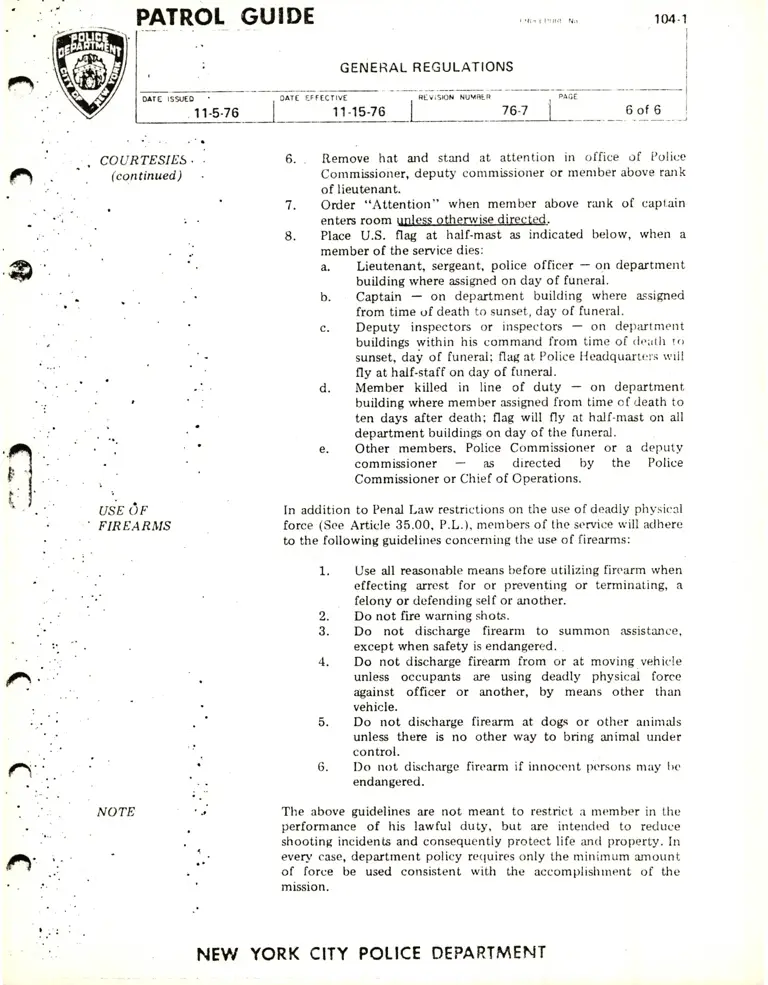
In addition to Penal Law restrictions on the u.se of deadly physical
force (See Article 35.00, P.L.), members of the service will adhere
to the following guidelines concerning the use of firearms:
1. Use all reasonable means before utilizing firearm when
effecting arrest for or preventing or terminating, a
felony or defending self or another.
2. Do not fire warning shots.
3. Do not discharge firearm to summon assistance,
except when safety is endangered.
4. Do not discharge firearm from or at moving vehicle
unless occupants are using deadly physical force
against officer or another, by means other than
vehicle.
5. Do not di.scharge firearm at dogs or other animals
unless there is no other way to bring animal under
control.
6. Do not discharge firearm if innocent persons may lie
endangered.
NOTE The above guidelines are not meant to restrict a member in the
performance of his lawful duty, but are intendr'd to reduce
shooting incidents and consequently protect life and property. In
every’ case, department policy recjuires only the minimum amount
of force be used consistent with the accomplisliment of the
mission.
NEW YORK CITY POLICE DEPARTMENT
INCIDENTS OF FIREARM DISCHARGES BY POLICE OFFICERS 1973-1979
. - /-• J '■ .. a' r . . ; / . ■ ’ ■ . ,
: k s 7 ^ ' . ' ■■'
' ••'■'- ' ^ j r d a t e - ' ' '
: '.r-.
. m L .
VjgjiliipjUitmerits accountable. It's -a complex business
and they should do more. We need to do a lot more
" rfesearch in order to be able tq do that well.
I don't think it's ever proper for the mayor to say,
"I met sergeant so-and so at a meeting last night
and he impressed me a lot. I think he should be
assigned to this unit or that uni^" 1 think that's the
kind of interference that's improper.
Q: Many cities have been forced to cut back their
police budgets and lay off employees. How do you
think city-officials can ensure adequate police
protection with less money? ,
I think’ every effort must be made to get more
out. of. existing resources, that I's, to make the
departments more productive- And I believe very
strongly that there's room for improved produc-
■ tivity in most police departments in the United
States. What I'm saying, in effect, is that there are
many departments that could suffer a loss of 2
percent or 3 percent or maybe 5 percent, but, by
impmvaments.'cduld make up foe that
■ loss.‘I tfiihk that's what the cities have to face up to:
to analyze whether their departments have any
wastp or fat in them and to determine how to make
. them more-effective.
' '
^ Q ; The National League of Cities and the Police
Executive Research,Forum conducted a joint study
.of police collective bargaining agreements. One
• conclifsion was; that both city-officials and police
"executives have.often bargained away manage-
.. ,ment rights crucial for effective police services.
‘ What suggestions do you have for city officials as
they attempt ̂ to negotiate with increasingly
tnilitant police unions?
> A:- 1 think the 'people responsible for the
negotiating, and the people responsible for making
the hard decisions about money and benefits should
devo.te as much time as they possibly can to
improving their own knowledge of issues. I think
■̂ that includes the mayor and city manager to some ,
extent, but, to a much greater extent, it applies to
.the lalxjr relations negotiator, the police chief, the
■ personnel department and the people in the police
department who negotiate particular issues.
. ■ SKCmd, 1 think the cities have been penny-wise
and poUnd-foolish in not having the legal and labor
relations expertise on their side of the bargaining
tablO.'The unions have been able to afford very
expensive labor lawyers and if the city doesn't have
the: same strength, it will be at a’disadvantage. To
me;>it heast, it is quite clear that this has been the
case in many cities and that many management
prerogatives have been negotiated away,
Q; We think that one of the most valuable
services that NLC has been able, to offer through
Police Foundation funding is the special Consulta
tion Service on Policing. Could you comment on
why you thought it was important to establish
such a service and the contribution that the service
can make to city officials? . • ‘
A: T think this kind of service can be uniquely
■val.uable»r'bccauM ,L, seetit. involving both police
Sec p, 6# coLl
Guidelines on
Deadly Force
by Quinn Tamm
The use of deadly force
by police came up again
as an issue at the annual
conference of the Inter
national Association of
Chiefs of Police (lACP)
in September when the
National Organization
of Black Law Enforce
ment Executives (NO
BLE) su b m itted a
resolution about it.
Although the resolutions committee.,
^^recommended its adoption, it was defeated two to
one at a business session.
The resolution called for the promulgation of
clear and uncomplicated firearms policies by police
departments and other law enforcement agencies.
It said such p>olicies should be based on the principle
that no officer's weapons should be discharged
except in the defense of life and would have
required police departments to insure proper
investigations once deadly force has been used.
I cannot stress too much how pressing the
problem of police use of deadly force has become.
The National Center for Health Statistics of the
U.S. Public Health Service tells us that between
1968 and 1976, law enforcement officers killed
3,082 civilians. Since 1970, American police have
killed, on the average, one person a day. Of these, at
least 50 percent have been nonwhite.
Even if a police executive or a mayor is not
concerned with the moral issues involved in this
problem, he or she certainly must be aware of some
of the practical ones. Better police relations with
minority communities are certainly not fostered
when deadly force is used so much more frequently
against the members of those communities.
Another practical aspect is money. Cities and their
police departments have increasingly become the
targets of liability suits as a result of police use of
excessive force, and defending against them is
expensive.
For these reasons alone, the principles put forth
the NOBLE resolution deserve some verym
serious thought by both city and police officials.
The principles are not totally new. For years, FBI
policy has permitted an agent to shoot only in self-
defense or to protect the life of a citizen. In other
words, the policy eliminated the old "fleeing felon"
rule, inherited from English common law, that
exonerates an officer who kills a fleeing suspect
after calling a warning.
Adopting strict guidelines such as those proposed
by NOBLE and used by the FBI is advantageous to
the public, the city government and the police
department. Having them is a boon to the police
See p. 8, col. 2
Muiphy from p. 6
.xanipl,. I„
interseclioncoMrolforyeMs'hilb"'* °I''7
of sworn police offirP^« I r
having to m e ^ t h f Same sUnd^ employees, ‘not
same high salaries, are d i r e c t traff "°^
ja r as I know. So it's f
productivity and cost effectiveness
problems city of«cills^*ndju" *hrce major
should be addressinir in th P°hce executives
. A: I think budget a^d
issue: how to stretch thp^f activity are the first
Second, I °hink L r '
management are very mucfTne
two things under one boarl- ‘̂ êd. Third, I'd put
relations: minority hiTing'^fnT'^ minority -------------------------y Hiring and promotion and
Guidelines from p. 5
use* d t c l^ ? ;r ™ r ‘T ' " •»
This /, an awe'om° K ' " ?'>'>' ‘h* W
thet the person c h a r g e T S it k i r “"'l'
«S expected of him or her h i^ ̂ l what
Jhese expectations and knovf tha" his
wha, the officer need, from society, then, i, a
excessive use of force. ‘ ' ■
ma^or^fi^%*'®n‘* the^ *̂ h’ ***̂ ® ^̂ ormdaUonaand a
communities, what do^vn*^ ̂ public policy'
contribute to police imnmv hope to
years? ̂ ovement in the coming
- a * an"d' ifm a li'°g tm w ° " : , ^ has
participation by plhce ^^"Ptance and
done research her^at thi / J " "^search. We've
our Police Executive Research p ‘° "
Executive Institute, which ^ is ^ T '" '
training program, and through "poHcp
^ e t a ^ c T a 'n d ^ t S -n -h i-l'^
need to do more research in their own JpaVtm Vnt7
authorlration bills have b^n
not set a date for their meeting have
K e?n 'ed ;°rM a'ss') S !!' '" 'n ^ Edward
Max Baucus (D-Mont r i o ^^‘ Aciz.),
^ H e f , ,n ,D - A | a l ‘ i a , , f ,:^ ':d S °:s°g;
6 - t m r * e use of
established procedure for inv . *̂ ^̂ ,'"‘ng and an
X L r s r - o F ^ S e t e f H s '^
m a?om : n r “ l“ f c U ' t ^ 1 « T
ec Members Named
S b t f and
of R e p l S : , ™ " : ; : ' ^ ' > h a House
Robert Kastenmeier (D-V\S )' R 7
.u i :S h n ^ 'h b r o o k < R .b h io ) ;a " ° d S '„ ';; 'g ;^
35.27 PENAL LAW
t
Part 1
rliat latter was peace* officer was
coMstiimioiial. I’cople v. Lattanzio,
HiTll. rtic N.Y.S.l’d Itl.'!.
2. Purpose
This section providing: tli.'it a i)cr-
soM may not use pliysical force* to re*-
sist ail arrest, whether aiithorizeel or
iiiiaiitliorize*el, wliicli is tieiiif: effi*cti*cl
or atti*nipti*el ley a peace offie-e*r whi*ii
it woiilil re*asonalily ap|M*ar tliat tlu*
hitti*r is a peace* eitfice*r is elesi);neel
to preire'e't pliysical safety of averaKC
citizen as well as that of pi*ace offi-
e'i*r, anil epiiti* propi*rly ilisconrafics
alteriatioiis anil eliniinati*s the* risk
of injury. I’i*opli* v Sininis. litTl, ;?(!
A.l).-_'il -J.!. :tl!t N.V.S.'Jil m .
Ity l■nae•lin!: this si-ction proviilin;;
that a pi*rsoii may not use physical
fore'i* to ri*sist an arre st whetlii*r an-
thorizi'il or iiiianthorizeil which is
hi*iii!r effi'eli-il or atte*nipti*el by a
pi*ace offii*e*r whi*n it wonlil reasona-
iily appe ar that latti*r is a iieaee offi-
l•l*r. le"is|atnre iliil not intenil to ex-
lianil sniestantive* scope i,f se'otion
ri'hitiniJ to violation for re-
sistiiiK arri'st. hut nieri*ly sonjilit to
take* away from a ilefcnilant cliars;i'il
with an orfensi* such as assault the*
ih’fensi* that physii’c.l forie iiseil was
jiistifii'il iineli*r circnnistanci*s hecansc
attenipti'il arr i’st which h'll to assault
was iinauthoriziil. l ‘e*opli* v. I,yke,
lit?;?. 7*J Misc.L’il 1040, ;!40 N.Y.S.‘Jil
;Cm.
3. Generally
This si'ciion proviilinR that a i>er
son may not use iihysical force to re
sist ail arrest, whether aulhorizeel or
iinautliorizeil, which is heiiu: effeeteil
or atti'iiipteil by a fieace offi(*i*r when
it wouhl reasonably appi*ar that the
latter is a jieace offie?er iloes not cre
ate a new substantive crime*. People
V. Simms, 1!I71, .30 A.D.2 il 2.3, .310 N.
Y.S.LM 144.
This si*ctioii lerohibitiii); the use of
jiliysical force in resistitiK an arrest,
whi*ther aiithorizeel or unauthorized
is nothiiiK more than a liinitalion
upon the invocalioii of trailitional
sclf-ili'feiise exemption where polie*i*
offici*rs are* involvi*il anil iloi*s not
make* it unlawful to resist an iinan-
thorizi*il arrest. l ’i*o[ili* v. Aili*y,
1074. 70 Misc.-Jil ."..SO, .3.31) N.Y.S.2,1
0.S1.
4. Elements of offense
Authorization for arrest is an in
dispensable elemi*iit of offi*nsi* of n--
sislinu' arrest. Pi'oiile v. Alley. 1074.
70 Mi.sc.2 il .">.Si), .3.-.0 N.Y.S.2d O.Sl.
5. Physical force within section
'I’liis si'ction which was inti*iiiliil
mcri l.v to pri*vi*nt l•omhat arisiiiK out
of a elispiiti* ovi*r valiility of an ar-
ri*st iloe*s not pri'vent an indiviiliial
from protectinc himself from an iiii-
ju st i f i i ’il bi*atins by the* polii*e. Peo
ple* V. Sauza, 1071, .37 A.I).2 il 0.32, 323
N.Y.S.2d 0.32.
6. Instructions
.Jury shoulil have been chari;e*il on
the* ile*fensi* of justification in |irosc-
cution for ri*si.stin!; arrest, where* evi-
di*nce i.eliliiceil at trial permitted in-
fi*ri*nci* that eli*fendant was the vic
tim of an unprovokeil poliee assault
or the* use* of exce*ssive physical force*
to effectiuite an arrest. Peoide* v.
Sauza. 1071, .37 A.I),2d 032, .323 N.Y.
S.2d 032.
This se*ctioii proviillnit that a pi*r
son may not use physical force to re
sist an arri*st whether authorizi*il or
unauthorizeil which Is lK*iiic effecti*il
or attempted by a peace officer whe*n
it would reasonably appear that hit
ter is a peace offievr was impropi*rly
included within charRe concernlnK an
alli*);ed violation of section 20.3,30
povernint; misdemeanor offense of re-
sistinp arri*st inasmuch ns it niisli*il
jury into expaniliiiK substantive*
scope* of tills section. Peoiili* v.
Lyke, 1073, 72 Misc.2d 1040, 340 N.Y.
S.2d .3.37,
tt*'
Part 1 JUSTIFICATION § 35.30
112
•;? .•
§ 35.30 Justification; use of physical force in making an
arrest or in preventing an escape
1 A peace officer, in the course of effecting or attempting
to effect an arrest, or of preventing or attempting to prevent the
escape from custody, of a person whom he reasonably believes to
have committed an offense, may use physical force when and to
the extent he reasonably believes such to be necessary to etiect
the arrest, or to prevent the escape from custody, or to defend
himself or a third person from what he reasonably believes to be
the use or imminent use of physical force; except that he may
use deadly physical force for such purposes only when he reason
ably believes th a t :
(a ) The offense committed by such person w as;
(i) a felony or an attempt to commit a felony in
volving the use or attempted use or threatened imminent
use of physical force against a person; or
(ii) kidnapping, arson, escape in the first degiee,
burglary in the first degree or any attempt to commit
such a crime; or
(b) The offense committed or attempted by such person
was a felony and that, in the course of resisting arrest
therefor or attempting to escape from custody, such person
is armed with a firearm or deadly weapon; or
(c) Regardless of the particular offense which is the sub
ject of the arrest or attempted escape, the use of deadly
physical force is necessary to defend the peace officer or
another person from what the officer reasonably believes
to be the use or imminent use of deadly physical force.
2. The fact that a peace officer is justified in using deadly
physical force under circumstances prescribed in paragraphs (a)
and (b) of subdivision one does not constitute justification for
reckless conduct by such peace officer amounting to an offense
against or with respect to innocent persons whom he is not seek
ing to arrest or retain in custody.
3 A person who has been directed by a peace officer to as
sist such peace officer to effect an arrest or to prevent an escape
from custody may use physical force, other than deadly physical
force, when and to the extent that he reasonably believes such to
be necessary to carry out such peace officer’s direction, unless
39 McKinney 55 1 .0 0 -1 3 9 .— 13 113
§ 35.30 PENAL LAW Part 1
he knows that the arrest or prospective arrest is not or was not
authorized and he may use deadly physical force under such cir
cumstances when:
(a) He reasonably believes such to be necessary to defend
himself or a third person from what he reasonably believes
to be the use or imminent use of deadly physical force; or
(b) He is directed or authorized by such peace officer to
use deadly physical force unless he knows that the peace of
ficer himself is not authorized to use deadly physical force
under the circumstances.
4. A private person acting on his own account may use phys
ical force, other than deadly physical foi'ce, upon another person
w'hen and to the extent that he reasonably believes such to be
necessary to effect an arrest or to prevent the escape from cus
tody of a person whom he reasonably believes to have committed
an offense and who in fact has committed such offense; and he
may use deadly physical force for such purpose when he reason
ably believes such to be necessary to:
(a) Defend himself or a third person from what he rea
sonably believes to be the use or imminent use of deadly
physical force; or
(b) Effect the arrest of a person who has committed
murder, manslaughter in the first degree, robbery, forcible
rape or forcible sodomy and who is in immediate flight
therefrom.
5. A guard or peace officer who is charged with the duty of
guarding prisoners or an employee of the drug abuse control
commission who is charged with the duty of securing the custo
dy of a certified drug dependent person or a narcotic addict re
quired to undergo a period of inpatient treatment as a condition
of probation or a detained alleged drug dependent person in a
detention facility, as that term is defined in section 205.00, or
w'hilfe in transit to or from a detention facility, may use physical
force when and to the extent that he reasonably believes such to
be necessary to prevent the escape of a prisoner or a certified
drug dependent person or a narcotic addict required to undergo
a period of inpatient treatment as a condition of probation or a
detained alleged drug dependent person from a detention facility
or from custody while in transit thereto or therefrom.
Added L.1968, c. 73, § 8 ; amended L.1972, c. 598, § 1; L.1973, c. 676,
§ 27.
114
JUSTIFICATION
H istor ica l Note
35.30
2 '
%
A'*
t
1973 Amendment. Rutid. T,.197.3.
P 670 § 27, eff. Sept. 1, 197.3, siibRti-
tuted' “'oniployeo of the drop nboso
control commission who is rlmrpcd
with the dut.v of spcnrinp the custod>
of n certified drop dependent person
or a narcotic addict reipnred to nn-
der-’o a period of inpatient treat
ment as a condition of prol.ation or a
' detained alleped drop dependent per-
son" for "employee of th(' <lrnp abuse
control commission "h o is charped
with the dtity of seenrinp the custody
of a ccrtifieii or detained alleped nar
cotic addict" and “a certified drup
dependent person or a narcotic addict
' required to nnderpo a period of inpa
tient treatment as a condition of pro
bation or a detained alleped drop de-
person" for “a certified or
detaineii alleped narcotic addict.
1972 Amendment. Solid, n. 1.1972.
c. ri9.S, § 1. *'**̂ *’ '
Mav 24, 1972. inserted "or an em
ployee of the narcotic coidrol com
mission who is charped witli tlie dut.v
of seenrinp the custody of a certified
or detained alleped narcotic addict
and “or a certified or detained al-
leped narcotic addict."
Derivation. Former section 3.'i..30,
added 11.190.'., c. 1030. and rei.ealed by
L.19tVS. c. 73. S 8. Said
tion :r>..30. was from Penal I .a " 130. ,
55 246. 103.'). for history, see 5 •l-'.io
note al)Ove.
*4 • y
.̂3
rj*:
Practice Commentaries
by Arnold D. Hechtman
This section deals with the questions of when and how
categories o p ̂ are; peace officers in geneial
r r r the . f ,«ace
officers (subd 3 ) ; private persons acting on their o " " »c
f u S ( s u S 4) I and" .uards and other ^
orisons and other detention facilities (subd. )■
Tear foHovvdng its coming into effect, the section
restructured and reformulated in several ^ ^ ^ s ta n ^ ̂
t rr iQ6« c 73) The most important subsia
r n « e , S e d t the use of physical force h , peace oft c e „
a " r y arrests and preventing escape, from «s V,
particularly expanding
officer’s permissible use of deadly physical force.
Peace officers in general (subda. 1, 2)
The chief proposition postulated by subdivision 1 is,
in subsin^e, t L t \ peace officer having - s o n a b l e ^
believe that a person has committed an
mav in order to arrest him, use as much physical force, short
of the deadly variety, as he reasonably believes necessary
to effect the arrest. While the former ^ §
.n o provision expressly dealing is
c246 [1 ] ) . and while the case law relating to the matter
115
§ 35.30 PENAL LAW Part 1 P art 1 JUSTIFICATION § 35.30
rather sparse, approximately the same principle seems to
have been followed by the Court of Claims in disposing of
death and personal in jurj' actions against the state based
upon alleged negligence of, and improper conduct by, peace
officers in apprehending offenders (Fletcher v. State, 1959,
15 Misc.2d 1014, 1017, 183 N.Y.S.2d 265, affirmed 9 A.D,2d
862, 194 N.'i.S.2d 456; Houghtaling v. State, 1958, 11
Misc.2d 1049, 10,54-1055, 175 N.Y.S.2d 659; Lippert v.
State, 1955, 207 Mi.sc. 632, 636, 139 N.Y.S.2d 751).
With respect to the use of deadly physical force, however,
the problems are more intricate and controversial. The
lesser difficulty involves the use of deadly physical force
when the peace officer reasonably believes such to be neces
sary to defend himself or another from what he reasonably
belie\es to be the use or imminent use of deadly force by the
arrestee (subd. ( I c ) ) .
The greatest difficulties arise in situations where there
may be no danger to the officer or anyone else but the
officer simply cannot catch the arrestee without using
deadly force (ordinarily his revolver). Here, the deadly
force authorization is made to rest upon the kind of offense
which is. or is reasonably believed to be, the subject of the
arrest. The old Penal Law required merely that it be a
felony ( § 105.5 [3 ] ) . The original Revised Penal Law section
required that it be “a felony involving the use or threatened
use of deadly physical force” (original § 35.30 [2 b ]).
The latter provision was intended to exclude non-violent
felonies fe. g. forgery, car theft) but to preserve the of
ficer's right to use his revolver for apprehension of persons
reasonably believed to have committed felonies of a violent
and physically dangerous nature, such as homicide, robberj'
and forcible rape. It was criticized, however, as being too
narrow and imprecise for the purpose. One contention
advanced was that some robberies (e. g. muggings) and some
forcible lapes may not involve either the use or threatened
use of deadly physical force,” and that in any event it is
unfair to saddle the police with the difficult burden of deter
mining when the force used in any given case was of a
“deadly” nature.
Out of these considerations, the provision was changed to
authorize deadly force by the officer in apprehending for
any felony or felony attempt involving the actual, attempted
or threatened use of any physical force, whether of a deadly
nature or-otherwise (§ 35.30 [ la i ] ) . This clearly covers,
inter alia, every conceivable robbery and forcible rape.
116
I"
In addition, moreover, four specific felonies— kidnapping,
arson, first degree escape and firs t degree burglary are
explicitly placed in the same category (id. [ la i i ] ) . The
reason for this is that those crimes, which do not neces
sarily involve the use of any physical force at all and,
hence, are not necessarily covered by the previous clause,
are nevertheless of such a serious and dangerous character
as to merit the use of deadly force by the police in their
efforts to apprehend the perpetrators.
Another situation justifying deadly force by peace officers,
for arrest purposes involves the armed fleeing felon. The
original section permitted deadly force by the officer to
arrest any felon, regardless of the kind of felony committed,
“attempting to escape by the use o f a deadly weapon”. This
was of limited application or utility in that virtually all
such cases would apparently be covered by the above treated
provision justifying deadly force by the officer to defend
against threatened or imminent deadly force by the arrestee
(§ 35.30 [ I c ] ) . WTiat was not covered was the situation in
which the pursuing officer knows or has good reason to
believe that the fleeing felon, though not brandishing or
using a deadly weapon at the moment, has a gun or knife in
his pocket which he may well use on the verge of capture.
With this in mind, the amended provision (subd. lb ) expands
the original one by authorizing deadly force by the officer
where necessary upon a reasonable belief merely that the
felon “is armed with a firearm or deadly weapon,” regardless
of whether he is presently using it.
Subdivision 2, which is new (cf. A.L.I. Model Penal Code
§ 3.07 [2 b iii]) , is aimed at protection of innocent bystanders
from police action which, though in the line of duty, is
performed recklessly or negligently. The application of the
provision may be illustrated by considering the case of a
police officer pursuing through a crowded business area
of a city a man who has committed an armed robbeiy.
While the officer has a general right to shoot him in order
to effect the arrest, that right is qualified and superseded
by his duty to avoid injuring innocent persons by reckless
or criminally negligent use of his pistol. I f he both inten
tionally shoots the robber and recklessly kills a bystander,
the fact that he was authorized to do the former does not
justify the latter. On the other hand, his justification for
shooting the robber is not negated by his reckless shooting
of the bystander.
117
1320
4 ■
Ap,)ollant,s further ar^̂ uo lhai ihe slau.
'T.eru concorninjr
i-acUhat
test ifiv('/i lo I < i ^
H i r r a c r t h ' , ' " “ '" '" * '" " k I'I '•I'that LoisinK^T lcslifu.,1 „, ,rreai
u I : : ‘“ '"■” ........... ...........caused the gram shortage.
The refusal u, grant a mistrial or give a
c ^ o n a r y mstrucUon was not projmheial
Thepe being no merit in any of t|„. appel-
lanU^iarguments. the eonv,et,ons are 'af-
■̂ 7« FKDEKa l r e p o r t e r , 2d SERIES
L̂’at: ( 1) ,U u n U n had standing to
I'fosee-ute the action- I9\ fl. ,
the complaint,
S "fTftlJUSfRSrSKMN
I T _____ X
"■'« of Ih . hslaie
rum. Deceased, Appellant,
John MOATS and Robert J.
Rockwell, Appellees.
No. 77-1656.
though vaeue si - . t . i ' complaint,
ficienl t of action suf-
en to confer juri.sdiction; (3) the Ne-
aska ,s atute pertaining to the use of
o f f i c U " (T) to ,a)lice
police officers exer
ther o f k ./ f ^ d ie v tZ
-hich they .sought to arrest t h r ^ s p i "
orr " t t t " " T ' ' ' ' ‘-" ‘̂-'"‘-'‘' useofdea.ily CC th.,t a substantial risk existed that
he suspect would cause death or serio l
o 'l y harm if his apprehension were de
‘ayod; (.5) the officers were entit J to
t '>‘-‘' ‘cT .n the propriety of their
lief-' "(tinh 7 7 ' " “*''''''"c l, (b) I he defense of good faith w.
fa.th
“ 7 “ " ..... ■
r „ :7 r i r ;r
'Reversed and remanded.
United Slates Court of Appeal
Eighth Circuit.
Submitted ,Jan. 11, 1'.17k
Decided May ;{(), 1P7H
civil
lli« jV ry T a '*"" 7 ”'' Afternt jury returned a verdict for the police
, r T n 7 7 ‘' 7 ' - “ "at
J„ .lenied posttrial motions for
judgment notwithstanding the verdict or
Ti,:
'f ^ '’pcals. Bright, Circuit .Judge,
E federal Courts *=,542
An appellate federal court must satisfy
■d ofTh / - " ' " f " " " butI o of the jurisdiction of the lower court in
Ihe cause under review.
■i- federal Courts c = 4,‘Jl
Nebraska law fr/tc/.m.. i
7r"™ ‘
lice ocr ^ ugainst city p,,.
■ c officers to recover damages for L
19HS 42 U..S.C.A. §§ 1983,
J. Civil Rights 0=13.6
fite^h'’" 'i 'l of her son’s es-
, had slan.ling under Nebra.ska law to
n n , civil rights action against city H i^ :
fleers to recover damages for the shooting
-•'.■Ih of plaintiff’s son as he fled from the
f f
see
19!-
4.
ter
fac.
5. (
legi
imn
law
.siv.
wa.'
6. (
civi
clai
Sixl
coul
u.se
did
ny
U.S.
C.A.
7. C
wha
the 1
exac
teetc
of dc
had
and
Fifth
.4 me:
killei
the s
actioi
jurisi
Consl
8. Co
1
protei
lakin)
quirei
Amen
14.
scene of a burjjlary.
1988; R.R.S.Nel).1943, § 30
42 U.S.C.A. §§ 1983, 9. Municipal Corporations <fc=188
LANDRUM V . MOATS
Ci(easS76F.2d 1320 (1978)
1321
810.
4. Federal Courts c^32
In order for court to have subject mat
ter jurisdiction, the pleadin) ̂ must on its
face state a co)!;nizal)le claim for relief.
5. Civil Rights «= 13.3(1)
In a civil rights action to redre.ss al
leged deprivations of rights, p'rivileges or
immunities secured by the Constitution and
laws, plaintiff must be able to point to a
specific, articulable constitutional right that
was transgressed. 42 U.S.C.A. § 1983.
6. Civil Rights <3=13.12(3)
For pur[)ose of determining whether
civil rights complaint state<l a cognizable
claim for relief, each of the Fourth, Fifth,
Sixth, Eighth and Fourteenth Amendments
could be plausibly construed to forbid the
use of deadly force on a fleeing felon who
did not use violence in committing the felo
ny and who posed no threat to anyone.
U.S.C.A.Const. Amends. 4 (i, 8, 14; 42 U.S.
C.A. § 1983.
7. Civil Rights <5=13.12(4)
Despite fact that c<»mplaint was .some
what vague in that it di<l not specify either
the nature of the right allegedly violated or
exactly which constitutional provision pro
tected the right, complaint wherein mother
of decedent asserted that city police officers
had deprived her son of rights, privileges
and immunities guaranteed by the Fourth,
Fifth, Sixth, Eighth and Fourteenth
Amendments when the officers shot and
killed |)laintiff’s son while he was fleeing
the scene of a burglary stated a cause of
action sufficient to confer subject matter
jurisdiction. 42 U.S.C.A. § 1983; U.S.C.A.
Const. Amends. 4 6, 8, 14.
8. Constitutional Law <3=274(2)
The right to life is fundamental and is
protected against unreasonable or unlawful
takings by the procedural due process re-
(|uirements of the Fifth and Fourteenth
Amendments. U.S.('.A.Const. Amends. 5,
14.
The Nebraska statute pertaining to the
use of force in law enforcement iloes apply
to police officers, notwithstanding fact that
the .section refers only to “actors” and that
the statutory definition of “actor" excludes
law enforcement officers. R.R.S.Neb.1943,
§§ 28-833 to 28- 843, 28 -839.
10. Municipal Corporations <3=188
Where police officers who pursued and
fatally shot burglary suspect did not believe
that the crime for which they were seeking
to arrest the sus|>ect involved the use or
threatened use of deadly force or that a
substantial risk existed that the suspect
would cause death or serious bodily harm if
his apprehension were delayed, the |)olice
officers exercised unreasonable force as a
matter of law, under Nebraska law, in fir
ing at the sus[)ect as he fled. R.R.S.Neb.
1943, § 28-839.
11. Civil Rights <3=13.4(2)
Fact that city police officers used ex
cessive force as a matter of law in connec
tion with incident that led to death of bur
glary suspect did not necessarily establish
that the police officers were liable to the
suspect’s mother for unreasonable or un
lawful taking of the suspect’s right to life;
rather, |)olice officers were entitled to de
termination whether they acted in good
faith. 42 U.S.C.A. § 1983.
12. Civil Rights <5=13.8(4)
In actions to obtain damages for civil
rights violations, jjolice officers are entitled
to a qualified immunity from liability based
on good-faith l)clief in the ()ropriety of their
actions and reasonable groumls for that be
lief. 42 U.S.C.A. § 1983.
13. Civil Rights <3=13.4(2)
In evaluating [wlice conduct relating to
an arrest for purpose of determining
whether the conduct violated the arrestee’s
civil rights, the court’s guideline is good
faith and pnibable cause. 42 U.S.C.A.
§ 1983.
14. Civil Rights <3=13.10
In a.ssessing the |)ropriety of force used
by the police to effect an arrest, for purpose
1 (
1322 576 FEDKKAL KKPOKTEK. 2d SEKIKS
of delermininj? any liability for civil rijjhls
violations, |K)licc officers arc entitled to the
defense of };ood faith, even if their use of
force turns out to have been illej^al or ex
cessive, if the officers believed that a cer
tain amount of force was necessary to make
an arrest and that use of that amount of
force was lawful umler the circumstances
and if the officers had reasonable grounds
for each of those beliefs. 42 U.S.(3.A.
§ 1983.
15. Civil Rights <®=» 13.10
The defense of good faith is not inaj)-
plicable to a civil rights action ba.sed on
excessive force and assault and battery by a
police officer. 42 U.S.C.A. § 1983.
16. Civil Rights «= 13.10
In civil rights action against city police
officers wherein decedent’s mother sought
damages for the shooting death of her son
as he fled from scene of burglary, the appli
cation of a gooil-faith defense was not pre
empted by Nebraska law. 42 U.S.C.A.
§ 1983; R.R.S.Neb.l943, § 28 841.
17. Civil Rights <3=> 13.5(1), 13.10
The section imposing liability for depri
vation under color of state law of rights,
privileges or immunities secured by the
Constitution and laws provides a federal
remedy for the redress of wrongs done un
der the color of state law and, as such, state
law or the prevailing common-law view is
not decisive as to the availability of defens
es; rather, the prevailing common law must
be considered in light of policies and pur
poses of the civil rights action to determine
whether importation of a defense, or allow
ance of a defense where the common law
provides none, is appropriate. 42 U.S.C.A.
§ 1983.
18. Civil Rights <*=13.10
In defending against civil rights action
to recover damages for the shooting death
of plaintiff’s son as he fled from .scene of
burglary, city police officers were entitled
to rely on provisions of their police manual,
even though those provisions conflicted
with the postincident interpretations of
state law as pronounced by the district
court. 42 U.S.C.A. § 1983.
19. Civil Rights ‘£^13.14
Hecause good faith is depen<lent on mo
tivation and conduct of the defendant as
established at trial, the validity of the de
fense of g(H)d faith is ordinarily a (juestion
for the jury, in a civil rights action. 42
U.S.C.A. § 1983.
‘20. Civil Rights 13.13(1)
In a civil rights action presenting a
(juestion as to the defendant’s good faith,
ljurden is on defendant to [)rove each ele
ment of the good-faith defense to the jury’s
satisfaction. 42 U.S.C.A. § 1983.
21. Federal Civil Procedure <*=2342
Where verdict in favor of city police
officers, in civil rights action arising out of
fatal shooting of burglary sus|)ect, was un
supported by the evidence and contrary to
the instructions upon which the case was
submitted to the jury, plaintiff was entitled
to a new trial. 42 U.S.C.A. § 1983.
Charles 0 . Forrest, Omaha, Neb., argued
and on brief, for api>ellant.
Timothy M. Kenny, .Asst. City Atty.,
Omaha, Neb. (argued), and James E. Fel
lows, Omaha, Neb., on brief, for appellees.
Before BRIGHT, STEPHENSON, and
HENLEY, Circuit Judges.
BRIGHT, Circuit Judge.
Leslie Landrum, special administratrix of
the estate of her son, Roy Lee Landrum,
brought a civil rights action under 42 U.S.C.
§ 1983 (1970) and a common law tort action
against Omaha police officers John Moats
and Rol>ert Rockwell seeking damages for
the shooting death of her son as he fled
from the scene of a burglary. The jury
found for the defendants, and the district
court denied post-trial motions for judg
ment notwithstanding the verdict or a new
trial. Plaintiff then brought this appeal
as.serting primarily that the district court
erred in its rulings on these post-trial mo-
tion.s. In support of the verdict, appellees
Moats and Rockwell contend that under an
.ippnipna'i
they were
Based o
affirm the
ing judgm
denying a
to the disi
I. Facttti
On Aug
dispatcher
.Moats tha
service si
Boulevart
proceeded
they enU
they saw-
exit throi
the stati(
debris an
officers 1
Rockwell
Landri
crouched
cers. Hi
Officer .1
while s4ai
missed, ;
shouting
the nort
they sto:
as he ra
most sit
struck 1
No wt
trial, Lko
no reasi
threat 1
’I'he of:l
force (»ti
Landrui
him. li
1. The:
or off
whofit*
s iv t Iv
2. Th<-
IMlhCT
art
a hric
viiuin
LANDRUM V . MOATS
CUca.'>57<>f .2d 1320 (1978)
1323
appropriate construction of Nebraska law
they were not lial)le as a matter uf law.
Ibised on our review of the record, we
affirm the order of the district court d(jny-
ing judgment n.o.v. We reverse the order
denying a new trial, however, and remand
to the district court for a new trial.
I. Factual Background.
On August 15, 1975, at ‘2;<10 a. m., a police
dispatcher informed officers Rockwell and
Moats that a burglary was in progress at a
service station located at 4501 Florence
Boulevard, Omaha, Nebr:iska. The officers
l)roceeded immediately to the address. As
they entered the driveway of the station,
they saw the decedent, Roy Lee Landrum,
exit through a window on the north si<le of
the station, jumping onto some tires and
debris and then down to the ground. Both
officers leaped out of the car, and officer
Rockwell hollered: “Stop, police.”
Landrum a(>parently he:ird the shout and
crouched down, looking directly at the offi
cers. He then turned to the east and ran.
Officer Moats fired a single shot at him
while standing by the police car. The shot
missed, and both officers chased Landrum,
shouting at him to halt, until they reached
the northeast corner of the station. There
they stopped and began firing at Landrum
as he ran away, each firing two shots al
most simultaneously. One of the bullets
struck Landrum in the back, killing him.'
No weapons were found on Landrum. At
trial, lK)th officers testified that they had
no reason to believe that Landrum was a
threat to their safety or to anyone else’s.
The officers justified the use of deadly
force on the grounds that they believed that
Landrum would esca|>e unless they shot
him. In doing so, both relied on a directive
1. The parties all apree that either olficer Moats
or officer Rockwell fired the fatal shot, hut
whose bullet killed Landrum was not conclu
sively established at trial.
2. The issue ol standiiip was not discussed by
eiiher (>arty. but beiause it is an eli'iiieiil ul llie
arlu le III requirement ol a ‘ use or controversy
a briel coniiiieiit is in ortler In priK-eedinps to
undiiale iivil riphts, 42 U..SC l!lh« (l!)70)
of the Omaha police department, effective
at the lime of the incident, that among
other things permitted a police officer to
use his firearm in the performance of his
duty to
effect the arrest or capture, or prevent
the escape or rescue, of a [>erson whom
the officer knows or has reasonable
grounds to Ixjlieve has committed a felo
ny, when all other means have failed.
11. Subject Matter Jurisdiction.
[1] Although neither jiarly has raised
the jurisdictional issue and the district
court assumed jurisdiction, it is well settled
that “|a|n appellate federal court must
satisfy itself not only of its own jurisdic
tion, but also of that of the lower courts in
a cause under review.” Mitchell v. Maurer,
29.'̂ U.S. 227, 244, 55 S.Cl. 162, 165, 79 L.Ed.
228 (1924) (f(M)lnole omitted). Therefore,
we deem it a[)i>roi)riate to discuss the feder
al jurisdictional basis for this action.
(2, 2 1 Shortly after the death of her son,
on November 7, 1975, Leslie Landrum filed
the [ire.senl action in the United Stales Dis
trict Court for the Eastern District of Ne
braska. ̂ In count I of her complaint, she
contended that officers Moats and Rockwell
had deprived her son of constitutional
rights, violations of which are actiomdile
under 42 II.S.C. § 1982;
Every |>erson who, under color of any
statute, ordinance, regulation, custom, or
usage, of any Stale or Territory, subjects,
or causes to l>e subjected, any citizen of
the United Stales or other person within
the jurisdiction thereof to the deprivation
of any rights, privileges, or immunities
secured by the Constitution and laws,
shall l>e liable to the party injured in an
action at law, suit in equity, or other
proper proceeding for redress.
authorizes reference to state law for questions
left unanswered by the applicable federal law.
Because § 1983 does not mention standing, we
must turn to Nebraska law in order to as
certain whether Leslie Landrum, the decedent's
mother, has standing to prosecute this action
We hold that she does. .See Neb.Rev.Slat.
§ :i0 HIO (1975 reissue); i7 Mams v. Schnarr.
.502 K.2d 588. 593 (8th Cir. 1974).
i ! I
1324
i ■ i:
in
M «' ‘
•f .
Li I
complaint was a pendent
i.tate^tort claim for assault ami lottery.
In onl.T for the court to have
|*ul.ject matter juris,liction. the plea,liner
— ^n.a.ie claili
lor rUief. In a section ]<J8;{ action the
plaintiff must he able to point to a spJcifk
articulable constitutional rifrht that is’
transgressed.
[6] In the present case, |)laintiff-api>el-
ghth and fourteenth amendment rights-
That the acts of the Defen,lants. John
Moats and Roinirt J. Ibnikwell. umler color of law
y as police officers of the City of Oma
ha, as hereinabove set out, deprive,! Roy
Lee Landrum of his rights, privileges an,i
of the United States, by Amendments 4,
. , and 14 of the Constitution of the
United States, to Plaintiff’s damage in
Sw oS""* 1- an,l $.3,000,- doo.oo punitive damages.
Although the complaint ,li,l not specify ei-
txactly which constitutional provision pro
tected It and how, each of these amend-
ments could be plausibly construcl to forbid
the use of dea,ily force on a fleeing felon
to L y o n t3 - threat
57fi FEDERAL REPORTER. 2d .SERIES
(1976). C.L.L.Rev. ,361. 3 7 1 8 8
'‘’ 197m 538 F.2d 799 (8th Cir
=o’ T V d T d
. r ~ “ - r
S ’. ; ’’. '
5.
Mattis, age eighteen, and Thomas
back Window. Schnarr shluted at thê '’, ‘J :
Plaintiff-appellant’s vagueness is .some
what umlersumlable, for while this court
'<‘-s ent,Ttai„,.,| s.uular .section 10K3 actions
I" the ,,a.,i un,l a.s.sume,! subject matter
precise nature of our jurisdictional power
was vacate,! on procedural groun,!s by the
a-s bimling precedent. Afutt/s v <i..hr,,
M7 F.2d 1007 (8th Cir. 1976) (Maa/s I I / J n
><ine), vacate,/ as moot sub nom. Ashcroft
V. Afattes, 431 U.S. 171, 97 S.Ct. 1739 50
L.Ld.2,1 219 (1977). See a/so MuU/s y
.Schnarr, 502 F.2d 588 (8th Cir. 1974) (Afattfs
(Ihree-ju.lge panel). In Matt/s, a case
with facts nearly identical to this case * this
court rule,! unconstitutional a Missouri’ stat
ute that permitted the police to use deadly
force to apprehend a Heeing felon who has
used no violence in the commission of the
felony and who does not threaten the lives
of either the arresting officers or others
a8.sume,! juris,!,ction by first declaring that
an indivhlual has a fundamental right ô
againlt protected
g nst unreasonable or unlawful taking by
the fifth an,! fourteenth amendments. 547
f.2d at 1017-20. The court declined, h o ^
ever, to find additional constitutional causes
of actions implicit in the case ba.sed on the
to halt. They ran in different directions
Schnarr then shouted, •'Halt or rii shoot”
wo times. When the boys failed to stop 1
Rolf. Meanwhile, Officer Robert Marek who
^ d armed on the scene, ran to intercept the
boys. He collided with Mattis a s h l
around the comer of the building. BotWel!
S e h
ter h?m M u ran afMarek was losing ground Hp
̂ prevent Maths’s es
lh= »s. a ,h „ s„„, „ „
III
6.
7.
In
I -A M ) IU )M
C ilc Hit 576 f-.̂ L
eighth amendment cruel and unu.sual pun
ishment clause and the fourteenth atnend-
melll et)ual protection clause. Id. al KILiO n.
',iZ.
[7, 8] Des|)ite the vagueness of tiu: com
plaint in this case, we find that it slates a
cause of action under section 1988 confer
ring jurisdiction on this court. In particu
lar, we readopl the jurisdictional holding in
Mattis I I : The right to life is funilamental
and is protected against unreasonaiile or
unlawful takings hy the procedural due
process safeguards of the fifth and four
teenth amendments. In view of this hold
ing, we need not consider whether the
plaintiff Leslie Landrum has also asserted
cognizahle claims under the fourth, sixth,
and eighth amendments. We note, loo,
that the circumstances here are distinguish-
al)le from MuUis. In Maltis the police offi
cers relied upon a Missouri statute authoriz
ing their use of deadly force. Here, as we
discuss in part III .■\, the Neliraska statute
in (lueslion restricted the police officers’
privilege of using deadly force.*
III. The Profiricly o f Jud^mcnl ,V. O. V.
As staled above, the parties essentially
agree on the important facts of the case.
Officers Moats and Rockwell conceded at
trial that they had no reason to believe that
6. The holdinn of Maltis II on the merits was
that statutes that authorize police oftieers to
use deadly lone anaiiist neeiiin nonviolent fel
ons are unreasonable per se aiul thus unconsti
tutional As such. It is not un|ilicaled by this
case, which is a challenge to the reasonable
ness of individual police action rather than to a
lenislative grant of power to use ileadly force
undei the circumstances. See part III iidnt.
7. Nevertheless, in their brief they argue as fol
lows:
For while l.andrum brandished no weapons,
nor physically confronted the Defendants,
the situation itself represented a threat to
their personal salely. • • ♦ l l'lhc circum
stances as a whole— lliglit into a darkened
night III a black ncighboi hood, concern
whether the felon was aci onipanied by an
other party— were factors properly causing
Delendanis to be apprehensive loi then |>er-
sonal salety
We re)ect this argument. Landrum was shot in
the bat k as he lletl. No evident t‘ even suggests
the presentf ol an at t (iniplitf or ol .iiiv threat
to ilie otliiers' salety or that ol .tiivont* else.
V. MOATS
It t 3 ZU <I»7H)
the decedent, u burglary suspect, had used
violence in the contmission of the burglary
or lltal lie posed a llireal to anyone’s safe
ty.’ I'oLli leslified llial they shot ;it the
decetltml to prevent his escape from itrrest.
For her part, Leslie Lantlrum iloes not dis
pute the existence of probable cause to ar
rest her son for a felony.
Given the above facts, Landrum proceed-
etl under two alternative theories in prose
cuting her section 1983 claim: (1) the shoot
ing lieath of her son was a per se unreason
able taking of her son’s life; or (2) even if
not per se unreasonable, it was unreason-
;ible given the circumstances. In addition,
she argues here lh:it the good faith defense
normally [irovided police officers in section
1983 actions against them* was unavailable
to these defendants because it had been
expressly jireempled by Nebraska law. We
consider each of these points separately be
low.
A.
In support of her conclusion that the use
of detidly force* against a fleeing, nonviol
ent felon is per se unreasonable, Leslie
Ltindrum relies on this court’s interpreta
tion of the fourteenth amendment due proc
ess clau.se in Miiltis and section 28-839
8. .See, e. g,, Prociinier v Navarette, 4.i4 U.S.
98 .S.Ct Kri.S, .'■>.9 l..F.d.2d 24 (1978,'; Pier
son V Pay. .IKIi U..S. .'>47. 87 .S.Ct. 1213, 18
l. Ld.Zd 288 (19(i7).
9. Deadly force is defined in section 28 833(3)
of the Reissue of Revised Statutes of Nebraska,
1943:
Deadly force shall mean force which the ac
tor uses with the purpose of causing or
which he knows to create a substantial risk
of causing death or serious bodily harm.
Purposely firing a firearm in the direction of
another person or at a vehicle in which an
other [lerson is believed to be constitutes
tleadly force.
10. The following language in Mattis II is partic
ularly relevant:
The police officer cannot be constitutionally
vested with the power and authority to kill
any and all escaping felons, includin.g the
thief who steals an ear of corn, as well as one
who kills and ravishes at will For the rea
sons we have outlined, the officer is required
a *fi
Kt’
1326
SU U .es or Ne-
VVe consi.ler U,, ,uuuU,ry ,.|ai,n f,> .
S-U oo ,H H,,
H.i<). [Is,. „ r i.itforcr-
; ; ; r - <’ > «̂* the provisions .If
- .section nnd of s<s-ti„n 2« Mdl, i|,i. use
<'f oree upon or toward the person of
another ,s justifiahle when the actor is
and 'th '"h' in makinf. an arrest
and the actor believes that such force is
.mmediately necessary to effect a lawful
u nd er!!!' J ‘̂ «tifiableunder this section unless;
(a) The actor makes known the pur
pose of the arrest or believes that it is
^ m Z lT k '•‘-■â onably
(h) When the arrest is made under a
arrant, the warrant is vali.l or believe,I
hy the actor to be valid.
(3) The use of ,lea,lly force is not justi
fiable under this section unless:
(a) The arrest is for a felony;
(b) Such ,)erson effecting the’ arrest is
authorized to act as a peace officer or is
assisting a person whom he believes to be
uthonzed to act as a peace officer;
(c) The actor believes that the force
injury to innocent persons; and
(d) The actor believes that:
(i) The crime for which the arrest is
made involved conduct including the use
or th„au=„„d
(II) here is a substantial risk that the
person to be arrested will cause death „r
- ;^ / - % b a r m i f h i s a p p r e h J ; - : : : :
576 FKDKRAU KFPORTER, 2d SERIES
f lainly one of the prerequisites to t h . .
’ ''[•“"y '^as not met in thi, ,
Neither off..,.r Moats nor R.a.kweU
by sulcsection 3<d)L I
^hich the arrest w«
involve.1 the use or threatene.l use of d.
[; ; ‘7 ’r y a -bstantial risk existed I
Uic deccslent wouhl cause death or
tT u ' u ^''y • Thus It appears that Nebrask*!
mu,le the use of dea.ily force against II
K nonviolent felons unreasonable peri
R o l y i r " ' ^ ’ officers MoaUi
t tn S ' L T l'"'^ that the provisions of,
J T ' '■"'yon section 2 8 3of the Nebraska Co<le. which define
terms used m sections 28-833 to
including the term “actor.” That I
nsed in the section 28-839 provision emX
ctrning use of force in law enfon»m««
apparently excludes Nebraska law 601̂ ^ "
subse,|uent jirovisions;
28-833. Terms, defined. As used
text otherwise requires; *
al Judgmenrre"ma,nm "
but to find
unconstitutional m that they
(4) Actor shall mean any person
uses force in such a manner as to a tte 2 ^
a ffd r r I ' h im m unSlffordul him by sections 28-833 to a u f
, e.vcept any duly authorized law ,
orcement o fficer o f the State o f Vei
7 /'ohffcaf suMivisions •
I Emphasis added.]
[9] As is evident, a direct contradirti.1
exists between the definition of W
an r enforcement offiee,! j
and section 28 -^ 9 , which seems to appl^
law enforcement officers although it « f « |
on y to “actors.” The district
ilercd that issue and ruled that secti, :
cers or others. ( 5 4 7 T L 7 7 0 2 0 ? / '" * I
omitted).J 1020 (footnolii-J
11. •̂>ee note 7 supra.
•i-**
LANDRUM V. MOATS
C i l l - 57« l-.2d 1320 ( I 9 7 K)
1327
28 889 (Iocs apply to police officers, relying'
on the Icfrislalivc history and Icrms of sec
tion 28 S:!;i lliroiif;li 28 SI!!, which were
intended to adopt the Model I'eiial Code
pro\’isions on tlu‘ use of lorce.’-* Uased on
our review of the same sources,'' we aj^ree
with the district court.
[101 Under thesi; circumstances plaintiff
Leslie Landrum established that the jxdice
officers had exercised unreasonable force as
a matter of law.
Because we have determined that appel
lant established the u.se of (.'.scessive force
as a matter of law, we need not consider
her second theory of recovery under section
1983: that if not unreasonable jier se, the
force used by officers Rockwell and Moats
was unrea.sonable under the circumstances.
B.
[11, 12] Our rulinjr that officers Rock
well and Moats used excessive force as a
matter of law does not necessarily mean
that ap|)ellant was entitled to a directed
verdicL at the close of all evidence, thus
authorizinfr judjjment n. o. v. In .section
1983 actions for damaf^es, defendants are
entitled to a (|ualified immunity from liabil
ity ba.sed on ^ood faith belief in the proprie-
12. The rulin(> came in the (ourt's dcmal ol a
motion to dismiss hy the police otliccr I he
trial court wrote in part:
The commentary to .Section :!.()7 ol the
Model Penal Code clearly indicates that this
section IS intended to apply to law enlorcc-
ment officials. .See Model Peiud tiode, tenta
tive draft 8. 5.S 6.3 (Americtm l aw Institute,
I9.')8). In addition the specific laiipuape of
•Section 28 839 which provides in part:
I'he use ol deadly force is not lustiliahle
under this section unless (b) such
person eflectinn the arrest is authorized to
act as a peace officer
mandtites the conclusion that this section ap
plies to law enforcement olliiials notwith
standing the peneral exemption from .Sec
tions 28 83.3 to 28 843, contained in the deti-
nitions.
1.3. In Maids i- Schwirr. .‘547 K.2d 1007, 1013
(8th Cir. 1976), i.icatcdas moot sub iioiii Ash-
crolt c M.itds, 131 U S 171. 97 S ( I. 1739, .'52
I. Kd.2d 219 (1977), we coinnieiued on sei tion
28 8.39 and khu hided that it represeiitcd
ly of ihcir ticlion.s ;ind rcasonttblc (rrounds
for Ihal belief. I ’romnior v. ,V;ic.irefle,
i : m II..S, r,r,r>, w s . a sr,r,. r>r, L ,K d .2 d 21
(1978); Si hoiior c. lihoilos, 116 II..S. 232, 91
S.CL. Ki83, 10 L.K(l.2d 90 (1971).
[13, 14] Thu.s, for example, “[w|hen a
court evaluates police conduct relating to
an arrest its guideline is ‘good faith and
probable cau.se.’ ” Scheuer v. Rhodes, su-
pni, 416 U.S. at 245, 94 S.Ct. at 1691, t/uol-
inpr Pierson v. Ray, 386 U.S. 547, 557, 87
S.Ut. 1213, 18 L.Kd.2d 288 (1967). A similar
guideline must be applied in tissessing the
propriety of force u.sed by the police to
effectuiite an tirrest. If police officers (1)
believe th;tt a certain amount of force is
necesstiry to make an arrest, (2) believe that
use of that timount of force is lawful under
the circumstances, and (3) have rettsonable
grounds for each of the foregoing beliefs,
then they are entitled to the defense of
good faith even if the use of force turns
out, e.v posl, to have been'illegal or exces
sive. See Proeunier v. NtiviireUe, supru ;
W ixhI V. Slrieklnml, 420 U.S. 308, 95 S.Ct.
992, 43 L.Kd.2d 214 (1975); Seheuer v.
Rhodes, stipni ; Pierson v. Rny, sui>r;i.
115-17] The defen.se of good faith is not,
as |)laintiff-ap|>ellant as.serts, inajiplicable
to an action based on excessive force and
the Model Penal Code approach, which per
mits the u.se of deadly force only when the
crime for which the arrest is made involves
conduct including use or threatened use of
deadly force or when there is a substantial
risk that the [lersoii to lie arrested will cause
death or serious bodily harm if his apprehen
sion is delayed, (Kootnote omitted.)
14. The paradittm of "reasonable grounds" for a
ftood faith belief in the propriety of official
action is reliance on a state statute later de
clared unconstitutional. See, e. Pierson c.
Kiiy, :i86 U .S. 547, 5.56 57, 87 S.Ct. 1213, 18
l..lid.2d 288 (1967). Reliance on less tornial
state provisions may al.so be reasonable, fi's-
lin/̂ er v. Thomns. 476 F.2d 225, 229 (4th Cir
1974) (lonpstandint> custom of the South Caro
lina Senate); Clnyhrone v. rhompson, 368
I- -Sup|i. .324 (M 13.Ala. 1973) (standard operat
ion procedures of |>rison), and in our view po
lite oMiters may usually rely on standard oper-
.itinn iirocedures contained m their |xilice ni.iii-
iials , f.
I
i i |
1328
assault and battery.
by Nebraska I aw.*®
576 FKDERa L r e p o r t e r , 2d SERIES
Nor is it [)reem|)ted
15. In the instnictum conference at Inal conn
sTon of an
to In The plaintiff would object
to Instruction No. 11 in that it permits the
defendants the defense of reasonableness in
their belief in the valid stale law, and there is
no question raised by defense counsel a t l y
time dunnK this trial that the law of the state
date of the incident and I do not feel that the
defense of reasonable belief is applicable S
■•"ference to the eodd
faith, the good faith defense is not, in my
opinion, applicable to a case involving exces
stve force and assault and battery u Z l .
ctmis ̂ involving false arrest, mali
cious prosecution, where the issue of proba-
plaintiffs view pre.sent in this ca.se. There is
no claim of fal.se arrest, no claim of maliciLs
prosecution involved. Common law, the de-
fa iT w '■‘'‘*®°"®'’ ''“"ess, belief, and good
faith, were not available to the torts of as
Ts Pane Wonroe
The trial judge overruled the objection In this
appeal, plaintiff-appellant reasserts her obiec
( lb which she claims noted that, at corn-
good fdlth w ’■̂ •I'lainable belief and
good faith were not available for the tort of
tion oJ no question of immunity, however, and we question
Plaintiff-appellanfs reliance on it. In l o n Z
^ lice officers did not choose to • * .
defend the case on the hope that they could
-^ -a l . contendiS’^ 7
S e law thdrih'^® a ‘̂ "der
state a w l . f“"der color oflate law] . required by § 1983
[Pierson v. Ray, 386 U.S. 547 556 87 S r'l
1213, 1219, 18 L.Ed.2d 288 (19(67)]
“ federalremedy for the redress of wrongs done under
the color of state law. As such, state law or
the prevailing common law view is no longer
decisive as to the availability of a § 1983
S ' " “ ' Z“ T ” "'■■■
S iQS-t ^ ®"d purposes of the
fion of th 'Whether impona-
where the common law provides none is
424 U.S. 409, 424-29 [96 S Ct 984 47
u f f o 8
2141 e a ̂ L.i;d.2d^14] (1975), Schetier v. Rhodes. 416 U .S.
[18] Therefore, in defense of this action
for darnagru.s, p„|iee officers Moats and
( " I ? 7 4 f^ ‘' ' ' ‘'d£d.2d 90)UJ/4). (ornpare Whirl v. Kern 407 P 7
S I ' S !? 396 U.S.[90 s et. 210, 24 L.Ed.2d 177] ( 1969)
(good l.uth no defense to false imprisonment
at common law, so no defense under § 1983)
1 9 / 1 / ‘"n 1210 (5th Cir
976) (en banc) (overruling Whirl and hold-
n.g goo. ̂ taith defense generally availabl m
IJ83 damaj^e actions)
Developmems ,n the Law-Seetton 1983 and
(1977? /■ “ “ “•’̂ •L.Rev. 1133, 1211 n. 126
225 229 ? ' Thomas. 476 F.2d425, 229 (4th Cir. 1973).
' ? f , ? " ' " ‘df-appellant relies on section 28-841
of the Reissue of Nebraska Revised Statutes a
provision that she claims preempts the a p ito
on of good faith defense to this case:
28 841. Mistake o f la w; reckless or negll-
f?i"dedT jostification af-
- tb ie ? :h :,? " '"^ - -
o f ? ! , ? ! " d’® unlawfulness
T m ? “ "duct against which he
emp t̂ ys protective force or his belief in the
awtulness of an arrest which he endeavors
to effect by force is erroneous; and
(h) lbs error is the result of ignorance or
«.i.l to 28 84.i, any other provision of the
criminal law, or the law governing the legali
ty of an arrest or search. ^
(2) When the actor believes that the use of
force upon or toward the person of another is
necessary for any of the purposes for which
such belief would establish a justification un-
der sections 28 835 to 28- 840 but the actor is
ckless or negligent in having such belief or
in acquinng or failing to acquire any knowl-
S v ? ? / ^ the justifi-
affordeHh I " * " " jtistfficationfforded by those sections is unavailable in a
prosecution for an offense for which reck-
lessness or negligence, as the case may be
suffices to establish culpability.
(3) When the actor is justified under sec
towa'rdm^" force u^^Hr
ly or negligently injures or creates a risk of
injury to innocent persons, the justification
afforded by those sections is unavailable in a
prosecution for such recklessness or !egli
gence towards innocent persons
We doubt that this section applies here f o r
the Officers relied upon the law as gTve„ to
them in their police officers manual. The mis-
ors Tn Tested with their supen-
ors. In any event, the defense of good faithTo
a section 1983 action rests on feLral
not state policy See fv//
R.
IV
17
Rockwell were enlilled U) rely upon provi
sions of Iheir m:uiu;il, even lhou r̂h those
j)rovisions conflicleil with the posl-iiu iilenl
inlerpreliilions of slate law as pronounced
by the district court. Thus, their ^ood faith
was an issue in the lawsuit.
LA N D iaiM V. MOATS
CiU'ir. 576 F.2d 1320 (I9 7 «)
that rejitard the defendants
1329
(19,20) Hecause j,n>o<l faith is dependent
on motivation and coi\duct oi the deli ndant
as estahlishe<l at trial, the validity of lh<'
defense is ordinarily a (pieslion loi- the jury.
Pierson v. li:iy, supr:!, tiSti U.S. at ofj? 58,
87 S.Cl. 12i:5; Uevciopments in ihc L:tw-
Scclion lo ss :ind Fcdcrnlism, 90 Harv.I.,.
Rev. 1123, 1209 n. 119 (1!»7T). Moreover,
like other affirmative defen.ses orit înally
predicated on the common law,” the burden
is on the defendant to prove each element
of the defense to the jury's .satisfaction.'"
Cf. Pierson v. liny, siipni, tiXti U.S. at 555
58, 87 S.Ut. 12i:{. The existence id' a ^ood
faith issue stands as a bar to appellant s
claim to be entitled to a jiidKiiienl n. o. v.
on liability. Accordin ,̂dy, the trial jmRn'
correctly overruled plaintilf's motions lor a
directed verdict and judgment n. o. v.
IV. The Propriety o f a iVew Triul.
In arguing that the trial judj^e (.rred in
denyin(T her motion for a new trial, appel
lant Leslie Landrum reiterates her exces
sive force arj^umenl, concludinn that the
jury verdict is contrary to the evidence and
instructions. We have already ruled that
the policemen used excessive force as a
matter of law. We still need to analyze
appellant's arf^umenl, however, in lijtht of
the principal applicable instructions.
Instruction No. 11 read as follows;
In connection with [ilainliff’s first and
second causes of action, defendants con
tend that their actions did not deprive the
plaintiff’s decedent of his federal consti
tutional rights in that the defendants’
actions were lawfully performed within
the sco|)e of their authority as police offi-
17. In Sehener w Kluulvs, -tlli U.-S. 2.12, 2.18 19.
9-1 .S CI. 1118.1, 40 1. I.il.2cl 90 (1974), Cliict .lus
( ICC Burner aiiah'zeU ihe historical tools a m i
ilevelo|)ments ol Ihe iletense
cers. I n
claim:
1) That at the time of the incident in
(piestion here, they believed in jrood faith
that they had probable cause to attempt
to arrest plaintiff’s decedent for a viola
tion of Nebraska law; and
2) That the force used in atlemplin)r u,
make I his arrest was reasonably neces-
.sary under the eirciimslances.
If the defenilanls reasonably believed
that they were aclinfr by authority ol a
valid stale law in altemptin)r lo arrest
plaintiff’s decedent and that they had
probable cause as that term is explained
lo you in these instructions, lo attempt lo
arrest the plaintiff’s decedent, and if the
defendants acted in jrood faith on the
basis of these beliefs, then the defend-
ant-s’ rea.sonal)le belief and (toimI faith
would lawfully authorize the defendants
to attempt to arrest jilaintiff’s decedent.
If, in addition, the force utilized by
defendants m attempt in)? to effectuate
this arrest were reasonably necessary, as
explained elsewhere in these instructions,
and were not exce.ssive, then you must
find for the defendants in connection
w'ilh plaintiff’s first and second causes of
action.
If on the other hand you find by a
preponilerance of the evidence that de
fendants did not have probable cause lo
attempt to arrest plaintiff’s decedent or
if you find that defendants ilid have
probable cause to arrest plaintiff s dece
dent but u.sed excessive and unreasonable
force in attem|>lin(i; lo make that ar>-est,
then you may find for jilainliff on the
first and .second causes of action.
Instruction No. 14 read as follows;
In makinj' an arrest, a police officer
may use whatever force is reasonably
neces.sary. Reasonable force is (generally
that amount of force which an ordinary,
|)rudent and intelli)renl person with the
18. Here Ihe olficers needed lo show that "all
other means [ol capturing Rot l.andrum had]
tailed," a preretiuisile lo the use ol tleadly lorce
•iccortling lo the Omaha [Kilice manual.
I '
f',.'
, - 1 • A ?, e.
■
1330
r •
i:
I !
w!
nil
Jn . i e t o r m m i n g w h . i h . T o r n o i il. .
UHo,l on ly snyh ' ' ' ' "
real Roy Lee Lan,l/
mind t h . t r - m ^ t t a r i n
î̂ ;l̂ âska in full f '* SUlu of
limn of thl inoilL 7 " “ “n-'
t l . . . H n o d T « : ; * ‘‘ ' 7 » nn.
Of np, •* Officer,
ihe person believes ih=,» <■
^se<i creates no substantial lilk ^
to mnocent bystanders; and
4) The person believes that th
for which the arrest is m l
conduct including the use
ose of deadly fnr,-,, ̂ “!' threatened
=« ™DERAL reporter. SERIES
th e g ,H .rf'u V lesrto il,' J
‘- ‘ii.se to arrest bui ̂ r̂ob̂ Mi S
îPPellant does ’n t "°ted.
root Ihe .lucudunt R„v T “ •►
court. h .,»„.or L Z f , ^
•■ensu with rcLOini to th 7 ‘̂"'•' dp
of »»co»u ,„a,rfi,;:u .7.“ ,
ply informed in instm f "fas si». I
;onable force ,s . o n l ^ r t l ^ t t ^
force which an ordinary LudeL ? ■
hgent person with the ifn ̂
situation of the ^ and in th,
es.” 2» the circumstane.
ose of deadly force or th lt 1 e '^e ju r y 2 y " 7
^obstantial risk that the , ' ^ the use of a r
arrested will cause death or lerTô us , 7 7 P«''ce manual'.''"T"’ ‘=”"^°™'ty wi2
™ I his apprehension is delayed^ * ̂ ‘̂ "̂ed upon the"ir^*^"'^^’
Deadly focee is defined as r “se of d eSlv r ̂ 'whether
a person uses with it, ^ '^hich cers was ̂ the police offw
- l - or S „ r , X ' | " ” 0 fc a „ r i„ , n ^ " f ™ " « cc.non.hle^ B , t
'̂hich the fHirson knows to officers M oa^ "'“' J ‘h.|
stantial risk of death or ‘='̂ ed “reasonable f Rockwell exer.
harm. Purposely finne a twJily fieeing Roy Lee I a shooting at the
^■>ection of anotL I T T " 'o Part HI of '
• aistrrct court . ̂ <̂ ead,y ^
joested instructions in ° '« « rs ’ re- , , , c.rcumsUn>quested Ins^^uctionTin^^th'^ re-20 m/ra. ‘tus regard. .s>e note
ants correctly''emb^ied‘’m defend-
faith defense. ^ elements of a good
^5. was a aegm rt‘^of‘L ' ’s°w r'^ d ‘" * ‘™‘'‘ ‘° "
Procedure Manual of the Om a Operating
ment explaining when an ‘^^part-
ase his firearm while on dutw ' '
the°folLw .™ "‘2 '5- '975,
formance of dutV for^r P«r-
reasons; ̂ ̂ ‘he following
« J d .f„ d h „ „ „ ura.h „r
senous mju!7 ‘" ““•‘m person from draih or
.“ - r : i ' ^ : ; ™ - . P . P r . . o r o r . , , .
officer knows or has re "»
• -'-ve has com,^u«e/a ? r '" '" '»
er means have failed ^ a" oth-
when no other means assistance
The second. deferH , ? . ‘®“ ®̂‘'a'’'«-
'6. explained the S L r r l T ^ '"^'^ctioo
“ ">e use of dead lyloTcf in I P̂P'-̂ ^
e>‘her of them in us^^ deadly or
■ns the arrest of P laintiff h
ably believed deadly force to reason-
effect the arrest of P|a,n,,fr,
reasonably believed ‘"Ps deceased and
had the / .Z T y 7 o use^d^eadf
circumstance then attendant ̂ ‘h*
a verdict for and on their behalf
BS-rv- -
m
R̂ iS-c''
US as a matter of law
which the case was submitteil to the jury,
the jury venlict stands unsu|i|)orte<l liy the
evidetice and is contrary to the instructions.
Aecordinf l̂y, appellant is entitled to a
new trial. On retrial appellees have the
right to a proper instruction on their go(.d
faith defense, and they hear the burden of
proof on this issue.-'
Reversed and remanded for a new trial.
UNITKI) STATKS v. JOHNSON 1331
t tie iis 576 r.?d 1331 ( I97S)
On the theory upon and fraudulent statement to employer on or
about date of commencement of his employ
ment. tib i i .s .c .A . (i.R.c.i'.tro)
72(ir>.
UNITED STATES of America. Appellee,
V.
Douglas W. JOHNSON. Appellant.
No. 78-1191.
United States Court of .Appeals,
Eighth Circuit.
Submitted June 12, 1978.
Decided June lb, 1978.
Defendant was convicted in the United
States District Court for the Eastern Dis
trict of .Missouri, H. Kenneth Wangelin, J.,
of failing to make an income ta.\ return and
supplying a false and fraudulent statement
to his employer, and he appeaU'd. The
Court of Appeals held that there was no
basis for defendant's contentions that the
information was insufficient.
Affirmed.
1. Internal Revenue e=>2446
Record faile<i to sui>port contention of
defendant, in prosecution for failing to
make income tax return and supplying false
and fraudulent statement to employer, that
there was varianc(; between proof and in
formation’s charge that he supplied false
21. Hcraiis<* ol our disposition ol the cast*, we
do not n at h appcllam’s claims >»( ci roi rej ârd*
2. Criminal I-*aw o=»l 167(4)
Although trial court, in prosecution of
defendant for failing to make income tax
return and supplying false and fraudulent
statement to his employer, should perha|)s
have corrected typographical error in infor
mation bv amendment, failure to do so was
not error where error, which related to date
on which defendant allegedly supplied fal.se
and fraudulent statement to employer, did
not involve material element of offense and
defendant was not prejudiced. 26 U.S.C.A.
(I.R.C.1954) 720.6; Fed.Rules Crim.Proc.
rule 7(e), 18 U.S.C.A.
David M. Nissenholtz, St. Louis, Mo., for
appellant.
Robert D. Kingslaiid, U.S. Atty., and
James J. Harta, A.sst. U.S. Atty., St. Louis,
.Mo., for appellee.
Before LAY, BRIGHT ami ROSS, Circuit
.ludges.
PER CURIAM.
Douglas W. Johnson appeals from his
conviction on one count of failing to make
an income tax return in violation of 26
U.S.C. § 720.3, and two counts of supplying
a false and fraudulent statement to his
employer, in violation of 26 U.S.C. § 7205.
Finding no merit in either of the groun<ls
a.sserted by Johnson for reversal of his con
viction, we affirm.
HI j<* hnson contends that counts II and
III of the information charged him with
supplying a false and fraudulent statement
to his employer on or about the date of
commencement of his employment, whereas
the evidence |)roved a dil ferent date. He
misconstrues the information. It charged
him with supplying false and fraudulent
statements on September 10, 1974, and
iiig certain other instructions given by the dis
trut court.