Motion for Leave to File and Brief for the Police Foundation et al. as Amici Curiae in Support of the Respondent-Appellee
Public Court Documents
August 6, 1984
74 pages
-
Case Files, Garner Working Files. Motion for Leave to File and Brief for the Police Foundation et al. as Amici Curiae in Support of the Respondent-Appellee, 1984. 2f21885e-35a8-f011-bbd3-000d3a53d084. LDF Archives, Thurgood Marshall Institute. https://ldfrecollection.org/archives/archives-search/archives-item/c45875be-1522-4cc5-b15e-b3dff853fae8/motion-for-leave-to-file-and-brief-for-the-police-foundation-et-al-as-amici-curiae-in-support-of-the-respondent-appellee. Accessed September 25, 2026.
Copied!
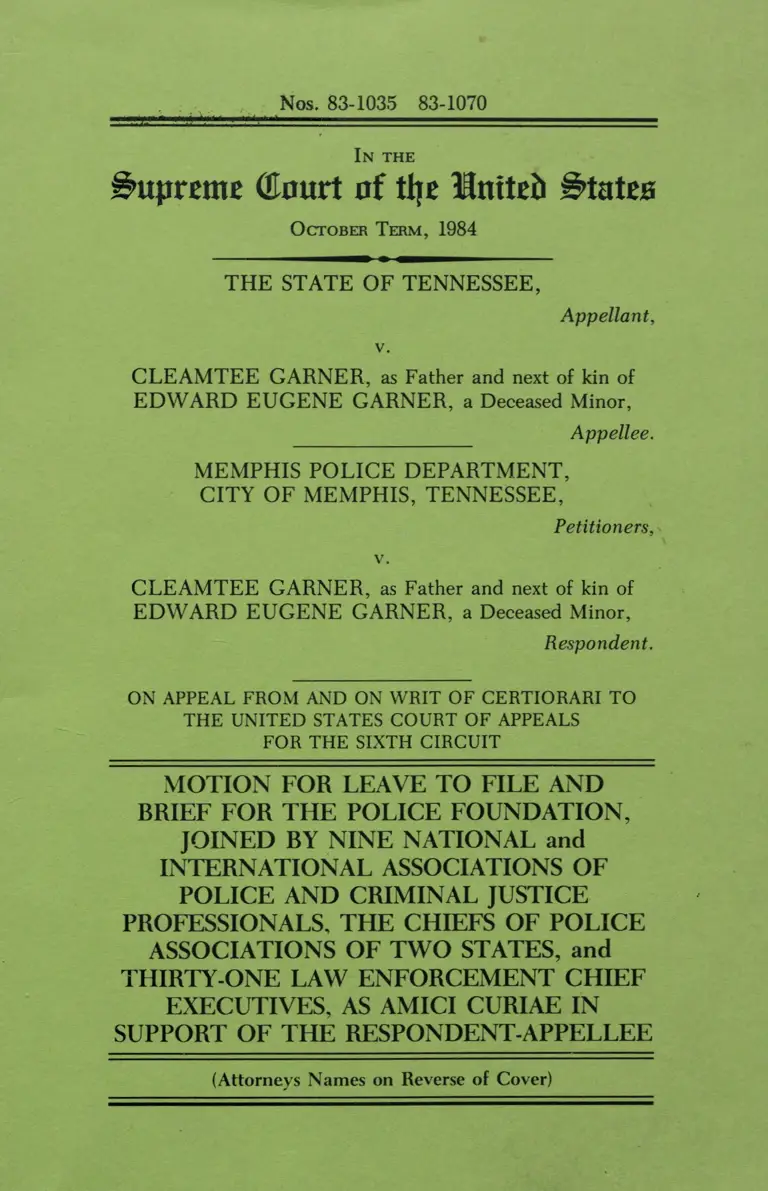
    Nos. 83-1035  83-1070

In the
Supreme (Hourt of tlje ISnitcii ^tatco

October Term, 1984

THE STATE OF TENNESSEE,
Appellant,

CLEAMTEE GARNER, as Father and next of kin of
ED W ARD  EUGENE GARNER, a Deceased Minor,

Appellee.

MEMPHIS POLIGE DEPARTMENT,
GITY OF MEMPHIS, TENNESSEE,

Petitioners,
V.

GLEAMTEE GARNER, as Father and next of kin of
ED W ARD  EUGENE GARNER, a Deceased Minor,

Respondent.

ON APPEAL FROM AND ON WRIT OF CERTIORARI TO
THE UNITED STATES COURT OF APPEALS

FOR THE SIXTH CIRCUIT
MOTION FOR LEAVE TO FILE AND

BRIEF FOR THE POLICE FOUNDATION,
JOINED BY NINE NATIONAL and

INTERNATIONAL ASSOCIATIONS OF
POLICE AND CRIMINAL JUSTICE

PROFESSIONALS, THE CHIEFS OF POLICE
ASSOCIATIONS OF TWO STATES, and

THIRTY-ONE LAW ENFORCEMENT CHIEF
EXECUTIVES, AS AMICI CURIAE IN

SUPPORT OF THE RESPONDENT-APPELLEE

(Attorneys Names on Reverse of Cover)


Of Counsel:
Robert K asanof, Esq.
767 Third Avenue
New York, New York 10017

W illiam  Josephson, Esq.*
Fried, Frank, Harris,

Shriver & J acobson
(A partnership which includes

professional corporations)
One New York Plaza
New York, New York 10004
(212) 820-8220

Phillip L acovara, Esq.
Hughes, Hubbard & Reed
1201 Pennsylvania Ave, N.W.
Washington, D.C. 20004

iMargaret Bush W ilson, Esq.
W ilson, Smith & Seymour
4054 Lindell Boulevard
Suite 100
St. Louis, Missouri 63108 *Counsel of Record


Nos. 83-1035
83-1070

IN THE
SUPREME COURT OF THE UNITED STATES

OCTOBER TERM, 1984

THE STATE OF TENNESSEE,
APPELLANT,

V .

CLEAMTEE GARNER, AS FATHER AND NEXT OF KIN OF
EDWARD EUGENE GARNER, A DECEASED MINOR,

APPELLEE.

MEMPHIS POLICE DEPARTMENT,
CITY OF MEMPHIS, TENNESSEE,

PETITIONERS,
V

CLEAMTEE GARNER, AS FATHER AND NEXT OF KIN OF
EDWARD EUGENE GARNER, A DECEASED MINOR,

RESPONDENT.

ON APPEAL FROM AND ON WRIT OF CERTIORARI TO
THE UNITED STATES COURT OF APPEALS

FOR THE SIXTH CIRCUIT


MOTION FOR LEAVE TO FILE BRIEF
AMICUS CURIAE

The Police Foundation, nine
national and international associations of
police and criminal justice professionals,
the chiefs of police associations of two
states and thirty-one law enforcement
chief-executives hereby move this Court
for leave to file the accompanying brief
amici curiae.

The interest of amici is
presented in the accompanying brief (in fra
at 1-10) in detail. Each is an
organization or individual police chief
executive dedicated to the effectiveness
of the police and the protection of the
basic rights of citizens. As such, the
amici are uniquely equipped to provide the
Court with both factual information and
policy perspectives that bear on the
constitutional issues raised in this case.


More specifically, the issue in
this case is the constitutionality of the
Tennessee statute, Tenn. Code Ann.
§ 40-808 (1975) permitting police officers
to "use all the necessary means to effect
the arrest" of fleeing non-violent felony
suspects. Garner v. Memphis Police
Depar tment, 710 F.2d 240 , 241 (6th Cir.
1983). Through long personal and
professional experience, amici have
particularized knowledge of the law
enforcement considerations which arise in
connection with deadly force laws, such as
the Tennessee statute. By means of this
brief, they seek to bring this knowledge
to the attention of the Court.

Counsel for the appellant, the
State of Tennessee, and for the
respondent-appellee. Garner, have
consented to the filing of this brief and
their letters of consent are attached.


Counsel for the petitioner, Memphis Police
Department, City of Memphis , Tennessee,
has not responded to the request of
counsel for amici for such consent.

Respectfully submitted,
/j/ UJiil
William vTosephson, Esq.
Counsel of Record
Fried, Frank, Harris,

Shriver & Jacobson
(A Partnership which

includes Professional
Corporations)

One New York Plaza
New York, New York 10004
(202) 820-8220
Attorneys for Amici Curiae

August 6, 1984


-V'.' ■■5̂'
■

, • ■■ ■ V' ■

.. ■ ■ ■

■■■-■■ ■ ■
'A/

- ■:

■ „. '. ■ ■ ■ ■ . -■'•vy' >'" y  " ' . ■' y .  y 'y y

... „ ■. ..■ ■ ' A y  - " A A - . , .

■■ : :■.■.:■■ ...
■ ^'A'

. A A ; . v ' A y „ A ^ K -  ^ A A  ' A ' i ' A ,

. . .  ■.

■ . ■
' - v - '  V-

■A.wA'.. . ■ . ....... : ^ ^ ^ t ' - y - . A > ' : " A : . A ' ‘ \ -  A A A ' .

; A '  ^

■■■■ , .

. ..........■ ■.'.. ■ ■...■■■■■■■ .■ ■ . ■ ■ .

■ .■■■
' a - a v . :  ■ ■ ' ; - , a a a ' ' -

.■ ■.
■ ■■ V ■ ■ ■ ■ ■ ■ A, , :

■ . ■ .■. ■■ ■• ■ ■■ ■. . . ■
. '■ -A .  A . ; .  ' ., -A-:. ■ ■ ■ '

■-'■X ■-;,.-- ,y,yy■■::? ■'; 'yiy . 'V..V/W'-. :'■■. ■ , .
i-

"1 v > ; A A  :'■

. ■
/AA-

■: ... A'A.A A:-.- ■■. : ■ ■:.. ■ . ... .A"A'':

. .
■ .■■■ ■■ . ■.A. .'. . ■. ■ .

■ ■■■■ ■. ■
..■'.. ■■ ■■■■■■; •

- y A ;

a '; :■■■

'
A,


State of Tennessee
Office of the Attorney

General
450 James RoDertson

Parkway
Nashville, Tennessee

37219 5025
July 17, 1984

Mr. William Josephson
Fried, Frank, Harris, Shriver

& Jacobson
One New York Plaza
New York, NY 10004
Re: Consent to Filing Amicus Curiae
Dear Mr. Josephson:

This is in response to your
letter dated June 27, 1984, requesting our
consent to your tiling an amicus curiae
brief in the case of State of Tennessee v.
Garner, No. 83-1035 now pending in the
Supreme Court of the United States. As
Attorney General of Tennessee, I hereby
give such consent.

Sincerely,

EMBLEM

/s/ W.J. Michael Cody
W.J. Michael Cody
Attorney General

& Reporter


j':S->-' ’■■■'  ̂'■'"■ ■■i''■ ■ ■ ■ ■ ■ . ■ ■

■ ■ :
, : -, ;■.' ,.; , ■ ; :;a"


August 1, ib̂ 84
99 Hudson Street
New York, N.Y. 10013
(212) 219-1900

William Josephson
Fried, Frank, Harris, Shriver

& Jacobson
One New York Plaza
New York, New York 10004
Re; Tennessee v. Garner

No. 83-1035
Memphis Police Department v GarnerNo. 83-1070

Dear Mr. Josephson;
This is to inform you that

respondent-appellee, Cleamtee Garner,
consents to the filing of an amicus brief
on behalf of the Police Foundation, et
al., in tne above noted case.

Sincerely,

/s/ Steven u. Winter
Steven L. Winter

cc; Walter L. Bailey, Jr.
Henry L. Klein
Jerry Smith
David E. Birenoaum


. :

H i

ssKiS:

«:- - -

Z:,[®8̂ 8

--

 ̂ ;r.^ ~ ~ c - - '-•*-.~5-'' ' ~‘T" -' >---̂v»«'. --r;' ' ■' .  ̂ _ „-'-' •.J?-"'--V' ' =“ - .■--- -■'—
Ss6#fS#Ss^^55iiSJs;J53fsS<%v?®i£* ̂ “'- 'V i  ̂ -T' ■" J -

m
W£Mi

£'i,
?r:_.
5  ̂ -T ' 9 M

-- - . «

: ‘ -V:-̂-c siSgst̂ Sta'. - 1 a -- - ' - > ,
'‘.- v-:ar'^- ~ ' *ci ti. » V ~


Nos. 83-1035 83-1070
IN THE

SUPREME COURT OF THE UNITED STATES
OCTOBER TERM, 1984

THE STATE OF TENNESSEE,
APPELLANT,

V .

CLEAMTEE GARNER, AS FATHER AND NEXT OF KIN OF EDWARD EUGENE GARNER, A DECEASED MINOR,
APPELLEE.

MEMPHIS POLICE DEPARTMENT, CITY OF MEMPHIS, TENNESSEE,
PETITIONERS,

V .

CLEAMTEE GARNER, AS FATHER AND NEXT OF KIN OF EDWARD EUGENE GARNER, A DECEASED MINOR,
RESPONDENT.

ON APPEAL FROM AND ON WRIT OF CERTIORARI TO THE UNITED STATES COURT OF APPEALS FOR THE SIXTH CIRCUIT

BRIEF FOR THE POLICE FOUNDATION, JOINED BY NINE NATIONAL and INTERNATIONAL ASSOCIATIONS OF POLICE AND CRIMINAL JUSTICE PROFESSIONALS, THE CHIEFS OF POLICE ASSOCIATIONS OF TWO STATES, and THIRTY-ONE LAW ENFORCEMENT CHIEF EXECUTIVES, AS AMICI CURIAE IN SUPPORT OF THE RESPONDENT-APPELLEE


TABLE OF CONTENTS

Table of Authorities.,
Interest of Amici....
Summary of Argument..,
Statement of the Case

ARGUMENT............

Page
i i
1

11
12

14
I.

II.

Laws that authorize the
police to employ aeadly
force to apprehend all fleeingfelony suspects do not contribute
to the ability of the police to
fight crime or to protect
themselves................ 15
Affirmance will be consistent
with most police department
policies and practices and
will not unduly intrude on
criminal law enforcement.... 27

III. Laws that authorize police
use of deadly force to
apprehend all fleeing felony suspects fail adequately to
guide police officer
discretion.................

Conclusion,
40
47


TABLE OF AUTHORITIES

CASES

Bivens v. Six Unknown Federal Narcotics Agents, 403 U.S. 388 (1971).........
Chimel v. California,395 U.S. 752 (1969)......................
Delaware v. Prouse, 440 U.S. 648 (1979)...
Furman v. Georgia, 408 U.S. 238 (1972)....
Garner v. Memphis Police Department,
710 F.2d 240 (6th Cir. 1983)........
Katz V. United States,
389 U.S. 347 (1967)......................
Kolender v. Lawson,
103 S. Ct. 1855 (1983)...................
Mapp V. Ohio, 367 U.S. 643 (1961)........
Payton v. New York, 445 U.S. 573 (1980)...
Rochin V. California,
342 U.S. 165 (1952)......................
Sibron v. New York, 392 U.S. 40 (1968)....
Werner v. Hartfelder, 113 Mich. App. 747,
318 N.W.2d 825 (1982), appeal denied,418 Mich. 906, 342 N.W.2d 520 (1984).....
Wong Sun v. United States,
371 U.S. 471 (1963)......................

ii

48

38
38
41

14, 28

38

39
38
38

38
38

Page

29

38


UNITED STATES CONSTITUTION Page
Amendment IV..............................  13
Amendment VIII............................  13
Amendment XIV.............................  13
STATUTES
42 U.S.C. § 1981........................  13
42 U.S.C. § 1983........................  13
42 U.S.C. § 1985........................  13
42 U.S.C. § 1986........................  13
42 U.S.C. § 1988........................  13
Tenn. Code Ann. § 40-808 (1975)..........  13

OTHER AUTHORITIES

M. Blumberg, The Use of Deadly Firearms
by Police Officers: The Impact of
Individuals, Communities^ and Race
(Ph.D. Dissertation, State
University of New York, Albany Sch.
of Crim. Justice, Dec. 14, 1982)......
Brown, Use of Deadly Force by Police
Officers; Training Implications,12 J. Pol. Sci. & Admin. 133 (1984)....,
A. Cohen, I've Killed That Man 10,000
Times, 3 Police 17 (1980).............

iii

36

45

23


OTHER AUTHORITIES
Page

J. Fyfe, Administrative Interventions
on Police Shooting Discretion: An
Empirical Examination  ̂
309 (1979)...........

7 J. Grim. Just

J. Fyfe, Observations on Police Deadly
Force, 27 Grim. & Deling.

20

376 (1981) 37
G. Gain, Discharge of Firearms Policy: Effecting Justice Through
Administrative Regulation -- A
Position Paper (Report released
December 23, 1971 by Oakland Police Ghief Gharles Gain in
explanation of a change in
departmental deadly force policy),
cited in W. A. Geller & K.J. Karales, Split-Second Decisions:
Shootings Of & By Ghicago Police
(1981)........................... 17-19
W.A. Geller, K.J.
Second Decisions:

Karales, Split-
Shootings Of

& By Ghicago Police (Ghicago Law
Enforcement Study Group 1981)..., 35
G. Hayden, Police Discretion in the
Use of Deadly Force: An Empirical
Study of Information Usage in Deadly
Force Decision Making (1979)(unpublished paper available at the
University of New Haven), cited in
L. Sherman, Executon Without Trial:Police Homicide and the Gonstitution,
33 Vand. L. Rev. at 95 n.l50 (1980)....... 42-43

IV


OTHER AUTHORITIES
Page

J. Klenoski,
Statements: Administrative Policy

Deadly Force 1 (Delaware
Police Department, May 21, 1981) 25
K. Matulia, A Balance of forces: A
Report of the International Association
of Chiefs of Police
(National Institute of Justice/U.S.
Department of Justice 1982)........... 29,34
Memphis Police Department, Training
Academy, General Order Number 95~79, Deadly Force Policy (July 16, 1979) ,
Jt. App. at 45, cited in J. Fyfe,
Blind Justice: Police Shootings in
Memphis, 73 J. of Grim. L. & Grim.
722 (1982)......................
M. Meyer, Police Shootings at
Minorities: The Gase of Los Angeles,
52 Annals 98 (1980)...................
G. Milton, J. Halleck, J. Lardner,
G. Abrecht, Police Use of Deadly Force,
(Police Foundation 1977)..............
Model Penal Gode § 3.07(2)(b)
(Proposed Official Draft 1962)........
National Organization of Black Law Enforcement Executives, "Stop - Or I'll
Shoot;" The Use of Deadly Force by
Law Enforcement Officers (1982).......
Police Foundation, Readings on Police
Use of Deadly Force (Fyfe ed. 1982)....

V

35

35

30


OTHER AUTHORITIES
Page

President’s Commission on Law
Enforcement and the Administration
of Justice^ Task Force Report;
The Police (1967)................. 21, 22 30
Program Commission on Accreditation
for Law Enforcement Agencies, Inc.,
Standards For Law Enforcement Agencies
The Standards Manual of the Law
Enforcement Agency Accreditation
(Aug. 1983)....................... 31-32
Report of the National Advisory
Commission on Civil Disorders(Bantam Books, 1968).................... 22
L. Sherman, Reducing Police Gun Use,
in M. Punch, Control in the Police Organization 98 (Atlanta 1983)...........  20
Staff Report to the Michigan Civil
Rights Commission (May 18, 1981).........  29
C. Uchida, L. Sherman, J. Fyfe,
Police Shootings and the Prosecutor in Los Angeles County:
An Evaluation of Operation Rollout
(Police Foundation 1981)............... 2
G, Uelman, Varieties of Police Policy:
A Study of Police Policy Regarding
the Use of Deadly Force in Los Angeles
County, 6 Loy. L.A. L. Rev. 1 (1973) cited
in U.S. Department of Justice,
A Community Concern: Police Use of
Deadly Force (1979)..................... 40

VI


INTEREST OF AMICI

The Police Foundation is a
private, non-profit organization
established by the Ford Foundation in 1970
with a mandate to improve the quality of
American policing. It has trained police
executives and managers tnrougnout the
United States and abroad, and has
conducted and puolisned more tnan 50
research studies and experiments involving
virtually every aspect of police policy
and operations.

The Police Foundation's research
on police use of deadly force has resulted
in publication of several articles in


professional periodicals and in three
books and monographs. Readings on Police
Use of Deadly Force (Fyfe ed. 1982); C.
Milton, J. Halleck, J. Lardner, G.
Abrecht, Police Use of Deadly Force
(1977); C. Uchida, L. Sherman, J. Fyfe,
Police Shootings and the Prosecutor in Los
Angeles County: An Evaluation of
Operation Rollout (1981). The Police
Foundation has also served as a consultant
and technical advisor to the National
Association for the Advancement of Colored
People (NAACP) on a United States
Department of Justice funded project with
respect to police deadly force policies
and practices (Office of Community
Anti-Crime, Grant No. 80-TA-AX-0004). In
addition, the Police Foundation is
presently engaged in a study of police use
of deadly force in New York City and
Philadelphia.


The Police Executive Research
I

Forum (PERF) is a District of Columbia
non-profit corporation whose membership
consists of police chiefs from the United
States and Canada who serve jurisdictions
with populations over 100,000. Eighty
police chiefs are now general members, and
their departments include approximately 20
percent of all American police personnel.
PERF conducts and publishes research
responsive to the needs of its membership
and the citizens they serve. It serves as
a center for the collection and
dissemination of information useful in
improving police effectiveness, and was a
co-author of the standards on the use of
deadly force adopted by the Commission on
Accreditation for Law Enforcement Agencies
(infra at 30-32) .

The Police Management Association
is a non-profit membership organization of
400 police managers and executives from


the United States and ten other
countries. PMA was incorporated in the
District of Columbia in 1980, and is
dedicated to upgrading police management,
professionalizing police at all levels,
and assisting police to protect the lives,
rights, and property of all citizens.

The National Organization of
Black Law Enforcement Executives (Noble)
is a non-profit organization of 1,000
professional command-level law enforcement
officials representing all elements of
federal, state, and local law
enforcement. It is dedicated to improving
the quality of criminal justice and police
services for all citizens throughout the
United States.

NOBLE unanimously adopted a
resolution in 1980 advocating limiting
police use of deadly force to the defense
of an officer's life or that of another
person. Research in this area by NOBLE


has resulted in the publication of a
monograph, "Stop - Or I'll Shoot;” The
Use of Deadly Force by Law Enforcement
Officers (1982) . NOBLE has been a
co-author of the standards on the use of
deadly force adopted by the Commission on
Accreditation (infra at 30-32) and has
provided technical assistance to the NAACP
as well as a number of police agencies
nationwide.

I

The Academy Of Criminal Justice
Sciences (ACJS) is a non-profit membership
organization incorporated in Nevada in
1972. Its membership includes
approximately 1,400 criminal justice
educators and practitioners, representing
all 50 states. The prime purpose of ACJS
is to foster excellence in education and
research in criminal justice.

The International Law Enforcement
Instructors Agency (ILEIA) is a membership
organization founded in Massachusetts in


1976. Its membership includes 850
instructors in academia, police
departments, police academies, state
training councils, and allied
institutions. ILEIA is dedicated to the
improvement of criminal justice and
related training and education.

The International Law Enforcement
Stress Association (ILESA) is a non-profit
membership organization incorporated in
Massachusetts in 1978. Its membership
includes 1,200 officials from local,
state, and federal law enforcement
agencies, as well as physicians, nurses,
and social workers. ILESA is dedicated to
reducing stress among law enforcement
professionals in order to instill a more
professional law enforcement ethic.

The National Association Of
Police Planners (NAOPP) is a non-profit
membership organization incorporated in
Missouri in 1982. Its membership


inlcludes 240 federal, state, and local
law enforcement planners in the United
States and abroad. NAOPP is dedicated to
the continuing effectiveness, improvement
and professionalization of law enforcement.

The National Black Police
Association (NBPA) is a non-profit
membership organization of approximately
15,000 officials in federal, state, and
local law enforcement throughout the
United States. NBPA is dedicated to
improving law enforcement effectiveness,
and to protecting the lives, rights, and
property of all citizens.

The Reserve Law Officers
Association of America (RLAOA) is a
non-profit membership organization founded
in 1969. Its membership includes reserve
deputy sheriffs, auxiliary police, reserve
deputy constables, police reserves, chiefs
of police, sheriffs, constables, and law
enforcement officers from 2,500 cities in


49 states. RLAOA is dedicated to
increasing law enforcement professionalism
through training, education, disseminating
information, improving police-community
relations, and eliminating use of
unnecessary force.

The Kentucky Association Of
Chiefs Of Police and the Utah Chiefs Of
Police Association are non-profit membership
organizations representing police chief
executives in their respective states. All
are dedicated to the continuing improvement
and professionalization of policing, and
to protecting the lives, rights, and
property of the citizens they serve.

The following are police chief
executives who join in this brief as
individuals:

8


William C. Banner
Chief of Police
Corpus Christi, Tex.
Keith R. Bergstrom
Chief of Police
Oak Park, 111.
Robert V. Bradshaw
Chief of Police
Reno, Nev.
Thomas E. Coogan
Chief of Police
Denver , Colo.
Bernard D. Crooke
Chief of Police
Montgomery County, Md
John F. Duffy
Sheriff
San Diego County, Cal
Donald G. Hanna
Chief of Police
Champaign, 111.
Richard A. King ^
Deputy County
Executive for
Public Safety
Fairfax County, Va.

Cornelius J. Behan
Chief of Police
Baltimore, County Md
Anthony V. Bouza
Chief of Police
Minneapolis, Minn.
David Cameron
Chief of Police
Moscow, Idaho
David C. Couper
Chief of Police
Madison, Wis.
Raymond C. Davis
Chief of Police
Santa Ana, Cal.
Reuben M. Greenberg
Chief of Police
Charleston, S.C.
Charles Johnston
Chief of Police
Lakewood, Colo.
William B. Kolender
Chief of Police
San Diego, Cal.

Schuyler M. Meyer,
Chief of Police
Pompano Beach, Fla

III George Napper
Director of
Public Safety
Atlanta, Ga.

Jerry Neal
Chief of Police
Amarillo, Tex.

Thomas J. Nichols
Chief of Police
Lubbock, Tex.


John P. O'Brien
Sher iff
Genesee County, Mich.
Daryl Stephens
Chief of Police
Newport News, Va.
Charles T. Strobel
Director of Public
Safety

Alexandria, Va.
Melvin L. Tucker
Chief of Police
Tallahassee, Fla.
Robert Wasserman
Chief of Police
Fremont, Cal.
Hubert Williams
Police Director
Newark, New Jersey

All amici wish to improve the
effectiveness of the police and to
safeguard the basic rights of citizens.
The amici are uniquely equipped to provide
the Court with both factual information and
policy perspectives that bear on the
constitutional issues raised in this case.

Charles M. Rodriguez
Chief of Police

San Antonio, Tex.
William K. Stover
Chief of Police
Arlington County, Va.
John L. Tagert
Chief of Police Colorado Springs, Colo.

Robert C. Wadman
Chief of Police
Omaha, Neb.
Gerald L. Williams
Chief of Police
Arvada, Colo.

10


SUMMARY OF ARGUMENT
After extensive research and

consideration, amici have concluded that
laws permitting police officers to use
deadly force to apprehend unarmed,
non-violent fleeing felony suspects
actually do not protect citizens or law
enforcement officers, do not deter crime or
alleviate problems caused by crime, and do
not improve the crime-fighting ability of
law enforcement agencies. Thus, arguments
based on these factors would not justify
use of deadly force against fleeing
non-violent felony suspects. Moreover, we
have concluded that laws permitting use of
deadly force in those circumstances are
responsible for unnecessary loss of life,
for friction between police and the
communities they serve resulting in less
effective law enforcement, and for an undue
burden upon police officers who must make
and live with the consequences of hasty
life-or-death decisions.

1 1


STATEMENT OF THE CASE
This case involves the fatal

shooting of Edward Eugene Garner by a
Memphis, Tennessee police officer. At the
time he was shot. Garner was fifteen years
old, stood five feet four inches tall,
weighed between 85 and 100 pounds, and was
fleeing from the scene of a reported
burglary. The police officer who shot
Garner has testified that, while
approaching the unoccupied house that was
the scene of the reported crime, he heard a
screen door slam and saw a figure running
into the rear yard. In a subsequent search
of the rear yard, he saw Garner stooping
next to a six-foot tall cyclone fence at
the rear of the yard. The officer shouted
"halt." After pausing momentarily. Garner
ran and sprang to the top of the fence.
The officer, who correctly believed Garner
to be unarmed, then fired his revolver,
striking Garner in the right side of the

1 2


head. Garner fell, draped over the top of
the fence, and died later that night at a
hospital. It was later determined that he
had broken into the house and had taken a
ring and a wallet containing two five
dollar bills. The officer testified that
he fired because he believed that the boy
would otherwise elude capture and because
he had been trained that it was proper
under Tennessee law to shoot fleeing felony
suspects in such situations.

A suit was brought against the
City of Memphis by Garner's father under
authority of 42 U.S.C. §§ 1981, 1983, 1985,
1986 and 1988 (1981) to recover damages for
wrongful death caused by claimed violations
of the Fourth, Eighth, and Fourteenth
Amendments to the Constitution. Reversing
the District Court for the Western District
of Tennessee, the Court of Appeals for the
Sixth Circuit held that the Tennessee
statute, TENN. CODE ANN. § 40-808 (1975),

13


permitting police officers to "use all the
necessary means to effect the arrest" of
fleeing non-violent felony suspects,
violated the Fourth Amendment and the due
process clause of the Fourteenth
Amendment. Garner v. Memphis Police
Department, 710 F.2d 240, 241 (6th Cir.
1983). On March 19, 1984, this Court noted
probable jurisdiction of the appeal by the
intervening State of Tennessee in number
83-1035 and granted the petition for
certiorari of the Memphis Police Department
and City in number 83-1070.

ARGUMENT
Appellant argues that the Court of

Appeals judgment should be reversed because
"the State retains compelling interests in
the apprehension of criminals which can
only be served through the truly effective
power of arrest." Brief for Appellant at 7
(emphasis added). Petitioners similarly
argue that "the Court of Appeals either

14


ignored or gave insufficient deference to
the compelling state interests herein --
effective law enforcement and the
apprehension of fleeing criminals. The
rule adopted favors the criminal and
encourages flight to avoid capture." Brief
for Petitioners at 8. Amici believe that
the available evidence indicates that the
public's interest in effective law
enforcement is furthered by the decision of
the Court of Appeals.

I. LAWS THAT AUTHORIZE THE POLICE TO
EMPLOY DEADLY FORCE TO APPREHEND ALL
FLEEING FELONY SUSPECTS DO NOT
CONTRIBUTE TO THE ABILITY OF THE
POLICE TO FIGHT CRIME OR TO PROTECT
THEMSELVES

Through long personal and
professional experience, amici know well
the terrible costs of crime to American
society and the dangers it presents to
law-abiding citizens and to police
officers. Amici share the frustration of

15


all law-abiding citizens with our high
rates of crime and, as police
professionals and students of police
operations, amici would not argue that
this Court should take any action that
would unreasonably diminish the ability
of the police to prevent or detect crime,
to apprehend criminals, or to protect the
public or themselves. Affirming the
decision of the Sixth Circuit in this
case, however, as amici urge, will result
in no diminution of police effectiveness.

If expansive use of police deadly
force had a measurable effect upon crime
and public safety, one would expect to
find some association between the breadth
of police authority to use deadly force
and measures of crime and public and
police safety. One would expect that
rates of crime and violence would be
lowest in jurisdictions in which police
authority to use deadly force was most

16


broad, and one would expect that
jurisdictions that more clearly defined
and limited police officers' authority to
use deadly force would experience
increased crime rates and decreases in
the safety of the public and the police.

All the available evidence
indicates that expansive use of police
deadly force to apprehend fleeing suspects
is in no way associated with reduced rates
of crime or with increased safety of the
public or the police. For example, in
1968, the Oakland, California, Police
Department established an administrative
policy prohibiting use of deadly force to
apprehend fleeing auto theft and burglary
suspects. In a 1971 evaluation of the
effects of that policy, then Police Chief
Charles Gain reported that:

There is absolutely no
evidence supporting the
proposition that
restrictive [deadly force]
policies adversely affect 17


the arrest rate for
burglary and auto theft.
Our own experience in
Oakland indicates that the
institution of a policy
restricting the use of
deadly force against
burglars had no effect,
one way or the other, upon
the arrest rate for
burglary. . . . There is
no evidence whatever to
support the contention
that police authority to
shoot is a deterrent to
the commission of the
crime. . . .  It cannot be
demonstrated that police
firearms policies have had
any effect, one way or the
other, on the increase in
the incidence of crime.

"[N]ot a single
[police] officer has been
injured, killed or placed
in jeopardy because of the
restrictions upon his
authority to fire."
C. Gain, Discharge of
Firearms Policy:
Effecting Justice Through
Administrative Regulation
-- A Position Paper at 18
& 25 (Report released
December 23, 1971 by Oakland Police Chief
Charles Gain in explanation of a change in
departmental deadly force

18


policy), cited in W. A.
Geller & K. J. Karales,
Split-Second Decisions:
Shootings Of & By Chicago
Police at 67-68 (1981)
A 1979 study of the effects of a

New York City Police Department
regulation that restricted officers'
authority to employ deadly force against
fleeing suspects reached similar
findings. It analyzed 2,926 police
shooting incidents. It reported that
implementation of the Police Department
regulation was followed by a 75 percent
decrease (from 2.0 per week to 0.5 per
week) in incidents in which officers
fired shots at fleeing suspects who
presented no imminent threat to life.
The number of people shot and non-fatally
wounded by the police decreased by 41
percent (from 3.9 to 2.3 weekly), and the
number of fatal shootings declined by 38
percent (from 1.6 to 1.0 weekly). These
declines, however, had no adverse effect

19


on rates of crime or arrest rates.
Police injuries and deaths decreased
following the directive. J. Fyfe,
Administrative Interventions on Police
Shooting Discretion: An Empirical
Examination ̂ 7 J. Crim. Just. 309 (1979).

A study published just last year
of police use of deadly force in Atlanta
similarly reported that restriction of
police shooting discretion in that city
was accompanied by a decrease in police
use of deadly force and that there was no
effect upon violent crime rates, arrest
rates, or police injury and death rates.
L. Sherman, Reducing Police Gun Use, in
M. Punch, Control in the Police
Organization 98 (1983).

Amici are aware of no empirical
evidence, reports or studies that
establish a public benefit flowing from
broad use of police deadly force.

20


Broad police deadly force
statutes actually work against the
primary police responsibility to protect
life and enforce the law. Whenever
police officers kill citizens, tensions
between police and the communities they
serve are likely to increase, especially
when police take the lives of persons who
present no clear and present danger to
officers or others. Consequently, it
becomes more difficult for the police to
obtain public cooperation in their daily
efforts to protect life and to fight
crime. Police inability to obtain
cooperation and information ultimately
results in failure to identify violent
offenders and in further loss of life.
President's Commission on Law Enforcement
and the Administration of Justice, Task
Force Report: The Police 144 (1967).

On occasion, public reaction to
instances of police use of deadly force

2 1


has included violence and further loss of
life. The National Advisory Commission
on Civil Disorders reported that police
shootings were followed by riots in New
York City in 1964; that the fatal police
shooting of a young black led to violent
demonstrations in Los Angeles in 1966;
that, in 1966, a fatal police shooting of
an auto thief in Atlanta nearly
precipitated a riot; and that 1967 riots
in Tampa were triggered by the fatal
police shooting of a young black fleeing
from a burglary. Report of the National
Advisory Commission on Civil Disorders at
36, 38 & 42 (1968). In addition, in
1966, disturbances followed the fatal
police shooting of a fleeing car thief in
San Francisco, and a fatal shooting in
St. Louis. President's Commission on Law
Enforcement and the Administration of
Justice, Task Force Report: The Police
189 (1967). More recently, fatal

2 2


shootings by police in New York City,
Birmingham, New Orleans, and Miami have
led to public disorder and violence.

The primary police
responsibility of protecting life and
enforcing law is best served by reducing
use of deadly force to an absolute
minimum by providing meaningful
guidelines for officer discretion.
Indeed, the police as well as the public
will benefit from standards that are more
carefully tailored than tne Tennessee
statute's. Under any circumstances, the
taking of a life produces trauma for the
police officer. A. Cohen, I've Killed
That Man 10,000 Times, 3 Police 17
(1980). When such a killing occurs under
circumstances that are legally
justifiable but that subsequently raise
questions of judiciousness, fairness, and
propriety, that trauma is bound to be
increased. Laws that authorize police to

23


use deadly force to apprehend all fleeing
felony suspects but provide no other
guidance, encourage such killings and
expose police officers to unnecessary
criticism, trauma, and civil liability.

In a real sense, the officer who
shot Edward Eugene Garner has been
severely victimized by the statute in
question on which he based his decision
to shoot. Over the nearly ten years
since Garner's death, this officer has
been publicly criticized and second-
guessed. The criticism, trauma, and
liability that have affected the life of
this officer are far more attributable to
the inadequacy of the laws and rules
under which he acted than they are to his
own actions.

The Delaware Police Chiefs'
Council eloquently stated the forces that
work upon police officers who find
themselves in situations like that

24


leading to the death of Edward Eugene
Garner:

The decision to
employ deadly force
against another human
being is in all
probability the most
serious and difficult
decision a law enforcement
officer will be faced
with. The primary
responsibility of the
police is that of
protecting life. This
responsibility dictates
the need for consideration
of not only the legal
aspect of the use of
deadly force, but also the
moral issues arising from
a reverence for the value
of life. It is,
therefore, in the interest
of both the public and the
law enforcement officer
that uniformly accepted
guidelines clearly govern
the use of firearms in the
enforcement of the law.
J. Klenoski,
Administrative Policy
Statements: Deadly Force1 (May 21, 1981).
Laws authorizing police to

employ deadly force to apprehend all
fleeing felony suspects include no such

25


clear guidelines. Indeed, they place
officers who serve under those statutes
in the terrible position of having to
live forever with the consequences of the
instantaneous decision, made without real
legislative guidance as to whether and
when it is appropriate to take the life
of a non-violent fleeing felony suspect.
Thus, laws that authorize police officers
to employ deadly force to apprehend all
fleeing felony suspects are likely to
lead to arbitrariness in the taking of
life by police officers. This increases
the exposure of officers to censure,
trauma, and civil liability. Conversely,
because such laws so inadequately define
appropriate police behavior, officers who
refrain from using deadly force will
always be uncertain that they have acted
correctly. In either case the long-term
effects of such laws upon both sets of
police officers is bad for their

26


understanding of and respect for the law
and their duties and for their general
effectiveness and morale.

II. AFFIRMANCE WILL BE CONSISTENT
WITH MOST POLICE DEPARTMENT
POLICIES AND PRACTICES AND WILL
NOT UNDQLY INTRUDE ON CRIMINAL
LAW ENFORCEMENT

The State of Tennessee and the
City of Memphis and its Police Department
have argued that the rule adopted by the
Court of Appeals "places burdensome and
impractical constraints on effective law
enforcement," Jurisdictional Statement at
7, and that it "will create much
confusion among law enforcement
officers...." Petition for Cert, at 11.
That is simply not so. The Court of
Appeals has adopted a standard that is
clear, workable, and not unduly

27


restrictive of law enforcement. Before
an officer uses deadly force to stop a
fleeing felony suspect, he or she must
have "an objective, reasonable basis in
fact to believe that the felon is
dangerous or has committed a violent
crime." 710 F.2d at 241.

In fact, the actual practices of
most law enforcement agencies demonstrate
the practicability of the standard
adopted by the Court of Appeals. Most
jurisdictions studied already restrain
the use of deadly force by police
officers in a manner that is as
restrictive or more restrictive than that
adopted by the court below. The common
sense of law enforcement professionals
across the nation is that these
restrictive standards are workable and do

28


not hamper law enforcement.*
There has been a steady move to

The actual practices of most police
departments are in fact governed by
municipal or departmental policies
more restrictive than state laws.
See K. Matulia, A Balance of Forces:
A Report of the International
Association of Chiefs of Police at
153-54 (1982).
is a common law
Werner v. Hartfelder,

For example, Michigan
jurisdiction. See

Mich.113 Mich. App.
747, 318 N.W.2d 825 (1982), appeal
denied, 418 Mich. 906, 342 N.W.2d 520
(1984). But more than half of the
local law enforcement agencies have
deadly force policies that are more
restrictive than the common law and
about 75 percent of those are
consonant with the standard adopted
by the court of appeals in this
case. Staff Report to the Michigan
Civil Rights Commission at 54 ^  seg.
(May 18, 1981). This trend is
particularly true of major
metropolitan areas. Although
Arizona, Connecticut, Massachusetts,
New Mexico, and Ohio are common law
states, Phoenix, New Haven, Boston,
Alburquerque, Santa Fe, Cincinnati,
and Dayton all have deadly force policies that would bar the shooting
in this case. App. 1318, 1291, 1131,
1110, 1330, 1209 & 1218. (App.
citations are to the docketed Court
of Appeals record. Jt. App. citations are to the Joint Appendix
prepared by the parties for the
Court.)

29


restrain the police use of deadly force.
More than twenty years ago the Model
Penal Code proposed to restrict police
authority to employ deadly force against
all fleeing felony suspects. Model Penal
Code § 3.07(2) (b) (Proposed Official
Draft 1962).

In 1967, the President's
Commission on Law Enforcement and
Administration of Justice observed:

Deadly force should be
restricted to the
apprehension of
perpetrators who, in the
course of their crime
threatened the use of
deadly force, or if the
officer believes there is
a substantial risk that
the person whose arrest is
sought will cause death or
serious bodily harm if his apprehension is delayed.
President's Commission on
Law Enforcement and the
Administration of Justice,
Task Force Report: The
Police at 189 (1967).
In 1983, the federally funded

Commission on Accreditation for Law
30


Enforcement Agencies, which is composed,
of judicial, legislative, state and local
government, academic, and law enforcement
representatives, adopted the following
model policy and commentary on use of
deadly force:

1.3.2 A written directive
states that an officer may
use deadly force only when
the officer reasonably
believes that the action
is in defense of human
life, including the
officer's own life, or in
defense of any person in
immediate danger of
serious physical injury.
Commentary: The purpose
of this standard is to
provide officers with
guidance in the use of
force in life and death
situations and to prevent
unnecessary loss of life.
Definitions of "reasonable
belief," and "serious physical injury" should be
included in the directive.
1.3.3 A written directive specifies that use of
deadly force against a "fleeing felon" must meet
the conditions required by
standard 1.3.2.
Commentary: A "fleeing
felon" should not be
presumed to pose an

31


immediate threat to life
in the absence of actions
that would lead one to
believe otherwise, such as
a previously demonstrated
threat to or wanton
disregard for human life.
Program Commission on
Accreditation for Law
Enforcement Agencies,
Inc., Standards For Law
Enforcement Agencies: The
Standards Manual of the
Law Enforcement Agency
Accreditation at 1-12
(Aug. 1983) (emphasis in
original).

These standards were drafted and
unanimously recommended to the Commission
by the International Association of
Chiefs of Police ("IACP")f NOBLE, the
National Sheriffs' Association and PERF.

In a United States Department of
Justice-supported study of police deadly
force in 53 American cities with
populations over 250,000, the
International Association of Chiefs of
Police reported that, as of 1980, 46
police departments (86.8 percent) had

32


promulgated administrative rules that
prohibited officers from employing deadly
force to "arrest any felon," that four
(7.5 percent) permitted such deadly
force, and that the administrative
policies of three (5.7 percent) did not
address this issue.

Thus, nearly seven in eight of
the major municipal police departments in
the United States did not permit officers
to use deadly force to apprehend all
felons. K. Matulia, A Balance of Forces:
A Report of the International Association
of Chiefs of Police at 161 (1982). On
the basis of its analysis, lACP
recommended the following guideline on
use of deadly force to effect
apprehensions:

An officer may use deadly
force to effect the
capture or prevent the escape of a suspect whose
freedom is reasonably
believed to represent an
imminent threat of grave

33


bodily harm or death to
the officer or other
person(s).
Id. at 164 (emphasis in

original).
A 1982 survey of the deadly

force policies of 75 police departments
whose chief executives were members of
PERF by that organization's staff found
that 74 prohibited use of deadly force to
apprehend all fleeing felony suspects.

These statements and the lACP
and PERF findings regarding the small
number of police agencies adhering to the
rule that deadly force is permissible to
apprehend all fleeing felony suspects
demonstrate that the law enforcement
community generally considers this
standard reprehensible. Indeed, since
the death of Edward Eugene Garner, the
Memphis Police Department itself has
adopted an administrative policy
prohibiting its officers from using

34


deadly force in situations such as the ,
instant. Memphis Police Department,
Training Academy, General Order Number
95-79, Deadly Force Policy (July 16,
1979), Jt. App. at 45, cited in J. Fyfe,
Blind Justice: Police Shootings in
Memphis, 73 J. of Grim. L. & Grim. 722
(1982).

Very few police departments
actually use deadly force to stop fleeing
suspects. Only a small minority of
police firearm discharges nationwide are
for the purpose of stopping fleeing
felony suspects.* This use of deadly

The figures vary, of course, from
city to city depending on that city's
policy. See App. 791 (11.3% in New
York between 1971-1975); W.A. Geller,
K.J. Karales, Split-Second
Decisions; Shootings of & by Ghicago
Police, 6 (Ghicago Law Enforcement
Study Group 1981) (17% between1974-1978); M. Meyer, Police
Shootings at Minorities: The Gase of
Los Angeles, 52 Annals 98, 103-104

Footnote Gontinued
35


force is insignificant to the ability of
the police to make felony arrests. For
example, between 1969 and 1974, Memphis
police made more than twenty-six thousand
arrests for property crimes. App. 1767.
As the Memphis police director observed:
"of all arrests how many involve the use
of deadly force, I would say it would be
less than one percent, probably less than
a half percent.... [I]f you want to even
boil it down to arrests of felons I think

Footnote Continued From Previous Page
(1980) (between 1974-1978, 15% of all
shootings at black, 9% of all
shootings at Hispanics, and 9% of all
shootings at whites); M. Blumberg,The Use of Deadly Firearms by Police
Officers: The Impact of Individuals,
Communities, and Race, 201 (Ph.D.
Dissertation, State University of New
York, Albany, Sch. of Crim. Justice, Dec. 14, 1982) (7.8% in Atlanta
between 1975-1978; between 1973-1974,
4.6% in the District of Columbia, 10%
in Portland, Ore., but 58.1% in
Indianapolis).

36


you'd still find it less than -- well,
let's say you'd find it a minute
percentage point." App. 957-58. Dr.
Fyfe has observed: "[I]n order for the
police to have cleared even 1 percent
[more] of the non-violent felonies
[burglary, larceny, and auto larceny]
reported in 1978 through 'apprehensions
effected by shooting,' they would have
had to increase the rate at which they
shot people during that year by at least
fifty-fold. Doing so would have resulted
in approximately 35,000 fatalities and
70,000 woundings." J. Fyfe, Observations
on Police Deadly Force, 27 Grim. &

Deling. 376, 381 (1981).
In applying constitutional

dictates this Court has made many
decisions which have had a substantial
impact on police policies and procedures
and have arguably limited the
effectiveness of police operations.

3 7


E.q,, Payton v. New York  ̂ 445 U.S. 573
(1980) (restricting police authority to
enter residence to make arrest without
arrest warrant); Delaware v. Prouse, 440
U.S. 648 (1979) (restricting police
authority randomly to stop motorist);
Chimel v. California, 395 U.S. 752 (1969)
(denying police authority to search
beyond suspect's body pursuant to
arrest); Sibron v. New York/ 392 U.S. 40
(1968) (narrowing police authority to
search a suspect); Katz v. United States,
389 U.S. 347 (1967) (limiting police
authority to eavesdrop); Wong Sun v.
United States, 371 U.S. 471 (1963)
(confining police authority to arrest
without a warrant); Mapp v. Ohio, 367
U.S. 643 (1961) (restricting use of
unreasonably seized evidence); Rochin v
California, 342 U.S. 165 (1952) (police
authority to use stomach pump on
suspect). Most recently, this Court

38


struck as unconstitutionally vague a
California statute that authorized police
to arrest pedestrians who failed to
provide to a police officer credible and
reliable identification and to account
for their presence. Kolender v. Lawson  ̂
103 S. Ct. 1855 (1983).

In all of these cases, the Court
has delineated the limits of police
authority under the Constitution and has
directed police not to employ former
practices that had been in widespread and
effective use. Police use of deadly
force to apprehend fleeing suspects is
not common. Accordingly, affirmance of
the decision below, which protects the
due process right to life, will not
substantially intrude on current police
policies and procedures. Police
discretion to use deadly force to
apprehend a fleeing felon endangers a
more fundamental right -- the right to

39


life -- than any of the police techniques
that this Court has found prohibited by
the Constitution.
III. LAWS THAT AUTHORIZE POLICE USE OF

DEADLY FORCE TO APPREHEND ALL
FLEEING FELONY SUSPECTS FAIL
ADEQUATELY TO GUIDE POLICE OFFICER
DISCRETION

The adoption of restrictive
administrative policies governing deadly
force in states with laws otherwise
authorizing police use of deadly force to
apprehend all fleeing felony suspects is
largely dependent upon the individual
predilections and philosophies of police
chiefs. G. Uelman, Varieties of Police
Policy: A Study of Police Policy
Regarding the Use of Deadly Force in Los
Angeles County/ 6 Loy. L.A. L. Rev. 1
(1973), cited in U.S. Department of
Justice, A Community Concern: Police Use
of Deadly Force at 88-89 (1979) . Where
there are no administrative guidelines,
shooting is left to the discretion of the

40


individual police officer. The question
of when police officers are permitted to
take a life should no more be a matter of
unlimited administrative prerogative or
unguided officer discretion than should
the imposition of capital punishment be
totally at the discretion of local
juries. In Furman v. Georgia  ̂ 408 U.S.
238 (1972) , this Court ruled that the
death penalty may not be imposed even
after conviction for murder unless the
legislature has given the sentencing
authority guidance adequate to eliminate
arbitrariness and capriciousness. The
Tennessee statute at issue in this case
gives police officers on the street
unbridled discretion whether to shoot to
kill any time a fleeing suspect may have
committed some felony. This unguided
discretion is far less tolerable in a
well-ordered system of criminal justice.

41


There can be little doubt that
statutes like the one involved in this
case lead to arbitrary exercises of
deadly force. One scholar has conducted
an experiment in which he presented
hypothetical fact patterns concerning
three arrest situations to 25 randomly
selected police officers in Connecticut,
a state in which the common law allows
police to use deadly force to apprehend
all fleeing felony suspects. Although
all 25 officers were making decisions on
the basis of the same state law, they
split almost evenly when asked if they
would be likely to use deadly force in
identical situations. G. Hayden, Police
Discretion in the Use of Deadly Force:
An Empirical Study of Information Usage
in Deadly Force Decision Making (1979)
(unpublished paper available at the
University of New Haven), cited in L.
Sherman, Execution Without Trial; Police

42


Homicide and the Constitution  ̂ 33 Vand
L. Rev. at 95 n.l50 (1980).

Another scholar found a
correlation between use of deadly force
and personal characteristics of the
officer based on analysis of the results
of a questionnaire administered to 151
patrol officers from two unnamed
municipal police departments in the
central south and the midwest. The
officers were asked to identify eight
personal characteristics* and judge the
appropriateness of using deadly force in
twelve hypothetical police situations. A
high degree of agreement among these
officers was found in eleven of these
situations. Of the twelfth hypothetical,

Officer's age; assignment, sex; race;
length of police service; if officer
had been victim of a felonious
assult; military experience.

43


a "classic fleeing felon situation [in
which] an officer sees and shoots a
burglar fleeing the scene of his crime,"
however, the officers’ assessments of the
appropriateness of using deadly force
varied significantly with seven of the
eight personal characteristics analyzed.
Officers with high educational levels
were significantly less likely than less
well educated officers to regard shooting
in the fleeing felon hypothetical as
appropriate. The study also found that:

Older officers were
less likely to agree with
the use of a firearm to
apprehend a fleeing
burglar suspect than
respondents in other age
groups. Younger officers
may be in the "badge is heavy" phase of their
careers as police officers. They are most
likely to be cynical, alienated, and definite in
their opinions. They may
also be the group of
police officers most
likely to shoot someone.

44


Brown, Use of Deadly Force by Police
Officers: Training Implications, 12 J.
Pol. Sci. & Admin. 133, at 139 (1984).

Appellant and Petitioners argue
that the decision below invades the
province of the state legislature. The
real issue, however, is whether the
policy manifested by the Tennessee
statute is one the Constitution permits a
legislature to adopt. This Court should
conclude that the Constitution requires
states to impose rationally and factually
based limits on police discretion to kill
prior to indictment or conviction, just
as it has held that legislatures may not
delegate unrestrained discretion to
impose capital punishment after
conviction.

Even though there are
distinctions between capital punishment
and police use of deadly force, the
distinctions do not justify the breadth

45


of discretion allowed here. Unlike
capital punishment, police use of deadly
force does not always kill, because
officers sometimes miss or only wound
their targets. But police deadly force
is almost always employed before
adjudication, without careful procedures
to ascertain actual guilt. The greater
risk of error and of irreparable injury
warrants tighter control over potentially
lethal public authority.

No state capital punishment
statute allows for as much arbitrariness
as do statutes authorizing police deadly
force to apprehend any fleeing felony
suspect. A decision to execute
invariably followed a substantial trial
and is subject to extensive review by
appellate courts and by the state
executive before it results in death.
There is no such check on the wisdom of a
police officer's decision to use deadly

46


force to apprenend a fleeing felony
suspect. As in this case, tne decision
to employ deadly force is typically made
in a dark alley or rear yard. It is
almost always quick, unilateral, and
irreversible. Thus, the Constitution
Should constrain the permissible scope of
official discretion where the legislature
authorizes police use of extra-judicial
deadly force. The Tennessee statute does
not satisfy this test.

CONCLUSION
Thirteen years ago Chief Justice

Burger wrote:
From time to time judges
have occasion to pass on
regulations governing
police procedures. I
wonder what would be the
judicial response to a
police order authorizing
"shoot to kill" with
respect to every
fugitive. It is easy to
predict our collective
wrath and outrage. We, in
common with all rational
minds, would say that the
police response must

47


relate to tne gravity and
need; tnat a "snoot" order
might conceivably be
tolerable to prevent the
escape of a convicted
killer but surely not for
a car thief, a pickpocket
or a shoplifter.
Bivens v. Six Unknown
Federal Narcotics Agents,
403 U.S. 388, 419 (1971)
(dissenting opinion).
Amici agree wholeneartedly with

tne Chief Justice. The Tennessee statute
in question is, in fact, an authorization
to shoot to kill car thieves,
pickpockets, and shoplifters, and it
cannot be 3 ustified as a legitimate
exercise of public authority. We urge
affirmance of the 3 uagment of the Court
of Appeals.

Respectfully submitted,
i hi) 111 *3̂ 5'̂  P^ ̂

william Josephson, Esq.
Counsel of Record
Fried, Frank, Harris, Shriver

& Jacobson
(A partnership which includes
professional corporations)

One New York Plaza
New York, New York 10004
(212) 820-8220
Attorneys tor Amici Curiae

August 6, 1984


COUNSEL PRESS INC.,
11 EAST 36TH STREET, NEW YORK, NEW YORK 10016

(212) 685-9800; (516) 222-1021; (914) 682-0992
(2471)