Response to Motion to Compel Production of Tapes; Second Set of Interrogatories; Motion for Expedited Discovery Schedule
Public Court Documents
December 19, 1977
28 pages
-
Case Files, Hatcher v. Methodist Hospital - Hardbacks. Response to Motion to Compel Production of Tapes; Second Set of Interrogatories; Motion for Expedited Discovery Schedule, 1977. 2dc8482e-5484-f111-ab0f-7c1e527d528a. LDF Archives, Thurgood Marshall Institute. https://ldfrecollection.org/archives/archives-search/archives-item/c5da0233-46cd-4d07-9531-7c34a9a70d1a/response-to-motion-to-compel-production-of-tapes-second-set-of-interrogatories-motion-for-expedited-discovery-schedule. Accessed October 10, 2026.
Copied!
     [||0b3c0879-420e-4e97-b73e-0b9252a30f33||] IN THE ILE

UNITED STATES DISTRICT COURT

FOR THE NORTHERN DISTRICT OF INDIANA

HAMMOND DIVISION U a GRAN]

BERNICE TERRY, et al.,

Plaintiffs

VS. No. H 76-373

METHODIST HOSPITAL OF GARY, INC.,
er ..al.,

N
s
?


N
t
”


N
a
w


a
t
?


w
a
d
?


a
”


a


t
l


“
u
s
?


“
S
t
”


Defendants

"RICHARD GORDON HATCHER, et al.,;

Plaintiffs

VS. No. H 77-154

METHODIST HOSPITAL OF GARY, INC.,
et al.,

N
a
t
?


N
u
a


n
s
?


N
a
t
l


g
t
?

N
t


n
s


a
?


“
a
p
t


g
t
?


Defendants

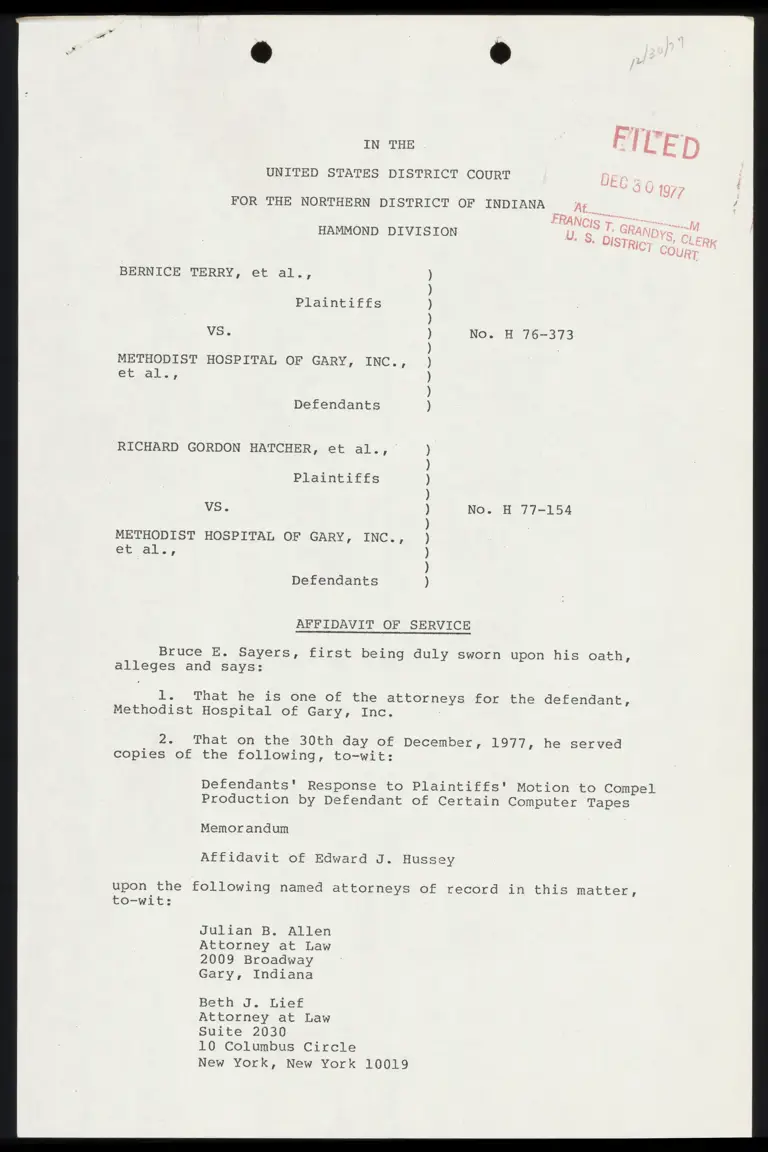
AFFIDAVIT OF SERVICE


Bruce E. Sayers, first being duly sworn upon his oath,
alleges and says:

l. That he is one of the attorneys for the defendant,
Methodist Hospital of Gary, Inc. :

2. That on the 30th day of December, 1977, he served
copies of the following, to-wit:

Defendants' Response to Plaintiffs' Motion to Compel
Production by Defendant of Certain Computer Tapes

Memorandum

Affidavit of Edward J. Hussey

upon the following named attorneys of record in this matter,
to-wit:

Julian B. Allen
Attorney at Law

2009 Broadway
Gary, Indiana

Beth J. Lief

Attorney at Law

Suite 2030
10 Columbus Circle

New York, New York 10019


" *


Rebecca L. Ross, Esq.
Department of Justice
10th and Pennsylvania Avenue, N.W.
Washington, D. C.

Marvin G. Garvin and Edward L. Koven
Regional Attorney and General Attorney
Department of Health, Education and Welfare
300 South Wacker Drive, 18th Floor
Chicago, Illinois

Fred W. Grady

Assistant United States Attorney
United States District Court
Northern District of Indiana

Federal Building, 507 State Street
Hammond, Indiana 46325

Marilyn G. Rose
Christine B. Hickman
1751 N Street, N.W.
Washington, D. C. 20036

Theodore Sendak
Attorney General
State House
Indianapolis, Indiana 46320

by depositing same in the United States Mail, postage prepaid,
and addressed to each of the above-named individuals.

3. Further affiant $aysLh not. 2

3)
> oY Ps

;

ta a
rr E. di


Subscribed and sworn to before me, & Notary Public,
this 30th day of December, 1977.

A
RY Shirley mar, Notary Public


\» My Commission Expires:

March. 2, 1981


IN THE Eirier

UNITED STATES DISTRICT COURT

FOR THE NORTHERN DISTRICT OF INDIANA =v ou 1977

HAMMOND DIVISION

BERNICE TERRY, et al.,

Plaintiffs

VS. No. H 76-373

METHODIST HOSPITAL OF GARY, INC.,

et al.,

N
a
”


N
m
?


N
w


S
u
m


w
t
?


“
w
n
t
?


w
n
t
’


S
w
?


w
p


“
w
s


Defendants

RICHARD GORDON HATCHER, et al.,

Plaintiffs

VS. No. H 77-154

METHODIST HOSPITAL OF GARY, INC.,

et al.,

V
e
”


Y
a
m


a
’


N
a
p
?


N
a
t
”


m
t
?


V
a
n
?


N
u
i


w
t
?


“
u
n


Defendants

DEFENDANTS' RESPONSE TO PLAINTIFFS' MOTION TO COMPEL
PRODUCTION BY DEFENDANT OF CERTAIN COMPUTER TAPES


Come now the defendants, Methodist Hospital of Gary, Inc.

and Denis E. Ribordy, and respectfully ask this Court to

deny plaintiffs' Motion for an Order Compelling Production

by defendant, Methodist Hospital, of Certain Computer Tapes,

and in support thereof state as follows:

1. That on or about the 26th day of September, 1977,

plaintiffs herein served their Second Set of Interrogatories

on defendant, Methodist Hospital, (a copy of which is attached

hereto as "Exhibit A") requesting detailed and complex definition

of any and all computer systems utilized by the Hospital.

2. That thereafter defendant informed plaintiffs’

counsel, Ms. Beth Lief, that the Interrogatories had been

forwarded to the third party independent contractor utilized

by the Hospital to prepare its payroll accounting (Health


Information Systems of Indianapolis Indiana) and utilized

by the Hospital to retain inpatient information to aid in

the medical audit internal review function (Commission on

Professional and Hospital Activities of Ann Arbor, Michigan).

3. That the defendant further informed Ms. Lief that

the Hospital did not have a computer expert on staff and

therefore must rely on these independent contractors to

prepare answers to plaintiffs' Second Set of Interrogatories.

4. That, after consultation with their respective

legal counsels the H.I.S. and C.P.H.A. each submitted answers

to plaintiffs' Interrogatories to the Hospital which answers

were prepared and filed with this Court on November 3, 1977.

5. That thereafter plaintiffs' attorney, Ms. Lief,

asked that the Hospital ask its computer expert to contact

plaintiffs' computer expert, Mr. Martin Mador, in an attempt

to resolve difficulties in the discovery process with regard

to the computer information. The Hospital then contacted

H.I.S. and was informed that Ms. Sharon Webster of H.I.S.

was willing to talk with Mr. Mador. The Hospital has been

informed that Ms. Webster and Mr. Mador have discussed the

problem at some length. The Hospital also contacted C.P.H.A.

and was informed that that organization would speak to the

plaintiffs or their experts only through their attorney,

Mr. Robert Fine of Ann Arbor, Michigan. This fact was communi-

cated to Mr. Brent Simmons, co-counsel for plaintiffs.

As of this date, the Hospital is not aware of any attempts

by plaintiffs to communicate with C.P.H.A.

6. That thereafter on November 15, 1977, plaintiffs

mailed an informal request to defendant Methodist's attorney,

Bruce E. Sayers, asking that the Hospital obtain duplicate


copies of all computer tapes in the possession of H.I.S.

That on November 17, 1977, the Hospital asked the H.I.S.

to examine the Zeasibilicy of such a request. The Hospital

was informed that such a copy could be made, but that the

duplicate could not be produced in a manner which would

eliminate the names, addresses and social security numbers

from said tapes. The Hospital requested that such a tape

be produced. The tape has not as yet been received by the

Hospital.

7. That thereafter the Hospital prepared copies of

computer printouts of the information contained on the H.I.S.

tapes eliminating the names, addresses and social security

numbers of its employees. Copies of said printouts were

mailed to all parties herein on December 21, 1977.

8. That on November 22, 1977, the plaintiffs informally

asked that the Hospital make the following request on C.P.H.A.:

Request for the PAS file for all patients
within the parameters set forth:

"Copy on magnetic tape 9-track
in E.8.C.D.1.C. character code
of all patients in the PAS file
for Gary Methodist Hospital and
Broadway Methodist Hospital."

9. That, on November 29, 1977, the Hospital asked

C.P.H.A. to examine the feasibility of such a request.

Mr. Dean Hosmer and Ms. Susan Whitfield of C.P.H.A. have

informed Methodist Hospital that the request would cover

the period 1964 to present, that four computer systems and

four separate programming systems have been utilized by

C.P.H.A. during that period of time.

10. That, due to illness, vacation and/or holidays

the full response from C.P.H.A. to the Hospital's inquiries


* »

has not yet been received (see attached Affidavit of Edward

J. Hussey). However, the Hospital has been informed that

complying with the request for the years 1969 to present

would cost in excess of $3,000.00. For years previous to

1969 the cost would substantially escalate.

11. That despite plaintiffs’ protestations to the

contrary, much of the pertinent information on the C.2.H.A.

tapes for the years 1965, 1970-77 has been previously provided

to plaintiffs in Defendants' Answers to First Set of Interroga-

tories and the pertinent information contained on the H.I.S.

tapes sans names, addresses and social security numbers

has been provided to plaintiffs in defendants' December

21 response to the letter of Mr. Brent E. Simmons.

12. That defendant believes that release of the H.I.S.

and C.P.H.A. tapes would violate the right to privacy of

its patients and employees, as well as violate the confidential

relationship between the patient and hospital, the patient

and doctor as well as the Hospital and doctor.

13. That plaintiffs in their Motion and Supplemental

Motion failed to comply with Local Rule 7(e) in that plaintiffs

failed to refer to Local Rule 7(e) in their Motions, Called

to convene a personal meeting with defense counsel in a

Sincere attempt to resolve differences and, therefore, failed

to recite the date, time and place of such personal conference

and the names of individuals attending.

14. That defendants assert that plaintiffs' Motion

is too broad in that it encompasses a time span from 1964

to present and would require the release of information

which is irrelevant to the matter at hand, that much of

the information sought is repetitive and disclosure of other


* ®

information would violate various confidential relationships

between Hospital, patient and doctor and violate the right

of privacy of various individuals.

15. The defendants reiterate their position which

has been frequently conveyed to the plaintiffs that if the

Plaintiffs would only identify precisely what information

they want from the tapes, the defendants will make every

effort to have a computer printout prepared of that information

and make it available to plaintiffs.

WHEREFORE, defendants pray that the Court deny plaintiffs’

Motion to Compel in its entirety or in the alternative for

a Protective Order limiting production of the C.P.H.A. and

H.I.S. tapes to the years 1974 to present, in a form eliminating

all reference to patient, doctor or employee name, number,

address and social security number, and Furthermore that

plaintiffs be required to bear any costs attendant to such

production, and Furthermore that utilization of such tapes

and that information obtained therefrom be limited to the

Present action before this Court.

Respectfully submitted,

HODGES, DAVIS, GRUENBERG, COMPTON & SAYERS
ATTORNEYS FOR DEFENDANTS, METHODIST HOSPITAL
OF GARY, INC. AND DENIS E. RIBORDY

go J ; ol Lr

BY? ANA AN jen LB liar


“BRUCE EE, SAYERS /

5525 Broadway
Gary, Indiana 46410
Ph, 981-2557


IN THE

UNITED STATES DISTRICT COURT

FOR THE NORTHERN DISTRICT OF INDIANA

HAMMOND DIVISION

BERNICE TERRY, et al.,

Plaintiffs

VS. No. H 76-373

METHODIST HOSPITAL OF GARY, INC.,

et al.,

N
t
”


N
t
”


N
a
t
’


N
a
l
?


N
a
a
t


Na
ni
”

u
n
i


a
u
t
?


u
u
?


p
a
t
”


Defendants

RICHARD GORDON HATCHER, et al.,

Plaintiffs

VS. No. H 77-154

METHODIST HOSPITAL OF GARY, INC.,

et al.,

N
a
?


N
a
l
l


N
a
t
’


S
s
t
?


N
u
t
?


a
n
t


S
a
i
?


u
t


“
m
t


“
u
t
?


Defendants

MEMORANDUM


Plaintiffs in support of their Motion to Compel Production

of certain computer tapes cite the need for said tapes to

enable plaintiffs to analyze their claims that Gary Methodist

Hospital is understaffed, that nurses at Gary Methodist

Hospital work more overtime than the nurses at Broadway

- Methodist, and that transfers of employees from Gary Methodist

Hospital to Broadway Methodist Hospital at the time Broadway

Methodist Hospital was opened was discriminatory. (Affidavit

of Beth J. Lief dated December 20, 1977 p. 2). Plaintiffs

further state that they are entitled to the requested data

in "computer readable form" as a matter of law. (Affidavit

of Brent E. Simmons dated December 15, 1977 p. 3).

Defendant, Methodist Hospital, would point out to the

Court that the "claims" referred to by Ms. Lief are not


disclosed in plaintiffs' Complaint. Furthermore, there

have not been, to this point any allegations by plaintiffs

concerning discriminatory hiring or staffing at Methodist

Hospital. The plaintiffs' Complaint speaks only of deprivation

of Civil Rights under Title VI of the Civil Rights Act of

1964, not employment discrimination under Title VII. Perhaps

the material requested would be relevant to such claims.

However, that is not the issue herein.

The plaintiffs further allegation that defendants do

not dispute the relevance of the requested materials is

not correct. While some of the material contained on the

tapes may be relevant and, therefore, discoverable, other

material such as employee names and addresses and patient

and doctor identification cannot be relevant (especially

in light of the Court's decision not to require notice to

the plaintiff class) but can only serve to invade the rights

of privacy of the individuals concerned.

Nevertheless, despite the questionable relevance of

much of the material requested, the vast majority of the

information contained on the H.I.S. tapes, and a good deal

of the information contained on the C.P.H.A. tapes has been

previously provided to the plaintiffs in response to the

plaintiffs' First Set of Interrogatories as well as informal

letter and telephonic requests by the plaintiffs' attorneys.

Furthermore, the assertion by Mr. Simmons that the

plaintiffs are entitled to the tapes as a matter of law

is not a complete and accurate statement of the law.

Plaintiffs cite Donaldson v. Pillsbury Co., 554 PF 24


825 (8th Cir. 1977) in support of their assertion. The


Pillsbury case was a Title VII employment discrimination


case. The Eighth Circuit Court of Appeals, in reversing

the lower courts denial of class action certification and,

dismissal of complaint, stated that the lower court might

re-examine its denial of plaintiffs' motion to compel production

of computer tapes in light of the Appellate Court's ruling

on the class question. The Court does state that two district

courts had upheld motions for production. The Court seems

to be stating that such material may be Ais cover ALE in

‘certain circumstances BUT NOT as a "matter of law".

Plaintiffs also cite United States v. Davey, 543 F


2d 996 (2nd Cir. 1976). In this case the Internal Revenue

Service summoned, pursuant to 26 U.S.C. §7602, the original

business records of the Continental Corporation, including

some records which were contained on computer tape. The

important distinction here is that the I.R.S. was acting

pursuant to a specific statute allowing the Service to compel

production of the original business records of a taxpayer

and the materials sought were records kept pursuant to another

requirement of the Internal Revenue Service Regulations,

i.e. R.R., 71-20, 1971-1 Cumm. Bill 392 requiring expense

records to be kept for a minimum of 5 years. Printouts

or duplicate tapes were not sufficient as there was no showing

that these materials were accurate. The government was

involved, therefore, a different set of rules applied.

The Davey court does suggest however that, in considering

such a summons, or a motion to produce, that the court must

weigh the obvious accuracy and simplicity of the tapes against

the relvancy of the material contained therein, the burden

and cost of production, the confidentiality of the information

on the tapes and whether such a production is unnecessarily

duplicative.


The third case cited by plaintiffs is Adams v. Dan River


Mjilis, Inc,, 54 P.R.D. 220, a 1972 District Court opinion

from Virginia. This case involved alleged racially discrimina-

tory employment practices by the defendant, and plaintiffs’

request for defendant's current computerized master payroll

file. After reviewing the notes of the Advisory Committee

on Rules pertaining to Rule 34 of the Federal Rules of Civil

Procedure (which states in part that "In many instances...respon-

dent will have to supply a print-out of computer data.”

28 U.S.C.A. Rule 34) the Court ordered the production of

a computer tape stating that the Advisory Committee's notes

did "not appear to preclude the production of computer in-

put information such as computer cards or tapes.” 54 P.R.D.,

at 222. The Court noted the accuracy and inexpensiveness

of such a production. The Court did not go through the

well reasoned weighing process outlined above.

Defendant asserts that, if the Court considers: the

fact that much of the information contained on the tapes

requested has already been produced (at considerable expense

to the defendant), the effect that wholesale production

of these tapes might have on the Hospital-patient-doctor

relationship as well as the privacy rights of the individuals

concerned, defendants' willigness to provide particular

information assuming it is discoverable if plaintiffs will

only identify what information it is that plaintiffs want,

and the further expense and burden to produce such tapes,

the Court will deny plaintiffs' Motion.

Respectfully submitted,

HODGES, DAVIS, GRUENBERG, COMPTON & SAYERS
ATTORNEYS FOR DEFENDANTS, METHODIST HOSPITAL
OF GARY, INC. AND rr RIBORDY & ” /

BY ps ™ ; AA KY it) ry Pd . i Sle

BRUCE E. SAYERS /
5525 Broadway /
Gary, Indiana 46410
Ph. 981-2557


i


IN THE

UNITED STATES DISTRICT COURT

FOR THE NORTHERN DISTRICT OF INDIANA

HAMMOND DIVISION


BERNICE TERRY, et al.,

Plaintiffs,

Ve. NO. H 76-373

METHODIST HOSPITAL OF GARY, INC.,

et al.,

0.


00


00


90


00


00


00


00


00


Defendants.

ee


oo


RICHARD GORDON HATCHER, et al.,

Plaintiffs,

Ve NO. H 77-154

METHODIST HOSPITAL OF GARY, INC.,

et al.,

Defendants.

e
o


o
e


o
e


LX


J
LX


J
(
1


LX


]
o
e


L
X
]


LX
]


PLAINTIFFS' SECOND SET OF INTERROGATORIES
TO DEFENDANT METHODIST HOSPITAL OF GARY,

INC.

Plaintiffs respectfully request, pursuant to Rule 33 of

the Federal Rules of Civil Procedure, that defendants answer the .

following interrogatories within ten (10) days. The definitions

and rules set forth in plaintiffs' first set of interrogatories

apply to the following questions:

The following are definitions eed throughout these

interrogatories

a) a "field" is composed of one or more columns

; : ; : ; (characters), and comprises a discrete item of information, such |

Or aie andi oe SM oe OF 7]

 WEXHIBIT
C A Ein.

RSET. NPE ., PN SR


% &

as name, race, job, etc.

.b) all individual fields for one entry to the file, calor

together, form a record.

c) A "file" or "Data Base," is composed of any number of

records. Each record is similar in format or contents and func-

tions to all others, although records of different structure

(Layout) may exist together in the file, As a field is the log-

ical subdividion of a record, so the record is the building block

of a file. A file exists in computer-readable form, which may

include magnetic disks, drums, data cells, direct access devices,

or tapes; keypunch cards; punched paper tape; or optical charac-

ter forms. Any medium which can be processed by an input/output

device is considered to be in computer-readable form. Print-outs

are not included.

a For the purposes of these interrogatories, the term

"Data Base" is limited to only those files containing any of the

information below relating to (1) any employee, and (2) medical

staff (present, former, prospective, hourly, salaried, affiliated,

management, professional, operative, laborer, etc.) of defendant,

and (3) any patients serviced at defendant's facilities.

As to Sloe and persons with staff privileges:

1) race

2) sex

3) age or birth date

4) social security number

5) seniority dates used for purposes of progression,

demotion, layoff, recall, vacation

6) date of hire or affiliation agreement

7) date of termination

Te

4


® @

8) reason for termination

9) job, department, gang, plant, division, 1 lile-nf-orogress

sion, organization assignments

10) dates of such assignments

11) rates of pay

12) the dates of such rates

13) dates of all layoffs, leaves of absence, or other extend-

ed absences from work

14) relative Staning among other employees (such as senior-

ity)

15) identification, clock or badge number

16) transfers between hospital facilities, plants, depart-

ments, etc.

17) the dates of such transfers

18) level of education: format, vocational, on-the-job, etc.

19) the dates of such education

20) medical qualifiactions or disqualifications

21) hourly or salarly pay, status

22) work station or physical working location

23) shift

24) requests or bids for promotion or transfer

25) waivers or refusals to promote

26) gross earnings for calendar years 1972 — present

27) gross earnings for all pay periods 1972 — present

28) hours worked or hours paid for calendar years 1972 —

present

29) hours worked or hours paid for all pay periods 1972 —

present


@ ®

30) address

31) evaluations or ratings made of employee

32) skills, qualifications, training gained by employee

during employment with defendant

33) name and race of supervisors

34) professional qualification of employee, such as certifi-

cates held, languages spoken

35) pension richts or payments

36) union status

37) job vacancies

38) job class, pay level, pay grade

As to patient services, all information for the years 1970-1977

"with regard to Gary Methodist Hospital and for the years 1976-

1977 for Broadway Methodist Hospital:

(L) for each patient in inpatient services: zip code,

race, age, source of admission, number patient days, service

(clinic) and source/method of payment;*/

(2) total number of patients and patient days in in-

patient services;

(3) for each patient services in emergency room: zip

code, race, age, source of payment, whether admitted, service

(4) total number of patients given emeTgehiy Loam ser—

vices;

(5) for each ancillary service (with diagnostic x-ray

and therapeutic x-ray separately reported.as distinct services)

name of service, each patient by race, age, zip code, source of

admission, method of payment

(6) for each ancillary service (defined as in (5)),


| |     */ E.g., CHAMPUS, Medicare, Medicaid, Blue Cross, Workmen's

Compensation, Self-Pay, Free Care, Unknown.

ee


® @®

total number of patients;

| (7) for each clinic service, separately by name of

clinic: each patient by zip code, race, age, method of payment,

total number of patients.

If any of these Interrogatories can be atisveron by produc-

tion of working documents associated with defendant's customary

data processing operations they may be supplied in lieu of such

answer only if accompanied by clear explanations of any coded,

abbreviated, or otherwise ambiguous material contained therein.

PART 1

Answer each question in this Part separately for each Data

Base (see definition, supra), which the defendant currently hain

tains, or has previously maintained. If the answer to any

question applies to two or more distinct computer systems, answer

that question separately for each. Answer each question forthe

entire time period during which the data base was in use. If the

data base changed over time in any way, answer each applicable

question separately for each differing time period in question.

1. ‘Skate the name of the data base, either as it is re-

ferred to in the defendant's customary data processing operation

or so that it can be uniquely identified in subsequent answers

or pleadings.

2. Which categories of employees are included in the data

base.

3. When was the data base first created, and when was it

last used.

4, If volumes, version, or generations of the data base are

(were) periodically produced, state:


“ =P

a) how often a copy is produced.

b) what period of time is covered by each volume.

c) in what ways any of the answers to questions in Part

I differ between different volumes of the data base.

d) by volume serial or other unique identifier, the vol-

umes still extant and the contents and dates thevsol, retained,

and if so, |

€) identify any volumes scheduled for destruction within

the next twelve months.

5. If entries in the data base are periodically updated,

without a new volume or copy being created (such as the weekly up-

dating of a disk master file), state:

a) how often the data base is updated.

b) which fields or records are subject to revision.

c) whether complete copies are made and retained, and

if sO,

d) state by volume or other unique identifier the vol-

umes still extant, the contents and dates thereof, and any pro-

posed destruction dates.

e) whether changed or purged entries are maintained in

computer-readable form, and if so,

f) answer all applicable questions in Part I for any

files containing these purged entries.

6. Provide the following for all. fields found within each

different record structure within the data base. In the alterna-

tive, a "record layout" for the file may be produced, providing ig

supplies each requested item of information in a clear, legible,

and unambiguous format:


® ®

a) its location within the record.

b) a brief description of its contents.

c) a brief description of its function and signifi-

cance, if not immediately obvious (such as name, race).

d) the physical representation of its contents (char-

acter, zoned decimal, packed decimal, signed decimal, binary,

floating point, location of assumed decimal point, location of

sign, right—or left—justified, strictly numeric, numeric with

blanks, etc.).

e) the sign codes used for decimal fields (i.e., IBM

standard PE he oY or Ppt. for plus, hex "HY for minus).

f) the status of the field; whether data was always

entered, was sometimes entered (was optional), or was never en-

tered (space was provided, but field was not used).

g) for each field which Sontains "coded" entries, such

as a Field for race containing =z "1" for white and a "2" for

black, or numbers representing department titles, provide a

translation table which contains each possible entry and its

English translation or literal meaning. If such translation

table exists in computer-readable form, answer all appropriate

questions in Part I concerning the table.

7. If the file is composed of records differing in format

from one another, provide the record layout for each possible

record entry, (c.f. question 6) and state how the format approp-

riate to any particular record can be ascertained. If the file

is "hierarchical® in structure (i.e., it contains an unpredicta-

ble number of minor-level records related in some manner to a

preceeding major-level record), describe in detail the structure


of the file, and state how different record types and levels can

be recognized.

8. State the approximate number of logical records in the

data base,

9. Describe the storage device or medium.

10. : State the:

a) logical record length.

b) physical record length (blocksize).

c) record format (fixed length, variable length, spanned,

blocked.

d) file organization (sequential, indexed, direct, VSAM)

e) reins code (EBCDIC, ASCII, BCD, Hollerith,

column binary).

11. State the programming language or retrieval system used

to create and access the data base.

12. If the data base is generated or accessed by a program

which is part of a formal or documented processing system, pro-

vide a "flowchart" for that system, showing the flow of informa-

tion (files) from program to program.

13. If on magnetic tape, state the density (bits per inch),

the number of tracks (7.9), the recording technique (parity,

translation, conversion, character code) if on 7 track, the form

of internal identifying labels (IBM standars, non-labelled, IBM

1400 series, Burroughs standard, etc.), and the format of black

prefixes if ASCII.

14. With reference to the fields enumerated in the answer

to Question 6, describe the order in which records in the data

base are sorted.


i
14


PART 11

15. Briefly describe each of the defendant's computer facil~

ities, including:

a) manufacturer.

b) model number.

c) name and release of operating system.

d) type and number of each input/out/put device.

16. If the defendant's current computer system is not cap-

able of copying each of the data bases identified in Part I ac-

cording to the following parameters, state why not, and state

what alternatives are available for each of the parameters

listed:

a)onto magnetic tape.

b) 5 track.

c): at ‘800, 1600, or 6250 bpi.

d) in EBCDIC character code.

e) with IBM standard OS 1abels,

17... ‘For sack Intoraation retrieval program or report gen-

erator (i.e., software capable of producing a multitude of

different reports, depending on control information entered)

available, whether purchased, leased, or written locally,

a) identify its name or title, vendor or author, and

any optional features installed.

b) identify which of the data bases named in Part I

Lhe program operates on, and whattype of reports it is capable

of generating.

c) Identify and describe all documents, reference man-

uals or texts which describe the program and its operation.

18. If defendant contracts with an outside service bureau

or agency for processing of data bases identified in Part I,

Os


*® { i

a) describe those services completely.

b) indicate which data bases identified in Part I are

in the possession of such bureau or agency.

c) answer all parts of questions 15 and 16 concerning

the bureau's data processing capabilities.

19. Give the name, business address, job title, and job

function of:

a) the manager of defendant's data processing operation:

b) each analyst or programmer who has intimate knowledge

of the contents or function of each data base identified in Part

I (specify which).

c) the person(s) who answered these Interrogatories.

Respectfully submitted,


JACK GREENBERG

BETH J. LIEPF

MELVYN LEVENTHAL"

10 Columbus Circle

New York, New York 10019

JULIAN B. ALLEN

CHARLES B. MILLER

2009 Broadway

Gary, Indiana 46407

MARILWG. ROSE

CHRISTINE G. HICKMAN

1751 N Street, N.W.

washington, D. C. 20036

Attorneys for Plaintiffs

Dated:

1)


IN THE

| UNITED STATES DISTRICT COURT

FOR THE NORTHERN DISTRICT OF INDIANA

HAMMOND DIVISION


BERNICE TERRY, et al.,

Plaintiffs,

Vv. NO. H 76-373

METHODIST HOSPITAL OF GARY, INC.,

et al.,

Defendants.

60


00


00


49


00


00


ep


G0


SB


G0


00


00


s
e


RICHARD GORDON HATCHER, et al.,

Plaintiffs,

Vv. NO. B 77-154

METHODIST HOSPITAL OF GARY, INC.,

et al.,

Defendants.

88


00


00


05


00
%

OC


ee


OF


0


00


ee


0


[2
]

    MOTION AND NOTICE OF MOTION

FOR EXPEDITED DISCOVERY SCHEDULE

Please take notice that plaintiffs respectfully move this
|

Court pursuant to Rule 33 (a) for an expedited discovery schedule

requiring the defendant to answer the attached Interroga-

tories within ten (10) days of service on the grounds that this
Court has set trial in the above-captioned cases for December 5. 4

1977 and that plaintiffs thereforerequire answers to interroga-

tories as quickly as possible, and that defendants will suffer no


prejudice since the interrogatories only seek information which

is or should be readily at defendant's disposal.

Respectfully submitted,

-

Dit, fl Kote
JECK GREENBPRG
BETH J. LIEF
MELVYN LEVENTHAL

10 Columbus Circle

New York, New York 10019


JULIAN B. ALLEN
CHARLES B. MILLER

2009 Broadway

Gary, Indiana 46407

MARILYN G. ROSE

CHRISTINE G. HICKMAN

1751 N Street, N. W.

washington, D. C. 20036

Attorneys for Plaintiffs

Dated:


* »


Certificate of Service


I hereby certify that a copy of the foregoing plaintiffs'’

Second Set of Interrogatories to Defendant Methodist Hospital of

Gary, Inc.,Motion & Notice For Expedited Discovery Schedule,


was served by United States mail, postage prepaid, on
va

the HE day of Dba tty 1977; on counsel for
J

defendants as follows:


Rebecca L. Ross, Esq.
Department of Justice
10th and Pennsylvania Avenue
Washington D.C.

Marvin G. Garvin, Esg. and Edward L. Koven, Esq.
Regional Attorney and General Attorney

Department of Health, Education and Welfare
300 South Wacker Drive, 18th Floor
Chicago, Illinois

Fred W. Grady, Esq.
Assistant United States Attorney
Northern District of Indiana
Federal Building, 502 State Street
Hammond, Indiana 46325

Attorneys for Defendant Secretary of Health,
Education and Welfare

Hodges, Davis, Gruenberg, Compton & Sayers
Bruce E. Sayers, Esq.

5525 Broadway
Gary, Indiana 46401

Attorneys for Defendant Methodist Hospital
of Gary, Inc.

Theodore L. Sendak, Esq.

Assistant Attorney General of Indiana
219 State House
Indianapolis, Indiana

Attorneys for State Defendants


Anthony DeBonis, Jr., Esq.

Joseph E. Costanza, Esq.
Murphy, McAtee, Murphy & Costanza
First National Bank Building
720 W. Chicago Avenue
East Chicago, Indiana 46312

Attorneys for Defendant Kipton Kaplan

  7
eth J. Left

Counsel for Plaintiffs


IN THE

UNITED STATES DISTRICT COURT

FOR THE NORTHERN DISTRICT OF INDIANA

HAMMOND DIVISION

BERNICE TERRY, et al.,

Plaintiffs

VS. No. H 76-373

METHODIST HOSPITAL OF GARY, INC.,

et al,,

Defendants

V
e
s
?


t
®


C
n
”


N
n
”


“
u
s


S
a
n
t
?


w
t
?


s
t


“
g
t
?


“
u
s
?


RICHARD GORDON HATCHER, et al.,

Plaintiffs

Vs. No. H 77-154

METHODIST HOSPITAL OF GARY, INC.,

et al.,

W
t
”


a


N
w
?


N
a
s
t
?

N
w
?


N
u
i
?


i
t
?


“
a
w
?


“
w
n
t


“
e
g
?


Defendants

Ar rPIDAVIT


Comes now Edward J. Hussey, who being first duly sworn

upon his oath, alleges and says:

l. That he is one of the attorneys for the defendants,

Methodist Hospital of Gary and Denis E. Ribordy.

2. That he has been engaged in various attempts to

comply with the discovery request for production, motions,

interrogatories and various informal discovery requests

made by the plaintiffs.

3. That he has been in contact with plaintiffs' attorneys,

Beth J. Lief and Brent E. Simmons, with regard to the plaintiffs’

Second Set of Interrogatories concerning various computer

data maintained for Methodist Hospital of Gary by various

independent contractors.


4. That he has been in contact with Mr. Dean Hosmer

and Ms. Susan Whitfield of the Commission on Professional

and Hospital Activities and Ms. Sharon Webster of Health

Information Systems, the two independent contractors utilized

by Methodist Hospital to maintain inpatient and payroll

information.

5. That he has been informed by Ms. Sharon Webster

of Health Information Systems that the payroll information

for Methodist Hospital has been retained on the H.I.S. computers

for the years 1974 to present. That the H.I.S. computer

information can be duplicated in tape form at a reasonable

cost. However, that material includes the names, addresses,

social security numbers, rates of pay, and annual earnings

for all of Methodist Hospital's erblovess. Furthermore,

Ms. Webster informs him that H.I.S. does not have the capability

of deleting this information from the tapes and that, therefore,

any duplicate tape produced pursuant to plaintiffs' request

would contain such information.

6. That he has proffered to plaintiffs’ attorneys

On December 21, 1977, a printout listing of the race, sex,

zip code, position and work location of the employees of

Methodist Hospital obtained from Methodist Hospital's records

and information retained by H.I.S.

7. That he has been informed by C.P.H.A., the independent

contractor utilized by the Hospital to maintain inpatient

records on computer tapes, that that institution maintains

records on Methodist patients for the years 1964 through

present and that said records are in computer form. However,

the records have been kept in four different computer systems

utilizing four different computer programs for various years.


The systems for 1964 through 1966, 1967 through 1969 and

1970 through 1973 are different computer systems and different

computer programs from those currently being utilized by

C.P.H.A. Therefore, the cost of complying with plaintiffs’

request as well as the time required to comply with the

plaintiffs' request is exorbitant. He has been informed

by C.P.H.A. that the cost of reproducing the tapes simply

for the years 1969 to present to be in excess of $3,000.00.

8. That he has communicated at various times all of

the above information to Mr. Brent E. Simmons or to Ms.

Beth J. Lief, attorneys for plaintiffs.

9. Further affiant sayeth not.

Maa
EDWARD J. HUSSEY


STATE OF INDIANA (

4p]


COUNTY OF LAKE

Subscribed and sworn to before me, a Notary Public,

this Re sory of December, 1977.

sites willie spn
Med, 7 7 Notary Public


~~ My Commission Expires:
{

nt 2 LZ [||0b3c0879-420e-4e97-b73e-0b9252a30f33||]