Dowell v. Oklahoma County Board of Education District No. 89 Judgment; Memorandum Opinion
Unannotated Secondary Research
March 26, 1976
23 pages
-
Case Files, Henry v. Clarksdale Hardbacks. Dowell v. Oklahoma County Board of Education District No. 89 Judgment; Memorandum Opinion, 1976. a920359e-8418-f111-8342-7c1e526962fd. LDF Archives, Thurgood Marshall Institute. https://ldfrecollection.org/archives/archives-search/archives-item/c8293cf6-9cf5-407d-a116-2caaca4cc79f/dowell-v-oklahoma-county-board-of-education-district-no-89-judgment-memorandum-opinion. Accessed October 06, 2026.
Copied!
     [||74ba031f-8d25-4bac-b941-a8b96f3c26b2||] »

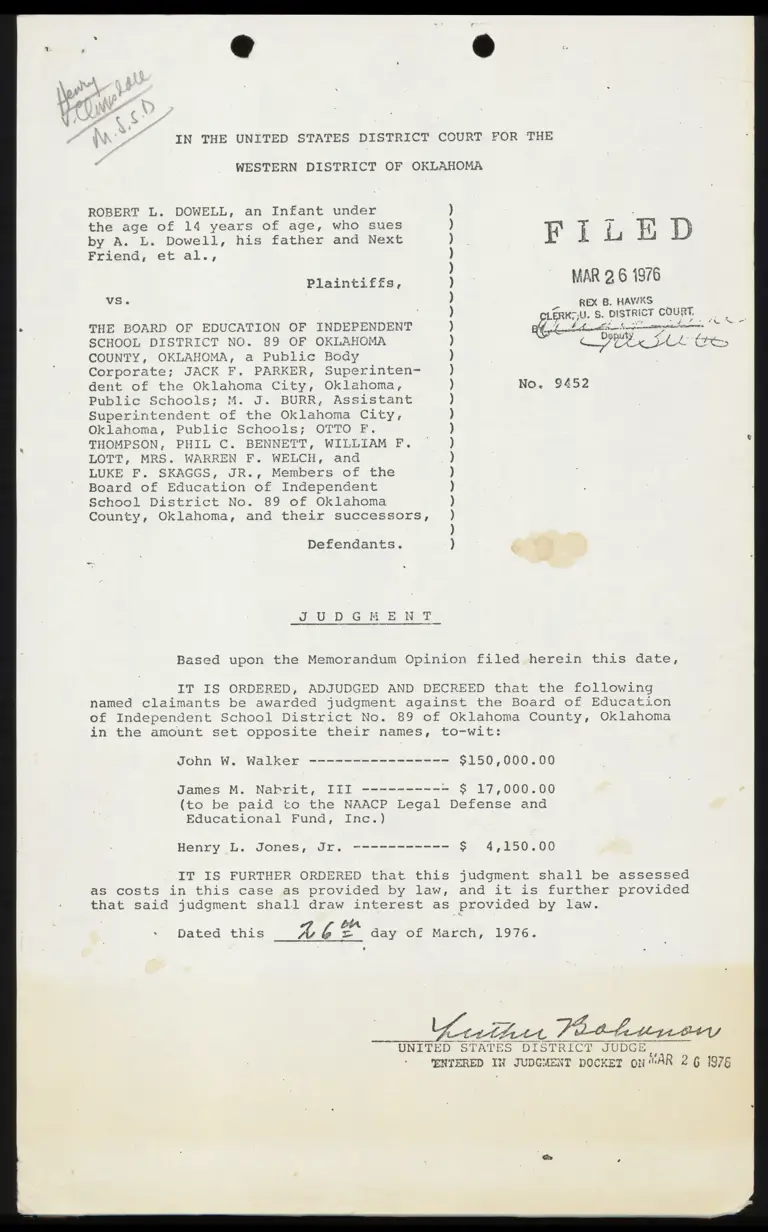
IN THE UNITED STATES DISTRICT COURT FOR THE

WESTERN DISTRICT OF OKLAHOMA

ROBERT L. DOWELL, an Infant under

the age of 14 years of age, who sues

by A. L. Dowell, his father and Next

Friend, et al.,

FILED

MAR 2 6 1976
Plaintiffs,

VS. REX B. HAWKS
ERMC. S. DISTRICT COURT,

. THE BOARD OF EDUCATION OF INDEPENDENT (Lesa Sei mamta © Nie

SCHOOL DISTRICT NO. 89 OF OKLAHOMA dd Cn IY Aes

COUNTY, OKLAHOMA, a Public Body

Corporate; JACK F. PARKER, Superinten-

dent of the Oklahoma City, Oklahoma, No. 2452

Public Schools; M. J. BURR, Assistant

Superintendent of the Oklahoma City,

Oklahoma, Public Schools; OTTO F.

THOMPSON, PHIL C. BENNETT, WILLIAM F.

LOTT, MRS. WARREN F. WELCH, and

LUKE F. SKAGGS, JR., Members of the

Board of Education of Independent
School District No. 89 of Oklahoma
County, Oklahoma, and their successors,

N
e
?

V
t
?

N
e
”

a
r
”

T
a
n
”

N
n
”

N
n
’

“
m
e
?

S
u
n

V
n
”

N
a
’

V
a
t
”

N
a
t
?

i
’

t
l

w
i
?

N
a
t
l

w
n
t

a
t

“
w
l

w
t

a
k

“
a
t

“
w
s


Defendants.

JUpDGEENT

Based upon the Memorandum Opinion filed herein this date,

IT IS ORDERED, ADJUDGED AND DECREED that the following

named claimants be awarded judgment against the Board of Education
of Independent School District No. 89 of Oklahoma County, Oklahoma
in the amount set opposite their names, to-wit:

John W. Walker =——=cwcccecamaae—- $150,000.00

James M. Nabrit, II] =--===-===== § 17,000.00
(to be paid to the NAACP Legal Defense and
Educational Fund, Inc.)

Henry L. Jones, Jr, =mwesssswse $ 4,350.00

IT IS FURTHER ORDERED that this judgment shall be assessed
as costs in this case as provided by law, and it is further provided
that said judgment shall draw interest as provided by law.

EA
Dated this po A z day of March, 1976.

Lt ow nitont, Totdtinrtirts
UNITED STATES DISTRICT JUDGE

"ENTERED IN JUDGMENT DOCKET on “AR 2 ¢ 1976


IN THE UNITED STATES DISTRICT COURT FOR THE

WESTERN DISTRICT OF OKLAHOMA F i LLG HD)

ROBERT L. DOWELL, an Infant under

the age of 14 years of age, who sues AR 2.6 1076

by A. L. Dowell, his father and Next REX B. HAWKS A

Friend, et al., CLERK, y. S. DISTRICT COURT

BY Sein, b] er l lL (
Lis re” bei, Plaintiffs,

VS.

ng THE BOARD OF EDUCATION OF INDEPENDENT

SCHOOL DISTRICT NO. 89 OF OKLAHOMA

COUNTY, OKLAHOMA, a Public Body

Corporate; JACK F. PARKER, Superinten-

dent of the Oklahoma City, Oklahoma,

Public Schools; M. J. BURR, Assistant
Superintendent of the Oklahoma City,

Oklahoma, Public Schools; OTTO F.

9 THOMPSON, PHIL C. BENNETT, WILLIAM F.

LOTT, MRS. WARREN F. WELCH, and

LUKE F. SKAGGS, JR., Members of the

Board of Education of Independent

School District No. 89 of Oklahoma

County, Oklahoma, and their successors,

No. 9452

V
e
t
’

N
n
?

N
e

N
m
’

N
p
?

C
l

N
m

i
l

N
w

C
a
l

“
w
t

a
?

“
i
t

w
i
h

N
u
t

w
a
t

w
t

w
l

a
l

C
w

w
t

w
t

“
w
e
t

“
a
d


Defendants.

John W. Walker and Henry L. Jones, of Walker, Kaplan & Mays, Little
Rock, Arkansas, and James M. Nabrit, III, New York, New York,

Attorneys for Plaintiffs. :

J. Harry Johnson, Oklahoma City, Oklahoma, and Larry L. French of
t Edwards & French, Seminole, Oklahoma, Attorneys for Defendants.

MEMORANDUM OPINION

Before LUTHER BOHANON, United States District Judge


'

a

This cause is now before the Court on a Motion to Allow

Attorney Fees to counsel for the plaintiffs herein.

The services for which payment is requested were primarily

rendered after the Court of Appeals for the Tenth Circuit in Board

of Education of Oklahoma City Public Schools v. Dowell, 375 F.2d 158

(C.A. 10 1967) had found: |

"The record reflects very little actual desegre-
. gation of the school system between 1955 and the filing

of this case." : :
375 F.24 a:"1631.

"Inherent in all of the points raised and argued
here by appellants is the contention that at the time
of the filing of this case there was no racial discrimi-
nation in the operation of the school system. That con-
tention should be first considered. The question of
the existence of racial discrimination necessarily goes
hand in hand with the question of the good faith of the
board in efforts to desegregate the system.

As we have pointed out, complete and compelled
segregation and racial discrimination existed in the
Oklahoma City School system at the time the Brown
decision became the law of the land. It then became
the duty of every school board and school official
'to make a prompt and reasonable start toward full
compliance' with the first Brown case. . . .

« « + When the trial court here made such a find-
ing and pointed out the areas of discrimination, it was
the clear duty of the school authorities to promptly
pursue such measures as would correct the unconstitu-
tional practices. . ..a

. « «. The board presented no plan, it only reiter-
ated its general intention to correct some of the

; : existing unlawful practices. This was not compliance
with the order of the court. . . .

Because of the refusal of the board to take prompt
substantial and affirmative action after the entering
of the court's decree, without further action by the
court, the aggrieved plaintiffs, even with a favorable
decree from the court were helpless in their efforts
to protect their court-pronounced Constitutional rights."
375 F.24 at: 164, 165,

The Court later noted in Dowell v. Board of Education of Oklahoma City

Public Schools, 430 F.2d 865 at 868, 869 (C.A. 10 1970):

"He [the trial judge] has been faced with many
unusually difficult situations in his enforcement of
the mandates of the Supreme Court and has actéd in an
effective and skillful way. The record in this and
the related cases demonstrates that little or no action
would have been taken by the Board of Education with-
out his 'encouragement.'" .


Finally it observed in approving the final plan of unification for

the system:

~~ "The plan now approved by' the trial court is
a direct attack on what is still fundamentally a
dual system to desegregate it as rapidly as possible.
It was necessary for the trial court to adopt a
comprehensive plan such as the one advanced by
Dr. Finger in view of the fact that the school
board did not come forward with an effective plan."
Dowell v. Board of Education of Oklahoma City
Public Schools, 405 F.2¢ 1012 at 1015 (C.A. 10 1972)

The issue presented is she 28attional cost to the school

district of the intransigence and bad faith of the defendant School

Board in seeking to preserve and protect a dual school system in |

defiance of constitutional imperatives for a unitary system. Spurred

by a press hostile to the constitutional concept of equal education

for all children, the Board has pursued a deliberate course of delay,

obstruction and evasion in the implementation of a unitary system.

By its obstinate disregard of its Sunstisubional responsibilities,

it compelled the plaintiffs to claim, demand, struggle for and

defend that which was constitutionally theirs. Willing to expend

and exhaust the resources of the school district in fruitless en-

deavors to frustrate plaintiffs' constitutional siones, the Board

made necessary the very services by counsel for plaintiffs whose

cost it now opposes. The Board is responsible for its betrayal

of the trust imposed by the citizens of the district. The conse-

quences of its wanton stewardship must not be iboEne alone by the

very parties whose rights were denied. Indeed, the vindication of

their rights unde the Constitution is necessarily an affirmation

of the rights of every citizen and of benefit to all who respect

and cherish the values of our Constitution. :

4

J. THE HISTORICAL CONTEXT

This action was filed October 9, 1961, by John E. Green,

attorney of Oklahoma City, and U. Simpson Tate of Wewoka, Oklahoma.


Mr. Green shortly thereafter withdrew as attorney for plaintiffs

in order to accept the position of Assistant United States Attorney.

for the Western District of Oklahoma. Mr. Tate continued as chief

counsel until the time of his death in 1968. In July, 1969, John W.

Walker of Little Rock, Arkansas, became lead counsel for the plain-

tiffs with the able assistance of his associates who are also seek-

ing compensation for their 6 1/2 years of professional services.

This was a very critical period in the development of plans to

convert from a dual system to a unitary system.

On April 8, 1968, in an action encouraging to the Court,

the Board had authorized the appointment of a Committee on Equality

of Educational Opportunity in the Oklahoma City Public Schools.

The Committee consisted of approximately 35 members representing

_various civic groups and other interested organizations and included

teachers, citizens from each high school attendance area, bankers,

church ministers, representatives from the Chamber of Commerce and

members of the School Board staff. Mr. Foster Estes, President of

the School Board, announced the appointment of Dr. Willis Wheat

as Chairman of the Committee, and the Committee was given the

following charge by the Board:

"The Oklahoma City Board of Education hereby
reaffirms and declares that an equal educational

opportunity for every pupil in the school district
regardless of racial or ethnic background, is the
policy of the school district, and that the creation
of the advisory council is desirable for the orderly
consideration and implementation of decisions
affecting equality of educational opportunity.

(a) WHAT ARE THE BEST POLICIES, PROCEDURES

AND PLANS FOR PROVIDING EQUAL EDUCA-

TIONAL OPPORTUNITY FOR ALL PUPILS OF

THE OKLAHOMA CITY PUBLIC SCHOOLS?

(b) WHAT CHANGES SHOULD BE MADE IN PRESENT

POLICIES AND PROCEDURES? WHAT NEW

POLICIES AND PROCEDURES, IF ANY, SHOULD

BE ADOPTED?"

The Committee was to meet from time to time with the

Oklahoma City Board of Education in order to present its ideas


k: v7

and to obtain clarification and guidance in Pornschion with
 the

specific task assigned to it. The rolled identified for the

Committee by the Board was "to provide equality of educational

opportunity by:

(A) Integration of pupils in the Oklahoma City

Public School District by such means, as:

1. Consideration of boundary changes,

2. Consideration of new construction,

3. Consideration of enrollment policies.

(B) Specialized programs designed for equalizing

educational opportunity within majority and

minority schools; : '

(C) Other possibilities.”

The Committee undertook its assignment with dedication

and diligence and on April 3, 1969, submitted to the Board an

extensive "Interim Report" calling for immediate action by the

Board to deal with the more urgent problems. Specifically, it

advised:

"We recommend that the Oklahoma City Board

of Education take immediate action to improve the

process of integration in the Harding-Northeast

schools.

l. The administration and Board of Educa-
tion should act and speak positively
regarding the integration of the four
schools. Such positive action should

include:

a. A statement to all Oklahoma City
Public School employees and to the
public at large that the Board is
determined to successfully complete
the desegregation and integration

of the four schools.

b. A meeting with administrators and
teachers of the four school area
for the purpose of reassuring them
that the Board solidly supports
them in their efforts.

c. A meeting with community leaders of
the area for purposes of outlining
aims and objectives and for enlist-
ing their support .and cooperation.


d. A meeting with the Advisory Committee
for Equality of Educational Opportunity
for purposes of defining Board decisions
plans for action, and means by which the
citizens committee can assist in edu-
cating and informing the public.

2. Emphasis should shift to the positive,
successful aspects of school desegregation
and integration as found in the four school
areas. Undoubtedly, the stories that cir-
culate most freely are those that are
negative. What is needed is an aggressive
public relations campaign which will throw
the public spotlight on what the community,
faculty and students are accomplishing.

3. The Board should evaluate the effective-
ness of the present administrative and
teaching staff in the four school areas.
Replace those who have not performed effec-
tively with the strongest possible replace-
ments. -

We recommend that the Board of Education take
immediate action to improve the racial balance of the
student body at Harding Junior High School and at
Northeast High School. Since the Oklahoma City Board
of Education and administration possess the data to
develope a desegregation plan, it is possible they
have already developed defensible alternatives. If
so, these plans should be announced immediately and
implemented at the proper time. However, the
Committee on Equality of Educational Opportunity
believes that action is necessary now, and conse-
quently, offers the following alternative courses
of action to be considered by the Board of Education.

3. The Board should consider the following
alternatives in descending priority until
the desired white-Negro ratio is achieved:

f. Adjust the north boundary of Northeast
High School northward sufficiently to
attain the desired number of additional
white students at Northeast.
and/or
Assign some or all junior high and senior
high school students “from the Wilson
attendance area to Northeast and Harding.
Assign gome or all junior high and senior
high students from the Linwood attendance
area to Central and Classen.
and/or
Assign to Northeast and Harding junior and
senior high students living in the Belle
Isle and University Heights Elementary
School districts.
and/or
Assign tc Northeast and Harding junior and
senior high students from the following
areas:


(1)

(2)

(3)

Students living between Lincoln Blvd.
and Santa Fe and between N. E. 30th

and N. E. 23 St.

Students living south of 71st St.
extended west to Pennsylvania Ave.

Students living between Classen
Blvd. and Pennsylvania Ave. and
between N. W. 23rd St. and N. W. 29th
St.

Assign to Central and Classen students
living between N. W. 19th St. and
N. W. 10th St. and between May Ave.
and Portland Ave.

g. Further boundary adjustments as necessary
and feasible to attain the desired goal."

The Board gave a cold reception to the recommendations

proposed by its own Citizens' Committee and accordingly on May 30,

1969, adopted and submitted to the Court its own "Plan for Desegre-

gation and Integration of the Oklahoma City Public Schools for the

year 1969-70." This Plan provided that the following steps would be

taken by the Board:

l. Maintaining order and discipline;

2. Strict enforcement of regular attendance;

3. Strict enforcement of the attendance of students
according to their legal residence;

4. Establishment of a school for students requiring
special programs other than special education;

5. Support open housing;

6. Continue efforts to prevent the concentration of
multiple housing units which would concentrate large
numbers of the minority race in the Northeast section of
Oklahoma City;

7. Request a policy statement from the Oklahoma
Education Association,

and the Oklahoma City Classroom Teachers Association con-
cerning their commitment and involvement in the desegre-
gation and integration of the schools.

8. Sponsor legislation providing for a 7-member
Board of Education representing 7 rather than 4 geographi-
cal areas, in order to provide for greater community
participation of the Board and representation of the
minority races;

9. Request that the Oklahoma State Legislative Council
rewrite the State School Laws which relate to the transfer
of pupils;

Oklahoma City Education Association


the Board

10. Request the Oklahoma County Superintendent

of Schools to cease granting legal transfers from the
Oklahoma City Public Schools;

11. Communicate regularly with the Superintendents
of neighboring school districts asking that they not
accept legal transfers from Oklahoma City Public Schools;

12. Work with institutions of higher learning in
the development of teacher education programs which will
prepare more effective teachers;

13. All staffs, including central office, to repre-
sent more than one race effective September, 1969;

14. Continue in-service education for teachers
working with culturally deprived pupils, integrated staffs
and student bodies;

15. Strengthen the curriculum by closing small
elementary schools;

16. Develop and utilize multi-ethnic instructional
material;

17. Cease charging pupil fares on existing trans-
portation routes and provide transportation within the
rules and regulations of the State Department of Education.

With reference to paired schools, the Plan stated:

"The Oklahoma City Board of Education believes
that boundary changes suggested by the Committee in
an attempt to achieve racial balance are not feasible
at this time.

The Oklahoma City Board of Education has consis-
tently expressed, and desires to maintain, its position
of being opposed to the mandatory, or forced, busing of
pupils; that is requiring pupils to be transported from
their neighborhood school to attend another school."

The Chairman of the Advisory Committee in a statement to

on June 19, 1969, noted:

"It is apparent by the May 30th statement issued by
the Oklahoma City School Board that the Board has
adopted certain policies which has in effect changed
the charge that the School Board originally set forth
to the Committee."

Thereafter, in July, 1969, the Court held a hearing on the

May 30th Plan, at which time the School Board members were all in

attendance. In his testimony to the Court, the Chairman of the

Advisory Committee described the necessity of changing boundaries

of the Northeast and Harding areas in order to further desegregate


0 (4 ty

”


a
d
n
 —
—
—
—


them and to prevent them from becoming resegregated schools. At

the conclusion of the hearing the Court found that the May 30th

proposed Plan was not a good-faith plan as it constituted nothing

more than a freedom~of-choice plan. The Court then requested that

the Bonud newt and reconsider the recommendations of its Committee

on Equality of Educational Opportunity and thereafter prepare and

submit to the Court a plan which would prevent Harding and Northeast

from becoming resegregated schools. On August 1, 1969, the School

Board submitted to the Court a supplement to its May 30th Plan, and

the Court on the same day approved the Plan as supplemented and

hs | ordered that it be put into effect for the school year 1969-1970.

It further directed the Board to file with the clerk on or before

November 1, 1969, a comprehensive plan for the complete desegregation

and integration of the Oklahoma City Public School System as to

Students, faculty and employees of all grades employed by the Okla-

homa City School District.

At this point the litigation became extremely complex, and

some affected patrons became very excited and vocal in their support

of the School Board. The Court of Appeals had ordered certain neigh-

borhood school groups to be reinstated as intervenors in the District

Court case. The intervenors proceeded to appeal from the Court's

Order approving the School Board's May 30th Plan as supplemented and

approved August 1, 1969, for the 1969-1370 school year. Before the

appellate court, the defendant School Board abandoned its own plan

and joined with the intervenors in condemning the trial court for

disapproving the May 30th Plan and claiming that the supplemental plan

approved August 1, 1969, was unwarranted and not within the jurisdic-

tion or power of the trial court. Accordingly, in defending the sup-

plemental plan for 1969-1970 the plaintiffs were confronted by the

Board as an opponent and not as an ally as they might reasonably have

expected for a plan originally conceived by the Board's own Committee

and ultimately presented to the Court by official action of the Board.


SE

The Board's reversal and inconsistent stance gave color and texture

to the intervenor's attack in the Court of Appeals, and there the

neighborhood school intervenors and the School Board secured an Order

vacating the Plan approved by the Court on August 1, 1969, and further

ordering the trial court to fashion an Order in keeping with 42 U.S.C.

§2000c~-6. The trial court then on August 13, 1969, reinstated the

May 30th Plan as supplemented on August 1, from which Order the

intervenors took a further appeal and were joined by the School

Board. Thereafter on August 27, 1969, the Appeals Court reversed

and vacated the Trial Court's Order of August 13 with directions to

consider and adopt a full and comprehensive plan for the complete

desegregation and integration of the Oklahoma City School System.

The frantic activity by the opponents of desegregation to

delay the implementation of the Plan for the 1969-1970 school year was

muted only when the plaintiffs obtained in the United States Supreme

Court an Order by Justice William Brennan on September 3, 1969:

"UPON FURTHER CONSIDERATION of the motion

submitted by the applicants to vacate the order
of the United States Court of Appeals for the
Tenth Circuit issued in this case on August 27,
and to reinstate the order of the United States
District Court for the Western District of Oklahoma
issued on August 13, and of the opposition thereto,

IT IS ORDERED that my order of August 29 is
superseded and the order of the United States
Court of Appeals for the Tenth Circuit is vacated
and the order of the United States District Court
for the Western District of Oklahoma is reinstated
provided a petition for a writ of certiorari is filed
by the applicants within fifteen (15) days from the
date of this order. Should such a petition be so
timely filed, this order is to remain in effect
pending this Court's action on the petition. In
the event the petition for a writ of certiorari
is denied, this order is to terminate automatically.
Should the petition for a writ of certiorari be
granted, this order is to continue in effect
pending the issuance of the judgment of this Court."

On December 15, 1969, the Supreme Court per curiam formally

vacated the circuit's August 27 Order stating:

"The Court of Appeals on August 27, 1969, instead
of limiting relief to the requested stay, summarily
vacated the district court's approval of the school
board's proposal. . . . The burden on a school board is
to desegregate an unconstitutional dual system at once."


rd . rd »

The Board, in the meantime, had conceived and submitted

on November 6, 1969, the "Cluster Plan" as its comprehensive plan:

for future years. Its approval by the Court resulted in further

involved appeals in which the Board again demonstrated its bad faith

by attempting to repudiate its own "Cluster Plan" and to revive the

inadequate and rejected May 30th Plan. The Board declared to the

court of appeals that the "May 30th, Freedom of Choice Plan" was

the only plan it desired to implement. The Board advised:

"Although both the plaintiff Dowell and the
defendant School Board are, technically, appellees

on this appeal, they are . . . maintaining different
postures « + «

As previously indicated by the defendant school

board in its brief . . . the school board wants, and

prefers over the comprehensive desegregation involved
on this appeal, what has been referred to as the
May 30th Plan. The so-called May 30th Plan was
originally designed only for the 1969-1970 school
yeay, ao"

On July 29, 1970, the circuit court approved the Cluster Plan in

principle, but with injurious modifications.

The Court then considered it desirable to have a cooling

period to see how the Cluster Plan, as approved and modified by the

circuit court, would work and to wait further clarification of

desegregation guidelines by the Supreme Court. Therefore, on

August 21, 1970, the Court entered an Order, on its own motion,

closing the case. The Board, when left to its own devices, proceeded

to reincarnate the discredited Freedom of Choice Plan in critical

departure from the approved Cluster Plan. On May 3, 1971, the Court

reinstated the case.

With the approval of the Court, the School Board employed

two disinterested experts in the field of desegregation, cne from

Cleveland, Ohio, and one from ‘Washington, D. C., who timely presented

their plan for the comprehensive further desegregation and integra-

tion of the entire Oklahoma City School System. The Court conducted

hearings on the new Plan on September 21, November 18 and December 9,

1971. The Board, in these proceedings, true to form, sought to stand


pat with the Cluster Plan as administered during the school year

1970-1971 and condemned the plan proposed by its consultants.

Confronted by the unwillingness of the Board to produc.

a plan that would work it became incumbent upon the plaintiffs

under the able leadership of John W. Walker to devise and present

to the Court a satisfactory plan. The Court on February 1, 1972,

approved the "Finger Plan" submitted by the plaintiffs after

finding:

"The defendant School Board has presented
no plan for the further desegregation of the
Oklahoma City Public School System and it has
in turn rejected a proposal by the Department
of Health, Education and Welfare, the consul- '
tants' plan and the plaintiffs' plan. It has
not considered presenting any alternative to
the present plan. The Board simply prefers to
continue with the plan currently being imple-
mented. Its policy is designed to protect the
‘neighborhood schools' and to keep desegregation
on a voluntary basis. It rationalizes its

: intransigence on the constitutionally unsound
- basis that public opinion is opposed to any

further desegregation.

This litigation has been frustratingly
interminable not because of insuperable diffi-
culties of implementation of the commands of
the Supreme Court of the United States and the
Constitution of the United States, but because
of the unpardonable recalcitrance of the defen-
dant board and the Superintendent of Schools
to come forward with a constitutional plan for
the desegregation of the schools of this district."

The inevitable unsuccessful appeals to the Court of Appeals and

the Supreme Court followed. ‘Since then there have been problems,

more litigation and more futile appeals by the Board but good

progress has been made, and the Plan is proving effective and

moving toward full constitutional compliance.
-

II. THE.LEGAL CONTEXT

This brief resume’ of the tortuous struggle to achieve

a constitutionally acceptable school system for the children of

this district illustrates the great obstacles which Mr. Walker

and his predecessors and associates have had to overcome. It is

a sad tale characterized by obduracy, procrastination and deception


© Ly” Y >--p aan ®

by defendants School Board and Superintendent. In this historical

context of defiance and bad faith, the attorneys are clearly en-

titled to be paid for their services which have been necessary,

perfectly professional and excepiitnatly skilled and competent.

Their research, pleading, preparation, presentation and argument

in every step and stage of this proceeding have been compelled to

bring about compliance with the commands of the Constitution for

a nondiscriminatory school system. |

20 U.S.C. §1617 authorizes a federal court to award a

reasonable attorney fee when appropriate in a school desegregation

case. In construing this statute, the Supreme Court in Northcross

v. Board of Education of the Memphis City Schools, 412 U.S. 427,

428 (1973) held that:

"[The successful plaintiff] should ordinarily
recover an attorneys fee unless special circum-

. ; stances would render such an award unjust."

In Bradley v. Richmond School Board, 416 U.S. 696 (1274), the Court

further held that it authorizes the award of counsel fees although

services may have been rendered prior to the effective date of the

act. Here defendants point to no exceptional circumstances. and

there are none. Here it is true as well as in Bradley: |

"In this litigation the plaintiffs may be
recognized as having rendered substantial
service both to the Board itself, by bringing
it into compliance with its constitutional
mandate, and to the community at large by
securing for it the benefits assumed to flow
from a nondiscriminatory educational system."
416 U.S. at 718.

Bereft of defenses upon the merits, the defendants have

sought to find refuge in the supposed shelter of the Eleventh

Amendment. This is not, however, in form or substance an action
4

for the recovery of damages from the State. Cf. Ford Motor Company

v. Department of Treasury of Indiana, 323 U.S. 459 (1945). The

award is merely the taxation of costs as authorized by the appli-

cable federal statute cited. It is well established that costs

may be taxed against the losing party even though it may be a State.


0 Vr

Fairmont Creamery Company v. Minnesota, 275 U.S. 70, 77 (1972).

The Eleventh Amendment forbids only those awards measured in terms

of a "monetary loss resulting from the past breach of a legal duty

on the part of the defendant State officials." Edelman v. Jordan,

415 U.S. 651, 668 (1974). The award of attorney fees under the

circumstances here presented is not to provide compensation for

violation of the substantive right but simply to pay, in justice,

for valuable services found to have been rendered to the Board

and the community. The bar of the Eleventh Amendment to the re-

covery of damages from a State does not extend to an award for

attorney fees taxed as costs. Thonen v. Jenkins, 517 F.24 3

C.5. 4 1975). ‘Accord: Souza v. Travisono, 512 r.24 1137 (c.5. 1

1975); Class v. Norton, 505 P.24 123: 4{C.A. 21974); Jordan Vv.

Fusari, 496 F.2d 646 (C.A. 2 1974); Brandenburger v. Thompson,

494 F,24 885 (C.A. 9 1974); Sims v. Amos, 340 F.Supp 691 (M.D.

Ela, 1972), aff'd, summarily 409 v.85. 942 (1972). Contra: Jordan v.

Gilligan, 500 F.2d 701 (C.A. 6 1974); Named Individual Members

San Antonio Conservation Society v. Texas Highway Department,

496 F.24 1017 (C.A. 5 1974); Skehan v. Board of Trustees of Blooms-

burg State College, 501 F.24 31 (C.A. 3 1974).

‘Moreover, the school district in its position in this

case is not the state or arm of the state within the meaning of

the Eleventh Amendment. It is merely a political subdivision of

the State and in Hopkins v. Clemson College, 221 U.S. 636, 645

(1911) the Supreme Court recognized that under the Eleventh Amend-

ment:

"[N]either public corporations nor political
subdivisions are clothed with the immunity from
suit which belongs to the State alone by virtue
of its sovereignty."

In Edelman, supra at n. 12, the Supreme Court discussed its prior

decision of Griffin v. County School Board of Prince Edward County,

377 U.5. 218 £1964) as it relates to the Eleventh Amendment issue:

"The Court of Appeals considered the Court's
decision in Griffin v. School Board,. 377 U.S. 218


~14~ y

(1964), to be of like import. But as may be seen

from Griffin's citation of Lincoln County v,.
Luning, 133 U.S. 529 (1890), a county does not

occupy the same position as a State for purposes
of the Eleventh Amendment. See also Moor v.
County of Alameda, 411 U.S.. 693 (1973). The
fact that the county policies executed by the
county officials in Griffin were subject to the
commands of the Fourteenth Amendment, but the

county was not able to invoke the protection of
the Eleventh Amendment, is no more than a recog-
nition of the long-established rule that while
county action is generally state action for
purposes of the Fourteenth Amendment, a county
defendant is not necessarily a state defendant
for purposes of the Eleventh Amendment."

There is no Eleventh Amendment impediment to a federal court awarding

attorney fees against a school district and its officials. See

Incarcerated Men Of Allen County Jalil v. Fair, 507 F.24 281 (C.A. 6

1974).

III. STANDARDS FOR AWARD

Having concluded that the plAlnLirrs are entitled to

an award for attorney fees, there remains only for determination

the basis and the amount. The standards for the award of attorney

fees are generally well recognized. An accepted statement appears

in In re Osofsky, 30 F.24 925, 927 (S.D. N.Y. 1931):

« « « (1) The time properly used in dealing
with the case because this represents the amount
of work necessary. (2) The quality of skill which
the situation facing the attorney demanded. (3)
The skill employed in meeting that situation. (4)
The amount involved; because that determines the
risk of the client and the commensurate responsi-
bility of the lawyer. (5) The result of the case,
because that determines the real benefit to the
client. (6) The eminence of the lawyer at the bar
or in the specialty in which he may be practicing.”

Accord: Johnson v. Georgia Highway Express, Inc., 488 F.2d 714,

717-720 (C.A. 5 1974); Chromalloy American Corporation v. Alloy

Surfaces Co., Inc., 353 P.Supp. 429 (D. Del. 1973); Clark v., American

Marine Corporation, 320 F.Supp 709 (E.D. La.), aff'd. 437 F.2d 959

(C.A. 5 13971); United States v, Gray, 319 P.Supp. 871 (D. R.1. 1970);

Canons of Professional Ethics, American Bar Association, (Canon 12),

56 A.L.R. 24 1957); Code of Professional Responsibility, Ethical

Consideration No. 2-18 ("A.B.A. Code") and Disciplinary Rule 2-106B


("A.B.A. Rule"), American Bar Association. The Court has further

reviewed Swann v. Charlotte-Mecklenburg Board of Education, 66

P.R.D. 483 (W.D. N.C. 1975); Stanford Daily v. Zurcher, 64 F.R.D.

680 (N.D. Cal. 1974) which relate to the proper award of attorney

fees.

This case is analogous in many ways to the history of

the Swann litigation. First, the case has been vigorously contested

at every stage, frequently in a hostile and resentful environment.

Second, each involved numerous hearings over protracted periods of

time. Third, the case established important new precedents in the

- Supreme Court and Court of Appeals. Fourth, the final plan (developed

by the same expert as in Swann) was comprehensive and workable.

Fifth, the school district acted in bad faith at all stages of the

litigation. In Swann the trial fudtoe set the fee for plaintiff's

counsel at $65.00 per hour and approved a total award of approxi-

mately $175,000.00. It would appear, however, that this case may

well have invclved far more. lawyer and judicial energy than Swann.

Here, there have been at least five Petitions for Certiorari filed

since 1967. The 1awvers for the School Board and intervening part-

ners in opposition to desegregation have been numerous and have

included many leading members of the local bar. The litigation has

at times been so frantic and complex that counsel for the plaintiffs

have been called upon in all three levels of the federal judicial

system at the same time to respond to novel and confusing legal

contentions. Moreover, an appeals court judge in a sensitive situa-

tion was recused from further participation in the case.

IV. SPECIFIC FINDINGS

In its hearing on the instant motion on January 15, 1976,

the Court heard the testimony of John W. Walker and attorney John P.

Sizemore, a civil rights expert from Washington, D. C. Admitted in

evidence were 32 exhibits, briefs of ‘the parties and the entire record

of the proceedings before this Court from 1967 to date. The defendant


EE ER a

School Board offered no evidence and made no defense upon the facts

but relied solely upon its untenable argument of its immunity under

the Eleventh Amendment. The record of the services performed and

their value is uncontradicted. The defendant School Board produced

not a single expert or other witness to challenge the plaintiffs

evidence, nor otherwise submitted any documentary or other evidence

to establish any basis to refute plaintiffs' claim. Speculation,

skepticism. and argument can never be a substitute for evidence.

Based upon the complete and unrefuted record, the Court, therefore,

finds:

A. Claim of John W. Walker

Mr. Walker is a graduate of Arkansas AM&N College, B.A.

1958; New York University (M.A. 1961) and Yale Law School (1964).

_He was admitted to practice law by the bar of Arkansas in August,

1964. He is admitted to practice in the Supreme Court and in the

Courts of Appeals of the Tenth, Eighth and Fifth Circuits and

numerous District Courts in Texas, Oklahoma and Arkansas. Mr. Walker

has handled numerous civil rights cases in Arkansas, Texas, Oklahoma,

Louisiana and Tennessee, several of which were ultimately resolved

by the Supreme Court. He has been continuously involved as the

lead counsel of record herein from July, 1969, until the present.

During the past 6 1/2 years this case has consumed far more of his

time than any other occupational endeavor. He has devoted a mini-

mum of 2,488 hours to this case. His preoccupation with his repre-

sentation herein has necessarily precluded him from working on other

‘legal work or from taking on new work. As attorney for plaintiffs

in this case involving novel and complex issues, Mr. Walker had the

difficult task of proving every aspect of the constitutional viola-

tions which were present in this very large school district. He

had to collect and present important evidence on issues such as

school capacities, zone lines, the effect of transfer policies,

employment practices, the current plan of desegregation and many

Ll


others. Then when he had established the constitutional violations,

in the face of the Board's obstinate refusal to take necessary

curative action he was required to litigate each detail of the

appropriate remedy. The results achieved through the exercise

of his efforts have been tremendous and it would be impossible to

calculate their value in any monetary terms.

The Court specifically finds that the time expended by

Mr. Walker far exceeds the documented time of 2,488 hours and that

the reasonable value of his services during the period from 1969 to

date on an hourly basis would be in the range of 840 to $70. It

further concludes that he should be paid for his services in this

case to date the sum of $155,000.00 which is a necessary and reason-

able amount. Mr. Walker testified that he had previously been paid

for his services in this case $5,000.00 by a third party. Therefore, ,

the Court has deducted from the $155,000.00 allowed the $5,000.00

previously paid Mr. Walker, leaving a net sum of $150,000.00 to be

paid by defendants herein.

B. Claim of James M. Nabrit, III

Mr. Nabrit is a graduate of Bates College and Yale Law

School and was admitted to practice in the District of Columbia

in 1955. From 1955 to 1956 and 1958 to 1959 he was engaged in the

general practice of law in Washington, D.C. Since 1959 he has been

employed as a staff attorney and subsequently as associate counsel

of the NAACP Legal Defense and Educational Fund, Inc. In this capa-

city he has been engaged primarily in civil rights litigation in the

federal courts throughout the United States. He has argued the

following school desegregation cases before the Supreme Court of the
i

United States: Monroe v. Board of Commissioners, 391 U.S. 450 (1968) ;

Swann v. Board of Education, 402 U.S. 1 (1971); Board of Education v.

Swann, 402 U.S. 43 (1971); Keyes v. School District No. 1, Denver

Colorado, 413 U.S. 189 (1973). From time to time he has participated

as one of plaintiffs' counsel herein. ' This has consisted mainly of

; H \? n

. ®- -— p.

® -17-

|
|

|


-18- in

attorneys in the case. He has spent oh less than 320 hours in

conference and briefings in connection with this case.

In his affidavit Mr. Nabrit explains that the NAACP Legal

Defense and Educational Fund, Inc., is a non-profit organization

engaged in providing legal assistance in civil rights matters with-

out charge to clients it represents. The Legal Defense Fund has

been approved to function as a legal aid organization by the New

York court; however, the relevant court order provides the Legal

Defense Fund may receive fees awarded by courts. Legal Defense

Fund StREE attorneys, including claimant, are salaried and do nog

receive any portion of such award. Various courts have awarded

. fees to the Legal Defense Fund. See e.g. Clark v. American Marine

Corporation, 320 P.Supp. 709, 71) (B.D. La. 1970), aff'd. 437 r.24

- 959 (C.A. 5 1971); Miller v. Amusement Enterprises, Inc., 426 F.24

534 (C.A. 5 1970). The Court specifically finds that the 320 hours

documented by we, Nabrit is a conservative estimate of his time Spent

on this case and that the reasonable value of his services during the

appropriate time span on an hourly basis would be in the range of

$50 to $70. It further concludes that he should be paid for his

services in this case to date the sum of $17,000.00 which is a

necessary and reasonable amount and which sum will be paid to the

NAACP Legal Defense and Educational Fund, Inc. as requested by

Mr. Nabrit.

C, Claim of Henry L. Jones, Jr.

Mr. Henry L. Jones 1s a member of the law firm of Walker,

Kaplan & Mays, P.A. He graduated from Yale College and the University

of Michigan School of Law ang’ was admitted to practice in Arkansas

in 1972. He has served as law clerk to the Honorable G. Thomas

Eisele of the United States District Court for the Eastern District

of Arkansas from June, 1972, through May, 1973, and thereafter as

law clerk to the Honorable Gerald W. Heaney, United States Court of


Appeals Zor the Eighth Circuit Fm June, 1973, through June, 1974.

He joined Mr. Walker's law firm July 1, 1974, and has spent 83 hours

assistance upon this case. The Court finds that the reasonable value

of his services on an hourly basis as a junior attorney would be $50.

It further concludes that he should be paid for his services in this

case to date the sum of $4,150.00, which is a necessary and reasonable

amount.

D. Claim of Archibald B. Hill, Jr.

~ Mr. Archibald B. Hill, Jr., has filed his statement of

services rendered wherein he alleges that he has been associate

- counsel for the plaintiffs in this cause since 1967; that he has

made numerous court appearances for which extensive preparation was

required; that he has had numerous conferences with witnesses and

principles and due to the hostility of the community engendered by

the school officials' conduct, he, being local counsel, has spent

countless hours consulting with various school officials, teachers,

patrons, community leaders and others in this matter. The claimant

further states that a conservative estimate of his time spent would

be in excess of 450 hours and asks the Court to allow a proper attor-

ney fee for his services in this cause. His claim was not supported

by testimony or affidavit. Mr. Hill does not indicate in any way

4 what a reasonable attorney fee would be for the services he claims

he performed, nor is there any credible proof of the number of hours

that he spent in the interest of plaintiff in this case. Under the

circumstances the Court concludes that his claim is not substantiated,

and it will, therefore, be denied.
[4

LJ

E. Claim of R. Sylvia Drew

Ms. R. Sylvia Drew has not submitted an affidavit to the

Court setting out the professional services she performed or the time

expended, nor did she present any evidence on her claim at the hearing.


Mr. Walker has filed a statement regarding the service
s performed

and estimated time expended by Ms. Drew in connection with th
e pro-

secution of plaintiffs' case. He states that her time involved has

been very extensive; that she was present for and participated in

most of the district court and appellate court hearings, making

several of the oral arguments in the latter. He states that her

effective time involvement, not including travel time between New

York and Oklahoma City and Denver, is at least twice that of asso-

ciate counsel, James M. Nabrit, III. Mr. Walker submits that a

conservative time estimate for Ms. Drew is 600 hours including

si travel time. In connection with Ms. Drew's claim, the Court recog-

nizes that she was helpful to Mr. Walker in the prosecution of this

case and assisted him on several occasions with court appearances

and oral argument. Notwithstanding this, the Court finds that there

is no evidence which would satisfy the applicable standards to

support any award in her favor. The award made in favor of Mr. Walker

may be used in part, should he be inclined to do so, to compensate

Ms. Drew for the aid and assistance she has given him. The Court

has observed her presence and nothing more, and since the proof in

support of her claim is far short of that required for the Court to

award her compensation, her claim will be denied.

F. Other Attorneys

As pointed out in the historical statement of the case,

Mr. John E. Green and Mr. U. Simpson Tate originally represented

the plaintiffs at the inception of this action. Though he rendered

important services in the prosecution of this case, Mr. Green makes

no claim for attorney fees. Mr. Tate is now deceased and the Court

has no properly documented and supported claim for the payment of

attorney fees to him herein. However, the Court finds and holds

that Mr. Green and Mr. Tate have performed valuable services herein

by requiring the defendants to begin in earnest to follow the guide-

lines of “"e Constitution of the United States to desegregate the

dual school system which was .and had been maintained for so


* bs *

many years before the filing and prosecution of the Complaint

herein. Although the Court regrets that it is unable to enter an

Order to pay to Mr. Tate's estate any sum of money for the valuable

services he rendered to the plaintiffs, the Court knows that he was

the type of skillful, conscientious and learned counsel who would

perform these services as a private citizen and officer of the Court
for the good of the public. The action of Mr. Tate and Mr. Green
comports with the highest mandate of the legal profession. Mr. Green

can, and certainly Mr. Tate would, if he were living, take pride in
the knowledge that they have contributed to the current program of
equal educational opportunity in the Oklahoma City Public Schools.

For the reasons Previously stated herein, the Court finds

. specifically as follows:

lJ... That attorney fees to date, to be taxed as costs, i
are awarded to counsel for the Plaintiffs as set out below:

-

JOIN W. Walker weemwmweionmm $150,000.00 ($155,000 less $5,000 paid by third party) |
Janes M. Nabrif, III w—wemwe $17,000.00
(to be paid to the NAACP Legal Defense and
Educational Fund, Inc.)

Henry L. JONES, "Jr. wwesmma $ 4,150.00

2. That all other claims for services heretofore rendered

by any attorney for Plaintiffs are denied and forever barred.

3. Mr. John W. Walker is the attorney of record for

Plaintiffs herein and he is hereby authorized to render such further
services in support of pPlaintiffs' cause as may be necessary for the
accomplishment of a unitary system and the final disposition of this
cause. In that event, however, he is directed toc file a monthly
Statement of fees as they accrue in order that the defendant School
Board will be constantly aware of the expenses to be incurred by it.
should it fail to comply with the Sonstitutional provisions for a
nondiscriminatory school system.

Accordingly, a proper Judgment will be so entered.

Dated this AL Fazy of March, 1976.

Wont tre [80 vreau)
UNITED STATES DISTRICT JUDGE [||74ba031f-8d25-4bac-b941-a8b96f3c26b2||]