Variations in Wounding Due to Unusual Firearms and Recently Available Ammunition (Journal of Forensic Sciences)
Unannotated Secondary Research
July, 1972
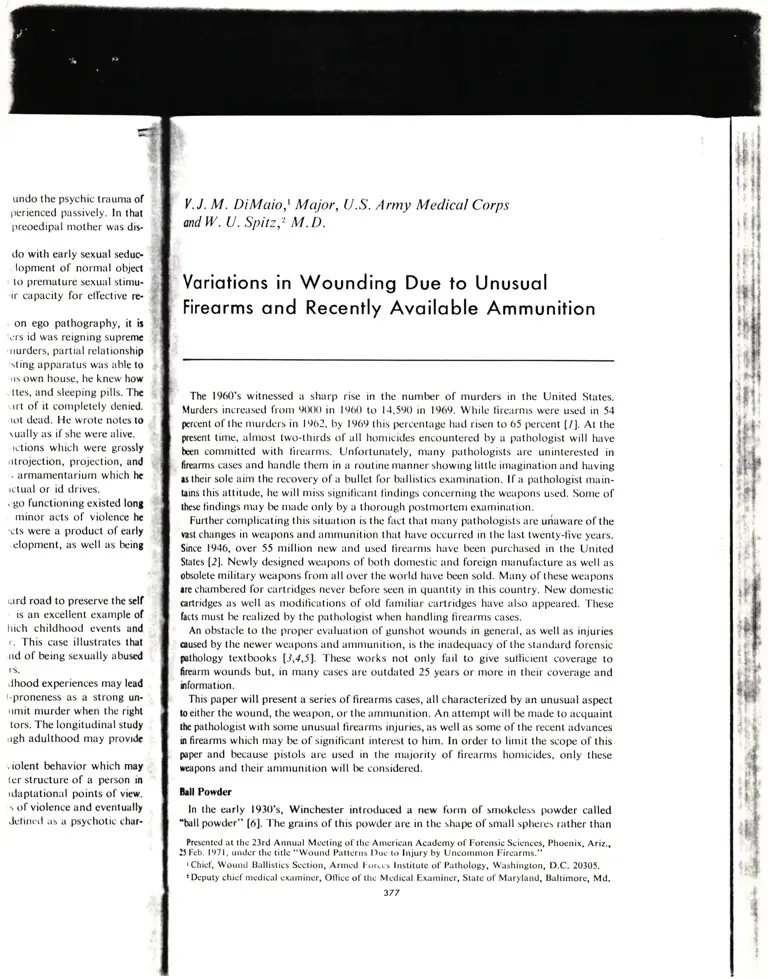
10 pages
-
Case Files, Garner Working Files. Variations in Wounding Due to Unusual Firearms and Recently Available Ammunition (Journal of Forensic Sciences), 1972. e562f475-33a8-f011-bbd3-000d3a53d084. LDF Archives, Thurgood Marshall Institute. https://ldfrecollection.org/archives/archives-search/archives-item/c8d36890-800f-4016-8f51-c1fb46b9651c/variations-in-wounding-due-to-unusual-firearms-and-recently-available-ammunition-journal-of-forensic-sciences. Accessed September 26, 2026.
Copied!
1
undo the psychic trauma of
perienced passively. In that
preoedipal mother was dis-
do with early sexual seduc-
lopment of normal object
to premature sexual stimu-
If capacity for elfective re-
on ego pathography, it is
crs id was reigning supreme '
nurders, partial relationship
sting apparatus was able to
us own house, he knew how
ttes, and sleeping pills. The
u t of it completely denied,
lot dead. He wrote notes to
uially as if she were alive,
ictions which were grossly
iitrojection, projection, and
. armamentarium which he
ictual or id drives.
> go functioning existed long
minor acts of violence he
■cts were a product of early
elopment, as well as being
lard road to preserve the self
is an excellent example of
hich childhood events and
t. This case illustrates that
nd of being sexually abused
I S .
Ihood experiences may lead
l-proneness as a strong un-
iimit murder when the right
tors. The longitudinal study
igh adulthood may provide
. iolent behavior which may
ler structure of a person in
idaptational points of view.
̂of violence and eventually
deliiu'd as a psychotic char-
V.J. M. DiMaio,' Major, U.S. Army Medical Corps
and W. U. Spitz,- M.D.
Variations in Wounding Due to Unusual
Firearms and Recently Available Ammunition
The 1960’s witnessed a sharp rise in the number of murders in the United States.
Murders increased from 9()()() in I960 to 14,590 in 1969. While lirearms were used in 54
percent of the murders in 1962, by 1969 this percentage had risen to 65 percent [/]. At the
present time, almost two-thirds of all homicides encountered by a pathologist will have
been committed with lirearms. Unfortunately, many pathologists are uninterested in
firearms cases and handle them in a routine manner showing little imagination and having
»s their sole aim the recovery of a bullet for ballistics examination. If a pathologist main
tains this attitude, he will miss significiint findings concerning the weapons used. Some of
these findings may be made only by a thorough postmortem examination.
Further complicating this situation is the fact that many pathologists are uriaware of the
vast changes in weapons and iimmunition that have occurred in the last twenty-live years.
Since 1946, over 55 million new and used lirearms have been purchased in the United
States [2], Newly designed weapons of both domestic and foreign manufacture as well as
obsolete military weapons from all over the world have been sold. Many of these weapons
are chambered for cartridges never before seen in quantity in this country. New domestic
cartridges as well as modilications of old familiar cartridges have also appeared. These
facts must be realized by the pathologist when handling firearms cases.
An obstacle to the proper evaluation of gunshot wounds in general, as well as injuries
caused by the newer weapons and ammunition, is the inadec|uacy of the standard forensic
pathology textbooks [4,4,5]. These works not only fail to give sulficient coverage to
firearm wounds but, in many cases are outdated 25 years or more in their coverage and
information.
This paper will present a series of firearms cases, all characterized by an unusual aspect
to either the wound, the weapon, or the ammunition. An attempt will be made to acquaint
the pathologist with some unusual firearms injuries, as well as some of the recent advances
in firearms which may be of significant interest to him. In order to limit the scope of this
paper and because pistols are used in the majority of firearms homicides, only these
weapons and their ammunition will be considered.
Ball Powder
In the early I930’s, Winchester introduced a new form of smokeless powder called
“ball powder” [6]. The grains of this powder are in the shajie of small spheres rather than
Presented a t the 23rd A nnual Meeting o f the American A cademy o f Forensic Sciences, Phoenix, Ariz.,
25 Feb. I‘171, under the title “ W ound Patterns Hue to Injury by U ncom m on F irearm s.”
•Chief, W ound Ballistics Section, Armed Fon.es Institute o f Pathology, W ashington, D.C. 20305.
' Deputy chief medical exam iner, Otlice o f the Medical Exam iner, State o f M aryland, Baltim ore, M d.
377
i"
i f ]
%
hi-
378 JOURNAL OF FORENSIC SCIENCES
FIG . l - ( a ) Ball ponder; (b) flake pov^der: (c) cratered base o f bullet due to ball pomler: (d) base of
unfired bullet.
I
the traditional Hakes or cylinders (Fig. li;, h). Many of the pistol cartridges Prod^ed at
present by Winchester Weapons are loaded with ball powder. Examination of a bullet fired
from such a cartridge shows the lead base to have a cratered apircarance with numerous
little pockmarks most frequently but not invariably due to use of ball powder as a pro
pellant (Fig. Ic). This feature was observed in the following case.
A twenty-five year old Negro male was found shot to death in a Baltimore paik^
large irregular shaped gunshot wound was present in the forehead. 1 here was powder
blackening of the inner and outer tables of the skull surrounding the entrance hole. The
irregular nature of the entrance wound in the soft tissue was due to rodents nibbling on he
margins of the wound. Recovered from the brain was a .25 caliber, full metal-jac e e
bullet with its base bearing the impressions characteristic of ball powder. This was further
confirmed by the recovery of unburnt ball powder grains from the soft tissue surrounding
the entrance wound. . , r , „r̂ h.jbi<.
Since most ammunition is not loaded with ball powder, it may be important for p obabl
exclusion purposes to determine when it is used. If in this particular case, the buHe ha
exited the body, examination of the entrance wound alone would have revealed hat b
powder was used. If on the other hand, the gun had been fired at a distance and the bullet
retained, examination of the base of the bullet would have shown that ball powder was
most likely used.
Powder Patterns
All forensic pathologists are fan
wounds and the powder strippline
ever, there is nothing suliicientb
The two ca.scs to be presented an
A twenty-three year old Negro i
beside the body. There was a com
the overlying teeshirt. Interest wa'
powder pattern present. Beginning
2 o’clock positions were two radia
than 1/2 in. wide (Fig. 2a). Becausi
police and examined by us. Tin
equipped with a muzzle-brake (I 1
of gas from the barrel in an upwai
the blackening observed.
The second unusual powder pal
Rican male who shot himself twin
blackening of the skin. One and 01
small irregular area of blackcmi'
bullets recovered from the body v
Examination of the suicide wc.
barrel had been reamed open. Pi
channel otf gases when blank can
in an upward and forward directio
DIMAIO A>
C T -
a
is ^
I
FIG . 2— (a) powder p a ttii
<ise o f bullet due to hall powder; (d) base o f
>y of the pistol cartridges produced at
1 powder. Examination t)f a bullet tired
,1 cratered appearance with numerous
\ due to use of ball powder as a pro
following case.
.hot to death in a Baltimore park. A
i in the forehead. There was powder
ill surrounding the entrance hole. The
sue was due to rodents nibbling on the
was a .25 caliber, full metal-jacketed
ristic of ball powder. This was further
•rains from the soft tissue surrounding
wder, it may be important for probable
i in this particular case, the bullet had
id alone would have revealed that ball
1 Ix’cn lired at a distance and the bullet
old have shown that ball powder was
DIMAIO AND SPITZ ON UNUSUAL FIREARMS AND AMMUNITION 379
Powder Patterns
All forensic pathologists are familiar with the fouling and smudging of contact gunshot
wounds and the powder strippling of close up wounds. In the vast majority of cases, how
ever, there is nothing sulliciently characteristic to enable identilication of the weapon.
The two cases to be presented are exceptions.
A twenty-three year old Negro male was found dead in his room with a .22 caliber pistol
beside the body. There was a contact gunshot wound of the left chest with a bullet hole in
the overlying teeshirt. Interest was immediately drawn to the shirt because of the unusual
powder pattern present. Beginning at a point 1/2 in. from the hole in the shirt at the 10 and
2 o’clock positions were two radially oriented powder smudges 1 in. long and slightly less
than 1/2 in. wide (Fig. lu). Because of the curious pattern, the gun was requested from the
police and examined by us. The weapon was a Hi Standard “Olympic” target pistol
equipped with a muzzle-brake (Fig. 2h). The muzzle-brake operates by diverting two jets
of gas from the barrel in an upward and forward motion. These two streams of gas caused
the blackening observed.
The second unusual powder pattern was seen in the suicide of a twenty year old Puerto
Rican male who shot himself twice in the chest. The two contact wounds showed extensive
blackening of the skin. One and one-quarter inches superior to each entrance wound was a
small irregular area of blackening and powder burning (Fig. 3). Fhe two .22 caliber
bullets recovered from the body were free of rilling.
Examination of the suicide weapon showed it to be a .22 caliber starter pistol whose
barrel had been reamed open. Present on the top of the barrel was a vent intended to
channel otf gases when blank cartridges were tired. This vent directed some of the gases
in an upward and forwaid direction causing the patterns observed.
FIG . 2— (a) powder pattern on shirt; (b) weapon equipped with muzzle break.
ii
380 JOURNAL OF FORENSIC SCIENCES
Pi/**?' '
F IG . 3— Powder pattern on chest.
In these two aises, the weapons used at contact range caused unusual and characteristic
powder patterns. Tentative identification of the general type of weapons used could be
made from these observed patterns. In both cases, the observations are of only academic
interest since the weapons were at the scene. However, the information as to type of
weapon would be of great importance if these deaths had been homicidal and the weapons
unknown.
Cap Firing Conversions
A zip-gun is a crude, homemade, single shot firearm [7]. Conversion of a toy cap pistol
to fire ammunition is a major improvement over the zip-gun. Both these weapons are
more commonly encountered in areas where there is restrictive firearms legislation as they
can be manufactured with few tools and limited skill.
Cap pistols are usually light metal castings held together by rivets. They are converted
to weapons by inserting a piece of car radio antenna or similar metal tubing in the barrel
and providing a firing pin. This firing pin may be made by filing the hammer to a point or
by inserting a nail or screw. A .22 caliber cartridge is used in this type of gun. If the
hammer fall is too light, it may be strengthened by wrapping rubber bands around the
frame and back of the hammer.
In the case illustrated, a 15 year old white male committed suicide by shooting himself in
the left temple. The weapon used was a toy derringer in the upper barrel of which a portion
of radio antennae had been inserl
about wounds produced by these
bullet, he will find that there is a ci
zip-guns, cap-firing conversions, ai
i’lastic Aniniiinition
With the increasing popularity o
lively safe and inexpensive form o!
the development of plastic ammui
propelled only by a large pistol an
of plastic. One of the principal m:i
bullet is propelled over 500 ft /s [,SJ
Tests were conducted to see how
conducted on bodies at distances
projectiles penetrate the body. The
superficial circular lacerations wlv
(Fig. 5b). These findings lend suppi
tion. While these projectiles are n
degree, they would be capable of pi
DIMAIO ANi
T.
rv-
F IG . 4— Contact entrance
‘ •'■V i
in chest.
nge caused unusual and characteristic
iieral type of weapons used could be
he observations are of only academic
vever, the information as to type of
had been homicidal and the weapons
rm [7], Conversion of a toy cap pistol
I he zip-gun. Both these weapons are
restrictive firearms legislation as they
II.
i)gether by rivets. They are converted
I or similar metal tubing in the barrel
ide by filing the hammer to a point or
'.e is used in this type of gun. If the
> wrapping rubber bands around the
iimitted suicide by shooting himself in
in the upper barrel of which a portion
DIMAIO AND SPITZ ON UNUSUAL FIREARMS AND AMMUNITION 381
of radio antennae had tieen inserted (Fig. 4). Externally, there is nothing characteristic
about wounds produced by these weapons. However, when the pathologist recovers the
bullet, he will find that there is a complete tibsence of rilling marks. This is encountered in
zip-guns, cap-lii ing conversions, and blank-tiring pistol conversion.
Plastic Ammunition
With the increasing popularity of hand-gun shooting, there arose a demand for a rela
tively safe and inexpensive form of ammunition suitable for indoor practice. This led to
the development of plastic ammunition consisting of a reusable plastic case and bullet
propelled only by a large pistol cartridge primer (Fig. 5ci). The bullet is a cylindrical piece
of plastic. One of the principal manufacturers of this ammunition states that the plastic
bullet is propelled over 500 ft/s [S].
Tests were conducted to see how dangerous these projectiles really are. Test firings were
conducted on bodies at distances varying from contact to 20 ft. In no instance did the
projectiles penetrate the body. The wounds inflicted were limited to the skin, consisting of
superficial circular lacerations whose diameter corresponded to that of the projectile
(Fig. 5h). These findings lend support to the claims of the relative safety of this ammuni
tion. While these projectiles are not capable of penetrating the skin to any signifiamt
degree, they would be capable of penetrating the eye and should be used with caution.
F IG . 4— Contact entrance wound, left temple; weapon and cartridge case.
382 JOURNAL OF FORENSIC SCIENCES DIMAIO A
■ i i
N C H t S
f i g . 5 - ( a ) bullet and cartridge case: (b) wound.
.22 Caliber Frangible Bullets . , „.,Ueries to prevent ricochets which
.22 caliber frangible bullets are of bonded fragments of iron
may occur with solid lead bullets. The gt al [9] reported a death resulting
or lead disintegrate on striking the ‘ ^ ^ projectile. These aut ors
^;om a penetrating wound of the head and brain from ,
conducted a series of tests with ^ showed that frangible buUjs
^7rr:» -rrrr.^The deceased had been beaten, ^^g back of the head. A f
Autopsy revealed a gunshot wound beneath the scalp. There wa no
caliber bullet weighing 25.6 ^ ^dily identified as a f ra n g i^ e
“ oetration or for ballistic comparison because
. . . r '".rrr-'-s ris7;r s“̂ :s
The propellant is a special cartridge wh ^ gri^gntally induced stud gun injuries.
recently published a J ^ s t u d ^ g u n injury m the literature.
They stated that they knew of no pnrpose >
I,nee then such a case has been oo^ountered^ be a stellate
A 50-year old white male was found de Alongside the body was a stud
shaped S n ,.c . sunsho. wound of .he »? . A. .u.ops,, .her. was a
p L conlainine a Bred .22 c.hter was no visible blackening of d«
^ r : : 7 .s 7 : a n T s r i l ° « . l A n a i l . l , k e s.nd fl.ed f.on. Ibis gun was •
cove'red from the wall behind Ibe . . c n . s bed.
All stud guns have a built-in
be pressed firmly against a flat •
case pressed the weapon firmly
cussion with a worker who used
workers have used these weapon
hand and fire the tool with the ot
Interchangeable Cartridges
Many physicians are unaware i
caliber. In some cases, this is inti
An example is the H & R Model
can fire .22 long rifle, .25 automi
FIG. 6—(a) /
1
* ! ,
^ / J
i
' V - " b
ise: (b) wound.
lleries to prevent ricochets which
sed of bonded fragments of iron
al [9] reported a death resulting
n such a projectile. These authors
d came to the conclusion that
ts showed that frangible bullets,
ible for ballistics comparison due
and murdered in her apartment,
d and strangled with a ligature,
back of the head. A flattened .22
I beneath the scalp. There was no
idily identilied as a frangible lead
Ic for ballistic comparison because
luds into steel, wood, or concrete,
from .22 to .38 caliber. Spitz and
ntally induced stud gun injuries,
stud gun injury in the literature.
ith what appeared to be a stellate
.;). Alongside the body was a stud
1 Fig. 6b). At autopsy, there was a
e was no visible blackening of the
stud fired from this gun was re-
DIMAIO AND SPITZ ON UNUSUAL FIREARMS AND AMMUNITION 383
All stud guns have a built-in safety device that requires a guard at the tip of the gun
be pressed firmly against a flat surface before it can be discharged, fhe deceased in this
case pressed the weapon firmly against his forehead depressing the safety guard. A dis
cussion with a worker who used this type of tool in his trade, revealed that he and other
workers have used these weapons for “plinking.” They depress the safety guard with one
hand and fire the tool with the other. Targets have ranged from tin cans to rabbits.
Interchangeable Cartridges
Many physicians are unaware that some guns are capable of firing cartridges of different
caliber. In some cases, this is intentional, that is, the weapon has been designed to do this.
An example is the H & R Model HK-4, which by the changing of the barrel and magazine,
can fire .22 long rifle, .25 automatic, .32 automatic, and .380 automatic cartridges.
■■ ' - I p
r ^ ' > f s
f - 1 ^
i-.i C
« . lie
m
F IG . 6—(a) Entrance wound in forehead: (b) weapon.
384 JOURNAL OF FORENSIC SCIENCES
Cyrtridges may also be fired in weapons never designed to handle them with unusual
consequences [//]. The most notorious automatic weapon in this category is the Astra
pistol. Chambered for the 9-mm Bergmann-Bayard cartridge, this weapon has had
various types of 9-mm cartridges fired from it [12],
More commonly encountered and of more importance to the forensic pathologist is the
practice of firing .32 automatic ammunition in .32 revolvers. This is due to eithei a shortage
of ammunition or ignorance. Because the .32 automatic cartridge is not truly limless but
actually semi-rimmed, it will chamber and fire in a .32 revolver without any dilliculty [/3].
The following case illustrates this.
A 21-year old Negro male was shot three times during an altercation. The assailant used
a .32 caliber revolver which was subsequently recovered. At autopsy, three bullets were
recovered from the body. Two of these were .32 caliber full metal-jacketed bullets and
one was a .32 caliber lead revolver bullet. If the crime had not been witnessed, the recovery
of two different bullets would have suggested that two different weapons and probably two
different individuals were involved.
KTW Ammunition
A new specialized form of ammunition has recently appeared on the market. I his is the
KTW metal-piercing cartridge designed for penetrating engine blocks and the skin of
automobiles [14], This ammunition is available in several dilferent pistol calibers as well
as .30 carbine. The cartridges are loaded with a teflon-coated tungsten alloy bullet with a
gilding metal half jacket on its base. This half jacket serves as a rotating band for the
lands and grooves to grip. The .38 Special KTW is the caliber most likely to be encountered
by the pathologist.
The KTW cartridge will present a problem to the pathologist only if he is unaware that
the bullet may shed its half jacket in passing through a body. This jacket is necessary for
ballistic identification as the barrel markings will be found only on it and not on the bullet
(Fig. 7). In a test carried out by us, the bullet perforated a body going through the vertebral
column and penetrating, to a depth of 1 in., a wooden beam behind the body. The bullet
shed its half jacket just under the skin at the exit site. If this had been an actual case, the
pathologist would have been presented with a perforating wound in a victim and the
story of a bullet being recovered at the scene. If he did not do a thorough autopsy, he might
very well have missed the jacket at the exit site and made ballistic comparisons impossible.
X-ray films of the body, of course, would reveal the presence of the jacket.
Super Vel Ammunition
The .38 Special is the most widely used police cartridge in the United States. Recently,
many police departments have begun to complain that this cartridge is not an ellective
“man-stopper” [/5]. To remedy this deficiency, manufacturers have developed a new
loading for the .38 Special. This load consists of a light-weight, semi-jacketed bullet pro
pelled at a higher velocity. The pioneer in the development of this type of ammunition has
been the Super Vel Corporation. They produce a .38 Special cartridge loaded with a 110-
grain partial-jacketed, semi-wadcutter bullet, whose muzzle velocity is 1370 fps and whose
muzzle energy is 458 ft lbs. In comparison, the standard .38 Special loaded with a 158
grain round nose bullet has a muzzle velocity of 855 fps and a muzzle eneigy of 256 ft Tbs.
The Super Vel bullet comes in two designs: a flat nose soft point and a hollow point.
We decided to conduct a limited series of experiments using Super Vel ammunition to
determine whether these cartridges produced greater injury than the ordinary .38 Special.
DIMAIO AN!
FIG. 1— Fired KTW bullet with deta,
Test firings were confined to the l
ducted at a distance of 10 ft. Both
were used.
The entrance wounds in the skin
Special round. On reflecting the ski
were seen to be at least 2 to 3 tii
158-grain round nose bullet (Fig. 8
struck a rib. A difference was also n
Vel ammunition. The entrance woui
irregular than those caused by the
hollow point is apparently due to tl
jacket peels back allowing the lead
The exit wounds in the skin cam
than those of the Super Vel soft pii
depended on the shapic and size of II
point bullets causing larger exit woi
Summary
The standard textbooks in forensi
matter relating to gunshot wounds,
topic, but they also have failed to kc'
ammunition. An attempt has been i
utilizing a combination of experimei
Ac know! edgmen Is
We wish to thank D. J. DiMaio.
Brooklyn, New York City, for perm
t-ned to handle them with unusual
upon in this category is the Astra
cartridge, this weapon has had
ice to the forensic pathologist is the
vers. This is due to eithei a shortage
uc cartridge is not truly rimless but
revolver without any difficulty [13].
ng an altercation. The assailant used
icd. At autopsy, three bullets were
iber full metal-jacketed bullets and
iiad not been witnessed, the recovery
dilferent weapons and probably two
. appeared on the market. This is the
iling engine blocks and the skin of
veral dilferent pistol calibers as well
ii-coated tungsten alloy bullet with a
et serves as a rotating band for the
caliber most likely to be encountered
pathologist only if he is unaware that
I'l a body. This jacket is necessary for
found only on it and not on the bullet
cd a body going through the vertebral
icn beam behind the body. The bullet
0. If this had been an actual case, the
forating wound in a victim and the
.1 not do a thorough autopsy, he might
nade ballistic comparisons impossible,
c presence of the jacket.
rtridge in the United States. Recently,
that this cartridge is not an elfective
iianufacturers have developed a new
light-weight, semi-jacketed bullet pro-
.pment of this type of ammunition has
18 Special cartridge loaded with a 110-
muzzle velocity is 1370 fps and whose
.mdard .38 Special loaded with a 158
̂fps and a muzzle energy of 256 ft • lbs.
)se soft point and a hollow point,
.ments using Super Vel ammunition to
. r injury than the ordinary .38 Special.
DIMAIO AND SPITZ ON UNUSUAL FIREARMS AND AMMUNITION 385
FIG . 1— Fired K T W bullet with detached h a lf jacket. Rifling m arks present on ha lf jacket only.
Test firings were confined to the thoracic region of unautopsied bodies and were con
ducted at a distance of 10 ft. Both Super Vel hollow point ancl soft point ammunition
were used.
The entrance wounds in the skin were identical to those produced by the standard .38
Special round. On reflecting the skin, the Super Vel entrance wounds in the thoracic wall
were seen to be at least 2 to 3 times the diameter of those produced by the standard
158-grain round nose bullet (Fig. 8). This finding was unrelated as to whether the bullet
struck a rib. A difference was also noted in the wounding ability of the two types of Super
Vel ammunition. The entrance wounds from the hollow point bullets were larger and more
irregular than those caused by the soft point bullets. The greater wounding ability of the
hollow point is apparently due to their tendency to mushroom on penetrating tissue. The
jacket peels back allowing the lead core to expand.
The exit wounds in the skin caused by the Super Vel hollow point were slightly larger
than those of the Super Vel soft point and the ordinary .38. The size of the exit wounds
depended on the shape and size of the bullet as it exited the body, the mushroomed hollow
point bullets causing larger exit wounds.
Summary
The standard textbooks in forensic pathology are seriously deficient in their coverage of
matter relating to gunshot wounds. Not only do they fail to give sufficient coverage to this
topic, but they also have failed to keep pace with developments in the field of firearms and
ammunition. An attempt has been made to update our knowledge of firearms injuries by
utilizing a combination of experimentation and case presentation.
Ack no wledantcn t s
We wish to thank D. J. DiMaio, M.D., Deputy Chief Medical Examiner, Borough of
Brooklyn, New York City, for permission to use four of his cases in this paper.
386 JOURNAL OF FORENSIC SCIENCES
FIG . V,-Entrance womuis o f
round nose.
chest won. skin retracted. Left: Super Vet soft point, right: 158-grain lead
References .
[ ,] Hoover, J. E., •'Crinrc in .he U .S..” Uniform Crime R ep o rts -J9 6 9 , U.S. G overnm ent Prmt.ng
Life, sta ir repo rt to the N m ional Conttnission on the Causes and
Pm ven.ion o f Violence, U.S. G overnm ent Printm a Olhee, 1965.
a a" ' v f ; : : ; : m ' : ; l l '^ e r M .n n ^ ^ U : ; h r g e r ^ C ^ Medicine, 2nd ed., Appleton-
151 O m p ^ ' p Legal Medicine. 2nd ed., W illiams and W ilkins Co. 1968.
S20-531 and 115-125, respectively.
R1 S a R e t r S » ' £ ' ' r ) . M .. . n J P o m o , , . W E . " F o .™ « A.P«=B » f F r .n .iM .
, ,,| E ..-^ E . , l . - E . ; r N .n l« h a l ^
A m m unition," Journal o f Forensic ' 25th ’cd*̂ 1971 pp. 185-189.
1',]} s t i t ’w.- 1̂ : ' h . " n ^ S m U r J ^ E " 7 ; i V o . w X ^ e r s , 7th ed., S .aekpole Books, Harris-
[!4] lB w ,'* in ’c .,^ 1 0 C ooper-Foster Park Road Lorain,
[/5] Olt, J. R., "T he .38 Special,” Gun Digest, 25th ed., 1971, pp. 168 173.
W. Q. Stumer, ̂ M.D., A. B
R. S. Putnam, ^M.D., and J.
Osmolality and Othe
in Postmortem Huma
The measurement of osmotic pressi:
clinical investigation and is beginning
laboratory [/-■#]. It is deiiendent on tli
their shaix;, weight, or charge. The tl
solution gives a good estimtitc of the 1
tion of the osmolality. Serum osmolali
electrolytes, particularly sodium, con
nonprotein nitrogen, and protein sub
The average osmolality of urine rang
intake, and is generally higher in malt
lality in fifty living patients was fouti'
tended from 269 to 304 mOsm /kg [.5
included osmolality determinations.
Specimens of vitreous humor from
following death and have been submiti
toxicologic determinations [S,9,/0].
(with the exception of potassium) ai
terminal serum concentrations and
absence of severe putrefaction [6]. It
our knowledge not previously reco'
measurable factors in this medium
nondestructive testing technique, its |
desired studies.
Materials and Methods
Forty-five specimens were obtaim
dispensable plastic hypodermic syring
mately 4 ml of vitreous humor bem
frozen in rubber-stoppered, chemtctil
subjects involved died from variou^ I
case of sudden death at the scene 01 \
fluid or medication had been termiti.
Received for ptihlictUioii 22 Dec. 1971.
' D epartm ent o f Pathology, Universits
Southwestern Institute o f Forensic Scii n,i