Tuttle v. Oklahoma City Court Opinion
Public Court Documents
February 28, 1984
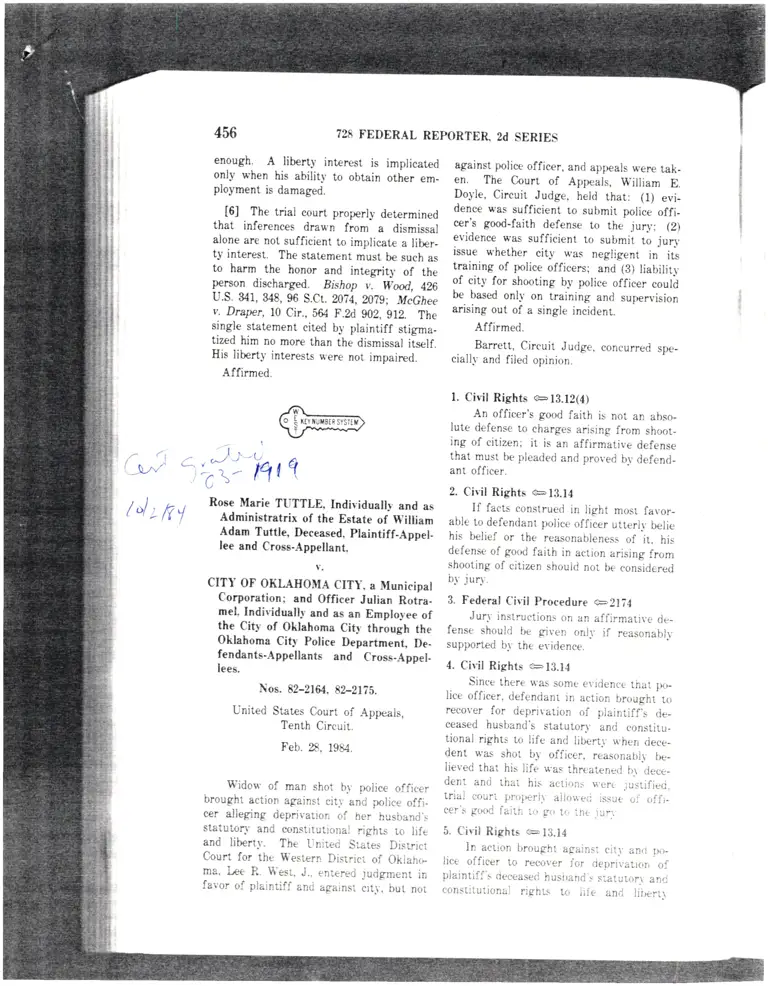
7 pages
-
Case Files, Garner Working Files. Tuttle v. Oklahoma City Court Opinion, 1984. b740454b-35a8-f011-bbd3-000d3a53d084. LDF Archives, Thurgood Marshall Institute. https://ldfrecollection.org/archives/archives-search/archives-item/c92452e3-80bd-4abd-8442-340a9c36feee/tuttle-v-oklahoma-city-court-opinion. Accessed September 25, 2026.
Copied!
456 728 FEDERAL REPORTER. 2d SERIES
enough. A liberty interest is implicated
only when his ability to obtain other em
ployment is damaged.
[6] The trial court properly determined
that inferences drawn from a dismissal
alone are not sufficient to implicate a liber
ty interest. The statement must be such as
to harm the honor and integrity of the
person discharged. Bishop v. Wood, 426
U. S. 341, 348, 96 S.Ct. 2074, 2079; McGhee
V. Draper, 10 Cir., 564 F.2d 902, 912. The
single statement cited by plaintiff stigma
tized him no more than the dismissal itself.
His liberty interests were not impaired.
Affirmed.
( o I KEY NUMBER SrSTEHl
. T .
Rose Marie TUTTLE. Individually and as
Administratrix of the Estate of William
Adam Tuttle, Deceased, Plaintiff-Appel
lee and Cross-Appellant.
V.
CIT ̂ OF OKLAHOMA CITL. a Municipal
Corporation; and Officer Julian Rotra-
mel. Individually and as an Employee of
the City of Oklahoma City through the
Oklahoma City Police Department, De-
fendants-Appellants and Cross-Appel
lees.
Nos. 82-2)64, 82-2175.
United States Court of Appeals,
Tenth Circuit.
Feb. 28, 1984.
Widow of man shot by police officer
brought action against city and police offi
cer alleging deprivation of her husband's
statutory and constitutional rights to life
and liberty. The United Stales District
C-ourt for the Western District of Oklahc--
ma. Lee R, 'West, J., entered judgment in
favor of plaintiff and against city, but not
against police officer, and appieals were tak
en. The Cxiurt of Appeals, William E.
Doyle, Circuit Judge, held that: (1) evi
dence was sufficient to submit police offi
cer’s good-faith defense to the jury: (2)
evidence was sufficient to submit to jury-
issue whether city was negligent in its
training of police officers; and (3) liability
of city for shooting by police officer could
be based only on training and supervision
arising out of a single incident.
Affirmed.
Barrett, Circuit Judge, concurred spe
cially and filed opinion.
1. Civil Rights 13.12(4)
An officer s good faith is not an abso
lute defense to charges arising from shoot
ing of citizen; it is an affirmative defense
that must be pleaded and proved by defend
ant officer.
2. Civil Rights e=> 13.14
If facts construed in light most favor
able to defendant police officer utterly belie
his belief or the reasonableness of it, his
defense of good faith in action arising from
shooting of citizen should not be considered
by jury.
3. Federal Civil Procedure g=2174
Jury instructions on an affirmative de
fense should be given only if reasonably-
supported by the evidence.
4. Civil Rights 13.14
Since there was some evidence that po
lice officer, defendant in action brought to
recover for deprivation of plaintiff's de
ceased husband's statutory and constitu
tional rights to life and liberty when dece
dent was shot by officer. reasonaPly be
lieved that his life w-as threatened by dece
dent and that his actions v-ere justified,
trial court prop>erly allowed issue of offi
cer's good faith to go u. the jurv.
5. Civil Rights «= 13.14
In action brought against city and oo-
lice officer to recover for deprivation of
plaintiff s deceased husiiand s statutory and
constitutional rights to life and lihertv
TUTTLE V. CITY OF OKLAHOMA CITY
c i te as 728 F.2d 456 (1984)
> were tak-
Villiam E.
(1) evi-
police offi-
jury; (2)
lit to jury
ent in its
(3) liability
■ficer could
supervision
:urred sp>e-
ot an abso-
from shoot-
ive defense
bv defend-
most favor-
jtterly belie
,s of it, his
irising from
j considered
>174
irmative de-
reasonablv
nee that po-
I brought to
aintiff's de-
id constitu-
when decv-
isonably be-
led iiy dect-
ro justifiea.
;sufr of offi-
rv.
city and po-
pnvation of
tatutorv and
and libtrtv
when decedent was shot by police officer,
evidence was sufficient to submit to jury
issue whether city was negligent in its
training of police officers.
6. Civil Rights 13.14
In action brought against city and po
lice officer to recover for deprivation of
plaintiffs deceased husband’s statutory and
constitutional rights to life and liberty
when he ŵ as shot by police officer, instruc
tion to jury that it could find for plaintiff
based upon a single incident of use of force,
from which jury could infer inadequate
training of officers by city, was proper and
instructions, taken as a whole, properly
stated law of municipal liability and affirm
ative defenses.
7. Civil Rights ©=>13.14
Contrary to contention of city, defend
ant in action against city and police officer
to recover for deprivation of plaintiff s de
ceased husband’s statutory and constitu
tional rights to life and liberty when he was
shot by police officer, trial court properly-
required proof of city’s gross negligence in
training police officer.
8. Civil Rights ©=13.7
City could be held liable for deprivation
of plaintiff’s deceased husband’s statutory
and constitutional rights to life and liberty
when he was shot by police officer based
only on training and supervision arising out
of a single incident.
way, Hughes, Nelson & Gassaway, Oklaho
ma" City, Okl., with him on brief), for plain
tiff-appellee and cross-appellant Rose Marie
Tuttle.
Burck Bailey, Fellers, Snider, Blanken
ship, Bailev & Tippens, Oklahoma City, Okl.
(Warren F. Bickford IV and Margaret
McMorrow-Love, Fellers, Snider, Blanken
ship, Bailey & Tippens, Oklahoma City,
Okl, with him on brief), for defendant-ap
pellant, cross-appellee City of Oklahoma
Citv.
Before BARRETT, DOYLE and SEY
MOUR, Circuit Judges.
Robert E, Manchester, McClelland, Col
lins, Bailey. Bailey & Manchester, Oklaho
ma City, Okl. (Susan Talbot, McClelland,
Collins, Bailey, Bailey & Manchester, Okla
homa City. Okl, with him on brief), for
defendant"-appellar.t, cross-appellee Officer
Julian Rotramel
Michael C. Turpen, Atty. Gen. of Okl,
David W. Lee, Ass:. Atty Gen.. Chief, Fed
eral Div., Oklahoma City. Okl, for amicus
curiae State of Okl
Diane Pedicord. Oklahoma City, Okl, fo’-
am.icus curiae Oklahoma Mun. League.
Carl Hughes, Hughes, Nelson & Gassa
way, Oklahoma City, Okl. (Michael Gassa-
WILLIAM E. DOYLE, Circuit Judge.
This matter is before us pursuant to 28
U.S.C. § 1291, the regular appeals statute,
and 42 U.S.C. § 1983. dealing with the vio
lation of constitutional and statutory rights.
Rose Marie Tuttle was the plaintiff in the
court below. She brought this action
against the defendants, Oklahoma City and
Police Officer Julian Rotramel, individually
and as administratrix of the estate of her
deceased husband. She alleged deprivation
of her husband’s statutory and constitution
al rights to life and liberty, contrary to 42
U.S.C. § 1983.
The cause was tried to a jury in the
United States District Court for the West
ern District of Oklahoma. A verdict was
returned in favor of Mrs. Tuttle in the
amount of $1,500,000 actual damages
against the City. The jury returned a ver
dict in favor of the defendant Rotramel, the
officer who caused the damage by shooting
and killing Tuttle. The jury found in favor
of Officer Rotramel because the jury found
that he acted in good faith. Oklahoma City
has appealed the verdict against it and Mrs.
Tuttle appeals the verdict and order to pay-
costs for Rotramel tne police officer.
This incident took place on October 4.
1930. T'ne decedent William Tuttle was
inside, and had been inside, tne Me’ll Do
Club in Oklahoma City. A complaint was
made reporting an armed robbery in
progress at the We'll Do Club. The party
458 72S FEDERAL REPORTER. 2d SERIES
who called the police described the alleged
robber as a 37 year old male with brown
hair and glasses. The description matched
Mr. Tuttle, and the parties stipulated that
Mr. Tuttle actually made the call. Police
Officer Julian Rotramel was dispatched to
the Club, and when he arrived there was no
armed robbery in progress. The bartender
testified that she informed Rotramel that
no robbery had occurred. Decedent at
tempted to leave the Club, and Officer Ro
tramel told him to stay where he was. De
cedent disregarded Rotramel and left. Tut
tle did not at any time brandish a weapon.
In fact, Tuttle made no overt threat.
Nevertheless, Officer Rotramel drew his
gun and shot the decedent in the back. The
latter was a short distance from the officer
and had gone down on one knee. No w'eap-
on was found on the decedent; there was
allegedly a toy gun which was said to have
been found in Tuttle’s possession. This was
not visible to the officer, but he said that he
was apprehensive that the decedent had a
weapon. Decedent died from the gunshot
wound verv soon after the incident.
A limited number of contentions have
been asserted in support of the requested
reversal. These are set forth and also dis
cussed below.
1. The contention that the trial court
erred as a result of not directing a
verdict against Rotramel on the issue of
liability.
Mrs. Tuttle argues that the facts of the
case fail to supfjort Rotramel's claim of
good faith, and hence the trial court should
not have allowed the issue to go to the jury.
We here address this issue.
The good faith defense of police officers
charged with constitutional violations was
first recognized by the Supreme Court in
Pierson v. Ray, 386 U.S. 547, 554, 87 S.Ct.
1213. 1217-18, 18 L.Ed.2d 288 (1967). In its
most recent pronouncement on the good faith
defense, the Supreme Court made clear that
an officer's good faith must be judged by
an objective standard. Harlow v. Fitzger
ald. 457 U.S. 800. 818. 102 S.Ct, 2727, 2738-
9, 73 L.Ec.2d 396 (1982j (government offi
cials “are shielded from liability for civil
damages insofar as their conduct does not
violate clearly established statutory or con
stitutional rights of which a reasonable per
son would have known”). Harlow reaf
firmed the objective standard previously
applied, but overruled earlier Supreme
Court pronouncements that a subjective
component existed as w’ell. See Wood i-.
Strickland, 420 U.S. 308, 322, 95 S.Ct. 992,
1000-01, 43 L,Ed.2d 214 (1975) (“A school
board member is not immune from liability
for damages under § 1983 if he knew or
reasonably should have known that the ac
tion he took within his sphere of official
responsibility would violate the constitu
tional rights . . of the student”); Scheuer
V. Rhodes. 416 U.S. 232, 247-48, 94 S.Ct.
1683, 1691-92. 40 L,Ed,2d 90 (1974) (“It is
the existence of reasonable grounds for the
belief formed at the time and in light of all
the circumstances, coupled with the good
faith belief, that affords a basis for quali
fied immunity"): Pierson v. Ray, 386 U.S.
at 557, 87 S.Ct. at 1219 ("If the jury found
that the officer reasonably believed in good
faith that the arrest was constitutional,
then a verdict for the officers would follow,
even though the arrest was, in fact, uncon
stitutional”).
[1] An officer’s good faith is not an
absolute defense to charges; it is an affirm
ative defense that must be pleaded and
proved by the defendant officer. See Go
mez Toledo, 446 U.S. 635. 100 S.Ct. 1920,
64 L.Ed.2d 572; Martin Duffic, 463 F.2d
464 , 468 (10th Cir.1972).
[2. 3] Under certain circumstances, the
facts may negate the good faith defense as
a matter of law. If the facts construed in
the light most favorable to the defendant
officer utterly belie his belief or the reason
ableness of it, his defense should not be
considered by the jury. Butler v. Goldblatt
Bros., Inc., 589 F.2d 323, 326 (7th Cir.1978).
Jury instructions on an affirmative defense
should only be giver if reasonably sup
ported by the evidence
[4] Defendant Rotramel aamitted at t r i
al that he violated Police Department policy
: [■.ft .
TUTTLE V. CITY OF OKLAHOMA CITY
Cite as 728 F.2d 456 (1984)
liability for civil
conduct does not
statutory or con-
a reasonable per-
). Harlow reaf-
ndard previously
earlier Supreme
hat a subjective
dl. See Wood v.
322, 95 S.Ct. 992,
(1975) (“A school
lune from liability
83 if he knew or
nown that the ac-
sphere of official
late the constitu-
tudent”); Scheuer
, 247-48. 94 S.Ct.
d 90 (1974) (“It is
)le grounds for the
I and in light of all
led with the good
i a basis for quali-
n V. Ray. 386 U.S.
;"lf the jury found
)ly believed in good
was constitutional,
ficers would follow,
(cas. in fact, uncon-
)d faith is not an
ges; it is an affirm-
st be pleaded and
it officer. See Go-
635. 100 S.Ct. 1920,
1'. Duffit, 463 F.2d
circumstances, the
ood faith defense as
e facts construed in
le to the defendant
belief or the reason-
'en.se should not be
Butler 1'. Goldblatt
3, 326 (7th Cir.1978).
affirmative defense
if reasonably sui>-
amel admitted at tri
ce Department policy
in shooting Mr. Tuttle. He testified how
ever, that he believed Mr. Tuttle was a
felon reaching for a gun. His belief was
supported by some evidence. Officer Ro-
tramel was responding to a report
robberv had taken place. Apparently, Mr
Tuttle'made the report, describing himself
and reporting that the robber had a gun.
Officer Rotramel testified that he attempt
ed to stop Mr. Tuttle, that a struggle had
ensued and that Mr. Tuttle repeatedly-
reached for his boot. Officer Rotramel
claimed that Mr. Tuttle broke away and
was again reaching for his boot, apparently-
retrieving a weapon, when Officer Rotra
mel shot him. The other witnesses to the
shooting disputed these aspects of Rotra-
mel’s testimony. If the jury believed Offi
cer Rotramel, however, it could find that he
reasonably believed his response was per
mitted.
The trial court clearly thought the evi
dence was sufficient to send the issue to the
jury, and the jury apparently believed Offi
cer Rotramel’s story. Inasmuch as the jury
was properly instructed and since there is
evidence which favors Rotramel, we cannot
assume that the conclusion was improper.
It is not enough that Officer Rotramel s
good faith defense does not seem to be
stronglv supported in this case; we mus ̂
decline'to rule that it was inadequate as a
matter of law. There was some evidence
that he reasonablv believed that his life w as
threatened and his actions were justified.
Accordingly, we affirm the jury’s
that Officer Rotramel acted in good faith
and thus deny the contention of Mrs. Tut
tle.
erate indifference. The argument is also
that a single incident of police misconduct
cannot establish grossly negligent training,
and that, in light of the single incident here,
the trial court should have granted the
City’s motion for a directed verdict and for
judgment notwithstanding the verdict.
2. The contention of the City that the
evidence was insufficient to justify sub
mission to the jury.
The City- insists that the trial court erred
in denying the defendant City’s motions for
a directed verdict and judgment notwith
standing the verdict. lUs claim is that the
trial judge held the City to a sUndarcl o.
ordinan negligence in failing to train U.ii-
ce-- Rotramel. rather than the allegedly re
quired showing of gross negligence or delib-
[5] The plaintiff-appellee Mrs. Tuttle
argues that extensive evidence, and not the
single incident referred to, established the
grossly negligent training provided by the
City. ' She argues that virtually all of the
evidence established the necessary link be
tween the inadequate training and the con
stitutional deprivation. Owens v. Haas, 601
F.2d VM2 (2d Cir.1979). She claims tnat
the trial judge recognized that gross negli
gence existed if the City had actual or
imputed knowledge of the almost inevitable
consequences that arise from completely in
adequate training or supervision. See Leite
V. City of Providence, 463 F.Supji. 585, 590-
91 (D R 1.1978). We agree that Judge W est
properly denied the City’s motions and
properly submitted the issue to the jury.
3 Appellant’s further contentions that the
Judge's instructions to the jury were
erroneous and that the judgment should
be set aside because of these alleged
error or errors.
[6] The argument of the City, taken as
a whole, is that the jury instructions did not
articulate the law governing the case. Par
ticularly, the City challenges the instruction
to the jury that it could find for the plain
tiff based upon a single incident of the use
of force, from which the jury could infer
inadequate training. The plaintiff-appel
lee, Mrs. Tuttle, contends that the sufficien
cy of the instructions is not usually to be
determined by error in any single instruc
tion but rather by viewing the charge as a
whole. United States v. Jenkins. 701 F.2d
8,50 (10th Cir.l983i. Ŵe regard the chal
lenged instruction to be projier, and we
consider that tne instructions, taken as a
whole proyieriv state the lau of municipa,
liability and affirmative defenses. Apart
from the killing incident, there was ade-
460 728 FEDERAL REPORTER, 2d SERIES
quate evidence. Even the officer admitted
the inadequacy of the training.
There was much complaint on the part of
the City to the effect that the standard of
wrong-doing submitted by the court was
that of ordinary negligence. However, the
instructions given do not agree with this.
The instruction which addresses the applica
ble standard of gross negligence and other
elements of the claim is as follows:
You are instructed that the City of
Oklahoma City is not liable for the depri
vation of the decedent’s constitutional
rights solely because it hired and em-
ploj'ed the defendant Rotramel. But
there are circumstances under which a
city is liable for a deprivation of a consti
tutional right. Where the official policy
of the city causes an employee of the city
to deprive a person of such rights in the
execution of that policy, the city may be
liable.
This occurs when a city implicitly or
tacitly authorizes, sanctions, ratifies, or
acquiesces in the constitutional depriva
tion in such a manner that such constitu
tional deprivation can be found to result
from the execution of a city’s official
policy or custom.
In the circumstances of the case before
you, the City of Oklahoma City can be
found to have authorized, sanctioned, or
acquiesced in any denial of the decedent's
rights only if an official policy which
results in constitutional deprivations can
be inferred from acts or omissions of su
pervisory city officials and if that policy
was a proximate cause of the denial of
the civil rights of the decedent.
It is the plaintiff's contention that such
a policy existed and she relies upon alle
gations that the City is grossly negligent
in training of police officers, in its failure
to supervise police officers, and in its
failure to review and discipline its offi
cers. The plaintiff has alleged that the
failure of the city to adequately suf>er-
vise, train, review, and discipline the po
lice officers constitutes deliberate indif
ference to the constitutional rights of tne
decedent and acquiescence in the proba
bility of serious police misconduct. Fur
thermore, the policy of placing police offi
cers on duty who were inexperienced and
unqualified to act in a particular situa
tion in applying the use of a deadly weap
on constitutes deliberate indifference to
the rights of the decedent.
The City, of course, has denied the
plaintiff’s allegations and further denies
the existence of an official policy of the
City of Oklahoma City which results in
constitutional deprivations.
The existence of such a policy is a
question of fact for you to determine.
The policy, if it existed, need not be ex
pressed in writing; it may be an implicit
policy. An official policy can be inferred
from the acts of a municipality’s supervi
sory officials, as well as from its omis
sions, if the inaction amounts to deliber
ate indifference or to tacit approval of an
offensive act. (Emphasis supplied.)
[7] Contrary to the present contention
of appellant, the trial judge, in outlining
the standard, required proof of the City’s
gross negligence. The jury was told that
inadequate training of Rotramel amounting
to gross negligence and deliberate indiffer
ence to the rights of the decedent was nec
essary in order to deprive the decedent of
his right to liberty and life without due
process. In other words, the gross negli
gence standard was plainly set forth as it
pertains to the civil rights claim under
§ 1983.
The instructions were not erroneous.
The gross negligence-indifference standard
was sufficient as instructed. As a result
the court was correct in denying dismissal
relief to the City.
4, The appellant City's argument that the
alleged lia’nility of the City is based only
on training and supervision arising out
of a single incident.
The city cites case law in support of ihe
doctrine that a single incident is not ade
quate evidence to establish liability for in
adequate training and supervision. McClel
land V. Facteau. 61(i F.2d 693. 696 (10th
Cir.1979). There it is noted that a police
TUTTLE V. CITY OF OKLAHOMA CITY
c i te as 728 F.2d 456 (1984)
duct. Fur-
: police offi-
rienced and
cular situa-
eadly weap-
if fere nee to
denied the
rther denies
)olicy of the
;h results in
policy is a
I determine,
f not be ex-
e an implicit
) be inferred
ity’s supervi-
3m its omis-
:s to deliber-
jproval of an
pplied.)
It contention
in outlining
of the City’s
cas told that
el amounting
rate indiffer-
lent was nec-
; decedent of
without due
; gross negli-
et forth as it
claim under
T o n e o u s .
standard
a result
dismissal
iment that the
‘y is based only
ion arising out
support of the
jnt is not ade-
liability for in
cision. McCIei-
693, 696 noth
d tnai a police
chief could be held liable if he neglected his
duty to train subordinates and establish de
partment procedures. He must provide
protection for constitutional rights and su
pervision to correct misconduct of which he
has notice. The showing that the individual
police officer may have violated the law on
an isolated occasion was said not to be
sufficient to raise an issue of fact for pur
poses of imposing liability on police chiefs
for failure to train subordinates and estab
lish department procedures that would pro
vide protection for constitutional rights.
The court added that there was a genuine
issue of material fact as to whether defend
ant jxiliee chiefs violated the duty of super
vision to correct misconduct of which they
had notice.
[8] Although the McClelland case is
entirely different from the case at bar,
involving as it does police chiefs failing to
supervise, the principle is much more diffi
cult to establish than the violation here.
The act here was so plainly and grossly
negligent that it spoke out very positively
on the issue of lack of training, the prob
lem which is presented. We are not to be
understood as holding that there exists a
guarantee that all persons whose constitu
tional rights are violated by municipal em
ployees will recover from the City. Our
holding requires proof of a city s violation
of its duty such as to constitute deliberate
indifference to the rights of its citizens.
Here there was plenty of independent proof
of lack of actual training. In this case the
individual defendant had been on the police
force for a very short period of time: more
over, he admitted his lack of training to
cope w’ith robberies. Nevertheless, he was
allowed to go in on a suspected robbery by
himself. Also, his gross failure to success
fully handle the problem clearly demon
strated his complete lack of training and
also his lack of ability. Thus, the incident
itself, as well as independent evidence, at
tested to the officer's lack of knowledge
and abiln\. He claims to have considered
Tuttle to be a robber but instead of pursu
ing him. for the purpose of questioning, he
fatally shot him without the least justifia
ble provocation. Tne single incident rule is
not to be considered as an absolute where
the circumstances plainly show a complete
lack of training.
Our conclusion must be that this action,
coupled with the clearly inadequate train
ing, demonstrate the City’s gross negligence
and deliberate indifference to the rights of
the decedent.
5. The Damages Requested by Plaintiff
The plaintiff has sought on behalf of the
estate and herself the following damages
from the defendants, jointly and separately.
The trial court described the plaintiff’s al
leged damages as follows:
$2,134.65 for burial expenses;
$984.60 for hospital and medical ex-
penses;
$55,000.00 for loss of consortium and
grief as the surviving spouse;
$2,000,000.00 for mental anguish and
physical pain suffered by the decedent
prior to his death;
$455,000.00 for pecuniary loss, namely
loss of future earnings of the decedent,
and,
$250,000.00 for grief and loss of compan
ionship of the children.
The plaintiff also sought $1,500,000.00 in
punitive damages from the defendant Ro-
tramel.
We have called attention to the numbers
w’hich w-ere contained in the complaint of
the plaintiff and which the judge men
tioned in his instructions for the purposes of
explaining, in part at least, how the jury
arrived at the verdict returned. This court
is not in a favorable position to issue a
remittitur with respect to these damages.
The judgment of the district court should
be and the same is hereby affirmed.
BARRETT, Circuit Judge, concu.'-ring:
I concur liecause 1 am coni inced the trial
court properly and aaequateh instructed
the iur>. Even so. I am at a loss t<>
ascertain tne basis for the jury's obvious
finding that Officer Rotrame! was so lack
ing in training to coiie- with robberies that
u
!
I
f
9
462 728 FEDERAL REPORTER, 2d SERIES
Di
!li
m
such constituted proof of Oklahoma City’s
violation of its duty to train Officer Rotra-
mel to the extent that, as the opinion pin
points it, it amounted to Oklahoma City’s
“deliberate indifference to the rights of its
citizens.”
I have not been able to ascertain what
facts the jury relied on to render Officer
Rotramel’s actions unreasonable. The fac
tual background, as I view it, consists of the
false call placed by Mr, Tuttle about the
robber}’ at the Club involving an armed
jjerson who met his description. Officer Ro-
tramel s immediate confrontation with Mr.
Tuttle upon entering the Club, Rotramel’s
identification of Tuttle as the reported arm
ed robber, Rotramel’s testimony that he
saw Tuttle reach down at w’hich time Tuttle
was ordered to stay put, Tuttle’s hurried
exit from the Club in the darkne.ss with
Officer Rotramel in pursuit, the fatal shoot
ing by Rotramel when he observed Tuttle
bent down near a vehicle and reaching for
that which Rotramel believed to be a gun,
and finally the discovery of a toy pistol on
Mr. Tuttle’s person following the shooting.
Beyond this, I have not been enlightened
with the factual basis of Oklahoma City’s
“deliberate indifference” in the context of
the facts of this case.
I KEY NUMBER S Y S T ty '
. T . — ---------------'
Dr. Bruce HOLMAN; Audrey B.
Holman, Plaintiffs-Appellants,
V.
UNITED STATES of America,
Defendant-Appellee.
No. 83-1528.
United States Court of Appeals,
Tenth Circuit.
Submitted on the Briefs Pursuant to
Tenth Circuit Rule 9.
Decided Feb. 29, 1984.
Taxpayers brought suit for refund of
overpayment of taxes. The United States
District Court for the District of Colorado,
Sherman G. Finesilver, Chief Judge, grant
ed summary judgment in favor of Govern
ment, and taxpayers appealed. The Court
of Appeals held that: (1) taxpayers were
properly taxed on income conveyed to trust
under assignment-of-income doctrine and
grantor-trust provisions; (2) taxpayers
were not entitled to deduction for cost of
materials and forms which enabled them to
set up family trust; and (3) taxpayers were
properly assessed five percent negligence
penalty.
Affirmed.
1. Internal Revenue c=4024
Taxpayers were properly taxed under
assignment-of-income doctrine and “grant
or trust provisions on income conveyed to
“family trust,” where trust was mere sham,
lacking any economic substance, and it was
inconceivable that grantor’s wife would be
motivated to [)revent income from being
distributed or held for her benefit, and
therefore she could not be adverse party as
to her husband. 26 U.S.C.A. §§ 67U679.
2. Internal Revenue c=3363
Taxpayers were not entitled to deduc
tion for cost of materials and forms which
enabled them to set uji family trust. 26
U.S.C.A. §§ 162, 212, 262.
3. Internal Revenue <s=.5233
Taxpayer has burden to show absence
of negligence in underpaying taxes owed.
4. Internal Revenue g=>5235
Taxpayers were properly assessed five
percent negligence jKmalty, in light of find
ings that taxpayers, who had been advised
prior to the filing of their tax return that
family trust would not be recognized for
income tax purposes, had not met their
burden of showing absence of negligence.
Dr. Bruce Holman, pro se.