Brief for the United States as Amicus Curiae
Public Court Documents
October 30, 1970
38 pages
-
Case Files, Swann v. Charlotte-Mecklenburg Hardbacks. Brief for the United States as Amicus Curiae, 1970. a9518406-2e34-f111-88b4-7c1e526962fd. LDF Archives, Thurgood Marshall Institute. https://ldfrecollection.org/archives/archives-search/archives-item/c9318223-780f-4625-817d-256383ef4824/brief-for-the-united-states-as-amicus-curiae. Accessed October 15, 2026.
Copied!
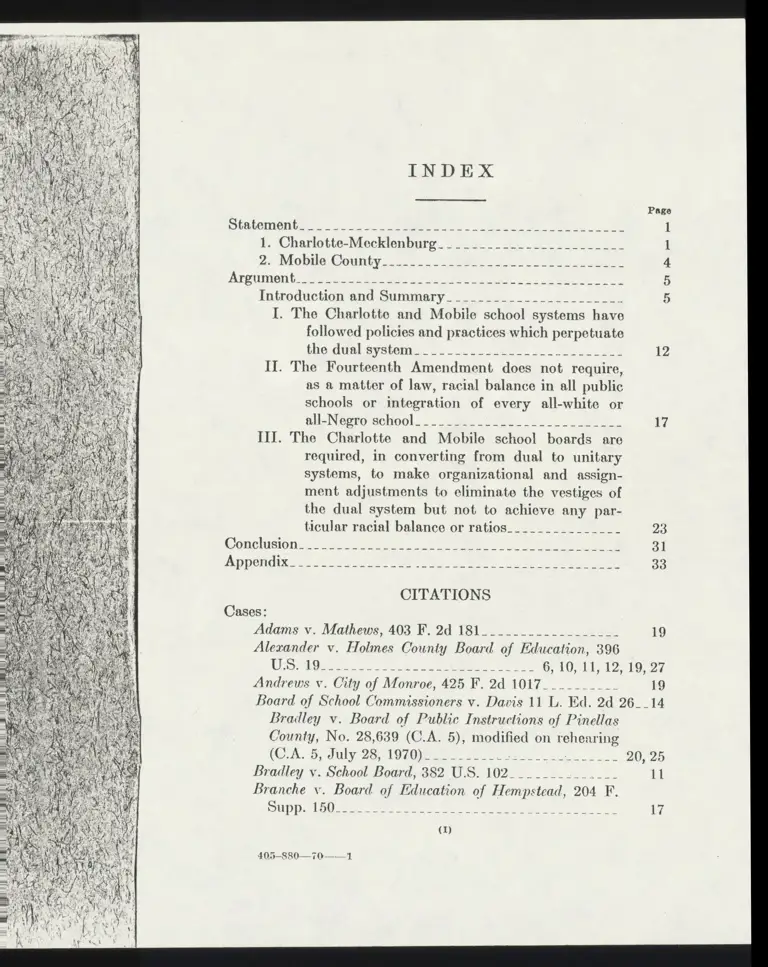
     [||01807706-9bb0-4ee6-9635-bea0ab46ca5a||] INDEX

Statement... la aE
1. Charlotte-Mecklenburg
2. Mobile County

Argument. bl el
Introduction and Summary... o.oo. 0

I. The Charlotte and Mobile school systems have
followed policies and practices which perpetuate
theduslsystom. . .......oo0as. oi t

IT. The Fourteenth Amendment does not require,
as a matter of law, racial balance in all public
schools or integration of every all-white or
slil-Negroschwol.. ... ol. o.oo ao

III. The Charlotte and Mobile school boards are
required, in converting from dual to unitary
systems, to make organizational and assign-
ment adjustments to eliminate the vestiges of
the dual system but not to achieve any par-
ticular racial balance or ratios

Conclusion

Appendix

CITATIONS
Cases:

Adams v. Mathews, 403 F. 2d 18Y .. . _... .. _c. . oot

Alexander v. Holmes County Board of Education, 396
U.S. 19

Andrews v. City of Monroe, 425 F. 2d 1017

Board of School Commissioners v. Davis 11 L. Ed. 24 26. .14

Bradley v. Board of Public Instructions of Pinellas

County, No. 28,639 (C.A. 5), modified on rehearing

(CA. 5, July 2819700. Coa oo

Bradley v. School Board, 382 US. 102... ...........

Branche v. Board of Lducation of Hempstead, 204 F.
Supp. 150

405-880—70——1

ARE eRe gl 6,10, 11, 12, 19, 27


   12


17


23

31

33


19


19


   II

Cases—Continued Page

Brewer v. School Board of City of Norfolk, No. 14,544

(C.A. 4, June 22, 1970), reversing 302 F. Supp. 18,

BOSE. Supp. 1274... cnet r ranma 22

Brown v. Board of Education, 347 U.S. 483 _ _ ___---- 7,10, 13

Brown v. Board of Education, 349 U.S. 294________ 9,13,27

Carter v. Jury Commission, 396 U.S.320_ __ _____--- 27

Carter v. West Feliciana Parish School Board, 396

US 290... oc ooh an aaa 5,10, 11, 27
Cassell v. Texas, 330 US, 283 cn ian de nnngianan 17

Clark v. Board of Education of Little Rock School

District AZ F20A008. idl 2B neni ye 16

Cooper v.Aaron,358 U.S. 1____ o-oo 11

Davis v. Board of School Commissioners of Mobile

County, 414 F.2d 609_ _ _ 4, 14

Davis v. Board of School Commissioners of Mobile

County, No. 29,332 (C.A. 5, Aug. 28,1970) ________ 5

Goss v. Board of Education, 373 U.S. 683____________ 11,22

Green v. County School Board, 391 U.S. 430. ______. 2,6,9,

11, 12, 18-19, 21, 22, 23, 24, 26, 27, 28
Griffin v. School Board, 377 U.S. 218__ 27

Hall v. St. Helena Parish School Board, 417 F. 2d 801

certiorari denied, 396 U.S. 904 ________________.__ 19

Harris v. St. John the Baptist Parish School Board sub.

"nom. Singleton v. Jackson. Municipal Separate School :

District, 419 F.2d 1211 _ _ o-oo 19

Henry v. Clarksdale Municipal Separate School District,

No. 29,165 (C.A. 5, Aug. 12,1970). _ 26

Kemp v. Beasley, No. 19,782 (C.A. 8, March 17, 1970) - 20

Lee v. Macon County Board of Education, C.A. No.

604-E (M.D. Ala., April 3, 1970) _______._._.__. 22

Mannings v. Board of Public Instruction of Hills-

borough County, No. 28,643 (C.A. 5, May 11, 1970)... 20,
25-26

Monroe v. Board of Commissioners, 3904 U.S. 450__ 6,9, 10, 11

Northeross v. Board of Education, 397 U.S. 232. _______ 10, 11

Raney v. Board of Lducation, 391 US. 443___ 6,9,10,11,28

Singleton v. Jackson Municipal Separate School

District, 419 F. 2d 1211 reversed sub nom. Carter v.

West Feliciana Parish School Board, 396 U.S. 290__ 5, 19


i

{

f


Cases—C

Smith

Span

Ed


Page

1

2 22

7,10, 13

9, 13, 27

® 27

6
0,11, 27

. 17

91
. 16

v 11

le

. 4,14

le
: 5

- 11,22

1 2,6,9,

26, 27, 28

27

)1
AE 19

b.

ol

oy 19

> )

i 26

y. 20

0.

L- 22

’'s-
PRA 90,

25-26

. 9,10, 11

10,1}

10, 11, 28

bol

Vv.


III

Cases—Continued '

Singleton v. Jackson Municipal Separate School District,
No. 29,226 (C.A. 5, May 5, 1970)... . loo.

Singleton v. Jackson Municipal Separate School Dis-
trict, No. 29,226 (C.A. 5, Aug. 12, 1970)

Swvith v. Texos, 331 US 128 aceon oc ug)

Spangler and United States v. Pasadena City Board of
Education, 31 X. Supp. 50L. cme

Swann v. Charlotte-Mecklenburg Board of Education,
243 F. Supp. 667, affirmed, 369 F. 2d 29__________

Swann v. Charlotte-Mecklenburg Board of Eaucation,
SOF. Supp. 1209... conan

Swann v. Charlotte-Mecklenburg Board of Education,

No. MBIT CAN... ow oo Fe
Swann v. Charlotte-Mecklenburg Board of Education,

C.A. No. 1974 (W.D.N.C. Aug. 3, 1970)
Turner v. Fouche, 396 U.S. 346... ... cu... 0.
United States v. Georgia, C.A. No. 12,972 (N.D. Ga.,

Doo, 17,0000). pe vo oF
United States v. Hinds County School Board, 417 F. 2d

Unated States v. Jefferson County Board of Education,
372 F. 2d 836 affirmed on rehearing, 380 F. 2d 385,
certiorari denied sub nom. Caddo Parish School

Board v. United States, 389 U.S. 840________________
United States v. Montgomery County Board of Educa-

tion, 395 U.S. 225
Valley v. Rapides Parish School Board, No. 30,099

(C.A. 5, Aug. 25, 1970)


Page

21

19

11,13

i i wa A A A 5 ok 2 11, 23, 27, 30

20


dn the Supreme Gourt of the Wnited States
OcroBer TERM, 1970

Nos. 281, 349

JAMES E. SWANN, ET AL. PETITIONERS, CROSS-
RESPONDENTS

v.

CHARLOTTE-MECKLENBURG BOARD OF EDUCATION, ET AL.,
RESPONDENTS, CROSS-PETITIONERS

No. 436

BirbiE MAE Davis, ET AL., PETITIONERS

v.

BoArp oF ScHoor, COMMISSIONERS OF MOBILE County,
ET AL.

ON PETITIONS FOR WRITS OF CERTIORARI TO THE UNITED
STATES COURTS OF APPEALS FOR THE FOURTH AND FIFTH
CIRCUITS

BRIEF FOR THE UNITED STATES AS AMICUS CURIAE

STATEMENT
‘ Charlotte-Mecklenburg. This case was com-

menced in January 1965, and the district court there-
after approved a free-transfer desegregation plan.
243 F. Supp. 667 (W.D.N.C.), affirmed, 369 F. 2d
29 (C.A. 4). The present proceedings were initiated

(1)


2
in September 1968 by the plaintiffs’ motion for

supplemental relief based on Green v. County School

Board, 391 U.S. 430, and its companion cases. Fol-

lowing an evidentiary hearing, the district court held

on April 23, 1969, that the school system was not

being operated in conformity with constitutional re-

quirements and directed submission of a plan for

faculty desegregation to be effective in the fall of 1969

and for student desegregation to be implemented in

two steps at the commencement of the 1969 and 1970

school years (App. 285a). The school board, in sub-

AS stance, declined to submit a plan for either faculty

or student desegregation (App. 330a-340a).

Further evidentiary hearings were held, and on

June 20, 1969, the district court again directed sub-

mission of a plan (App. 448a). The school board

thereafter proposed a plan by which some all-black

schools would be closed and students from those

schools, as well as from over-crowded black schools,

would be permitted to attend predominantly white

schools, and otherwise the free-transfer plan would

remain in effect; no faculty desegregation plan was

offered (App. 480a). The district court approved

i the board’s submission on an interim basis and di-

rected the preparation by November 17, 1969, of a

plan for student and faculty desegregation to be

effective for the 1970-1971 school year. The school

board, indicating that a plan was being prepared,

moved for an extension of time until February 1970.

The district court denied the motion (App. 6552),

and the board again indicated that a plan for student


desegr

i1ses th

segreg:

were ¢

(App.

On |

the bc

pointe

tion pl

board

On Fe

modific

and th

819a)

suggest

Impl

the Co

March

district

disturb

appeal,

the dist

rejected

and ren

mit the

(App.

June 29

court’s

court (A

On re

were sul


on for

School

>s. Fol-

irt held

vas not

nal re-

lan for

of 1969

nted in

nd 1970

in sub-

faculty

and on

ed sub-

1 board

11-black

n those

schools,

y white

1 would

lan was

pproved

and di-

39, of a

1 to be

> school

repared,

Ty 1970.

. 655a),

student


3

desegregation was being prepared based on the prem-
ises that only rezoning would be used to achieve de-
segregation and that no school to which white students
were assigned would be less than 60 percent white
(App. 670a-671a).

On December 1, 1969, the District court held that
the board’s submission was unacceptable and ap-
pointed an education expert to prepare a desegrega-
tion plan (App. 698a). Plans were filed by the school
board (App. 726a) and the court-appointed expert.
On February 5, 1970, the court adopted, with some
modifications, the board’s plan for secondary schools
and the expert’s plan for elementary schools (App.
819a) and adopted a timetable for implementation
suggested by the board.

Implementation of the plan was partially stayed by
the Court of Appeals for the Fourth Circuit on
March 5; and thereafter stayed in its entirety by the
district court (App. 1255a). This Court declined to
disturb the Fourth Cireuit’s order. 397 U.S. 978. On
appeal, the court of appeals indicated approval of
the district court’s order of February 5 insofar as it
rejected the school hoard’s plan but vacated the order
and remanded the case for reconsideration and to per-
mit the board to submit a new elementary school plan
(App. 1262a). This Court granted certiorari on
June 29, 1970, directing reinstatement of the district
court’s order pending further proceedings in that
court (App. 1320a; 399 U.S. 926).

On remand, two new plans for elementary schools
were submitted: a plan prepared by the United States


Department of Health, Education, and Welfare based

on contiguous grouping and zoning of schools, and a

plan prepared by four members of the nine-member

school board achieving substantially the same results

as the court-expert plan but requiring somewhat less

transportation. A majority of the school board de-

clined to amend its proposal. After a lengthy eviden-

tiary hearing, the district court directed the board to

adopt the minority board plan or to submit a new,

equally effective plan; the court ordered that the

court-expert plan would remain in effect in the event

that the school board declined to adopt a new plan.

@: August 7 the board so declined.
2. Mobile County. This case was initiated by private

plaintiffs in 1963, and the United States intervened

as a party-plaintiff in 1967. The history of the litiga-

tion is recorded in a lengthy series of decisions cited

on page two of the Memorandum for the United

States on the petition for a writ of certiorari.

In June 1969 the Court of Appeals for the Fifth

Circuit reversed the district court’s approval of a de-

segregation plan combining elements of freedom of

choice, geographic zoning, and minority-to-majority

transfers. 414 KF. 2d 609. The district court was di-

rected to order the school board to engage the assist-

@.. of the United States Department of Health, Jdu-

cation, and Welfare in preparing a new desegregation

plan for the entire system. HEW developed a two-

step desegregation plan, reaching all rural schools and

the schools in the western portion of metropolitan

Mobile in 1969 and reaching the eastern urban schools


m 197

tially t

directe:

schools.

v. Jack

2d 121;

in part

School

On L

board

Depart

separat

On Jan

modific:

geogray

States :

On J

adoptin

by the ]

tioned f

‘has sin

reprinte

randum

Commas

Aug. 28,

Sever:

minate

cases.

405-8¢


based

and a

ember

results

at less

rd de-

viden-

ard to

L new,

it the

event

plan.

rivate

vened

litiga-

y cited

Tnited

Fifth

a de-

om of

jority

as di-

assist-

, du-

ration

1, two-

Is and

volitan

chools


R-

3,

in 1970. The district court adopted a plan substan-
tially the same as the first step of the HEW plan and
directed submission of revised plans for the eastern
schools. That decision was affirmed sud nom. Singleton
v. Jackson Municipal Separate School District, 419 TF.
2d 1211 (C.A. 5) (en bane) (per curiam), reversed
in part sub nom. Carter v. West Feliciana Parish
School Board, 396 U.S. 290 (per curiam).

On December 1, 1969, plans were filed by the school
board and HEW. At the district court’s request, the
Department of Justice filed on January 27, 1970, a
separate proposal for implementation pendente lite.
On January 31 the district court adopted, with some
modification, the school hoard’s submission based on
geographic zoning. The plaintiffs and the United
States appealed.

On June 8, 1970, the court of appeals reversed,
adopting with some modifications the plan submitted
by the Department of Justice, and the plaintiffs peti-
tioned for a writ of certiorari. The court of appeals

‘has since twice amended its mandate (see decision
reprinted in appendix to the government’s memo-
randum on the petition and Davis v. Board of School
Commissioners of Mobile County, No. 29,332 (C.A. 5,
Aug. 28, 1970)).

ARGUMENT

INTRODUCTION AND SUMMARY

Several threshold considerations may serve to illu-
minate the issues in these two school desegregation
cases.

405-880—70——2


   6

First, these are school districts which contain large

metropolitan areas. While this Court has dealt with

such districts in the past, it has not had occasion since

the Green trilogy * and Alexander v. Holmes County

Board of Education, 396 U.S. 19, to define with par-

ticularity the obligations of large metropolitan school

systems with respect to pupil assignment. Green and

Alexander answered many of the questions as to the

obligations of rural and small town systems, and the

uestion now is the extent to which the remedial prin-

® developed in those cases of classic dualism apply

to large metropolitan systems. In this sense, these

are cases of first impression.

Second, both of these school systems are character-

ized by residential patterns of racial separation as

well as a history of racial separation in the public

schools, The two types of separation are interrelated,


but the extent of the relationship is at best ‘specula- :

“ive. (These ca cases might thus involve the questions”

whether school boards can retain a “neighborhood

school” assignment policy where the result is to oper-

ate some schools that are racially identifiable at least

the extent reflected by the racial composition of the

udent bodies, whether the Fourteenth Amendment

requires school boards to achieve some mathematical

degree of integration regardless of housing patterns,

and the extent to which the burdens of alleviating

racial isolation are to be borne by school boards and

1 Green v. County School Board, 391 U.S. 430; Raney v.

Board of Education, 391 U.S. 443; Monroe v. Board of Com-

missioners, 391 U.S. 450.


school el

governme

power to

Third,

previousl

some dua

dual trar

are, there

school sy

tary syste

unitary s

what ren

districts

ments? A

a method

the scope

priate rer

These «

dies and -

school sys:

_ rights anc

balance b

a conflict

dents an :
pp ATT A

“of” other 1

ance, or if


would jus

segregatio

goals is n

nanced, b;

right of ¢


large

with

since

yunty

par-

chool

1 and

o the

d the

prin-

pply
these

reter-

mn as

yublic

lated,

>eula-

stions

rhood

oper-

least

Hf the

lment

atical

Lerns,

ating

5 and

ney Vv.

Com-


7

school children rather than being shared by other

governmental institutions and agencies having the

power to affect such isolation.

Third, there is evidence that these school hoards
previously maintained aspects of dualism—such as

some dual, overlapping zones, faculty segregation, and

dual transportation systems. If these school districts

are, therefore, properly regarded as traditionally dual

school systems, whose obligation is to convert to uni-

tary systems, the question remains: what constitutes a

unitary system? Stating this question another way:

what remedial adjustments would bring these school

districts into compliance with constitutional require-

ments? And, when school boards have failed to select

a method of compliance, a further question arises as to
the scope of judicial discretion in ordering appro-

priate remedial adjustments.

These questions relate hoth to rights and to reme-
dies and raise yet another question: In desegregating

school systems is there a conflict between individual
rights and public need, and, if so, 1s there some proper
balance between them ¢ We think there could be such

a conflict if the Fourteenth Amendment, granted stu-
dents an absolute right to attend school with children

i A ATT on 1 rr a TN RR ba fo

or other races, 1.e. , required some form of racial bal-
ance, or if there were an unyielding public need which
would justify the wholesale maintenance of racial
segregation; but we think the first of these conflicting
goals is not prescribed, and the second not counte-
nanced, by the Constitution. Rather, we think the
right of school children articulated in Brown is to


8
attend school in a system where the school board exer-

cises its decision-making powers so as to operate a non-

racial unitary school system free from discrimination,

and that where this has not been done there is a viola-

tion of the rights of such children requiring remedial

adjustments which give proper weight to that which

is feasible and that which is just. If choices exist


which may have a racial impact, they cannot be exer-

cised in a racially neutral manner where to do so no

to perpetuate segregation. Thus, the right and the
Se tints

medy are interrelated.

This interrelationship is most easily perceived in

rural systems, such as New Kent County, Virginia,

where the violation was the maintenance of two

twelve-grade schools, one nearly all white and one

black, cach serving the entire system. Pairing or

zoning the two schools were remedies that flowed

naturally from this violation. But where scores of

schools serve the same grades, some attended largely

by students of one race, the remedy is not self-

evident.

The controversy in these cases is over the standards

eo be applied in fashioning remedies for state-imposed

egregation in large metropolitan areas. We believe

that an appropriate standard should give proper

attention to a number of circumstances, such as the

size of the school district, the number of schools, the

relative distances between schools, the ease or hard-

ships for the school children involved, the educational

soundness ef the assignment plan, and the resources

of the school district. Chr


All tl

count bj

ment of

That Of

school d

have an

cisions

but are f

benefits {

neighbor:

‘this prine

expandin

or cluste

principle

courts an

This (

Board, 3

the disms

tems ten

multiface

quire tim

vd. at 437,

ating stat

clearly ec

whatever

unitary s;

be elimin.

Raney v.

Monroe v.

460. Last '

every sche

tems at o


exer-

1 NON-

ation,

viola-

nedial

which

exist

emer-
, 50 1S

d the

ed in

"ginia,

fF two

d one

ng or

Howed

res of

argely

. self-

1dards

posed

yelieve

roper

as the

Is, the

hard-

ational

ources


J

All these circumstances have been taken into ae-

count by HEW’s Office of Education in the develop-

ment of desegregation plans for urban school systems.
That Office has followed the general principle that
school districts which are under a duty to reorganize
have an obligation to make all reorganizational de-
cisions so as to eliminate the vestiges of dualism,
but are free at the same time to take into account the
benefits to be derived from preserving the traditional
nei ighbor hood method of school assignment. In applying

this principle, the Office has employed the techniques of

expanding contiguous geographic zones and pairing
or clustering schools having contiguous zones. This
principle has found general acceptance in the lower
courts and should be adopted by this Court.

This Court observed in Green v. County School
Board, 391 U.S. 430, that “Brown IT was a call for
the dismantling of well-entrenched dual [school] sys-
tems tempered by an awareness that complex and
multifaceted problems would arise which would re-
quire time and flexibility for a suceessful resolution,”
vd. at 437, and held that “[s]chool boards * * * then oper-
ating state-compelled dual systems were nevertheless
clearly charged with the affirmative duty to take
whatever steps might be necessary to convert to a
unitary system in which racial discrimination would
be eliminated root and branch.” Id. at 437-438; see
Raney v. Board of Education, 391 U.S. 443, 447-448;
Monroe v. Board of Commissioners, 391 U.S. 450, 458-
460. Last Term this Court held that “the obligation of
every school district is to terminate dual school Sys-
tems at once and to operate now and hereafter only


1

unitary schools.” Alexander v. Holmes County Board

of Education, 396 U.S. 19, 20; see Carter v. West

Feliciana Parish School Board, 396 U.S. 290; North-

cross v. Board of Education, 397 U.S. 232.

These decisions clearly contemplated the reorgani-

zation of racially segregated, dual school systems. But,

like earlier school desegregation decisions of this

Court, they arose in the context of rural, classically

dual systems or the perpetuation of the most egregious

forms of racially dual operation. New Kent County

operated two schools, one attended solely by Negroes

nd the other almost exclusively by whites, offering

exactly the same grades and serving exactly the same

attendance area (coextensive with the entire county),

while both whites and blacks resided throughout the

district. Similarly, in Raney “[t]here [were] no at-

tendance zones, each school complex providing any

necessary bus transportation for its respective pupils.”

391 U.S. at 445. In Monroe v. Board of Commission-

ers, supra, involving a small city school district in

which many residential areas were racially segregated,

a zoning plan had “assigned students to * * * schools

in a way that was capable of producing meaningful

desegregation,” 391 U.S. at 458, but a free-transfer

[| N. superimposed on geographic zoning had ‘‘per-

mitted the ‘considerable number’ of white or Negro

students * * * to return, at the implicit invitation of

the Board, to the comfortable security of the old, es-

tablished discriminatory pattern.” Id. at 458-4509.

Hence, while this Court has dealt with large urban

school districts in the past, including Topeka, Kansas,

Rrown v. Board of Education, 347 U.S. 483; Little

&


Rock, A:

Tenness

683; Ri

382 U.S

Montgor

225; ans

of Fduc

an oceas

constitu

signmen

Green-It

ated wit

those ca:

held to I

because

perpetus

“[t]he ¢

public

County .

5), affirr

bane), c

School F

In ace

Court’s

Holmes

Carter v.

that dus

nearly a

are dese

plans bas:

restructe


Board

West

Jorth-

rgani-

ut,

* this

sically

gious

ounty

2gTO0es

fering

Same

anty),

ut the

no at-

g any
1pils.”

§SSLON-

"ict In

cated,

ichools

ingful

ansfer
‘“‘per-

Negro

tion of

ld, es-

9.

urban

.ansas,

Little


A A

Rock, Arkansas, Cooper v. Aaron, 358 U.S. 1; Knoxville, -

Tennessee, Goss v. Board of Education, 373 U.S.

683; Richmond, Virginia, Bradley v. School Board,

382 U.S. 102; Montgomery, Alabama, United States v.

Montgomery County Board of Education, 395 U.S.

225; and Memphis, Tennessee, Northcross v. Board
of Education, 397 U.S. 232, the Court has not had

an occasion to define with any degree of finality the

constitutional obligations—particularly the pupil as-

signment obligations—of such school systems. The

Green-Roney-Monroe trilogy presented issues associ-

ated with traditional dualism. In the circumstances of

those cases, freedom of choice and free transfer were
held to be unacceptable methods of student assignment

because they maintained racial segregation by tacitly

perpetuating dual, overlapping attendance areas,

“[t]he central vice in a formerly de jure segregated

public school system,” United States v. Jefferson

County Board of Education, 372 F. 2d 836, 867 (C.A.
5), affirmed on rehearing, 380 F. 2d 385 (C.A. 5) (en
banc), certiorari denied sub nom. Caddo Parish

School Board v. United States, 389 U.S. 840.

In accordance with the mandate of Green and this

Court’s definitive announcement in Alexander v.
Holmes County Board of Education, supra, and

Carter v. West Feliciana Parish School Board, supra,

that dual systems must be converted ‘‘at once,”
nearly all of the traditionally dual school districts
are desegregating by implementing desegregation

plans based on compact geographic zones and grade
restructuring, through either litigation or voluntary


   agreements with the United States Department of
Health, Education, and Welfare.’

Most of these are rural systems which, by the use

of contiguous zoning and contiguous pairing, have con-

verted to systems “without a ‘white’ school and a

‘Negro’ school, but just schools.” Green, 391 U.S. at

442. In urban school systems like Mobile and Char-

lotte, however, the constructive use of contiguous zon-

ing and pairing places biracial student populations in

most, but not all, schools. This distinction was well

stated by Judge Butzner in the Charlotte case below:

All schools in towns, small cities, and rural
w areas generally can be integrated by pairing,

zoning, clustering, or consolidating schools and

transporting pupils. Some cities, in contrast,

have black ghettos so large that integration of

every school is an improbable, if not an un-
attainable, goal. [ App. 1267a-1268a.]

In this respect, then, these cases present issues of

first impression for this Court and may require the

Court to distinguish between rural and metropolitan

school districts.

I. THE CHARLOTTE AND MOBILE SCHOOL SYSTEMS HAVE

FOLLOWED POLICIES AND PRACTICES WHICH PERPETUATE

¢ DUAL SYSTEM

aclal dualism in large urban systems may be found

not only in overlapping attendance areas but also in

2 See Appendix, infra, for a summary of the status of school
districts in eleven Southern states, which brings up to date the
table in the Appendix to the government’s Supplemental
Memorandum. filed in this Court in Alexander v. Holmes
County Board of Education, No. 632, October Term, 1969.

the orga

ance of

distortec

mandere

ious oth

tion of

patterns

Neithe

quires 1:

and inso

a part 1

boards’ j

ingful o

decision

and day-1

all of tho:

the exten

criminati

U.S. 483.

294, 300:

of Educa

v. Texas,

Site sel

aspects o:

bilities in

dential sc

substitute

lotte-Mech

a TY

405-880-


t of

use

con-

id a

3 at

har-

7,01-

1S in

well

ow:

ural

ing,

and

~ast,

1 of

un-

"AVE

ATE

nnd

) 1n

hool

_ the

ntal

"mes

969.


e
i


| |
|
|
|
|

{

|

{
]

13

the organizational decisions of the system in further-
ance of racial separation. It may be manifested in
distorted grade structures, outsized schools, gerry-
mandered zones, curriculum manipulation, and var-
ious other devices for accommodating the organiza-
tion of the system to fluctuating racial residential
patterns.

Neither North Carolina nor Alabama presently re-
quires racial segregation in public education by law;
and insofar as an official policy of segregation plays
a part in defining the Charlotte and Mobile school
boards’ present constitutional obligation, it is mean-
ingful only to the extent that it is manifested in the
decision-making (involving hoth long-range planning
and day-to-day operations) of the boards. Accordingly,
all of those decisions must be considered in determining
the extent to which a school district has engaged in dis-
crimination contrary to Brown of Education, 347
U.S. 483. See Brown v. Board of Education, 349 U.S.
294, 300-301; United States v. Jefferson County Board
of Liducation, 372 F. 2d 836 (C.A. 5). See, also, Smith
Vv. Texas, 311 U.S. 128, 132.

Site selection and school construction are important
aspects of a school board’s decision-making responsi-
bilities in school districts characterized by racial resi-
dential segregation, because they have heen used as
substitutes for dual zoning. The records in both Char-


[lotte-Mecklenburg and Mobile suggest that the school

boards have consciously selected building sites and


EA ym ee npn


405-880—70——3

—


   14

constructed schools in a manner designed to perpet-

“iate—separate schools for whites and blacks. Thus in
“1963, when the Mobile board sought a stay of a Fifth

Circuit order directing it to commence admitting

Negro students to white schools under the Alabama

pupil-placement laws, the board argued that

desegregation would “seriously delay and pos-

sibly completely stop” the Board’s building pro-

gram, ‘particularly the improvement and

completion of sufficient colored schools which

are so urgently needed.” In recent years, more

» than 50% of its building funds, the Board

pointed out to the parents and guardians of its

colored pupils, had been spent to “build and

improve colored schools,” and of eleven million

dollars that would be spent in 1963, over seven

million would be devoted to “colored schools.”

Board of School Commissioners v. Davis, 11 L. Ed. 2d

26, 28 (Black, J., on application for a stay). As Mr.

Justice Black then observed, “It is quite apparent

from these statements that Mobile County’s program

for the future of its publie school system ‘lends itself

to perpetuation of segregation,” a consequence which

the Court recently had occasion to condemn as unlaw-

Jul.” Id. at 28-29. This policy continued until at least

June of 1969. See Davis v. Board of School Com-

missioners of Mobile County, 414 F. 2d 609 (C.A. 5).

Similarly, in Charlotte-Mecklenburg the district

court found that the “[1]ocation of schools in Char-

lotte has followed the local pattern of residential

development, including its de facto patterns of segre-


gation.

schools

black

comple

and pr

App. 3

Othe

cisions

progra

on the

separa

the siz

serve.

examp

virtual

dential

schools

schools

for Pe

same 1

isfacto

school

twelve

served

and su

13 n.¢

tains ¢


3 That

the nun

to be sei


rpet-

us in”

Fifth

itting

bama

| pos-
ry pro-

and

which

more

Board

of its
1 and

illion

seven

00ls.”

id. 2d

s Mr.

yarent

gram

itself

which

mlaw-

bt least

Com-

A. 5).

istrict

Char-

lential

segre-


I
|

15

gation. With a few significant exceptions * *. * the
Rea £2 bi Sa

schools” which have been built recently have been

black or almost completely black, or white or almost

completely_white, and _this_ probability was apparent

and predictable when the schools were built.” Charlotte

App. 305a; see id. at 456a—457a.

Other necessary educational and administrative de-

cisions must be coordinated with a school-construetion

program; and the record in Mobile is especially clear

on the potential effects of those decisions on racial

separation. The capacities of schools can be based on

the size of the racially identifiable areas they are to

serve. Two" junior high schools were constructed, for

example, to serve relatively small white neighborhoods

virtually surrounded by predominantly Negro resi-

dential areas; accordingly, the capacities of those

schools were far smaller than the capacities of other

schools in the system serving the same grades. Brief

for Petitioners in Mobile, Appendix at 15, n. 24. The

same is true of grade structures. No reason can sat-

isfactorily explain, for instance, why one all-Negro

school was the only school in the city to offer all

twelve grades except that the Negro area to be

served by the school was relatively small, compact,

and surrounded by white residential areas.’ Id. at 4,

15 n. 24; see, also, td. at 10. The Mobile record con-

tains evidence of numerous instances in which port-

3 That school has now been fully desegregated by reducing
the number of grades and expanding the neighborhood zone
to be served.


16
able classrooms were used at schools serving one race

while nearby schools offering the same grades but

serving another race operated under capacity. Id.

at 10-11; sce, also, #d. at 64-67. The location of at-

tendance-zone boundaries (including the use of noncon-

tiguous zones) has also been utilized in Mobile to pro-

duce segregation. Id. at 7-9.

We submit, therefore, that the constitutional viola-

tions which have occurred in these two cases are the

products of a process of decision-making in which the

ate chose, in spite of the availability of feasible

alternatives, courses which perpetuated the racially

segregated dual systems. In light of the fact that in

many metropolitan school systems ‘‘black residential

areas [may be] so large that not all schools can be

integrated by using reasonable means,” Swann V.

Charlotte-Mecklenburg Board of Education, No. 14,617

(C.A. 4) (App. 1267a), 1t is appropriate, therefore, to

look to that decision-making process as ‘the focal point of

a proper remedy. Accordingly, an appropriate remedy

is to require that the governmental decisions affecting

racial segregation be so made and implemented, when

eo. alternatives are available, as to disestablish the

1al system and eliminate its vestiges. In this sense,

the remedy is a dynamic one, cf. Clark v. Board of

Education of Lattle Rock School District, 426 F. 2d

1035 (C.A. 8), and not a static one. And, as we shall

now show, it does not require, as an a prior: constitu-

tional standard, racial balance or integration of every

all-white, all-Negro, or predominantly Negro school.


II. THE

A M!/

SCHO!

ALL-D

The

burg a

constit

tifiabili

this vie

cially i

jority

It wou

the pe

that th

1S as nq

dents 1

either

ings of

spect te

accepts

dial dv

is not

obligat

gard t

Fducai

(E.D.2

+ Tt 3s,
ment of

scribe a

ship of

Cassell


= race

5 but

Id.

Hf at-

neon-

) pro-

viola-

~e the

=h the

nsible

cially

1at in

ential

an be

nn Vv.

14,617

ire, to

int of

medy

seting

when

sh the

sense,

rd of

F.2d

» shall

1stitu-

every

Hol.


IT. THE FOURTEENTH AMENDMENT DOES NOT REQUIRE, AS

A MATTER OF LAW, RACIAL BALANCE IN ALL PUBLIC

SCHOOLS OR INTEGRATION OF EVERY ALL-WHITE OR

ALL-NEGRO SCHOOL

The plaintiffs-petitioners in both Charlotte-Mecklen-

burg and Mobile argue that school boards have a

constitutional obligation to eradicate the ‘‘racial iden-

tifiability’’ of all schools within their jurisdiction. In

this view a predominantly Negro school would be ‘‘ra-

cially identifiable’” in a school district having a ma-

jority of white students such as Charlotte and Mobile.

It would appear that all school boards, according to

the petitioners’ theory, must be required to ensure

that the ratio of white to black students in each school

is as near as possible to the ratio of white to black stu-

dents in the system as a whole. We do not agree that

either general constitutional principles or the hold-

ings of this Court or the courts of appeals with re-

spect to disestablishment of dual school systems compel

acceptance of this formulation of school boards’ reme-

dial duty. In our view, ‘‘[hJow far that duty extends

is not answerable perhaps in terms of an unqualified

obligation to integrate public education without re-

gard to circumstance * * *.”’ Branche v. Board of

Education of Hempstead, 204 TF. Supp. 150, 153

(E.D.N.Y.).

+ Tt is, of course, clear that the Fourteenth Amendment's require-
ment of due process and equal protection does not, by itself, pre-
scribe any particular racial (or other) admixture in the member-
ship of individual institutional groups, such as a particular jury.
Cassell v. Texas, 339 U.S. 282.


   18

As the court of appeals stated in the Charlotte case,

“if a school board makes every reasonable effort to

integrate the pupils under its control, an intractable

remnant of segregation * * * should not void an

otherwise exemplary plan for the creation of a ‘uni-

tary school system’’”” (App. 1268a). Neither, on the

other hand, do the decisions support the use of racial

quotas, as in the Charlotte-Mecklenburg school board’s

plan, as a limitation on the extent of a school board’s

remedial obligation.

Federal courts have made basically three uses of

Q. expressions as “racially identifiable schools,”
8 bf ‘““all-Negro schools,” and ‘‘racial balance,”” none of

which supports the near-absolute standard suggested

by the plaintiffs-petitioners. The courts have used

these expressions as a characterization of the state’s

holding out a classically dual school system in tacit

perpetuation of legally required segregation, as an

analytical starting point, and as a convenient refer-

ence to a remedial standard requiring the comparison

of available alternatives.

This Court said in Green that an acceptable de-

segregation plan must “promise realistically to con-

ert promptly to a system without a ‘white’ school

and a ‘Negro’ school, but just schools.”” 391 U.S. at

442. But that remark was made in the context of the

state’s holding out one school for whites and another

for blacks serving the same attendance area, just as

it had done when racial segregation was enforced by

law. In holding that the state could not maintain such

a system, even though it had the appearance of racial

-


neutral

based «

that th

or ‘‘rac

effectin

see 391

actly t

It was

freedor

~ dual af

: moribu

was ur

See, e.(

Hall v.

801 (C

States

(CA.

v. Hols

(revers

the Ba

v. Jacl

F.2d 1

The

standa

showin,

for the

schools

ton V.

No. 29,

City of


> case,

prt to

ctable

id an

‘uni-

m the

racial

yard’s

pard’s

ses of

ools,”’

ne of

rested

used

state’s

tacit

as an

refer-

rison

le de-

) con-

school

SS. at

of the

10ther

ust as

ed by

1 such

racial


19

neutrality in the sense that student assignments were

based on free choice, this Court might well have said

is the schools of New Kent County must be merged

or “racially balanced,” for the simplest techniques of

a desegregation (such as zoning and pairing,

see 391 U.S. at 442 n. 6) would necessarily promise ex-

actly that result in the circumstances of that case.

It was in the same context, namely, the failure of

freedom of choice to alter significantly the racially

dual attendance patterns of the past, that the Court

a f Appeals for the Fifth Circuit adopted the rule, now

moribund, that an existing student- assignment plan

was unacceptable if it retained an all-Negro school.

See, e.g., Adams v. Mathews, 403 F. 2d 181 (CA. 5);

Hall v. St. Helena Parish School Board, 417 F. 2d

801 (C.A. 5), certiorari denied, 396 U.S. 904; United

States v. Hinds County School Board, 417 IF. 2d 852

(C.A. 5), related order reversed sub nom. Alexander

v. Holmes County Board of Education, 396 U.S. 19

(reversing as to timing). But see Harris v. St. John

the Baptist Parish School Board, sub nom. Singleton

v. Jackson Municipal Separate School District, 419

F. 2d 1211, 1221 (C.A. 5) (en banc).

The Fifth Circuit, although no longer relying on a

standard of no all-Negro schools, has required a

showing and findings of the specific “reasons, if any,

for the continuation of any all Negro or all white

schools” under proposed desegregation plans. Single-

ton v. Jackson Municipal Separate School District,

No. 29,226, at 14 (C.A. 5, May 5, 1970) ; Andrews v.

City of Monroe, 425 F. 2d 1017, 1021 (C.A. 5). This


   20

requirement, obviously, is an analytical starting point

designed to inform the court of appeals of both the

extent to which racial concentration remains in a school

district and the feasibility of reducing concentration by

alternative means. For numerous recent decisions of

that court, including the decision in Mobile, have ap-

proved plans even though all-Negro schools remained.

See, e.g., Bradley v. Board of Public Instruction of

Pinellas County, No. 28,639 (C.A. 5), modified on

rehearing (C.A. 5, July 28, 1970); Valley v. Rapides

Parish School Board, No. 30,099 (C.A. 5, Aug. 25,

970) ; Mannings v. Board of Public Instruction of

Hillsborough County, No. 28,643 (C.A. 5, May 11,

1970). Similarly, the Court of Appeals for the Fighth

Circuit observed with respect to racial balance:

We do not rule that precise racial percentages

across the District at the respective elementary,

junior high, and high school levels are as yet

constitutionally required. * * * We certainly

can conceive of a fully desegregated system

where percentages do vary from school to school

and in which even one school might have a black

majority and another a white majority but
still, when all factors are fairly and unemotion-

ally considered, the system is ‘‘unitized” within

w the Supreme Court’s Alexander requirement.

That happy day may not yet be upon us and

until it arrives percentages may be more sig-

nificant than they eventually deserve to be.

Kemp v. Beasley, No. 19,782, at 14-15 (C.A. 8,

March 17, 1970) (El Dorado, Arkansas) ; see Swann Vv.


Charlo

Supp.

States

1969)

in ligl

district

Fina

schools
remedi

“natives

could 1
© Unated

unrepo

report

articul

the un

tioners

Meckle

the ple

has no

is requ

schools

partic

rect ir

Swann

C.A. M

id. (IF

medial

and fir

more |


point

-h the

school

on by

ms of

ve ap-

ained.

“on of

ed on

wpides

g. 25,

“on of

3y 11,

Nighth

1tages

ntary,

as yet
tainly

ystem

school

black

y but
,otion-

within

xment.

1s and

e Sig-

e.

i A . 8,

ann v.

Charlotte-Mecklenburg Board of Education, 306 KF.

Supp. 1299, 1312 (W.D.N.C.) (App. 710a); United

States v. Georgia, C.A. No. 12972 (N.D. Ga., Dec. 17,

1969) (and subsequent orders amending the formula

in light of the circumstances of individual school

districts).

_ Finally, tl the standard of no predominantly Negro

schools has been used as a means of translating into

remedial terms a finding, in view of available alter-

“natives, of “the exteiit to which racial concentr ation

could feasibly be eliminated. See, e.g., Spangler and

“United States v. Pasadena City Board of Education,

unreported order entered on findings and conclusions

reported at 311 F. Supp. 501 (C.D. Calif.). Such an

articulation of remedial obligations cannot be read in

the unyielding terms suggested by the plaintiffs-peti-

tioners. Indeed, the district court in Charlotie-

Mecklenburg, while approving the plan supported by

the plaintiffs, was careful to point out, “This court

has not ruled, and does not rule that ‘racial balance’

is required under the Constitution; nor that all black

schools ‘in all cities are unlawful; * * * nor that the

particular order entered in this case would be cor-

rect in other circumstances not before this court.”

Swann v. Charlotte-Mecklenburg Board of Education,

C.A. No. 1974, at 12 (W.D.N.C,, Aug. 3, 1970); see

td. (Feb. 5, 1970) (App. 822a). Insofar as such re-

medial expressions are made on the basis of a record

and findings on “the availability to the board of other

more promising courses of action,’ 391 U.S. 439, they


22

represent no departure in constitutional principle

from Green, which directed district courts to assess

proposed plans “in light of any alternatives which

may be shown as feasible and more promising in their

effectiveness.”’ Ibid.

The desegregation plan supported by the Charlotte-

Mecklenburg school board is based on the premise

that “‘[n]o school district to which white students are

assigned should have less than 60 per cent white

student population * * *.”” App. 671a. In the factual cir-

umstances of the Charlotte school system, this rule,

@Q.. coupled with the board’s declining to consider

any technique of desegregation except geographic

zoning, inevitably constitutes a limitation on the ex-

tent of desegregation to be achieved: Whenever an

all-Negro school could not be so zoned as to make it

at least sixty percent white, this limitation would re-

quire that it remain all-Negro. As the district court

observed, such a use of a ‘‘ ‘60-40’ ratio is a one-way

street,” App. T01a, and the court of appeals properly

rejected it. App. 1276a. See Lee Vv. Macon County

Board of Education, C.A. No. 604-E (M.D. Ala,

April 3, 1970) (Conecuh County) ; Brewer v. School

@ of City of Norfolk, No. 14,544 (C.A. 4, June 22,

1970), reversing 302 F. Supp. 18, 308 F. Supp. 1274

(E.D. Va.). No use of racial quotas “of which racial

segregation is the inevitable consequence may stand

under the Fourteenth Amendment.” Goss v. Board

of Education, 373 U.S. 683, 689.


Il. THI

QUIR
TEMS

this fie

the ba

of Hn

school

a req

in all

of no

inatec

“syste

been ]

at 43

can, 3

of a-

the

of me

police:

long

objec

439),


ciple

ssess

= hich

—their

Sotte-

—mise

—s are

=vhite

= eir-

rule,

sider

—aphic

ne ex-

=cI' an

=ke it

1d re-

court

_e-way

Operly

"ounty

Ala.,

School

ane 22,

». 1274

racial

stand

Board

III. THE CHARLOTTE AND MOBILE SCHOOL BOARDS ARE RE-

QUIRED, IN CONVERTING FROM DUAL TO UNITARY SYS-

TEMS, TO MAKE ORGANIZATIONAL AND ASSIGNMENT

ADJUSTMENTS TO ELIMINATE THE VESTIGES OF THE DUAL

SYSTEM BUT NOT TO ACHIEVE ANY PARTICULAR RACIAL

BALANCE OR RATIOS

L. Clarification of the proper remedial standards in

this field thus begins, in our view, with recognition of

the basic principle that the constitutional requirement

of “a completely unified, unitary, nondiseriminatory

school system” (Montgomery, 399 U.S. at 235) is not

a requirement that racial balance need be achieved

in all schools within the system or that all instances

of non-diseriminatory racial isolation need be elim-

inated. It is, instead, a requirement of a school

“system in which racial discrimination * * * [has

been] eliminated root and branch” (Green, 391 U.S.

at 438). It follows that the constitutional objective

can, in most situations, be achieved by means of any

of a variety of methods of pupil assignment, and that

the choice of the particular method, or combination

of methods, to be employed is a matter of educational

policy within the discretion of the school board—so

long as that choice accomplishes the constitutional

objective. As this Court said in Green (391 U.S. at

439):

There is no universal answer to complex prob-

lems of desegregation; there is obviously no one

plan that will do the job in every case. The mat-

ter must be assessed in light of the circum-


24

stances present and the options available in each

instance. It is incumbent upon the school board to

establish that its proposed plan promises mean-
ingful and immediate progress toward dis-

establishing state-imposed segregation. * * *


Indeed, the Court in Green specifically declined to

“hold that ‘freedom of choice’ can have no place in

such a plan,” or ‘that a ‘freedom-of-choice’ plan might

of itself be unconstitutional’ (391 U.S. at 439), even

though it noted that ‘‘the general experience under

‘freedom of choice’ to date has been such as to indicate

s ineffectiveness as a tool of desegregation’ (391 U.S.

440) and held that in the three cases before it the

freedom-of-choice plans were constitutionally inade-

quate. And the Court specifically indicated in Green

that either geographic zoning or pairing (consolida-

tion) of the two schools in the rural district involved in

that case would be an acceptable method of pupil as-

signment (391 U.S. at 442 n. 6).

We submit that a system of pupil assignment on the

g basis of contiguous geographic. (residential) zones—

the “neighborhood” school system, which is the most

4 amiliar and traditional method of pupil assignment’

e. throughout the Nation—is constitutionally

eptable i in desegregating g urban’ school systems also.

We recognize, however, that where dual systems have

previously been maintained, school buildings and fa-

cilities will frequently be located on sites which would

not have been chosen had the system been operated on

a unitary basis, and that there will generally be avail-

able to school boards more than one choice of pupil


assigr

neigh

In

of th

a due

depen

nique

1ImMpos

(see

schoo

All

appre

have

gletor

No. 2

of P

(C.A


each

1rd to

nean-

dis-
“ ¥

ed to

ce In

night

even

imder

icate

U.S.

t the

1ade-

Freen

lida-

ed in

1] as-

ould

xd on

vail-

upil


25

assignment plans which would be consistent with the

neighborhood school concept.

In many such districts the constitutional adequacy

of the ‘neighborhood school” method of converting

a dual system into a unitary one will, accordingly,

depend on the choice of those complementary tech-

niques designed to eliminate the effects of state-

imposed discrimination that would otherwise remain

(see supra, pp. 13-16). The techniques available to

school officials include:

(a) Change the grade structure. A school with
fewer grades can accommodate more children

in each grade, so that it would serve a larger

area.
(b) Permit students to transfer from a school

in which their race is in the majority to one in
which it is in the minority. The courts below, in
adopting this technique, also required that such
students be provided transportation.

(¢) Close unneeded or substandard schools.
(d) Draw zone lines so that they cut across

racially impacted residential areas instead of
encircling them.

(e) Plan new construction of school facili-

ties so as to serve students of both races.

All of these techniques are utilized in the plan

approved by the court of appeals in Mobile, and they

have been used successfully elsewhere. See, e.g., Sin-

gleton v. Jackson Municipal Separate School District,

No. 29,226 (C.A. 5, Aug. 12, 1970); Bradley v. Board

of Public Instruction of Pinellas County, No. 28,639

(C.A. 5, July 28, 1970) ; Mannings v. Board of Public


   26

Instruction of Hillsborough County, No. 28,643 (C.A.

5, May 11, 1970) ; Henry v. Clarksdale Municipal Sep-

arate School District, No. 29,165 (C.A. 5, Aug. 12,

1970). The good faith utilization of such techniques to

promote desegregation would, in our view, ordinarily

enable any district which prefers a “neighborhood”

school policy to achieve compliance with constitutional

requirements by means of that method of pupil assign-

ment.® Such racial isolation as might then persist, not

attributable to school officials, can best be undone

rough the action of the numerous public and private

agencies and individuals whose daily decisions can in-

fluence the racial composition of a neighborhood.

2. In the present cases, the courts of appeals cor-

rectly held that neither school board came forward

with a pupil assignment plan adequate to meet its

constitutional obligations. Nothing in the record in

either case would suggest that either school board’s

objective in the plans it offered was anything other

than to attempt to maintain racial segregation while

eliminating overlapping attendance zones. This plainly

did not fulfill the boards’ ‘‘affirmative duty’’ (Green,

91 U.S. at 437) to eliminate the effects of racial

discrimination, “root and branch” (391 U.S. at 438).

5 Of course, the Constitution does not require the adoption

of a “neighborhood” pupil assignment policy, and school dis-
tricts are free, if they prefer, to choose an assignment method
designed to achieve racial balance or any other non-discrimina-
tory assignment method. See Memorandum for the United
States as Amicus Curiae in McDaniel v. Barresi, No. 420, this

Term.


We

the qu

by the

defau

ance

that :

wide

e.g., 1

300;

Educ

Boare

Schoc

Coma:

396 TL

quirt-

thoug

the e

dates

tion,

Scho-

bent

prop

of am

and

391 ®

wayss

395 L

In


(C.A.

d Sep-

2.12,

es to

marily

hood’

tional

1SSign-

st, not

ndone

srivate

-an 1n-

Is cor-

srward

eet its

ord in

yoard’s

- other

while

Hlainly

Green,

racial

t 438).

vdoption
ool dis-

method

rimina-

United

120, this

27

We come, then, to the precise issue in these cases:

the question of the propriety of the remedies adopted

by the courts below in the face of each school board’s

default. This Court has consistently held, in accord-

ance with general principles of equitable remedies,

that in this situation the lower federal courts have

wide diseretion in formulating appropriate relief. See,

e.g., Brown v. Board of Education, 349 U.S. 294, 299-

300; United States v. Montgomery County Board of

Education, 395 U.S. 225; Green v. County School

Board, 391 U.S. 430, 438 n. 4, 439, 442 n. 6; Griffin v.

School Board, 377 U.S. 218, 232-234; cf. Carter v. Jury

Commission, 396 U.S. 320, 336-337; Turner v. Fouche,

396 U.S. 346, 355. Indeed, this Court has authorized re-

quiring implementation of desegregation plans al-

though recognizing that the particular plans were not

the exclusive means of satisfying constitutional man-

dates. Alexander v. Holmes County Board of Educa-

tion, 396 U.S. 19; Carter v. West Feliciana Parish

School Board, 396 U.S. 290. It is, in general, incum-

bent on the federal courts to assess the school boards’

proposals ‘“in light of the facts at hand and in light

of any alternatives which may be shown as feasible

and more promising in their effectiveness’ (Green,

391 U.S. at 439). And, ‘“in this field the way must al-

ways be left open for experimentation’ (Montgomery,

395 U.S. at 235).
In Mobile, we believe that the plan approved by the

court of appeals meets these standards. It is basically

a “neighborhood” school plan, supplemented by judi-


   28

cious use of complementary techniques (see supra,

p. 25) designed to minimize residual racial isolation.

Especially in light of the court’s inclusion of a

majority-to-minority transfer option and its serupu-

lous attention to desegregation of faculty and of school

facilities and activities (See Pet. App. 12a-13a, 16a),

the plan, in our view, ‘promises realistically to work,

and promises realistically to work now” (Green, 391

U.S. at 439). It should, of course, be re-evaluated in

practice by the courts below, after it has been in op-

ation for a sufficient time (see 391 U.S. at 439;

9. v. Board of Education, 391 U.S. 443, 449).

In Charlotte, we believe the court of appeals cor-

rectly sustained the district court’s judgment as to

the junior and senior high schools, in light of the

unaceeptability of the school board’s proposal and the

feasibility and practicality of the court’s modifications

thereof. We also believe the court of appeals was correct

in remanding the case to the district court for further

consideration of that aspect of the court’s order requir-

ing far-reaching cross-busing of elementary school

pupils, since the district court had initially indicated

‘some doubt as to whether racial balance was the constitu-

@ required objective (see App. 710a) and may,

therefore, have exercised its remedial discretion in pur-

suit of an erroneous constitutional standard. On

remand, the district court reconsidered the matter. Al-

though it had another opportunity to do so, the school

board again failed to come forward with a constitu-

tionally adequate plan. The Department of Health,

Edueati

tiguous

acceptal

and ind

plan.’

In th

the HE

was bas

a const:

for the

In light

by the c

from tl

that the

own ple

ions of

quireme

of the 1

¢ See 'T
1078 (Mi

TH

that «

So

iS nos

the 1

tions

Boar

situa

does

feel

midc

See, also.


pra,

tion.

of 4

upu-

hool

16a),

york,

, 391

din

1 Op-

439;

cor-

as to

[the

1 the

tions

rrect

rther

quir-

chool

cated

stitu-

may,
 pur-

«On

r. Al-

chool

stitu-

ealth,


Education, and Welfare did submit a plan of con-

tiguous zoning which we believe was constitutionally -

acceptable, but the school hoard objected to it strongly

and indicated that it might prefer the court’s original

plan.’

In these circumstances the district court rejected

the HEW plan. If the decision of the district court

was based on an understanding that racial balance is

a constitutional requirement, it cannot be supported

for the reasons stated in earlier portions of this brief.

In light of the fact that the plan ultimately adopted

by the court went beyond the HEW plan in departing

from the neighborhood school concept, and the fact

that the school board rejected any alternative to its

own plan which failed, in our opinion and the opin-

ions of the courts below, to meet constitutional re-

quirements, we believe that in further consideration

of the problem the board should be required to choose

¢ See Transcript of Hearing, July 15-24, 1970, at 1071, 1077
1078 (Mr. Waggoner, attorney for the school board) :

The HEW plan, under anybody’s estimation, is a plan
that doesn’t produce any satisfactory solutions in any way.

k * * * *

So we take the position, if the Court please, that there
is no reasonable alternative between the Finger plan and
the Board plan, the alternatives suggested here or por-
tions thereof are unreasonable, and this places * * * the
Board and the plaintiffs in the difficult position of seeing a
situation where an appellate court has ruled one plan
doesn’t go far enough and the other plan goes too far. We
feel this is where the chips in this case fall, there is no
middle ground. :

See, also, id. at 1113.


30

from among those plans in the record, including the

“Finger” plan, the minority board plan, and the Tho

HEW plan, or in the alternative submit to the district jurisd

court a plan meeting the standards and requirements it wor

of the Constitution as enunciated by this Court. tho sl

The decisions below should not be regarded as pre- sopra

seribing the only method of pupil assignment which ther

may, in the future, be used in these districts. It 18 Ron

still the school boards, and not the federal courts, that

have the authority, within constitutional limitations,

to make educational policy—including pupil assign-

@ policy. The role of the courts in these matters


arises only because of the school boards’ failure to Oct

fulfill their constitutional obligations. So long as that Th

failure persists, the eourts must, to a limited extent, lotte

assume the functions of the school boards and, within ole

the traditional confines of equitable discretion, en- aond

gage in ‘‘experimentation’” (Montgomery, 395 1.8. at plan i

235) comparable to that appropriate for the boards in gested

achieving the constitutionally required objective. The i

boards are free, however, to reassert their authority

whenever they wish, by coming forward with consti-

tutionally acceptable proposed modifications of the

Q plan or with an entire new plan that meets

bonstitutional standards. We see no reason why the

school boards in these cases should not be permitted

to propose, for the approval of the courts below,

new pupil assignment plans (if they so desire) for

implementation in the 1971-1972 school year.


1g the

d the

istrict

ments

.

s pre-

which

It 1s

5, that

ations,

.Ssign-

patters

ire to

1s that

xtent,

within

n, en-

1.8. at

yrds in

e. The

-hority

consti-

of the

meets

hy the

mitted

below,

e) for


JA

CONCLUSION

In view of the district courts’ express retention of

jurisdiction to entertain amendments to the plans,

it would be appropriate for this Court to enunciate

the standards which are applicable to cases of this

sort and to remand the cases to those courts for fur-

ther proceedings in the light of those standards.

Respectfully submitted.

Erwin N. GRISWOLD,

Solicitor General.

JERRIS LEONARD,

Assistant Attorney General.

OcToBER 1970.

"The August 3, 1970, decision of the district court in Char-

lotte properly retained jurisdiction pursuant to the directive of

the court of appeals that “after a plan has been approved, the

district court may hear additional objections or proposed

amendments, but the parties shall comply with the approved

plan in all respects while the district court considers the sug-

gested modifications.” In Mobile the court of appeals also di-

rected the district court to retain jurisdiction.


APPENDIX
The following status report on eleven southern

states as of September 1970, indicates how many

school districts were unitary prior to 1970-71, how
many are committed to terminal 1970-71 plans, and

how many are currently not committed to a terminal

1970-71 plan. This information was compiled from a

central status report now maintained jointly by the

Department of Justice and the Department of Health,

Education and Welfare. While absolute accuracy in

placing school systems in appropriate categories is not
possible, every effort has been made to reconcile the
sometimes conflicting information by using the most
recent data.
Under the heading “Unitary Prior to 70-71” are

included the following:

1. Those desegregated districts as enumerated

by HEW,
2. Those few districts operating under court-

ordered freedom of choice plans which, accord-
ing to the statistics, are effectively desegregating
the systems.

3. Those districts ordered by district courts
to desegregate totally before 1970-71.

Under the heading “ Committed—1970-71 Terminal ”’
are included:

1. Those districts for which the district court

has ordered a terminal 1970-71 plan.
2. Those districts for which such a plan has

been achieved ‘through voluntary agreement

with HEW.,

(33)


   34

Under the heading “Uncommitted—1970-71 Term-

inal” are included:

1. Those systems currently in court proceed-

ings where a final plan has not yet been filed or

ordered. : :

92. Those districts which are under court or-

der but which (a) have been ordered to imple-

ment a terminal 1971-72 plan, or (b) are

operating under a freedom of choice or other

court-ordered plan (terminal later than 1971-

72) which does not appear to he effectively de-

» segregating the system for 1970-71; districts in

this category are not currently involved in

court proceedings.

3. Those districts which are committed to

neither a court order nor a voluntary plan; this

category includes districts from which HEW is

trying to obtain voluntary compliance, those

which are involved in out-of-court negotiations

with the Justice Department, and those which

have reneged on voluntary plans.

Under the heading ‘Private Suit-Status Unknown”

are included districts involved in private suits where

our information regarding the progress or status of

hat suit is not current.

The use of the word “terminal’’ to describe a plan

and “unitary” to describe a system means that the

system has been ordered or has agreed to follow a plan

which would achieve conversion to a unitary system

by the fall of 1970. But some cases are on appeal,

some plans may not be fully implemented, and all may

still be subject to challenge or modifications in the

district courts. In Texas, we have classified as unitary

prior to 1970-71 some all-black districts; a govern-


ment s

grated
not re

dents,
involv

studen


‘erm-

ceed-

ed or

t or-

nple-

are

other

1971

y de-
cts In

din

xd to

: this

IW is

those

tions

which

, plan

it the

1, plan

ystem

ppeal,
1 may

in the

nitary

OVern-


35

ment suit to merge some of these distriets with inte-

grated distriets is pending. Because Texas law did

not require segregation of Spanish-surnamed stu-

dents, the report does not take into account litigation

involving discrimination against Spanish-surnamed

students.


e
a
@
Q
<
m
El
2
=
m
=
-
-
=

=

be
=
@

o
-
i
o
m

©
~
°

STATUS OF SCHOOL SYSTEMS IN 11 SOUTHERN STATES


Alabama Arkansas Florida Georgia Louisi- Mississ North South  Ten- Virginia Texas Total
ana sippi Carolina Carolina nessee

Unitary prior 10 1070-71. vin serie nsanshansmnians 32 305 35 66 33 98 12 109 107 1,126 1,986

Committed: 1970-71 terminal:
BT ibe | ERE A 88 18 23 102 26 56 10 32 23 14 28 420

Voluntary DIAN... oo cnn mnie mmm nm mw mn 0 48 9 13 3 28 35 49 9 11 35 240

Subiotal i icra sen ST 120 371 67 181 62 147 143 93 141 132 1,189 2, 646

Uncommitted: 1970-71:
In current court proceedings... ..._....... 2 7 0 1 2 f } 4 0 0 X 4 22

Under court order:
(a) 197-72 terminal... . . nov siubamamaan i i 0 0 0 1 0 0 0 0 0 3

(b) Not unitary and not in current
court proceedings........neameeaas 1 1 0 1 1 0 0 0 0 0 9 13

Not committed to voluntary plan and not in
E17 Dehn bea ae DEE Se SR Se SL 0 3 0 5 1 1 2 0 3 0 2 17

bye RE A WC Ee OM 4 12 0 7 4 3 [i 0 3 1 15 55

Private suit—Status unknown... .........__.._. 0 3 0 3 0 0 4 0 [1 2 3 20

Total number of districts. .cocoenmnnernan=n 124 386 67 191 66 150 153 93 149 135 1,207 Zn [||01807706-9bb0-4ee6-9635-bea0ab46ca5a||]