Motion to Tax Costs
Public Court Documents
July 28, 1971
13 pages
-
Case Files, Swann v. Charlotte-Mecklenburg Hardbacks. Motion to Tax Costs, 1971. fc43472c-2e34-f111-88b4-7c1e527f53b4. LDF Archives, Thurgood Marshall Institute. https://ldfrecollection.org/archives/archives-search/archives-item/c985ac5b-4759-4e10-9477-65b6da3e501a/motion-to-tax-costs. Accessed October 16, 2026.
Copied!
     [||6f71ee9e-a4f0-4daa-9506-d56fc53c456f||] CE


mn


pe |

DL iM.


a EN


&

pera RS


  —-


swmiriom


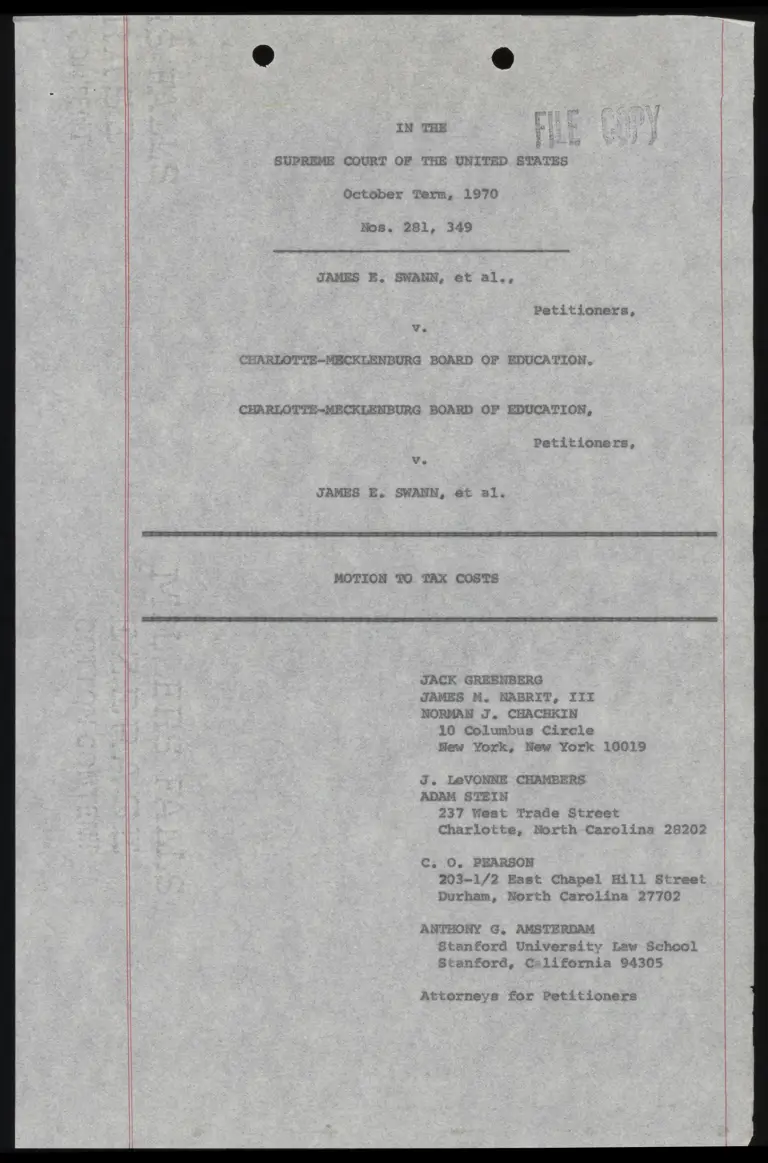
IN THE

SUPREME COURT OF THE UNITED STATES

October Term, 1970

Nos. 281, 349


JAMES E. SWANN, et al.,

Petitioners,

Vv.

CHARLOTTE-MECKLENBURG BOARD OF EDUCATION,

CHARLOTTE~-MECKLENBURG BOARD OF EDUCATION,

Patitioners,

Ve

JAMES E. SWANN, et al.,


MOTION TO TAX COSTS

Petitioners James E. Swann, et al, respectfully requests


that the Court enter an order allowing petitioners their costs

this Court in No, 281, including the cost of printing the

appendix, for the reasons stated below.

Statement


1. This case was decided April 20, 1971, with an opinion

Chief Justice Burger for a unanimous Court, This Court's deci-

sion of April 20, 1971, concluded by stating:

For the reasons herein set forth, the

judgment of the Court of Appeals is affirmed

as to those parts in which it affirmed the


judgment of the District Court. The order of
the District Court dated August 7, 1970, is

also affirmed.

A petition for rehearing filed by the Charlotte-Mecklenburyg Board

of Education was denied June 7, 1971, and the judgment issued on

that date. Petitioners Swann, et al, wrote to the Clerk on

June 8 requesting that they be allowed their costs in No. 281

pursuant to Rule 57(2). The Clerk responded July 7, 197l1--having

in the interim requested and received a response from opposing

counsel--that no costs were allowed to petitioners and stating:

The judgment of this Court, entered April 20,

1971, by its term affirms the judgment of the

United States Court of Appeals for the Fourth

Circuit, Under Rule 57(2), costs are allowed to

the appellant when the judgment of the court
below is reversed or vacated, which is not the

case here. It appears, therefore, that the judg-

ment was entered in accordance with the rule.

2. A brief resume of the somewhat unusual procedural history

of the case is useful to put the matter in context. The Court

granted three separate petitions for certiorari in the case. See

399 U.S, 9263 400 U.S. B05: 400 U.8. 802, The first petition in

No. 281 (previously No. 1713, Oct. Term, 1969) was filed June 18,

1970, and granted June 29, 1970 (399 U.S. 9226). The petition in

No. 281 was filed by Swann, et al. seeking review of a decision

by the Fourth Circuit which, on the school board's appeal from a

district court desegregation order of Pebruary 5, 1970, had

hd
"vacated" the district court judgment. The Pourth Circuit

approved the district court's plan for secondary schools but held

that the elementary school plan unduly burdened the board.


1l/ Swann v, Charlotte-Mecklenburg Board of Education, 431 F.2d


138, 160 (4th Cir. 1970), vacating a district court decision

reported at 311 F. Supp. 265 (W.D. N.C., Feb. 5, 1970).


Petitioners, supporting the entire district court order; filed

the petition in No. 281 seeking to have that district court order

reinstated and the Fourth Circuit reversed insofar as it set

aside the district court's plan. Petitioners also filed a Motion

2/
to Advance and for Pendente Lite Relief. On June 29, 1970, this

Court granted certiorari and reinstated the district court plan

pending further proceedings in that court, stating (399 U.S. 926);

«ss Petition for writ of certiorari granted,

provided the judgment of the Court of Appeals is
left undisturbed insofar 28 it remands the case

to the District Court for further proceedings,

which further proceedings are authorized, and
the District Court's judgment is reinstated and

shall remain in effect pending those proceedings,

The decision on the motions to expedite is
deferred, Mr. Justice Black dissents from the
Court's order which reinstates the district

court's judgment. He would grant the motion to
expedite action in this Court and set the case

for hearing at the earliest possible date.

The Court not having acted on the reguest that the matter

proceed without a printed record (see note 2), it thereupon became

the duty of petitioners to prepare an appendix, The voluminous

appendix of more than 1,300 pages (including more than 240 pages

of lower court opinions) was printed at petitioners’ expense and

timely filed, The cost of printing as indicated by the attached

3
bill, was $14,105.03 (see Appendix A, infra).


2/ Because the primary item of costs at issue in this case is the
printing of the appendix, it is perhaps relevant to mention that
in the Motion to Advance petitioners asked that this Court "con-

sider the case on the original record without printing or,
alternatively, to permit reproduction of the appendix record used
in the Court of Appeals by other than standard typographic means.”

3/ The attached printers' bill (Appendix A, infra) indicates
that petitioners printed 65 copies of the appendix. We submit

that in the circumstances of the case most, if not all, of the

copies were reasonably necessary. We served copies on Messrs.


On July 2, 1970, during the Court's vacation, the school

board filed a cross~petition for certiorari (No. 349, Oct, Term,

1971) in which the hoard challenged the entire district court

plan. In July 1970 the district court conducted further hearings

and entered orders on August 3 and August 7, 1970, which left in

effect the February 5, 1970, judgment. The Fourth Circuit

declined to issue a stay at the hoard's request, and the board's

motion for a stay addressed to the Chief Justice and referred by

him to the Court was denied in this Court. The board then filed

a motion for an ancillary writ of certiorari pertaining to the

proceedings since the writ was granted in No, 281, and the Court,

treating the motion as a petition for certiorari, granted it as

well as the petition in No. 349, on October 6, 1970 (400 U.8. 802

803, 805). In the meanwhile, the parties had been notified that


(Continued)

Horack and Waggoner representing the Board of Education, as well

as upon the Solicitor General of the United States and the Attor-
ney General of Horth Carolina, We also served counsel for the
National Education Association and the United Negro College Fund,

et al. who had filed amicus briefs with leave of this Court (399

v.85. 926). 8Subseguently, we served Mr. Blakeney, counsel for
appellants in a related case, No. 444, Moore v, Charlotte-Macklen+


burg Board of Edueation, which Mr. Blakeney sought to have
‘consolidated with No. 281. Purthermore, petitioners were twice
requested by the Clerk's office to furnish additional copies of
the petition for certiorari and the voluminous appendix containing
the many opinions below, so that they thought it a reasonable pre«

caution to print a number of extra copies of the appendix,


The board's counsel, by letter to the Clerk, has also argued
that if petitioners obtain costs they should be limited to $5.59

per page, the price paid by the board in printing the appendix in
No, 349. Petitioners in No. 281 printed the appendix by standard
typographic means at prevailing rates in New York without overtime

or rush charges notwithstanding the great bulk of the material and
the short time involved. The ruling urged by the board would, if

it were adopted by the Court as a precedent, have the effect of preé-

venting litigants from having their printing work done in uhion
print shops. If any limitation on the price per page for printing

work is to be adopted, beyond the general notion that work shall
be done at the prevailing printing rates, it ought to be announced

in advance by rule of Court and not applied after the fact as
urged by the board.

- a.

/

]


oral argument in all the cases was scheduled by order of the Chief

Justice for October 12, 1970. The board then prepared an appendix

in No, 349 consisting of the district court proceedings after the

&/
grant of certiorari in No. 281,

3. This Court's decision completely affirmed the district

court's February 5, 1970, desegregation order. Thus, the Court

completely rejected the position of the board of education which

challenged the February 5 order throughout the appellate proceed-

ings and completely upheld the position of petitioners Swann, et

al. who had supported the order. There is no dispute over the

fact that Swann, et al. were the winning litigantsy this was

acknowledged by counsel for the school board in his letter to the

5/
Clerk of this Court of June 16, 1971.

REASONS FOR GRANTING THE MOTION


l. Petitionexs Swann, et al, are entitled to costs in


No, 281 as a matter of course under Rule 57(2).


Rule 57(2) of the Rules of the Supreme Court states that "In

cases of reversal or vacating of any judgment or decree by this

court, costs shall be allowed to the appellant or petitioner,

unless otherwise ordered by the court." Petitioners in No. 281

sought. to have the Fourth Circuit judgment of May 26, 1970,

reversed or vacated only in part, that is insofar as it vacated


4/ The appendix in No. 349, consisting of 510 pages, was much
smaller than that printed in No. 281, since the earlier appendix

included all the record hefore the Court of Appeals.

3/ Mr, Waggoner's letter to Mr, Seaver said "Referring to
Mr. Nabrit's letter of June 8, we acknowledge that in general,

Swann, et al. prevailed in both appeals.”


the district court order of February 5, 1970, Petitioners obtained

the relief they sought by this Court's order of June 29, 1970 (399

U.S. 926) which "reinstated" the district court order. By "rein-

stating” the district court order, this Court necessarily vacated

the Court of Appeals' order to that extent. All of the subsequent

proceedings, including the final decision, confirmed that result,

Accordingly, although this Court's orders have not used the word

"reversed" or "vacated" their plain and obvious intended purpose

and effect was to set aside the Court of Appeals' order to the

extent that it was in conflict with the district court order. Thi

Court's affirmance of the district court order of August 7, 1970

(which continued in effect the February 5th elementary school

order which the Court of Appeals had disapproved), also amounted ¢

saving the same thing as reversing the Court of Appeals’ judgment

in this respect. Thus, the Court of Appeals’ judgment was vacated

to the only extent that petitioners in No. 281 complained of it,

and, accordingly, under Rule 57(2) costs should be allowed.

Rule 57, which allows costs to a petitioner who succeeds in

having a judgment reversed or vacated, and requires an unsuccess-

ful petitioner to pay costs, has been applied with relatively

little change in this Court since the January Term 1838. See

Rules of Court prefixed to 37 U8. (12 Pet); Bradstreet v. Potter,


41 U.8., (16 Pet.) 317: 8t. louis & S.F. BR. Co. v. Spiller, 275


U.8. 156, 159-160, Ordinarily costs are awarded to the “"prevail-

ing party” in accordance with "the long established practice and

universally recognized rule of the common law." Mansfield C. &


L.M.R. Co. Vv. Swan, 111 U.S. 379, 387. The practice of awarding


costs to the prevailing partv has long applied in this and other

federal courts, St. louis & S.F, R. Co. v, Spiller, supra; Ex


So

d


Parte Peterson, 253 U.S, 300, 317; Newton v. Consolidated Gas CO.,


265 U.8. 78; 6 Moore's Federal Practice p. 1301, et seg.; cf.

Spraque v. Ticonic National Bank, 307 U.8. 161. Nothing has


transpired in this case to justify any deviation from the general

rule of awarding costs to prevailing petitioners.

It should be noted that this Court has long awarded costs to

an appellant or petitioner under Rule 57 even where a judgment

appealed from is reversed only in part. St. louis & S.F. R. Co.


v. Spiller, supra. Thus, where only part of a petitioner's argu~


ments are vindicated on appeal, he is entitled to costs. It

follows a fortiori that petitioners in this case are entitled to


costs where they prevailed with respect to the only matters com-

plained about in the judgment below.

This Court has applied the rule on co ts in accordance with

the purpose and spirit of the rule and has not woodenly applied

it so as to award costs to parties who prevail in only a formal

or nominal sense. Mansfield C. & L.M. R. Co. v. Bwan, 111 U.S.


379, 388-389; Rogers v, Durant, 106 U.S. 644. In Mansfield the


Court, noting that the rule "leaves room for the exercise of dis-

cretion," awarded costs against a nominally prevailing party:

In the present case, the writ of error is not
dismissed for want of jurisdiction in this court;

on the contrary, the jurisdiction of the court
is exercised in reversing the judgment for want
of jurisdiction in the Circuit Court; and although,

in a formal and nominal sense, the plaintiffs in

error prevail in obtaining a reversal of a judg-

ment against them, the cause of that reversal is

their own fault in invoking a jurisdiction to
which they had no right to resort, and its effect

is, to defeat the entire proceeding which they

originated and have prosecuted. In a true and
proper sense; the plaintiffs in error are the

losing and not the prevailing party and, this
court having jurisdiction, upon their writ of
error, Bo to determine, and in that determination


being compelled to reverse the judgment, of which,

on other grounds, they complain, although denving
their right to be heard for that purpose, has jur-

isdiction, also, in order to give effect to its

judgment upon the whole case against them, to do
what justice and right seem to reguire, by award-
ing judgment against them for the costs that have

accrued in this court. (111 U.8., at 388-389)

In the instant case, as in Mansfield, costs ought to be awarded tc


the party who actually prevailed in order "to do what justice and

right seem to require” (111 U.S. at 389).

2. It is eguitable to award costs to petitioners Swann,


et al.


The Court may exercise an equitable discretion to award

costs even if it be assumed arguendo that the matter is not gove


erned by the terms of Rule 57(2). Mansfield, C. & L.M. R., Co, Vv.


Swan, 111 U.S. 379; Sprague v, Ticonic National Bank, gupraj


Ex Parte Peterson, supra; Newton v, Consolidated Gas Co., supra.


Rule 57 contemplates that the Court may on occasion award costs

by special order to fit the exigencies of a case.

This is a case where private plaintiffs have supported long

and expensive litigation to vindicate the constitutional rights

of thousands of individual students attending the public schools

of Charlotte-Mecklenburg. They maintained the litigation more as

"private attorneve general" (cf. Newman v. Piggie Park Enterprise

p


390 U.S. 400, 402) to vindicate the public interest and that of

countless other children in securing obedience to the Constitu-

tion than as private litigants vindicating their individual

interests. In the Newman case, supra, this Court construed the

counsel fee provision of Title II of the Civil Rights Act of 1964

to grant counsel fees routinely to prevailing plaintiffs who sued


to enjoin racial discrimination in places of public accommodation.

The reasoning of the Court in Newman applies with even greater

force to the award of conventional court costs in a school deseg-

regation case, It would be a positive discouragement of private

litigation to vindicate the constitutional principles of Brown v.

Board of Bducation, 347 U.S. 483, if this Court were to deny con-


ventional court costs to petitioners who succeed in such litigation.

This is a case where the Charlotte-Mecklenburg Board of

Education has vigorously resisted every step of the litigation

designed to eliminate the unconstitutional dual system of segre-

gated schools maintained by the board. Chief Justice Burger's

opinion, for the Court, referred to the "total failure®™ of the

school board to meet its obligations neting "the school board had

totally defaulted in its acknowledged duty to come forward with

an acceptable plan of its own, notwithstanding the patient efforts

of the district judge who, on at least three occasions, urged


6/ In Newman the Court said (390 U.8. 400, 401-402):

When the Civil Rights Act of 1964 was passed, it
was evident that enforcement would prove difficult and
that the Nation would have to rely in part upon private
litigation as a means of securing broad compliance with

the law. A Title II suit is thus private in form only,
When a plaintiff brings an action under that Title, he

cannot recover damages. If he obtains an injunction,

he does so not for himself alone but also as a "pri-
vate attorney general,” vindicating a policy that

Congress considered of the highest priority. If suc

cessful plaintiffs were routinely forced to bear their

own attorneyvs' fees, few aggrieved parties would be in
a position to advance the public interest by invoking

the injunctive powers of the federal courts. Congress
therefore enacted the provision for counsel fees--not
simply to penalize litigants who deliberately advance

arguments they know to be untenable but, more broadly,

to encourage individuals injured by racial discrimina-

tion to seek judicial relief under Title II, (Footnotes

omitted, )


the board to submit plans” U.B. at y 28 L.ed.2d at 554, ¢

571 ). Judge Sobeloff recounted in some detail the tactics by

which the board "resisted and delayed desegregation at every turn.”

Swann v. Charlotte-Mecklenburg Board of Education, 431 F.2d4 138,


154-155, note 9 (Scbeloff, J., concurring in part, dissenting in

part).

Indeed, the question of whether the board's conduct, or the

other eguities, justify an award of counsel fees and costs not

generally taxable is pending in the district court. See Newman,

supra, 390 U.S. at 402, note 4; Sprague v. Ticonic National Bank,


supra Mills v. Electric Auto~Lite Co., 396 U.85. 375; Rolax v.


Atlantic Coast Line Railroad Co., 186 FP.24 473 (1951) Vaughan v.


Atkinson, 369 U.S, 527; Bell v. School Board, 321 F.2d 500 (4th

Cir. 1963). And see a learned opinion by Judge Merhige awarding

counsel fees in the Richmond, Va. school desegregation case and

collecting all the relevant authorities including numerous school

desegregation cases. Bradley v. School Board of the City of


Richmond, Va., PF. Supp. (Ww.D. Va.,, May 26, 1971) (Civ.


Action No. 3353-R). The reasoning of theses cases applies with

even greater force to support an award of normal taxable costs in

this case. The matter of counsel fees is, of course, committed to

the discretion of the district court in the first instance. We

seek no order with respect to counsel fees by this present motion,

but mention the matter by way of suggesting that this Court's dis-

position of the costs issue ought not unintentionally preempt

consideration of the counsel fee issue by the district court.

The school board, by documents submitted to the Clerk has

urged that no costs be awarded to the petitioners because the case

o 10 =


@
" aa
h


m


a
d
?


0
&

ov 0
rd

O

ot

a
4

+

.*

oh

§

fi

0


LE
a


) 4

&


3


0

i

rd

ot
WW

got
©


+


y

Y


sped

at
u

Soe
.

£4
Be

“
£

"


LL}
4


3


[44
So

u
v

gs

1


©


uy
H

.
fa

3
est

@

H

3
9


=
0

p-
a

ho
ot

o
iy!

a
[#

:
m

od
=

wi
©

'e
fu

po”

ps

"

4

o
3

ood
’

i)
:

£0
4

r
e


£
,


£3)
45)

ot

of
5

i]
ah

p
d


;
©


CO
@


x


0


p
r


£
@®

3
ec

3
8

®
a
l
e


B
B
e


9

vt
8

‘3
0

-
1

v
is

%

:

A

ee

o
>

fo
A

g
fa}

h
m

<
=

¥
1

i
F

bx
oO

M
o

o
"

S
=

U
.

#
$
O


g
BO

BR.
8

w
a


E
E
R


it
S
R


=


wu
%,

[7
7


¥


0


3


J
,


ot
oJ

a


pn
r
i


,
3


fl

K+

ord
®

oO

»

i
e


y
+

Oo
&

.
a

ry
+

-


4
+

a
i

2
0

by

hy

k
apd

(4%
Dvr

43
0


bo
£
9


L&
i


Ri
.

(
|


o
N


~
Ww

v
-

w


| % 1

3

»

i
h


%
ted

J


¢


sped
4

p
d


&
o
O


:
By

“
r
e


9


H
on

4
i

33
©

co
Al

on
.

4
3

&
=

U

o
8

O


wi
he:

’
J


”


-
6

:
3


%

|
¥)

ho

:
pov

g
wy

,
$

£
pa

po.
“wd

4
ved

»

:
oy

&
]

ri
'

BR
3

5
5

8
8

p30
SOR,

RA
CY.

©
D
8


Ss
8

5
gg.

3

£

i»

oh
o

3
“4

&
is

=
dl

S
a

@

=
o

0
Eg

ond

a

4

hed
.

ir

uv

+


ed
Be

op
Bw

uw
od

«
o

od
£

i
v

&
0

3
0

Rr
S,

B
Y


g
*H
i


<
B

he
By

=
E

2

¥
4

:¢
.

a


%

4


fy
id

:
h
o
e
o
B


ow
v

B
a


B
.

0

g
w


)

"
¢

i

g
8

3
©

o

gi
8

0
S

ES

:
S
0
9


8
os

§

o

i

»

£


w
w


’

o
t


-
a

rs
i
H


"

3

4

~
ro

@
U

¥
a

0

@

hb)
i

«
Fe

)


p
e


a


Ed
-


o
y


.


Lah
F.

Li

r
d


5

»
™

0
-

wr
"

[el

’
“8

. #


4

®


”


-


»

i
e
d


Fo
|

0


|


Ww

oY

A

s
e


A
d


r

{¥)

od

pod

3
-

3

”

&

.

8
4.4

u

tw
i)

wd

.

|
ha

od
Q

3)

b.

&
5

@
-


“


{

|
E


:
g§

0
=

£2
P

i

¥)

og

&

gi
es

4

w
e
d


:

inf
3

po
a
e


2
a


a
o
e


in

"

tl
7

 %
1

§
3

(#1

¢
LJ

~
0

ow
Li}

hg
be

:

4
ord

rt
ce

i
1

A


o
e


*

¥

>

y

>.
-

:

y

rs

od
"

om

=i

v1
Por

43

has
in

1

oh

»

o

0


a;
WJ

Ee
©


:

o~
4d

tha
J

-

Bo...
ts

or
A

wry

~

iy
~

po,
wd

8
J

ee
43

ys
pd

Oo
>


$4

W

Fey

O
i |

fo
>

g
[(¥

@
4

ed
i

a
ord

=

A

pet

c
Fis]

pd
4]

-
,

2
:

Oo
WW

r3

a
-

ue
4)

q

Lo
4

>
£5

8
7

0


be
Ud

A


po

od
=

~.
a


0
y

5
8

Fo
w

hs
£2

U
o

5
:

fl

4
+

x

BR.»
5

w
m


a
iy

;
B
B


>
gs

D
o


i


3

o
R


p-
g
o


a


"

i

LS

3

Re
4

0

"
0

:
d
a


wf
oc

=
8

3
0

-
0M

I
-

wl
«

(&
Lo

ho
a

v
0

a
hy

0
nt

wd

2
’

Q
@

ar!

5.

p-

hf

p
o


p
sped

b
i


red
Ey

&


iy
Q


=


Hh

=
,

:
x

She
»

>
1

©
uw

m

ys]
¥


‘

&


0


£3
6.

os
E
o
)


-
:

L
E


i
.


=
uw

&
®

oo
)

®
g

8
“

g
u


g
8°

he

ou
oO

0
= SE

D
@

©
:

_
pos

4

“rd
;

:
3

M

@
\

w
oo

La
p

4


hed
5

[i]

on

|

i"

3
$F

He
W)

b
LX

§

wd

fo

on

s
§

r

-


i
-

iJ

gL
$d

*
iw

pa

Q


Sun

od
13

Ts
ed

m


_-
=


o


{
©


poe

&


W


b..
&


>


i
i

‘

O
—

A

:
rs

5

=


=
a

“r=
1

@
#,

pA
is

|
t

[
8

"
&

B
We

O


0

1}
ord

tv

a


4


£
3


&


-


{
*

a


w
e
e
d


i
,


l
a


&


dd
o


0


a


i
n


be
po

a
@

rh
0

:
0

’
Lt

i
o

3
=

$4

{

ay
O

oO
Py

EY

33
.

ta

rin
ix

%

O

:
|

a

a
or

3
)


r

A

&¢
O

g
©

p
o


a
r
e


el

a
N
O


pod
w?

wend
vy

0
od

bo

 -

Ww

~

epvd
S

er

pod

3

t
0

&A

i:
PE

\
A

O

oO
[md

»

ou

oi
+

1

|

Ad
me

ol
.

ay

ws
Ww

a


6


Q
s


O


dod

Fat
ct

w
o


pod

$3
Li

of
v

Ww

m


4
©


3

3

p
"

i
J


yo
he

fo
°

on
@

o
i

i
Oo

M
ed

ba

od
0

0
”

u

Q
et

Ht
;

Kut
¢

y
ho

.
©

Tr
uv

E
's)

i

co
@

.

i

0
dd

3
be

§@
1

od
+

=

:
#

Ww
4

Ph

[4

ps
Foy

4

,

bd
“

o
|

3
|


O
U


a


Ww

a


m


le
=


©


An

po

CO
&


0


o

wed
~

nt
Fin

a
oped

yy
n

pd
wi

(F

4

ww

i

pa

-
33

Qo
g

hs

.
3d

é@

{

\
FI

i

-
“

ct
shot

p¥
*

4

&
fan

po
:

@

=


wn
fo!

£
he

“
e

ol

a
=

©
&

£

wl

wt
pi

@
0

Biwi
$d

’

hy

Bo

»
yd

y

x
Ce

Ty

po
iH

and
aed

8)

\

—

»,

4

8
|

pd
0”

ed
£1

| XT
~


5

:
VD

>

Tod

F
E


3


al
a


%

&O
prt

&
J

PY
33

he
'y

{
har

i

&

4

bod

0D
&


pe

bons
QO

z

]

a]
:

eH
|

h-. A
bes]

:

..
3


3

»


py
4

0


3


{I
oe

hang

a
p
d


_

A


f


La
1

9
gd

7


g
o
d


O


hed

W
r


Fe
.

iE

.
wd

rd
et

#)
44]

:
(34)

‘
ns

.
i)

iJ
;

Po

por’

"1
a
y


O


pi
»

-
a
a

4 }
od

4


4
p
o


nd?
h
e
.


4
3


“
4


e
s


m
t


4


J


'

-

44

8
ved

@
be

-
ht

oo
&

oo
&

>


>

$d

£3
£52

PE

LF

when
Phos!

©


£3

8

L3

4
Ww

:
49

hv
pe

po

8
3

£0
pr

|

Loh

ow

.
iJ

=
ot

=
i

#!

Lo

¢

.

4

4

oF
&

“
wail

()
»

of

be
+

Las

5
|

epi
LE

®

pot

of
5

hy
2

bs

ed

.
p+

[01
”

ht

ood
5,

:
©

3


i
es

a
ly

ap
bpd

ad

L

3)
§

fo

.

hg

*

i]
:

:

\
4

a


i
.

4
i

$4
-

$4

0
os

U
o

ri

-.

3

oh
w

3
wd

+

4
io

|

se
-

~

oy
¢

be
fry

vi)
oO

=
ow

4d
ho

be
2

14

~pef
pod

|
§

pu
O


()

0


p
s
.


w
d


i
He

#7
3


OO
©

oO
i)

EF
Prd

[54

£2) +
th

y

4


r
3

Fa]

H
r
d


wh
6


t
e


Pe
os

ad
he

3

£
5


-

d
t
a


5
-

=


mn
6
3


Oo
py

~
o

Li

e
ud

La

Ls.
ad

vill:

-
44

ue

wd
wi

a


he
w

FY
UO

) BS
pd

w
i


:

3

oy
Q)

+
apd

4


Ld

(x
&

0
©

)

#


po

A


| od
:

a


y
&


Li

err
3

4


=
3

~
h


-

i
43


El an i   SR HE


Ag

se -
af ; "5 a
dor Sol dow Li


EEVEC Ls [||6f71ee9e-a4f0-4daa-9506-d56fc53c456f||]