Letter from Lani Guinier to Ernest Green RE: Memo on discriminatory registration barriers
Policy Advocacy
May 10, 1984
3 pages
-
Legal Department General, Lani Guinier Correspondence. Letter from Lani Guinier to Ernest Green RE: Memo on discriminatory registration barriers, 1984. fa484606-e692-ee11-be37-6045bdeb8873. LDF Archives, Thurgood Marshall Institute. https://ldfrecollection.org/archives/archives-search/archives-item/ca52e587-444e-4473-87b0-3ee899cbc38c/letter-from-lani-guinier-to-ernest-green-re-memo-on-discriminatory-registration-barriers. Accessed October 07, 2026.
Copied!
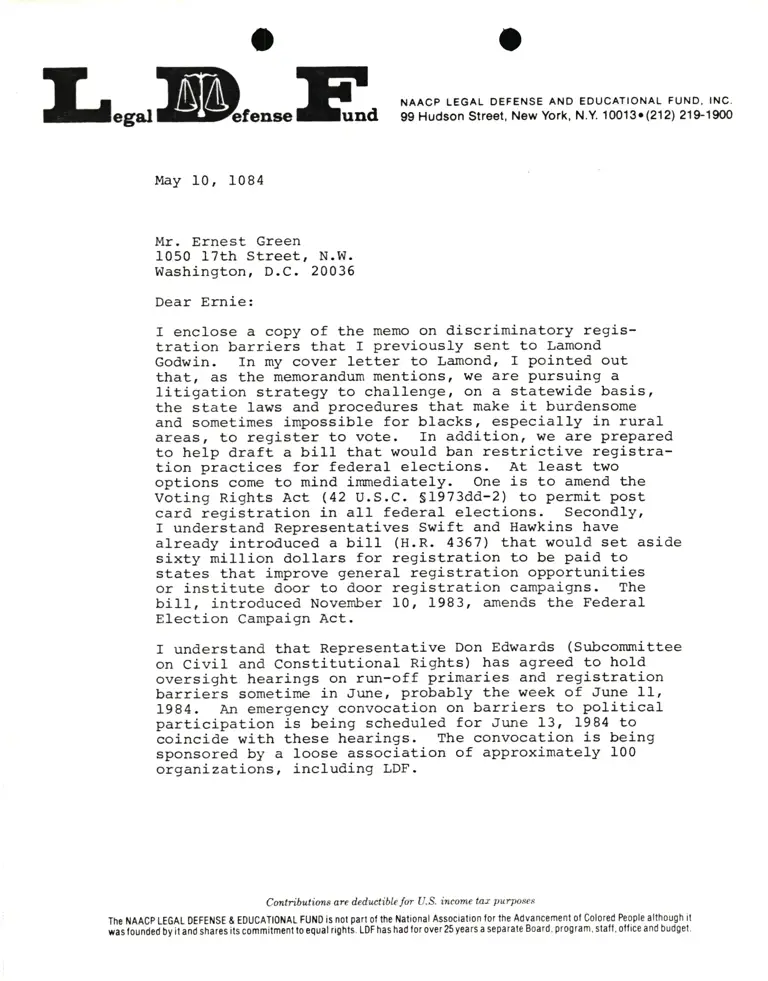
    L*,E&renseH.
I,lay I0 , I0 84

1,1r. Ernest Green
1050 17th Street, N.w.
Washington, D.C.20036

Dear Ernie:

I enclose a copy of the memo on discriminatory regis-
tration barriers that I previously sent to Lamond
Godwin. In my cover letter to Lamond, I pointed out
that, Ers the memorandum mentions, w€ are Pursuing a
litigation strategy to challenger orl a statewide basis,
the state laws and procedures that make it burdensome
and sometimes impossible for blacks, especially in rural
areas, to register to vote. In additionr w€ are PrePared
to help draft a bill that would ban restrictive registra-
tion pract.ices for federal elections. At least two
options come to mind irunediately. One is to amend the
Voting Rights Act (42 V.S.C. S1973dd-2) to Permit post
card registration in all federal elections. Secondly,
I understand Representatives Swift and Hawkins have
already introduced a bill (H.R. 4367) that would set aside
sixty million dollars for registration to be paid to
states that improve general registration opportunities
or institute door to door registration campaigns. The
bill, introduced November 10, 1983, amends the Federal
Election Campaign Act.

I understand that Representative Don Edwards (Subcommittee
on Civil and Constitutional Rights) has agreed to hold
oversight hearings on run-off primaries and registration
barriers sometime in June, probably the week of June 11,
1984. An emergency convocation on barriers to political
participation is being scheduled for June 13, 1984 to
coincide with these hearings. The convocation is being
sponsored by a loose association of approximately 100
organizations, including LDF.

Contributions ore d.edrntible fm U.S. incotne tar purposes

The NAACp LEGAL DEFENSE & EDUCATTONAL FUND is not part 0f the National Association lor the Advancement ol colored People although it

*ai fornOeO Oi itind shares its commilment to equal righti. LDF has had lor over 25 years a separate Board, program, stall, ollice and budgel.

NAACP LEGAL OEFENSE AND EDUCATIONAL FUND, INC.
g9 Hudson Street, New York, N.Y. 10013o(212) 21S1900


l'1r. Ernest Green llay 10, 1984

In addition to the issue of registration barriers, there
has been some talk of introducing legislation that would
bar use of the double primary in federal elections- I
do not think that for L984, this issue is as important
as the problem of legislation to eliminate registration
barriers. Nor do I think it would be easy to get the
Congress to act on this issue this session. Nevertheless,
f witt be happy to assist in preparing for hearings on
run-offs provided that the issue of registration barriers
is also high on the agenda.

It is not that I disagree that blacks suffer as a result
of the double primary. In fact, there are several sources
that in my opinion demonstrate the requirementrs adverse
impact on black political participation- First, the
Department of Justice has, in its 18 year enforcement of
Section 5 of the Voting Rights Act, extensive experience
with reviewing the operation of the majority vote require-
ment in the Section 5 covered jurisdictions, which, in
addition to Oklahoma and Arkansas, are the only states that
use such a rule and use it only for nomination by a political
party, i.e., in primary elections. In fact, between 1975
Lna tgAO, 66 objections were interposed by the Justice
Department to the majority vote reguirement. Only annexa-
tions and changes to at-Iarge elections were the subject of
more objections.

Second, the case law, including several Supreme Court
opinions, consistentty recognized the discriminatory impact
oi a majority vote requirement in a jurisdiction where
voting is ra-iatty polarized. (See, for example, Whit_e_ v.

Tmree judge court opinion, Jan. 27, L984) at 37-38, copy
attached. )

Finally, the legislative history of the 1982 amendments to
tfre Voling Rights Act reflects the finding by Congress that
the majority vote reguirement is a voting procedure that
tends [.o diicriminate against minority voters. For example,
at page 29 of the senate Report, the senate Judiciary
Commiltee includes the majority vote requirement in a list
of procedures that typically enhance the opportunity for
while voters to discriminate and inhibit the opportunity
for btack voters to elect candidates of their choice.

Resesf.er, ALZ U.S: 755 (1973), City of Port Arthur v. gnited
ffies, IO3 S. Ct. 530 at 535 (19E21; and Gingles v. Ed.misten.


Mr. Ernest Green -3- ltay I0, 1984

Eowever, for the reaaons discussed more fuIly in the
enclosed merrc to Lamond, I ettryIy underscore the need
to concentrate rtpre resources on chalLenging discrLmina-
tory registration laws.

PleaEe feel free to calL me at any time to meet on these
issues or to discuss them at greater length.

Sincergly,
. ,'' ,

tnAu*|-/r,"tr)-crinier

w/r
Enclosures

cc: Professor Ron Walters