Griggs v. Duke Power Company Brief for the United States as Amicus Curiae No. 1405
Public Court Documents
June 1, 1970
-
Brief Collection, LDF Court Filings. Griggs v. Duke Power Company Brief for the United States as Amicus Curiae No. 1405, 1970. a28eb4d7-b49a-ee11-be36-6045bdeb8873. LDF Archives, Thurgood Marshall Institute. https://ldfrecollection.org/archives/archives-search/archives-item/cb66e039-5f42-40d6-996e-8d524d5134aa/griggs-v-duke-power-company-brief-for-the-united-states-as-amicus-curiae-no-1405. Accessed October 06, 2026.
Copied!
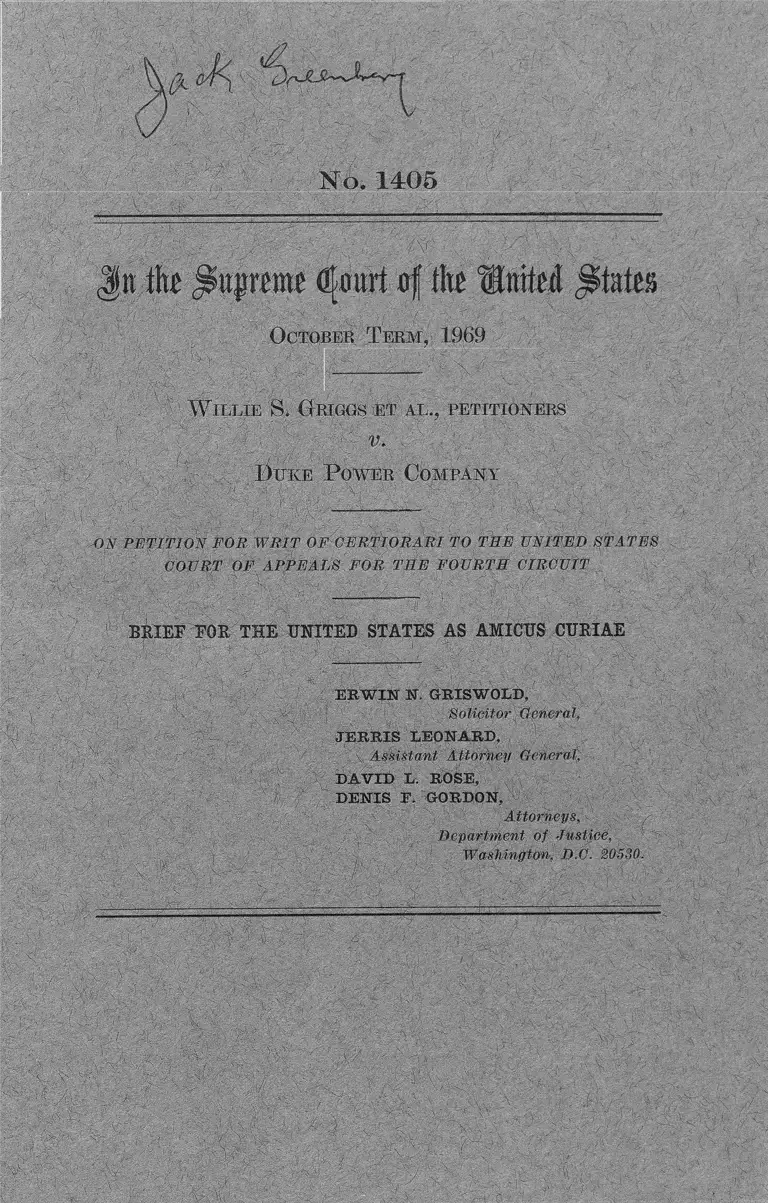
No. 1405
October T erm , 1.969
W illie Si Griggs et al., petitioners
' v.
' !)[ ke P ower Com paw
ON P E T IT IO N FO R W R IT OF C E R T IO R A R I TO T H E U NITED S T A T E S
COURT OF A P P E A L S FOR T H E F O U R TH C IRC U IT
BRIEF TOR THE UNITED STATES AS AMICUS CURIAE
ERW IN N. GRISWOLD,
Solicitor General,
JERRIS LEONARD.
A ssistan t A ttorney General.
DAVID L. ROSE,
DENIS F. GORDON,
Attorneys,
D epartm ent o f Justice,
W ashington, U.O. 205SO.
I N D E X
Page
Opinions below____________________________________ 1
Jurisdiction________________________________________ 1
Question presented_________________________________ 1
Statute involved---------------------- 2
Introduction and interest of the United States__________ 3
Statement_________________________________________ 4
Argument_________________________________________ 8
Conclusion________________________ 14
CITATIONS
Cases:
Clark v. American Marine Corporation, 304 F. Supp.
603_________________________________________ 9
Dobbins v. Local 212, IBEW , 292 F. Supp. 413______ 9
Local 53 Asbestos Workers v. Vogler, 407 F. 2d 1047_- 9
Local 189, United Papermakers v. United States, 416 F.
2d 980, certiorari denied, 397 U.S. 919___________ 9
Quarles v. Philip Morris, Inc., 279 F. Supp. 505------- 9
Robinson, et al. v. P. Lorillard Co. (M.D. N.C., 1970),
62 Lab. Cas. 1f9423____________________________ 9
United States v. IP. K. Porter Co., 296 F. Supp. 40,
appeal pending, C.A. 5, No. 27,703______________ 10
United States v. Sheet Metal Workers, 416 F. 2d 123.- .. 9, 12
Statute:
Title VII of the Civil Rights Act of 1964 (42 U.S.C.
2Q0Qe, et seq.)___________________ 2, 3, 5, 8, 9, 10, 11, 12
Sec. 703(a), 42 U.S.C. 2000e-2(a)___________ 2
Sec. 703(a)(2), 42 U.S.C. 2000e-2(a)(2)______ 2, 11
Sec. 703(h), 42 U.S.C. 2000e-2(h)____2, 7, 11, 12, 13
(i)
388—073— 70— -—1
IX
Miscellaneous: Page
Bureau of Labor Statistics, Employment and Earnings,
June 1970, Table A-3, Major Unemployment In
dicators_____________________________________ 3
1980 Census of the Population, Characteristics of the
Population, Yol. 1, U.S. Summary, Table 174,
p. 1-421____________________________________ 10
Equal Employment Opportunity Commission, Guide
lines on Employment Testing Procedures, August 24,
1966, reprinted in CCH Employment Practices
Guide, 1(16,904_______________________________ 1]
Order of Secretary of Labor, Validation of Employ
ment Tests by Contractors and Subcontractors
Subject to the Provisions of Executive Order 11246,
33 Fed. Reg. 14392___________________________ 3, 12
Jftr it it t̂ifveme fltmtri of tte states
October T erm , 1969
No. 1405
W illie S. Griggs et al., petitioners
v.
D uke P ower Company
•ON P E T IT IO N F O R W R IT OF C E R T IO R A R I TO TH E U NITED S T A T E S
COURT OF A P P E A L S F O R T H E F O U R TH C IR C U IT
brief for the united states as amicus curiae
O PIN IO N S BELOW
The opinion of the court of appeals (Pet. App.
18a-62a) is reported at 420 P. 2d 1225. The opinion
of the district court (Pet. App. la--17a) is reported
at 292 F. Supp. 243.
j u r i s d i c t i o n
The judgment of the court of appeals was entered
on January 9, 1970. The petition for a writ of cer
tiorari was filed on April 9, 1970. The jurisdiction of
this Court is invoked under 28 TJ.S.C. 1254(1).
QUESTION PR ESE N T E D
Whether it is unlawful under Title Y II of the Civil
Flights Act of 1964 for an employer to require the
(i)
2
completion of high school or the passage of certain
general intelligence tests, as a condition of eligibility
for employment for, or transfer to, jobs formerly re
served only for white employees, when
(1) both the high school standard and the sub
stitute tests operate to disqualify Negroes at a
substantially higher rate than whites; and
(2) neither possession of a high school educa
tion, nor passage of the substitute tests, has
been shown to measure the capacity of em
ployees to perform such jobs.
STA TU TE IN VO LVED
Title Y II of the Civil Rights Act of 1964 (42 U.S.C.
2000e et seq.) provides in pertinent part as follows:
Sec. 703(a) I t shall be an unlawful employ
ment practice for an employer—
* * * *
(2) to limit, segregate, or classify his em
ployees in any way which would deprive or
tend to deprive any individual of employment
opportunities or otherwise adversely affect his
status as an employee, because of such indi
vidual’s race, color, religion, sex, or national
origin.
* * * # #
(h) * * * it shall not be an unlawful employ
ment practice for an employer to * * * give and
to act upon the results of any. professionally
developed ability test provided that such test,
its administration or action upon the results
is not designed, intended or used to discriminate
because of race, color, religion, sex or national
origin. * * *
3
lETTRODITCTIGN A ND IN T E R E S T OP T H E U N IT E D STATES
This brief is submitted in response to an order of
this Court, entered on May 25, 1970, inviting the
Solicitor General to file a brief in this case expressing
the views of the United States.
Federal responsibility for enforcing Title Y II of
the Civil Rights Act of 1964 is assigned by that Title
to the Attorney General and the Equal Employment
Opportunity Commission. Pursuant to that statutory
mandate, and the provisions of Executive Order 11246
prohibiting employment discrimination by govern
ment contractors and subcontractors, the United
States is engaged in comprehensive efforts to eliminate
racially discriminatory employment practices and to
remedy the continuing effects of past discrimination.
But the goal of equal employment opportunity remains
unrealized; unemployment among Negroes and other mi
nority groups continues to be substantially higher than
it is among the population at large,1 and such unemploy
ment and underemployment continues to be a serious
national problem.
The decision of the majority of the court of ap
peals, if permitted to stand, would give judicial sanc
tion to the use of employment screening devices which
do not measure abilities to perform specific jobs but
have the effect of seriously limiting employment and
promotion opportunities for Negroes and other mi
nority groups. This result would seriously impede the
1 For example, in May 1970, unemployment for non-whites
was 8%, while that for whites was 4.6%. See Bureau of Labor
Statistics, Employment and Earnings, June 1970, Table A-3,
Major Unemployment Indicators.
4
government’s efforts to achieve equality of employ
ment opportunities.
STA TEM EN T
1. Traditionally, and at least until some five years ago,
respondent Duke Power Company discriminated on the
basis of race in the hiring and assigning of employees
at its Dan River Steam Station in Eden, North
Carolina. Negroes were employed only in its Labor
Department, where the best jobs paid less than the low
est paying jobs in the four “operating” depart
ments, staffed solely by white personnel. While nor
mally promotions were made within each department
on a job seniority basis, there was some mobility
between the operating departments. No Negro held a
job in a department other than Labor, however, until
August 1966, some five months after the filing of charges
with the Equal Employment Opportunity Commission.
At that time, a Negro employee assigned to the Labor
Department was promoted into a formerly white job
in the Coal Handling Department.
Beginning in 1956, the Company instituted a policy
of requiring a high school education as a prerequisite
for initial assignment to any department except Labor
and for transfer from the Coal Handling Depart
ment or from Watchman to any “inside” department
(i.e., Operations, Maintenance or Laboratory and
Test Departments). When the Company abandoned
its policy of restricting Negroes to employment in the
Labor Department, the high school requirement was
5
also applied to transfers from Labor to any other
department.
In July 1965, the Company instituted the additional
requirement that new employees register satisfactory
scores on two commercially prepared aptitude tests2
to qualify for assignment to any but the Labor De
partment. Possession of a high school education alone
continued to render incumbent employees eligible for
transfer to the four desirable departments. In Sep
tember of that year, a procedure was instituted
whereby incumbent employees who lacked a high school
education could qualify for transfer by passing the same
two aptitude tests. One of the tests purports to
measure general intelligence; the other, general
mechanical comprehension. Neither of the tests was
intended to measure the ability of an employee to
perform any particular job. For both initial hiring
and for transfers, the cut-off scores chosen were the
national median scores of all high school graduates,
making the test standards more stringent than the
high school requirement, since the tests would screen
out approximately half of all high school graduates.
2. This suit was brought by the thirteen Negro em
ployees of the Labor Department on October 20, 1966,
alleging that the testing, transfer, and seniority prac
tices violated the rights of incumbent Negro employees
under Title Y II of the Civil Rights Act of 1964 by con
ditioning their eligibility to transfer out of the Labor
Department on educational or testing requirements
which did not have to be met by white employees pre
2 The tests used at all times relevant to the action were the
Wonderlic test and the Bennett Mechanical test.
6
viously assigned to jobs in the more desirable depart
ments. They further contended that, even if applied
by the Company only to Negroes hired after 1956, the
high school requirement and the alternative testing
requirements were unlawful ; by disqualifying Negroes
in substantially higher proportions than they did
whites, the requirements tended to restrict Negroes
to the low paying jobs in the Labor Department, without
any business necessity for doing so, thus unlawfully per
petuating the effects of the Company’s past discrimi
nation.
Through expert testimony, the plaintiffs attacked
the testing requirements on the ground that the Com
pany had not shown that the tests measured capacity
to perform the work of any particular job or class of
jobs in the plant, or that they predicted success on
any job or category of jobs. The testimony of the
experts for plaintiffs also tended to show that the
testing requirements disqualified Negroes in dispro
portionate numbers (App. 140a, 147-148a, 154-155a),
The Company’s expert conceded that the tests were
not designed to measure a person’s capacity to per
form certain jobs, but testified that they were intended
merely as a substitute for a high school education
“ on the assumption that a high school education pro
vides the training, ability and judgment that a person
needed to do the jobs in the plant” (App. 181a).
3. The district court found that the Company had
followed a policy of overt racial discrimination prior
to the adoption of the Act, and agreed that the in
equities of the pre-Act racial discrimination were
continued by the Company’s limitations on transfer
7
eligibility and department seniority system, but found
that, as of the time of trial, the practice of making-
initial assignments based on race had ceased. The
court ruled that, since the application of Title V II
was intended to be prospective only, no relief was
authorized as to any of the Negro incumbents.
The court of appeals reversed in part, unanimously
rejecting the district court’s holding that Title V II
does not prohibit allegedly neutral practices which
perpetuate the effects of past discrimination. The
court ruled that Negroes hired and assigned to the
Labor Department at a time when there was no high
school requirement for entrance to the higher paying
departments could not now be made subject to that
requirement, since whites hired contemporaneously
into the other departments were never subject to such
a requirement. As to those Negroes, the court also
ruled that their seniority rights be measured on a
plant-wide, rather than on a departmental, basis.
With respect to Negroes hired after imposition of
the high school requirement, however, a majority of
the court of appeals affirmed, the holding of the dis
trict court, finding that the high school requirement
had been applied fairly to whites and Negroes alike.
The court found that there was no racial purpose or
moti-eJf in the adoption of the education requirements,
and that in the absence of such a purpose, their use was
permitted by Section 703(h) of the Act. The court ex
pressly rejected petitioners’ contention that, since both
the high school requirement and the tests operated to
disqualify proportionately more Negroes than whites,
those requirements were unlawful under Title V II ab
8
sent a showing that they were, in fact, valid predictors of
job success (that is, that they were “job-related”).
Judge Sobeloff dissented from this part of the decision,
maintaining, as do petitioners in this Court, that
Title V II does not protect the use of employment
tests which do not measure the skills or abilities
necessary to performance of the jobs which the appli
cants are seeking.
A R G U M EN T
This case presents the issue whether Title V II of
the Civil Rights Act of 1964 permits the use of
allegedly objective employment criteria which dis
qualify disproportionately large numbers of Negro
and other minority group persons from employment
opportunities for which they are actually or poten
tially qualified. The issue is one of a high importance,
because use of employment criteria of the kind utilized
by the Company here is widespread in many parts of
the country today. Yet those criteria bear no demon
strated relationship to employees’ abilities to perform
the jobs for which they are used, and they operate to
disqualify Negroes in substantially higher propor
tions than they do whites. In these circumstances, the
use of such criteria needlessly perpetuates the effects
of past discrimination, and is, in our view, prohibited
by Title V II of the Civil Rights Act of 1964. In
holding to the contrary, the court of appeals expressly
rejected the interpretation of Title V II adopted by
the Equal Employment Opportunity Commission, and
refused to follow an Eighth Circuit decision proscrib
9
ing the use of tests which do not measure relevant
abilities. Review by this Court is appropriate to re
solve tliis important issue.
1. In the nearly five years since Title Y II of the
Civil rights Act of 1984 became effective, efforts to
enforce that Act through litigation, both by the
United States and by aggrieved private individuals,
have resulted in nearly unanimous judicial acceptance
of the proposition that covert as well as overt, and
residual as well as active, discrimination is proscribed
by Title YII.
The courts have regularly been confronted with
records showing prior racial discrimination by em
ployers or unions and current restrictions and prac
tices which, although arguably serving some identi
fiable business or economic purpose, were not derived
from any compelling business necessity and which,
while not inherently discriminatory, tended to per
petuate the discriminatory disadvantages at which
Negroes had been placed. In each of these cases, the
courts of appeals have ruled that the “ neutral prac
tices” involved were unlawful. Local 189, United
Papermakers v. United States, 416 F. 2d 980 (C.A. o),
certiorari denied, 397 U.S. 919; Local 53 Asbestos
Workers v. Vogler, 407 F. 2d 1047 (C.A. 5); United
States v. Sheet Metal Workers, 416 F. 2d 123 (C.A. 8).
The district courts have generally reached the same
result.3
3 Quarles y. Philip Morris, Inc., 279 F. Supp. 505 (E.D. Y a.);
Dobbins v. Local 121%, IB E W , 292 F. Supp. 413 (S.D.
O hio); Clark v. American Marine Corporation, 304 F. Supp.
603 (E.D. L a .) ; Robinson, et al. v. P. LoriMard Co. (M.D. K.G.
10
In our view, the high school education and test re
quirements used by the Company in this case are
legally indistinguishable from the employment, pro
motion and referral restrictions found unlawful in
the cases cited above. Like the apparently neutral re
strictions in those cases, imposition of the high school
requirement and use of the test alternatives here
demonstrably fall far more heavily on Negroes than
they do on whites. Nationally, of all non-white males
over the age of 25, only 12.8 percent have attained
12 years of formal education as compared with 34.6
percent of all white males in the same age group.4
Necessarily, the imposition of a high school educa
tion, or the ability to demonstrate the equivalency of
such formal educational attainment on a paper and
pencil test, as a condition precedent to consideration
for employment or employment advancement, will re
sult in a disproportionately higher percentage of
Negroes being excluded.
To be sure, if the possession of a twelfth grade
education or its intelligence test score equivalent is
shown to be a necessity for satisfactory performance
on the jobs for which it is required, the fact that such
a requirement eliminates a disproportionately higher
percentage of Negroes than it does whites, does not
make it an unlawful employment practice. Title Y II
does not prohibit the use of valid criteria to select
1970), 62 Lab Cas. If 9423; but see, United States v. II. K. Porter
Co., 296 F. Supp. 40 (N.D. Ala.), appeal pending, C.A. 5, No.
27,703.
4 1960 Census of the Population, Characteristics of the Popu
lation, Vol. 1, U.S. Summary, Table 174, p. 1-421.
11
qualified applicants for particular jobs. On the other
hand, if the requirement does not measure the appli
cant’s ability to perform the job in question satis
factorily, then the requirement serves to restrict the
employment opportunities of Negroes to the advantage
of other applicants without satisfying a demonstrated
business need, and is unlawful.
In the case at bar, the respondent acknowledges,
and the courts below have found, that the requirement
of a high school education or attainment of minimum
scores on the tests are not valid predictors of success
in performing the jobs involved in this litigation.
Unless and until such a showing is made, we think
the discriminatory impact of those requirements for
promotion and transfer constitutes a classification of
employees which would “tend to deprive [Negroes]
of employment opportunities” on account of race, in
violation of Section 703(a)(2) of the Civil Rights
Act of 1964 (42 U.S.C. 2000e—2(a) (2)).
2. We turn to the Company’s contention, sustained
by the court of appeals, that the use of the Wonderlie
and Bennett tests as a substitute transfer require
ment is specially protected by Section 703 (h) of the Act
(42 U.S.C. 2000e-2(h)).
Shortly after Title V II of the Civil Rights Act of
1964 became effective, the United States Equal Em
ployment Opportunity Commission interpreted Sec
tion 703(h) as protecting only tests which measured
the ability to perform the jobs for which they were
used, that is, valid and “job-related” tests.5 Similarly,
5 Equal Employment Opportunity Commission, Guidelines
on Employment Testing Procedures, August 24, 1966, re
1o &
the Eighth Circuit has proscribed under Title YI1
the use of a journeyman’s test which does not measure
the ability of the applicant to do the work usually re
quired of journeymen. United States v. Sheet Metal
Workers, supra, 416 E. 2d at 136. Conceding that the
tests in the case at bar were not job related,6 the
majority below rejected the “ job-related” standard
and concluded instead that in adopting Section
703(h), Congress specifically intended to permit the
use of any professionally developed test, so long as
there was no discriminatory purpose or motive. We
think that reading of Section 703(h) is in error, and
that, notwithstanding the majority’s disclaimer,7 it
invites the use by employers of a wide and varied
array of tests and other qualifying devices which
operate unjustly to limit employment opportunities
for Negroes as a class.
While the legislative history surrounding the adop
tion of the Tower amendment is subject to more than
one interpretation,8 the overall congressional intent
manifested by the enactment of Title V II compels
the view that, where tests tend to perpetuate the ef
fects of past discrimination by disqualifying dispro
portionately large numbers of Negroes, only those
tests which are job related are protected by Section
printed in CCH Employment Practices Guide, 16,904. Tlie
Secretary of Labor has applied that standard with respect to
the employment practices of Federal contractors and subcon
tractors under Executive Order 11246, see, 33 Fed. Reg. 14392.
6 The district court so found, and the majority below’ did not
question that finding. 420 F. 2d at 1234,
7 420 F. 2d 1235, n. 8.
s Compare the legislative analysis of the majority below, 420
F. 2d at 1234-1235, -with that of Judge Sobeloff dissenting, 420
F. 2d at 1241-1243.
13
703(h). For while it is understandable that Congress
should have reserved to employers the right to test
the abilities of prospective employees to perform the
jobs for which they are being considered, it is con
trary to the language of section 703(h) itself,9 and
inconsistent with the overriding objective of Title VII,
to conclude, as the majority below did, that Congress
intended to protect the use of such tests in circum
stances where they are not shown to measure any
such abilities.
The majority of the court of appeals also appears
to have relied upon the proposition that the tests in
question were the equivalent of the requirement of a
high school education, and could be justified on that
ground. But the passing scores used were the median
scores of high school graduates, so that approximately
one-half of all high school graduates would be barred
from jobs by the use of those tests.
More significantly, however, the Company’s reliance
on Section 703(h) begs the question. For it is clear
that the requirement of a high school education has
a highly discriminatory impact. And the lack of any
business necessity is shown by the fact that white
employees have performed satisfactorily and have
been promoted to high ranking jobs in the favored
“ inside” departments without such an education.
9 The protection of 703(h) is limited to “any professionally
developed ability test” which is not “intended or u s e d to
discriminate (emphasis added). The concept of an “ability
test” suggests a test which measures relevant abilities. And the
coupling of the word “used” with that of “intended” demon
strates that Congress was concerned with discriminatory im
pact as well as discriminatory motive and purpose.
14
CONCLUSION
For the foregoing reasons, the petition for a writ
of certiorari should be granted.
Respectfully submitted.
E rw in 1ST. Griswold,
Solicitor General.
J erris L eonard,
Assistant Attorney General.
D avid L. R ose,
D enis F . Gordon,
Attorneys.
J une 1970.
U .S . GOVERNMENT PRINTING OFFICE: J 9 7 0