NAACP v. Committee on Offenses Against the Administration of Justice Petition for Rehearing
Public Court Documents
January 1, 1958
-
Brief Collection, LDF Court Filings. NAACP v. Committee on Offenses Against the Administration of Justice Petition for Rehearing, 1958. 7dd5222e-bf9a-ee11-be36-6045bdeb8873. LDF Archives, Thurgood Marshall Institute. https://ldfrecollection.org/archives/archives-search/archives-item/cb8348ad-467c-46fd-90bf-04828a09941e/naacp-v-committee-on-offenses-against-the-administration-of-justice-petition-for-rehearing. Accessed October 06, 2026.
Copied!
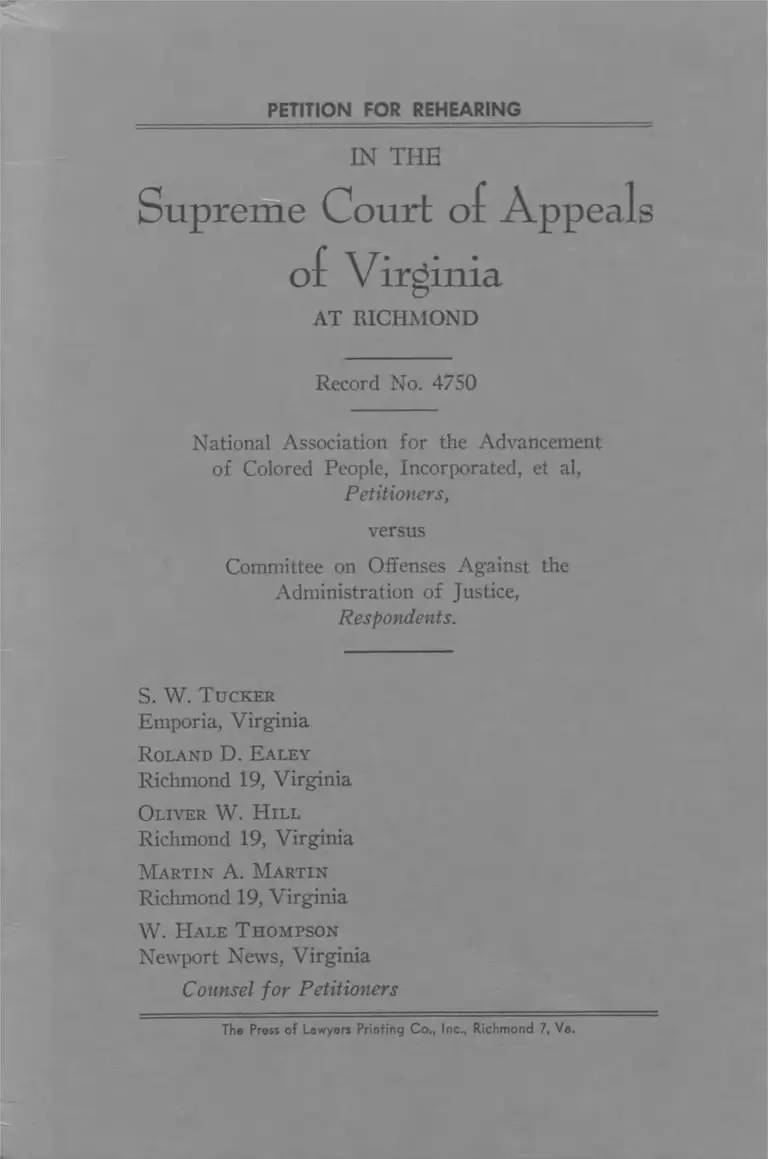
PETITION FOR REHEARING
IN THE
Suprem e C ourt of A ppeals
of V ir ginia
AT RICHMOND
Record No. 4750
National Association for the Advancement
of Colored People, Incorporated, et al,
Petitioners,
versus
Committee on Offenses Against the
Administration of Justice,
Respondents.
S. W. T ucker
Emporia, Virginia
Roland D. E aley
Richmond 19, Virginia
Oliver W. H ill
Richmond 19, Virginia
Martin A. Martin
Richmond 19, Virginia
W. H ale T hompson
Newport News, Virginia
Counsel for Petitioners
The Press of Lawyers Printing Co., Inc., Richmond 7, Va.
TABLE OF CONTENTS
Page
Petition For Rehearing................................................ 1
Argument ....................................................................... 4
Conclusion ........................................................ 1........... 15
TABLE OF CASES
American Communications Association v. Douds, 339
U.S. 382, 70 S. Ct. 674, 94 L ed 925 ........................ 8
Barrows v. Jackson, 346 U. S. 249 .............................. 12
Brewer v. Hoxie School District, 8 Cir. 238 F. 2d 91 .. 12
Herndon v. Lowry (1937) 301 U. S. 242, 81 L ed
1066, 57 S. Ct. 732 ................................................ — 9
National Association for the Advancement of Colored
People, et al, v. Kenneth C. Patty, Attorney-Gen
eral, et al (Civ. Nos. 2435 and 2436, E. D. Va.,
decided January 21, 1958)............... 2, 3, 5, 6, 7, 11, 14
Sweezy v. New Hampshire, 354 U. S. 234, 1 L ed 2d
1311........................................................................... 5,11
Thomas v. Collins (1945) 323 U. S. 516, 89 L ed 430,
65 S. Ct. 315............................................................... 14
United States v. Harris (1954) 347 U. S. 612, 98 L
ed 989, 74 S. Ct. 808 .................................................. 10
Watkins v. United States, 354 U. S. 178, 1 L ed 2d
1273 ....................... 11
West Virginia State Board of Education v. Barnette
(1942) 319 U. S. 624, 63 S. Ct. 1178, 147 ALR
674, 87 L ed 1628............................................. -....... 9
Page
OTHER REFERENCES
Rule 5:1, Section 4, Rules of Supreme Court of Ap
peals of V irginia........................................................ 6
Rule 28, Canons of Professional E th ics.................... 7
Chapter 35, Acts of General Assembly of Virginia,
Extra Session, 1956 .....................-.......................... 3
IN THE
Suprem e C ourt of A ppeals
of Virc dnia
AT RICHMOND
Record No. 4750
National Association for the Advancement
of Colored People, Incorporated, et al,
Petitioners,
versus
Committee on Offenses Against the
Administration of Justice,
Respondents.
PETITION FOR REHEARING
To the Honorable Justices of the Supreme Court of
Appeals of Virginia:
This petition for rehearing is filed by and on behalf
of the National Association for the Advancement of
Colored People, a corporation, the Virginia State Con
ference of NAACP Branches, and W. Lester Banks, as
Executive Secretary of said Conference, and also by
said W. Lester Banks in his own right as a member of
said Association residing in Virginia and on behalf of
other persons similarly situated. Said petitioners pray a
rehearing of the case styled National Association for the
Advancement of Colored People, et al, vs. Committee on
Offenses Against the Administration of Justice, Record
No. 4750, decided January 20, 1958, in which this Court
held that the Hustings Court of the City of Richmond
had properly caused the issuance of subpoenas duces
tecum to compel certain papers and records of the peti
tioning organization to be produced before the respond
ent committee.
In so deciding this case, the Court stated: “. . . the
real issue is whether the witness should be compelled to
disclose the names and addresses of the members of the
NAACP, and its voluntary workers and associates, in
Virginia.” But having properly defined the issue, the
Court then proceeded expressly to decide broad consti
tutional issues, which by the very nature of the record
had not been fully developed upon the original hearing;
and, by necessary inference, to decide the constitution
ality of other acts of the General Assembly, Extra Ses
sion, 1956, all of which is in conflict with a decision of
the United States District Court for the Eastern District
of Virginia, rendered on January 21, 1958. in National
Association for the Advancement of Colored People, et
al, vs. Kenneth C. Patty, Attorney-General, et al (Civil
Actions Nos. 2435 and 2436) (hereinafter referred to
3
as N AAC P vs. Attorney General), a case involving the
basic issues here determined.
The case of N AAC P vs. Attorney General involved
the constitutionality of the package of laws commonly
referred to as “Anti-NAACP” statutes, namely Chap
ters 31, 32, 33, 35 and 36, Acts of the General Assem
bly, Extra Session, 1956. In this case and a companion
case on behalf of the NAACP Legal Defense and Edu
cational Fund, the power of the State to compel the dis
closure of the names and addresses of its members, con
tributors, voluntary workers and associates through reg
istration laws (Chapters 31 and 32) was challenged.
This case also challenged the validity of Chapters 33,
35 and 36, Acts of the General Assembly, Extra Session,
1956, through which the State sought to make unlawful
the activity of the Association in sponsoring litigation
attacking racial segregation. The District Court held
Chapters 31, 32 and 35 unconstitutional and held the
case open pending an interpretation of Chapters 33 and
36 by the State courts.
In view of the eminence of the respective Courts ren
dering conflicting decisions, the grave public issues in
volved, and the fact that in the case of N AAC P vs.
Attorney General, supra, the Court had the benefit of a
full record which this Court did not, we ask a rehearing
of the instant case on the following ground:
This Court has passed on a question which was neither
presented by an assignment of error nor raised else
where in the record and, in so doing, has abridged rights
secured by the First Amendment and protected against
4
State action by the due process clause of the Fourteenth
Amendment to the Federal Constitution.
ARGUMENT
A
Upon a record which was not specially developed for
such purpose, the Court has decided Federal Constitu
tional questions which were not in issue here.
The Court broadened the scope of the questions pre
sented and then extended its negation of the asserted
constitutional rights to encompass a denial of rights pro
tected by the First Amendment. We quote from the
opinion:
“. . . (3) Does the disclosure of the information
sought by the subpoenas violate any constitutional
rights of the appellants? (Emphasis supplied.)
* * *
“. . . Nor do we agree with the suggestion in the
appellants’ brief that the required disclosure of the
names of their members and associates ‘would be
necessarily coercive’ and therefore a restraint on
their freedom of speech or right of assembly guar
anteed by the First Amendment. No limitation by
license or otherwise on the activities of the appel
lants is here involved. This is an inquiry into such
activities and the identity of those who are involved
therein, to ascertain whether they are engaged in
unlawful practices. Clearly, this is within the State’s
police power.”
5
The motion to quash the subpoena from the Hustings
Court of the City of Richmond does not, in terms, men
tion the Constitution of the United States. The Assign
ments of Error invoked the due process clause of the Four
teenth Amendment only to the extent that said clause and
its counterpart in Section 11 of the Constitution of Vir
ginia may have had a bearing upon the procedure fol
lowed in the Court below. The “due process” challenges
were to the entry of the lower court’s initial judgment
order upon an ex parte application (second assignment)
and to the action of the Court below in so far as it (en
tirely) relieved the Committee of the onus probandi
(third assignment). Except to state The Errors Assigned
in their original language, the appellants in their opening
brief avoided all mention of the Fourteenth Amendment
to the Federal Constitution. The citation of Swcezy vs.
New Hampshire, 354 U. S. 234, 1 L ed 2d 1311, as an
illustration of a failure to show that the information
sought was required by the legislative directive, could
not be taken as an invocation of federal law.
Only questions of state procedural and substantive law
were formally presented to the state courts. Prior to the
commencement of any proceeding in the state court,
questions of a substantive federal law, and particularly
questions involving rights secured by the First Amend
ment as incorporated into the Fourteenth, had been ten
dered to the United States District Court for the Eastern
District of Virginia in the cases of N A AC P vs. Attor
ney General, supra. A record appropriate for the disposi
tion of such questions was developed in that Court and
a decision of those issues, contrary to the decision of
this Court, was rendered on January 21, 1958. Even be
6
fore the motion to quash subpoenas was filed in the court
below, these issues of federal law had also been made the
subject of controversy between the parties here in the
case of National Association for the Advancemeiit of
Colored People, etc., et al, vs. Ames, et al, (Civil Action
No. 2480) still pending in said United States District
Court, a copy of the proceedings in which were filed here
by the appellee during the oral argument.
Petitioners could not anticipate that this issue, orig
inally addressed to the District Court and yet pending
before it, would be decided in the instant proceeding. Nor
could they anticipate a ruling on that issue in this Court.
Rule 5:1, Section 4, of the Rules of this Court is explicit
that only errors duly assigned will be noticed by this
Court. The effect of the decision is clear. The compelled
disclosure of the names and addresses of the Associa
tion’s members, voluntary workers and associates “con
stitutes a restriction upon the right of free speech which,
as we have seen, the Association is entitled to exercise.
*** (R)egistration of names of persons who resist the
popular will would lead not only to expressions of ill
will and hostility but to the loss of members by the plain
tiff’s Association.” N A AC P vs. Attorney General, supra.
The decision in the instant case necessarily deprives peti
tioners, and the many thousands of persons they repre
sent, of vital constitutional rights without opportunity
to be heard.
In this same connection this Court cited Chapter 35.
Acts of General Assembly, 1956, as the basis for the re
quirement that the Association disclose the names and
addresses of its members, voluntary workers and asso
7
ciates and buttressed it with a citation of Rule 28 of the
Canons of Professional Ethics. Obviously, this pre
supposes that Chapter 35 as applied to these petitioners
is constitutional without affording appellants an oppor
tunity to point out the infirmities of Chapter 35. The
error is all the more apparent when it is considered that
the first Court to which the constitutionality of Chapter
35 was fully and adequately presented declared it uncon
stitutional as applied to the activities of these petitioners.
The decision in N AAC P vs. Attorney General, supra, not
only expressly declared Chapter 35 unconstitutional, but
also clearly pointed out the inapplicability of Rule 28 in
the premises.
It is well established that an invalid statute cannot form
the basis for coercive state action. (N AAC P vs. Attorney
General, supra; Sweezy vs. New Hampshire, supra.)
B
Compulsory disclosure of names of members of peti
tioning organizations would, at the least, impinge upon
First Amendment rights. Such disclosure would be but
a species of “thought inspection.” Disclosure of the names
of members would involuntarily lay bare the individual
opinions of 23,000 citizens residing in the Common
wealth on its most controversial subject of the century.
Thoughts are inviolate. The peaceable association for a
lawful purpose is also inviolate.
In the case of N AAC P vs. Attorney General, supra.
the effort of the Commonwealth of Virginia to require
disclosure of the names of the contributors and members
8
of the petitioning organizations was clearly denounced
as an invasion of First Amendment rights.
The case is not removed from the protection of the
First Amendment by the Court’s observation that “ ( n)o
limitation by license or otherwise on the activities of the
appellants is here involved.” In American Communica
tions Association v. Douds, 339 U. S. 382, 70 S Ct. 674,
94 L ed 925, five justices, for the Court, upheld a Con
gressional requirement that leaders of labor unions which
seek to obtain advantages under labor relations legisla
tion must file affidavits disclaiming membership in Com
munist organizations; and an equally divided Court up
held the requirement of the statute that the union official
state that he does not believe in the Communist doctrine.
Justification for the restraint was rested upon general
information that labor leaders, acting under orders of
the Communist Party, called strikes merely to disrupt
the national economy and upon the legislative judgment
that interstate commerce must be protected from a con
tinuing threat of strikes. However, the Court (and. more
vigorously, the dissenting justice and the justices dis
senting in part and concurring in part) clearly recog
nized the required disclosure as an abridgement of free
dom of speech. To quote language of Chief Justice Vin
son, for the Court:
“. . . (T )he fact that no direct restraint or punish
ment is imposed upon speech or assembly does not
determine the free speech question. Under some cir
cumstances, indirect ‘discouragements’ Undoubtedly
have the same coercive effect upon the exercise of
First Amendment rights as imprisonment, fines, in-
9
junctions or taxes. A requirement that adherents of
particular religious faiths or political parties wear
identifying arm-bands, for example, is obviously of
this nature . . . (339 U. S. at 402)
C
Any subordination of First Amendment rights to the
police power must be clearly justified by the government
in terms of its own self preservation.
“The power of a state to abridge freedom of speech
and of assembly is the exception rather than the
rule . . . . ” Herndon v. Lowry (1937) 301 U. S. 242,
258, 81 L ed 1066, 1075, 575 S Ct. 732.
In the case of West Virginia State Board of Education
v. Barnette (1942) 319 U. S. 624, 639, 63 S Ct. 1178.
147 ALR 674, 87 L ed 1628, the Court said:
“. . . ( I ) t is important to distinguish between the
due process clause of the Fourteenth Amendment as
an instrument for transmitting the principles of the
First Amendment and those cases in which it is ap
plied for its own sake. The test of legislation which
collides with the Fourteenth Amendment, because
it also collides with the principles of the First, is
much more definite than the test when only the
Fourteenth is involved. Much of the vagueness of
the due process clause disappears when the specific
prohibitions of the First become its standard. The
right of a State to regulate, for example, a public
utility may well include, so far as the due process
10
test is concerned, power to impose all of the restric
tions which a legislature may have a ‘rational basis’
for adopting. But freedoms of speech and of press,
of assembly, and of worship may not be infringed
on such slender grounds. They are susceptible of
restriction only to prevent grave and immediate
danger to interests which the state may lawfully
protect. . . .”
In United States v. Harris (1954) 347 U. S. 612, 98
L ed 989, 74 S Ct. 808, the justices recognized that Con
gress had impinged upon the area of First Amendment
rights when, by passing the Federal Regulation of Lobby
ing Act, it required identification of those who employed
professional lobbyists. The constitutionality of the
abridgement was upheld; but only because, in the opin
ion of five of the justices, the purpose of the Congress
has been “to maintain the integrity of a basic govern
mental process.” Said the Court:
“Under these circumstances, we believe that Con
gress, at least within the bounds of the Act as we
have construed it, is not constitutionally forbidden
to require the disclosure of lobbying activities. To
do so would be to deny Congress in large measure
the power of self protection. And here Congress has
used that power in a manner restricted to its ap
propriate end.” 347 U. S. at 625.
No attempt at justification for the demand of the
names of members is reflected in the record here; neither
was any valid justification shown in the United States
District Court in the case of N AAC P vs. Attorney Gen-
11
oral, supra, in which this specific issue was made up and
extensively developed.
D
The right of legislative investigation cannot transcend
First Amendment rights. In Watkins v. United States,
354 U. S. 178, 1 L Ed 2d 1273, 1290, the Supreme Court
observed:
“We cannot simply assume, however, that every
congregational investigation is justified by a public
need that over balances any private rights affected.
To do so would be to abdicate the responsibility
placed by the Constitution upon the judiciary to in
sure that the Congress does not unjustifiably en
croach upon an individual’s right to privacy nor
abridge his liberty of speech, press, religion or as
sembly.”
In Sweezy v. Nezv Hampshire, supra, these admoni
tions appear:
“It is particularly important that the exercise of the
power of compulsory process be carefully circum
scribed when the investigative process tends to im
pinge upon such highly sensitive areas as freedom
of speech or press, freedom of political association,
and freedom of communication of ideas . . . ” (1 L
ed 2d at 1322)
* * *
“Merely to summon a witness and compel him
12
against his will, to disclose the nature of his past
expressions and associations is a measure of gov
ernmental interference in these matters. These are
rights which are safeguarded by Bill of Rights and
the Fourteenth Amendment.” (1 L ed 2d at 1324)
E
Rights of the petitioners under the First Amendment
take the color and substance of the rights of their indi
vidual constituents or members.
“. . . (W)e may fairly consider not only the rights
of the plaintiff corporations but also the rights of
the individuals for whom they speak, particularly
the rights of the members of the Association . . . .
The rights that the plaintiffs assert take their color
and substance from the rights of their constituents;
and it is now held that where there is need to protect
fundamental constitutional rights the rule of prac
tice is relaxed, which confines a party to the asser
tion of his own rights as distinguished from the
rights of others. See Barrows vs. Jackson, 346 U. S.
249, 257. This rule was applied in Brezver vs. Hoxie
School District, 8 Cir., 239 F. 2d 91, 104, where the
school board in an Arkansas county brought suit to
restrain certain organizations from obstructing the
board in its efforts to secure the equal protection of
the laws to all persons in the operation of the public
schools in the district. The court said:
“ ‘The school board having the duty to afford the
children the equal protection of the law has the cor
relative right, as has been pointed out, to protection
13
in performance of its function. Its right is thus in
timately identified with the right of the children
themselves. The right does not arise solely from the
interest of the parties concerned, but from the neces
sity of the government itself. *** Though, generally
speaking, the right to equal protection is a i>ersonal
right of individuals, this is ‘only a rule of practice’,
*** which will not be followed where the identity of
interest between the party asserting the right and
the party in whose favor the right directly exists is
sufficiently close’ ” N A A C P vs. Attorney General,
supra. See also so much of that opinion in which
the Court discusses “Civil Rights of Corporations” as
a phase of the Court’s disposition of “Defendant’s
Motion to Dismiss.”
F
The State’s procedural concept of due process is in
adequate here. One of the 'arguments of the appellants
was that due process required the Court to hear both
sides before rendering judgment and another argument
was that the burden of proof should have been imposed
upon the appellee to show the materiality of the informa
tion sought to any legitimate purpose of the committee.
As far as the procedural law of this Commonwealth goes,
these questions were resolved against the appellants. But:
if the opinion of this Court is to be read as holding that
such procedure squares with the due process clause of
the Fourteenth Amendment even as it protects First
Amendment rights, then such opinion clashes with this
Federal requirement:
“ (A)ny attempt to restrict those liberties must be
14
justified by clear public interest, threatened not
doubtfully or remotely but by clear and present dan
ger. The rational connection between the remedy
provided and the evil to be curbed, which in other
contexts might support legislation against attack on
due process grounds, will not suffice. These rights
rest on firmer foundation. Accordingly, whatever
occasion would restrain orderly discussion and per
suasion, at appropriate time and place, must have
clear support in public danger, actual or impend
ing. Only the gravest abuses, endangering para
mount interests, give occasion for permissible limi
tation. It is therefore in our tradition to allow the
widest room for discussion, the narrowest range for
its restriction, particularly when this right is exer
cised in conjunction with peaceable assembly. It was
not by accident or coincidence that the rights to free
dom of speech and press were coupled in a single
guaranty with the rights of the people peaceably to
assembly and to petition for redress of grievances.
All these, though not identical, are inseparable.
* * *
“. . . There is some modicum of freedom of thought,
speech and assembly which all citizens of the re
public may exercise throughout its length and
breadth, which no State, nor all together, nor the
Nation itself, can prohibit, restrain or impede.”
Thomas v. Collins (1945) 323 U. S. 516, 530, 543,
89 L ed 430, 65 S Ct. 315.
In dealing with the precise questions involved in this
case, the Court, in N A AC P vs. Attorney General, supra,
stated:
15
“No doubt, the State of Virginia has the right
reasonably to regulate the practice of law. but,
where that regulation prohibits otherwise lawful
activities without showing any rational connection
between the prohibition and some permissible end of
legislative accomplishment, the regulation fails to
satisfy the requirements of due process of law. Here,
under the guise of regulating unauthorized law prac
tice, the General Assembly has forbidden plaintiffs
to continue their legal operations.”
CONCLUSION
For the reasons hereinabove stated, petitioners pray
that they be granted a rehearing in this case and that
upon a rehearing the decision of this Court upon the
constitutional questions be reversed and that the affirm
ance by his Court of the judgment rendered in the court
below be reversed, or at least be so restricted as to protect
petitioners’ constitutional rights.
Respectfully submitted,
NATIONAL ASSOCIATION FOR TH E
ADVANCEMENT OF COLORED PEO
PLE, INCORPORATED; V I R G I N I A
STATE CONFERENCE OF NAACP
BRANCHES; W. LESTER BANKS, Ex
ecutive Secretary of said Conference; and
W. LESTER BANKS in his own right as
a member of said Association residing in
Virginia and on behalf of other persons sim
ilarly situated.
By S. W. T ucker
O f Counsel
16
S. W. T ucker
Emporia, Virginia
Roland D. E aley
.420 North First Street
Richmond 19, Virginia
Oliver W. H ill
118 East Leigh Street
Richmond 19, Virginia
Martin A. Martin
118 East Leigh Street
Richmond 19, Virginia
W. H ale T hompson
611 - 25th Street
Newport News, Virginia
Counsel for Petitioners
CERTIFICATE
I certify that three copies of this petition will be de
livered or mailed to opposing counsel.
Oliver W. H ill
O f Counsel for Petitioners