Medical/Ballistics Effects: Questions Prepared for Hearing on Hollow-Point Bullets
Working File
May 5, 1975
4 pages
-
Case Files, Garner Working Files. Medical/Ballistics Effects: Questions Prepared for Hearing on Hollow-Point Bullets, 1975. f262f475-33a8-f011-bbd3-000d3a53d084. LDF Archives, Thurgood Marshall Institute. https://ldfrecollection.org/archives/archives-search/archives-item/ccef1014-bae9-4728-93b0-ee0b872931f4/medicalballistics-effects-questions-prepared-for-hearing-on-hollow-point-bullets. Accessed November 11, 2026.
Copied!
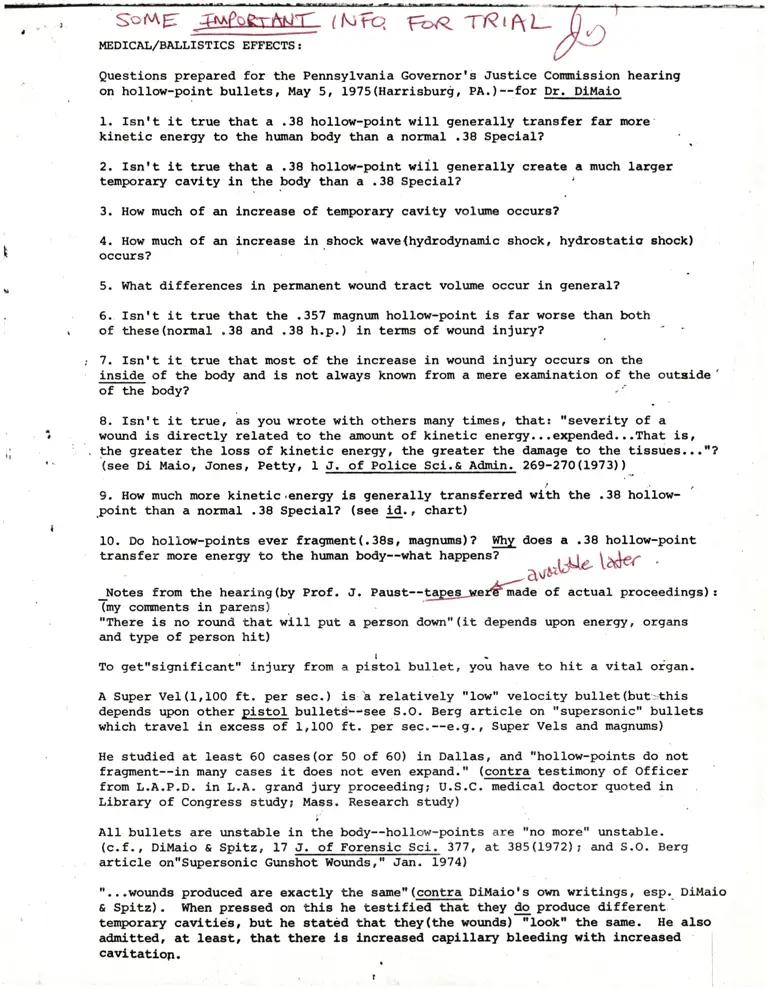
    MEDICAL/BALLISTICS EFFECTS:

Questions prepared for the Pennsylvania Governor's Justice Commission hearing
on hollow-point bullets, May 5, 1975(Harrisburg, PA.)— for Dr. DiMaio

1. Isn't it true that a .38 hollow-point will generally treuisfer far more
kinetic energy to the humeui body them a normal .38 Special?

2. Isn't it true that a .38 hollow-point will generally create a much larger
temporary cavity in the body them a .38 Special? '
3. How much of an increase of temporary cavity volume occurs?
4. How much of an increase in shock wave(hydrodynamic shock, hydrostatic shock)
occurs? '
5. What differences in permanent woxmd tract volume occur in general?
6. Isn't it true that the .357 magnum hollow-point is far worse than both
of these(normal .38 emd .38 h.p.) in terms of wound injury?
7. Isn't it true that most of the increase in wound injury occurs on the
inside of the body and is not always known from a mere examination of the outside '
of the body?
8. Isn't it true, as you wrote with others many times, that; "severity of a
wound is directly related to the amount of kinetic energy...expended...That is,
the greater the loss of kinetic energy, the greater the deimage to the tissues..."?
(see Di Maio, Jones, Petty, 1 J. of Police Sci.s Admin. 269-270(1973))

^ f9. How much more kinetic'energy is generally transferred with the .38 hollow-
point than a normal .38 Special? (see id., chart)
10. Do hollow-points ever fragment(.38s, magnums)? Why does a .38 hollow-point
transfer more energy to the human body— what happens?

_Notes from the hearing (by Prof. J. Paust— tapes _wei'̂ '̂made of actual proceedings):
(my comments in parens)
"There is no round that will put a person down"(it depends upon energy, organs
cmd type of person hit)

tTo gefsignificant" injury from a pistol bullet, you have to hit a vital orgcui.
A Super Veld,100 ft. per sec.) is a relatively "low" velocity bullet(but;this
depends upon other pistol bullets— ‘see S.O. Berg article on "supersonic" bullets
which travel in excess of 1,100 ft. per sec.— e.g.. Super Vels and magnums)
He studied at least 60 cases(or 50 of 60) in Dallas, and "hoilow-points do not
fragment— in many cases it does not even expand." (contra testimony of Officer
from L.A.P.D. in L.A. grand jury proceeding; U.S.C. medical doctor quoted in
Library of Congress study; Mass. Research study)

»
All bullets are unstable in the body— hollow-points are "no more" unstable.
(c.f., DiMaio & Spitz, 17 J. of Forensic Sci. 377, at 385(1972); and S.O. Berg
article on"Supersonic Gunshot Wounds," Jan. 1974)
"...wounds produced are exactly the same"(contra DiMaio's own writings, esp. DiMaio
& Spitz). When pressed on this he testified that they ^  produce different
temporary cavities, but he stated that they(the wounds) "look" the same. He also
admitted, at least, that there is increased capillauny bleeding with increased
cavitation.


- 2-

(statements of Dr. DiMaio, contd.)

He also admitted again: Yes, there is a directly proportionate increase in
wound injury with increase in kinetic energy transfer.

Yes, a .38 hollow-point transfers eibout three times
more energy to the human body as a normal .38.

Yes, the wounding effect is three times as great for'
the .38 hollow-point, (he said this again later) ^  ̂  o
To a question: how much of an increase in temporary cavity effect generally
occurs? (Answer): maybe 2, 3, maybe 4 times; it depends— you'll see in the film
(referring to his film of actual cavitational effects in gelatin blocks, which
was shown later). But the injuries "look" the same.
To a question; but do they measure the same? (Answer):"Its a problem,
exactly measure— with certain organs its impossible."

You can't

To a question re; magnums (Answer): The most you can get from magnums is about
400 foot pounds(of energy transfer— contra Remington Arms Co. chart arid letter
to J. Paust that a magnum could transfer all of its available energy to the
human body, ie, 845 foot pounds for a Remington .357 magnum h.p., 158 gr.)

To a question re; difference between a .38 h.p. and a normal .38 (Answer); can
say the wound effect will be greater; but you can't say that it will'more likely
stop a person("to go down"— that an individual hit with a .38 h.p. will more
likely "go down." Thus, there is no real need for a hollow-pointi)
,— A .45 will not knock you down— its like walking into a wall(later he showed
a slide to the effect that its like a 150 lb. man walking into a wall=156 foot
pounds of energy treinsfer— of course, energy transfer to the outside of the body,
i.e., not penetrating, etc. Note also that the .38 h.p. hits with about 331
.(from 250 to 406) foot pounds) f
To a question about mushrooming effect of .38 hollow-points (Answer): the
158 grain tends not to mushroom, it is rare— the 110 grain may or may not,
(see also DiMaio & Spitz at 385; DiMaio(in The Forensic Science Gazette, vol. 5,
no. 4, Sept. 1974, at 1), stating: "It is not, however, only the mushrooming
action of the hollow-point bullet that causes the greater loss of kinetic
energy..."; S.O. Berg article; others)
He said that in Dallas, 90% of all bullets studied stayed in the body(which meems
that they lost all of their kinetic energy in the body). He doesn't have statistics
(here) as to whether or not the persons shot were shot more than once(re; question
whether or not officers tend to shoot more than once if they shoot— so no. need
for h.p.s). N
To a question: Is the hollow-point less accurate? (Answer); some people are more
"sensitive to recoil, some more sensitive to flash."(see also DiMaio, et al. in
the F.B.I. Bulletin, Dec. 1974 at 8; and DiMaio, Jones s Petty, at 271, "The
amoiant of recoil cind flash from hollow-point ammunition varied markedly between
brands." See also testimony of N.Y.P.D. officer, Lt. McGee, and ACLU/CCLU pamphlet).

To a question about tumble within the air (Answer): aerodynamic effect is external
ballistics— that's not my field.
Said wounding effect is due to kinetic energy loss(in the body)— doesn't matter
whether the bullet expeinds or not (except that an expanding bullet cein transfer
more energy to the body— which is the whole issue: effects within the body and
bullet types which tend, in most cases, to produce such effects)(in particular
cases there may not be much of a difference— the point is that in most cases there is)

II i .11/ i


Questions prepared for Dr. DeMuth for the Penn. Governpr's Justice Commission
hearing(same);
1. Isn't it true that a .38 hollow-point will generally transfer far more
kinetic energy to the humain body than a normal .38 Special?

2. How much of an increase generally occurs?
3. In 1966 you wrote that "the temporary cavity found during passage of the
projectile...is primarily a result of the kinetic energy expended...It is the
explosive cavitational effect which may give rise to the fratured bone despite
the fact that the bone was not struck by the projectile."(W. De Muth, 6 ^.of Trauma
222, at 224(1966)) Dr. DeMuth, isn't it true then that a .38 hollow-point or
magnum hollow-point, because they transfer far more kinetic energy, will
generally produce more severe, larger temporary cavitational effects?
4. In that article(at 229) you also wrote: "Assuming equal penetration... the
expanding bullet assumes a potentially much greater wounding probability." Isb‘'»t
it true that woxznd injury is increased with the level of kinetic energy transfer?
5. In that article(at 231) you also wrote: "...the average hospital pathologist
and surgeon are usually not well informed concerning the details of bullet
behavior and the wounds produced." Isn't it true that surgeons treating a
wound would not stop to measure actual differences in bullet effects, but would
seek to treat the woimd? Even then, are there differences between wounds produced
by an expanding bullet like a magnum hollow-point and a normal .38 Special that
a surgeon should address?
— Notes from the hearings(Dr. Demuth's testimony was short and there were very
few questions— also, he tended to disagree with Dr. DiMaio on several issues, e.g.,
he said that velocity was a primary factor, that bullet design was insignificant—
whereas Dr. DiMaio's published charts show exactly the differences which can
result from different configurations)
— my articles addressed bullets with velocities in excess of 2,000 feet per second
(note, however, that magnums can travel at 1650 and more feet per second)
— you will not see different effects from configuration differences because
velocity is most important(contra, Dr. DiMaio's charts)
— re: Dr. DiMaio's slides of heart wounds: we don't have all the information(e.g.,
specific gravity of tissue, etc.) '
— bullet design has no effect on recoil(contra Dr. DiMaio, and others)
— "all this is insignificcint; there are no real differences"(in effects)(contra
Dr. DiMaio's charts and testimony, e.g., that wound injury is directly proportionate
to increased kinetic energy transfer and that the .38 h.p. will transfer at least
3 times more kinetic energy to the human body as a normal .38)

- 3 -

— Notes on testimony of Lt. McGee, of the N.Y.P.D., at the Pennsylvania hearing:

— N.Y.P.D. doesn't use hollow-points under their regulations. If we opted for
ho-low-points we could. All officers must carry issued bullets and weapons;
they must carry the .38 Special— on or off duty.
— We rejected hollow-points because of increased velocity, recoil eind muzzle flash
which all interfere with "skill and marksmanship."(see also Lt. McGee's statement
quoted in the ACLU/CCLU pamphlet— in other words, the .38 hollow-points are-
more inaccurate)
— hollow-points fired in target practice were less accurate(because of above).
— we use wad cutters because they are less penetrating— we don't use it for
stopping power(they opted for it because of accuracy problems & penetration)


- 4 -

(testimony, notes, of Lt. McGee, contd.)
— he said: the mission of the military is far different than the mission of the
police. If all this energy was focused on police training the public would
be better served.
To the question: Do you think your bullet complies with international conventions?
(Answer): No. I don't think any police bullet complies with international
conventions. They require a full metal jacket(I disagree— they prohibit excessive
death, injury or suffering; cruelty; and inhumane death, injury or suffering but
they do not, in all cases, require a metal jacket— a hard lead bullet can be
just as humane without excess flattening or expansion within the human body. Also,
international law addresses the effects of bullets as well as certain bullet types
the effects are most important, e.g. cruelty, inhumane effects, excessive effects).
(Although we don!t have a lot of evidence about the wad cutters, it seems that
they transfer no more than 78 to 121 foot pounds— the same as many normal .38s
and the military .45— 108 foot pounds— all by Dr. DiMaio's charts. Thus, they
seem to be permissible; whereas the .38 hollow-point clearly transfers from
three to four or more times the energy as a normal .38)

U.seful statistics given:
In 1974: 949 rounds were fired by the N.Y.P.D. and others. Of those, some 2.6 rounds

were fired per incident(thus, showing that more than one shot is fired
when shots are fired, on the average, and that, therefore, there is no
need for a bullet which kills with one shot). There was a "hit potential"

of only 25%(thus, only 25% of the bullets fired hit the target— 75% went elsewhere,
presumcdsly adding to the, dcingers to innocent bystanders, fellow officers, hostages,
etc.).

4 officers were killed(30 in the last 5 years)
80 felons were wounded
32 officers were shot, some others injured by other weapons
"there were no accidental injuries to civilians by bullets passing through

the target(this is significant, because the claim by some has been that
hollow-points pose less of a danger to others because they don't pass
through— in New York the argument is pure myth).

— there were 4 injuries to civilians by"misdirected fire" or misses(this
is also significcuit, because it shows that actual danger exists with
bullets which tend to be less accurate and increase miss potential, that
actual danger to innocent bystanders and hostages exists from misses
and not bullets passing through, etc.)

TO the question: Did officers who were injured or killed draw their weapons?
(Answer): Unfortunately, officers are killed in New York the "same as across
the country."(see, then, former Chief Wilson's statement about 75% never drawing
their weapon from the Wash. Post article). Generally, "they are fired upon first
before they return fire."(and that's why, of course, we feel that a bullet-proof
vest is more conducive to saving the police officer's life than increased’
firepower— which has never been shown to be necessary to lawfully enforce the
law or to save the life of an officer)
To the question: Of the 4 or the 30(killed) did they draw their weapons? "We've
had those"(where they didn't draw their weapons). He later said that of the four
in 1974 he recalls that one drew and fired, one drew(but didn't fire), one did
not draw(and apparently the other didn't draw— thus, 3/4 either drew and didn't
fire or didn't draw their weapons)
--To the question about injury,to civilians from bullets: Therefore, passing through
danger isn't the problem— its more from misdirettion? (Answer); Yes.