Defendants' Rebuttal to Plaintiffs' Opposition to Defendants' Motion to Alter or Amend Judgment
Public Court Documents
1978
4 pages
-
Case Files, Norwood v. Harrison - Hardbacks. Defendants' Rebuttal to Plaintiffs' Opposition to Defendants' Motion to Alter or Amend Judgment, 1978. dfd9d4cc-722e-f111-88b4-0022482cdbbc. LDF Archives, Thurgood Marshall Institute. https://ldfrecollection.org/archives/archives-search/archives-item/ce2b1a86-26d4-43d0-82f5-5ac71ba9d215/defendants-rebuttal-to-plaintiffs-opposition-to-defendants-motion-to-alter-or-amend-judgment. Accessed October 16, 2026.
Copied!
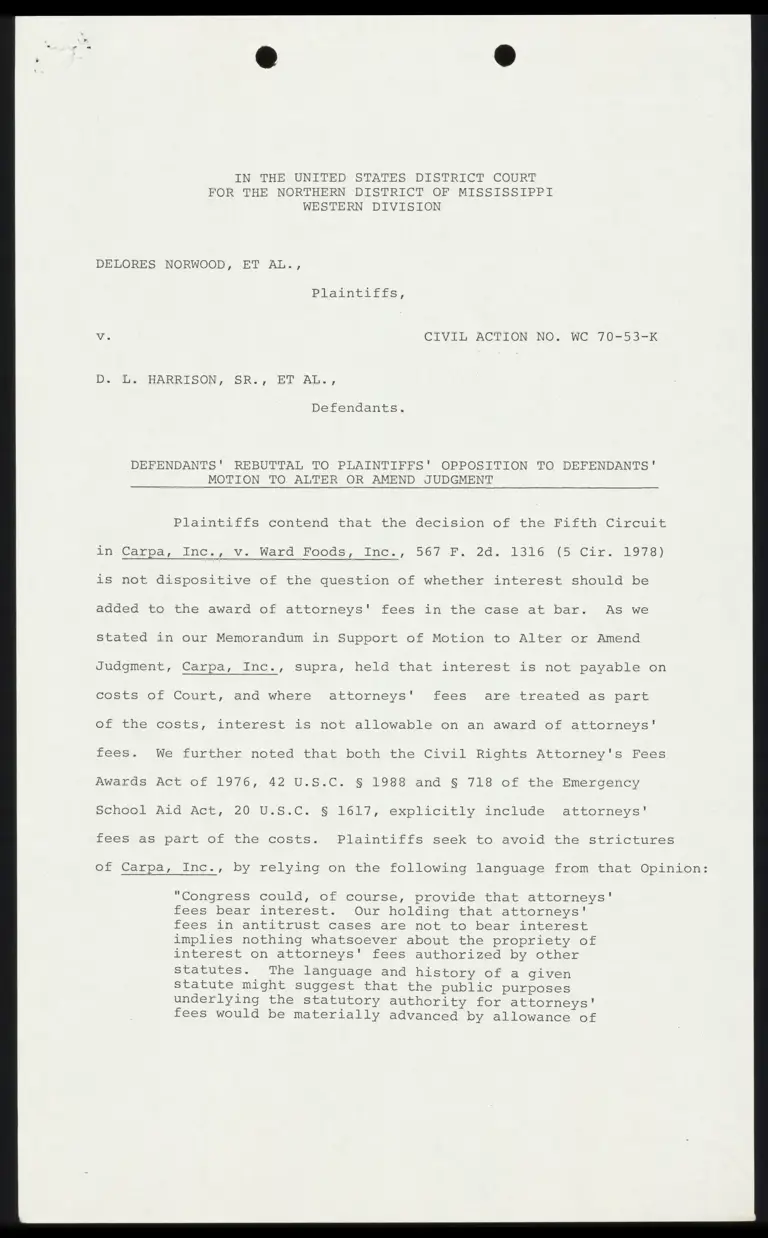
     [||5bcae6a7-f457-4460-af46-4c8fe2ab9d79||] IN THE UNITED STATES DISTRICT COURT

FOR THE NORTHERN DISTRICT OF MISSISSIPPI

WESTERN DIVISION

DELORES NORWOOD, ET AL.,

Plaintiffs,

Vv. CIVIL ACTION NO. WC 70-53-K

PD. L. HARRISON, SR., ET AlL.,

Defendants.

DEFENDANTS' REBUTTAL TO PLAINTIFFS' OPPOSITION TO DEFENDANTS

MOTION TO ALTER OR AMEND JUDGMENT


Plaintiffs contend that the decision of the Fifth Circuit

in Cayrpa, Inc., 'v. Ward Poods, Inc., 567 F. 24. 1316: (5 Cir. 1973)


is not dispositive of the question of whether interest should be

added to the award of attorneys' fees in the case at bar. As we

stated in our Memorandum in Support of Motion to Alter or Amend

Judgment, Carpa, Inc., supra, held that interest is not payable on


costs of Court, and where attorneys' fees are treated as part

of the costs, interest is not allowable on an award of attorneys’

fees. We further noted that both the Civil Rights Attorney's Fees

Awards Act of 1976, 42°0U0.8.C. § 1988 and § 718 of the Emergency

School Ald Act, 20 U.S.C. § 1617, explicitly include attorneys’

fees as part of the costs. Plaintiffs seek to avoid the strictures

of Carpa, Inc., by relying on the following language from that Opinion:

"Congress could, of course, provide that attorneys’
fees bear interest. Our holding that attorneys
fees in antitrust cases are not to bear interest
implies nothing whatsoever about the propriety of
interest on attorneys' fees authorized by other

statutes. The language and history of a given
statute might suggest that the public purposes
underlying the statutory authority for attorneys’
fees would be materially advanced by allowance of


interest, and the absence of a treble damage
provision which complements the attorneys’
fee provision would also require consideration.”

567. F. 24. at 1323.

We have no problem with the above quoted language, and

think that it is perfectly consistent with the position that the

holding in Carpa, Inc. 1s negatively dispositive of the question of

whether interest may be added to an award of attorneys' fees.

Plaintiffs do not contend, nor could they, that there is

any language contained in either Act of Congress authorizing the

award of attorneys' fees in the case sub judice which has any pro-

vision for the adding of interest to the award of attordeys! fees.

Being unable to find any statutory language in either Act of Congress,

Plaintiffs pluck one paragraph from one of 25 cases /1 «cited in

the Report of the Senate Judiciary Committee, and attempts to use

that as a sound basis for a finding that it was the intent of the

Congress which enacted the ‘Civil Rights Attorney's Fees Awards Act

of 1976 to provide for the adding of interest to an award of attor-

neys' fees. This is far too slender a reed upon which to rest the

weighty presumption that Congress, in enacting the Fees Awards Act,

intended to alter the well-settled rule that interest should not be

added to costs of Court.

It is clear from reading the complete pertinent language

of the Report of the Senate Judiciary Committee which referred to

Davis v. County of los Angeles, supra, that Davis was cited strictly


as an example of the appropriate standards to be used in fixing the

amount Of attorneys' fees, and not to support the proposition that

interest should be added to an award of attorneys' fees. The complete

language is as follows:

"It is intended that the amount of fees awarded under
S. 2278 be governed by the same standards which prevail
in other types of equally complex Federal litigation,


/1" Davis v. County of Los Angeles, 3 EPD Y 9444 (C.D. Cal. 1974).


such as antitrust cases and not be reduced because
the rights involved may be nonpecuniary in nature.
The appropriate standards, see Johnson v. Georgila
Highway Express, 488 F. 24. 714 (5th Cir. 1974), are
correctly applied in such cases as Stanford Daily v.
Zurcher, 64 P.R.D. 680 (N.D. Cal. 1974); Davis v.
County of Los Angeles, 8 B.P.D. 9% 9444 (C.D. Cal. 1974);
and Swann v. Charlotte—-Mecklenburg Board of Education,
66 F.R.D. 483 (W.D.N.C. 1975},


This is highlighted by the fact that neither Stanford Daily

V. Zurcher, supra, nor Swann v. Charlotte-Mecklenburg Board of


Education, Ssupra,not mentioned by the Plaintiffs, have nothing to do


with the adding of interest to an award of attorneys' fees, but deals

strictly with the standards for fixing the amount for the award of

fees, which is the sole and only purpose for which the Senate Judi-

ciary Committee referred to all of the cited cases, including Davis

v. County of Los Angeles, supra.

As to the contentions of Plaintiffs that the doctrines of

res judicata and law of the case bar consideration of the question

of interest on the attorneys' fees award, the decision of the Fifth

Circuit in Carpa, Inc., supra, in which the Court of Appeals definitively

gtated the law of this Circuit that interest should not be added

to ALEOTREYE! fees where fees are considered part of the costs, was

a supervening legal development which constitutes an exception to

such doctrines. Plaintiffs attempt to make something of the point

that Defendants did not appeal the Order of this Court of March 13,

1978 which denied Defendants' previous Motion to Amend the Judgment

as to Interest on the Award of Fees. This Court entered its final

judgment as to the award of attorneys fees on January 3, 1978, and

after Plaintiffs had filed a Motion to Amend Judgment and Defendants

had filed a Motion to Vacate that judgment, this Court entered an

Order denying Plaintiffs Motion to Amend the Judgment on January 13,

1978, and entered an Order to deny the Motion of Defendants to Vacate

the Judgment oh January 23, 1978. On February 14, 1978, the Defen-

dants filed a Notice of Appeal from the Final Judgment of January 3,

1978, and on February 21, 1978, Plaintiffs filed a Notice of Appeal

from said Final Judgment. In light of these facts and circumstances,

it is highly doubtful that the Order of this Court of March 13, 1978


denying our Motion to strike the interest provision from the Stay

Order granted Defendants by the Court was an appealable Order.

Stone v,. Wyoming Supreme Court, 236 FP. 24. 275, 276-277, (10 Cir.


1976) held that:

"A direct appeal will not lie from a post-
judgment order denying a motion to re-con-
sider earlier action taken on a post-judg-
ment motion."

See, also, Vaughn v. City Bank and Trust Company, 218 PF. 24.


802 {5 Cir. 1955).

For the above reasons and the reasons stated in our previous

memorandum, Defendants contend that our Motion to Alter or Amend Judg-

ment should be granted.

Respectfully submitted,

A. F. SUMMER, ATTORNEY GENERAL

STATE OF MISSISSIPPI

PETER M. STOCKETT, JR.

ASSISTANT ATTORNEY GENERAL

STATE OF MISSISSIPPI

{

Fa Ct we Th
BY pS oo cs Da {1y yo HC } SH \ :


PETER M. STOCKETT, JR. [||5bcae6a7-f457-4460-af46-4c8fe2ab9d79||]