Motion for Reconsideration of Trial Date; Memorandum in Support; Correspondence from Dodds to Harding
Public Court Documents
September 30, 1977
40 pages
-
Case Files, Hatcher v. Methodist Hospital - Hardbacks. Motion for Reconsideration of Trial Date; Memorandum in Support; Correspondence from Dodds to Harding, 1977. 69135eb3-5484-f111-ab0f-7ced8d2181dd. LDF Archives, Thurgood Marshall Institute. https://ldfrecollection.org/archives/archives-search/archives-item/cec88523-979e-47c6-8002-4a323a4aae08/motion-for-reconsideration-of-trial-date-memorandum-in-support-correspondence-from-dodds-to-harding. Accessed October 10, 2026.
Copied!
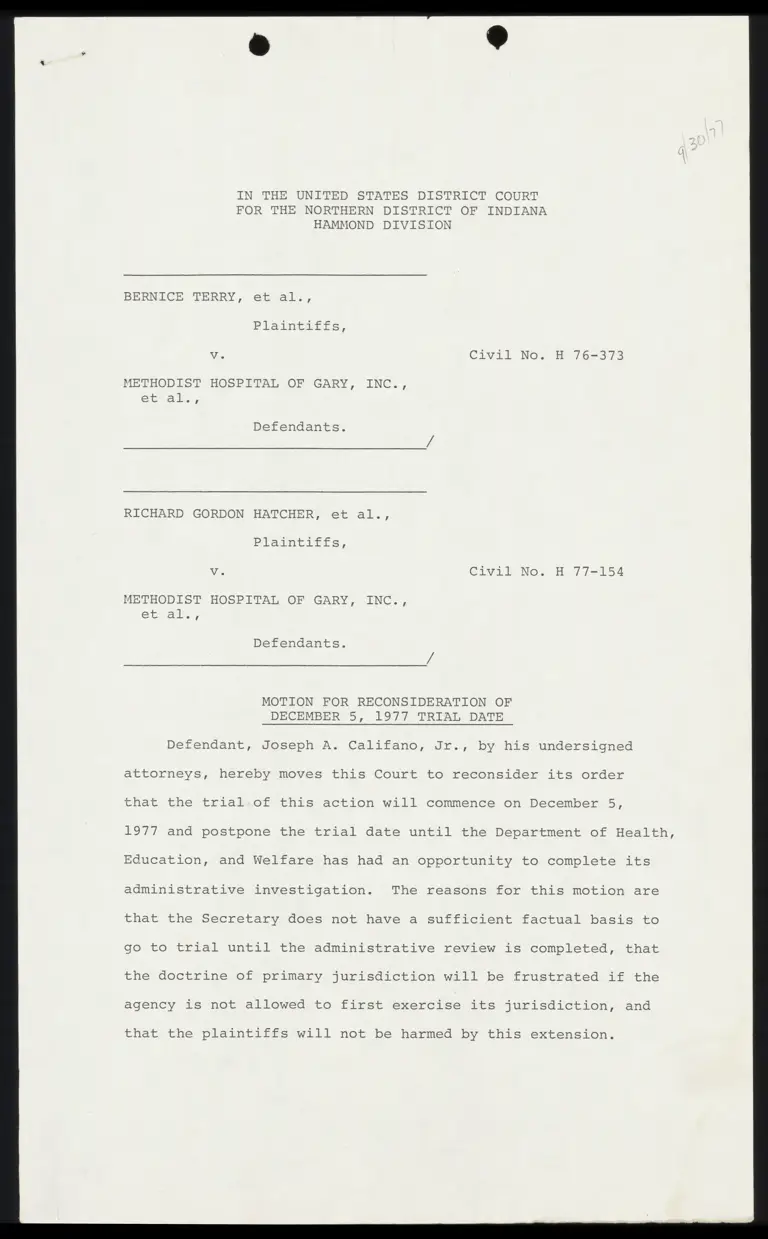
     [||a4066979-28ed-4f71-9b55-4c22c6ffd3e3||] IN THE UNITED STATES DISTRICT COURT

FOR THE NORTHERN DISTRICT OF INDIANA

HAMMOND DIVISION


BERNICE TERRY, et al.,

Plaintiffs,

Vv. Civil No. H 76-373

METHODIST HOSPITAL OF GARY, INC.,

et al.,

Defendants.


/

RICHARD GORDON HATCHER, et al.,

Plaintiffs,

Ve. Civil No, H 77-154

METHODIST HOSPITAL OF CARY, INC.,

et al.,

Defendants. y


MOTION FOR RECONSIDERATION OF

DECEMBER 5, 1977 TRIAL DATE


Defendant, Joseph A. Califano, Jr., by his undersigned

attorneys, hereby moves this Court to reconsider its order

that the trial.of this action will commence on December 5,

1977 and postpone the trial date until the Department of Health,

Education, and Welfare has had an opportunity to complete its

administrative investigation. The reasons for this motion are

that the Secretary does not have a sufficient factual basis to

go to trial until the administrative review is completed, that

the doctrine of primary jurisdiction will be Frustrated if the

agency is not allowed to first exercise its jurisdiction, and

that the plaintiffs will not be harmed by this extension.


In support of this motion, the Court is respectfully

referred to the Memorandum of Points and Authorities filed

herewith.

Respectfully submitted,

i AS 22 | =

{Cn Den ae A {en abc oul UZ]
BARBARA ALLEN BABCOCK :

Assistant Attorney General


RICHARD L. KEISER

United States Attorney

OF COUNSEL:

JEFFREY CHAMPAGNE Dean d {1 EL pry ny INE wr hE A ~ an Xan Soy | Cry)

U.S. Department of DAVID J. ANDERSON ;
Health, Education

and Welfare


3


MARVIN G. GAVIN abn 43 Som. of,0,
Regional Attorney BARBARA B. O'MALLEY : ]

EDWARD L. KOVEN
Assistant Regional Ty 0 i ge

Attorney Kolber J ADDO
Department of Health, REBECCA L. ROSS

Education and Welfare
300 South Wacker Drive Attorneys for Defendants

15th Floor Attorneys, Department of Justice
Chicago, Illinois Washington, D. C. 120530

Telephone: 739-2230


IN THE UNITED STATES DISTRICT COURT

FOR THE NORTHERN DISTRICT OF INDIANA

HAMMOND DIVISION


BERNICE TERRY, et al.,


Plaintiffs,

Vv. Civil No. HH 76-373

METHODIST HOSPITAL OF GARY, INC.,

et al.,

Defendants.

i

RICHARD GORDON HATCHER, et al.,

Plaintiffs, By

Vv. Civil No. H 77-154

METHODIST HOSPITAL OF GARY, INC.,

et al.,

Defendants.

/


MEMORANDUM OF POINTS AND

AUTHORITIES IN SUPPORT OF

MOTION FOR RECONSIDERATION OF

DECEMBER 5, 1977 TRIAL DATE


STATEMENT


Plaintiffs have alleged in this action that Methodist

Hospital of Gary is violating Title VI of the Civil Rights

Act of 1964, 42 U.S.C. $20004 et seq. and §504 of the Rehabi-

litation Act of 1973, 29 U.8.C. §706, by providing allegedly

inferior care to the minority residents of Gary while providing

better care to non-minority residents in the suburbs. Plain-

tiffs also allege that the Secretary has failed to fulfill his

responsibilities under Title VI and §504 nationwide and in

Gary by failing to prevent or correct situations such as that

alleged in Gary.


The facts behind this litigation are somewhat complex.

In 1972, Gary Methodist applied for a Hill~-Burton grant pur-

suant ‘to 42 U.8.C.A. §§291~291= Tor $333,300 for fiscal year

1972 and for $819,227 for fiscal year 1973 in connection with

the proposed construction of a new facility in Merrillville,

Indiana, located about 14 miles south of downtown Gary. In

addition, Methodist applied for a Hill-Burton loan guarantee

of 816,336,193 pursuant to 42 U.85.C.A. §84601-4655. Under

the loan guarantee program, the federal government pays a 3%

interest subsidy and the borrower must pay the remaining per-

centage of the loan.

Because regional HEW officials were concerned that the

construction of a new facility in Merrillville might result

in a loss of services to the inner-city minority residents of

Gary and consequently violate Title VI of the Civil Rights Act,

they conducted a Title VI review of the project. Pursuant to

this investigation, the regional office required Gary Methodist

to sign extensive assurances specifically guaranteeing that

Gary Methodist would continue to operate as a viable acute

care hospital in Gary and that financial resources generated

by Broadway Methodist would be used to assist Gary Methodist

when necessary. These assurances were executed in July, 1973.

When Methodist determined in July, 1974 that it wished

to construct a health services building in Gary, a health ser-

vices building in Merrillville, and a new laundry in Merrill-

ville, it sent a copy of its proposals to the regional Office

for Civil Rights for approval. Por two years, from July, 1974

until April, 1976, Methodist put together applications for

Federal financial assistance for the two health services

buildings and laundry and processed its applications through


the appropriate local and state health agency reviewing autho-

vities. On April 23,:.1975, the regional Office for Civil Rights

received the Hill-Burton applications for Title VI review.

The Office for Civil Rights (OCR) investigated several con-

cerns including the changes in services proposed by the con-

struction plans. The regional office, OCR, determined on

September 20, 1976 that the applications for the construction

of the health services buildings and laundry presented no poten-

tial or actual Title VI problems and recommended proceedin

with funding. On September 28, 1976, the Department of Health,

Education, and Welfare executed two loan guarantee agreements

with Methodist. If the Department subsequently determines that

the recipient is unable to meet federal requirements which it

says it does meet in its application, the Department can refuse

to execute the endorsement to the loan guarantee agreement (close).

Because the Department 1s investigating Title VI and §504 com-

plaints concerning the hospital, it is not willing to execute

this endorsement.

On or about October 1, 1976, several persons wrote mailgrams

and letters to orn generally objecting to the approvals given to

Gary Methodist. — Letters explaining HEW's previous review

were sent to those persons on October 21, 1976.

On September 29, 1976, the Gary Human Relations Commission

(GHRC) delivered a letter of complaint to OCR alleging:

(1) Gary Methodist Hospital had failed to replace

the "inadequate power plant, X-ray, and emergency

room,”


*/ Because these letters did not set forth any specific or
general civil rights allegations, they were treated not as
civil rights complaints, but as expressions of conclusory
opinions by interested parties.


(2) Methodist deleted three of the original five

improvements from Gary Methodist Hospital that

were in the original Hill-Burton application, and

(3) There was a prediction that at some undisclosed

future time the number of beds at Broadway Methodist

Hospital would be increased and the number of beds

at Gary Methodist Hospital would be reduced.

On November 24, 1976, the GHRC added some additional allega-

tions concerning the type of equipment used at the two hospitals

and the qualifications of the medical personnel. HEW investigated

these complaints and on March 29, 1977 issued a preliminary

letter of findings to the GHRC holding that there was no

Title V1 violation. During a March 16, 1977 deposition of

Dr. Alfonso Holiday HEW became aware of a new allegation

concerning an alleged reduction in the availability of

radio-therapy services at Gary Methodist. HEW initiated an

investigation of this new allegation.

In April, 1977, Mr. David Tatel became Director of the

Office for Civil Rights. He realized that although there are

general regulations, policy has not been developed in specific

detail. He also realized that while HEW's regional office had

been diligently investigating complaints, because there was

no adequately specific policy, the standards under which they

had been operating deserved bolstering and further scrutiny.

He therefore did not allow the preliminary letter of findings

to the GHRC's complaint to become final. He also felt that

although the specific plaintiffs in this litigation had not

exhausted their administrative remedies, that HEW's reorgani-

zation and policy shift to the central office required that


HEW treat the consolidated complaints in these cases as new

complaints. This would enable HEW to gather the factual

basis needed to make determinations using as a starting point

the standards ostablished in the letter of findings to Wilming-

ton Medical Center. >

OCR also determined after consultation with the regional

staff, the plaintiffs and the hospital that the problem was not

one which could be solved without reference to the other hospitals

in the area. It became clear that HEW should not prevent Broad-

way Methodist from building additional beds or improving its

Merrillville location without taking into consideration the

competition from other hospitals in the area. It also be-

came clear that a determination of whether any one hospital

had caused or contributed to the apparent segregation in

Gary would result in allegations that other hospitals had

done the same thing, or that it was necessary to perpetuate

this situation for fear of competition from other federally

funded hospitals. HEW also determined that no remedy would

be ultimately successful (i.e., ending any discrimination

while allowing the hospitals to remain viable) unless all

hospitals were a party to that remedy so that a consistent

policy could be determined as to all of the hospitals in the

area. HEW therefore decided to conduct a Title VI review of

all hospitals in Lake County. That review has now begun and

1s expected to be completed in late March.

On September 7, 1977 this Court set this case for trial

on December 5, 1977. HEW respectfully requests that the trial

be postponed until after the review is completed. In light of

HEW's offer to stipulate that it would not enforce 42 C.F.R.


*/ WMC has proposed to move part of its facility to a suburban
location. After a civil rights review, HEW determined that
the proposed plan would violate Title VI and required certain
assurances and plans from the hospital. A copy of the letter
of findings is attached.


§100.109, the provision which requires Methodist Hospital to

obligate its funds by the end of March, until the Court has

entered a final judgment, the hospital will not be harmed by

this extension, and HEW will have an administrative record

for this Court to review. Moreover, if this Court does not

stay its hand, the doctrine of primary jurisdiction will be

frustrated, and HEW will be put in the unenviable position of

completing the review after the responsibilities of one hos-

pital has been adjudicated. This could result in HEW either

not being able to solve this potential problem equitably or

in requiring inconsistent actions by the different hospitals

in the area. Finally, HEW will be unable to fully participate

in the trial because. its factual basis cannot be completed in

light of the two months of data required to be submitted by

all hospitals which HEW will utilize as a basis for gathering

further information. The Secretary of the Department of

Health, Education, and Welfare therefore respectfully requests

that the trial date established by this Court be postponed

pending completion of the administrative review.

ARGUMENT

I. This Court Should Stay Its Hand
Until HEW Has An Opportunity To
Exercise Its Primary Jurisdiction


The doctrine of primary jurisdiction is closely aligned

to that of exhaustion of administrative remedies. It con-

stitutes a judicial recognition that in numerous situations,

Congress has established a scheme whereby the expertise of

an agency can be first exercised in order to avoid unneces-

sary litigation and to provide a record which the Court can

review. Additionally, the agency can coordinate its deci-

sions nationally so that consistent determinations can be

made.


As the United States Court of Appeals for the Seventh

Circuit said in Interstate Commerce Commission v. All-American,


Inc., 505. 7.24 1360, 13562 {7th Cir, 1974):

The doctrine of primary jurisdiction
determines whether the federal court will
refrain from exercising its unquestioned
jurisdiction over a dispute until after an
administrative agency has resolved some
question arising in the proceeding before
the court. It represents a recognition of
the need for an orderly coordination between
the functions of court and agency in securing
the objectives of their often overlapping
competency. Far East Conference v. United
States, 342 U.8. 570, 575," 72:8. Ct. 492,96
L.Ed. 576 (1952). The doctrine, first snun-
ciated in Texas & Pacific R. v. Abilene Cotton
011. Co., 204 U.S. 426, 27 S.Ct, 350, 51 1.74.
553 (1907), has been developed and refined in
subsequent decisions. '[I]ln cases raising is-
sues of fact not within the conventional exper-
ience of judges or cases requiring the exercise
of administrative discretion, agencies created
by Congress for regulating the subject matter
should not be passed over.' Far East Conference
¥., United States, supra, 342 U.S. at 574, 72

S.Ct. at 494,  'Primary jurisdiction . . .
applies where a claim is originally cognizable
in the courts, and comes into play whenever
enforcement of the claim requires the resolu-
tion of issues which, under a regulatory scheme,

have been placed within the special competence
of an administrative body. .. .. .'. United
States v. Western P.R. Co., 352 0.8. 59, 64-65,

77. 8.Ct. 161,465 1 1.84.24 126 (1956).


The instant case is precisely the kind of situation to

which this doctrine should apply and HEW is in the process

of preparing a factual basis for this Court to review.

Congress has provided an elaborate mechanism for terminating

funds to recipients such as Methodist Hospital which gives the

hospital every opportunity to voluntarily comply with Title

VI requirements. It also gives HEW the opportunity to explore

innovative methods of solving Title VI and §504 problems while

assuring consistency between different program areas and dif-

ferent recipients.


Although plaintiffs have only made general allegations

concerning the hospital's provision of health care, they have

made it clear that the remedy which they envision entails

preventing Broadway Methodist from further expansion and en-

suring that Gary Methodist is the primary facility with Broad-

way being only a satellite. HEW is concerned that that will

result in Broadway becoming a totally white hospital. It may

also mean that whites around Broadway will not go to Gary

Methodist, but will instead go to other suburban hospitals.

It may mean that physicians now at Broadway will simply move

their practices to other hospitals. And, it may mean that

eventually neither Broadway nor Gary will remain open. The

other alternative (assuming some violation of Title VI as

plaintiffs allege) would be to either "forgive" the violation

(a result contrary to Congress' intention) or to simply termi-

nate federal financial assistance (a solution which could also

result in both hospitals closing).

HEW determined that there was yet another alternative:

to find a remedy whereby all hospitals would be equally af-

fected so that one hospital's compliance with Title VI would

not result in an economic advantage to the others. This deter-

mination was made after it appeared that all hospitals in the

area were actively competing with each other for staff and

patients and that if a civil rights problem existed, it was

probably caused or aggravated by this competition.

The Department of Health, Education, and Welfare is there-

fore in a very awkward position by virtue of this Court's

September 9, 1977 ruling setting this case for trial on

December 5, 1977. Unless both HEW and the Court found no


discrimination, or unless this Court should find discrimina-

tion and leave the remedy to HEW, requirements set by the

Court for Methodist Hospital could conflict with remedies

devised for the other hospitals by HEW. If this Court should

determine that Methodist 1s not discriminating and HEW should

determine that all hospitals have contributed to a violation

of Title VI, the remedy devised by HEW could not include Gary

Methodist. Such a result should be avoided.

One of the difficulties in this case arises from the

Fact that it is procedurally complicated - a fact HEW tried

to obviate by initiating its review. These plaintiffs have

not exhausted their administrative remedies and their claims

are apparently somewnat different from the claims raised by

the Gary Human Relations Committee. While HEW has withdrawn

its Motion to Dismiss for failure to exhaust administrative

remedies, that withdrawal was done in order to expeditiously

settle this complaint through the administrative channels.

HEW therefore requests that their administrative review pro-

cess be allowed to proceed to conclusion prior to any deter-

mination by this Court.

II. Defendants Will Not Be

Injured By This Extension


The Secretary has offered to enter into a stipulation

with both plaintiffs and defendant hospital that it will toll

the time for enforcement of 42 C.F.R. §100.109(a), the provi-

sion which requires Methodist Hospital to obligate its funds

by the end of March, until this Court has entered a final judg-

ment. This would mean that the remainder of the hospitals’

additional six months would not begin to run until the date

this Court enters a final order.


HEW offered this stipulation because of the importance to

both national civil rights policy and to the Lake County area

Of completing its civil rights review. Such a stipulation has

never before been offered and will not again be offered except

in an extreme situation like that present here.

Although the hospital has neither accepted nor rejected

this offer of stipulation, it appears clear that if it is

harmed by this continuance, it is an injury of its own making.

The reason for holding a trial prior to HEW's final adminis-

trative action was to not prejudice the hospital's §1122 ap-

proval. The stipulation removes the need for this immediacy

and consequently HEW should be allowed to fulfill its Title VI

responsibilities, and exercise its expertise so that if a

judicial determination need ever be made, it can be done on

the basis of a thorough administrative record.

CONCLUSION


For the foregoing reasons, defendant Joseph Califano

respectfullly requests that the trial date be postponed until

it has completed its administrative review.

Respectfully submitted,

{A | nn i / 7 / /|

FGNhe NG WX iin Dr be nc i | CW
gd


BARBARA ALLEN BABCOCK ok
Assistant Attorney General


RICHARD I. KEISER

United States Attorney

OF COUNSEL:


JEFFREY CHAMPAGNE iid ds Go ilinen | on
U.S. Department of DAVID J. ANDERSON !

Health, Education

and Welfare


-
; 7) Yi ) oN ( /) / /

MARVIN 3. Savy 1D aloe (4 Wet lis | Gn

Regional Attorney BARBARA B. O'MALLEY a

EDWARD L. KOVEN

Assistant Regional
Attorney

-10-


Department of Health,
Education and Welfare

300 South Wacker Drive

18th Floor

Chicago, Illinois

Vtg uF, y £35 dil snnn (AAO 0 - oh . NALD


REBECCA L. ROSS

Attorneys for Defendants
Attorneys, Department of
Washington, D. CC. - 20530
Telephone: 739-2230

Be

Justice


y ? 7
Ret sie mal 4 ad Dat

ris a | 4 a YY 1 im a i
| IRN

DEPARTMENT OF HEALTH. EDUCATION, AND WELFARE
REGION II?

35335 MARKET STREET


4 PHILADELPHIA, PENNSYLVANIA 19101

July 5, 1977 OFFICE OF THE SECRETARY
OFFICE FOR CIVIL RIGHTS

MAILING ADDRESS
-

5. P.O. Box 13716

Mr. James A. Harding, President BaP HIA ooh
Wilmington Medical Center, Inc.
501 W. 14th Street

Wilmington, Delaware 19899

Dear Mr. Harding:

This letter contains the findings of the Office for
Civil Rights (OCR), of the Department of Health, Edu-
cation, and Welfare (HEW) concerning Wilmington Medical
Center's Plan Omega.

Y¥. Introduction


A. Background

"Plan Omega”, as described by the Wilmington Medical
Center (WMC), is a "long-range construction and moderni-

: zation program® which includes constructing "a new
800~bed community hospital/tertiary care center on a
200-acre site at the intersection of Ogletown-Stanton
and New Churchman's Roads in New Castle County (hereafter,
"Southwest Division], and remodeling the Center's present
Delaware Division as a modern, 250-bed community
hospital /primary care center, but also with emergency
tertiary care available." 1/ The latest in a series
of proposals by WMC's Long Range Planning Committee
Plan Omega was approved by the Board of Directors on
October 15, 1975,


[}

2,

1/ Document entitled "Wilmington Medical Center - An Update on
Plan Omega”, Apri 11, 1977, p. 1.


Page 2

On September 10, 1976, a group of organizations and in-
dividuals brought suit against WMC and several governmental
entities, including the United States_Department of Health,
Education, and Welfare, on the grounds that Plan Omega

violated, inter alia, Title VI of ‘the Civil Rights Act of
1964, 42 U.S.C. §20004, and Section 504 of the Rehabilitation
Act of 1973, 29 U.3.C. $794. « 2/ BREW was named as a ¢o-

defendant because it allegedly "approved" Plan Omega pursuant
to Section 1122 of the Social Security act, 42 §.5.C. §1320a-1.


OCR commenced a review of Plan Omega on January 19, 1977.

On February 18, 1977, at the Court's request, the Secretary
filed a report detailing the investigative plan to be
used by OCR in conducting its review. 3/ The plan was
later augmented to include a hospital-conducted survey
of modes of transportation used by patients coming to
WMC for one month ending April 30, 1977, as well as a study
of transportation modes used by employees of WMC on one


particular day. OCR also undertook a study of transportation
to the proposed Southwest Division as currently projected by
area trensportation providers, as well as an examination of the
capability Of WMC itself to provide transportation to patients,

visitors and employees.

In conducting the esnips OCR staff
team was mindful of a mber of factors reflecting the
present and future hanson care needs of New Castle County
and WMC's role in providing that care. Among those factors
are the following: :

2/ NAACP, et al. v. Wilmington Medical Center, et al., Civil       a

Action No. 716-298 (D. Del.)

_3/ ‘Report to Court Concerning Investigation of Plan Omega with
Respect to Alleged Title VI Violation.


(1) WMC now provides approximately 75% of the inpatient hospital care in the area; the
remaining 25% is provided Principally by St. Francis and Riverside hospitals, both located in the City of Wilmington, and to a lesser degree by Union Memorial Hospital in Elkton, Maryland and Chester-Crozer Hospital in Chester, Pennsylvania. With regard to clinical services and tertiary care, WMC's role 1s even more significant.

{2) There ig a generally recognized need for viable and accessible hospital services to the people of the communities of southwestern New Castle County. This need has been acknowledged by the Bureau of Comprehensive Health Planning, the Suburban County Hospital Task Force, and the Plaintiffs in the above cited litigation. Among most of these sources there is general acceptance of the proposition that either under the aegis of WMC, or under other sponsorship, a hospital facility located in or near the southwestern communities of New Castle County will be built in the not-too-distant future.

(3) WMC must provide for improvements Of its existing facilities in order to meet various health and safety requirements. To accomplish this, while building for the future, WHC must maintain a sufficiently sound financial base.

{4) The appropriate service area to be considered 1s New Castle County, since approximately 85% of WMC's current patient population resides within the county.

The OCR staff team reviewed the allegations of Plaintiffs in the above-cited lawsuit, their responses to WMC's interrogatories, and other information which Plaintiffs made available to us.

Particular assistance in appraising the relationship of all of the above factors to Plan Omega was provided by Dr. Montague Brown, Professor of Health Administration at. the Duke University Medical School, and his associates.


Page 4

We have concluded that Plan Omega contains many features
which will assist in assuring that WMC retains its ability
to deliver high quality health care to all segments of the
New Castle County population, equally and in settings which
are not racially isolated. However, other aspects of Plan
Omega threaten this goal and must be altered by way of
Plans and assurances (to be discussed, infra) to avoid
a finding of noncompliance with Title VI of the Civil
Rights Act of 1964 and Section 504 of the Rehabilitation
Act of 1973. Absent such measures, OCR believes that the
new facility is likely to serve only a very small segment
of the county's minority population. Therefore, health service
delivery to the county's minority population would become
almost exclusively the responsibility of the older, urban,
and increasingly racially identifiable and segregated facility.

B. Legal Standard


Our review was based on Title VI of the Civil Rights Act
of 1964 and Section 504 of the Rehabilitation Act of 1973.
$601 of the Civil Rights Act of 1964, 42 U.5.C. §200043,
provides:

0 person in the United States shall, on
the ground of race, color, or national
origin, be excluded from participation in,
be denied the benefits of, or be subjected
to discrimination under any program or activity
receiving Federal financial assistance.

Section 504 of the Rehabilitation Act of 1873, 29 U.S.C. 5754;
to the same effact provides:

[N]Jo otherwise qualified handicapped
individual. . .shall, solely by reason of
his handicap, be excluded from participation
in, be denied the benefits of, or be
subjected to discrimination under any
program or activity receiving Federal
financial assistance.

With respect to both Title VI and section 504, the
Department has adopted regulations which prohibit site selection
decisions that have the effect of excluding individuals from
federal assisted programs, or otherwise discriminating against
them, on the grounds of race, national origin or handicap in
any programs receiving federal financial assistance.


Page 5 ”

F

The Title VI regulation, at 45 C.FP.R. §80.3(1) (3),
provides:

In determining the site or location of a
facility, an applicant or recipient may not
make selections with the effect of excluding
individuals from, denying them the benefits of,
or subjecting them to discrimination
under any programs to which this regulation
applies, on the ground of race, color, or
national origin; or with the purpose or
effect of defeating or substantially
impairing the accomplishment of the

objectives of the Act or this requlation.
(emphasis added)


Similarly, the §504 regulation, at 45 C.F.R. §84.4(b)(5),
provides:

In determining the site or location of
a facility, an avplicant for assistance or

a recipient may not make selections (i) that

have the effect of excluding handicapped
persens from, denying them the benefits of,

or otherwise subjecting them to discrimina-
tion under any program or activity that

receives or benefits from Federal financial
assistance or (ii) that have the purpose
Or effect of defeating or substantially
impairing the accomplishment of the
cbjectives of the program or activity with
respect to handicapped persons.

The following additional sections of the regulations

are relevan our review, since Plan Omega involves
both site s and also the overall administrative
structure o ho: Facility. OD

:
=~


The Title VI regulation, at 45 C.P.R. §80.3(b){2),
provides:

3

A recipient, in determining the types of
services, financial aid, or other benefits,
or facilities which will be provided under any
such program, or the class of individuals to
whom, or the situations in which, such services,
financial aid, other benefits, or facilities

will be provided under any such program, or the


B
C


Lt
ah


T
T


Page ©

class of individuals to be afforded an opportunity
to participate in any such program, may not,
directly or through contractual or other
arrangements, utilize criteria or methods
of administration which have the effect
of subjecting individuals to discrimination
because of their race, color, or national
origin, or have the effect of defeating or
substantially impairing accomplishment of
the objectives of the program as respect
individuals of a particular race, color,
or national origin.

Similarly, the §504 regulation, at 45 C.F.R. §84.4(b) (4),
provides:

A recipient may not directly or through
contractual or other arrangements, utilize

¢ basis of handicap, (ii) that have
2 Or effect of defeating or sub-

mpairing accomplishment of the
f the recipient's program with

handicapped persons, or (iii) that
e discrimination of another
both recipeints are subject to
Ss

: 3s tion on
|

fe
st

e
y


A )

A
LE

E
LI


L.
Hi


HL


O
r
r


a
r
r


O
r


D
A
D


L
i
e
r


OF


DO


Cy

(
h
i
n
.


oy


i


i


ol


OT


m CY


ry


In

C
a


0
r
a


ar
a
Ue


le


T
O
D


D
Y


e
r
t


=
|
 D
3


n

=
=3

(
D
e


poe


trative control or are agencies
ate. CO


M
Y

O
m


rt


¥4


OO


(D


0


ur view that a prima facie case of discrimina-
tion of these regulations is made by showing
ular action proposed by a recipient of Federal

portionately burdens members of a racial
oup, or the handicapped. This Office

recognizes, however, that an action which has a dispro-
portionate adverse impact upon an identifiable racial or
ethnic group, or on the handicapped, is not discriminatory
1f there are compelling justifications for it. Once
a disproportionate racial impact is showh, the recipient
must bear the burden of demonstrating (a) that the impact
is justified by important non-race related goals which
the law recognizes and (b) that there are no alternative
sites or arrangements which would permit the substantial

yi a

C

OQ


3

©


Bl


J
VP

N
{y


(
D
+
 ry


Cl


Uy

Q
i


pa
ts


[
T
R

=


R
O


Page 7

accomplishment of these goals without disproportionate

impact. A similar showing of necessity is required where

impact upon the handicapped is concerned. In the context

of hospital site selection, the relevant goals are related

to the delivery of quality, accessible, integrated health care.

As this letter will indicate, OCR has found that, absent

additional actions and assurances, implementation of Plan

Omega, as presently conceived, would violate Title VI and

Section 504, since the proposed relocation (1) would have

a disproportionate impact on the basis of race and handicap

and (2) that degree of impact is not justified by sub~-

stantial considerations unrelated to race, national origin

or handicap.

Inasmuch as our findings were reached after taking into

account overall health planning considerations and supplementary

information provided by WMC on a variety of subjects, _4/ OCR’

investigation has weighed some, if not all, of the relevant

+h


a} @!
T
T


-
O
 t mn
 53 E
d
 OQ £3 £3 ay in some circumstances justify a dispro-

portionate impact. WNC will, of course, have an opportunity

to present further evidence in this regard if it so chooses.

We have taken into account WMC's claims regarding (1) the

verall health benefits that would accrue to the community

under Plan Omega, (2) alternative sites available and the

nature of the reasons for rejecting them, and (3) steps that

would be taken in conjunction with Plan Omega to ameliorate

the dispropecrtionate impact.

II. Demographics (Racial and Ethnic Minority Population)


In assessing the impact of Plan Omega upon the black

population of New Castle County, an array of racial

and ethnic demographic data was compiled and analyzed.

Using United States Census Bureau data, both with respect

to the county as a whole and with regard to mail zip code

zones, OCR was able to determine the racial and ethnic makeup

&-


2 8/ WMC's legal and administrative staff have been enormously

cooperative in promptly providing any information OCR

requested. This cooperation is greatly appreciated by OCR.


Page 8

>”

and concentration of New Castle County. Using either the
concentric circle method 5/ or the quadrant method 6/,
as appropriate, it was possible to ascertain the dis-
tribution of the various racial and ethnic populations in
guestion as well as the proximity of those populations to the
Delaware Division and to the proposed Southwest Division of

WMC.

According to the 1970 census, New Castle County has a
population of 385,856, 0f which 13.1% is minority. The City

cf Wilmington's total population is 80,386 including 35,450
minorities, or 44.1%. While the county as a whole experienced

a growth of 25.5% from 1960 to 1970, Wilmington lost 16.1% of
its population during the same periods, thus indicating a
population shift away from the city. An analysis of population
of the county under the quadrant method indeed reveals that
a near majority (48.6%) lives in the Southwest area. However,
using the concentric circle method, the data clearly show

that a majority of the county's posuls tion resides nearer to
the Delaware Division than to the Southwest Division. In

fact, approximately four and one half times as many persons


5/ The concentric circle method of analysis involves drawing

a series of concentric circles, all the points of which are
equidistant from the center, with the center being either
the Delaware Division or the Southwest Division, as
appropriate. It is then possible, using Census data, to
determine how many persons live within a radius of a

given number of miles of either division.

6/ The quadrant method involves aividing New Castle County

into four separate quadrants with the City of Wilmington
serving as the central focal point. The population of

Wilmington is not considered to be included in any of
the four qu 1adrants but is considered separately from that

of each of the four quadrants, which are as follows:
(1) Northwest (Greenville), (2) Northeast (Brandywine),
(3) Southwest (Stanton, Middletown, Elsmere), and (4)
Southeast (New Castle). By then associating those zip
zones with the appropriate quadrant, we were able to
calculate the populations of each of the four quadrants

plus Wilmington itself.


Page 9

live within 2-1/2 miles of Delaware Division as live within
. that distance of the proposed Southwest Division. Indeed, for
blacks, Spanish-surnamed, aged, and disabled, the patterns are
even clearer. For example, approximately forty times as
many blacks live within 2-1/2 miles of the Delaware Division
as live within 2-1/2 miles of the Southwest site. While the
disparity for all groups diminishes as the distance from
the two sites increases, it is clear that, in terms of

proximity, the relocation provosed under Plan Omega will
disproportionately impact upon the above-mentioned groups.

Factors other than distance which affect accessibility,
such as availability of privately-owned transportation,
reinforce rather than diminishe this disproportionate impact.
According to the Census, 74.8% of all households in New Castle
County without automobiles reside within 2-1/2 miles of the
Delaware Division.

n 1:71. Access


A. Discrimination on the basis of Race, Color,

Cr National Origin

Undzr 45 C.F.R. §80.3(b)(3), quoted above, where a
recipient selects a site for ons of its facilities and access
to services available at that site is disproportionately
limited for members of a particular racial or ethnic group, a
prima facie violation of §30.3(b){3), and hence Title VI,
occurs. Tae primary access problem presented by Plan Onega
involves transportation to the proposed southwest site.

In considering this issue, we have examined the existing
and proposed transportation matrix, the types of public
and private transit services available (including those
currently prov ided by WMC), the modes of transportation

Gin r
utilized by WIC patients during a selected recent period,

and a Seo ention of modes of patient transit to the Southwest
site. For purposes of this analysis, OCR accepted the
inclusion, as part of Plan Omega, of WMC pdans for providing
transportation as those plans were expressed in a June 7
letter from George H. Larson, Director of Plant Operations,
to William Wade, Esquire, a copy of which was given to OCR.
A review of the above information leads us to conclude that,
insofar as transportation is concerned, Plan Omega would


T
I


E
N
 t
t


H
e
n


M
A
R
I
N


5
F
A

S
P
F


3

4
&
°e
£

Page 10

not, if coupled with plans and assurances to be discussed,
infra, violate Title VI.

Our analysis of the transportation matrix, i.e., the
system of roads and highways in the vicinity of the proposed
Southwest site, indicates an overload of present capacity.
OF the six major SN in that vicinity, only two, viz.,
I-95 and New Churcaman's Road, are experiencing traffic
volume below capacity. Soversi of the other roads are handling
at least one and one half times their present capacity, and
therefore are considered to be above the critical level.
Projections we received indicate that the situation will become

more severe by 1980. However, Route I-95 will remain at or

below capacity and has an eleven-foot-wide shoulder to

facilitate movement of emergency vehicles. Proposed improve-
ments to Route 7 will coincide with the construction of the
proposed Southwest facility and, hence, may create minor but

remediable impediments to the flow of traffic on one approach
route to the site.

Our review of the array of county transportation services
which now serve or which by 1980 could serve the proposed
Southwest site shows that the most reliable, most efficient and
least expvensive transportation between divisions is now and will
in the future bz provided by WMC itself. The other modes of
transit examined were taxis, DART, DAST, VIPS, and private autos.
Taxls ars expensive, costing $18.00 to $19.00 on the average
for a round trip from downtown Wilminchon to the proposed
Southwest site. The cab companies said that it would be

possible to run a shuttle service to the Southwest site,
Similar to the airport shuttle, at a cost of 50%. 0Ff regular
cab fare; however, no such proposal has been formally made.

At present, DART (Dz2laware Area Rapid Transit) has no bus

route serving the site, and either of its two alternatives
rvice to the site involves lengthy routes and

considerable time. DAST (Delaware Authority for Specialized
Transportation) is designed to serve the handicapped and
elderly only and does so generally only upon advance telephone
request from an agency representative. Despite certain proposed
amendments to its enabling legislation, DAST will continue to
serve only the handicapped and elderly (see discussion, infra).
Finally, a new concept in transit service called VIPS (Vehicular
Individual Profile System) is a computer assisted method to
match a handicapped Delaware resident with the appropriate mode
of transportation and provide for payment through coupons, thus
rendering the service available even to the very poor. Illowever,


Page 11

VIPS would, if implemented, serve only the handicapped.

Moreover, many of the above concepts are dependent upon

funding which is by no means certain to be provided.

Thus, in light of the demographic data, it is likely that,

if these existing or proposed New Castle County transportation

services are all that will be available, the impact of the

transportation problems resulting from the relocation under

Plan Omega will fall disproportionately upon the minority

populations of the county. However, as noted above, WMC

through its Director of Plant Operations indicated that

it would provide the following transportation in connection

with Plan Omega:

1. A shuttle will run between the two divisions every

fifteen minutes between the hours of 6:00 am and

9:00 pm.

2. The service will run at least five days per week

and possibly extend to weekends if the need

warrants.

3. A minimum of three shuttles, each with a capacity

of twenty to thirty passengers, will operate

between the divisions.

4 the shyptet le vehicles will be p
od Y

roperly equipped

rt handicapped persons.

-m

to determine the approximate number of persons

without reliable means of transportation to the

hwest site, WMC, at our request, conducted a one-

on patient, employee and visitor transportation.

In ©

who would
proposed S
month surv
After subt
to be served at Delaware Division), we found 1069 daily person-

trips which would be without reliable transportation to the

Southwest site, (all those who walked, were driven by a non-

household member, or who took a bus or taxi to the Delaware

Division during the period of the survey). Therefore, 15%

of the 6976 person-trips per day to Delawarg Division would

be without reliable means of transportation fo the Southwest

site. However, under Plan Omega, WMC itself, irrespective

of all other modes of transit, would have the capacity to

transport at no cost to the passenger from 1800 to 2700

person trips per day, or from 1-1/2 to 2-1/2 times the

number of patients, visitors, and employees whom

ty


C
T
C


Ch

f
a


ah


WD


=

Y
O


QQ


Vv


ing the number of clinic patients (who will continue


Page 12 | . .

we project would be without other reliable means of trans-

portation. We note, however, that these overall figures
do not take into account peak load periods for patients,
employees, and visitors. Such needs must be taken into

account.

Although this analysis of access to the proposed Southwest

Division has focused upon available modes of private and public

transportation, OCR recognizes that a hospital 1s not inherently

responsible for meeting the transportation needs of its patients

and visitors. On the other hand, when a hospital which receives

federal financial assistance cndertakes a voluntary action,

such as Plan Omega, which shifts medical facilitles and resources

to a location relatively inaccessible to identifiable minority

groups absent special provision of transportation, the hospital

bears some responsibility to take steps adequate at least to

maintain the preexisting level of access for minority groups.

in defining the appropriate responsibility of WMC, OCR has

considered a variety of factors, including, among others, the

existence of other hospitals or clinics, the extent of the

facility's service area, the currently available modes of access

to the existing facilities, and the resources being relocated

from the current facility. We conclude that, if WMC provides

an acceptable plan for sufficient hospital-owned transportation,

as well as the other assurances discussed below, Plan Omega

would not (insofar a= access of minority population groups

is concerned) viclate Title VI or the site selection re gulation,

AS C.P.R. 880.3{b1(3). While minority group patients admitted

to the Southwest site will suffer relatively greater incon-

venience than New Castle County whites -- for example, an

increase in travel time for non-emergency cases of approximately

25 minutes -- our investigation has revealed no significant,

predictable harm to the health or safety of minority group

patients, since major clinic and emergency room facilities will

be maintained at the Delaware Division. Thus, OCR concludes no

estimable impact of Plan Omega upon the willingness of minority

group citizens to seek health care can be reliably identified.

Accordingly, OCR has concluded that although the demographic

data suggest a disproportionate impact in terms of access for

the minority population, this burden or inconvenience will

not have the effect of "excluding individuals from,

denying them the benefits of, or subjecting them to discrimi-

nation under federal programs. This conclusion is, of course,

subject to WMC's willingness to (1) bind itself to carry

out the transportation plan set forth in the Larson letter,

regardless of cost (OCR believes that the services

described in the letter are financially feasible for WMC)


{

Page 13 ’

and (2) execute the plans and assurances described, infra.

B. Discrimination Against the Handicapped

The site selection regulation promulgated pursuant to
section 504 of the Rehabilitation Act of. 1973 and set forth. at
45 C.F.R. 8$84.4(b)(5) im; taken from, and is almost identical
to, the Title VI site selection regulation quoted supra.

OCR encountered great difficulty in obtaining data on the
incidence and distribution of handicapped persons in New Castle
County, largely due to the fact that "handicapped person" was
only very recently defined by regulation and due to the fact
that the very definition itself did not permit a simple "head
count" survey. Nevertheless, based on data avallable to us,
OCR believes that handicapped persons are located in greater
concentrations near the Delaware Division than near the
Southwest location. Thus, the preceding Title VI discussion
of the access question and the finding with respect thereto
applies to our concerns about discrimination against the handi-
capped. Since WMC plans to make transit accommodations for more
persons than appears necessary, and since it plans to provide
appropriate transportation for handicapved persons, we fing
(subject to appropriate binding assurances) no impediment to
access insofar as transportation to and from the new site is
concerned and hence no violation of 45 C.F.R. §84.4(b)(5) in
that regard.

HEW facilities engineers have examined the plans for
construction of the Southwest Division and have identified
a series of deficiencies and architectural barriers preventing
access by the handicapped. Until the plans and specifications
are altered to correct these deficiences, Plan Omega cannot
be viewed as complying with $504.

Plan Omega also contemplates a renovation of the
Delaware Division. At present, the architectural plans for
the renovation are not yet complete. When they become available,
HEW facilities engineers will inspect them to insure compliance
with required standards; this evaluation would include, but
would not necessarily be limited to, parking facilities, res
rooms, water fountains, ramps, walks, stairs, entrances, and
door handles. WMC's compliance with §504 cannot, however,
be postponed until the renovation. Under the applicable
regulations, WMC must achieve "program accessibility" no
later than August 2, 1977, eliminate all Structural barriers
within three years, and have a transition Plan by December, 1977


Page 14

for the accomplishment of this latter goal. Plan Omega's
acceptability when revised in accordance with the
other concerns expressed in this letter is contingent,
therefore, upon (1) WMC's commitment to, or showing of,
"program accessibility" and (2) presentation either of a transition plan which meets the requirements of the §504
regulations or completed architectural plans for the
renovation of the Delaware Division showing removal of all
physical barriers within the three-year time period.*/

Delivery of Services:
IV. Segregation, Quality, and Continuity


A. Discrimin


Q
o


[pa
d

(|


O hh
 if


0
 i


MD


oo


[4]
)

0 =
.


0n


Oo
 Hh


fu 0 (D


[@
]

oO


-


O at


i =~


VI site selection r
imination on the ba
lpient's selection o

Ich discrimination can be
facility (as discussed above
ulting from the location of two or more separate
Bh render like services. OCR's early projections made on the 1s of current inpatient utilization of servi and its init ungerstanding of the proposed location o services under Plan Omega, did not appear to create a

problem in this regard. However, recent information provided

The Ti
prohibits 4
origin in a
facilities,
Of access to
segregation

facilities w

e
cS
S [1


+ COlor, or national
r'“one of its

£
0


n

h
b

< 4


0)


(D


wn


O
U

0
D


U
O


Q
O


=
4
-
4
0


6)


X/ an Issue concerning the handicapped other than the
transportation issue, viz., staffing and communication, Presents immediate compliance problems. While this investi- gation does not constitute a complete compliance review Of WMC as it is presently constituted, some Section 504 areas in which WMC would currently be out of compliance and which are not addressed by, or do not appear to be destined for correction under, Plan:0Omega were considered and are noted as compliance issues. - Staffing to facilitate communication with handicapped persons, particularly blind and deaf persons, 1s now nearly non-existent at WMC, largely owing to a previous lack of standards. Since Plan Omega includes no reference to these problems, WMC must be deemed out of compliance with Section 504 and an assurance that WMC will meet all Section 504 requirements in this regard will be required in order that WMC come into compliance.


43 C.E.R.i8$80.3(b3(3},

0
d not only by a lack

ri DOL also by racial


&

.

A

Pl

ds us to conclude that Plan Omega does not incor-
ficient safeguards to avoid an unlawful S€gregative

Under Plan Omega, there will be 255 beds devoteg to
inpatient Services at the Delaware Division ang 792 beds are

Blanned for those services at the Southwest Division. WMC
document entitled "pj 1lity and Service Location™ (February
18, 1977). Specia ed’ beds have been grouped as follows
for the two Proje d locations:

Delaware Division (downtown Wilmington)

—=227alg Uivision

Q
=


MD

N
r


Family Practice - 28-31 Beds Surgery - 58-67 Beds Medicine - 68-74 Beds Psychiatry ICS~ICcy 23 Beds Emergency Roonm Holding - ig Medicine 188, Coco, 10h 43 Surgicenter - 12 Beds Surgery ICU - 18 Beds

RE a RR NET Se TOTAL - 250 beds minimum

Southwest Division (Stanton)


OB/GYN, CYN, OB = 132 Beds Pediatrics, including Hurserjes - J15 SIC, MICH, OCU - 162 Beds Surgery - 134 Beds Medicine - 349 Beds

SY Tm

TOTAL - 792 beds minimum

OCR collecteg data on inpatient admissions from December 1,
1976 through February 1977 in order to evaluate inpatient care
both Presently and jin the future, Our initia] Projections for
inpatient Care were based op the SUppositidn that Certain
inpatient Services were to be offered Only at one of the
two locations, ag described in Plan Omega, By assigning the
Patients who, during our Study Period, received Services
which under Plan Omega would be offered at a particular
location, we were able to construct ga Patient profile by
face for each site location. This Profile, which was based
On an assumption that ail Patients admitted for ja Service


Page 16 ; :

which was offered "primar ily" at a particular site would
receive services at that primary site, shows the followin

Inpatient Service by Race: Delaware Division


Race No. Percent

Black 740 5 16.1
Puerto Rican 43 1.0
White 3668 79.6
Other 44 1.0
Unknown -:1}] 2.4

TOTAL 4606 100.0

Inpatient Service by Race: Southwest Division


Race No. Percent

Black 911 16,5
Puerto Rican 79 1.4
White 4419 80.0
Other 55 1.0
Unknown 58 Jil

TOTAL , 5522 100.0

It appeared, based on these projections, that no
segregative effect would result. We emphasize again, however,
that these projections were based on the assumptions that
(1) in the few instances where patients have a choice, thev
will select the closest hospital, and (2) Plan Omega provides
for little duplication of services. In the course of the
investigation, we discovered through discussion with WMC

‘officials that no services except outpatient "Siintes for
the Disadvantaged" would be provided exclusively at the Delaware
Division. The only non-duplicated in-patient services will
be (1) obstetrics, (2) newborn nursery, (3) premature nursery,
and (4) radiation therapy, all of which will be available
exclusively at the Southwest Division. With respect to patients
who will be admitted for a service which could be obtained
at either location, admission is to be made on the basis
of "physician option. 7/ 1t is our viewgthat this mode of
admission offers opportunity for choices which could result


1/ We include all services "primari L11y" located at one or
the other division within the scope of physician
option, because the hospital defines "primari ily” as
referring to those services which have their headquarters
at a particular location but for which patients can be
admitted to either location.


Page 17 a
\


in the raci..ly disproportionate or segregated delivery
of the duplicated services (particularly general surgery
and general medicine) -- including all those services
to be offered at the Delaware Division.

OCR's initial projections of inpatient distribution by
race were also based on the assumption that where services would
be available at both locations, patients would be admitted to
the facility closest to their homes. However, the white
patients projected at the Delaware Division are, on the average,
more affluent, have more automobiles, and hence, are more
mobile than the minority population. Whites in the northwest
quadrant EEA and the northeast guadrant (Brandywine)
would therefore experience_comparatively little difficulty
in going tc the Southwest Division, particularly in view
of their accessibility to I-95, while blacks in the City,
many of whom would be without their own transportation to
the Southwest, might well opt for the Delaware Division.
This disparity would in our opinion permit a higher white
utilization of the Southwest Division and a correspondingly
lower white utilization of the Delaware Division. While,
at this point, there appears to be no real difference in
the quality of services currently projected at the two si
many patients might quite naturally equate newness with
and would accordingly perceive the Southwest Division as
the superior facility. In addition, we believe that some
proportion of white patients may desire to avoid the Delaware
Division because of the racial composition of the City of
Wilmington. These assumptions reflect the experience in other
communities. Thus, while the exclusive location of four services
at the Southwest Division will prevent that Division from
becoming an all white facility, the lack of inpatient services
located exclusively at the Delaware Division, combined with
New Castle County demographics and the mobility and factors
mentioned above, could well produce a facility that has a
disproportionately high percentage of blacks.

Q
Q


i

uv


(D


HH


Wn


f
=
 ~


i
|

Wnile it is difficult to predict with precision the exten
to which Delaware Division could become racially identifiable
a black facility, we have been able to make a revised projection,
based on an assessment of these additional factors and inferences
drawn therefrom. Although physician option is a complex process,
which may be affected by the location of the physician's
office, the patient's residence, the preference and/or convenience
of either or both the physician and the patient, the assessed
degree of risk, and bed availability, certain conclusions may be
drawn: For example, the Southwest Division would probably
admit not only those patients receiving the four services mentioned
above, all of which will be exclusively at Southwest, but
also those children and adolescents admitted as general or
medical surgical patients. Admission of persons of this age


Page 18

group to the facility which houses the specialities and
sub-specialties peculiar to that age group is consistent
with the concept of tertiary care as explained by OCR's
consultant, Dr. Brown.

OCR considere:
patient population
varying assumption
admitting inpatient
adult medical and

On the basis of p
specialized progr
the Southwest Div
other and unknown e
to Delaware Division, (
(all but one of whom we

t

the possible racial composition of the
at the Southwest and Delaware Divisions und
about the exercise of "physician option" in

Assuming (1) that one-half of the remaining
gical patients at Southwest were identified
med "high risk”, (2) that the array of
reviously treated as assignable to

etaln their white, Puerto Ricay
y while all blacks are reassi
and that all the Dupont patie

Ee) are taken out of the
Delaware Division coun sultant impatient racial
configuration would be black at the Southwest Division and
30% black at the Delaware Division. It should be noted that this
latter projection yields a patient distribution of 7488 at
Southwest and 2495 at Delaware, which is far more compatible with
the 792/250 bed distribution than is the 5522/4606 patient
distribution projec under OCR's initial assumptions. This
would indicate that
it might at first a

+
3


U0


1
3

AD

N
r


£.


-


0 r

al yi

x


0)


[o)]


bi
 =


o
n


P
lon
Ei

5
-

a

FY


0
g


3
ry


p
y
a
r


DD


~~


rT


= i
3

00


p
e


0 (D


Ln


S
S


aD


et


While a 30% b la inpatient population at Delaware Division,
as opposed to a corr t

he
11

-

ponding 12% at the Southwest Division,
would not render t elaware Division amenable to
description as a "majority" black or "predominately" black
facility, such a configuration clearly demonstrates a wide
variance between the two divisions insofar as utilization
by.blacks is concerned.

In addition to the above-discussed problems of demographics
and patient perceptions, almost all of the outpatient clinics will
be located at the Delaware Division under Plan Omega. During the
period from December 1976 through February 1977, 55.5% of the
visits to these clinics, known as "Clinics for the Disadvant-
aged" in Plan Omega, were made by blacks, while 6.1% of the
visi were made by Puerto Ricans. Thus, more than three-fifths

ts

Of the 23,180 patient visits to these clinics made dur ing
this three-month period were minority. The location of the
Clinics (with the exception of 8 clinics comprising only
2% Of the patient visits) at the Delaware Division thus
insures a significant additional minority presence at that


Page 19

location. This additional minority presence must be weighed as a

factor in the potential racial identifiability of the Division.

The problem discussed above with respect to a

services applies to ancillary services for non-clinic

+ Under Plan Omega, only five ancillary services will b

exclusively at the Delaware Division and ten exclusively

Southwest Division, while twenty-five will be located at

places. Considering only those 15 services which will be

exclusively at Delaware or Southwest, OCR's survey from

December 1976 to February 1977 showed that 12% of the pati

visits to Southwest and 35% of the patient visits to Dela:

would be black. This disparity is, as is the case with

inpatient services (see discussion, above), likely to become

significantly greater when the result of Shs latan op!

assignment for the 25 duplicated services ls considere

While racial identifiability itself can in some circum-

stances be a violation of Title VI, §/ the consequences of such

identifiability, particularly when coupled with the fact

that the "minority" hospital is also the "ola" hospital,

underscore the violation in this instance. The danger is that

unequal distribution of new eguipment, physician preference

and patient preference could have a snowballing effect in terms

of deterioration of the Delaware Division, and could ultimately

lead to its closure. While we again stress that this view of

the ultimate result involves considerable speculation, we find

that the duplication of medical and surgical services, the

question of "primary availability” of services, and the "physicilan

option" component combine to prevent a finding that Plan

Omega complies with Title VI because of the grave risks that

the Delaware Division will become a racially identified facility.

There is another element to our concern: Initial

jections of the expected utilization patterns were based on

information supplied to us by WMC officials. These pro-

jections Changed when it became apparent that WMC officials

were far from unanimous in their explanations as to how


-8/ This would typically depend on the organization of the hospital,

the demography, and other local factors including the degree tO

which the hospital's voluntary actions contributed to or

caused the racial identifiability.


[4

Page 21
:

(1) As we mentioned earlier in this letter, there is
general acceptance of the proposition that not only is there
a need for a hospital facility in the Southwestern Part of New
Castle County, but that such a facility will be built in the
near future, if not under the aegis of WMC, then by someone els
OCR was advised by members of the Suburban County Hospital Task
Force that they had been approached by groups interested in
building such ;3 facility. Moreover, the Bureau of Comprehensivy
Health Planning has endorsed the Proposition that a hospital
be built in that area. Were such a hospital independent of WMC
WMC would lose a significant portion of its affluent clientele
the new ang more convenient (for that Clientele) facilicy,
with a concomitant loss of revenue. This would in turn impair WMC's ability to provide high quality care to those who are unable to pay high fees. "It is in the interest of al} residents of lew Castle County, including minority persons and handicapped Persons, to have a financially sound medical facility capable of delivering high
quality comprehensive health care to all Persons, regardless of
ability to Pay. Accordingly, to the extent that WMC's ability to Provide such care is contingent on jts Sponsoring
whatever facility will pe built to the Southwest of Wilmington, sone disproportionate impact resulting from the
Partial relocation is justified,

(2) SIL is generally agreed that Provision of SOophisti-
cated tertiary care Services represents an important improvemen
in the delivery of healt} Care opportunities. Por reasons
of economies of scale and quality, it is also accepted that
tertiary services must be offered in groups or clusters, including as broad a range of such services 2% possible. Thus,
OCR accepts the Position of WMC that if construction of a facility which could handle a Comprehensive set of tertiary
Services ator near the Delaware Division location is not Possible, the Provosed size and Scope of the Southwest ity is reasonable,

{3}, OCR also considered some factors which tend to mitigate the disproportionate impact of Plan Omega upon minority and handicapped persons, including Provision of
transportation, Unitary administration, budgeting, ang Staffing. These are Critical, and oCR will insist on detailed
Plans as well as assurances that WMC will miintain a unitary
Structure for the two facilities, | Phe Same 1s true as regards transportation and access, as discussed above.

The prima facie Case -of discrimination based upon the finding of disproportionate impact thus has not been

a
—

Qa
—

I 4

to

4
o


Page 22
’

satisfactory rebutted at present. Therefore, we find Plan

Omega to be out of compliance with Title VI of the Civil

Rights Act of 1964 and Section 504 of the Rehabilitation

Act of 1973.

VI. Conditions and Assurances for Title VI and Section

504 Compliance -

As indicated above, the Office for Civil Rights concludes

that, as presently formulated and explained, Plan Omega would,

if effectuated, violate Title VI of the Civil Rights Act of 19

and §504 of the Rehabilitation Act of 1973. The shifting

explanation of the Plan's provisions minimizing duplication

of services subject to "physician option" at the two sites

has been particularly troubling.

OCR recognizes the justification for additional hospital

capacity in the southwestern portion of New Castle County.

Given adequate modification of Plan Omega -— LO De recorded

in a comprehensive written description far mor specific

than the current document -- as well as the binding commitment

of WMC to take additional steps to minimize or eliminate

the disproportionate impact of the relocation, OCR believes

that construction and operation of a southwest facility withou

violation of Title VI or §504 is feasible.

To this end, we describe below some of the conditions and

assurances which we believe are required if Plan Omega, as

modified, is to be viewed as consistent with the Title VI

and §504 obligations of WMC. See 45 C.F.R. $880.31), (P¥(3),

84.4(b). In some instances, the commitment of WMC to the

principle expressed in assurances, together with adequate

provision for future monitoring and corrective action where

required, will suffice. In others, OCR must have before

review and approval in ©

Title VI and §504:

1.

handle normal and pea

portation, as well as

and Southwest Divisions.

william Wade

ae.

6:00 a.m.

rder to satisfy the requi r m
L ef

WMC must implement a transportation plan adeg

k load patient visitor and staff trans—

staff movement, between the Delaware

on proposed by WMC for its
ents of

a
= uat

WMC's letter of ulune 7, 1877 to

proposed the following:

A shuttle will run between the two divisions

every fifteen minutes between the hours of

and 9:00 p.m.

to


(o
))


N
o


hb. The service will run at least five .

days per week and possibly extend

to weekends if the need warrants.

c. A minimum of three shuttles, each

with a capacity of 20 to 30 passengers,

will operate between the divisions.

d. The shuttle vehicles will be properly

equipped to transport handicapped

Data and plans available to OCR suggest that this capacity may

be inadequate to handle patient, visitor, and employee peak

loads. Of particular concern is transportation at the beginning

and end of visiting hours and work shifts. Accordingly,

WMC must devise and present to OCR for approval a transportation

plan (including cost justifications and avidence of fiscal

and other feasibility) sufficient to accommodate such peak

loads. In the event that WMC's estimation of need differs

from that of OCR, WMC must be prepared to present to OCR a

detailed justification for a lesser estimation of peak loads

and an appropriate justification for WMC's transportation

plan. WMC's transp rtation plan must include a commitment to

weekend shuttle service for patients, visitors and staff. WMC's

transportation plan must also provide for adegate trans-

tation for handicapped persons. WMC's transportation plan

must in addition provide for (a) back-up passenger vehicles,

(b) back-up ambulances, and (c) back-up vehicles capable of

transporting the nonemergency handicapoed, either in the form

of additional vehicles owned by WMC or of arrangements in the

nature of requirements contracts with local lessors, so that

additional vehicles will be available in the event that the

main vehicles are not in operation or cannot meet the demand.

3. WMC must, in addition TO ensuring that transportation

be accessible to the handicapped in accordance with regulations

promulgated pursuant to §504, take steps Lo ensure that

information regarding handicap-accessibility will be made

available to affected persons.

3. WMC must provide for and encourage an advisory

board and/or ombudsperson authorized to receive and act

upon {within WMC's administrative structure) complaints or

related problems related to segregation or the relative

quality of care in WMC's two sites.

4. WMC must take all reasonable steps to encourage

community groups, advisory groups and volunteer groups as

well as the print and electronic media to make the existence

of both transportation system and the advisory board/ombuds-

person known to the community.


ambulance service and

circumstances, emergen

WMC must adopt a
~~

patients should be taken to
Cc

rooms without regard to race or national origin,

WMC must develop a detailed plan of admini management and operation of the Delaware Division a Proposed Southwest Division which will minimize, to greatest extent Possible, or eliminate the potentia racially differentiated utilization patterns betwee; facilities to occur as a result of patient choice o Physician option. Such a Plan may recommend to OCR whatever effective techniques WMC considers appropr elimination of duplication of services at t facilities. The same considerations should be appl to outpatient anclllary services. It is suggested sid the following types of l18sues and plans in S plans for OCR review:

That WMC would detail to OCR/HEW and WMC's staff what "primarily" means in the contex of a service being "primarily" at one Site Or the other, in such a Way as to limit (within the bounds of medical prudence)
the possibility that duplication of
Services will result in the racial
identifiability of the two Sites.

policy and inform both its own
11 other private or public ambulance services operating in New Castle county that, under ordinary
Y pa

C

That WMC would alter its Plans so as to place (within the bounds of medical prudence) services which are currently to be "primarily" in one site in the category of services which
are "exclusively, except for emergencies” in one site, in Order to limit the
POSsibility that duplication of services Will result in the racial identifiability of the two sties.

That WMC would adopt a policy and inform i staff that, where duplication of inpatient services and outpatient auxiliary, services exists, patients should be instructed to utilize the facility closest to their home Or place of work wherever possible, to the extent that it would limit the possibility that duplication of services will result in the identifiability of the two sites.


‘ Page 25

d. That WMC would articulate and implement
standards for referring inpatients to the
two sites to the extent that it would
limit the POSsibility that duplication of
Services will result in the racial
identifiability Of the two sites.

€¢. That WMC would articulate and implement
standards for applying the terms "high
risk” and "low risk" to minimize
the possibility that _duplica-
tion or separation of services will
result in the racial identifiabilit
Of either site.

7. WMC must submit, for OCR review, a plan under which it will operate its Delaware and P2 aan divisions ina unitary fashion. At a minimu » Ehis would include plans and assurances:

8. That unitary staffing be implemented, including rotation of professional staff through both
divisions.

be. That, to.the extent to which WMC is or becomes 8 teaching hospital, it ia Operated in a
Unitary manner. This is understood to include

ervisors and teachers at
n

a full arr ay Of sup
lv 1

lication exists, the units
je I he two divisions be admi nistered in a unitary fashion. Por e€xample, the two emergency rooms will be administered DY. a single person, under a single budget, with

a@ unitary review and evaluation procedure, and with a unitary supplies and equipment procure- ment procedure.

the two divisions of WMC will be administered
gd. Th

un a single budget. i
>


;

€. That there will be a unitary purchase system for supplies.

£. That there will be a unitary review and evaluation System, treating the two divisions as a single unit. It 1s understood that this will epply to. the PSRO and all other review Procedures.


Page 26 :

ent be done on g. That all purchase of new equipm

u the same high leve
Ss

LO

;

unitary basis so as to ensure
of quality at the two divisio
possibility that either divis
an inferior faciliuy.

N
o
o


and limit the

n become viewed as

h. That all easonable steps be taken to create a
single health care delivery system so as to

limit the possibility that either location become
racially identifiable.

i. That the hospital budget and any subsidiary
information will be kept and made available
to OCR/HEW upon appropriate notice to WMC.

8. WMC must alter existing plans for the proposed
Southwest site construction in accordance with the
comments of HEW facilities engineers in order to insur
that the construction complies with Section 504 of the
Rehabilitation Act of 1973. In addition, WMC nust

demonstrate that it will meet the "program accessibility"
requirements of 45 C.P.R. §84.22{a) at the Delaware Division

py August 2, 1977 and that it either {1) has completed
renovation plans for the Delaware Division which will
insure that the requirements of 45 C.P.R. -§84.22(48) are
met within three years of the effective date of the
regulation, or (2) has prepared a transition plan for the
Delaware Division which meets the requirements of 45 C.F.R
§84.22(e). :

9. WMC must submit a plan for OCR review under
which records would be kept and made available to OCR
so that OCR, and WMC can monitor the compliance with these
plans and assurances. See. 45 C.F.R. §30.6{b), {(cC).

10. Prior to any additions to or expansion of the
southwest site, plans must be submitted for approval to
the Regional Civil Rights Director .0of the Department
Of Health, Education, and Welfars, as well as to any
other official or agency as may be required by statute.

-

9,

ll. Prior toi:any reduction of services at Delaware
Division such proposed reduction must be submitted to and
approved py the Regional Civil Rights Director of the
Department of Health, Education, and Welfare in a manner
consistent with Title VI of the Civil Rights Act of 1964
and the regulations issued pursuant thereto.


Page 27 .

12. WMC must com mit itself to effectuate these conditions, plans and assurances with the understanding that they
constitute a contract between WMC and OCR/HEW, breach of
which will constitute a violation of Title VI and/or §504,
and that such conditions (unless modified jointly by WMC
and OCR/HEW) will remain in effect so.long as WMC continues
to be a recipient uf Federal financial assistance.

We feel that the above represent reasonable and
feasible steps by which WMC can bring its Plan Omega into
compliance with Title VI and §504. Please do not hesitate
to call on OCR staff for technical assistance in achieving
full compliance.

/ /

5 <
Dewé&y-_E.\ Dodds
Director
Office for Civil Rights
Region III

3,


CERTIFICATE OF SERVICE

I hereby certify that copies of Motion for Reconsideration

of December 5, 1977 Trial Date and Memorandum in support thereof

have been served this 30th day of September, 1977 by mailing

postage prepaid to:

Jack Greenberg
Beth J. Lief

Melvin R. Levanthal

10 Columbus Circle

New York, New York 10019

Julian Allen
2009 Broadway
Gary, Indiana 46407

Marilyn G. Rose
Christine B. Hickman

1751 N Street, N.W.

Washington, D. C.: 200345

Theodore Sendak
Attorney General
State House

Indianapolis, Indiana 46320

Anthony DeBonis
720 West Chicago Avenue
East Chicago, Indiana

Bruce Sayers

HODGES, DAVIS, GRUENBER,

COMPTON & SAYERS

5525 Broadway
Gary, Indiana 46410

Chil = ) i

\Xa\ein A J) LS S
REBECCA IL. ROSS


Attorney, Department of Justice
10th § Constitution Avenue, N.Y.

Washington, D. CC. 20530

Telephone: 739-2230 [||a4066979-28ed-4f71-9b55-4c22c6ffd3e3||]