Legal Research on Testimony of Rolando L. Rios 2
Unannotated Secondary Research
February 4, 1982
-
Case Files, Thornburg v. Gingles Working Files - Guinier. Legal Research on Testimony of Rolando L. Rios 2, 1982. 4c66675c-e192-ee11-be37-6045bdeb8873. LDF Archives, Thurgood Marshall Institute. https://ldfrecollection.org/archives/archives-search/archives-item/d0129dd3-f906-4497-b937-f915a9e40fe7/legal-research-on-testimony-of-rolando-l-rios-2. Accessed October 05, 2026.
Copied!
kg“ 988

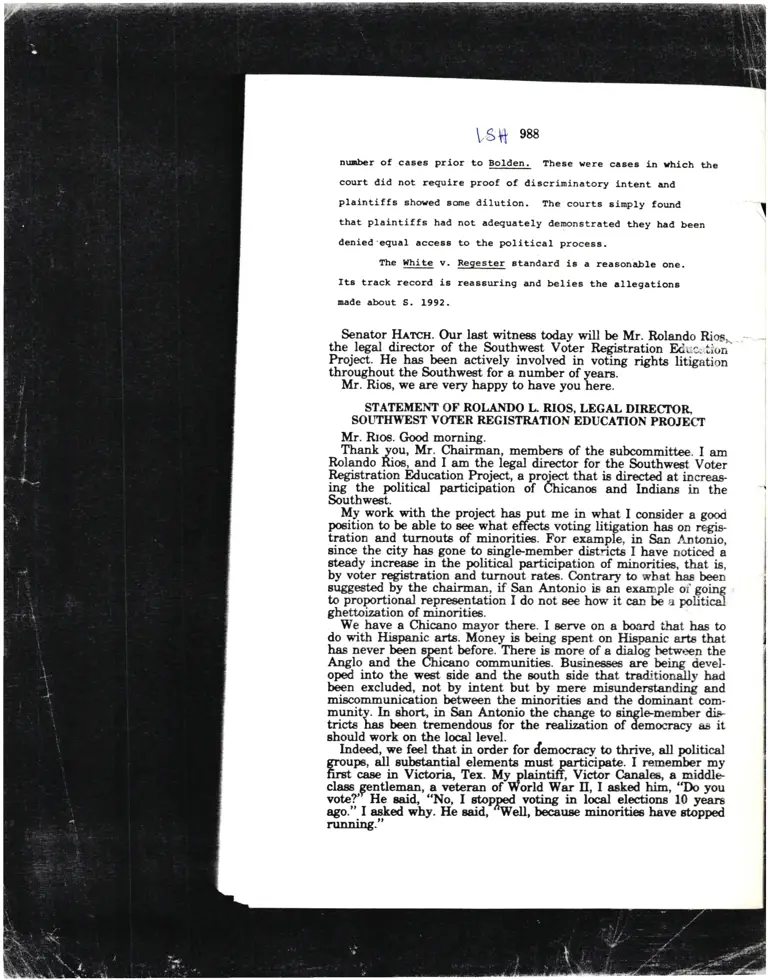
number of cases prior to Bolden. These were cases in which the


court did not require proof of discriminatory intent and
plaintiffs showed some dilution. The courts simply found
that plaintiffs had not adequately demonstrated they had been
denied equal access to the political process.

The EEEES v. Regester standard is a reasonable one.
Its track record is reassuring and belies the allegations

made about 5. 1992.

Senator HATCH. Our last witness today will be Mr. Rolando Riosk
the legal director of the Southwest Voter Registration Eda; tion
Project. He has been actively involved in voting rights litigation
throughout the Southwest for a number of ears.

Mr. Rios, we are very happy to have you ere.

STATEMENT OF ROLANDO L. RIOS, LEGAL DIRECTOR,
SOUTHWEST VOTER REGISTRATION EDUCATION PROJECT

Mr. Rios. Good morning.

Thank ou, Mr. Chairman, members of the subcommittee. I am
Rolando '08, and I am the legal director for the Southwest Voter
Registration Education Project, a pro'ect that is directed at increas-
ing the political participation of 'canos and Indians in the
Southwest.

My work with the project has ffput me in what I consider a good
position to be able to see what e ects voting litigation has on regis»
tration and turnouts of minorities. For example, in San Antonio,
since the city has gone to single-member districts I have noticed a
steady increase in the political participation of minorities, that is,
by voter registration and turnout rates. Contrary to what has been
suggested by the chairman, if San Antonio is an example 0." going
to proportional representation I do not see how it can be a political
ghettoization of minorities.

We have a Chicano mayor there. I serve on a board that has to
do with Hispanic arts. Money is being spent on Hispanic arts that
has never been 8 at before. There is more of a dialog between the
Anglo and the 'cano communities. Businesses are being devel-
oped into the west side and the south side that traditionally had
been excluded, not by intent but by mere misunderstanding and
miscommunication between the minorities and the dominant com-
munit . In short, in San Antonio the change to s' lemember dis-
tricts been tremendous for the realization of emocracy as it
should work on the local level.

Indwd, we feel that in order for democracy to thrive, all political

ups, all substantial elements must participate. I remember my
case in Victoria, Tex. My “plaintiff, Victor Canales, a middle
class gentleman, a veteran of orld War II, I asked him, “Do you
vote?’ He said, “No, I stopped voting in local elections 10 years
ago.” I asked why. He said, Well, because minorities have stopped

runmng