Supplement to the Federal Rules of Appellate Procedure for U.S. Court of Appeals for the Fifth Circuit
Public Court Documents
October 1, 1981
23 pages
-
Case Files, Norwood v. Harrison - Hardbacks. Supplement to the Federal Rules of Appellate Procedure for U.S. Court of Appeals for the Fifth Circuit, 1981. 522ba088-722e-f111-88b4-0022482cdbbc. LDF Archives, Thurgood Marshall Institute. https://ldfrecollection.org/archives/archives-search/archives-item/d02cee0f-ad8e-4c17-8825-630901c80ec7/supplement-to-the-federal-rules-of-appellate-procedure-for-us-court-of-appeals-for-the-fifth-circuit. Accessed October 16, 2026.
Copied!
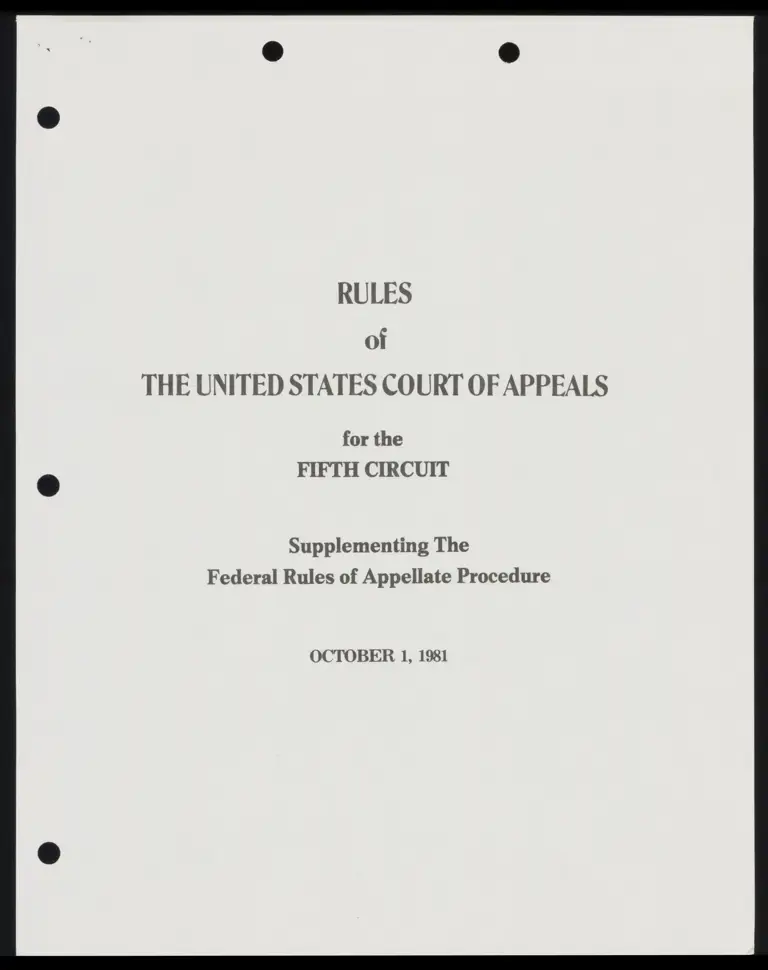
     [||8cc2a24e-9ce9-489d-a2b9-7fabd979327c||] RULES

of

THE UNITED STATES COURT OF APPEALS

for the

FIFTH CIRCUIT

Supplementing The

Federal Rules of Appellate Procedure

OCTOBER 1, 1981


RULES

of

THE UNITED STATES COURT OF APPEALS

for the

FIFTH CIRCUIT

Supplementing The

Federal Rules of Appellate Procedure

OCTOBER 1, 1981


INDEX

Fifth Circuit

Rule

Name, Seal, and Process 1

Sessions 2

Clerk 3

Circuit Executive, Library and

Staff Attorneys

Attorneys

Practice

National Labor Relations Board

Enforcement of Orders

Docketing Cases

Dismissing Cases

Motions

Federal Energy Regulatory Commission
Petition Procedures

Writs of Mandamus

Appendix and Briefs

Docket Control

Oral Arguments

En Banc

Stay or Recall of Mandate

Summary Calendar

Calendar Priorities

Frivolous Appeals 20

Affirmance Without Opinion 21

Costs 22

Bankruptcy 23

NOTE: The Local Rules cross reference the Federal Rules of Appellate Procedure

and the Court's Internal Operating Procedures (IOP).

-1-

October 1, 1981


I, STATES COURT OF wes ®

FOR THE FIFTH CIRCUIT


RULE 1. NAME, SEAL AND PROCESS

Name. The name of this court is "United States Court of Appeals for the
Fifth Circuit."

Seal. The seal of this Court shall contain the words "United States" on
the upper part of the outer edge; and the words "Court of Appeals" on the lower
part of the outer edge, running from left to right; and the words "Fifth Circuit"
in two lines in the center, with a dash beneath.

Writs and Process. Writs and process of this Court shall be under the seal

of the Court and signed by the Clerk.


RULE 2. SESSIONS

Sessions of the Court shall be held in each of the states constituting the

circuit at least once each year. Sessions may be scheduled at any location

having adequate facilities. On motion of a party or on the court's own motion
the court may reassign the hearing of any appeal to another place of sitting or
time.

RULE 3. CLERK

Location. The office of the Clerk shall be maintained in the city of New
Orleans, Louisiana.

Release of Original Papers. The Clerk may release original records or

papers without a Court order for a limited time for purposes of printing, or

upon request of a party or his counsel to facilitate preparation of a brief in a

pending appeal.


Office to be Open. The office of the Clerk shall be open for business on
all days except Saturdays, Sundays, New Year's Day, Washington's Birthday,

Memorial Day, Independence Day, Labor Day, Columbus Day, Veterans's Day, Thanksgiving

Day, and Christmas Day.


[For other information regarding this Clerk's office, see FRAP 45
and IOP 1(b) and 4(a).]

RULE 4. CIRCUIT EXECUTIVE, LIBRARY, AND STAFF ATTORNEYS

Circuit Executive. The office of the Circuit Executive shall be maintained

at New Orleans, Louisiana. The Circuit Executive shall act as Secretary of the


October 1, 1981


Council or the Chief Judge.

Library. A public library shall be

Judicial Council of the @. Circuit, provide administrative support to the

Court, and perform such other duties as may be assigned to him by the Judicial

[See also IOP 1(b).]

maintained at New Orleans, Louisiana,

which shall be open during hours fixed by the Court. Books and materials may not

be removed from the library without permission of the librarian. Other libraries

may be maintained at such places in the circuit as the Court may designate.

[See also IOP 1(b).]

Staff Attorneys.


A central staff of attorneys shall be maintained at New

Orleans, Louisiana, to perform such research and record analysis as may be from

time to time assigned by the Court.

RULE 5.

Admission and Fees.

practice before the Court.

FRAP 46.

Only attorneys

Admission to

Each attorney shall pay to the


shall be transferred to the Library Fund.

[See also IOP 1(b), 3(e) and 4(g).]

ATTORNEYS

admitted to the Bar of this Court may

the Bar of this Court is governed by

Clerk an admission fee of $20, which

An attorney who is appointed by the

Court to represent an appellant in forma pauperis and an attorney who appears on

behalf of the United States must have all other qualifications for admission,

but shall be admitted to practice in this Court without payment of an admission

fee.

Entry of Appearance. Attorneys admitted to the Bar of this Court shall
enter their appearance in each case in which they participate at the time the

case is docketed or upon notice by the Clerk. A form for entry of appearance

will be provided by the Clerk. In addition to other pertinent information, such

form shall require counsel to cite all pending related cases and any cases on

the docket of the Supreme Court, or this, or any other United States Court of

Appeals, which involve a similar issue or issues. Counsel shall update such

information at the time of briefing. Counsel shall also indicate on the form if

the appeal is in a category of cases requiring preference in processing and

disposition as set out in Local Rule 19.


[For additional provisions regarding attorneys, see FRAP 46 and IOP 2.]

RULE 6. PRACTICE

Practices of this Court not fixed by statute or rule are set out in the

Court's Internal Operating Procedures which can be obtained from the Clerk

without charge.

RULE 7. PROCEEDINGS FOR ENFORCEMENT OF ORDERS

OF THE NATIONAL LABOR RELATIONS BOARD

In enforcement proceedings by the National Labor Relations Board under FRAP

October 1, 1981


15(b), the respondent ® be considered the petitioner, and the Board considered
the respondent, for the purposes of briefing and oral argument, unless otherwise

ordered by the Court.

RULE 8. DOCKETING CASES

8.1 Notice of Appeal. A copy of the notice of appeal shall be transmitted

by the Clerk of the District Court to the Clerk in all cases, together with a

copy of the Clerk's docket entries.


8.2 Transcript of Trial Proceedings.


8.2.1 Ordering the Transcript - Duty of Appellant. Appellant's order
for the transcript of proceedings, or parts thereof, contemplated by FRAP 10(b)
shall be on a form prescribed by the Clerk, and a copy of such order form shall

be furnished by counsel to the Clerk in addition to the other parties set out in

FRAP 10(b). If no transcript is to be ordered, appellant shall file with the
Clerk a copy of the certificate to that effect which counsel served on the

parties under FRAP 10(b). [See also IOP 3(b).]


8.2.2 Duties of Court Reporters - Extensions of Time. The court

reporter shall, in all cases in which transcripts are ordered, furnish the

following information, on a form to be prescribed by the Clerk of the Court:


Acknowledge receipt of the order for the transcript;

The date of receipt of the order for the transcript;

Whether adequate financial arrangements under CJA or

otherwise, have been made;

The number of trial or hearing days involved in the

transcript, and an estimate of the number of pages;

The estimated date on which the transcript is to be

completed;

A certificate that he or she expects to file the

trial transcript with the District Court Clerk within

the time estimated.

A request by a court reporter for enlargement of the time for filing

the transcript beyond the thirty day period fixed by FRAP 11(b) shall be filed

with the Clerk and shall specify in detail (a) the amount of work that has been
accomplished on the transcript, (b) a list of all outstanding transcripts due to
this and other courts, including the due dates of filing, and (c) verification
that the request has been brought to the attention of, and approved by, the

district judge who tried the case.

October 1, 1981


8.2.3 Transmission of Record. It is the responsibility of the Clerk

of the District Court to determine when the record on appeal is complete for

purposes of the appeal. Unless the record on appeal can be transmitted to the

Clerk within fifteen days from the filing of the notice of appeal

or fifteen days after the filing of the transcript of trial proceedings if one

has been ordered, whichever is later, the Clerk of the District Court shall

advise the Clerk of this Court of the reasons for delay and request an enlarged

date for the filing thereof.


8.3 In Forma Pauperis Appeals. In all appeals in which a party has been

permitted to proceed in an action in the District Court in forma pauperis, the

District Court shall certify, in writing, prior to transmission of the notice of

appeal to the Clerk of this Court, that the party is a pauper and that the

appeal is taken in good faith. If the District Court finds that the appeal is

not taken in good faith, or is frivolous, or that the party is not a pauper, the

District Court shall state in writing the reasons for such finding. This rule

shall not apply to pauper appeals from judgments of conviction and appeals under

the Criminal Justice Act.


8.4 Docketing Fee - Agency Review Proceedings. Parties proceeding under
FRAP 15 shall pay to the Clerk the $65.00 filing fee at the time
of filing the petition for review.


8.5 Form of Record. The record on appeal shall be bound in a manner which

will facilitate reading with pages numbered consecutively by the Clerk of the

District Court.


[For other provisions relating to the docketing of appeals and the filing

of records, see FRAP 11, 12 and IOP 3(a).]

RULE 9. DISMISSING CASES

9.1 Dismissal by Appellant. In all cases where the appellant or peti-
tioner files an unopposed motion to withdraw the appeal or agency review pro-

ceeding, the Clerk shall enter an order of dismissal and issue a copy of the

order as the mandate.


9.2 Dismissal for Failure to Prosecute.


9.2.1 Appeals in forma pauperis in criminal and prisoner matters

(docketed or undocketed). In direct criminal appeals, habeas cases, and cases

filed pursuant to 28 U.S.C. Sec. 2255 and other prisoner matters, the following

action shall be taken if appellant fails to timely file the record or fails

to file a brief or otherwise fails to comply with rules requiring processing the

appeal to hearing.


2.1.1 Appeals with counsel. If appellant is
represented by counsel, appointed or retained, the Clerk

shall issue a notice to counsel that, upon expiration of


October 1, 1981


fifteen days from the date thereof, the appeal may be dis-

missed for want of prosecution unless prior to that date the

default is remedied, and shall enter an order directing

counsel to show cause within fifteen days from the date

thereof why disciplinary action should not be taken against

counsel. If the default is remedied within that time the

Clerk shall not dismiss the appeal and may refer to the

Court the matter of disciplinary action against the attorney.

If the default is not remedied within that time the Clerk

may enter an order dismissing the appeal for want of prose-

cution or may refer to the Court the question of dismissal.

The Clerk shall refer to the Court the matter of disciplinary

action against the attorney. The Court may refer the matter

of disciplinary action to a District Judge to act as a

special master.

2.1.2 Appeals without counsel. The Clerk shall
issue a notice to appellant that upon the expiration of

fifteen days from the date thereof the appeal may be dis-

missed for want of prosecution unless prior to that date the

default is remedied. If the default is remedied within that

time the Clerk shall not dismiss the appeal. If the default

is not remedied within that time the Clerk may enter an

order dismissing the appeal for want of prosecution.


9.2.2 In all other appeals (docketed or undocketed) when an appellant

fails to timely file the record or fails to file a brief or otherwise fails to

comply with the rules of the Court, the Clerk shall enter an order dismissing

the appeal for want of prosecution.

9.2.3 In all instances of failure to prosecute an appeal to hearing

as required, the Court may take such other action as it deems appropriate.

9.2.4 A copy of an order dismissing an appeal for want of prosecution

shall be issued to the Clerk of the District Court as the mandate.

[For other provisions regarding dismissals, see FRAP 42 and IOP 6(e).]

RULE 10. MOTIONS

10.1 Clerk May Rule on Certain Motions. The Clerk is authorized, in his
discretion and subject to review by the Court, to take appropriate action for

the Court on the following unopposed procedural motions:


10.1.1 To enlarge the time for filing designations as to printing

under FRAP 30; and for filing briefs, answers, objections, or replies to pending

motions, in any cases not yet assigned or under submission;

10.1.2 To transmit records to the Supreme Court for use in connection

with petitions for writs of certiorari;

October 1, 1981


10.1.3 To withdraw appearances;

10.1.4 To make corrections in briefs or pleadings filed in this Court at
the request of counsel;

10.1.5 To grant leave to file briefs in preliminary typewritten form with

privilege of later substitution of printed copies;

10.1.6 To extend time for filing petitions for rehearing for not longer
than 30 days;

10.1.7 To stay further proceedings in appeals; upon notice to the Chief

Judge or such member of the Court as may be designated by him;

10.1.8 To supplement or correct records;

10.1.9 To consolidate appeals;

10.1.10 To incorporate records or briefs on former appeals;

10.1.11 To grant leave to file further reply or supplemental briefs in

addition to the single reply brief permitted by FRAP 28(c), either in type-

written or printed form and either before or after argument;

10.1.12 To stay the issuance of mandates pending certiorari in civil

cases only not to exceed a period of 30 days and provided the Court has not

specially ordered the mandate issued earlier;

10.1.13 For leave to file an amicus curiae brief under FRAP 29;

10.1.14 To reinstate appeals dismissed by the Clerk;

10.1.15 To enter and issue without special submission consent decrees

in Labor Board and other Government agency review cases;

10.1.16 To enter CJA Form 11 orders continuing trial court appoint-

ments of counsel on appeal for purposes of compensation.

10.2 Single Judge May Rule on Certain Motions. Pursuant to FRAP 27(c)
any single judge of this Court is authorized, in his discretion and subject

to review by the Court, to take appropriate action for the Court regarding

the following procedural motions:


10.2.1 Where opposed, the motions which are subject to action by the

Clerk under paragraphs numbered 10.1.1 through 10.1.16, supra;

10.2.2 To permit interventions in agency proceedings pursuant to FRAP

15(d);

October 1, 1981


18 ed certifi > Yor

Sec. 2253 333 U.S.C.A

stays or i

to the restri

review of de

the powel

1U

certiorari;

10

Mot

shal

10.4

wine t nex ad

kmergency
iressed to the Court

, LETrK

where time does not permit the

mail, or by wire, contact

counsel shall file the

The motion, appl ication or

actions of this or other

or a substantially similar o

An application for habeas

appropriate District

rotation on the

for YpUus re

judge of the Court Except

renewed applications are no

such PE itions with the (

v1 LI

MOL 1011

any

Court

routing | Og

habeas C¢ lief ma

QaLTO

111; and

1 LF Po
ited petition fox

cause under FRAP 22(b), and 28 PL obab 1

4 and 28
’ U.S.C.A. Sec.

)Y 1ndigent pei

a}
ts of habeas

permi t

sons appealing from judgments

s corpus or petitions filed
court-appointed counsel to withdraw;

id the length of briefs under FRAP 28(g), and

pre scribed by the

Court supplementing

Court to enlarge the

this

the

er IRA}

power granted in FRAP 8 and 9, with respect to
n criminal cases pending appeal, and subject

FRAP 18, respecting stays pending

the restrictions on

undeir

sub ject a ] so to

mandates o recall of same pending

(WN | he ise ordered by the Court,

having emergency motions or applications,

dual judge, ordinarily shall file

individual judge. In matters
ion or application in person, by

telephone and thereafter

with the Clerk as promptly as possible.
a brief account of the prior

r judge to which the motion or application,

has been submitted.

transferred to the

reference to the initiating judge next in

the Clerk, the party making application

renew the same to any other

without prejudice, such

1Thn 111

d MOT

may be made by

contain

relief,
lief ordinarily will be

Clerk to

ial has been

October 1, 1981


10.5 Form of Motions. In addition to the requirements of FRAP 27, all

motions except purely procedural motions shall include a certificate of

interested persons as described in Local Rule 13.6.1.


[For other provisions regarding motions, see FRAP 27 and IOP 4(e).]


   RULE 11. PROCEEDINGS FOR REVIEW OF ORDERS OF THE

FEDERAL ENERGY REGULATORY COMMISSION


11.1 Petition for Review. Every petition for review shall specify as a

part of its caption the number, date, and identification of the order to be

reviewed and append the service list required by FRAP 15(c).


11.2 Docketing. All petitions for review and other documents concerning
Commission orders in the same number series (i.e., 699, 699A, 699B) shall be

assigned to the same docket in this court.


11.3 Intervention.


11.3.1 Party. A party to a Commission proceeding may intervene in a

review of the same proceeding in this Court by filing a notice of intervention

in the docket assigned to the petition for review of any order entered in such

proceeding. The notice shall state whether the intervenor is a petitioner who

objects to the order or a respondent who supports the order. A notice of inter-

vention shall confer petitioner or respondent status on the intervening party as

to all proceedings in the docket.


11.3.2 Nonparty. A person who is not a party to a Commission proceed-

ing who desires to intervene in a review of that proceeding in this Court shall -

file with the Clerk, and serve upon all parties to the proceeding, a motion for

leave to intervene. The motion shall contain a concise statement of the interest

of the moving party, the grounds upon which intervention is sought, and a statement

why the interest asserted is not adequately protected by existing parties. Any

opposition to a motion shall be filed within 10 days of service.

    11.4 Docketing Statement. Within 30 days of the initial petition for

review, but not later than 10 days after the expiration of the period permitted

for filing a petition for review, all parties filing petitions for review shall

file a joint Docketing Statement which shall:


List each issue to be raised in the review;

List any other review proceeding pending as

to the same order in any other court, and

Append copies of the order to be reviewed.


Every petitioner who files for review after a Docketing Statement has

been filed shall specify in the petition for review any exceptions taken or

October 1, 1981


additions to the issues listed in the Docketing Statement. Every party who

intervenes after a Docketing Statement has been filed shall specify in the

notice of intervention any exceptions taken to the issues listed in the

Docketing Statement.

11.5 Venue. Any party who raises an issue as to venue shall immediately

move for resolution of that issue and serve a supporting memorandum therewith.

Within 10 days of service, opposing parties may serve an opposing memorandum.

The Court will expedite its decision of this issue. Any dispute as to priority

of institution of proceedings in two or more courts of appeal will be referred

to the Commission for findings of fact.


11.6 Prehearing Conference. Ten days after the filing of a Docketing
Statement, or 10 days after entry of an order by the Court deciding a venue

issue, whichever is later, the Clerk may notice a prehearing conference to (a)

simplify and define issues, (b) agree on an appendix and record, (c) assign

joint briefing responsibilities and schedule briefs, and (d) such other matters

as may aid in the disposition of the proceeding. Except for good cause shown,

any party who petitions for review or intervenes in a docket after prehearing

conference has been held will be bound by the result of the prehearing

conference.

11.7 Severance. Any petitioner or respondent may move to sever parties or

issues on a showing of prejudice.


[For other provisions governing review of Administrative Agencies, Board,

Commissions, see FRAP 15 and IOP 4(f) and 6(c).]

RULE 12. WRITS OF MANDAMUS AND PROHIBITION DIRECTED TO A

JUDGE OR JUDGES AND OTHER EXTRAORDINARY WRITS

A petition for writ of mandamus, writ of prohibition, or other extra-

ordinary writ shall not bear the name of the District Judge, but shall be

entitled, In re: , Petitioner. To the extent that relief

is requested of a particular Judge, unless otherwise ordered, the Judge shall

be represented pro forma by counsel for the party opposing the relief, who

shall appear in the name of the party and not that of the Judge.


The petition shall contain a certificate of interested persons as described

in Local Rule 13.6.1.

[For other provisions relating to extraordinary writs, see FRAP 21.]

RULE 13. APPENDIX AND BRIEFS

13.1 Appendix - Appeals From District Courts and the Tax Courts. Appeals
from District Courts and the Tax Court shall be on the original record without

requirement of the appendix prescribed by FRAP 30. At the time of filing appel-

lant's brief, appellant shall file 4 copies of the following portions of the


October 1, 1981


district court record, to be bound together, but not in the brief:

The judgment or interlocutory order appealed from;

any other orders or rulings sought to be reviewed; and

any supporting opinion, findings of fa or conclusions
of law filed or delivered orally bv the district court.

Such copies shall be reproduced on white paper by any duplicating

or copying process capable of producing a clear black image, with a cover

sheet bearing the case number and style and captioned "Record Excerpts.

13.2 Appendix - Agency Review Proceedings. Petitions for review of orders
of an administrative agency, board, commission or officer shall proceed on the

original record on review, without the requirement of the appendix prescribed by
FRAP 30.


If a certified list of documents comprising the record is filed in

lieu of the formal record, petitioner shall obtain from the agency, board or
commission a certified copy of the portions of the record relied upon by the

parties in their briefs, to be suitably covered, numbered and indexed and filed

within 21 days from the date of filing of respondent's brief.

Except in review proceedings covered by Rule 11.4, at the time of

filing petitioner's brief, petitioner shall file separately 4 copies of any
order sought to be reviewed and any supporting opinion, findings of fact or

conclusions of law filed by the agency, board, commission or officer.

13.3 Briefs - Length. Except by permission of the Court, principal briefs

shall not exceed 50 pages and reply briefs shall not exceed 25 pages, exclusive
of pages containing the table of contents, tables of citations and any addendum

containing statutes, rules, regulations, etc. regardless of the form of printing

or reproduction used. Motions for leave to file briefs in excess of the page

requirements of this rule must be filed at least ten (10) days in advance of the

due date of the brief. The Court looks with disfavor upon motions to exceed

the page limitation and such a motion will only be granted for extraordinary and

compelling reasons.

13.4 Briefs - Form. Each copy of every brief, whether produced by a
commercial printing or duplicating firm or otherwise, must comply with FRAP 32,

and, in addition have a cover of durable quality on both front and back

sides, and be securely bound by three heavy staples or other secure binding

device along the left-hand margin so as to insure that the bound copy will not

loosen or fall apart or the cover be detached by shipping and use.


Pages of briefs produced by any printing or duplicating process must

have sufficient spacing between the lines of text to permit the briefs to be

easily read. Within the type matter limitation fixed by FRAP 32, a brief pro-

duced by the standard typographic process should contain not more than 34 lines

October 1, 1981


of text on a page with a proportionate adjustment to be made for quoted matter
or footnotes. Briefs produced by any duplicating or copying process shall have
not more than 27 lines of text, with appropriate adjustment to be made for
single-space quoted matter or footnotes. Elite, or type similar thereto, shall
not be considered 1ll-point type.

Briefs produced by any duplicating process in 8% x 11 inch size, shall
use only one side of each sheet.

In all cases the cover of the brief must clearly indicate the name of
the party on whose behalf the brief is being filed.

Unless each copy of the brief, in the judgment of the Clerk, conforms
to this Rule and to all provisions of FRAP 32, the Clerk in his discretion may
either return nonconforming copies unfiled for refiling after submission in the
proper form or, in order to minimize delay, may have the nonconforming copies
properly corrected, and the party filing such nonconforming copies shall be
billed for the expense thereof.

13.5 Briefs - Number of Copies. Seven copies of briefs shall be filed in
all cases.


13.6 Briefs - Contents:


13.6.1 Certificate of Interested Persons. A certificate will be

furnished by counsel for all private (non-governmental) parties, both appellants

and appellees, which shall be incorporated on the first page of each brief

before the table of contents or index, and which shall certify a complete list

of all persons, associations of persons, firms, partnerships, or corporations

which have an interest in the outcome of the particular case.


If a large group of persons or firms can be specified

by a generic description, individual listing is not

necessary.

The certificate shall be in the following form:

Number and Style of Case.
The undersigned, counsel of record, certifies

that the following listed persons have an interest
in the outcome of this case. These representations

are made in order that the Judges of this Court may
evaluate possible disqualification or recusal.

(Here list names of all such persons

and identify their connection and

interest.)

Attorney of record for

October 1, 1981


13.6.2 Summary of Argument. In addition to the requirements of FRAP 28,
the opening briefs of the parties shall contain a summary of argument, suitably

paragraphed, which should be a‘ succinct, but accurate and clear, condensation of

the argument actually made in the body of the brief. It should not be a mere

repetition of the headings under which the argument is arranged. It should

seldom exceed two and never five pages.


13.6.3 Record References. Every assertion in briefs regarding matter in

the record shall be supported by a reference to the page number of the original

record where the matter relied upon is to be found.


13.6.4 Request for Oral Argument. Counsel for appellant shall include
in appellant's brief (as a preamble thereto) a short statement of the reasons why
oral argument would be helpful, or a statement that appellant waives oral argument

Appellee shall likewise include in appellee's brief a statement of why oral argu-

ment should or need not be had. The Court will accord these statements due,

though not controlling, weight in determining whether oral argument will be

heard in the case. See FRAP 34(a) and (f) and Local Rules 15.1 and 18.2.


13.6.5 Statement of Jurisdiction. Each principal brief shall include a

concise statement of the statutory or other basis of the jurisdiction of this

Court, containing citations of authority when necessary.


13.7 Briefs - Order of Contents. The order of contents of the brief, as

governed by FRAP 28 and this Local Rule, shall be as follows:


Certificate of interested persons, if required.

Statement regarding oral argument.

Table of contents and citations.

Statement of jurisdiction.

Statement of the issues.

Statement of the case.

(i) Course of proceedings and disposition

in court below.

(ii) Statement of facts.

Summary of the argument.

Argument

Conclusion.

Certificate of service.

October 1, 1981


[For other provisions regarding briefs, see FRAP 28, 31, 32 and IOP 4(f).]

RULE 14. DOCKET CONTROL

In the interest of docket control, the Chief Judge may from time to time,

in his discretion, appoint a panel or panels to review pending cases for appro-

priate assignment or disposition under Rules 18 or 20 or any other rule of this
Court.

RULE 15. ORAL ARGUMENTS

15.1 Oral Arguments. Oral argument shall be allowed in all cases except
those determined by a three-judge panel of the Court to fall in one of the

categories specified by FRAP 34(a). Those cases to be orally argued will be

calendared by the Clerk based upon the Court's calendaring priorities. Counsel

for each party must present oral argument unless excused by the Court for good

cause shown. The oral argument docket will show the time the Court has allotted

for each argument. If counsel for all parties indicate pursuant to Rule 13.6.4
that oral argument is not necessary, the case will be governed by FRAP 34(f).


15.2 Submission Without Argument. A party who desires to waive oral
argument in a case noticed for oral argument must file a motion for permission

to waive in advance of the date set for hearing.


15.3 Number of Counsel to be Heard. Only two counsel will be heard for
each party on the argument of a case, and the time allowed may be apportioned

between counsel in their discretion.


15.4 Expediting Appeals. The Court may, on its own motion or for good


cause shown on motion of either party, advance any case for hearing, and pre-

scribe an abbreviated briefing schedule.

15.5 Continuance of Hearing. After a case has been set for hearing, it

may not be continued by stipulation of the parties or their counsel, but only by

an order of the Court on good cause shown. Engagement of counsel in other

courts will not be considered good cause.


15.6 Recording of Oral Arguments. Oral arguments in all cases are tape

recorded for the exclusive use of the Court. Copies of the tapes or transcripts

thereof cannot be prepared and furnished to counsel or the parties nor will
counsel be permitted to listen to the tape. However, with the advance approval

of the Court counsel may arrange at their own expense for a qualified court

reporter to be present to record and transcribe the oral argument.


[For other provisions relating to Oral Argument, see FRAP 34 and IOP 4(g)
and 5(a).]

RULE 16. EN BANC CONSIDERATION

16.1 Procedure. A suggestion of en banc consideration upon initial hearing

October 1, 1981


or rehearing may be made as provided in FRAP 35 and herein or by any judge of

the Court in active service on his own motion. If en banc consideration is

granted, every party shall furnish to the Clerk fifteen (15) additional copies

of every brief the party has previously filed, and fifteen (15) copies of each

supplemental brief on rehearing the party may file. See also the last sentence

of Local Rule 17.

16.2 Form of Suggestion. Fifteen (15) copies of every suggestion of en

banc consideration, whether upon initial hearing or rehearing, shall be filed.

The suggestion shall not be incorporated in the petition for rehearing before

the panel, if one is filed, but shall be complete in itself, In no case shall a

suggestion of enbanc consideration adopt by reference any matter from the petitions

for panel rehearing or from any other briefs or motions in the case. A suggestion

of en banc consideration shall contain the following items, in order:


16.2.1 Certificate of interested persons required for briefs by Local

Rule: 13.6.1;

16.2.2 If the party suggesting en banc consideration is represented

by counsel, one or both of the following statements of counsel, as applicable:

I express a belief, based on a reasoned and

studied professional judgment, that the panel decision

is contrary to the following decision(s) of the United
States Court of Appeals for the Fifth Circuit [or the

Supreme Court of the United States], and that consider-

ation by the full court is necessary to secure and

maintain uniformity of decisions in this Court:

[citing specifically the case or cases]

I express a belief, based on a reasoned

and studied professional judgment, that this appeal

involves one or more questions of exceptional importance:

[set forth each question in one sentence]


Attorney of record for


Counsel are reminded that in every case the duty of counsel is fully

discharged without filing a suggestion for rehearing en banc unless the case

meets the rigid standards of FRAP 35(a).

16.2.3 Table of contents and citations;

16.2.4 Statement of the issue or issues asserted to merit en banc con-

sideration. It will rarely occur that these will be the same as those appropriate

for panel rehearing. A suggestion of en banc consideration must be limited to the

circumstances enumerated in FRAP 35(a).

October 1, 1981


16.2.5 Statement of the course of proceedings and disposition of the case;

16.2.6 Statement of any facts necessary to the argument of the issues;

16.2.7 Argument and authorities. These shall concern only the issues

required by paragraph (.2.4) hereof and shall address specifically, not only
their merit, but why they are contended to be worthy of en banc consideration.

16.2.8 Conclusion; and

16.2.9 Certificate of service.

16.3 Response to Suggestion. No response to a suggestion of en banc

consideration will be received unless requested by the Court.


16.4 Time and Form--Extensions. Any petition for a suggestion of en banc

consideration upon rehearing must be filed within 14 days after the date of the

opinion. Counsel should not request extensions of time except for the most

compelling reasons. Printing delays will not be considered sufficient justi-

fication for extensions. See FRAP 40(b).


16.5 Length. A suggestion for en banc consideration shall not exceed 15

pages in length, without permission of the Court.

[For other provisions relating to determination of causes by the Court En

Banc and Petition for Rehearing, see FRAP 32, 35, 40; the final paragraph of

Local Rule 17, and IOP 5(c).]

RULE 17. STAY OR RECALL OF MANDATE

A motion for a stay of the issuance of a mandate in a direct criminal

appeal filed under FRAP 41 shall not be granted simply upon request. Unless the

petition sets forth good cause for stay or clearly demonstrates that a sub-

stantial question is to be presented to the Supreme Court, the motion shall be

denied and the mandate thereafter issued forthwith.

A mandate once issued shall not be recalled except to prevent injustice.

Unless otherwise expressly provided, the effect of granting a rehearing en

banc is to vacate the panel opinion and judgment of the court and to stay the

mandate.

[For other provisions relating to Mandates, see FRAP 41, Local Rules

10.1.12, 10.2.10 and IOP 5(4).]

RULE 18. DECISIONS WITHOUT ORAL ARGUMENT

18.1 Whenever counsel for all parties indicate pursuant to Rule 13.6.4

that oral argument is not necessary, the case may be submitted to the Court for

decision on the briefs.

October 1, 1981


18.2 Whenever a three-judge panel of this Court unanimously determines
that a case falls into one of the three categories specified in FRAP 34(a), it
will be placed on the summary calendar for decision without oral argument.

[For other provisions relating to Decisions Without Oral Argument, see

FRAP 34 and IOP 4(g).]

RULE 19. CALENDARING PRIORITIES

The following categories of cases will be given~preference in processing
and disposition in accordance with the statutes shown.

19.1 Appeals - District Courts.


19.1.1 Criminal and Criminal-related Proceedings
Recalcitrant Grand Jury Witnesses - orders of confinement.

[28 U.S.C. Sec. 1826]


Criminal Cases. [Fed. R. App. P. 45(b)]


Habeas Corpus - actions under 28 U.S.C. Secs. 2241 and
2254 from judgments of state courts, and habeas corpus
actions under the Immigration and Naturalization Act. 8
U.S.C. Secs. 1105A(a)(9) and (b) and Sec. 1503(c).


2255 Appeals - actions under 28 U.S.C. Sec. 2255 for
relief from sentences of federal courts.


Release in Criminal Cases - orders setting conditions of
release. [18 U.S.C. Sec. 3147 and Fed. R. App. P. 9]


Civil Proceedings.


Extraordinary Writs - petitions for extraordinary writs

such as injunction, mandamus or prohibition under Fed. R.
App. P. 8 and 21. [Fed. R. App. P. 21(b) and (c)]


Bankruptcy Act: Railroad Reorganization -orders fixing
operating cost allowances. [11 U.S.C. Sec. 205]


Federal Election Campaign Act - actions under 2 U.S.C.
Sec. 437g. [2 U.S.C. Sec. 437g(a)(11)] Certified
questions of constitutionality of the Federal Election
Campaign Act under 2 U.S.C. Sec. 437h are required to be
expedited and heard by the Court en banc. [2 U.S.C. Sec.

437h(c)]


October 1, 1981


Freedom of Information Act - actions under 5 U.S.C. Sec.

552. [5 U.S.C. Sec. 552(a) (4)(D)]


Norris-LaGuardia Act - injunctions in labor disputes
issued pursuant to 29 U.S.C. Sec. 107 [29 U.S.C. Sec. 110]


Fair Housing Act - civil actions, private or governmental.

[42 U.S.C. Sec. 3614]


Internal Revenue - summons enforcement appeals [26 U.S.C.

Sec. 7609(h)(2)]


Grant of Motions to Disqualify Counsel -Fifth Circuit
Judicial Council action 1/11/80.


Petitions for Review or Appeals - Agencies, Boards,
Commissions.


National Labor Relations Board - enforcement or review of

orders. [29 U.S.C. Sec. 160]


Occupational Safety and Health Review Commission - review
of orders. [29 U.S.C. Sec. 660(a)]


Commodity Futures Trading Commission - orders suspending
or revoking the designation of a board of trade as a
contract market. [7 U.S.C. Sec. 8]


Small Business Administration - review of license

» revocation, license suspension, or cease and desist orders
issued against small business investment companies. [15

U.S.C. Sec. 687a]


Secretary of Labor - actions withholding certification of
States pursuant to 26 U.S.C. Sec. 3033(b) and Sec. 3304(c)
of the Federal Unemployment Tax Act, or findings by the

Secretary of Labor pursuant to 42 U.S.C. Secs. 503(a), (b)

and (c) which disqualify States for payments under the
Act, if preference is requested. [26 U.S.C. Sec. 3310 and
42 U.S.C. Sec. 504]


Secretary of Treasury - actions determining that a State's

income tax laws do not qualify for federal collection

under 26 U.S.C. Sec. 6362, if preference is requested.
[26 U.S.C. Sec. 6363(d)]


Federal Communications Commission - any proceeding to

enjoin, set aside, annul or suspend any final order of the

Commission brought pursuant to 47 U.S.C. Sec. 402(a). [28

U.S.C. Sec. 2349]


October 1, 1981


Secretary of Agriculture - appeals from cease and desist

orders regarding violations of the Federal Seed Act. (7

U.S.C. Secs. 1599, 1600) [7 U.S.C. Sec. 1600] Appeals

from cease and desist orders regarding violations of the

Packers and Stockyards Act. (7 U.S.C. Secs. 193, 194) [7
U.S.C. Sec. 194(d)] Petitions to enjoin, set aside,

suspend or determine the validity of orders of the

Secretary under the Perishable Agricultural Commodities

Act, 1930. (7 U.S.C. Secs. 499a - 499f and 499h - 499s)

[28 U.S.C. Sec. 2349]


Federal Maritime Commission - all proceedings for judicial

review of final orders and decisions of the Commission

under the Shipping Act, 1916 and the Intercostal Shipping
Act, 1933 (46 U.S.C. Secs. 801 - 848) made reviewable by

46 U.S.C. Sec. 830. [28 U.S.C. Sec. 2349]


Nuclear Regulatory Commission - any proceeding to enjoin,

set aside, suspend or determine the validity of final

orders of the Commission related to patent licensing or

construction permits made reviewable by 42 U.S.C. Sec.

2239. [28 U.S.C. Sec. 2349]


Interstate Commerce Commission ~- all proceedings for

judicial review of final orders and decisions of the

Commission made reviewable by 28 U.S.C. Sec. 2321, [28
U.S.C. Sec. 2349) and cease and desist orders based on
violations of anti trust laws in 15 U.S.C. Sections 13,

14,18 and 19. {15 U.8.C. Sec. 21(e)]


Board of Governors of the Postal Service - decisions
approving, allowing or modifying decisions of the Postal

Rate Commission. [39 U.S.C. Sec. 3628]


Environmental Protection Agency - orders of the
Administrator under the Federal Environmental Pesticide

Control Act of 1972 [7 U.S.C. Secs. 136d(c)(4) and 136m];
and regulations promulgated by the Administrator estab-
lishing tolerances for or exempting pesticide chemicals

under the Federal Insecticide, Fungicide or Rodenticide

Act. [21 U.S.C. Sec. 346a(i)(5)]


Federal Trade Commission - cease and desist orders based

on violations of 15 U.S.C. Sec. 45 of the Federal Trade

Commission Act, [15 U.S.C. Sec. 45(e)] and on violations
of anti-trust laws in 15 U.S.C. Secs. 13, 14, 18 and 19.

[15 U.S.C. Sec. 21(e)]


October 1, 1981


regulations related to the safety of food additives under
the Food, Drug and Cosmetic Act. [21 U.S.C. Sec.
248(g) (2)]


Federal Communications Commission, Civil Aeronautics Board,

and Federal Reserve Board - cease and desist orders based

on violations of anti-trust laws in 15 U.S.C. Secs. 13, 14,
18 and 19. [15 U.S.C. Sec. 21(e)]


Railroad Retirement Board - orders under the Railroad

Unemployment Insurance Act. [45 U.S.C. Sec. 355(f)]


[For other provisions relating to Calendering Priorities, see IOP 5(a).]

RULE 20. FRIVOLOUS AND UNMERITORIOUS APPEALS
If upon the hearing of any interlocutory motion or as a result of a review

under Rule 14, it shall appear to the Court that the appeal is frivolous and

entirely without merit, the appeal will be dismissed.


RULE 21. AFFIRMANCE WITHOUT OPINION


When the Court determines that any one or more of the following circum-

stances exists and is dispositive of a matter submitted to the Court for deci-

sion: (1) that a judgment of the District Court is based on findings of fact
which are not clearly erroneous, (2) that the evidence in support of a jury
verdict is not insufficient, or (3) that the order of an administrative agency

» is supported by substantial evidence on the record as a whole; and the Court

also determines that no error of law appears and an opinion would have no prece-
dential value, the judgment or order may be affirmed or enforced without

opinion.

In such case, the Court may in its discretion enter either of the following

orders: "AFFIRMED. See Local Rule 21." or "ENFORCED. See Local Rule 21."


See N.L.R.B. v. Amalgamated Clothing Workers of America, 5th Cir. 1970, 430
F.2d 966.


RULE 22. COSTS

Supplementing FRAP 39(c), the Clerk in taxing costs for printing thereunder
shall tax such costs at rates not higher than those determined by him from time
to time by reference to the rates generally charged for such work in the

principal cities of the circuit, or at actual cost, whichever shall be the less.


     October 1, 1981


RULE 23. BANKRUPTCY

23.1 The Federal Rules of Appellate Procedure and these local rules apply

to all appeals from Bankruptcy Courts to this Court.

23.2 If all counsel stipulate in writing to a direct appeal to this Court

from the Bankruptcy Court pursuant to 28 U.S.C. section 1293(b), the stipulation
shall be filed with the notice of appeal. If a notice of appeal has previously

been filed in the same matter, but the appeal has not yet been docketed in the

Court to which the appeal has been taken, the filing of a direct appeal shall

also have the effect of a stipulation of dismissal of that earlier appeal, and

the bankruptcy judge shall dismiss the earlier appeal, subject to its reinstate-

ment if the appeal to this Court is dismissed on the ground that the judgment,

order, and decree appealed from was not final.

23.3 An appeal, once docketed in the District Court or with the Clerk of

the appellate panels, should such panels be authorized, may not be transferred

to this Court without the written approval of the district judge or appellate

panel.

October 1, 1981 [||8cc2a24e-9ce9-489d-a2b9-7fabd979327c||]