Brief for Defendants-Appellants
Public Court Documents
July 2, 1976
44 pages
-
Case Files, Norwood v. Harrison - Hardbacks. Brief for Defendants-Appellants, 1976. 07bc9e59-722e-f111-88b4-0022482cdbbc. LDF Archives, Thurgood Marshall Institute. https://ldfrecollection.org/archives/archives-search/archives-item/d0577245-bcee-4e50-97d5-bafd276531a4/brief-for-defendants-appellants. Accessed October 16, 2026.
Copied!
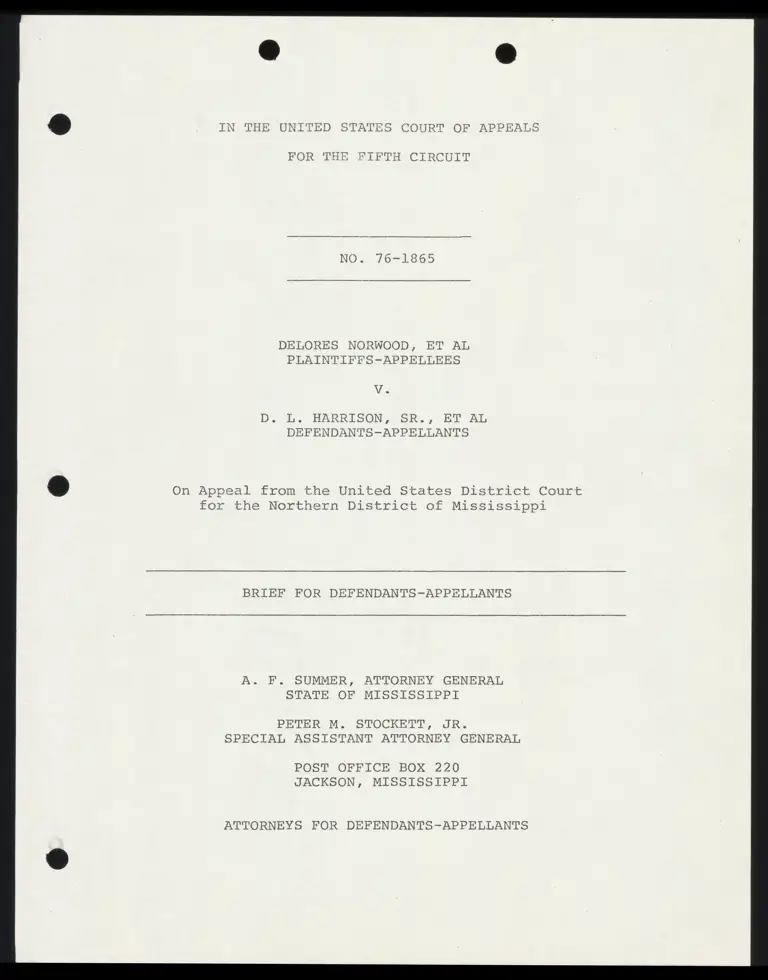
     [||7ff6ee64-1f0b-4825-a32e-7922b5bb17b7||] IN THE UNITED STATES COURT OF APPEALS

POR THE ‘PIFTH CIRCUIT


X00. 76-1865


DELORES NORWOOD, ET AL

PLAINTIFFS-APPELLEES

Vv.

D, 1... HARRISON, SR., ET AL

DEFENDANTS-APPELLANTS

On Appeal from the United States District Court
for the Northern District of Mississippi


BRIEF FOR DEFENDANTS~-APPELLANTS


A. F. SUMMER, ATTORNEY GENERAL

STATE OF MISSISSIPPI

PETER M. STOCKPETT, JR.

SPECIAL ASSISTANT ATTORNEY GENERAL

POST OFFICE BOX 220

JACKSON, MISSISSIPPI

ATTORNEYS FOR DEFENDANTS~-APPELLANTS


I3pey

QUESTIONS PRESENTID ov fv vin ranges we B87 es gin

STATEMENT OF THRE CASE | oJ cabo sia ds Navas

PROCEDURAL HISTORY eT ie a ee De ie i

ARGUMENT. ls ah aie le vise oy a i ins

TX.


RECOVERY OF ATTORNEYS' FEES AND COSTS

OF COURT IS BARRED BY THE IMMUNITY OF

THE STATE OF MISSISSIPPI TO SUIT AND

JUDGMENT.

A. The Eleventh Amendment and Hans v.

Loutsiaena, 134 U.S. 1, as interpreted
by the Supreme Court in Edelman v.
Jordan, 413 U.8. 631 prohibits the
imposition of attorneys' fees and
Cogte dn this case. . . . vite giant

B. Attorneys' fees or court costs a-
gainst a state cannot be imposed
under. the "ancillary effect” lan~
guage in Fdelman. +. we D8 ass,

THE DISTRICT COURT ERRED IN HOLDING
THAT § 718 OF THE EMERGENCY SCHOOL
AID ACT, 20 U.S.C. 1617, MANDATED THE
AWARD OF PERS AND COSTS. vv iv vinnie

A. Congress, in enacting §718 of the
Emergency School Aid Act, did not
intend to provide for the awarding
of fees and costs against funds of
a state, especially in the situation
involved in this case. ' . . Lio. .

10. -

ig

23

No


18

22

29


B. §718 of the Emergency School Aid Act
is uneongtiturional 4Ff lt is inter-
preted to mandate the payment of attor-

neys' fees from the funds of an un-
CONSENtIiNng StALS es 'v vw. so wiv so oineiie

711. THE STATE OF MISSISSIPPI IS AN ABSENT

INDISPENSABLE PARTY TO THIS LITIGATION.

CONCTLUSTON « viel vo me siiimis Sn icin ns dinies gitatin ow

CERNIDICATE ov wiv 3 iv ie teal oi leiTe a feli atiy

21.


TABLE OF CASES


Accord, Taylor v. Perini, 5063 F.24 899,
901; :905 (6th Clr. 1978) ', . . vi vi viies

Alyeska Pipeline Service Co., v. The
Wilderness Society, _ U.S. 44 1L..F4 24,

141 (1975) oie miiie iw iene BT Tra ee

Arkansas v.. Pennessee, 246 U.S. 158, 176,
38 S.Ct. 301, 62 LBA. B38 vu. .v "0 ‘ve 2 ia

Bitzer v. Matthews, NO. 75-283 vs oi in wei

Clork v. Barnard, 108 U.S. 436, 447, 2 5.Ct.
878, 27 L.BA 780 + o indie ne cai whens ie

Class v. Norton, 505 F.2d 123 (2nd Cir. 1974)

Cohens v. Virginia, 6 Wheat (19 U.S.) 264,
5B Le BA 257 vii iv uid ae ie Cee a ie

Durfee v. Duke, 375 U.S. X06, 115;
B48. Ce.» 242, 11 LBA 28 186 . . vitereie.

Edelman v. Jordan, 415 U.S. 651, 94 S.Ct.

1347, 39 L.BA 28 662 uv vo ivi. ieimiiniiin nite

Ex Parte Young, 209 U.S. 123, 28 8.Ct. 441,

2 LBA 708 oe ee er eer ee Gate

Fairmont Creamery Co. v. Minnesota,
275. 0.8.70, 47 8 Ct... 506, 7% L:E4..893 . .

Fitzpatrick v., Bitzer, 317 ¥.2&4 559,
B73 (208 Cir. 3978) .. ov sv vinnie se duis

Ford Motor Co. v. Department of Treasury of
the: State of Indiana, 323 U.S. 459, 65 S.Ct.
347, 89 L.EQ 3B: ¢ v idie sie ino nin sek nie

74%]

PAGE


15

i7,

18,

16

22

21


Gates p.

Feb 3,

Collier,
1976).

Gates v. Collier,

Gates vv. Collier,

aff'd,
reh.

{5th Cir. 1975) .

».Supp.

37). F.
439 P.24 298

en banc granted,

522 P.24 81

Supp.

{5th Cir.

ag {(N.D. Miss.

(35th Cir.

1368
1973) pet.

500 ¥.24:1382

1572) .

{(N.D.

Gates v. Collier, No. 76-1549 . +

Great Northern Life Ins.
322 U.S. 47,
112). ose

Hallmark Clinic v. North Carolina Department of

50-51,


Hum. Res. ,»519 ¥.24 1315, 1317
{4th Cir. 1975) iia el aay ee ee .

Hans v. Loutetana, 134 U.8. 1, 18°8.Ct. 504,
33 LBB. 842 Se he Ne as ee a ae

Jordan v. Pusori, 496 ¥.24 646 {2nd Cir. 1974)

Jordan v. Gilligan, 500 ¥.24 701, (6th Cir.
1974), cert. denied, 421 U.8. 991 i i o« a's 'o

Murgia v.
Retirement,
1974},

Named Ind. Mem.,
Texas Buy. Dept.,

1974) cert. denied,

Northeross v.

412 U.8. 427,

Norwood v.

874). (ieee,

Norwood v. Harrison,
{(N.D. Miss. 1972)

Norwood v. Harrison,
723 $1973) iain

340 F.Supp. 1003,

64
Co.

S.
v.

Ct.

Commonwealth of Mass.
386 P.Supp.

Judgment aff'4 421 U.S.
179,

420 U.S.

93 S.Ct.

°

413 U.S.

iv.

2201,

San Antonio Con.

496 F.24 1017

926

455,

Bd.
182

972

Read,
873,

of

88 L. Ed.

(D. Mass.

Ld

Soc.

{5th Cir.

y

Memphis Board of Education,
37 L.Ed.

37 L.E4.
a

2d 48

Miss.)

for

Harrieon, 382 F.Supp. 921 (N.D. Miss.

PAGE


20

11

13

15

16

15

29

10


Pardon v. Alabama Docks Department,

Petty v. Tennessee-Missouri Bridge Com.,
359 U.S. 275, 276, 79 S.Ct. 785,

3 L.Ed. 24 804

Provident Bank & Trust Co. v. Patterson,
390 U.S. D2, 88 .5.Ct. 733, 18% L.E4.

Sehutten v.: Shell 011 Co., 42) P.24 569
{58h Cir. 1070) « silva wie: a0

Shields v. Barrow, 17 How. 130, 15 L.E4.

Skehan v. Bd. of Trustees, 501 F.24 31,

Souza vv.  Travieono, 512: F.24 1137
{ISt Clive 975) oo afb ieiviinin Tae

Vargas v. Trainor, 508 F.2d 485, 491
(76h Clr. 1972) is ov oiurs nis te

Western Union Telegraph Co. v. Pennsylvania,
3683 U.S. 71, 75, 82 s.Ct. 199, 7 L.E4.

OTHER AUTHORITIES:


Unitted States Constitution +. + «


LJ

28 139


® IN THE UNITED STATES COURT OF APPEALS

FOR THE FIFTH CIQCUIY


2 oO


~
J


[o
y |

fo
d

Q
O


(O
F!


DELORES NORWOOD, ET AL

PLAINTIFFS-APPELLEES

Ve.

D. L., HARRISON, SR., ET AL

DEFENDANTS~-APPELLANTS

On Appeal from the United States District Court
for the Northern District of Mississippi


BRIEF FOR DEFENDANTS-APPELLANTS


QUESTIONS PRESENTED

The legal and constitutional question presented

by this appeal are as follows:

l. Was an award of attorneys' fees and costs

against funds of the State of Mississippi barred by the

states immunity to suit or judgment?


» 2, Did the district court ery in holding that

3 the award of fees and costs is mandated by §718 of the Emer- u

gency School Aid Pa 20 UBC. 8168117."

3. Is the State of Mississippi an absent

indispensable party to the litigation?


STATEMENT OF THE CASE

1 This is an appeal from the order of the district

court of March 2, 1976 awarding counsel for the plaintiff

$23,852.00 as attorneys' fees (522,102.00 to Melvyn R.

Leventhal, $1,750.00 to James M. Nabritt, II1), and $4599.44

taxable costs incurred by plaintiffs, to be paid by "the

members and Executive Secretary of the Mississippi State

Textbook Purchasing Board, and their successors in office,

vin edn thelr Official Anni (PR. pp. 107). This

order was accompanied by a memorandum opinion (R. pp. 68-

106) which elucidated the reasoning of the district court

in making this award.

The district court found that such an award

was not barred by the Eleventh Amendment to the constitution

of the United States as explicated by the Supreme Court of

the United States in Edelman vo. Jordan, 415 U.S. 651, 94. 8S.

Ct. 1347,:39 1... BEd. 28. 662. {R. pp. 70-72) The district

court attached to its memorandum opinion, and incorporated

therein, its memorandum opinion in the case of Gates v. Collier,

P. Supp. = , (XN, D. Miss. Peb. 3, 1974). "The digtrict

court, in its Gates opinion dealt at some length with the

Eleventh Amendment issue (R. pp. 94-103). The district court

also held that §718 of the Emergency School Aid Act, 20 U.S.C.


§1617, mandated the awar fees and costs.

68, 72-81)

On March 17, 1976, defendants appealed

of the district court awarding attorneys' fees and cos

(Supp. R. 170)


PROCEDURAL HISTORY


On October 9, 1971, plaintiffs, black parents of

public school students in Tunica County, Mississippi filed

a class action complaint challenging the constitutionality

of Miss. Code Annotated §6634 et seq. (1942), a statute

providing for the state's distribution of free state-owned

textbooks to all school children in all elementary and

secondary grades in Mississippi, whether attending public

or private SE Ty SR as defendants were the executive

secretary and members of the Mississippi State Textbook

Purchasing Board. The complaint was addressed particularly

» to the statute's effect in providing state-owned textbooks

to students attending schools alleged to be all-white or

schools having racially discriminatory admission policies.

(R. pp. 1-5) Since the complaint sought to enjoin enforce-

ment of a statute of apparent statewide application a three

judge court was convened which upheld the Act's constitu-

tionality. / Jorvooed ve Harvisorn, 340 F. Supp. 1003 (MN. D.
—f

Miss. 1972) (three-judge court).

On appeal, the Supreme Court of the United States

reversed, holding that the Equal Protection Clause forbade

direct or indirect state aid to private segregated schools,

irrespective of the purpose of the assistance or whether


the state aid gave any appreciable support to the main-

tenance of segregated education. Norwood v. Harrison, 9g

In
Y 413 0.8. 455, ‘37 L,. B84. 24 723 (1973). "Recognizing that

all private schools in Mississippi could not be presumed

guilty of racial discrimination, the Court remanded with

instructions to the district court to determine, on a

school-by-school basis, the eligibility wel nen of private

schools in the State to receive continued state textbook

aid.

After remand, the three-judge court was dissolved

and the case remanded to a single judge of the district court

to establish an appropriate certification procedure. Pur-

suant to the supreme court's directive, the district court

conducted a school-by-school eligibility examination, com-

pleting the process in Norwood v. Harrison, 382 F. Supp.

921 (N.D. Miss. 1974). Immediatly thereafter, plaintiffs

filed their motion for an attorneys' fee award and submitted

their itemized cost bill. (R. p. 47, 60-63) Plaintiffs’

attorneys submitted affidavits in support of their motion

for award of attorneys' fees. (R. pp. 52-59, 64-66) The

district court deferred ruling on the motion for award of

attorneys' fees and the taxing of costs because the constitu-

tionality of a similiar award was pending before this court,


9 NAL, nt

Gates 2. Collier, 37% ¥. Supp. 1368 (XN. D. Miss.) aff’4g,

48% TF. 3&8 298 (5 Cir. 1973), vet. for reh. en banc granted,

500 'F. 24 1382 (5 Cir. 1975) This court remanded Gates to

———

the district court for further consideration in light of

Edelman, supra and Alyeska Pipeline Service Co. v. The

Wilderness Society,  _U.8. , 44 L. Ed. 24 141, (1975).

Cates v. Collier, 522 7. 28 .81,:(5 Cir. 1975} (en banc).

After remand by this court in Gates, the parties

in the case sub juduce, submitted a brief to the district

court on the relevant issues, and that court on March 2,

1976 entered the order from which this appeal is taken,

awarding counsel for the plaintiffs, attorneys' fees in

the sum of $23,852.00 and taxable costs in the sum of

$4,999.44, to be paid by "the members and Executive Secretary

of the Mississippi State Textbook Purchasing Board, and

their successors in office, « +.» intheir official capacity”.

(R. p. 107) This order was accompanied by a memorandum

opinion (R. pp. 68-106) which set forth the district court's

reasons for entering this docket.

Defendants appealed the district court's award

of fees and costs. (Supp. R. p. 107)


Du Mma


ARGUMENT

rr—y

{ The recovery of attorneys' fees and costs of

court is barred by the immunity of the State of Mississippi +

to a monetary judgment, as embodied in the Eleventh

Amendment and the decision of the Supreme Court of the

United States in Hans v. Louisiana, 134 UV.8. 1, 108. Ct.

504,33 L. Ed. 842. | Such an award of attorney's fees

and court costs will have direct fiscal impact on the funds

of the State of Mississippi. The order of the district

court awarding attorneys' fees was therefore in excess of

its jurisdiction and must be reversed. This onciusion

is compelled by Edelman v. Jordan, 415 U.S. 651, 94 S. Ct.

1347, 39 L. Ed. 662 as interpreted by decisions of several

circuits. Those decisions holding to the contrary have

misinterpreted Edelman v. Jordan, and have attempted to

evade the immunity Dog by labeling an award of attorneys’

fees and costs as 20 Yaneiitavy effect on the state

treasury" ,/

| Defendants also submit that the district court

erred in holding that § 718 of the Emergency School Aid

Act 20 U.S.C. 1617 mandated the award of fees and costs.

This contention is based upon two separate and independant

premises: (1) That congress, in acting the statute, did


NL [not intend fto provide for the awarding of fees and costs
al

against funds of a state especially in the situtation in-
-


volved here where state officials fairly and non-discrima-

torily enforced a state stutute which they had reason to

belleve was valid and constitutional;/f{(2) if congress

did in fact intend for 20 U.8.C. 1617 to' apply £0 the

facts and circumstances involved in the case sub juduce,

then such statute is/ unconstitutional./ The relevant cases

hold that only the state can waive its immunity to suit
——— —————— —

or judgment, either explicitly by the terms of a legislative

Ri ai uit 1 1 by a courge of conduct. The hay

Federal government has no power to waive the immunity of


» the State of Mississippi, just as the State of Mississippi

has no power to waive the immunity of the United States.


I.

RECOVERY OF ATTORNEYS' FEES AND COSTS

OF COURT IS BARRED BY THE IMMUNITY OF

THE STATE OF MISSISSIPPI 70 SUIT AND

JUDGMENT.

A. The Eleventh Amendment and Hans v. Louisiana,


134 U.S. 1, as interpreted by the Supreme Court
in Zdeliman v. Jordan, 415 U.8. 651 prohibits

the imposition of attorneys' fees and costs in
this case.


The Eleventh Amendment to the United States

Constitution, ratified in 1798 and unchanged since, pro-

vides:

The judicial power of the United

States shall not be construed to
extend to any suit in law or equity
commenced or prosecuted against one
of the United States by citizens of
another state, or by citizens or sub-

jects of any foreign state.

While the amendment does not bar suits against a state by

its own citizens, the United States. Supreme Court has con-

sistently held that an unconsenting state is immune from

suits brought in federal courts by her own citizens as well

as by citizens of another state, Hans v. Louisiara, 134 U.S.

1, 108. C+, 504, 33 1,. Bd. 842, In the instant case,

though the State of Mississippi was not named a defendant,

any monetary award for attorneys' fees and costs of court

will obviously not be paid out of the pocket of defendants,

but will have a direct impact on the funds and fiscal manage-

ment of the State of Mississippi. The order of the district


court of March 2, 1975, from which this appeal is taken,

specifically provides that the money judgment for attorneys’

fees in the amount of $23,852.00 pavable to plaintiffs’

counsel, and $4,999.44 as taxable costs be assessed against

"the members and Executive Secretary of the Mississippi

State Textbook Purchasing Board and their successors in

office; ... in their official capacity". This money judgment

against State officials in their official capacity clearly

runs against the State of Mississippi. State funds, not

money of the individual defendants, will be used to pay

such money judgment if it is ultimately enforced. The

money judgment entered by the district court is a judgment

 B against the State of Mississippi, and is barred by the State's

immunity to suit or judgment. See Great Northern Life

Insurance Co. v.uRead, 322 0.8.47, 50~51,-6%4 8. Ct. 873,

88 YL. £4. 1121.

The Supreme Court has reviewed its decisions

relating to the immunity of the States to monetary judgment

in Zdelman vu. Jordan, 415 0.8. 631, 94 8S. Ct. 1347, 391.

Bd. 28. 662. In Fdelmar, plaintiffs had originally filed

suit in United States District Court for the Northern District

of Illinois, seeking declaratory and injunctive relief

against two former state officials and two officials of Cook

County, Illinois, alleging that the officials were improperly


administering the federal-state programs of Aid to the

Aged, Blind and Disabled. The district court held, inter

alia, that the officials must release AABD ben=2fits which

had been wrongfully withheld. Illinois appealed to the

United States Court of Appeals for the Seventh Circuit,

contending, inter alia, that the Eleventh Amendment barred

the award of retroactive benefits. After the Court of

Appeals affirmed the decision, certiorari was granted, in

order to settle the Eleventh Amendment issue.

The Supreme Court held that the retroactive pay-

ment of benefits fromthe State Treasury was barred by the

Eleventh Amendment. Id. at 662-669. In so holding, the

court stated:

'[Wlhen the action is in essence one
for the recovery of money from the state,
the state is the real substantial party
in interest and is entitled to invoke
its sovereign immunity from suit even
though individual officials are nominal
defendants.' Thus, the rule has evolved

that a suit by private parties seeking to
impose a liability which must be paid
from public funds in the state treasury
is barred by the Eleventh Amendment. (Ci-
tations omitted.) Id. at 663,

In its ruling, the court specifically distinguishes

Zw Pave Young, 209 0.8. 123,: 28 8. Ct. 44), 52 L. Fé. 714:

But the relief awared in Ex Parte Young
was prospective only; the Attorney General

of Minnesota was enjoined to conform his
future conduct of that office to the require-


ment of the Fourteenth Amendment.
Such relief is analogous to that
awarded by the review in this case. wr

But the retroactive portion of the
District Court's order here, which

requires the payment of a very sub-

stantial amount of money which that
court held should have been paid, but
was not, stands on quite different
footing. These funds will obviously
not be paid out of the pocket of pe-
titioner Edelman. Id. at 664.

The court also held that a monetary award against

a state officer does not evade the Eleventh Amendment bar

by labeling such award "equitable restitution." Id. at

665-666. Further, the Supreme Court held that the State of

Illinois did not waive the Eleventh Amendment bar or con-

SS sent to be sued because it had participated in the federal

AABD program... Id. at 671-677.

Defendants submit that the rationale of Edelman

applies to the money judgment for attorneys' fees and costs

of court from which this appeal is taken. There is no doubt

as in Edelman, that the State will be held accountable for

such an award. Such a award would have direct impact upon

the funds and fiscal management of the State of Mississippi.

it is clear from a reading of Bdelman that the

primary requirement of federal court relief granted against

officers or agents of the State in their official capacity

is that relief be prospective in nature. ' Retroactive re-


lief, which would have a monetary impact on the state, is

1 Clearly prohibited. The terms "prospective" and "retro-

have no meaning or concrete application unless
pi Evol 1

active"

applied to a fixed point of reference, or a specific date.

Logic, common sense and the holding of relevant court de-

cisions all compel the conclusion that the relevant date

or fixed point of reference in determining prospectivity

is the date of the entry of the court order. This is

illustrated by the facts in fdelman, in that the date of

the preliminary injunction issued by the district court

(April 16, 1971) was the date which the Supreme Court held

to be the cut-off’ point between permissable prospective

» relief and impermissable retroactive relief. The Seventh

Circuit, which might be adanodl to be acutely aware of the

meaning of the opinion of the Supreme Court in reversing

it in Edelman, has subsequently stated this principle quite

explicitly. See Vargas vu. FPrainor, 508 7. 24 485, 491

{7th Ciy. 1974).

Applying this test to the case sub judice, it

is clear that the monetary relief granted by the district

court against the State is retroactive in nature. The

order of the district court on the merits of the litigation

was entered on July 12, 1974. The entire award of attorneys’

fees and costs made by the district court is based on services


rendered by plaintiffs' counsel from the commencement of

the sult in 1870 to the July 12, 1974 order and judgment

Of the Court and 'on a bill of costs filed inithe district

court August 19, 1974 which reflects that the most recent

-

date upon which itemized costs were incurred was April 3,

1974. :

The monetary relief granted by the district

court was retroactive in nature and barred by the State's

immunity to the suit or judgment.

It has been held that the Fdelman decision com-

pels the conclusion that the Eleventh Amendment bars the

recovery of attorneys' fees against a state. Jordan v.

Gilligan, 500 F24. 70) (6th Cir. 1974), cert. denied, 421


U.8.:991., Aceord, Taylor v. Perini, 303 7.28. 899%, 901,

905 (6th Cir. 1974), vacated on other grounds at 421 U.S.

982; SBkehan v. Board of Tvrustees, 501 P.24 31 (1574),

vacated on other grounds at 421 U.S. 983; Named Ind. Mem.,

San Antonio Con. Soe¢. v. Tewas Bvwy. Dept., 496 P. 24 1017

{5th Cir. 1974), cert. denied, 420 U.8. 926; Hallmark Clinic

Qe. North «Covoling Dept. of Bum. RBes., 319 %., 24.3315, 1317

(4th Cir. 1975, Significantly, the Supreme Court has sum-

marily affirmed a decision of a three-judge district court

in the First Circuit which denied an award of attorneys’

fees both as a matter of law (on Eleventh Amendment grounds)


and discretion. Murgia v. Commonwealth of Mass. Bd. of

Retirement, 386 F.Supp. 179, 182 (D. Mass. 1974), judgment

affirmed, 421 U.S. 972.

The Supreme Court of the United States has co-

gently stated the principle that monetary judgments against

a state, or judgments to be paid from funds of the state, are

impermissable as against a non-consenting state. In Ford

Motor Co. v. Dept. of Treasury of the State of Indiana,

3230.5. 459, 65 8.Ct.” 347, 89 L.Ed. 399, the Supreme Court

stated:

And when the action is in essence one
for the recovery of money from the state,
the state is the real, substantial party

Ww in interest aNdis entitled to invoke its
sovereign immunity from suit even though
individual officials are nominal defendants.
(323 U.S. at page 464.)

If we substitute the word "judgment", for the

words "action" and "suit", we have the case sub Jjudice.

fin this case, the State of Mississippi was not sued, and

has never been made a party to the litigation, but a money

judgment has been entered against its funds. | This effort

to circumvent the state's immunity to suit or judgment was

forseen and dealt with by those who framed, proposed and

ratified the Eleventh Amendment, which prohibits Federal

jurisdiction to anv suit "commenced or prosecuted against Y


one of the united states". (Emphasis added) This court should


forthrightly overturn the judgment entered by the district

court which is being prosecuted against the State of Mississippi.

As to the taxing of court costs against the

State of Mississippi, the argument has been made that

this is sanctioned by the Supreme Court in Fairmont Creamer;

Co. Vv, Minnesota, 275 U.8..70, 47 8.0. 506,-71 %.. 24. 8393.

While it is quite true that in Fairmont, supra,

the Supreme Court held that costs could be taxed against

Minnesota, it is noteworthy that in that case there is no

mention of the Eleventh Amendment. Fairmont involved re-

view of a state court decision affirming a criminal convic-

tion. The Eleventh Amendment was not discussed because it

had no possible application. The amendment speaks only

to suits "commenced or prosecuted against one of the united

states. . . ." It does not reach a prosecution commenced

by the state itself. A state cannot insulate itself from

review of its criminal convictions, when they are attacked

on federal constitutional grounds, by arguing that under

the Eleventh Amendment the Supreme Court has no jurisdiction.

This much has been settled since the landmark case of

Cohens v. Virginia, B VWheat, {19 0.8.) 264, 5 L.Ed. 257.

Unlike Fairmont Creamery, the civil suit in the instant case

was commenced against Mississippi officials.


On April 20 and 21, 1976, the Supreme Court

heard oral argument in the case of Bitzer v. Matthews,

No. 75-283. The principal issue involved in that case is

whether the Eleventh Amendment prohibits an award of

attorneys' fees against the defendant state officials

because those fees are to be paid out of the state treasury.

The decision of the Supreme Court in Bitzer will be rele-

vant to the merits to this appeal and may be dispositive

thereof.

B. Attorneys' fees or court costs against a state

cannot be imposed under the "ancillary effect"
language in Edelman.


Defendants recognize that some circuits have

taken the position that an award of attorneys' fees is

permissible, on the grounds that such an award has only

an "ancillary effect on the state treasury" resulting from

compliance with the order of injunctive relief. Fitzpatrick

v. Bitmer, 517 F.2d 559, 571 (2nd Cir. 1975): Jordan wu.

Fusari,496 ¥.24 646 (2nd Cir. 1974); Class v. Norton, 505

F.24 123 (2nd Cir. 1974)» Bouzga iz. Travisono, 512 F.28 1137

(lst Cir. 1975), remanded on other grounds,  . U.S. ’

S.Ck. , 44 U.S.L. Week 3198-3199. However, an analysis

of Edelman does not support the conclusion of these circuits.

The Supreme Court in Edelman did not leave at large what was

meant by the phrase "ancillary effect".


The phrase comes at the end of a paragraph at 415 U.S. 667-

668 in which the Court discusses Ex Parte Young, supra,

as well as two of the Court's more recent welfare cases, and

notes that the decrees in those cases would have an effect

on the states! funds. "Bul," the Court stated, "the fiscal

consequences to state treasuries in these cases were the

necessary result of compliance with decrees which by their

terms were prospective in nature." 415 U.S. at 667-668.

This is the “ancillary effect” that the Court described as

permissable.

In the next paragraph, the Court distinguished

the decree it was reviewing from those it had referred to:

It requires payment of state funds
not as a necessary consequence of com-

pliance in the future with the sub-
stantive federal-question determination,
but as a form of compensation to those
whose applications were processed on
the slower time schedule at a time
when petitioner was under no court imposed
obligation to conform to a different
standard. 415 U.S. at 658.

It can hardly be argued that an award of attorneys’

fees can be classified as a "necessary consequence of com-

pliance in the future with a substantive federal-question

n"

Aetermination. «ss

The district court in the case sub judice, in

its Memorandum Opinion accompanying its order awarding


v attorneys' fees and costs against the State of Mississippi,

attached thereto a copy of its Memorandum Opinion in

Gates v, Collier, FPF. Sup {(N.D. Miss,, Feb. 3,

1976) ,1 which explicated its reasoning on the "ancillary

effect” issue in the following language:

Edelman reaffirmed that federal
courts may lawfully direct relief
which necessarily requires the ex-
penditure of state funds, where

such outlays are considered "ancil-
lary” to the brincipal thrust of the
litigation. No case could better
illustrate this principal than this
litigation affecting the Mississippi
State Penitentiary. We have in our
earlier orders granted relief which
has required, and will continue to
necessitate, the expenditure of

substantially increased appropri-
EE ations by the State to eradicate

unconsitutional conditions at Parch-
man. Such relief, the consitutionality

of which has been finally upheld on
appeal, has impact of such magnitude
on the state fisc as to dwarf the award
at issue today.

In contrast, the constitutional pro-
blem with the monetary claim in Edelman
was that it provided a substantial por-
tion of the raison d'etre of the lawsuit.
Indeed, Edelman was conceived and pro-
secuted as an action against the state
treasury from the very beginning. In no


1/ Defendant state officials have appealed the judgment
in Gates awarding attorneys' fees and costs to this
Court, Gates pv. Collier, 5 Cir. No. 76-1549,


® sense could the retroactive payment of
welfare benefits to the plaintiffs, by
whatever name called, be said to be

ancillary to the principal purpose of
5.3
the principal purpose of the litigation.

It is apparent on which side of the
Edelman line fall the attorneys' fees
and costs before us today. This action
was brought to seek injunctive and de-
claratory relief from unconstitutional
state actions; it was not an attempt to
secure monetary damages for inmates.
See Edelman, supra, 415 U.S. at 663.
Likewise, plaintiffs' attorney fee claim
is not a suit for money damages "mea-
sured in terms of a monetary loss [to
the Plaintiffs] resulting from a past
breach of a legal duty on the part of
the defendant state officials." Edelman,

supra, 415 U.S. at 668. No claim for
attorneys' fees or expenses existed at
the commencement of this action, and neither

element constituted the primary relief
R 4 sought. Plaintiffs could not have invoked

| this court's power to enjoin future il-
legal conduct without incurring the
expenses of costs and attorneys' fees.
Fitzpatrick v. Bitzer, supra note 3, at

571. Equally obviously, these expenses
could not have accrued had the action not
been brought.


The attorneys' fees and costs here
are therefore expenses incidental to
this litigation seeking 'decrees which
by their terms are prospective in nature."
Edelman, supra, at 668. They "represent
a cost achieving compliance with pro-
spective decrees" as surely as do the
substantive decrees we have already issued.
They cannot in any way constitute a com-
penpensatory award for past wrongs to the
Plaintiff inmates, who are proceeding
here in forma pauperis, and who will
not receive any benefit, direct or in-

direct, from such an assessment. Indeed


the Supreme Court has already held
that the Eleventh Amendment is no

bar to an assessment of court costs

it made such an award in Fairmont

Creamery Co. v. Minnesota, 275 U.S.
70, 72 L..F4. 168 {18 )

mentioned by Edelman. (R. p. 100-101)


Defendants contend that the court below erred

in confusing the alleged ancillary purpose of the litigation

with the ancillary effect to its order upon the fiscal

affairs of the state. The supreme court in Edelman mentioned

nothing about the ancillary motive or purpose of the 1liti-

gation being determinative of whether relief against the

state is permissable.

As to the effect on the Treasury of the State

of Mississippi, it is difficult to imagine a more primary

direct effect than the entry of a judgment in the sum of

$28,851.44 payable by "the members and Executive Secretary

of the Mississippi State Textbook Purchasing Board, and their

successors in office. . . '. in their official capacity".


IY.

THE DISTRICT COURT ERRED IN HOLDING

THAT §718 OF THE EMERGENCY SCHOOL

AIpaCY, 20 U.8.C. 1617, MANDATED

THE AWARD OF FEES AND COSTS.

Congress, in enacting §718 of the Emergency


Scnoot Ald ACE, UiG NOE heen to provide Tor


the awarding of fees and cost against funds of


a state, especially in the situation involved


in this case.


The sole and only basis of the district court

for awarding attorneys' fees and costs against funds of

the state is §718, which appears in the United States code

as 20 U.9.C. 81617 provides as follows:

"Upon entry of a final order by a court
of the United States against a local educa-
tional agency, a State (or any agency there-

of), or the United States (or any agency
thereof), for failure to comply with any pro-
vision of this chapter of for discrimination
on the basis of race, color, or national
origin in violation of Title V1 of the Civil
Rights Act of 1964, or the Fourteenth Amend-

ment to the Constitution of the United States
as they pertain to elementary and secondary
education, the court, in its discretion, upon
a finding that the proceedings were necessary
to bring about compliance, may allow the pre-
vailing party, other than the United States,
a reasonable attorneys' fee as part of the
costs.”

The court below found that it had entered a

final order against a state agency based on discrimination


practiced by the defendants in violation of the Fourteenth

Amendment. Defendants submit that the district court

erroneously applied this statute in deciding this case.

In interpreting the intent of Congress in

enacting this statute, the district court resorted to its

legislative hisotry. (R. p. 76-78) In footnote 5 of

it's opinion (R. p. 78), the district court jusified

reliance on the legislative history in the following

language:

"Although '[s]tatements by individual

members of legislature as to the mean-

ing of provisions in a bill subsequently

enacted into law, made during the general

debate on the bill on the floor of each

legislative house following its presenta-

tion by a standing committee, are generally

held not to be admissable as aids in con-

truing the statute . ., .  [tlhis. rule has

been modified to permit consideration of

explanatory statements by the sponsor Of a

bill, or by the member of the standing

committee who is in charge of its presenta-

tion to the legislative house and leads

the debate thereof. . . . Statements made

by individual legislators during floor

debates are also considered, along with

information about contemporary conditions

and events, when they tend to establish

what problems or evils the legislature

was undertaking to remedy by the statute

being construed.'" 2A Sands, Statutes and

Statutory Construction § 48.13-at 216-17

(4th ed. 1973).

Defendants agree that it will be most informative

and useful to examine the relevant legislative history in


order to ddtavuinel “hat problems or evils the legislature

was undertaking to remedy." J

The House version of the Emergency School Aid

Act contained no attorney fee provisions. (1972 U.S. Code

Cong. and Admin. New 2668.) In the Senate, Senator Mondale

succeeded in having the Senate Committee adopt a provision

that authorized the appropriation of Fifteen Million Dollars

$15,000.000.00) in Federal funds to pay attorneys' fees to

prevailing parties in school discrimination cases. This

provision was the same as the one ultimately adopted. Except

it provided that the United States should pay the attorney

fees, not the losing party. 2 On April 19, 1971, Senator

Dominick offered an amendment to strike §11 of the Bill,

which was the provision for Federal payment foe attorney

fees. There was a very brief debate on that date. On

April 21 the debate resumed on the Dominick Amendment,

and Senator Cook joined in the debate and made the point

that Federal funds should not be used to pay lawyers'

fees in school discrimination cases where the United States

was not at fault, but that the losing parties in such

litigation, being the local school districts should have

to pay such attorney fees.> The Dominick Amendment to


See individual views of Senator Dominick found at 117 Cong.
Rec. 10,747-10748. ® i

117 Cong. Rec. 11,341-11342


4 4

strike the provisions for Federal payment of attorney

fees was adopted by a vote of 47 to 38 on April 21.

117 Cong. Rec. 11345. On April 22, Senator. Cook introduced

his amendment, which was adopted by the Senate, accepted

by the House, and enacted into law. There was debate

on the Cook Amendment on April 22 and April 23, after a very

brief additional debate, the Cook Amendment was adopted

4
by a vote of 30 to 24. This is not a civics textbook

example of how our laws should be made. The original

Mondale proposal for Federal payment of attorney fees

presented no constitutional problems, because Federal funds

would pay the fees, and that a financial burden would not

be placed upon unconsenting states or agencies thereof.

Acting in great haste, and with little thoughtful consideration,

the Senate revised this proposal into one which would ap-

parently compel non-consenting states and their agencies

to pay those attorney fees. Counsel for defendants is unable

to find any discussion or mention in the debates on the

Cook Amendment as to any legal or constitutional problems

in casting this financial burden upon the states. f
-—

It is instructive to consider the remarks of

Senator Mondale in stating the reasons why an attorney fee

provision should be adopted:


117 Cong. Rec. p. 11725


"There have been allegations by the
National Education Association that several

thousand black teachers have been fired

in the South, or demoted. I would like to

to see lawsuits brought on that. There
has been testimony that some schools have
taken public property and given it away
to segregated private academies. I would
like to see some lawsuits on that. . . .
Unfortunately they have not been forth-
coming.” 117 Cong. Rec. 10,762 (1971)

"We have had widespread reports of
wholesale firing and demotion of blacks
teachers. We have had reports of the
transfer of public school property to
segregation academies. We have had reports
of segregation of schoolchildren by race
in school rooms, and many other evidences

of discriminatory practices which, in
my opinion, clearly violate the proscrip-
tion of the 14th Amendment." 117 Cong.
Rec. 11339. |

¢ E It is clear from reading the Senate debates that

the evil which was sought to be remedied consisted of various

acts of willful, purposeful discrimination on the part of local

school districts and their officials. Bach of the above

catagories of actions wag clearly discriminatory, and the

defendant school officials who performed those actions knew,

or should have known that such actions were discriminatory.

These are clearly the types of cages which congress intended

to be covered by Lt ee-shiftin 1S] of the law.

How do the actions of defendants in the case

sub juduce fit into this mold? The record is clear that

the only thing done by defendants and their predecessors in


® office was to administer in a neutral and non-discrimina-

tory manner a Mississippi statute, enacted in 1940, for

the loaning, without cost, of textbooks to public and

private schools within the State. There was no reasonable

= basis for defendants or their predecessors to believe that

such enforcement and administration of the state statute

was discriminatory. Indeed, the initial decision of the

three-judge district court upheld the validity of the

defendants' administration of the State statute. This
——— \

situation 1s clearly distinguishable from the cases in |
{
|
| i

which school officials persisted in enforcing state statutes

compelling racial separation in the public schools after


a the Supreme Court decisions in Brown I and Brown II.

Defendants are not contending that good faith

is a defense to the awarding of attorney fees under §718,

but they do maintain that purposeful action with actual or

constructive knowledge of its discriminatory impact, is

a necessary ingredient of "discrimination on the basis of

race, color, or national origin in violation OF iieiils

the Fourteenth Amendment to the Constitution of the United

States”.

The category of situations mentioned by

Senator Mondale relative to the transfer of textbooks to

private schools quite nicely illustrate this key distinction.

: NNNM~ SS TT —


       He was referring to cases


transferred property, including state owned textbooks
aa


td privees schools which were established to avoid the
a — ee ————— =

ation progress. Such action by local school

NW RE of state law or reguldtion,

and the persons who committed such acts were chargeable


EE res of thetit 2Tlneat ras SterripiEator STERTAT,

The conduct of the defendant in this case does

not come within the ambit of "discrimination" as intended

by Congress in enacting §718 of Emergency School Aid Act.

Even if this court should disagree, the posture of defendants

brings them within the "special circumstances" exception

mentioned in Northeross v. Memphis Board of Education, 412

v.85. 427, 428, 93 8. Ct. 2201, 37 L. Fd. 24 48.

B. §718 of the Emergency School Aid Act is uncon-
stitutional if it is interpreted to mandate
the payment of attorneys' fees from the funds
of an unconsenting state.


The immunity of a state from suit or judgment

is a privilege which it may waive at its pleasure by

voluntary submission to suit (Clark »v. Bawmard, 108 U.S.

436, 447, 2:8. Ct. B78, 27 1. Bd. 780), and by general

law specifically consenting to suit in Federal courts.

Such consent must be clear and specific and consent to

suit in its own courts does not imply a waiver of immunity


in Federal courts Murray v. Wilson Distilling £0. ,:213

U.S. 1513,172,:28..8, Ct, 458, 53 L.. Bd 42; Cravens. v. Tex

Company 298 U.8. 393, 403-404, 56 8.- Ct, 818, 80 L. Ed.

1236. Such waiver of lmmunity must be made by the State

either explicitly by the methods above noted, or implicitly

through a course of conduct (Pardon V. Alabama Stat e Docks

Deparinment, 3770.5. 184;-84 8. Ct. 1207,12 L. B&. 248

233)

It 1s clear that according to the controlling

decision above cited and others that the State of Mississippi

must have done something, either explicitly in its statutes

or by a course of conduct, in order to effect a waiver of

its immunity to suit or judgment. It is equally clear

that the state in the case, sub juduce, has done absolutely

nothing to male or effect such a waiver. If §7183 is con~-

strued to apply to defendants in this case, it would by the

device of the Congress of the United States undertaking

to waive the immunity of the state. This would be no more

constitutionally permissable than allowing the legislature

of Mississippi to waive the immunity of the United States

to suit or judgment. The Supremacy Clause of the United

States Constitution, Article VI, Section 2, 1s not pertinent

to this argument. Defendants concede the obvious, that

the Constitution of the United States, and laws made

pursuant thereto and all treaties made under the authority


“ of the United States shall override any state enactments

to the contrary. Rather, we are here discussing an

essential attribute of an independant entity of government,

tC make its own decision as to waiver of its immunity

to suit or judgment. This is the corner stone of our dual

system of government known as Federalism.

Some highlights of controlling Supreme Court decisions

reinforce the propositions above stated:

Federal courts, sitting within
states, are for many purposes courts

OF that state, Madisonville Traction

Co. Vv. B5t. Bernard Min. Co. 196 U.S.
239, 255, 49 L.. Ba. 462, 468, 25 SS.
Ct. 251, but when we are dealing with
the sovereign exemption from judicial
interference in the vital field of

% financial administration a clear

declaration of the state's intention
to submit its fiscal problems to other
courts than those of its own creation
must be found. Great Northern Life
Ina. Lo. ». Read, 322:U.85. 47, 54,
64:S. Ct. 873, 88 IL... Ba, 112%

These cases declare the rule that

clear declaration of a state's con-

sent [0 sult against itself in the
federal court on fiscal claims is

required. Xemmecott Copper Corp. v.
State Tax Com.y 327 U.8.:573, 577,

66S. Ck. 745,90. 1,. BEd. 862

When the Court in 1793 held that a
state could be sued in the federal courts

by a citizen of another Statel (Chisholm
Vv. Georgia {US) 2 Dall 419, 1 L. ed.
440), the Eleventh Amendment“ was passed


precluding it. But) this ls an
immunity which a state may waive
at its pleasure (Missouri v. Fiske

290 U.,83.018,.24, 78 L. BE 1453, 148,
7

54 ‘8.°C 18) as by a general ap-

gavance in litigation in a federal

court {Clark v. Barnard, 108 U.S.
236, 447%, 448, 27: L. Ba 780, 784,

785,2.8.. Ct. 878) or hy stature,

Ford Motor Co. v. Department of

Treasury, 323 U.8, 459, 468-470, 89

1. 24 389, 396, 65-8. Ct. 347. + The
conclusion that there has been a

waiver of immunity will not be lightly

inferred. Murray v. Wilson Dis~-

tilling Co. 213 U.8.-151, 171, .33 LL.

Eq. 742, 753}, 29 8. Ct. 458. "Hor

will a waiver of immunity from suit

in state courts do service for a
waiver of immunity where the liti-
gation is brought in the federal
court. Chandler v. Dix, 194 1.8.
590, 5301, 592, 48 1L,, ed 1129, 1130
131,524 8S. CL. 766.1359. 0.8. 277}
And where a public instrumentality
ig created with the right “to sue
and be sued" that waiver of immunity

in the particular setting may be
restricted to suits or proceedings
of a special character in the state,
not the federal courts. Cf. Delaware
River Joint Toll Bridge Com. v.
Colburn, 310 U.S. 419,84 L.. Ed. 1287
60. 8. Ct, 1039, Petty v. Tennessee~-

Missouri Bridge Com., 359 0.8. 275,

276, 79 SS. ct. 785; 3°... Bd. 24 804

The decision of the Supreme Court in Parden v.

Alabama Docks Department, supra, announced the principle

that a state may implicitly waive its immunity to suit

by a course of conduct. The actions taken by the State

of Alabama in the case pursuant to a course of conduct


X31.

THE STATE OF MISSISSIPPI 15 AN

ABSENT INDISPENSABLE PARTY TO

THIS LITIGATION

The defendants in this litigation are the members

of the Mississippi State Textbook Purchasing Board and

its Executive Secretary. The State of Mississippi has not

been made a party to these proceedings. Any effort to make

the State a party would defeat federal jurisdiction. Yet

the order of the district court from which this appeal is

taken enters a judgment in the sum of $28,851.44 to be

Pal by nnSl Salmning SRNR Als panel or Signs.
It is hornbook law that the rights, duties, 4

obligations and liabilities of a state will not be adjudi-

cated when the State is not a party to the proceedings. See

Durfee uv. Duke, 375 0.8.:106, 115; 84 8S, Lt: 242, 11:4. Bd.

24. 186, [Arkansas pv. Tennessee, 246 U.S. 158, 176, 38: S.Ct.

301, 62 L. EA. 638, and Western Union Telegraph Company

2. Pennsylvania, "368 U.8. 7%, 75, 82 8. Ct. 199, 7 L. Bd. 24.

139. The court in Western Union Telegraph Company, supra,

succinctly stated the proposition as follows:

But New York was not a party to this
proceeding and could not have been made
a party, and, of course, New York's claims

could not be cut off where New York was
not heard as a party. - (368 U.8. at

B.. 75)


The above cited cases state the rule in situa-

tions where there is reason to believe that an absent State

would have an interest in the outcome of the litigation.

A fortiori, this must be the rule where a money judgment

is entered against the State who is not a party to the

litigation. When the joinder of such an indispensable

party would defeat federal jurisdiction the case must be

dismissed.

The Supreme Court of the United States and this

court have interpreted Rule 19 of the Federal Rules of Civil

Procedure dealing with parties, and synthesized the provisions

of Rule 19 with the line of Supreme Court decisions relating

to necessary and indispensable parties. 8See Provident Bank

and “Trust Company: v.. Patterson,;::390 U.S. 102, 88 8.Ct. 733,

19 L,.84.28. 936, and Schutter wv. Shell 01] Company, 421 7.24

869 (5th Cir. 1970). The Supreme Court and this court made

it plain that the line of cases beginning with Shields v.

Barrow, 17 How. 130, 15 L.Ed. 158, dealing with necessary

and indispensable parties is still the law, and that Rule 19

is to be used as a guide in interpreting the principles

enunciated by Shields and its progeny in specific cases. Rule

19 (b) of the Federal Rules of Civil Procedure provides as

follows:


"Determination by Court Whenever
Joinder not Feasible. If a person
as described in subdivision (a) (1)-
(2) hereof cannot be made a party,
the court shall determine whether
in equity and good conscience the
action should proceed among the par-

ties before it, or should be dis-
missed, the absent person being thus
regarded as indispensable. The fac-
tors to be considered by the Court
include: firslr, to what extent a
judgment rendered in the person's
absence might be prejudicial to him
or those already parties; second,
the extent to which, by protective
provisions in the judgment, by the
shaping of relief, or other measures,
the prejudice can be lessened or
avoided; third, whether a judgment
rendered in the person's absence will
be adequate; fourth, whether the
plaintiff will have an adequate
remedy if the action is dismissed for
nonjoinder." (19 L.E4., p. 944)

The very First factor mentioned in Rule 19(b),

which takes precedence over the other factors, is "to

what extent a judgment rendered in the person’s absence

might be prejudicial to him or those already parties.”

We submit that the State of Mississippi is extremely pre-

judiced in having a judgment in the sum of $28,851.44

entered against it without it being a party to the litigation

which produced the judgment. This court, in Schutten, supra,

held that the Board of Commissioners of the Orleans Levee

District was an indispensable party to a suit to determine

ownership of oil, gas and minerals. It is obvious that the


State of Mississippi is an indispensable party to the

judgment entered by the district court. This court should

1 direct the district court to vacate its money judgment

against the State.


CONCLUSION

A review of the record in this case and the application

thereto of correct legal and constitutional principles com-

pel the conclusion that the district court erred in awarding

attorneys' fees and costs to be paid with funds of the

State of Mississippi. Such an award of fees and costs is

in clear violation of the States' immunity to suit or

judgment. The district court also erred in holding that

§ 718 of the Emergency School Aid Act mandates the award

of attorneys' fees and costs against funds of the State of

Mississippi. The State of Mississippi isan absent ‘indis-

pensable party to this litigation and PAY Sadonent

For the above reasons, and based on the foregoing

authorities, defendants—-appeallants contend that this Court

should reverse the order of the district court from which

this appeal is taken and direct the district court to vacate

such order.

Respectfully submitted,

A. FP. SUMMER, ATTORNEY GENERAL

STATE OF MISSISSIPPI

PETER M. STOCKETT, JR.

SPECIAL ASSISTANT ATTORNEY GENERAL

BY: 5 alain Ly ol FT —
Peter M. Stockett, Jr.


2
DID)


This is to certify that the undersigned has on

this day caused to be mailed through the United States Mail

postage prepaid, one copy of my Brief for defendants-

appellants to the following:

Melvyn R. Leventhal
Suite 2030, 10 Columbus Circle
New York, New York 10019

This the id day of July, 1976.

A Sle


2 VN SA ee
PETER M. STOCKEIT, JR V - [||7ff6ee64-1f0b-4825-a32e-7922b5bb17b7||]