Boynton v. Virginia Brief for the United States as Amicus Curiae
Public Court Documents
August 8, 1960
-
Brief Collection, LDF Court Filings. Boynton v. Virginia Brief for the United States as Amicus Curiae, 1960. d1529b9c-ca9a-ee11-be36-6045bdeb8873. LDF Archives, Thurgood Marshall Institute. https://ldfrecollection.org/archives/archives-search/archives-item/d0aa685d-8950-4681-89ca-48495aa7e812/boynton-v-virginia-brief-for-the-united-states-as-amicus-curiae. Accessed October 07, 2026.
Copied!
J> // / // [V-€
/£)
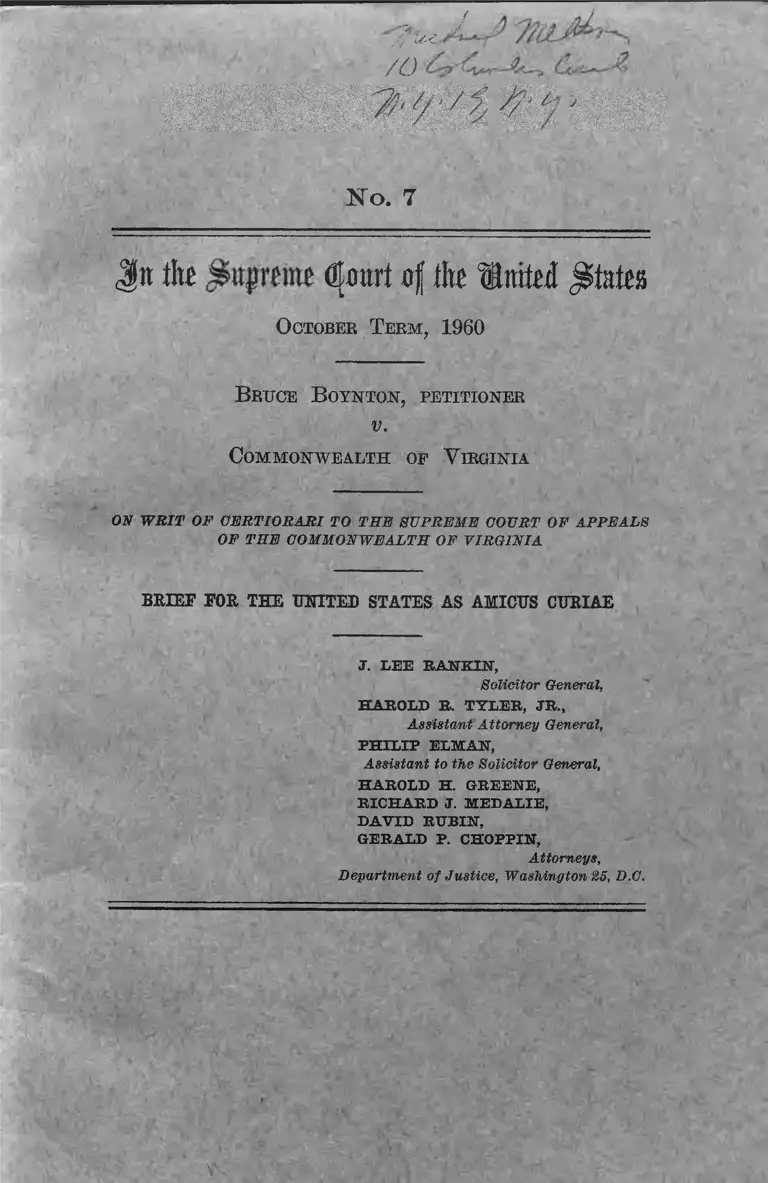
l o . 7
J tt tfe d|0urt 0f t o Wimtd S tates
October Term , 1960
B ruce B oynton, petitioner
v.
COMMONAVEALTH OF VIRGINIA
ON W R IT OF C E R T IO R A R I TO T H E SU P R E M E COURT OF A P P E A LS
OF T H E COM M ONW EALTH OF V IR G IN IA
BRIEF FOR THE UNITED STATES AS AMICUS CURIAE
J. LEE R A N K IN ,
Solicitor General,
HAROLD R. TYLER, JH .,
A ssistan t A ttorney General,
P H IL IP ELMAN,
A ssistan t to the Solicitor General,
HAROLD H. GREENE,
RICHARD J. M EDALIE,
DAVID R U B IN ,
GERALD P. CHOPPIN,
A ttorneys,
Department of Justice, Washington 25, D.C.
I N D E X
i*ag«
Statement__________________ 1
Argument________________ 4
Point I______ 5
Point II____________________________ 9
Point III____________________________ 16
Conclusion_____________________ 28
Appendix___________________________________ 29
C ITA TIO N S
•Cases:
Air Terminal Services, Inc. v. Rentzel, 81 F.
Supp. 611_________________________ 20
American Federation of Labor v. Swing, 312
U.S. 321__________________________ 18
Atchison, Topeka & Santa Fe Ry. Co., 135
I.C.C. 633_________________________ 14
Atlantic Coast Line R. Co. v. North Carolina
Corp. Commission, 206 U.S. 1__________ 11
Augustus v. City of Pensacola, 1 R.R.L.R. 681 19
Barrows v. Jackson, 346 U.S. 249_________ 17
Bob-Lo Excursion Co. v. Michigan, 333 U.S.
28________________________________ 15
Boman v. Birmingham Transit Co,, decided
July 12, 1960_______________________ 26
Bridges v. California, 314 U.S. 252_________ 18
Brown v. Board of Education, 347 U.S. 483__ 20
Cantwell v. Connecticut, 310 U.S. 296______ 18
Chance v. Lambeth, 186 F. 2d 879, certiorari
denied, 341 U.S. 941____________ _____ 10,11
City of Greensboro v. Simkins, 246 F. 2d 425__ 20
561431— 60-------1 ( l )
II
Cases—Continued
City of Petersburg v. Alsup, 238 F. 2d 830, Page
certiorari denied, 353 U.S. 922__________ 19
Civil Rights Cases, 109 U.S. 3__________ 16,17, 21
Coke v. City of Atlanta, (N.D. Ga.)______ 20
Dayton Union Ry. Co. Tariff for Redcap Serv
ice, 256 I.C.C. 289___________________ 12
Debs In re, 158 U.S. 564________________ 11
Derrington v. Plummer, 240 F. 2d 922, cer
tiorari denied, 353 U.S. 924___ _________ 20
Draper v. City of St. Louis, 92 F. Supp. 546,
appeal dismissed, 186 F. 2d 307______ _ 19
Fay v. New York, 332 U.S. 261_______ ___ 27
Flemming v. South Carolina Electric & Gas Co.,
224 F. 2d 752, appeal dismissed, 351 U.S.
901_______________________________ 21
Freeman v. Retail Clerks Local 1207 (Kings
County Super. Ct., Washington), decided
December 9, 1959 (28 U.S.L. Week 2311).- 25
Gayle v. Browder, 352 U.S. 903___________ 20
Gibbons v. Ogden, 9 Wheat. 1___________9
Hall v. DeCuir, 95 U.S. 485_____________ 9
Hayes v. Crutcher, 137 F. Supp. 853_______ 19
Henderson v. United States, 339 U.S. 816____ 7,
10, 12,13,15
Henry v. Greenville Airport Commission, de
cided April 20, 1960__________________ 20
Holley v. City of Portsmouth, 150 F. Supp. 6__ 19
Holmes v. City of Atlanta, 350 U.S. 879, revers
ing 223 F. 2d 93_____________________ 19
Hurd v. Hodge, 334 U.S. 24______________ 27
Kansas City So. Ry. Co. v. Kaw Valley List.,
233 U.S. 75_________________________ 10
" Kerr v. Enoch Pratt Free Library, 149 F. 2d
212, certiorari denied, 326 U.S. 721_____ 21
in
Cases—Continued Page
Keys v. Carolina Coach Co., 64 M.C.C. 769.. 8
Korematsu v. United States, 323 U.S. 214_____ 22
Kreshik v. St. Nicholas Cathedral, 363 U.S.
190_______________________________ 18
Lawrence v. Hancock, 76 F. Supp. 1004_____19, 20
Lonesome v. Maxwell, 220 F. 2d 386___________ 19
McCabe v. Atchison .T. & S.F.R. Co., 235 U.S. :
151----------------------------------------------- 19
Marsh v. Alabama, 326 U.S. 501___ 5,17, 24,25, 26
Mayor and City Council of Baltimore v.
Dawson, 350 U.S. 877, affirming 220 F. 2d
386------------------------- ---------------------- 19
Mitchell v. United States, 313 U.S. 80______ 7,
10,13,15,19, 21
Moorhead v. City of Ft. Lauderdale, 152 F.
Supp. 131, affirmed, 248 F. 2d 544______ 19
Moorman v. Morgan, 285 S.W. 2d 146_____ 19
Morgan v. Virginia, 328 U.S. 373____ 9, 10, 14,15
Morris v. Duby, 274 U.S. 135_____________ 11
Muir v. Louisville Park Theatrical Ass’n., 347
U.S. 971, reversing 202 F. 2d 275________ 19, 20
Munn v. Illinois, 94 U.S. 113______ ______ 24
N.A.A.C.P. v. Alabama, 357 U.S. 449_______ 18
N.A.A.C.P. v. St. Louis-S.F. Ry. Co., 297
I.C.C. 335-------------------------------------- 12,15
Nash v. Air Terminal Services, 85 F. Supp. 545- 20
National Labor Relations Board v. Babcock &
Wilcox Co., 351 U.S. 105____ 24
New Orleans City Park Improvement Assoc, v.
Detiege, 358 U.S. 54, affirming, 252 F. 2d
122-------------------------------- 19
Philadelphia, B. & W.R. Co. v. Smith, 250
U.S. 101___ •_______________________ 11
Republic Aviation Corp. v. National Labor
Relations Board, 324 U.S. 793, n. 8_____ 24
IV
Cases—Continued Page
Rice v.Santa Fe Elevator Corp., 331 U.S. 218_ 12
St. Louis-S.F. Ry. v. Public Service Com
mission, 261 U.S. 369___________________ 11
Seaboard Air Line Ry. v. Blackwell, 244 U.S.
310_______________________________ 9
Shelley v. Kraemer, 334 U.S. 1____ 5,17,18, 25, 27
Smith v. Allwright, 321 U.S. 649____________ 26
Solomon v. Pennsylvania R.R., 96 F. Supp.
7 0 9 - ___ 9
South Covington Ry. v. Covington, 235 U.S. 537_ 10
Southern Pacific Co. v. Arizona, 325 U.S. 761 _ 9
Tale v. Department of Conservation, 133 F.
Supp. 53, affirmed, 231 F. 2d 615, certiorari
denied, 352 U.S. 838__________________ 20
Terry v. Adams, 345 U.S. 461____________ 26
Virginia v. Rives, 100 U.S. 313___________ 27
Ward v. City of Miami, 151 F. 593, affirmed,
252 F. 2d 787_______________________ 19
Whiteside v. Southern Bus Lines, 177 F. 2d 949- 10,11
Williams v. Carolina Coach Co., I l l F. Supp.
329, affirmed, 207 F. 2d 408____________ 8
Williams v. Howard Johnson’s Restaurant, 268
F. 2d 845__________________________ 13,14
Williams v. Kansas City, Mo., 104 F. Supp.
848, affirmed, 205 F. 2d 47, certiorari denied,
346 U.S. 826________________________ 19
Constitution and statutes:
United States Constitution:
Fourteenth Amendment. 15,16,17,18,19,20, 27
Art. I, Sec. 8, Cl. 3_________________ 9,11
Act of September 18, 1940, 54 Stat. 899___ 5
Civil Rights Act of 1866, 14 Stat. 27______ 23
Civil Rights Act of 1875, 18 Stat. 336_____ 23
Constitution and statutes—Continued
Interstate Commerce Act, 49 U.S.C. 1, et seq.:
National Transportation Policy (preced-
ing 49 U.S.C. 1)__________________ 5-6
49 U.S.C. 3(1)_____________________ 7,12
49 U.S.C. 16(13)___________________ 8
49 U.S.C. 303(a)(19)_______________ 7,9
49 U.S.C. 304(d)___________________ 8
49 U.S.C. 316(a)___________________ 6
49 U.S.C. 316(d)___________________ 6, 7
42 U.S.C. 1981____________________ 27, 28
42 U.S.C. 1982____________________ 27, 28
Miscellaneous:
Cong. Globe, 42d Cong., 2d Sess., pp. 381,
382-383____________________ 23
Cong. Record, 43d Cong., 1st Sess., p. 11._ 23
1 R.R.L.R. 681________________ 24
N.Y. Times, April 23, 1960, p. 21, col. 1.. 25
J n the £ttj?ttme flfottrt of the United States
October T erm , 1960
No. 7
B ruce B oynton, petitioner
v.
Commonwealth op V irginia
ON W R IT OF C E R T IO R A R I TO T H E SU PR E M E COURT OF A P P E A LS
OF TH E COM M ONW EALTH OF V IR G IN IA
BRIEF FOR THE UNITED STATES AS AMICUS CURIAE
STA TEM EN T
At 8:00 p.m. on December 20, 1958, petitioner, a
Negro student in his third year at the Howard Uni
versity School of Law in Washington, D.C., boarded
a Trail ways bus in Washington to travel to his home
in Selma, Alabama (R. 27). He had in his possession
a ticket entitling him to travel to Montgomery, Ala
bama, on Trail ways (R. 27). The bus arrived at the
Trail ways Bus Terminal in Richmond, Virginia, at
about 10:40 p.m. When the driver pulled the bus
up to the stop at the terminal, he notified the passen
gers, including petitioner, that there would be a forty-
minute stopover (R. 28).
(i)
2
Because lie was hungry, petitioner alighted from
the bus and entered the terminal to get something to
eat (R. 28). He had never stopped in Richmond
before and did not know of any other place where
he could get something to eat within such a short time
(R. 29). There were two restaurants in the terminal.
One, which was “customarily used for colored people”
(R. 22), appeared to be crowded (R. 28). Petitioner
proceeded to the other restaurant, “customarily used
for * * * white” people (R. 22) which was not
crowded, and sat down upon one of the vacant stools
at the counter (R. 28).
One of the waitresses thereupon asked him to leave
and go over to the other restaurant (R. 28). He in
formed her that the other restaurant was somewhat
crowded and that he was an interstate passenger (R.
28). She insisted that, because of specific orders
which she had been given and also because of the
custom there, she could not serin him (R. 28). He
reminded her that he was an interstate passenger and
explained that, because his bus would be leaving
within a short time, he would like to get something
that would not take too long to prepare (R. 28). The
waitress suggested that he purchase a prepared sand
wich, whereupon he ordered one of the sandwiches
with a beverage (R. 29).
The waitress departed, and then returned and in
formed petitioner that she had orders not to serve
him (R. 29). He then asked her to find someone who
could serve him (R. 29). She departed again and
returned with the Assistant Manager of the restaurant
(R. 20, 29). The Assistant Manager told petitioner
3
that he could not be served (R. 29), explained that
there was a restaurant “ on the other side for the
colored” (R. 21), and suggested that he go to that
restaurant (R. 21). Petitioner refused and continued
to insist that his status as an interstate passenger
entitled him to be served (R. 29). The Assistant
Manager then called a police officer to enlist his aid
in getting petitioner to leave (R. 21). The officer
took petitioner outside and “tried to explain to him
the situation” (R. 21), and then returned and asked
the Assistant Manager if he wanted a warrant for
petitioner’s arrest (R. 21). After first replying in
the negative (R. 21), the Assistant Manager, upon
noticing that petitioner had returned, reconsidered
and caused petitioner to be arrested for trespassing
(R. 21, 29).
The bus terminal was owned and operated by
Trailways Bus Terminal, Inc. (R. 9). The restau
rants were built into the terminal upon its con
struction and leased by Trailways to Bus Terminal
Restaurant of Richmond, Inc. (R. 9-17). The lease
grants exclusive authority to the latter to operate
restaurants in the terminal (R. 10) and requires
that the restaurants be operated in keeping with
the character of service maintained in an up-to-date,
modern bus terminal (R. 14), that the lessee obtain
the lessor’s permission before selling any commodity
not usually sold or installed in a “bus terminal
concession” (R. 11), that the lessee refrain from sell
ing on buses operating in or out of the terminal, and
that, upon notice from the lessor, the lessee refrain
561431— 60----2
4
from making sales through the windows of the buses
(ft. 16). At no facility in the terminal, with the ex
ception of these restaurants, is racial segregation
required or practiced (R. 8).
Trial on the trespassing charge was held on Janu
ary 6, 1959, in the Police Court of the City of
Richmond (R. 19). At the conclusion of the pro
ceedings, petitioner was found guilty and fined $10
(R. 30). On February 20, 1959, the judgment was
approved by the Hustings Court of the City of
Richmond (R. 30-31). On June 19, 1959, the
Supreme Court of Appeals of Virginia affirmed the
judgment of the Hustings Court (R. 32).
A RG UM EN T
During the course of his journey, petitioner, an
American citizen traveling from one state to another
on a federally-regulated carrier, was denied, solely be
cause of his race or color, the right to equal treat
ment in the use of an essential transportation facility -
in this instance, a restaurant in a bus terminal serving
interstate passengers. This denial was compounded by
the action of a state in prosecuting and punishing him
as a criminal trespasser. The invocation of the state’s
trespass law against petitioner for acts constituting a
peaceable and orderly attempt to exercise his federal
rights to equal treatment in the use of transportation
facilities while traveling on interstate carriers subject
to federal regulation had the necessary and inevitable
effect of thwarting and defeating these rights.
: This case does not involve purely private or individ
ual action which is in no respect enforced, implemented,
5
or supported by governmental authority. I t does not
present any question as to “ the right of a homeowner”
to choose or “to regulate the conduct of his guests”
{Marsh v. Alabama, 326 U.S. 501, 506), for the facili
ties with which we are concerned here were “built and
operated primarily to benefit the public” {ibid.). Nor
is this a case in which the state “has merely abstained
from action, leaving private individuals free to impose
such discriminations as they see fit.” Shelley v.
Kraemer, 334 U.S. 1, 19. On the contrary, the judg
ment here under review represents an affirmative exer
tion of governmental authority to sanction and consum
mate racial discrimination, thereby making the state
itself a party to the discrimination. In short, the sig
nificant aspects of this ease are its public, interstate,
and governmental action aspects.
I
The discrimination here against petitioner con
flicts both with the general purposes and objects of
the Interstate Commerce Act, 49 U.S.C. 1, et seq., as
embodied in the “National Transportation Policy,” 1
149 U.S.C. preceding Section 1, added to thej Interstate Com
merce Act by the Act of September 18, 1940, 54 Stat. 899. Seg
regation of interstate bus passengers by race in a bus terminal
restaurant is contrary to the “National Transportation Policy”
in almost every one of its particulars. That policy is as fol
lows: “I t is hereby declared to be the national transportation
policy of the Congress to provide for fair and impartial regu
lation of all modes of transportation subject to the provisions
of this Act, * * * so administered as to recognize and preserve
the inherent advantages of each; to promote safe, adequate, eco
nomical, and efficient service and foster sound economic
conditions in transportation and among the several carriers;
to encourage the establishment and mainilend/nce o f reasonable
6
and with several of the specific provisions of the Act,*
especially 49 U.S.C. 316(d).3 That subsection states
clearly that it “shall be unlawful * * * to subject any
charges for transportation services, without unjust discriminar
tions, undue preferences or advantages, or unfair or destruc
tive competitive practices; to cooperate with the several States
and the duly authorized officials thereof; and to encourage
fair wages and equitable working conditions; all to the end
of developing, coordinating and preserving a national trans
portation system by water, highway, and rail, as well as other
means, adequate to meet the needs of the commerce of the
United States, of the Postal Service, and of the national de
fense. All of the provisions of this Act shall be administered
and enforced with a view to carrying out the above declaration
of policy” (emphasis added).
2 For example, 49 U.S.C. 816(a) provides in pertinent part
that “[i]t shall be the duty of every common carrier of pas
sengers by motor vehicle * * * to provide * * * adequate serv
ice * * * and facilities for the transportation of passengers in
interstate or foreign commerce; to establish, observe, and en
force just and reasonable individual and joint rates, fares, and
charges, and just and reasonable regulations and practices re
lating thereto, and to * * * the facilities for transportation,
and all other matters relating to or connected with the trans
portation of passengers in interstate or foreign commerce
* * I t seems clear that a segregated dining facility is
foreign to the mandate, embodied in Section 316(a), that “ade
quate service and facilities” be maintained for all, including
Negro passengers. Similarly, the duty of enforcing “just and
reasonable regulations and practices” relating to transportation
facilities “and all other matters relating to or connected with
the transportation of passengers” clearly seems to be violated
by the practice of racial discrimination in the terminal facili
ties which the passengers must use.
3 49 U.S.C. 316(d) provides in pertinent part that “[a]ll
charges made for any service rendered or to be rendered by
any common carrier by motor vehicle engaged in interstate or
foreign commerce in the transportation of passengers or prop
erty as aforesaid or in connection therewith shall be just and
reasonable, and every unjust and unreasonable charge for such
service or any part thereof, is prohibited and declared to be
7
particular person * * * to any unjust discrimination
or any undue or unreasonable prejudice or disad
vantage in any respect whatsoever * * This
provision in Section 316(d), embodied in Part I I of
the Act dealing with “ Motor Carriers,” is identical to
the provision in 49 U.S.C. 3(1), embodied in P art I
of the Act dealing with “General Provisions and Rail
road and Pipe Line Carriers,” which was held in
Mitchell v. United States, 313 U.S. 80, and Henderson
v. United States, 339 U.S. 816, to proscribe racial dis
crimination in interstate railroad pullman and dining
cars. Under the Act, “racial classification of passen
gers holding identical tickets” {id. at 825) is barred
in relation to interstate transportation services of
every kind.
To be sure, Section 316(d) speaks only of ‘'any com
mon carrier by motor vehicle,” and not of terminals
or terminal restaurant facilities as such. But 49
U.S.C. 303(a) (19) defines the “services” and “trans
portation” to which Part I I of the Act applies as
including “ all facilities and property operated or con
trolled by any * * * carrier * * * used in the trans
portation of passengers or property in interstate or
foreign commerce or in the performance of any
service in connection therewith” (emphasis added).
unlawful. I t shall be unlawful for any common carrier by
motor vehicle engaged in interstate or foreign commerce to
make, give or cause any undue or unreasonable preference or
advantage to any particular person * * * in any respect what*
soever; or to subject any particular person * * * to any.unjust
discrimination or any undue or unreasonable prejudice or dis
advantage in any respect whatsoever * *
The facilities involved in the present case are so
controlled. The Trail ways Bus Terminal in Richmond,
Virginia, is owned by Trailways Bus Terminal, Inc.
(R. 18). According to an authenticated copy of the
records of the Interstate Commerce Commission, re
printed in the Appendix, pp. 29-31, infra,4 Virginia
Stage Lines, Inc., a “common carrier by motor vehicle,”
owns fifty percent of the stock in Trailways Bus Ter
minal, Inc., and operates the terminal as a joint facility
with the Carolina Coach Company, also a “common car
rier by motor vehicle” (see Williams v. Carolina Coach
Co., I l l P. Supp. 329 (E.D. Va.), affirmed, 207 P. 2d
408 (C.A. 4) ; Keys v. Carolina Coach Co., 64 M.C.C.
769).
The fact that the restaurant in the terminal is leased
by Trailways Bus Terminal, Inc., to Bus Terminal
Restaurant of Richmond, Inc., is thus immaterial
here. Since a carrier is prohibited from enforcing
racial segregation in facilities which it operates or
controls, it may not evade its statutory responsibili
ties in this respect by leasing such facilities to an
other. The paramount federal duty of nondiscrimi
nation is not delegable and cannot be discharged
4 “ [AJnnual or other reports of earners made to the Com
mission * * * shall be preserved as public records * * 49
U.S.C. 16(13). These public records, including “copies of and
extracts from” them, properly certified and sealed, “shall be
received as prima facie evidence of what they purport to be
* * * in all judicial proceedings * * Ibid ./ see 49 U.S.C.
304(d). The extracts from the annual reports of the carrier
which appear in the Appendix, pp. 29-32, infra, have been cer
tified by the Secretary under the Commission’s seal as required.
9
through, lease of facilities.6 I t follows that maiute-
nance of segregation in the Richmond terminal restau
rant, and its enforcement by the state, violate the
Interstate Commerce Act which thus provides a full
defense against the trespass charge on which the judg
ment below was based. Cf. Solomon v. Pennsylvania
R.E., 96 ¥. Supp. 709, 712 (S.D.N.Y.).
I I
Ever since Gibbons v. Ogden, 9 Wheat. 1, “the
states have not been deemed to have ..the authority to
impede substantially the free flow of commerce from
.state to state * * *.” Southern Pacific Co. v. Arizona,
325 U.S. 761, 767. This “ long-recognized distribution
of power between national and state governments”
has been predicated in some cases upon the expressed
or the presumed intention of Congress (id, at 768),
and in others “ upon the implications of the commerce
clause itself” (ibid.). Thus, even in the absence of
congressional action, the Commerce Clause, of its own
force, requires invalidation of unreasonable state-
imposed burdens on interstate commerce. See Morgan
v. Virginia, 328 U.S. 373; Hall v. DeCuir, 95 U.S. 485.
See also Seaboard Air Line By. v. Blackwell, 244 U.S.
6 Moreover, the terms of the lease itself evidence sufficient con
trol by the carrier for purposes of Section 303(a) (19) : the termi
nal restaurants are required to be operated in keeping with the
character of service maintained in an up-to-date, modern bus ter
minal (It. 14); the lessee must obtain the lessor’s permission be
fore selling any commodity not usually sold or installed in a “bus
terminal concession” (R. 11); the lessee must refrain from sell
ing on buses operating in or out of the terminal (R. 16); and,
upon notice from the lessor, the lessee must also refrain from
making sales through the windows of the buses (R. 16).
10
310; South Covington Ry. v. Covington, 235 U.S. 537.
Whether any particular state legislation is invalid
depends upon whether “ it unduly burdens * * * com
merce in matters where uniformity is necessary * *
Morgan v. Virginia, supra, at 377. And whether “ the
statute in question is a burden on commerce” depends
upon the “situation created by the attempted enforce
ment of * * * [the] statute * * *.” Id. at 377-378.
Thus, in Morgan v. Virginia, supra, a Virginia
statute required racial segregation in interstate
buses. Stating that the issue of the statute’s
validity must be decided “as a matter of bal
ance between the exercise of the local police power
and the need for national uniformity in the regulations
for interstate travel,” the Court concluded “ * * *
that seating arrangements for the different races in
interstate motor travel require a single, uniform rule
to promote and protect national travel.” 328 U.S. at
386. See also Henderson v. United States, 339 U.S.
816; Mitchell v. United States, 313 U.S. 80; Chance v.
Lambeth, 186 F. 2d 879 (C.A. 4), certiorari denied,
341 U.S. 941; Whiteside v. Southern Bus Lines, Inc.,
177 F. 2d 949 (C.A. 6).
The application of a state statute is not the only
official act of a state which has been found by the
Court to be invalid as a burden on interstate com
merce. In Morgan v. Virginia, supra, at 379, the
Court also observed that “ * * * a final court order is
invalid which materially affects interstate commerce.”
Accord, Kansas City So. Ry. Co. v. Raw Valley Hist.,
233 U.S. 75. An order of an administrative commis
sion may also constitute a burden on interstate com-
11
merce. Morris v. Duty, 274 U.S. 135; St. Louis-S.F.
Ry. v. Public Service Commission, 261 U.S. 369;
Atlantic Coast Line R. Co. v. North Carolina Corp.
Commission, 206 U.S. 1. Similarly, the federal courts
have ruled that a burden may be created by the state
enforcement of a private regulation. Chance v. Lam
beth, supra; Whiteside v. Southern Bus Lines, Inc.,
supra.
In the present case, petitioner was ejected from the
restaurant and arrested by a state police officer,
prosecuted by the state for violation of a law enacted
by the state legislature, and convicted by a state judge
in a state court. Thus, whether the trespass convic
tion be isolated as an unconstitutional application of
the state trespass law or whether it be regarded as a
combination of state legislative, executive, and judicial
action, it nevertheless is clearly the type of activity
which is embraced within the scope of the Commerce
Clause.6
I t is not material that the present case
involves racial segregation in dining facilities at
bus terminals rather than on the bus itself. The fur
nishing of food to interstate passengers is as much a
part of interstate commerce in the one place as the
other. See Philadelphia, B. & W. R. Co. v. Smith,
250 U.S. 101; Henderson v. United States, 339 U.S.
816. Facilities are, of course, not removed from inter-
6 Some courts have indicated—correctly, we believe—that racial
segregation imposed by a private carrier alone, unsupported by
state authority, would also constitute an unlawful burden on in
terstate commerce. Chance v. Lambeth, supra, at 882-883;
Whiteside v. Southern Bus Lines, Inc., supra,, at 953; cf. In re
Debs, 158 U.S. 564, 581, 582.
561431— 00----3
12
state commerce simply because they are stationary.
See, e.g., Bice v. Santa Fe Elevator Corp., 331 U.S.
218, 229. The Interstate Commerce Commission, by
asserting jurisdiction over terminal facilities such as
red-cap service, Dayton Union By. Co. Tariff for
Bedcap Service, 256 I.C.C. 289, 299, and station wait
ing rooms and rest rooms, N.A.A.C.P. v. St. Louis-
S.F. By. Co., 297 I.C.C. 335, has demonstrated its recog
nition that a facility may be in interstate commerce
although it is located in a terminal rather than on a
moving carrier.7 This Court, in Henderson v. United
States, 339 U.S. 816, 824, characterized regulations of
a railroad carrier which required segregation of the
races in dining cars as “ unreasonable discriminations”
in violation of Section 3(1) of the Interstate Commerce
Act, 49 U.S.C. 3(1).8 Segregation in terminal dining
7 By striking down racial segregation in station waiting rooms
and rest rooms as violative of the Interstate Commerce Act, the
Commission has recognized that segregation within the confines
of a terminal prejudices and disadvantages a Negro traveler as
unreasonably as segregation on the carrier itself. N.A.A.C.P. v.
St. Louis—S.F. Ry. Co., supra.
8 In A .A.A.C.P. v. St. Louis-S.F. Ry. Co., supra, the Interstate
Commerce Commerce Commission refused to assert jurisdiction,
under Section 3(1), over lunchrooms in the Richmond railway
terminal. However, the Commission’s sole basis for declining
to assert jurisdiction over the lunchroom was that there had
been a nineteen-year lapse in its operation, which, according
to the Commission, indicated that this lunchroom had not
constituted an integral part of the terminal’s common-carrier
functions and therefore was not within its jurisdiction. But,
as the record shows in the present case, the restaurants were
built as an integral part of the interstate terminal facility
(R. 9), and there is no indication that they have not been in
continuous operation since then. Access to the restaurant was
intended to, and did, facilitate interstate travel.
13
facilities, no less than segregation on a moving diner,
constitutes, in the words of Henderson, “unreasonable
discrimination,” “unreasonable prejudice,” and “un
reasonable disadvantage” to the passenger denied
equality of treatment.9
Bus passengers are far more dependent upon termi
nal dining facilities than are railroad passengers.
Unlike bus companies, railroads do not schedule regu
lar stops which are long enough to permit their pas
sengers to eat in terminals. Once a journey by rail has
commenced, railroad passengers normally satisfy
their food requirements during the course of the trip
either by buying sandwiches and eating them while
occupying seats in coaches, or by eating regular meals
in the dining car of the train itself. As a practical
matter, interstate bus passengers ordinarily must ob
tain their meals from the facilities offered at the bus
terminal or go hungry. Thus, bus terminal restau
rant facilities are a precise equivalent of dining cars
on railroad trains.
The decision of the court of appeals in Williams v.
Howard Johnson’s Restaurant, 268 F. 2d 845, 848
(C.A. 4), assuming that it was correctly decided, does
not compel an opposite conclusion. In that case the
court decided that a restaurant located on an inter
state highway in the city of Alexandria is not engaged
in interstate commerce “merely because in the course
of its business of furnishing accommodations to the
8 This Court has similarly characterized, and has held repug
nant to the Interstate Commerce Act regulations segregating
Negroes from whites in Pullman cars. Mitchell v. United
States, supra.
14
general public it serves persons who are traveling from
state to state,” and it concluded that the restaurant
was “an instrument of local commerce.” 10 The Trail-
ways bus restaurant in Richmond, on the other hand,
is located in an interstate bus terminal, was con
structed at the same time that the terminal was con
structed (R. 9), and was leased upon conditions re
quiring that the lessee obtain the lessor’s permission
before selling any commodity not usually sold or in
stalled in a “bus terminal concession” (R. 11), and
that the restaurant be operated “ in keeping with the
character of service maintained in an up-to-date, mod
ern bus terminal” (R. 14). There is therefore no
warrant for designating the restaurant in this case as
an instrument of local commerce.” Even though it
may incidentally serve local traffic (R. 23), it clearly
is primarily an instrument of interstate travel, and in
this case it was in fact sought to be used by petitioner
in connection with his interstate journey. Cf. Atchi
son, Topeka & Santa Fe By. Go., 135 I.C.C. 633, 634-
635.
Racial discrimination or segregation interferes with
a “single, uniform rule to promote and protect national
travel” (Morgan v. Virginia, supra, at 386), and
thereby imposes a burden on interstate commerce. In
instances in which rules have varied from state to
state with respect to racial discrimination or non
discrimination in interstate transportation facilities,
the Court has held invalid statutes requiring racial
10 The plaintiff in the Williams case contended that the pri
vate segregation itself constituted a burden on interstate com
merce. Cf. footnote 6, supra.
15
discrimination (see, e.g., Morgan v. Virginia, supra)
because of their tendency to undermine any “ single,
uniform rule to promote and protect national travel.”
See Bob-Lo Excursion Co. v. Michigan, 333 U.S. 28,
40. I f diversity of racial rules from state to state is
to be avoided, and uniformity with respect to inter
state travel achieved, racial discrimination and segre
gation, be it by state statute no matter how enforced,
must be deemed invalid. Interstate commerce would
flow more smoothly if states did not use their criminal
process to support racially discriminatory policies of
the proprietors of such restaurants, and if the latter
were thereby encouraged to serve all interstate passen
gers indiscriminately instead of refusing to serve some
of them on grounds irrelevant to the interstate travel.
Moreover, enforcement of racial discrimination,
such as that involved in the present case, supports
and accentuates an unreasonable disadvantage and
prejudice to a class of interstate travelers. Cf. Hen
derson v. United States, 339 U.S. 816, 824; Mitch
ell v. United States, 313 U.S. 80. Since interstate bus
travel cannot be conducted without regularly sched
uled bus stops, and since dining facilities at such
stops are an integral and essential part of interstate
bus service, the disadvantage and prejudice cannot be
avoided by the interstate Negro bus traveler. In
N.A.A.C.P. v. St. Louis-S.F. By. Co., 297 I.C.C. 335,
347, the Interstate Commerce Commission, in ordering
the end of segregation in interstate rail travel,
declared:
* * * The disadvantage to a traveler who is
assigned accommodations or facilities so desig-
16
nated as to imply his inherent inferiority solely
because of his race must be regarded under
present conditions as unreasonable. Also, he is
entitled to be free of annoyances, some petty
and some substantial, which almost inevitably
accompany segregation even though the rail
carriers, as most of the defendants have done
here, sincerely try to provide both races with
equally convenient and comfortable cars and
waiting rooms.
Racial segregation works a serious and unwar
ranted burden and hardship upon those against whom
it operates, and the prospect of encountering it in
bus terminals surely operates as a deterrent to a
Negro contemplating an interstate bus journey. Na
tional travel is hindered by the enforcement of such
arbitrary discriminations in service. Persons hold
ing the same tickets, whatever their race, color, reli
gion or other irrelevant personal characteristic, are
entitled to the same service and treatment when they
travel in interstate commerce. Under the controlling
provisions of federal law, a Negro passenger is free to
travel the length and breadth of this country without
hindrance or humiliation, and to receive precisely the
same service, no more and no less, as any other
passenger.
I l l
In the Civil Rights Cases, 109 U.S. 3, 11, this Court
declared that “ positive rights and privileges are un
doubtedly secured by the Fourteenth Amendment,”
which “nullifies and makes void all State legislation,
and State action of every kind, which impairs the
17
privileges and immunities of citizens of the United
States, or which injures them in life, liberty or prop
erty without due process of law, or which denies to
any of them the equal protection of the laws.” Ibid.
(emphasis added). Racially discriminatory acts of in
dividuals, moreover, are insulated from the proscrip
tion of the Fourteenth Amendment only insofar as
they are “ unsupported by State authority in the shape
of laws, customs, or judicial or executive proceed
ings,” or are “ not sanctioned in some way by the
State.” Id. at 17.
That the discrimination in the present case was of
private origin is irrelevant. The application of a
general, nondiscriminatory, and otherwise valid law
to effectuate a racially discriminatory policy of a pri
vate agency, and the enforcement of such a discrimi
natory policy by state governmental organs, has been
held repeatedly to be a denial by state action of rights
secured by the Fourteenth Amendment. Thus, in
Shelley v. Kraemer, 334 U.S. 1, the judicial enforce
ment of private racially restrictive covenants by
injunction was held violative of the Fourteenth
Amendment; similarly, in Barrows v. Jackson, 346
U.S. 249, this Court decided that such covenants
could not be enforced, consistently with the Four
teenth Amendment, by the assessment of damages for
their breach; and in Marsh v. Alabama, 326 U.S. 501,
this Court ruled that the criminal courts could not be
used to convict of trespass persons exercising their
rights of free speech in a privately-owned company
18
town,11 See also Kreshik v. St. Nicholas Cathedral,
363 ILS. 190, 191; N.A.A.C.P. v. Alabama, 357 U.S.
449, 463.
If, in Shelley, the action of a state judiciary alone
was in question, in the present case each branch of
state government contributed directly and substan
tially to the support and enforcement of the terminal
restaurant’s discriminatory policy. By the active in
tervention of the executive and judicial branches of
that government, applying a law passed by its legis
lature, “the full panoply of state power” (Shelley
v. Kraemer, supra, at 19) was exerted to deny to
petitioner, on the ground of race or color, the enjoy
ment of the right to equal treatment in the use of
accommodations open to the public generally—here
interstate travel facilities—a right clearly secured by
11 I t is immaterial that the state judicial action which en
forces the denial of rights guaranteed by the Fourteenth
Amendment may be procedurally fair. Such action is consti
tutionally proscribed “even though the judicial proceedings
* * * may have been in complete accord with the most rigor
ous conceptions of procedural due process.” Shelley v. Krae
mer, supra at 17. See also Bridges v. California, 314 U.S. 252;
American Federation of Labor v. Swing, 312 U.S. 321; Cant
well v. Connecticut, 310 U.S. 296. Similarly, it is no answer
to say that the state courts stand ready to convict white per
sons of trespass should they refuse to leave bus terminal res
taurants from which they have been excluded because of race
or color. “The rights created by the first section of the Four
teenth Amendment are, by its terms, guaranteed to the indi
vidual. The rights established are personal rights. * * * Equal
protection of the laws is not achieved through indiscriminate
imposition of inequalities.” Shelley v. Kraemer, swpra at 22.
19
the Fourteenth Amendment. See Mitchell v. United
States, 313 U.S. 80,94.12
The right not to be excluded solely on account of race
from facilities open to the public has been held to ex
tend to such accommodations as public beaches and
bathhouses (Mayor and City Council of Baltimore v.
Dawson, 350 U.S. 877, affirming 220 F. 2d 386 (C.A.
4 ) ),13 golf courses (Holmes v. City of Atlanta, 350 U.S.
879, reversing 223 F. 2d 93 (C.A. 5)),14 park and recre
ational facilities {New Orleans City Park Improve
ment Assoc, v. Detiege, 358 U.S. 54, affirming, 252 F.
2d 122 (C.A. 5)),15 and theatres {Muir v. Louisville
Park Theatrical Ass’n., 347 U.S. 971, reversing 202 F.
2d 275 (C.A. 6), and remanding for consideration in
“ There, the Court stated that “ [t]he denial to appellant of
equality of accommodations because of his race would be an
invasion of a fundamental individual right which is guaranteed
against state action by the Fourteenth Amendment.” See also
McCabe v. Atchison, T. & S.F. Ry., 235 U.S. 151, 160-162.
13 See also City of Petersburg v. Alsup , 238 F. 2d 830 (C.A.
5) , certiorari denied, 353 U.S. 922; Williams v. Kansas City,
Mo., 104 F. Supp. 848 (W.D. Mo.), affirmed, 205 F. 2d 47 (C.A.
8), certiorari denied, 346 U.S. 826; Draper v. City of St. Louis,
92 F. Supp. 546 (E.D. Mo.), appeal dismissed, 186 F. 2d 307
(C.A. 8); Lawrence v. Hancock, 76 F. Supp. 1004 (S.D. W.
Va.).
14 See also Moorhead v. City of Ft. Lauderdale, 152 F. Supp.
131 (S.D. Fla.), affirmed, 248 F. 2d 544 (C.A. 5); Holley v.
City of Portsmouth, 150 F. Supp. 6 (E.D. Y a.); Ward v. City
of Miami, 151 F. Supp. 593 (S.D. Fla.), affirmed, 252 F. 2d 787
(C.A. 5); Hayes v. Crutcher, 137 F. Supp. 853 (M.D. Tenn.);
Augustus v. City of Pensacola, 1 R.R.L.R. 681.
15 See also Lonesome v. Maxwell, 220 F. 2d 386 (C.A. 4);
Augustus v. City of Pensacola, supra; Moorman v. Morqan,
285 S.W. 2d 146 (Ky.).
20
light of Brown v. Board of Education, 347 U.S. 483,
and “conditions that now prevail” )-16
A restaurant, like a theatre, a common carrier, a
school, a beach, a pool, a park, or a golf course, is a
place of public accommodation. The federal courts
have held, therefore, that rights guaranteed by the
equal protection clause are contravened when a private
lessee of a state-owned restaurant engages in racially
discriminatory practices. Derrington v. Plummer, 240
F. 2d 922 (C.A. 5), certiorari denied, 353 U.S. 924;
Coke v. City of Atlanta (N.D. Ga.).17 These holdings
illustrate, moreover, that where the state enforces or
supports racial discrimination in a place open for the
use of the general public—as, in this case, interstate
transportation facilities—it infringes Fourteenth
Amendment rights notwithstanding the private origin
of the discriminatory conduct.18
Uor is it relevant that the property upon which the
discrimination occurs is privately owned. State laws
which require or permit segregation of the races on
privately owned interstate motor buses are invalid
under the Fourteenth Amendment. Gayle v. Brow-
16 See also Henry v. Greenville Airport Commission (C.A. 4),
decided April 20, 1960 (waiting room in a municipal airport).
17 Cf. Nash v. Air Terminal Services, 85 F. Supp. 545 (E.D.
V a .); Air Terminal Services, Inc. v. Rentzel, 81 F. Supp. 611
(E.D. Va.).
18 Accord, Muir v. Louisville Park Theatrical Ass'n., supra;
City of Greensboro v. Simkins, 246 F. 2d 425 (C.A. 4); Der
rington v. Plummer, supra; Tate v. Department of Conserva
tion, 133 F. Supp. 53 (E.D. Va.), affirmed, 231 F. 2d 615
(C.A. 4), certiorari denied, 352 U.S. 838; Nash v. Air Terminal
Services, supra; Lawrence v. Hancock, 76 F. Supp. 1004 (S.D.
W. Va.).
der, 352 U.S. 903; Flemming v. South Caroli?ia Elec
tric & Gas Co., 224 F. 2d 752, appeal dismissed, 351
U.S. 901; see Mitchell v. United States, 313 U.S. 80,
94. Racial discrimination by a privately-owned place
of public accommodation may also violate Fourteenth
Amendment rights if such place is financially sup
ported or regulated by the state. Kerr v. Enoch
Pratt Free Library, 149 F. 2d 212 (C.A. 4), cer
tiorari denied, 326 U.S. 721. That the right to
equal treatment in places of public accommodation
is protected by the Fourteenth Amendment against
deprivation by state action is not impaired by the
decision in the Civil Rights Cases, 109 U.S. 3, for
there the Court carefully reserved the question
whether the Amendment secured the right to be free
from state-sanctioned discrimination in places of pub
lic accommodations.19
19 The Court emphasized that it was reserving this question
(109 U.S. at 19, 21, 24):
We have discussed the question presented by the law on
the assumption that a right to enjoy equal accommodation
and privileges in all inns, public conveyances, and places
of public amusement, is one of the essential rights of the
citizen which no State can abridge or interfere with.
r Whether it is such a right, or not, is a different question
which, in the view we have taken of the validity of the
law on the ground already stated, it is not necessary to
examine.
jJ; * * * *
But is there any similarity between such servitudes [the
: ’ burdens and disabilities incident to feudal vassalage] and
a ; denial by the owner of an inn, a public conveyance, or a
theatre, of its accommodations and privileges to an in-
22
Because an asserted justification for invasion of the
right to be free from state enforcement of racially
discriminatory practices warrants the most searching
judicial scrutiny, such enforcement can withstand
attack, if at all, only where the constitutional right is
subordinated to a countervailing right or interest so
weighty as to occupy a preferred constitutional status.
Gf. Korematsu v. United States, 323 U.S. 214, 216.
The narrow issue in the present case is not whether
the right, for example, of a homeowner to choose his
guests should prevail over petitioner’s constitutional
right to be free from the state enforcement of a
policy of racial discrimination, but rather whether
the interest of a proprietor who has opened up his
business property for use by the general public—in
particular, by passengers travelling in interstate com-
dividual, even though the denial be founded on the race or
color of that individual? Where does any slavery or ser
vitude, or badge of either, arise from such an act of de
nial? Whether it might not he a denial o f a right which,
i f sanctioned by state law, would he obnoxious to the pro
hibitions of the Fourteenth Amendment, is another ques
tion.
* * * * *
Now, conceding, for the sake of the argument, that the
admission to an inn, a public conveyance, or a place of
public amusement, on equal terms with all other citizens,
is the right of every man and all classes of men, is it any
more than one of those rights which the states by the
Fourteenth Amendment are forbidden to deny to any per
son? And is the Constitution violated until the denial
of the right has some State sanction or authoiity? [Em
phasis added.]
23
meree on a federally-regulated carrier—should so pre
vail.20
20 During the debate on the bill introduced in the Senate by
Charles Sumner of Massachusetts on December 20, 1871, to
amend the Civil Eights Act of 1866, 14 Stat. 27, which served
as the precursor to the Civil Eights Act of 1875, 18 Stat. 336,
Senator Sumner distinguished between a man’s home and places
and facilities of public accommodation licensed by law: “Each
person, whether Senator or citizen, is always free to choose who
shall be his friend, his associate, his guest. And does not the
ancient proverb declare that a man is known by the company he
keeps? But this assumes that he may choose for himself.
His house is his ‘castle’; and this very designation, bor
rowed from the common law, shows his absolute independence
within its walls; * * * but when he leaves his ‘castle’ and goes
abroad, this independence is at an end. He walks the streets;
but he is subject to the prevailing law of Equality; nor can he
appropriate the sidewalk to his own exclusive use, driving into
the gutter all whose skin is less white than his own. But no
body pretends that Equality on the highway, whether on pave
ment or sidewalk, is a question of society. And, permit me to
say,, that Equality in all institutions created or regulated by
law is as little a question of society” (emphasis added). After
quoting Holingshead, Story, Kent and Parsons on the common
law duties of innkeepers and common carriers to treat all alike,
Sumner then said: “As the inn cannot close its doors, or the
public conveyance refuse a seat to any paying traveler, decent
in condition, so it must be with the theater and other places
of public amusement. Here are institutions whose peculiar
object is the ‘pursuit of happiness,’ which has been placed
among the equal rights of all.” Cong. Globe, 42d Cong., 2d
Sess., 382-383. See also Cong. Eec., 43d Cong., 1st Sess., 11:
“Our colored fellow-citizens must be admitted to complete
equality before the law. In other words, everywhere in every
thing regulated by law, they must be equal with all their fellow
citizens. There is the simple principle on which this bill
stands” (emphasis added); Cong. Globe, 42d Cong., 2d Sess.,
381: “The precise rule is Equality before the Law; * * *
that is, that condition before the Law in which all are alike—
being entitled, without any discrimination to the equal enjoy
ment of all institutions, privileges, advantages and conveniences
created or regulated by law * * *” (emphasis added).
24
Courts have long placed restrictions upon pro
prietors whose operations are of a public nature, af
fecting the community at large. As early as Munn v.
Illinois, 94 U.S. 113,126, this Court said:
Property does become clothed with a public
interest when used in a manner to make it of
public consequence, and affect the community
at large. When, therefore, one devotes his
property to a use in which the public has an in
terest, he, in effect, grants to the public an
interest in that use, and must submit to be
controlled by the public for the common good,
to the extent of the interest he has thus
created. * * *
This Court in Marsh v. Alabama, 326 U.S. 501, 506,
similarly rejected the contention that the rights of a
proprietor of property open to the public were coex
tensive with those of a homeowner:
Ownership does not always mean absolute do
minion. The more an owner, for his advan
tage, opens up his property for use by the
public in general, the more do his rights be
come circumscribed by the statutory and con
stitutional rights of those who use it * * *.21
21 Of. Republic Aviation Gorp. v. National Labor Relations
Board, 324 U.S. 793, 798, 802, n. 8; National Labor Relations
Board v. Babcock da Wilcox Go., 351 U.S. 105, 112. Although
Marsh v. Alabama involved the rights of free speech and
religion, its principle is equally applicable to other Fourteenth
Amendment rights, and this Court, in Shelley v. Kraemer,
supra, at 22, has specifically applied it to the right to equal
protection of the laws, stating that “the power of the State
to create and enforce property interests must be exercised
within the boundaries defined by the Fourteenth Amendment.
Of. Marsh v. Alabama, 326 U.S. 501 (1946).”
25
Only recently, a Washington court applied the
Marsh principle in rejecting the right of an owner
of a shopping center to obtain an injunction from a
state court restraining peaceful picketing on the pri
vately-owned sidewalks of the shopping center. Free
man v. Retail Clerks Local 1207 (Kings County
Super. Ct., Washington), decided December 9, 1959
(28 U.S. Law Week 2311). The court noted that the
owner had contracted away his right to private and
personal use and occupancy, and emphasized that in
terference with the owner’s fundamental right of pri
vacy was not involved because he had devoted his
property for use by the general public. In April of
this year, the Superior Court of Raleigh, North Caro
lina, relying on the Marsh decision, dismissed trespass
charges against forty-three Negroes who had been ar
rested for demonstrating on the privately-owned side
walks of a shopping center against segregated lunch
counters in the stores of the shopping center. See
New York Times, April 23, 1960, p. 21, col. 1.
The concepts of “private property” and “state
action,” as Marsh illustrates, do not fall into neat,
precise categories. In the last analysis, the determi
nation whether private conduct has been so “ pano
plied” by governmental action, power, or support
that it may fairly be judged by the standards of the
Fourteenth Amendment is, like so many questions of
constitutional law, one of proximity and degree. As
already noted, this case concerns, not an individual
home owner, but an essential public transportation
facility in the direct stream of interstate commerce
26
and subject to effective federal regulation under the
Interstate Commerce Act. While the facility here
may be distinguished from a company town, such as
was involved in Marsh v. 'Alabama, or from the pri
mary voting machinery involved in Terry v. Adams,
345 U.S. 461, 473, and Smith v. Allwright, 321 U.S.
649, we think the underlying rationale of those cases
is equally applicable here. The Trailways Bus Ter
minal in Richmond, Virginia, is not comparable to
a home or even to a corner grocery store. Though
privately owned, it is an interstate facility operated
for the benefit of the general public, in relation to
which the broad constitutional principle of Marsh v.
Alabama may properly be applied. Cf. Boman v.
Birmingham Transit Co., decided July .12, 1960, in
which the Fifth Circuit held that because of “the
peculiar function” performed by a bus transit com
pany as a public utility “ and its relation to the City
and State of Alabama through its holding of a special
franchise to operate on the public streets of Birming
ham,” the acts of the bus company in requiring
racially segregated seating were “state acts,” and
thus violated the constitutional rights of Regro
passengers.
To be sure, local trespass laws are directed towards
the avoidance of breaches of the peace. But petition
er’s conduct was peaceable and orderly; if any threat to
the peace was involved, it arose solely from the racial
discrimination against him. Accordingly, if the state’s
legitimate interest in preventing breaches of the peace
is made the basis of governmental intervention in such
a situation, its intervention could be constitutionally
27
justified only if directed at the source of the threat to
the peace, rather than at the person who is being dis
criminated against.
The federal statutory and constitutional rights here
invoked are derived from not only the Interstate
Commerce Act and the Fourteenth Amendment, but
the Civil Rights Acts as well. 42 U.S.C. 1981 pro
vides: “All persons within the jurisdiction of the
United States shall have the same right in every
State and Territory to make and enforce contracts,
* * * and to full 'and equal benefit of all laws and
proceedings for the security of persons and property
as is enjoyed by white citizens * * 42 U.S.C.
1982 provides: “ All citizens of the United States
shall have the same right, in every State and Terri
tory, as is enjoyed by white citizens thereof to * * *
purchase * * * real and personal property.” Refer
ring to similar statutory provisions involving jury
service, this Court has declared: “For us the majestic
generalities of the Fourteenth Amendment are thus
reduced to a concrete statutory command when cases
involve race or color which is wanting in every other
case of alleged discrimination.” Fay v. New York,
332 U.S. 261, 282-283. See also Shelley v. Kraemer,
334 U.S. 1, 10-12; Hurd v. Hodge, 334 U.S. 24, 30-34.
In Virginia v. Rives, 100 U.S. 313, 318, the Court,
speaking of these statutes, said:
The plain object of these statutes, as of the
Constitution which authorized them, was to
place the colored race, in respect of civil
rights, upon a level with whites. They made
the rights and responsibilities, civil and crimi
nal, of the two races exactly the same.
28
When a state abets or sanctions discrimination
against a colored citizen who seeks to patronize a
business establishment open to the general public,
the colored citizen is thereby denied the right “ to
make and enforce contracts” and “ to purchase per
sonal property” guaranteed by 42 U.S.C. 1981 and
1982 against deprivation on racial grounds.
CONCLUSION
I t is respectfully submitted that the judgment
below should be reversed with directions to vacate the
conviction and dismiss the criminal proceedings
brought against petitioner.
J . L e e R a n k i n ,
Solicitor General.
H a r o l d R . T y l e r , J r .,
Assistant Attorney General.
P h i l i p E l m a n ,
Assistant to the Solicitor General.
H a r o l d H . G r e e n e ,
R i c h a r d J . M e d a l ie ,
D a v id R u b i n ,
G e r a l d P. C h o p p i n ,
Attorneys.
S e p t e m b e r 1960.
1T.S. 80VERIIKEHT PBJNT1N8 O FPIC Ii lff«0
A P P E N D I X
ANNUAL REPORT
I. C. (3: D oc**t No. ,
ORGANIZATION AND CONTROL
1. S ta te full and exact nam e of respondent m aking th is report:
V i r g i n i a S ta g e L in e s * I n c .
doing batiiM M a a . - Y . i r £ L n ia _ . T r a i . ( w a y s — ....................................... ........... .................................................... —..........................--— ......... *
2, H*k»% title ,j*nd address of officer, owner or partner to whom correspondence concerning th is repo rt should be addressed.
___ ______ D ,_ S . M a rsh a llw ________ O f f i c e Manag e r ____ ._____ l._ ,...........
' f r *5 C h a r l o t t e s v i l l e ^ V i r g i n i a
................................................ (city)...... .... &**•)
1 1 4 - 4 t h S t , ,
(N um im ) (Street)
3. Address of dffiee where accounting records are m aintained:
. . . 1 1 4 - 4 t h „ S t .Jl. .S [.„ E . ’ V ir g in ia
T ~ ! ..........(State''
C h a r l o t t e s v i l l e ..................
(Number) (S tm t) ............ ......... ... .................... <City> - ••» '■
4. Carrier is ........Corporation ______*..................... ........... .......................... ................................ ..... ...................
(XadWidufti, partTOrsbip, corporation, etf.) .
&. It a partnersh ip , s ta te th e nam es and addresses of each p a rtn e r , including silen t or lim ited , a n j th e ir in terests; ,
' ■ Name AddrtM ■ ; 1 Pn>foH
' i.
o n ____19.??.
6. If a sorporation, association,, or o th er sim ilar form of enterprise:
A. Incorporation or organisation was—
In the S ta te o f ____ V ir g in ia ------ ------------ -----------------------...-------
B. T he directors’ nam es, addresses, and te n sa of office are:
S, a , Jessup*1** Chario11 e s v ^ a . __Qoe y ea r or u n t i l
....... p„ SA J e s s u p ___ _________ _________.Wa,sklri&tan#..-EA..C*.------------ —.— q t a j x S-.
__ .J e s su p ................................. ........................JCharJLfl.tt&sxijLle>-Aaw._i—i--------- ifaily. ..sJkc£.tted.*—
___ l«.JL ,..lessujA __________________ „..CixaiilQtte.sxillfi*-Aaw...,.-.i-..... -----
Jks G. Muncy _ C h a r lo t t e s v i l l e , Va.__________ _ ___............ -............. _
~F~
——— r-— rr.*?‘ *r~*rm-,~-7-T-rr • T~."r ~tvTr’—"ttt-
C. The namea and titlea rtf principal general officers are: ...............< .... .. .....
N a m t Title
S, A, Jessu p Chairman o f Board
......................... c :* X “ je s su E ......................................... " g r is a g n t " ^ G en'eral'l^ n g e f ' ......
.................... -Je.ES.up.........................................................yiCfi..jP.re.5Me.«.t........................................ .
....... ..................v r,_ M?»we.y................................................ Sft£X<:XazJ..b.. As a i s la n t.. Ti^.a sure r _
....... ............ ..................................................... .JrfiaAWsr-,....
.......................... Rennalda........................................ -..............A s.5 l§ .tM t...|e cre t^ y _ _ ..------- ...
R, .A;. T r ic e ............................. ..................A s s is ta n t S c c r e t t g i ; . : ; ^ , ,^ ____....
C raft V ice -P resident ! ........
...............................................- ........................- ................................. - ......................................................—
........................ ..............................------------------rrrrrrrrr"-rxr-:rr-
. . . . . . . ----
. . . . --- W;--------»—
29
56
14
31
0
-
6
0
{F
ac
e
p.
28
)
N
o,
IS. List of companies under common oootroi with resjKxi'Vrtt
Lis*
So.
. C h a r l o t t e s y i l i e A i b e m a r ;. CU
.T r a i iw a ir s . S e r . Y . i .„...............................
S a f e w a y . I r a n s i . t - .C .c 4....................... ..... .............
.Lyncljj3«rig..TxAXi!a.t..C:v'...................... . . ..
. S a f e t y . . M o.t© x.. 1 c j m &jlL. .CJ«...........................
- S a f e w a y - lx a x I .S L ,- . J x t '. . . . ..................... ........... .
.All£nt^HTi.k.fieajiliX!iz..-lxaLaaxi- G. ̂ ...
.IraiiWay.5..Biju3—Tft.rjiuxja.1 . .la;... .. .. ...
V aA..J?e P S i . . C o. i a . . B e 1 1 1 i n j . . C>,,. I t . - .,
- l £ a i l w ra y x . . j£ X .m .r ta i . . .a K . .W a i ih ^ n g t? .n ...
- I i a i j j» 'a y 5 . . .o i . . f i e .w . . - £ c a t x a t t d ._____ ______
In.,
i ‘Wa» - o t t e ?! i - I le Va_.
Wa t.nfil.on Do Co
w imx.ngj.tm.,.. N» .Co__
ly;nr.hibur.,;.. . V.a»
H.<xC.,'.Ke.. v i . ..... .
k ia n s t : : ! 1 ..Do C«
...
guiunoxta. . Va* ..
Char i i . e V a»
Wa. ?.b xngt on D». C.....
toasL-.iigton D._ Co
J o i n t .
. JoyntL
. j.Qtn.t.
Jsjxn.t-
. Jo in t,
jo in t
J o in t .
M anagem ent...
M a n a g em en t..
i jn a g e m e n .t .
^ a g e r o e n t . . .
Management...
M anagemnt...
.ManagstK.ng...
F a c i l i t y .___
M a n a H e m e .n t ..
F a c i l i t y . ____
. Management
14. Furnish complete list showing ail companies controlled by respondent, either directly or indirectly. List under each directly con
trolled company the companies controlled by it and under each such company any others of more rem ote control. Each step of control
should be appropriately indented from the left margin. After each company sta te the percentage, if any, of the voting power represented
by securities owned by the im mediately controlling company.
LineNo,
21
22
»
24
25
»
27
28
29
S©
81
32
33
34
3h
Allentown h Reading Tra n s i t A:, entown Pa.,...... IJOjC Stc;.k Owner.ship
lif t A .1 W ays.. Se ry-it e Wa.\h.,.ngt y*n. . .P y..Co..... ................. 50% Stock Owner s h ip
jo in t Ga r a g e F a c i l i t y -R e s p o n d e n t b .S afew ay ...T ra i i s.i...Inp.;..... W ashington^.._D, . Co
..T railw ay.§...P .u5...Tgm iaft,l.-,..Ini:r.A ..R ichm ond.,..V a5......... .........................................50% S to ck Ownership
. .J i3in.t...TfirJM .na.l..igvgiLtJ.::Re.aE2adent..& C a r o l in a . C g f t . J r . C ^ ..............................
.S a ff iw a y -J r g U -s .,-Ia u 0.i...W auaingtun,,..DA..QA....... ............. ....... .Omer&kip__pf 355 .sh a re s o f t o t a l o f
...................................................... ................................. ............. .................. .i.5.0.0..-9.hft.r;es..out9tgnd.ing..............................
.I ta jJ y a y A .J itrm ijo a l..a £ J fo & h i.n g ta n ....lL .,u ................. ....... .......................... .......5.PJ. Slock..Ow n ersh ip ............
Jflii3X..JjiXjrjLaag.JxLi-LliLy..Reipcnden.t.-&..5ftffiWiis...Trgkii; .-tox-s.*...Waih.ing.t;onJ1...J3A..CA............ ....... .
...Safew ay-Jrajasi.t..£a>v..tfxiiaingtap^..Wa..Ca............... . -.................................15P%J5iQ£L.0!fl2S.C&h.AP-.
Traxlway..s. a t .g e w .E n g la n d ................... ............. ............... ............. .......................... 52%.J.fQfck..QWB£X.3h.ip..
» j...Safe-ty..Mator...Xransi.t..Co^y.Ik,anoKe_..i’a . .................... ...... ............ lQQ2„StQfck..QwnfiXJ5lup..
37
38
30
40
yallgy...Traglway&i. .I n c M.................... . ................ ........................................... 50% Stock Ownership.............
.L ynghbutg .T ransit. Co.c ..Lynchbui g V j. ....... ...... ......... ........ ....... 100% Stock Owner$h i p ............
3 ^ 0 x e e . C o a c h . L i n e I n .:, . T am pa, K c . r . d a ■ ICC D o c k e t M MCF b - tb - J >3 1 , 3 % S t o c k Own e r s h i p
.JUms...R.ibbv>.n. k i n e s . w r.p ».» A.Juand*. K ftn ipx ky ....... ...................... 100% Stock O w n e rs h i p .............
15. Furnish complete list showing companies controlling the respondent. Commence w ith the company which is m ost rem ote and
list under each such company the company im m ediately controlled by it. Each step of control should be appropriately indented from the
left margin. After each company sta te the percentage, if any, of the voting power represented by securities owned by the immediately con
trolling company. Where any company listed is im mediately controlled by or through two or more companies jointly, list all such companies
and list the controlled company under each of them , indicating its sta tus by appropriate cross references.
Line
No.
61
62
63
64
56
88
57
88
89
00
None
30
(M
56
14
31
0
-
6
0
( F
ac
e
p.
28
)
N
o.
-
Schedule *>#».~€O N T SA C T S AND AGRKEMKNTS— ASSOCIATED COM PANIES
1. Furnish th e inform ation called for In item 9 concerning each contract agreement or arrangem ent (w ritten or unw ritten) in effect a t
any tim e during the year betw een the respondent and companies or person* associated w ith the respondent, including ofBeera, directors, stock
holders, owners, partners o r the ir w ires and o ther oloee relatives, or the ir agents, whereby the respondent reoaired m anagem ent, oonatruettoo,
engineering, financial, legal, accounting, purchasing or o ther type of service including th e furnishing erf m aterials and supplies, purchase at
equipm ent and th e leasing of structures, land, and vehicles.
2. T he basis for com puting paym ents such as rental charges, commissions, taxes, m aintenance eoeta. charges for im provem ents, ate.,
should be fully sta ted in th e case of each such contract, agreem ent or arrangem ent.
8. T he to ta l am ount paid by th e respondent during th e year under the term s of each contract, agreem ent, etc., should be sta ted .
4. I f m otor fuel is furnished th e respondent, th e price per gallon should be shown.
8. In connection w ith th e repairing and servicing of the respondent's equipm ent, and the furnishing at o ther m aterials and supplies, the
m ark-up at labor mud m aterials should be stated.
6. Inform ation to be reported in th is schedule shall be furnished for each company or individual to whom th e respondent paid $3,800 or
more during th e year covered by th e report.
7. Do no t include inform ation shown in schedule 9003-A,
$. If th e respondent did no t partic ipate in any such contract or arrangem ent, th a t fac t should be stated.
9. (a) Nam e of oompemy or person rendering service.
(ib) If associate is o ther th a n a principally-owned subsidiary of respondent such as a com pany controlled by persona associated w ith
respondent, furnish names of partners, owners, or stockholders of associate and their proportionate in terest in associate.
(<) C haracter of service.
<«f> B is k of charges,
(«) D ate and term of eon trac t. j ,
( / ) D ate of Commkwkm authorisation , if con tract has received Commission approval.
(g) T o tal charges for year, classified as to purchases, com pensation for service, and reim bursem ent fa r expenses.
Lint
N».
( a i T r a i l w a y s S e r v i c e I n - , „ W a s h i n g t o n , B . C .
( c ) M a i n t e n a n c e & S e r v i c e t o R e v e n u e E q u i p m e n t
( d l C o s t o f a c t u a l w o r k d o n e p l u s f i x e d p e r c e n t a g e o v e r r i d e o n l a b o r , m a t e r i a l s a n d
s u p p l i e s f u r n i s h e d t o c o v e r o v e r h e a d .
( e ) S e p t e m b e r 1 9 4 7 w i t h c a n c e l l a t i o n by e i t h e r p a r t y ____________ ______ _____________________________
( f i N o n e .................. ........................................ ............................................................................................................. ........... .............. J
( g ) N o t a v a i l a b l e ....................................... ........ __ __________ _________ ___ ________ ________
» ....................J i . f f i . v a y . . .T i a l l a ^ . . I a f f - i L . . h a h . . i f i a ^ £ d . . i fp A v £ . . iD .^ e .v t . . I f t r .K . .E c r t . . i 3 X . .A u ib D r i tX - iu a . i c L D a i a A l --------
» ...... ............. —
II .....................X .o r „ .c .O D 4 p e x A tx m ^ y - f t c t i& A n £ . .a » d . .5 a i £ ^ .P x .o in o . t l . a j a . J j i . . t h e . J i£ N . .X p x k .A r e A . . ......................................... .
] |
U _______ , . . .R £ 3 p c M e r i t . . j o j m h . - . i Q i . .S t a u k . .Q l . . l x a i i w a A i i . J 3 j u x . l e i i h m a i , . . . I n c * . . « i u x .h . .A ^ . j o f ! f t r j i L e d . j i i a . j i — ...
m ..................... J f i i i2t..l£xm inaJ..la.cjJLi£y...JUi..RAwj3iacnd^...Y A i^m ia..-iiL iLh..C araiJuia..£ca£k.£ojnpany.^ ---------------- . . . .
IS
gg
m Respondent owns 50% of Stock of T r a i lw ays Terminal o f W a sh in g to n , I n c .
m
m
W ashington, D„ C. which is operated as a jo in t f a c i l i t y w ith S a few a y T r a i l s , I n c .
M
R e sp o n d e n t a l s o h a s working a rra n g em en t .3 w ith v a r io u s o t h e r c a r r i e r s f o r
^ P o o led E q u ip m en t’1 b e tw e e n v a r io u s p o i n t s on an ex c h a n g e eq u ip m en t b a s i s , lihe
c o n t r a c t c o n t e m p la t e s b a la n c in g o u t m ile a g e by e v e n m ile a g e on e x c h a n g e o f
e O P A P m e P t* . . ..................... ............................................................. ..............................................
3£
n
M
M
M
91
99
m
m
m
41
«
31
Moral Ci -rtmx d
CO
56
14
31
0
-
6
0
( F
ac
e
p.
28
)
N
o.
interstate Commerce Commission
BHa^tngton 2 5 ,3B. C.
SEC
COMMERCE COMMISSION
HAROLD D. McCOY, Secretary of the INTERSTATE COMMERCE
COMMISSION, do hereby certify that the attached is a
rue copy of the Title page and pages 3 and 50 taken from
annual report of Virginia Stage Lines, Inc., for
year ended December 31» 1959} "the original of which
on file in this Commission, in my custody as
of said Commission.
IN WITNESS WHEREOF, I have
hereunto set my hand and
affixed the Seal of said
Commission this 8th day
of August, A. D. I960.
32
56
14
31
0
-
6
0
{F
ac
e
p.
Z8
)
N
o.