Singleton v. Jackson Municipal Separate School District Memorandum Brief
Public Court Documents
September 9, 1981
7 pages
-
Case Files, Henry v. Clarksdale Hardbacks. Singleton v. Jackson Municipal Separate School District Memorandum Brief, 1981. ae215961-8418-f111-8342-0022482cdbbc. LDF Archives, Thurgood Marshall Institute. https://ldfrecollection.org/archives/archives-search/archives-item/d13941ba-e5dc-4f31-a14f-e985de84e6bd/singleton-v-jackson-municipal-separate-school-district-memorandum-brief. Accessed September 28, 2026.
Copied!
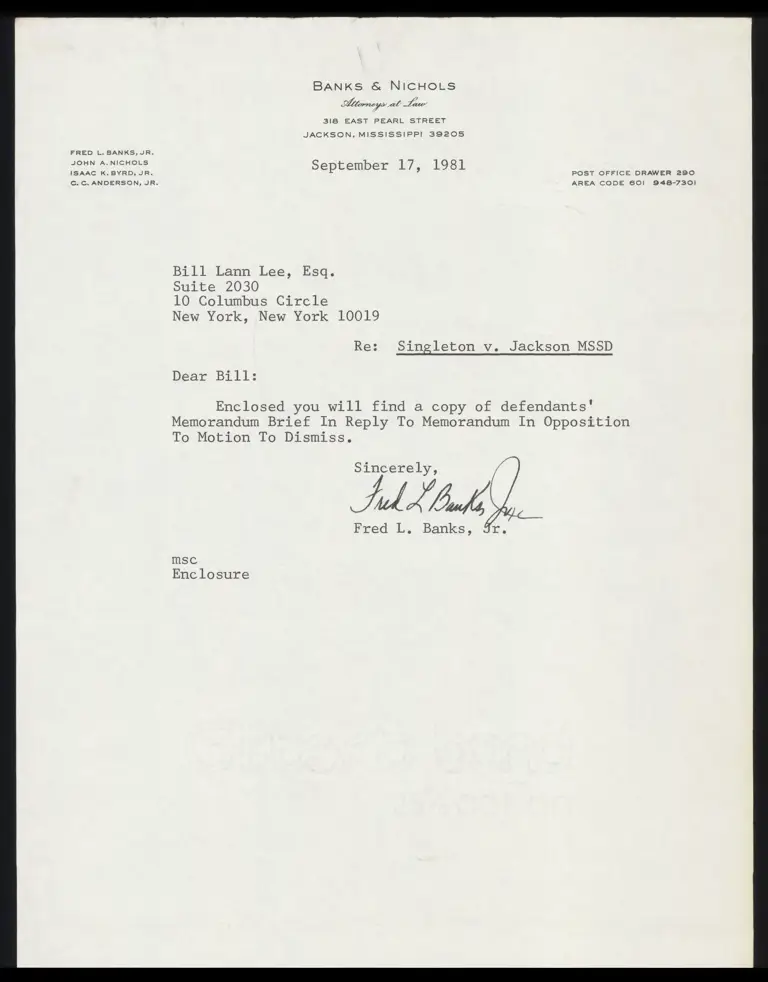
     [||e7535a76-ec19-4ab1-bba5-f1aa0100925a||] BaANks & NicHoLs

318 EAST PEARL STREET

JACKSON, MISSISSIPPI 39205

FRED L. BANKS, JR.

JOHN A.NICHOLS September 17, 1981
ISAAC K.BYRD, JR. POST OFFICE DRAWER 280

C. C. ANDERSON, JR. AREA CODE 601 948-730I

Bill Lann Lee, Esq.

Suite 2030
10 Columbus Circle
New York, New York 10019

Re: Singleton v. Jackson MSSD

Dear Bill:

Enclosed you will find a copy of defendants
Memorandum Brief In Reply To Memorandum In Opposition
To Motion To Dismiss.

Sincerely,

Fd LBA
Fred IL. Banks, Ir.

msc
Enclosure


IN THE UNITED STATES DISTRICT COURT

FOR THE SOUTHERN DISTRICT OF MISSISSIPPI

JACKSON DIVISION

DEREK JEROME SINGLETON, ET AL. PLAINTIFFS

VS. : CIVIL ACTION NO. 3379

JACKSON MUNICIPAL SEPARATE

SCHOOL DISTRICT : DEFENDANT

MEMORANDUM BRIEF IN REPLY TO MEMORANDUM
IN OPPOSITION TO MOTION TO DISMISS

8 £7

Introduction

Counsel for Plaintiff apparently does not contest the

School District's contention that it has achieved unitary status

in extracurricular activities, facilities, staff and transporta-

tion. Therefore, this reply brief will be limited to the areas

of composition of student body and faculty.

11.

Composition of Student Body

The elementary student assignment plan for the elementary

schools which was agreed to by the Plaintiffs, the Justice

Department and a court appointed bi-racial committee was entered

by this court on June 22, 1971. 1It is admitted by counsel

opposite that said consent order provided for a racially neutral

assignment plan. The School District operated under this court-

approved student assignment plan for more than three years. The

student body was effectively desegregated, and this court had

fully performed its function of providing the appropriate remedy

for the previous racially discriminatory zones. Pasadena City

Bd. of Education v. Spangler, 427 U.S. 424 (1976).

Having accomplished a unitary assignment plan, there was

no constitutional requirement that the School District make year

by year adjustments, but there was also no prohibition against


making adjustments in student attendance zones unless these

modifications were motivated by segregative actions on the part

of the School District. Swann v. Bd. of Education, 402 U.S. 1

(1971); Pasadena City Bd. of Education Vv. Spangler, supra.

Certainly counsel opposite, an experienced civil rights

attorney, was not motivated by an intent to segregate children of

-the black race when he agreed to the modifications in the elemen-

tary student assignment plan under the April 15, 1975 consent

order. Neither does he charge the School District with such

improper motivation. Therefore, the unitary nature of the School

District's student assignment plan was obsattected.

Counsel opposite contends that no student assignment

plans with statistics similar to the School District's present

statistics have ever been approved, with the exception of the

City of Atlanta. Basically, counsel opposite is comparing apples

and oranges. He is comparing the racial composition of the

School District's student body now with the racial composition

projected under court-approved desegregation plans. The School

District is not submitting a desegregation plan to this court for

approval. Its desegregation plan was approved long ago by this

court. 1t is asking this court to dismiss this case because it

is entitled to a dismissal under Swann and United States v.

Texas, 509 F.2d 192 (5th Cir. 1971). As stated by the United

States Supreme Court in Swann v. Bd. of Education:

Neither school authorities nor district
courts are constitutionally required to
make year by year adjustments of the
racial compositions of student bodies
once the affirmative duty to desegregate
has been accomplished....402 U.S. at

31-32.

Even if it were appropriate to compare the racial composi-

tion of the School District's student body today with the racial

composition of student assignment plans approved by the Fifth

Circuit, it 1s clear that the School District's student assign-

ment plan, as modified in 1975, would be approved by the Fifth

Circuit. In Carr v,., Montgomery Bad. of Education, 377 F.Supp.


3123: (M.D. Ala. 1874), aff'd 51) F.284°1374 (5th Cir. 1975),

rehearing and rehearing en banc denied 511 F.2d 1390 (5th Cir.

1975), the Fifth Circuit approved a student assignment plan which

contemplated that 51% of all black elementary students would

attend schools with student bodies 87% or more black. During the

1975-76 school year, after implementation of the April 15, 1975

court order, only 48% of the School District's black elementary

students attended schools with student bodies of 87% or more

black. These statistics are especially enlightening when con-

sideration is given to the fact that during the 1975-76 school

year, 73.5% of the School District's elementary students were

black, whereas only 50% of the elementary students in the

Montgomery, Alabama Schools were black when its desegregation

plan was approved. Also, under the Fifth Circuit approved

Montgomery, Alabama plan, 94.5% of all white elementary students

attended elementary schools with 60% of more white student popu-

lations. During the 1975-76 school year, only 14.4% of the

School District's white elementary students attended elementary

schools with 60% or more white enrollment.

Even today, with a 71.9% black elementary enrollment,

the School District. student attendance percentages compare |

favorably with the desegregation plan approved by the Fifth

Circuit in Carr v. Montgomery Bd. of Education, supra. In Carr

v. Montgomery, with a 50% black elementary enrollment, 94.5% of

all white students attended elementary schools with 60% or more

white student enrollment. Today, only 37% of the School District's

white elementary students attend elementary schools with 60% or

more white enrollment. It is true that a substantial number of

black students within the School District attend predominantly

black schools. Presently, 71.9% of the School District's elemen-

tary students are black. 72.1% of the entire student population

is black. It is inevitable that there will be several schools

with predominantly black student bodies.


However, the School District has voluntarily taken steps

to desegregate its student bodies £0 the fullest degree possible,

taking into account the practicalities of the situation. For

example, the School District's Biracial Task Force recommended

modifications in student attendance zones which increased the

black enrollment at Oak Forest Elementary School from 18.4% last

year to 25.9% this year. Forest Hill High School, which had a

black enrollment last year of 24%, has a black enrollment this

| year of 31%. Timberlawn elementary, which had a 13.6% black

enrollment last year, has an 18.2% black enrollment this year.

Whitten Jr. High School, which had a black enrollment of 26%

last year, has a black enrollment. of 33% this year. Conversely,

Hardy Jr. High School, which had a white enrollment of 11.1% last

year has a white enrollment of 18.7% this year. These modifica-

tions in student attendance zones were the result of recommen-

dations made by the Biracial Task Force in December, 1979. The

Task Force will continue to monitor student attendance and make

recommendations when necessary to insure a deseuresated student

body to the fullest degree practicable.

Counsel opposite contends that community acceptance of a

unitary system, as measured by "white flight", should be coneidered

by this court before declaring the School District unitary,

citing United States v. Corinth Mun. Separate School District,

414 F.Supp. 1336 (N.D. Miss. 1976). However, the Fifth Circuit

has refused to recognize "white flight" as a deterrent to

declaration of unitary status. In Calhoun v. Cook, supra, the

court considered the unitary status of the Atlantic Public School

Systems. In its consideration, the court stated:

Since 1958 when this school desegregation

suit was filed, the winds of legal effort
have driven wave after wave of judicial
rhetoric against the patrons of the
Atlanta Public School System. Today,
hindsight highlights the resulting errosion,
revealing that every judicial design for
achieving racial desegregation in the
system has failed. A totally segregated
system which contained 115,000 pupils 1n
1958 has mutated to a substantially
segregated system serving only 80,000


students today. A system with a 70% white
pupll majority when the litigation began
has now become a district in which more
than 85% of the students are black.
Notwithstanding the lack of success in
integrating these classrooms, our task
1s to test whether the plan approved
or district operation realistically
promises effective protection now for
the right of the pupils to a nondiscrimina-
tory education. (Emphasis supplied)

The Fifth Circuit concluded by holding that the Atlanta

School System was unitary, notwithstanding its substantial decline

in white enrollment following desegregation.

111.

Faculty

Finally, counsel opposite contends that the School

District is not unitary because of its discriminatory employment

practices. Today, 55% of the School District's junior high

teachers are black. 50% of the senior high teachers are black.

54% of the School District's elementary teachers are black. In

spite of these statistics, counsel opposite refuses to admit that

the School District has a desegregated teaching staff. Perhaps

counsel opposite's definition of a desegregated teaching staff is

one that is 100% black. Counsel opposite contends that at least

one lawsuit is pending in this court alleging unconstitutional

employment practices, as if that were probative of some fact. He

+ fails to point out, however, that no judgment has been entered

against the School District for unconstitutional employment prac-

tices for over a decade. It is ludicrous to contend that a

majority black faculty is not desegregated.

IV.

Conclusion

Counsel opposite, who has been a party to and in agreement

with every court order entered since 1971, wants this court to

retain jurisdiction over the School District because it allegedly

has not yet achieved unitary status. If counsel opposite's

watchful eye and "input from plaintiffs in every critical


decision" for the last ten years has not resulted in a unitary

school system, then counsel opposite and plaintiff have no one to

blame but themselves. However, the School District has achieved

unitary status. Contrary to counsel opposite's contention, the

sky will not fall and the schools will not resegregate when this

court dismisses this action. The biracial staff and school board

.0f the School District have made a commitment to the continuation

of a quality desegregated education for its students. It does

not need the supervision of counsel opposite to fulfill that

commitment.

Respectfully submitted,

JACKSON ynearal SEPARATE

(he; A. Speyer
Its Attorney

CERTIFICATE OF SERVICE

I, Christopher A. Shapley, attorney for Defendant, do

hereby certify that I have this day mailed by United States mail,

postage prepaid, a true and correct copy of the above and fore-

going Memorandum Brief in Reply to Memorandum in Opposition to

Motion to Dismiss to the Hon. Fred L. Banks, Jr., Banks & Nichols,

'318 East Pearl Street, Jackson, Mississippi 39205.

This the i day of September, 1981.

CHRISTOPHER A. SHEAPLERY [||e7535a76-ec19-4ab1-bba5-f1aa0100925a||]