Per Curiam Opinion
Public Court Documents
October 5, 1970
8 pages
-
Case Files, Henry v. Clarksdale Hardbacks. Per Curiam Opinion, 1970. 68abcf66-8418-f111-8342-7c1e526962fd. LDF Archives, Thurgood Marshall Institute. https://ldfrecollection.org/archives/archives-search/archives-item/d32fc545-481d-438d-9d4c-d9f9326df738/per-curiam-opinion. Accessed September 28, 2026.
Copied!
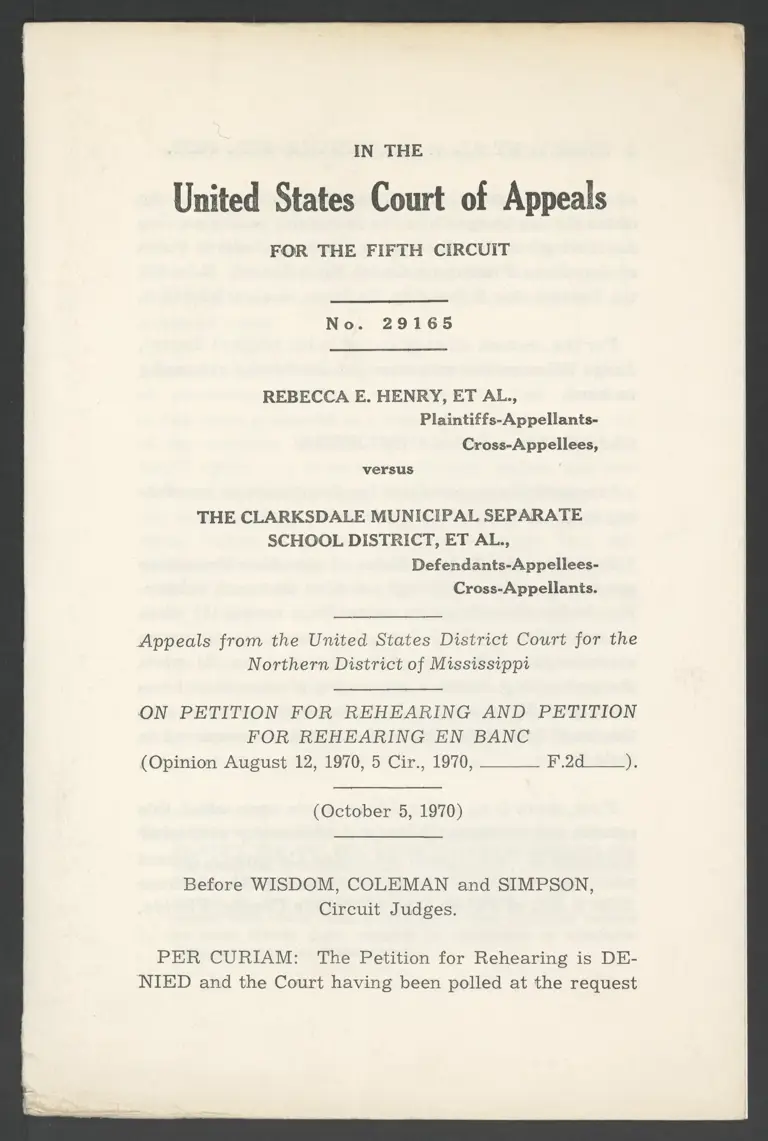
     [||e0e95809-dd0f-492f-8d3b-fd803dea49a3||] IN THE

United States Court of Appeals
FOR THE FIFTH CIRCUIT

REBECCA E. HENRY, ET AL.,

Plaintiffs-Appellants-

Cross-Appellees,

versus

THE CLARKSDALE MUNICIPAL SEPARATE

SCHOOL DISTRICT, ET AL.,

Defendants-Appellees-

Cross-Appellants.

Appeals from the United States District Court for

Northern District of Mississippi

ON PETITION FOR REHEARING AND PETITION
FOR REHEARING EN BANC

(Opinion August 12, 1970, 5 Cir., 1970, Bad),

(October 5, 1970)

Before WISDOM, COLEMAN and SIMPSON,

Circuit Judges.

PER CURIAM: The Petition for Rehearing is DE-

NIED and the Court having been polled at the request


2 HENRY, ET AL. v. CLARKSDALE SCH. DIST.

of one of the members of the Court and a majority

of the Circuit Judges who are in regular active service

not having voted in favor of it, (Rule 35 Federal Rules

of Appellate Procedure; Local Fifth Circuit Rule 12)

the Petition for Rehearing En Banc is also DENIED.

For the reasons already stated in his original dissent,

Judge Coleman dissents from the denial of a rehearing

en banc.

CLARK, Circuit Judge, DISSENTING:

I respectfully dissent from the Court’s action in refus-

ing to grant in banc reconsideration of this case.

Rule 35 of the Federal Rules of Appellate Procedure

governing in banc hearings provides that such rehear-

ings ordinarily will not be ordered “... except (1) when

consideration by the full court is necessary to secure

or maintain uniformity of its decisions, or (2) when

the proceeding involves a question of exceptional im-

portance.” My dissent is based upon the premise that

this case falls within both of the stated exceptions in

Rule 35.

First, there is no rational legal basis upon which this

opinion can consistently stand in uniformity with other

decisions of this Circuit. As Judge Coleman’s dissent

points out, Clarksdale is legally indistinguishable from

Ellis v. Bd. of Public Inst. of Orange County, Florida,


HENRY, ET AL. v. CLARKSDALE SCH. DIST. 3

423 F. 2d 203 (5th Cir. 1970). This case also violates

every ordinary precedent of this Court, of the Supreme

Court of the United States and Rule 52 of the Federal

Rules of Civil Procedure defining the limited power

of appellate courts to re-resolve fact issues decided by

a district court.

Second, the decision we refuse to review is the result

of processes, briefing, consideration and decision

in this court premised on a basis that it is, in the words

of the majority opinion, “... an extraordinary mat-

ter.” I agree — it is an extraordinary matter, and one

of exceptional importance. It is more, much more, than

one lawsuit. We are deciding on the separate educa-

tional future of more than 5,300 students. Our de-

cisions affect the rights of the parents and relatives of

each of them as well as the rights of several hun-

dred teachers, staff and administrative personnel

employed by the school system. It is hard to conceive

of any case that could involve more important dimen-

sions. Yet, under the manner in which it was decided,

we haven’t permitted the parties normal briefing time,

and counsel have been denied oral argument. The three

judges in ‘this court who participated in the making

1In addition to what Judge Coleman states I cannot agree with the

majority’s view that Ellis decided that the neighborhood sys-

tem permitted in Orange County represented “. .. the maximum

that could be accomplished” by way of numerical racial inte-

gration for that system. Obviously the Court could have re-

quired total racial balance and there were available options

no more drastic than required in Clarksdale to eliminate

Orange County’s all black schools.


4 HENRY, ET AL. v. CLARKSDALE SCH. DIST.

of this decision probably never conferred in person.®

I seriously doubt any of them, particularly the majori-

ty, would claim any personal intimacy with the phy-

sical structures in or the actual geographic makeup

of the Clarksdale School District. Notwithstanding

these circumstances, two judges of an appellate court

override the deliberate judgment of a district judge

and conclude:

... Concededly [the HEW Plan ordered into

effect immediately] is not perfect, but its one

paramount advantage outstrips and overcomes

each of the criticisms leveled at it by the dis-

trict judge: it accomplishes desegregation of

the Clarksdale Municipal Separate School Dis-

trict. As the only plan now extant even ap-

proaching this goal, its adoption for the present

at least is a must.

The objections as to children being required

to walk as much as two miles as opposed to an

average of 0.5 miles heretofore, and of having

to traverse natural or man-made barriers

[rivers, railroads and highways] and the

claim that a 2-2-2 grade division is somehow

less desirable than a 1-6 division [long in use

by the district] all fail. (Emphasis added by

the Court.)

2] intend not the slightest intimation of judicial impropriety by

making these observations. The panel strictly followed the,

now ordinary, extraordinary pattern adopted by this Court to

expedite all “school cases.”


HENRY, ET AL. v. CLARKSDALE SCH. DIST. 5

Here again our court misconceives the true end sought

— it is not statistical integration of racial groups in

school buildings but rather the protection of the equal

right of all citizens to receive a viable public education.

The problem is not to get the numbers “right”. That

kind of a problem could be solved by any mathema-

tician. Preserving an environment for education of all

citizens is the hard part, and the part in which we are

now meeting with such small success.®

Perhaps the most convincing way to demonstrate the

merit of granting in banc rehearing in this case is to

simply, briefly set out the fact context involved in the

8As I write these words (August 31, 1970), news comes that the

highly-regarded progressive superintendent of the State’s

largest school system has found it physically necessary to

resign less than two weeks before school was to start. He left

with these words:

With deep regret I have found it necessary to request

the Board of Trustees to accept my resignation as

Superintendent of the Jackson Public Schools.

As everyone is well aware the Jackson schools have

been in a continuous series of litigation involving

numerous court orders requiring the Superintendent

to administer drastic changes. Professionally and

personally I cannot continue as superintendent under

the existing situation.

I regret that I cannot be involved in developing the

outstanding school program that I am confident could

exist in Jackson. I assumed the position of superintend-

ent here to develop such a program. Unremitting dis-

ruption has prevented the accomplishment of that ob-

jective.

If we fail to get the poignant message of this last sentence, it

just might become a part of the epitaph when courts are laid

to rest with other institutions that have lost their relevance

to society’s changing demands.


6 HENRY, ET AL. v. CLARKSDALE SCH. DIST.

six matters in which we have already granted pending

in banc rehearings:

(1)

(2)

(3)

(4)

(5)

Whether an individual was properly award-

ed a money judgment against a corpora-

tion.

Household Goods Carrier Bureau vs. Ter-

rell vs. Aero Mayflower Transit Co. Inc. No.

25,989.

Whether an oil well driller may sue a Ger-

man ship and its owner in Florida.

Zapata Off-Shore Co. vs. M/S Bremen and

Unterweser Ruderi GMBH, No. 27,497.

Whether a person who has pled guilty to

bank robbery and been sentenced to twenty

years in the federal penitentiary must now

be retried because he will not let his pri-

vately hired lawyer say that he told him

the length of the maximum prison term

that could be imposed if he pled guilty.

U.S. v. Woodall, Nos. 28,352 and 28,353.

Whether a white man can challenge his

conviction on the basis of the exclusion of

Negroes from the juries which considered

his case.

Salisbury v. Grimes, No. 27,179.

Whether a person who has confessed to

making moonshine whiskey should have

his conviction reversed because the officer


HENRY, ET AL. v. CLARKSDALE SCH. DIST. 7

who stopped him as he was headed toward

the illicit still took paper sacks from him

that contained corks for the empty bottles

at the still.

U.S. v. Brookings, No. 27,067.

(6) Whether the racial and ethnic composition

of local draft boards is subject to challenge.

No. 28,295, Cortez v. Local Board

No. 28,356, Lopez v. Local Board

No. 28,113, Sumrall v. Kidd

No. 28,181, Evers v. Williams

No. 27,659, Smith v. Leach

This is not to assert that in banc consideration was

improvidently granted in the cases listed above. I only

state that if those cases are inbancworthy, a fortiori

this cause merits the same treatment. It is past time

for this largest of all the circuits to give face to face

deliberation as a court to the multi-party, multi-faceted

litigations we lump together in what we conveniently

call school cases. I regret that we keep heaping “extra-

ordinary” school case decisions on the district in this

circuit without pausing to reflect upon the real efficacy

of the ways used to meet the challenge these cases

present.

Adm. Office, U.S. Courts—Scofields’ Quality Printers, Inc., N. O., La. [||e0e95809-dd0f-492f-8d3b-fd803dea49a3||]