Motion to Affirm or Dismiss and Brief in Opposition
Public Court Documents
1983
35 pages
-
Case Files, Garner Working Files. Motion to Affirm or Dismiss and Brief in Opposition, 1983. c1b779c9-35a8-f011-bbd3-000d3a53d084. LDF Archives, Thurgood Marshall Institute. https://ldfrecollection.org/archives/archives-search/archives-item/d378de96-cffa-4b09-bd50-4ff2da348208/motion-to-affirm-or-dismiss-and-brief-in-opposition. Accessed September 27, 2026.
Copied!
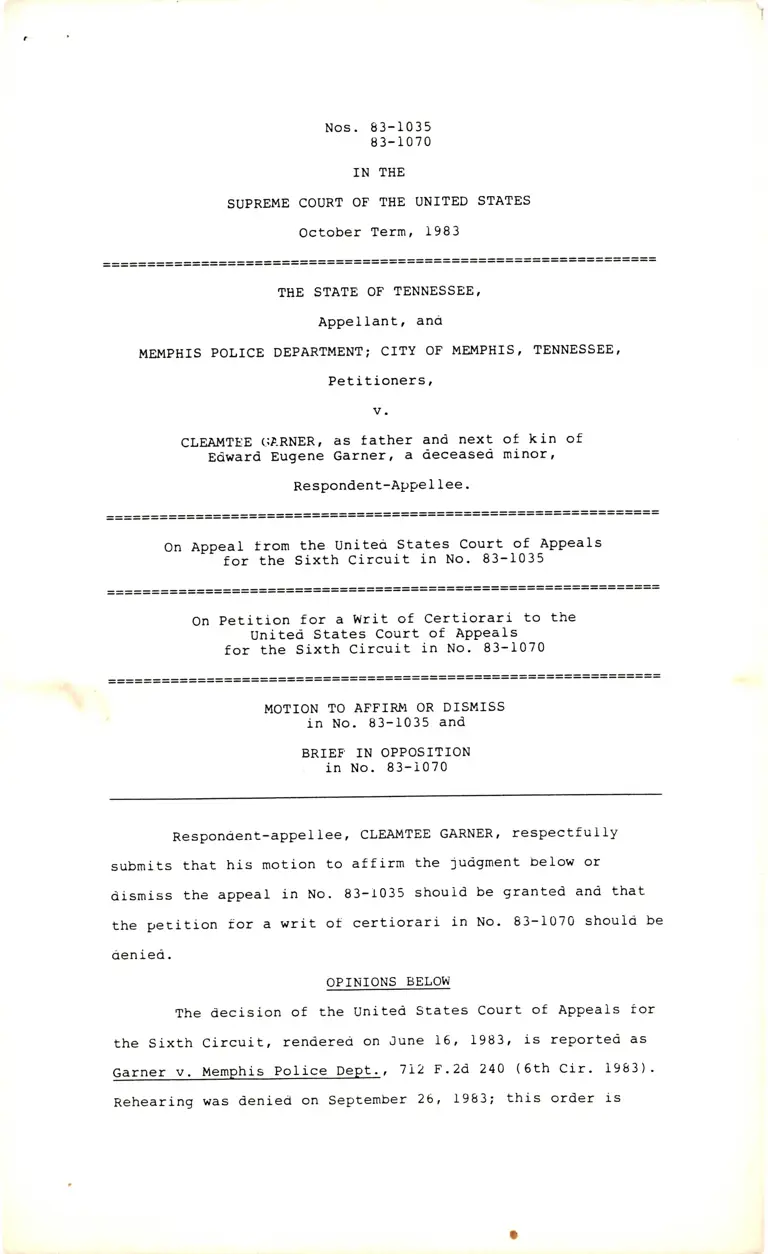
Nos. 83-1035
83-1070
IN THE
SUPREME COURT OF THE UNITED STATES
October Term, 1983
THE STATE OF TENNESSEE,
Appellant, and
MEMPHIS POLICE DEPARTMENT; CITY OF MEMPHIS, TENNESSEE,
Petitioners,
V .
CLEAMTEE OARNER, as father and next of kin of
Edward Eugene Garner, a deceased minor,
Respondent-Appellee.
On Appeal from the United States Court of Appeals
for the Sixth Circuit in No. 83-1035
On Petition for a Writ of Certiorari to the
United States Court of Appeals
for the Sixth Circuit in No. 83-1070
MOTION TO AFFIRM OR DISMISS
in No. 83-1035 and
BRIEF IN OPPOSITION
in No. 83-1070
Respondent-appellee, CLEAMTEE GARNER, respectfully
submits that his motion to affirm the judgment below or
dismiss the appeal in No. 83-1035 should be granted and that
the petition for a writ of certiorari in No. 83-1070 should be
denied.
OPINIONS BELOW
The decision of the United States Court of Appeals for
the Sixth Circuit, rendered on June 16, 1983, is reported as
Garner v. Memphis Police Dept., 712 F .2d 240 (6th Cir. 1983).
Rehearing was denied on September 26, 1983; this order is
notea at 710 F .2d at 240. The Sixth Circuit's prior opinion
* /is reported at 600 F.2d 52 (6th Cir. 1979).—
STATEMEFT OF THE CASE
Fifteen—year-old Edward Eugene Garner was shot and
killed by a Memphis police officer on the night of October
3, 1974. On April 8, 1975, Cleamtee Garner filed "an action
for damages brought pursuant to 42 U.S.C. 1981, 1983,
1985, 1986 and 1988 to redress the deprivations of the rights,
privileges and immunities or Plaintiff's deceased son, Edward
Eugene Garner, secured by the Fourth, Fifth, Sixth, Eighth
and Fourteenth Amendments to the United States Constitution."
Complaint If 2; App. 6,—^ On August 18, 1975, the district
court entered an order dismissing the City of Memphis and
the Memphis Police Department as defendants under 42 U.S.C.
§ 1983. Trial was held on August 2 through 4, 1976. On
September 29, 1976, the district court entered a memorandum
opinion rendering judgment for the defendants.
Plaintiff appealed. The court of appeals. Chief
Judge Edwards and Judges Merritt and Lively, reversed ana
remanaed the case for reconsideration in light of Moneli v.
Department of Social Services, 436 U.S. 658 (1978) . One of
the questions that it listed for consideration on remand was
whether "a municipality's use of deadly force under Tennessee
law to capture allegedly nondangerous felons fleeing from
*/ Citations to the opinion below are to the appendix to
the petition for a writ of certiorari in No. 83-1070 and
are designated as A. Citations to the record below
are to the Joint Appendix in the Sixth Circuit and are
designated as App. ____.
1/ The suggestion by the state, appellant in No. 83—1035,
that the fourth amendment had not been raised, see Jurisdictional
Statement at 5, is incorrect. Indeea, the district court
noted in its initial opinion that: "Plaintiff cited specific
ally in this regard the Fourth Amendment right to be free of
unreasonable seizure of the body ... incorporated into the
due process clause of the Fourteenth Amendment and made
applicable to the States." A. 2. See also Complaint If 19,
App. 11-12; Memorandum Opinion of Feb. 29, 1980, A. 21.
- 2 -
nonviolent crimes [is] constitutionally permissible under
the fourth, sixth, eighth and fourteenth amendments?" Garner
V . Memphis Police Dept., 600 F .2d 52, 55 (6th Cir. 1979); A.
18. It also remanded for consideration of the question of
Memphis's "policy or custom" for purposes of liability under
Monell. Id., 600 F.2d at 55; A. 19.
On remand, the district court denied plaintiff the
opportunity to introduce additional evidence on the question
of the Memphis "policy or custom," to submit an offer of
proof, or to submit a brief on the merits; it entered judgment
for the defendants. A. 20. After consideration of plaintiff's
motion to reconsider, the court allowed the submission of a
brief and offer of proof and then again entered judgment for
the defendants. A. 31. The court of appeals. Chief Judge
Edwards and Judges Merritt and Keith, reversed. It held
that the Tennessee statute, Tenn. Code Ann. § 40-808 (1975),
violated the fourth amendment and the due process clause of
the fourteenth amendment "because it authorizes the unnecessarily
severe and excessive, and therefore unreasonable," use of
deadly force to effect the "arrest" of unarmed, nonviolent,
fleeing felony suspects such as plaintiff's son. 710 F .2d
at 241; A. 40-41. Rehearing and rehearing en banc were
denied on September 26, 1983. 710 F .2d at 240; A. 58.
STATEMENT OF FACTS
A. The Facts Regarding the Shooting
At the time of his death, Edward Eugene Garner was
fifteen-years-old. He was an obvious juvenile; slender of
build, he weighed between 85 and 100 pounds and stood only
five feet and four inches high. App. 78 and 290-91. He
- 3 -
had a minor juvenile record. At the age of 12, he and two
other boys illegally enterea the house in whose yard they
were playing. App. 686 and 689. In July of 1974, his family
called the police when they discovered that he had taken a
jar of pennies from a neighbor's house.— He was placed on
probation for one year. App. 88-89 and 689. There was also
a prior arrest for a curfew violation, but that was resolved
when it was explained that young Garner was working at a
local store and under supervision at the time. App. 84 and
693-94.
On the night of October 3, 1974, Officers Hymon and
Wright responded to a burglary in progress call at 737
Vollentine in Memphis,. When they arrived at that address, a
woman was standing in the door pointing at the house next
door. Upon inquiry by Officer Hymon, she said that "she had
heard some glass breaking or something, and she knew that
somebody was breaking in." App. 207.—^ Hymon went around
the near side of the house, his revolver drawn, while Wright
went around the far side. Hymon reached the backyard first,
where he heard a door slam and saw someone run from the back
of the house. He locatea young Garner with his flashlight:
2/ The neighbor declined to call the police about this
minor incident. It was the family that insisted that the
police be called. App. 88-89.
3/ Hymon testified that: "Roughly I recall her saying,
'They are breaking inside....'" App. 207. He qualified
that testimony when He was asked: "Did you understand her
to be saying that there were several people inside the house?
He responded: "I don't really think she knew. I think that
she — I think that she might have mentionea that she had
heard some glass breaking or something, and she knew that
somebody was breaking in. I don't think that the plural
form had any indication of her knowing." Id.
This version was corroborated by his partner. Officer
Wright. He testified that: "I was leaning over in the
street like this to hear what she was saying through the
open door. She said, 'Somebody is breaking in there right
now.'" App. 707.
- 4 -
Garner was crouched next to a six foot cyclone fence at
the back of the yard about 30 to 40 feet away from Hymon.
Hymon was able to see one or both of Garner's hands; he
concluded that Garner was not armed. App. 239, 246-47, 658,
and 677.-^
While young Garner crouched in Hymon's flashlight
beam, Hymon identified himself and ordered Garner to halt.
Garner paused a few moments during which Hymon made no attempt
to advance,-^ but continued to aim his revolver at Garner.
Garner bolted, attempting to jump the fence. Hymon fired,
striking young Garner in the head. Garner fell, draped over
the fence. He did not die immediately; when the paramedics
arrived on the scene "he was holding his head and just
thrashing about on the ground," App. 141, "hollering, you
know, from the pain." App. 137. Edward Eugene Garner died
on the operating table. App. 153.
4/ At his deposition, introduced into evidence, Hymon
testified that: "I am reasonably sure that the individual
was not armed___ " App. 246. On direct examination by the
city at trial, Hymon was asked; "Did you know positively
whether or not he was armed?" He replied: "I assumed he
wasn't...." App. 658.
Hymon also testified that Garner did not act as an
armed suspect would, neither firing a weapon not throwing it
down. App. 246. He testified that: I figured, well, if
he is armed I'm standing out in the light and all of the
light is on me the[n] I assume he would have made some kind
of attempt to defend himself...." App. 658. That officer
Hymon operated on the assumption that young Garner was
unarmed is further corroborated by his testimony that he
"definitely" would have warned his partner if he had had any
question whether Garner was armed, App. 246-47, and that: "I
would have taken more cover than what I had."
5/ Hymon testified that he did no more than take "a couple
of steps," App. 651, "which wasn't, you know, far enough to
make a difference." App. 256. Officer Wright testified
that when he rounded the corner of the house after the shot,
Hymon "was standing still...." App. 720. According to
Wright, it took only "three or four seconds" for Hymon to
reach Garner after the shot. Id.
- 5 -
There was no one home when the house was broken
into. After the shooting, the police found that young
Garner had ten dollars and a coin purse taken from the
house. App. 737. The owner of the house testified that the
only items missing were a coin purse containing ten dollars
and a ring belonging to his wife, but that the ring was
never found. The ten dollars were returned. App. 169.-'^
Plaintiff called two expert witnesses — Chief Detective
Dan Jones of the Shelby County Sheriff's Department and
Inspector Eugene Barksdale, former commander of the personal
crimes bureau of the Memphis Police Department — to testify
about the reasonableness of Hymen's use of deadly force
under the circumstances. As the district court found: "The
substance of such testimony was to the effect that Hymon
should first have exhausted reasonable alternatives such as
giving chase and determining whether he had a reasonable
opportunity to apprehend him in some other fashion before
firing his weapon." A. 8. Both Jones and Barksdale testified
that Hymon "should have tried to apprehend him," App. 278
and 375; Barksdale added that "in all probability he could
have apprehended the subject without having to shoot him....
App. 373.
B . The Memphis Policy or Custom; Liberal Use of Deadly
Force
Because of the district court's decision not to allow
further hearings on remand, the record on the question of
"policy or custom" is a hybrid. It consists of the evidence
adduced at the original trial and the offer of proof tendered
on remand.
6/ The owner also testified that: "The first -- I had some
old coins in there and when they did let me in, I went to
them. They were still there." 1^.
- 6 -
At trial, plaintiff called Captain Coletta, who was
responsible for recruit training and the ammunition policies
of the Memphis Police Department. He testified that the
department used the film "Shoot - Don't Shoot," which presents
only armed fleeing felons in its situational illustrations
of the fleeing felon rule, App. 329-32; that there was no
training in alternatives that should be exhausted before
resorting to aeadly force to stop unarmed fleeing felony
suspects, App. 340; that the department's firearms manual
details firearms techniques, but not techniques to avoid the
need for the use of weapons, App. 344-45; and that the use
of deadly force to stop fleeing felony suspects is left to
the individual officer's aiscretion: recruits are simply
told that they must live with themselves if they kill a
person. App. 326 and 345. Accord App. 195-96, 901, 956,
and 1796.
According to Captain Coletta, the Memphis police have
always used a .38 caliber Smith and Wesson. In the years
immeaiately preceding the Garner shooting, Memphis twice
upgraded its ammunition to bullets with greater velocity,
accuracy, and predicted wounding power. App. 413-16, 425-
27, and 447. The bullet that was finally selected was the
125 grain, semi-jacketed, hollow-point Remington. Both
Coletta ana the Shelby County meaical examiner testified
that this bullet is a "dum-dum" bullet banned in international
use by the Hague Convention of 1899 because it is designed
to produce more grievous wounds. App. 487-88 and 572. This
is the bullet that killed young Garner.
- 7 -
Finally, Coletta testified that Memphis recruits are
taught to aim at the torso, or "center mass," where vital
organs are more likely to be hit. App. 357-58. See_also
App. 1597 and 1807-08. In a prior case, the district court
found that Memphis police officers "were trained whenever
they use their firearms to 'shoot to kill.’" Wiley v. Memphis
Police Dept., 548 F .2d 1247, 1250 (6th Cir. 1977).
On remand, plaintiff assembled an extensive offer of
proof on the question of the Memphis policy or custom.
App. 762-1891. Organized in fifteen parts, it contains
affidavits of expert witnesses who would have been called to
testify, App. 765-97; excerpts from prior federal cases
against the Memphis Police Department that illuminate Memphis s
actual policies and customs regarding the use of deadly
force, App. 798-1019, 1409—57, 1460—69, 1477—1601, and 1614
1891; excerpts from the report of the Tennessee Advisory
Committee to the U.S. Commission on Civil Rights, which was
based on hearings on civil rights abuses by the Memphis
Police Department, App. 1050-58; the deadly force policies
of 44 major municipalities, App. 1108-1368; the training
materials tor the New York Police Department, App. 1369-
140b; and an excerpt from an LEAA publication on aeadly
force that details police training procedures used in other
cities but not in Memphis. App. 1602-13.
It is beyond the scope of this submission to summarize
these materials in depth. In general, these materials in
dicate the deficiencies in the Memphis policies and customs
concerning the use of deadly force in rerms of written policy,
actual practice, training, and discipline. For example, one
- 8 -
of plaintiff's experts was William R. Bracey who, at the
time of his affidavit, was Chief of Patrol of the New York
Police Department with supervisory authority over all 17,500
uniformed personnel of the New York Police Department. He
would have testified: that guidelines and committed enforce
ment of those guidelines by the police hierarchy will lead
to reductions in the use of unnecessary deadly force; that
New York has reduced firearms discharges by 50% by these
means; that the result of this reduction has been the increased
safety of New York Police Department officers with fewer
assaults on officers and fewer deaths; that law enforcement
has been unhampered; that training, including training in
alternatives to minimize the need for use of deadly force,
and discipline are the keys to reducing unnecessary deadly
force; that shooting unarmed fleeing felons is related to
the officer's subjective notions of punishment; and that the
Memphis policies of shooting fleeing property crime suspects,
use of "dum-dum" bullets, and training and discipline were
all deficient. App. 765-76.
Similarly, the Memphis-specific materials show a policy
or custom that can only be characterized as a liberal use of
deadly force policy. The Memphis policy has been one of
ready resort to deadly force which, as in this case, has
served as a disincentive to the exhaustion of reasonable
alternatives by the police officer. See, e.g., App. 798-818
(Preliminary Report of Jan. 18, 1972); App. 819-74 (Deposition
of Officer Fredrick). This has been reinforced both by the
public statements of Memphis mayors and police directors,
see App. 1632 and 1825-28, and the operation of the Memphis
- 9 -
Police Department disciplinary system: No Memphis police
otficer has ever been disciplined for the use oi his gun,
App. 547 and 1858; the civilian complaint procedures are
7/designed to deter complaints, App. 1050-58.—
C . The Memphis Policy or Custom: Race Discrimination
The materials contained in the offer of proof strongly
support a tinaing that the Memphis deadly force policy runs
afoul of the Constitution in another fundamental way not
discussed by the court of appeals: It is a policy that
discriminates on the basis of race.
The offer of proof contains the raw data concerning
all arrests in Memphis between 1963 and 1974, App. 1409-57
and 1767-68; aata on all shootings of fleeing property crime
suspects between 1969 and 1974, App. 1460-69; data on all
those killed by Memphis police officers between 1969 and
1976, App. 1764-67 and 1071;-^ prior analysis of this data
by a statistician, App. 1769-77, and his testimony at an
earlier trial regarding this analysis, App. 1559-62 and
1589-92; historical data regarding race discrimination by
the Memphis Police Department from 1874 through the mid
seventies, including the deposition testimony of the mayor
and police director supporting this conclusion, App. 908-
910, 928-32, 972-74, 1539-40, 1571-75, 1646-56, 1677-78,
lb90, and 1828-29; and the affidavit of plaintiff's expert.
7/ The two salient procedures that deter complaints are
the rule that all complainants must take a polygraph while
no officer is ever required to and that the officer against
whom a charge is made must immediately be notifiea or the
complainant's name and address. App. 1050-58.
8/ All of the foregoing data was collected and provided by
the Memphis Police Department as defendant in Wiley v. Memphis
Police Dept., Civ. Action No. C-73-8 (W.D. Tenn. June 30,
1975), atf'd, 548 F.2d 1247 (6th Cir. 1977).
- 1 0 -
Dr. James J. Fyfe,-'^ which analyzed in detail the arrest and
shooting data contained in the offer of proof. App. 787-97.
On the use of deadly force, the data reveal that
there are significant disparities based on the race of the
shooting victim/suspect and that virtually all of this dis
parity occurs as the result of the Memphis policy that allows
officers to exercise their discretion to shoot fleeing property
crime suspects. Between 1969 and 1976, blacks constituted
70.6% of those arrested tor property crimes in Memphis but
88.4% of the property crime suspects shot at by the Memphis
police. In contrast, the percentage of black violent crime
suspects shot at by Memphis police was closely proportionate
to their percentage in the violent crime arrest population:
85.4% and 83.1%, respectively. App. 1773.
Dr. Fyfe reviewed this data and concluded that con
trolling for differential racial representation in the arrest
population, black property crime suspects were more than
twice as likely to be shot at than whites (4.33 per 1000
black property crime arrests; 1.81 per 1000 property crime
arrests), four times more likely to be wounded (.586 per
1000 blacks; .1113 per 1000 whites), and 40% more likely to
be killed (.63 per 1000 blacks; .45 per 1000 whites). App.
792. Comparison of shootings by Memphis Police officers
while controlling for race of the shooting victim and the
nature of the incident provided similarly striking data.
His analysis of the shooting incidents between 1969 and 1976
described by the Memphis Police Department to the Civil
9/ Dr. Fyfe is a former New York Police Department lieutenant
and training officer. He designed a firearms trainings
program for the New York Police Department in which over
20,000 officers have participated. His aoctorai thesis
concerned the use of deadly force by New York Police Depart
ment officers. He is an associate professor at The American
University in Washington, D.C., and has served as a consultant
on the deadly force issue for the United States Department
of Justice and the Civil Rights Commission. App. 788-89.
He also teaches courses at the F.B.I. National Academy at
Quantico, Va.
- 1 1 -
Rights Commission showed a dramatic disparity between the
situations in which whites were killed and those in which
blacks were killed. Of the blacks shot/ 50% were unarmed and
nonassaultive, 23.1% assaultive but not armed with a gun,
26.9% assaultive and armed with a gun. Of the whites shot,
only one was non—assaultive (12.5%), five (62.5%) were armed
with a gun, and the remaining two (25%) were assaultive but
not armed with a gun.— ^ Based on this data. Dr. Fyfe con
cluded that, during the period in question, Memphis police
^02̂ 0 fai' more likely to shoot blacks than whites in non-
threatening circumstances and that the great disparity in
blacks shot by Memphis police officers is largely accounted
for by the policy allowing the shooting of non-aangerous
fleeing felony suspects. Between 1969 and 1976, Memphis
police killed 2.6 unarmed, non-assaultive blacks tor each
armed, assaultive white. App. 793-94.
Plaintiff proffered this evidence having previously
requested both additional discovery and a hearing on these
factual questions. The district court, in its post
reconsideration order, A. 31, rejected Dr. Fyfe's conclusions
on the basis of several unsupportable considerations. It
noted Dr. Fyfe's "bias," A. 34, having never seen him testify.— '̂
It attacked Dr. Fyfe's conclusions because, it claimed, he
failed to "specify the actual number of blacks arrested
10/ Dr. Fyfe noted that: "These are certainly dramatic
Qifferences, but no measure of their significance is possible
because the only statistically significant category of
v^hitss killed is those armed with guns. App. 794.
11/ The district court's "bias" finding was based on Dr.
Fyfe's disagreement with the Memphis policy allowing the ^se
of deadly force against nondangerous suspects. This "bias,"
however, is the official policy of the F.B.I. and numerous
metropolitan police departments as disparate as New York,
Atlanta, and Charlotte, North Carolina. See App. 1113,
1200, 1293, and 1869.
- 1 2 -
,nd/or convicted tor alleged 'property crimes' as compared
to whites curing this period." A. 32. But, as discussed
above, Dr. Fyfe's analysis specifically "controls for dif
ferential involvement among the races in property crime...,"
App. 792; indeed, the data on which Dr. Fyfe relied was
included in the offer of proof ana provided the actual number
or both white and black property crime arrests together with
the raw data of all arrests. App. 1409-57 and 1767-68. The
district court questioned the delineation of "'property
crime' in the Fyfe definition." A. 32. But the delineation
between property crimes and violent crimes that Dr. Fyfe
employed was that made by the Memphis Police Department
and included with the arrest statistics. App. 1559 and
1767-68. In numerous similar ways, the district court either
12/misapprehended or deliberately distorted Dr. Fyfe s
proffered testimony.
12/ For example, in questioning Dr. Fyfe's observation that
the incidence of use of deadly force in property crime arrests
in Memphis tar exceedea that in New York, the district court
noted that: "Professor Fyfe admitted his comparison was not
'precise' in respect to 'property crimes' comparison." A. 332a way3 ^ ^ A l l A ^ V. w — J — — - - t
n. 1. But Dr. Fyfe accounted for this imprecision in
that favored Memphis. His "admission" was that:
More than half (50.7 percent) of the police
shootings in Memphis during 1969-1974 involved shoot
ing at property crime suspects. The comparable
percentage in 1971-1976 in New York was no more
than 11.8 percent. This comparison is not precise
because the New York City figure includes all shoot
ings to "prevent or terminate crimes." Thus, it
includes shootings precipitated by both property
crimes and crimes of violence. My estimate of the
percentage of New York City police shootings which
involved property crime suspects only is four percent.
App. 791.
Similarly, in arguing that Dr. Fyfe failed to control
for disparate racial involvement in the underlying felonies,
the district court alleged that Dr. Fyfe "concedes elsewhere
that there is also 'differential racial involvement in police
shootings.'" A. 32. What Dr. Fyfe said, however, is that;
"In New York City, differential racial involvement in police
shootings also exists, but [unlike Memphis] it is almost
totally accounted for by differential racial involvement in
the types of activities likely to precipitate shootings."
App. 792.
- 1 3 -
Because the court of appeals held that the Tennessee
fleeing felon statute violates the fourth amendment and the
due process clause, it did not reach the race discrimination
issue.
REASONS FOR DENYING REVIEW
I. THE COURT OF APPEALS CORRECTLY HELD THAT A
STATE STATUTE THAT CONFERS UNLIMITED DIS
CRETION ON POLICE OFFICERS TO SHOOT NON-
DANGEROUS, FLEEING FELONY SUSPECTS WHOM THEY
REASONABLY ASSUME TO BE UNARMED VIOLATES
ESTABLISHED CONSTITUTIONAL PRINCIPLES_______
The court of appeals applied established constitu
tional principles to review a state statute that authorizes
police officers to use deadly force against non-dangerous,
fleeing felony suspects. It held that the fourth amendment
applies and that it requires reasonable methods of capturing
suspects. 710 F.2d at 243; A. 44. As at common law — when
all felonies were capital offenses, the fleeing felon doctrine
authorized the use of deadly force to prevenr the felon's
escape — the court of appeals held that the fourth amendment
allows only the reasonable, proportional use of deadly force
in the arrest context: i.e., "the police response must
relate to the gravity and need...." Bivens v. Six Unknown
Agents, 403 U.S. 388, 419 (1971) (Burger, C.J., dissenting).
Since the use of deadly force against unarmed, nonviolent
felony suspects is excessive, it violates the fourth amendment
710 F.2d at 246; A. 51.
The court of appeals also held that the use of deadly
force against unarmed, nonviolent felony suspects violates
due process. The due process clause explicitly protects the
right to life, U.S. Constitution Amend. XIV, ̂ i; Williams
V. Kelly, 624 F.2d 695, 697 (5th Cir. 1980), a right so
- 1 4 -
axiomatic that it is an understatement to characterize it as
"rundamental." Compare Yick Wo v. Hopkins, Ufa U.S. 356,
370 (1886) ("the fundamental rights to life, liberty and the
pursuit of happiness"), and Johnson v. Zerbst, 304 U.S. 458,
462 (1938) ("fundamental human rights of life and liberty"),
with Trop v. Dulles, 356 U.S. 86, 102 (1958) ("the right to
have rights"). The Tennessee statute falls under the due
process clause because the state interests cannot support
the taking of life in the context of a nonviolent, nondangerous
felony. 710 F .2d at 246-47; A. 52-53.
The state and the city argue that the court of appeals
erred because the fourth amendment does no more than set the
minimum standard — i.e., probable cause -- for initiating
an arrest, but that it does not govern the manner of police
action in effectuating that arrest. Jurisdictional Statement
at 8-9; Cert. Petition at 10-11. They argue that the reliance
by the court of appeals on the Fourth Circuit s ruling
in Jenkins v. Averett, 424 F .2d 1228 (4th Cir. 1970), is
misplaced because in Jenkins the officer had no probable
cause to arrest and, thus, was not authorized to use any
force. Jurisdictional Statement at 8; Cert. Petition at 11.
Finally, they argue that the Court should grant review because
the decision in this case conflicts with that of the Second
Circuit in Jones v. Marshall, 528 F.2d 132 (2d Cir. 1975).
Jurisdictional Statement at 10; Cert. Petition at 10.
The state and the city are wrong on each of these
points, and the court of appeals is correct. As we show
below, the fourth amendment plainly applies under the prin
ciples consistently enunciated by this Court and affirmed
- 1 5 -
again only last Term. Moreover, the ruling below is entirely
consistent with the decision in Jenkins and the parallel
authority in every circuit, including the Second Circuit.
The Tennessee statute at issue, Tenn. Code Ann. § 40-
S08, provides that;
Ir, after notice of the intention to arrest the
defendant, he either flee or forcibly resist, the
officer may use all the necessary means to effect
the arrest.
Id. It is an arrest statute; there can be no suggestion
that "such police conduct is outside the purview of the
Fourth Amendment. Terry v. Ohio, 392 U.S. 1, 16 (1968). The
fourth amendment speaks directly to: "Tie right of the people
to be secure in their persons ... against unreasonable ...
seizures___ " U.S. Constitution Amend. IV; Terry, 392
U. S. at 16 ("It is quite plain that the Fourth Amendment
governs 'seizures' of the person.,.."); accord United States
V , Place, U.S. ____, 77 L.Ed.2d 110, 121—22 (1983);
Dunaway v. New York, 442 U.S. 200, 207 (1979); Cupp v. Murphy,
412 U.S. 291, 294 (1973); Davis v. Mississippi, 392 U.S.
721 , 726-27 (1969) .
Moreover, the Court has long repudiated the contention
that the fourth amendment governs only the "when" of police
action and not the "how," Only last Term, the Court reaffirmed
what it "observed in Terry, '[t]he manner in which the
seizure ...[was] conducted is, of course, as vital a part of
the inquiry as whether [it was] warranted at all.'" United
States V . Place, 77 L.Ed.2d at 121 (quoting Terry, 392 U.S.
- 1 6 -
28).— ^ Place, the court went on to "examine the
agents’ conduct.,.." i^., and round it "sufficient to render
the seizure unreasonable." at 122. See Schmerber v.
California, 384 U.S, 757, 768 (1966) ("whether the means and
procedures employed ,.. respected relevant Fourth Amendment
standards of reasonableness"); Ker v. California, 374 U.S.
23, 38 (1963) (whether "the method of entering the home may
offend federal constitutional standards of reasonableness");
United States v. Calandra, 414 U.S. 338, 346 (1974) (subpoena
"'far too sweeping in its terms to be regarded as reasonable'
under the Fourth Amendment") (aicta).
In determining the reasonableness of the use of deadly
force under the fourth amendment, the court of appeals followed
exactly the mode of analysis applied by this Court in considering
other forms of police action.
Terry and its progeny rests on a balancing of the
competing interests to determine the reasonableness
of the type of seizure involved within the meaning
of "the Fourth Amendment's general proscription
against unreasonable searches and seizures." 392
U.S. at 20. We must balance the nature and quality
of the intrusion on the individual's Fourth Amendment
interests against the importance of the governmental
interests alleged to justify the intrusion.
Un ited States v. Place, 77 L.Ed.2d at 118.— ^ The court
12/ In Terry, the Court added that: "The Fourth Amendment
^oceeds as much by limitations upon the scope of governmental
action as by imposing preconditions upon its initiation."
392 U.S, at 28-29.
13/ In fact, this mode of analysis did not originate in
Terry; the Terry Court derived it from the decision in Camara
V . Municipal Court, 387 U.S. 523 (1967):
In order to assess the reasonableness of the police
conduct as a general proposition, it is necessary
"first to focus upon the governmental interest
which allegedly justifies official intrusion upon
the constitutionally protected interests of the
private citizen," for there is "no ready test for
determining reasonableness other than by balancing
the need to search [or seize] against the invasion
which the search [or seizure] entails."
Terry, 392 U.S. at 20-21 (quoting Camara, 387 U.S. at 534-
35, 536-37).
- 1 7 -
ot appeals looked at the "nature and quality of the intrusion:"
As an intrusion by police, the use of deadly force is "a
method 'unique in its severity and irrevocability.'" Garner,
710 F .2d at 243; A, 44 (quoting Gregg v. Georgia, 428 U.S.
153, 187 (1976)). It balanced this against the state's
interests and concluded that, as was true at common law, the
state interests are proportionate only when the underlying
felony is a violent one or the fleeing suspect will endanger
the physical safety of others.— '̂ The court of appeals thus
properly applied settled fourth amendment principles and
correctly arrived at the decision below.
Nothing in Jenkins v. Averett, on which the court of
appeals relied, is inconsistent with this reasoning. Nowhere
in Jenkins did the Fourth Circuit engage in the reasoning
suggested by the state and the city: that the shooting
violated the fourth amendment because there was no probable
cause to arrest. To the contrary, the Fourth Circuit never
discussed whether the police were authorized to stop Jenkins.
Rather, the vice it found was that "our plaintiff was subjected
to the reckless use of excessive force." 424 F .2d at 1232
(emphasis added).
Jenkins was premised on the principle that the fourth
amendment protects the "inestimable right of personal
security." ^ . , 424 F .2d at 1232 (quoting Terry v. Ohio, 392
U.S. at 8-9). Accord Florida v. Royer, 460 U.S. ____, 75
L.Ed.2d 229, (1983); Davis v. Mississippi, 394 U.S. at
726-27 ( "Nothing is more clear than that the Fourth Amendment
was meant to prevent wholesale intrusions upon the personal
14/ The city argues that the court of appeals ”fail[ed] to
recognize the valid state interests encompassed by the
statute...." Cert. Petition at 11. This is false. The
scope ot the state interests in the use of deadly force were
fully briefed in the court below. Brief tor Appellees at
18; Brief for Appellant at 21-28, 33-35. They will not be
recapitulated here because of the necessary length of such a
discussion. Suffice it to note that the question was fully
considered by the court below; it simply decided the issue
adverse to the city.
- 1 8 -
security of our citizenry...."). As such, the fourth amendment
"shield covers the individual's physical integrity." Jenkins,
424 F.2d at 232. See Schmerber v. California 384 U.S. 767
("we are dealing with intrusions into the human body").
Every circuit has concurred in this conclusion, although
most now follow the Second Circuit's lead as articulated by
Judge Friendly in Johnson v. Click, 481 F .2d 1028 (2d Cir.),
cert, denied, 414 U.S. 1033 (1973, that "quite apart from
any 'specific' of the Bill of Rights, application of undue
force by law enforcement officers deprives a suspect of
liberty without due process of law." at 1032; accord
Landriqan v. City of Warwick, 628 F .2d 736, 741-42 (1st Cir.
1980) (citing United States v. Villarin Gerena, 533 F .2d
723, 728 (1st Cir. 1977) (fourth and fifth amendments));
Howell V . Cataldi, 4 64 F .2d 272 (3rd Cir. 1972); United
States V . Stokes, 506, 771, 775-76 (5th Cir. 1975); Tefft
V . Seward 689 F.2d 637, 639 n. 1 (6th Cir. 1982); Byrd v.
Brishke, 466 F .2d 6 (7th Cir. 1972); Herrera v. Valentine,
653 F.2d 1220, 1229 (8th Cir. 1981); Gregory v. Thompson,
500 F.2d 59 (9th Cir. 1974); Morgan v. Labiak, 368 F .2d 338
(10th Cir. 1966); Carter v. Carlson, 447 F.2d 358 (D.C. Cir.
1971), rev'd on other grounds, 409 U.S. 418 (1973). The
court of appeals simply applied the well established prin
ciple that excessive force by law enforcement personnel
violates the fourth amendment and the due process clause to
- 1 9 -
the facts of this case.— ^
The state and city's argument that the decision below
is in conflict with the Second Circuit opinion in Jones v.
Marshall is simply wrong. Jones was decided before Monel1.
Jones decided only the question of the privilege the police
officer could invoke under § 1983, not the substantive
constitutional question under the fourteenth amendment.
15/ In the courts below, respondent-appellee advanced
another, established, due process principle that supports
the judgment. The due process clause provides "protection
against punishment without due process of law...." Bell v.
Wolfish, 441 U.S. 520, 535 (1979(; accord Ingraham v.
Wright, 430 U.S. 651, 671-72 n. 40 (1977); Kennedy v.
Mendoza-Martinez, 372 U.S. 144, 165-67 (1963); Screws
United States, 325 U.S. 91, 106 (1945); Krause_______
572 (6th Cir. 1977). Application of the
criteria, cited in Wolfish as "useful
S
Rhodes
570 F.2d 563,
Mendoza-Martinez
seven
guideposts," 441 U.S. at 538, establishes that the shooting
of nondangerous, fleeing felony suspects "amounts to punish
ment," id. at 535, in violation of the due process clause.
Sherman, Execution Without Trial: Police Homicide and the
Constitution, 33 Vand. L. Rev. 71 (1980). This conclusion
is particularly supported by the history of the common law
fleeing felony doctrine, which was a direct outgrowth of the
application of capital punishment and, in its earliest in
carnations, summary punishment for all felonies. Sherman,
supra, at 81; see also 4 W. Blackstone, Commentaries 98
(Garland ed. 1978); United States v. Clark, 31
(C.C.E.D.Mich. 1887); Bohlen & Schulman, ________________
Without a Warrant, 75 U. Pa. L. Rev. 485, 495 (1927); Note,
Legalized Murder of a Fleeing Felon, 15 Va. L. Rev. 582, 583
_ Fed. 710,
Arrest With and
713
1929); T. Taylor, ____________
28 (1968); R. Perkins, Criminal
The Use of Deadly Force in Arizona
495
Va. L
Two Studies in Constitutional Interpretation
Law 10 (2d ed. 1969); Note,
by Police Officers, 1972
L. & Soc. Order 481, 482 Comment, Deadly Force to Arrest;
Triggering Constitutional Review, 11 Harv. Civ. Rights &
Civ. Lib. L. Rev. 361, 365 (1974). In addition, the Memphis
policy promotes one of "the traditional aims of punishment."
Mendoza-Martinez, 372 U.S. at 168-69. The record establishes
"that one of the principal purposes of Memphis's policy ...
is to deter criminal conduct." Wiley, Civ. Action No. C-73-
8, Slip op. at 13; see App. 962, 1832-33 and 1848-50. Neither
of the courts below, however, addressed this aspect of the
due process issue.
- 2 0 -
Id., 528 F.2d at 137, 138, 140. 142. Indeed, it expressly
rejected the view of the defendant in that case that the
Connecticut statute was constitutional and that no further
analysis was necessary. I^. at 137. Rather, it noted that
Johnson v. Click provides the controlling constitutional
principle, i^. at 139, declined to assess the balance of
the competing interests, 3t 142, and instead incorporated
the Connecticut rule of the officer's privilege as a defense
to the § 1983 action. Id. at 138, 142. Thus, the opinion
in Jones is in striking conformity with the rulings of the
court of appeals in this case. On the first appeal, the
Sixth Circuit held that the officer was entitled to invoke
the qualified privilege of good faith reliance on state law.
Garner, 600 F .2d at 54; A. 16-17. On the second appeal, it
reached the constitutional question not decided in Jones and
held the state statute unconstitutional. 710 F .2d at 246-
47; A. 51-A. 53.
The city makes one last argument against the balance
of competing interests struck by the court of appeals.
Without any supporting authority, it asserts that "the
nighttime breaking and entering a dwelling is a crime so
frequently associated with the commission of violence...."
Cert. Petition at 13. But there is no evidence in the record
to support this bald assertion.— ^ Nor has the Tennessee
legislature ever made such a tactual determination. The
1_6/ This argument is, in fact, inconsistent with the city's
position in the prior cases and that expressed in the record
in this case. The mayor of Memphis has on several occasions
testified under oath regarding the reasons for the Memphis
policy allowing the officer discretion to shoot unarmed
burlgary suspects. On those occasions, he has testified
that the policy is justified not because burglars commit
violence in connections with that crime, but because they
graduate to commit subsequent crimes of violence. App. 961;
App. 1832-34.
- 2 1 -
statute at issue in this case was passed in 1858 and merely
codified the then existing common law, Tenn. Code Ann.
§ 40-808; the Tennessee legislature has never heid hearings
on this question.
The available evidence is to the contrary. As the
Court has observed,
competent observers have concluded that there is
no basis in experience for the notion that death
so frequently occurs in the course of a felony
for which killing is not an essential ingredient....
This conclusion was based on three comparisons of
robbery statistics, each of which showea that only
about one-half of one percent of robberies resulted
in homicide. The most recent national crime statistics
strongly support this conclusion.
Enmund v. Florida, U . S . 73 L.Ed.2d 1140, 1153
(1982) (citations and footnotes omitted). In light of the
fact that this is so for robbery, a crime that by definition
involves the use of force or the threatened use of force,
the city's assertion is highly questionable.
In sum, the court of appeals applied well establishea
fourth amendment principles as enunciated by this Court. It
applied principles under the fourth amendment and the due
process clause that are consistent with the holdings of
every circuit in the country. The oecision below is
correct, and review by this Court is unnecessary.
- 2 2 -
II. THL STANDARD ADOPTED BY THE COURT OF APPEALS
IS WORKABLE AND, AS A PRACTICAL MATTER, WILL
NOT INTERFERE WITH LAW ENFORCEMENT__________
The court of appeals has adopted a standard under
the Fourth Ainendment that is clear, workable, and not unduly re
strictive of law enforcement. Before an officer uses deadly force
to stop a fleeing felony suspect, he or she must have "an objec
tive, reasonable basis in fact to believe that the fellow is dan
gerous or has committed a violent crime." 710 F .2d at 246; A. 52.
ITie actual impact of this ruling on the day-to-day
activities of police officers around the nation will be minimal,
the state's assertions to the contrary notwithstanding. See
Jurisdictional Statement at 7. WTiile some number of states will
17/retain the common law rule, comparatively few police
17/ The state cites Ringel, Searches and Seizures, Arrests
and Confessions, § 23.7 at 23-29 (2d ed. 1902), for the proposi
tion that there are 24 states with statutes adopting the common
law rule. Ringel, however, does not provide a listing of states
nor authorities. An earlier article lists 24 states with
statutes that codify the common law, Conutient, Deadly Force to
Arrest; Triggering Constitutional Review, 11 Harv. Civ. Rights -
Civ. L.L. Rev. 360, 368 n.20 (1976), but that listing is incorrect.
At least three of those states have am.ended their statutes. See
Alaska Stat. § 11.81.370; Iowa Code § 804.8, Schumann v. City of
St. Paul, 268 N.W.2d 903 (1978). Also, as indicated in the
text, infra, some of those states have read their statutes more
narrowly, confining the use of deadly force to those fleeing
violent felonies. See Kortum v. Alkire, 59 C.A.3d 325, 138
Cal.Rep. 26 (1977); State v. Sundberg, 611 P.2d 44 (Alas. 1980)
(reading prior Alaska statute consistently with new statutes
and limiting it to dangerous felonies; see also Clark v.
Ziedonis, 368 F. Supp. 544, 546 (E.D.Wisc. 1973), aff'd on other
grounas, 513 F.2d 79 (7th Cir. 1975) (reading Vvisconsin statute
as limited to violent felony situations).
Several states have no statute. In these jurisdictions,
it is sometimes difficult to asertain what rule is applied since
the case law is frequently of substantial vintage. See, e .g .,
State ex rel. Baumgarner v. Sims, 139 W.Va. 92, 79 S.E.2d 277
(196 3 j ; Meldrum v. State, 23 Wyom. 12, 14t> P. 596 (1915). As
discussed infra, this may reflect the fact that few juris
dictions actually employ deadly force to stop nondangerous
fleeing felony suspects. Of the prior common law jurisdictions,
some have reaffirm.ed the rule in recent years, Uraneck v.
Lima, 359 Mass. 749, 269 N.E.2d 670 (1971), while others have
modified it. Giant Food, Inc. v. Scherry, 51 Md.App. 586, 544
A.2d 483 (1982).
- 2 3 -
departraents actually operate under that standard. Several states
that ostensibly follow the common law rule have modified it by
judioial interpretation. For example/ California is normally
listed as one of those staets that has codified the common law
rule by statute. See e .g ./ Matulia/ A Balance of Forces;
A Report of the International Association of Chiefs of Police
17 ^National Institute of Justice 1982); Comment, Deadly Force
to Arrest; Triggering Constitutional Review, 11 Harv. Civ.
Rights-Civ. Lib. L. Rev. 360, 368 n.30 (1976); Cal. Penal Code
̂ 196 (West 1970). Its courts, however, have interpreted that
statute to allow the use of deadly force against only those flee
ing violent felonies. Kortum v. Alkire, 69 C.A. 325, 138 Cal.
Rep. 26 (1977). Similarly, Maryland has a common law jurisdiction,
but its courts have limited the privilege to use deadly force to
those situations involving an immediate threat of harm. Giant
V . Foods, Inc, v. Scherry, 51 Md. App. 586, 544 A.2d 483 (1982)
(robber fleeing without threat of violence).
More importantly, the actual practices of most police
departments are governed not be state law but by more restrictive
raunicipal or departmental policies. See Matulia, supra, at 153-44.
For example, Michigan is a comraon law jurisdiction. See Werner
V . Hartfelder, 113 Mich. App. 747, 318 N.W.2d 825 (1982). But more
than half of the local law enforcement agencies have deadly force
policies that are more restrictive than the common law and about
75% of those are consonant with the standard adopted by the court
of appeals in this case. Staff Report to the Michigan Civil Rights
Commssion at 54 et seq. (May 18, 1981). This trend is particularly
true of major metropolitan areas. Although Arizona, Connecticut,
Masachusetts, New Mexico, and Ohio are common law states, Phoenix,
New haven, Boston, Alburquerque, Santa Fe, Cincinnatti, and Dayton all
have deadly force policies that would bar the shooting in this
- 24 -
IS/
case. App. 1318, 1291 1131, 1110, 1330, 1209, & 1218.
The most recent survey of municipal deadly force policies
confirms this trend. The International Association of Chiefs of
Police ("lACP") solicited the deadly force policies of all cities
over 250,oOO. All but three responded. Matulia, supra, at 153.
Only four, or 7.5%, follow the common law rule. More than half
limit the use of deadly force ina manner that is consonant with
or stricter than the standard adopted by the court of appeals.
About 40% limit the use of deadly force to those fleeing from
"atrocious" felonies; the lACP report does not distinguish between
those policies that exclude burglary from that category and those
ii/that include it. Id- at 161. The survey of municipal deadly
force policies contained in the offer of proof, although somewhat
dated, is to the same effect. The offer of proof contains the
deadly force policies of 42 cities, including 30 of the 44 largest
20/ . . , -cities in this country. Over 70% of these policies woula
bar the shooting in this case; almost two thirds apply standards
consonant with the decision below. The recora information
18/ The same is true for the Memphis Police Department, whose
bitten policy is stricter than state law in that it prohibits
the use of deadly force against those fleeing arrest from
certain property crimes such as embezzlament. ̂ App.
Although ^lemphis's written policy does authorize the shooting o
fleeing burglars, it would prohibit the shooting that occurred
in thif case because it applies a defense of life standard when
the fleeing suspect is a juvenile.
19/ The information available to respondent-appellee, including
^ e municipal policies contained in the offer of proof, indicate
that no miore than half of these policies include burglary as _ an
"atrocious" felony. Thus, only about one quarter of the municipal
policies considered by the lACP would allow the shooting in this case,
20/ Of the fourteen cities from this category that are not
Tipresented in the offer of proof, information is available on seven.
Six of these cities — Houston, El Paso, Forth Worth, Austin, a
Antonio, and Honolulu — are in states with deadly ,
modeled on the Model Penal Code. Tex. Penal Code, . 2, ^9.51(c)
(1974); Hawaii Rev. Stat. Title 37, § 7U3-307(3)(197b). Two others
— Baltimore, Maryland and Long Beach, California are in states
whose courts hve restricted the use of deadly force. Giant Foo^ ,
supra; Kortum v. Alkire, supra.
- 2 5 -
indicates that/ for the 44 cities/ these fiyures are and
21/77^, resepectively.
Perraissive state laws and municipal policies notwithstand~
ing, very few police departments actually use deadly force to
g-̂ op fleeing suspects* Only a small minority of police firearm
discharges nationwide are for the purpose of stopping nondangerous
22/fleeing felony suspects. in large part, this reflects the fact
than handguns are an unreliable means of effecting an arrest.
For example, the record information on the use of deadly force
to stop fleeing property crime suspects in Memphis shows that
between 1969 and 1974, Memphis police used their revolvers to
attempt to stop fleeing suspects on 114 occasions, resulting in
23/only 16 woundings and 17 deaths. App. 1460-69. Although
the data is incomplete, it appears that a large percentage of tlie
suspects fired upon eluded capture. ; App. 957. In the words
of the Memphis police director: "The chances are ... under the
circumstances where deadly force is used. . . , he Ltlie police officerj
will not hit [the suspect]." App. 958. Ke also observed that
21/ 'These figures include the seven cites discussed in n.20,
supra.
22/ The figures vary, of course, from city to city depending
on that city's policy. See Aplp. 791. 11.3% in New York between
1971-1975); W.A. Seller k K.J. Karales, Split Second Decisions:
Shootings of and by Chicago Police 6 (Chicago Law Enforcement
Study Group 1981) (17% between 1974-1978); M. Myer, Police
Shootings at Minorities: The Case of Los Angeles, 52 Annals of
ûaer. Acad, of Pol. & Soc. Sci. 98, 104 (1980) (between 1974-1978,
15% of all shootings at blacks, 9% of all shootings at Hispanics,
and 9% of all shootings at whites); M. Blumberg, The Use of
ueadly Firearms by Police Officers: The Impact of Individuals,
Communuites, and Race 201 (Ph.E . Dissertation, S.u.N.Y., Albany,
Sch. of Crim. Justice uec. 14, 1982) (7.8% in Atlanta between
1975-1976; between 1973-1974, 4.6% in the District of Columbia,
10% in Portland, Ore,, but 58.1% in Indianapolis).
zu/ This represents only about half of all firearm discharges
by Memphis police during this period. App. 14b9.
— 2 6 —
"of all arrests how mani- involve the use of deadly force, I would
say it would be less than one percent, £:)rcbably less than a half
percent. ... Ll]f you want to even boil it down to arrests of
felons I think you'd still find it less than -- well, let's say
you'G find it a ninute percentage point." App. 9b7-t8. kart of
the reason for banning warning shots was the fact that it had the
opposite of the desired effect; it tenaed to spur the fleeing
suspect. Tne Memphis j^olice director concluded that shots that
iuiss probably have the saiue effect. App. 963-b4.
Thus, it is not suprising that the majority of modern police
departments no longer authorizes the use of deadly force in this
coiitext. Many, including the FBI, App. lHb9, apply a strict defense
of life policy. Also telling is the position of professional police
organizations. The standard recommended by the lACP report is
that: "ian officer may use deadly force to effect the capture or
prevent the escape of a suspect whose freedom is reasonably believed
to represent an imminent threat of grave bodily harm or death to
the officer or other person(s)." Matulia, supra, at 164 (emphasis
in original). Similarly, the Standards for Law Enforcement Agencies
(August 1983) of the Commission on Accreditation for Law Enforcement
. 24/Agencies provides "that an officer may use deadly force only
when the officer reasonably believes that the action is in
defense of human life, including the officer's own life, or in
defense of any person in immediate danger of serious physical
injury." Standard 1.3.2. This clear position of the organized,
professional police community refutes the state's argument that
effective law enforcement will be hampered without the authority
24/ These standards were "prepared by the four major law
enforcement executive membership associations, the ... lACP,
Natioanl Organizaiton of Black Law Enforcement Executives
(NOBLE); National Sherrifs' Association (NSA); and the Police
Executive Branch Forum (PERF). Id. at iii.
- 2 7 -
to shoot nondangerous fleeing felony suspects.
Finally, it should be noted that the city's argument that
"the decision below will create much confusion among law enfcrce-
iLent officers," Cert. Petition at 11, is unsupportable. To the
contrary, the standard adox^ted by the court of appeals is superior
to the m.ultiplicity of formulations that currently govern the use
26/of deadly force. Rather, it provides "a single, familiar stan
dard ... essential to guide police officers, who have only
2 5 /
25/ Respondent-appellee recognizes that such standards "do not
establish the constitutional miraima . . . , " Bell v. b’olfish, 441
U.S. 520, 543 n.27 (1979), and does not offer them: as such.
Indeed, these standards are more restrictive than that adopted by
the court of appeals under the Fourth Amendment. But these
standards are surely "instructive," Wolfish, supra, of the degree
to which experienced police professionals have concluded that the
authority to shoot nondangerous fleeing suspects is not necessary
to effective law enforcement.
The significance of the ability to shoot at fleeing property
crinies suspects to the overall clearance rate for all reported
property crimes is miniscule. As Dr. Fyfe has observed: "[I]n
order for the police to have cleared even one percent [more] of
the nonviolent felonies [burglary, larceny, and auto larceny]
reported in 1978 thorugh 'apprehensions effected by shooting,'
they would have had to increase the rate at which they shot people
during that year by at least fifty-fold. Doing so would have
resulted in approximately 35,000 fatalities and 70,000 woundings."
Fyfe, Observations on Deadly Force, 27 Crime & Delinquency, 376,
381 (1981).
26/ For example, while some states require only that there be
anapparent necessity for the use of deadly force, see, e . g . ,
^,artyn v. Dcnlin, 151 Conn. 402, 198 A.2d 700 (1964J, others
require actual necessity. See, e . g . , Onion Indeminity Co. v.
Webster, 21a ALa. 468, 118 So. 794 (1928J. Similarly, some
states require only that the officer have a reasonable belief
that a felony has been couimitted, see, e . u . , Keese v. Seattle,
81 Wash.2d 374, 503 P0.2d 84 (1972), while a minority of juris
dictions require that there have been a felony in fact. See,
e.g., tetrie v.Cartwrig^, 11^ Ky. 103, 70 S.W. 297 (1902j. See
generally, rim,otation, t'iodern Status; Right of Peace Officer
to Ose Deadly Force In Attempting to Arrest Fleeing Felon, 83
^^.b.R.od 174, 19 5- .iU5 ^1978).
On the local level, the various departmental and municipal
ueadly force policies vary with regard to the underlying criminal
conduct justifying the use of deadly force, but also with regard
to the subjective state of mind of the officer. Scrae require an
"honest and reasonable belief," App. 1348, "reasonable cause,"
rixqj. 1272, "probable cause," App. 1151, "knowledge beyond a
reasonable doubt," App. 1211, or "a virtual certainty," App. 1218.
- 2 8 -
limited time and experties to reflect on and balance the social
and individual interests involved in the specific circumstances
they confront." Dunaway, 442 U.S. at 213-14.
III. THE JUDGMENT BELOW SHOULD BE AFFIRMED BECAUSE THE
MEMPHIS POLICY AND CUSTOM IS ONE OF LIBERAL USE OF
DEADLY FORCE THAT RESULTS IN THE EXCESSIVE AND UN
NECESSARY USE OF SUCH FORCE TO STOP NONDANGEROUS,
FLEEING FELONY SUSPECTS_____________________________
Although the court of appeals did not reach the question
of the constitutionality of Memphis's policy and customs regarding
the use of deadly force, it was familiar with the exceptional
record of Memphis police with reagard to the shooting of fleeing
suspects, particularly blacks. See Hayes v. Memphis Police Dept.,
571 F . 2d 357 (bth Cir. 197b); tviley v. Memhis Police Dept., 546
F.2d 1247 (bth Cir. 1977); Qualls v. Parish, 534 F.2d b90 (bth
Cir. 197b); beech v. Melancon, 465 F. Supp. 1072 (v;.L. Tenn.
1971) (three judge court); McKenna v. City of Memphis, 544 F.
Supp. 415 (Vv.D. Tenn. 1982) (shooting of brother officer in
27/attempt to stop fleeing misdemeanant;. The excessivenes of
the Metphis policy and customs in vioaltion of the Fourth Amendment
and the due process clause is an alternative ground for affirming
the judgment below. Rule lu.5. Rules of the Supreme Court of the
United States.
Depite the lack of findings below on this issue, the
record makes clear that Memphis' use of deadly force policy is
uniquely excessive in its execution. Even assuming the approp
riateness of using one's revolver to arrest a suspect, Memphis'
policies, practices, and customs go beyond what is necessary.
27/ As indicated above, supra n.22 and text accorapanying
nn.23-24, the percentage of firearm discharges against non-
aangerous, fleeing susplects as compared to all firearm dis
charges by Meiaphis police is amongst tlie highest in the nation.
It is also noteworthy tliat Memphis accounts for about 30% of all
the reported federal cases on this issue in the last lU years.
-2b-
The Memphis Police Department arms it officers with "dum-dum"
28/bullets and trains them to shoot at the target's torso caus
ing a far greater risk that the resulting wound will be fatal.
The interplay of these two factors creates an indelible impression
upon the Memphis police officer that the policy of the Police
, 29/Department is one encouraging use of one s revolver. Indeed,
the district court in Wiley, found that the defendant police
officers
testified that they shot without attempting to wound or
incapacitate the fleeing two, and that they were trained
whenever they use their firearms to "shoot to kill."
548 F. 2d at 1250. See App. 1807-08.
Other policies, practices, and customs of the Memphis Police
Department also encourage the quick resort to the use of deadly
force without a proper effort to exhaust other alternatives.
These policies and customs include inadequate training in alter
natives to deadly force; inadequate stress, both in the written
policy and in training, on the necessity of exhausting other
reasonable alternatives; and an official policy, evidenced by
pronouncements of the mayor, App. 1632 and 1825-28, and the miserable
failure of Memphis Police Department disciplinary procedures, App.
5^7 and 1858, to review and control firearmi discharges. The
proximate result is the excessive use of deadly force in situations
where it is not necessary in order to apprehend the suspect.
28/ Captain Coletta testified that the reason for teaching
Fecruits to aim for the torso was not related to police safety in
any way; it did not create a better chance of neutralizing a
dangerous suspect. App. 353—57. Rather, it is taught solely
because the torso presents a greater target and thus reduces the
chances of missing. App. 357-58.
29/ Chief Bracey would testify that "a definite m.essage was
transmitted when LMemphis] reiterated its policy of shooting 'to
stop' and at the same time introduced the use of dum-dum bullets.
The message transmitted to line officers would seem to suggest
the departiaent ' s support of firearm use." App. 773.
- 2 9 -
This case provides an adequate illustration: the police
experts testified that hyraon should have attempted to apprehend
young Garner, who was only 30 to 40 feet away, rather than relying
30/solely on his gun. A. b. Other illustrations abound. In
McKenna, the officer who hit his fellow officer was shooting at a
fleeing misdemeanant; he was a known shooter, but had never
been disciplined or restrained. 544 F. Supp. at 417. In another
instance, MempKhis officers shot and killed a fleeing black teenager
who had committed car theft, even though his accomplice was already
in custody and could have provided identification. The officer
who shot never considered any alternatives. App. 844-45.
Moreover, Memphis' inadequate disciplinary and review
. . 11/procedures and inadequate training telegraphOthe clear
message to Memphis police officers that they can use deadly
force without guidelines and with impunity. This is established
by review procedures that discourage complaints regarding use of
force generally, by consigning the decision to shoot to their
discretion and unguided judgment, and by failing to teach and
emphasize alternatives and tactics that would obviate the need
for deadly force.
In sum, there can be little doubt that myriad Memphis
polices and customs are implicated as the cause of the shooting
death of respondent-appellee's son. "In this case. City officials
30/ The only witness to testify that the officer was justified
Tn using his gun was Captain Coleta, who had both trained Hymon
and sat on the review board that condoned the shooting. App. 506 &
507-0y. Even so, his opinion was based on an assumption not sup
ported by the facts: that Hynion was "physically barred from the
area by a fence." App. 532.
31/ The evidence of inadequate training such as the testimony
aT the original hearing that new recruits are told to use their
judgment to use deadly force, but not given adequate guidelines
to structure that judgment, and the heavy reliance on the "Shoot/
Don't Shoot" film, which appellant's expert Chief Bracey would
testify has a negative effect on an inexperienced recruit, making
hiru jumpy aiid more likely to employ deadly force. App. ____.
- 30 -
did set the policies involved ... training and supervising the
police force...." Leite v. City of Providence, 463 F. Supp. 585,
5b9 (u. R.I. i97b), exposing tiie city to liability under bcneJJ^.
ioung Garner was shot pursuant to that policy and custom "which
allows an officer to kill a fleeing felon rather than run the
risk of allowing him to escape apprehension." Garner, 6U0 F. 2d
at 54-; A. 16. here, the officer did no more than follow that
policy, as he "was taught." at 53; A. 16. The judgment
below should be affirmed on this basis alone.
IV. MEMPHIS' POLICY AUTHORIZING THE SHOOTING OF NON-
UANGEROUS, FLEEING PROPERTY CRIME SUSPECTS VIOLATES
THE EQUAL PROTECTION CLAUSE BECAUSE IT IS RACIALLY
DISCRIMINATORY _____________
The Memphis policy runs afoul of another basic
principle:
If a statute that authorizes the discretionary imposition
of a particular penalty for a particular crime is used
primarily against defendants of a certain race, and if
the pattern of use can be fairly explained only by refe
rence to the race of the defendant, the Equal Protection
Clause of the Fourteenth Amendment forbids continued
enforcement of that statute in its existing form. Cf.
Yick VJo V . Hopkins, 118 U.S. 356 (1886).
Furman v. Georgia, 408 U.S. 238, 389 n. 12 (1972) (Burger J.
dissenting). The authorization of Memphis of police officers to
use discretion to shoot nondangerous, fleeing property crime
suspects in just such a policy: the Tennessee law as applied in
Memphis is just such a statute.
Under Arlington Heights v. Metropolitan Housing Corp., 429 U.S.
252 (1977):
Determining whether invidiou
a motivating factor demands
such circumstantial and dire
be available. The imipact of
whether it "bears more heavi
Vvashington v. Davis, supra,
S.Ct. 2040 — may provide an
Sometimes a clear pattern un
s discriminatory purpose was
a sensitive inquiry into
ct evidence of intent as may
the official action --
ly on one race than another,"
at 242, 48 L. Ed. 2d 597, 96
important starting point,
explainable on grounds other
- 3 1 -
than race, emerges from the effect of the state action
even when the governing legislation appears neutral on
its face. Yick Wo v. Hopkins, 118 U.S. 356, 30 L.Ed. 220,
6 S.Ct. 10fc)4 (1686)....
The historical background of the decision is one eviden
tiary source, particularly if it reveals a series of
official actions taken for invidious purpose....
Id. at 265-67.
Here, the Memphis policy authorizing use of deadly force
against non-dangerous fleeing property crime suspects clearly
"bears more heavily on one race than another" and is "unexplainable
on grounds other than race." W . Just a sam.ple of the statistical
evidence offered below illustrates this significant disparity.
Blacks accounted for 84.21% of the property crime suspects shot
by Memphis police between 1869 and 1974, although blacks comprise
only 70.5% of those arrested for property crimes. Controlling
for differential involvement in property crimes, blacks were more
than twice as likely to be shot at four times more likely to be
wounded and 40% more likely to be killed. App. 792-93. It is
particularly significant that in situations involving violent
suspects, when Memphis officers are more likely to be shooting on
the basis of real need, this disproportion disappears; the number
of black violent crime suspects who were shot at was proportional
to the racial breakdown of violent crime arrests. App. 1589-92
and l7t>9-77.
Moreover, the historical background of the Memphis Police
Department is one of entrenched racism in employment, promotion,
42/and law enforcement. Tlie department was repeatedly the
agent of enforcement of the segregation laws in the 60's, App.
1539-40, engaging in racial abuse and brutality during the
sanitation strike in 1968. App. 1571-75. A 1970 NAACP Ad Hoc
42/ As long ago as 1874, a "Resolution asking Police Board to
XDUt 20 colored men on force, lost by vote 16-3" before the City
Council. App. 1646.
- 32 -
CciTJ-uittee Report concluded that: "the most common form of
address by a tlemphis policeman to a black person appears to be
'nir.ger.'" App. 1671. And, it was acknowledgeu by Mayor Chandler
that, as late as 1972;
The black corrariunity, speaking generally and in a broad
sense, perceives the police departiaenc as having consis
tently brutalized them, almost their enemy insteaa of
their friena.... LTJalking about in 1972, what you say
is absolutely true and I would say almost across the
board.
l62b-29; accora App. 931-32 (police director testified that:
"There is a basis in fact for the distrust of the black community
.... C. And 1974? A. Absolutely.") In 1974, when young
Garner was shot, blacks made up only 10% of the force and only
3.1% of the officers over lieutenant (there were no blacks higher
43/than captain) in a city that was almiost 40% black. This
inevitably led to a situation when ever the black officers, such
as officer Hymon, were disposed to follow the ethos of the
department. See Castaneda v. Partida, 430 U.S. 482, 499 (1977).
The Memphis police direcotr testified in 1979 that he "had eqal
problems with the black officers in terms of the black officers
trying to out red—neck the white officers.... I mean that's
literally LsicJ what we had." App. 975.
The discretionary nature of the authority to shoot allowed
Memphis police is another factor that confirms the racially
discriminatory nature of the disparate imipact of the Hemiphis
policy regarding use of deadly force against non-dangerous
fleeing property crime suspects. The consignment to the officer's
43/ Community Relations Service, United States Department of
Justice, Memphis Police and Minority Community; A Critique at 7
(May 1974), App. 1690. See also App. 910 & 974. That same year, an
employment discrimination lawsuit brought by the Department of
Justice was settled. The consent decree was designed to increase
the hiring and promotion of black officers. United States v. City
of Memphis, Civ. Action. C-74-286 (W.D. Tenn. 1974).
- 3 3 -
45/
discretion is "a ready mechanism for discrimination." Rowe v .
General Motors Corp., 457 F. 2d 348, 359 (5th Cir. 1972) (Title
VlIJ. rt.very v. State of Georgia, 34t U.S. 559, 562 (1953;
(discrimination in jury selection). "[A] selection proce
dure that is susceptible of abuse or is not racially neutral
supports the presumption of discritiination raised by the statisti
cal showing." Castaneda v. Partida, 430 U.S. at 494 (citing
t<ashington v. bavis, 42b U.S. at 241).
In conclusion, Memphis' polioy allowing the shooting of
nondangerous fleeing property crime suspects is discriminatory.
The policy "bears raore heavily on one race than another . . . [and
itj is very difficult to explain on nonracial grounds...."
V»ashington v. Davis, 42b U.S. at 242. It must be read against an
historical record of racism in the Memphis Police Department.
^loreover, this racial discrim.ination is the result of the explicit
policy consigning the decision when to shoot to the individual
officer's "heavily subjective" discretion without prescribing
adequate standards. Castaneda, 430 U.S. at 497; Furman, 408 U.S.
at 389 n. 12.
CONCLUSIQIm
For the foregoing reasons, the motion to affirm or dismiss
in No. 83-1035 should be granted and the petition for a writ of
certiorari in No. 83—1070 should b denied.
Respectfully submitted.
45/ At the very least, the proffer established a prima
facie case of discrimination shifting the burden to the city
to rebut. Castaneda, 430 U.S. at 443-96. The district court's
misunderstandings, suppositions, and attacks on the "bias"
of the proffered expert testimony cannot suffice to fill
this "evidentiary gap." at 499.
\
-34-