Hensley v. Municipal Court Response in Opposition to Petition for Writ of Certiorari
Public Court Documents
July 10, 1972
-
Brief Collection, LDF Court Filings. Hensley v. Municipal Court Response in Opposition to Petition for Writ of Certiorari, 1972. 5a82d617-b89a-ee11-be36-6045bdeb8873. LDF Archives, Thurgood Marshall Institute. https://ldfrecollection.org/archives/archives-search/archives-item/d3ae47a8-cd99-4043-8a9c-3e34656597e3/hensley-v-municipal-court-response-in-opposition-to-petition-for-writ-of-certiorari. Accessed October 07, 2026.
Copied!
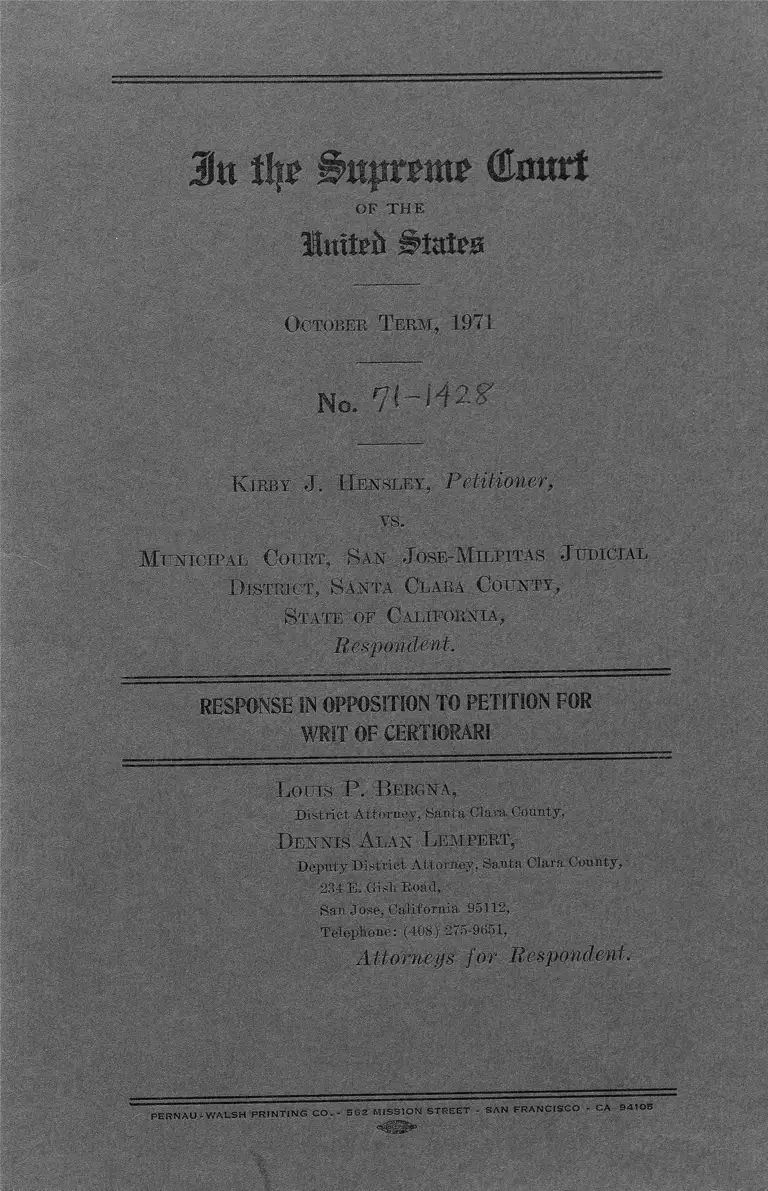
Jn tS|? (Eourt
OF T H E
O ctober T e r m , 1971
No. 7 t'-H 2 > /
K irby J . H ensley. Petitioner,
vs.
M unicipal Court, Ran J ose-Milpitas J udicial
D istrict, S anta Clara County,
State of California,
Respondent.
RESPONSE IN OPPOSITION TO PETITION FOR
WRIT OF CERTIORARI
L otus P . B e r g n a ,
D istrict A ttorney, Santa Clam County,
D e n n is A l a n L e m p e r t ,
Deputy D istrict A ttorney, Santa Clara County,
23I K Risk Road,
San. .Jose, California 95.112,
Telephone: (108) 275-9651,
Attorneys for Respondent.
P E R N A U - W A L S H P R I N T I N G C O . - 5 5 2 M I S S I O N S T R E E T ■ S A N F R A N C I S C O - C A 9 f O S
Subject Index
Page
Opinions below ............................................................................... 1
Jurisdiction ..................................................................................... 2
Question presented ....................................................................... 2
Constitutional and statutory provisions involved ...................... 2
Statement of the case ................................................................... 3
Argument ....................................................................................... 4
The decision below was in accord with existing law re
quiring state prisoners to be “in custody” to qualify
for federal habeas corpus ................................................. 4
Conclusion ....................................................................................... 5
Table of A uthorities Cited
C ases Pages
Carafas v. La Vallee, 391 U.S. 234 (1968) ............................ 4
Pay v. Noya, 372 U.S. 391 (1963) ......................................... 5
Jones v. Cunningham, 371 U.S. 236 (1963) .......................... 4
Matysek v. United States, 339 F.2d 389 (Ninth Circuit
1964) 3
McNally v. Hill, 293 U.S. 131 (1934) ....... 1
C odes
California Education Code, Section 29007 ........................... 3
C o n stitu tio n s
United States Constitution, Art. I, Sec. 9 ............................. 2
S ta tu te s
28 U.S.C.:
Section 1254(1) ................................................................... 2
Section 2241(c)(3) ..............................................................2,3,4
Section 2254 ......................................................................... 3
Jtt tip? I^Mpran? ©curt
OF T H E
InitCD
October T e r m , 1971
No. 7 1 - 1 4 2 8
K irby J . H e n s l e y , Petitioner,
vs.
M u n ic ip a l C ourt , S a n J ose-M il p it a s J u d ic ia l
D istrict ,, S a n t a Clara C o u n t y ,
S tate op Ca lifo r n ia ,
Respondent.
RESPONSE SN OPPOSITION TO PETITION FOR
WRIT OF CERTIORARI
OPINIONS BELOW
The decision, of the United States District Court
for the Northern District of California denying peti
tion for writ of habeas corpus is unreported and is
reproduced at Appendix A of Petition for writ of
certiorari at la. The District Court’s order denying
reconsideration but granting certificate of probable
cause is also unreported. Ibid., Pet. B at 2a,
The decision of the United States Court of Appeals
for the Ninth Circuit is officially reported at 453 F.2d
1252, Ibid., Pet. C at 3a. On February 18, 1972, the
2
Court of Appeals denied a petition for rehearing and
rejected the suggestion for rehearing en banc, Ibid.,
Pet. D at 5a.
JURISDICTION
The jurisdiction of this court is invoked under
Title 28, United States Code Section 1254(1).
QUESTION PRESENTED
Whether or not a person released on his own recog
nizance following trial, conviction, and imposition of
sentence, but before execution of said sentence on a
state criminal charge, is within the purview of 28
U.S.C. Section 2241(c)(3), which extends the remedy
of habeas corpus to- persons “ in custody” in violation
of the Constitution of the United States,
CONSTITUTIONAL AND STATUTORY
PROVISIONS INVOLVED
Article I, Section 9, of the Constitution of the
United States provides, in pertinent part:
“ The Privilege of the W rit of Habeas Corpus
shall not be suspended, unless when in Cases of
Rebellion or Invasion the public Safety may re
quire it,”
28 U.S.C. Sec, 2241:
“ Power to grant writ:
(c) The writ of habeas corpus shall not extend
to a prisoner unless—
* * *
3
(3) He is in custody in violation of the Consti
tution . . . of the United States;”
28 U.S.C. Sec. 2254:
“ State custody; remedies in Federal Courts
(a) The Supreme Court, a Justice thereof, a
circuit judge, or a district court shall entertain
an application for a writ of habeas corpus in
behalf of a person in custody pursuant to the
judgment of a State court only on the ground
that he is in custody in violation of the Consti
tution . . . of the United States.”
STATEMENT OF THE CASE
Petitioner, Kirby J. Hensley, was convicted of a
misdemeanor on June 25, 1969. Thereafter on July
1, 1969, Hensley was sentenced to one year in jail
plus $625 fine for his violation of Section 29007 of
the California Education Code. Since that time, he
has been at liberty on his own recognizance.
The District Court did not reach the substantive
issues raised in the petition for writ of habeas corpus
filed with it, but denied the petition on the basis that
the court lacked jurisdiction over the matter citing
the controlling decision of Mat.ysek v. United States,
339 F.2d 389 (Ninth Circuit 1964) ; holding that the
custody requirement of 28 U.S.C. Sec. 2241(c)(3) is
not met by one at liberty on his own recognizance.
The Court, of Appeals affirmed, relying on its pre
vious holding in Matysek v. United States, supra.
4
ARGUMENT
THE DECISION BELOW WAS IN ACCORD WITH EXISTING
LAW REQUIRING STATE PRISONERS TO BE “ IN CUS
TODY” TO QUALIFY FOR FEDERAL HABEAS CORPUS.
The statutory prerequisites of a state prisoner being
“ in custody” to qualify for federal habeas corpus
pursuant to 28 U.S.C. 2241(c)(3) have been broad
ened by decisions of various federal courts,
The term “ in custody” has been pulled and stretched
to cover more and more applicants not previously
under the protective umbrella of federal habeas
corpus. In that pulling and stretching of “ in cus
tody” a single fiber has remained unaltered; namely,
that the applicant must be under some form of re
straint. The gamut of the forms of restraint that
have been considered range from actual detention1 2 to
parole? to the disability of a prior felony conviction.3
The breadth of restraints has not been so broad as
to include the minor intrusion resulting from a re
lease on one’s own recognizance.
The cases cited by the petitioner deal with situa
tions where the applicant was suffering from re
straint or disability not suffered by the public at
large that, would make him eligible for habeas corpus,
iAs this court said in McNally v. Hill, 293 U.S. 131, 136 (1934),
“This court has consistently refused to review upon habeas corpus
questions which do not concern the lawfulness of the detention”.
2Jones v. Cunningham, 371 U.S, 236, 243, 1963 [Parole) imposes
conditions which significantly confine and restrain his [ petitioner s]
freedom; this is enough to keep him in the “custody” of the Vir
ginia Parole Board within the meaning of the habeas corpus
statute.
sCarafas v. La Vallee, 391 U.S. 234, 238 (1968).
5
CONCLUSION
The purpose of the writ of habeas corpus, is to pro
vide a prompt and effective remedy for whatever so-
city deems to be intolerable restraints. Fay v. Noya,
372 U.S. 391, 401 (1963).
In the three years since his conviction, the peti
tioner has moved freely and unrestrained. The ex
traordinary, circumstances requiring- the invocation
of the writ of habeas corpus do not exist as to this
petitioner. Were this court to grant such relief, it
would vitiate the statutory requirements provided for
federal habeas corpus, and convert the writ of habeas
corpus into a writ of error.
The decision of the Court of Appeals should be
affirmed by the denial of certiorari.
Dated, San Jose, California,
July 10, 1972.
Respectfully submitted,
Louis P . B er g n a ,
D istric t A ttorney, S an ta Clara County,
D e n n is A l a n L e m p e r t ,
Deputy D istrict A ttorney, Santa Clara County,
Attorneys for Respondent.