Excerpt of Testimony: John A. Coletta
Public Court Documents
August 2, 1976 - August 3, 1976
-
Case Files, Garner Hardbacks. Excerpt of Testimony: John A. Coletta, 1976. 4cf37ee2-24a8-f011-bbd3-000d3a151b15. LDF Archives, Thurgood Marshall Institute. https://ldfrecollection.org/archives/archives-search/archives-item/d43cb90c-7621-476e-a594-0b13de858daf/excerpt-of-testimony-john-a-coletta. Accessed September 25, 2026.
Copied!
r s
n
n
I
i j
1
3
4
5
6
7
8
9
10
n
12
13
14
15
16
17
18
19
20
21
22
23
24
2
V- -2-
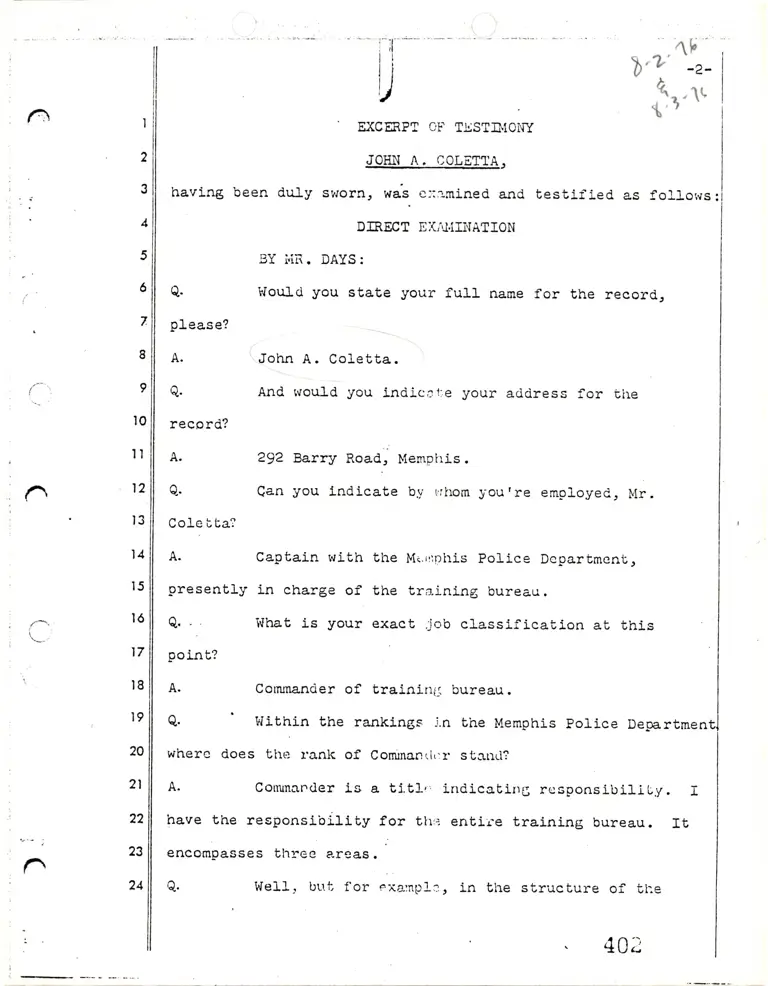
EXCERPT OF TESTIMOi'TY
JOHN A. CQLETTA.
having been duly sviorn, was examined and testified as follows:
DIRECT EX/lIINATION
3Y MR. DAYS:
Would you state your full name for the record^Q.
please?
A.
Q.
record?
A.
Q-
Cole tta?
John A. Coletta.
And would you indiccte your address for the
292 Barry Roadj Memphis.
Can you indicate by whom you're employed, Mr.
A. Captain with the Mi.i:'phis Police Department,
presently in charge of the training bureau.
Q* - ■ What is your exact job classification at this
point?
A. Commander of training bureau.
Q- Within the rankings In the Memphis Police Department,
where does the rank of Commard.'r stand?
A. Coiiunaoder is a titl> indicating responsibility. I
have the responsibility for the entire training bureau. It
encompasses three areas.
Q- Well, but for example, in the structure of the
402
r
<
J
depart,uent, i tats it there u a Chief of Police, ia there
no t?
Yes.
^ And tnere is a Director of Public Safety?
A- N o .
Is there any official or employee of the department
with a higher title than Chief of Police?
No, not at present. There is hut- i
I S , but It's not filled.
And what title is that?
Director of Police.
Director of Police-'•
Yes, sir.
No«, below the levol of Chief of Police, what la
141 the next rank?
Deputy Chief.
And below Deputy chief is what rank?
Inspector.
̂ And oelow Inspector is what rank after that?
Captain.
Captain?
Rleht, but elther-o- contingent upon responsibility
13 job asslgrttent rather than rani- indicating it.
fl- Now, what is your exact rank in the department?
Captain l.s my rank.
' 403
n 1
3
4
5
6
7
8
9
10
11
12
13
14
15
16
17
13
19
20
21
22
23
24
2
-4-
J
Q- And how does the ti.(;.ie ''Commander" come into play?
A. That v;as the title. rvC the person that is in charge
and has the responsibility of the training bureau.
Well, does a Captain who is a Commander get paid
more than a Captain who is nc'-. a Commander?
A. Not a bit.
Q' Is that a policy that pleases you?
A. Yes, it does.
In other words, yoti don't mind the fact that
Captains v;ho are Commanders get paid the same salary as
Captains v/ho are not Commanders?
A- I may mind a lot o.i things, but I can' t do anything
about it.
How long have you been a member of the Memphis
Police Department?
A. 19 years .
'5- Can you indicate something about your educational
background before you joined ttie Police Depaertment?
A- Prior to joining in 1957j I had a high school
diploma.
And have you had any education subsequent to your
joining the Police Department?
A- Yes, I received a Bachelor of Arts Degree from
Memphis State .in Police / dmi^iis tration. I have also attended
401
n
■k J
; V
3
4
5
6
7
8
9
10
11
12
13
14
15
16
17
18
19
20
21
22
23
24
1
2
u
-5 -
the National Academy which is a recognized police school con
ducted by the FBI.
Q. And how long was'that course of study conducted by
the FBI?
A. Three months .
0,. • And can you indicate what the substance of the
course of study was?
A. It was directed tov.'-rds your individual respon
sibility. They have options which v/e can take for subject
matter such as the same as a university^ and I elected courses
in Management and Contemporary Problems of Administrators and
Trainers, Research.
Q. Prior to your becoming a Commander of the training
bureau, what responsibility did you have with the department?
A. I was in charge of the firearms section of the
training bureau.
Q. Were you at the rank of Captain at that point?
A. Yes, I was. Well, I was Lieutenant and Captain. I
was promoted that year.
Q. All right, perhaps we could get a sense of your
movement up through the rank:', in the Police Department. VJhen
you joined the department, do I recall correctly some 19 years
ago?
A. Yes. sir.
405
: r
n
2
3
4
5
6
7
8
9
10
11
12
13
14
15
16
17
18
19
20
21
22
23
24
1
' ■ 1 II' 't
1 ] ( /
Q.
y
You were at what
A. Patrolman.
Q. And how long did
A. Seven years.
Q. And after that se
-o-
higher rank in the department?
^ wa-s promoted to Detective and then
subsequently to Lieutenant, cr,ri i spent three years in the
Detective Bureau.
Q* . And can you describe briefly the nature of your
responsibility v;ithin the burc;-?.u?
^ investigator in the pav;n shop and junk
squad.
Q- Could you explain and repeat, and once you have
explained what that is all about, exactly the term you used,
what that responsibility was?
A- The responsibility was to investigate any complaints
regarding thefts and to check the various pawn shops and
scrap yards within the city to check for stolen merchandise,
and also to receive their daily pawn report that would indicate
what persons had oawned what i.v.rchandisc, and to check those
against the stolen lists, whstover.
Q- Okay, could you repeat what detail it was that you
had responsibility foi-? Did you say —
̂ 40G
r N
3
4
5
6
7
8
9
10
11
12
13
14
15
16
17
18
19
20
21
22
23
24
1
2
J
-7 -
(Interposing) i was an investigator. I did not
have the responsibility for it.
^ thought you said something to the effect of
stop and jump or pav/n shop, something along those lines?
A.
Q.
Pawn shop.
The pawn shop. -
MR. KLEIIl: I really hate to
interrupt. I don't see the relevancy
of this to the issiv- at hand. I'm
going to have to object to it.
MR. DAYS: Well, Mr. Klein, I
ivas just doing that tor purposes of .my
own record. I simplv dian't hear what
he said.
THE COURT: All right, I think
he said'pawn and junk shop.
THE WITNE.'o: Detail, yes.
(By Mr. Days) Pawn o.nd junk, all right. After
your three year stint in the Detective Bureau, did you assume
other responsibilities?
after ray three .years, I was transferred to the
firearms section of the training bureau and I was there until
approximately October of last year when I assumed full
responsibility lor the entire braining bureau.
- 407
Q
■ ^
3
4
5
6
7
8
9
10
11
12
13
14
15
16
17
18
19
20
21
22
23
24
1
2
•J - 8 -
A H rightj now, xroru what year to what year were
you in charge of the firing range?
A* I was assigned there from I966 until 1975. I
assumed command of that sectJ.on approximately 1 9 7 0.
All right, between l̂ '6o and 1970^ what v;ere the
nature of your duties at the firing range?
A* Primarily administrative and instructive duties.
Q- Could you be more specific, Mr. Coletta?
A‘ There is ejuite a number of items of inventory at
the range, weapons, tactical gear, et cetera, and it's our
responsibility to keep up with them, to issue them, to
instiuct in the use of those various items of equipment and
also, of course, the weapons themselves.
Now, during that process between or during that-
period, between I966 and 1 9 7 0, were you charged with instruct
ing members of the Police Department in the use of firearms?
A- • Yes, I did some instructing also.
Q- . How was it that you cossessed qualifications to
instruct other members of the department in the use of fire
arms?
A* Well, I have initially taken it upon my own to
investigate the various avenues that are open to bettering
myself as far as ,job opportunities v/ere concerned, and I
took it upon myself to delve into the finer aspects of
̂ 403
! If
-9-
^,9
- o
3
4
5
6
7-
8
9
10
11
12
13
14
15
16
17
18
19
20
21
22
23
24
1
2
firearms instruction, and to also research the ramifications
surrounding firearms themselves, which is a very, very wide^
field.
Q- All right, but during the period I966 to 1970, did
you receive any specialized course of instruction with respect
to the use ox firearms either within the department or else-
'where?
A. Yes, within the department, certainly.
Q- And what was the nature of that type of training
that you received?
A' Of course, it was primarily a firearms instructor
course which was designed to equip a person teaching that
particulai’ type of subject, t'c be able to teach it better.
Q- And who taught you?
The person who was in charge at that time.
And who was that person?
Captain Earl Clark.
Captain Clark?
Uh huh.
In 1970 you, I assume, took the responsibility over
A.
Q.
'A.
Q.
A.
Q.
from M r . Clark?
A. Yes, sir.
Q’ And between the period I970 and 1975 while you v;ere
in charge of the x'ange, did vou receive any specialized
40d
-1 0 -
n
r ^
3
4
5
6
7
8
9
1.0
n
12
13
14
15
16
17
13
19
20
21
22
23
24
1
2
instruction with respect to ine use of firearms or the
instruction in the use of firearms?
A. Yes, I did.
Q- Can you indicate the nature of that instruction?
A. I attended the National Police Firearms Instructors
School which is held annually at Camp Perry, Ohio, and I also
attended the Firearms Instructors' School conducted at the
State Training Academy at Donclson, Tennessee.
Q- And hov; long a course of study was that?
A- One week each, I believe. In addition, of course,
I have attended many seminars and workshops and things of
this nature that are also related.
During the 'period '.•hen you were in charge of the
firing range, 1970 to 1 9 7 5 ̂ Wno v;as your direct superior..in
the .i department?
A. The Commander of the training bureau who was —
well, I would have to think because it's been quite a number
of them.
Q- V7ellj it's not necessary if you don't remember the
name to recall the specific individual, but you reported to
the commanding officer of the I'-raining bureau?
A. Commander of the tvilning bureau, yes.
Q* And to whom did the Commander of the training bureau
report, if you !uiow?
̂ 410
n
2
3
4
5
6
7
8
9
10
n
12
13
14
15
16
17
18
19
20
21
22
23
24
1
■J
-1 1 -
A- The Deputy Chief of Administrative Services.
All right. Now, at the time that you were in charge
of the firing range, were ypu given instructions by the
Commander in charge of the tr-ining bureau with respect to
what type of instruction you r-'iculd provide to the members of
the department?
Viell, certainly we v/oiild have meetings concerning
it, but really the Commander of the training bureau didn't
know as much about it as I did, because I had made it a point
to learn that particular topic .
Well, what was the luiture of the mandate, if you
will, that you received from your superior with respect to
how you went about conducting firearms training for officers
of the department?
A* Our objective was to qualify people in the use of
the revolver and the shotgun. That was our primary objective.
In the course of that instruction the question might arise
upon when it would be tactica-ily feasible to use a firearm,
when it v/ould be, according to department policy auad according
to law. Justified to use firearms, but this was to reinforce
the legal subjects which were to.ught in the academic section
of the Academy itself.
Q- You Just usrd the term "Academy" and we were talking,
if I recall correctly, about the firing range. Are they, in
̂ 411
-1 2 -
u
1 fact, the same entity —
2 A. (Interposing) They are the same bureau. They are
3 separate sections.
4 Q. All right, but before we get to that, I want to ask
5 you v/hether it v/ould be a fail' characterization of your
6 authority when you were in ch-arge of the firing range of the
7 department, that you were essentiaJ-ly delegated by your
8 superiors the responsibility for determining what would be
9 the appropriate type of firearms training for members of the
10 Memphis Police Department?
11 A. Yes, more or less.
12 Q. VJhy did you conclude by saying, "More or less"?
13 A. You're never an autb.ority because every subject is"^
14 dictated not only by what has been or by precedent, but also
15 by contemporary problems of what is and also by projected
16 what may be. A lot of policies changed and a lot of proce-
17 dures were changed because of changing times and changing
18 orders which would be issued from time to time, amd because
19 of the legal ramifications thab aJ-so were changing pretty
20 rapidly through this period of time.
21 Q. Mr. Coletta, is it fair to say that on a day-to-day
22 basis you had decision making authority with respect to
23 training at the firing raxxge?
24 A. More or lass, yes.
- 412
’ M I !}
-1 3-
n
n
u
3
4
5
6
7
8
9
10
n
12
13
14
15
16
17
18
19
20
21
22
23
24
1
2
I'14 beijirunin̂ i to fcal that "more or less" is just
a habit that you have in responding to questions or did. ;̂ ou
mean something —
A. (Interposing) I'm not absolute —
Q- (Interposing) I s f .
A. (Continuing) — if that is what you mean.
Q* I see. Now, I would like to turn to the whole
question of the training academy as distinguished from the
firing range. Could you make clear for the record hov; those
two entities differed, if, in fact, they did differ?
A- Yes, sir. The training academy is charged with
the classroom responsibility. The firing range is charged
with the practical responsibility of teaching firearms
instruction. The Academy does not teach firearms. The range
section teaches the firearms.
Q- All right. In your capacity as head of the firing
range, what responsibilities did you have with respect to the
Police Academii- in which I assume recruits to the Police
Department receive training?
A. To the recruits?
Q. Yes.
A
A. Well, naturally I would work in liason, in close
liason with the Academy to be aware of what they were teach
ing, but my direct responsi'-ility was to the Commander of the
413
r
n
3
4
5
6
7
8
9
10
11
12
13
14
15
16
17
18
19
20
21
22
23
24
2
i j
-14-
training bureau who' had the overall — who was charged with
the overall operation. It wac his responsibility to
coordinate.
Q- Okay, v;as the Commander of the training bureau in
charge not only of the firinj; range but of the Academy
itself?
A. Yes, sir.
Q« And v;as there a perron below the Commander of the
training bureau at your leve]. who was, in fact, the direct
supervisor of the Academy?
A. Yes, sir, there was.
Q- And was that person at the level of Captain?
A. It's fluctuated. At one time,, yes.
Q* Well, did you have any line authority to spealc of
in terms of what types of training would be included at the
Academy for police recruits?
A. 'Vrell, I would imagine line authority — if you
would explain —
Q- (Interposing) All right, by line authority I mean
that you would have the power bo say to the person in charge
of the Academy, you must incln.ie the following procedures
within the training program for this group of recruits.
A. No, sir.
Q- VJould you have thn. i'. authority?
. 414
1
3
4
5
6
7
8
9
10
n
12
13
14
15
16
17
18
19
20
21
22
23
24
2
- 1 5 -
iy
A.
Q.
A.
Q.
No, sir.
Did you have —
(Interposing) I would recommend. I wouldn't tell.-
Were you generally successful in getting your
recommendations approved?
A- Fairly successful, I -would say.
Do you recall any major respects in which your
recommendations were not entertained and acted upon favorably
by your superior?
A- Well, not offhand, really. I can remember incidents
where maybe the change was n o t implemented within a specific
time opan that I thought maybe, it should have been.
Did you participate i.n an Academy training program
for recruits in I972?
A. Yes, I'm sure I did.
And do you have any recollection of whether you also
were involved in a training program for recruits in 1973?
A. Yes, sir.
Q* And ivhat was the natu.re of your responsibility in
1972 and ' (3 with respect to th.c training program for the
Academy?
A. My primary responsibility?
Q- Yes , sir.
A* Was to teach peopl - to fire revolvers and shotguns.
41u
n
1
2
3
4
5
6
7
8
9
10
n
12
13
14
15
16
17
18
19
20
21
22
23
24
I i
- 16-
Q* Could you in generalized fashion describe the
structure of the course of training that you would provide
with respect to the use of'firearms? What were the blocks of
instruction that you provided?
A. Well, of course, vie would try to provide a program
based upon chronological order in the learning process, start
at the base and work up. Initially, we would orientate the
people to just exactly what ttiey would be subjected to. We
would teach them the safety aspects surrounding the use,
surrounding the handling, surrounding the care and cleaning
of firearms. We would instruct in the nature of’the firearm
itself, the names of the various parts, the technical
aspects of it. Vie would use training aids to illustrate
these various points and atteiapted to gee the student to be
able to, once he walked on the line, to be safe and to be
able to at least understand tlie basic rudiments.
Q- Now, was the content of this training program a
reflection, to the best of your understanding, of the
departmental policy with respect to what officers should Icnow
about the use of firearms and v/hat types of firearms they
should be faniilJar with in terms of their police work?
A. Yes, sir, but not in its entirety because when you
talk about officers knowing t'veir firearms and how to use
them, you're also speaicing .'.bout legal aspects which is
41b
I JI -1 7 -
n
O'
1
3
4
5
6
7.
8
9
10
n
12
13
14
15
■;i6
17
13
19
20
21
22
23
24
2
taught in the. Academy section by a lawyer.
Q- What do you know about the so-called legal aspects
of the training as that area might relate to the use of
firearms?
A. Well, of course, as it's written now, Tennessee
State Law is the governing factor. Now, that is law.
Q- All right, but what I'm asking you is were you a
participant at any point in wl'-at you characterize as legal
discussions or legal instruction with respect to the use of
f irearms?
A. Yes.
Q- Can you describe the nature of your participation
in that process?
A. During the course of marksmanship questions would
arise, when to shoot, when not to shoot, .should you do this,
should you do that, and certainly we would attempt to ansv/er/
questions that we were knowle.igeable about, regarding those;
'Whether it be departmental policy, whether it be State Lav;,
and we would attempt to counsn], and guide the student into
a realm whereby he wouldn't t':ike the v;rong impression from ̂
there.
Also, v;e would talk about the moral, aspects of
firearms use,' the right and th.e wrong of it.
Q- Was there anything i.n the department manuals or
X
41
n
!
n
3
4
5
6
7
8
9
10
n
12
13
14
15
16
17
18
19
20
21
22
23
24
1
2
-18-
U
regulatiotiG that addressed, il.seli to the moral aspects of the !
use of lethal force?
A. I don' t^think so
Q.
3
Well, how did this moral instruction come about in
terms of the use of firearms’-
A- Generally in a question and answer period a dis
cussion would follow. ■
Q- During the period^ Mr. Coletta^ between I970 and
1 9 7 5, did you have any involvmont in questions relating to the
type of v/eapon or type of ammunition that the department
should issue to its line officers?
A. Yes, sir.
Q* And can you descriV' tiic natui’c of your involvment?
A- Wellj I had initially been involved in it maybe as
a matter of curiosity or maybe because I thought it was my
responsibility to make certain that I was aware of what the
teciinicaJ. aspects of ammunition and 'weapons are and what would
be best suited for a police officer.
In addition, the Tactics and Evaluation Board had
requested a study when the Un'.on the issue that they
wanted to use a larger hand gun, and this particular Board
requested a study that we looi' at what 'we were using and make
a recommendation a.s to v;hat ['articular type of ammunition that
we would recommend, 'which 'W"’ did.
̂ 418
-19-
3
4
5
6
7
3
9
10
11
12
13
14
15
16
17
18
19
20
21
22
23
24
1
2
Now, 'What 'Was the name of that Board that yoa just
referred to?
A- I just — I don't recall its name. Tactics and
Evaluation, or something of that nature.
Q- And was that Board comprised of persons within the
Police Department?
A. Yes.
Q- Can you identify b- rank, if you v;ill, who 'was
involved in that particular Board? Was the Chief of Police
involved?
A.
Holt.
The Chairman, ■ I thi.nl:, was Chief Inspector Jack
Q- Well, let me put !'■ this way, did that Board
reflect a policy making entity within the Police Department?
A. They do not have the power to set policy, I don't
think. I think what they did 'was make their recommendations-
to the then Director.
Q- _ All right. And di i you, in fact, conduct any
investigations into the use C various ammunition and v;eaponry
at the request of the Board tlvat you mentioned?
A.
Q.
A.
Q.
Yes, we did.
And when was this 'lone?
I don't recall e:c.?.ctly, somewhere around 1973, '74.
Was it prior to Cc:;cber of 1973?
̂ 4 I
(
J -2 0 -
3
4
5
6
7
8
9
10
11
12
13
14
15
16
17
18
19
20
21
22
23
24
2
A- I don't recall.
f
'3.- Can you indicate what weaponry the Police Department
was using prior to that request that you conduct a study?
A* Tne same that we are using now. The medium Ten
Smith V/esson 3-1- heavy barrel revolver.
3* And What type of auununition were you using prior to
the conducting of this study? ^
A- We bought — the period of time from 1970 until
now^ we had used hollow point ammunition of various makes
due to the City's purchasing policy until we definitely
established one round. And it's just like choosing an
automobile. They make aill brands.
M K . DAYS: Your Honor, this
reaJ-ly concludes my introduction.
THE COURT: Let's resume at
9 :1 5 in the morning.
(Whereupon, Court v;as adjourned
at 4:55 o'clock p.m.. until 9:15, August 3,
1976.)
420
r
n
2
3
4
5
6
7
8
9
10
11
12
13
14
15
16
17
18
19
' 20
21
22
. 23
24
25
1
21
MORNING SESSION ---- ^ -----------
AUGUST 3. 1976
THE COURT: Are v/e ready to proceed,
gentlemen, with the testimony of Captain
Coletta?
MR. DAYS: Your Honor, we were
trying to determine whether another one
of our witnesses was present. We thought
we might take him before continuing with
Captain Coletta, but he's not present.
THE COURT: All right. You may
proceed.
» s * s »
421
n
r
O
2
3
4
5
6
7
3
9
10
11
12
13
14
15
16
17
18
19
20
21
22
23
24
25
1 JO^ A. COLETTA,
resumed the stand and testified further as follows:
DIRECT EXAiMINATION
BY MR. DAYS:______ ^
'3* Captain Coletta, directing your attention
to the training program and the Academy In the use
o-f" firearms. First, I would like to ask you what
the applicable standards are In the state of
Tennessee, In the City of Memphis under department
regulations with respect to the use of firearms.
If you know?
A. Yes, sir. The city requires, the police
department requires —
Q- (Interrupting) Could you start. If I
may Interrupt, could you start with the state
standards first. If you would.
A. • ‘- I don’t know If there are any state
standards for recruits per se. However, at a
recent meeting It was determined that every officer
shall qualify under his fire department program at
least annually.
Q- Perhaps you misunderstood my question.
Let me restate It more carefully In hopes that you
will understand.
Is there not a state statute that controls
2 2 .
422
n
1
2
3
4
5
6
7
8
9
10
11
12
13
14
15
16
17
18
19
20
21
22
23
24
25
2 3 .
the circumstances und’er which police officers may
V
use lethal force?
A.
Q.
A..
Q.
A.
Yes, there is.
Are you familiar with that standard?
Yes, sir.
Would you state your familiarity with that^
I believe it- is section 40-808, I*m not
certain of that, but it authorizes a law enforcement
Officer to use deadly force after all other means,
reasonable means, have been exhausted in the
apprehension of a felon-.
Q. Now, there are also departmental regulations
with respect to the resort of lethal force by police
officers?
A. Yes, sir, there are.
• V/hat is the nature of that regulation?
A. It is more restrictive than state law.
Again following the guidelines of the state law,
after exhausting all means of apprehension, and it
eliminates some felonies, such as embezzlement, et
cetera, primarily the felonies in which deadly fore
are authorized or crimes against persons, murdering, ''
burglaries.
Q. Now, as a person Involved in training
programs for recruits-, did you have occasion to go
423
n
2
3
4
5
6
7
3
9
10
n
12
13
14
15
16
17
18
19
20
21
22
23
24
25
1 J 24 .
over with recruits the requirements of the laws and
the regulations that you just described?
A- I did discuss them from time to time, but
that primarily was given to them during their legal
phase of Instructions, probably by a guest Instructor,
and I Imagine It was our legal advisor at that time.
Q* And would you be present at those lectures
by the legal advisor?
No, sir, I would not.
Have you ever had any hand In preparing
a fire arms manual for the Memphis Police Department?
A. Yes, I have.
Q* Can you Indicate the nature of your
participation In such an effort?
A. On many occasions we were asked what do we
teach, and In an effort to clarify this and provide
guidelines, or as to what we taught, we prepared the,
prepared the manual that encompassed at that time
all of the subject matter that we did teach.
Q- And when you refer to "at that time" can
you Indicate what time you are referring to?
Yes, sir, when the manual was Instituted
I believe around 1972 .:-'
Co the manual would reflect what was being
taught to recruits as of 1 9 7 2 , Is that right, at the
̂ 424
€ '
r
1
2
3
4
5
7
8
9
10
11
12
13
14
15
16
17 '
18
19
20
21
22
23
24
25
I :i
y
2 5 .
Academy?
A. Actually It would reflect what had been
taught before also, to a certain extent.
Q- Do you have a-copy of that manual with
you?
A. No, sir, I don't.
Q* Mr. Coletta, let me show you this document
and ask you whether this is the manual to which you
were Just referring?
A. Yes, sir, this appears to be it.
Q* And is this the manual that you were
responsible for preparing?
A . Yes, sir.
Now, I ask you whether you recall any
suggestion in this manual of the legal requirements
Controlling the use by Memphis Police officers of
lethal force? .
A. Policies and procedures were Instituted
and placed in the front portion of the manual.
I don't recall at this time just exactly what
policies are there
Q* Let me direct your attention to page 34
of this document, chapter 5 , and ask you whether
that refreshes your recollection as to whether or
not there was included in the manual any discussion
. 425
r ^
'v^
O
2
3
4
5
6
7
3
9
10
11
12
13
14
15
1 i i
26
• 16
17
18
19
20
21
22
23
24
25
of the legal standard controlling the use of lethal
force by police officers?
Y q s , during discussion of liabilities
and tact on the applicable use of weapons, which
Is the chapter, we did discuss legal ramifications
surrounding the use of firearms.
When you say "we", does that indicate that
you personally engaged In such discussion with
recruits?
A*. It could have been any one on a range
staff. I don't recall who gave the lecture.
Q- Did you, on occasion, give a lecture with
respect to this particular subject matter?
A. Yes, I did.
*3- Can you indicate the nature of the
lecture that., .you gave on this particular question of
the use of lethal force by police officers?
•A. Well, of course, we wouldattempt to
provide the officers with guidelines as far as what
he could and could not do. We would cite cases
which have occurred elsewhere showing and
demonstrating to them what these court cases said,
what the action of the officer was and what the
result was. We would speak of ethical reaction
from the community.
̂ 42G
2 7 .
o
1
2
3
4
5
6
7
3
9
10
11
12
13
14
15
16
17
18
19
20
21
22
23
24
25
Q. What do yov^mean by "ethical reaction from
the community"?
A. What the community thought that the ethics
of the police department should be In the use of
deadly force and how, if we succeed, what their
expectations were. We felt that there would be more
restrictive laws and that particular time It was
discussed at length I think on a number of occasions
concerning these various things. We would also
speak of the moral dilemma that the officers will
be confronted with.
Q. What do you mean "moral dilemma"?
A. What that persons, that officer could live
with his actions. If he v/as wrong we have had
occasion to see where officers have been subjected
to psychiatric examination. If he was wrong we felt
•■'.that 'it would-work on him, perhaps not nov;, but per
haps later on'in his life and we emphasized the
point that the officers must be right, that he must
follow the law and that he must be able to Justify
his action.
Q. And by "Justify" what exactly do you mean?
A. Justify it in every way.
Q. I'm asking for a specific, since you are
engaged in instructing recruits?
42 r
r
2
3
4
5
6
7
8
9
10
11
12
13
14
15
16
17
18
19
20
21
22
23
24
25
1 Wust be B^lsfled under the Police Department
policy. He must be able to Justify It under the
state law, he must be able to Justify it in his own
mind so he can live with it.
the course of academy Instruction in
the use of firearms between, let's say, the years
1972 and 1973 up to the end of 1973, did you
employ any films, that is movies, to aid in the
instruction of recruits in the aid of lethal force?
we employed one to help and try to
develop the officers in the Judgment of his process.
2 8 .
Q.
A.
Q.
court?
A . ,
Q.
A.
Q.
What film was that?
"Shoot, Don't Shoot".
Were you requested to bring that film to
Yes , ,sir.
Do you have that film?
Yes,sir.'
Are you in a position to project that film
for tHe benefit of the court?
Yes, sir, it would require a few minutes ’
to set the projector and film up.
MR. DAYS; Could we have a brief
recess for the purpose of setting up this
film?
428
n
̂ U
P
2
3
4
5
6
7
3
9
10
11
12
13
14
15
16
17
18
19
20
21
22
23
24
25
1 THE cd^RT: Yes, sir, but I would
hope that we can go ahead and conclude
the examination of this witness, unless
you have some examination in respect to
the film, and then if possible conclude
the cross examination, unless cross
examination relates to the film, and
then go ahead and get to the film rather
than Interrupt at this point .
MR. DAYS: Yes, Your Honor, I really
do have questions that are directed toward
the content of the film.
THE COURT: All right, sir. I'm
sorry that the film equipment and so
forth was not set up. If you will
advise us when you are ready. We will
take a recess.
(Recess.)
(By Mr. Days) Captain Coletta, you were
asked to screen the film "Shoot or Don't Shoot".
Is that film ready?
A. Yes, sir.
Q- Would you start running it, please?
(Thereupon, the film began at
9 ̂5 a.m. and concluded at 1 0 :0 8 .)
2 9 .
Q.
42J
3 0 .
n
I r '
u
1
3
4
5
6
7
3
9
10
11
12
13
14
15
16
17
18
19
20
21
22
23
24
25
2
) I
YiMR. DAiJiS: Your Honor, I would like
to have that film marked and moved
into evidence If counsel has no
objection.
MR. KLEIN: No, Your Honor, I have
no objection.
THE COURT: All right, sir. Let
It be marked with the ultimate right
either to make a copy or to return
after It has fulfilled whatever use the
record would specify.
THE CLERK: The next number Is
16.
(Whereupon, the said film was
accordingly marked Trial Exhibit l6 and
» ' . J-
received In evidence.)
THE COURT: All right, sir.
Q- (By Mr. Days) Ho-w, Mr. Coletta, In the
film "Shoot, D on’t Shoot", there is a discussion,
is there not, of three criteria that an officer
should look to in determining when to fire a weapon
at another person, is that correct?
A . Correct.
Q. Identifying whether a person who Is armed
has the ability to injure the officer, whether there
4;nJ
n
r
]
2
3
4
5
6
7
3.
9
10
11
i
12
13
14
15
16
17
18
19
20
21
22
23
24
25
uD^in.1 u re
I
3 1 .
an opportunity toAnjure the officer, whether in
fact the officer is in jeopardy, whether there is
a chance, the ability and opportunity will be't' *
^^^■llzed in some fashion, is that correct?
A. Tha t ’s correct.
*5- Is it fair to say that this film is
directed toward the queation of when police
officers should shoot to protect themselves?
A- Yes, sir, as well as other times,
Q* Is there a discussion in the film of
whole question to shoot fleeing felons, is
there not?
A. Yes, sir, there is.
And the film.says generally
police officers have the right to use
^o apprehend fleeing felons?
A . Yes .
I
*3* Is it not true in the case that in the
film that all of the fleeing felons were armed, the
man running through the field, the gun in the hand,
the fireman, the right to shoot a -fleeing felon,
there is a situation where the man Jumped out of the
automobile and ran toward the corner and pulled his
gun, that is the fleeing felon situation, and then
there is a man with the satchel in the ooen field and
43i
32 .
O
n
n
3
4
5
6
7
8
9
10
11
12
13
14
15
16
17
18
19
20
21
22
23
24
25
1
2
I II
i 'ihe had a, I don't knc^ what the weapon was, but he
had a gun in his.possession, isn't that correct?
A. Yes, sir, and there were several more
scenes where the man that preceded the man coming
out behind a row of buildings, he was not armed,
and the last scene, I believe those two were not
armed either. Yes, for the most part they were
armed.
. Does it specifically say under those
circumstances that ,i^.^was clear that a felony had
been committed?
Yes, in some of the cases I think it was
self explanatory.
Q. I'm trying to get your understanding of
what the film was communicating to you and bn the
recruits that saw this film. In the situation where
the two men were comlpg out of the building there
was no indication tha.t the unarmed man running out
of the building was a fleeing felon, was there, and
the last scene with the officers holding his
badge out, there was no indication that those men
running away had committed a felony?
A . N o .
Q. They also said if there is a slightest
doubt the officer should not shoot?
43,
O
1
3
4
5
6
7
8
9
10
11
12
13
14
15
16
17
18
19
20
21
22
23
24
25
2
I 33.
I
A. Yes . :J
Q. You should be absolutely sure there is
a felony committed before a firearm is used?
A . Yes .
Q. Now, do you have any doubt that this film
was shown to recruits during 1972 and 1973 at the
academy?
A. I don’t know exactly when. I don’t believe
that there is any question about when it was shown.
Q. Now, did you show any films that related
to the use of lethal force to apprehend fleeing
felons that were unarmed?
A. I d on’t know of any in existence.
Q. So your answer is that you did not show
such a film?
A. No.
Q. Did you engage in any discussions with the
recruits about the use of firearms to apprehend flee
ing felons that were unarmed?
A . * I sure did. '
Did you indicate generally the nature of
discussions that you had with the recruits, what
types of standards did you indicate to them that
they should follow in shooting unarmed felons?
A. Of course, the first thing I would do is to
! I
\
43J
( 1il 34.
o
2
3
4
5
6
7
8
9
10
11
12
13
14
15
16
17
13
19
20
21
22
23
24
25
1 find out what they knpw about it because they had
understanding when they came to the firearms portion
of It, their training, they had understanding, their
legal training. I would find out Just exactly what
knowledge they have, and I would try to clarify
points of doubt that they may bring up.
Q. In other words, they would have gone through
, the discussion of what state law required and what
the department of regulations required?
Yes, sir.
Q* ' All right. Now, am I correct In thinking
that under state law and the police department
regulations there Is a requirement that officers
exhaust all alternative non-lethal means In —
A. Yes, sir, exhaust all means that are present
there that you can exhaust.
Q. All right. ■. Now, did you show any films
to recruits about what non-lethal alternatives
might be available to them In a situation where a
person was fleeing from the commission of a felony
that was unarmed?
A. Yes, sir, we discussed It.
Did you show any films?
No films.
Q.
A.
Q. But you say that you discussed It. Can
43i
35.
r
1
2
3
4
5
6
7
8
9
10
n
12
13
14
15
16
17
18
19
20
21
22
23
24
25
you give a general lij^ication of the nature of your
discussion?
A. Yes, sir, that if you don't catch him
immediately, more than'likely he will escape and
then the alternative is to put out radio calls, what'
ever, and attempt to apprehend him that way.
Q. Well, are you saying that if a fleeing
felon escapes, then the police officers should
contact other policemen and try to apprehend the
fleeing felon by getting reinforcements, is that
right?
A . Certainly.
Q. But did you discuss what constitutes
reasonable alternatives, non-lethal alternatives?
A. Yes, sir. There really are none
generally if you don't catch them and then
generally that is the-point that I'm trying to
make, that they will have a very difficult time in
catching them. Most of the fleeing felons are
driven by some motivation, I don't know exactly
what, that really drives them to perhaps run
faster or perhaps do -things that they normally
couldn't do.
Q. Well, are you saying that, in fact, in
most situations there are no reasonable non-lethal
43J
3b
n
n
2
3
4
5
6
7
S.
9
10
11
12
13
14
15
16
17
18
19
20
21
22
23
24
25
1 alternatives that a tjjĵ lice officer can rely upon
when a person, who is unarmed, is fleeing from a
felony?
A. No, sir, you -asked me what my discussion
was .
Q. I'm trying to find out what your particular
position is with respect to the existence of
reasonable alternatives to the use of fleeing force,
if there are reasonable alternatives, and, if so,
what they are and to what extent are these alterna
tives communicated to. recruits? Start with the first
one. ,7.
A. The first one is to run and catch him.
Q. First, wait a minute, do you think they
are reasonable alternatives?
A. No, sir, I don't think running and
catching him is reasonable alternative.
Q. Why not?
A. Because I don't think, in the majority of
^he cases it can be reasonably done.
Q. Are there any alternatives to running?
A. When someone runs from you, the only
i
alternative you may have would be on the front end
possibly, if manpower is available, employ a
different set of tactics.
‘ I
43G
a
1
3
4
5
6
7
8
9
10
n
12
13
14
15
16
17
18
19
20
21
22
23
24
25
2
jl
*3* All right .|̂ So you think that running
probably is not .a very effective alternative.
You have suggested that maybe heading this
person off might be an-alternative?
A. Certainly you may do so.
educate your recruits that running
after a fleeing felon that was unarmed was probably
an unreasonable alternative to the use of lethal
force?
A- I don't think I projected it as an
unreasonable alternative. '---
Did you tell the recruits they had to
exhaust all reasonable alternatives before they
use their weapons?
A Ye^ sir, absolutely, and they were also
during their law session instructions.
Q- , ■ Did you discuss with them techniques- that
would employ alternates to the use of lethal force?
A . Yes,sir.
'3* . And what were the nature of those police
techniques?
Well, of course, as all contingents of
catching or being within the same area as the
suspect --
Q • All right.
̂ 43/
I ll
V;,:-
2
3
4
5
6
7
8
9
10
11-
12
13
U
15
16
17
18
19
20
21
22
23
24
25
1 A. Once you h a J e decided what your course of
action would be, and once you have deployed yourself
accordingly, for example, your partner to the front
of the office and you to the rear of the. office or
whatever the situation, utilizing the covered hand,
once you met armed resistance, once you have adopted
a particular course of action, then you must carry
It through until some act changes that course of
action. Now, you can give a thousand Instances, and
̂ venture to say that those thousand Instances woul^n’
occur the way In which you say In the next three
38 .
years.
Q. That Is true of this film?
A. Absolutely.
Q. That film can't show all the situations
that a policeman encounters?
A. Certainly not. Certainly It would
provide guidelines of some of the reasonable
alternatives that you are talking about.
Q. ' All right. So I'm asking you what efforts
that you made to establish guidelines for the use
of lethal force when people were fleeing from the
commission of felonies and were unarmed, what are
the standards?
A. That Is wh??t T say. One alternate Is
̂ 433
■/ - I
2
3
4
5
6
7
8
9
10
11
12
13
14
15
16
17
18
19
20
21
22
23
24
25
1 j. uiiii j-ii dx u c xa neauxng c
another alternate is shouting at them to stop.
Q.- Youare telling —
MR. KLEI-N: Your Honor, I don't
think he's letting the witness finish,
and number two, I think he's cross
examining his ov/n witness. I object
to that because he's using legal
questions.
MR. DAYS: I would like to
clarify that for opposing counsel and
the court. Captain Coletta is called
as a hostile witness and/or adverse
witness under Rule 6ll of the Federal
Rules of Evidence and under that
r.ule I am permitted, as I read the
rule, to examine as though it were
cross examination. I think it is
fair to say that Mr. Coletta is a
. witness Identified with an adverse
party in the sense that he is employed
by one of the defendants in this
case.
THE COURT: Well, I will
overrule the objection to the use of
43j
' • »
, 2
3
4
5
6
7
3
9
10
11
12
13
14
15
16
17
18
19
20
21
22
23
24
25
1
* - I
V
40 .
leading question in treating the
• witness as representing the adverse
party in the,proceeding. I will
ask that if the witness feels he has
not oeen able to complete a response
that he advise us so that his response
will be completed before the next
question.
Q- (By Mr. Days) Let me apologize to the
witness and to the court if I have been unduly
Interruptlve in terms of your responding to my
'5'^estlons. I certainly want you to answer as fully
as you feel is necessary.
I was asking you at an earlier stage how
you went about communicating to recruits what the
guidelines should be in terms of the use of lethal
force in apprehending felons who are unarmed?
A. The way I construe that, Mr. Days, and I
can respond this way, the lecture method, talking,
the discussion method, that I presume is what you
are asking. I really don't understand.
Q* All right. Let me try again. You are in
police academy and you have a group of recruits
before you. And let's assume that the question is
the use of lethal force to apprehend fleeing felons.
̂ 440
4 1 .
r
1
2
3
4
5
6
7
8
9
10
n
12
13
14
15
16
17
13
19
20
21
22
23
24
25
In that context did h a v e , as a part of your
presentation, a discussion of techniques for
apprehending unarmed fleeing felons?
A- Per se, yes, generally. But specifically
I did not delve into peculiarities because this is
a legal subjec-t and should have been handled in
depth by the legal instructor who provided them
that instruction at the academy.
Q- Let's presume that the legal Instructor
says that Tennessee state law says, gentlemen,
Recruits and gentlemen, women I guess are recruits
at this point, you may use lethal force to apprehend
fleeing felons, but before doing that you must exhaust
all reasonable legal alternatives. All right. And
the legal advisor also tells the recruits that under
the Memphis Police Department regulations, state
law, is restricted to’ a certain extent and that fewer
felonies are regarded'as Justifying the use of lethal
force by officers, but that under both state law and
under police department regulations there is this
requirement of exhausting of non-lethal alternatives.
All right. That is the predicate.
A. O.K.
Q. Then you have the police recruits before
you and the question arises of you on behalf of one
44i
n
i /'
o
2
3
4
5
6
7
8
9
10
n
12
13
14
15
16
17
18
19
20
21
22
23
24
25
1
: \ 42.
' ! !of the recruits, Captain Coletta, we know what the
legal advisor told us about reasonable non-lethal
alternatives. What are they, what do we do in terms
of police in regard to-tactics to carry out that
requirement of exhausting non-lethal alternates.
That is not a legal question?
A . N o .
Q. That is a tactical question?
A . Yes.
Q. How do you go about communicating an
answer to that particular question?
A. Well, Mr. Days, the first thing I said
before, to approach the scene properly, to plan to
develop their course of action prior to arriving on
the scene, to devise, if it is a two man car, who
will go where so that one will be aware of the other,
where he will be, what his actions may be; and once
they have decided upon their plan of action to
approach the particular location contingent upon
where it is located, what its physical structure
and lighting is, whether it is daytime, nighttime,
or whatever, and in approaching to be aware of
anything because nothing is routine. Anything could
happen, to approach it with caution, particularly
a felony type call and then once they are on the
44
‘. J
2
3
4
5
6
7
3
9
10
11
12
13
14
15
16
17
18
19
20
21
22
23
24
25
1
J
^3.
scene to apprehend, first try to cover the exits, but
if, for example, someone should escape, to do their
utmost to apprehend or capture without using
deadly force, to run after him, possibly that they
can't catch him, to shout at him, to halt, if possible
to shout at his partner to head him off, as you
suggested, to utilize any means at their disposal
^t that particular time to apprehend that subject.
If they are close enough, certainly they could
resort to the use of a night stick possibly, but I
don't know, but in some cases that non-lethal —
Q* Mr. Coletta, in the police manual that we
discussed earlier, is there not a section that relates
to procedures, police officers should use in certain
situations yith respect to the use of lethal force?
A.
Q.
There is a section on tactics in there.
All right, could you find that section in
there?
A.
Q.
Page 4l, specific tactics.
Would it refresh your recollection if I
directed your attention to page 39- Isn't that
also .a place where tactics are discussed?
Yes, it is.
• 3o there is a discussion earlier than
Page ^1 with respect totactlcs?
̂ 443
; ■)
^ n
.•̂ •■'-V "v
A
^es, sir, there is.
you Involved n^o
the manual on tactics? the section or
^®s, I was.
And how many pages In th^
devoted to manual areto this quest--fr,„^ question or tactics?
not certain.
Wsll, could you Inn l ->ou look and try to
I’ecollectlon? ^ ^e^^resh your
on-page 38 it dl«?
then also «tcusses it, hut it
"0 with buiiat eff
potential of projectll “ tlveness
taoti
I through page t6 .
It there, a discussion of tactic
- «tear„s fro„ page 38 to „hat a ' ̂ , wnat, page ifs?
^o, sir, there -f .= a.not. There l<5 h -?
°I tactics with use of fip., Itcusslon
It goes Into® into cover. it a c e s n ' t all d ,
with firearms it a *^=tlcs
It deals with tactics of a ,
orricer. ^ -Dollce
Q • O y
There...ls a discussion of t a c n
38 to page What?., “
^5.
. 444
r
1
2
3
4
5
6
7
8
9
10
n
12
13
14
15
16
17
18
19
20
21
22
23
24
25 •
1 II i
tactics? \ j
A. 46.
Q, What techniques police officers should
use In apprehending fleeing felons that are unarmed?
A. I don't recall, I would have to look. I'm
sure —
Well, would you look now and try to
refresh your recollection?
A. Under the specific section of tactics.
It has it here that the tactics that a person can
commit. It doesn't make any specific distinction
over unarmed or armed, but it can be employed In
either way.
Q. Does It say anything about non-lethal
alternative tactics for apprehending'fleeing felons?\
A. Not per se, no, sir.
---
Q. Does It say’ other than per se in that?
A. It says the unknown, the unexpected In
dealing with situations where police do not have
positive information or initiated from minor actions,
minor Infractions, disorderly conduct, family
disputes
Q . That, Is talking about non --
A. It Is talking about tactics, that Is what
this section covers, tactics.
44.
n
o
1
2
3
4
5
6
7
8
9
10
11
12
13
14
15
16
17
18
19
20
21
22
23
24
25
Q. Is there an^ specific mention to the best
of your knowledge in that manual of what non—lethal
alternate should be employed by an officer before
resorting to lethal f9rce?
No, sir, per se, no, sir.
Well, you have used the term per se, several
A.
Q.
times.
A. That means explicitly in the way that I
use it-
Q, All right. What role does a police
officer's discretion play based upon your experience
in the Memphis Police Department and your role of
a teacher of recruits with respect to the use of lethc
force; what role does discretion play in the
decision of an officer to use lethal force to
apprehend a fleeing felon who is unarmed?
A . I would say it plays a major part.
Q. And why would you say that?
A . Judgment, discretion, term it what you
may,‘it is a very difficult subject to teach, and
I'm not certain that you can even teach it. I'm
not certain that you, at all thatyou can teach a
man Judgment. It evolves from maturity, from
experience, from a number of factors over which you
may have no control.
^7.
r
2
3
4
5
6
7
8
9
10
11
12
13
14
15
16
17
18
19
20
21
22
23
24
25
1 Q. Isn't the extent to which Judgment is
exercised is dependent upon what standards a person
^s provided?
A. Certainly that, is part of the experience.
Q- Well, let's assume that we have an officer
who does not have a great deal of experience as a
policeman, that is, does not have many years of
service. Let's say we take a person who is several
months out of the academy, several months on the force,
to what extent is the judgment of that officer in
terms of the use of lethal force against unarmed
^^eelng felons circumscribed by some type of standards,
certainly circumscribed by standards and circumscribed
by state law?
A. In 1973, if my memory serves me right, we
had no policy regarding the policy of deadly force.
We were strictly governed by state law. I believe
deadly force policy was instituted in February of
197^1. ^
Let me direct your attention to a document
and ask you whether you can Identify it?
s
MR. KLEIN: May I inquire what
that is.,?
MR. DAYS: I'm sorry, let me show
it to counsel before you look at it.
447
*i :
i
, ' * " -V'
V #'V’'~"**‘
* ■ .''':*■ '
. * '. * T ' ,' • . . '.
.*‘V‘*''*- ' .» «
* '
: ■■■ •■.
■ *'>» • •'.;■» •
•' *v
1
2
'■ 3
4
5
. 6
■. V,;7 7
8
9
10
11
12
13
14
: - ^ J 5
16
• .17• * .-•. •*
'•̂ . -1
18
• 19.
. 2 0
21
■ ■• 22
. 2 4
i *
■ > ■ 2 5 =
iiy '•
'J M .
*3- (By Mr. Days) Can you Identify that'1 w
document, M r . ■ Coletta? ' ' V r'--• ■- :.• y'--;. ....n f.; • ■■•.', ̂ .’■' i.
: ft ‘ ' '.■ ' '■ '■■ ' •'■ ■ ’ . ‘ ■' '■ '■ " • ’ ■'‘ "V.vi-'' . Yes, .1 had,.my attention diverted to .'fire-
arms r e v i e w board,. I'm sorry, I guess that' is where ' '■ • . - o ̂ C.
I was thinking February of ’7II.
' Based on yo.ur observing this. document ." do
.you have any reason'^to change the'testlmony'-' that’-" ■ '■7
you Just gave? • ■ ,
A- No, sir, not one lota. Not one lota.
.And your testimony is that ,there were no
departmental regulations with respect to the use of^"-
lethal force?
2../
A. No. No, I thought I clarified that'I had
in mind the establishment of the firearm review
board, I believe, and I believe I said, If .my. memory./
•.serves, me correctly ,7;‘I will, .apologize no ,1 thla.^isf' ■. ' .--v- -yVir-->■•■
.wrong. It is dated 1972, w.hich concerns the use of
firearms. • !
Q* • And is it a policy that also.articulates
‘.r ’ V .'- "• ,
the'fact that there'has to be an exhaustion; of ..y-'
non-lethal^alternatives before using lethal‘force?
A...„ Ye.s,, It, ls,7' . ..
, ••• . g C-« \ . l '\ x n / / y ■ -* .
Q. ■ \You''areVengaged, or- you were engaged,
were you not, Mr. Coletta, as head of the firing
range In teaching recruits how to use firearms?
*r;v.
1 ;
•.'.•J-'V.;
'.. f*
•?v -1 • A m. i-
. .V
• •■■>>’ i'rX'̂v ̂.' "v/'"-''; ■. , '
. - . V
■ >C •. V*. y
..... ^ 9
10
'K’12
■''■>V-'V'»̂si: • - ̂ ■.** * .-. 1 ,1 .y ̂ •
• vVV
r>
13
14
> '. ' ' . * • - *,*'*• •, *.' f ♦ ^
•y. .•*••■■■*•%
'-■j•X— - -•••■ ..'. .i*" fx'■:•••'■.
18
19
20>
> \ •;
V.yS vt’ •■■:?'V '
21
22
. . 23
- ̂ ̂ 24
■ 25’■y
A.
Q.
Yes, sir. J
I
; i :■ 49
And did that training involve teaching them
how to shoot at .human-beings? '̂ ' ̂::X, ■. .■;■ >:
• ••; Primarily-'pur,, obJ ective ...is {. to .shoot•■;.•.'V"v-‘-4';.
accurately regardless-'.'of what the target, and not
primarily teaching them departmental policy or the
legal, aspects surrounding i t . ; Our_ primary-_obj ective ■:'
'was teaching marksmanship i ' 'f .• i-»i
Q* In terms of.; teaching marksmanship, did you
use targets? ' •"^
■ A.,;'x'. :, . ■ Yes ,..we .dî Û̂ /',!'' '■: X-. • ■'•' '• ■ : ■'■' ■ •. ' • ;y ‘ ' ■/' ..A''’-' ' ; “■ r̂'' ,'0 ‘ '■-'O.*-''' >' * And did any.-iof. those targets, that' you " r'i;
used have conformities that were parallel to the
conformities of the human body? .X ■' - -
,.A.̂ ■■ ■ Many of-'them-do * ^
' Q. ' •■ And ;ln , termsivof the use of'that: target ,
: what :.yere you' trying-^to teach the . recruits jto do: ih'̂ r̂ ;̂
terms of shooting that^; tar g e t ' that represent ed • a .’• 'v.'
human figure? .
'A. ‘ To hit It.-f; ̂ 'V'V’'■'t: '''--v '.
Q. To hit any particular part of the target? ':
A. Yes,. sir, certain mass. .;
Q.
■̂’aO
Q.
Certain-center-mass? ' <.. .t -. .-r- , . - , ■ ■■■ t • -r-
*t f ,/• • -'̂TfxX *. 1 • ■ ./ .I;; Yes',“ sir .*■
If one were considering a human body as
' • ' I* •
I 7
n
\\
o
1
3
4
5
6
7
3
9
10
n
12
13
14
15
16
17
18
19
20
21
22
23
24
25
2
5 0 .
opposed to the target^ where would the center mass of
the body be?
A. Somewhere around the sternum, I ’m sure.
Q* I'm not a doctor, and if you could use a
more simple vernacular of the body.
A* This area between the chest and the
stomach.
Q.
A.
Q.
Between the chest and the stomach?
Yes, sir.
And can you indicate why your goal was
^^struct recruits to shoot that particular portion
of the target? •,
A- Yes, sir.
Q- Would you,please?
A* Because of the fact of the mastery of a
hand gun is the most difficult to teach and to grasp.
Proficiency with a hand gun is far' more difficult
than obtaining proficiency with a shotgun or a rifle,
and it is due to the physiological characteristics
of the*person who must support the gun, and any human
being having to support the weapon at arm's length
is more unsteady than one supported by the shoulder
and by the hand, so handguns are the most difficult
to master. In attempting to master them, most common
errors that are committed with the handgun are either
430
r
j
n
3
4
5
6
7
8
9
10
n
12
13
14
15
16
17
18
19
20
21
22
23
24
25
1
2
! ' 51.
shooting high or dlppJEng the front sight and shooting
low, or Jerking the trigger and Jerking It off to the
left at what we call 7:00 o'clock position off of
the target or anticipating the shot and bucking Into
It and/or pushing It up to the 1:00 or 2:00 o'clock
position, all of which the person who Is not familiar
with the particular terminology may call flinching.
Q. Thank you. What does that have to do with
uslngthe center mass as the area recruits should
learn to shoot at and hit?
A. It allows them that should they make an
error, which are common, that still they might hit
their target and may Incapacitate or stop that person
°r target or whatever. If you want to relate to that
person, may stop that person from performing the
Illegal act, but certainly in marksmanship It would
indicate to them that that is the greatest area and
best area to aim at to hit an area on the target.
Q. Let's assume for purposes of hypothesis
at this point, a recruit could be taught to shoot
at parts of the body other than the center mass to
which you have made reference.
A. I would not —
Q. Let me finish the question.
A. Excuse me.
45i
' T
r
2
3
4
5
6
7
3
9
10
11
12
13
14
15
16
17
18
19
20
21
22
23
2 4
2 5
1 Q.
\ )
Formulation, if you would, or could shoot
the arm portion or the hand, would you, based upon
your knowledge of Memphis Police Department policy
and your own policies with respect to instructions
of recruits, would you teach that type of marksman
ship?
No, sir, I would not.
Q- And why wouldn’t you?
Because I think it Is an Impossibility.
There Is other factors —
Q. ,,would you entertain my hypothesis for a
while?
• Yes, sir, I will and be glad to throw a
little of my own In there if you d on’t mind.
*5* . Let's take mine first and then I will be
glad to entertain yours.
All right, sir.
Q- My hypothesis, you. In fact, Mr. Coletta,
as a skilled marksman,, are a person familiar with the
use of the teaching of. firearms, could teach recruits
to shoot arms and leg areas other than what you refer
to as the center mass?
■ 1A* . Are you saying that I could.
could, that is a hypothesis, and the
question Is If that were possible would you do so.
452
r 53
o
1
2
3
4
5
6
7
8
9
10
n
12
13
14
15
16
17
18
19
20
21
22
i 2 3
24
25
would you instruct recruits in that respect?
A. No, this would require qualification. It
would require qualifying. Certainly I would,
certainly I, however, number one, we are bound by
a number of variables under which we operate. One
is a time factor. I think as I said before that it
is possible to teach anyone within the time specified
that we have to train recruits, and, in fact, is
in my experience, it may be impossible to teach
anyone to hit that particular target every particular
time when you throw the other variables that come
into play, and I guess you are applying this to the
police work, so I throw it in. In addition we are
bound by budgetary requirements. Now, I'm certain
that the budgetary requirements are not the concern
of this court, but it is my concern, and when you
asked me would I teach, then I must say certainly
I'm bound by the budgetary requirements, and it is
a very real problem 'for m e , as a training
administrator, we are bound by the quality of the
students that we get, the quality and the aptitude
that he possesses on the front end, so with all
of these variables brought into play, for that
reason I say that it' is impossible toteach a
recruit at this time to be a marksman to the extent
4 l)
3
4
5
6
7
3
9
10
n
12
13
14
15
16
17
18
19
20
21 ■
22
2 3
24
2 5
1
2
I i
that he could hit a ii;in ’ s arm, a leg or any extremity
of the body.
Q. O.K. Well, let's take a situation where a
person is armed and either confronting the officer or
trying to flee. Isn't it true that the extent to which
an officer can hit the center mass, that is that
mid portion of the body, the greater the likelihood
that the person who is unarmed will not shoot‘the
officer as opposed to, for example, shooting a
person, who is armed,.in the leg because his hand
would still be free and he might shoot the officer,
is that fair? Is that not fair?
A. Would you repeat that again. Maybe I
didn't follow the gist of it.
Q. If an officer is confronted with a suspect
who is armed, and let's assume that the suspect is
either pointed toward the officer or running away,
but has a weapon, and for all intents and purposes
and to the knowledge of the officer, he'sable to,
well, meets all of those requirements in the film,
the ability and the opportunity and the Jeopardy
factors there.
A. All right, sir.
Q. Is it not correctthat an officer who shoots
that center mass will- better able -- will better
54.
4 5 1
i - : ■>.
2
3
4
5
6
7
8
9
10
11
12
13
14
15
16
17
18
19
20
21
22
23
24
25
1
I i 55.
insure that he's not a/^ing to get shot by that
person who is armed as opposed to if he shot the
person in the arms or hand or leg or some other place?
A. I can't predict that.
Q. • Why can't you predict that?
A. Because of the variables involved and the
effect of bullets on live tissue.
Q. Is it your assumption that a person, if a
person were shot in the leg as opposed to being shot
in the stomach, that there wouldn’t be any expectancy
that in the situation"where the person is shot in the
leg that person might;be able to return the fire,
whereas if the person.is shot in this mid portion
and the person would be incapacitated to the extent
that the weapon mlght^not be fired?
A. Wo, sir, I don't buy that at all.
'5* Then why?
A. I'm trying to find —
Q. I'm sorry. J
A. It doesn't matter where the person is shot
generally, specifically, yes, but generally, but the
matter, what you shot, you know, there are a lot of
variables, what you shot him with, the caliber, the
projectile, et cetera, et cetera. Presuming all things
to be equal, he shot him in the chest, the probability
45o
56.
o
3
4
5
6
7
8
9
10
n
12
13
• 14
15
16
17,
18
19
20
21
22
23
24
25
1
2
Q,
A .
of* him becoming, I li^glne what you say Is neutralized
rather than Incapacitated, because he's Incapacitated
If you knock his leg out from under him.
Q. By neutralized, let me understand your
terminology, does that mean that the persons will not
be able to return fire?
A. He is Immediately stopped from any further
action.
Including fire?
Any action.
Q. And incapacitation In your terminology
would be a less drastic impact upon the person than
neutralization?
A. Yes, It would be. Now, the things, and
this evolves down again to the bullet effect on
people and it Is not a predictable factor balllstician
cannot predict'-what is going to happen. I think it • ^
Is more than psychological than anything. Just my
own viewpoint that If a person Is shot that fact
must register on his brain in order for him to
immediately stop whatever act he is performing.
Q. All right. Now, based upon your experience
and your knowledge in the field, can one predict the
extent to which a wound in one area of the body will
have a more neutralizing effect than a wound in
' 45u
2
3
4
5
6
7
8
9
10
11
12
13
14
15
16
17
18
19
20
21
22
23
24
25
1 another oart of the bo/dy?
J
A. Yes, sir, you can.
'3. And can you Indicate the nature of that
progressive neutralizing effect in terms of areas of
the body?
A. Yes, sir, I will try to. If you were to
strike a person in the head, for example, and it
strikes the central nervousness, the brain, the
control, then my guess, of course, is then you would
neutralize him faster.
Q All right.
A. In the chest portion, I don't know, I'm
not a medical doctor.
Q. All right.
A. I can relate what I have seen from
experience.
Q. By'chest, do you mean from the base of
the neck down to the rib cage?
A. The stomach.
Q. _ The bottom of the ribcage?
A . Yes, sir.
Q. All right.
A. I don't really know, I'm not a doctor,
from the stomach, again I don't really know. All I
can relate are my experiences on what I have read
57.
4 o 1
58.
'jfxy
1
2
3
4
5
6
7
8
9
10
11
12
13
14
15
16
17
18
19
20
21
22
2 3
24
25
N
and what I have seen.
Q. And what have you concluded from that
exercise?
A. I have concluded that there is no projectile
that is in the hands of police at this time that will
effectively neutralize a person or stop him instantane
ously from performing another act.
Q. But if you will Indulge me, I believe the
question was, what are the relatively neutralizing
effects based upon, whether a projectile hits various
parts of the body, and we had gone from the head down
to the chest area to the stomach. Is it clear that
that mid portion will probably cause a person bo be
more neutralized by a projectile than if that person
were hit in the chest area?
A. i; If he were hit where?
Q. In the chest area.
A. In the chest he would be more neutral?
I couldn't say, yes. It depends on what it strikes.
It depends on the velocity of the projectile. It
depends on a lot of things.
Q. All right. Well, why do you teach the
recruits to shoot at the central mass, if, in fact,
it is possible that shooting a person in the leg
might have a more neutralizing effect?
4dS
c 2
3
4
5
6
7
8
9
10
11
12
13
14
15
16
17
18
19
20
21
22
23
24
25
1 59 .
A. It has grea?ter room for error. The probabili
of hitting that area when you hold center mass.
Q.
correct?
A.
O.K, So It Is the bigger target, Is that
es .
Q.
A.
Q.
Are you concerned with neutralizing people?
I sure am.
And Is Ityour concern to neutralize
people even when they are unarmed and pose no threat
to officers?
A. You know, a police officer Is sworn to
uphold the law, that may sound trite and cliche, but
It Isn't, that Is his duty, but that Is what he Is
sworn to do. He must enforce the law by whatever
reasonable means that are at his disposal, whatever
' he' is allowed to do, whatever the law dictates’that ' ’
he should dp, whatever policy that the law allows
him to. It is his duty to apprehend the person
certainly, and we know and we perform acts every day
which may, to us as an Individual, be distasteful.
It Is our duty, therefore, we must perform It.
Q* I ’m sure there is no disagreement here in
the court with the point that you Just made, Mr.
Coletta.
DAYS: Your Honor, at this point
453
;
■V.- >
i
1
2
3
4
5
6
7
8
9
70
n
72
13
•14
15
16
17
18
19
20
21
'22
23
24
25
< ■!
-J 178 .
for reliability- to be present.
Are you saying that it is not as accurate
as the .38 as far as t'he man that is carrying it
and as liability?
A . Yes, sir.
Captain, getting to the training program
at the,academy, I think you testified yesterday
relative to your role at the training academy?
A . Yes, sir.
And do you recall whether or not you were '
out there during the 36th, I believe it would be
the 36th session, which would run from July the 30th
of '73 to August 3rd of -- well, beginning July 30th,
I think, running through September of '73?
A- Yes, sir, T was there.
All right. I'm going to hand you this
document and ask you if you can identify it?
A* Yes, sir, this is a curriculum. It
appears to be the curriculum that was used for that
school.
know whether or not officer Hymon
1 attended; the- 36th session or not?
A. Yes, sir, he did .
Q * V7hat was the v/hole curriculum that was
used during that particular session, was it not?
■ GO?
I ' 1 7 9 .
Yes, sir
n
/' \. j
i o
o
3
4
5
6
7
8
9
10
n
12
13
14
15
16
17
18
19
20
21
22
23
24
25
A.
Q. It shows the different hours, classes and
instructors, is that correct?
A.
Q.
A.
Yes, sir.
Did you follow that curriculum?
As closely as nossible.
MR. KLEIN: Your Honor, I ’m
going to move that that be made
an exhibit to his testimony.
MR. DAYS: No objection. Your
Honor.
THE COURT; All right, let it
introduced .
THE CLERK: Number 20.
(Whereupon, the said document
^sferred to above was accordingly
marked Trial Exhibit 20 and received
in evidence.)
Q. (By Mr. Klein) Now, Captain, are you
familiar with the firearms review board?
A Yes, sir, I am.
What is your understanding of the function
«
of the firearms review board?
’A- it was instituted to review those
cases wherein the officers discharges his weapon;
GO.
\
2
3
4
5
6
7
3
9
10
n
12
13
14
15
16
17
18
19
20
21
22
i
'23
24
25
1 to make recommendations to the chief whether
disciplinary action should be taken or whether the
officer was justified.
Q* All right. Do you know when this was
implemented.
A. I believe it was February of *74.
Q. February of *7^?
A. Yes,sir.
Q. Now, does that mean in every case where
an officer used his weapon that he was subjected
to the firearm review board and it would convene?
A. Yes, sir, every case, accidental discharge
on duty, off duty or whatever, except, of course,
for hunting or target practice it did not include
that.
Q. All right. Now, how deeply would the
board go into the matter when it would review it.
Captain?
A. They would try to ascertain the fact to
see if the officer was justified, and that, of
course, would require quite a number of inquiries.
One of the range personnel is assigned the task of
*■•?.*'*
screening the scene of physically observing the
scene to report to the board of the physical
characteristics of the incident, locations, and then
603
1
2
3
4
5
6
7
3
9
10
11
12
13
14
15
16
17
18
19
20
21
22
23
24
25
A.
Q
i 1
the board takes that [ J n t o consideration as well as
the statement of the officer, as well as his testimony
or when he appears before it.
Q. All right.. i.Does the officer himself .
actually appear before the board?
A. Yes, sir, he does.
Q Do you know whether such a board convened
to study the situation involving officer Hymon in
the shooting on October the 3rd of 197^ of Young
Garner?
Yes, sir, it did.
Did you sit on that board?
Yes, sir, I did.
MR. DAYS: Your Honor, I would
object to this document as being
self serving, since it was prepared
by the defendant in this case. '
THE COURT: Mr. Klein.
MR. KLEIN: If Your Honor
please, they have offered testimony,
of course, over my objection from
others, from others who have testified
about the situation Involved here
whether the officer acted reasonably
01’ not under the circumstances, and
G I O
G
\
2
3
4
5
6
7
8
9
10
11
12
13
14
15
16
17
18
19
20
21
22
23;I
24
25
1
1 9 5
really. It must be,|^3ecause that is policy. Now,
I don't know how else, did I personally present --
do I know the man that personally took It to the
grand jury — no, I don't.
MR. DAYS: I move to strike.
Your Honor.
.'THE COURT: All right, sir,
I'm going to sustain the objection
insofar as this v/itness is concerned.
I understand that this witness has
testified that as a matter of
policy the matters are generally
presented, but I'm sustaining the
objection to any assumption or
presumption by the witness or the
court based on this witness's '
testimony with respect to grand
Jury action.
MR. KLEIN: That is my problem,
V
Your Honor.
(By Mr. Klein) All right. Captain, let
me ask you this question. You say you reviewed
the reports, all the reports that were submitted in
connection with this matter?
A . Yes, sir.
G24
Q
1
2
3
4
5
6
7
8
9
10
n
12
13
14
15
16
17
18
19
20
21
22
23
24
25
196
Q. And that is part of your Job as a member
of the review board, is that correct, sir?
A. Yes, sir.
Q. All right. And assume we have the situation
on October the 3rd, 197^ wherein officer Hymon is
called to the scene or called to a scene, which
the scene h e ’s called to is 737 Vollentlne, which
is a house right next door and to the west of a
house designated as 739 Vollentine. And assume
that this exhibit 6, which has been Introduced into
evidence, is a scale model of the house and the
backyard and the yard of the house behind it at
739 Vollentlne.
A. Yes, sir.
Q. All right. An officer gets to the scene
and he is told by a next door neighbor that they
are breaking in the house, meaning 739 Vollentlne.
H e ’s with a partner. And he goes back to his
partper, who is in the car, tells his partner that
there is a robbery or burglary in effect. He
gets his flashlight and oroceeds 'down the west
side of.the house. His partner moves his car from
'the middle of'the street up to the curb, radios
in and gets out and proceeds around the east side
of the house, that when the officer gets to a point
̂ G25
1
3
4
5
6
7
8
9
10
11
12
13
14
15
16
17
18
19
20
21
22
‘23‘
24
25
2
u,
197
which Is Just beyond'--the southwest corner of the
house and at a point where he is a few feet east of
a fence, a chickenwire fence, about three to three
and a half feet high, he hears the back door slam,
and he sees a person running out of the back door
and heading for a back fence and this fence is the
one I*m indicating here on which is the .back fence
on 739 Vollentlne, a chain link fence approximately
six and a half to — five and a half to six feet
high. The officer has a flashlight in one hand and
his revolver in the other hand and when he sees the
person fleeing or running out of the back of the
house, he also notes that there is broken glass by
a window which is on the back side of the house. He
is on a call which indicates that it is a prowler
in the house. He's been directed to the house by
those people next door, which are the ones that
made this initial call to the police, the people
at the police department and at this time the subject
%
or the person who comes out of the back door has
gone to a point at the back fence, and this point
is right at the corner of an out building, which
would be the:; southeast corner of the out building.
The person is stopped and with his hands up on the
fence, but he is in ? stooping position or squatting
G 2 u
n
2
3
4
5
6
7
3
9
10
n
12
13
14
15
16
17
13
19
20
21
22
23
24
25
1 position. The office^ at that point seeing the person
at the fence yells halt, police, or words to that
effect and then yells over to the partner who is
proceeding around the. east side of the house, too, ■
h e ’s on the fence, get him, or words to that effect,
and the subject who was a.t the fence had momentarily
stopped then begins to. Jump or spring over the
fence. The officer then takes, he has his firearm
in his left hand. He,then fires.
Now, you can also assume that officer
is not familiar with^^ the neighborhood --
MR. BAILEY: Your Honor, we
are going to ob.ject to that clearly.
That was not one of the bits of
evidence that has been produced that
he wasn't familiar with the
neighborhood,. ,
MR. KLEIN: In the depositi.on
that was read o/' Officer Hymon as
part of their proof he indicated that
he was in a ward which was not his
regular ward.
■ THE COURT; Has that been
introduced to the court at this time
^nd is it a part of the proof and
198
G2T
o
r '
1
2
3
4
5
6
7
8
9
10
11
12
13
14
15
■ 16
) 17
18
19
20
21
22
23
24
25
the characti^isatlon of the assumption,
I'm overruling that the witness is
explaining his answer and part of what
the testimony*will be, whether the
answer will be based upon the assumed
question has been made or not, so I'm
overruling your objection. You may
proceed.
Q. (By iMr. Klein) Oo ahead.
A. The officer is physically barred from the
area by a fence so that he can't get to him. The
officer has shouted to his partner for help, and
evidently that help did not arrive. The officer
saw that the subject was attempting to scale or
vault the fence and that in the event that he should
succeed then probably-he would escape and feel like
that -if' he could see,‘‘that in the light, which in
a city you stated it was dark, but I know that in
a city that light is reflected and that certainly
if he*could observe, that he could observe the
fact that the man was scaling the fence and
attempting to escape, and that in my opinion, should
he have been successful in scaling the fence, I
don't think that the 'officer would ever, have caught
him, so I think he was Justified for those reasons.
2Qll
633
o
r -
1
2
3
4
5
6
7
8
9
10
n
12
13
14
15
16
17
18
19
20
21
22
23
24
25
Q. Well, is Ifj i
2 0 5
a decision that an officer
has to make in a- second or split second, would
that be a fair characterization of the circumstances?
A. Yes, sir, I think it would.
Q- And is the officer called upon to use
best Judgment under those circumstances?
A. Yes, sir, that's correct.
Q* Is that what h e ’s taught at the academy?
A . Yes, sir, it i s .
0-• Let me go on to another subject if I
may. Well, I will talk about the — are the
principals which are taught at the police academy,
are they consistent with v/hat you have learned
^n your research, your study, your attending of
various seminars, the FBI academy, are these
principles which are taught here at the Memphis
Academy similar to those that are taught elsewhere?
MR. DAYS: Objection, Your Honor,
to the leading nature of the question.
THE COURT: I will again, Mr.
Klein, ask you to phrase your questions
in such a manner that an answer is not
®i^ggested in the form, and inherent in
that is that not to phrase a long
question but is or is not that right,
- G34
■i- : ^ \ 4 ^^ . ’ : .' .̂ -?5 - . r
■ muf:im ij
12
13
,sa ' 14
■&I
15
that »-hA ,..4-* " “ "^33 in
respond in h-fo
the ' than ■
a „ » e n he saj^geeted.
KLEIN- Tf .• ^ ” J“=t trying to
the „nttar. j, ^
‘hen "^"hing,
fBy Mf. Klein) Let „e
h“= = tlon canr , ‘hit
’ prlneipiee n
- ‘- ‘Piet that yoa teaoh at th " "
- - . there 1 3 ^ /
' assume, tell °“ahatlon t o r it j
' - 1 1 PS What that 1 3 , .
There I s a u ^
enforcement of ^ h n o w e d g e among law
— - P t with- What 13 within the ^ " "
- h y Of knowledge and that hod
been developed by nume knowledge has
° y numerous sources fr.
-.secernent agenclee "
universities fr. ’Tronj police scientists t
"Irtt say or pollep i„ the fle,n ’
in that parti , - e educational^Parolcular field or
- - — Of knowledge that we tea '
- insistent. Pnohably the 1 ^
“ is When we get mt'into policy our.
-llPles and Procedures and ’ " " — “laP
r that wouldn’t-
from any other ar-ncy. ^
̂ 635
20'