Gulf Oil Company v. Bernard Brief Amicus Curiae in Support of Respondents
Public Court Documents
March 2, 1981
-
Brief Collection, LDF Court Filings. Gulf Oil Company v. Bernard Brief Amicus Curiae in Support of Respondents, 1981. 49d6dcf5-b49a-ee11-be36-6045bdeb8873. LDF Archives, Thurgood Marshall Institute. https://ldfrecollection.org/archives/archives-search/archives-item/d4c6afd8-7090-4898-a5b0-501c42226063/gulf-oil-company-v-bernard-brief-amicus-curiae-in-support-of-respondents. Accessed October 08, 2026.
Copied!
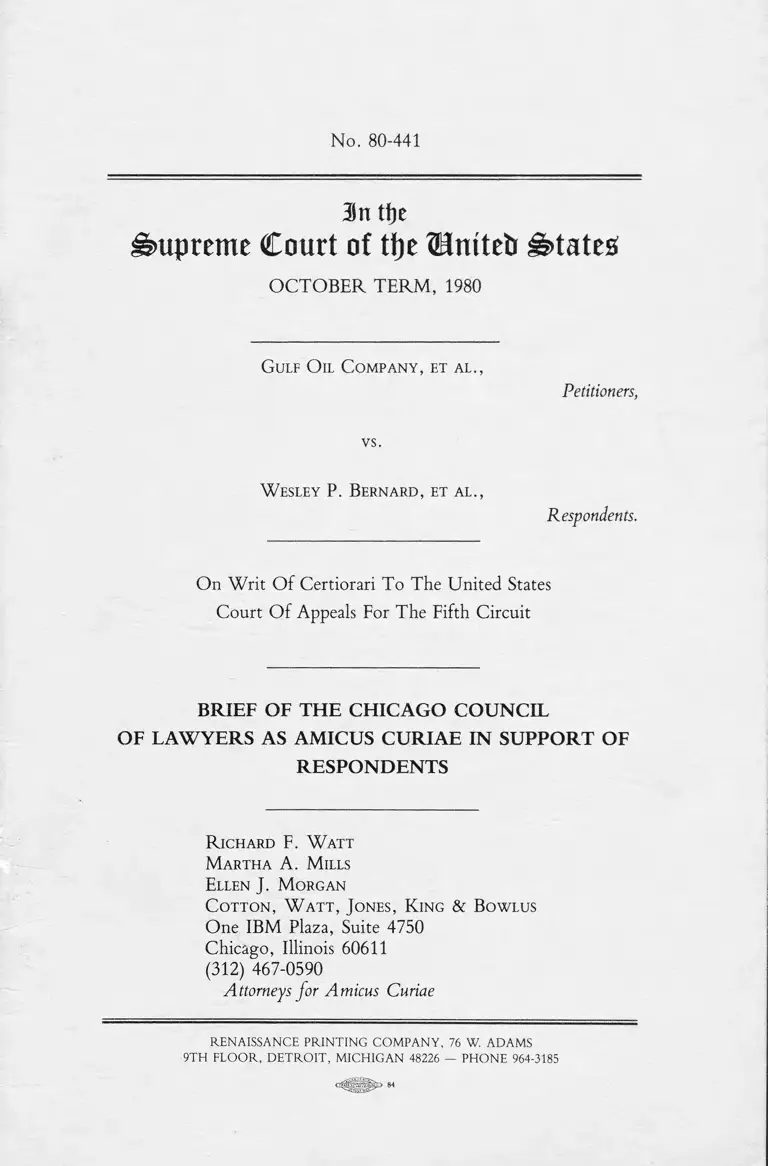
No. 80-441
3)n tfje
Supreme Court of t\)t fEnitetr states:
OCTOBER TERM, 1980
Gulf O il C ompany, et al.,
Petitioners,
W esley P. Bernard, et al.,
Respondents.
On Writ Of Certiorari To The United States
Court Of Appeals For The Fifth Circuit
BRIEF OF THE CHICAGO COUNCIL
OF LAWYERS AS AMICUS CURIAE IN SUPPORT OF
RESPONDENTS
R ichard F. W att
Martha A. M ills
Ellen J. Morgan
C otton, W att, J ones, K ing & Bowlus
One IBM Plaza, Suite 4750
Chicago, Illinois 60611
(312) 467-0590
Attorneys for Amicus Curiae
RENAISSANCE PRINTING COMPANY, lb W. ADAMS
9TH FLOOR, DETROIT, MICHIGAN 48226 — PHONE 964-3185
TABLE OF CONTENTS
Table of Authoriti
Statement of Inter
Summary of Argumen
Argument
es 1
est 1
t 9
14
I. General Restrictions on
Communications Concerning
Class Litigation Unconsti
tutionally Impinge Upon
First Amendment Freedoms 14
A. Communications by
Parties and their
Counsel are Protected
by the First
Amendment 14
B. A Blanket Restriction
On All Communications
Between Parties, or
Their Counsel, and Class
Members Violates Estab
lished Constitutional
Standards in the Area
of First Amendment Rights 24
1. The Non-Communication
Order is Not Justified
by the Need to Protect
a Countervailing Compelling
Interest 24
2. The Restriction on All
Communications With Class
Members is Impermissibly 30
Overbroad
32
3. The Non-Communication
Order is Unconstitu
tionally Vague
II. Broad Restrictions, by Order
or Rule, Upon Communications
Between Parties or Their
Counsel and Actual or Poten
tial Class Members Exceed the
Authority of the District
Courts 37
Conclusion
Certificate of Service
49
51
TABLE OF AUTHORITIES
CASES
Bates v. Little Rock, 361 U.S.
516 (1959) 27
Bridges v. California, 314 U.S.
252 (1941) 26
Brotherhood of Railroad Trainmen
v. Virginia, 377 U.S. 1
(1964) 15-16, 19
Califano v. Yamasaki, 442 U.S.
682 (1979) 40-41
Chicago Council of Lawyers v.
Bauer, 522 F.2d 242 (7th
Cir. 1975), cert, denied,
427 U.S. 912 (1976) 6, 20, 25, 27,
Coles v. Marsh, 560 F.2d 186
(3d Cir.), cert, denied
sub nom., Blue Cross v.
Marsh, 434 U.S. 985 (1977)) 48
Contract Buyers League v. F&F
Investment, 48 F.R.D. 7
(N.D. 111. 1969) 39
Craig v. Harney, 331 U.S. 367
(1947) 26
Deposit Guaranty National Bank
v. Roper, 445 U.S. 326
(1980) 40
Dubose v. Harris, 434 F. Supp.
227 (D. Conn. 1977) 39
-i-
Grayned v. City of Rockford,
408 U.S. 104 (1972) 33
Great Western Cities, Inc. v.
Binstein, 476 F. Supp.
827 (N.D. 111.) aff'd.,
614 F.2d 775 (7th Cir.
1979) 18, 23
Hohman v. Packard Instrument
Company, 399 F.2d 711
(7th Cir. 1968) 39
In re Primus, 436 U.S. 412
(1978) 19, 21
Maine v. Thiboutot, 48 U.S.L.W.
4859 (U.S. June 25, 1980)
(No. 79-838) 23-24
NAACP v. Button, 371 U.S. 415
(1963) 17, 21
Nebraska Press Association
v. Stuart, 427 U.S.
539 (1976) 25
New York Times Co. v. United
States, 403 U.S. 713
(1971) 25
Ohralik v. Ohio State Bar
Association, 436 U.S.
447 (1978) 21, 22,
Orqanization for a Better
Austin v. Keefe, 402
U.S. 415 (1971) 25
-li-
26
Pennekamp v. Florida, 328 U.S. 331
(1946)
Procunier v. Martinez, 416
U.S. 396 (1974) 30
Rodgers v. United States Steel
Corporation, 508 F.2d
152 (3d Cir.), cert,
denied, 423 U.S. 832
(1975) 26, 28
Rutherford v. United Staets,
429 F. Supp. 506
(W.D. Okla. 1977) 39
Schaumburg v. Citizens for
a Better Environment,
444 U.S. 620 (1980) 31, 35
Shelton v. Tucker, 364 U.S.
479 (1960) 30-31
Talley v. California, 362 U.S.
60 (1960) 32
Thomas v. Collins, 323 U.S.
516 (1945) 17-18,
United Mine Workers v. Illinois
Bar Association, 389 U.S.
217 (1967) 17-18
United Transportation Union
v. Michigan Bar, 401
U.S. 576 (1971)
- i i i -
16, 17
Winters v. New York, 333 U.S.
33507 (1948)
Wood v . Georgia, 370 U.S. 375
(1962) 26
Zarate v’. Younqlove, 86 F.R.D.
80 (C.D. Cal. 1980) 29, 38
CONSTITUTIONAL PROVISIONS,
STATUTES, RULES AND
REGULATIONS
United States Constitution,
First Amendment passim
28 U. S.C. §2071 38
42 U. S.C. §1983 23
42 U. S.C. §1988 23
Fed. R. Civ . P. 23 passim
Fed. R. Civ P . 83 37-38
Civil. Rule 22, United States District
Court for the Northenn District
of 11linois (vacated) passim
-lv-
OTHER AUTHORITIES
Developments in the Law —
Class Actions, 89 Harv.
L. Rev. 1318 (1976)
Manual for Complex Litigation,
1 J. Moore, Moore1s
Federal Practice, Pt. I
and II, §1.41 (2d ed. 1980)
7 C. Wright and A. Miller,
Federal Practice and
Procedure (197~2j
46-47
passim
39
-v-
The Chicago Council of Lawyers, with
the written consent of all parties, sub
mits this brief as amicus curiae, in
support of the Respondents.
INTEREST OF THE AMICUS CURIAE
The Chicago Council of Lawyers (the
"Council"), a member of the American Bar
Association, is an association of approx
imately 1300 lawyers, most of whom are
admitted to practice before the United
States District Court for the Northern
District of Illinois (the "District
Court"). Many members of the Council
practice regularly as counsel in class
litigation before the District Court.
Council members have represented both
classes and individuals in class actions
involving alleged violations of the United
States Constitution and various civil
rights statutes as well as in class suits
arising under other federal legislation.
Until recently, the speech activities
of Council members and other attorneys
involved in class litigation before the
District Court were governed by Civil
Rule 22 of the United States District
Court for the Northern District of
Illinois ("Rule 22"). ̂ Rule 22, entitled
1 Rule 22 provided as follows:
In every potential and
actual class action under Rule
23, F.R. Civ. P. all parties
thereto and their counsel are
hereby forbidden, directly or
indirectly, orally or in writing,
to communicate concerning such
action with any potential or
actual class member not a formal
party to the action without the
consent of and approval of the
communication by order of the
Court. Any such proposed com
munication shall be presented
to the Court in writing with
a designation of or description
of all addressees and with a
(footnote continued on next page)
-2-
motion and proposed order for
prior approval by the Court of
the proposed communication and
proposed addressees. The commu
nications forbidden by this rule,
include, but are not limited to,
(a) solicitation directly or
indirectly of legal representa
tion of potential and actual
class members who are not formal
parties to the class action; (b)
solicitation of fees and expenses
and agreements to pay fees and
expenses, from potential and
actual class members who are not
formal parties to the class
action; (c) solicitation by
formal parties to the class
action of requests by class mem
bers to opt out in class actions
under subparagraphs(b)(3) of
Rule 23, F.R.Civ.P.; and (d)
communications from counsel or
a party which may tend to mis
represent the status, purposes
and effects of the action, and
of actual or potential Court
orders therein, which may create
impressions tending, without
cause, to reflect adversely on
any party, any counsel, the
Court, or the administration of
justice. The obligations and
prohibitions of this rule are
not exclusive. All other ethical,
legal and equitable obligations
are unaffected by this rule.
(footnote continued on next page)
-3-
This rule does not forbid
(1) communications between an
attorney and his client or a
prospective client, who has on
the initiative of the client or
prospective client consulted
with, employed or proposed to
employ the attorney, or (2)
communications occurring in the
regular course of business or
in the performance of the duties
of a public office or agency
(such as the Attorney General)
which do not have the effect of
soliciting representation by
counsel, or misrepresenting the
status, purposes or effect of
the action and orders therein.
-4-
For the Prevention of Potential Abuses
of Class Actions," was patterned after
the rule recommended in the Manual for
Complex Litigation^ and was substantially
identical to the non-communication order
entered by District Court Judge Joe J.
Fisher in the case at bar.3 it subjected
to the prior approval of the District
2 Manual for Complex Litigation,
reprinted in 1 J. Moore, Moore's Federal
Practice Pt. II, §1.41 (2d ed. 1980) * 3
[hereinafter cited as Manual].
3 Unlike Judge Fisher's order and
the Manual's proposed rule, Rule 22 did
not contain an exception for constitu
tionally protected speech. However, as
argued at p. 32, n. 5, infra, that excep
tion does not cure the constitutional
infirmities of a rule or order generally
restricting communications.
-5-
Court almost all communications between
formal parties in an actual or potential
class action, or their counsel, and ac
tual or potential members of the class.
The Council's interest in the issues
raised by restrictions upon communications
of litigants and their attorneys has been
long-standing. In Chicago Council of
Lawyers v. Bauer, 522 F.2d 242 (7th Cir.
1975), cert, denied, 427 U.S. 912 (1976),
it successfully challenged the constitu
tional validity of several local rules
which severely curtailed the rights of
litigants and attorneys to comment on
pending criminal and civil litigation.
Following the Bauer decision, the Council
urged the Executive Committee of the
District Court to repeal Rule 22. In
requesting abrogation of the rule, the
Council took the position adopted in the
-6-
en banc opinion of the Court of Appeals
for the Fifth Circuit in the case at bar.
It argued that Rule 22, like the rules
struck down in Bauer, was an unconsti
tutionally overbroad and vague prior
restraint on the First Amendment rights
of attorneys, litigants, and potential
litigants. It contended also that the
enactment of Rule 22 exceeded the rule-
making authority of the district courts
in that it conflicted with the objectives
of Fed. R. Civ. P. 23.
The Council's most recent action
concerning Rule 22 was the submission of
an amicus curiae brief in American Civil
Liberties Union, et al, v. McMillen, 7 9-
1576 (7th Cir. 1979), in support of a
petition for issuance of a writ of manda
mus directing the District Court to re-
-7
scind an order entered pursuant to Rule
22 and to repeal Rule 22 itself. The
order prohibited the parties and their
attorneys in Jane Does, et al. v. City of
Chicago, et al., 79 C 789 (N.D. 111. E.
Div.), a class action challenging the
constitutionality of strip searches con
ducted by members of the Chicago Police
Department, from "soliciting" class mem
bers. The petition for a writ of manda
mus was denied.
In January, 1981, the judges of the
District Court repealed Rule 22, after
repeated requests by the Council and in
light of the Fifth Circuit's holding in
this case that a non-communication order
virtually identical to Rule 22 was an
unconstitutional infringement upon the
First Amendment rights of attorneys and
litigants. The outcome of this petition,
-8-
therefore, has special significance in
the Northern District of Illinois. This
Court's decision on the validity of non
communication orders will likely deter
mine the future here of a rule which
profoundly affects the rights of Council
members and their clients to communicate
freely regarding class litigation in
which they are involved. The Council,
thus, has a direct and immediate interest
in the resolution of this case.
SUMMARY OF ARGUMENT
Restrictions on communications be
tween parties to an actual or potential
class action, or their counsel, and
individual members of the actual or po
tential class seriously impinge upon
their well-established constitutional
rights to free speech, association, and
meaningful access to the courts. Under
-9-
either prior or subsequent restraint
analysis, a court may not restrain such
communications in the absence of a clear
showing that they are in direct and
serious conflict with an important public
or private interest and that such restric
tion is necessary to protect that
interest. While the fair administration
of justice is admittedly a significant
governmental interest, it may not be
invoked as a talismanic justification for
the wholesale rejection of First Amend
ment rights. The constitution requires,
moreover, that any ban on communications
be tailored narrowly and specifically to
avoid unnecessarily inhibiting the exercise
of First Amendment freedoms.
The non-communication order entered
in the case at bar, like the model rule
and order after which it is patterned,
does not satisfy constitutional standards.
-10-
It is based solely on speculative and
theoretical fears that the parties or
their attorneys may engage in abuses of
the class action device sometime in the
future. The general proscription against
all communications, direct and indirect,
is both vague and overbroad. It encompasses
speech that presents no threat to the
fair administration of justice as well as
communications that will actually further
that goal. The order improperly deters
activities falling within the protection
of the First Amendment. The Court of
Appeals for the Fifth Circuit correctly
held that such wide-ranging restrictions
on communication exceed constitutional
1 imitations.
In addition, general orders prohib
iting all communications concerning class
actions are in direct conflict with the
-11
policies embodied in Fed. R. Civ. P. 23
and therefore, exceed the authority of
the district courts to enter orders and
enact rules so long as they are consis
tent with the Federal Rules of Civil
Procedure. Rule 23 was intended to pro
vide a mechanism for resolving suits
involving common factual and legal issues
and common claims for relief in a manner
that would be economical, efficient, and
effective for both the parties involved
and the judicial system.
A communications bar presents formi
dable obstacles to the achievement of
these objectives. It deprives the parties
their counsel, and the court of essential
information in deciding whether to proceed
on a class basis. it interferes with the
proper maintenance of a class action by
preventing free development of litigation
strategy, discovery, and trial preparation
-12-
It inhibits the flow of information to
class members on matters affecting their
interests. A communications bar thus,
hinders meaningful access to the courts
for both class representatives and class
members.
While the district courts are not
without power to monitor communications
in the class action context, they may do
so only in a manner that comports with
Rule 23. This requires a specific record
showing that the communications in ques
tion constitute particular abuses of the
class action device. Any restriction on
communications must, futhermore, be drawn
to provide the narrowest possible relief
from such abuses. The order entered in
the case at bar fails to satisfy these
requirements.
The en banc decision of the Court of
-13-
Appeals for the Fifth Circuit invali
dating the non-communication order should
be affirmed.
ARGUMENT
I
GENERAL RESTRICTIONS ON
COMMUNICATIONS CONCERNING CLASS
LITIGATION UNCONSTITUTIONALLY
IMPINGE UPON FIRST
AMENDMENT FREEDOMS
A. COMMUNICATIONS BY PARTIES TO CLASS
LITIGATION AND THEIR COUNSEL ARE
PROTECTED BY THE FIRST AMENDMENT
The order entered in the case at
bar, like the proposed order and rule
found in the Manual, generally prohibits
parties to a class action and their
attorneys from communicating, directly or
indirectly, with potential or actual
members of the class without the prior
approval of the district court. It then
sets forth a non-exclusive list of pro
hibited communications: (1) solicitation
of legal representation, (2) solicitation
-14-
of fees and expenses from class members,
(3) solicitation of requests to opt
out from the class action, and (4) commu
nications tending to misrepresent the
nature and status of the litigation.
The communicative activities pro
scribed by this order, as well as the
order and rule recommended in the Manual
are protected by the First Amendment to
the United States Constitution. As this
Court has said,
It cannot be seriously
doubted that the First Amend
ment's guarantees of free
speech, petition and assembly
give [ individuals] the right
to gather together for the
lawful purpose of helping and
advising one another in asserting
the rights Congress gave them...,
statutory rights which would
be vain and futile if [indivi
duals] could not talk together
freely as to the best course
to follow....And the right...
to advise concerning the need
for legal assistance - and
most importantly, what lawyers
[an individual] could confi
dently rely on - is an insep-
-15-
arable party of this
constitutionally guaranteed
right to assist and advise
each other.
Brotherhood of Railroad Trainmen v .
Virginia, 377 U.S. 1, 5-6 (1964). "Col
lective activity undertaken to obtain
meaningful access to the courts is a
fundamental right within the protection
of the First Amendment." United Transpor
tation Union v. Michigan Bar, 401 U.S.
576 , 585 (1971).4 it includes efforts to 4
4 Petitioners' suggestion at p.
29, n. 29 of their brief that restrictions
on communications after initiation of
a lawsuit do not impinge upon this right
ignores that access to the courts must
be meaningful. A ban on communications
can effectively deprive formal parties
and class members of meaningful access
to the courts for the redress of grievances.
See discussion infra, pp. 41-45.
-16-
finance the costs of litigation. "That
right [of access to the courts] would
be a hollow promise if courts could
deny associations of workers or others
the means of establishing their members
to meet the costs of legal representation."
401 U.S. at 585-586.
The First Amendment's protection
of such activity does not depend on
the nature of the underlying rights
sought to be vindicated. The present
litigation involves the assertion of
civil rights, and therefore, falls squarely
within this Court's decision in NAACP
v. Button, 391 U.S. 415 (1963). However,
the First Amendment does
not protect speech and assembly
only to the extent it can be
characterized as political.
"Great secular causes with small
ones, are guarded. The grievances
for redress of which the right
of petition was insured, and
with it, the right of assembly,
are not solely religious or
political ones. And the rights
-17-
of free speech and a free press
are not confined to any field
of human interest."
United Mine Workers v. Illinois Bar
Association, 389 U.S. 217, 224 (1967)
(quoting Thomas v. Collins, 323 U.S. 516,
531 (1945)). See also Great Western
Cities, Inc, v. Binstein, 476 F. Supp.
827, 834 (N.D. 111.), aff'd, 614 F.2d 775
(7th Cir. 1979) (according First Amendment
protection to activities of association
organized to pursue legal remedies for
claimed securities fraud against members
and to advise others of their rights and
recommend legal counsel). Thus, the
First Amendment protects communications
relating to "civil rights" as well as
"commercial" class litigation.
The constitutional protection afforded
the associational activities of parties
involved in class litigation extends to
lawyers retained by them to represent
-18-
their interests. In Brotherhood of Rail-
road Trainmen v. Virginia, this Court
found constitutionally protected a
union's activities which involved
advising injured union members not to
settle any claims for damages without
first seeing a lawyer and recommending
that they consult counsel selected by the
union. The Court held that such activity
could not be enjoined and noted, "of
course, lawyers accepting employment
under this constitutionally protected
plan have a like protection which the
State cannot abridge." 377 U.S. at 8.
See also In re Primus, 436 U.S. 412, 431-
432 (1978). The extension of such protec
tion to lawyers recognizes that an attorney
speaks for his client regarding all matters
for which he is retained.
-19-
Protection of lawyers' communications
regarding class litigation derives from
practical necessity as well. As the
Court of Appeals for the Seventh Circuit
stated in invalidating a local rule
prohibiting comment by attorneys involved
in civil litigation:
Sometimes a class of poor
or powerless citizens challenges,
by way of a civil suit, actions
taken by our established private
or semi-private institutions or
governmental entities.... The
lawyer for the class plaintiffs
may be the only articulate
voice for that side of the
case. Therefore, we should be
extremely skeptical about any
rule that silences that voice.
Chicago Council of Lawyers v. Bauer,
522 F.2d at 258.
The solicitation activity prohibited
in this case also is protected by the
First Amendment. Any alleged acts of
solicitation by the respondents' attorneys
in this litigation involving charges of
-20-
racial discrimination in employment are
plainly within the rule, enunciated by
this Court in NAACP v. Button and In re
Primus, that solicitation of legal repre
sentation for the purpose of vindicating
political and civil rights is constitutionally
protected. The fact that respondents
have requested money damages and attorneys'
fees does not deprive solicitation activity
of constitutional protection. See In
re Primus, 436 U.S. at 429-430.
In fact, the Council believes that
the distinction between "public interest"
lawsuits and "commercial" litigation, drawn
by this Court in Ohralik v. Ohio State
Bar Association, 436 U.S. 447 (1978), is
not appropriate in the context of solici
tation by counsel for formal parties in
purported or actual class litigation.
The class action situation is quite different
-21
from the circumstances of Ohralik, where
the solicitation activity in question was
directed at initially obtaining a client
to institute a lawsuit. In contrast, the
attorney for the formal party already has
an individual client, whose interests he
is bound to pursue, and depending on the
stage of the litigation, either purports,
or has been judicially determined, to
represent adequately the interests of the
class. Solicitation of additional class
representatives is usually for the purpose
of insuring sufficient numbers to with
stand the effects of attrition and possible
dismissal of a suit. Such activity by an
attorney already retained to represent a
formal party whose interests are potentially
or actually the same as those of solicited
class members hardly presents the dangers
of stirring up litigation, assertion of
fraudulent claims, misrepresentation,
-22-
undue influence, and overreaching poten
tially posed by solicitation of a prospec
tive client to institute a lawsuit. Ohralik,
436 U.S. at 461. See Great Western Cities,
Inc, v. Einstein, 476 F. Supp. at 835.
There is no justification for condi
tioning the right to engage in solicitation
on the nature of the rights asserted
in a class action or the motivation of
legal counsel. Even those who favor
a communications bar do not distinguish
between types of litigation in terms of
the frequency of potential abuses of the
class action device. Moreover, the line
drawn between "commercial" and "civil
rights" litigation is necessarily arbitrary
to some extent, and a distinction based
upon the motivation of legal counsel
has become blurred by the increasing
availability of court-ordered fee awards
under 42 U.S.C. §1988. See Maine v.
-23-
Thiboutot, 48 U.S.L.W. 4859 (U.S. June
25, 1980) (No. 79-838), (42 U.S.C. §1983
encompasses violation of any federal
statute and availability of attorneys*
fees awards under 42 U.S.C. §1988 is not
limited to civil rights actions).
The First Amendment freedoms of
parties to class actions and their counsel
are admittedly not absolute. However,
any restrictions on such rights must
satisfy strict constitutional standards.
Whether analyzed as a prior or subsequent
restraint on speech, the order entered in
the case at bar fails to fulfill such
requirements.
B. A BLANKET RESTRICTION ON ALL COMMUNI
CATIONS BETWEEN PARTIES, OR THEIR
COUNSEL, AND CLASS MEMBERS VIOLATES
ESTABLISHED CONSTITUTIONAL STANDARDS
IN THE AREA OF FIRST AMENDMENT
RIGHTS
1. The Non-Communication Order
Is Not Justified By The Need
To Protect A Compelling Counter
vailing Interest
-24-
The non-communication order entered
in this case is a classic example of a
prior restraint, "a predetermined judicial
prohibition restraining specified expres
sion. ..." Chicago Council of Lawyers v.
Bauer, 522 F.2d at 248; see Nebraska
Press Association v. Stuart, 427 U .S.
539, 556 (1976). As such, it bears a
heavy presumption against its constitu
tional validity. Id. at 558; Organization
for a Better Austin v. Keefe, 402 U.S.
415, 419 (1971). The proponents of a
prior restraint must demonstrate that the
expression sought to be restrained "surely
[will] result in direct, immediate and
irreparable damage" to a compelling
public or private interest, New York
Times Co. v. United States, 403 U.S. 713,
730 (1971) (Stewart, J. concurring), or
that it presents a clear and present
-25-
danger to an asserted interest. Thomas
v. Collins, 323 U.S. 516, 530 (1945).
While the fair and proper administra
tion of justice may justify some restraints
on speech, "it does not authorize any
blanket exception to the First Amendment."
Rodgers v. United States Steel Corporation,
508 F.2d 152, 162 (3d Cir.), cert, denied,
423 U.S. 832 (1975) (citing Wood v. Georgia,
370 U.S. 375 (1962); Craig v. Harney, 331
U.S. 367 (1947); Pennekamp v. Florida,
328 U.S. 331 (1946); Bridges v. California,
314 U.S. 252 (1941)). Free speech rights
"should not be impaired... unless there is
no doubt that the utterances in question
are a serious and imminent threat to the
administration of justice." Craig v.
Harney, 331 U.S. at 373.
Even if rules or orders restricting
communications concerning class actions
- 2 6 -
may not be characterized as prior restraints,
Chicago Council of Lawyers v. Bauer,
522 F.2d at 248-49, they are still subject
to exacting judicial scrutiny. Before
a court can so limit fundamental rights,
there must be a showing that the restraint
on speech protects "a subordinating
interest that is compelling." Bates
v. Little Rock, 361, U.S. 516, 524 (1959).
In the case at bar, the Fifth Circuit
noted that the district court entered
the non-communication order in the absence
of proof of the petitioners' unsworn
charges of abuses by the respondents'
attorneys and without making findings
of fact. 619 F.2d at 464. It concluded
that the court based its order on the
recommendations of the Manual that district
courts enact rules or enter orders limiting
communications in actual or potential
-27-
class actions in order to protect against
potential abuses of the class action
device. 619 F.2d at 466.
The fact that abuses of the class
action device have occurred in scattered
cases or the remote possibility that the
attorneys or parties in this action might
commit some unknown abuse in the future
does not establish a threat to the fair
administration of justice sufficient to
justify the entry of a wide-ranging
communications ban. Moreover, many of
the so-called abuses mentioned in the
Manual in support of a communications
bar, e.g., seeking a declaratory judgment
as to the liability of one defendant,
seeking to withdraw class allegations in
an effort to effectuate an individual
settlement, and negotiating a settlement
with a second set of attorneys after the
-28-
first set had declined the offer, would
not be prevented by a non-communication
order. It is questionable whether other
potential abuses mentioned in the Manual,
e.g., solicitation of additional plain
tiffs in class actions already filed, are
actually abuses at all. See Zarate v.
Younglove, 86 F.R.D., 80, 98 (C.D. Ca.
1980) .
Thus, it is unclear what interests
the order is intended to protect, how the
prohibited communications threaten any
legitimate interest, or whether the order
is a reasonable means of protecting a
countervailing interest. Restriction of
First Amendment rights cannot be bottomed
on such uncertainty, especially in light
of the Manual 1s recognition that "generally,
the experience of the courts in class
actions has been favorable.... [A]buses
-29-
are the exception in class action litiga
tion rather than the rule." Id. at 36-
37 .
2. The Restriction On All Communi
cations With Class Members
Is Impermissibly Overbroad
The First Amendment requires that
restrictions on speech and associational
activities be drawn carefully to avoid
needless inhibition of constitutional
rights. "[T]he limitation of First
Amendment freedoms must be no greater
than is necessary or essential to the
protection of the particular government
interest involved." Procunier v. Martinez,
416 U.S. 396, 413 (1974). A legitimate
and substantial government interest
may not be protected "by means that
broadly stifle fundamental personal
liberties when the end can be narrowly
achieved. The breadth of legislative
abridgement must be viewed in light
-30-
of less drastic means for achieving
the same basic purpose." Shelton v.
Tucker, 364 U.S. 479, 488 (1960). See
Schaumburg v. Citizens for a Better
Environment, 444 U.S. 620, 637 (1980).
The order here, like its counterparts
in the Manual, suffers from overbreadth.
The prohibition against all communications,
direct or indirect, undoubtedly restricts
protected speech and associational activities
that pose no conceivable threat to the
fair administration of justice or any
other legitimate interest. In fact,
it encompasses communications that actually
would facilitate the fair and effective
functioning of the judicial system.
Only a narrowly-tailored order limiting
only those communications which constitute
specific abuses of the class action
-31-
device can satisfy constitutional stan
dards.5 Limitations on freedom of speech
and association must not go beyond what
is necessary to protect an established
countervailing interest. Talley v.
California, 362 U.S. 60, 64-65 (1960).
3. The Non-Communication Order
Is Unconstitutionally Vague
Restrictions on fundamental liberties
must satisfy constitutional standards
5 The special treatment of consti
tutionally protected speech in the order,
and in the most recent version of the
rule proposed in the Manual, does not
cure its overbreadth. An attorney or
party who communicates with class members
in the belief that such communications
are constitutionally protected may,
nonetheless, be called upon to establish
the basis for his belief, thus risking
a possible contempt citation. The chilling
effect on the exercise of First Amendment
rights is surely as great as an outright
prohibition of all speech.
-32-
of specificity. Specificity is especially
critical where, as here, rights of free
speech and association are involved.
[W]here a vague statute
"abut[s] upon sensitive areas
of basic First Amendment freedoms,"
it "operates to inhibit the exer
cise of those freedoms." Uncer
tain meanings inevitably lead
citizens to 'steer far wider of
the unlawful zone'...than if the
boundaries of the forbidden areas
were clearly marked."
Grayned v. City of Rockford, 408 U.S.
104, 109 (1972) (footnotes omitted). A
restriction on speech "so vague and
indefinite in form...as to permit within
the scope of its language the punishment
of incidents fairly within the protection
of the guarantee of free speech is void
on its face as contrary to the Fourteenth
Amendment." Winters v. New York, 333
U.S. 507 , 509 (1948) .
The order entered here, like its
model in the Manual, is replete with
-33-
vague terms offering no guidance to
attorneys, parties, or judges as to
what behavior is permitted and what
is prohibited. For example, the "indirect"
communication prohibited by the order
is susceptible of no limiting definition.
Under this language, respondents or
their attorneys risk violating the order
if they respond to a reporter's questions
concerning the class action, because
they thereby may be communicating "indirectly"
with class members. The ban on all
communications certainly would encompass
requests for information from class
members. A lawyer therefore, risks
punishment if he seeks information relevant
to his client's case from persons with
knowledge of the facts because they may
be potential class members. As a result
he may not satisfy his obligation to his
client to investigate the facts fully.
-34-
Even the specific, but non-inclusive,
prohibitions of the order are subject to
widely varying interpretations. The line
between prohibited "solicitation" and the
mere transmission of information is diffi
cult to draw, and the two messages are
often part and parcel of the same communi
cation.® The order offers no guidelines
® This Court recently reiterated
its view that solicitation is often in
extricably entwined with First Amendment
activity:
Solicitating financial
support is undoubtedly subject
to reasonable regulation but
the latter must be undertaken
with due regard for the reality
that solicitation is character
istically intertwined with
informative and perhaps persuasive
speech seeking support for
particular causes or for particular
views on economic, political
or social issues, and for the
reality that without solicitation
the flow of information would
likely cease.
Schaumburg v. Citizens for a Better Environ
ment , 444 U.S. at 632.
-35-
for distinction. The prohibition on
communications that tend to misrepresent
the action or reflect adversely on the
court, the parties, or their counsel
likewise provide no indication of what
is prohibited and what is permitted.
Such vagueness forces parties and their
attorneys to refrain from speaking at
all in order to protect themselves against
possible remote effects on their comments.
See Chicago Council of Lawyers v, Bauer,
522 F .2d at 259 (prohibition against
public comment on matter that is "reasonably
likely to interfere with a fair trial"
is unconstitutionally vague).
The order entered in this case,
as well as the proposed rule and order
after which it is modelled, do not
comport with constitutional standards
where restriction of First Amendment
-36-
freedoms is involved. Specific remedies
and sanctions for specific abuses, such
as discipline of attorneys who exceed
ethical limitations in communicating with
class members, are available and satisfy
constitutional requirements. Abuses of
the class action device are a legitimate
area of concern for the district courts.
At the same time, no court can ignore
speech and associational rights guaranteed
by the First Amendment in attempting to
deal with such abuses.
II
BROAD RESTRICTIONS, BY ORDER
OR RULE, UPON COMMUNICATIONS
BETWEEN PARTIES OR THEIR COUNSEL
AND ACTUAL OR POTENTIAL CLASS
MEMBERS EXCEED THE AUTHORITY
OF THE DISTRICT COURTS
The authority of the district courts
to prescribe rules and enter orders re
garding class litigation is limited by
Fed. R. Civ. P. 23(d) and 83 and by
-37-
28 U.S.C. §2071. Rule 23(d) states
that the court may make "appropriate
orders" in the conduct of class actions.
Rule 83 permits the district courts to
"make and amend rules governing [their]
practice not inconsistent with" the Federal
Rules of Civil Procedure, and in cases
not provided for by rule, to "regulate
their practice in any manner not inconsis
tent with these rules." Section 2071
allows them to prescribe rules which
"shall be consistent with Acts of Congress
and rules of practice and procedure pre
scribed by the Supreme Court." Rules and
orders affecting class litigation must,
therefore, comport with the policies of
Fed. R. Civ. P. 23, which governs the
initiation and maintenance of class actions.
Rodgers v. United States Steel Corporation;
Zarate v. Younglove, 86 F.R.D. 80, 93-94
-38-
(C.D. Cal. 1980) .
The objectives of Rule 23 include
the efficient resolution
of the claims and liabilities
of many individuals in a single
action, the elimination of repe
titious litigation and possibly
inconsistent adjudications in
volving common questions, related
events, or requests for similar
relief, and the establishment of
an effective procedure for those
whose economic position is such
that it is unrealistic to expect
them to seek to vindicate their
rights in separate lawsuits.
7 C. Wright and A. Miller, Federal Practice
and Procedure §1754, p. 343 (1972) [herein
after cited as "Wright and Miller"]- See
also Hohmann v. Packard Instrument Company,
399 F .2d 711, 714-715 (7th Cir. 1968);
Dubose v. Harris, 434 F. Supp. 227, 230
(D. Conn. 1977); Rutherford v. United
States, 429 F. Supp. 506, 508 (W.D. Okla.
1977) (citing Wright and Miller); Contract
Buyers League v. F&F Investment, 48
F.R.D. 7, 12-13 (N.D. 111. 1969). This
-39
Court recently summar ized the purpose of
class actions brought pursuant to Fed. R.
Civ. P. 23(b)(3):
The aggregation of indivi
dual claims in the context of a
class-wide suit is an evolutionary
response to the existence of
injuries unremedied by the regula
tory action of government. Where
it is not economically feasible
to obtain relief within the
traditional framework of a mul
tiplicity of small individual
suits for damages, aggrieved
persons may be without any
effective redress unless they
may employ the class-action
device.
Deposit Guaranty National Bank v. Roper,
445 U.S. 326, 339 (1980).
In Cal ifano v. Yamasaki, 442 U.S.
682, 701 (1979), it commented upon the
desirability of class litigation in
certain cases:
[W]e note that class relief
for claims such as those presented
by respondents in this case is
peculiarly appropriate. The issues
involved are common to the class
as a whole. They turn on questions
-40-
of law applicable in the same
manner to each member of the
class....[E]ach individual
claim has little monetary
value. It is unlikely that
differences in the factual^
background on each claim will
affect the outcome of the legal
issue. And the class-action
device saves the resources of
both the courts and the parties
by permitting an issue poten
tially affecting every social
security beneficiary to be
litigated in an economical
fashion under Rule 23.
Rules and orders, such as those
recommended in the Manual, the order
entered in the case at bar, and former
Rule 22 of the District Court for the
Northern District of Illinois, which
impose far-reaching restrictions on the
ability of litigants and attorneys in
actual or purported class actions to
communicate with class members, conflict
squarely with the policies embodied in
Rule 23 and severely impede the proper
conduct of class litigation. By limiting
virtually all discussion concerning class
-41
actions they deprive Rule 23 of much of
its force. Such restrictions deny parties
and their counsel access to crucial infor
mation relating to the number of potential
claimants or defendants involved in a
particular action, the size and similarity
of their claims or defenses, and the
appropriateness of a formal party as
class representative. The proponents
of a communications bar have themselves
recognized that "[i]n many such cases
class members will have knowledge of
facts relevant to the litigation and to
require a party to develop the case without
contact with such witnesses may well
constitute a denial of due process." Manual,
p. 34 .
The lack of such information makes
it exceedingly difficult, if not impossible,
for parties and their attorneys to make
an informed decision as to the propriety
-42-
and feasibility of proceeding with liti
gation on a class basis. Restrictions
on communication thus, hinder meaningful
access to the courts by actual or potential
members of a class, see Zarate v. Younglove,
86 F.R.D. at 97 (it is especially desirable
to involve class members in Rule 23(b)(2)
class actions because they do not have
the right to opt out of the class), and
discourage the resolution of disputes
common to many in the class action form.
Restrictions on communication also
interfere with the effective, fair and
efficient functioning of the judicial
system. The trial court's decision on
the propriety of class certification
depends largely on evidence provided by
counsel for the formal parties. If counsel
cannot freely obtain information concerning
the size of a potential class, the nature of
the claims involved, the interests of the
-43-
potential class members, and the adequacy
of the class representation, such infor
mation will, most likely, never reach the
court. The unavailability of information
on the very factors which govern the
outcome of the class certification issue
may often lead the district court to an
improper decision to certify a class or
to deny class certification.
The hazards created by broad non
communication orders do not cease with
class certification. Once a class is
certified, restrictions on communication
with class members present formidable
obstacles to class representatives and
their counsel in fulfilling their obliga
tions to members of the class and in
effectively conducting litigation. Such
restrictions interfere with their duty to
"fairly and adequately protect the interests
-44-
of the class" as required by Fed. R. Civ.
P. 23(a) (4). A communications bar disrupts
the development of litigation strategy,
discovery, and trial preparation for
plaintiffs and defendants alike, and
inhibits the flow of information to class
members on matters affecting their interests.
Moreover, unless a sufficient number of
class representatives can be obtained
through free communication with class
members, the inevitable effects of attri
tion, particularly in long, complex cases,
may result in dismissal of a meritorious
suit.
The fact that communications are
subjected to the prior approval of the
district court rather than absolutely
prohibited does not mitigate the deleterious
effects on the commencement and maintenance
of class actions. A requirement that all
-45-
proposed communications be submitted to
the court and opposing counsel may deter
counsel for class representatives from
making necessary contacts with class
members in light of the duty to maintain
the confidentiality of attorney-client
communications. Furthermore, obtaining
prior court approval of every proposed
communication is not feasible when such
communications may necessarily be on an
ongoing basis. A rule or order that
requires prior court approval of all
communications with class members will,
in a practical sense, stop such contacts
almost as effectively as an absolute
prohibition on communications.
In a frequently-cited, comprehensive,
and thoughtful article entitled Developments
in the Law -- Class Actions, 89 Harv. L.
Rev. 1318 (1976), the authors have summarized
-46
the serious problems that orders such as
the one involved here pose for the effec
tive maintenance of class actions:
The present practice in
some federal courts of prohi
biting communications with the
class by both the class attorney
and the class opponent in the
absence of prior court approval,
although responsive to concerns
of abuse, seems overbroad and
potentially dysfunctional. Class
attorneys and class opponents
may limit their communications
with a class in order to avoid
the time consuming process of
obtaining prior judicial clear
ance and limit the risk of anta
gonizing the judge. As a result,
class attorneys may be handicapped
in their efforts to obtain a
picture of the different situa
tions of class members, informa
tion-gather ing and necessary
business communications by class
opponents may be impaired, class
members may be denied legal
advice, and the court itself may
be deprived of information poten
tially relevant to its litigation
decision.
Id. at 1600-01.
The district courts are not absolutely
without power to monitor communications
-47-
in the class action context. However, in
order to avoid conflict with the important
policies of Rule 23, any restriction on
communications concerning actual or poten
tial class litigation must be based upon
"a specific record showing by the moving
party of the particular abuses by which
it is threatened," and must be formulated
to afford "the narrowest possible relief
which would protect the respective parties.
Coles v. Marsh, 560 F.2d 186, 189 (3d
Cir.) , cert. denied sub nom., Blue Cross
v. Marsh, 434 U.S. 985 (1977). This
standard is not met where, as here,
a non-communication order is based solely
on theoretical abuses or the occurrence
of activities which encourage participa
tion in the litigation of common claims
and provide potential class members with
information concerning the nature of a
suit commenced on their behalf. Id.
-48-
Rules which generally constrain
communications between formal parties or
their counsel and class members in every
potential and actual class action are
necessarily made in the absence of any
specific showing of actual or imminent
abuse of the class action device. Hence,
they too must fall when viewed in the
light of the important objectives served
by Rule 23. Rodgers v. United States
Steel Corporation, 508 F.2d at 163-164.
CONCLUSION
For the foregoing reasons, amicus
curiae the Chicago Council of Lawyers
respectfully urges that the decision
-49-
of the Court of Appeals below should
be affirmed.
Dated:
Respectfully submitted,
Richard F. Watt
Martha A. Mills
Ellen J. Morgan
COTTON, WATT, JONES,
KING & BOWLUS
One IBM Plaza
Suite 4750
Chicago, Illinois 60611
(312) 467-0590
Attorneys for Amicus
Curiae The Chicago
Council of Lawyers
March 2, 1981
-50-
CERTIFICATE OF SERVICE
It is hereby certified that three
(3) copies of the foregoing Brief of
the Chicago Council of Lawyers as Amicus
Curiae in Support of Respondents have
been served this 2nd day of March, 1981,
by United States Mail, postage prepaid,
upon the following counsel of records:
Patrick 0. Patterson, Esq.
10 Columbus Circle
Suite 2030
New York, New York 10019
William G. Duck, Esq.
Post Office Box 3725
Houston, Texas 77001
Carl A. Parker, Esq.
449 Stadium Road
Post Arthur, Texas 77640
Martha A. Mills
Attorneys for Amicus
Curiae
-51-