Transcript of Hearing on Plaintiffs' Request for Injunctive Relief
Public Court Documents
July 9, 1971
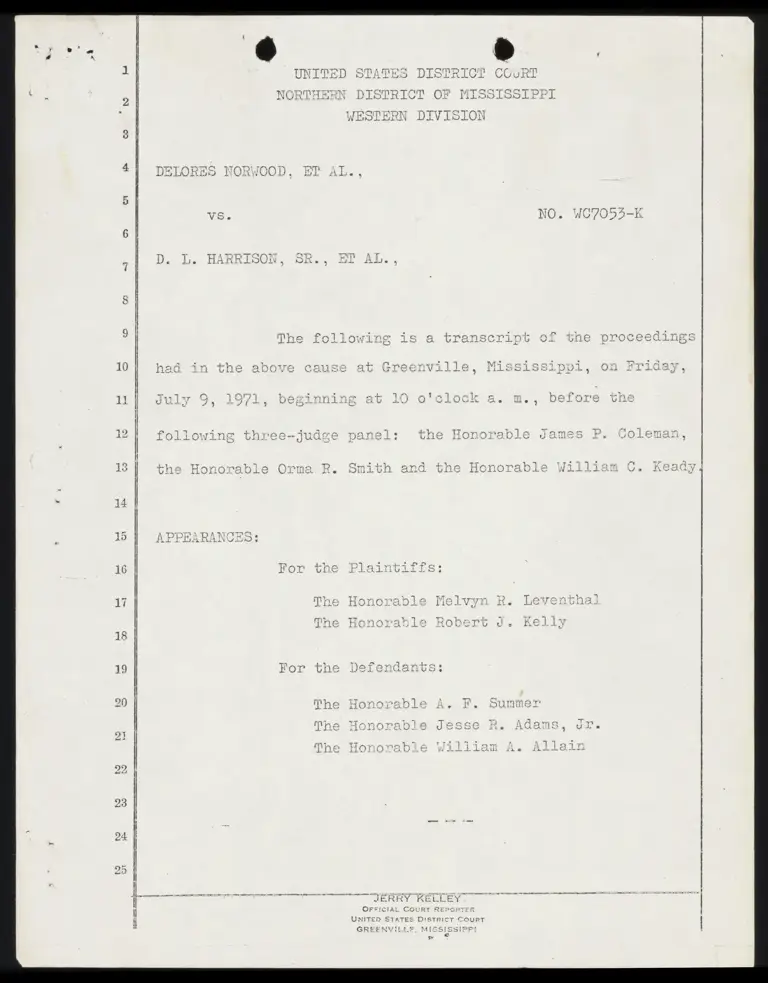
57 pages
-
Case Files, Norwood v. Harrison - Hardbacks. Transcript of Hearing on Plaintiffs' Request for Injunctive Relief, 1971. 1dbc9e59-722e-f111-88b4-0022482cdbbc. LDF Archives, Thurgood Marshall Institute. https://ldfrecollection.org/archives/archives-search/archives-item/d69dd996-1816-48c4-bd2a-1696115096de/transcript-of-hearing-on-plaintiffs-request-for-injunctive-relief. Accessed October 18, 2026.
Copied!
     [||e4c85b43-3588-4f54-b959-7f9b0ec94038||] DISTRICT COURT

H 3 {PPI $F 8S
@

NEB Mi GREENVILLE

2
Me

£
0


Lid
~

Fa

Pr]
’.,

Nr

;

W
E


:
[

)
a

3

red
7


QL

i

CJ
LW,

r
a


i

Ae
f

|


t

KA
@

i


i

#4
D

.

No
FA

i
G
n


|

C
4

2

'

a


:
.

5%.
—


{

5
i


|
9

r
s


4
Cs

»

i

o
g


®
a


:

OD
I)

c
}

{

h
o


]
-

id

*

=


-)
.

:
3

O
2

ey

S
r


C
i


A


foo
c=

.
i

a


gis
4


i


I)
po

So

~.

LP]

a

ar
SS

G4
i

0
Po

=
~

©

E
i


4


~
—
i


O


¢))]
F
y


©


i
s
,


¢9,
—


OF
td

f
g:

;
+

=
]

f53
Sy

“
4

ri
a

J


.
Be

ne

SY)
iD

ae]
;

i
d
s


i
f
o
o
d


O
W


By
-u

=
—~

I
bt

0 FS
Qo

O
H


*-
9p:

0


£
EH

=


0

er
PA

i
S


.
od

o
£

dl

=
UD

=


O
oy

«
5-4

pl
re

.

B
a


A
2

H
B


5

O
E


;
~
~


-
ir

a
)

g
r
o
.


O
*

£4
fy

HH
~

—
oO

rd
0

fx

£4
ry

pred
O

Eo
i

n
O


E>
+2

—
|

i

:

T
A


4,
Q

®
4D

La
.

A
KH

AQ
«

>
)

Pe
:

oe
ul

i

O
;

fo
oO

42
—

0
!

7)
HH

pr
0)

D
IS

4


ID

fy}
~


r
e


14
—


ey
1-4

f

h
a
n


-
SEE

LE
@

rd
-

4


=


7
4


:
i

~~
r
i


ve
J

S
Wm

v
d


rT
"

f
r


a


~

<x
0

Hf
3

80
©

-
§>

el
FH

0
=

L
e
t
a


5
Hh

2
~~

[=
-

i
i


+
fay!

-
od

5
®

O

r
n


ts
et

A
-

&


C
d


i


.
—


°
l
l


>


os
AY)

"
2,

i,

a
G6

O
£2;

nN
Q

Q

0
Ti

ol
i

ri!
D

:
3

bpd

ot
EE

N
i

[6p

hi

oie
ro

2
4

H
o


4
;

O
o


2
g


0)
a

prelil
5


v
Ye

is}
A


ow
Ri

|

5
>

3
&

4
Ed

:
ay

{

pod
4

9p)
W

ad
0!

a
y
o


+3
Bi

]

C
:

9,
Ye

[

=
ci

oo)
!

=
S

£
i

ei
-

-
=


v
i

oO
{

o
O


F
r


|


pv
o


P
o


®
O


:

a
oO

&
OG

=~
i

he?
:

QO
-

4
©

t

~
~


2


3


2


1


af

|

£3
H

B
E
,


S
d


.
{

Q
oe

:
Mog

42
0

od
bs

1 R
E


por
|

i


be
a


ol
t.

A
wl

j

[49]
1


5


=


0
0


&


i

i

(0p)
bs

aw
+4

.
le)

{

r-3
r

F
t


«=
a
e


~4

!
:

S
d


i
i


!
3

I


i


C
T


brid
bY

i

o
s
,


®
a
h


=


7

i

Q
fin

ry
'

©
=

f

—
~


=
C
p


os
|

i

[x]
'

a
L
R


|

an
fo

o
~

o
Ll

|

=
—-

Cr
[iS

! ! |

r4
(A

:
N

©


oe
5


i

f=)
=

vi
~

os
-

_-
bod!

a
|

Ne)
1)

to
:

e
e


ry
r™

ri
=


i


0


on
<

ri
3

oy
-H

3
!

i
&

oy
&

&
a2

"
oN

aN
[ony

’
4


& w 5

; 1 JUDGE COLEMAN:

4 2 Now, gentlemen before the bar, under the usual

3 procedure in these three court cases the Circuit Judge

4 presides. However, Judge Keady has been in charge of thls

5 case from the beginning as the initiating Judge, he has been

6 in charge of the pretrial procedures and so forth, under

7 those circumstances I have asked him to preside over this

8 hearing and he will preside. I will go along for my part of

9 it, but I now turn the presiding duties over to Judge Keady.

10 JUDGE KEADY:

11 Thank you, Judge Coleman. The Court now calls

12 WC7053-K, Delores Norwood and others, plaintiffs, versus

. 13 D. L. Harrison, Sr., and others, defendants, for hearing on

14 plaintiffs’ request for injunctive relief. What say the

15 plaintiffs?

16 MR. LEVENTHAL:

17 Plaintiffs are ready, Your Honor.

18 JUDGE KEADY:

19 What say the defendants?

20 MR. SUMMER:

21 Defendants are ready, Your Honor.

22 JUDGE KEADY:

23 All right. Now, gentlemen, do you have evidence

24 to offer at this time?

25 MR. LEVENTHAL:

JERRY KELLEY
OFFICIAL COURT REPORTER

UNITED STATES DISTRICT COURT

GREENVILLE, MISSISSIPPI


x


10

11

13

14

20

21

22

23

24

® »

If it pleases the Court, I would like to offer into

evidence the depositions which are in the court jacket file.

JUDGE KEADY:

All right. Do you have a list or tabulation by

which they can be identified?

MR. LEVENTHAL:

JUDGE KEADY:

All right. If you have the tabulation, it may be

presented to the Clerk, marked for the record, and then the

Clerk will accordingly file all of the depositions as part of

the evidentuary record in this case. Is there an objection to

that from the defendants' standpoint?

MR. ADAMS:

No objection.

JUDGE KEADY:

All right. o


vr CLERT =

Be Plointiffes Fxhibit One.

JUDGE KEADY:

All right. Anything further by way of evidence from

MR. LEVERTHAL:

NO, ‘SRY.

JUDGE KEADY:

JERRY KELLEY
OFFICIAL COURT REPORTEK


10

11

19

20

21

evidence

June 21,

arrang
emen

4

Any evidence

MR. ADAMS:

Your Honor, the defendants would offer into

the deposition of Marshall A. Snowden, taken on

is in the Court's file.

Any objection to the

MR. ADAMS:

¥o, sir,

JUDGE KEADY :

Let that HD
 2 =,


[o
F D od All right. deposition of Mr. Sr

Sy , mfr ae ad
That will be Defendants Exhibit Number Tw

The Court now will receil

rvs £ TS yy ey vo Thor Te arguments from counsel in the case. By prior

fo 1-1 or t 5X76 : te ard TS
ents, these arguments have been limited to thirty

FTN A

= FJ


r
v


. ey


“-
 R
e
 J

pl
n

|
2 # T

HALL 4 BR
EME SREIIR 3

A.

Leventhal.

T73 TTR NTITAT [ | 4 A M
MR ea INIA LR

JERRY KELLEY
OFFICIAL COURT REPORTER

UNITED STATES DISTRICT COURT

offering of th atv

ve


\a »

@)
)


Pe
ed


C4
 udge Coleman --

2 JUDGE KEADY:

3 You may touch first on the three-judge court

4 jurisdiction and move in from there.

5 MR. LEVENTHAL:

6 Your Honor, plaintiffs take the position that a

7 three-judge court need not be convened and should not be

8 convened to determine the issues presented by this litigation.

9 Of course, under Jackson Hy


D Hs nn


<
 nN


I

5


O 1) pa
rs


ry


ry


©)
 ox QO
 b

bd


wn


3 [O)
 Q i be
ds


be
 J

(@)
]

jo
r

10 to determine that question as a three-judge court b;

11 preliminary -—- as a preliminary matter.

12 JUDGE COLEMAN:

13 Like to suggest to you for your guidance In future

1

14 cases that Jackson v. Choate is Just about as dead as any- 4

15 thing in this Circuit can be not to be buried. Nobody on the

17 MR. LEVENTH = -


y
t


=

4


3
~


se


18 Yes, sir. The Chief Judge?

19 J UDGE { CO. TEM \N: H

20 Yes.

21 MR. IEVENTHAL:

1 2 -— oT x (oud @' ox 3 -¥ ~ 2 5 - ~ 51 EO]

22 Without question, though, sir, it's binding upon

: y ad : ~ al A A re 23 the Court .as a procedural device

JERRY KELLEY
SNC i Ar OY PEDO TeR


- »
r


1 MR. LEVENTHAL:

2 We take the position, sir, that, first, since the

3 statute is not being considered in its entirety, a three-

4 judge court is not required and that as we set forth in our

5 memorandum of law, the rule of law is that in the absence of

6 some statewide doom of the state statute, a three-judge court

7 should not decide the issue.

8 JUDGE KEADY:

9 What if you had an administrative order? Would that

10 be the same as a state statute?

- 12 Yes, sir. In fact, the Courts have held that an

13 administrative order with statewide implications is reviewable

14 by a three-judge court. But the facts in this case don't fall

15 within that category in that we have the administrative order
i

16 perhaps with statewide application. But the categ gory of

Yi schools involved is a very small one. There are very few

18 schools, looking at the state's total of schools, which are

19 before the Court. There are one hundred fifty four school

20 districts in the state, over one thousand public schools, and

21 approximately forty schools which are not affected by this

22 administrative order, as the Court puts it. And as a result,

23 we do not have the statewide ramifications that dinarily

24 prevail when a three-judge court is convened, when it does

Do


(W
B)
 |

0 oD


c
t


@ ee


(¢)
)

iO)


F + LJ
 n

Ul


- (©)


LJ   ERRY KE LES


1 JUDGE COLEMAN:


2 What would be the difference between this adminis-

3 trative procedure and that which we had in the matter of the

5 Nobody seemed to doubt that they had statewide application

6 within the requirements for a three- -judge court, although

7 they applied only on the campuses of about four or five

8 institutions which might have occupied five or six square

9 miles out of forty-eight thousand in the state.

10 MR. LEVENTHAL:

11 Your Honor, I believe you will find in this case

: 12 law more confusion and doubt as to Just when a three-judge

13 court should be convened than perhaps any other area of the

14 law. 1 subumit that there are many courts which have sumed.

15 jurisdiction without thoroughly considering the question.

16 That, if you look to the controlling decisions of the Supreme

17 Court, it 1s a rare court, it should be convened only under

18 extraordinary circumstances. And I submit that the cases

19 Your Honor refers to might not have been decided by a three-

20 judge court.

21 JUDGE COLEMAN:

22 Do you concede at the outset that this statutbe,

23 which was passed back in 1940, to lend free textbooks to all

- 24 children in the state, regardless of race or color, is on

25 its face constitutional?

JERRY KELLEY

OFFiciAL COURT REPORTER

UNITED STATES DISTRICT COURT

GREENVILLE, MISSISSIPPI


10

11

12

13

po
d

EN
S

20

21

22

23

24

challenge

tion?

throughout

the pring

MR. LEV. ENTHAL:

Yes, sir, on its face it's constitutional, and we

it in its application.

JUDGE COLEMAN:

Fa .

So you are challenging it only as fo its applica-

JUDGE COLEMAN:

Did you make that clear in your Complaint?

MR. LEVENTHAL:

alleg Our ation is,

we have a system of formed

: oc - 3 IR Tl ly wis 4 RS a 2 Sa t the state which have undermined public

" ~ 7%) 3 £ PRES. j= y 2
secondly. that we seek relief .against tnose

J 3 -)

Q


o
 £5
 CS 3 r Tx


for a three-judge

MR. LEVENTHAL:

Te ea : 3 Sa :
Plaintiffs filed a motion relying entirely upon

* r 2 1m cn al ~ ~ "
iple of Jackson versus Choate, Your Honor. Ue

- on Yn VT A + ~ 3-3} 4- Ta1n+4 fF J 3 , 4 3 Se “vy

in the Motion that plaintiffs 4id not believe, and

PEI hi
require ad ’ but

opinion in Jackson versus Choate, therefore

. .
ue. fy i 7 al alos 1Ts convening,

JERRY KELLEY
OFFICIAL. COURT REPORTER

UNITED STATES DisTRICT COURT

GREENVILLE, MISSISSIPFI
)


Eo 10
* ®

1 JUDGE COLEMAN:


2 What do you understand Jackson v. Choate to have

3 really held?

4 MR. LEVENTHAL:

5 That whenever there is any doubt with regard to the

.

question of whether a three-judge court should be convened, (=p
)

then it should be convened to decide whether it should convene

-J


8 JUDGE COLEMAN:

9 That's just exactly about what it holds.

10 MR. LEVENTHAL:

11 I recognize, sir, that there is some confusion in

13 JUDGE KEADY:

14 Suppose you move on, then, into the merits.

15 MR. LEVENTHAL: .

16 Xe sir. Your Honor, I don't want to rshash The 0 U

18 my presentation by fact versus law. Instead, I would like to

19 liscuss perhaps five crucial questions before the Court

20 discussing fact and law as they relate to one another. As

21 they are interwoven in this case.

99 The first issue, the factual question, is whether

23 we have before the Court a case where the aid is aimed at

24 the student as opposed to the school. We must begin with

* 25 recognizing that this very argument was made by numerous

JERRY KELLEY
OFFICIAL COURT REPORTER

UNITED STATES DISTRICT COURY

GREENVILLE, MISSISSIPPI


10

11

12

16

17

18

19

20

21

22

23

24

® »

defendants in the various tuition grant cases. This was

argument made by the State of Mississippi in Coffey I, it was

made in Coffey II, it was made in Poindexter, it was made in

Griffin. And uniformly the Court has held that that argument

misses the thrust of the lawsuit.

The claim is that the state is without the right to

aid. We challenge the right to give, not the right or the

power to receive. And on that basis, the Courts have

that this argument, that the aid goes to the student, is

specious. But there are additional facts in this case which Q ’

buttress that conclusion of the Coffey court by implication,

of the Poindexter court by clear statement, and of the Griffin

court by clear statement.

First, whether a child is e] ligible to receive

ol 3
textbooks depends up igh 3

- on the eligibility of the school he

attends. A child is eligible under the statute only if he is

in attendance at a private school which is accredited by the

State or equivalent agency and it must meet the standards

established by the State. If it is ald, in fact, to the

child, then why does the statute provide such close scrutiny

of textbooks available. This list is compiled by rating

afl To 3 3 yam ad 3 ~ vy ” Tn de = 7 uy ny 4
committees, which are formed under the statute to evaluate

JERRY KELLEY
OFFICIAL COURT REPORTER

UNITED STATES DISTRICT COURT

GREENVILLE, MISSISSIPPI


=


k


fd


No


1 the content and merit of extboo ks made available by pub-


2 lishers. The schools determine from the master list. which

3 books are to be used. So, again, we have clear involvement

4 by the school over the curriculum and over the textbooks in

o use by the school,

6 Thirdly, the schools are responsible for textbooks,

7 not the child. The school, under the state law and under the

8 regulations promulgated by the defendants, are responsible

9 for the care, the use, and the distribution and return of all

10 state textbooks. Again, looking at this same question of

0 11 whether we have aidy to students as opposed to schools, I

DQ} 3 A 1~ laa oa 117m mia yg ) oa 1 += 3 ls QM N 12 # think this Court must recognize that there can be no school

3 - - + 1 ~rt= Tn ~ 1 ~ A +n 3 ry “J o 2) ho: i y -vy ~ 13 without textbooks. And this is dramatically demonstrated

> ri » 1 Y The a Yen fee ~ 1 I Lo = Pp ‘ o> A Es YO) } 14 when we had our great, quote, disruptions of midyear 1969-70.

15 JUDGE COLEMAN:

16 May I just interrupt you to ask

17 saying that we should overrule what the Supreme Court said in

A \ o~ J - 1.7 - +7 N or 1 qq + als oe o 18 the Allen case dealing with another constitutional issue,

y3 gr A Jon 3 J ny £ 1 voy vv do 4 : ; od SP, Be 19 First Amendment, separation of Church and State, in which

1 < EP Yd . v - al Yr 1 - 1 )) a 20 they said that the lending of the books was for the benefit

21 of the student ond not for the benefit of thse school?

VT TNMITAT
22 MEG. LEV Vv HINT HA 1:

+. 1 Erg: Tet vir Chrys PETIT o (COSARETOI mele J Titi dlr 23 Your Honor, 1 think the Supreme Court viewed the

: PARE Ls RERE  RERTE MEO sar aT aw PR REN g SAR Dyes SE . 24 entire question through the establishment clause. I think

je Se X ~~ 4 +, ££ —- 7 <5 a 3 iy - 4 pW a Fi on) 25 the Court will find factually that there are differences in

JERRY RELLEY
OFFICIAL COURT REPORTER

UNITED STATES DISTRICT COURT
GREENVILLE, MISSISSIPFI


WW


- the Allen case.

3 That was just as much a constitutional prohibition

4 as the one we are dealing with here, tv i857?

5 MR. LEVENTHAL:

6 Yes, but the standard was different.

4
 TAN 1 AUN LE
]

7 JUDGE COLE!

5 How was it dif

9 MR. LEVENTHAL:

RR

10 Tt's substantially different from the standard

4 gr - A «i= 3 on) 1 2 ma WERT i SZ oo

11 under the establishment clause. There is a long line ol

¢ % ; Pode Shel LL Le RAN ne
12 cases demarking that difference.

: 13 JUDGE COLEMAN:

14 TI would like for you to tell me what it is so for 38

17 All right. If I can get So that in a few moments,

18 I will appreciate the Court's indulgence.

19 JUDGE COLEMAN:

21 i


¢ 1 be on pe ¥ SORE. 3 MEE mene BL } BY pp irs Sl cry

22 That 18 One of The Rey Qguesyvl Ong Derorse.vne LOourt.,

r TT 5% oan +h oo ol heath Ea

23 Your pnonor ’ 283511 on the gue Svion O01 wWahopner 16'S

/ * A 4 += A Fra A An a 77 <r <r vA 19 det Nyy] CY NYY priginena, TO

24 81d to the students ) final iY 5 810Y educasciong.l resource can oe

! y \

= rr 3 + 11 TEI SE ody GEST as foray 2 ob "

20 determined aid to the student. 1I tne svate pas ed 3 Landa

JERRY KELLEY
OFFICIAL COURT REPORTER

UNITED STATES DisTRICT COURT

GREENVILLE, MISSISSIPPI


p
t


oh


i is
.


1 saying that teachers at private schools shall be paid by the

2 state, and if they phrase that statute in terms of students

3 instead of teachers; for example, all teachers shall be em-

4 ployed for the benefit of children and not for the benefit of

5 the school, then, would that statute pass tire constitutional

n the grounds that it was aid to students instead of

7 schools? In summary, it's a specious argument which has been

5 1

8 rejected by other Courts and which the facts in this case
t J

9 cl early revesl to be specious.

10 Secondly, Your Honor, I want to point out that there

11 is a special class of schools before this Court that was not

12 | pefore the Coffey court or the Green court. And they are

13 church related schools. We have brought to the Court a total

14 of one hundred seven schools. A substantial number of those

15 schools are proceeding under a mask of sectarian education.

16 It is our position, and we believe the record will more than

17 demonstrate, that there is no significant or meaningful dis-

18 tinction between a church school, as they have sprung up in

19 our state, and the so-called nonsectarian schools. We have

20 only one system of parochial education in the state, and tha

21 is the Catholic system. And beyond that, we have none

22 JUDGE COLEMAN:

23 What about the Episcopal Church? Don't they have a

: 24 | pretty big private school in Jackson?

MR. LEVE cNDHAT 4 123 |)


(4


JERRY KELLEY
OFFICIAL COURT REPORTER

UNITED STATES DISTRICT COURT

GREENVILLE, MISSISSIPPI


Yes, sir, and that school is integrated and not


2 before the Court.

3 JUDGE COLEMAN:

mn

yself to your state- TN


=


od


p
t


pe
ed


i
 » (6p
]

Ct
. co


6)
}

ct


(8h
) 0,


Os


= oD


n 0 4
 = cq
 =

5 ment that nobody had any parochial schools in the state but

6 the Catholic Church, That's Just not correct, is it?

7 MR. LEVENTHA

8 I stand corrected. I emphasize there is a system

9 among Catholic schools only.

10 JUDGE COLEMAN:

11 Right.

19 MR. LEVENTHAL:

13 To demonstrate this point, Your Honor, I want to

: 14 address the Court's attention to the Coahoma County system.

15 We have in Coahoma five schools which are operating out of

16 churches. We have the Clarksdale Baptist School, The First

17 Presbyterian Day School, The First United Methodist, Happy Day

18 School and Saint George's School. Clarksdale Baptist was

19 formed in 1964 and opened the very grades that Judge Clayton

20 ordered desegregated in '64-65. First Presbyterian Day School

21 opened in September of 1970. Happy Day School opened after

22 the school year began, to accommodate children who, in the

23 words of the school administrator, had no place to go. She

24 confesses that they were assigned to one of the former black

he Illinois Central railroad track

JERRY KELLEY
OFFICIAL COURT REPORTER

UNITED STATES DISTRICT COURT

GREENVILLE, MISSISSIPPI


which this Court and I and others have labored over for many

|


2] years. BSaint George's School was formed in September 1959,

38 one of the few schools formed prior to desegregation. But

[)
]

aD
 1

rN
 @) iv} ~ Oo MD
 o,


H
 ct
 N 0 a FH riculunm and its program. Teachers and

6 students at these schools are from the public schools, have

1 left the public schools upon integration.

8 Moreover, sirs, there are no teachers teaching

9 parochial subjects at these schools. The schools admit

i o£ La 3 ~1 a] + TON 3 [an N « ~ ~7r wv ~

10 children of all faiths, although in some instances they prefer

1 1 hg YV mamneo « 3 &. TY xr WE oo y He v N ~y “3 vy

11 church members, and generally there is no sectarian education.

12 There might be a Bible reading or a half hour program, but

r a nonsectarian school being housed in

14 church facilities to be contrasted thoroughly with the

15 Catholic schools of our state which offer an extensive progran

16 and, as Judge Coleman points out, perhaps the Episcopal Church

17 of Jackson and one or two others.

18 Your Honor, the defendants take the position that

19 plaintiffs have not made their case as to these private


pA Yi oy prea Re 2 abe » ph pg % Bt, de :
20 academies. Their argument is two pages long, it's not, in

- IGRI» J AT. er pas 3 - ~ +} ~ 21 plaintiffs view, very cogent and not at all

Se a 1- + RE 1 A NOTA Tra £0 11) oS
22 Le 65'S look at a statewlde pers peli ive O11 want we

IRR ll, ’ 1 Ie “ PA wns 2 WEE BEA yar iggy
23 have here. We have schools opening in midyear, we have grades

24 added in midvear we have acl ols norine 1r abandoned »iiblia
/ CANAL TA LLL Af. (8) 834 3 WC EAC SCHoo 3 op ening Ih oan SENGonaea- pp a0 L 1.0

25 arth ” 1 Hs A 3 ~ = noo TAT 2 Theasxro fa 7 Vy Pa -\ MCT) - -\ 3 ¥ 4-7  ? mn Sa

SCHA00L DUlLLILLINEgS, WE [I8Ve © chools opening in the homes O01

JERRY KELLEY

OFFICIAL COURT REPORTER

UNITED STATES DISTRICT COURT

GREENVILLE, MISSISSIPPI


1

parents, in abandoned homes, we have a principal who is a


2 full time student at 4} [o
. e University of Mississippi, we have

3 virtually no cafeterias, no lunchroom facilities at any of

: - Na

5 the administrators refer to as faith. No tuition is charged,

6 we Just hope that they will pay. We have schools almost

3


4


o
F


PD ) P
a
s
t


a


o
h


Ke r @ bo
d Oo


c
k


t
e


Oo


10.


c
t


SY


i)


O
 cl
 chout the state which are operating

8 without budgets or on budgets prepared overnight. We have

— t= Tes 4 -y I T mr N CITT OY Po - - - 4 COA CTY ~ —- ~~ 10 feature of our statewide system of private, segregated


11 acadenies: They were, as the Coffey court points out, formed

12 on the. thinnest financial basis and they were, as this record

13 more than demonstrates, formed for one purpose only -- to

: 14 provide whites with an alternative to public integrated educa-

15 tion.

16 > The chart we have prepared, which we have styled

17 of Public School Desegregation, The Growth

18 of Private Academies, pinpoints key facts which we believe

a collectively demonstrate, perhaps circumstantially, but still
1 J of 9 5 9

7 : = Twit wer Ty deinen: wy x = A > obs Varro, : 20 overwhelmingly, that we have a system of private racisv

21 acadamies. It is true that these superintendents or princi-

22 pals do not admit very frequently that thelr schools were

23 formed for the purpose of furnishing whites with an alterna-

: 24 tive. Judge Coleman and Judge Keady, I believe, are painfully
,

25 familiar with the Greenwood case. It houses grades seven and

JERRY KELLEY
OFFICIAL COURT REPCRTER

UNITED STATES DisTRICT COURT

CRLEENVILLE, MISSISSIPPI]
3)


[=


& ® 18

1 ‘eight, been open since September of 1970. I asked the adminis<

2 trator, "Is there anything, is there any connection whatsoever

3 between the formation of your school and Judge Keady's Order

4 or the formation of your school and desegregation of public

5 schools?" And his answer was, "No."

6 Now, Judge Johnson would say that it would be naive

vid ioulss L 226%

7 to the point of error for this Court to accept that.

8 Judge Wisdom says it's incredible. Judge Smith, you are

9 familiar with the Grenada School system. You entered an Order

10 in March 1970 desegregating Grenada public schools. There is

11 a school called Gre nada Academy opening in March, the very day

12 your Order was implémented. The same question was asked and

13 his answer was, "I don't know whether his school was opened

14 for that purpose." The school opened March 1, the day your

15 Order was entered. :

16 If we look at the schools the defendants say were

17 formed, and I quote them, "it would be unjust and unrealistic

18 to assign this factor, that 1s the factor of public school

19 desegregation, as the sole purpose in the minds of the honest

20 people involved." And he cites several examples. He says

21 Adams County Christian was an example of that. That was

29 formed in midyear, in January, upon Alexander versus ; Holmes.

923 He cites Clarksdale Baptist, which I have already pointed out

24 was opened in 1964, simultaneously with Judge Clayton's Order

25 In every instance cited by the defendants, there is evidence

JERRY KELLEY
OFFiciAL COURT REPORTER

UNITED STATES DISTRICT COURY

GREENVILLE, MISSISSIPPI
DB


10

11

15

18

19

20

21

% »

by the chart before the Court that the assertion 1s outrageous.

I am amazed that the defendants would include on this list of

schools involving parents who were sincere the name of the

Tunica Church school. That was the school that was the sub-

ject of U. S. versus Tunica County decided by Judge Keady of

this Court. That is an example of the schools the State of

his Court believe was formed out o c
t


Mississippi would have

sincere concern on the part of honest, concerned people re-

lating to nonracial considerations or nonpublic school desegre:

think I ought to pass on to other more pressing questions.

I want to go now to the question of the establish-

ment clause, the First Amendment Issue versus the Fo

Amendment Issue. Now, first, I want to point out that plain-

ffs assume a much greater burden in their brief than the

law requires. We have asserted in our brief, and we maintain

vigorously, that the law is that in any state support for

racially segregated academies formed for the purpose and with

the effect of providing whites with an alternative, any such

aid violates the right of equal protection of the rights of

my clients. But that's a burden that we need not assume. We

may approach it from a different perspective and reach the

~y: Poet, 4 3h SEER Ln, +3 ”
We have a long line of cases holding that there 1s

o ~ 3} - - D a - +n adr ao r

a need for a balancing of prohibition against the establishmer

JERRY KELLEY
OFFICIAL COURT REPORTER

UNITED STATES DISTRICT COURT   GREENVILLE, MISSISSIPPI

F
d


O


-]


10

11

13

14

17

18

19

20

21

22

% al

religion and at the same time the prohibition of thie state

and the United States against interfering with the free

exercise thereof. As a result of that balancing, the Courts

have permitted aid to parochial academies or to parochial

schools or private schools. But that, slrs, is a very differ-

ent question from whether aid to private racially segregated

schools is to be foreclosed. Because the equal protection

standard, as it has been developed over the Joode, is a more

exacting standard. The Fourteenth Amendment says, "No state

shall ... period. There is no balancing there.

JUDGE COLEMAN:

Doesn't the First Amendment say that, "Con

shall make no ... * Which is about the same thing.,isn't it?

JUDGE COLEMAN:

And the First Amendment is equally binding on the

-Btate's, isn't it, by incorporation, or adoption, or whatever

"you want to call it, the same way that all the other Bill of

Pdi 7 7 2 yey EA re 3 TN ~ - , S Rights have been ingrafted upon state requirement?

TR I mH AT MR. LEVENTHAL:

3 wr A i - vrs AY Ti - TE. SN: J. ¥ vn Yes, sir, most assuredly. The distinction I'm
rah %

EA A Tl ae 3-1) Nl ERT RIE © Yo + wey yyy ge making 1s that in the First Amendment the pr bation 1s againkt

1 NT, - - - ~ the establishing but also against the Iree exercising of

— Qo vt ~ . Tw TIA 3 a religion. So there 1s a need for balance. When the Court

JERRY KELLEY

OFFICIAL COURT REPORTER

UNITED STATES DisTRICT COURT

GREENVILLE, MISSISSIPPI

EN


10

11

16

17

18

19

20

21

22

23

24

reads Cooper versus Aaron it's talking about a standard

quite distinct and different from the standard of Allen.

When the Court reads Rickman (phonetically) versus Mulky

(phonetically) and the other cases cited in our Brief, that's

the Fourteenth Amendment andard. There is no case upholding

aid to private schools, Your Honor, turning to the Fourteenth

Amendment, which has been upheld, period. The question of

state textbooks in Cochran ver apie Touisiana was a taxpayers

suit challenging the use of public funds for a private pur-

pose. The Allen case and all of the progeny of Allen. The

progeny of cases preceding Allen hold that in the case of

religion, in such instances ald is per-

missible. But, again, the distinction 1s clear.

In a case decided but a few days ago in the District

of Columbia, the Green case, the Court at page 28, I believe,

of the typewritten opinion says precisely what plaintiffs ask

this Court to hold. There. we had intervenors, Mr. Coyd

i (phonetically) of Jackson and the citizens council intervened

in behalf of schools built for the purpose of --

lking about the Tax case? br


H D

d
 oO


« cr


AV)


b
d


versus Connally (phonetically). This distinction is made
-—

FE TR t ro - TT 4 > vob TEA YY A TO my" Sy TY -, wal
by the Court in response to the intervenors argument that the

v fs

JERRY RELLEY
OFFICIAL COURT REPORTER

UNITED STATES DISTRICT COURT

GREENVILL.E, MISSISSIPPI
pn
t


-~
J

13

14

15

20

21

establishment clause should control. Tax exemption b

is only a minimal and remote involvement when compared to the

kind of identification and suppor
gl

ct
r

0 Hh
 H oD


p
d


-
—


Gq =
 Oo


= <
t


QQ


ct


L
d


.

0 ie Rs Oo
 |

hibited under the establishment clause. But, said the Court,

governmental and constitutional interests of avoiding racial

discrimination in education embraces the interests of avoiding

even the indirect economic benefit of a tax exemption. So we

have that distinction clearly drawn by this three-judge court

between the First Amendment Issue and the Fourteenth Amend-

JUDGE COLEMAN:

I have not had an opportunity to see +

I just wondered who the author was.

B.C

the Seeds na, Oirculit Court of Judge Ieventhal o Hh

-Appeals.

JUDGE COLEMAN:

- ~ = fe - "oy « ~1r a Ea a Ta -) ~~ > I probably would not have asked the question had I

known he had the same name as yours. As a matter of fact,

Judge Leventhal is recognized as being a very good Judge. But

ny 3 atrdeot £ y virvty i ” 7 Hf vse eels on 7} the District of Columbia Circult is pretty badly fragmented on

0 13 orb sd Xa, 3 4 A = "en be 4 § bh ™19 Tq 4 *\ ~F 3 » Ella] some questions, including the recent publication of documents

: JRE A 1 +E Y ney ode YY 4-1 3 oS i go pn Judge Wilkie, at least, among others, dissented there as to

wr oh ye F YS Sa ” x WET RG C, COE EE AN a what was held. Of course, the Supreme Court settled it all.

AT TTT TNNMITAT
VID iH \ } NT H! / %

I Ite. AAV BER v1 Al:

JERRY KELLEY
OFFICIAL CCURT REPORTER

UNITED STATES DISTRICT COURT

GREENVILLE, MISSISSIPPI

i


7


1 Yes, sir. I want to add, as my time runs, out, a

2 word on a facet of this case which plaintiffs only touched on

3 in our Brief. We note in a footnote early in the Brief, on

4 page 9 of our Brief, the reason for a change in the adminis-

5 trative regulations of the textbook board separating accounts

6 private and public schools. We cite in that footnote an Act

7 of Congress styled Emergency School Assistance Act, it was

8 énacted in August of 1970. The .Congress of the United States

9 has said that funds received under the ESAP program shall not

10 be used to assist a local school district which engages or

11 has unlawfully engaged in the gift, lease, sale of real or

12 personal property or services to a nonpublic elementary or

13 secondary school or school system practicing discrimination

14 on the basis of race, color or national origin. We have here

15 a statement of policy by the Congress of the United States

16 declaring such aid to racist academies unlawful. 1% is in-

17 conceivable to plaintiffs that this Court would adopt a

18 standard inconsistent with an act of Congress. We have a

19 national policy against racial discrimination. At least, we

20 hope we do. And that has been a standard in this country at

21 least since 1964. It appears to us that every year since 'CO4

22 the Congress of the United States has committed itself in one

23 way or another to the elimination of racial discrimination

24 Surely that policy of the United States is binding upon The

: 25 State of Mississippi. The time is long overdue for the State

JERRY KELLEY

OFFICIAL COURT REPORTER

UNITED STATES DISTRICT COURT

GREENVILLE, MISSISSIPPI


10

11

13

14

15

18

19

21

22

23

I would like to save my remainir

JUDGE COLEMAN:

I would like to ask you some

Court's time and not on your time.

MR. LEVENTHAL:

Fine

JUDGE COLEMAN:

As a matter of interest, how

3 3 £ ET ™y A= 4-1 3 Qn a lend free textbooks to their school c¢

MR. LEVENTHAL:

I believe virtually all, You:

JUDGE COLEMAN:

Virtually all of them do?

JUDGE COLEMAN:

TTY V YRITLTA ©

ME. LEV] aN THAL:

JUDGE COLEMAN:

JERRY KELLEY
OFFICIAL COURT REPORTER

UNITED STATES DISTRICT COURT

GREENVILLE, MISSISSIPPI


ree minutes

=


3

Do the students in those states get the benefit of


2 free textbooks?

4 Yes, sir, Which doesn't mean that it's lawful,

5 JUDGE COLEMAN:

6 I understand that. But I was fixing to ask you the

7 next question. Have there been any Court decisions in these

8 other states dealing with this same identical problem?

10 Not that I know of, sir. There will be —-- I'm of

11 the clear view and have the knowledge that there will be other

12 suits filed in the United States challenging this, but not

13 that I know of now.

14 JUDGE COLEMAN:

Po 1-4 AT.r ter +P - 4 "A 3 SY ATT 15 As far as you know, 1s there any suit pending now

> - . ~~ or SOE. iE men ir oy yb NEA mr v i 16 | . in any formerly dejured state except Mississippi?

17 MR. LEVENTHAL:

18 { That's right. I know there 1s one being considered

19 in Louisiana and one being developed in Texas.

20 JUDGE COLEMAN:

HE SRA no re $a) hh , =
21 Be fairly safe for us to assume that the conditions

“rn +) Cig catatraoa ara ahi +r camo ac hao hara? 929 in Those sates are abou Tne same a8 nose nere:

23 MR. LEVENTHAL:

24 The dejured states

JERRY KELLEY
OFFICIAL COURT REPORTER

UNITED STATES DISTRICT COURT

GREENVILLE, MISSISSIPPI
®


1 Yes, sir. In that they have free textbooks. Which

2f is a rather misnomer. The state doesn't give them the books,

3 they just lend them the books. They have the benefit of the

4i books without having to pay for it, so they are called free.
oJ

Nal

5 These other states have free textbooks and they have, of

6 course, the same, in varying degrees, problems about unitary

7 schools. And, of course, they have private schools, as I know

8 from my experience on the Fifth Circuit. But no-one has
LF, # in

9 chosen to litigate the matter so far in any of these other

10} states, so far as you know?

: 11 : MR. LEVENTHAL:

12 I know the decision has been made to litigate, but

13 they haven't been filed as of yet.

14 JUDGE COLEMAN:

15 Haven't been done?

16 MR. LEVENTHAL:

17 Yes,

18 | JUDGE COLEMAN:

19 Now, I'm a little interested by your argument that

20 you are not -- by your statement, rather, that you are not

21 attacking the constitutionality of this statute on its face,

22 but only as to its application. And you move on to the pro-

23 position that there are very few private schools in Missis-

24 sippi that are accredited in which the children would be

25 entitled to get these books in any event. Immediately that   JERRY KELLFY
OFFICIAL TGURYT REPORTCK


nN
)

~J


2 raises a question in my mind that you have no federal ques-

2 tion as to those who are receiving them and who, under state

3 law, are not entitled to get them. You could enforce that in

4 the state Courts, couldn't you?

5 MR. LEVENTHAL:

p] 6 Well, perhaps we could, but our theory derives en- iy iy i (7

1 tirely from the Fourteenth Amendment. Th

8 question.

10 I know. But if books are being given out in viola-

11 tion of the state law, you certainly could regress that in

12 the state. Courts, couldn't you?
e/

13 MR. LEVENTHAL:

14 Yes, sir. But plaintiffs must concede that under

; fi ny il i RR. 3 ihe RP ro Sv A 1 1 3 15 the state statute the textbook board is required to distribute

Cer} - ; Pt Al RE Attar adem anil 16 textbooks to all schools which meet accreditation standards.

17 JUDGE COLEMAN:

ir J Wohe ey Pr ET ok ” . ie GRIN eh SA 18 But there are so few of them meeting accreditation

19 standards that the harm in what you are complaining about in

20 order tO be tantial must be that they are getting these

21 books in all of these other schools which you say under state

22 law are not entitled to get them anyway.

. 23 MR. LEVENTHAL:

24 Well, under federal law we have half a million

25 dollars in a hundred seven schools under challenge. I believe

JERRY KELLEY

OFFICIAL COURT REPORTER

UNITED STATES DISTRICT COURT


ND


(9
8)


1 that's a substantial sum of money -- )

2 JUDGE KEADY:

3 Well, are those schools all accredited?

4 MR. LEVENTHAL:

5 No, sir.

6 JUDGE COLEMAN:

7 That's the point I'm trying to get across. What is

8 the value of the books being given to private accredited

9 schools with pelation +a these nonaccredited private schools

10 which they are not supposed to be getting anyway?

11 MR. LEVENTHAL:

12 Your Honor, I believe right now there are very few.

13 Tf this suit had been filed in mid 1970, this might have been

14 clear.

15 JUDGE COLEMAN:

16 I thought you were the one making the point. 1 got

17 the impression from what you told us that these books were

18 going to a great host of unaccredited schools and that giving

19 the books to these schools had to be for the benefit of the

20 school rather than the child because the law said the child

21 shouldn't have them in the first place. Now, in order to try

22 to bring this whole thing into as reasonably narrow Compass

23 as we can, and Courts are not supposed to decide questions

24 unnecessary to the decision of the litigation, are you not

25 saying to the Court that most of these private schools are,

JERRY KELLEY
OFFICIAL COURT REPORTER

UNITED STATES DISTRICT COURT

GREENVILLE, MISSISSIPPI


1 in fact, accredited?


2 MR. LEVENTHAL:

3 Under -—--

4 JUDGE KEADY:

5 That is the one hundred seven, now, that are under

ost of them are accredited or not B 6 attack. Are you saying «

7 accredited?

9 They are accredited at this point and under minimum

10 state standards. Now, the defendants have interpreted the

11 state textbook law, perhaps in '6% and '70 for the first

3 12 time, but nevertheless have interpreted it to mean if you

13 meet minimum standards you are eligible for textbooks. And,

14 in fact, the response of giving of textbooks to nonaccredited

- iy cy «Y os af - = Ey _ PE IEEE
15 schools was the assertion that they met somewhat oF ! the J

" 4 2 Yrs TA HP. peg -. no vr wr i A 4 N “4-1 de wre

16 minimum requirements as TAaey unaersuvool then. It’s not very

17 clear from the record. Indeed, they take the position that

19 presume the school is’ credited, you see. And in the absence

20 of some information from the state aawvine 14 1a not aceredited
i S50 Ul < 11 OF ad U 30 xz Xe 43] ULLT ~~ T ( hes) = it | Ee -— 1 he} ro (¥] aC LSU Ld 3

= 3 « Fa a “ra yd pit vhs ir 1 TW fe 2 NEI Y ot pp

21 they will provide state books. That was their answer as TO

ie: ye ey - ~~ rT - 3 i SL RPE ve - yy JERE A

22 why textbooks were given to schools that were unaccredited.

‘ Their answe oa The 2tTo aver told them thev were un-
23 inely answer was ul gcate nev OL Lnem tney were ul

- 7 sS 24 accredited.


JERRY KELLEY
OFFICIAL COURT REPORTER

UNITED STATES DISTRICT COURT

GREENVILLE, MISSISSIPPI
L par


10

11

12

13

14

15

16

17

18

19

20

21

22

23

24

25

Once inawhile you will read in the newsbapers that

uch and such a school is about to be disaccredited. I'm

talking now about public schools. What happens when a state

ai saccredits a public school? Do the children continue to get

the books?

JUDGE KEADY:

1

I believe the statute says all children in public

schools.

JUDGE COLEMAN:

So that raises an equal protection issue right

there. Some children in some schools get them and. children

in other schools don't get then.

MR. LEVENTHAL:

I want to get to the Court's question. I'm going to

try to answer it. The thrust of our lawsuit is a denial of

4

equal protection. If next year a school became accredited

and we would have to wait for that accreditation to take

place before we file the lawsuit, we would have a multiplicity

of lawsuits. What I'm suggesting is this. That, we cannot

look at a particular moment and determine whether the schools

ed or unaccredited when in the long run we presume

that many will be and at that point we: are going to have the

degree of state unlawful activity that this Court might find

would say that most schools meet at least the defendan

JERRY KELLEY
OFFICIAL COURT REPORTER

UNITED STATES DISTRICT COURT

CREENVILLE, MISSISSIPPI

<e


\
N


oO


0


10

11

12

13

14

16

17

18

20

21

22

23

24

standard of what accreditation is, minimum state standards.

And the presumption favor of accreditation.

Of course, you are not interested at all in having

us declare the entire statute unconstitutional, because if we

did, then no children, including those that you champion, i
Bg J

n

particular, would gel any books, would they?

MR. LEVENTHAL:

That's exactly correct, sir.

MR. LEVENTHAL ce


Fo, sir. By no mesans,

JUDGE COLEMAN:

All right. Suppose we were to say that this busi-

granting use of textbooks to some children will not

be permitted while others get them. And suppose the legis-

lature were to say, well, if not all the children in Missis-

sippl are going to get these books, we are not going to

yropriate the monev for any Wh ; lA 14d 04 about that: OropTrIiae Lhe I0NeyY “I0or any. wilatv would you QO abDOUuU 1Aabu:

brik 3 3 i w er ey ® he Po. de, XN Sof $3 i de 3: Bra Na FE — would be unlawful. But I think if the Court is referring to

JUDGE COLEMAN:

I'm talking about their failure to appropriate the

JERRY KELLEY
OFFICIAL COURT REPORTER

UNITED STATES DISTRICT CQURT

5


10

11

13

14

18

19

20

21

22

no


[)
]

funds. Suppose they just didn't appropriate the money to

buy these books with and so forth. Do you think the courts

wave finally come to the point where they may supersede the

legislative process to the extent of appropriating money?

MR. LEVENTHAL:

To protect the equity, yes, sir. It would enter
sore,

-

order enjoining a hundred seven academies and the Ttabudte was

fe += + el]
iminate the TI believe the Court Cl


p


ar


ct


©)


Do you know of any Court which has held that?

MR. LEVENTHAL:

In effect, yes, sir, the Griffin case. The Supren

Court in effect holding that we had. a legislature of private

‘schools and we had an act which, in effect, was overturned

and the courts virtually ordered the legislature and the

local district to reopen public schools,

JUDGE COLEMAN:

That's in Virginia?

MR. LEVENTHAL:

Yes, sir. I have prepared some oral argument

exhibits which document further our claim of the growth of

the private academies. They are self-explanatory. I have

3 7 CRO UR. oo -

run out of time and I ~~

JUDGE COLEMAN:

JERRY KELLEY
CFFiClAL COURT REPORTER

UNITED STATES DISTRICT COURT

SEs I\/ Mle icalpiy


10

11

12

13

14

17

18

19

20

21

22

A)


[3


Have you given

MR. LEVENTHAL:

JUDGE COLEMAN:

Allright.

JUDGE KEADY

All wight, Mr.

We wil

MR. LEVENTHAL:

q

copies of these to the defendants?

Leventhal. We thank you for the

1 allow you time for some reply in

Thank you, sir.

JUDGE KEADY

MR. SUMMER:

If the Court 1D

will gag

JUDGE KEADY:

All right, Mr.

about the three-judge

MR. ADAMS:

defendants

enlarged nor limited by

degree. The statute 1s

OFFICIAL

from the defendants.

please, Mr. J. R. Adams from my office

regard to that issue,

-1 ov Be i ly i MY += N +he statute cannot be position that

A -~ on) oy 2 a § 2 a bw

the administrative agency in any

JERRY KELLEY
COURY REPORTER

UNITED STATES DISTRICT COURT
Ek VE GE GES

\N


\N


~3


10

11

12

13

14

16

17

18

19

20

21

23

24

q

schools and to all children in private schools located in the
i

state and which maintain standards equivolent to the standards

of the State Education Department. Defendants don't see any

way that the statute could be administered other than to pro-

vide private schools located in the sta te where the State

Education Department finds they maintain equivolent standards,

than to provide children in those schools free textbooks.

Plaintiffs take the position that, regarding !
 ct


b
d


ih
) @®


Judges inquiry as to the administrative order that has state-

wide application, that only a few schools are involved in this

lawsuit. But defendants strongly suggest that there is no

way that a few schools can be treated differently from all

other schools in the state under this statute. The statute

says what we have said it says -- all children in private

schools shall receive textbooks, shall receive them unless

the State Department of Education finds that the school does

not maintain standards equivolent to their standards. Now, 0

plaintiffs make much of the fact that terminology has been

egarding minimum standards. Well, defendants suggest

that maybe they run again in between minimum and un naximum. But

they meet minimum, they certainly meet standards. Certain-

£r

ly there is no abrogation, no degree of moving away from the

JUDGE KEADY:

a9
So you say the statute is necessarily involved?

JERRY KELLEY
OFFICIAL COURT REPORTER

UNITED STATES DISTRICT COURT

GREENVILLE, MISSISSIPP!


WR,
\/


U
l


i MR. ADAMS:

2 Yes, sir, we certainly do.

3 JUDGE KEADY:

4 That would make it a three-judge Court matter, then?

5 MR. ADAMS:

6 Yes, sir.

7 JUDGE KEADY:

8 What about the argument -- Well, we are not attack-

9 ing the statute on its face, it's just simply the way it's

10 administered? What's your reply to that?

11 MR. ADAMS:

12 My reply to that is that an administrative agency

: 13 is not able to limit or confine the terms of the statute. If

14 it administers a statute at all, it has to administer it by

15 the statute's terms, and the terms are limited and clear.

16 JU DGE KEADY: 3

17 All right. You may proceed with the merits, then.

18 MR. ADAMS:

19 Thank you, Your Honor. Plaintiffs have raised

20 issues that they have numbered. First of all, plaintiffs

21 contend to the Court this morning on oral argument that text-

22 bcoks are aid -- comprise aid, rather, to the school and not

23 to the student. This is clearly not what the cases held in

: rs 2h i | he SE, MELA, a oon IP Se OE NT this area. The tuition grant cases, as we pointed out in our

Do


(1


Brief, involve aid only to students in private schools

JERRY KELLEY
OFFICIAL COURT REPORTER

UNITED STATES DisTRICT CCURT

EEN MIS SIGSI


W
 0)
!


1 textbook statute, of course, provides aid to students in all

2 schools. The Poindexter case has made this distinction clear

3 that the tuition grants they found there were part of an

4 affirmative policy, discrimination, the Court found such, and

5 they found that textbook aid to the children was aid to the

6 children and not aid to the school in any fashion. The Allen

7 case, Board of Education versus Allen, makes the same holding.

8 The Cochran case from Louisiana, though, a due process case
Y

9 certainly makes the distinction that textbook aid is aid to

10 the children and not aid to the school.

11 Plaintiffs make much of the fact that if textbook

12 aid is aid to schools, then the statute doesn't make sense in

13 its requirements that the schools meet standards of the State

14 Education Department. This is not fair, this is not so. The

15 state has an overall interest which is sbuitastel by this

16 standard in the educational welfare of all its citizens. The

17 statute provides that all children shall have books. ‘It has

18 provided that since 1940. It doesn't make sense that books

19 be provided to a school that does not meet standards that

20 are approved by the State Education Department, because it

21 wouldn't make sense to provide books to these children if they

22 weren't properly supervised and used,

23 Plaintiffs suggest that the Allen case and the other

24 First Amendment cases affect different standards than the

25 standards before this Court under the Fourteenth Amendment.

JERRY KELLEY
OFFICIAL COURT REPORTER

i UNITED STATES DISTRICT COURT
whol od GAY 4 sgl ain


10

11

13

14

18

19

20

22

23

24

Defendants argue that this is not correct. I don't see that

we can say that something is more unconstitutional under the

Fourteenth Amendment than it is under the First Amendment.

And, in fact, in Poindexter, which was indeed a Fourteenth

Amendment case involving tuition grants, the Court found that

the textbook statute in Louisiana, which is identical to the

textbook standard under consideration here, was the product

volent racial policy on the part of the State of
1

01 & 0o8n Ww


Louisiana. I suggest this is indicative of the fact that the

courts have realized that the statute is not any different in

this amendment than in the first.

And plain 1biffs argued this morning that if we could

say that textbooks were aid to the child, then we could say

that teachers were aid to the child and buildings were aid to

the child, Board of Education versus Allen

is not so, there is a distinction between textbook

other forms of aid to the children. In fact, the didgtinctions

that were made in that case have been recognized very re-

cently in Supreme Court decision of Iemon (phonetical 13) ver-— i = 7

sus Kirschman (phonetically) and has been cited to our Court

3 ~ i Te a Nr J » in our memorandum, wherein the defendants were providing on

among other things, reimbursement for teachers salaries. The

Oo PETES TRICE mi or) - 4 ; TE x AF Se y HE » sri} Supreme Court found that this was a little bit too much en-

JERRY KELLEY
OFFICIAL COURT REPORTER

UMITED STATES DISTRICT COURT

21


WN


0


al guarantees. But they went ahead to say that they distin-

guished Allen because it involved textbooks and textbooks can Bo


3 be said to be in a different category.

4 Plaintiffs have mentioned this morning that here we

5 deal with a special category of schools and they mentioned

6 church schools. It's true that from the depositions many of

7 the schools have been formed in church schools. Plaintiffs

8 sav. they are not sectarian schools because they don't teach

Nw
) sectarian subjects. But the fact is, as the depositions

10 point out, the people who operate +

11 there and work with the children do afford some measure of

12 religious experience to those children which, of course, they

13 cannot get in public schools.

14 And importantly, Your Honors, defendants would ob-

15 serve that plaintiffs make much of the fact that private

16 schools have been formed and they have been formed at certai:

17 times following desegregation orders. And this is so from the

18 evidence. But plaintiffs have not gone forward and shown ir

19 any affirmative manner that the private schools that have been

20 formed are guilty of discriminatory practices.

21 JUDGE KEADY:

. weevil ry y £ - 2 n} +4
29 Well, let's assume as a matter of fact, though, that

hoy 7m Vu TIO DS Tea } h 1 TOT £ ~ med 1 n tha we reas nt

23 they are one-race schools that were Iormed 1n the wage Ox

A ee ~ - oY - J 4 - LGPL t W, O E ay

24 federal court orders. let's assume that 1s S50 in thls case.

JERRY KELLEY
OFFICIAL COURT REFORTER     URITED STATES DISTRICT COURT

: By
= 1 AA SC loo J


10

11

12

18

19

20

21

22

Do


[)


All right, sir,

JUDGE KEADY:

ct
 Does that give a Cour

follow the people who don't like

state benefit?

MR. ADAMS:

Your Honor, defendants

The question not so empowered.

look at

textbook aid to children w

perly selected textbooks free

0 | J £ comprised of onl

they be

you, have always received these

in no degree different

reason, Ww 1S

properly take I ] hy

SCNO0.LS

of equity the power to

those orders and to take

contend that

here, we feel, is what -- we

of having pro-

31 a it
ithout discrimination ,since

y minority

white or what have

For that

the power to

.
7c
he 1? improper. I think,

QO


JERRY KELLEY

OFFICIAL COURT REPORTER

STATES DisTrICT Count     UNITED


i $ 40


1 have pointed out in our Brief, this is not the correct stan-

2 dard. In Poindexter, the court pointed out that under Cooper

3 versus Aaron and its progeny the holding is that any aid that

4 is the product of an affirmative racially discriminatory

5 policy is constitutionally improper. There can be no question,

6 it cannot be denied that this statute is not a product of a

7 racially discriminatory policy. It's a statute that was passed

8 in 1940, has been administered equally and fairly since that

9 time.

10 Plaintiffs have stated this morning that there is a

u national policy against racial discrimination and that this

12 Court cannot condone racial discrimination this morning. Some

13 might say that there has only been a Southern policy against

14 discrimination, a policy against discrimination in the South.

15 Be that as it may, we are not dealing with discrimination on

16 the part of the textbook board here. Ve are dealing with the

17| discrimination just on the part of the State of Mississippi.

18 In answer to Judge Coleman's question in regard to

19 appropriating funds, plaintiffs’ counsel has stated that the

20 Court would have the right to enjoin them from appropriating

21 these funds. In the Jackson swimming pool case, the City of

22 Jackson was upheld in that they would not be required to

23 spend funds to keep open a swimming pool that the city felt

24 would not be economically rewarding to them.

Your Honors, it seems that the issue this morning 1s

JERRY RELLEY

OFFICIAL COURT REPORTER

COURT   UMITED STATES DISTRICT

EE AIL/ Ril CS C


A og

“ \& 4 :


1 whether to treat textbook aid to children in the same category

2} with tuition grants and tax exemptions. And defendants re-

8f spectfully urge that this is just not the same kind of case.

48 In tuition grant and tax exemption cases the Courts have found

5 that these benefits provided by laws benefited only private

6 schools. They found in most of the cases that the statutes

71 were passed with 1e purpose of benefiting only those in pri-

8 vate schools. Plaintiffs have arrayed a smoke screen in this

9 case, we feel, and the components of the smoke are, number one,

INAS AS V€2¢°%

10 let's say, Wiitsses tradition in having dual systems in schools

11 Another tradit

12 gated education. And they seem to say this is jus

13 one of those cases where the State of Mississippi is doing

14 something that it shouldn't do. This is not that kind of case,

15 This is just not that kind of case, As I have sald, and 1'm

17 books since 1940, it has been administered equally since that

18 time, and the Courts have uniformly held that state support is

19 not support to the school, it's support for aid to the child. o C

+1 i Le oy 4 VY fm) li 7 BOT, Tee

20 As to whether or not state support should be in-

ii _ re ere Sa oo vlna aa 1+V'a 1 I Sv Onno

21 volved, we suggest, is a standard as it's held in Cooper

29 EVEL CL - it directed toward a p rposeful discrimina-
ed Cf CL ve us £ Aar or ed not; 10 O17 el wd 5 owarl TC Pur LUO ad. LF SS we RIOR t a I

3 . - that 1h 1 a A cr 1 have +he
23 tory policy. We don't have that in this case. We have une

IS es i ChE rh : Te ” Na a = % 4 no
24 State of Mississippi, who has an overriding and compelling

3 ~~
2 ors ode re: ~ AE 3 a 7 7 —~ a) = . A

interest of the education and welfare of all the c¢ (a
)

(3
)

bd
 b} } D

JERRY KELLEY
OFFICIAL COURT REPORTER

UNITED STATES DISTRICT COURT
~ ne
GREENVILLE, MISSISSIPPI


Nw
]

10

11

12

13

14

15

16

Yi

18

19

20

21

located in the state. The textbook statute has never been

-

administered discriminatorily and it's not being so now.

The plaintiffs’ argument that a few schools can be

isolated and handed treatment differently, different from

those of other schools located in the state, under this

atute is not correct. This statute is clear on its face, s

alternative but to administer the statute --

JUDGE KEADY:

What about the Standard that you raised in your

Your Honor, in the tuition grant cases and the

that there was some direct injury, some direct stake on the

part of the plaintiffs in those cases. In the tuition grant

cases the plaintiffs were able to show that the only way they

could get a tuition grant -- these were Negro children -- wa

-

to attend a private school which they could not attend. That

Hy Mawar. 2 7. AGE
was their $btandard in that case. The Burden (phonetically)

—r ” Lo ch - ‘ ry : - y Je vrs = ~~ l ~

case, a person was refused service in a restaurant located o

a state park facility.on the grounds of race. Hs ceritalnly

had a personal stake in the outcome of the case. In the

public school desegregation cases, no question that there wa

a personal stake there because the courts held that there we

JERRY KELLEY
OFFICIAL COURT REPORTER

UNITED STATES DISTRICT COURT

GREENVILLE MISSISSIPPI

TT}
3

ll


Fy
£1. % a =


discriminatory practices brought directly to bear on the

3 Here we have children, public school children, who

4 allege that their status is they are public school ch

5 The issue they raise is whether or not the state has a right

ks to children in private schools

=


+
 Q cl


>


a (®
] H oO

>


MD


a
 AS)


U c
t


=
 oD
 0,


MD


Hy


D = Qu


0 es


ci


Nn


U
 ©)


¢ f
d


ci


= 0)


Q 0 = n +


ct


< A
i

L
e
d
e


O ~


=


& pt


U U ~
~


jr
} D F
E


O = fd
a

(J
)

® ®)
 44 “
/


bs


pe


|
=


MD


) 5 - < <
t


EY


a
 9

C
r


E
y


QQ
) ct


10 for +

o ££ YWYYYY TO i + = Q =} Ea  & ¥ ~ 3 4m £2 11 defendants see that is possible for plaintif

12 that if they lose this case, then the private schools will

Q ¥ J wd & “Tr 4-1 - =A " r OM ox 13 receive textbooks. And they say that the private schools

A - 4 3 = ala 3 “Te j= i ~ - - J ~} 3 3 [a] n 44 VILE a 14 practice discrimination and violate -- and this is something--

.

. ; Vi “ 1 3 al las Ee LL Xin Tees A anyad : & 15 they say they violate their right to integrated public educa-

16 | -tion. I think this sort of combines with our egual protection

3 TV. SE) - FAs oh 0D , es. a rh Py
17 argument. These children are receiving free books under the

ia : te re 3 - a. gen £1 ”~ 1 ~r 1.77 eo 4-W vie 18 same statute. If they win the case, they will have the same

19 textbooks that the other children are denied.

7.7 t nS ¥ oS yep oT, ae 21 Well, the argument of the plaintiffs 1s, isn't 1%,

a9 that because of this state benefit to these private schools

i FT Ye : fio: mr Ng I. Sp I In — i J 1 ni 7 NY Ta 4 "

23 the black children in the public schools are being Jeopar-

Pe 180.4 bh 2 bi, a. FE, Sah GN ve IAS, WO GENEL SO LIOR 3 «my gy de 3 wh Pa
24 dized in thelr right to get an integrated education? Right?

- “TT A \ C

20 MR © A Fs AM 1 5S :

JERRY KELLEY

OFFiciaL COURT REPORTER

UNITED STATES DIsTRICT COURT

GREENVILLE, MISSISSIiFE]


* ° .


1 Yes, sir.

2 JUDGE KEADY:

3 Isn't that about the sum and substance of what they

4 are saying?

6 Yes, sir, I will agree with that. But, Your Honor,

they have not affirmatively shown that their right to an in- ~

8 tegrated education is so jeopardized. They have shown that --

9 some schools have shown -- they have not shown with any

10 evidence the defendants have been able to find that the

11 public schools have been debilitated, that the

12 integrated, They have alle

13 draining the public schools of teachers, but they have not

b T.7Y 3 Oy ad 1 3 ~~ 2 2 ~ py i Ta i Yn yh @ o 14 shown that, first of all, there is an inadequate amount in

fe
ed


3)


ci

a


MD


Jie
) ublic school systen.

e
s


|

16 JUDGE SMITH:

17 Do you think the Court will have to close its eyes

18 to its own record in the many cases we have in tl

19 here? Do you think the Court would have to close its eyes to

20 the records that exist”?

21 ME. ADAMS:

22 In what respect, Your Honor

23 JUDGE SMITH:

24 With reference to whether or not there has been any

= Ci go i 4-1} : - p 3 p/ = 1 , Phagl  HEP. AT Kal y TE

25 effect on the integrated schools by the withdrawal of white

JERRY KELLEY
OFFICIAL COURT REPORTER

UNITED STATES DisTrICT COURT

REENVILLE MISSISSIPPI


10

11

12

13

14

16

17

18

19

20

21

23

24

children going to private schools.

MR. ADAMS:

Well,

the Court woul

serious manner.

- Wal ee way ope of fostering 4

Your Honor, I certainly wouldn't think that

d close its eyes to any such happenings, but

the defendants are not aware of a number

public schools have been debilitated in any

But defendants feel that, really, the issue K JY :

r or not this school textbook case, free text-

ildren, is in the same category as other ior-

under the tax exemption case wherein the cour

statutes were passed for the specific purpose

iscriminatory practices and benefiting--and the

benefits of the statutes were directed toward only those

children in private schools. And defendants urge that thi
1

0

is just not that kind of case.

JUDGE KEADY:

Well, let's assume that it's not the product of a

racially discriminatory policy. But what about ths

arcument if it has the effect of protecting a racially dis-

criminatory PO olicy it's equally unconstitutional?

$ L.8 | vs? Siu 5 on y pry oy ~ ~ 4 ey ry he

instructive there. The Shimp (phonetically) case, in that

JERRY KELLEY
OFFICIAL COURT REPORTER

UNITED STATES DISTRICT COURT

GREENVILLE, MISSISSIPPI


* » &


D 4-
Av Q b the question in that area is what the primary effect of wh

4 All right.

5 MR. ADAMS:

mn

6 And, of course, the primary effect of this statute

7 is to provide textbook aid to children, to manifest the ©)


mE | . . .
8 states overriding interest in the general welfare, educational

10 pointed out, if some indirect benefit inures to the school,

A $e ~ = PRE UF SR. 5 ; : og b! or ar fery ole wy 3 T= 12 Allen, the court noted that because of the statute, and this

13 evaluation certainly wouldn't be diluted in any respect by

de} ~~ - L000 -~ Vv s wv LDoonNn ® x 1.3 S ” Fr vy I = 14 the different standards effecting the Fourteenth as coupared

= ii Fh; 2S med A SUT ROT ER WL, Se v yoga am my gyi 2 - 3 15 to the First Amendment, but the Allen court said in that

oY C7 3. Ty SE I = Ta be 1 PR SE Ee tern A Aon mano 16 case, under tnat statute, that the students received textbooks

17 on a loan QQ


b
e
d


= 0 O 1


a
 5 MD
 HS r
n


{n


fo
g

f
—


,
3 oy


/


3
 4 oO
) 84


F
e


13

~


ss


(©)


a te


x 42]


ct


Y
m
?


5 \
V


in


ct


0) ct


dD


L Q h
a


|

= (MD


3 mn


y
t


{2
s

®]


18 remained 1n the state and students are responsible to damage

19 to the books, pay fines if the books are unreasonably damaged.

20 So, as regards that issue, Your Honor, we say that clearly

21 the primary factor of the statute is the benefit to all

22 school children in Mississippi.

23 And although we feel that Allen and Poindexter are

24 authority for the proposition that in effect school book aid

25 to children comprises no support to the school, we feel that

JERRY KELLEY

OFFICIAL COURT REPORTER

UNITED STATES DISTRICT COURT

CREENVILLE, MISSISSIFFI


@® _ 47


A if the Court should find that the school receives {ndirect

2 benefit, that that's certainly not the primary effect of this

3 statute. If the Court has no further questions, the defen-

4 dants close because of time.

5 JUDGE KEADY:

6 Do your colleagues wish to add a statement?

7 MR. SUMMER:

8 If he 41d noy complete the time, if the Court

9 please, I would like to make a few --

10 JUDGE KEADY:

11 I think he has got about six minutes more.

12 MR. SUMMER:

13 I would like to address myself to some of the

14 questions that have been raised there insofar as the number

15 of schools that the plaintiffs have set out for this Court.

16 I believe it's a hundred seven of them. And the thought

I 17 occurs to me that the plaintiffs have put upon this Court a

18 tremendous burden of saying that either they, themselves, or

19 this Court will substitute their judgment for the State

20 Legislature in determining which individual school will gev

21 free school books and on what basis they will get free school

22 books, and while some schools are segregated all black and

23 others are segregated all white, there should be a distinction

24 made for different reasons and those books loaned only to the

25 ones they seem to designate in their Brief. So it's puzzling

JERRY KELLEY

OFFICIAL COURT REPORTER

UNITED STATES DISTRICT COURT

1 CREENVIIIE MISSISSIPD


» » us


to me as I read the Brief to determine how they can take a

es to every school child in the State of 1

has applied to every school child in the

4 State of Mississippi, and say that we are not challenging the

5 constitutionality of that statute, we are merely challenging

6 the way that that statute is being administered, which the

administration is set out in the statute, and then come for- -t


8 ward further to say that it's all right if you administer it

he Ie Sr Cyr ! viceds Me ny re a PES le 2 2) ; 2 : 9 that way in some instances where the segregated schools are

10 black, but not in the instance where they are white without

11 having shown this Court the fact that these schools were set

12 up for these definite purposes.

13 I don't think that the Cour of course, is familiar

3 4-3} x. x + Ro ~Vi  ov EF URE, TO. ~~ my Ma aaq a te Mh ar
14 wlitn he fact of the school situation in Misslis S1PPle. Laers

A mel a n 3 3 ' $Y rs Ty 1 y gs v ! 15 have en private schools set up, there have Deen an awlul

16 lot of thew seb up, but I still Tail to find a reason that

ny 2.0% A ] gn Th oo Fad =, DE CH IA MEL REE

18 does that have to do with the effect of this statute?

19 This statute saves that all of the school books

20 shall be furnished to every child in this state, public and

21 all other schools, parcchial, private and otherwise. I recall]

22 I wasn't very old, thank goodness, when this was passed, but

23 I do seem to recall that the whole purpose of this free text-

24 book law as it was discussed in the campaign prior to the

25 time of its passage was to aid the very people that these

JERRY KELLEY
OFFICIAL. COURT REPORTER

UNITED STATES DISTRICT COURT     i CATA ANA “) as1Ss IPP? H


10

11

12

13

14

17

18

20

21

22

23

gentlemen represent and who have been getting the benefit of

it——the poor and the underprivileged children who couldn't

buy their school books in that day and age. And for thirty

ney have benefited from this and now would like n oO


[=]


(©)


d
 MD


40)


[>


n 08

We talk about to the schools, to the schools. It

doesn't go to the schools. They are not free school books

private school, because it is some form of state aid, then you

r that that same child can't be helped

across the street to that school by a policeman because that

is some form of state aid, or if that private school catches

on fire the fire department can't come put it out because

oh TL SER Try al oo 4 » : po mh - SE that would be a form of aid to a private school. The dis-
rr

3 lana =o - 1 my = Tre : rir 3 vl weyxr + tinctions are not all that great in my mind as I have lived

5" J+Ty es PRE IEE VA sy wy (5 v} 3 I=} : - fe ~} T under this statute for so long that the aid goes to the chiid.

EES i a7? 4-3 3 T= 1 aT Co > A —~ ~ p “2 oT « The cases down the line have said that there 1s a

- Be tin 3 fv rs yy he i PRG, WIT ea. RE LO re %, NET. distinction between textbooks being furnished to children and

! 4 on. 4 h! a= od

other types of aid, such as grant in aid or Teacher assistance

- o4-1~ : -——ry © ~-3 b ™ p P Ee bs lle) ~N oo : “3 C3 TAT 1 < ho, JF SRP SP 4

or this type of thing. The Courts have drawn those distinc-

A= et be ma TTY OY ~ CY OY ~ oo . y CY | Y 3 bale 1 a Ge a ur ie. 3 oe bal a 8 \ 2 oo

statute was passed as a discriminatory measure Or ever used as

JERRY KELLEY

QFFICIAL COURT REPORTER

UNITED STATES DISTRICT COURT

49 Ir"


® ® 50

: 1 I made a statement just a few minutes ago about

2 forcing the legislature to appropriate money. And I think

3 this is a very cogent thing because I think this is a very

4 important question to all of Mississippi at this time, as 1

5 know the Court does. That, if you say that there are segments

6 of children who perhaps did not make this determination for

7 themselves in the first place, but being in a school that

8 would be called under the statute "other schools” cannot re-

9 ceive the loan of a textbook from the State of Mississippi,

10 then I would not be too surprised if the legislature could

11 very easlly decide that they would go out of the free textboox

12 business. And I would be very doubtful that the legislature

: 13 could be forced to appropriate money.

14 Talk about the Virginia case, I belleve that Order

15 went to the Board of Supervisors and not to the Legislature,

: 16 to reopen that school. And so I don't believe that that

17 question has really been reached yet. And it's the consti-

18 tutionality of some children being able to receive school

19 | books and other children not being able to receive them. 1

20 can see if you go on a school basis, if you wanted to change

21 the statute to say that these books are furnished to the

22 school, that these books are furnished to private schools,

: 23 that these books are furnished to private segregated schools,

24 that you might be able to go off in another direction. Bub

25 these books are furnished to each individual child, regardless

JERRY KELLEY
OFFICIAL COURT REPORTER

| UNITED STATES DISTRICT COURT

i SrEENVILLE [MiSSISSIPP


J


10

11

12

13

16

17

18

19

20

LV
)

on


of where

schools that

he goes to school. And the distinction between the
im)

has been drawn in the plaintiffs Brief reac

ct


by


0)


Uo


Oo


as
d

c
t


oO


+


[¢5
)

O nN


ee
 3 Q i


T
y


0]


-~


ct


by


o
d
 O


(©


oq


PH


~ uy


oO


de


QQ


D Is


ct


e
h


HH


wo a ft


| O
Y
)


I

school that

been 1n existe

1

then, tha

books? And

= a a. YY +A ot 2) > 1 T bs - «3 private segregated school. And how could you sa;

has been -- one all blac

nce ror years and served a good purpose and was

and which we do not quarrel with one moment, but

the fact remains, if you would follow their line of reasoning [15 4

?

-

t those children were entitled to the loan of these

>" }- q ¥ b - +- N ny “rr 3 1 yet, children who by circumstances over which

receive free school books, or can you reach a point

to say that it is constitutional for some children to receive

them and yet it is unconstitutional, because of arbitrary lines

drawns for other children to receive them? Thank you. .

JUDGE KEADY:

right, sir. All right, Mr. Leventhal, we'll |

t ten minutes for reply. Will you touch

first, on the standing issue?

MR.

Yes Sy

LEVENTHAL:

sir.

right. le ha

JERRY KELLEY

OFFICIAL COURT REPCRTER

UNITED STATES DiIsTRICT COURT

GREENVILLE, MISSISSIPPI
x
n


=)


10

11

12

13

14

16

17

18

19

20

21

22

23

24

MR. LEVENTHA

Your Honor,

gard to standing,

standi were without a

££ the plaintiffs argue

quasl public school s3

WI

in Poindexter

there again the state claimed the plainti

ing, and I'm quoting

that the very e

endangers

and damages Negro pupils. It damages

: : T Pi aee : eg
ing teachers, students and funds into

tegrated scho .

JUDGE KEADY

Is that Co

MR. LEI
“WIN TT

VENTH

Poi

puts the stamp of app

inferiority, Dperpetus

in education.

segregated schools or

kind of complaint

6) » A
2 ;, Sow 0 ~~

} Proaidant +hig the President. on thls

tends to dilute the

fey?

AT,

"Ror ~ 3 rn ndexter, Your Ho

roval on the stign

to help maintai

ig to Negro schoo

vt dn 4.1 4 Pp

ed in this case,

was

1 >) ~ - a

naa rit

Green court -- I

JERRY KELLEY
OFFICIAL COURT REPORTER

UNITED STATES DISTRICT COURT

GREENVILLE, MISSISSIPPI

the Court

cistence of

apt

Ww 4 =

said with re-

from. 250 F Sup. 1563,

od
a second and

bona fide public schools

public schools by drain-

a competitive system.

children to attend in-

mor, 250° F Sup. 163. It

gma of so called Negro

rity of Negroes implicit

Any amount of state support to help found

n such schools is suffi-

That's Poindexter.

proved in Coffey and

1A vs - ~ - ~~ wn d=] ~y
CO me . but approxima ve os

do have it with ne.

F Sup, 1152. we follow

the point of standing,
\n


A


N
O


L
N


©
i

Q
J


35
-

+2
~

®]
+3

<1
4]

-
{

40

O
)

©
sr

]
~

BS
Li

a
4)

(6)
-~

3

rd
QO

>
J


a!
0)

[®)
®

~~
Oo

3
£4

Bs
®

H
Oo

a!
ye.

A
20

yo]
AQ

i.
Fu

-
[®

[5]
ad

O
fd

%
-

<3
©

rs
=

Cy
a!

i=
or

42
0

O
®

<
Ga

@
:

+r
oO

O
£1

.
45

ol
0

oO
©

S
E


P
f


S
w


P
i
e
d


ie
B
d


&
-


ri
Oo

&0
O

j
Ue

EH
-

.
02

“
=


42
©

@
-

;
Fy

cl
®

©
a

or
=!

®
Oo

®
+

or
42

ad
bf

4
H

+2
+0

ori
Ne

@
)

0
U

a
o

~
i

.
oO

elt)
O

0
8

it
G )

a)
2

2
=

8
%


A
5

—


Fr
~~

C
y


4)
P

=
P
n


er
o
r
i


Q
©

0)
3

0)
0)

(69)
fo)

J
+2

rt
a

0
or

1
.

<i
a

0
0

Cy
0

O
+2

+2
rl

-
(0)

jo
l@

©
ny]

i

40
oO

A
=

Cy
0!

iw
<

or
or

G1
i

D
©

£2
or

Q

i
or

C
(OF

>
a

=
42

«-
(0)

oo
Lo!

(
O

fm
®

o
£4

O
42

4


Qy
—


:
®

O
po

&0
i


O
=

«
[ay]

©]
0]

mn
a

6
or

—


©
0)

oh
Cl.

rs
a0

The
le!

wr}

O
©

0
4

Ke!
o

an
0

wi
>

0
-

O
42

f°
4%

£4

2


=
£4

0
4


42
a

i


0)
42

—~
=

or
0

fa
-

C
04

0

c


~


oO
4)

[3]
=

In
—

~
fu

6)
0

~

9


+
=]

4
0

©
~

S
—

Io
©

P
or

0)
Po

43.
42

ol
4%,

-
0

&
RS

Pe
—


Oo
+

Cy
y

-
Si

4
ay

-
~

jo
0)

Oo
-


rd
ay

=


[ay]
O

=
©

a)
©

33
O

8


WD

o
1D

:
ig

Cy
k=

Eh
a


33
x


O
=

(
bs

“rd
0)

=
O

>
FE

-

CG
©

Pa
Oo

ri
oO

-r
43

®
®)

i»
ho

or!
Won

N
a
d


+2
~~

Gi
CG

3
£1

io
I.

to
+2

£4
&0

0)
0)

a
~~

>
&
U
x


=
ME

a
o

a


O
¢

ies
0)

hy
od

oF
Cl

Co
BS

O
©»

W
o
r
n


~
|

4
«

=
P

1
a)

©
Gt

©
~

or
I

i
0,

H
E
E
E


OS
0)

er
cl

£4
0

&y
-

—
0

0
Lo!

4
0

33
Oo

—
E
E


0

O
jn

Q
[e)

©
42

=
e)

©)
«©

a
3

s
9)

3
9)

oO
H
E
g
s


>


02
a

Is
Oy

0
ne

Cl
[o)

0
=

cl
ey

oO
Oo

@
pu

42
.

®
oD

X
=
0


ou

i.
)

to
&

0
a.

D
e


=
©.

+0
O

a)
Oi

=
=

>
3

2
0

0
~~

~
oF

<l
=

a
©

®
>

pow
0)

20)
SE

©
o

-
E
,
5
3


0
>

2
vy

Nn
IN

®
[e®

a
J

~
42

O
mn

"3
Sl

-
oO

E
2
E
k
>


or
>

<i
3

iw
<

Kw
+4

Eh
a

©)
0

Ww
©

O
15

®
jl.

3
2

H
>

.“
O

©
+

©
4

[0
$
=


n
Ba

5
rw

Th j
e


2
i;

i
0

1
=

x
)

-
n
H


(6)
49

0
ey

42
0)

o
t


02
Gf

or
bd

|
AX]

RY
©

=
<

®
o

~~
+r

+2
an

or
yo,

;
GC

+


h
a


«4
Gy

>


IT
O

+2
<i

wn
Ie

=
O

O
ay

<
QO

a
Gy

i
=

a


O
A


/M
.

—
ay

0)
he

4


~


O
£1

10
<4

.
>

or
~


ND
ered

O
3


:
oO

©
<1}

+
£4

ri
O

42
Oy

O
0

=


=
or

<i
©

a3
=|

©
ol

=


Po
£3)

QO
O

&
O

<
a

4
io,

QO
®

4
0)

4
£4

2
©

-
©

o%0)
<

+2
;

a0
Eo»

a0
oO

ix
©

£2
or

OG
~

4


or
)

80
+

by

ie
ed

ed
£2]

0)
we

Gf
O

0)
42

©
we

oy
ed

c}
Q)

|
irs

(0)
~~

40

—
0

3
.

[
E
w


)
0)

42
42

-
6

4
wn

ri
Cy

O
®

$P
@

>


=

3


AR
HC,

HR
(&

+o
—~

TJ
~~

a!
Ci

ER
Oo

a!
4


<
q

©
av

Re

|
Qy

-
ri

»
i

O
O

=
60

=
0}

ri
a!

<i
+>

ri
=

-

0
Q;

o
r
d


L
E


od
gH

fe
*

>
je

O
ol

0)
>

—
os

©

p
-r]

A
=


<r!
=


=i
=

<Q
el

Fry
O

=


fo
0

<1!
Oo

©
0)

Cir
ved

O
fry

~

)
{

C
1

a


G
a


o
p
t


4)
o
p


:
1

3


th
o


O


o


2


=
i
g


|
i


Ph
=


ri
—
i


Oo
d )

~~
~-}

5
1)

AQ
©

.
O

+2
PD

~~
rr

=
&


ha

+
oped

0
Lapel

oO
(oF

ow
©

4
H

Q
—

oO
0

oO
O

]
0

0
+2

©)
42

[)
2

89)
.


0)
=

—
Jo

y
o
n
d


0
¢

®
0

wn
:

—


&0
po

a
4

£4
£4

0)
3D

i TRE
7

oe

Sl
or,

OBL
ECx

RE
O

<
&

ay)
©

9)
0)

[ay
40

>
=

3
td

+
oo

i
=


Q
rd

©
Xl

fe
2

or
0)

3°
O

=]
0)

=

=}
&f

<1
-

©


S
©

NE
pu

~~
O

4


O
+>

Ea
Gf

O
rf

0
Ix

-
0)

©
2

=
Q

oO
gs

<
wi.

8
«

©

Oo
Oo

TS
IS

)
=

>
=

G4
+2

ot
=

oO
+40

ri
+2

ald
=

rt
[a

on
<H

0
©

i
a
d


[0
0}

D


=


~


N


t
s


<4
0


©


T-
[ve]

(=p)
>


vedi
a


o
n


i


He

ri
v
i


|
r
i


r
i


r
i


(AV
a
N


G
N


[AY]
&
N


a


x ® * 2


the defendants say to this Court, primarily on the basis of

no


Qn
 question from the Court, that the Legislature of Mississip

3 might cut off all aid and therefore you should be cautious.

4 That is precisely what was said when the State of Arkansas

o . [SN fa SP) : & __, NLA”

5 asked 1ts supremely extraordinary power upon a Iittie cour’d io

6 Arkansas more than once. They said, You had better not

7 enter this order because we don't like it and we are going to

8 do something about it if you do. n perhaps one of ‘the most

-

9 important cases decided by the (6)
. upreme Court, the Court

10 answered unanimously. So we have got to recognize that this

1 Court cannot be intimidated or else the entire system col-

~~

= oe
s I>) or “

12 1 2Dse

1 Well, this Court is not going to be intimidated by

15 anybody. There is no point in discussing such a possibility.

16 I think, though, there 1s some question of using your Judgment

17 about the exercise of poutialle powers. We are sitting here

18 as a court of equity and it is true that the ‘swimming pools

19 in Jackson were not reopened. And the Supreme Court of the

20 United States said as long as none had them there was no

21 discrimination. Just might run into the same thing with

22 reference to your school books. Having had some practical

23 experience in these matters for about thirty years, the

- 24 thought occurs to me. Of course, 1 think it would be a catas-

25 trophe, I think the thousands of children in Mississippi of

JERRY KELLEY

OFFICIAL COURT REPORTER

UNITED STATES DISTRICT COURT

GREENVILLE, MISSISSIPPI


AJ
]

\J
1


hI 3  ] : 1 ¢ . yg

1 all races who, if they lost their free textbooks, might not

2 get to go to school at all, I don't really care to close wy

4 MR. LEVENT

5 Yes, sir. 1 think if we are talking about the

6 realm of the political, then, and the possibilities, I think

-
J


«o
t —4
 D yo. are gpesculsting. I think it's clear that there are per-

.


8 haps four hundred seventy thousand children in public scho

9 today, white and black. And I think in terms of reality,

16 Court suggested it would be unlikely the Mississippil

11 Legislature would repeal a statute affecting that ‘many people

: a ocho - RR dr I DRIER DR £ A £* py yi - 1 SYS
12 in order to assuage the indignation of the forty-two thousand

children in the private school system. In fact, I want to

4 point out,too, that the Jackson swimming pool case, in a
L ? 9 ob SEE ?

15 footnote, I believe it's footnote six, I don't have it with

‘ : EEN :

16 me, points out rather clearly the difference between Griffins

17 school closing and Jackson pool closing, that one is an

18 essential governmental function. The court says in that

19 footnote ~~this is not Griffin because in Griffin versus

20 Board of Education they held that education was perhaps the

21 most important function of state and local government.- For

22 that reason, it might be lawful to close a swimming pool,

23 but unlawful to close a school.

“=

i # ¥ ES PN 1 J Pad Ae Le on mi als 1 Vv -

24 Your Honor, I think defendants missed our point

= r ~ 1iYm omit $= 37] 1 1a “1 y AS gi r 3 on ged ; Wel

25 when they talked about traditionalism in this attack Dy

JERRY. KELLEY
OFFICIAL COURT REPORTER

UNITED STATES DISTRICT COURT

GREENVILLE, MISSISSIPPI


10

7)

13

14

18

19

20

21

22

plaintiffs on the basis of past discrimination. There is a

fundamental principle of law controlling in this circuit and

in the United States since Jefferson and since Green which

holds that there is an affirmative duty on the part of state

agencies to overcome the effects of past discrimination. Our

key argument, and I must emphasize it, is that clearly under

that affirmative duty established by Green and established by

Jefferson, any state support for racially segr
I

MD


09
 od


MD


03
 QO)


ct


(6
) Q,


in


QO
 3

O oO


a
n
d


6)


providing an alternative to public integrated schools is un-

lawful. It's clearly implied. The duty to align yourself

with integrated schools, to get the job done, as the Fifth

Circuit has said in various ways. It would be impossible for

the state to meet its affirmative duty as long as it's pro-

viding any aid for privat academies. I treat this separately

LAT UNC r, nN . :

in my brief because it's standsed. from Cooper and Aaron. This

is a standard arising from the remedial powers of court © J

eliminate the effect of past discrimination.

Your Honors, I think we are at a critical stage in

or hk)

the history of school desegregation and 1 think this Court

= ~nta + ! +h a OF EN Arr oy - ~Ty A 0) ~ » mith Aa

its agents that this Court cannot on tne one hand order public

-}
 ld


 Y x

¥)¢ }
ana D (@ 8

- 1 Ey ] po’ = aa Ty -~ 3 2 de

its back on schools which are undermining the public inte-

: ~) es 3 $n 2 ade be) : Ya RO 3m

grated education. And I think this Court ought to tell the

WE EY, I CR J ir ” gis a¥or Loy: gail EF SL a v Jo Lue ocr 9 4 4-

State of Mississippi clearly that it's clear at this poiny,

JERRY KELLEY
OFFICIAL COURT REPORTER

UNITED STATES DISTRICT COURT
A = ~ S1=1=31

\
N


0
)


~ Lr =r “wr ChAT - 3 h/ in] oo 3 X [

1 it cannot be wishy-washy on these questions, it cannot say,We

2 are neutral,and in the middle of the '69-'70 school year,

3 address itself through an emergency memorandum to the need

ks in private schools. What it should have done was

6 They should provide psychological support to the

7 public schools. That's something that the Green court said

8 in Pobsergon, but it's terribly important. If held, I believe

9 that if the tax exeuwption was providing merely psychologica > Rn

10 support in the knowledge that the United States of America

J was saying.,It's okay to discriminate, that was unlawful.

3 12 | What these private schools must be made to know is that the

13 State of Mississippi stands opposed to them and will not pro-

: 14 vide any encouragement or any support, that neutrality in the

15 context of the Fourteenth Amendment means to provide no aid.

1 Your Honors, I have prepared a revised brief.

17 Needless to say, there are no changes except statistical

18 changes, which I would like the Marshall to hand to you. It's

19 the exact brief you received, counsel opposite has received a

20 corrected copy

21 JUDGE KEADY:

22 Very well. Pass it up to the Sours

23 MR. LEVENTHAL:

» 24 And lastly, Your Honor, another chart which derives

25 entirely from the record. Thank you, sir.

JERRY KELLEY

OFFICIAL COURT REPORTER

UNITED STATES DISTRICT COURT

GREENVILLE, MISSISSIFPI


13

14

15

16

17

23

24

J > MYO Judge Colena

the case?

No, sir.

JUDGE KEADY:

Smith?

NAT QOMTMLT
JUDGE SMITH:

it is prac

ANT MAN
COLEMAN 3

— a —

JERRY KELLEY

OFFICIAL COURT REPORTER

UNITED STATES DisSTRICT COURT

GREENVILLE, MISSISSIPPI

e Court will need to

®

consideration and

tical To [||e4c85b43-3588-4f54-b959-7f9b0ec94038||]