Correspondence from Lani Guinier to Norman C. Francis (Xavier University of Louisiana)
Correspondence
October 25, 1985
-
Legal Department General, Lani Guinier Correspondence. Correspondence from Lani Guinier to Norman C. Francis (Xavier University of Louisiana), 1985. e6f868c9-e892-ee11-be37-6045bdeb8873. LDF Archives, Thurgood Marshall Institute. https://ldfrecollection.org/archives/archives-search/archives-item/d6ed1679-502e-4fcc-88d4-4fca92df686b/correspondence-from-lani-guinier-to-norman-c-francis-xavier-university-of-louisiana. Accessed October 06, 2026.
Copied!
    Lesa,UDrenseH. NAACP LEGAL DEFENSE ANO EDUCATIONAL FUND, INC.

99 Hudson Street, New York, N.Y. 10013o(212) 219-1900

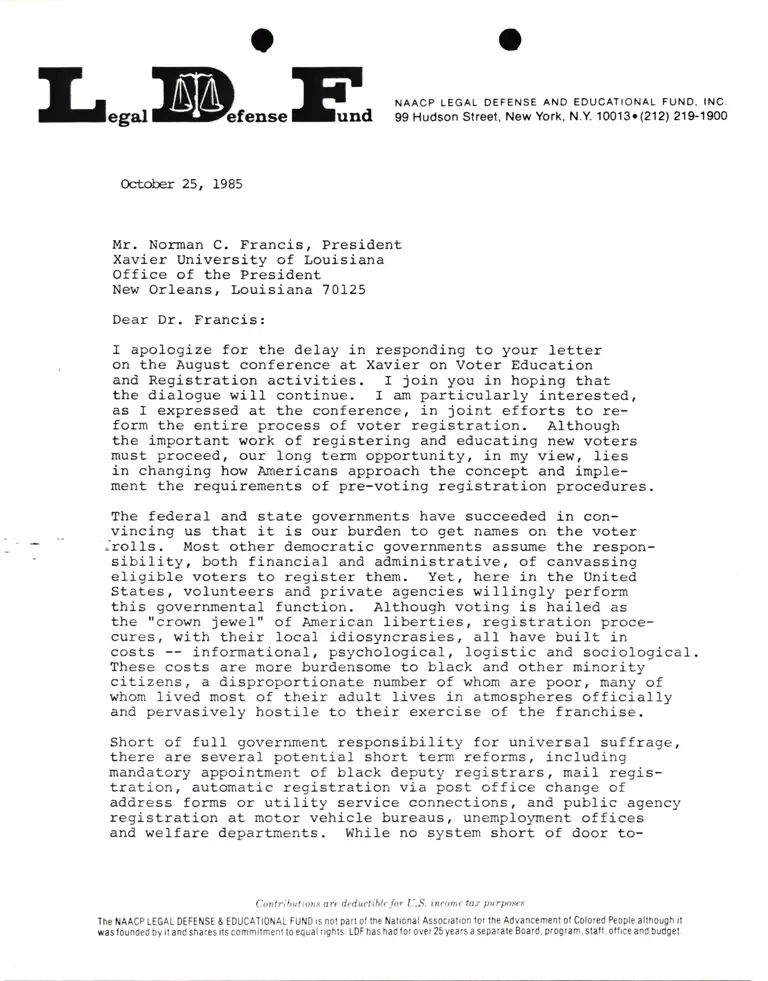
October 25, 1985

Mr. Norman C. Francis, President
Xavier University of Louisiana
Office of the President
New Orleans, Louisj-ana 70125

Dear Dr. Francis:

I apologize for the delay in responding to your letter
on the August conference at Xavier on Voter Education
and Registration activities. I join you in hoping that
the dialogue will continue. I am particularly interested,
as I expressed at the conference, in joint efforts to re-
form the entire process of voter registration. Although
the important work of registering and educating new voters
must proceed, our long term opportunity, in my view, lies
in changing how Americans approach the concept and imple-
ment the requirements of pre-voting registration procedures.

The federal and state governments have succeeded in con-
vincing us that it is our burden to get names on the voter

=ro1Is. Ir{ost other democratic governments assume the respon-
sibility, both financial and administrative, of canvassing
eligible voters to register them. Yet, here in the United
States, volunteers and private agencies witlingly perform
this governmental function. Although voting is hailed as
the "crown jeweI" of American liberties, registration proce-
cures, with their IocaI idiosyncrasies, dI1 have built in
costs informational, psychological, logistic and sociological.
These costs are more burdensome to black and other minority
citizens, a disproportionate number of whom are poor, many of
whom lived most of their adult lives in atmospheres officially
and pervasively hostile to their exercise of the franchise.

Short of fuI1 government responsibility for universal suffrage,
there are several potential short term reforms, including
mandatory appointment of black deputy registrars, mail regis-
tration, automatic registration via post office change of
address forms or utility service connections, and public agency
registration at motor vehicle bureaus, unemployment offices
and welfare departments. While no system short of door to-

(.- r tnt r i t' ul i ori s a rt dtduct i hl r'./trr [.'..S. i n roni t ta r pu r posts

The NAACP LEGAL DEFENSE & EDUCATIoNAL FUND is not part ol the Nataonal Association lor the Advancement of Colored People although it
wasloundedbyitandsharesitscommitmentloequalnghts LDFhashadlorover25yearsaseparaleBoard.program.stall.otliceandbudgel


Dlr. Norman C. Francis -2- October 25, 1985

door canvassing by government employees or paid volunteers
will achieve dramatic increases in black participation, each
of the above possibitities represents an improvement on
present procedures, particularly j-n the South. A combina-
tion of two or three of the proposed methods would be most
effective though still not perfect. The real advantage is
that each reform makes the next reform easier, while creating
a climate for public affirmation of the ultimate goal of
greater government registration initiatives. Iuoreoverr a's
the responsibility for registration is gradually returned to
state and local government, volunteers and civil rights groups
witl have more resources, time and energy to address the
even more fundamental and troublesome problem of moving the
black community beyond the symbolic act of voting to full
fledged potitical participation, decision making and electoral
accountability

A group that j-ncludes Gracia Hillman and myself have agreed
to Serve aS a steering committee on registration reform. Our
first meetj-ng is tentatively scheduled for November 8, 1985.
We welcome the ideas, strategy considerations and general
commentary of all the participants. I do hope the August meet-
ing was just the first of manY.

Thank you again for the invitation and the opportunity to
express my views.

ry",[i
{^* r5,A-r\t1

Lani Guinier

LG/ r

cc: l,ls . RubY l{artin
Field Foundation