Brief for Defendant-Appellee on Remand from the US Supreme Court
Public Court Documents
July 17, 1985
12 pages
-
Case Files, Garner Working Files. Brief for Defendant-Appellee on Remand from the US Supreme Court, 1985. 15fb7e06-35a8-f011-bbd3-000d3a53d084. LDF Archives, Thurgood Marshall Institute. https://ldfrecollection.org/archives/archives-search/archives-item/d6f960d9-5ab5-41a1-afc6-ff589dc1765c/brief-for-defendant-appellee-on-remand-from-the-us-supreme-court. Accessed September 25, 2026.
Copied!
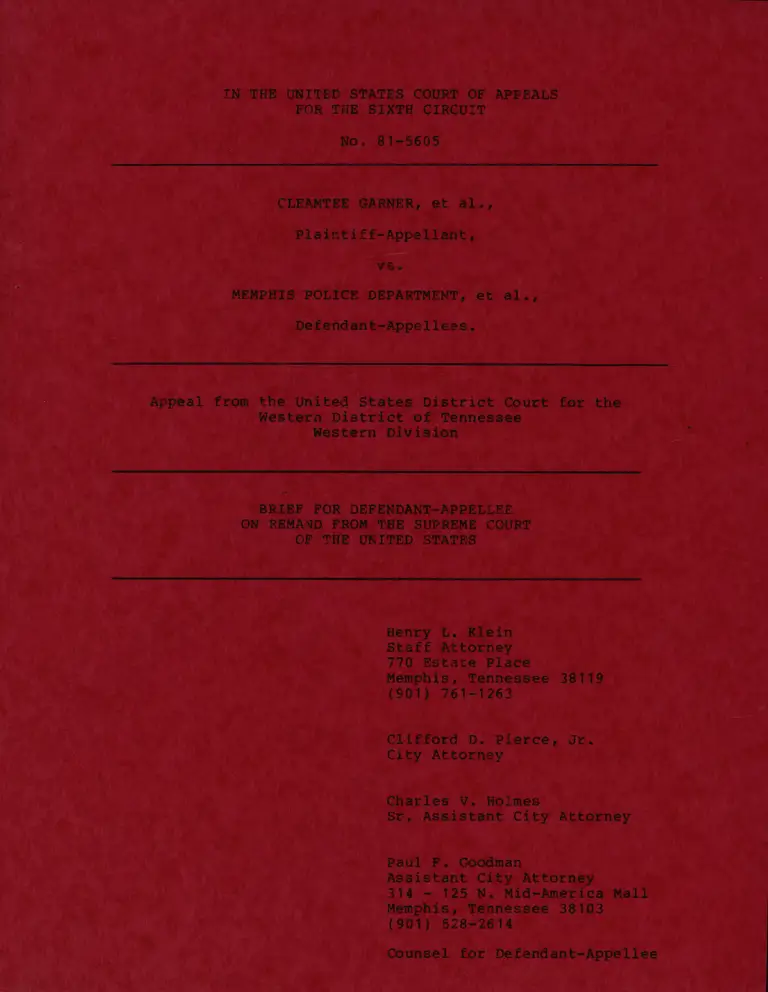
    NO. 81-5605

IN THE UNITED STATES COURT OF APPEALS
FOR THE SIXTH CIRCUIT

CLEAMTEE GARNER, et al.,
Plaintiff-Appellant,

™ v s .

MEMPHIS POLICE DEPARTMENT, et al.,
Defendant-Appellees.

Appeal from the United States District Court for the
Western District of Tennessee

Western Division

BRIEF FOR DEFENDANT-APPELLEE
ON REMAND FROM THE SUPREME COURT

OF THE UNITED STATES

Henry L. Klein
Staff Attorney
770 Estate Place
Memphis, Tennessee 38119
(901) 761-1263

Clifford D. Pierce, Jr.
City Attorney

Charles V. Holmes
Sr. Assistant City Attorney

Paul F. Goodman
Assistant City Attorney
314 - 125 N. Mid-America Mall
Memphis, Tennessee 38103
(901) 528-2614
Counsel for Defendant-Appellee


No. 81-5605

IN THE UNITED STATES COURT OF APPEALS
FOR THE SIXTH CIRCUIT

CLEAMTEE GARNER, et al. ,
Plaintiff-Appellant,

vs.
MEMPHIS POLICE DEPARTMENT, et al.,

Defendant-Appellees.

Appeal from the United States District Court for the
Western District of Tennessee

Western Division

BRIEF FOR DEFENDANT-APPELLEE
ON REMAND FROM THE SUPREME COURT

OF THE UNITED STATES

Henry L. Klein
Staff Attorney
770 Estate Place
Memphis, Tennessee 38119
(901) 761-1263

Clifford D. Pierce, Jr.
City Attorney

Charles V. Holmes
Sr. Assistant City Attorney

Paul F. Goodman
Assistant City Attorney
314 - 125 N. Mid-America Mall
Memphis, Tennessee 38103
(901) 528-2614
Counsel for Defendant-Appellee


TABLE OF CONTENTS

Page
Table of Cases........................................ ii
Introduction.......................................... 1
Argument.............................................. 2
Conclusion............................................ 7


TABLE OF CASES

Page
Beech v. Melancon, 465 F.2d 425 (6th Cir.

1972), cert, denied 409 U.S. 1114, 93 S.Ct.
927 (1973)

Cunningham v. Ellington, 323 F. Supp. 1072
(W.d'". Tenn. 1971)

Garner v. Memphis Police Department,
600 F.2d 52 (6th Cir. 1979)

Garner v. Memphis Police Department
710 F.2d 240 (6th Cir. 1983)

Johnson v. State, 173 Tenn. 134, 114 S.W.2d
819 (1938)

Love V. Bass, 145 Tenn. 522, 238 S.W. 94 (1921)
Mattis V. Schnarr, 547 F.2d 1007 (8th Cir. 1976),
vac. sub nom. Ashcroft v. Mattis, 431 U.S. 171
97 S.Ct. 1739 (1977) rehearing denied 433 U.S.
915, 97 S.Ct. 2990

Owen V. City of Independence, 445 U.S. 622,
100 S.Ct. 1398 (1980)

Qualls V. Parrish, 534 F.2d 690 (6th Cir. 1976)
Reneau v. State, 70 Tenn. 720 (1879)
Scarbrough v. State, 168 Tenn. 106, 76 S.W.2d

106 (1934)
State V. Boles, 598 S.W.2d 821 (Tenn. Crim. App.

1980)

3, 4

2, 4

5-6

2

2

3, 4

5
3
2
2

Tennessee v. Garner, 471 U.S.
1694 (1985)

, 105 S.Ct.

Wiley V. Memphis Police Department, 548 F.2d
1247 (6th Cir. 1977), cert, denied 434 U.S.
822, 98 S.Ct. 65

STATUTES
Tenn. Code Ann. §39-3-401 (former §39-901)
Tenn. Code Ann. §40-7-108 (former §40-808)

ii

3-5

1

2


INTRODUCTION

The defendant herein ("City of Memphis" or "City"
hereinafter) acknowledges that its police shooting policy
authorized Officer Hymon to shoot at a fleeing suspect if the
officer had probable cause to believe that the suspect had
committed a first-degree burglary* and all other means of
apprehension had been exhausted. This policy did not
require, as the Court now does, that the officer also have
probable cause to believe that the suspect inflicted or
threatened to inflict serious physical injury on the officer
or a third party. Insofar as the brief of plaintiff-
appellant argues that this was the City's policy on October
3, 1974, the City agrees.

The City concedes that the Question Presented and the
Statement of the Case are essentially as set forth in
plaint iff-appellant's brief on remand from the Supreme Court
of the United States.

♦Defined by Tennessee Code Annotated §39-3-401 as "the
breaking and entering into a dwelling house, or any other
house, building, room or rooms therein used and occupied by any person or persons as a dwelling place or lodging either
permanently or temporarily and whether as owner, renter,
tenant, lessee or paying guest, by night, with intent to
commit a felony."


ARGUMENT
At the time this cause of action arose, Tennessee's

deadly force statute (Tennessee Code Annotated §40-7-103
(formerly §40-808)), as interpreted by the Tennessee courts,
permitted an officer to use force that could result in death
in preventing the escape of a person he was attempting to
arrest if (1) he reasonably believed that the person had
committed a felony; (2) he notified the person of his intent
to arrest him, and (3) he reasonably believed that no means
less than such force would prevent the escape. Johnson v.
State, 173 Tenn. 134, 114 S.W.2d 819 (1938); Scarbrough v.
State, 168 Tenn. 106, 76 S.W.2d 106 (1934); Love v. Bass, 145
Tenn. 522, 238 S.W. 94 (1921); Reneau v. State, 70 Tenn. 720
(1879), and State v. Boles, 598 S.W.2d 821 (Tenn. Grim. App.
1980) .

The constitutionality of Tenn. Code Ann. §40-7-108 has
been considered on several occasions. In the case of
Cunningham v. Ellington, 323 F.Supp. 1072 (W.D. Tenn. 1971),
the plaintiff contended that the statute was unconstitutional
on its face because it permitted the use of cruel and unusual
punishment in violation of the Eighth Amendment; it was
unconstitutionally overbroad; it was an unconstitutional
incursion with respect to a person's rights to trial by jury,
confrontation of witnesses and assistance of counsel, and it
violated the due process clause of the Fourteenth Amendment.
After considering each argument, the three-judge panel

2


concluded that §40-7-108 was not unconstitutional on its face
and, further, that any changes to this rule allowing the use
of deadly force should be left to the state legislature.

The statute was also upheld by the United States Court
of Appeals for the Sixth Circuit in Beech v. Melancon, 465
F.2d 425 (6th Cir. 1972 ), cert. denied, 409 U.S.1114, 93
S.Ct. 927 (1 973), and Qualls v. Parrish, 534 F.2d 690 (6th
Cir. 1 976). In both of these cases the Court of Appeals
found the statute to be constitutionally sound.

In 1976 Mattis v. Schnarr, 547 F.2d 1007, 1009 (8th Cir.
1976) held that Missouri's deadly force statute, which was
identical to Tennessee's, was unconstitutional "as applied to
arrests in which an officer uses deadly force against a
fleeing felon who has not used deadly force in the commission
of the felony and whom the officer does not reasonably
believe will use deadly force against the officer or others
if not immediately apprehended." (Er̂  banc decision with
three judges dissenting.)

In 1977 Wiley v. Memphis Police Department, 548 F.2d
1247 (6th Cir. 1977) cert, denied. 434 U.S. 822, 98 S.Ct. 65,
upheld a judgment for defendant police officers who had fired
at and killed plaintiff's decedent, who had been fleeing from
a burglary of a sporting goods store. With regard to
Tennessee's deadly force statute, the court stated that the
officers;

had a right to assume that the statute
was constitutional. It had been twice
so declared in this Circuit, first by


the three-Judge Court [in Cumujigham, supra] and later by this Court [in Beech,
supra] , and its invalidity, or that of a
similar statute, up to that time had never
been declared by any Court. The plaintiff
has not cited a single case to the
contrary decided prior to the burglary
involved in the present case [incident of
January 8, 1972],

548 F.2d at 1251.
The court acknowledged that Mattis, supra, was contra to

the Sixth Circuit decisions, but srongly criticized Mattis as
an aberration, as follows:

The Eighth Circuit is the only Court to
our knowledge which has ever held that
such a statute, which is so necessary even
to elementary law enforcement, is
unconstitutional. It extends to the felon
unwarranted protection, at the expense of
the unprotected public.
We agree with the dissent in the Eighth
Circuit case (Mattis v. Schnarr), which was highly critical of the majority opinion for
not following the decisions of other
Circuits and for embarking on a new course
which should have been left to the state
legislatures where it belongs.
The legislative bodies have a clear state
interest in enacting laws to protect their own citizens against felons, and a right,
if not a duty, to do so. When the burglar escapes pursuit he is free to commit other
felonies. The dissent appropriately
pointed out:
"In 1934 the ALI, in its First Restatement
of Torts, modified the common law principle
permitting the use of deadly force to effect the arrest of a felon. Restatement
(First) of Torts & 131 (1934). This
modification was abandoned in 1948,
however, and the common law rule was readopted. The 1966 Appendix to the Second
Restatement of Torts justifies this
abandonment on the grounds that the

4


modification contained in § 131 had, from
its inception, lacked any support other
than dicta and argument by analogy."
The dissent further states;
"There is no constitutional right to commit
felonious offenses and to escape the
consequences of those offenses. There is no
constitutional right to flee from officers
lawfully exercising their authority in
apprehending fleeing felons."
The majority opinion of the Eighth Circuit
in Mattis does not suggest how law
enforcement officers are to make the
on-the-spot constitutional analysis called
for by its proposal and still react quickly
enough to meet the exigencies of an
emergency situaiton. How can a police
officer ever know, reasonably or otherwise,
whether the felon will use force against
others if he is not immediately apprehended? It is clearly the prerogative
of the state legislature to decide whether
such restrictions on the use of force are
consonant with public policy.

Two years later, in Garner v. Memphis Police Department,
600 F.2d 52 (6th Cir. 1979), the court remanded to the
District Court for consideration of these two questions inter
alia;

1. Does a municipality have a similar qualified
immunity or privilege based on good faith under
Monell?

2. If not, is a municipality's use of deadly
force under Tennessee law to capture
allegedly nondangerous felons fleeing from
nonviolent crimes constitutionally
permissible under the fourth, sixth, eighth
and fourteenth amendments?

The first question was answered in the negative by Owen
V. City of Independence, 445 U.S. 622, 100 S.Ct. 1398 (1980).
The second question was answered in the negative by Garner v.


Memphis Police Department  ̂ 710 F.2d, 240 (6th Cir. 1983),
sustained sub. nom. Tennessee v. Garner, 471 U.S._____, 105
S.Ct. 1694 )1983. But it does not follow that the City is
liable herein.

Obviously only an omniscient city official or city
attorney could have predicted, in 1974, what the court would
hold in 1983 in Garner II, 710 F.2d 240. To hold the City of
Memphis liable herein in damages would be to adopt a rule of
strict liability in tort, as the concept of fault must be
totally ignored to reach such a result.

The City of Memphis is guilty of attempting to operate a
police department with an aim of preventing and solving
crimes and apprehending criminals, promulgating a policy much
narrower than the state statute which authorized deadly force
to apprehend fleeing felons, and following the pre-1983
dictates of the United States Court of Appeals for the Sixth
Circuit. The City herein did not affirmatively promulgate a
totally new policy, ordinance, or practice, as was the case
in Owen, but merely adopted a police policy that represented
its best attempt to constitutionally narrow the state deadly
force statute. At least in the limited instance where a
municipality, through its officials, is relying on the
dictates of a state statute which had been upheld by the
United States Court of Appeals on several occasions, the city
must be entitled to qualified immunity. To apply strict
liability in such a case is to apply Owen v. City of
Independence, supra, to create an absurd result.


CONCLUSION

The City of Memphis submits that Owen v. City of
Independence^ supra, does not require a finding of liability
herein, that the City is entitled to immunity where its
policy was authorized by state statute which had been upheld
several times by the United States Court of Appeals for the
Sixth Circuit, and that the judgment below in its favor
should be affirmed.

Respectfully submitted.

Henry L. Klein
Staff Attorney
770 Estate Place
Memphis, Tennessee 38119 (901) 761-1263

Clifford D. Pierce, Jr.
City Attorney

Charles V. Holmes
Sr. Assistant City Attorney

Paul F. Goodman
Assistant City Attorney
314 - 125 N. Mid-America Mall
Memphis, Tennessee 38103 (901) 528-2614
Counsel for Defendant-Appellee


CERTIFICATE OF SERVICE

I hereby certify that copies of the foregoing Brief for
Defendant-Appellee on Remand have been served by placing same
in the United States mail, postage prepaid, addressed to
Steven L. Winter, 16th Floor, 99 Hudson Street, New York, New
York 10013 and Walter L. Bailey, Jr., Suite 901, Tenoke
Building, 161 Jefferson Avenue, Memphis, Tennessee 38103 this
17th day of July, 1985.

Assistant City Attorney