Defendant Indiana State Board of Health Answer to Plaintiffs' First Set of Interrogatories
Public Court Documents
October 31, 1977
15 pages
-
Case Files, Hatcher v. Methodist Hospital - Hardbacks. Defendant Indiana State Board of Health Answer to Plaintiffs' First Set of Interrogatories, 1977. c7a51dee-5384-f111-ab0f-7c1e527d528a. LDF Archives, Thurgood Marshall Institute. https://ldfrecollection.org/archives/archives-search/archives-item/d712674b-a9c8-48f4-b889-23a3bc7857d0/defendant-indiana-state-board-of-health-answer-to-plaintiffs-first-set-of-interrogatories. Accessed October 10, 2026.
Copied!
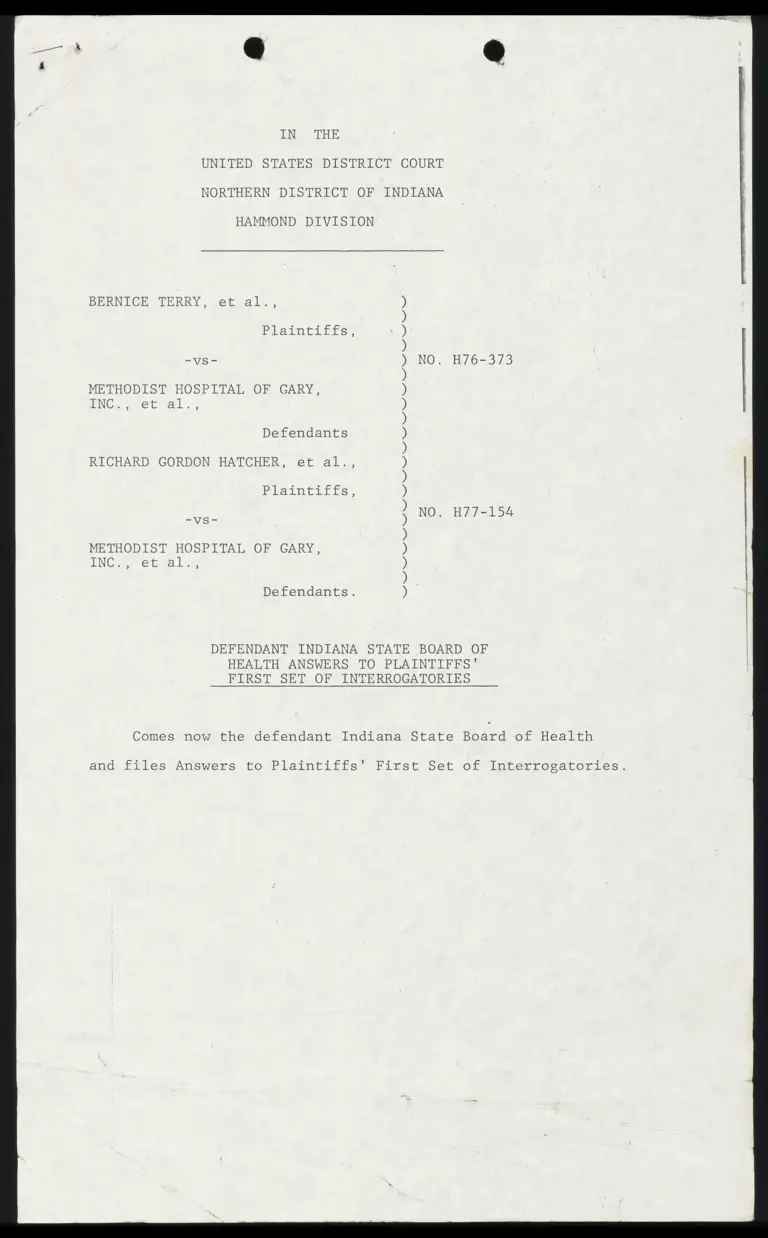
     [||3fd7938b-7e7b-41a4-8979-ae35c4d92ff6||] IN THE

UNITED STATES DISTRICT COURT

NORTHERN DISTRICT OF INDIANA

HAMMOND DIVISION

_
—


BERNICE TERRY, et al.,


METHODIST. HOSPITAL OF GARY,

INC... et.al.

)
)

Plaintiffs, )

)
-vs- Y NO. H76-373

)
METHODIST HOSPITAL OF GARY, ) 4

INC. , et al. )
)

Defendants )

)
RICHARD GORDON HATCHER, et al., )

)
Plaintiffs, )

) No. H77-154
-VS- )

)
)
)
4
) Defendants.

DEFENDANT INDIANA STATE BOARD OF

HEALTH ANSWERS TO PLAINTIFFS
FIRST SET OF INTERROGATORIES


Comes now the defendant Indiana State Board of Health

and files Answers to Plaintiffs' First Set of Interrogatories.


* »

ANSWERS TO PLAINTIFFS INTERROGATORIES

OF OCTOBER 1977

1. No formal agreement between the Indiana State Board of Health and

the Department of Health, Education, and Welfare in regard to the Hill-Burton

program is available.

The Indiana State Board of Health entered into Agreement with the

Secretary of Health, Education, and Welfare to carry out the provisions of

Section 1122 of the Social Security Act. (Exhibit 1, attached.) (Note:

Includes Agreements July 1, 1973, to June 30, 1976; October 1, 1976, to

September 30, 1977; and October 1, 1977, to September 30, 1978.)

The agreement to establish the Indiana Health Planning Program under

Section 314(a) was initiated by the Indiana State Board of Health in response

to an executive order from Roger Branigan, then Governor of Indiana, to

A. C. Offutt, M.D., then State Health Commissioner dated January 6, 1967 (a

copy of that executive order is attached as Exhibit 2). Pursuant to that

order, the Indiana State Board of Health submitted an application to the

Secretary of the Department of Health Education and Welfare, for designation

as the 314(a) agency. The Secretary designated the Indiana State Board of

Health as the 314(a) agency. This process was repeated every year until the

314(a) program was terminated in 1976.

The agreement to establish state level health planning under Titles XV

and XVI of the Public Health Service Act was accomplished in 1976 when as a

result of submitting an application, to the Secretary for designation as a

state agency (copy attached as Exhibit 3), a designation agreement was received

and signed by Otis R. Bowen, M.D., Governor of Indiana (a copy of the designation

agreement is attached as Exhibit 4). The designation was achieved in July 1977

for the second year when a second designation agreement from the Secretary was

received and signed by Governor Bowen (copy attached as Exhibit 5).

2. In regard to the Hill-Burton Program the Indiana State Board of

Health recommends the approval of projects to the Department of Health, Education,

and Welfare for the allocation of Hill-Burton funds based upon priorities

established in the State Hill-Burton Plan. It monitors the construction phase

of the project and the post-construction provisions of uncompensated care to

the needy.

For description of functions, responsibilities, and obligations of

the Indiana State Board of Health pursuant to any agreements and contracts

with federal agnecies pertaining to Section 1122, Section 314 of the Public

Health Service Act, and Titles XV and XVI of the National Health Planning and

Resources Development Act of 1974 refer to the several agreements between the

Indiana State Board of Health and the Secretary of Health, Education, and

Welfare as per attachments referenced in answer #1 above and the DPA Manual,

March 1974, as issued by the Division of Comprehensive Health Planning, Department

of Health, Education, and Welfare.


* »

The functions, responsibilities, and obligations of the Indiana

State Board of Health as the State Agency under Title XV and XVI of the Public

Service Act as defined by law and regulations are described in:

Section 1511(b) (2)

Section 1513(e) (2)

Section 1521(b)(1l) & CFR 42:123 & CFR 42:123,106 &

CPR 42:123.202 and CFR 42:123.204

Section 1522(b) & CFR 42:123.104(a) & (b) and The

Indiana Open Door Law (S.B. 83, 'P.57, Acts of 1977)
Section 1523(a) & CFR 42:123.106(b)

Section 1532(a)

Section 1601

Section 1602(1)(A)(B)(C)(D)(E)
Section 1603

Section 1604(a)

(b) (1) (A) (B)(C)(G)
Section 1611(a)(b)(1)(2)

Also under

CFR42:123.103(f)

CFR42:123.104(b)(3)(17)

CFR42:123.204(b) (2)

CFR42:123.206

Section 5 (c)

3. There are no known relevant delegations of functions, responsiblities,

and obligations per se regarding matters connected with these interrogatories.

4. Attached as Exhibit 6 are two pages of instructions to applicants
entitled, "Requirements and Procedures Relative to the Construction of Health

Facilities in Indiana Part A, Requirements for Applicants for Federal Funds"

which are used to advise potential applicants for Hill-Burton funds of the

application deadline and of general requirements to be met. Attached as

Exhibit 7 are two pages of instructions entitled "Requirements and Procedures

Relating to the Construction of Health Facilities in Indiana-Part B-Development

and Processing of Project Programs and Plans" which are used to advise applicants

with construction projects of the procedures to follow when processing architec-

tural plans and in the development of the program of operation. A "Summary of

Indiana's Program under P.L. 88-443 and P.L. 88-164 Federal Grant-in-Aid
Facility Constructions Programs" describes briefly pertinent information about

the federal grant-in-aid health facility construction programs (copy attached

as Exhibit 8). These three guidelines were issued by the Division of Hospital

and Institutional Services of the Indiana State Board of Health. Enclosed

also is a booklet entitled "Hill-Burton Aid for Building and Modernizing

Community Health Facilities'" which further describes the Hill-Burton grant and

loan program Exhibit 9. This booklet is issued by the Department of Health,

Education, and Welfare, Rockville, Maryland.


® ®

For Section 1122, refer to materials identified as attached in item

##1 above.

All functions relative to 314(a) were carried out under the guidance

established in Section 314(a) of P.L. 89-749 under Regulations for 314(a)

agencies, in Federal Register CFR 42-51, and in "A" agency performance standards.

CHP Program Letter 74-02, dated 12 December, 1973 (copy attached as Exhibit 10).

The activities and functions of Titles XV and XVI of the Public

Health Services Act are carried out under the guidelines established in the

Act (P.L. 93-641), and regulations in the Federal Register dated June 3, 1976,

CFR 42:123 (Interim Regulations for Designation and Funding of State Agencies);

and Capital Expenditures Review, Certificate of Need, and Review of New

Institutional Health Services.

5. See IC 16-1-8, 1C 16-2-1, and -1C 5-19-1. Also, for Section 1122,

authority of the Indiana State Board of Health to fulfill its health facilities

construction responsibilities under Section 1122, see Exhibit 1.

6. The Hill-Burton plan (the Indiana Hospital and Health Facilities

Plan) which was originally prepared in 1947 and updated annually by the Indiana

State Board of Health and approved by the Department of Health, Education, and

Welfare through the 1972-1973 issue, was consistently developed through changing

federal guidelines and new periodic health facility data. "Health service

areas'" (geographical areas) were determined in various ways to serve the

population of the state. From approximately the mid-1960s through the 1973 plan,

the health service areas were developed in relationship to studies of origin

of hospitalized patients. This provided information on the flow of patients

from their places of residence to community hospitals and provided information

to identify boundaries for these health service areas.

With the advent of the 314(b) agencies (the Comprehensive Health

Planning Agencies) consideration for revisions of health service areas were

given to either their recommendations or accomplished with their knowledge and

approval. This would be reflected in the plan of 1975-1976. (See Exhibit 11.)
While operating under Section 314 of P.L. 89-749, the State Board of Health

encouraged groups planning to establish 314(b) agencies to use the fourteen

(14) planning and development regions established by the Governor's Executive

Order 18-68 (copy attached as Exhibit 12). These fourteen (14) planning areas

were broad areas within which health service areas were identified.

After the enactment of P.L. 93-641, the State Board of Health provided

staff assistance to the Governor who designated "health service areas' meeting

detailed requirements of that law. The Governor's designation was described

in the Indiana Health Service Area Designation Plan (Exhibit 13). The plan

includes information about some alternatives considered, organizations consulted,

etc. The Secretary of Health, Education, and Welfare accepted the Governor's

designations and established the areas by publication of a notice in the

Federal Register.


» N

A map is attached (Exhibit 14) which shows the P.L. 93-641 health

service areas and subareas. Under P.L. 93-641, decisions were made by the

respective health systems agencies regarding establishment of subareas and

their composition.

fo The Northern Indiana Health Systems Agency, Inc., (NIHSA) is a
nonprofit private corporation. NIHSA submitted an application for designation

and funding to the Secretary of Health, Education, and Welfare. The Secretary

approved the application and awarded federal funds to the Agency. There are

no "state authorities" for operation of the health systems agencies.

The Indiana State Board of Health is a unit of state government

established in accordance with the state law. The Board of Health was designated

by Executive Order 6-76 (Exhibit 15) as the Indiana Health Planning and
Development Agency, commonly referred to as the State Agency (P.L. 93-641,

Section 1521).

The State Board of Health has no authority over NIHSA, as the State

Agency or in any other capacity. P.L. 93-641 requires that state agencies

consider recommendations of health systems agencies in some circumstances.

Attached as Exhibit 16 is a pamphlet entitled "Agency Relationship under

P.L. 93-641" published by Midwest Center for Health Planning, which gives an

interpretation of many of the relationships among health systems agencies,

state agencies, and statewide health coordinating councils. Information about

statewide health coordinating councils is contained in Section 1524 of

P.L. 93-641.

NIHSA is neither "an advisory council" nor a ''government council."
It has no "government" functions or status. As a private corporation it has a

board of directors referred to in the law as ''governing body." The word

""'governing' applies to responsibility for operation of the agency. See P.L.
93-641, Section 1521(b)(3). The NIHSA Board of Directors or governing body

sometimes is referred to as a "council." We are not aware of any law, regulation,

or general usage which would classify health systems agencies' governing

bodies as "advisory councils."

Authoritative information about the "program responsibilities" of

health systems agencies under P.L. 93-641 is contained in Sections 1512 and 1513.

Similar information regarding state agencies appears in Section 1521 and 1523.

Since the health systems agencies and state agencies have many common interests

they use joint committees to coordinate some health planning work.

Applications concerning health facility proposals are received and

recommendations made under the Hill-Burton Program in accordance with federal

regulations. In Indiana the agency responsible for administering Hill-Burton

funds is the State Board of Health. The Division of Hospital and Institutional

Services of the State Board of Health annually developed a State Hospital Plan

which indicates the need for hospitals and related facilities. Projects are

recommended for aid in accordance with the State Plan and priority schedules

by a State Advisory Council and the State Board of Health. Each year a letter

was sent to administrators of hospitals and health facilities in Indiana

soliciting interest in Hill-Burton funds for the current year. Funds are

available for construction of hospitals, public health centers, long-term care


facilities, rehabilitation facilities, outpatient facilities, and for moderniza-

tion of hospitals. Each State annually elects the basis for determining the

federal share for projects during the ensuing fiscal year. This share may

vary between one-third and two-thirds of the total eligible cost of the project.

Indiana has elected to establish the rate of federal participation at 33 1/3

percent of the estimated eligible cost of the project for all categories

except the outpatient and rehabilitation categories which have been established

at 50 percent. The State Plan which is revised annually includes an inventory

of all facilities in the eligible categories. The classification of beds into

"conforming" or "nonconforming' is based on a modernization survey of all

facilities in the State in 1965 and 1966 and updated upon the "as needed"

basis since that time. Priorities which are developed for each category serve

as the basis for recommending approval of an application by the State Hill-Burton

Advisory Council to the Executive Board of the Indiana State Board of Health

which in turn makes recommendations to the Department of Health, Education,

and Welfare, the final approval authority.

The Indiana State Board of Health routinely requests the approval or

nonapproval recommendations on health facilities from each of the three Indiana

Health Systems Agencies, including the recommendations of the Northern Indiana

Health Systems Agency, in compliance with P.L. 92-603, Section 1122(d) (ii) (I).

and related Rules and Regulations under Title 42, Chapter I, Part 51, Part 100,

Section 100.104(1i).

Section 1122 applications are processed and recommendatons are

received in accordance with federal rules and regulations under Title 42,

Chapter I, Part 51, Part 100--Cost Containment and Quality Control and the DPA

Manual, March 1974, by the Division of Comprehensive Health Planning, Department

of Health, Education, and Welfare.

7a. The Indiana State Board of Health, acting as the Designated Planning

Agency (DPA), does not make decisions in either the Section 1122 or the

Hill-Burton Program. The DPA only makes recommendations to HEW.

8. Yes.

8a. HEW found the existing Indiana program to be in conformance with the

requirements of Title XV of the National Health Planning and Resources Development

Act of 1974. See Exhibits 4 and 5.

9. Assurances and methods of administration between the Indiana State

Board of Health and the Department of Health, Education, and Welfare pertaining

to the Hill-Burton Program under P.L. 88-443 as amended by P.L. 91-296 are
contained in the Indiana Hospital and Health facilities Plan, 1972-73. (Copy

attached as Exhibit 17.) A copy of each State Plan which was prepared or

revised annually since 1946, and may be on file with the Department of Health,

Education, and Welfare. A copy of the State Plan for 1976-77 submitted by the

Department of Mental Health to the Department of Health, Education, and Welfare

under which the Indiana State Board of Health has responsibilities under

P.L. 88-164 as amended by P.L. 91-517 is attached as Exhibit 18. State Plans

for previous years may be on file with the Department of Health, Education,

and Welfare.


* »

10. Attached herewith, as Exhibit 19, is the complete organizatonal

structure of the Indiana State Board of Health. Sections Bl and B2 reflect

the organizational status of the units which presently handle Section 1122 and

the Hill-Burton Programs, together with the involvement in Title XV and

Section 504.

11. i See Exhibit 19.

12. See Exhibit 19.

13. Exhibit 19 lists the name and the job title or position for each of

the individuals therein noted. Records are not available, without personal

interviews, on race, national origin, and sex. Objections filed to the question

itself on the grounds that it is not material to the issues at hand.

All of the individuals listed are merit employees, employed pursuant

to the Indiana Personnel Act (IC 4-15-2).

14. We are unaware of whether any present or former members or employees

of the Indiana State Board of Health, its divisions or bureaus, members of

their families or business associates have ever served in any capacity on a

board or other division of The Methodist Hospital of Gary, Inc. Since the

creation of the Indiana State Board of Health in 1945, only one physician from

the Lake County area has served on the Board. This individual, now deceased,

served in 1945 and no records are available to determine whether or not he had

staff privileges. The only present member of the Board from the Lake County

area 1s a practicing dentist, and we understand that he does not have staff

privileges.

15. The members of the Indiana State Board of Health are selected by the

Governor pursuant to Indiana Code 16-1-36-1.

All other employees of the State Board of Health, with the exception

of the Secretary (State Health Commissioner) who is appointed by the Governor
upon the recommendation of the Board, are merit employees employed pursuant to

the State Personnel Act (IC 4-15-22). All jobs within the merit system have
job descriptions with minimum qualifications for each job. Information on job

description, etc., is so voluminous for the employees involved that objections

are filed to the request made on the basis of lack of materiality and the

inability to readily obtain same.

16. See Answer #7 relative to procedures, standards, and guidelines.

17. . See Exhibits 6, 7, 8, and 9,

18. We object to the question as raised as it is not pertinent and

places an impossible burden to comply considering the actual information

presently available and the time restraints placed upon us. However, since it

is our personal recollection that almost all hospitals within the state excluding

federal facilities have been subjected to state review on one or more occasions

during the period, a copy of the current hospital directory is attached and

marked as Exhibit 20.


19. Hospital projects listed in Exhibit 20 which involved a relocation

of an existing hospital include Parkview Hospital, Fort Wayne, St. Joseph

Hospital, Huntingburg, St. Vincent Hospital, Indianapolis, South Bend

Osteopathic Hospital, South Bend, and Wirth Hspital, Oakland City. Projects

which involved the construction of a new hospital not within the City of Gary

by a corporation which operates a hospital within the City of Gary include the

Broadway Methodist Hospital, Merrillville, and St. Mary Medical Center, Hobart.

New hospitals constructed outside the City of Gary by a corporation which does

not operate a hospital within the City of Gary include, within the past 15 years,

the following Indiana Hospitals: North Clark Community Hospital, Charlestown;

Jennings Community Hospital, North Vernon; Kosciusko Community Hospital,

Warsaw; Community Hospital, Munster; St. Anthony Hospital, Crown Point; LaPorte

Hospital, LaPorte; Bedford Medical Center, Bedford; Community Hospital,

Indianapolis; Westview Osteopathic Medical Hospital, Indianapolis; Winona

Memorial Hospital, Indianapolis; Warrick Hospital, Boonville.

20. The Indiana State Board of Health received assurances from applicants

for federal construction funds under the Hill-Burton Program and transmits

them to the Department of Health, Education, and Welfare for review for compliance

with Title VI of the Civil Rights Act of 1964.

In the review of the projects for Section 1122 purposes, the State

Agency complies wth the criteria as set forth by the Department of Health,

Educaton, and Welfare in its Rules and Regulations, Title 42, Chapter 1,

Part 51, Part 100, Section 100.107, and its '"Mandated Review Criteria" as

recorded in the DPA Manual, March 1974, by the Division of Comprehensive

Health Planning, Department of Health, Education, and Welfare. The State

Agency is not in a position to comment on the review process of the Department

of Health, Education, and Welfare. (Refer to Exhibit 1.) We object to the
last part of this interrogatory on the grounds that it is not germane to the

issue involved and this is impossible with the records available and time

constraints placed upon us to adequately respond.


21. In determining the needs of the population identified in the Indiana

Hospital and Health Facilities Plan, 1972-1973, the state agency utilized the

methodology as prescribed and later approved by the Department of Health,

Education, and Welfare. Briefly, the state agency received both the maximum

current and projected state population estimates as supplied (annually) by the

Bureau of Census. The state agency utilized this data by allocating this

maximum population data to the several designated health service areas in the

state. The health service areas were determined through a study of hospital

patients. This detailed distribution was accomplished with the assistance of

the Public Health Records, Division of the Indiana State Board of Health. The

federal directive required consideration for primarily two groups of population

in each area, which called for the total population for programming general

acute health facilities and age 65 and over population for programming long-term

care facilities.

These area population designations were then used in conjuncton with

the prescribed Hill-Burton formula in determining the facility needs for each

health service area.


For population distribtion within the Indiana Hospital and Health

Facilities Plan, 1975-1976, refer to its Chapter III, page 11, provided in

Exhibit 11.

It should be noted that where the need of a population group is

determined to be other than what the Hill-Burton formula provides and where

this need is based upon local study by a recognized professional consultant

agency and/or by a local planning agency, the state agency, in compliance

again with federal guidelines, considers such programming when requests and

recommendatons are made to include such. Where such variance occurs, the

federal guidelines require that the state agency so identify this depature

from regular formula programming.

22. See the plans referred to in Answer #9.

In determining the needs of population groups within the several

health service areas within the state, a Hill-Burton plan was originally

developed in 1947 and has been upgraded annually in accordance with changing

federal guidelines and new raw data findings. Each plan was properly reviewed

and brought to the public's attention prior to final state's submission to the

Department of Health, Education, and Welfare for its final review and approval.

All plans developed between 1947 and 1973 were so approved by DHEW.

The 1975-1976 plan was not reviewed for approval by the Department of Heath,

Education, and Welfare although copies are on file with that agency.

23. The ISBH attempts to comply with all legal federal and state mandates

in this area.

24. At the present time, the State of Indiana does not have a certificate-

of-need program.

25. . Yes.

26. See Exhibit 21.

See Exhibit 22.

27. See Exhibits 23 and 24.

28. The information requested is not readily available within the State

Board of Health; the Northern Indiana Health Systems Agency should be able to

provide this information.

29. The Hill-Burton Project proposals submitted by the Methodist Hospital

of Gary since 1970, together with all related correspondence and minutes of

meetings are included herewith as follows: Broadway Methodist Hospital,

Project No. 189 (original construction) (Exhibit 25); Broadway Methodist

Hospital, Project No. 213 (proposed expansion) (Exhibit 26); Methodist Hospital
of Gary, Project No. 212 (proposed expansion) (Exhibit 27); Hill-Burton Advisory
Council minutes dated December 18, 1974, November 29, 1972, December 1, 1971,

November 18, 1970, October 8, 1969 (Exhibit 28).


29. Copies of all Section 1122 applications and related documents from

and on Methodist Hospital of Gary, Inc., and Broadway Methodist Hospital from

1970 to present time are provided under identified exhibits:

A. ID No. 18-4-0053 (submitted May 29, 1974) (Exhibit 29).

Methodist Hospital of Gary, Inc. A new building containing ICU/CCU,

ambulatory care service, family practice residency area and hospital-based

physician offices.

Broadway Methodist Hospital. Containing an ambulatory care center,

an admitting center, a patient health education area, a hospital-based

physician office, and a building containing a modern laundry plant.

Note: This application became void on July 28, 1975.

ID No. 18-6-0083 (Submitted June 23, 1976) (Exhibit 30).

Methodist Hospital of Gary, Inc. Health Service Building.

Broadway Methodist Hospital. Health Service Building and Laundry.

Date of final state finding September 14, 1976.

ID No. 18-7-0103 (Submitted May 2, 1977) (Exhibit 31).

Methodist Hospital of Gary, Inc. Addition of Ultrasound Service.

30. Names of members of the Hill-Burton Advisory Council are listed in

the minutes of attachments to interrogatory 29. Employees of the Indiana

State Board of Health who worked on the projects are: Mr. Robert Rogers,

Director, Division of Hospital and Institutional Services (now retired); Mr.

Frank Sherer, Hospital Administrative Consultant, who worked on the processing

of the applications (now retired); Mr. James L. White, Hospital Administrative

Consultant, who worked on the processing of the applications; Ms. Janet Craig,

Director, Division of Hospital and Institutional Services, worked on architectural

plans and program of operation; Mr. Vernie Swanson, Engineer, worked on archi-

tectural plans, equipment lists, and bid documents (now retired ); Mr. Corwin

Weaver, Auditor, audited invoices and other financial documents on project

No. 189; Mr. Gerald T. Cravey, Engineer, worked on architectural plans and bid

documents; Ms. Thelma E. Jordan, Hospital Administrative Consultant, worked on

architectural plans; Mr. Steven F. Mann, Administrative Officer, Comprehensive

Health Planning Review (has terminated employment at Indiana State Board of

Health); Mr. Jack I. Cohen, Administrative Officer, Section 1122 Program has

terminated employment at Indiana State Board of Health).

Employees and staff of the Indiana State Board of Health who were

involved in various ways on the Section 1122 applications are identified in

materials submitted for Answer 29.


ID. No.  18-4-0053.

Steven F. Mann, Hospital Administrative Consultant. Functioning

as project review officer in processing Section 1122 applications.

(No longer employed.)

Jack I. Cohen, Administrative Officer. Functioning as a project

review officer in processing Section 1122 applications. (No

longer employed.)

Robert L. Rogers, Director, Division of Hosital and Institutional

Services. Involved in hospital licensure, the Hill-Burton

program, and review of hospital projects within the Section 1122

program. (No longer employed.)

Richard E. Thompson, Director, Comprehensive Health Planning.

(No longer employed in that capacity.)

Miss Thelma E. Jordan, Hospital Administrative Consultant.

Reviews hospital projects relative to licensure compliance in

terms of architectural and construction programs as well as

Section 1122 applications.

David J. Edwards, M.D., Administrator, Hospitals and Health

Facilties Programs. Assisted in administrative processing of

Section 1122 applications. Currently employed as Director,

Bureau of Health Facilities, Services, and Resources Development.

(In charge of entire Section 1122 program and health resources

development as of September 5, 1976.)

Arthur E. Hasse, Director, Health Facilities and Services

Review Division. (Administration of the Section 1122 program

as of September 5, 1976.)

Only additional new names will be identified in the following projects:

ID No. 18-6-0083

8.

9.

William D. Christen, Hearing Commissioner.

Deloris Wakefield, Project Review Officer, assigned to processng

Section 1122 applications received in Northern Indiana Health

Systems Agency. (Employed as of June 7, 1976.)

Lee E. Cloe, Ed.D., Director, Health Plan and Program Development

Division. (Develops special health facility and service criteria

and services and reviews selected hospital project applications.)

Janet A. Craig, Director, Hill-Burton Program and Director,

Hospital and Institutional Services Division. (Replaced

Mr. Robert L. Rogers identified in A.3 above.)

William T. Paynter, M.D., State Health Commissioner, Indiana

State Board of Health.


13. Mr. James White, Hospital Administrative Consultant, Division

of Hospital and Institutional Services. Currently Director of

Health Resources Development Division.

31. Not to our knowledge, as it is not our policy.

32. No special studies, reports, and recommendations were made for the

Indiana State Board of Health in connection with the proposals for construction

and/or expansion of Broadway Methodist Hospital. Routine studies and analysis

of data collected were made and is included in the applications under interrogatory 29.

33. Refer to answer to interrogatory 32 above. The staff person most

knowledgeable about the situation would be Mr. Robert L. Rogers, Director,

Division of Hospital and Institutional Services (not currently employed by

this agency).

34. a. Refer to Exhibit 30, labeled Application 18-6-0083; materials

submitted by Northern Indiana Health Systems Agency, Inc., dated

September 7, 1976, Lee E. Cloe, Ed.d., review dated July 28,

1976.

See answer to #31.

The Section 1122 application was subjected to routine and

careful review similarly as are all Section 1122 applications.

Confirmation by members of the Indiana State Board of Health of

recommendations made was unanimous in all cases.

From personal recollection, this information would have been in

the so-called "Hamilton Report" which was the basis of the

local agency's report. We cannot locate a copy of said report.

f. Unaware of what 'conclusions'" are required.

35. (a-e) In reply to this interrogatory both Methodist Hospital of Gary

and St. Mary Medical Center of Gary, have made agreements with the Office of

Civil Rights, Region V, prior to their expansion programs. The Indiana State

Board of Health was not a party to and was not provided a copy of such agreements.

Since ongoing surveillance for compliance was conducted by the Office of Civil

Rights, the State's role in the collection of Civil Rights information was

minimal (see Civil Rights Information on Broadway Methodist Project No. 213

under interrogatory 29).

36. Refer to answer #35.

37. Based upon the information given in the applications and recommenda-

tions made by the local planning councils for Hill-Burton assistance the

Indiana State Board of Health does not anticipate a reduction of services to

the lower income, racial minority, and/or handicapped residents of Gary and

has recommended approval of federal construction funds amounting to $2,727,000

to improve hospital facilties in the City of Gary.


38. See answer #35.

39. The Hill-Burton applications submitted for the construction and/or

expansion of Broadway Methodist Hospital required recommendations from the

Northwest Indiana Comprehensive Health Planning Council and later the Northern

Indiana Health Systems Agency and their recommendations together with the

financial and other data submitted by the applicant were considered by the

Indiana State Board of Health in making its recommendation.

40. No specific comments noted in the files.

41. See Answer #8 and exhibits supplied in connection with that answer.

42. The Indiana State Board of Health did develop and/or recommend use of

plans, standards, or guidelines for health planning for the Northern Indiana

Health Systems Agency area. The response to question #2 provides more information.

It also, as described in the answer to question #6, provided staff

assistance in the process of area designation.

It also, as described in the answers to questions #9, and 21, developed

plans for health facilities for the area.

Specific information requested follows or its location is cited by

reference:

(a) See Answer {}6.

See Answer #6.

See Answer 6.

See Answer #6.

See Answer #6 and the Indiana Health Service

Area Designation Plan.

See the Indiana Health Service Area Designation Plan referred to

in Answer #6.


STATE OF INDIANA )
8S:

COUNTY OF MARION )

RICHARD E. THOMPSON, being first duly sworn upon

his oath deposes and says:

That he is the Planning Coordinator, of the Indiana

State Board of Health; that the above answers to Interrog-

atories were prepared at his specific direction and request

on behalf of Defendant, Indiana State Board of Health; and

that they are true and correct to the best of his knowledge

and belief.

Wa ED,
Ric¢hard E. Ed


SUBSCRIBED AND SWORN to before me, a Notary Public

in and for said County and State, this 31st day of October,

1977.


rah] or ’ :

\ AM ES on z

Aotary Public

My Jramission Expires:

rh

nds; LG JD
V4


THEODORE L. SENDAK
Attorney General of Indiana

Fre B Seva


Eric B. Servaas
Deputy Attorney General


IN THE

UNITED STATES DISTRICT COURT

NORTHERN DISTRICT OF INDIANA

HAMMOND DIVISION


BERNIECE TERRY, et al.,

Plaintiffs,

-vS- NO. H-76-373

METHODIST HOSPITAL OF GARY,
INC. "et al.

Defendants.

RICHARD GORDON HATCHER, et al.,

Plalnuiils.

NO. H 77-154

METHODIST HOSPITAL OF GARY,

ING. “et aly,

Defendants.

N
u
?


N
r
?


N
u
t


N
u


N
t


N
o


N
o


N
o


N
o


N
o


N
u


N
w


N
o

N
N


N
N

N
N
N


CERTIFICATE OF SERVICE


I hereby certify that a copy of defendants' Indiana State

Board of Health, Answers to Plaintiffs' First Set of Interrogatories

was served by United States Mail, postage prepaid, on the 3lst

day of October, 1977, on counsel of record as follows:

Rebecca L. Ross, Esq. Anthony DeBonis
Dept. of Justice 720 West Chicago Avenue
10th & Penn. Ave. N.W. East Chicago, Indiana
Washington,D.C.

Julian B. Allen Bruce E. Sayers
2009 Broadway 5525 Broadway
Gary, Indiana 46407 Gary, Indiana

THEODORE L. SENDAK
Attorney General of Indiana

LJ


Eric B. Servaas
219 State House Deputy Attorney General
Indianapolis, Indiana 46204
Telephone (317) 633-6268 [||3fd7938b-7e7b-41a4-8979-ae35c4d92ff6||]