Response in Opposition to Appellees' and Cross Appellants' Motion for Costs
Public Court Documents
May 18, 1971
6 pages
-
Case Files, Swann v. Charlotte-Mecklenburg Hardbacks. Response in Opposition to Appellees' and Cross Appellants' Motion for Costs, 1971. f90b8ce0-2e34-f111-88b4-7c1e527f53b4. LDF Archives, Thurgood Marshall Institute. https://ldfrecollection.org/archives/archives-search/archives-item/d73a5ef2-cf29-49be-a672-3dc9ed6da328/response-in-opposition-to-appellees-and-cross-appellants-motion-for-costs. Accessed October 16, 2026.
Copied!
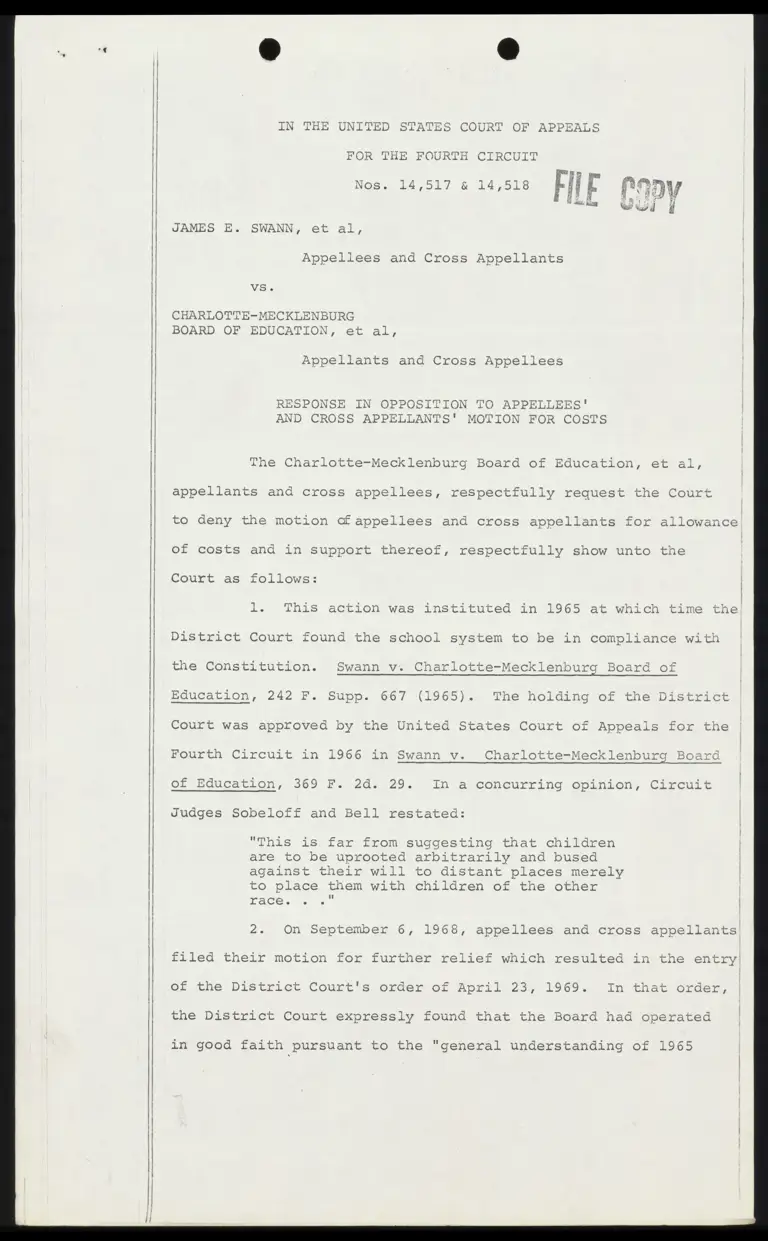
     [||6f04c220-2490-4262-9589-e1d8dbb6a1f9||] JAMES E. SWANN, et al,

Appellees and Cross Appellants

VS.

CHARLOTTE-MECKLENBURG

BOARD OF EDUCATION, et al,

Appellants and Cross Appellees

RESPONSE IN OPPOSI ITION TO APPELLEES
AND CROSS APPELLANTS’ MOTION FOR COSTS

The Charlotte-Mecklenburg Board of Education, et al,

appellants and cross appellees, respectfully request the Court

to deny the motion cf appellees and cross appellants for allowance

of costs and in support thereof, respectfully show unto the

Court as follows:

1. This action was instituted in 1965 at which time the!

District Court found the school system to be in compliance with

-

the Constitution. Swann v. Charlotte-Mecklenburg Board of


Education, 242 FP. Supp. 667 (1965). The holding of the District


Court was approved by the United States Court of Appeals for

Fourth Circuit in 1966 in Swann v. Charlotte-Mecklenburg Board


of Education, 369 P. 24. 29. In a concurring opinion, Circuit


Judges Sobeloff and Bell restated:

"This is far from suggesting that children
are to be uprooted arbitrarily and bused
against their will to distant places merely
to place them with children of the other
race. . 0"

2. On September 6, 1968, appellees and cross appellants

filed their motion for further relief which resulted in the entry

Of the District Court's: order of April 23, 1969. In. that order,

the District Court expressly found that the Board had operated

in good faith pursuant to the "general understanding of 1965


". . . They have achieved a degree and volume

of desegregation of schools apparently unsur-
passed in these parts, and have exceeded the
performance of any school board whose actions
have been reviewed in appellate court decisions.
The Charlotte-Mecklenburg schools in many

respects are models for others."

[1


F
I]

-


'

)


(8
)

F
|]

Ce
)

(0
)

WO


O = (@)


(D


H
 cr


rs


(()


| wn


ct


H
 Q ct


@)


O £ HN


cl
 {| In the same Ap

I found there was no racial discrimination or inequality with

ll reference to the use of federal funds or special aid to

disadvantaged, use of mobile classrooms, the cguality of school
pi A -

be 3 buildings and equipment, coaching of athletics, parent-teacher

association contributions and activities, school fees, school

lunches, library books, elective courses, individual evaluation

| of students and gerrymandering.

I As indicated above, the good faith administration of

|| the Charlotte-Mecklenburg schools was accomplished under express

lI authorization and approval of a district court which held:

"As a general proposition, it is undoubtedly
true that one could deliberately sit down

| with the purpose in mind to change lines

in order to increase mixing of the races and
| accomplish the same with some degree of

success. I know of no such duty upon either
the School Board or the District Court. The

1 question is not whether zones can be
I gerrymandered for the assumed good purpose
1 of racial mixing, but whether gerrymandering
| occurred for the unconstitutional purpose of
I preventing the mixing of the races." Swann v.
1 Charlotte-Mecklenburg Board of Education,
I 242 TP... -SUpp. 667 (19565).


In affirming, this Court of Appeals held:

vies SO long a8 the boundaries are not

rawn for the purpose of maintaining racial
} segregation, the School Board is under no

constitutional requirement that it effectively
1 and completely counteract all the effects of
| segregated housing patterns Swann vs.
BR Charlotte-Mecklenburg Board of Education,
| 269 7. 28. 29. (1566).


| 1As found by the District Court, this School Board operated

pursuant to the understanding of the law. It was not alone as

| evidenced by the many conflicting and inconsistent opinions of

|| the various district courts, courts of appeal and the Supreme
de

Fos Court.


GISTITLOT wn


O Hi


ct


r
s


o Notwithstanding the express holding

fered a plan for Hh


O

August 15, 1965, the District Court found that the Board had

acknowledged its affirmative duty to desegregate pupils, teachers,

principals, and staff members at the earliest possible date and

had dramatically exceeded its goal in desegregating former


all black faculties. The plan forithe 1970-71 school year

(1)


x Q MD


od


0 ()]


of


;
4 5 ® OQ


(()
) wn


(0)


0
)
 H ® QQ


0
}

ct


-
 O oh
 3} iccomplished by any major urban area

restructuring of attendance lines which accomplished a remarkable

degree of desegregation, placing 68 percent of the black students

in predominantly white schools. This offered performance so far

|| exceeded the performance of any other major urban school system

Ne, meee
BATE RT | that it was inconceivable that the effects of the former

| system" would not be removed by such a plan. The District Court

| engrafted upon this plan the feature of satellite zones and

resulting extensive long distance cross busing, thereby resulting

in the most sweeping and extreme desegregation order entered by

any district court affecting a major urban area of this nation.

| The Court of Appeals for the Fourth Circuit, on appeal,

1 by opinion dated May 26, 1970, (431 FP. 2&. 138) vacated the

1 Judgment of the District Court and remanded the case for further

proceedings, primarily with reference to the question of "reasonabl

ness" as expressed in the opinion of this Court.

| On August 3, 1970, the District Court held that its

|| order of February 5 was reasonable and ordered implementation

{| thereof,

| The Supreme Court of the United States, in holding the

Hi District Court's order in compliance with the Constitution,

stated:


"These cases present us with a problem of

defining in more precise terms than hereto-
fore the scope of the duty of school
authorities and district courts in
implementing Brown I and the mandate
to eliminate dual systems and establish
unitary systems at once. Meanwhile,
district courts and courts: of appeal
have struggled in hundreds of cases with
the multitude and variety of problems
under this Court's general directive.
Understandably, in an area of evolving
remedies, those courts had to improvise
and experiment without detailed or specific
guidelines. This Court, in Brown I,
appropriately dealt with the large
constitutional principle; other federal
courts had to grapple with the Zlinty,
intractable realities of day-to-day
implementation of these constitutional
commands. Theilr efforts of necessity
embraced a process of "trial and error
and our effort to formulate guidelines
must take into account their experience."
Swann v. Charlotte-Mecklenburg Board of
Education, Supreme Court of the United

States, Nos. 281 and 349, Apr. 20, 1971,
ati 'De 2,


In NorthcCross Vv. Board of Bducation, 396 U.S. 19 (1969),


the Chief Justice of the United States Supreme Court recognized

that it was high time that the Supreme Court came to grips with

the many problems resulting from the unsettled state of the law

with reference to the creation of a unitary system. These

acknowledgments by the Supreme Court so clearly demonstrate the

confused state of the law with reference to desegregation, distript

courts, courts of appeal and school boards did not and could not

know the obligations imposed by the Constitution.

Notwithstanding the Board of Education could not have known

what was expected of it, it operated its system in good faith

pursuant to the directives of the federal courts and exceeded

the performance of any school board whose actions had: been

reviewed in the appellate court decisions. To award costs

against this school system would clearly be contrary to the

principles of equity, particularly where it is believed that the

plaintiffs have not advanced and are not expected to advance any

of these costs.


: p A SE


- = i III'S dT A JS Tia Th VTA ep oy 7d AN OY
{Hl WHEREFORE, the appellants and cross

pray that appellees'and cross appellants' motion for costs be

denied.

Respectfully submitted this the 17th day of May, 1971.


William J. Waggoner
H Waggoner, Hasty and Kratf

1 723 Law Building
| Charlotte, North Carolina

" Attorneys for Appellants and
Cross Appellees

b

|
|
i

{


bY
-

i

|
|
|}

|
i

This is to certify that

going Response in

Motion for Costs

in the United States

to said parties as

CRDM TO TOAMD
Lone JO a8


4 mail, post

follows:

Julius 1. Chambers

Chambers, Stein,
White House Inn

Charlotte, North Carolina

Nabrit, TIT

Circle

New York

ephen J. Pollak
4 15th Street,
shington, D. C.

N.W.

dee
-
~
-

a

This the 1¥th day of May, 1971.

Py tam tin T are

Ferguson & Lanning

a.Gldressec CQ [||6f04c220-2490-4262-9589-e1d8dbb6a1f9||]