Trial Transcript 4
Public Court Documents
August 10, 1964
284 pages
-
Case Files, Bush v. Orleans Parish School Board. Trial Transcript 4, 1964. 3484a736-d2fd-f011-8406-7c1e526962fd. LDF Archives, Thurgood Marshall Institute. https://ldfrecollection.org/archives/archives-search/archives-item/d740a1e0-cc9a-4a5f-8fb5-88861170703c/trial-transcript-4. Accessed October 05, 2026.
Copied!
10
11
12
13
14
15
16
17
18
19
20
21
22
23
24
25
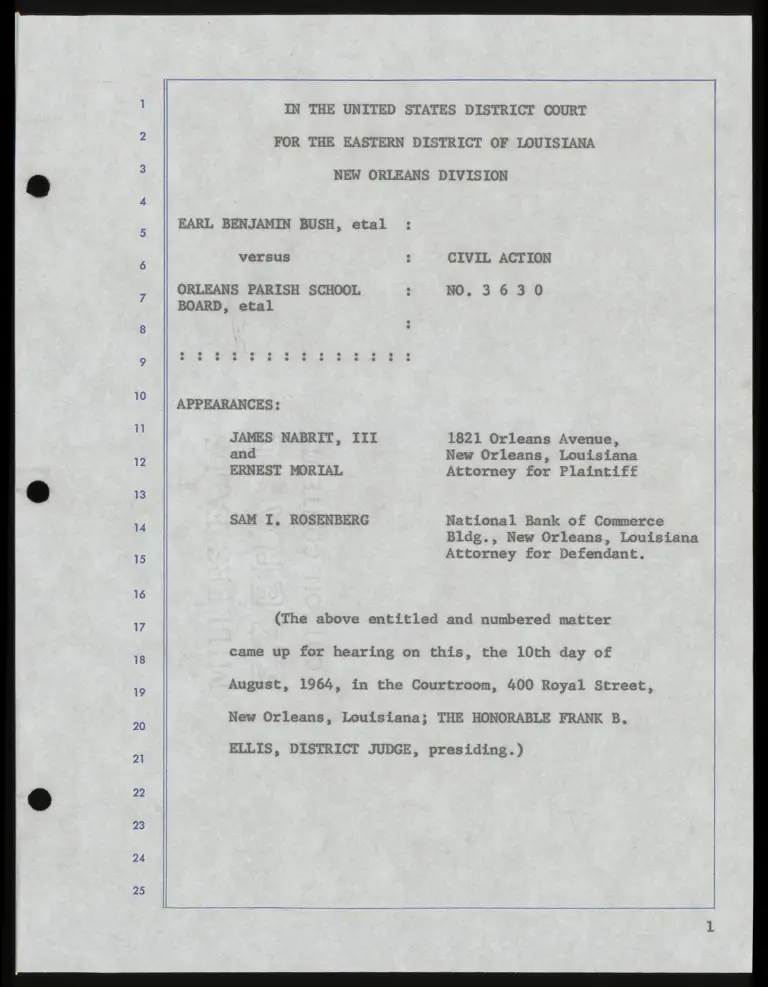
IN THE UNITED STATES DISTRICT COURT
FOR THE EASTERN DISTRICT OF LOUISIANA
NEW ORLEANS DIVISION
EARL BENJAMIN BUSH, etal
versus
ORLEANS PARISH SCHOOL
BOARD, etal
APPEARANCES :
JAMES NABRIT, III
and
ERNEST MORIAL
SAM I, ROSENBERG
CIVIL ACTION
NO, 3630
1821 Orleans Avenue,
New Orleans, Louisiana
Attorney for Plaintiff
National Bank of Commerce
Bldg., New Orleans, Louisiana
Attorney for Defendant.
(The above entitled and numbered matter
came up for hearing on this, the 10th day of
August, 1964, in the Courtroom, 400 Royal Street,
New Orleans, Louisiana; THE HONORABLE FRANK B.
ELLIS, DISTRICT JUDGE, presiding.)
-
o
11
13
14
15
16
17
23
24
25
{p
od
ut
WITNESSES:
James E. Dean, Jr.
Dr. Stanley Fitzpatrick
EXHIBITS:
1964 OPSB-25
Plaintiff-A,B,C,D
Plaintiff-E,F
8.9, 10.11, 12,
16, 17, 18a
22, 23, 24a,b
164
Page
261
110
10
11
12
13
14
15
16
17
18
19
20
21]
22
23
25
PROCEEDINGS
THE COURT: All right, gentlemen, are we ready
to proceed in this matter?
Did you want to address the Court?
MR. NABRIT: Your Homor, I think that we probably
need some more of the court's papers here. I don't believe
that we have all of the court's papers here, because the thing
that I was particularly interested in was an answer to some
interrogatories.
THE COURT: In this matter, after the Court handed
judgment down in May of 1963, as you well know, the Court
obtained jurisdiction over this matter. And if there ever
crept into the proceedings any violation of the Constitutional
rights of the plaintiffs, the Court would at all times enter-
tain any motions which you or other counsel would desire to
submit. And the Court did not pass upon, except by innuendo,
the integration of the kindergarten grades. So it would
seem that some further order by this Court is necessary in
order to accelerate the integration in that particular field.
Now, I agree with you, and I think both counsel,
or all counsel in this matter, that there is a slight
in the meaning of the order, and I would, therefore, rather
be inclined to let you gentlemen take up this matter of the
kindergarten at this sitting, without fail.
Now, from the point of the mechanics of this, is
opaqueness
t
n
10
11
12
13
14
15
16
17
18
19
20
23
24
25
it agreeable that the defendant School Board go forward with
a showing, if they can show it, a prima facie showing, in
substantiation of the documents, interrogatories, and other
matters and things? And, in other words, they will go forward
with the requisite proof, and then if the Court feels that
the burden shifts, and that you decide to go forward with
your proof, and that the Court wants specifics as far as
possible, and not statistics, which can indicate almost any-
thing, if you construe them the way you wish to construe them.
And, by way of illustration, your only basis here
for attack would be that the single district system has,
according to the complainants, this redistricting has created
a juxtaposition which, per se, on the basis of the count of
those on the complaint, and the count of those in the Negro
schools, that this is racial discrimination.
And it is the view of the Court that if this is
wrong, and if there is racial discrimination, as you allege,
then it is your duty to come forth and prove it.
Now, as to what degree this Court will accept the
| statistical figures depends upon the position of the statistic
in relation to the documents to be considered and other fac-
tors, and the Court will listen to it, and see what comes out
of this.
I do not want to rehash the total trial that we
had here several months ago.
10
11
12
16
17
18
19
20
2]
22
23
24
25
I might ask Mr, Nabrit, if under those circum=-
stances, and I think that counsel reached an agreement
yesterday evening about the introduction of certain documents
without the necessity of identification, and would it not
be in order to place those documents in the record as of now
in order that they will be before the Court?
MR. ROSENBERG: Yes, sir.
May it please the Court, apparently the clerk does
not have readily available all of the documents here, and
what we are looking for are the interrogatories which were
filed by the plaintiff and the answers to the interrogatories
which were made, as well as the interrogatories propounded
by the School Board and the answers thereto filed by the
plaintiffs.
Do you have the copy that was filed in the clerk's
office?
THE CLERK: I believe it is all right there in the
record.
THE COURT: Approach the bench.
(Conference of Court and counsel at the bench.)
THE COURT: All right.
We have these originals of the answers to the
interrogatories right here. We have those on behalf of the
School Board, and a copy of the School Board's interrogatories
addressed to you, and the answers to the interrogatories by
10
11
12
13
14
15
16
17
18
19
20
2]
22
23
24
25
(questions. If you will look at the questions, you will see
the Orleans Parish School Board, and the answers which, I
understand, were given on the interrogatories propounded by
the School Board, were insufficient in that there was not
a pinpoint of the areas within or in which ==
MR, ROSENBERG: May it please the Court, I take
the position that in making the answers which they did to
my interrogatories 3 through 13, they have admitted that
there is no discrimination in any of the respects interrogated
or covered by those interrogatories.
MR, NABRIT: May it please the Court, the answers
stated that we did not know the facts, and we admit that.
We didn't know the facts about the answers to the specific
that some of them have -- the answers are only in the possession
of the School Board, and probably most of them, only.
THE COURT: Mr. Nabrit, the Orleans Parish School
Board is a public body, and the right to access of these
records and these statistics, is a matter which we have dis~-
cussed here time and again.
Now, Mr. Tureaud is not here today, the general
counsel for the NAACP, and I believe you say that you did
not, or you could not formulate these answers because the
information is hidden from you?
MR. NABRIT: No, your Honor, I am saying that all
the information that was sought in Mr. Rosenberg's questions,
6
10
11
12
13
14
15
16
17
18
19
20
21
22
23
24
25
the information is in the possession of the School Board,
and we did not have it, and that is all our position.
MR, ROSENBERG: May it please the Court, the
interrogatories, and let me give the Court an example: In-
terrogatory Number 3, for example, says, "Have any of the
plaintiffs, or any of the class they represent made any
written or oral representations to the Orleans Parish School
Board, its administrative staff or its attorney, that its
school attendance district or any one of them are gerry-
mandered on a racial basis?" And the answer to that is:
"Plaintiffs are unable to furnish information as to Inter-
rogatory Number 3."
MR. NABRIT: May I comment on that?
THE COURT: Let him finish.
MR. ROSENBERG: Now, may it please the Court, the
plaintiffs have filed a motion in which they have made certain
objections to our plan. In order to prepare for the trial
of this motion, under the discovery procedure approved by
the Federal Rules of Civil Procedure I filed these inter-
rogatories. Now, when I asked did the plaintiff or any of
the class they represent have made any representations that
the districts were gerrymandered, and they answered by saying
that they are unable to furnish that information, I assume
that they are saying that they have made no such representa-
tion, and I prepared my case based on that assumption.
1 THE COURT: Do you have any comment now?
2 MR. NABRIT: Yes, your Honor.
3 My statement is very simple that we knew of no
| s 4 such representation, but there is 42,000 or over 40,000
5 Negroes in the school system, and we have no way of knowing
who has made oral or written, that is, who among that group
made oral or written representations to the School Board.
The School Board knows what it has received.
y THE COURT: Of course, you are not in the position
10 | here of being a party in interest, and the actual party at
n interest is the School Board. And what it does, the School
12 || Board operates as a representative of both sides of this
| 13 case. And you say that this knowledge is hidden knowledge,
14 and it is within their possession, and that the reason that
15 you cannot get answers to the interrogatories is because
16 they would not furnish you the information that they have
17 |i got? Is that your position? Can you pinpoint that for me,
18 just what specific information has been withheld?
19 MR. NABRIT: My statement, your Honor, was, and
20 we are talking about one interrogatory, and we are not
21 talking about all of them in general, and my statement was,
| % 22 and this one is a perfect example, there are 42,000 Negroes
23 in the =-- or more ~~ in the school system, and he asked us:
24 "Have any of them complained about gerrymandering?" Our
25 answer to them is that we didn't know --
10
11
12
13
14
15
16
17
18
20
2]
22
23
24
THE COURT: Well, what is your complaint? All
that I want to know is just what are the issues here? You
reopened it, and Mr. Rosenberg went a step or two further,
and after your suggestions were submitted and after you had
made your attack upon the fairness of the School Board's
administrative operations =--
MR, NABRIT: Your Honor, I am not quite sure I
understand now what we are proceeding on here. If you want
me to state all of the positions I have taken in the case, I
would have to state -- well, if you want me to answer the
questions about the interrogatories, I will be happy to answer
those. I am just unable to say, your Honor, because I don't
quite know what subject we are discussing. I will be happy
to state what our complaint is, and answer the question.
The plaintiff's position is that the School Board has not
and cannot justify delaying desegregation on the grade-a-year
basis, and under the School Board's proposed plan all of the
schools in the system, and all of the grades, twelve, cannot
be reached until 1973. I think that is unfair, and they
cannot sustain that burden under the appropriate decisions
of the Circuit Court and the other decisions of the Supreme
Court.
We believe that the school attendance areas which
they have adopted have not at all corrected the pattern of
overcrowded Negro schools, and under-utilized white schools,
9
10
11
12
13
14
15
16
37
18
19
20
21
22
23
24
25
and we are prepared to show ==
THE COURT: Do you have evidence to show this?
MR, NABRIT: Yes, your Honor, and the answers to
the ==
THE COURT: Now, you showed me certain evidence
that you had last night at the conference in chambers, and
is that the same evidence that you propose to submit here?
MR, NABRIT: Well, and I propose to ask a few
questions from the witnesses, but that is the basic answer,
yes. It is evidence which shows, and which was furnished
by the School Board, as to the capacity of the schools, and
it shows the enrollment of the schools. And if you look
at the location of the schools on the School Board's map,
you will see that Negro schools are overcrowded in various
parts of the city, adjacent to, and sometimes surrounded
by, under-utilized white schools.
Further, plaintiffs take the position that the
School Board should be directed, unequivocally, to desegregate
the kindergarten. It is our position in this case that the
Court decided that matter in its opinion of May, 1963, and
that that is settled.
The School Board contends it does not have to de-
segregate kindergarten, and I think that should be, that
matter must be and should be cleared up.
We submit that the plan contains no provision
10
10
11
12
13
14
15
16
17
18
19
20
21
23
24
25
for the assignment of teachers or other professional persons
on a non~racial basis, and that the School Board should be
enjoined forthwith to make a beginning in that regard.
We further submit that the plan contains no pro-
visions for directing school administrative personnel not
to continue the past practices of planning new schools and
additions to schools on the racial basis. The evidence,
uncontradicted in the record of the hearing in 1962, was
that that was the pattern until that date. And I submit
that there is no evidence that it ever has been changed.
Those are basically the matters raised in our motions.
THE COURT: TI think everyone admits that the
purport of these orders generally has been to maintain the
flexibility of the situation, with the Court keeping the case
under advisement in order to make available this forum for
the complainants or the School Board to complain of the
method of procedure being followed.
And you have come in now to complain specifically
about the method that has been followed. As soon as you get
the information which you have sought in the interrogatories,
the Court feels, and felt a year ago, that you have not ex-
hausted your administrative opportunity to examine these
things, and discussed a little bit the employment of an expert
who would analyze this proposed plan from a racial point
of view, residence point of view, and in that way some light
11
10
11
12
13
14
15
16
17
18
19
20
21
22
23
25
could be shed on the problem. But as it is now, we simply
have a rather dull, opaque situation. And you come in and
gay that it is not in conformity or in keeping with the
l4th Amendment.
This Court feels, as I told you yesterday, that
at some time this litigation has got to come to an end. Any
time there is a flagrant violation of the basic rights of
these plaintiffs, then it is the obligation of this Court
to come back here again. But, frankly, I don't know just
what you are driving at, and I assume that this is agreeable
to the parties, that we will open up this matter, and I will
say that an attack has been made on the School Board's
interim program, and this is yet for determination by this
Court, the broad range of the program, or the permanent
program that was discussed, and which was handed to this
Court for decision. However, when the interim judgment was
handed down, and I decided to delay the kindergarten a year,
and to go forward with the stepladder proceeding, plus the
lateral transfers, the Court feels that these orders about
these things ~~ I don't mean about the integration of two
additional grades, and I mean as to just what constitutes
a violation under this single zone system that has been estab~-
lished, and this Court feels and many other attorneys for
the NAACP, and members of Congress, and others have felt
that we were going forward in this case, and that we were
12
10
11
12
13
14
15
16
17
18
19
20
21
22
24
25
moving to make those so-called second class citizens first-
class citizens.
And the Court wants to see developed here, as
nearly as possible, districts with their lines drawn in such
a way that there will be reasonable, a reasonable adherence
to the Court's orders.
I assume that there will be no objection, since
an attack has been made, to have Mr. Rosenberg pick it up
for the School Board with the burden upon him only to show
a prima facie case?
MR, NABRIT: You are asking me a question whether
or not I have an objection?
THE COURT: Do you object? You don't object to
that, do you?
MR, NABRIT: Well, I don't agree with that position
that his burden is only to show a prima facie case. No, I
don't agree with that.
As far as your procedure is concerned, that Mr.
Rosenberg will put on his witnesses first, I agree to that.
But I am not sure that the burden is just to make out a
prima facie case. The burden on the School Beard is to
justify the delays,and if they do it by substantial evidence,
I am not very clear, but the shifting of the burden is not ==
THE COURT: Well, you see, again and again we are
repeating what we said here before. Why haven't you gotten
13
10
11
12
13
14
15
16
17
18
19
20
21
22
23
24
25
some evidence of your own? Why don't you get an expert to
examine these books and records? Is it entirely the fact
that you do not have the money to do it?
MR, NABRIT: Your Honor, it is the plaintiff's
position that the case we have to put on, and the case we
do put on sufficiently establishes, we hope to the satis-
faction of the Court, the contentions we have made, And
our position is that I am ready to proceed, to go on to a
hearing, and we can prove our case.
THE COURT: You are ready to proceed? In other
words, you wish to go forward with your proof at this time?
MR, NABRIT: No, that was not my statement; I
said that we are ready to proceed with the trial. And the
procedure that was outlined at the pre-trial conference was
very good.
THE COURT: Then, as Mr. Rosenberg places his
witnesses, or the witnesses for the School Board on the stand,
you would interrogate them on each and every matter that
related to this controversy from the time it began back in
1960, when the first orders were issued, right up through
the present time, reviewing and going back, reviewing and
going back? What I want to do is te review and go forward,
but to open this door to unlimited cross examination is going
to be the first question that the Court will have to handle.
Do you think that you are entitled to that right
14
10
11
12
13
14
15
16
17
18
19
21
22
23
25
because you haven't been able to get the information that
you have sought, and, therefore, you are without knowledge
to intelligently prepare your defense?
Frankly, we are back here again and on the same
documents that you had the last time, and except that you
have made up your own format to show that there would be
in an area of four school zones, three of those four school
zones, that is, that three of those schools would be over-~
weighted? And well, all the year round we will say that the
first of the schools in the area, say that they were totally
white, and that it's running way down below its maximum
capacity, whereas in the other schools, in the other three
schools, which are so-called Negro schools, that there is a
general overcrowding of those particular institutions, and
then that for the reason that since there is overcrowding
in the Negro schools and no overcrowding in the white schools,
then you would say that the plan is not being properly ad-
ministered? Is that right?
MR, NABRIT: I am afraid I wasn't able to follow
your statement. I'll try to state it, and the way that I
hope to prove =-
THE COURT: Yes, I wish you would tell me what
it is that you propose to prove.
MR. NABRIT: We propose to establish that the
School Board program of desegregation as has proceeded to
15
10
11
12
13
14
15
16
17
18
1?
20
21
22
23
24
25
date up through the first and second, including only the
first and second grades, the desegregation of these grades,
plus the lateral transfers which were allowed to a few
students, a few particular individuals in the third and fourth
grades last year, and the only other desegregation was at
the special highschool for exceptional children; we propose
to show that aside from those categories that I have mentioned
all the other grades, all the other people in the grades
three through tw elve and kindergarten, segregated beyond last
year, that the school board proposes to proceed, and this is
an admitted violation of their Constitutional rights, on the
basis of a grade-a-year. And the School Board is asking
for delay; the School Board put a plan before the Court,
and they are asking for delay of segregation.
We submit that it is their burden to show that
the delay is justified. I don't think that the proof last
year can by any stretch of the imagination demonstratesthat
that such delay was required--until 1973-- to desegregate
all of the grades.
As far as the delay issue is concerned, first,
the onus will rest on the School Board.
As far as the overcrowding of the Negro schools,
the figures speak for themselves, and they are all ready in
the answers to the interrogatories--all that is required is
to look at them, and you will see that the overcrowded
16
10
11
12
13
14
15
16
17
18
19
20
21
22
24
25
Negro schools are surrounded by unutilized white schools.
It doesn't take any special qualification to see --
THE COURT: Apparently you do not recognize that
the Court is trying to act here in good faith in this thing,
and the Court went back and gave vitality to Judge Wright's
old order of 1962, and this Court has tried, in working out
this whole overall plan, to give you what has never been
given before -~- and that was a homogenous reservoir contain~-
ing one type of district -- no Negro district, and no white
district, but all molded into one, and from that reservoir
we would then move into the area of quiet integration. I
had hoped that this could be done without counsel stirring
the situation up down here, and trying to go back, and saying
that we have been moving too slowly.
And, frankly, from the standpoint of capital
improvements, and from the standpoint of attention to the
problems of the Negroes, the success of it, I think you can
lay arbitrarily at the door of the directors of the Orleans
Parish School Board. I think that there is probably room
for modification. But it has to be some basis that the
Court can intelligently move forward.
Now, you are telling me that you are going to
present it in a different way. Now, just exactly what is it
that you are here seeking to do now? You say that you are
going to present the proposition that the Negro schools are
17
10
11
12
13
14
15
16
17
18
19
20
2]
22
23
25
overcrowded, generally speaking, and that the white schools
are not, and that there is not an assignment to these schools
on the basis of equality?
Now, you listened to Mr. Rosenberg yesterday in
chambers, and I listened to him a little bit yesterday, and
his problem is that this thing constantly changes. At one
point, when this Court came in, there were 2500 Negro children
on the platoon system. Within a year that was eliminated
almost entirely.
Subsequent to that time, these large housing units
were built, with concentrations of either Negroes or whites
in one locality, and I understand that this is one of the
reasons why we had to practically reform it, and begin to
breaking it down.
Now, the next problem is just as simple as anything
in the world, and that is the increase in Negro school popu-~
lation is tremendous, Where the white schools have gained
nothing by way of students, student strength, the Negroes
gained several thousand. The birth rate among Negroes is
much higher than it is among the whites, and I think that
a large part of the fault which is alleged to exist here is
due to factors that are somewhat beyond the control of the
Board, or of the School Board having to do its duty.
So I wish you to proceed now.
Is there anvthing further? y
18
10
11
12
13
14
15
16
17
18
19
20
21
22
23
24
25
MR. ROSENBERG: No, sir.
THE COURT: Proceed with the preliminary proof.
And you are required to show a legal justification for this
plan.
MR. ROSENBERG: Yes, sir.
THE COURT: Is it your intention to take up the
legal justification of the entire, long-range plan? Or are
we limiting ourselves here in any way?
MR. ROSENBERG: May it please the Court, the
position of the School Board in this case is very similar
to the position of the Atlanta School Board in Latimer versus
Calhoun. In Latimer versus Calhoun, may it please the Court,
and the opinion in 1963, the Court commented in footnote 3,
and I quote: "The dearth of evidence probably results from
the parties each taking the position that the burden of
proof was on the other. The burden is plainly on the Board
to justify the plan, and the delays under it, Having done so,
and having obtained the approval of the Court, we think that
the burden shifted to appellant (that is the Negro plaintiffs
in the Atlanta case) to, at least, make a prima facie showing
that changes were in order."
May it please the Court, in this case we had a
hearing last year which covered, the transcript of which,
covered some 400 pages. At the conclusion of that hearing
your Honor made certain findings and handed down an opinion,
19
10
11
12
13
14
15
16
17
18
19
20
21
22
23
24
25
which included the proposition that the record in the case
shows beyond a peradventure of a doubt that the shifting
from a dual zone to a single zone system is an arduous ad-
ministrative task.
The Court further found that what facts there
were that were presented to the Court were that the Board
intended to treat all students even-handedly.
The Court also held that the Board had carried
the burden of justifying a delay in going into total deseg-
regation, and, finally, the Court said that so long as the
Board indicates good faith and honesty in the administration
of the plan, that the Court would leave the public school
system to those who would know it best, namely, the School
Board.
Now, may it please the Court, I would like at this
time to bring the record up to date in order to show precisely
what the Board has done since your Honor's opinion of May 17,
1963.
At the outset I would like to have introduced and
filed in evidence the interrogatories propounded by the
Bush plaintiff to the Orleans Parish School Board, and the
answers to those interrogatories filed by the Orleans Parish
School Board.
And in comnection therewith, I wish to offer,
introduce and file into evidence the following exhibits,
20
10
11
12
13
14
15
16
17
18
19
20
25
which are annexed to and made a part of the answers to the
interrogatories:
Number 1: I offer, introduce and file in
evidence a copy of "Facts and Finances' of the Orleans Parish
School Board for the year 1963-1964, and I mark same for
identification 1964 OPSB~-1.
May it please the Court, in the pre-trial
conference yesterday it was agreed or suggested that the ex-
hibits be marked "1964," and as filed this exhibit was marked
OPSB-1, but I would now like to identify it as 1964 OPSB-1l
2
so as to distinguish the exhibits in this year's hearing from
those filed last year.
THE COURT: Why don't you just call them "School
-
without that detail, or is this rather lengthy =-=-
1% 4
£4 Board,
MR. ROSENBERG: Well, po
d
2
0
<
®
marked them OPSB,
which stands for "Orleans Parish School Board,"
four letters.
THE COURT: All right. Just let it go.
MR, ROSENBERG: Next, may it please the Court,
I wish to offer, introduce and file in evidence an exhibit
showing a list of elementary school buildings stating the
number of classrooms and the estimated capacities, which I
PO
have marked for identification 1964 OPSB-2.
Next, an exhibit showing a list of the secondary
school buildings, the number of classrooms and the estimated
Ly) FJ
bee
10
11
12
13
14
15
16
17
18
19
20
21
22
23
24
capacity, and I have marked same for identification 1964
Next, I offer, introduce and file in evidence an
exhibit which is a set of condensed data sheets. and mark b J
same for identification 1964 OPSB-3.
May it please the Court, at this time the inter-
served upon the School Board we had not, or we did not have
available a blue line map, or a map showing the proposed
single zones for the year 1964-'65. Since answering the
interrogatories, we have had such a map prepared and printed,
and we have furnished a copy to opposing counsel, and 1
would like to offer it and introduce it and file in evidence
a copy of such map, which I have marked for identification
1964 OPSB-4.
Incidentally, Mr. Nabrit, here is a list, to save
time, and not having to write them down, here ig a list of
the exhibits.
May it please the Court, I would like to change
the designation on the map from 4 to 4-A.
And my exhibit OPSB 4-A, data sheet showing or
covering the secondary schools, in other words.
Therefore, at this time I would like to offer,
introduce and file in evidence a condensed, a set of condensed
data sheets covering the secondary schools, and mark same for
22
10
11
12
13
14
15
16
17
18
19
20
2]
22
23
24
25
identification 1964 OPSB-4,
Would your Honor like a list of these exhibits?
It may be a little easier to follow.
I am going to have to change the marking of number
4, so that the record will be clear, may it please the Court,
1964 OPSB-4 is the condensed data sheet covering secondary
schools, and OPSB 4~A is the single zone map for 1964~'65.
Next, may it please the Court, is an exhibit which
is Table II of the state equalization fund, second phase,
and I offer, introduce and file in evidence said exhibit
and mark same for identification 1964 OPSB-5.
Next, may it please the Court, 1 offer, introduce
7
and file in evidence a set of zone maps for 1963-'64, and
mark same for identification 1964 OPSB-6.
Next, may it please the Court =--
MR, NABRIT: Did that last exhibit include the
verbal description?
MR, ROSENBERG: Yes.
The exhibit OPSB~-6 includes not only the zone map
for 1963-'64, but also includes a listing of the changes made
in the '60-'64 zones, which were proposed for '64-'65.
And the exhibit OPSB~4 1g the zone map for the
single zone, which has incorporated into it those verbal
changes made to the '63-'64 maps.
Next, may it please the Court, I offer, introduce
23
10
11
12
13
14
15
16
17
18
19
20
ya
22
24
25
and file in evidence a table showing teacher employment by
the Orleans Parish School Board in two parts, and mark same
for identification 1964 OPSB-7.
And at this time, may it please the Court, I would
like to amend instanter one of the columns in that exhibit
which contains a typographical error which I have called to
the attention of counsel for the plaintiff.
Does your Honor have a copy of that exhibit that
you would want to change?
THE COURT: I don't think so.
But do you want to initial there where the change
takes place, I assume?
MR, ROSENBERG: In Part I, may it please the
144 Court, in the column which is headed "New," the column which
is headed "New," the first figure "49" is correct, but the
second figure should be "71," and the third, fourth, and
fifth figures are correct, and the last figure should be
"18." Under the Negro teachers, in the column "New ~~
THE COURT: Let's go back.
You've got OPSB 77%
MR. ROSENBERG: Yes, sir.
THE COURT: And the first change is line 2, is
that correct, "71" in lieu of "26"?
MR. ROSENBERG: Yes, sir.
THE COURT: And 246 in lieu of 1127
24
10
11
12
13
14
15
16
17
18
19
20
23
24
25
MR, ROSENBERG: Yes, 246 instead of 112.
THE COURT: And the last is 18 in the first column?
MR, ROSENBERG: Instead of 28.
And then, finally, the 103 in the second column
should be 113.
Do you find that, your Honor? Under "Negro
Teachers, New, for 1962-'63 --"
May I approach the bench?
THE COURT: Yes.
MR, ROSENBERG: That exhibit there shows all of
the changes.
THE COURT: All right.
That completes the situation?
MR, ROSENBERG: Yes, sir. These were typographical
errors there in the numbers involved.
Next, may it please the Court, I wish to offer,
introduce and file in evidence the interrogatories propounded
by the Orleans Parish School Board to the Bush plaintiffs
and the answers to those interrogatories filed by the attor-
neys by the plaintiffs.
Next, may it please the Court, I wish to offer,
introduce and file into evidence a certified copy, or, rather,
a copy of a recommendation made by the Superintendent of
Schools, Mr. 0. Pcrry Walker, to the Orleans Parish School
Board under date of May 20, 1963, and I mark same for iden-
25
10
11
12
13
14
15
16
17
18
19
20
21
22
23
24
25
tification 1964 OPSB-8. And, by way of explanation I would
say to the Court that this exhibit is a recommendation sade
by the Superintendent of Schools to the Orleans Parish School
Board as to how to handle the registration of children in the
first and second grades under a single zone system in 1963.
Next, may it please the Court, I wish to offer,
introduce and file in evidence, an extract from the minutes
of the Orleans Parish School Board at its meeting held May
27, 1963, which exhibit shows an approval by the Orleans
Parish School Board of the plan submitted to it, and con-
tained in the recommendations of the Superintendent, and I
mark said exhibit for identification 1964 OPSB~9 for iden-
tification.
Next, may it please the Court, I wish to offer,
introduce and file in evidence the certified extract of the
minutes of the meeting of the Orleans Parish School Board
held July 15, 1963, and I mark same for identification 1964
OPSB~10.
Now, by way of explanation, may it please the
Court, this is the resolution by the Orleans Parish School
Board directing the Superintendent to take whatever adminis-
trative action is necessary in order to comply with the orders
of this Court entered on May 17 in this case.
Next, may it please the Court, I wish to offer,
f
=
introduce and file in evidence a certified copy of a resolutiox
26
1 of the Orleans Parish School Board adopted at its meeting
2 held on May 25, 1964, which sets forth the directives by the
3 Board to the Superintendent as to the continuation of its
® 4 plan for desegregation for the year 1964-'65, and directing
5 the Superintendent to establish dates and procedures for
6 the orderly registration and for assignment of all children
7 desiring to enroll in the public schools of this parish, and
8 it fixes the date for, the maximum date for the registration
9 of kindergarten and first grades for the year '64-'65. And
10 I mark same for identification 1964 OPSB-1ll.
1 Next, may it please the Court, I offer, introduce
12 and file in evidence a recommendation of the Superintendent
| % 13 to the Orleans Parish School Board dated May 26, 1964, con-
| 14 taining a recommendation as to the detailed procedures for
15 registration and assignment of all children desiring to
16 enroll in the public schools of Orleans Parish in September,
17 for the session beginning September, 1964, and I mark same
18 for identification 1964 OPSB-12.
19 Next, may it please the Court, I offer, introduce
20 and file in evidence an extract from the minutes of the
21 meeting of the Orleans Parish School Board at a meeting held
| % 22 June 18, 1964, which approves and adopts the recommendations
23 of the Superintendent just referred to, and I mark that for
24 identification 1964 OPSB-13.
25 | Next, may it please the Court, I offer, introduce
27
10
11
12
13
14
15
16
17
22
23
24
25 {
| Nee
and file in evidence a tabulation showing the results of the
registration of kindergarten pupils and first grade pupils
for the session beginning September, 1964, and I mark same
for identification 1964 OPSB-14. And I have added, I have
shown under that, Exhibit A as the registration of kinder-
garten pupils in formerly all white schools, and "B" is
kindergarten pupils in formerly all Negro schools, and "C"
is first grade pupils in formerly all white schools, and '"D"
is first grade pupils in formerly all Negro schools.
Next, may it please the Court, is another exhibit
which purports to show, but in a slightly more readable form,
information relative to the kindergarten registration, and
it is an exhibit which analyzes the applications received for
registration for kindergarten in the registration held in
June, 1964, and I mark same for identification 1964 OPSB~15.
MR. NABRIT: A point of clarification on that
document; am I correct in understanding that that exhibit
marked 1964 OPSB-15 refers to Negro students who have regis-
tered or applied to register in the kindergartens of formerly
all white schools?
MR. ROSENBERG: That is correct.
THE COURT: In formerly all white schools?
MR, ROSENBERG: That is correct.
And, next, may it please the Court, is an exhibit
which shows a breakdown of the registration information
28
10
11
12
13
14
15
16
17
18
19
20
21
22
24
25
relative to the first grade registration held in 1964, and
shows a comparison of those figures with the same figures
for 1963, and I mark this exhibit for identification 1964
OPSB~16.
I think that your Honor already has a copy of
those, that I gave you in chambers.
I now offer, introduce, and file in evidence a
certified copy of a notarial act before Samuel I. Rosenberg,
Notary Public, dated February 13, 1964, being a building
contract entered into between the Orleans Parish School
Board and Granite Construction Company for the construction
of an elementary school in the Guste Homes area for a price
of $901,024.00, and I mark same for identification 1964 OPSB-1
Next, may it please the Court, I offer, introduce
and file in evidence three photographs taken on July 31,
1964, of the same elementary school which is now under con-
struction next to the Guste Homes, elementary school, and I
mark this exhibit for identification 1964 OPSB-18 (A), ~18 (B)
and -18 (C).
As the next item, I offer, introduce and file into
evidence a tabulation of the registration of children in
the first and second grades held on May 29, 30, 31, 1963,
for the 1963-1964 session, and I mark same for identification
1964 OPSB-19.
Next, I offer, introduce and file into evidence
a
|
29
10
11
12
13
14
15
16
17
18
19
20
21
22
23
24
25
a recommendation made to the Orleans Parish School Board by
Dr. Stanley Fitzpatrick, Assistant Superintendent, Research,
Planning and Construction, approved by Mr. 0. Perry Walker,
Superintendent, together with certification of the fact that
this report was received and approved by the Orleans Parish
School Board at a meeting held May 11, 1964, which said report
contains a proposed building program for the year 1964
through 1969.
Next, I offer, introduce and file into evidence a
graph showing the enrollment, showing the number of Negro
children enrolled in formerly all white schools in the first,
second, third, and fourth grades, and the tenth grade at
the Benjamin Franklin School for the year 1960, 1961, '62,
and '63, which shows graphically the enrollment figures.
Next, I wish to offer, introduce and file into
evidence a tabulation showing the kindergarten and first
grade, first trimester enrollment, for the years 1954 through
1963, and I mark same for identification 1964 OPSB-22.
THE COURT: All of these documentations were placed
in the hands of counsel, were they not? Mostly last night,
were they?
MR. ROSENBERG: Yes, exhibits through 7 were
annexed to my interrogatories, and the others I made a copy
available to counsel last night, with the exception of the
graph and the last exhibit, all of which I assume there is
30
11
12
13
14
15
16
17
18
19
20
21
22
23
24
25
no question as to the correctness of.
MR. NABRIT: No.
MR, ROSENBERG: Next, may it please the Court,
an exhibit setting forth the children enrolled in the public
schools from Negro public housing projects by grade, which
I shall mark for identification 1964 OPSB-23.
And, lastly, I wish to offer, introduce and file
in evidence four charts which also show graphically the
progress of desegregation in the public school system, and
I mark these for identification, the one covering the year
1960 --
MR, MORIAL: We are objecting to the introduction
of these charts, and we haven't had an opportunity to cross
examine, nor will we have an opportunity to cross examine
the person who prepared them.
MR, ROSENBERG: I prepared them, and I am prepared
to be cross examined on then.
What do you question about them? The number?
MR. NABRIT: The numbers are already in evidence
on the graph, but the area of, the proportion of the colors
do not conform ~~ what is your formula?
MR. ROSENBERG: The formula? Well, I will tell
you in a minute, 1/20th of an inch equals one pupil, and
this represents ==
MR, NABRIT: 1/20th of an inch square?
31
10
11
12
13
14
15
16
17
18
20
2]
22
23
24
25
MR, ROSENBERG: No, sir, linearly. There is
seven inches from the bottom of the -~ to the first line,
and it is three inches from the top to the first line, and
each grade is two inches in width.
There is a total of 25 inches from this first
line to the end of the paper, which represents an enrollment
of 500; the midway point is 12 1/2 inches. And plotted from
that 12 1/2 inches is four students, is supposed to represent
4/20th of an inch, and I personally plotted this. And I
am, of course, prepared to take the stand and testify, if
you wish, as to the authenticity of the accuracy =~
THE COURT: I believe I understand the purport of
Mr. Morial's objection, and why don't we let the objection
go to the effect and you can renew it =--
MR. MORIAL: We would have no objection if some-
body would inform us on the legend -~
MR. ROSENBERG: This is for the first grade, 196l1--
MR, MORIAL: We mean the legend on the table.
THE COURT: They don't attack the accuracy, and
counsel has already stated he prepared it, and he will make
himself available for cross examination.
MR. MORIAL: We would have no objection if he would
put the information that he just indicated on the ==
THE COURT: Without being sworn?
MR. MORIAL: Yes, sir.
32
10
11
12
13
14
15
16
17
18
19
20
21
22
23
24
25
MR, ROSENBERG: I will be happy to.
THE COURT: Well, you don't have to do that at
the moment, does he?
MR, MORIAL: No, sir.
THE COURT: We will let all those documents be
admitted.
MR. ROSENBERG:
well, this will be 24 A,
The last one was 23, which was =~
B, C, and D.
I mark these exhibits 1964 OPSB-24 (A), for the
year 1961, and (B) for the year 1961-'62; and (C) for the
year 1962-'63; and (D) for the year 1963-'64, and I would
like the record to indicate that all four of these charts
were prepared on the identical scale which is 1/20th of an
inch equals one pupil.
MR, NABRIT: 1/20th of an inch across the =~
MR. ROSENBERG:
MR. ROSENBERG:
Running from left to right.
(Whereupon, the documents above re-
ferred to, marked for identification
as OPSB-1 through OPSB~24 were
received in evidence.)
Now, may it please the Court, I
would like to call as a witness for the Board Mr. Dean, who
is the administrative superintendent in charge of adminis~
tration.
33
10
11
12
13
14
15
16
17
18
20
21
23
24
25
JAMES E., DEAN, JR,
Called as a witness at the instance of the
Orleans Parish School Board, having been duly sworn, was
examined and testified as follows:
DIRECT EXAMINATION
BY MR. ROSENBERG:
Q Mr. Dean, what is your occupation, sir?
A Assistant Superintendent in charge of school
Administration.
Q Were you employed in a like capacity last year?
A Yes, sir.
Q Did you appear as a witness in a hearing in this
case which was held last year?
A Yes, sir.
Q Do you recall, Mr, Dean, that last year there was
introduced in evidence a recommendation of the Superintendent
to the Orleans Parish School Board which was dated March 11,
1963, and was introduced in evidence last year setting forth
the Superintendent's recommendations?
A Yes, sir,
Q And do you recall also that om March 11, 1963, the
Orleans Parish School Board adopted a resolution which called
for the submission of the plan to this Court, do you not?
A Yes, sir.
Q And you recall that there was a hearing last year
34
10
11
12
13
14
15
16
17
18
10
20
ya
22
23
24
recommendation actually carried out by the administrative
which resulted in an opinion being handed down by Judge
Ellis on May 17, 19637
A Yes, sir.
Q Now, Mr. Dean, I have just offered, introduced
and filed in evidence a copy of the Superintendent's recom-
mendation to the Board, setting forth the administrative
procedure, and I marked same for identification OPSB-8.
Now, are you familiar with this document, Mr.
A Yes, sir.
Q And the accompanying documents marked OPSB=9
for identification, are you?
A Yes, sir.
Q Now, what part did you play in carrying out and
executing the administrative procedures which are set forth
in that recommendation of the Superintendent which has been
approved by the Board?
A The instructions to the principals in regard to
the holding of the necessary registration came through my
office; the registration was held in the school, and the
blanks were returned to my office, and I was in charge of
the committee that processed the handling of the registration,
the assignment of the children.
) Q Was the procedure described and prescribed in that
BR —————
35
10
11
12
13
14
15
16
17
18
19
20
21
22
23
24
25 rolled in the single zone, in May of 1963, pursuant to the
staff of the Orleans Parish School Board?
A Yes, sir.
Q On what date, Mr. Dean, in 1963 was the regis~
tration held?
A May 29, and that was Wednesday, May 29, and the
30th, May 30th, and Friday, May 31st.
Q Was any public notice given of the fact that there
was to be such registration?
A Yes, it was published. The notice was published
in the newspapers, and a copy of the single zone map was
printed in the newspapers, and information to go with the
map as to what districts were went into the papers. We also
had some TV and radio coverage.
Q Did notices go out also to the schools?
A Yes, notices went to the schools, prepared through
my office, and in order that the parents would be notified
by their children.
Q As a result of that, Mr. Dean, was registration
actually held for the first and second grades in 19637
A Yes, it was.
Q I show you now a document which has been identified
and marked for identification 1964 OPSB~19, and I ask you,
does this correctly set forth the actual number of children
from the various schools, and the schools at which they en-
36
10
1
12
13
14
15
16
17
18
19
21
22
23
24
25
orders of this Court?
A Yes, it does.
Q Now, I show you an exhibit which was marked for
identification as 10 -=-
May it please the Court, for the purpose of the
transcript, in referring to these exhibits, I am just going
to refer to them by the number instead of the long prefix.
Now, this Exhibit number 10, which was a directive
by the Board to the Superintendent to comply with the Court's
order entered on May 17, I ask you whether you are familiar
with that?
A Yes, sir.
Q Pursuant to this directive, what steps, to your
knowledge, did the Superintendent and his administrative
staff take in order to comply with the Court's order?
The certified, or registered -- I can't remember |
4
whether it was certified or registered, but they had return
receipts requested letters which were sent to the parents
of all children who requested admission to a white school,
and any Negro child who requested admission to a white school
in '60-'61, or '61-'62, the parents were invited, and the
letter was signed by the Superintendent and went out from
the Superintendent's office, not my office, but, in turn, I
was asked, along with certain other assistant superintendents,
to be prepared and available to interview the parents if they
37
10
11
12
13
14
15
16
17
18
19
20
21
22
23
24
25
came in and still wished to transfer their children to
formerly all white schools.
This was done. Every parent who came in was inter-
viewed by a staff member, and he was instructed as to how
to fill out the necessary permit or request forms, and the
permit requests ~~ I mean the permit card for admission was
then filled out, and transmitted to the superintendent. And
in each case every parent who requested and still wished
their child to go to a formerly all white school, was granted
such a permit.
Q No parent was denied the right to have their
child attend a formerly all white school, who made application
A No parent was denied; every parent who made =-~-
every parent who applied, the child was admitted.
Q Mr. Dean, do you recall the number of children
whose parents applied for lateral transfers at the third and
fourth grade levels last year?
A I am reasonably sure that the number was 35.
THE COURT: That would be for both of these grades?
MR. ROSENBERG: That would be for the third and
fourth grades last year, your Honor.
THE COURT: That would be a total of 35?
MR. ROSENBERG: A total of 35, apparently came in.
THE WITNESS: Yes, sir.
| BY MR, ROSENBERG:
E
a
]
38
10
11
12
13
14
15
16
17
18
19
20
2]
22
23
24
25
Q I show you this exhibit 1964 OPSB-21, which shows
a total of 19 children in the third grade, and 27 children
in the fourth grade, and ask you if those figures were
correct for the total third and fourth grades?
A Yes, sir.
Q That would include in the third grade four children
who had come up through the desegregation process and were
not included in those who had not previously been accepted?
Is that correct?
That is correct. i
H
g
Q Mr. Dean, would you be in a position to know if
there were any complaints by any parent as to the failure of
their being notified, or any other objections that they might
have as to their children not being allowed the right to
laterally transfer at the third and fourth grade level?
A There were no complaints of any kind that came to
my office.
Q Now, if there would have been any complaints, they
would have come to your office, wouldn't they?
A It would be the logical place, since all principals
report to the assistant superintendent in my division or to
me directly, and in either case I would have gotten the com~
plaints.
Q Now, after the children were registered, Mr. Dean,
in 1963, would you state for the record the total number of
39
n
N
10
11
12
14
15
16
17
18
19
20
21
22
23
24
25
children that registered in the first grade in 19637
A That was 2,693.
Q Registered in formerly all white schools?
A Formerly all white schools, yes.
Q How many in the second grade in formerly all
schools? o
t
w
e
jo
Jo
do
5
6
A 2,669,
Q And how many in formerly all colored schools in
Q And in the second grade in formerly all colored
schools?
A 5,107.
Fa A 3 Pw 3: - F v4 114 r} 1 y 4 oso Lo Q And that is a total of slightly in excess of
15,000 registrations, is that correct? Is that correct,
Mr. Dean?
A That appears to be correct, sir.
Q Sir?
A It seems to be correct; I didn't add it, of course.
Q Explain briefly to the Court what was done with
these applications? Were these just received and filed away?
Or was there anything to do with these applications?
A The mechanical process followed was that every
application individually was proofread by a member of the
Superintendent's staff. I proofread many of them. Other
40
10
11
12
14
15
16
17
18
19
20
2]
22
24
25
members of the staff proofread many of them.
After being completely proofread, and the records,
all those that were in complete order, were then turned over
to the census department, which prepared the assignment
sheet, and the assignment card, so that the children might
be assigned in September. Those that had permits attached
to them, after we had proofread them through the staff com=-
mittee, were then turned over to the Superintendent who,
himself, went over these again before approving the permits.
Q Now, Mr. Dean, was any Negro child denied the
right to attend a formerly all white school where he lived
in the district, the new single zone district of that formerly
all white school?
A No, sir. No Negro child was denied the right to
go to the school in his single zone.
Q Now, did any Negro children who did not live in
the zone of a formerly all white school apply for a transfer
permit to attend that formerly all white school?
A Yes, sir.
Q Were any of those children denied the right to
attend this formerly all white school?
A No, sir.
Q So that, Mr. Dean, in so far as this lawsuit is
concerned, in the first and second grades no Negroes who were
in the first and second grades, who applied to attend any
41
white school anywhere in the city, were denied the right to
2 attend that school? Is that correct?
3 That is correct.They weren't denied the right to
8 4 attend any white school in the city.
: Q There can be no question about that in your mind,
6 can there?
7 A There is no question.
: Q Did you or any member of the School Board Admin-
? istrative Staff, to your knowledge, receive any complaint
6 from any Negro parent as to the method in which these children
H were both registered and enrolled?
32 A No, sir, no complaints.
| 33 Q In addition to the registration in the first
14 and second grades under a single zone, and in addition to
is the lateral transfers at the third and fourth grade level,
1s there was also an order issued by this Court in May of 1963
iy relative to the desegregation of Benjamin Franklin; what was
15 done relative to that, Mr. Dean?
3 A Publicity was given in the newspapers stating
| 20 that all children might apply who were eligible, whe thought
21 they were eligible. 39 children applied. They were given
x 22 | exactly the same admission test as had been given in the
|
23 | past to all white children, and of the 39 that applied,
24 || 14 were admitted. One dropped out, and 13 actually became
i students of Benjamin Franklin.
42
10
11
12
13
14
15
16
17
18
19
20
21
23
24
Q Were these applicants handled any differently
from the way that white children were handled?
A They were handled exactly the same way.
Q Did you receive any complaints or any protests
~~
either from any Negro children or their parents relative to
the manner in which the desegregation of Benjamin Franklin
was carried out?
A I did not receive any complaint in this matter.
Q Do you know if any of the administrative staff
received any complaints?
A Not to my knowledge.
Q Now, Mr. Dean, when school opened in September of
1963, did any children other than those who had pre-registered
in May, show up in formerly all white schools? Negro
children?
A Yes.
Q I show vou a copy of the exhibit OPSB~1l, and I
direct your attention to the pages 14 and 15 thereof, and I
ask you if that does not indicate that by October 16, 1963,
there were 199 Negro children attending formerly all white
schools, and 133 Negro children attending formerly all Negro
schools? Excuse me. In the second 133, Negro children in
the second grade attending formerly all white schools?
A That is correct. There were 199 Negro children
in formerly all white schools in the first grade, and 133 in
43
?
~<F
3
N
J
Lose
L
S 4
1 Te Lo
ads
=
a
}
o
oo
3
or
Q
Ue
I
r
e
rel
ed
:
a
cs
=
.
p
o
CO
b
l
&
0
Q
Y
Q
4
Q
$3
goed
75]
=
=
L
O
pu
0
Q
oO
u
2
v
i
“rd
ord
@
el
T
4
3
¢
QU
Q
od
E
w
0
ey
4)
;
"
0
4
43
$4
Ld
ord
4)
Mi
dd
4
|
B
o
1%
P
u
i
p
A
l
-
whet
o
k
i
.
s
W
a
o
y
$
d
Q
o
o
y
@
4
oa
y
t
y
f
g
:
i
old
3
f
o
O
a
|
73)
p
o
d
in
o
u
&
(
5
4
3
opel
¢
W
O
QO
4)
©
[4
o
i
pe
201
wo
dod
ow
vd
3
Oe
=
»
Q
=
"
x
oo
«
E
a
=
HM
~
>
4
3
o
e
©
”
i" «
y
d
oe
al
0
$
d
dod
a
0
4
0
0
8
0
wed
bd
oO
oy
dod
pod
o
d
or
0
ord
.
*
A
.
»
0
5
x
-
9
0
“0
Ls
W
w
P
o
w
h
t
w
-
u
d
n
tt
=
i
n
y
C
P
h
Li)
h
i
Qo
e
d
oe]
o
l
-
)
0
i
o
oy
0
o
i
o
r
(
0
; Pe
(
|
&
¥
¢:
3
3
|
=
@
o
r
Q
L&
®
a
¢J
yod
3)
w
od
o
d
-
®
pt
O
¥
|
3
n
e
v
d
Q
2
a
¢
o
vw
ot
Q
4
”
Q
3
3
od
=
|
ord
#
&
0
=
v
as
pr
|
{ 4
o
-
oi
!
4)
phd
Vi
od
he
*
&
od
o
d
2
]
&
C
H
e
d
gored
5
i
s
d
i
a
\
J
45)
=
P
o
w
~
-
»
R
”
-
ot
73
J
ors
&
&
3
4
#
O
1%)
i
7
O
n
e
$
=
.
p
r
o
g
»
P
h
t
3
4
|
»
A
(
3
)
F
i
#
4
y
a
d
4
|
&
oJ
hod
r
e
}
g
eh)
p
d
3
pitt
pote
po!
i
D
|
i
1
&
7
;
O
(4 ]
@
il
EO)
(
h
s
b,
o
l
s
g
$
4
|
J
¥
0
ks
od
|
11
A Except for certain reports that had to be made
Q Now, Mr. Dean, the next thing that happened that
is relevant to this case was the entering by Judge Ellis o
an interim order, which ordered the Board to proceed to
hildren for the kindergarten for the year 1964-
65, which order was issued on the 25th of May.
Do you recall that?
A Yes, I am quite familiar with it,
Q Now, I show you now an exhibit previously intro-
11 <4 . qe i ” # $ 4% 8 4 $
duced and marked number 11 for identification, bein o
Q
" ss
12 » ™ oy x wo Ba
resolution of the Board passed at a meeting on May 25, 1964,
Wilch was tie same, cine ni
Court issued the interim order, and I ask you if you are
1 cht of the same date that this
familiar with that resolution of the Board?
16 a '
A Yes, sir.
17 # i
Q Now, this resolution of the Board sets fortl
1 ® 4 2 33 > | a . : -
5 certain policies relative to the conduct of the schools and
19 Ho ia tad 3 ” -
the registration, the desegregation plan for the year 1964,
and concluded by a directive of the Superintendent to estab-
ures for the orderly registration and
23 public schools for the session beginning September, 1964.
2 | kG 1 2 : PD. 3 * * p- 3 ‘ he BN 4
4 Now, pursuant to this directive of the Board, did
PW ot ews dole Py CN patna MES a ~ 3 Ta - wa. 4 ne Te 3
you work with the Superintendent in setting forth and pre~
oe
~
-
.
13
h
a
A
a
p
+
b
w
A
¢
J
=
Ki
E
W
O
fo
(#
@
bi
w
d
h
v
Q
o
N
0
v
a
M
0
jo
&
4
or
rid
ord
2
Q
ih
h
20
I 4
k
2
1
3
Ad
(0
oye]
0
:
i
oe
4
3
)
teed
M
M
4
n
n
|
r
opr
o
e
0
0
9
a
3
3
-
|
™
”
4
3
3
-
fedod
a
a
Q
>
.
N
—
od
0
oe
or
>
w
vd
2
od
Js
.
pot
”
T'S
|
:
fe
"
a
od
3)
0
D
go
™
¢
o
e
|
;
pot
y
W
w
t
r
n
|
t
e
o
w
J
e
d
p
i
n
d
NE
V
i
#
"
i
y
3
&
1
Bl
0
|
y
a
n
-
W
W
|
3
(
N
>
4
P
d
3
—
p
o
r
h
o
|
o
p
“
|
oO
QO
4
3
|
a
a
s
~~
o
t
a
.
4
|
13
Pohvend
»
d
4
he
~
-
wet
|
.
“od
i
Q
®
CJ
|
*3
W
w
ord
J
b
d
o
O
"
o
t
D
o
O
I
»
=
A
~
~
w
d
145]
i
s
}
o
o
g
i
,
|
>
A
=
4d
rien
™
r
|
h(®
43]
[43]
*
4
©
od
o
O
is
aed
4
u
n
"
f
o
a
Fa
$
fran)
pase)
0
0
Q
Q
a
|
b
e
d
L
Sd
”
:
31J
Pa
"n
“
O
e
t
i
d
3
el
a
{
food
th
od
w
p
(3
|
Q
4.
L
d
|
(3)
4
oo.
-
|
”
|
8
r
m
=
a
<
=
&
:
y
W
|
m
t
a
o
d
|
b
u
t
5
3
: W
3
=
A
R
1
|
r
d
-
e
e
»
b
d
|
J
.
O
wo
|
8
-
4H
Oo
4
r
P
o
£
4
7,
|
ion
J
d
vot
n
d
Ey
4
3
.
Q
-
©
0
on
*
0
[1
24
0
a
o
s
i
4
5
]
d
J
a
W
B
Ss
B
g
B
a
Go
»
o
o
La
o
bd
cl
po
Pt
of
a.
5)
Ww
el
th
4
I
t
Lr
S
g
i “3
o
d
>
p
g
“y
{
I
]
2
A
4
ho
TR
C
pa
Tue
ord
Q
Li
Q
e
wi
e
t
4
o
p
]
is
.
4
i:
U
d
ord
E
=
cS
=
S
ts
8
+
r
oS
Q
Ll
o
-
;
=
g
"
we
“
2
a
£
3
Te
|
O
0
™
y
f
b
i
»
s
o
Q
P
t
3
od
—
p
t
¥
)
5
"
o
O
o
l
i
)
or
J
5
S
J
@
&
"
3
9
”
-
hy
@
™
7
ot
a
Uy
AS
ga
"
oN
hy
0
of
-
wed
g
9
{a
~
h
2d
3
8
WW
2
¢
ood
4d
]
@
O
i
J
£
)
|=
a
s
w
p
i
&
0
"
3
o
l
Ie
8
Mw
bi
2
-
a
y
J
u
je,
&
©
:
[
.
o
y
soul
h
a
t
r
y
4
poy
£4
1d
Q
J
oF
pt
Q
3
£
3
Q
©
bv
or
~
0
Q
Wo)
,
4d
A
4
M
4
i
»
ut
pn
yooed
et
oi
i
i
‘
-
.
3
W
w
[
ha
M
ha
4
phe
4
:
3
LW
Q
oe
rd
ot
ba
oped
3
p--
oun
ook
3
)
[oP
|
a
&
3
8
8
8S
or
:
:
- i
E
E
p
o
OQ
&
ot
oo
]
bi
ed
pn
-
9
Q
p
=
¢
Oo
g
4
0
9
e
B
H
1
£
1
3
“
a
d
-
n
wp
§
cl
sped
i
r
y
h
e
0
$4
Ged
3,
R
e
od
o
>
Q
ue
i
J
O
a
p
d
w
;
m
e
a
@
i
@
4:
fo}
0
«0
a
a
3.
-
=
-
-
u
4
o
©
¢
)
4}!
J
a
t
$
d
=
r
l
uy,
pire
[|
a
=
od
ol
Q
prt
13
e3
he
eo
od
.
:
Q
w
e
—
=
&
2
(
9
=
"
%
p
H
!
o
t
p-.
:
hood
4
4
d
4
®
«
a
pivot
=
~
¢ 3]
3
”
wt
p
y
Re
.
Re
at
re
5
|®
hd
;
£
™
o
e
Ba
for
G)
Wve
b
o
by
c
o
o
t
a
)
4
}
\i2
but
a
M
po
~
<Q
whet
e
t
o
n
a
1
L
e
¥
S
o
d
5
W
“
5
4
3
)
a
f
t
o
b
[
o
f
}
R
a
b
]
"
L
t
pot
r
o
o
d
™
e
‘
b
e
(
5
{
M
d
p34
-
"
N
y
pnd
hoo
pd
:
r
t
|
oped
.
iw |
A
r
e
Fe
ol
d
d
3
*
y
ves
|
bol
®
145)
»
o
d
w
i
"
¥
0
fan
&
|
p
i
2
4
§
.
1
f
i
£3
Fal}
Q
L
J
Q
08
o
t
4
3
od
3
d
dod
#
8
by,
w
i
!
O
pred
p
a
io
v
y
[a]
a
|
S
y
pos
|
ada
Py
o
d
(
2
wl!
4 :
1
o
d
a
a
3
{
3
nd
i,
a
oe)
0
rd
od
4d
=
-
}
i
©
.
#4
g
mw
8
g
4
|
n
pr
p
p
pos
oe
r
»
3
|
0
9
8
B
d
3
w
B
a
£
|
@
ha
rd
is
3d
LJ
bef
[4
wl
+
@o
=
o
d
5
2
]
id
R
s
t
r
)
A
dn
o
3
{
&]
rd 3
LE
|
+
I
i
s
4
?
a
o
b
e
g
{
Lod
Eo
|
o
P
O
|
ye
S
d
5
w
t
k |
yoped
po
hy
pro
oy
™
=
bi
p
r
#
pond
4
C
o
a
L
H
OE]
o
e
£
[014
B
w
Q
hove
«i
p
a
~
oe
[oe
%
Phat
i
u
v
4
th
a
r
ust
oped
=
p
n
t
y
$
i
.
“
u
a
“
&
P
n
’
w
o
@
a
hres
L
L
b
d
i
f
1
41
{
a
E
T
e
r
a
—
—
-
p
e
e
d
4
4
3
]
@
Q
J
~
~
w
e
M
o
y
:
o
h
2
\
E
w
Ly
ys
EB
Pat
-
»
-
pd
ol.
<
bi
Q
i
0
a
t
£
9
i
wig
4
p
i
p
o
sped
L 3
“
al
©
I
.
“
&
4
5
]
RS
"
n
0
a,
Oo
9
-
hy
H
b
x0
2)
ea.
5
oped
a
le)
yood
)
of
.
}
e
y
b
e
_
-
bt
e
l
Cad
3
3
.
—
w
d
Shy
ut
Pon
r
y
p
o
i
=
b
d
"
0
oe |
[13
.
x
™
~
N
O
o
d
o
N
p
o
N
o
N
wl
o
N
o
n
o
N
-
$
o
N
w
y
o
N
~
~
10
11
12
13
14
16
17
18
19
24
25
1 Q That document sets forth the number of children
91
}
1)
fo
s
Bo
Ho
££
t
av
oO
4.
3!
5
[
4
O
Q
n
H
45
)
£
L
0)
a
d
be
ad
fo
d that registered for
Lila Teg Stered Ior
& 5 1 rvs arn Ben 1 4 of the elementary schools o a
y
He
I
5
®
8
)
£5
] 4
a
n
=)
Q
Fh
o
Q
w
a
(1
)
2
3
47
]
L
43
]
as
[
a
i
e
in
Lac Correct, sir!
t Negro children who applied to a
t
o
u
d
P
e
w
e
4
5]
§
wh
y
™
b
d
Bu
d
L
Y
fs
]
a
e
t
py
por
oy
W
p
d
y
attend formerly all white schools, how many of them applied
to enter
me how many Negro children -- of
Q To enter kindergarten?
In formerly all white schools? 127.
Q I show you this Exhibit 15, and I ask you if that
de
L 7
4
not a correct breakdown of that 127?
A Yes, that is correct.
Q Now, Mr. Dean, how many Negro children applied
the first grade in formerly all white schools?
Q I show you this Exhibit 16, which is a tabulation
“4
of that 155, and compared witl figures in 1963, and
TT. | dL foo Ton — 4 oo 4 ” be 4 I ask you if those figures are correct?
ihey are correct, sir.
3 Now, Mr. Dean, in registering the children for
the first grade under the single zone system in June of 1964
re
for the school session commencing in September, 1964, were
there any Negro children who registered to attend a formerly L ow
48
10
11
12
13
14
15
16
17
18
19
22
23
24
all white school denied the privilege of attending that
school?
fo
d .
No, they were not denied the privilege.
If those children lived in the district set up
for that school, were their applications treated any differ-
ently than the applications of white children who lived in
A Not one bit different, Exactly the same, sir.
Q What was done with those registrations or those
A Just as in 1963, they were completed, completely
checked, proofread by the staff, and when found completely
in order, were then turned over to the census department in
order that an assignment sheet could be made out for the
school and cards sent to the parents admitting them to school
next year.
o
m
Q Have you run up a rough total of the applications
that were processed in this fashion, Mr. Dean? The total
applications for registration?
About 12,000.
Have notices yat been sent out to the parents of
children who registered to attend the first grade?
A Yes, those with and without requests for permits,
all of them were sent out.
Q And you are telling this Court that every Negro
49
10
11
12
13
14
15
16
17
18
19
20
21
22
23
24
25
child who registered to attend the first grade in a former ‘ly
; all white school had already been notified that he will be
Q How many of those Negro children were told that
A None were told that thev could not attend. All
7 were told that they could attend,
|
4
1
)
e
t
4
£3
r
t
<
e staff received any ped
e il avren = oo $1 Pre J |
nave you Or the aaminl
4 complaints or objections or protests from any Negro parent
relative to the manner in which registration was conducted?
Pursuant to the order of this Court, you also
conducted registration for kindergarten, is that so. sir? Rad a b 4 EJ
inat 1s correct, sir.
i3
[3
Q Now, in the administrative staff -- well, are you
and the administrative staff physically able to actually enroll
if it be the order of {
jot
©
"
o
t
a
on
Po
de
o
d
re
d fe {]
"i
o
w
4)
3!
{0
fou
f
d
o
t
po
d
r
r
GC
1)
1
ww
this Court for you to do so?
A Yes, sir.
Do you know, Mr. Dean, of any respect in which
the orders of this Court have not been fulfilled and carrie
out, the orders that were issued in May of 1963 and the interis
To the best of my knowledge that has been completel
wt Ln
50
G
s
E
N
1
M
Ld
|
als
Sr
§
™
~
¥
H
y
11
p
o
n
22
2
2
o
N
10
11
12
13
14
16
17
18
19
20
21
22
23
24
25
we
F
s
—
to offer
go on
read
want
have some
your ca
some of these on
PROCEEDINGS
(AFTERNOON SESSION)
COURT: Are we ready?
AL: This might be somewhat unusual, but Lgl 3
hibits, and perhaps we should have attempted
time Mr. Rosenberg offered his.
's On the contrary you should ~=-
AL: If possible, we would like to offer
WURT: On the contrary, the exhibits should
se in chief, and unless you want some to
ORIAL: We thought that we probably might
a
"
Oo
0
w
examination, and we
thought that we could just save the Court's time by =--
prec
start
po
» a Te te
LOX
introduci
You can go ahead and identii
[: Well, it is a bad procedure, or bad
1. you want me to establish here by letting you
documents when the other side is still
t
fy them, and you can
of
™
and you can tender them to the witness
examination.
ALL: We will do that.
RT: I think that is the best procedure,
iNBERG: Mr. Dean, take the stand, please.
52
ntary me Fle
oy
| &
1 am correct.
L
d
aon
a a
|
f
n
J
.
¥
S
n
e
l
oad
t
h
16
17
10
11
12
13
14
15
16
17
18
19
21
22
23
24
25
A Junior and senior highschools.
Q And your system is six grades elementary and
three grades junior high?
A Six, three, three. Six elementary, three junior
high, and three senior high.
Q Are there any new school buildings now that are
not listed in the Facts and Figures booklet?
A I think that may have come out before the Lawless
Junior Highschool, adjacent to the Lawless Elementary, was
put into operation, and before the Algiers area -- I am trying
to remember the name of the school now, that new junior high-
school in Algiers, Karr Junior Highschool. Both of those
opened at mid-term, or shortly after. I believe a week or
two after mid-term, and this came out in October. So I don't
believe they are listed.
Q Now, the Lawless Junior Highschool, is that an
all Negro school?
A It is a school in a Negro neighborhood, and it
does serve Negro children, yes.
Q Now, other schools? What is the name of that?
Is that Edmond Karr Junior?
A Yes, Edmond Karr Junior.
Q And that is ¥«g-r-r?
A Yes, and it is in Algiers, and it serves a white
area.
54
10
11
12
13
14
15
16
17
18
19
20
21
22
23
24
25
Q On your direct examination you testified about
the desegregation plan that was presented in March of 1963.
Under that plan the single zones, that is, the single zone
system is brought into effect in a gradual basis, over a
period of time, isn't that correct?
A Under that plan the single zone was put into
effect for the first and second grades, and we expected to
add one grade each year thereafter.
Q
A
Q
September,
A
Q
A
Q
A
The first and second grades in September, 1963 --
Right.
-- and under the plan the third grade will be
19647
Correct.
Four grades, by September of 1965?
This was my understanding.
And fifth grade in September, 19667?
Yes, sir. This is, again, my understanding.
I don't have the plan in front of me.
Q And the sixth grade in 19677?
MR. ROSENBERG: May it please the Court, I object
to the question on the ground that the plan speaks for itself.
It is an exhibit here, and it is detailed in all of its
details, in the written exhibit, and it speaks for itself.
MR. NABRIT: Is he objecting to us knowing what
year 2 grade is going to be desegregated?
33
10
11
12
13
14
16
17
18
19
20
21
22
23
24
25
THE COURT: What is the purpose of the testimony?
MR, NABRIT: I am asking him to explain the plan
that he testified on cross examination. In order to explain
the plan which he testified about under direct examination,
I want to get the time table in the record so that it is
perfectly clear =--
THE COURT: Well, that seems to be a very broad
question, and I doubt whether we can get a specific answer
on the question as it is, but proceed with the examination.
I overrule the objection.
THE WITNESS: Mr. Nabrit, to answer your question,
I understand the plan included one grade each additional year.
Now, mathematically, I could make an answer as to what year,
but it would be one grade per year.
BY MR. NABRIT:
Q Would you start from the beginning there, and give
it to me straight from the beginning, which grade is covered
each year?
A '63-'64, we had grades 1 and 2; '64-'65 would be
grade 3; '65-'66 would be grade 4; '66-'67 would be grade 5;
'67-'68 would be grade 6; '68-'69 would be grade 7; '69-'70
would be grade 8; '70-'71 would be 9; '71-'72 would be 103
*72-'73 would be 11; '73-'74 would be 12.
Q Thank you, sir.
On direct examination you testified about the
10
11
12
13
14
15
16
17
18
19
20
21
22
23
24
25
Fo
|
registration that you conducted May 29, 30 and 31, 1963 for
grades 1 and 27
A Right.
Q Now, how are pupils in the first grade registered
at that time? What were they told?
A Any pupil -~ it was published in the newspapers,
the map of the zones, and the parents were told that any
pupil, regardless of race, might register in these schools
in his single zone ~~ he had this right. If a pupil did not
choose to register in the school of his zone, he might go to
a school of his choice, fill out an application for assignment
and attach to it an application for permit, which might or
might not be granted, depending on the administrative pro-
cedure to be followed later.
Q Thank you.
Was that same thing true of pupils in the second
A That was true of the first and second grades.
Q The pupils in the second grade at that point, on
May 19, 1963,were then attending schools in the first grade?
Right?
A Yes, most of them would have been.
Q What was the mechanics for the pupils, second
grade pupils, were their parents required to come to the =--
A A parent or tutor was expected to come with the
57
10
11
12
13
14
15
16
17
18
19
20
21
child to register, that is correct, because the application
for school assignment requires the person responsible for
the child to sign it.
Q For that group of people, the second grade pupils,
if they did not come to a particular school and register,
were they reassigned to a school that they were already in?
A No, sir. We dismissed school for the day of
registration, or the principal was allowed, if they thought
it would work mechanically better, and some principals did
not dismiss the pupils and some did, but we took the attitude
that all assignments for first and second grade children were
null and void for the next year and every child must register.
If they did not come to re-register, to register in the pre-
registration, they were not admitted in except until the
parent did come and register.
Q So that all of the second grade parents had to
eventually come?
A Parents or tutors =-- someone representing or taking
the place of parents.
Q Do you know whether or not any of the pupils, white
or Negro, who registered outside their district on that occa-
sion, were denied the registration in the schools they sought?
A Not to my knowledge.
Q As far as you know, all were permitted to register
in the schools, were permitted to attend the school where they
58
n
N
10
11
12
14
15
16
17
18
19
20
21
22
23
24
registered, even if they registered outside of their zone?
A To the best of my knowledge every child was allowed
to register at the school of his choice, and the assignment,
then it was up to my office and the Superintendent, of course,
really, to make the final decision on the assignment.
Q Do you know how many people, approximately, were
registered outside of their zone, attending school outside
of their zone?
A It is on the exhibit there, and I don't know ==
I would hate to call the figure from memory.
Q Well, I will show you the exhibit so you can have
it accurately.
Referring to 1964 OPSB~19 --
A ‘64-1637
Q Do you see what I mean?
A Yes.
1964-19 ==
MR, ROSENBERG: I didn't catch the witness’
answer, and the question.
What year did you say?
THE WITNESS: It is 1963, and this is what he
wanted,
MR, ROSENBERG: '63?
MR, NABRIT: We are trying to get the exhibit
number.
10
11
12
13
14
15
16
17
18
19
20
21
22
23
24
25
THE WITNESS: At the first grade there were 344
children who registered for formerly all white schools, who
live outside of the district itself, and had permits requested
and everything was completed.
There were also 29 who live out of the district
and had applications for permits attached, but there was
something incomplete; and there were 344, plus 29 would be
373 total children, white and colored, who asked to go to
all white schools, and who lived out of the district.
In the children registered for formerly all Negro
schools, there were 350; 35 first graders whose applications
for assignment and permits were complete, and 318 second
graders; and with incomplete applications, 34 first and 33
second, or a total of ~~ if I may add this, 369 first graders,
and 351 second graders, if my addition in my head is correct.
BY MR, NABRIT:
Q So those were all? So those were Negro children?
A No, those were all children who lived out of the
district, who asked for permits at the re-registration.
Q Now, on the second page of this exhibit, there
are no white children in those categories?
A No, there were no white children; the only white
children lived in the district.
Q To recapitulate, all of the white children who
lived in Negro school zones and sought assignments outside
60
10
11
12
13
14
15
16
17
18
19
20
2]
22
23
24
25
of their district, were granted; and all of the Negro children
who sought assignments outside of the district, either in
white or Negro schools, were granted? Right?
A That is correct.
Q You said a moment ago that the registration was
published in the newspapers, and every parent was =-- well,
was every parent required to register in the first grade as
well as the second for every child?
A Every child who wished to attend at the first or
second grade had to come, or have a parent or guardian or
tutor appear with him, to complete the registration forms at
the school of his choice, that is correct.
Q Do you know how many Negro pupils were eligible
to attend white schools? Well, how many Negro pupils lived
in the zones of a white school?
A I could not give you that figure from memory, no.
Q On direct examination you testified about certain
pupils who, in the third and fourth grades, who were offered
the right of lateral transfers, and I believe you indicated
that 35 Negroes transferred at the third and fourth grade
level? 1s that correct?
A To the best of my knowledge, that figure is cor-
rect.
Q What was the size of the group that that 35 was
| part of? How many of them were offered thatopportunity?
61
10
11
12
13
14
15
16
17
18
19
20
21
23
24
25
2
A Again, to the best of my knowledge, it was
roughly 220,
Q And what was the notice as to that? Was that
the letter?
A A letter was sent from the Superintendent's office
telling them that under the orders of the Federal District
Court that they had the right to register in the white school
nearest their home, formerly all white schools.
Q What was the procedure for them? I think you
indicated that they were asked to come in?
A They were asked to come in to the School Board
office prior to the beginning of school. And when they came
in, I interviewed them, if I was available; if not, one of
the other assistant superintendents did, and gave them the
proper requests for permit forms, and saw that they were
filled out, proofread while they were there, so there could
be no blanks left out or mistakes, and then approved it as
a committee recommendation and forwarded to the Superintendent,
and they were assigned.
THE COURT: May I ask one or two questions on that
matter of lateral transfers because this Court was very much
interested in a matter of lateral transfers at that particular
time for the reason that there had been, in a court order
issued by Judge Wright, and there had been the ups and downs
in the case, and it just seemed like that justice might best
62
10
11
12
13
14
15
16
17
18
19
2]
22
23
24
25
be done by giving a retroactive effect to the time of Judge
Wright's order so that the School Board would be in a position
of going into compliance with the initial Wright order,
and not the subsequent order integrating the second grade,
but prior to that time, and, therefore, the Court in order
to fully and completely recognize all of the rights, Con-
stitutionally, coming to the persons attending Negro and
white schools in this area, I suggested that you send personal
letters to each one of these previous applicants under
the Wright order,
Did you do that?
THE WITNESS: Yes, sir.
THE COURT: At the time of the Wright order you
had turned these people down, is that not correct?
THE WITNESS: Yes, we were using pupil placement,
and they had not gotten through.
THE COURT: And they had been through the rigors
of pupil placement integration?
THE WITNESS: Yes.
THE COURT: And the new levels that went out
under the order which this Court promulgated, is the one that
Mr. Nabrit is asking you about?
THE WITNESS: Yes, sir.
THE COURT: And you were given instructions by
this Court to pereonally notify the pupils and the guardians
63
10
11
12
13
14
15
16
17
18
19
20
21
22
23
24
25
or nearest of kin, and did you do that?
THE WITNESS: Yes, sir, by either certified or
registered mail, with the return receipt requested,
THE COURT: And did you admit each and every one
of these individuals who came to school for the purpose of
this registration and lateral transfer?
THE WITNESS: Yes, everyone that came to the School
Board office, as the letter asked, was admitted.
THE COURT: And if you considered Judge Wright's
opinion to be an order, his original order, 1960, you were
then in effect saying that the school system of this Parish
had been in integration since 1960 because of the effect
which this Court gave to the Wright opinion?
THE WITNESS: Yes, sir.
1dE COURT: Suppose you had gone into immediate
compliance with Judge Wright's decree; you would have had
the same number of applicants that you did have, and which
you would have accepted, 1s that correct?
THE WITNESS: We have accepted all of the appli~
cants.
THE COURT: Under my judgment they were given a
second chance, is that correct?
THE WITNESS: That is right.
THE COURT: That is all I have.
MR, ROSENBERG: May it please the Court, the Super-
64
10
11
12
13
14
15
16
17
18
19
20
21
22
23
24
25
intendent has just gone out to put in a phone call to his
office, and we will have sent over an actual copy of the
actual letters that were sent out. I did not think that
the Court would be interested in that, but that will be here
within the half hour.
THE COURT: That is all right, and it was just
a question of good faith that was involved here, and it
concerns the Court of Appeals as well as this Court.
I will try not to interrupt you again.
BY MR, NABRIT:
Q Now, this letter of transfer, the third and fourth
grades that we have been talking about, were effective
September, 1963, is that correct?
A That is correct.
Q And there were, by your recollection, around 225
eligibles?
A Trusting my memory, the year 1960-'61, when I
was not an assistant superintendent but was a principal,
the figure I remember best is about 120 who had applied.
The following year it was possibly 95 to 100; so, I am
estimating that we must have had around 220 families to
send this letter to, and only 35 came in.
Q So you don't know whether some of those overlapped,
some of the same children, some applying there in '60 were
the same children that applied ~--
65
“
o
e
pow
a
.
:
bod
-
,
C
h
e
O
p
o
d
rr
©
4
d
bet
o
r
o
t
ps
A
F
o
e
e
y
|
”
t
p
g
"
*
4
w
n
«
©
I
w
s
3
$
3
o
s
oar
fred
f
y
43)
s
i
d
pie
o
r
i
o
t
J
O
o
w
e
h
o
d
bpd
=
o
d
™
ha
L
E
R
p
r
e
d
3
r
P
o
d
wd
a
n
a
]
Bo
£7
~~
§
.
-
0
fad
et
[
a
.
peed
=
@
po
i
Tay!
i
$
pod
pas.
i
3
Q
0
a
nord
=
by b+
ot 4
r
n
o
O
w L
i
be A
|
for
a
en
el
oped
43]
0
ba
3
O
open]
a
a
o
p
e
}
V
i
",
»
i
A
5
&
d
G
l
|
_-
h
e
a
]
4
h
a
a
—
»
ol
ox
:
ree]
o
0
bod
=
ord
fd
ct
0
w
oJ
a3
[gh
{
pri
g
t
oi
’
e
y
h
e
ny
a
x
E
R
-
B
o
w
.
a
T
E
oe
HER
i
A
.
opel
8
3
d
e
d
"
~
oped
J
h
w
hie
i
a
pos
}
as
A
¥3)
.
O
Q
x
d
d
=
h
o
3
4
a
8
)
e
d
441
145]
»
e
d
h
d
"
r~t
aed
Ay
ot
0
rd
eg
£
@
wW
0
o
-
H
O
M
Oo
¢
™
u
RE
}
3
H
£
3
sped
Wd
hed
0
oo
a
d
d
&
n
v
d
~
0
a)
o
O
:
h
e
o
N
,
h
d
i
esl
&
®
=
hid
nd
Sue
E
R
O
Q
S
d
r
y
a
w
e
d
a
|
o
m
p
a
t
ort
e
d
=
hil
|
wind
p
d
.
o
r
’
{
%
y
i
|
|
"
Vv
pmol
a
y
)
)
&
p
o
)
Fes]
[#9
o
n
a]
B
y
!
3
v
e
[43]
W
W
E
M
t
Q
=
,
youd
od
Q
ae
«
.
th
ye
0
5)
Ka
[om
o
m
0
O
o
l
=
a
45)
Q
O
b
l
wih
rd
v
3
o
t
(
a
-
i
)
A
D
O
fod
r
Bet
a
2
]
[a6 }
8
F
a
™
h
o
hs
-
0
i
(A
|
~
e
t
hd
ba
:
pie
a
1.3
p
>
povad
;
s
d
P
by
f
o
n
:
ii
-
y
a3
¥
0
ry
bd
-
4
oO
J
d
d
a
d
©
o
|
a
ot
h
l
rim
S
d
¢
3
2
Tt.
O
i
e
45)
t
=
i
o
d
M
m
r
s
e
t
b
d
¢
bis
(
p
e
m
M
i
J
E
N
oped
bn
has
-
-
©
o
0
Oo
-
hi
by
or
w
d
>
Fo)
7
W..
—
Q
a
r
e
v
A
SE
<
a
D
©
a
uv
3
r
d
.
J
r
r
fo
i
w
y
a
o
d
[6a
*
"V3
on
J
£2
oped
4
3
py
1)
W. re
a
.
jo
Li
oh
so
p
w
d
4
o
=
0
H
O
J
AE
FEY
EY
»
H
Sod
S
d
—-—
(
|
=
ks
aud
p
r
a
]
Pe.
n
d
ve
y
b
o
r
d
i
E
L
o
)
o
e
B
n
,
i
w
i
tet
p
a
441
49)
p
o
d
pe
;
rot
a
y
A
3
o
d
br
-
wh
Pry
.
8
(
I
&
iL
d=
-
o
y
vod
3
P
o
os
3
3
¢
i
@
£
3
io
=
Ls
po
i
helt
£
2
Pas
o
p
h
i
d
pr
o
t
oemd
1)
A
3¥)
B
Y
fas
pi
'
a
s
{ -
age
|
h &
:
oy y
l
o
O
a
®
0
g
~
pos
i
Ww
ore
.
™
’
ho |
t
d
fo
ord
e
d
¢
—
-
©
i
.
"
o
e
p
t
WR
e
e
TR
Pt
r
y
od
4
4
p
o
i
"
_
(
4
~
0
.
—
3d
=
d
d
Le
E
y
U
d
od
@
©
B
a
~
¢
ir!
W
W
0
4
a
v
d
-
¥
o
d
©
)
M
d
po’
Po
|
p
e
d
/
o
w
o
O
L
W
|
«
a
r
d
f
n
.
a
L
a
red
N
o
b
r
N
o
f
Ww
&
0
Q
ord
r
o
4
3
5
e
h
3
3
4
3
4
(
®
p
o
y
“*
t
r
i
a
)
p
VV
4
ol
+
»
7A
H
R
E
E
u
3
-
&
4s
0
a
cl
w
Ay
¢
od
o
Pp
=
Oo
0
v2
|
a3
U
d
43
QO
Che
r
i
bey
ny
a
S
d
a
0
b
d
@
pi]
1
ya
E
t
1
)
x
3
4
hak.
“
14
i
‘
Bo
I
;
Lin
“
rh
o
e
r
y
£
2
oped
wel
p
o
be
P
N
e
t
o
r
C
S
arth
a
=
vie
1
®
r
t
$2
©
g2
4°
EB
¢
=~
4
ao
oo
o
g
0
£4
~
5
-
<0
~
>
De
O
.
43
J
oot
0
o
w
th
0
=
8
0
Qo
e
=
wd
-
>
3
438
¥
i.
¢
[4
w
a
p
3
Bcd]
so]
phe
=
v
d
P
t
food
S
|
©
0
t
h
—
l
Und
ov
oped
wed
J
ort
©
h
y
r
tO)
C
J
i
h
’
spd
3
d
oped
food
Q
a |
Roc
(
&
)
opel
.
&
foe
@
|
A
:
S
E
0
Co
n
a
Q
rd
H
o
a
©
ri
-
.
-
o)
e
R
R
i
e
d
3
m
B
E
E
m
a
eo
i
0
!
o
y
a
h
a
g
-
.
foped
.
"
eo
=
¥
Oo
"
ot
Su
Q
et
"
e
e
ried
=
ry
Bi
3
@¢
al
4
:
pr
f
™
p
e
a
Led
peed
2
9
o
t
p
o
Fore
g
o
a
)
4
od
ou
pot.
pos’
~
4
So
r
e
Po.
po
Ye)
Pin
dod
a
vowed
or
p
o
h
i
ted
3
1
3
se]
ed
out
p
o
m
p
r
e
Q
o
W
W
ed
O
o
3
d
di
>
i
y
c
o
l
o
l
e
p
e
d
w
e
om
Und
th
Wi
:
¢
0
ed
<
3
hy
ov
PS
@
E
a
=
=
]
1
3
d
d
a
bod
h
ay
“
O
3]
e
d
our!
4
L
J
’
n
ct
0
3
)
4
3
[RF
od
1
,
S
N
GEER
5
@
w
w
out
on
™
)
C
t
4
3
&
LR,
|
¥
e
t
5]
pur
o
H
o
t
(41
43}
0
La.
™
Py
4
_
oor |
p
e
L
o
t
3
3
w
a
d
I.
ri
o
f
3
!
o
p
e
d
o
p
e
]
og
a
)
o
J
fhe
hl
™
t
N
vo
=
uons
3
3
fod
>
o
d
1
3
i
]
Lin
ow
4
3
0
0
Ww
Ww
i
@
i
oO
i
=
Q
{
a
:
r
d
pa
§
P
t
V
i
vr
p
o
t
por J
pons
9
Iriel
g
o
d
v
y
£
4
o
p
]
(4
L
a
e
|
4
S
d
[
syed
w
d
o
d
e
r
o
d
pia:
t
p
l
S
d
e
o
T
r
=
o
o
Q
i
o
t
4
2
8
*
-
1
d
|
o
d
orl
t
©
5
0
(&}
U
d
4
©
F
e
+
@
-
|
U
d
U
d
dud
<
Q
had
-
beef
1
2
3
4
5
6
7
8
9
10
11
12
13
14
15
16
17
18
19
20
24
21
22
23
10
11
2
13
14
15
16
17
18
19
20
21
22
23
24
25
Q No, I asked for the third grade and the fourth
grade?
A Well, in the third grade we had 2,997 white
students, and 6,471 Negro students; in the fourth grade,
3,129 white students, and 6,032 Negro students.
Q Are you also in charge of assigning pupils under
the dual zone system in the upper grades?
A I hesitate in answering that question because ac~
tually the Superintendent signs all of the assignment sheets
that go out to the schools, and I have certain duties to
perform, and so does Dr. Fitzpatrick's office down in the
Census Department,
Q But you had some duties?
A Yes, that is correct.
Q So you have some familiarity there, and at the
third and fourth grade levels, aside from these two Bundreds
odd students, how were the other students in those grades
assigned?
A We follow the procedure that has been used in
years past when we were not operating under Court orders,
and these students, at the end of each year, who expected
to return to the same school, were listed on the sheet,
several copies of which were made and sent into us, and
from these sheets of expected students they were assigned to
the school for the next vear.
67
10
11
12
13
14
15
16
17
18
19
20
21
22
23
24
25
a
d
i
,
a
Is there any actual notice to all these pupils?
No cards were sent in cases of that sort in the
So that if the pupil has just gotten promoted
expecting to stay im the same school, there is no
tual commumication, is there?
J
1
4
0
e
r
p
o
t
p
t
1)
H
o
fo
3
“
2)
Q
e ph Li
=
o
O
FH
3
4
Q
=
i
r
h
e he is being promoted
3ixth grade to junior highschool and the upper
No. He is always automatically assigned to the
ol in his district.
20m
How are they notified of that?
The students are notified.
5 |
a
i
students are told that this will be the
pv
That is correct, they know that when they make
tion for the following year, their elective studies
en on the basis of the -
m
8
e
y
® And those are assigned
Is that correct’
Attendance area maps.
And those were, in the case of the past year =--
1 in the case of this past year would be Exhibit
2 b ;
din th
10
11
12
13
14
15
16
17
18
19
20
21
22
23
24
25
map which says "white junior high districts,” and another
map which says "white senior high districts," and another
‘Negro senior high districts,™ and is that
A That is correct.
Q And for elementary pupils in grades 3 through 6,
you had for kind B ergarten the past year, you had a white map
and a Negro map?
A dual zone map, two maps. That is correct.
Q Is the same procedure which you deseribed a moment
ago followed, junior and goes to senior?
A Yes.
, He is notified at the school where to go the
5 3 following year?
A Transcripts are sent to the school in his district.
Q The records are forwarded?
Q And he is actually told that the next year he ==
» That is correct, he knows he is expected to go to
that school, ask for a permit ~- well, unless he ask
4 for a permit, he would go to that district school, that is
Q And this is done by your school staff at each
|
school, sometime in the spring, whe he
10
11
12
13
14
15
16
17
18
19
20
21
22
23
24
25
election, or indicates his elective course for the next
year?
A Mechanically, Mr. Nabrit, when we send a list of
the students that they expect back, they also send a list
of the students to which junior high or senior high they are
going, so Dr, Fitzpatrick's office can prepare the sheets
for the Superintendent's signature so that they will be of-
ficially assigned to the school. One exception perhaps I
should point out, so that there will be no confusion, always
in the past, before we went to the single zone, any child
beginning school for the first time had to fill out these
application blanks, and have the parents come with him to
sign the blank, and be forwarded and assigned to or on an
individual basis. But I have been speaking of children
already established in the schools up until this point.
Q And the procedure for children already established
in the school is the same during this past year as it has
been?
A That is right.
Q Now, for the single zone grades, that is. last A 2 £0 oF ? J
year, grades one and two, do I understand that pupils were
not assigned to the school they attended, that is indicated
on that single zone map, unless they came to that school and
asked to be placed there?
A They were not assigned to any school unless they |
70
10
11
12
13
14
15
16
17
18
19
20
21
22
23
24
25
completely re-registered.
Q In other words, pupils had to come and register,
r thev were not assiened? Is that rat ? Or they were not assigned! Is that correct!
A lt was the first time they ever had an opportunit
to register under a single zone, so everyone re-registered.
Q Now, coming to the registration which you conducte
n 1964, the first week of June, wasn't it?
A The first week of June, that is correct.
Q On that day you had registration for kindergarten
rye Eo 0 Flandres len? Re ole T? anc tne rirstc Saale: BRL gaL :
vl. £
That is correct,
Q Did you follow the procedure for these pupils,
substantially the same as you followed the previous year?
A We followed the same procedure as far as the
parents vegistering the childre en, that is correct.
Q Were the zone maps printed in the papers?
A I can't remember, to be plain honest about it.
A Notice was prepared, and the work was done in my
-~ ene $e za] $F on e340 r, OL vn 2 var) 3 gq 2 office, s0 I believe the Superintendent signed it, and it
wes or tagherd Pra in ox reds np a. Eom LLL nda 2 . Bound 21.3 was sent to the schools in sufficient quantities that childr
o
o
in the schools might take the notices to their parents. The
was notice in the newspapers, but I don't know whether a map
Q Now, on your direct testimony you indicated that
y
di
71
[
3
t
i
d
ho 20
4
d
@
0
4
+
&
]
al
d
5
h
i
S
e
n
you were
4
(
P
d
a
‘
3
ot
A
an
O
-
a
Cea
a
Q
w
Ql)
tye
Hed
=
§
©
3
0
0
2d
1
3
a
sped
i
4
b
e
d
ed
h-
1
i
s
gal
"
i
;
oped
fos
ud
wl
4
d
vi
{
w
o
d
i}
.
4
©
34)
Q
od
@O
vi
M
ol
)
,
el
poe
2
©
ok
p
l
apd
a
ped
i
Fl
"
a
R
o
ft
e
d
dod
spd
a
HM
we
@
0
@
a
.
o
f
|
bi
ro
L
Y
o
r
a
fs
rt
=
=
t
Og
5
uo
w
poe
>
@
»
Q
w
a
|
apd
spe
dod
¥1
o
f
~
I
@
+
=
>
5
e
d
33
o
wt
3d
dd
£
5
9
a
3
m
w
¢
e
t
R
a
WV
-
e
oo
>
i
not
r
™
off
: if
b
or
a
V
™
3 FE |
g |
a
;
a
oe
ha
1
des
as
St
§ i
b % |
= 3
0
$ -
on
3
| aod |
[§ 4
"
i 5
£ =.
#3
ls in June, 1964, registered, have now
a
.
Pa
a
|
:
:
ou
t
s
Q
we
h
o
O
Ld
_
U
R
went
4
d
4
g
o
d
w
e
Te
|
Vel
pod
”
od
»
p
o
£
3
dad
a
s
p
d
R
+
o
d
h
e
o
O
7
sd
4
i
hol
.
:
h
e
i
F
0
f
o
£
3
a
]
o
O
e
e
45)
Q
O
p
~
p
L
#
o
e
E
h
w
l
|
m
h
#
3
.
P
y
”
u
k
p
o
d
a
W
w
a
o
u
W
t
9
1
L®
|
|
£#
L
i
wy
of
Sond
o
a
a
d
3
=
a
be
a
»
ft
es
5
@
ope]
| #
2)
3
&
o
e
1
3
8
he 17%
5
|
#
n
y
A
M4
NN
OO
6
¢
8
X
©
O
f
.
$
a
1
P
N
£
3
i
43
a
r
e
d
8
3
;
.
£
bd
ded
hat
L
W
w
bo
a
W
W
pot
.
[&
W
s
hd
6
h
{
(
|
3
r
h
+
3
pe
3
p
$
P
e
r
l
0
3
dud
3,
SS
0
Q
A
d
H
y
B
e
Jud
&
4
¢
o
ol
ot
§
5
8
3
pot
¢
oy
a
a
d
y
3
¢
4
4
L*
J
u
£
2
»
$4
is
ta
or
|
tL
ood
J
ow
{
4
3
Fo
o
d
#
3
ny
F
a
3
S
a
d
[43]
3
d
35)
Q
O
4
)
W
L
d
0
W
| #
9
ks 2 |
P
d
a
&
a
e
Lo
|
pi
|
*
3
poi
&
1
ob
3
5
y
d
2
oid
=~
d
M
n
f
#
a
]
o
e
£
4
"
E
t
L
5
HM
50
i
eo
Q
orl
a
ped
O
«
4
=
HM
41]
¥
r
o
e
n
%
_
p
o
n
d
att
$2
$
y
a
a
e
{
®)
oO
#
d
d
5
a
o
e
L
f
d
d
W
o
#
opel
£5
orf
OU
QO
0
Ls T
E
Ld
2
0
@
gv
O
&
¥
5
e
d
or
"
Py
‘
on
y
a
8
#
3
poet
#
i
p
}
p
h
a
T
e
of
sod
J
o
n
F
a
4
4
|
Poy
“
‘
vd
e.
Ls S
E
o
o
c
gq
«-
3
EE
o
p
e
d
i
.
U
w
d
OJ
L
3
t
wd
[oe]
¥
3
£
3
L
y
By,
F
d
~
of]
y
aie}
he
&
g
d
®
es
"ri
7
rd
£3
5
A
d
a
o
u
d
p
o
g
o
d
S
a
?
v
a
E
A
]
w
d
o
d
?
r
«
i
po
Fons
3
3
{ §
a
8
504
o
S
#
1
W
f
| He
"od
p
o
d
i
3%
0
Pa
a
3
3
a
”
:
Sad
N
S
HE
Gg
*
|
h
d
*
Poin
wel
0
4 3]
d
e
d
L
W
ooh
v
3
b
i
d
a
¥
y
wt
i
-
~
w
i
1
wie?
w
u
~
~
W
Se
§
=
H
D
N
g
u
d
{
be a
|
Q
he
y
T
“
oy
i
©
]
o
a.
ow)
od
12
13
14
15
16
17
18
19
20
11
10
11
12
13
14
15
16
17
18
17
20
21
22
23
24
25
have never had pre-registration for first graders until the
Dr, Fitzpatrick's departments, but it has never been done by
did this year and the last prior year?
A No, I am afraid you misunderstood me there. We
Court orders of 1963, that is, not in my =-- but I have always
said that the first time a child entered in a school, that
the parents, in 1950, for instance, would go to the school
to register the child. If the child in 1950 was registered
in kindergarten, the parent did not have to go back the
following year to re-register him in the first grade.
Q I think I understand.
But whatever grade the child was in when he
entered the school system ~-
A When he first began, that is correct.
Q -= when he first began, the child came to the
£ school, or a parent did, filled out a form and was processed,
just the way they were?
A Any child living in the school district did follow
Q S50 that this matter of proofreading and screening
all of these applications, is something that is done annually?
Yes, and no. It is always done through one of
the staff before the Court ordered us to do it.
Q In other words, the higher echelons of the staff
did this this time, and they are the regular ones that do it. |
73
10
11
12
13
14
15
16
17
18
19
20
21
22
23
24
25
3
.
a
"
|
is that it
A The higher echelons of the staff have actually a
done the proofreading for the simple reason that we didn't
want to take any chances on mistakes.
oth, the lower echelon and p
d
But in prior years,
the higher --
A They also proofread it, and that was why, besides
.
we finished it, it went to his department
ITI. LE Tp Meo, DUNN vy rp hoo on. - rh —_ on ~ fo Ts : CS of fo Pp ’ and went through the normal procedure then. So it really
Isard 4 - - po | 1 had been proofread twice.
Q Well, to get my answer, in prior years, prior to
desegregation this same procedure was gone through, but it
7 ©
qe
45
) ets and Finances, that
Ag Gl LAC COU LGENT LOL
b 4 to confirm this, that in white elementa ry SCO ls sy FEegu las
4 . fo ve examen 12% off the t anane that had RG AT. HD
classes, there were Y.44 0 Che classes Chat nada J50 Or more
That 1s correct.
bo
74
r
y
rat ;
$
|
Lg
p
t
h
w
i
Sud
iF
od
o
d
s
x
i
u“
@
J
p-—-
» dud
Wis
p
o
n
d
.
o
d
y
J
a
g
3
fo
M
o
.
Q
@
4
]
~
0
~
J
d
4
~
4
d
©
o
l
a
d
v
©
or
an |
"™
£
4
;
ut
EE
wid
atin]
4
3
C
3
o
m
I
|
244
hod
3
7
o
n
4
P
r
]
(oe
r
d
ae
w
p
o
l
63]
a
At
2
%
|
“
T
a
b
4
0
hat page
ny,
o
d
i
o
Ne?
i
y
t
t
.
e
o
ey
r
y
sin
LR
J
a
s
=
i
=
-
pert
t
a
o
r
+
3
v
e
¥
f
o
N
e
o
d
od
a
&
b
5
™
a
~
nd
=
b
d
L
A
F
'
a
*
y
,
fob
:
,
£47 J
4
e
e
*
F
a
A
o
l
b
e
4
#
1
“~~
#0)
2
%
3-3
pAb
Joy
N
S
J
n |
yom
S
W
*
Tt
4
oid
3
pol
r
d
oy
.
w
r
C
e
e
~
a
L
}
&
b
e
§
[
wef
i
,
w
i
}
[on]
C
i
od
t
4
o
g
p
e
‘
A
h
-
waft
wet
£
3
W
W
bod
1
21
22
23
24
25
1
A
16
17
18
19
20
21
22
23
24
25
u
i
o
i
d
o
e
.
y
?
d
#
o
u
a
l
k
A
g
g
»
-
Lg
P
e
3
I
W
A
Y
5
22
23
3
oe)
A
7
4
#
3
on)
3
|
a
e
peel
}
i
Lak.
tw 2 og
id @ art
. %
10
11
12
13
14
5 1
S
A
Y
21
22
24
25
{ “
p
a
m
y
A p
Squid
-
»
p
3
Kl
dan
~
~
A
% 4 £33] ESTES
L
d
Ce 4 5
10
11
10
11
12
13
14
15
16
17
18
19
20
21
22
23
24
25
itself would not mean tha
street in the
I think Project that the child is Ap)
Well, is that the project that is served by Moton?
that project?
It serves part of the project.
And Dunn serves that
Dunn serves part, serves part,
possibly Lockett. I would have to go into my
Now, referring t zone map
[7
9]
large blue
#, £
8
w
e
zone map.
correct.
that cor-
correct.
10
11
12
13
14
15
16
17
18
19
20
21
22
23
24
25
Q And one of these maps says "Negro Junior High
and Departmental Districts, 1963-'64," is that correct?
A That is correct.
an all-Negro Junior Highschool shown on this map, and is
that correct?
A All right,
Q Isn't it true that the area indicated on that
map contains white pupils who are assigned --
MR. ROSENBERG: Mr, Dean =~-
MR, NABRIT: You may object.
MR. ROSENBERG: I want the witness not to answer
until I have had a chance to speak.
BY MR, NABRIT:
Q Again, that area of the Woodson School and each
of the schools on the map is served by a white school which
is indicated on another map marked "White Junior High Dis-
tricts"?
MR, ROSENBERG: May it please the Court, I object
to the question on the ground that counsel apparently now is
going completely beyond the pleadings and beyond the scope
of the direct examination.
Now, if he is planning on going into the junior
and senior highschool situation in the city, this is not
Q Now, as an example, taking the area of the Woodson,
included in the plan filed by the Board, and which is before |
86
10
11
12
13
14
15
16
17
18
19
20
21
22
23
24
25
the Court, and it was not the subject of anything contained
in their objections last year or this year, and I object to
bringing it up at this time.
MR, NABRIT: I disagree with that, your Honor.
THE COURT: What is the purpose of the examination?
MR, NABRIT: I want to make it perfectly clear
that in 1963, when we had a hearing in this Court we objected
to the grade a year plan, and we objected to the School
Board, that the School Board did not justify the grade a year
plan, and did not show that the delay was required in deseg-
regating all the grades up to and including the 12th grade.
Now, the Court did not rule on that, and the Court
ruled that it would postpone for the future consideration of
what the grades would be to be desegregated.
We again objected, and we filed our pleadings this
year asking that the Court now give us a ruling that was
postponed before because in the last case the Court used in
its opinion the phrase that we didn't have experience under
the single zone plan. So we now have before the Court --
THE COURT: Don't answer the question before the
Court rules, I want to find my last opinion, my last judg-
ment.
MR, NABRIT: I direct your Honor to the opinion
that your Honor entered on May 17, I believe it was 1963,
on the second page of your Honor's opinion you set out a list
87
10
11
12
13
14
15
16
17
18
19
20
21
22
23
24
25
of eleven objections, and the first one indicates that the
plaintiffs objected that the eleven year delay cannot be
supported, the eleven year delay in complete desegregation
could not be supported as an administrative necessity.
Then, further on in the opinion your Honor ruled
on that objection.
Then, at the bottom of page 5 of your opinion, the
Court wrote as follows --
THE COURT: I want the original opinion on that.
MR, NABRIT: At the bottom of page 5 of your Honor's
opinion, your Honor ruled that, and I quote, from the opinion:
"The Board's plans to adopt the single zone system in the
first and second grades is not based on true experience.
Until the single zone system is put into effect, it will be
impossible to determine its precise effect. Hence it is
premature to make definitive decisions on the long-range plan.
That decision will be pretermitted until the results of the
single-zone system can be evaluated in the light of at least
some actual experience. It is, of course, to be understood
that the Board will not be heard to say that it does not have
time to plan for the school year 1964 as it has done in the
past.
"The Board is fully aware of the orders of this
Court and the Fifth Circuit. The only decision made here is
that the final acceptance and approval of the long-range plan |
88
10
11
12
13
14
15
16
17
18
19
20
21
22
23
24
25
is not yet feasible. Desegregation will proceed in 1964,
but at what pace it cannot yet be said.
"Plaintiffs are in no way prejudiced since then
can, as in the past, seek further relief.
You have said here that the Board is fully aware
of the orders of this Court and of the Fifth Circuit, and
continuing:
"It is, of course, to be understood that the
Board will not be heard to say that it does not have time
to plan for the school year 1964 as it has done in the
past, The Board is fully aware of the orders of this
Court and the Fifth Circuit. The only decision made
here is that the final acceptance and approval of the
long-range plan is not yet feasible. Desegregation will
proceed in 1964, but at what pace it cannot yet be said.
"Plaintiffs are in no way prejudiced since they
can, as in the past, seek further relief.
"The Board will not be released from its
duties since it will be required to report to this Court
as soon as pertinent facts are available, at which time
further orders will issue.
So the posture of the case is that we are back
in Court for the ruling that was promised in the opinion,
that portion of the opinion that I just read, the ruling on
10
11
12
13
14
15
16
17
18
19
20
2]
22
23
24
25
whether the Court is going to approve a long-range plan or
not. And that is very plainly put before the Court in our
pleadings as well as by the Court in its decision, where your
Honor postponed the decision.
I don't know how much more your Honor wants me to
elaborate, but there are numerous other things in the record
which I could point to that would confirm what I have just
said. Your Honor did not approve the grade a year plan in
that your Honor promised that another hearing this year on
a grade a year plan would be --
THE COURT: This Court went to no end of trouble
to meet head-on, as far as was practically possible, every
single, solitary objection which the plaintiffs made. And
there were numerous objections. And the consideration of
all this was time-consuming, as it should have been, because
this is a very important matter,
Your first complaint was that the eleven year de-
lay in complete desegregation could not be supported as an
administrative necessity.
Your second objection was that there is no provisioj
for conversion to a single zone system for the first five
grades in 1964 as provided by the orders of the Fifth Circuit
Court of Appeals.
Then, that there is no provision for lateral
transfer of children in grades above the first and second
90
10
11
12
13
14
15
16
17
18
19
20
21
22
23
24
25
grades out of dual school districts.
Then, that there is no protection against diserim-
ination by routinely assigning children in the first and
second grades to their new attendance zone. And, that there
is no provision for relief of overcrowded Negro schools.
And that there is no provision for desegregation
of the kindergarten.
And that there is no provision for non-racial
admission to schools for exceptional children.
And that there is no provision for non-racial
admission to vocational schools, summer schools, and night
school,
And that there is no provision for non-racial
assignment of teachers, and that there is no provision for
building new schools without regard to race.
And, lastly, that school districts may be changed
by the Board without safeguards against discrimination.
Now, every question was raised that very competent
counsel could present to the Court in order that the full
issues would be before the Court, or within the Court's
consideration.
Now, the Court held at that time that the evidence
indicated that most of the, let us say, forecasts, attendance
forecasts, were, and I used the word at that time "guessti-~
mates’ as to what would take place. And the witnesses for
91
10
11
12
13
14
15
16
17
18
19
20
21
22
23
24
25
the Board at that time made it clear that the school practice
is to set up attendance districts based on prior facts which
are projected forward. After registration the zones are
altered to adjust the facts adduced at registration. This
means that certain zones will be shaped differently than
those presently shown on the single-zone maps. To this pro-
cedure the plaintiffs cannot reasonably object and the Court
approves this much of the plan as a rational method of
school administration.
So that, to that extent, the overall plan was ap-
proved.
"However, plaintiffs object that such a procedure
without more is a latent tool of discrimination. Of course,
the Board cannot expect final approval of what it terms an
estimate at best. The presumption is that the Board will
apply the attendance districts without regard to race. If,
after registration and the alteration of the maps, it appears
that the Board has 'gerrymandered' the attendance districts
sO as to continue segregated schooling, the time would be
ripe for the Court to correct the situation. Courts are
quite capable of dealing with discrimination by gerrymandering.
Similarly, administration of a School Board plan which does
not achieve desegregation, but only leaves the pattern as
before, is also within the competence of this Court to correct.
But the facts do not yet indicate any such discrimination and
92
10
11
12
13
14
15
16
17
18
19
20
21
22
23
24
25
the evidence presently before the Court is insufficient.
What facts there are indicate that the Board will treat all
students evenhandedly.
"After extensive testimony and intensive interroga-
tion by the Court it is established that every child in the
first and second grade will be routinely assigned to the
school in his attendance district on the single-zone map
unless he actively, of his own volition, chooses another
school. This method for attending school outside one's
school district will be by transfer. Hence, having confected
zone lines on non-racial considerations, the Board will assign
all children to the school in his or her attendance zone
and permit a child to leave an attendance zone only through
transfers.
"The Board also indicates that it has not determine
the criteria for transfer. It is presumed that whatever they
are, they will be non-racial. Some well-established guide-
lines can be mentioned. Transfer provisions may be applied
to white and Negro evenhandedly. The fact that one race is
in the minority is not a ground for transfer since it is
based on race.”
This Court, in effect, adopted the projected School
Board stepladder plan, but withheld -- provided the district,
the one continuous district was laid out and developed without
racial discrimination. And the Court held that the only way
93
10
11
12
13
14
15
16
17
18
19
20
21
22
23
24
25
that it could be told whether or not discrimination did
exist, whether or not there was gerrymandering of the dis-
tricts in order to fit into population patterns, and all of
that was called to the attention of the Court, and the Court,
in effect, certainly did approve the plan that was at that
time tendered, and obtained jurisdiction for the purpose of
directing it and for the purpose of ordering it, and for the
purpose of changing it where those who attacked it would
come forth with sound, reasonable grounds in which to base
discrimination.
Now, the Court is familiar with the recent au-
thorities on this matter, and it would be assumed that you
are not content with the rapidity in which the integration
processes are taking place in this state, and in this city,
and you desire now to hasten the integration of the New Or-
leans school system, although more has been accomplished
under the New Orleans school system than in any other metro-
politan school system in the South, as far as integration is
concerned. Yet, you come to this Court with not one single
sound objection to show that there has been gerrymandering.
And that is what this Court was interested in, and not ex-
panding this plan continuously and changing or altering it
every time we have a court meeting.
For example, I have again and again pointed out
here that at some point this matter has got to come to an end.
94
10
11
12
13
14
15
16
17
18
19
20
21
22
23
24
25
Are we, every month or two, going to come back here in court
claiming that there is segregation? There are areas all
over this nation where they are not going forward with the
integration processes, and I find that the School Board here
is attempting to go forward within the realm of reason, and
within the province of administrative costs.
The Court, therefore, if you are attempting to
enlarge this plan by expanding it by total grades, adding to
the grades that you have already gotten, the Court is going
to decline to permit you to introduce evidence on that point.
But the Court would be glad to entertain and will conscien-
tiously consider any evidence that you may show that there
has been gerrymandering, or that there has been unfair prac-
tices. This Court is bound by the provisions of the judgment
80 to do, and this Court will certainly give the claimants
in this case, the proponents in this case, full and complete
consideration,
I, therefore, maintain the objection in so far as
it may apply to the extension of the school system to a
level of ==
MR, NABRIT: May I make an inquiry?
THE COURT: Certainly.
MR, NABRIT: My inquiry is this: I would like to
state for the record that I am surprised, and indeed I am
Lsurprised, and indeed astonished that the Court has indicated
95
10
11
12
13
14
15
16
17
18
19
20
21
22
23
24
25
that it has already approved the plan requiring desegregation,
or providing for desegregation over a twelve year period.
THE COURT: No, sir, I said I approved that part
of the plan about which the Board has information, but that
no plan could be approved in its entirety until experience
gives the Board the opportunity of knowing on a year by year
basis just exactly how these zones should be developed.
And, these zones, being the first time in the history of the
South where there has been tendered by a School Board the
clean-cut right simply to attend a white school nearest their
home, and the complete right to register in that white school.
And then, when the right to register in that
white school was granted by this Court, the projection was
that it would mean movement of approximately 1,000 Negroes,
or that it would mean movement of perhaps 1,000 whites from
one area of adjustment into another.
As it turned out, the people whom you were repre-
senting in this matter, obviously and manifestly didn't want
to make the change that you were seeking here to make for
them, and, as a result, only a nominal few showed up to
register.
But then the Board went further than this, and
if there is anything here that is factually wrong, I am
perfectly willing to stand corrected, because these are facts
and they date back some time, but this Court, even when the
96
10
11
12
13
14
15
16
17
18
19
20
21
22
23
24
25
another question.
first and second grades were desegregated by this Court,
the School Board did not limit the applicants for change to
an all-white school to those who applied at a certain speci-
fied period, but allowed them to apply for the change at a
certain specified time; and then, if they didn't do it, gave
them another chance all over again to do it, and when the
schools opened in September. So that convinces the Court
that there is an element of fairness here which I don't be-
lieve that your claimants have given proper and appropriate
thought to.
S50 if the reasons I have given surprise you, it
surprises me even more, for this Court to learn that an
integration proceeding that is progressing as smoothly as
this is progressing, that we could be continuously harassed
to expand it.
MR, NABRIT: Your Honor, I am representing liti-
gants in court, and I have never yet, and I don't intend to
harass the Court or opposing litigants.
But I do have a simple inquiry that I would like
to address to the Court, and I think I need to know this in
order to be sure that I don't violate =--
THE COURT: Well, I don't know whether I will
answer that or not, and I will just simply give you the chance
to propound it, and whether I answer your inquiry or not is
97
10
11
12
13
14
15
16
17
18
19
20
21
22
23
24
25
MR, NABRIT: Quite naturally, sir, and my question
is, has the Court ruled that the plan will proceed .n a
twelve or eleven year basis, at a grade a year? And, if so,
was the ruling just now, or was your Honor explaining that
the ruling was a year ago? That is all that I wanted to
know.
THE COURT: Mr. Nabrit, the Supreme Court of the
United States has ordered this Court in two well-defined
decisions of Brown, in the civil rights cases, and in dozens
of cases, and this Court is under a mandate to carry out the
will of the United States Supreme Court and the will of the
Fifth Circuit Court.
But this Court is only required to enforce with
reasonable practicality, and consideration for the subject
matter, which is administered here by the School Board. And
if you were sitting there as president of the School Board
and ten thousand persons presented themselves to you to be
integrated into the fifth, sixth and seventh grades in a
period of say two weeks, I could well imagine that you would
have to -- well, frankly, I think you would have to give it
up as a bad job. I don't think that you could do it admin-
istratively. I don't think that you could do it any faster
than you have been doing it.
And, as I have tried to explain to you, I even
went back and got those who went under the first Wright
98
10
11
12
13
14
15
16
¥
18
19
20
21
22
23
24
25
decision in 1960, and ordered you to admit them in school
today. So actually we have grade one and grade two, and
grade three, and we have students in grades four and five,
is that correct?
MR, NABRIT: Well, we have five in September.
THE COURT: So, in effect, almost five grades
have been integrated by this Court. Now, if you can show
me another city where such progress has been made, I would
appreciate it,
the School Board asked me to inquire of Miss Motley, counsel
in the Atlanta case, what the situation was, and that was a
request which your Honor seemed to approve of.
I called her last night in New York, and learned
from her that that plan in the Atlanta school case, which
was only approved by Judge Hooper a short while ago, and
which Mr, Rosenberg told us last night involved five grades,
the eighth through the twelfth, and those are the Atlanta
Highschool grades, eight through twelve, and at the eighth
grade level, there are no zones and at the eighth grade leve
all pupils are given a preference form which they can fill
and in ninth through twelfth they are allowed transfers to
gchools.
MR, NABRIT: At yesterday's conference counsel for
1
out, if they would like to attend the school they would attend
And Mrs. Motley advises me at the hearing the |
99
10
11
12
13
14
15
16
17
18
19
20
21
22
23
24
25
evidence was that approximately 850 Negro students have been
accepted in white schools, and perhaps there would be more
before school opens.
I thought that I should make that report to your
Honor in view of some of the things you have said.
THE COURT: There was one other thing too, im my
recapitulation of a moment ago, I did not mention the fact
that I now have under advisement the matter of the integration
of the kindergarten. And the Court, as you know, acted upon
that last year in advising the Board to get ready for the
integration of the kindergarten, and gave them an entire
year in which to work out the detailed plans that it would
necessarily entail.
I think everybody agreed, and in reason and fair-
ness, that some difficulties would be encountered in making
these transfers. And the Court wants to hear, before we
leave here today, argument, or evidence, if any there be,
as to the finality of that judgment. This Court has never
officially ordered the integration of kindergarten, but I
mention this to you because I am going to rule on it before
the day is out.
MR, NABRIT: Well, your Homor, I am not sure where
1 stand; am I not allowed to ask questions about the exhibits
already in the record, about the junior highschools and the
highschools? What is the ruling? TI accede t : v
u
L an i Eo
100
10
11
12
13
14
15
16
17
18
19
20
21
22
23
24
25
want to be clear if that is the ruling.
THE COURT: Any exhibits in the record, anything
that relates to the unfairness of the present program, any-
thing that indicates that gerrymandering is taking place,
matters and things that are involved in an attack upon the
School Board and the way in which it is administering these
affairs, you may go into. And then I think too, you bear
some burden of showing, before the afternoon is over, that
these people can do this job that you are seeking to have
them do.
You see, here is my problem, and I will try to go
along here as far as I can, and I want to go as far as
possibly can be done within the realm of reason. And you
realize that beyond a certain point this Court does not pro-
pose to be pushed, But I shall see that your rights, and
everyone else's rights are properly protected in this Court.
So if you can show me that any rights have been
invaded by the method which has been used in the handling
and the setting up of these districts, I will be the first
to act upon it and order that these districts be rearranged
in order to meet your requirements -- if you can show it to
the Court.
But you come here with no plan of your own, and
you come here to destroy the plan that has been submitted, and
I just don't believe that that is the fair way to present
101
10
11
12
13
14
15
16
17
18
19
20
21
the matter.
That is all I have to say, and you may proceed
with the examination of this witness on any question that
you wish to examine him on. And I know that we have met
here before, and you have examined these same witnesses be-
fore, and we were here several days, and time and again I
told you that the record was getting voluminous, and that we
were rehashing the same things over and over again, but
you were insistent in producing everything in the books,
and I let you do it. And this Court went wide and far at
times, but now you want to come back into this Court and
do the same things all over again.
Now, that is the proposition. Go right ahead
| with your examination, and I will give you a wide field on
anything you may want to show which may go to demonstrate
that this plan is being administered by the Board in a way
that operates to the prejudice of the people whom you re-
present in this class action. The Court would like to know
| all this, and will act upon it.
MR, NABRIT: Well, I will certainly hope to do
that, and I do not feel that I am being unfair to the Court
or to the parties, because this lawsuit has been going on
for fourteen years, and I object, since we still have nine
grades to desegregate, and we do make that objection, and
insist upon it.
102
10
11
12
13
14
15
16
17
18
19
20
21
22
23
24
25
po
d
fo
rd
a
e
n
|
COURT: Proceed.
RF AAD BRIT
3 Q Now, Mr, Dean, isn't it true that the definition
school zones P
m
"4
a
g
i
s
d
e
A
44
)
J
o
o
| 8
bo
|
fe]
“
4
4p
]
o
p
oo
h
o
w
e
w
i
in
r
e
po
oh
o
n
a
f
T
F
e
A
n
d
1
fo
d
o
N
.
3 %,
pa
d
P
o
d
e
5
6
8
®
covering the entire city and Negro school zones covering
vy
J TS aa . oS Pre ih d= 1 ‘ "WT wy ro on ox re the entire city, so that some of them overlap? Isn't that
A There is some overlap, that is correct.
Q So every part of the city is covered by the
id
white zones, let's put it, as far as dual-zones?
Q And the same thing is true for Negroes?
A That is correct, Negro zon That is correct
Q And the entire system is on a dual system except
grades 1, and 2 and 3 under the Board's proposal for September
0
Pb A
104 {
1
19
a3
pe
[3
]
©
Q
r
i
™
3]
€3
[
2
ET (0 213 Tp oni ’ panel Pon om ane ou a E% 2 Tm i
MR, NABRIT: Your witness, Mr. Rosenberg.
ry rey FARE TIAT AY
RED 1IRECT EXAMINATION
Mr. Dean, on cross examination, counsel asked you
the procedures that were followed this year, and the work
that was done in connection with registration was the same
4
103
104
o
o
jo 3
M
3
3
a
S
a
$1
pov
@
0
po’
I
Y
|
a
p
d
o
s
|
3
)
L
a
d
wel
¢
I
d
a
o
d
§
ogreg
[
*
R
u
s
t
J
m
o
y
e
e
g
21
22
23
10
11
12
13
14
15
16
17
18
19
20
21
22
23
24
25
A A great deal more work, ves.
Q Mr. Dean, are there any administrative reasons
or problems involved in including kindergarten in a single-
A Yes, and it will take me a minute or two to ex-
plain them,
In the first place, pre-registration is not a com-
plete registration. We never get ~~ based on last year and
this year, it is quite obvious that we lack a good deal,
a good number of people, getting them all in to register.
Therefore, our figures that we are operating on in September
in our schools next fall, are not as accurate as we need to
have them. This concerns, therefore, the amount of space
that we should acquire for first and second grades, and per-
haps, if required to add them, kindergarten rooms; the number
of teachers that have to be assigned, and the number of
teachers involved, in turn, a certifi A cation problem. An i
F
Y
this is something that we have to work out with the State
partment in Baton Rouge, because teachers are certified
"lower elementary, upper elementary, secondary, and/or
kindergarten,” and with lower elementary some have and some
do not have the certifi
. 50 we have no way of estimating now, which multi-
plies our problem, the numbers of second and third grade
children who decided not to go to their zone schools last AF
10
11
12
13
14
15
16
17
18
19
20
ya
22
23
24
25
year, and asked and received permits, and now may wish to
back to their zone. This we will not know until after
school starts.
Last year we began what we are working on, and
|
usual, did not get from the state the numbers of teachers
that we asked for, or, rather, we did not get support for
the teachers that we needed, and we were short of teachers
3 d Phillips Junior Highschool open in mid-term, as
with, And, we wouldn't have been able to hire them.
o
So, when we make mistakes on these guesstimate ©
a
by putting too many teachers in a school, we will penalize
some other school that needs teachers later on.
schools, we may not have the money to hire the teachers
necessary. So we have problems with the first grade, the
at best, estimate our staff needs.
We asked, at least, through my division we aske
194, I believe it was, additional teachers next year. Dr.
go
what has been referred to as guesstimates, and we again, as
scheduled, we wouldn't have had enough teachers to staff it
Then, if we put too few and we fill up the other
second grade, and the third grade, and in which we can only,
d C
Rosenberg, added enough to run anywhere between 205 and 212,
special classes, and the state is only allowing us 145. So
we are desperately pushed to make our staffing do. So that
106
10
11
12
13
14
15
16
17
18
19
20
21
22
23
24
25
work on, is going to hurt children at some level or another.
Now, we have another big problem trying to get
our schools administratively staffed, the proper space, the
right type of furniture ready, in September; so if we only
go an additional grade the first, second and third grades
next year, adding the kindergarten will, therefore, magnify
somewhat more the problem of making our staff, limited by
our budget, cover the school system adequately. It is a
little worse because kindergarten teachers are somewhat
specialized teachers. And if we hire too many kindergarten
teachers and we will have =~ and everyone takes advantage
of the single-zone, that is, if the Negro children were to
take advantage of the opportunity to go to single~zone, and
we can't tell until September what will happen, we may have
to hire additional kindergarten teachers to put in some of
the formerly all-white schools.
If we hire them and they do not come in, we may
not be able to use them anywhere else because of thelr being
kindergarten teachers.
But if we don't hire them and they come in, we
may not be able to hire them because they are scarce. We
can only hire them in advance. So the problem of adding
kindergarten will add considerable administrative worries
to an already serious problem, which, going back so often,
does happen on the amount of money-th henbae LILES ah TR waked
10
11
12
13
14
15
16
17
18
19
20
21
22
23
24
25
That, in short gist, is some of the administrative
problems that are involved.
Q I assume, if this Court does order the Board to
include kindergarten and grades 1, 2 and 3 in the single-zone
system in September, 1964, and together with your lateral
transfers in 4 and 5, and your desegregation at Franklin in
10 and 11, that there would be considerably more administra-
tive problems superimposed upon all of that, if the Court
were to order that say the fourth grade also would go into
A
single-zone this year? Am I correct in that?
A You certainly are correct, sir, it would make it
almost insurmountable.
Q Now, Mr. Dean, on cross examination Mr, Nabrit
asked you if it were not a fact that in 1964 under the Board's
plan that all Negro children in the city and in grades 4 and
5 would go to Negro schools in 1964, and you answered yes.
I would like you to think about that answer, and
I ask you specifically if it is not true that in September,
1964, those children who are presently attending grade 4,
Negro children attending grade 4, in white, in formerly all-
white schools, will not those children be attending formerly
all-white schools in the fifth grade in September, 19647
A This is absolutely true, and they have already
been so assigned, The Negro children who were in the third
108
o
n
oan
"
|
3
i
J
§/
3
F
a
i
ad
i
w
s
y
e
d
y
A
a
p
n
i
"
4
|
1
W
i
11
23
24
25
gro]
p
s
a
x
3
o
d
:
#
w
od 4 yy 1% wi
h
y
“d
Sinad
a
3
~
wont
% .
g n
d
%
—
fo he
3 Jk
\
~
i
10
11
12
13
14
15
16
17
18
19
20
21
22
23
24
25
A It complicated the whole picture.
Q Complicated the whole picture?
A Right.
Q Now, looking at the other things you mentioned,
aside from that, isn't it true that your other kindergarten
problems that you have, separately with the Negro and white
schools to the same extent that you would have them if you
had single zones in kindergarten? Isn't that true about
every other problem that you mention?
A I don't follow the question.
Q Well, let's take them one by one.
You mentioned that one problem is caused by the
fact that the kindergarten pre-registration, present registra-
tion, is not accurate and everybody doesn't show up? Right?
A I didn't say specifically kindergarten, kinder=-
garten or first grade, neither one is completely accurate.
Q Well, you talked about kindergarten, then that
is going to be true whether you have integrated kindergarten
or not, you are not going to know exactly how many students
because some of them do not show up until September? Right?
A Right, it would not be completely accurate if it
were to continue segregated, this is true. I think it is
even more inaccurate, though, in a single zone, and I base
that on this fact that during the past ~-- well, about 80%
of the white children have gone to kindergarten, or, let's
112
10
11
12
13
14
15
16
17
18
19
20
21
22
23
24
25
put it this way, by the time they reach first grade about
120% of the amount in kindergarten reach the first grade =-
Q I don't follow that.
A Well, let's put it that about 20% more children
than the first grade in the white division than there are in
the kindergarten.
Have I made that clear? Where it is almost 250%
of the Negro children, more Negro children in the first
grade than there have been in kindergarten, and all this
cannot by any means be accounted for by waiting lists -- at
least 2007 more than we have in kindergarten -- so in the
zones that were formerly all-white, this is going to make a
difference, so this would mean many more Negroes maybe will
show up in September than didn't. It is just one of these
things that there is no way of being sure of.
Q Well, if I understand it, what you have told me
is that you have a smaller percentage of the Negro students
that go to kindergarten than white students?
A Right.
Q Now, and you know what that percentage is, roughly?
A Roughly, yes.
Q So that if you have segregated kindergarten in
September, as you deal with that separately --
A Well, we would assume that the figure would stay
approximately what they have been for ten years.
113
10
11
12
13
14
15
16
17
18
19
20
21
22
23
24
25
Q ~= is it your guess that the number of, the total
number of children attending Negro -- well, Negro children
attending kindergarten may change?
A It is quite possible. We have no way of knowing.
This is something that would be completely new and different.
There is just no way of knowing.
Q Even if they stayed segregated, you don't know
whether it is going to change?
A It could change. We have a history, that is,
we have figures for about ten years.
Q To use your words, you have no way of knowing --
MR. ROSENBERG: May the witness complete his
answer? I don't think he finished.
THE WITNESS: Well, you have the figures going
back ten years, and it is a little safer to guess on that
than something that is just beginning. It would only be an
educated guess, at best.
BY MR, NABRIT:
Q Now, the other administrative problems that you
mention, such as hiring a number of teachers, and having the
right number of classrooms, the certification, all of those
administrative problems relate to not knowing how many people yA
are going to have, don't they?
A Well, added to the fact that we don't have an
| adequate amount of money to hire teachers with, so that we
114
10
11
12
13
14
15
16
17
18
19
20
21
22
24
25
cannot protect ourselves by being sure that we have perhaps
a little more than enough teachers.
Q So your problem, or possibly I should say two of
your problems are in kindergarten: mot enough money and
not knowing how many pupils there will be?
A That is correct.
Q And then problems that arise out of those two
conditions?
A That is right.
Q And if you stay segregated you are not going to
have enough money, right?
A If we stay segreated money will still be a problen,
that is true. But I do believe the danger of our making a
mistake in how we use the money will be less.
Q If you stay segregated you are not going to know
how many children are going to show up until they actually
show up in September?
A No, but again, we have about ten years--1'm sure
there is more years than that--but I mean I personally can
get in touch and have at my disposal figures for ten years
that would give me a better chance to guess with than if I
have to go into something for the first time.
Q Is it correct to say thatnothing you learned in
converting to the single-zone system last year could help
you in that? That experience doesn't help you at all?
115
10
11
12
13
14
15
16
17
18
19
20
21
22
23
24
25
A I am sure that we have gained by the year's exper-
lence; however, but to me, kindergarten is our problem, or
I will say that kindergarten is a different problem because
it is not a required grade. I mean that parents are not
required to put their children in kindergarten, and many
choose not to, and yet we could have a change now.
Q You mention a waiting list; during the past school
year that situation stayed the same, a large number of Negroes
on the waiting list?
A In kindergarten? I don't have the figures, as I
did when you asked me these questions last year, as to how
many we have on the waiting list. I don't have the number
available. But we have had some waiting lists at the end of
the year, but I don't think it was == I mean ==
Q Well, do you have any white on the waiting list?
A At the end of the year, I am not sure,
Q Part of your problem about the estimate part of
this, the difficulties you described, I believed you said
was caused by the fact that students had choices to go to
school near a zone or outside, and you didn't know what they
would do?
A Well, some of our probkms come from that, that is
correct, because as the schools are not staffed, they could
take care of the situation as it was last year. We will
have to make some shifts, undoubtedly, and hire more teachers,
116
10
11
12
13
14
15
16
17
18
19
20
21
22
23
24
i
it
or shift some teachers, or something, if a big change comes
about because of this.
Q You could eliminate the guesswork if you assigned
everyone in their zone, and the guesswork comes because they
are allowed, the parents are allowed this flexibility?
A Mr. Nabrit, this is a public school and we could
not assign everyone in the zone and force them to go there.
Q I am not asking you about the policy; but this
is the reason why-~
A It is a physical impossibility anyway, because
they may choose to go to a private school, or a parochial
school.
Q The point is that no one is assigned any zones,
and everyone is left to choose whether he wants to register
in a zone, and he is assigned to his zone school if he
requested, and that is why you have this--
A If you request to go out of--he he requested to
| go out of his zone, he may or may not get the permit. There
is no question in my mind that we will not be able to give
| all of the permits requested to the kindergarten.
Q So that some of the Negroes who applied to attend
white kindergarten will probably not be admitted?
A That will have nothing to do, whether they are
Negro or white, as to whether they are admitted.
The kindergarten is limited to 30, and not 35.
10
11
12
13
14
15
16
17
18
19
20
21
22
23
24
25
Q Is it true that some of the Negroes who applied
for white kindergarten will not be admitted?
A It is a probability, and it is an even bigger
possibility that some of the white children applying for
white kindergarten will be put on a waiting list.
Q Would the Negro child be put on the white, on a
list for white?
A If they applied to that same school, they would
be put in the same order in which they registered, with no
discrimination as to color.
Q I am not sure you answered my previous question,
which was, isn't it true that without regard to the reason
or reasons you have for the procedure you have now, isn't
it true that you would eliminate the guesswork if pupils
were routinely assigned in their zones, but that they are
not routinely assigned in their zones, and they are told
to show up in their zones, or somewhere else at their choice?
A No, I don't think that would eliminate the guess
work because there are still a large number of pupils being
registered in September, and how many we would not know.
Q I am afraid that I put my question in too many
parts, but the last part would be right that pupils are not
routinely assigned in their zones, and they are told that
you can go to the school of your own zone or you can go to
some other school?
118
10
11
12
13
14
15
16
17
18
19
20
21
22
23
24
25
A No, you are told that you may go to the school
in your zone.
Q Or you may go to another school?
A Or another school, and apply for assignment, and
have a request for permit attached to it, to be granted or
not granted, as we are able to.
Q But there is no routine administrative action
that goes out to pupils saying that this is your zone, and
you are assigned there, transfers, if you will, and nothing
like that ever happens? Is that right?
A In the single~zone schools?
Q Single~-zone schools?
A No, we do not arbitrarily assign people without
them requesting.
Q You don't tell them, this is your zone, and you
are assigned -=-
A They had to register, and by registering indicate
whether they wanted to go to their zone school or not.
Q That procedure was adopted, that was decided, in
the memorandum or resolution dated -- well, it is in the
record, and it is dated May 20, 1963, is that correct?
A I would have to look at it, because I know that
there have been so many of those,
19637
Q Yes?
119
10
11
12
13
14
15
16
17
18
19
20
2]
22
23
24
25
A Were you asking me about the kindergarten?
Q I was asking you, when you adopted the first
procedure for the single-zone in 1963, if this wasn't the
document --
A Well, this is your answer right here, "...a child
desiring to attend the school designated for the zone in
which he resides must be registered by his parent at the
school assigned to his residence district. A child desiring
to attend a school other than the school designated for the
zone in which he resides must be registered by his parent
at the school he desires to attend.”
Q And that is from =--
A '63.
Q -= 19637
A Yes.
Q The document dated May 20, 19637
A That is right.
THE COURI: Did you ever object to that order,
counsel?
Or do you object to that order, that part of the
order?
MR. NABRIT: I have an argument to make about it,
your Honor, but the comment that I make now is that at last
year's hearing we asked what the procedure would be. The
School Board said they didn't know, that they wanted to wait hd.
120
10
11
12
13
14
15
16
17
18
19
20
2]
22
23
24
25
for the Court to rule.
Now, the Court ruled, or the Court's ruling was
that this would be one way, and they did it still another =--
MR. ROSENBERG: I object, if your Honor please,
because that is not so.
THE COURT: Go ahead, let me hear what you have to
say.
MR. ROSENBERG: I do object to counsel's making
a bald statement that the Court ordered the Board to do or
to handle the registration in one way, and that we did it
in exactly another way. This matter was handled administra-
tively by working up a draft of the procedures that we were
to follow, and they were presented to counsel for the other
side, and they were presented to the Court, informally, and
they were all approved informally.
And, this is the procedure that we followed. And
for counsel to say that we followed a procedure that was
different from that which was ordered by the Court, is just
not so.
MR. NABRIT: I would like to state for the record
that I received my copy of that notice on May 31, 1963, and
the date of that order is -- well, but the Court's order did
not deal with the order, that is, the order in 1963 did not
deal with the method of transfer procedure. The Court's
opinion stated the understanding the Court had about how it
121
10
11
12
13
14
15
16
17
18
1°
20
21
22
23
24
25
would be done, and your Honor read that portion that I re~-
ferred to a little while ago ~~
THE COURT: Mr. Nabrit, do I understand from your
comments that you would have this Court, or the Court of
Appeals, or any court, for that matter, issue a mandate to
the School Board saying that they've got to instruct each
and every child within a given year that they've got to
attend that particular school? You would be taking away,
it would seem, the power of an individual to even breathe,
if you go into that sort of a situation.
The School Board, under the orders of this Court,
under the continuation of the orders of this Court, which I
have so carefully guarded from the very beginning, has made
it perfectly plain that the procedure in this matter must be
quick and without regard to racial prejudice. But I cannot
say that yet you have brought to this Court any affirmative
evidence which indicates that the Board walvered from their
golemn administrative responsibility in the mammer in which
they handled this matter. I think that the Board has con-
scientiously attempted to do its full duty in working this
out,
And I welcome in this Court not a rehashing over
and over again of the same thing, but if you are operating
under the theory that water will wear away rock, we will
probably stay here for the balance of this week listening to
122
10
11
12
13
14
15
16
17
18
19
20
21
22
23
24
25
this case.
Now, I gave you an assignment in the middle of the
summer time, and you come here with no prior preparation
except to come in and find fault with the plan which is in
effect. You don't come here with something which you would
have supplant what is in effect now, but you come in here
with a delaying sort of a situation now. Evidently you are
not satisfied with the Court of Appeals' judgment, and the
Court of Appeals’ judgment ordered that if the circumstances
were proper and appropriate, they ordered that perhaps two
grades should be integrated in lieu of integrating one, or
two, or three. And the Court of Appeals, in my opinion, was
trying to work with this Court, and it has tried to work
with you.
How, if you want to throw this thing back into
their hands again, you can do it, or we can apply the rule
of reason, and I think that it can be worked out properly
and appropriately.
And, I will say this, that I don't think we can
do it by having this Court issue a mandate to elected indi-~
§
viduals because you are not satisfied with the elected indi-
viduals -~ while they are in office, this Court is going to
recognize that they have administrative power, and not the
plaintiffs In this case.
Now, I would like to know if vour construction of
123
10
11
12
13
14
15
16
17
18
19
20
2]
22
23
24
25
this opinion handed down by Judge Tuttle very recently ~~
MR, NABRIT: Which opinion is that?
THE COURT: That you had to take each individual
case, and keep it sufficiently flexible in order to construe
it in the light of the existing conditions. In the case
of Shirley Gaines, et al versus Dougherty County Board of
Education, etal, decided July 31, 1964, and which you are
very familiar with, Judge Tuttle said: "While the require-
ment for speeding up the plans of desegregation must be
uniformly applied in all school gystems in which litigation
reaches the courts of this circuit, the degree of such speed-
up must remain somewhat flexible."
Now, you have this order, and the Alabama courts
haven't handed down anything on integration in any form, so
that Louisiana has integration in five grades today, or New
Orleans has; now, Atlanta had none, and this order was that
Atlanta should integrate the first two grades, and then take
the next to the last grade, or grade 12, it was, off of the
top. And with that, under the circumstances, that still
puts Atlanta and the schools of Georgia behind New Orleans
in its move forward in this race, that we know, and we hope
each side will be generous enough =-- and, reading this, I
call your attention to the minority opinion in the Gaines
case, and some of it conveys some very commendable Consti-
tutional language --
124
10
11
12
13
14
15
16
17
18
19
20
21
22
23
24
25
MR, NABRIT: Well, I merely wish to state, despi
the Court's criticism, that I prepared for trial to the
best of my ability, and I've presented this case the best
way I know how.
THE COURT: You are a very able lawyer -=-
MR, NABRIT: I mean no disrespect to the Court,
but as far as the Gaines case is concerned and your Honor
C
just referred to, that required desegregation in that county
in Georgia, grades 1, 2, 3 and 12 for the first year, in
e
September, 1964, and this timetable would have them completing
desegregation before New Orleans.
THE COURT: It doesn't say, as I read it =~-
except, that it begins with the process, at both ends, and
is that the way you construe it? I have the decision here.
Did you read it?
MR, NABRIT: Yes, I did. And paragraph 2(b) of
the order requires that elementary schools, the first and fs
second grades, in 1964 --
THE COURT: Right, and paragraph 2(c) says: "In
each following year two more grades shall be added to the
plan of operation," and then == that gives you two grades a
year from the bottom.
MR, NABRIT: And paragraph (d) indicates the
12th grade, in addition to the first and second in September,
A ™ Py E55 a 3 eo: |
FRAT ELC ALLE TT UUWIIWAL WG ULIC
125
10
11
12
13
14
15
16
17
18
19
20
21
22
23
24
25
grade, so it's three grades a year until it meets in the
middle,
THE COURT: But, turning to the opinion, to clear
this up, Judge Tuttle does say that the rule in effect is
that each individual situation should be governed by the
particular circumstances then existing.
MR. NABRIT: But it further provides that the
same procedure will be followed from the llth, one grade
down, one more grade each year, until after the 5th year,
which they will all be -
THE COURT: And in my opinion I went into the ob-
jections to the approval of this plan, and I went into the
Dougherty case, and, of course, we can change that citation
from the recent Tuttle decision to the case of Shelley
Gaines, etal, versus Dougherty County Board of Education,
which is Circuit Court of Appeals for the Fifth Circuit,
decided March 29, 1964 —_.
MR, NABRIT: The March 29th has been superseded 9
by the other July 21 opinion --
TF HE C b § NRT Ts We don t t kn ow tha t it ha 8 .
rR A 7 &
L3N 9 N/ VABRIT Yes, -
*
t has, and it is the same case
March. The March opinion was written while they were
or the Supreme Court. And now they have decided
it, finally, on July 31 =~
THE COURT: They withheld the opinion, the Court
126
10
11
12
13
14
15
16
17
18
19
20
21
22
23
24
25
of Appeals did, awaiting the outcome in the court of last
resort, in the case of Calhoun versus Latimer, and in the
opinion published on June 18 it mentions -- I am looking for
0
hat section of this opinion where they say that they would
withhold action, and I know it is here, and I mean the
Court of Appeals withheld action =--
MR. NABRIT: That happened in the Gaines case,
in March, but the Court acted in June, and now it is July 31,
is what 1 ==
a
po
nt
fe
d THE COURT: You mean after the Supreme Court hac
handed down their opinion?
MR, NABRIT: That is correct.
THE COURT: Well, we are agreed on that,
MR, HABRIT: That is correct.
THE COURT: I don't disagree with you at all.
i
a
MR, NABRIT: My point is that it is three grades
a year for the school system in Georgia, so I just don't
understand -- it seems to me that that does support my posi-
tion that I argued in chambers yesterday.
oe
HE COURT: Yes, but he still states here: "While +
the requirement for speeding up the plans of desegregation
must be uniformly applied in all school systems in which
litigation reaches the courts of this circuit, the degree of
adup must remain somewhat flexible." And does he |
127
t “
r
o
M
h
y x ?
T
s
gf
S
t
l
21
22
23
24
”
.
e
a
16
17
18
19
20
21
L
d
LR]
15
16
17
18
22
t
n
“,
”,
e
d
oe
pA
¥
a
#
hot
wd
Xt
o
d
*
"
ro
5
Q
.
od
fe
.
4
4
»
a
d
-
~
4
)
-
’
o
r
k
”
a
a
:
Lo
|
H]
b
4
RD
™
“
-
-
&
»
ng
n
f
of
y
.
=o
f
e
—-
p
.
:
|
H
e
kx
.
-
&
ie
y
£
3
{
-
t
4
’
1
od
§
k
-
"
od
J
-
he
y
Fol
P
g
a
a
d
p
.
n
y
a
-
i
cio
¥
>
>
4!
&
q
”
he
®
h
t
an
.
,
»,
#
%
p
r
4
#
4
ud
bw
y
)
a
«
e
e
LE
J]
a”
wvey
v
a
a
e
{
oy
pA
:
3
|
11
12
13
14
15
16
17
18
19
20
2]
22
23
24
25
10
11
12
13
14
15
16
17
18
19
20
21
22
23
24
25
L
2
>
¥
y
e
f
s
EE
—
3
fe on
he -S
hon
12
13
14
15
16
17
18
19
20
"
4
a
3
*
i
F
a
i
+
_
f
p
T
e
y
f
f
#
i
|
e
l
L
d
E
3
1
5
3
™
>
J
f
3
®
GC
“
¢
%
w
:
yf
vo
#
.
#
J
|
©
&
3
!
7
J
_
¢
ge
i
a
po
e
r
f
3
l
a
d
5
|
J
2d
3
"
*
9
®
Pan}
d
a
3
4
|
bud
x
’
4
pr
1
p
h
”
®
£
a
]
W
d
\d
=
*
*
e
\d
wd
'
‘
x
:
3
a
a
%
Ny
6
1
|
}
wt
pa
fo
11
12
13
14
15
16
17
18
19
20
24
25
21
22
23
10
11
12
13
14
15
16
17
18
19
20
21
22
23
24
25
of these, and what would be the effect if you had to go
beyond third grade for dual-zones, and you said that the
problems would be insurmountable?
" and I wanted to use that word A I said "almost,
specifically, and I didn't say that it couldn't be done; I
said it would be almost -- well, to be frank with you, I
don't know whether it can be done, whether it could be done
in time for school to start this year and for us to get off
on a smooth, decent beginning for a school year with the
proper number of teachers and the proper places and the proper
number of children, and the proper classrooms, and the
equipment and everything furnished or not. I wouldn't say we
souldn’ do it; I would say, if ordered to, we would cer-
tainly try to do it. But I will say that it is a headache
that I would shudder to even think about trying because we
have tried to do everything with a great deal of meticulous
care, as I have indicated to you. Every application has been
checked by an assistant superintendent, a member of Mr.
Walker's staff. We have been extremely careful that no one
was discriminated against because of race. We have handled
them personally to be sure that no one else could make such
a mistake, and we just could not possibly give the same kind
of service this late in August to schools operating in
September for another grade. We would have difficulties with
kindergarten.
135
10
11
12
13
14
15
16
17
18
19
20
21
22
23
24
25
I have never said we couldn't do it. The question
was why would it be difficult to do, and on the fourth grade
or the fifth grade, learning about it this late in the year,
and there has been no registration, and it would be impossible
or almost impossible to get parents to come in in August,
and we have no staff in the school to register them if we
did, and from a money angle there may be tremendous problems
that adding another grade at this time of the year would
bring up. And it is just my common sense approach, and I
would say that this is so.
Q What I was wanting to do was to break these down
to see what they were; now, a number of things, or among
these things that were lumped together were the tenth and
eleventh grades at Franklin.
Now, the eleventh grade at Franklin will consist
of just promoting the Negro students already there?
A Not necessarily. There are set standards for the
children, white oF Negro.
Q But there are only 14 children involved?
A There were -- I don't know what is left, and I have
no way of knowing right now.
Q Well, 13 or less?
A The children fail out of Franklin regardless of
race quite regularly, and I have no way of knowing how many
there are there now.
136
10
11
12
13
14
15
16
17
18
19
20
21
22
23
24
25
Q Let me ask you, there are 13 children or less?
A Or less.
Now, let me go on to answer your question; we
have a regular procedure by which children may be admitted to
the 10th or llth grade at Franklin. No child may be admitted
to the 12th grade; in other words, if you haven't gotten in
before the 12th, you don't go to Franklin,
But if any Negro children have applied at the
11th grade, and I don't know since I have -- I know that we
have applicants, but how many and which grades, 1 am not sure,
but these will be exposed to the same procedures that the
white children are.
So you may have Negroes other than those that are
already there going into the llth grade. It is possible;
if they apply and pass the requirements, they will be admitted
Or if they have applied, let me put it that way, I might --
Q So that is handled by the Franklin School staff?
A No, not the testing. The testing is done through
our director of testing and guidance under Dr, Malcolm Rosen-
berg.
Much of Franklin, unlike the other 120 schools,
there are a good deal of things over at Franklin that are
not handled through my office but through Dr. Rosenberg.
Q As far as you know, you don't know of anything
that doesn't apply to Franklin 10th or 1lth ==
137
10
11
12
13
14
15
16
17
18
19
20
21
22
23
24
25
A Well, Dr. Rosenberg is the one -- I see what you
mean -- most of those at Franklin come through us, however,
there have been quite a few applicants, not as many as last
year, and last year there were probably 39 applicants, or
somewhat less, but there is a considerable number there this
year. And I don't specifically remember whether they are
10th or llth grade, and I didn't think to ask that question.
Q So as to Franklin, the problem there is just like
last year, and you have slightly less applicants, but the
same procedure to be followed that you followed last year?
A Except that you may have additional procedures
for any llth grader who may apply.
You see, the llth grade doesn't meet quite the
same standards as the 10th grade =~
Q But the procedure for the 10th and lith grades
is roughly the same?
A No. There is a considerable difference in
achievment tests, and the procedure as to the work required,
the achievement test requirement is different. You must be
in the upper 50%.
Q I am talking about the administrative burden that
you have to give the tests?
A Well, you have to give the tests to the llth
graders as well as the 10th graders, so it is a double
burden.
138
10
11
12
13
14
15
16
17
18
19
20
21
22
23
24
25
Q So in any event, you don't even know if there
are any llth graders?
A No, I have told you that.
Q The next thing you mentioned is the lateral trans-
fers, and that was grouped together in counsel's questions to
you, the lateral transfers for the 4th and 5th grades, and
I believe you have already told me «=~
A They have been assigned.
Q -- that you didn't anticipate any more?
A I have had no requests from any of those parents,
no.
Q The first grade through the third grade, the
second and third grades, that has already been done? The
first or third grades already have been done?
A The first grade has been registered, second and
third grades.
Q So they stay where they were?
A They stay where they are unless they request a
permit. We wouldn't know until school started whether or not
they are requesting a permit,
Q But this work has already been done for the first
three grades?
A Not necessarily; we expect to be at the School
Board until midnight practically every night the first week
handling the permit requests.
139
10
11
12
13
14
15
16
17
18
19
20
21
22
23
24
25
Q After school opens?
A That is correct.
Q That is for the transfers, but as far as routine
assignments, the second and third grades have already been
placed?
A They have been placed,
Q And you have never chosen to put a deadline on
these applications?
A That is right.
Q You told me that?
A That is right.
Q Now, the first-graders, every year you have pupils
coming that do not go to pre-registration in the spring?
A We don't have pre-registration; or we have only
had pre~registration in the spring for the first-graders
since we have gone to the single-zone.
Q So that you actually have more advance information
under the single-zone than you had before the single-zone
when you couldn't find out anything until after everybody
showed up in September?
A Not necessarily.
Q So the estimates that we just got from the formerly
all-white schools were pretty accurate?
A They were not as accurate perhaps from the Negro
schools =- there was a little give and take on that.
140
10
11
12
13
14
15
16
17
18
19
20
21
22
23
24
25
Q So you've got more accurate information now with
the single-zones than you had in the year prior to desegre-
gation?
A No, I said that there was a little give and take
on that; you've got it in one way more accurate, and in one
way it is not.
Q But you never had an actual count of the people
at the registration?
A Well, as I explained earlier in my testimony,
about 80% of the white children went to kindergarten over a
period of ten years, whereas there has been 200% or 250%
more Negroes showing up for first grade than they did in
kindergarten, And based on experience, there might have been
more, and the estimates of the principals were often more
accurate than the pre-registration.
Q Do you know what percent of the pupils in the
same time have pre-registered already? Have you got an idea
whether 807 already have showed up?
A I would give a guess, and I would want to call it
a guess, and 80% is probably about right.
Q So that you've got 20% coming in to you and you
don't know whether in Negro or white schools =--
A Well, we have a guesstimate, yes, but as I pointed
Out ==
LQ And that would be done during one week, the first |
141
10
11
12
13
14
15
16
17
18
19
20
21
22
23
24
25
week after, that is, the first week after Labor Day these
people will be registered and in class?
A Most of them will be, and within ten days after
school starts,
Q During that same ten days you are going to have
new pupils, or you are going to have pupils coming in for
transfer into junior high and --
A That is right.
Q Whether you desegregate or not, they are going to
be transferred out?
A That is correct.
Q And you don't know how many there will be, do you?
A No. We have a pretty good idea how many people
will be requesting permits for senior and junior highschools,
and they are being handled as they always were handled,
through the district office.
Q Will you know that before September?
A The district man will know, because they already
have tallies pretty well kept.
Q But the people will still be allowed to do it in
September, you say? Or did you say that most have done it
already?
A Most have made thelr applications for transfers
to the secondary schools already,
Q So that the district supervisor ig ==
142
10
11
12
13
14
15
16
17
18
19
20
21
22
23
24
25
A No, I am talking about the assistant superintendent
in charge of the district, district one, which is above
Canal Street, roughly, and district two which is roughly
below Canal Street.
Q And these men know generally where the junior
highschools and the highschool pupils will be next year?
They know that pretty well?
A Yes, pretty well.
Q And they know that there =~ well, they know this
already?
A Yes.
Q So what work is there in connection with that if
you don't desegregate ~--
A I am sorry, but I didn't understand the question.
Q So that most of the work has been done for regis-
tering those people?
A As far as registering those people? That is
correct.
Q And you say =-
A Well, what has that got to do with desegregation?
Q Well, so that if Negroes were allowed in junior
highschool or the highschools that they applied to for trans-
fers, these would be people that the work on, the work on
has been done, other than just the transfer?
A Well, I have to go into a lot of mechanical de-
143
10
11
12
13
14
15
16
17
18
19
20
21
22
23
24
25
tails to clear this up.
They will start issuing secondary transfers some~-
where around August 15th in those places where they know
now there is room. Some of the transfers they will not be
able to issue until perhaps almost the end of September,
after they have gotten final enrollment and they find out
how many people are coming in after school starts, and they
see how crowded the schools are going to be.
For instance, one of our big highschools, maybe
we know that it is going to be very crowded, but we may find
that there is room for a few more people, after it gets
safely opened. So there would be work, work on some of the
transfers before school starts, and others they will have to
issue after school starts.
Q So that if the Court ordered that Negro pupils be
allowed to apply for transfers to junior high, llth, or senior
high 1lth too, on the first-come first-serve basis, you
could handle it? Right?
MR, ROSENBERG: May it please the Court, I again
interpose an objection to counsel's going into junior and
senior highschools, which I do not believe is within the
scope of his pleadings, nor is it within the purview of this
hearing.
THE COURT: Well, we have gone into it anyway,
despite the Court's feelings that you should bring this to a
144
10
11
12
13
14
15
16
17
18
19
20
21
22
23
24
25
halt somewhere, and I am sure counsel would disagree with
the Court if I again attempted to curtail this cross exam-
ination. And, of course, we've had this discussion here be-
fore, and the Court does not want to limit your cross
examination, but the Court is not going to continue to permit
you to go forward with issues that are not strictly those
that are pertinent to this litigation.
Now, I don't know what you are going into now,
but it would seem that the Court could almost take judicial
notice of the fact that if you have to go through the prop-
osition of integrating, of integrating an initial grade
that you would have marked administrative problems which
naturally would arise. Now, whether or not they are insur-
mountable, that is all that you could show, or, actually,
whether they are reasonably surmountable.
But with the capital money that the School Board
has, $12,000,000,00, most of it went to the construction that
had been or were for Negro students. And the planning now,
if the other $25,000,000.00 is approved, it is due to the
same thing, so that there is some chance for the equal
opportunity for educational facilities, and for the total
elimination of zones, which, I understand, arose here, and
I mean zoning arose here with the establishment of a tremen-
dous housing setup, Negro housing established, involving the
movement of several hundred persons, and then began the re-
145
10
11
12
13
14
15
16
17
18
19
20
21
22
23
24
25
alignment of the school situation to fit in that particular
problem,
Now, I think this thing is continuous, and I
can recognize that the Court has said it is a continuous
problem, and Judge Tuttle has again reiterated that at the
end of the Gaines case, and we continue to hold jurisdiction
in this matter and from time to time it becomes necessary for
us to exert it, and we shall do so.
Now, you have received, and will continue to re-
ceive at all times documents, and if you wish to file anything
that is pertinent to this litigation, and the Court feels
that we have now, without much trouble, cooperatively, on
the part of all persons concerned, civic, business, and withou
regard to race, we have integrated the first and second grades
and the School Board is prepared to integrate the third.
And a result that we had here was that the Court ruled that
the school known as the Benjamin Franklin School, for ad-
vanced students, was integrated by the Court, and it was
opened to advanced students without regard to race, and is
open at this time,
Now, the only thing that this Court would not do
was, it felt that it was administratively -- well, not to
start integration too rapidly, and the process has been
dragging, and the Court recognizes that, and, therefore, the
orders were issued on one or two before, and the Court is
146
t
w
w
10
11
12
13
14
15
16
17
18
19
20
21
22
23
24
25
prepared to issue the order to three. And, more than that,
the Court is going to order the formal Integration of the
kindergarten, and the Board has already had advanced regis-
tration and sufficient time to permit the use of its total
personnel from last June.
So we have not, therefore, been in the category
of Atlanta, a city which I greatly respect, and a city which
has moved very slowly, and which this case refers to. And
we feel that the Court will recognize that we here will do
the best we can to devise a method to be fair within the
framework of our laws and the Constitution to everyone con-
cerned,
Now, on this matter, I don't know really what
additional questions you might want to ask the witness, be-
cause the Court is getting ready to adjourn. I believe you
had just about stopped a couple of hours age, and then you
got an idea and you continued with your examination =-
MR, NABRIT: Your Honor, I think I began with this
witness at 2:00 o'clock, or thereabouts, and there has been
a lot of colloquy in between, and I think that the record
will reflect that. And I would like to, and I think I am
compelled to state for the record that we object to judicial
notice of any facts relating to administrative problems, and
we base our objection on the due process clause of the Fifth
Amendment, and I will be willing to cite cases to your Honor
147
10
11
12
13
14
15
16
17
18
19
20
21
22
23
24
25
on that, after I have an opportunity to go in the library.
THE COURT: Well, do you have any further questions
of this witness?
MER, NABRIT: Any further questions of this wit=-
ness? I thought that your Honor indicated that you wanted
to adjourn.
THE COURT: Well, I meant to tell you, or I told
you that it was really time for recess, and if you can end
this up in a short time I think it would be beneficial be-
cause these men are busy, and I am sure you are as well.
CROSS EXAMINATION
BY MR, NABRIT:
Q Mr. Dean, you indicated that you had a problem
about buying furniture? Am I correct in understanding that
the only furniture problem is seats for children, or furniture
for the children in the classrooms? You have some unfur-
nished classrooms, is that it?
A No, this is not what I meant, I am referring to
the fact that, for instance, if many neighborhood children
were to take advantage of the opportunity to go to a white
school, to kindergarten, the kindergarten rooms are not fur-
nished the same as the first grades, or the second grades,
and certainly the higher grades.
There has to be the proper type of furniture and
equipment put into a room; kindergarten is a specialized field
148
10
11
12
13
14
15
16
17
18
19
20
21
22
23
24
requiring special equipment, location, for instance, and
many things of that sort; and we would have to get the room
ready. This poses a problem, and, as I said, it is not in-
surmountable, but it is a problem.
Q So the furniture problem related to kindergarten?
A In other words, it is a little different than
the equipment for a first and second grade room, for instance.
Q So that relates to not knowing how many ==
A That is right.
Q -= pupils you will have in kindergarten?
A That is right.
Q And we agreed, did we not, that you didn't know
how many pupils there would be in kindergarten if it were
integrated or segregated until they actually show up «=
A I believe we don't know how many anyway.
Q So you've got a furniture problem anyway?
A But I do not agree that the problem was not magni-
fied by desegregation.
Q And this kindergarten furniture problem is one
you had every year that you had kindergarten? Right?
A Not to the extent that we will have this year
because we have never had, we have never worked under a single
zone, and the zones are different, and the estimates were a
little more accurate in the past.
Q You don't know how accurate the estimates are until
1
149
10
11
12
13
14
15
16
17
18
19
20
21
22
23
24
25
September?
A We don't know how accurate this year our pre-
registration is until September,
Q In the previous years you didn't have pre-registra-
tion?
A We have always had pre-registration in the
kindergarten; we've had it in April.
Q You have had that pre-registration?
A But it was in a dual-zone system, where we re-
ceived some experience to fall back on.
Q Well, what was your experience? Tell us about
that? Was there any difference between the pre-registration
this year and the past one?
A Principals, or a principal in a white school, for
instance, if he, over a period of four or five years, he
| would discover that he would average 20% more in September
than he had in the pre-registration in April, he could pretty
well guess that the next year would not vary over 15 to 25%,
and he was pretty accurate.
Similarly, in the Negro schools he might figure
the same way, and when you are now putting them both in the
same zone, we are not sure how this is going to affect the
attendance. This is just common sense, Mr. Nabrit,
Q So what happened is that there are too many Negro
| children on the waiting list -- that's what you have in
150
10
11
12
13
14
15
16
17
18
19
2]
22
23
24
25
grade child in the same seat you put g first grade child in.
kindergarten now, in any given area ==
A Well, as you have pointed out, some of our white
kindergartens can take more children; and they have some
schools, and you know this, where we may have only a morning
kindergarten and we can use that same room in the afternoon.
And we may also have, and there are a few places where perhaps
our first and second grades may be falling off and we can
combine and put a kindergarten in there, and these are some
of the things that we have to face. And we do not know ahead
of time for sure how to prepare. And these are the things
that we are prepared to try to do, if Judge Ellis here orders
us to do, as he has indicated he is going to.
Q But this furniture problem doesn't affect the
upper grades, between ==-
A It affects every grade; you can't put a sixth
The point I am trying to make is that just in a routine running
of the schools without additional problems, we earn our
money, and we are constantly changing furniture, and we are
constantly buying this and doing that, and hiring teachers,
but we have some basis, more established, to go on, and when
you make radical changes, and change things around, you
multiply greatly administrative problems,
Q 50 do I understand you to mean that the more
pupils who move, the more problems you have? Is that it?
151
10
11
12
13
14
15
16
17
18
19
20
21
22
23
24
25
A It could very well end up that way, yes.
Q And you can't know how many pupils will move even
if the zone is extended to other grades because it is up
to the pupils and the parents?
A Well, the parents have had a considerable choice
in the matter, that is true,
Q Under this kind of a plan, where it is left to
the parents, the School Board can never know any year how
many ==
A Well, you are drawing an assumption that is in-
correct} you are saying that it is left to the parents. We
have promised to try, with good administrative reason, to
grant their permits, and we know full well that we may reach
a point where we cannot grant permits.
Q So you do have certain controls, and you've got
certain maximums «-
A Right.
Q Only to let a certain amount of people in the
schools?
A Well, there may be a time when we would be able
to grant all the permits requested.
Q And when your teachers are hired, do you know that
you will have a teacher in every school, in every classroom
in September?
A No, I wish that I could say we did. I mean we
152
10
11
12
13
14
15
16
17
18
19
20
21
22
23
24
25
|
i
placed into formerly all-white schools, all-white teachers.
start hiring teachers well before school starts, and we
are still hiring teachers sometimes a month after school
starts. Last year we had extreme difficulties in trying or
in staffing some of our schools.
Q I think the answers to interrogatories indicate
that the schools are still staffed on the traditional pattern;
the Negro schools have all Negro teachers, and the white
schools have all white teachers?
A That is correct.
Q There has been no change in that?
A That is correct.
Q So that when you are looking for a teacher to fill
a spot, you've got to find, that is, not only do you have to
find a teacher with the training, but you've got to find one
of the right race?
A We have to find a teacher to fit better into the
school,
Q There is no dispute between us, is there, that
they are placed in a school on the basis of race?
A Up to this point we have placed teachers in schools
all-white for all-white schools, or, for all-white schools
we've had all-white reachers.
Q I didn't hear that answer?
A I said that up until this point we have consistent] bi
153
10
11
12
13
14
15
16
17
18
19
20
21
22
23
24
25
I
| They have not given us actually what the formula calls for;
| would be true, but they are ignoring the fact that when we
| them will stay in the school where they are now and just
| teach smaller sized classes. In other words, this does not
Q And in all-Negro schools?
A In all-Negro schools all Negro teachers.
Q You testified that there was a shortage of
Leachers, or that there might be because although you re~
quested over 200, the state only approved 145 new positions~~
A Approximately 145, That's what I said.
Q The state approved 145? And you asked for over
2007?
A Well, what I mean is that the state allots us so
much money for the purpose of paying the teachers, and it is
about $300,00 per teacher less than we pay them because out
of the local funds we pay a little more than the state min-
imums through an equalization formula that I don't really
handle in my office, but I am concerned with the number of
teachers that we asked for, and we are allotted so many.
they have worked it on a different basis, and they have
estimated that we will get 4,500 new pupils next year, So
they felt that 145 teachers should take care of it. This
complete our Phillips Junior Highschool, the children that go
in there, in many classes, the teachers who have been teaching
allow us to reduce class load. This would take all afternoon
154
10
11
12
13
14
15
16
17
18
19
20
21
22
23
24
25
to explain this formula.
Q I believe I understand what you are saying.
So this problem of shortage of teachers, I assume,
is a problem that you have independent of desegregation,
and you would have that anyhow? |
A Let's make this clear, this problem that I was
talking about was shortage of money to hire teachers with,
and not shortage of teachers ~-- this is another problem,
We sometimes run short of teachers even when we have money,
especially in the specialized field.
Q But, at any rate, you have both of those problems,
or you had both of those problems before you ever had deseg-
regation?
A No, but again I keep pointing out that when you
change to a single zone, and you make a radical change,
it is much more difficult to estimate your staffing needs,
the radical switching of pupils back and forth in large
numbers, and not being sure how they are going to switch,
this makes it much more difficult to normally estimate which
schools to put the teachers in.
And, as I pointed out, we were only saved last
year by -- we would really have had a serious problem -- by
the fact that one of our schools wasn't completed in time to
operate before school was out.
Q To trace back, all of these difficulties are
155
10
1
12
13
14
15
16
17
18
19
20
21
22
23
24
25
|
|
caused by the lack of money and not knowing how many pupils
will be in a given school, and that lack of money exists any-
how? Right?
A Lack of money is a serious problem, and, let's
be honest, lack of money, and the radical change makes it
harder to know how to get the best use of the little money
that we do have.
Q Well, the fact that you can't tell how many people
are going to be in any one school «=
A I believe there was a word in there that you «==
Q Well, I mean it is inevitable under the plan, and
it is going to be the same every year, and it is just
apparent, aside from the --
A Well, again, I want to emphasize that we have
| made no promise that everyone asking for a permit will get
| one, We were able to do it last year, but we cannot guarantee
| you that we would be able to do it so far for this year, and
I will get many more requests for permits before the year is
out, some of which I may have to turn down.
THE COURT: Well, I think we've reached a reason-
ably late hour, and what additional evidence do you propose
to elicit from this witness?
MR, NABRIT: I was just questioning on matters
that he testified about on redirect examination, about all
these administrative problems. @ =
10
§
12
13
14
15
16
17
18
19
20
2]
23
24
25
THE COURT: Well, I think you have covered the
administrative problems fairly well, and I think it certainly
is a matter of judicial notice that if you've got 1,000
people in a school and you add another 1,000, and another
1,000, you are going to increase your administrative respon-
sibilities, and it seems to me that it just simply becomes a
question of degree. And the Court has already indicated to
you that if this testimony is designed to show that there
are no administrative problems involved in the integration of
kindergarten, that the Court disagrees with you, and the Court
considers it to be a serious administrative problem, but
the Court, nevertheless, feels that under the order as issued
last year that they have had sufficient time for that within
which the Board could prepare to make this move, and the
attorneys, and at the appropriate time the Court will so
order.
But as far as this line of questioning is con-
cerned, unless you have something very important or startling
that you wish to support by this withess, are you about
finished with him?
MR, NABRIT: Well, in light of your Honor's ruling-
THE COURT: Well, I have ruled constantly with
you and have allowed you or permitted you to go endlessly
into details and into far greater cross examination, cross
J
examination liberty, than I have given any lawyer at this Bar.
157
10
11
12
13
14
15
16
17
18
19
20
21
22
23
24
25
And all that I am asking you to tell me is what additional
evidence do you wish to elicit from this witness, and what
the purpose of it is, and then, if I feel that it is per-
tidient, then I should give you the right to interrogate him
tomorrow,
If not, I shall treat you as any litigant in this
court, and I shall refuse to permit you to interrogate any
further.
S50, will you state the purpose of the testimony?
MR, NABRIT: The purpose of the testimony is to
demonstrate, your Honor, that the administrative problems
| are such that faster desegregation, or the desegregation of
more grades willl eliminate them because they are a one-time
problems; but, primarily, all these problems are caused by
the way the School Board, by the administrative procedures
that the School Board adopted in May, after the Supreme
Court's ruling, which I still argue was different from what
the Court found.
THE COURT: What I am asking you is what you pur-
port to prove by this witness? And I think that you can give
it to me in two, three, or four or five sentences. Just
let me know what you intend to prove by this witness.
MR, BABRIT: TI seek to show that administrative
problems are not such to prevent the School Board from deseg-
regating more grades.
158
10
11
12
13
14
15
16
17
18
19
20
21
22
23
24
25
THE COURT: From desegregating more grades?
MR, NABRIT: Yes, sir.
THE COURT: So then you purport to prove by this
witness that it is not an administrative problem to integrate
the entire school system, and join them all together, which
is your ultimate objective? You say that this will be no
more of an administrative problem? Is that it?
MR, NABRIT: If we are going to argue the law,
the Supreme Court stated that the Board's burden is not to
show that there is an administrative problem, but the Supreme
Court stated that the Board's burden is to show that they
are desegregating as soon as possible, if they cannot do it
any faster, and that is what Brown says, and Cooper against
Aaron,
THE COURT: The facts that have been placed before
this Court, combined with all the existing circumstances
leads this Court to believe that we should proceed with due
diligence in this matter, and we have so done. Every time
that I ask you to be specific, you generalize, and you are
going to prove your case by the defendant's witnesses and
no testimony of your own. There hasn't been any effort by
you here to produce a witness here who will testify as to
the cost of operating the school system, and this cross
examination can ge on interminably into the night. And the
Court considers that you have been accorded every possible
159
| 1 latitude that any litigant would be entitled to receive
? from the Court anywhere,
3 We will ask the witness to return tomorrow morning,
*
| 4 and if at that time you have a specific, dispassionate
3 statement showing the Court what you would like to prove,
® | and what you will prove and expect to prove by this witness,
7 | the Court will entertain the matter at that time.
8 So the Court will be at recess until tomorrow
? |lat 10:30.
10 (Whereupon, court recessed,)
11
| 12
| K 3 13 |
14
15
16
17
18
19
20
21 |
| 23 |
160
10
11
12
13
14
15
16
17
18
19
20
21
22
23
24
25
EROCEEDINGS
(MORNING SESSION, Tuesday, August 11, 1964)
THE COURT: All right, gentlemen,
You may proceed,
JAMES A, DEAN, JR
Resumed the witness stand, and having previously
been sworn was examined and further testified as
follows:
RECROSS EXAMINATION
BY MR, NABRIT:
Q Mr. Dean, under redirect examination you made a
comparison of the work involved in registering people under
the single-zone system and the dual-zone system, and I think
you indicated there was more work under the single-zone
system? Is that correct?
A That is correct.
Q You also indicated to me that you had the same
transfer criteria for the dual-zone that you had for the
single-zone?
A That is right,
Q And you had the same pre-registration procedure
for the single-zone grades that had been used in the past
for new pupils coming into the system for kindergarten or
first grade, or whatever they were?
A That is basically correct.
161
10
11
12
13
14
15
16
17
18
19
20
21
22
23
24
25
| of us handle it, and last year I believe four of us handled it
Q And in describing the work I understood you to
say that the difference in the single-zone, the work involved,
was that an assistant superintendent of school checks every
application for assignment, in addition to the check that
is made by the lower echelon personnel?
A That is correct.
Q Now, how many assistant superintendent of schools
do you have?
A Let's see -- we have one, two, three, five.
Q So then you have five people that check what ~-- I
think 15,000 applications in one year and 12,000 the other
year?
A They didn't all work on this particular job; we
couldn't spare everybody for it. Actually this year three
Q Who are the people who regularly check these
applications? Are they clerks?
A Clerks.
Q And how many clerks normally do that work? Just
an estimate?
A I couldn't give you an exact number; there may be-=
it would depend on the time of the year, but I would say
during the first week of September there may be as many as
ten.
Q Now, would you look at page 18 of the Facts and
162
10
11
12
13
14
15
16
17
18
19
20
2]
22
23
24
25
Finances booklet?
A Yes,
Q Now, and this gives the public school enrollment
for the last school term, October, 19637
A That is correct.
Q In the first grade -- let's take the third grade,
in the third grade there were 6,471 Negro students, and in
the fourth grade there were 6,0327
A That is correct.
Q And so 1 get a total of 12,503 for those two
grades?
A I will accept that figure. That looks about
right, yes.
Q And of that 12,503 Negro students, 225 were sent
letters inviting them to apply for letters of transfer?
A Perhaps 1 should correct that figure because we
have the actual list here, and I was trusting my memory, and
I had also forgot to deduct the fact that 12 of them had been
accepted previously. So I think the figure is closer to
190.
Q 1907
A That is correct.
Q 190 out of 12,503 and in those grades were given
an opportunity to transfer prior to September, 1963 session?
A That is correct.
163
10
1
12
13
14
15
16
17
18
19
20
21
22
23
24
25
MR, NABRIT: I have no further questions.
Your witness, Mr, Rosenberg.
MR, ROSENBERG: I have no questions of Mr. Dean.
Mr. Nabrit, Mr, Dean's wife is in the hospital
just recovering from an operation, and do you have any inten-
tion of recalling him or may he be excused? He is not under
subpoena, and I had told you that he would be available.
MR, NABRIT: It is perfectly satisfactory that he
be excused,
MR, ROSENBERG: Very well.
Thank you very much, Mr, Dean. You may step down.
MR, ROSENBERG: I would now like to call Dr.
Fitzpatrick.
STANLEY FITZPATRICK,
Called as a witness at the instance of the Qrleans
Parish School Board, having been duly sworn was ex-
amined and testified as follows:
DIRECT EXAMINATION
BY MR, ROSENBERG:
Q Dr. Fitzpatrick, what is your occupation, sir?
A Assistant Superintendent of Schools in charge of
the division of Research, Planning and Construction Super-
vision,
Q Are you the same Dr. Fitzpatrick who appeared as
| a witness in this hearing in this case last year?
164
10
11
12
13
14
15
16
17
18
19
20
21
22
23
24
A Yes,
Q Your qualifications then are already in the record,
so I will not burden the record by going into that again.
I show you, Dr. Fitzpatrick, a map which has been
received in evidence and marked for identification 1964 OPSB-
4, and I ask you if you are familiar with that map?
A Yes, sir,
Q What does that map purport to show?
A That map shows the elementary schools, single-zones
adopted by the Orleans Parish School Board for 1964-'65,
Q Doctor, for facility, would you step down and
let's tack that map on this blackboard.
Now, doctor, last year, at the hearing in this
case, a map was presented which purported to show the single~
zones for the first and second grades last year, is that
correct?
A Yes.
Q Is this the same type of map?
A Yes.
Q Were any changes made in the single-zones since
last year?
A Yes.
Q Would you point out briefly to the Court what
changes were made?
A Well, I can't read that from here, and may I refer
165
to the map I have here?
2 Q Right, I thought maybe you could just indicate
. to the Court here what they are.
THE COURT: And when you point to a certain school
on the map, for the sake of the record and the court reporter
will you please say what that school is, and where it is
located, so as to keep the record clear on that, please.
BY MR. ROSENBERG:
Q Will it assist you to refer to the changes first?
3 A The first change that was made was the district
J, line between Lakeview and Hynes, and that was made at the
| 12
® 1
14
request of the parents living in the West Lakeshore Subdi-
vision, requesting that we restudy the district and include
their section in the Hynes School.
3s This change was made for schools actually open
3s for the 1963-'64 session. What it did, it changed the line
7 from coming straight down Canal Boulevard, and it included
18 the section bound by West End, Robert E., Lee, Canal, and
'” || Lake Ponchartrain in the Hynes Elementary School District.
2 A change which was made at mid-term, at the be-
ginning of the second semester, at that time we occupied for
% 2 the first time the new Lawless Junior Highschool serving
2s 7th, 8th, and 9th grades. It was possible to take the 7th
24 land 8th grade children out of Macarty School, thereby per-
25
mitting Macarty School to serve more children in grades
166
10
11
12
13
14
15
16
17
18
19
20
21
22
23
25
kindergarten, 1 through 6.
An adjustment was made in the district line between
Lawless-Hardin-Macarty and McDonogh 19.
Q Were those formerly all-colored or formerly all-
white schools?
A These (indicating) were formerly all-colored
schools with the exception of McDonogh 19, which was one of
the first schools desegregated which, as you recall, had a
complete boycott and was eventually converted to Negro use.
-Q How about Semmes?
A The Semmes district was not changed; we had hoped
that we would be occupying the Lawless Junior Highschool
earlier, but construction delays, because of construction
delays we were unable to get into the school, and it was
not necessary to change the Semmes district,
Q I meant, doctor, the Court requested that you
indicate which of the schools that you were referring to
are formerly all-white or formerly all-Negro.
Now, is the Semmes School formerly all-white or
formerly all-Negro?
A The Semmes is formerly all-white.
Q Now, give us other changes which have been ap-
proved by the School Board for the coming session?
A There is a slight change in the Lafon district
which takes one sguare out of the Lafon district, but that
167
10
11
12
13
14
15
16
17
18
19
20
21
pA
23
24
25
will not be necessary for any children to cross the highway
Wheatley district and the Rogers district.
square is part of the Magnolia Housing Project, and we are
talking in terms of 150 or more children, elementary school
children.
We have had an adjustment at Ricard; the enrollment
was down at Ricard, plus possibly due to some of the decline
from Ricard and Lafon going into McDonogh 10, which is one of
your desegregated schools, relieving the pressure on Ricard,
Now, we have another change between Phillips and
Nelson School, and we are looking forward to occupancy, openin|
of the school, of the Phillips Junior Highschool, and that
will make possible converting Nelson from AK-7 school, to
ARK-6 school, and we are now serving 7th graders, and the year
before last we had also the 8th grade in Nelson, So we were
able to take the 8th graders out and transfer them to a
junior highschool, and this year in order to balance the
numbers between Phillips and Nelson Schools, both of which
serve the nearby St. Bernard Housing Project, we have taken
I think two or possibly three squares out of the Phillips
district and are transferring those children into Nelson,
trying to balance the capacity and enrollments of those two
schools.
The Craig School, we have made a change so that it
at North Claiborne. And we have increased slightly the
U
W
168
10
11
12
13
14
15
16
17
18
19
20
21
22
23
24
25 | which is already operating beyond capacity.
We have also cut back on the Couvent district,
moving the lines from Esplanade over to St. Bernard. This
coincides with the districts for those grades which were not
desegregated, which this year we manned as grades 4 through 6,
and will help relieve overcrowding that we experienced at
Couvent.,
We have another change in the Algiers section
where, in order to relieve overcrowding at the Harte School
in the Aurora section, where there is a large amount of resi-
dential development, we have cut out that part of the Harte
district where the development is occurring.
Q Doctor, is the Harte School formerly all-white,
or formerly all-Negro?
A All-white.
And in order to balance the enrollment between
| Meyer, Harte and 45, we also are taking some children out of
| Meyer School who will be bussed to McDonogh No. 45.
We had changed the lines here in the Harte School
| (indicating), and we came across it at General DeGaulle.
At the present time there is no development between General
| DeGaulle and the Jefferson and Plaquemine Parish lines, but
in anticipation of development which had been brought to our
| attention, we felt that we should keep out that section and
| not permit any development to be included in the Harte School,
169
10
11
12
13
14
15
16
17
18
19
20
21
22
24
25
There was also a slight adjustment between Wood-
Pine Highway and Edsen, between McArthur and the river, where
some two or three hundred residential dwelling units are
planned for the very near future. We cannot permit that to
remain in the Harte School and have further overcrowding.
Sherwood Forest Elementary Schoel, which previously
served not only the immediate neighborhood of the school,
but the area extending below along the Chef Menteur Highway,
Highway 90, and the highway to the north, Highway 11 out to
Lake Ponchartrain, the only development previously was on
those two highways, but the NASA development has accelerated
the New Orleans East residential development, and the first
residential area north is the Village D'lest, and there are
several hundred homes under construction or completed at
the present time,
Now, in order to keep Sherwood Forest within its
capacity until we can provide a school, a school to serve
this area, we have taken this group out (indicating), and
transferred those by bus to the Bradley Elementary School.
The remaining part, children who are coming some
fifteen-twenty miles from down at the edge of the city limits,
down at The Rigolets, along Highway 90, and children on
U.S. 11, we will continue to bring to Sherwood Forest. The
number is small, and not growing, but those are the changes
which have been made over the map which we discussed last year,
J
170
10
11
12
13
14
15
16
17
18
19
20
22
23
24
25
the first single-zone map approved by the Board,
Q Now, you may take the stand again, Doctor,
In the answers to the interrogatories which were
propounded by the School Board to the plaintiffs in this case,
in Interrogatory number 1 the plaintiffs were asked the name
the school and attendance area which plaintiffs claimed in
paragraph 2(c) of their motion are gerrymandered on a racial
basis. And in the answer to Interrogatory number 1, the
plaintiffs answered: "The following attendance districts are
gerrymandered:” And they then listed a number of attendance
districts which they lettered from "a" through "u," and one
of the districts that they mentioned is "bus district to
Coghill."
Doctor, is there a district on this map called
"bus district to Coghill"?
A No.
Q There is no such district, is there?
A No.
Q Now, they also include "bus district of Helen s.
Edwards;" do you know of any such district as that?
A Not on this map, but for the upper elementary
| grades, two or three children who are being bussed from along
the lakefront «=
Q But in your single-zone map I understand that there
(was no bus district to the Helen S. Edwards, is that correct?
171
10
11
12
13
14
15
16
17
18
19
20
21
A That is correct, sir.
Q Doctor, not to repeat all of the testimony that
we went into last year, but just to serve as an illustration,
would you explain to the Court how you went about preparing
the McDonogh No. 6 District, and laying emphasis on any facts
which may indicate that that district is or is not gerry-
mandered?
A St. Charles Avenue, which is part of the major
street map for the City of New Orleans, is one of the boun-
daries; Napoleon Avenue also on the major street plan is
another boundary; Magazine Street, on the major street plan
is another boundary, and Doufossat Street, which separates
McDonogh 6, a formerly all-Negro school from McDonogh 14,
a formerly all-white school, and Doufossat Street is three
blocks away from McDonogh 6, and four blocks away from Me-
Donogh No. 14.
Now, the single-zone district of McDonogh 6 was
drastically reduced, having served an area all the way up to
Exposition Boulevard, and even crossing over St. Charles
Avenue,
Q Referring to Exhibit OPSB-1, which is "Facts and
Finances," on page 14, how many colored children enrolled at
the Allen School last year?
A 19.
172
10
11
12
13
14
15
16
17
18
19
20
21
22
24
25
And how many enrolled in the LaSalle Scholl?
None at LaSalle.
And how many enrolled in Danneel No. 1?
None at Danneel No. 1.
And how many at the Jefferson School?
0
P
P
L
O
P
p
I think Jefferson School, one child enrolled but
transferred out of Jefferson.
I have another record here that can verify that =--
one child enrolled, but later transferred out, I think, to
McDonogh No. 14,
Q Now, how about at McDonogh No, 77
A None,
Q Now, Doctor, McDonogh No. 6 was formerly an all-
Negro school, is that correct?
A That is correct, sir.
Q And the Allen, LaSalle, McDonogh 14, Danneel No.
1, Jefferson, and McDonogh 7 schools are formerly all-white?
Is that correct?
A Yes, sir.
Q Now, referring to page 12 of Facts and Finances,
how many children attended McDonogh No. 6 in the first and
second grades last year?
A 122 in the first grade, 96 in the second grade.
Q Now, if any of the 122 children who attended the
| first grade of McDonogh 6 last year, had wished to attend
173
10
11
12
13
14
15
16
17
18
19
20
21
22
23
24
25
McDonogh No. 14, or LaSalle, or Allen or Danneel No. 1, or
Jefferson or McDonogh 7, could they have done so?
A By going to that school, registering at that
school, and requesting an assignment through a permit.
Q Did any children so apply? And, if so, were they
denied the right to attend?
A No.
Q What?
A They did not apply, and they were not denied any
right.
Q Does that same thing hold true for the 96 children
who attended the second grade at McDonogh No. 6?
A Yes, sir,
Q Doctor, from an administrative point of view,
would it be feasible to further restrict the attendance dis~-
trict of McDonogh 6 from what is there shown?
A No.
Q Why?
A If we restrict it much further the school, the
location of the school will be outside of the attendance
district that we have drawn. We are just a couple of blocks
away from the school now.
Q When you drew this attendance district in 1963
for McDonogh 6, for the first and second grades, what was
| that attendance district on the dual-zone, or under the dual-
174
10
11
12
13
14
15
16
17
18
19
20
21
22
23
24
25
| along Calhoun, which is adjacent to the Loyola-Tulane property
| line, as we go around, is Elysian Fields Avenue, Florida
tracks, and one of the widest right-of-ways in the City of
zone?
A That is shown in one of the exhibits which have
been filed showing attendance districts for all of the schools
and the district was from Napoleon Avenue all the way to
Exposition, which is next to Audubon Park, and continuing
line, and extending from the river back to Claiborne, coming
in at Upperline to Loyola, over to Napoleon Avenue.
The district would include all of the present
district, single-zone district, for the Jefferson, for Danneel
1, LaSalle, McDonogh 14, McDonogh 6, and Allen.
Q So in drawing your districts for your single-zone,
you have drastically reduced the district of the McDonogh 6
district, have you not?
A I have.
Q Doctor, explain to the Court in detail, and I am
going to pick one of the schools of these that were claimed
to be gerrymandered, the Valena Jones School, and how did
you draw that district, and what are the details in connection
with that?
A One district line is the highway along North
Claiborne Avenue, a heavily~trafficed street, and another
Avenue, which is also the railroad yard, and many railroad
»
|
175
10
11
12
13
14
15
16
17
18
19
20
New Orleans, and St. Bernard Avenue into London Avenue, which
was recently paved into an avenue extending back to Florida
Avenue, or rather to Gentilly,
Q Can you justify the drawing of that district from
an administrative point of view?
A Yes, sir,
The school is centrally located, and has natural
barriers on all four sides,
Q If any of the children at the Jones School in the
first and second grades wished to attend any white schools
in the neighborhood, could they have done so in the year 1963-
"6417
A Yes.
Q Were any of these children denied the privilege
of attending any other school?
A No.
Q Now, I refer you to the Exhibit OPSB-l on page 11,
which shows that last year there were 352 children attending
the Jones School in the first grade, and 314 attending the
Jones District in the second grade, and now you are telling
us, or I understand your testimony to be that anyone of those
650 children, could have attended another school in the dis-
trict if they, or their parents so desired?
A They could have registered at the school of their
choice, any school in the city for that matter, elementary
TRL A
176
10
11
12
13
14
15
16
17
18
19
20
21
22
23
24
25
school.
Q As a matter of fact, Doctor, under the single-
zone plan it doesn't make any difference, even if you had
gerrymandered the district, as to where the children in that
district could attend last year, is that correct, sir?
A That is correct,
Q Now, Doctor, what is the reason for, in your opin-
ion, for the overcrowded conditions in the Negro schools in
the system?
A One reason is the large number of resident births,
‘and another is the amount of in-migration that we have ex-
perienced.
| Q Do you have any figures which would show the
Increase in the numbers of Negro educables in the past few
years?
A Yes. On page 23, membership, which is the actual
number belonging on rolls as of a particular day, for 1953-
'54 session, was 32,475 Negro children, and in 1963-'64, the
|
|immediate past school year, 62,598, or over a 30,000 increase.
| Q Now, Doctor, how does that compare with the increased
in the white enrollment?
| A In 1953-'54, membership for the white pupils was
36,361, and in 196€3-'64, or ten years later, 38,645.
Q In other words, the white enrollment increased by
a slightly over 2,000 while the colored enrollment increased
177
: slightly over 30,000 during the same period of time? Is
9 that correct, sir?
3 A Yes, and I should also point out that in 1959-'60,
® 4 the figure was higher, 40,894, and we did lose some white
5 | children before the opening of the 1960-'61 session, when we
6 had our first desegregation.
7 Q Doctor, I show you the Exhibit OPSB-22, and I
8 ask you if this does not indicate the increase in kinder-
9 garten and first grade between the number of whites and Negroeg,
10 the number of white and Negro educables, for the period from
1 1954 through 19637
12 A Yes, it does,
| : 1 13 Q Doctor, what does that exhibit show as to the
| 14 rate of increase in the earlier grades as compared to the
15 overall increase?
16 A The increase has been much greater at the lower
17 || grades, as we have felt the effect of the higher birth rate,
18 and in-migrationj we have a much higher percentage of increase
19 at the lower grades.
| 0 Q For example, what were the number of Negro educa-
21 ||bles in 1954 at the first grade level?
W a A 4,610 in 1954,
| ee Q 4,610?
| 24 A Yes, sir,
| 25 Q And at the same date, what was the number of white?
178
10
11
12
13
14
15
16
17
18
19
20
21
22
| we made of all public school children, Negro children, who
A 4,219,
Q 4,2197
A Yes, sir.
Q Now, ten years later, how many Negroes at the
first grade level?
A In 1963, on October 16th, there were 3,328 white
pupils in the first grade.
Q Three thousand what?
A 3,328, and 7,919 Negroes, Negro pupils, in the
first grade.
Q So that among the white educables you had a loss
of 891, which is approximately 25% of the number of whites
presently attending, and an increase of 3309 in the Negro
system, is that correct, or Negro educables?
A Right.
Q Now, Doctor, is your problem relative to over-
crowding conditions complicated any by the erection of federal
housing projects?
A The erection of federal low-rent housing projects
has caused us our greatest problem as far as school housing
is concerned.
Q I show you the Exhibit OPSB-23, and I ask you what
that purports to show?
A This shows the result of a residence survey which
179
1 resided in one of the low-rent housing projects. We have
2 indicated for each of the housing projects housing Negro
| 3 families the number of children enrolled in the public
lk 4 schools for kindergarten, grades 1 through 12, as well as
5 special classes.
6 Q What does that show?
7 A It shows that out of a total Negro enrollment in
8 the '63~'64 session of 62,598, 14,146 resided in a low-rent
9 || housing project, or 22 6/10ths%.
10 Q Explain briefly to the Court, Doctor, what this
11 does to your long-range plan and the building programs that
12 you submit to the Board?
| . 13 A Our problem is trying to provide enough classrooms
14 to house these children in these immensely populated neigh-
15 borhoods. We have an additional problem where we are given
16 estimates by the officials of the Housing Authority which
17 have constantly run under the number which we have experienced
18 as enrolled from the area.
19 Q Let me be specific, Doctor, are you familiar with
20 the Desire Housing Project?
21 A Yes, that is a low-rent project consisting of
22 | 1,860 family units.
23 | Q Describe briefly to the Court what that neighborhood
24 ‘was like about ten years ago?
|
25 A Ten years ago it was generally undeveloped with a
180
10
11
12
13
14
15
16
17
18
19
20
21
small amount of or some housing, which was cleared for the
erection of the project, but with very few families living
in that area.
Q Were there any public schools in that area more
than ten or twelve years ago?
A There were none.
Q Was the Moton School in existence?
A No.
Q Was the Dunn School in existence?
>
No.
Q Was the Edwards School in existence?
be
No.
Q Was the Carver Junior Highschool, which is adjacent
to and on the same site as the Edwards School in existence?
A No,
Q Is it mot a fact them that as a result of the
development of that housing project funds had to be made
available for the construction of schoolhouses in an area
which was uninhabited before the housing project was built?
A Yes.
Q As a part of your job, Doctor, and the doing re-
search in order to plan for the location of needed schools,
|
and is that a part of your job?
A Yes.
Q And 1s it part of your duties with the Orleans
181
10
11
12
13
14
15
16
17
18
19
20
21
22
23
24
25
Parish School Board to serve in a supervisory capacity on
the construction program of the School Board?
A Yes.
Q Approximately how many dollars were expended, or
were spent in the construction of the Carver Junior-Senior
Highschool, which is just north of the Edwards School, as
shown on this single district map?
A I have the exact figure here.
The total expenses for the Carver Senior and
Carver Junior Highschool was $5,138,967.95,
Q For that one school?
A For the Carver Senior and Junior Highschools.
Q And what was the cost of the Edwards Elementary
School?
A Edwards Elementary, $696,613.22,
Q And the Moton School?
A The original building $684,833.08, and a twenty
room addition.
Q Leave out the addition for the moment, Doctor, but
the original cost of the Dunn School was ==
A $780,349.30,
Q Now, Doctor, after the expenditures of all of
those millions of dollars for the construction of new class~
rooms, were the educables in that area comfortably and ade-
| quately housed?
182
10
11
12
13
14
15
16
17
18
19
20
21
22
23
24
A They were not,
Q Were these funds that you are talking about for
these schools spent over a period of fifty years, or were
they spent in a short period of time?
A It was closer to five years.
Q ' So what situation did you find yourself in rela-
tive to the children in the neighborhood of the Desire Pro-
ject relative to the Moton and Dunn Schools several years
ago?
A It was necessary to take many of the children out
of the project and assign them to the Lockett Elementary
School, and to the Edwards Elementary School, and even to
place them on a platoon basis going from 8 to 12, and 12 to 4.
Q So in order to relieve that situation, what did
you recommend to the Board?
A A 20-room addition at Moton Elementary School, and
a 20-room addition at the Dunn Elementary School.
Q And 20 rooms accommodate approximately how many
children?
5 Approximately 700 children, based on 35 per
classroom,
Q S50 those two additions accommodated approximately
how many children?
A 1400,
Q When you made this recommendation to the Board,
183
10
11
12
13
14
15
16
17
18
19
20
21
22
23
24
what action did the Board take? Did they accept it or reject
it, or what?
A They approved it.
Q And as a result of that, how much money was spent
on the addition to the Moton and Dunn Schools, and when was
that accomplished?
A The Moton addition, which we have some unfinished
items, just a few thousand dollars, but the total budget,
$421,926.00, and the Dunn addition, $449,443.00,
Q When were those additions opened to accommodate
the students?
A I think it was during the 1962-'63 session. We
had them in operation for the first time for a full year in
'63-'64,
Q Now, Doctor, what was the situation relative to
the Carver Junior-Senior Highschool, which is just adjacent
to the project, as far as enrollment and capacity and increase
is concerned?
A Carver Junior and Senior Highschools were both
operating beyond capacity.
Q This, despite the fact that the plant costing in
excess of $5,000,000.00 was constructed?
A That is correct.
Q So what have you done about it?
A We have recommended additions to both the Carver
184
1 Junior and the Carver Senior Highschools; in fact, bids on
h construction are supposed to be opened this afternoon.
3 Q What is the budget for that?
. 4 A $917,477.00,
3 Q And how many classrooms, additional classrooms,
will that provide?
4 A Forty additional classrooms, accommodating approx-
imately 600 pupils at each school.
Q Doctor, why is it sound from an educational point
| 0 of view to provide these facilities in the neighborhood of
4 the educables rather than bussing them to other locations?
32 A There are many reasons in favor of that; the
® 13 first, of course, is that you want to provide the neighborhood
| 14 | | school where the children reside, where you can work with
15 the parents of the community, Also, you have the continued
16 || expense of bus transportation, which we are trying to elim-
17 || inate throughout our school system.
1 Q How about the time element?
17 A We have the time element where it 1s necessary for
20 |! children maybe to be on the bus from half an hour to
2] possibly over an hour both ways.
| pe 22 Q And in your opinion, as an expert in the field
23 of education, would it be sound to bus the children from the
24 | Desire Street Project clear across the city up into the
25 University area in order to occupy some unutilized classrooms
185
10
11
12
13
14
15
16
17
18
1?
20
2]
22
23
24
up in the uptown section of the city?
A No,
Q Why?
A Because it would be far better to provide the
school housing in the neighborhood serving those children;
another problem is that we want the cooperation of the par-
ents, and where we have busses serving schools, we do not
have that cooperation from the parents because we will have a
meeting of the parents group, and we have much poorer atten~-
dance because they are not able to or not Interested in
traveling that distance to attend a parents meeting, and
things of that nature.
It is also a problem in case a child becomes ill
during the day, or for disciplinary reasons, if the child
has to be sent home, and many other problems, which you would
encounter in such a case,
Q Are there any disciplinary problems and educational
problems encountered with children who come from areas such
as the Desire Project, which is a low-rent housing project,
which are not encountered with children who come from en-
vironmental backgrounds which are more advanced?
A Yes.
Q And 4s it desirable for the staff of the school
to be in contact with the parents of these children?
186
10
11
12
13
14
15
16
17
18
19
20
21]
23
24
25
Q Doctor, I show you another exhibit which I had
previously marked 20 for identification, and ask you what
that exhibit shows?
A This is a recommended, proposed, construction
program for the period 1964 to 1969, a five-year building
program.
Q Who prepared that program?
It was prepared by me and under my supervision.
Was it submitted to the Superintendent?
Yes.
Was it approved by him?
0
P
L
O
P
Yes, sir.
~
D
Board?
Yes.
Was it approved by them?
0
»
Yes, on May 11, 1964,
Q How many millions of dollars does that proposed
building program cover?
A Forty eight and one half million dollars.
| Q Over what period of time?
| A Five years.
Q In preparing that budget, Doctor, were you in=-
structed by the Orleans Parish School Board to design that
| in order to perpetuate a pattern of racial segregation in
Was it then submitted to the Orleans Parish School
the
187
10
11
12
13
14
15
16
17
18
19
20
21
22
23
24
25
community?
A I was not.
Q Did you take racial consideration into account in
preparing that budget?
A I did not.
Q What were the criteria that you used in preparing
that recommendation to the Board?
A Present and anticipated future needs, One of our
biggest problems, again, is providing housing in low-rent
housing projects.
One of the first schools recommended is the one to
serve the Fischer Homes, which is under comstruction in Al-
giers, on the Westbank of New Orleans, consisting of 1,003
family units.
Q That is located just as you come off the new
Mississippi River Bridge into Algiers, is that not correct?
A That is correct, adjacent to Henderson Elementary
School, and immediately across from it.
Q Prior to the time that the Federal Government de-
cided to put a project at that location, did you intend to
build another schoolhouse at that location?
A We did not.
In cooperation with the City Planning Staff, that
' school was located and we were able to get a street voided,
and combined two squares for the school site serving A & B
188
10
11
12
13
14
15
16
17
18
19
21
22
24
25
residential neighborhoods.
The school was built with a capacity of approx-
imately 600, and our enrollment was running around 525 and
then, overnight, it was decided that that is where the
housing project was going, and it shall be necessary for us
to increase the capacity at Henderson from 600 to over 1,000,
and to build another school, the one designated as Fischer
Homes, for some 1,225 pupils.
We still have not gotten the site on which to
build this new school, but the Housing Authority has pur-
chased a site for us, since we had no funds to purchase a
site, and we expect shortly to have title turned over to us
for that school.
Q Now, doctor, while we are back on the problems
posed by these housing projects, what happened in the area
of McDonogh No. 367
A Very near to McDonogh 36 Elementary School, and
despite the objections of the School Board, the Superintendent
and myself, appearing before committees, a low-rent housing
project for the GCuste Homes LA-1- --15 was constructed,
serving 993 families.
And, because of the occupancy of that project,
and the increased density, it was necessary to place the
children on platoon at McDonogh 36, which is serving that
neighborhood.
189
10
11
12
13
14
15
16
17
18
19
20
21
22
23
24
25
Q Backing up a few years, Doctor, was it the inten-
tion of the Board to build a school in that neighborhood
before the Federal Government decided to build the Guste
Homes project?
A No. The new McDonogh 36 School was built to serve
that neighborhood. There was no knowledge of the fact that
a project was planned for that area.
Q Now, when the Housing Authority did decide to put
a project there, did the School Board have the funds with
which to buy a site in order to build a school to acccommodate
the children that would be put into the project?
A No, they did not.
Q So what did we have to do?
A The School Board entered into an agreement with
the Housing Authority for them to purchase an additional
square of ground adjacent to the project, at a cost of ap~-
proximately $280,000.00, and to hold that for us until such
time as funds would be available to the School Board to pur-
chase that property.
Q Now, as soon as funds were available, were those
funds allocated for the purchase of that site?
A Yes,
Q And as soon as those funds were available, were
architects appointed to design a school on that site?
A Yes, air. rie, *
10
n
12
13
14
15
16
17
18
19
20
21
22
Q I show you an exhibit marked 17 for identification,
which purports to be a building contract, and I ask you if
that is not the building contract that was entered into for
the construction of the school on that site?
A Yes.
Q For how many dollars?
A $901,025.00. That is just for comstruction, and
does not include the cost of the furniture and equipment.
Q Did you go out to that site about a week or ten
days ago and make these photographs that have been offered
in evidence and marked 18-A and 18~B and 18-C?
A Yes, on July 31st, 1964. These are pictures of
the building under construction.
Q Now, Doctor, show the Court, if you will, what
will happen to the area around McDonogh 36 when this school,
which is already under construction, is opened relative to
the district adjacent to McDonogh 367
A We are planning an attendance district for that
school which will roughly approximate the area bounded by
Melpomene Avenue, South Claiborne Avenue, the Ponchartrain
Expressway, and Simon Bolivar Avenue, which includes all of
housing projects and several areas adjacent to it.
At that time we will be able to take children out
of the Harney District, which extends down into that area,
near the intersection of Claiborne and Expressway. That will
191
10
11
12
13
14
15
16
17
18
12
20
21
22
23
24
25
what is the total number of elementary school children that
|children.
relieve the overcrowding at McDonogh 36, and at Harney, and
it will be necessary to make an adjustment in the attendance
district of those schools in the neighborhood.
In addition, McDonogh 38 is overcrowded because
many children who moved into the housing project were per=
mitted to remain at McDonogh 38, so as not to further over-
crowd the McDonogh 36.
Q So does that mean that when the new Guste Homes
Elementary School is opened, it will then be necessary for
you to change your district line or lines of nearly all of
the schools in the neighborhood of McDonogh 367 Is that not
correct?
A That is correct.
Q Is it, therefore, not true, Doctor, that the
drawing of district and zone lines is a continuing, on-going,
living, current process?
A That is right.
Q One last question on the housing project situation;
‘live in the Desire Project alone?
A In the Desire Project, from kindergarten and grade
1 through 6, there were a total of 4,302 elementary school
Q 4,302 elementary school children in this one pro-
192
10
11
12
13
14
15
16
17
18
19
20
2]
22
23
24
25
A Elementary public school children.
Q Now, Doctor, in the building program which is
underway, you have already commented on the Phillips Junior
Highschool, which is under construction; when is it planned
that that school be opened?
A Phillips Junior Highschool, we anticipate occupancy
at the beginning of this school term.
Q When did you anticipate that the Guste Homes
School will be finished?
A We are hoping that we can occupy it at mid-term,
February, 1965.
Q Now, you also have another elementary school under
construction in the Donna Villa subdivision, is that correct,
sir?
A Yes, sir,
Q Where is that located?
A That is located in the area indicated as "bus to
McDonogh No. 39," betw-ean Davis and Sherwood Forest =--
Q Yes, between Davis and Sherwood Forest Schools,
is that correct, sir?
A Yes, sir.
Q Out in East Gentilly, is that correct?
That is in one of the suburban areas of the City
of New Orleans? 1Is that correct, sir?
we A That is correct,
193
10
[R]
12
13
14
15
16
17
18
19
20
21
22
23
24
Q What is the status of the Clark Senior Highschool
construction?
A At its meeting last night the School Board approved
recommendations for accepting bids on construction of the
Clarke Senior Highschool gymnasium at a cost of $301,600.00.
Q Is the Clark Senior Highschool presently serving
white or Negro students?
A Negro students.
Q Where is that located?
A It is located -- I can give you the exact address
here, 1301 North Derbigny, with a frontage on Esplanade
Avenue. It is near the intersection of Esplanade Avenue and
North Claiborne.
Q You know where that school is, Doctor, because
you attended it, did you not?
A We both attended it, yes.
Q That at one time was Easton Annex, was it not?
A That is correct, in 1928.
And what is being constructed on this site?
A At the present time we are adding eight portable
classrooms, and, of course, we will construct the gymnasium
consisting of the locker and shower rooms for boys and girls,
exercise rooms for boys and girls, as well as physical education
classrooms.
Q Was there a gymnasium on that site when you attended
194
10
11
12
13
14
15
16
17
18
19
20
21
22
23
24
25
that school?
A There was not.
Q Did I understand you to say that the Board just
last night accepted the low bid and awarded the building con-
tract for the construction of a gymnasium on that site?
A That is correct.
Q Was it necessary to expropriate property in order
to construct this facility on this Negro highschool site?
A Yes, it was.
Q What were the amount of the bids that came in last
night?
A The lowest bid, or the low bid was $301,600.00,
Q Was that within the budget?
A It was not within the budget; the budget was
$273,252.00, adjusted for rising building costs.
Q Did the School Board in order to discriminate
against these Negro pupils decide not to build that gymnasium
because the bid came in over the budget?
A No.
Q What did they do last night?
A They accepted the bid as recommended.
Q Were any other bids received last night?
A Yes.
We received bids for an addition at the Frederick
Junior Highschool for an addition consisting of a new cafe=~
195
10
11
12
13
14
15
16
17
18
19
20
21
22
23
24
25
fl
§
Hi
ooo i
teria and kitchen, for locker and shower rooms for boys and
for girls, for an instrumental music room, vocal music room,
and homemaking laboratory.
Q Is that presently all-Negro or all-white school?
All-Negro.
Were those bids within the budget?
The bids were not within the budget.
What did the Board do?
S
o
E
S
The Board accepted our recommendation to accept
a low bid of $291,267.00, even though the budget was approx-
imately $250,000.00.
Q The bids were approximately $40,000.00 over the
budget, as I recall?
A That is correct.
Q And the Board accepted the low bid and awarded the
contract anyway?
A That is right,
Q Were any other bids received last night?
A No bids, but estimates of construction costs on
a gymnasium and an addition for Booker T. Washington Senior
Highschool.
Q What action did the Board take on that?
A The Board approved advertising for bids for con-
I struction, at an estimated cost of $627,185.00.
: 'Q Has there been any discrimination by the Board
196
10
11
12
13
14
15
16
17
18
19
20
21
22
23
24
25
against the highschools which are presently serving the
Negro students in so far as athletic facilities and gymmasia
are concerned?
A None whatsoever.
In fact, there are more gymnasiums in the Negro
secondary schools than in the white schools because most of
their schools are new schools constructed in the past ten
years, and the full plant was provided.
Q In answer to the interrogatories propounded by
the plaintiff, Doctor, in addition to the schools that you
have mentioned 1 see that there are bullding contracts let
at Clarke Senior Highschool, Fisk Elementary, Gordon Elemen~
tary, Green Junior High, Jones Elementary, lewis Elementary,
Priestley Junior High, Rogers Elementary, and Wheatley, is
that correct? Are all of those projects in the mill and in
various stages of completion?
A We hope to have them completed within the next
thirty or sixty days.
Q When they are completed, will that have any effect
on your attendance maps, your zone maps! Or will you have
to restudy the problem at that time?
A We have made certain changes in advance in anti-
cipation of the enrollment in the area such as the Jones
School, and, for instance, at Fisk we are providing better
cafeteria facilities and some remodeling will be necessary
197
10
11
12
13
14
15
16
17
18
19
20
2]
22
24
25
there, but it will reduce class size and take care of the
enrollment presently in the school.
Q Now, Doctor, last year you had attempted to make
some kind of a guess as to the number of children that would
be at the various schools as a result of the shifting to
the single~-zone? Do you remember that?
A Yes.
Q Do you recall that?
A Yes.
Q When registration was held in 1963 you heard Mr.
Dean's testimony yesterday, I believe, that there weren't
nearly as many changes as you had estimated that there could
be, and is that a facet?
A That is a fact.
Q When school actually opened in September, there
were mora chlldren that showed up to be enrolled than had
| pre-registered, is that not a fact?
A That is a fact,
Q Now, do you have any way of knowing when school
opens in September this year, what the number will be in the
second and third grades, in the single-zone district?
A I do not.
Q Is there any way that you can intelligently plan
by attempting to estimate those numbers, come September?
A No, because we have no guidelines to follow; it
198
10
11
12
13
14
15
16
17
18
19
20
21
22
23
24
25
has been fluctuating too much in the past.
Q Well, have you had any prior experience under a
single-zone system upon which you can draw in order to so
estimate?
A Just on the basis of last year, the first year for
the single zone, we can estimate how many children pre-
registered and the total number that actually enrolled, On
that basis we could make an estimate, but there again, it is
still an estimate, and it has been much more than that.
Q But you have absolutely no experience as to what
will happen In the second year in a single-zone system, do
you?
A We do not.
Q By projecting the numbers in the first grade who
registered this year, and comparing them with the number
who registered last year, and the number that showed up, what
will your projectior be as to the number of Negro children
who will be attending formerly all-white schools in the first
grade come September?
A 212,
Q That would be compared with what number for last
A 199.
Q Now, we have had no prior experience relative to
kindergarten in a single-zone system up until this point, have
199
10
11
12
13
14
15
16
17
18
19
20
21]
22
23
24
25
A We have not,
Q Do you have any way of projecting the number of
kindergarten children who would arrive to be enrolled in
formerly all-white schools in September, predicated upon the
numbers of registration?
A We do not, We do know, however, that it will be
much greater than those who pre-registered; that is true
each year of any preliminary registration figure.
Q What would be your educated guess then as to the
number of kindergarten children who would be enrolled in
| formerly all-white schools, Negro children who would be en-
rolled in formerly all-white schools come September, if this
| Court were to order the Board to shift to the single-zone
for kindergarten?
A Probably 200 or more.
Q Predicated upon prior experience, what happens, or
what is the relationship between the number of children in
kindergarten and the number of children at the first grade
level?
A The number of children in kindergartem. is always
lower than the number of children in first grade, the follow-
ing year,
Q Is there any disparity between the Negro and the
white children in this respect?
200
10
11
12
13
14
15
16
17
18
19
20
21
22
23
24
|| game which experience will be applicable in the desegregated
A None whatsoever.
Q Let me rephrase the question, Doctor. I don't
think you understood.
When I said "there is no disparity," what I meant
to infer was, is there any difference in the additional per-
centage of white children between kindergarten one year and
first grade the following year, as there is between the
colored children in kindergarten one year and the same colored
children one year later in the first grade?
A Well, using the enrollment figures on Exhibit 22,
white kindergarten in '62 was 2,580; the sider of first=-
graders the following year, white first-graders, 3,328.
Now, that is an increase there of some 800, or
about, say 25%.
In the case of the Negro kindergarten, 3,394
in '62, and the following year first grade 7,919, or about
2 1/2 times as many.
Q So then there is a disparity in experience between
colored and white in so far as their attendance in kinder-
garten as compared with the following year?
A Yes, that is correct.
Q Now, are you able to tell at this stage of the
system?
A No,
201
10
11
12
13
14
15
16
17
18
19
20
21
22
23
24
that you could expect?
Q Does this further complicate your problems for
planning?
A Yes.
Q If you anticipate 200 Negro children attending
formerly all-white schools and kindergarten in September,
is there any way for you to intelligently project how many
that would mean would be in the first grade next year?
A On the basis of the comparison between kindergarten
and first grade, if it is the same ratio, it would be 2 1/2
times as many.
Q Which would be approximately how many?
A About 500.
Q Doctor, if you have 200 kindergarten children in
September, 1964, do you have any way of knowing how many
first~graders you will have in September, 19647 Negro
children? Do you have a figure there? I believe you have a
projection of 212, is that correct?
A Yes,
Q Now, this year you had 199 first-graders, and do
you have any way of telling how many you will have in the
second grade? In other words, will you have the same 199
or would it be more or less?
A I would estimate a larger figure than that.
Q What would be a rough estimate as to the number
202
10
11
12
13
14
15
16
17
18
19
20
21
22
24
25
A At least 25 or 50 more. It is rather difficult
to estimate how many will take advantage of their right to
go into the formerly all-white schools.
Q Would you say 250 would be a conservative estimate?
A I would think so.
Q Now, last year you had 133 at the second grade
level, and what would be a conservative estimate as to how
many there would be in the First grade come September?
A 150 or more, that would be very conservative.
Q 1507
Now, you had 19 at the third grade level, and
would you anticipate that those 19 would move up to the 4th?
A Yes.
Q Do you have any way of guessing whether that would
be increased or not?
A That's a possibility, but I wouldn't anticipate it
at this time.
Q Now, last year you had 27 in the 4th grade, and
would you anticipate that you would have that same number at
the 5th grade level this year?
A Yes,
Q And last year you had 14 in the 10th grade at
Franklin, and do you have any estimates as to whether those
14 will move up to the llth grade?
A I do know that it was dropped to 13; now, how many
EN EE
203
1 of those will have met the standards at Franklin, I do not
2 know. We can assume 13 of them were there eligible to return.
3 Many students transfer out of Franklin at the
4 end of the 10th grade,
5 Q Do you have any idea as to how many will be ac-
6 cepted in Franklin at the 10th grade level this year?
7 A I have not seen the figures, but I would assume
it would be close to what we had last year.
? Q So, assuming that you would have 13 at the 10th
10 grade and 13 at the llth grade at Franklin, you would, there-
1 fore, project approximately 884 children, Negro children,
12 attending formerly all-white schools come September?
| $s 13 A That is correct.
| 14 MR, ROSENBERG: That is all.
15 Answer Mr. Nabrit's questions.
| 16 CROSS EXAMINATION
| 17 | BY MR, MORIAL:
13 Q In answer to Interrogatory number 3 you stated
19 that the information as to pupils in each zone by race was
20 not available, is that correct?
21 A Not the total figure; we had made a study prev-
| 22 | iously, which gave an estimate of the number of Negro pupils
23 | in the white districts, and white pupils in the Negro dis=-
24 | tricts. We did not make a recount district by district of
|
{
| 25 all the children involved. i
204
10
11
12
13
14
15
16
7
18
19
20
| of him, so he can see it.
Q Is this information available at this time?
A No, we don't have the information. We had the
same statistics that we used in estimating our numbers for
1963~'64 session.
Q Do you recall last year that you told the Court
that you could make this information available?
A The information I made available was with regard
to bussed children, those are the figures that I was requested
to furnish,
Q I would like to read the transcript of the testi-
mony of last year from page =~
MR, ROSENBERG: Let the witness have it in front
THE COURT: It is twenty minutes after twelve,
and I suppose that this will be a rather lengthy cross
examination from here on out, so we will adjourn until 1:30
this afternoon.
(Whereupon, court recessed.)
205
10
11
12
13
14
15
16
17
18
19
20
21
22
23
24
25
PROCEEDINGS
(AFTERNOON SESSION)
STANLEY FITZPATRICK
Resumed the witness stand, and having previously
been sworn, was examined and further testified as
follows:
THE COURT: All right, gentlemen.
CROSS EXAMINATION
BY MR. MORIAL:
Q Now, do you recall that statement, Mr. Fitzpatrick?
A Yes, my answer was with regard to the bus districts
because the number in the bus districts had been consolidated
with the neighborhood children, and the list which gave the
estimated number of children had not been broken down and I
was asked to break that information down. And I did so, and
forwarded the information to our attorney, Mr. Rosenberg.
Q I think the record will indicate that last year
the question was asked, on Page 80 of the transcript: "Now,
is it possible, and I repeat my prior question, is it possible
for you to furnish the Court with a list of the population
of each of these zones indicated on the map by race?"
"Answer: Yes."
And then the other question was: "Would you be
willing to make that available and indicate how long that
will take you to prepare? Would you have it tomorrow or the
206
1 next day?
"Answer: I can't do it tomorrow or the next day
3 because it will take some pulling out of these figures. In
hl 4 most of these areas we have bus transportation areas set up,
5 and we know how many were there, and we know how many were
6 being transported, and we are dealing with the same area. We
7 knew readily what it was, and it wasn't necessary to pull
8 this information from our maps. We do have the basic data,
9 and we can compile it. How long it will take depends on
10 how fast we are able to put it together. It may take a
1" week or two weeks.
12 "Question: You didn't have the material together
| . 13 when you drew the zone lines?
14 "Answer: Each individual area as we worked on it,
15 yes. But there is still-~
16 "Question: Well, as your zones were drawn on
17 guesses, they were drawn on information you had which was
18 either guesses or actual information?
19 "Answer: Again, I state that it was based on our
20 || student resident survey of '61-'62. The guesstimates, the
21 estimates are fur future enrollment=-"
% ” MR, ROSENBERG: May I suggest that the transcript
; 23 speaks for itself, and I see no useful purpose in burdening
v4 this transcript with reading into it the 400 and some odd
pages of the transcript of the hearing last year. I submit
207
10
11
12
13
14
15
16
17
18
19
20
21
22
23
24
23
that the transcript is here, and it speaks for itself, and
there is no useful purpose that can be served by reading it
back inte this record, and building up this transcript.
THE COURT: I suppose that it is a question of
degree more than anything else; and suppose that this witness
has testified four months ago directly contrary to the way
he testifies today? Certainly the witness could be asked,
"Didn't you say this or that a year or year and a half ago?"
And if he denies that he said it, then the reading of the
transcript is perfectly in order. But I must say that it must
be a positive misstatement or difference in statements, be~-
‘cause minor matters and in a thing like that, could be too
| innocuous to be of any, or to have any bearing on this
matter, because actually we could go on in this thing for
‘hours with just slight variations --
i MR. ROSENBERG: Not only that, your Honor, but
| counsel begins to read in the middle of a page, in the middle
|of page 80, and if he will read the last question on page 79,
| and the top of page 80, you will see that when he says "these
i
| zones," he is referring to the bus zones.
THE COURT: I know that that happens, that by
|
lifting out of context, we all know that a different meaning
can be established,
But you are fully protected on your objection, and
|you may ask the witness, and them if you have any other testi-
208
10
11
12
13
14
15
16
17
18
19
20
21
22
23
24
25
|
mony than that which has been read to the witness, you could
make a request that it be done.
MR, MORIAL: If your Honor please, I beg to differ
with counsel for the School Board; we are not trying to lift
anything out of context.
THE COURT: Well, I have already ruled with you,
and do you want me to rule against you?
Proceed.
MR, MORIAL: No, your Honor.
THE COURT: The objection is overruled.
BY MR. MORIAL:
Q Do you have this information with you at this
time, Dr. Fitzpatrick?
A We did not prepare any new estimates other than
the ones we prepared for the '63-'64 session. These were
estimates and we felt they gave us a very good idea of the
approximate number of children involved, and we felt that
the changes were not that great which would necessitate any
changes needed in the attendance districts.
Q In order that the record might be clear, I would
like to read from page 75 of the tramscript, and if you have
a copy of it, will you open it to that?
Now, at the bottom of the page the question was
‘asked: "I am asking you now if you would be willing to make
available information by race as to who lives in each one of
209
10
11
12
13
14
15
16
17
18
19
20
21
22
24
25
| did you have reference to?
these school zones on the map?
"Answer: The information is indicated on this
area for first and second grades, where we estimate the
number of eligibles. I don't know next year how many first
grade students there will be. There is a variation between
grades. Some neighborhoods grow older faster than others,
and, therefore, there are a maximum number of children of
maybe one grade or another. And I did indicate at the time
that the figures shown on this report for first and second
grades were taken from the total number of elementary schools,
based on the ratio of enrollment for '61-'62. The column
showing the eligible first grade Negro children is 21.1%
of the total number of children in grades one through six.
"So if you want to know how many children in the
first grade estimated, approximately the number of Negro
children, you can multiply that number by five. So, in
round figures, if there are ten children shown, you multiply
that by five, which shows there is 50 children.
"On the other hand, from the standpoint of the
number of white children, the ratio in that case is 17.7%
of the total for grades one through six."
When you were asked this question, what survey
A Well, I think it was Exhibit P-1 of the plaintiffs
in which the memorandum I had prepared indicated approximately
210
10
11
12
13
14
15
16
17
18
19
20
21
‘children who had
the number of Negro children in each of the formerly all-
white districts on the single-zone map, and the approximate
number of white children in the formerly all-Negro schools.
Now, the figure is there because what I stated
in the record here is that I took a percentage, 21.1% of the
total, and, in effect, that it showed how many children were
in each zone.
I said that if it showed 10 for the lst grade,
then the total number of Negro children grades 1 through 6
would be approximately five times that much, or 50.
If it showed 20, then the answer would be 100.
Q But this was only for the lst and 2nd grades, is
that correct?
A We did not have it individually grade by grade,
but we had a total of how many children grades 1 through
6, and we took a percentage of the total of all elementary
children, grades 1 through 6.
Q Didn't you promise that you could provide the
Court with that information for the other grades?
A The information I was asked for, was in my opinion,
was still with regard to the number of bus children. And
you will notice on page 7/5 we are talking here about children
being transported by a school bus, and I think the reason
for this is the fact that we had joined together all of the
been assigned to a particular school -- those
211
10
11
12
13
14
15
16
17
18
20
21
23
24
25
| actually enrolled in lst and 2nd grades, and in the case of
and also in everyone of the Negro districts how many white 1 |
living in the neighborhood as well as those transported by
school bus,
Q I think the question in the transcript would
indicate that you were asked concerning the school zones
by race, and there was no reference to the busses, and you
began to talk about the busses =-
A I indicated that we already had the number of
children by race, that we had taken a percentage of the total
in grades 1 through 6, and that was the figure that we had
indicated next to each school for all of the formerly all-
white schools. We indicated the approximate number of
children eligible for lst grade and 2nd grade, the number
formerly all-Negro schools we indicated the approximate
number of white children enrolled in those areas.
Q Would you open the transcript to page 85, please,
beginning at the last paragraph where it says, and this is by
the Court: "And you are to proceed in due course to getting
together this information and the Court placing no deadline,
no time limit, except to ask you to do it with reasomable
speed.
“THE WITNESS: Yes. And I would like to make it
clear for your Honor that we have shown in each of the white
districts how many Negro children we estimate are enrolled,
212
10
11
12
13
14
15
16
17
18
19
20
21
22
23
24
25
children are enrolled, are eligible, how many white children
are eligible. And our thinking is that there would be very
few, if any, white children applying for enrollment in Negro
schools. And our attention was given to the numbers of
eligible Negroes going into the white schools from the stand-
point of classification and numbers of teachers.”
So this has no reference to bus zones, does it,
or doesn't it include all zones in your answer to the Court?
A I repeat that the figures which were given in the
estimates had combined the neighborhoods with the bus zones,
and that after the hearing I prepared the information and
broke it down separating neighborhood figures from bus zones.
Q Do you have any plot maps indicating where the
children live in each zone inthe city, each school zone?
A We are preparing those maps, yes. We are prepar-
ing, specially in those neighborhoods where we anticipate
changes in the attendance disticts, and even give to the
principal the name, the address, and the grade of any child
who is to be transferred, wherever the Board approves one of
the recommended changes in zones.
Q You are preparing those for 1964-'657
A We haven't gotten any information for'64-'65,
but these are maps for '63-'64. We are still working on
1963-64.
Q When will those maps be completed?
213
10
11
12
13
14
15
16
17
18
19
20
21
23
24
25
A 1 would imagine, or we hope to finish it this
summer, from the standpoint of the plotting of the children.
Q And you will make these available to us upon
completion?
A Yes,
Q Doctor, this is OPSB Exhibit 4, which has been
introduced into the record, and would you take this red pencil
please, and insert each Negro school on that map?
A Do what?
Q Just encircle each Negro school as it is shown on
that map with that pencil?
A Each Negro school?
Q Predominantly Negro schools, yes?
MR. ROSENBERG: If you wish, I will call them out~-
THE WITNESS® Well, I think I can circle these.
MR, MORIAL: Yes, please circle -- pardon me =~
I mean the white schools.
THE COURT: All right.
BY MR, MORIAL:
Q So circle the white schools, the formerly all-white
schools?
A McDonogh 19 was formerly all-white, but was con~-
verted.
Q So it is now Negro predominantly?
A Yes, a a 7
214
10
11
12
13
14
15
16
17
18
19
20
21
22
23
24
25
I am not certain of Rogers, which was also con~-
verted just recently.
Q Would the record indicate that the witness had
indicated by a red circle on OPSB-4 the white, formerly all-
white elementary schools, by encircling them with a red penc
mark.
Would you indicate right on this map a legend of
some sort that the white schools are indicated by a red
circle?
A Yes.
I have indicated a legend on the circle and
printed "formerly all-white elementary schools.”
Q Do you have a copy of the Exhibit OPSB-6, which
shows the elementary districts, grades 1 and 2 for 1963-'64?
I think that was introduced at the time of the
original hearing =-- no, it was introduced this morning.
The next one of the exhibits ~- well, it was one
of the exhibits attached to the interrogatories.
THE COURT: Well, the only exhibit that I remember
was this ~-- we have this little green book, Facts and Finan~
ces ==
MR, MORIAL: There were additional exhibits intro
duced by Mr. Rosenberg.
THE COURT: Well, we discussed them, and it may be
that that one is on the clerk's desk right in front of you.
il
on
215
10
11
12
13
14
15
16
17
18
19
20
21
22
23
~
~
O
n
T
R
N
E
P
FA
A
P
E
S
09
All I have up here is the interrogatories and the answers.
MR. NABRIT: It was like this, 6 or 7 maps clipped
together, and we would like to have them now for the purpose
of having the witness indicate or marking the same.
THE COURT: Yes, you certainly can have these.
BY MR, MORIAL:
Q Doctor, I show you what has been introduced as
an Exhibit OPSB-6, which indicates the elementary districts,
grades 1 and 2 for 1963-'64, and will you encircle the
predominantly all-white schools on this map as you did on
the map for 1964-'657
A Yes.
MR. ROSENBERG: I would like to state for the
record, while the witness is working on this, that I don't
know what purpcse counsel has in mind, but I would say to
the Court that the exhibits which counsel is now having this
witness mark up, were exhibits that were filed by the School
Board for the purpose of having in the record single district
zone maps, particularly this Exhibit OPSB-4, so that they
would be in the record for an appellate court to be able to
see and to demonstrate that for which they were introduced.
I don't know how far counsel intends to go in
marking up these exhibits, but I would hope that he will not
have the witness so mark them up that they will not show that
for which they were originally designed to show,
216
1 MR, NABRIT: May it please the Court, we have no
2 further intention of having the witness mark the maps this
| 3 morning. I would like to say that these maps were maps which
| ” 4 we requested in our interrogatories, and the one being marked
5 now was one that was filed in response to our interrogatories.
6 The one on the board was one that should have been filed in
7 response to our interrogatories, but wasn't printed until
8 after.
9 THE COURT: I don't see how anyone can be con-
10 fused by actually marking the map, or this exhibit; we can
1 make a copy of it, if necessary, for the Court of Appeals,
12 to show what was intended. As far as the marking of it, it
é 13 doesn't have any effect on it, and it just goes to the weight
14 of the testimony and the good faith of the parties. And it's
15 just that we have to have a way to get the nucleus of this
16 case.
17 Go ahead.
18 BY MR, MORIAL:
19 Q Doctor, will you kindly indicate on this map
20 OPSB~4, down in the legend that Dunbar and Benjamin schools
21 were incorrectly marked, and that these are Negro schools?
| % 22 Will you make that correction on the map, please?
23 THE COURT: Do you have an eraser? Do you have
24 an eraser that will take it up?
25 THEWITNESS: Well, I marked it white, and be told
217
10
11
12
13
14
13
16
17
18
19
20
21
22
23
24
25
| answer to Interrogatory number 5 respondent avers that the
| school zone attendance maps have been adopted for 1964-'65
f
{
§
}
|
}
‘a description of the changes which had been approved by the
Orleans Parish School Board. The maps are not yet available
| term. And, if so, supply copies of such maps."
school term, and copies of such maps are annexed hereto and
‘marked for identification OPSB-6."
me to mark ==
THE COURT: Well, I think you can erase that.
THE WTINESS: Yes, sir.
BY MR, MORIAL:
Q Doctor, in answer to our Interrogatory number 5,
you indicated that the dual-zone maps for 1964 and '65 are
attached, but they were not attached, and what was attached
to the exhibits were dual-zone maps for '63-'64.
Are these dual-zone maps for '64~'65 available?
A What was attached were the maps for 1963-'64, with
>
and we had not yet had them printed.
Q The interrogatory was: "State whether any school
zone attendance map has been adopted for the 1964-'65 school
Then, the answer to Interrogatory number 5: ''For
A We don't have those maps, and they were not at~
tached to the answers to the interrogatories.
MR. ROSENBERG: May it please the Court, counsel
says he does not have such maps, The maps, and the changes
10
11
12
13
14
15
16
17
18
19
20
2]
22
23
24
25
which were made in those maps are annexed to the interroga-
tories, and all of them constitute OPSB-6, which is the
answers to Interrogatory bes 5, and the maps which were
adopted formerly by the School Board are the 1963-'64 maps,
together with the changes which have been made to those maps
by the Board. New printed copies of the maps have not yet
been printed, but the maps are annexed, and the specific --
THE COURT: That is entirely sufficient.
You are in error about it, are you, counsel?
MR, MORIAL: No, sir, the maps indicated 1963-
1964 maps, elementary districts, grade 1 and 2, 1963-'64,
and the answers to the interrogatory say, since we asked
for '64-'65, they say that they were attached.
THE COURT: They say that '64~'65 were attached?
MR, MORIAL: That is correct, that is what the
answers to the interrogatories say.
THE COURT: I understood that they were working
on that now, or that is what the witness testified to.
MR, MORIAL: Well, in the answer to interrogatories
they say that they were annexed to the answers, but they
were not.
THE COURT: Is that so?
MR, MORIAL: He says that they were available,
or that they are ready, so we would like to have them, your
Honor.
219
1 THE COURT: What about that, counsel?
4 MR. ROSENBERG: It is no error, your Honor, and
| 3 I prepared the interrogatories from the information given to
” 4 me by Dr. Fitzpatrick, and I am trying to explain to counsel,
5 || and I want the Court to understand --
6 THE COURT: Is there one simple explanation?
7 || bid you say that the maps covering '64-'65 session were an-
% nexed?
9 MR, ROSENBERG: Yes, and they are annexed.
10 The maps which are annexed show that they are the
1! maps for '63-'64, and the maps for '63-'64 have been adopted
12 | by the Orleans Parish School Board for the years '64-'65,
| @ 13 with a change of certain specific, amended changes, which
| 14 | are specifically itemized and are annexed to the map to show
| 18 what the changes are. And these are maps for '63-'64, and
16 together with these changes, are the maps for 1964-'65,
7 THE COURT: And the witness has also testified
18 || as to the changes that were made?
1? MR, ROSENBERG: Yes, sir.
20 THE COURT: And after getting the additional
21 information, as probably will be the case, you will have this
@ 22 flexibility from time to time as this matter proceeds?
23 MR, ROSENBERG: That is correct.
24 THE COURT: We spent about fifteen minutes on this
25 | matter just now which there is not the slightest occasion for,
220
10
11
12
13
14
15
16
17
18
19
20
21
22
24
25
Now, I want to ask counsel, since Mr. Rosenberg
has explained it perfectly, and I think that counsel, you
can just look at that and say, refer to -- this refers to
'64 and '65, and, of course, that was brought about by the
changes or addenda which were submitted for the two previous
years ==
MR, MORIAL: We understand the explanation now,
your Honor.
THE COURT: Well, I just don't want this to happen
every few minutes, because it just places an unusual and
onerous approach upon the trial of the case.
MR, MORJAL: Well, if that is the situation,
the answers to the interrogatories should have made that
clear and indicated that such was the case.
THE COURT: Well, there is a burden that rests
upon the complainants, and in this case I have listened to
all this business with all the time and attention that I
could give it, and you do have a burden, but you seem to
have the attitude that "we don't have to do a thing except
sit back and cross examine the defendant School Board's
witnesses.” And the Court gets a little bit concerned about
the apparent refusal of counsel for the complainant to ever
come up with a plan of their own. You want to tear this
one to pieces, and you want to wrap together this situationm,
but this Court is concerned, seriously concerned about this
221
10
11
12
13
14
15
16
17
18
19
20
2]
22
23
24
matter, and if you feel that this plan is wrong, then let's
see what better plan have you got which you can prove up
through experts and other witnesses, that would permit this
Court to deal justly with this matter?
Now, I am not going to mention this much any more,
and I have never meant anything as much as I mean this, but
when you do not come up with a plan, a plan of effective
operation in place of the plan that you criticize, then I
think that you are subjecting yourself to just criticism from
this Court.
Now, that is the situation, and if you are trying
just to show the weaknesses of the School Board case and
have no substitute plan of your own, then we might as well
know that,
Now, what is the answer to that, Mr. Nabrit? Do
you have any other plan?
MR, NABRIT: No, your Honor, I take the view
that, with my experience in the school cases, as has been
indicated to me, that trying to present alternative plans
damages my case, It is just not an effective way of doing it,
and 1'11 try to explain why again by answering the question,
and I will say no, and I am trying to explain why 1 feel
that that is not the best way to present my case ==
THE COURT: As a matter of strategy you feel that
your policy would be to tear down and not to attempt to build
222
10
11
12
13
14
15
16
17
18
19
20
21
22
23
24
25
up, whereas this Court is interested in the building up of
a plan that will do justice to the Constitutional rights of
these complainants, and at the same time be a practical
solution of this very serious problem, and with the considera-
tion of the administrative details, and with due consideration
of the economics and other factors involved. And I am trying
to tell you that, but =~
MR, NABRIT: I am aware of your problems on this,
your Honor, and I am just trying to explain ours.
THE COURT: All we do here is go over and over
again the same thing with these witnesses that they have
testified to before ~~ well, some of them have, and some of
them haven't, but I would like to reach some point where we
are going to stop the argumentative character of what is
taking place now.
Just go right ahead and proceed, and I will give
you some additional latitude in this matter.
Mr. Morial, I wish you would confine it as closely
as possible to the facts, responsive matters, and not so
much criticism of the other plan.
MR, MORIAL: I will try to do that, your Honor,
| BY MR, MORIAL:
Q Dr, Fitzpatrick, on direct testimony you testified
as to certain changes in the school zones, is that correct?
A Yes,
10
11
12
13
14
15
16
17
18
19
20
2]
22
23
24
Q Were any of these zone changes made between
formerly all-white and formerly all-Negro schools? Or were
all these changes between all-white schools and all-Negro
schools?
A I will have to study the map.
Q Will you take a few minutes to do that, please?
A It would appear that the changes are between
formerly all-white schools or between formerly all-Negro
schools.
Q The question was, were any changes made between
the white system and the Negro system or the formerly all-
white schools and the formerly all-Negro schools, as between
those two classes of schools?
Or were the changes only made as they affected
formerly all-white schools and between formerly all-white
schools?
A The changes were made between formerly all-white
schools and formerly all-Negro schogls.
Q There was no interchanges as between the formerly
all-white schools and the formerly all-Negro schools?
A None that I noticed here.
Q Is the same true of the statement you made in your
testimony concerning the future school building in that the
buildings are all proposed as planned for presently, for
Negro schools or white schools? I mean in the long-range
224
10
1
12
13
14
15
16
17
18
19
20
21
22
23
24
25
D'lest, predominantly all-white neighborhoods. And how many
building program?
A That is not so. Of course, many of the neighbor-
hoods that we are trying to provide schools, like the large
housing projects, maybe all-Negro, so the schools, the en-
rollment would be all-Negro. But we are trying to provide
schools in outlying, new subdivisions, say like the Aurora
section over in Algiers, or New Orleans East, the Village
Negro families will move in, I don't know.
Q In the example that you gave on direct examination
as to the future zone changes, were those examples only
between white schools? On direct examination I think you
gave certain examples as to the future zone changes? Do
you recall?
A The ones I referred to were mainly those pertaining
to McDonogh 36, and the Guste Homes under construction, the
Guste Homes school, the Harney School, and schools in that
neighborhood where we have new construction. Those happen to
be all-Negro schools, and in all-Negro neighborhoods.
Q So whatever zone changes would take place would
be between all-Negro schools?
A Not necessarily, no, sir. Those are the ones that
I referred to. It is quite likely that there would be other
changes.
Q I think you stated in your direct examination
225
10
11
12
13
14
15
17
18
19
20
21
22
23
24
25
that there was no bus districts affecting the Coghill School?
A On the map there is no bus district shown, but we
do transport children to many schools where bus districts are
not shown,
For instance, we bus to Lakeview, we bus to
Hynes, and we bus to many other schools where there is a large
district and the children are beyond a mile walking distance.
Q There is a bus district to the Coghill School,
isn't there?
A We do transport children by bus.
Q Would you indicate that bus district to the Court
on the map, please? And if it isn't shown on the map, would
you mark it on that map and then indicate it by a legend?
A The Coghill district elementary school comes all
the way to Elysian Fields (indicating on map), and we are
bussing children ~~ I am not quite sure whether we are
still transporting children in this corner (indicating on
map ), Southern University here, but we were transporting
from there.
Q Would you read the bus district, as you indicated,
if possible?
A Well, Franklin -- Filmore-Franklin, and that would
‘be this section here (indicating on map), lst and 2nd grades.
I Q Would you indicate that on that map, please, as
a bus district? And put "bus, Coghill"?
[
4
]
10
11
13
14
15
16
17
18
19
20
2]
22
23
25
MB. ROSENBERG: May it please the Court, I object
to marking that as a bus district to Coghill; the area
marked by the witness is within the delineated area for
the Coghill zone. It so happens that the Coghill zone is
of such density that there are busses that take the children
to the Coghill School. But it is all part of the Coghill
district, and not a district that is separate.
MR, MORIAL: May I be heard, your Honor?
THE COURT: Yes.
MR, MORIAL: On direct examination, on the gues~-
tioning by Mr. Rosenberg, this witness denied there was a
Coghill bus district, and in very clear terms, as we demon=-
strated from this material, there is a bus district.
MR. ROSENBERG: May it please the Court, there is
not a Coghill bus district} there is a Coghill district which
+ is part of one homogenous district, and it so happens ==
THE COURT: Well, I will let the witness testify.
I overrule the objection.
| BY MR, MORIAL:
Q Doctor, I show you what is indicated as the Direc~-
tory of the Public Schools of New Orleans, louisiana, for
| the session 1963-'64,
Is this a school directory?
A it is.
| Q Does this indicate, this directory, in the dis-
A A CR CY Er SPA ais poi mR 5 PARR LL Be el at eM A a i IA es CA Aa a
227
10
11
12
13
14
15
16
17
18
19
20
21
22
23
24
25
tricts on page 83 for the Coghill Elementary School --
A It does.
Q Well, will you read under there where it indicates
"bus district" please?
A It indicates "bus district for grades 'l and 2,°
Franklin Avenue, Pressburg, Peoples Avenue, Filmore Avenue,
and Franklin Avenue."
My statement this morning was that there was no
Coghill bus district shown as such. We have other schools
where we don't have a bus district shown on the map, but
the area is spelled out so that our transportation manager
will know which children are eligible to ride to school by
school bus.
MR, MORIAL: Would the Court please instruct the
witness to answer the question in a responsive manner?
THE COURT: All right, counsel.
I think we will save time if we try to narrow a
little bit, and try to get a yes or no answer, if you can.
And will you try to give a yes or no answer? And if you can,
we can ==
BY MR, MORIAL:
Q 1 show you what has been introduced as OPSB-7,
and ask you if you are familiar with the information contained
in that exhibit under part 27
A Yes, sir,
1 Q Would you kindly explain this section to the
2 Court?
3 A Part 2 indicates for the school year '58-'59
4 through the school year '63-'64, up to May 11, 1964, the
5 actual number of teachers employed, both white and Negro.
6 Q This would be a total number of teachers employed
7 over that period, including the turnover?
8 A That takes care of the requirements; that takes
? care of the increased numbers of teachers, and takes care of
10 those assigned or taking the place of teachers on leave.
1 Q This figure for 1963-'64 through 5~11, 1964, and
12 under that is 563, and what does that indicate?
| 13 A That indicates that since the close of the '62-
| 14 '63 session, that contracts were signed with 563 people to
15 staff the white schools. Many of those are teachers who
16 resigned and left for other systems, or took various types
17 of leave of absence, and a few of them may have been for ad-
18 ditional positions.
19 And the figures under the column headed "Negro,"
20 showing 413 for the comparable period, would indicate the
21 number of Negro contracts that were signed.
22 Q For that period?
23 A That is right.
24 Q Does this table, part 2, actually indicate the
25 total nunber of individuals employed, or does it indicate
229
10
11
12
13
14
15
16
17
18
19
20
21
22
24
25
the total number of new individuals employed within a given
period over that period of years from 1958 through May 11,
19647
A For '63, '64, the 563 teachers who were hired
were hired to take care of the increased teaching positions,
and to take care of teachers who had retired, teachers who
had resigned, and teachers who had gone on maternity leave,
military leave, sick leave, and special leaves, and so on.
Q I understand that, but I want you to explain,
Doctor Fitzpatrick, is that this shows the total number of
individuals employed? In effect, it rapresents a total
number of new persons employed or replacements, is that
correct?
A That is correct, it is a turnover figure.
Q A turnover figure? That's what I wanted to know.
In other words, would it be clearer to lable this
part 2, the total number of new individuals employed instead
of a total number of individuals employed?
A Either way, I suppose.
Q So from the period 1963-'64 through May 11, 1964,
a total of 976 new persons were employed? |
A That is right.
Q And of that number 563 were white, and 413 were
Negro?
A That is correct.
230
Q Doctor, do you have a copy of "Facts and Finances"
2 for 1963-'647
i; : A Yes, sir.
; THE COURT: As a matter of strategy, I want to
inquire into your method of procedure, Mr. Morial. Will you
6 have one of your own witnesses, your own men here in court,
7 the lady, or one of your plaintiffs seeking admission?
8 MR. MORIAL: No, your Honor,
? THE COURT: Where are your plaintiffs?
10
First, how many persons were petitioners? It
1 : or i
began a long time ago with two, and wasn't it supplemented
32 by 175 later?
4 13 MR. MORIAL: Yes, your Honor, it was,
14 THE COURT: And this was set up as a class action
| at that time?
16 MR, MORIAL: That is correct. Initially as a
17 class action on behalf of the intervenors.
i THE COURT: I was wondering about that particular
19 :
procedure,
20 All right.
21 BY MR, MORIAL:
22 Q Doctor, would you turn to page 6 of Facts and
23 | Finances? Or, would you take this, Doctor, and this being
24 | OPSB-2, and what is the capacity of the Lee School? What is
25 | the capacity of the Lee School?
231
10
11
12
13
14
15
16
17
18
19
20
21
22
23
24
A Estimated capacity, 435.
Q And what was the attendance at the Lee School
during 19--, enrolled as of September, 1963-'64?7 Or as of
October 16, 19637
A 210 white, plus 19 colored.
Q That leaves how many vacant spaces in that school?
A Well, the difference between 229 and the 435,
would be 206, if my mathematics is correct.
Q What is the capacity of the Lafayette School?
A 845.
Q How many students were enrolled in that school as
. of October 16, 1963?
A 515 white and 11 Negro.
Q That would leave how many vacant pupil stations?
A 329.
Q Would it be 319 or 3297
A Let me figure it again --
Q We are on Lafayette School.
A 319.
Q What is the capacity of the Johnson School?
A 835.
Q And what was the enrollment at the Johnson School
as of October 16, 19637
A 978.
Q Then that school would be over capacity by how
232
1 many pupils?
? A 123.
4 3 Q Would you point out to the Court the location of
® 4 the Lee and the Lafayette Schools, and the location of the
3 Johnson School?
6 A Yes. (Indicating on map.) This is Lee, and this
7 is Lafayette, and this is Johnson.
5 Q Lee and Lafayette are white schools?
A Formerly all-white schools,
10 Q And Johnson is a formerly all-Negro school =--
| i A Yes.
12 Q At least as to the lst and 2nd grades?
® 13 Now, the Lee and Lafayette Schools are near the
4 | Johnson School?
i A Yes, sir.
16 0 Could you tell me what the boundaries are for the
7 Lee School, the lst and 2nd grades, single-zone, the boundaries
18 for Lee School?
1? A The boundaries for Lee School, St. Charles Avenue,
20 Cambronne, South Claiborne Avenue, and Burdette; and the
2] boundaries for the Johnson School, the Mississippi River or
L 22 || Orleans-Jefferson Parish line, South Claiborne Avenue, and
3 . Cambronne.
24 Q Is there any natural boundary or thoroughfare
2 separating the Johnson and Lee distridts?
233
10
11
12
13
14
15
16
17
18
19
20
21
22
23
24
25
A
Q
School?
1963?
A
Q
kh
Q
A
Q
16, 1963?
A
Yes, but it is Carrollton Avenue ~~ lee School
faces on Carrollton =~ I mean if we could keep the children
from crossing Carrollton Avenue, it would be better there.
But we have used Cambromne, which is three blocks each way
from Lee and Johnson.
Now, Doctor, what is the capacity of the Allen
735.
What was the enrollment there as of October 16,
293 white, plus 19 Negro.
That would leave a total of how many vacant pupil
| stations at that school?
423.
What was the capacity of the Wilson School?
630.
And what was the attendance there as of October
367 white plus 20 Negro.
And that would leave how many vacant pupil stations
243.
And McDonogh No. 7, what was the capacity dof that
234
[5
]
10
11
12
13
14
15
16
17
18
19
20
21
22
23
24
25
Q What was the attendance as of October 16, 19637
A 273.
Q That would leave how many vacant pupil stations
at that school?
A 182.
Q 1at was the capacity of the Lafon School?
A 1975.
Q How many students were enrolled there as of
October 16, 1963?
A 2,491.
Q That would be an excess?! How many pupils in
excess of the capacity? J
A 516.
Q Now, the Allen, Wilson, and McDonogh No. 7 are
predominantly white schools?
A That is correct.
Q And Lafon is predominantly a Negro school, or all~-
Negro school?
A That is correct.
Would you point out to the o
O
of those predominantly white schools?
Court the locations
A McDonogh 7, Allen and Wilson (indicating on map).
Q Will you point out to the Court where the Lafen
School is located?
A Lafon (indicating on map).
10
11
12
13
14
15
16
17
18
19
20
21
correct?
A That is correct,
Q Are there any natural boundaries or thoroughfares
within the Lafon School District?
A There are quite a number of major streets running
through the area; we have used South Claiborne Avenue,
Washington Avenue, St. Charles Avenue, Loyola, and those are
the major streets that we have used in the area.
or cross these streets to get to the Lafon School?
A No, sir, those are the boundaries 1 gave you.
Q Are there any major thoroughfares or natural
boundary lines within those boundaries for the Lafon School?
A Loyola extends all the way down, Freret Street,
Napoleon Avenue, Toledano, Louisiana Avenue -- all those are
major traffic arteries.
Q And those major traffic arteries are within those
boundaries for the Lafon School?
A That is correct.
rather, would have to cross these major thoroughfares?
1}
i
A Yes.
Q And I mean to get to Lafon School?
A Yes, certain children, yes, Most of the enrollmen
Q All three of those schools are near Lafon, is that
Q Children attending the Lafon School have to traver
Q Children living in the area of, or in that district,
se
t
23 6
10
11
12
13
14
15
16
17
18
19
20
21
22
23
24
25
comes from the Magnolia Housing Project, which surrounds the
school. The school is built inside of the project.
Q What is the estimated capacity of Shaw School?
Q And what was the enrollment at the Shaw School as
of October 16, 19637
Pi
e A 311 plus 28 Negro,
Q And that would leave how many vacant pupil stationgl
A 326.
Q What was the estimated capacity at the Gayarre
School?
A 995.
Q What was the enrellment there as of October 16,
19637
A 854 white, plus 1 Negro.
Q That would leave how many vacant pupil stations at
that school? |
A 139.
Q Did you say 139 or 140? Would you check your
id
figures?
A 995 capacity figure, 854 plus 1, 855, that is
correct, so that would make it 140.
Q 1407
b
i
That is correct.
Q What was the estimated capacity of Palmer School?
EE
237
1 A 1120.
2 Q What was the enrollment as of October 16, 1963?
3 A 444 white and 7 Negro, or 451,
® 4 Q Leaving a total number of how many vacant pupil
3 stations at that school?
6 A 669.
7 Q What was the capacity, or what is the capacity
8 of the Frantz School?
9 A 540.
10 Q What was the enrollment there as of October 16,
1 19637
12 472 white plus 28 Negro.
pa 13 Q That would leave how many?
14 A 500, total 500, which would leave a difference
| 15 | of 40.
16 Q So there are 40 vacant pupil stations at that
17 || school, or there were, in the '63-'64 school year?
| 18 A Based on the estimated capacity, yes.
19 Q What was the estimated capacity of the lockett
20 School?
21 A 1345.
v] 22 Q What was the enrollment there during 1963-'64,
23 (las of October 16, 19637
24 A 1492, but I would like to state there was an ad-
25 ||justment made in this district during the year, as we changed
238
10
11
12
13
14
15
16
17
18
19
20
21
22
24
25
numbers between Moton and Dunn, Edwards, and Lockett.
Q But no changes to Shaw, Gayarre, Palmer and
Frantz, though, did it?
A No.
Q So the number of vacant pupil stations remained
the same there?
A That is correct.
Q On the basis of those figures that you have just
given that would indicate that as of October 16, 1963, there
were how many vacant pupil stations in the Lockett School?
How many over capacity?
A 147.
Q Now, Doctor, would you indicate the location of
those four predominantly all-white schools on the map, and
basing it on the 1964-65 =~
A Gayerre, Shaw, Palmer and Frantz (indicating on
map.)
Q Will you also indicate the location of the Lockett
School?
A Yes. {Indicating on map).
Q And the attendance district for Lockett School is
bounded on three sides by the attendance districts for the
| predominantly all-white schools, is that correct? I mean
| aceording to the map?
A Actually, it would be four white schoo ls.
239
10
11
12
13
14
15
16
17
18
19
20
21
23
24
25
Q Yes, four white schools, but the attendance
districts for those white schools border on three sides the
attendance district for the Lockett School? Is that correct?
A That is correct.
Q Would Gallier be considered a major thoroughfare
or natural boundary?
A Gallier? To the extent that it borders on the
Florida Avenue housing project, and only recently we have
permitted children to go from that area into Frantz School.
It had been a bus area into Palmer School, and it still is
for grades 4 to 6.
Q Are there any major thoroughfares or natural
boundaries within the attendance district for the Lockett
School?
A Florida Avenue, which would be just below Abun~
dance, which is shown there.
Q Is there any other?
A North Galvez.
Q Those would be the only two major thoroughfares
within that school attendance district?
A Only one that I can recall right now, and there is
a bus line on louisa, but it is not part of the major street
system.
Q What is the estimated capacity of the Live Oak
240
10
11
12
13
14
15
16
17
18
19
20
21
22
23
24
A
school, and 12 rooms have been assigned for elementary use
in this school, and on the basis of those 12 rooms we have
estimated the elementary capacity at 420.
Q And what was the enrollment as of October 16,
1963 at the Live Oak School?
McDonogh No. 17
A 770.
16, 1963 ==
A 756 white, plus 1 Negro.
Q 757 total? And that would leave an excess of
how many pupil stations?
A 13.
ber 16, 1963?
A 134 white plus 55 Negro, or a total of 189.
A Live Oak is a combination elementary-junior high-
A 354.
Q And that would leave an excess of how many pupil
stations?
A 66.
Q What was the estimated capacity of the Laurel-
Q What was the enrollment at that school on October
Q What was the estimated capacity of McDonogh No. 10
School?
A 315.
Q What was the attendance at that school as of Octo~-
241
10
11
12
13
14
15
16
17
18
19
20
21
22
23
24
25
Q That would leave an excess of how many student
stations?
A 126.
Q And what was the estimated capacity of the Jackson
School?
A 680.
Q And that would leave an excess of how many pupil
stations?
A There were 503 white plus 22 Negroes enrolled, or
a total of 525, leaving a balance of 155.
Q What is the estimated capacity of the Lewis School?
A 435 with eight classrooms under construction that
we should have available when school opens or shortly after.
Q What was the attendance last October, October 16,
1963, on the basis of the estimated capacity for '63?
A 696.
Q And that left a total of how many vacant pupil
stations -- I mean an excess of how many pupils in that school
over capacity?
A 241,
Q Now, will you indicate on the map for the Court
the boundaries, naming the streets for the Lewis School?
A I can read it from the directory.
Q Will you do that, please?
However, as you read it, if possible, I would like
i
|
242
10
11
12
13
14
15
16
17
18
19
20
2]
22
24
25
that the Lewis district is gerrymandered, and was not included
you to point out to the Court =-- would you do it on this one >
please, so that the Court will have the benefit of your
information, and --
A Well, the river, 9th Street, Chippewa, Sixth,
Laurel, Washington Avenue, Magazine, 3rd, Annunciation,
2nd, Chippewa, Philips, St. Thomas, Josephine, and back
to the river (indicating on map).
MR, ROSENBERG: May it please the Court, if the
purport of this testimony is to attempt to show that the
Lewis district is gerrymandered, I object to it on the
ground that in answer to my interrogatories as to which dis-
tricts the plaintiffs allege to be gerrymandered, lewis is
not included. They apparently are now attempting to show
in the reply to my interrogatories.
MR. MORIAL: We are trying to point out the district
of the Lewis School, and we are trying to point out to the
Court the district of =--
THE COURT: Well, what attack is there on the
Lewis School district? What is the purpose, again?
MR. MORTAL: The purpose is that we are going to
indicate that there are bus zones near this school surrounded
by Live Oak, and the other schools, which are under capacity--
MR. ROSENBERG: May it please the Court, if that
is an attempt to show that the Lewis School district is
243
10
11
12
13
14
15
16
17
18
19
20
21
22
24
25
gerrymandered, I claim surprise because in the preparation
of the case I asked plaintiffs to name the districts that
they claimed were gerrymandered, and Lewis was not among
them.
MR. MORIAL: May it please the Court, your Honor,
we are simply bringing out testimony as to the facts sur-
rounding Lewis School, and it is for the Court to decide
whether or not this district has been gerrymandered.
THE COURT: Well, you have answered interrogatories
and you have set up certain ones that you assert have been
gerrymandered, and you have shown the Court a copy of that
documentation, and you have arrived at your cenclusion by
trying to find out how many Negroes attended the schools in
that zone, and how many whites attended, and in that way you
determined the capacity and then you find out the number of
whites that go there, taking away from the total capacity,
>
and it indicates the figure which you have used to develop
your position of gerrymandering.
Is that correct?
MR, MORIAL: We are just attempting to develop
our position that there are schools nearby, and which schools
are under capacity, and there are predominantly Negro schools
‘which are over capacity in that area, and there are bus zones
adjacent to those schools, and these children are being bussed
great distances away from those schools that have vacant pupil
244
10
11
12
13
14
15
16
17
18
19
20
21
22
23
24
25
stations.
THE COURT: But basically your attack is leveled
at the proposition that the Negro schools are still over-
crowded, and that the white schools are not, isn't that
correct?
MR. MORIAL: That is correct, your Honor.
THE COURT: Now, in your answers to the interroga~-
tories, and do you have them directly in front of you now,
because I have them here, and you say that the following
districts are gerrymandered, and you set up Johnson, McDonogh
24, McDonogh 6, Lafon, Paul Lawrence Dunbar, Judah P. Benja~
min, bus district of Judah P. Benjamin, McDonogh 38, Marie
C. Couvent, Joseph A. Craig, McDonogh 42, bus district of
McDonogh 42, Valena C. Jones, Phillis Wheatley, Lawless
Elementary, Mary D. Coghill, bus district of Mary Dora Cog-
hill, bus district of McDonogh 40, and bus district of Helen
S. Edwards, and bus district of Medard H. Nelson, and Johnson
| Lockett.
Now, counsel is not attacking the charge that
there is gerrymandering in this area, but as far as your
| outline of the districts is concerned, but apparently you are
trying to develop your charge here that busses could be made
more available to the areas where these colored people live,
| instead of msking them unavailable, and that that is the
| injustice, but that doesn't substantiate the claim of gerry-
245
10
11
12
13
14
15
16
17
18
19
20
2]
22
23
24
mandering in itself.
MR. MORIAL: In addition to that, in our motion
for further relief, under "C" we allege that the defendants
have adopted and enforced school attendance areas which are
gerrymandered on a racial basis, and which will continue
the pattern of overcrowding in all Negro schools, and under-
utilization of the predominantly all-white schools.
THE COURT: When this Court ordered integration
of grades 1 and 2 and there was an opportunity given, and
you heard the testimony here to that effect, that an oppor-
tunity was given to the persons desiring, within a certain
zone, desiring to attend the schools of that zone, whether
it be white or whether it be black ~~ and I want you to listen
to me, Mr. Nabrit, and if you want to confer I will adjourn
Court and let you do it, but while 1 am speaking I would like
to have your attention, please =~
MR. NABRIT: 1I beg your pardon.
THE COURT: I will repeat this one more time,
because I think that this goes out of your case, and at the
time that this Court ordered the integration without regard
to race of grades 1 and 2, and ordered for the first time in
the history of this segregation suit, the elimination of the
dual school system in grades 1 and 2, an administrative pro-
cedure was established for the purpose of registering these
students. This procedure was designated to take place on
246
10
1
12
13
14
15
16
17
18
19
20
21
22
23
24
25
§
that by ==
certain particular days, at certain particular times. And,
in addition to that, there has been testimony adduced here
that following the transfer by some students from all-colored
to all-white, of all-Negro and all-white, the Board never-
theless in an abundance of caution and care, permitted trans-
fers, requests for transfers, to be filed in the fall after
the actual session of the school had begun. So that you not
only had a determinative time within which to make these
transfers, but you had the willingness of the Board to
cooperate with the judgment of this Court to voluntarily
accepting assignments after the '64 session had opened.
But now you are up here this morning complaining
about the crowding of these schools, these school areas,
and what the Court would like to know is why didn't you take
advantage of the period of time that you had to transfer,
both, on a specific registration date and subsequent? If
you were so interested in this gerrymandering that you allege,
you had a clear, concise ruling of this Court wherein at
least a certain amount of these overcrowded conditions could
have been, by your own actions, forestalled, and you wouldn't
be here today.
Now, is that true or not?
MR. MORIAL: Your Honor, I would like to answer
THE COURT: I wanted to ask you these specific
247
W
w
10
11
12
13
14
15
16
17
18
19
20
21
22
23
24
25
questions, because I think that the Court has a right to
know the issues in this case. But, finally, Mr. Nabrit has
informed the Court that he is not interested in all the
speed that we have had here, but that that is gone, and that
we now have Gaines versus Dougherty, and that it doesn't
make any difference what the situation is in a given area,
administratively or otherwise, and that we are to go into
total integration. I don't believe that the Supreme Court
of the United States ever intended that, or I don't think
that this Circuit ever intended it.
So now I ask you the specific question as to
whether or not you took advantage of the privilege that
was accorded to you to change these registrations that you
are now complaining about?
MR, MORIAL: I think that the plaintiffs -=-
THE COURT: I am asking you that question.
MR, MORIAL: I am attempting to answer, your Honor.
THE COURT: Well, don't be evasive.
MR, MORIAL: I think that the plaintiffs did
intend to take advantage of that, but they had no knowledge
that these certain schools were overcrowded when they regis-
tered since the School Board has to process wherever the
student goes, and the principal, the principals are the ones
that register the students ==
THE COURT: Well, but you got a chance again this |
248
10
11
12
13
14
15
16
17
18
19
20
21
22
23
24
25
|| That is the question.
year ==
MR, MORIAL: Well, we intend to do something about
it this year.
THE COURT: But you didn't do it last year.
And this is the point in the case, that you didn't do what
you were supposed to do to protect yourselves actually.
MR, MORIAL: TI think that, in spite of the Court's
continued reference to the burden on us, the burden being on
the plaintiffs to have made a conscientious effort, I think
that the plaintiffs and the class they represent did make an
effort to the extent that they could to attend these schools
that were formerly all-white schools.
THE COURT: The Court feels that the School Board
has come in with a plan, and it was a plan that was ordered
by this Court in good faith, and a plan that the Court felt
that perhaps the city, the School Board, as well as the Negro
residents could live with; or the School Board came up with
a plan, more particularly, and it was subsequently approved,
with some amendments by this Court.
Now, what would you say if this plan, the full
adoption of it, or the full and complete, let us say, transfer:
which the mechanics of this plan call for, had been adhered
to, there wouldn't be the crowded conditions you have today.
In other words, every one of these areas where you
249
10
11
12
13
14
15
16
17
18
19
20
21
22
23
24
25
claim that they are crowded as to Negroes and whites, in so
far as the lst and 2nd grades are concerned, it is your own
fault that you didn't apply for transfers. Isn't that correct
And you have just told me that your -- I think that one of
these exhibits of the School Board indicated what they es~-
timated, what the estimated enrollment would be, unless they
were proven to the contrary, the one exhibit by the School
Board that you know, as a matter of good faith, that I re~-
quired the defendant School Board to reach down into the
bowels of their files and come up with their work paper
estimates, and which the School Board objected to doing.
But I did so order that a full and complete factual situation
would be before you. Now, this conjecture, and this is
conjecture, was that it ran over 1,000. And how many were
actually transferred? What was the actual number transferred?
MR. ROSENBERG: 199 in the first grade, and 133
the second.
THE COURT: And why didn't another few hundred,
perhaps, transfer from their overcrowded districts when they
had the opportunity to do it? That 1s my question.
MR. MORIAL: Your Honor, there is a multiplicity
of reasons why people did not transfer.
Now, when you have a person, or a group of people
that have been segregated for a century and there are inhi-
bitions and frustrations placed upon them for over 100 years
250
10
11
13
14
15
16
17
18
19
20
21
22
23
24
25
in their lives in a segregated commmity, where they have
been deprived of equal rights, they just don't rush in and
take advantage of their Constitutional rights. This is true
of all minorities in America, and it is evidenced through
the pages of history of each country. We don't expect all
of the Negroes, all of the 64,000, or 62,000 school-age
population, if you stated tomorrow or today, and issued an
order desegregating the entire school system on a single
zone, we wouldn't have fifty per cent of the people who would
be eligible going to those schools; it would take some time
for them to develop the attitude that would be necessary for
them to exercise their Constitutional rights.
THE COURT: Now, some of the Negro schools that
they attend -- isn't your brother a principal over at Carver?
MR. MORIAL: That is correct.
THE COURT: And that is one of the outstanding
schools in America.
MR, MORIAL: I don't know anything about its being
outstanding ==
THE COURT: Well, it has that reputation --
MR, MORIAL: There are educators who question the
wisdom of such a physical plant as that at Carver.
THE COURT: I only brought it up because I do think
‘that economically, you do get into that field, and you find
that there is and has been and is going to be more capital | Se L
251
10
11
12
13
14
15
16
17
18
19
20
2]
23
24
25
expenditures dedicated to the elimination of these crowded
areas, and you will find school facilities that you find
now, but still that isn't the basic answer. I don't think
that you are going to get the basic answer by what you are
complaining of, since we had something here that through
my order you were afforded an opportunity to correct.
Go ahead.
MR, MORIAL: I would like to point out this one
reason for perhaps the failure of more pupils to take advan~-
tage of the opportunity was because the brothers and sisters
in upper grades were not afforded the right to transfer.
We are faced with this problem, and your Honor perhaps himself
has been faced with it, that if a family has more than one
child and they are of different ages, they would prefer to
send their children to the same school as much as possible,
particularly where the first and second grades are involved.
THE COURT: And, also, you have the problem of
meddling with the grouping, because if you've got a son who
is fifteen years old and he wants to go to McDonogh No. 6,
and he does not want to go to McDonogh No. 9 because maybe
the buildings and the yard may be smaller in this particular
school, or for other reasons, and you are not going to make
him happy by sending him across town to an all-white school.
And that is the reason 1 say that this Court did volumtarily
open this path for you, and I do appreciate the difficulties
252
10
11
12
13
14
15
16
17
18
19
20
21
22
| UB. S. Supreme Court.
| over backwards, and has tried always to go forward, and never
| integration problem is concerned.
that you would have because, as you have said, if this
Court were to order tomorrow every school integrated in this
city, the number of persons who would take advantage of it
would be relatively slight.
So what really -- it is really the right to go
that we are fighting about.
MR, MORIAL: That is correct. We think that all
children of all school ages should have an opportunity to,
during the course of their schooling, and we have the history
of this thing, since Brown, to attend a desegregated school.
This matter has been in litigation since '52, and under the
School Board's plans it will be 1973 or longer before all of
the schools will be desegregated. There are children in
school now, not alone the original plaintiffs, who were
never afforded the opportunity to attend a desegregated
school, but the intervenors themselves, and other children
who were in school, will never have the opportunity to
exercise their Constitutional rights as ennunciated by the
THE COURT: You and Mr. Touro have done a fine
job here in New Orleans in this situation, as related to
other areas in the South, and this Court has tried to bend
to take a step backward in this situation in so far as this
253
10
1
12
13
14
15
16
17
18
19
20
21
22
23
24
25
every step of the way in this situation, but where you have
But Mr. Nabrit makes it perfectly clear that he
is not willing to take that one step forward =-- he wants to
take forty steps forward. And when we take forty, then, Mr.
Nabrit --
MR, MORIAL: I feel compelled to make a statement
at this time, I think that we are not directly questioning
the good faith of the School Board, but I must say this,
that when the issue came up as to kindergarten the School
Board took the position that kindergarten hadn't been ordered
to be desegregated. We have Constitutional rights to attend
desegregated schools, and we want to cooperate with the Court
and with the School Board as much as possible. But why should
we always be compelled to cooperate when the School Board
reluctantly refuses to, even though that was already implicit
in your Honor's order as to the desegregation of kindergarten
in 1964-19652
| THE COURT: Well, I think you know the reason why.
I think that you know that we have to go out and ploneer
reached the top of the mountain, I don't gee why you are
starting down the other side, and that is what you, in the
Court's opinion, are doing in this case.
1 think that we have developed here a pretty good
working system, and I think that we have moved rapidly, more
rapidly than you think, and we might seek the 3rd grade this
254
10
11
12
13
14
15
16
17
18
19
20
21
22
23
24
year, or there might be many more that will decide to take
advantage of their right of transfer into a white school.
In fact, I am sure of this because of the Court's reasonable-
ness in holding this hearing way in advance of registration,
80 you can have an opportunity to protect yourself. And
that is the reason why 1 left the hospital in Boston to come
down here and hear the inde.
At the same time, I frankly feel that the way you
cooperate with the Court is to take advantage of the Court's
orders that have been issued, and you are trying to set
aside or not to permit the applicability of the Court's order.
I admit that it is not a definitive order, but this case
has got to come to an end sometime. And this is bound to
be it because, according to Mr. Nabrit, here, you are asking
for total integration of all of the schools, despite the
success you had in working under the Court's original order,
but we will then have a ruling on that, and you will have
an opportunity to appeal it, and we will find out whether or
not the Appellate Court means that in every circumstance
that administrative responsibility and speed are non-essential
considerations. 1 do not think that the Court is going to go
back on Brown versus Topeka to that extent in Civil Rights
cases. Now, I believe that we are me to have plenty of
litigation, besides the integration of the school system,
| and, in fact, the Court now has several cases which reflects
255
10
11
12
13
14
15
16
17
18
19
20
21]
22
23
24
25
the problem. But we have a decision here integrating the
hotels, and a decision here integrating some of the public
facilities, public buildings, and you have a three judge
decision in your favor integrating the Auditorium here from
this Court. So this Court has gone very far, and this is
getting into an area of policy-making, as far as you are
concerned; but, to me, I will go along with you on any
reasonable presentation to this Court, but I am not going to
go along on one, where I can see the School Board struggling
for every nickel that they get, and regardless of what you
may say about administrative responsibility, these things are
there, and in order to do it right, you've got to have capable
personnel, and capable teachers, and you've got to have the
capital improvements, and the buildings necessary to make it
go.
Well, that is all I have to say, and what you are
doing is what we did last year, and that was to try to show
racial irresponsibility on the part of the defendant School
Board, by cross examining the defendant's witnesses. And,
frankly, you haven't proved anything to the Court so far that
would justify this Court in taking this plan and destroying
it and substituting its own judgment. The Court does not
think that there has been an abuse of the administrative
functions vested in the Board. They have gone along in this
matter as expeditiously as they probably could.
256
W
w
10
11
12
13
14
15
16
17
18
19
20
21
22
23
24
25 I
|
£
iH
Phir
Now, I do not want to drag this out four or five
more days and just make a voluminous record here, so let's
see if we cannot expedite this.
MR, MORIAL: I would like to say this: the plain-
tiffs are appreciative of the fact that the Court had to
perhaps cut short his period of convalescence so as to make
the judicial wachinery available to the plaintiffs for them
to have an opportunity to litigate their rights in this Court,
and we certainly appreciate that. But, at the same time,
we strongly feel that your Honor has a right and the obliga-
tion to judicially decide this issue, and so do we have the
right to attempt to advance our case and the litigation for
the interests of our clients.
THE COURT: Yes, but every lawsuit is entitled to
and must proceed under certain practices and rules of evi-
| dence which should be adhered to, and it has nothing to do
with whether I am hearing your case or not hearing your
| case, and it is just a question that I do not want all this
| eternal repetition of what has gone on before.
Now, the school plan was under attack before, and
it is under attack here again, and you are picking on these
isolated instances, and you are coming up with your map to
- show that there are these white schools next to the colored
| schools, and that the colored schools are full, and the
white schools are not full, or nearly empty. And, of course,
257
(4
% ]
10
11
12
13
14
15
16
17
18
19
20
21
22
23
24
25
there are, I assume, some white schools that are overcrowded
as well, and where those are I cannot specify, and it is
subject to proof, and I assume that it will be.
Go ahead.
MR. MORIAL: We are prepared to show more than
just the few that we have shown.
THE COURT: Well, I have seen the list in the
answers to the interrogatories, and is that the list that
you ==
MR, MORIAL: That is correct, plus additional
ones.
THE COURT: That is based on the proposition,
or in this issue you are basing your case on the proposition
that the Negro schools are overcrowded whereas the white
schools nearby are not? Isn't that your case?
MR, MORIAL: And the method in which the lines
were drawn, the witness has testified earlier that, as a
| matter of fact, there are natural boundaries and major thor-
| oughfares that, on which he bases the school zones to some
extent, and he has also testified that within the Negro
school zones, in some of the Negro school zones there are
major thoroughfares that the students have to cross, and
\
natural boundaries within the Negro attendance zones, and
| there are white schools adjacent thereby.
THE COURT: That there can be some discrimination
/
258
10
11
12
13
14
15
16
17
18
19
20
21
22
23
24
25
entering into the boundary line situation, that would not be
particularly appealing to the Court.
MR. MORIAL: But there is one reason, your Honor,
and that is why we wanted to get the ratio population maps.
THE COURT: The whole situation here, or the notion
that any effort could be exerted to make up a perfect set of
zones that did complete racial justice -- well, I don't
know. that that is possible. You have some situations here
in New Orleans where you have one block that is almost totally
Negro, and then the next block to it totally white. And
that is true of the greater part of New Orleans, and you've
got to draw some line someplace.
MR, MORIAL: I agree with the court on that.
THE COURT: Trying to draw those lines would be
just like trying to draw a caricature from Mars?
MR, MORIAL: TI agree with the Court on that, but
there is one example of it here that those lines are drawn
like a caricature, and that is at the Lewis School.
THE COURT: Proceed with your examination.
BY MR, MORIAL:
Q You have indicated on your base map, Dr. Fitz-
patrick, near the Mississippi River, and adjacent to Laurel-
McDonogh No. 1, and Lewis Schools, two bus zones apparently;
and where are those students bussed to? Which school?
A Those bus zones are from the St. Thomas Housing
259
10
11
12
13
14
15
16
17
18
19
20
21
22
23
24
25
Project, and one group is bussed to Howard No. 2, and the
other to McDonogh No. 7.
Q Where is Howard No. 2 located?
A At 3601 Camp Street, near the Touro Hospital,
to give you some idea of the location (indicating).
Q And both of the busses that are shown on that map
go to those schools?
A Yes, sir.
Q Where is McDonogh No. 7 located?
A At 1111 Milan Street.
THE COURT: The Court will take a five minute
recess.
(Short recess.)
(After recess.)
THE COURT: Proceed.
MR, MORIAL: We discussed with Mr. Rosenberg the
possibility of expediting the case from here on out; and,
with the Court's indulgence, we think that there is a possi-
bility that we might conclude this afternoon. Mr. Rosenberg
has indicated that he has no other witnesses.
Now, at this point he says that he has no questions
that he would ask under redirect examination, so if the Court
will permit now we have some exhibits that I showed to Mr.
Rosenberg during the recess, and he has no objection to these
exhibits being introduced.
10
11
12
13
14
15
16
17
18
19
20
21
22
23
24
25
Now, I think that this will greatly reduce the
testimony, and after that we would have to elicit from Dr.
Fitzpatrick =--
THE COURT: Were these the exhibits that were
shown to me that relate to the juxtaposition of the school
districts?
MR, MORIAL: No, these are simply capacity figures,
showing the capacities ==
MR. ROSENBERG: This would be subject, if your
Honor please, to the subsequent right of the defendants to
check the correctness of these figures. We have not checked
these, and I assume that they are correct.
MR, MORIAL: Certainly.
THE COURT: I understand,
MR, MORIAL: Counsel would offer, introduce and
file in evidence and marked as Plaintiff's Exhibit A, estimate
of white, 1964 ~~ this is Plaintiff's Exhibit A, which
shows the white junior highschools and the capacity enrollment
and whether they are over or under capacity.
The plaintiff files and marks 1964 Plaintiff
Exhibit B an estimate showing the Negro junior highschools
and the capacity and the enrollment figures, as well as the
over~capacity and under-capacity of these schools, junior
'highschools, and the senior highschools, with the same infor-
y
mation.
261
10
11
12
13
14
15
16
17
18
19
20
21
23
24
25
The plaintiffs file in evidence 1964 Plaintiff's
Exhibit C, listing of the Negro elementary schools showing
the schools, capacity and the enrollment for '63 and '64, and
whether the schools are over or under capacity.
The plaintiffs file and mark 1964 Plaintiff's
Exhibit D, a list showing the white elementary enrollment
indicating the school capacity and enrollment for '63-'64,
and whether these schools are under or over capacity.
THE COURT: Subject to the objection, the documents
are admitted.
(Whereupon, the documents above re-
ferred to, marked for identification
as Plaintiff's Exhibits A,B,C, and D,
were received in evidence.)
THE COURT: All right, let's proceed.
| BY MR, MORIAL:
Q Dr. Fitzpatrick, I show you a copy of what has
been introduced as 1964 OPSB-20, and ask you, does this plan
of construction indicate that there are five new secondary
| schools to be constructed in the next five years, and added
classrooms to five secondary schools in the next five years?
A Yes,
Q Now, Dr, Fitzpatrick, under the School Board's
present plan for desegregation of the schools, is it correct
that all these new schools, secondary schools that are planned
262
10
11
12
13
14
15
16
17
18
19
20
21
22
23
24
25
for the next five years, will be opened on a segregated
basis?
A Any elementary school that is completed will cer-
tainly go under a single-zone.
Q Now, these are secondary schools, and I ask you
about secondary schools?
A Yes ==
Q Which will be completed within the next five years?
Is that correct?
A Well, this is recommended for a five-year program,
and I am quite certain that we will not have funds available
for all of this construction,
Q But under the recommendations there, there are
certain secondary schools to be completed within the next
five years?
A That is correct.
Q Isn't it correct that all of these schools,
secondary schools, will open on a segregated basis because
of the School Board's long-term plan? The plan does not
affect these schools until 1968 as to 7th grade, and 1971 as
to the 10th grade?
A That would be correct, yes.
Q When a new school is plammed, or additional class-
rooms are planned, do you project an attendance area to be
» ; & 9
served By this new construction?
263
10
11
12
13
14
15
16
17
18
19
20
21
22
23
24
25
A A With regard to the elementary schools we had to
be more flexible with the secondary schools because of the
fluctuation in enrollment, density patterns, and things of
that nature.
Q Now, for each school that might have been or that
is recommended as to junior high and the highschools, when
was the determination as to the location of that school made?
A The location?
Q Yes?
A At the time we were able to get a school site,
that is what determines the location.
We usually check all or several sites which are
availab le, which are large enough for building a secondary
school, and weigh the advantages of the different school sites,
and from the standpoint of size, accessibility, and avail-
ability of utilities, water, sewerage, gas, and drainage
problems.
Q Taking all of that into consideration, could you
tell us when the sites for those schools indicated on that |
exhibit were decided upon?
A We don't have these sites -- that is another
problem. You will notice that there is money allotted for
sites here, except in some instances where a site has been
dedicated in a new subdivision ~- Behrman Heights, we show
"site" at $75,000.00, and that is merely for improvements
264
of the site, for some fill, or maybe sidewalks, or things
of that nature. But we don't have sites.
g + Q You don't have the specific sites, but you have
an area where these schools are recommended as a recommended
5 area for construction?
6 A That is correct, where there is no existing
7 secondary school,
8 Q And this area for construction is determined on
9 the basis of attendance areas and population and need for
10 schools in that area?
1 A On the basis of projected number at the secondary
12 level.
. 13 Q Could you tell us from this plan, construction or
14 recommended construction, the new highschools which perhaps
15 will be open before the end of 1977, those that you know
is || about at the present time?
17 A We have no funds for any of this construction.
18 Q But the Board did decide last night to place on
19 the ballot a bond proposal in the November election, did it
20 not?
21 A Well, for a twenty million bond issue, but we must
& 34 also pass a millage transfer to make possible the sale of
23 the first $10,000,000.00, a Constitutional amendment which
24 will be voted on statewide.
25 Q At the same time that the bond issue, the bond
265
10
11
12
13
14
15
16
17
18
19
20
21
22
23
24
25
i
|
{
| there be any new highschools open before the end of 1970-'71
on what priorities would be established.
plans for desegregation?
proposal is voted, isn't that correct?
A That is correct, at the November 3rd election.
Q If that bond issue is successful, and the Consti-
tutional amendment, then this recommended construction will
probably go forward to the extent that funds are available,
is that correct?
A That is correct.
Q The revenues from the bonds have been earmarked
for this construction that is recommended in OPSB~207?
A This is a tentative recommended program which has
been adopted by the School Board as a guide for future con-
struction. But the final decision is made when an architect
is recommended and a budget is established for the construction
of the school.
Q Now, if those recommendations materialize, will
school term?
A Yes, there would be two, possibly three, depending
Q If these schools were opened as recommended, they
would be segregated schools under the School Board's present
A Under the present plan, yes.
ja
e]
Q Does the present plan of the Board for desegregatioi
of schools propose any desegregation of special classes, to
266
10
11
12
13
14
15
16
17
18
19
20
21
22
23
24
25
your knowledge?
A Not to my knowledge, but in many cases those are
children who are at the lower level, who are in need of
special instruction, assigned to those classes, and something
that is handled through our division of instruction, based
on the need of the particular children in a school.
Q Are these ungraded classes?
A Yes.
Q So, is it your testimony that the School Board's
plan for desegregation of the schools makes no provision for
the desegregation of the special classes?
A Not to my knowledge. Not specifically, let's say.
Q Has your Department of the Board, to your knowledge
taken any steps to prepare for applying single zones to the
4th and 5th grades in September of 19647
A No.
Registration is for incoming students, and new
students coming into those grades, and pupils who will be
permitted to register on the 8th and 9th of September, our
usual registration period for all grades, with desegregation
plans for lst, 2nd, and 3rd.
Q Now, as an expert in the census and planning, and
one who has been in the school system for a long number of
years, the program wherein parents have some choice in attend-
| ing schools under the single-zone, is a good practice, would
267
10
11
12
13
14
15
16
17
18
19
20
21
22
23
24
25
information is complete and accurate, assignment certificates
you say? In other words, the present plan that the School
Board has for freedom of choice, is that a good and sound
concept in the school administration?
A I would say yes.
Q And this was not done in the past, however, was it?
A Well, with separate zones, we have had the same
policy followed -- parents desiring their children to attend
certain schools for many reasons --
Q Students are not forced to attend the school in
their zone?
A In some instances it may be required, on a tempo-
rary basis especially, unless we can get our enrollment fig-
ures -- some of the requests have been withheld -=- but in
just about every case they are able to grant those permits.
Most of them have already been acted upon.
0 Presently, no initial assignment is made of 1st
and 2nd grades, is it? I mean initial ssslipumnts to a school
within a zone, residence zone or tenant zone?
A Assignments are made on the basis of applications
for assignments, filled out by the parents or guardian, pro-
cessed by the principal of the school and forwarded to the
administrative office. And, after checking to see that the
are prepared from thos applications.
Q Is the principal compelled to register a student who
268
10
11
12
13
14
15
16
} i 4
18
19
20
21
22
23
24 | elementary schools affected by the single-zone system have
| any instructions to the effect that they should state to
comes to his school regardless of where that student resides?
A Those are the instructions that were given out
in the registration procedure,
Q The registration procedure has not directed the
principal to instruct these persons when they came to these
schools if they resided in other zones, that they should run
to that zone and seek admission?
A No, the instructions are, that is, pupils who
reside in other zones, the parents or guardian and in addition
to filling out an application for assignment, also fills out
an application for a permit.
Q Are the parents, when they seek these applications
for transfer or permits to attend the school outside of their
zones, are they informed that the school they seek to attend
is an overcrowded school, where overcrowding does exist?
A I wouldn't know for a fact, but I know in some
instances that has been done, and children have been referred
either by the principal or others to another school.
Q But does the registration procedure coming from
the School Board's office direct principals to so inform
applicants for transfer?
A Not to my knowledge.
Q To your knowledge do Negro principals in overcrowde
269
10
11
12
13
14
15
16
17
18
19
20
2]
22
23
24
25
these persons that they should go to other schools or en-
courage them to attend the other schools?
A Not to my knowledge, but those meetings are held
in the division of administration, and I do not attend those
meetings with the principals.
Q Do you think that under the free choice system
parents should have the right to enroll their children in any
school on the basis of any objectives or whims they might
have, to enroll their children in a certain school?
For example, because of the teachers in that
school, because of the race of the teachers in that school?
A Well, the reason for granting of permits has been
listed in the instructions for registration, and those are
the ones that are considered in acting upon the permit, the
request for permit to a school out of the district.
Q Isn't this procedure somewhat flexible also?
A Well, it is -- administrative judgment is used
in determining whether or not the permit shall be granted,
and finally approved by the superintendent.
Q In the criterion for transferring, for the granting
of permits, there is listed here as one "...to allow a child
to attend a school which in the judgment of the administrative
|
staff is within the best interests of the child."
| Now, would it be in the best interests of the
|
child for him to attend the school staffed by Negro teachers,
270
(#
3)
10
11
12
13
14
15
16
7
18
19
20
21
22
23
24
25
as an administrative determination, do you think?
A That would depend upon the particular case.
Q 1f this were one of the reasons that a parent
gives as requesting a transfer or permit, would this be one
of the factors that would be considered by the administrative
staff in making the decision?
A As I recall, any request for a permit which indi-
cated the reason of race, was denied.
Q That would include the racial identity of the
faculty in a school?
A To attend a white school or to attend a Negro
school -= J do know for a fact that these were returned to
those parents, and they were returned to those people, these
permits, and were denied in the past.
J Dr. Fitzpatrick, I show you what has been intro-
duced and marked as 1964 OPSB~-22, and ask you to review that
for a minute, please.
|
| Does that indicate the number of Negro children
| on the waiting list for kindergarten?
| A No, sir, it does not.
Q During the past ten years has there been a sub-
stantial number of Negroes on the waiting list for kindergar-
| ten?
| A Yes.
|
| Q Approximately what would you estimate has been the
271
1 number each year? Do you know?
2 A I don't recall.
3 Q Is it, the number of Negroes on the waiting list
for kindergarten, larger than the number of whites on the
waiting list?
6 A Yes,
7 Q Sometimes there have been large numbers of Negroes
and no whites on the waiting list? Do you remember that?
A Will you repeat your question?
ia Q Do you know if it has ever existed that there
Li have been Negroes on the waiting list and no whites on the
12 waiting list to attend kindergarten?
| ® 13 A If memory serves me correct, we have been able to
14 ldiminate waiting lists at many schools, and the waiting lists
would be in many of our overcrowded neighborhoods where we
16 llhad a lack of classroom facilities, and most of those neigh-
17 || borhood schools being Negro.
18 Q To be clear, now, is it your testimony that there
19 has existed a large number of Negroes waiting to be admitted
20 to kindergarten, and there have been small numbers of sometimes
21 no whites in relation to the number of Negroes waiting to be
@ 22 | admitted?
23 A That is correct, and by "large numbers" I would
24 | say a few hundred perhaps, perhaps 300, 400 -- I don't recall
25 the exact figure.
272
10
11
12
13
14
15
16
17
18
19
20
21
22
23
24
25
{
|
Be
Q And in relation to what number of whites?
A Well, at the beginning of the year it might be
75 or 100, but during the year we find that parents take
their children out of kindergarten, and it is too much
trouble to take them for a halfday perhaps, or some other
reason, or moving out, and these children on the waiting list
move in. And in many cases the kindergarten waiting list is
eliminated during the school year.
Q Would you know from your experience and from the
information that you have as to whether or not, or as to what
extent, perhaps, the practice is that younger children attend
school together with older children in the same family?
A Well, yes, that is correct =--
Q Is it the practice that in many situations parents
request this situation, where it normally may not exist, if
such a situation were to arise?
In other words, do parents seek this, as a practice
to send their children to school together?
A I have seen some permit requests which indicate
that is the reason to attend the school, not only with other
members of the family, but also friends.
Q Would you say the reason for this is so that there
will be an older child to oversee the younger child in the
same family, if they are in the same school together?
A That would be one of the reasons, ves.
273
10
11
12
13
14
15
16
17
18
19
20
21
22
23
24
25
Q Doctor, do you know how soon you will be able to
provide us with a dual-zone map for 1964-'657
A I would hope that next month we should have them
completed; we have had a vacation schedule, and other pro-
jects that we have been working on, and it has been necessary
to postpone the completion of them.
Q Do you know when maps will be available showing
the racial identity of the public school students as to atten=-
dance districts?
A A purchase order has already been issued, and 1
have been waiting on action of this Court to determine what
grades we should indicate on the maps for the attendance
districts, and they all have to be printed at one time, the
type of process that has been bid on.
Q Am 1 correct to assume ==
A I would say that we hope to have it before the
opening of school.
Q What I am asking for is the map showing the racial
identity of the students who live in the various school
attendance districts? Do you have such?
A The actual survey maps, we are still working on
them, some 101,000 children plus that we are trying to plot.
But we have been busy on other projects and weren't able to
complete it as yet.
Q Is this what you referred to as a survey?
274
10
11
12
13
14
15
16
17
18
17
20
21
22
23
24
25
A Residence survey map.
Q And you state that you are waiting for an order
from this Court in order that you may plot that?
A No. I thought you were referring to the maps
that we distribute showing the zones, that was the map I
was referring to.
Q They are the survey maps?
A No, I was referring to the district maps, the
dual-zone maps as well as the single-zone maps for elementary,
junior high, and senior high.
Q Well, are the residence attendance district maps
| available?
A They have not been completed as yet.
Q How soon will these be complete?
A As I stated before, I expect a month, possibly
longer == it depends upon how much other work comes out with
regard to the registration and assignment of pupils, because
the same clerks who work on these projects also are involved
in census and child accounting, and assignment of children.
Q Are those maps usually printed? Do you usually
make maps on ==
A No, these are base maps, and they are dot maps,
and they are usually referred to in school administration.
One thing that we did was plot the children in the housing
projects. We were able to get that information as a special
275
10
| t
| 12
| 2 13
| 14
15
16
17
18
19
20
21
3 22
| 23
24
25
study.
Q We would like, if possible, for you to make that
information available to us from your base map, from your
work maps, so that we can plot it?
A It will be available in my office; in fact, the
same type of maps were shown to you in a conference held
last May.
THE COURT: I think you ought to go to the office
and get that information.
MR, MORIAL: That is what I want to find out; I
want to find out if he knows exactly when they are available,
and all we would like to do is make copies, if possible, for
our personal use,
BY MR, MORIAL:
Q When you refer to as "last May" you meant May of
'63, and not May of '647?
A May of '63 I was referring to.
Q Dr. Fitzpatrick, I show you here a document which
is purported to have been prepared by you showing the white
elementary schools for 1963 -'64, and is this a document
that was prepared by you?
A This is the document referred to in the earlier
(testimony showing the number of eligible Negro pupils esti-
mated for the 1st grade and 2nd grade, which broke down the
neighborhood school areas as well as the bus areas coming into
276
10
11
12
13
14
15
16
17
18
19
20
21
22
23
24
25
the schools.
MR, MORIAL: Counsel would like to offer, intro-
duce and file in evidence and mark it 1964 P Exhibit E,
together with the letter of transmittal marking it 1964 P
Exhibit F,
And we tender the witness for redirect,
(Whereupon, the documents above re
ferred to, marked for identificati
as 1964 P Exhibit E and 1964 P
Exhibit F, were received in eviden
witness.
THE COURT: You may be excused, sir,
Thank you for coming here today.
Mik, ROSENBERG: May it please the Court, I would
| and I mark same for identification 1964 OPSB-25, being a
copy of the form of letter which the Superintendent sent to
| all of the parents of children who had applied to be admitt
| in the lst grade in 1960 and "61, and who were and who did
not pass the pupil placement procedure and in compliance
| with the orders of court, or, rather, the letter being sent
out in compliance with the orders of court of last year.
MR. NABRIT: Before we leave that letter, in ord
on
ce.
MR. ROSENBERG: I have no questions to ask of this
| like to offer, introduce and file in evidence a last exhibit,
ed
er
that the record might be clear, I wonder if we could have this
277
10
11
12
13
14
15
16
17
18
19
20
21
22
23
24
further identified as to the date this was sent out. This
was sent out in the summer of 1963, is that correct?
MR. ROSENBERG: Do you have the date?
THE WITNESS: Well, I have here the =--
MR. NABRIT: All I am interested in is the year.
MR, ROSENBERG: It was in the summer of 1963,
July 22nd, 1963.
MR, NABRIT: And this was addressed to the children
who were referred to in the court order of May 17, 19637
Isn't that correct?
MR. ROSENBERG: Yes, sent out to the parents of
all the children who applied to attend the lst grade in 1960
and 1961, and who were not admitted to formerly all-white
schools; those children, in '63, being in the 3rd and 4th grad
MR, NABRIT: Thank you.
THE COURT: And they would be entitled to take
advantage of that, that is, they would be entitled, they
would be able to take advantage of this registration at that
time?
MR. ROSENBERG: Yes, sir, and they were so notified
in that letter.
THE COURT: I thought they would be in the 4th and
5th grade ~- if they originally registered in '60 --
MR. ROSENBERG: They will be in the 4th and 5th
grade in September of '64.
278
10
11
12
13
14
15
16
17
18
19
20
21
22
23
24
25
THE COURT: That is what I mean, this fall, they
would be in the 4th and 5th grades?
MR. ROSENBERG: Yes, sir.
But last year, in '63, they were entering the 3rd
and 4th grades.
THE COURT: And what you are stipulating with the
defendant is that you will agree to re-establishment of the
efficacy of that order as to those that did not take advantage
of this previously?
MR, ROSENBERG: That is not what I said; I have
an open mind on the subject, and all this is, Your Honor,
at the time Mr. Dean testified yesterday as to what was done
last summer, we did not have available a copy of the actual
letter which was sent out last year in compliance with the cou
orders, with the court's orders of last year. And I am now
simply supplying that deficiency by introducing that letter.
With that, may it please the Court, we rest.
(Whereupon, the document above re-
ferred to, marked for identification
as 1964 OPSB~-25, was received in
evidence.)
MR, NABRIT: I think we may be able to rest if
you will give us just a moment to look at our note papers.
THE COURT: Surely.
MR, NABRIT: May it please the Court, I would like
279
10
11
12
13
14
15
16
17
18
19
20
21
22
23
24
25
to remind your Honor about an exhibit in last year's trial,
that is, the base map of the actual streets, and I don't
think that there is any question about where Canal Street is,
the River, the parks, and so forth, since that is already in
the record, but =-
THE COURT: Suppose the Court went into this and
you would be absent from the city, and the Court -- well,
your assoclate counsel would be here, and we could see whether
or not there exists any corrections in the periphery of
these districts that could be worked out to prevent any
inequity geeurring as a result of the overiap of the major
highways, and the feasibility of doing that is not now known
to the Court, and it would certainly -- and the Court would
like to stress here, that the complainants have appealed to
the Court, and a reasonable study should be made to see if
there couldn't be some adjustments made, and that sort of
thing.
The Court is going to issue an order that in view
of the evidence, both oral and documentary submit ted to this
Court on May 17, 1963, or, during the period of time which
included May 17, and lasted several days, and the Court con-
cluded that the New Orleans School Board should have one year
in which to prepare for integration of the kindergarten; and
that year now having elapsed, and the kindergarten matter
being an integral part of this particular presentation, the
280
10
11
12
13
14
15
16
17
18
19
20
2]
22
23
24
25
grade in conformity with the previous ruling made in this
Court is going to order the integration of the kindergarten
lengthy litigation.
And as to the balance of the case, the Court will
now fix this case for argument in this Court at 10:00 AM
on Tuesday, August 18. And, at that time, the Court will
suggest that counsel furnish the Court with an abbreviated
findings of fact and conclusions of law ~~ I do not expect it
to be long, and I do expect it to be short and to the point.
MR, MORIAL: Your Honor, you indicated that you
were going to issue a formal order on the question of the
kindergarten desegregation? How soon will it be?
THE COURT: Under the new procedural system, the
formal order is drafted by the lawyers, and I will have a
formal order because I want this to be clear, and we will
draw that tomorrow, and file it, and that will start the
tolling of the time.
MR. ROSENBERG: I am sorry, but I didn't follow
your Honor -=-
THE COURT: 1I say that now, under the rules that
were adopted actually last year, in July, the clerk draws
the formal judgment and that marks the beginning of the delays
for rehearings and appeal of the Court's order.
I would like very much, the day before this case
is set for argument, if possible, that there be some discussion
281
W
w
10
11
12
13
14
15
16
17
18
19
20
22
23
24
between the parties on the Monday before that date, if at
all possible, to attempt to see if there is not some area
here where further adjustment can be reached.
MR. MORIAL: I won't be present on the 17th or
18th, and Mr. Nabrit will be joined by local counsel, Mr.
Trudeau, who is on the record as counsel in the original
pleadings in this case.
THE COURT: Well, the Court will now be at recess.
(Whereupon, court recessed.)
282
10
11
12
13
14
15
16
17
18
19
20
21
22
23
24
25
{g
'
jo
i
|
fe
a
La
t
fr
ed
Li
mi
{
)
i
>
Je
d
Te
s
The undersigned certifies, in his capacity
of Official Court Reporter for the United States
District Court, Eastern District of Louisiana,
the foregoing to be a true and correct transcrip=-
tion of his Stenograph notes taken during the
proceedings in the above-numbered and titled
case, on the 10th day of August, 1964.
New Orleans, Louisiana, this 16th day of
April, 1965.
F { \ of a
Vidal G. Apodaca
Official Court Reporter
U. SS. District Court
Telephone TAylor 9-4700
No. 41660
CITY SALES
DEPT. Naf O Na Wholesale
841 W. Jackson Blvd. a Tai | 0 rl N § Co Custom Tailors
CHICAGO 7, ILL. 833-841 W. JACKSON “BLVD. : A;
CHICAGO 7, ILLINOIS Dato \ / at Lo
3 \
Sold to IR A. a RD WE wh
JAddress HIG BR iARWOOYD - AGirticN PEIGTS |
: Quantity
w
Amount
ry py +7
Na A “Srl Pe ay
Salesman mt Sn or ~7- —
Zz