Fifth Circuit Court of Appeals Opinion
Public Court Documents
July 2, 1976
11 pages
-
Case Files, Campbell v. Gadsden County District School Board Hardbacks. Fifth Circuit Court of Appeals Opinion, 1976. 11c4ecd7-a111-f111-8407-7c1e526962fd. LDF Archives, Thurgood Marshall Institute. https://ldfrecollection.org/archives/archives-search/archives-item/d74df71c-5089-45d1-bbfb-9564611451a8/fifth-circuit-court-of-appeals-opinion. Accessed October 17, 2026.
Copied!
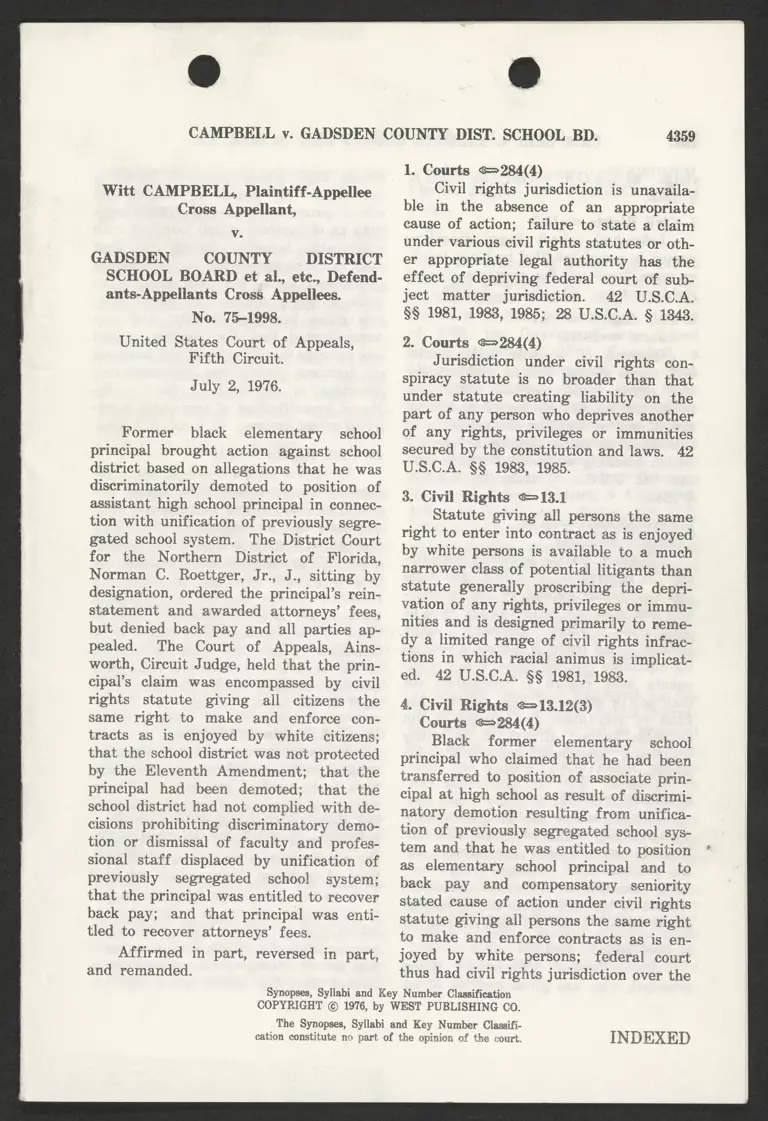
    CAMPBELL v. GADSDEN COUNTY DIST. SCHOOL BD.

Witt CAMPBELL, Plaintiff-Appellee
Cross Appellant,

Ve.

GADSDEN COUNTY DISTRICT
SCHOOL BOARD et al., etc., Defend-

ants-Appellants Cross Appellees.

No. 75-1998.

United States Court of Appeals,
Fifth Circuit.

July 2, 1976.

Former black elementary school
principal brought action against school
district based on allegations that he was
discriminatorily demoted to position of
assistant high school principal in connec-
tion with unification of previously segre-
gated school system. The District Court
for the Northern District of Florida,
Norman C. Roettger, Jr., J., sitting by
designation, ordered the principal's rein-
statement and awarded attorneys’ fees,
but denied back pay and all parties ap-
pealed. The Court of Appeals, Ains-
worth, Circuit Judge, held that the prin-
cipal’s claim was encompassed by civil
rights statute giving all citizens the
same right to make and enforce con-
tracts as is enjoyed by white citizens;
that the school district was not protected
by the Eleventh Amendment; that the
principal had been demoted; that the
school district had not complied with de-
cisions prohibiting discriminatory demo-
tion or dismissal of faculty and profes-
sional staff displaced by unification of
previously segregated school system;
that the principal was entitled to recover
back pay; and that principal was enti-
tled to recover attorneys’ fees.

Affirmed in part, reversed in part,
and remanded.

4359

1. Courts &=284(4)

Civil rights jurisdiction is unavaila-
ble in the absence of an appropriate
cause of action; failure to state a claim
under various civil rights statutes or oth-
er appropriate legal authority has the
effect of depriving federal court of sub-
ject matter jurisdiction. 42 U.S.C.A.
§§ 1981, 1983, 1985; 28 U.S.C.A. § 1343.

2. Courts &=284(4)

Jurisdiction under civil rights con-
spiracy statute is no broader than that
under statute creating liability on the
part of any person who deprives another
of any rights, privileges or immunities
secured by the constitution and laws. 42
U.S.C.A. §§ 1983, 1985.

3. Civil Rights &=13.1

Statute giving all persons the same
right to enter into contract as is enjoyed
by white persons is available to a much
narrower class of potential litigants than
statute generally proscribing the depri-
vation of any rights, privileges or immu-
nities and is designed primarily to reme-
dy a limited range of civil rights infrac-
tions in which racial animus is implicat-
ed. 42 U.S.C.A. §§ 1981, 1983.

4. Civil Rights &=13.12(3)
Courts &=284(4)

Black former elementary school
principal who claimed that he had been
transferred to position of associate prin-
cipal at high school as result of diserimi-
natory demotion resulting from unifica-
tion of previously segregated school sys-
tem and that he was entitled to position
as elementary school principal and to
back pay and compensatory seniority
stated cause of action under civil rights
statute giving all persons the same right
to make and enforce contracts as is en-
joyed by white persons; federal court
thus had civil rights jurisdiction over the

Synopses, Syllabi and Key Number Classification
COPYRIGHT © 1976, by WEST PUBLISHING CO.

The Synopses, Syllabi and Key Number Classifi-
cation constitute no part of the opinion of the court. INDEXED


4360 CAMPBELL v. GADSDEN COUNTY DIST. SCHOOL BD.

claim. 42 U.S.C.A. § 1981; 28 U.S.C.A.

§ 1343.

5. Civil Rights ¢=13.7
Individual school board members

named in complaint filed by black teach-
er were “persons” for purposes of civil
rights statute. 42 U.S.C.A. § 1983.

6. Civil Rights &=13.7
Courts &=284(4)

Question of whether action under
civil rights statute will lie and whether
civil rights jurisdiction will attach de-
pends not on the nature of the relief
sought but on whether the action is, in
substance, an action against a “person”
within meaning of the civil rights stat-
ute. 42 US.C.A. § 1983; 28 U.S.CA.

§ 1343.

7. Civil Rights &=13.16
Courts &=284(4)

Although statute generally proscrib-
ing the deprivation of rights, privileges
and immunities secured by the constitu-
tion and laws will suffice as the basis of
jurisdiction where teacher’s claim
against school board is merely a request
for equitable reinstatement, it is not ad-
equate with regard to complaints for
back pay or attorneys’ fees; relief in the
form of restitution or damages is not
available against officers of an entity
which is a “nonperson” under civil rights

statute. 42 U.S.C.A. § 1983.

8. Courts ¢=303(2)

Florida school boards are not the

type of entity sheltered by the Eleventh
Amendment and that Amendment did
not preclude black principal from recov-

ering back pay or attorneys’ fees with
respect to his civil rights action against
school board. U.S.C.A.Const. Amend. 11.

9. Civil Rights &=9.12
Black former elementary school

principal, who was given position of as-

sistant high school principal following

unification of previously segregated
school system and who earned $300 more
than an elementary school principal with
comparable seniority during his first
year, but who earned $200 to $500 less in
subsequent years, who was required to
drive a longer distance to school, who

was given less responsibility, and who
demonstrated that the position carried
less prestige was “demoted” for purposes
of decisions prohibiting discriminatory
demotion or dismissal of faculty dis-
placed by unification of previously segre-
gated school system. 42 U.S.C. A. § 1981.

10. Civil Rights &=9.10
Obligation of school board not to en-

gage in discriminatory demotion or dis-
missal of faculty and professional staff
displaced by unification of previously
segregated system does not accrue only
after integration-related dismissals or
demotions have occurred; if there is a

reduction in the number of principals,
teachers and other professional staff as
result of unification, staff member to be

dismissed or demoted must be selected
on the basis of objective and reasonable
nondiscriminatory standards from all the
staff of the school district.

11. Civil Rights &=13.13(3)
Evidence that school board never de-

veloped written, objective, nonracial cri-

teria to be used in connection with de-
motion or dismissal of school personnel,
and that black elementary school princi-

pal who was the senior administrator in
the county system was demoted to posi-
tion of assistant high school principal
even though two other whites who had

no experience serving as principal while
school was in session were retained in
principalships for which they were hired
just prior to desegregation order demon-
strated that the school board had en-


CAMPBELL v. GADSDEN COUNTY DIST. SCHOOL BD. 4361

gaged in discriminatory demotion of the
black principal. 42 U.S.C.A. § 1981.

12. Civil Rights ¢=13.17
Black elementary school principal

who demonstrated that he was discrimi-
natorily demoted to position of assistant
high school principal in connection with
desegregation of school district was enti-
tled to recover reasonable attorneys’ fees
under statute allowing federal court to
grant reasonable attorneys’ fees as part
of costs upon entry of final order against
a local educational agency under the
Emergency School Aid Act. Emergency
School Aid Act, § 718, 20 U.S.C.A.
§ 1617; 42 U.S.C.A. § 1981.

13. Civil Rights ¢=13.16
Black elementary school principal

who was demoted to position of assistant
high school principal at the time that
segregated school system was replaced
by unitary school system was entitled to
recover back pay. 42 U.S.C.A. § 1981.

14. Civil Rights ¢=13.16

Statute granting all citizens the
same right to make and enforce con-
tracts as is enjoyed by white citizens is
broad enough to encompass back pay
claims where a public entity has failed to
treat a black in the same manner as
similarly situated whites in the course of
arranging its contractual relationships
with employees. 42 U.S.C.A. § 1981.

Appeals from the United States Dis-
trict Court for the Northern District of

Florida.

* Of the U.S. Court of Customs and Patent Ap-

peals, sitting by designation.

1. Campbell originally sought class action re-

lief, but this was denied by the District Court

on the ground that the appropriate channel for

securing class relief would be through inter-

vention in the ongoing Gadsden County School

Before GEWIN and AINSWORTH,
Circuit Judges, and MARKEY,* Chief
Judge.

AINSWORTH, Circuit Judge:

In the process of complying with a
final desegregation order issued by the
United States District Court for the
Northern District of Florida in August
of 1970, the Gadsden County School
Board transferred Witt Campbell, a
black, from a principalship at a black
elementary school which was being
phased out to an assistant principalship

at a high school. Campbell subsequently
instituted this action,! claiming that his
reassignment was imposed on him in vio-
lation of Singleton v. Jackson Separate
Municipal School District, 5 Cir., 1969,
419 F.2d 1211, cert. denied, 396 U.S.
1082, 90 S.Ct. 612, 24 L.Ed.2d 530 (1970),
which prohibits discriminatory demotion
or dismissal of faculty and professional
staff displaced by the unification of pre-
viously segregated school systems, and
that accordingly, he is entitled to a posi-
tion as an elementary school principal,
back pay, compensatory seniority, and
reasonable attorneys’ fees.

Campbell has been employed by the
Gadsden County Board of Public Instruc-
tion since 1934, and served as principal
in a series of black elementary schools
until the County’s dual school system
was eliminated in 1970. Although he
had thirty years of administrative expe-
rience and was the senior administrator
in the Gadsden County system at the
time of the final desegregation order, he

desegregation case. In the interest of efficien-

cy, the District Court retained jurisdiction over

Campbell’s particularized complaint under Sin-

gleton v. Jackson Separate Municipal School

District, 5 Cir., 1969, 419 F.2d 1211, cert. de-
nied, 396 U.S. 1032, 90 S.Ct. 612, 24 L.Ed.2d
530 (1970).


4362

was transferred in order to avoid “bump-
ing” either of two recently appointed
white principals, neither of whom had
actually administered an elementary
school as principal while school was in
session at the time of Campbell’s trans-
fer. The District Court issued a perma-
nent injunction, ordering the Gadsden
County District School Board, the Super-
intendent of Schools, and individual
members of the Board to assign Camp-
bell to a position as an elementary school
principal beginning with the 1975-76
school year. A motion for stay of the
injunction pending appeal was denied.
The court further held that Campbell
was entitled to attorneys’ fees, but de-
nied his claim for back pay. Maintain-
ing that no Singleton violation occurred,
appellants challenge the award of in-
junctive relief and attorneys’ fees; ap-
pellee has preserved the back pay issue
by appropriate cross appeal.

2. Circuit court analysis on the issue of wheth-

er or not school districts or state (or state

related) universities are ‘persons’ under sec-

tion 1983 has not been uniform. Compare Ad-

kins v. Duval County School Bd., 5 Cir., 1975,

511 F.2d 690; and Sellers v. Regents of Uni-
versity of California, 9 Cir., 1970, 432 F.2d 493,

500, cert. denied, 401 U.S. 981, 91 S.Ct. 1194,

28 L.Ed.2d 333 (1971) (indicating that section

1983 jurisdiction is improper) with Aurora Ed-

ucation Ass'n East v. Board of Education of

Aurora Pub. School Dist. No. 131, 7 Cir., 1974,

490 F.2d 431, 435, cert. denied, 416 U.S. 985,

94 S.Ct. 2388, 40 L.Ed.2d 762 (1974) (suggest-

ing that section 1983 jurisdiction is available).

3. 28 U.S.C. § 1343 provides:

The district courts shall have original jur-

isdiction of any civil action authorized by

law to be commenced by any person:

(3) To redress the deprivation, under color

of any State law, statute, ordinance, regula-

tion, custom or usage, of any right, privilege

or immunity secured by the Constitution of

the United States or by any Act of Congress

providing for equal rights of citizens or of all
persons within the jurisdiction of the United
States;

CAMPBELL v. GADSDEN COUNTY DIST. SCHOOL BD.

I. Jurisdiction

[1-7] As a preliminary matter, appel-
lants contend that the District Court was
without jurisdiction to adjudicate Camp-
bell’s claim. They argue that City of
Kenosha v. Bruno, 412 U.S. 507, 93 S.Ct.
2222. 37 L.Ed.2d 109 (1973), which held
that injunctive relief was not available
against a city under 42 U.S.C. § 1983,

since a city is not a “person” for pur-

poses of that statute, and Adkins v. Du-
val County School Board, 5 Cir., 1975,
511 F.2d 690, which held that school
boards are not “persons” for purposes of
section 1983, preclude federal court juris-
diction in this case.? This line of reason-
ing overlooks the fact that jurisdiction
under 28 U.S.C. § 1343 3 was asserted not
only in connection with a section 1983
cause of action! but also in conjunction
with claims arising directly under the
Fourteenth Amendment of the United

(4) To recover damages or to secure equi-

table or other relief under any Act of Con-

gress providing for the protection of civil

rights, including the right to vote.

(Emphasis supplied). Because of the phrase

“civil action authorized by law,” section 1343

jurisdiction is unavailable in the absence of an
appropriate cause of action. In this sense,

failure to state a claim under sections 1981,

1983 and 1985 or other appropriate legal au-

thority has the effect of depriving federal

courts of subject matter jurisdiction under sec-

tion 1343. See Harkless v. Sweeny Indep.
School Dist., S.D.Tex., 1975, 388 F.Supp. 738,

745 & n. 4.

4. 42 U.S.C. § 1983 provides:

Every person who, under color of any stat-

ute, ordinance, regulation, custom, or usage,

of any State or Territory, subjects, or causes

to be subjected, any citizen of the United

States or other person within the jurisdiction

thereof to the deprivation of any rights, priv-

ileges, or immunities secured by the Consti-

tution and laws, shall be liable to the party

injured in an action at law, suit in equity, or

other proper proceeding for redress.


CAMPBELL v. GADSDEN COUNTY DIST. SCHOOL BD.

‘States Constitution 3 and under 42 U.S.C.
§§ 19816 and 1985.7 In light of several
recent cases sustaining section 1343 jur-
isdiction with regard to section 1981
claims alleging racial discrimination? in
employment, see, e. g., Johnson v. Rail-
way Express Agency, Inc., 421 U.S. 454,
95 S.Ct. 1716, 1720 & n. 6, 44 L.Ed.2d
295, (1975); Kelly v. West Baton Rouge

5. Because we conclude that jurisdiction under

section 1981 is available in this case, we need

not consider whether the Fourteenth Amend-

ment creates ex proprio vigore a cause of ac-

tion capable of serving as the basis of section

1343 jurisdiction under the circumstances of

this case. See note 3, supra; cf. Paul v. Davis,

— U.S. . » 98 S.Ct. 1135, 1157, 47

L.Ed.2d 405, 44 U.S.L.W. 4337, 4339 (1976).

6. 42 U.S.C. § 1981 provides:

All persons within the jurisdiction of the

United States shall have the same right in
every State and Territory to make and en-

force contracts, to sue, be parties, give evi-

dence, and to the full and equal benefit of all

laws and proceedings for the security of per-

sons and property as is enjoyed by white

citizens, and shall be subject to like punish-

ment, pains, penalties, taxes, licenses, and

exactions of every kind, and to no other.

7. Section 1985 provides, in substance, that

persons who conspire to deprive individuals of

their civil rights may recover damages against
any one or more of the conspirators for the
deprivation or injury suffered. Like section

1983, section 1985 derives from the Ku Klux
Klan Act of 1871, and liability is limited by its
language to “persons.” Section 1985 jurisdic-

tion is thus no broader than that under section
1983.

Federal question jurisdiction was also asserted

under 28 U.S.C. § 1331, but the record does

not affirmatively establish the existence of an

amount in controversy in excess of $10,000.

Cf. Kenosha, supra, 412 U.S. at 514, 93 S.Ct.
at 2227.

8. The fact that these cases uniformly involve

racial discrimination reflects a significant re-

striction on the range of actions that may be

brought under section 1981. In Jones v.

Alfred H. Mayer Co., 392 U.S. 409, 413, 88

4363

Parish School Bd., 5 Cir., 1975, 517 F.2d
194, 197; Cooper v. Allen, 5 Cir., 1974,
493 F.2d 765, 766 n. 1; Penn v. Schlesin-

ger, 5 Cir., 1973, 490 F.2d 700, 701-03,
rev'd on other grounds, 5 Cir., 1974, 497
F.2d 970 (en banc); Caldwell v. National
Brewing Co., 5 Cir., 1971, 443 F.2d 1044,
cert. denied, 405 U.S. 916, 92 S.Ct. 931,
30 L.Ed.2d 785 (1972); Sanders v. Dobbs

S.Ct. 2186, 2189, 20 L.Ed.2d 1189 (1968), while

expounding the scope of section 1982, the

companion section to section 1981, see note 9,

infra, the Supreme Court was careful to note
that

“[w]hatever else it may be, 42 U.S.C. § 1982

is not a comprehensive open housing law.

In sharp contrast to the Fair Housing Title

(Title VIII) of the Civil Rights Act of 1968,

the statute in this case deals only

with racial discrimination and does not ad-

dress itself to discrimination on grounds of

religion or national origin.”

Our court has construed section 1981 broadly

enough to embrace claims regarding employ-

ment discrimination on the basis of alienage.

Guerra v. Manchester Terminal Corp., 5 Cir.,

1974, 498 F.2d 641, 653-55. It should be not-

ed, however, that the discrimination against

Mexicans involved there has strong racial

overtones. See generally Greenfield v. Kates,

Mexican Americans, Racial Discrimination,

and the Civil Rights Act of 1866, 63 Calif.L.
Rev. 662 (1975). The fact that racial discrimi-
nation is a key component in a section 1981
cause of action is apparent from our recent
decision in McDonald v. Sante Fe Trail Trans-
portation Co., 5 Cir., 1975, 513 F.2d 90, cert.
granted, — U.S. ——, 96 S.Ct. 770, 46
L.Ed.2d 634 (1976), in which we held that sec-
tion 1981 confers no actionable rights on white
persons. Thus, section 1981 is available to a
much narrower class of potential litigants than
section 1983, and is designed primarily to rem-
edy a limited range of civil rights infractions in
which racial animus is implicated. In view of
the fact that section 1981 has more restricted
applicability than section 1983, the differences
in statutory language that limit liability under
section 1983 to “persons” but fail to similarly
confine section 1981 liability, see notes 4 and
6, supra, do not seem unreasonable. Section


4364 CAMPBELL v. GADSDEN COUNTY DIST. SCHOOL BD.

Houses, Inc., 5 Cir., 1970, 431 F.2d 1097}
we affirm the District Court’s holding
that there was jurisdiction with regard
to Campbell’s claims against both the in-
dividual defendants and the School

1981 allows a limited class of persons broader

access to relief for particularly serious (i. e.,

racially discriminatory) civil rights violations.

We do not interpret the District Court’s find-

ing that “[t]he re-assignment of plaintiff was

not a result of a pattern or practice of discrim-

ination” (emphasis supplied) as a holding that

no racial discrimination was involved in the

reassignment. To the contrary, its holding

that the reassignment violated Singleton im-

plies a finding of racial discrimination in
Campbell’s case, since Singleton enjoins only

discriminatory demotions or dismissals in

carrying out staff reductions necessitated by

desegregation.

9. The availability of a section 1981 cause of

action to remedy employment discrimination

such as that suffered by Campbell here is sup-

ported by parallel developments in cases

brought under section 1982. Section 1982 dif-

fers from section 1981 primarily in that it pro-

scribes racial discrimination in the sale or

rental of property, whereas section 1981 pro-

hibits such discrimination in the making and

enforcing of contracts and in a number of re-

lated contexts in which persons may be de-

prived of “the full and equal benefit of all laws
and proceedings . . . enjoyed by white

citizens.” Just as section 1982 forbids dis-

criminatory exclusion of blacks from available

housing, see Jones v. Alfred H. Mayer Co.,

supra, so section 1981 proscribes discriminato-

ry exclusion of blacks from available employ-

ment contracts and contract terms. See John-

son v. Railway Express Agency, Inc., 421 U.S.

454, 95 S.Ct. 1716, 1720, 44 L.Ed.2d 295
(1975); Johnson v. Goodyear Tire & Rubber

Co., 5 Cir., 1974, 491 F.2d 1364; Comment,

Racial Discrimination in Employment Under

the Civil Rights Act of 1866, 36 U.Chi.L.Rev.

615, 617 (1969). See also Cody v. Union Elec-

tric, 8 Cir., 1975, 518 F.2d 978 (though claim
that public utility required blacks to pay a

higher security deposit than whites was not

cognizable under section 1983 due to lack of

state action, it did state a cause of action un-

der section 1981); Olzman v. Lake Hills Swim

Club, Inc., 2 Cir., 1974, 495 F.2d 1333, 1339-40
(section 1981 bars discriminatory exclusion of

black guests from a swimming club) (alterna- |

tive holding).

0. Neither our prior decisions nor those of the

Supreme Court rule out the possibility of ob-

taining section 1983 relief which is not, in sub-

stance, relief from a “non-person” under the

statute. Kenosha involved an action seeking

Board under section 1981 and section

1343.

[8] Appellants further contend that
Campbell’s claims for back pay and at-

As the Supreme Court has noted in Tillman v.

Wheaton-Haven Recreation Ass’n, Inc., 410

U.S. 431, 43940 & n. 11, 93 S.Ct. 1090, 1095
& n. 11, 35 L.Ed.2d 403 (1973), “[i]n light of
the historical interrelationship between § 1981

and § 1982 [the operative language of both

sections is traceable to the Civil Rights Act of

April 9, 1866, c. 31, § 1, 14 Stat. 27], we see no

reason to construe these sections differently”

—at least in contexts where an exemption

from the nondiscrimination requirements of
the statutes is being asserted. See also Lar-

son, The Development of Section 1981 as a

Remedy for Racial Discrimination in Private

Employment, 7 Harv.Civ. Rights-Civ.Lib.L.Rev.

56, 60-61 (1972). Courts have repeatedly held
that “§ 1982 is not a ‘mere prohibition of state

laws establishing or upholding’ racial discrimi-
nation in the sale or rental of property but,

rather, an ‘absolute’ bar to all such discrimina-

tion, private as well as public, federal as well

as state.” District of Columbia v. Carter, 409

U.S. 418, 422, 93 S.Ct. 602, 605, 34 L.Ed.2d 613
(1973) (emphasis in original); see Gautreaux

v. Chicago Housing Authority, 7 Cir., 1974,

503 F.2d 930, aff'd sub nom. Hills v.

Gautreaux, — U.S. , 96 S.Ct. 1538, 47

L.Ed.2d 792, 44 U.S.LW. 4480 (1976) (claim
brought under both section 1981 and section

1982); Sullivan v. Little Hunting Park, Inc.,

396 U.S. 229, 90 S.Ct. 400, 24 L.Ed.2d 386
(1969); Jones v. Alfred H. Mayer Co., supra;

Hurd v. Hodge, 334 U.S. 24, 68 S.Ct.:847, 92
L.Ed. 1187 (1948); Penn v. Schlesinger, 5 Cir.,
1973, 490 F.2d 700, 702, revd on other

grounds, 5 Cir., 1974, 497 F.2d 970 (en banc);

Jennings v. Patterson, 5 Cir., 1974, 488 F.2d
436, 441-42. See also Greenfield & Kates, su-

pra note 8, at 664; Larson, supra, at 57. Sec-

tion 1981 relief seems particularly appropriate

where, as here, the discrimination complained

of arises directly from the failure to afford a

black the same consideration as white citizens

in the process of structuring new employment

contracts necessitated by desegregation. See

ent, supra, 36 U.Chi.LRev. at 617-19.


CAMPBELL v. GADSDEN COUNTY DIST. SCHOOL BD.

torneys’ fees are barred by the Eleventh
Amendment in accordance with Edelman
v. Jordan, 415 U.S. 651, 94 S.Ct. 1347, 39
L.Ed.2d 662 (1974). The District Court
apparently accepted this argument, at
least with respect to the back pay issue,
since its denial of back pay was predicat-
ed on Edelman concerns. As the Su-

preme Court in Edelman was careful to

note, however,

a county does not occupy the same
position as a State for purposes of the
Eleventh Amendment. arte
[While county action is generally

state action for purposes of the Four-

| =

injunctive relief against a city, and Adkins v.

Duval County School Board, 5 Cir., 1975, 511

F.2d 690, involved actions brought solely

against school boards. As we indicated in Ad-

kins,

the trial court could not, of course, have

dismissed the suits for failure to allege a

proper jurisdictional basis . . . [if]

there [had] been individual party defendants,

whom this Court has previously held to be

‘persons’ for purposes of § 1983

511 F.2d at 696. The individual defendants

named in Campbell’s suit are “persons” within

the meaning of section 1983. See, e. g., Goss

v. Lopez, 419 U.S. 565, 95 S.Ct. 729, 42

L.Ed.2d 725 (1975); Sterzing v. Fort Bend In-

dependent School Dist., 5 Cir., 1974, 496 F.2d

92, 93 n. 2. Appellants argue, however, that a

suit brought against individual board members

in their official capacity is indistinguishable

from a suit against the board itself. While it

is clear that we lack jurisdiction over claims
for injunctive relief brought nominally against

public officials in a thinly disguised effort to

circumvent the ‘‘person” requirement of sec-

tion 1983, Muzquiz v. City of San Antonio, 5

Cir., 1976, 528 F.2d 499 (en banc); Warner v.

Board of Trustees of the Police Pension Fund,

5 Cir., 1976, 528 F.2d 505 (en banc), it does

not follow that section 1983 relief is never

available against public officers acting in their

official capacities. See McGill v. Parsons, 5

Cir., 1976, 532 F.2d 484, n. 1 [1976]; Reeves v.

City of Jackson, 5 Cir.,, 1976, 532 F.2d 491

[1976]; Thurston v. Dekle, 5 Cir.,, 1976, 531

4365

teenth Amendment, a county defend-
ant is not necessarily a state defend-
ant for purposes of the Eleventh

Amendment.

415 U.S. at 667 n. 12, 94 S.Ct. at 1358 n.
12. Our post-Edelman cases involving

actions for retrospective monetary relief
against county school boards and similar
entities have held that the Eleventh

Amendment does not bar such awards so

long as the entities sued are locally con-

trolled, essentially local in character, and

the funds to defray the award would not

be derived primarily from the state trea-

F.2d 1264 [1976]; Gray v. Union County Inter-

mediate Education Dist., 9 Cir., 1975, 520 F.2d

803, 805; Harper v. Kloster, 4 Cir., 1973, 486

F.2d 1134, 1137-38. In Muzquiz, the suit was,

in substance, an action against an impermissi-

ble party. The question whether ‘a section

1983 action will lie and whether section

1343(3) jurisdiction will attach hinges not on

the nature of the relief sought (e. g., equitable

or legal), but on whether or not the action is in

substance an action against a “person” within

the meaning of the statute. See Muzquiz, su-

pra, 528 F.2d at 500-01.

While section 1983 would thus suffice as a

basis of jurisdiction if Campbell’s claim was
merely a request for equitable reinstatement in

a principalship, it is not adequate with regard

to his claims for back pay and attorneys’ fees.

Relief in the form of restitution or damages is

not available against officers of an entity

which is a “non-person” under section 1983.

Thurston v. Dekle, supra; Muzquiz, supra.

Thus, Campbell would be unable to recover

back pay under section 1983. See also Monell

v. Department of Social Services of the City of

New York, 2 Cir., 1976, 532 F.2d 259, [1976].
Campbell’s claim for attorneys’ fees is predi-

cated on 20 U.S.C. § 1617, see note 2, infra.

Under this section, attorneys’ fees may be

awarded as costs “[u]pon the entry of a final

order by a court of the United States against a

local educational agency.” Such a “final or-
der” cannot be entered by a federal court act-

ing under section 1983. See Adkins v. Duval

County School Bd., supra.


CAMPBELL v. G 4366

sury. Adams v. Rankin County Board of
Education, 5 Cir., 1975, 524 F.2d 928,
929; Hander v. San Jacinto Junior Col-
lege, 5 Cir., 1975, 519 F.2d 273, 279-80.
See also Incarcerated Men of Allen
County Jail v. Fair, 6 Cir., 1974, 507 F.2d
281, 287; Miller v. Carson, M.D.Fla.,
1975, 401 F.Supp. 835, 848 n. 3; Wright
v. Houston Indep. School Dist., S.D.Tex.,
1975, 393 F.Supp. 1149, 1151-58; Smith
v. Concordia Parish School Bd., W.D.La.,
1975, 387 F.Supp. 887, 891; Note, Dam-
age Remedies for Constitutional Viola-
tions, 89 Harv.L.Rev. 922, 931-32 & n. 57
(1976). Our analysis of the nature of
Florida school boards in the context of
determining their similarity to munici-
palities is sufficient to convince us that
they are not the type of entities which
are sheltered by the Eleventh Amend-
ment. See Adkins v. Duval County
School Board, supra, at 693. The lower
court accordingly erred in holding that
Edelman precluded consideration of
Campbell’s back pay claim. Parallel rea-
soning establishes our authority to con-
sider Campbell’s request for reasonable
attorneys’ fees.

II. The Singleton Claim

[9] Appellants attack Campbell’s
claim to a position as an elementary
school principal under Singleton v. Jack-
son Separate Municipal School District, 5
Cir., 1969, 419 F.2d 1211, cert. denied,
396 U.S. 1032, 90 S.Ct. 612, 24 L.Ed.2d
530 (1970), on two grounds. First, they
maintain that Campbell’s reassignment
as an assistant principal of a high school,
far from being a “demotion” within the
meaning of Singleton, was actually a
promotion, and thus that Campbell suf-

fered no cognizable Singleton injury.
Second, they contend that even if the

NED lel
SDEN COUNTY DIST. SCHOOL BD.

reassignment did constitute a demotion,
no elementary school principalships have
become available since the 1970 desegre-
gation order was entered, and that at
most, Singleton requires them to offer
Campbell a principalship when a vacancy
occurs. Neither of these arguments is
sound.

In Singleton, “demotion” was defined
as

any re-assignment (1) under which the
staff member receives less pay or has
less responsibility than under the as-
signment he held previously, (2) which
requires a lesser degree of skill than
did the assignment he held previously,
or (3) under which the staff member is
asked to teach a subject or grade other
than one for which he is certified or
for which he has had substantial expe-
rience within a reasonably current pe-
riod.

419 F.2d at 1218. The District Court
correctly applied these criteria in deter-
mining that Campbell had been demoted.
Although Campbell received $300 more
than an elementary school principal with
comparable seniority during his first
year as Assistant Principal and Desegre-
gation Specialist at Chattahoochee High
School, he earned $200 less in 1971-72,
$500 less in 1972-73, and $500 less in

1973-74. In addition, Chattahoochee
High was located approximately 22 miles
from Campbell’s home, which necessitat-
ed increased expenditure of time and
money in getting to and from school.
The new position also carried considera-
bly less responsibility and required less
skill than the prior principalship. Camp-

bell no longer had responsibility for se-
lecting and hiring faculty, making teach-
er assignments, presiding over faculty
meetings, or officiating at other ceremo-


CAMPBELL v. GADSDEN COUNTY DIST. SCHOOL BD.

nial events. As of September 1973, few-
er pupils were enrolled at Chattahoochee
than had been enrolled in Campbell’s ele-
mentary school. Finally, the District
Court found that an elementary school
principalship was more prestigious, both
in general and in Campbells specific
case, than an assistant principalship at
any level. The lower court thus did not
err in concluding that Campbell had suf-
fered a demotion as defined in Singleton.

[10] Appellants’ second argument
misconceives the extent or protection af-
forded to those whose positions are af-
fected by desegregation orders. It as-
sumes that obligations under Singleton
accrue only after integration-related dis-
missals or demotions have occurred and
that compliance consists merely of giving
those displaced priority in filling equiva-
lent positions which subsequently become
available. While this is certainly part of
what Singleton demands! the mandate
in the case is much broader. It requires
that if, as a result of the creation of a
unitary school system,

There is to be a reduction in the num-
ber of principals, teachers, teacher-
aids, or other professional staff em-
ployed by the school district which will
result in a dismissal or demotion of
any such staff members, the staff
member to be dismissed or demoted
must be selected on the basis of objec-
tive and reasonable non-discriminatory
standards from among all the staff of
the school district. Prior to
such a reduction, the school board will
develop or require the development of
nonracial objective criteria to be used

11. Specifically, Singleton provides that

[1}f there is any [desegregation re-

lated] dismissal or demotion, no staff vacan-

cy may be filled through recruitment of a

person of a race, color, or national origin

different from that of the individual dis-

4367

in selecting the staff member who is

to be dismissed or demoted. These cri-
teria shall be available for public in-
spection and shall be retained by the
school district. The school district also
shall record and preserve the evalua-
tion of staff members under the crite-
ria. Such evaluation shall be made
available upon request to the dismissed
or demoted employee.

419 F.2d at 1218 (emphasis added).

[11] After reviewing the record in
Campbell’s case, it is clear that the ap-
pellants failed to comply with these re-
quirements in reassigning Campbell. As
the District Court found, the school
board has never developed written, ob-
jective, nonracial criteria to be used in
connection with demotion or dismissal of
school personnel. More important than
appellants’ failure to promulgate such
criteria, however, was its failure to se-
lect the principal to be demoted “on the
basis of objective and reasonable non-dis-
criminatory standards from among all
the staff of the school district.” 419
F.2d at 1218 (emphasis added). In Unit-
ed States v. Texas Education Agency, 5
Cir., 1972, 459 F.2d 600, 607 n. 3, we
suggested that appropriate objective cri-

teria for determining which principal to
displace in a Singleton situation included
the degree or degrees held by the princi-
pal and the number of years of experi-
ence he or she had as a principal in the
system being desegregated, as a princi-
pal in any system, and in education other
than as a principal. Under these crite-
ria, Campbell should not have been de-
moted.

missed or demoted, until each displaced staff

member who is qualified has had an oppor-

tunity to fill the vacancy and has failed to

accept an offer to do so.

419 F.2d at 1218.


4368

As noted earlier, Campbell was the
senior administrator in the Gadsden
County system at the time the final de-
segregation order was entered. He had
over thirty years of experience as a
school administrator, and had served
during at least fifteen of those years as
a principal. He has been certified as an
elementary and secondary school princi-
pal since 1952. By August of 1970,
Campbell had more years of experience
as a principal within the Gadsden Coun-
ty system than most of the other princi-
pals in the system had as educators in
any capacity. The contrast between
Campbell’s experience and that of the
last two white principals to be hired be-
fore entry of the final Gadsden County
desegregation order is particularly sharp.
The first of these, Charles D. Boyd, who
was appointed on February 3, 1970 to an
elementary school principalship com-
mencing June 8, 1970, had served previ-
ously as an assistant principal and had a
total of four years of educational experi-
ence. The second, Corbin W. Scott, who
was hired just four days prior to entry
of the integration order, had served pre-
viously as a teacher and had seven years
of experience. Neither had any experi-
ence serving as principal while school
was in session. In view of these facts,
we conclude that the appellants decided
to reassign Campbell only because his
school was being phased out, and that
this decision was made without any ef-
fort to compare his objective qualifica-
tions with those of other principals in

12. 20 U.S.C. § 1617 provides:

Upon the entry of a final order by a court

of the United States against a local educa-

tional agency, a State (or any agency there-

of), or the United States (or any agency

thereof), for failure to comply with any pro-

vision of this chapter or for discrimination

on the basis of race, color, or national origin

in violation of title VI of the Civil Rights Act

CAMPBELL v. GADSDEN COUNTY DIST. SCHOOL BD.

the system in determining who should be
demoted. We accordingly affirm the
District Court's conclusion that Camp-
bell’s rights under Singleton were violat-
ed and its order that Campbell be placed
in an elementary school principalship
commencing with the 1975-76 school
year.

ITI. Attorneys’ Fees and Other Relief

[12] The District Court held that
Campbell was entitled to an award of
attorneys’ fees, to be determined in ac-
cordance with the guidelines of Johnson
v. Georgia Highway Express, 5 Cir,
1974, 488 F.2d 714. Campbell’s claim for
such an award is predicated on a provi-
sion of the 1972 Emergency School Aid
Act, 20 U.S.C. § 1617, which allows a

federal court, in its discretion, to grant a
reasonable attorney’s fee as part of the
costs upon entry of a final order against
a local educational agency.? We have
previously construed this provision as ap-
plying in cases where Singleton viola-
tions have been established. Ward v.
Kelly, 5 Cir., 1975, 515 F.2d 908, 912;
Thompson v. Madison County Board of
Education, 5 Cir., 1974, 496 F.2d 682,
689-90; see Johnson v. Combs, 5 Cir.,
1972, 471 F.2d 84, cert. denied, 413 U.S.
922, 93 S.Ct. 3063, 37 L.Ed.2d 1044
(1973). Our review of the record reveals
no facts that indicate the proceedings in
this case were not necessary to bring
about compliance with Singleton and no
special circumstances which would ren-
der such an award unjust in this case.

of 1964, or the fourteenth amendment to the

Constitution of the United States as they

pertain to elementary and secondary educa-

tion, the court, in its discretion, upon a find-

ing that the proceedings were necessary to

bring about compliance, may allow the pre-

vailing party, other than the United States, a

reasonable attorney's fee as part of the

costs.


CAMPBELL v. GADSDEN COUNTY DIST. SCHOOL BD.

See Northcross v. Board of Education of
Memphis City Schools, 412 U.S. 427, 93
S.Ct. 2201, 37 L.Ed.2d 48 (1973); Ward v.
Kelly, supra, at 912; Henry v. Clarksdale
Municipal Separate School Dist., 5 Cir.,
1973, 480 F.2d 583. Because the Gads-
den County District School Board is not
an entity protected by the Eleventh
Amendment, as previously discussed,
Edelman v. Jordan poses no bar to an
award of attorneys’ fees, and the Dis-
trict Court correctly concluded that they

should be awarded.

[13,14] Campbell is also entitled to
an award of back pay and compensatory
seniority, in accordance with prior cases
which expressly consider the availability
of such relief under section 1981, see, e.

13. Few of our cases have expressly considered

the availability of section 1981 as a basis for

jurisdiction in Singleton-type cases, in part, no

doubt, because prior to Kenosha and Adkins

there was clear authority supporting jurisdic-

tion with regard to back pay claims under sec-

tion 1983. See, e. g., Harkless v. Sweeny Inde-

pendent School Dist., 5 Cir., 1970, 427 F.2d

319, cert. denied, 400 U.S. 991, 91 S.Ct. 451, 27

L.Ed.2d 439 (1971). Since demotions and dis-

missals effected by school boards inevitably

constituted state action in the sense required

for section 1983 jurisdiction, there was no

need to assert jurisdiction under section 1981

as well. As noted earlier, however, the Su-

preme Court has breathed renewed life into

sections 1981 and 1982 in the past decade.

See, e. g., Supreme Court cases cited in note 9,

4369

g., Johnson v. Railway Express Agency,

Inc, 421 U.S. 454, 95 S.Ct. 1716, 1720, 44
L.Ed.2d 295 (1975); Guerra v. Manches-
ter Terminal Corp., 5 Cir., 1974, 498 F.2d
641; Johnson v. Goodyear Tire & Rubber
Co., 5 Cir., 1974, 491 F.2d 1364; and with
those, such as Singleton and its progeny,
see, e. g., Ward v. Kelly, supra; Lee v.
Macon County Board of Education, 5
Cir., 1971, 453 F.2d 1104, 1114, in which
section 1981 was available as an alterna-
tive basis of jurisdiction.® Since the
District Court failed to award back pay,
we remand the case for a determination
of the amount due to Campbell in this
regard.

AFFIRMED IN PART, REVERSED
IN PART, AND REMANDED.

supra. See also Johnson v. Goodyear Tire &

Rubber Co., 5 Cir., 1974, 491 F.2d 1364, 1378.

This revitalization of provisions derived from

the 1866 Civil Rights Act has established the

existence of a cause of action under section

1981 which, though narrower in substance and

in availability than that under section 1983, is

broad enough to confer jurisdiction with re-

gard to back pay claims where a public entity

has failed to treat a black in the same manner

as similarly situated whites in the course of

arranging its contractual relationships with its

employees. We do not view Kenosha or Ad-

kins as completely undermining the jurisdic-

tional foundation of the innumerable reinstate-

ment and back pay cases that this court has

handed down in the course of supervising
school desegregation in the Deep South.

Adm. Office, U.S. Courts—West Publishing Company, Saint Paul, Minn.