Patino v. City of Pasadena Brief for Amici Curiae
Public Court Documents
March 31, 2017
-
Brief Collection, LDF Court Filings. Patino v. City of Pasadena Brief for Amici Curiae, 2017. 6de9fc99-c09a-ee11-be36-6045bdeb8873. LDF Archives, Thurgood Marshall Institute. https://ldfrecollection.org/archives/archives-search/archives-item/d8269120-4e45-4397-bb88-ce7534a1c2fa/patino-v-city-of-pasadena-brief-for-amici-curiae. Accessed October 05, 2026.
Copied!
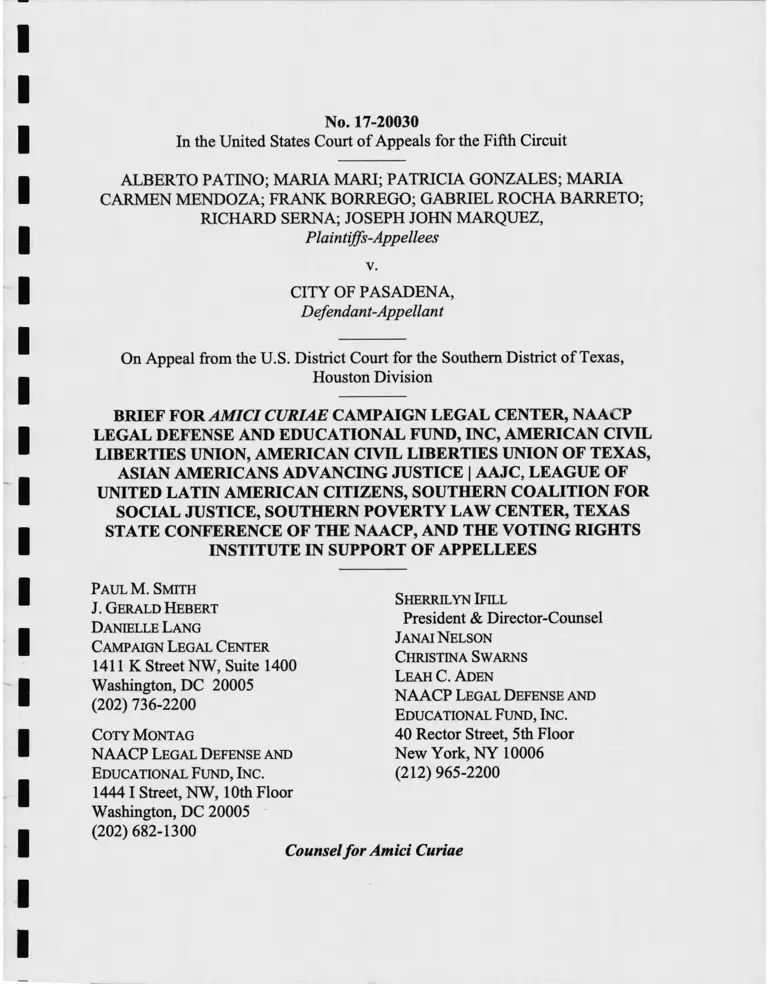
No. 17-20030
In the United States Court of Appeals for the Fifth Circuit
ALBERTO PATINO; MARIA MARI; PATRICIA GONZALES; MARIA
CARMEN MENDOZA; FRANK BORREGO; GABRIEL ROCHA BARRETO;
RICHARD SERNA; JOSEPH JOHN MARQUEZ,
Plaintiffs-Appellees
v.
CITY OF PASADENA,
Defendant-Appellan t
On Appeal from the U.S. District Court for the Southern District of Texas,
Houston Division
BRIEF FOR AMICI CURIAE CAMPAIGN LEGAL CENTER, NAACP
LEGAL DEFENSE AND EDUCATIONAL FUND, INC, AMERICAN CIVIL
LIBERTIES UNION, AMERICAN CIVIL LIBERTIES UNION OF TEXAS,
ASIAN AMERICANS ADVANCING JUSTICE | AAJC, LEAGUE OF
UNITED LATIN AMERICAN CITIZENS, SOUTHERN COALITION FOR
SOCIAL JUSTICE, SOUTHERN POVERTY LAW CENTER, TEXAS
STATE CONFERENCE OF THE NAACP, AND THE VOTING RIGHTS
INSTITUTE IN SUPPORT OF APPELLEES
Paul M. Smith
J. Gerald Hebert
Danielle Lang
Campaign Legal Center
1411 K Street NW, Suite 1400
Washington, DC 20005
(202) 736-2200
Coty Montag
NAACP Legal Defense and
Educational Fund , Inc.
14441 Street, NW, 10th Floor
Washington, DC 20005
(202) 682-1300
Sherrilyn Ifill
President & Director-Counsel
Janai N elson
Christina Swarns
Leah C. Aden
NAACP Legal Defense and
Educational Fund, Inc.
40 Rector Street, 5th Floor
New York, NY 10006
(212) 965-2200
Counsel for Amici Curiae
SUPPLEMENTAL STATEMENT OF INTERESTED PERSONS
Pursuant to Federal Rule of Appellate Procedure 26.1 and Fifth Circuit Rule
29.2, amici curiae provide this supplemental statement of interested persons in
order to fully disclose all the persons and entities as described in the fourth
sentence of Fifth Circuit Rule 28.2.1 that have an interest in the outcome of this
case. These representations are made in order that the judges of this Court may
evaluate possible disqualification or recusal. Amici certify that they are 501(c)(3)
non-profit corporations. None of the amici has a corporate parent or is owned in
whole or in part by any publicly held corporation.
Amicus Curiae:
Campaign Legal Center (“CLC”)
NAACP Legal Defense and Educational Fund, Inc. (“LDF”)
American Civil Liberties Union (“ACLU”)
American Civil Liberties Union of Texas (“ACLU Texas”)
Asian Americans Advancing Justice | AAJC
League of United Latin American Citizens (“LULAC”)
Southern Coalition for Social Justice (“SCSJ”)
Southern Poverty Law Center (“SPLC”)
Texas State Conference of the NAACP (“Texas NAACP”)
The Voting Rights Institute (“VRI”)
Counsel for Amici Curiae:
Paul M. Smith (CLC)
J. Gerald Hebert (CLC)
Danielle Lang (CLC)
Sherrilyn Ifill (LDF)
Janai Nelson (LDF)
Christina Swams (LDF)
Leah C. Aden (LDF)
Coty Montag (LDF)
Dale E. Ho (ACLU)
Sophia Lin Lakin (ACLU)
Rebecca L. Robertson (ACLU Texas)
Edgar Saldivar (ACLU Texas)
Terry Ao Minnis (Asian Americans Advancing Justice | AAJC)
Luis Vera (LULAC)
Anita S. Earls (SCSJ)
Allison J. Riggs (SCSJ)
l
Samuel Brooke (SPLC)
Caren E. Short (SPLC)
Bradford M. Berry (Texas NAACP)
Gary L. Bledsoe (Texas NAACP)
Robert S. Notzon (Texas NAACP)
Jesse L. Gaines (Texas NAACP)
Patrick Llewellyn (VRI)
Respectfully submitted,
/s/ Danielle Lam
Danielle Lang
11
TABLE OF CONTENTS
SUPPLEMENTAL STATEMENT OF INTERESTED PERSONS............................i
TABLE OF AUTHORITIES...................................................................................... iv
INTEREST OF AMICI CURIAE................................................................................. 1
INTRODUCTION AND SUMMARY OF THE ARGUMENT..............................1
ARGUMENT................................................................................................................3
I. Section 3(c) Is A Vital Component Of The Voting Rights A ct......................4
A. Sections 2, 4, and 5..................................................................................4
B. Section 3(c).............................................................................................. 8
C. Section 3(c)’s Bail-in Mechanism Differs Significantly From
Section 4(b)’s Coverage Formula And Thereby Avoids Any
Constitutional Concerns........................................................................11
II. The City Of Pasadena Was Properly Subjected To Preclearance
Pursuant To Section 3(c)................................................................................. 13
A. The Bail-in Of The City Of Pasadena.................................................. 13
B. Texas’s Statutory Arguments Against Bail-In Are Unavailing.......... 16
III. Section 3(c) Is A Constitutionally Appropriate Means Of Imposing
Preclearance In This Case................................................................................20
A. Section 3(c) Does Not Violate The Equal Sovereignty Principle....... 21
B. Section 3(c) Is An Appropriate Exercise Of Congress’s
Enforcement Authority..........................................................................23
C. Texas’s Constitutional Arguments Are Misguided............................. 26
CONCLUSION...........................................................................................................29
iii
TABLE OF AUTHORITIES
Cases
Ala. Legislative Black Caucus v. Alabama,
135 S. Ct. 1257 (2015)..........................................................................................18
Allen v. City o f Evergreen,
2014 WL 12607819 (S.D. Ala. Jan. 13, 2014)............................................... 9, 12
Allen v. State Bd. o f Elections,
393 U.S. 544(1969).............................................................................................. 5
Blackmoon v. Charles Mix County,
505 F. Supp. 2d 585 (D.S.D. 2007).....................................................................16
City o f Boerne v. Flores,
521 U.S. 507 (1997)..................................................................................20,23,25
City o f Rome v. United States,
446 U.S. 156(1980)................................................................................................ 6
eBay Inc. v. MercExchange, L.L.C.,
547 U.S. 388 (2006)...............................................................................................13
FDIC v. RBS Securities Inc.,
798 F.3d 244 (5th Cir. 2015)................................................................................ 17
Fisher v. University o f Texas at Austin,
136 S.Ct. 2198 (2016).......................................................................................... 25
Hayden v. Pataki,
449 F.3d 305 (2d Cir. 2006) (en banc)................................................................25
Jeffers v. Clinton,
740 F. Supp. 585 (E.D. Ark. 1990)................................................................12, 16
Kimel v. Fla. Bd. o f Regents,
528 U.S. 62 (2000)................................................................................................ 23
Kirkie v. Buffalo County,
2004 U.S. Dist. LEXIS 30960 (D.S.D. Feb. 12, 2004)......................................13
Page(s)
IV
TABLE OF AUTHORITIES
(continued)
Page(s)
LULAC v. Perry,
548 U.S. 399 (2006)..............................................................................................15
McMillan v. Escambia County,
748 F.2d 1037 (5th Cir. 1984)............................................................................. 14
Miller v. Johnson,
515 U.S. 900(1995)...............................................................................................18
N.C. State Conference o f the NAACP v. McCrory,
831 F.3d 204 (4th Cir. 2016)............................................................................... 10
Nevada Dep’t o f Human Resources v. Hibbs,
538 U.S. 721 (2003)........................................................................................ 24,25
Northwest Austin Mun. Util. Dist. No. One v. Holder,
557 U.S. 193 (2009)...................................................................................... .passim
Perez v. Abbott,
2017 WL 1787454 (W.D. Tex. May 2, 2017).......................................................9
Raney v. Bd. o f Educ. o f Gould Sch. Dist.,
391 U.S. 443 (1968).............................................................................................. 27
Reno v. Bossier Parish Sch. Bd.,
528 U.S. 329 (2000).............................................................................................. 27
Salary v. Wilson,
415 F.2d 467 (5th Cir. 1969)................................................................................27
Sanchez v. Anaya,
Civ. No. 82-0067M (D.N.M. Dec. 17, 1984)............................................... 12, 13
Shelby County, Alabama v. Holder,
133 S. Ct. 2612 (2013).................................................................................. .passim
South Carolina v. Katzenbach,
383 U.S. 301 (1966)...................................................................................... .passim
v
Squyres v. Heico Companies, L.L.C.,
782 F.3d 224 (5th Cir. 2015).................................................................................. 3
Tennessee v. Lane,
541 U.S. 509 (2004)................................................................................. 23,24, 25
Thornburg v. Gingles,
478 U.S. 30(1986)...................................................................................................5
United States v. Georgia,
546 U.S. 151 (2006).............................................................................................. 24
United States v. Louisiana,
363 U.S. 1 (1960).................................................................................................. 21
United States v. McRae,
795 F.3d 471 (5th Cir. 2015)..................................................................................3
Veasey v. Abbott,
2017 WL 1315593 (S.D. Tex. Apr. 10, 2017).......................................................9
Veasey v. Abbott,
830 F.3d 216 (5th Cir. 2016) (en banc).............................................. 4, 17, 20, 26
White v. Regester,
412 U.S. 755 (1975)...............................................................................................18
Yick Wo v. Hopkins,
118 U.S. 356 (1886).............................................................................................. 25
Statutes, Rules and Regulations
1 U.S.C. § 1................................................................................................................. 17
42 U.S.C. § 1973c(a).....................................................................................................5
52 U.S.C. § 10301.........................................................................................................4
52 U.S.C. § 10302(c)................................................................................ 8, 12,13,16
52 U.S.C. § 10303(b)................................................................................................... 7
TABLE OF AUTHORITIES
(continued)
Page(s)
vi
TABLE OF AUTHORITIES
(continued)
Page(s)
52 U.S.C. § 10304(a)................................................................................................... 5
Fed. R. App. P. 29(c)(5)................................................................................................1
Other Authorities
Travis Crum, Note, The Voting Rights A ct’s Secret Weapon: Pocket
Trigger Litigation and Dynamic Preclearance, 119 Yale L.J. 1992
(2010)..............................................................................................................passim
Heather K. Gerken, Understanding the Right to an Undiluted Vote,
114 Harv. L. Rev. 1663 (2001)...............................................................................19
Second Amended Complaint, Greater Birmingham Ministries v.
Alabama, No. 2:15-cv-02193 (N.D. Ala. Dec. 6, 2016), ECF No.
112..................................................................................................................10
Joint Center for Political & Economic Studies, 50 Years o f the Voting
Rights Act: The State o f Race in Politics 4 (2015),
https://goo.gl/05asG5.............................................................................................. 6
Leah M. Litman, Inventing Equal Sovereignty, 114 Mich. L. Rev.
1207 (2016)............................................................................................................21
NAACP LDF, Democracy Diminished: State and Local Threats to
Voting Po.st-Shelby County, Alabama v. Holder (2016),
https://goo.gl/sg5NFu............................................................................................10
Antonin Scalia & Bryan A. Gamer, Reading Law: Interpretation o f
Legal Texts 129 (2012)..........................................................................................17
Complaint, Terrebonne Parish Branch NAACP v. Jindal,
No. 314-cv-69 (M.D. La. Feb. 3, 2014), ECF No. 1 ...........................................10
1 Voting Rights Act: Evidence o f Continued Need, Hearing Before the
Subcommittee on the Constitution o f the H. Comm, on the
Judiciary, 109th Cong. 97 (2006)...........................................................................6
vii
INTEREST OF AMICI CURIAE
Amici curiae are non-profit organizations that have a demonstrated interest
in protecting the rights of voters under the Voting Rights Act of 1965 (“VRA”) and
the Reconstruction Amendments, and, in pursuing that interest, frequently litigate
in the area of election law and voting rights law. A list of amici curiae appears in
the Appendix. The parties consent to the filing of this brief.
INTRODUCTION AND SUMMARY OF THE ARGUMENT
Prior to the Supreme Court’s 2013 decision in Shelby County invalidating
the VRA’s coverage formula, the City of Pasadena (“City”) was a “covered
jurisdiction” that was required to “preclear” all voting changes with federal
authorities. See Shelby County, Alabama v. Holder, 133 S. Ct. 2612 (2013). This
preclearance process ensured that jurisdictions with a history of racial
discrimination in voting were not permitted to enforce voting changes that would
have a retrogressive effect on minority voters. Almost immediately after Shelby
County, the City moved to change its redistricting map from eight single-member
districts to a hybrid map with six single-member districts and two at-large districts.
As described in considerable detail by the district court, the City’s adoption of the
dilutive redistricting map, which occurred against the backdrop of surging Latino
Pursuant to Fed. R. App. P. 29(c)(5), amici state that no party’s counsel
authored this brief either in whole or in part, and further, that no party or party’s
counsel, or person or entity other than amici, amici's members, and their counsel,
contributed money intended to fund preparing or submitting this brief.
1
population growth, was done with the intent to discriminate against Latino voters.
As a remedy and to prevent and deter future violations, the district court invoked
Section 3(c) of the VRA—which authorizes courts to place States and political
subdivisions under preclearance in response to a violation of the Fourteenth or
Fifteenth Amendment—to “bail-in” the City until 2023.
The bail-in of the City was both statutorily and constitutionally appropriate.
The City’s enactment of an intentionally discriminatory redistricting plan
immediately after it was no longer required to obtain federal preclearance review is
a quintessential example of when bail-in is appropriate. Section 3(c), moreover, is
a proper exercise of Congress’s enforcement authority under the Reconstruction
Amendments. Unlike the coverage formula, Section 3(c) is triggered only upon a
judicial finding of a contemporary constitutional violation. Section 3(c), therefore,
does not raise the same constitutional concerns about reliance on “decades-old
data” and “equal sovereignty” that the Supreme Court identified in invalidating the
coverage formula in Shelby County. Id. at 2627, 2618. Instead, Section 3(c) uses
the uniquely effective preclearance process to prevent voting discrimination before
it occurs—in a manner that is custom tailored to redress an underlying
constitutional violation.
2
ARGUMENT
The City does not contest the district court’s remedy of preclearance under
Section 3(c); it challenges only the predicate finding of intentional discrimination.
2
City Br. 47-51. Any argument as to the appropriateness of the bail-in remedy is
therefore waived. See, e.g., United States v. McRae, 795 F.3d 471, 479 (5th Cir.
2015) (“[A]n argument not raised ... in the appellant’s opening brief is waived.”).
However, the State of Texas, as amicus curiae, has questioned the appropriateness
of the bail-in remedy. Because Texas is not a party to this case, this Court need
not—indeed, should not—address those arguments. See Squyres v. Heico
Companies, L.L.C., 782 F.3d 224, 233 n.5 (5th Cir. 2015) (declining to consider
arguments raised solely in amicus brief). But given the potential importance of this
case in setting precedent on this question of first impression in this Circuit, amici
submit this brief to clarify when Section 3(c) relief is warranted and to clarify its
constitutionality.
“The Voting Rights Act of 1965 reflects Congress’ firm intention to rid the
country of racial discrimination in voting,” South Carolina v. Katzenbach, 383
U.S. 301, 315 (1966), and its “historic accomplishments ... are undeniable.”
Northwest Austin Mun. Util. Dist. No. One v. Holder, 557 U.S. 193, 201 (2009).
2
Amici agree with and assume the validity of the district court’s well-
documented conclusion that the City violated the Fourteenth Amendment by
intentionally diluting the votes of Latino voters.
3
Although the Supreme Court determined in 2013 that the VRA’s coverage formula
was no longer justified by “current conditions,” Shelby County, 133 S. Ct. at 2631,
thus immobilizing a vital protection against racial discrimination in voting, this
case involves a distinct statutory provision for preclearance. Section 3(c)
authorizes preclearance based on contemporary and adjudicated constitutional
violations rather than on “decades-old data” contained in a coverage formula. Id. at
2627. It is a preclearance mechanism that is triggered by “current conditions.” Id.
at 2631.
I. Section 3(c) Is A Vital Component Of The Voting Rights Act
“[Djesigned by Congress to banish the blight of racial discrimination in
voting,” the VRA represents Congress’s most “inventive” enforcement of the
Reconstruction Amendments. Katzenbach, 383 U.S. at 308, 327. In enacting the
VRA, Congress developed an interlocking statutory scheme designed to root out
explicit—as well as “ingenious,” id. at 309—methods of vote denial or dilution.
Thus, Section 3(c) must be understood within the framework of the VRA’s
complimentary and reinforcing provisions.
A. Sections 2,4, and 5
Section 2 of the VRA is a permanent and nationwide ban on racial
discrimination in voting. 52 U.S.C. § 10301. Plaintiffs can establish a Section 2
violation by showing either discriminatory intent or effect. See Veasey v. Abbott,
4
830 F.3d 216, 229 (5th Cir. 2016) (en banc). Section 2 claims can be brought on a
theory of vote denial, see id., or, as here, vote dilution, see ROA.2984; Thornburg
v. Gingles, 478 U.S. 30, 46-49 (1986).
Section 5 applied only in certain “covered jurisdictions” and “provided that
no change in voting procedures could take effect until it was approved [that is,
precleared] by federal authorities in Washington, D.C.—either the Attorney
General or a court of three judges.” Shelby County, 133 S. Ct. at 2620.
Preclearance was “granted only if the change neither ‘ha[d] the purpose nor
[would] have the effect of denying or abridging the right to vote on account of race
or color.’” Northwest Austin, 557 U.S. at 198 (quoting 42 U.S.C. § 1973c(a), now
codified at 52 U.S.C. § 10304(a)). Section 5 applied broadly to voting changes,
including “ballot-access rights” as well as the drawing of district lines. Id.; see also
Allen v. State Bd. o f Elections, 393 U.S. 544, 564-66 (1969).
Preclearance was specifically designed to prophylactically address the
particular harms of voting discrimination and avoid the unique challenges of
protracted voting rights litigation. As the Court in Shelby County explained,
preclearance was a congressional response to a world wherein “litigation remained
slow and expensive, and the States came up with new ways to discriminate as soon
as existing [laws] were struck down.” 133 S. Ct. at 2620. This interminably slow,
whack-a-mole approach to discrimination was particularly problematic in the
5
voting rights arena because, once discriminatory voting changes are in effect for an
election, the harmed voters can rarely, if ever, be made whole. 1 Voting Rights Act:
Evidence o f Continued Need, Hearing Before the Subcommittee on the Constitution
o f the H. Comm, on the Judiciary, 109th Cong. 97 (2006) (noting that harmed
voters cannot change past electoral outcomes, and the benefits of incumbency
adhere to those elected under discriminatory procedures). Thus, Section 5’s
preclearance process “‘shift[ed] the advantage of time and inertia’” from those who
enact discriminatory laws to the victims of discrimination. City o f Rome v. United
States, 446 U.S. 156, 182 (1980) (quoting Katzenbach, 383 U.S. at 309). By
stopping discriminatory laws before they were implemented, preclearance under
Section 5 was responsible for much of our Nation’s uncontested progress in
battling discrimination in voting and improving meaningful access to the franchise
for racial minorities. See Joint Center for Political & Economic Studies, 50 Years
o f the Voting Rights Act: The State o f Race in Politics 4 (2015),
https://goo.gl/05asG5 (“Since 1965, ... African Americans went from holding
fewer than 1,000 offices nationwide to over 10,000.”).
Section 4(b) supplied the “coverage formula” for determining the
jurisdictions to which Section 5 applied. Under Section 4(b), a jurisdiction was
covered if, during the 1964, 1968, or 1972 presidential election, it (1) maintained
an illegal “test or device,” such as a literacy test, and (2) had voter turnout below
6
https://goo.gl/05asG5
fifty percent. 52 U.S.C. § 10303(b). In crafting the coverage formula and adopting
these proxies for identifying egregious racial discrimination in voting, Congress
“limited its attention to the geographic areas where immediate action seemed
necessary.” Katzenbach, 383 U.S. at 328.
Sections 4(b) and 5 were temporary provisions that were reauthorized by
large and bipartisan majorities in Congress in 1970, 1975, 1982, and 2006. Shelby
County, 133 S. Ct. at 2620. The 1965, 1970, 1975, and 1982 enactments were all
upheld by the Supreme Court. See id. at 2620-21 (collecting cases). The Court,
however, invalidated the 2006 reauthorization of Section 4(b) in Shelby County.
There, the Court stated that “the [Voting Rights Act’s] ‘current burdens’
must be justified by ‘current needs,’ and any ‘disparate geographic coverage’ must
be ‘sufficiently related to the problem that it targets.’” 133 S. Ct. at 2627 (quoting
Northwest Austin, 557 U.S. at 203). Applying that standard, the Court held that
Section 4(b)’s coverage formula was “based on 40-year old facts having no logical
relation to the present day” and was therefore an unconstitutional “basis for
subjecting jurisdictions to preclearance.” Id. at 2629, 2631. The Court did not
strike down Section 5, see id. at 2631, and invited Congress to draft another
3
Once a jurisdiction was covered by Section 4(b), it could seek “bail-out” of
the preclearance regime by showing that it had not engaged in discrimination in
voting for ten years, in accordance with criteria enumerated in Section 4(a). See
Shelby County, 133 S. Ct. at 2620.
7
formula for preclearance, suggesting that another method would be constitutional.
See id.; see also infra at p.22. Section 3(c) was left undisturbed by Shelby County
and remains a viable tool for preclearance.
B. Section 3(c)
Included as a permanent provision in the original VRA, “Section[] 3 ...
strengthen[ed] existing procedures for attacking voting discrimination by means of
litigation” and targeted “pockets of voting discrimination” missed by Section
4(b)’s coverage formula. Katzenbach, 383 U.S. at 316, 308. Section 3(c) provides,
in relevant part, that:
If in any proceeding instituted by the Attorney General or an
aggrieved person under any statute to enforce the voting guarantees of
the fourteenth or fifteenth amendment in any State or political
subdivision the court finds that violations of the fourteenth or fifteenth
amendment justifying equitable relief have occurred within the
territory of such State or political subdivision, the court, in addition to
such relief as it may grant, shall retain jurisdiction for such period as it
may deem appropriate and during such period no [voting change]
different from that in force or effect at the time the proceeding was
commenced shall be enforced unless and until the court [or the
Attorney General] finds that such [voting change] does not have the
purpose and will not have the effect of denying or abridging the right
to vote on account of race or color, or in contravention of the voting
guarantees set forth in section 10303(f)(2) of this title ....
52 U.S.C. § 10302(c).
Section 3(c) thus authorizes federal courts to place States and political
subdivisions that have violated the Fourteenth or Fifteenth Amendment under
8
preclearance. In other words, Section 3(c) authorizes courts to “bail-in” a
jurisdiction into the preclearance process.
Between the passage of the VRA in 1965 and Shelby County's invalidation
of the coverage formula in 2013, Section 3(c) was invoked to bail-in two States
(Arkansas and New Mexico), six counties (Los Angeles County, California;
Escambia County, Florida; Thurston County, Nebraska; Bernalillo County, New
Mexico; Buffalo County, South Dakota; Charles Mix County, South Dakota), and
one city (Chattanooga, Tennessee). See Travis Crum, Note, The Voting Rights
A ct’s Secret Weapon: Pocket Trigger Litigation and Dynamic Preclearance, 119
Yale L.J. 1992, 2010 (2010) (collecting cases). The dearth of Section 3(c) bail-in
cases is due, in part, to the existence of Section 4(b)’s coverage formula for several
4
decades. See id. at 2015.
In addition to the City of Pasadena, the City of Evergreen, Alabama, has
been bailed-in post-Shelby County. See Allen v. City o f Evergreen, 2014 WL
12607819, at *2 (S.D. Ala. Jan. 13, 2014). And multiple potential Section 3(c)
bail-in suits are pending in federal courts. See, e.g., Veasey v. Abbott, 2017 WL
1315593 (S.D. Tex. Apr. 10, 2017) (finding intentional discrimination in
enactment of Texas’s voter ID law); Perez v. Abbott, 2017 WL 1787454, at *2-3
4
Many of these bail-ins were the result of consent decrees. See Crum, 119
Yale L.J. at 2015.
9
(W.D. Tex. May 2, 2017) (finding intentional discrimination in enactment of
redistricting plan and noting request for Section 3(c) relief); Second Amended
Compl. at 74-75, Greater Birmingham Ministries v. Alabama, No. 2:15-cv-02193
(N.D. Ala. Dec. 6, 2016), ECF No. 112 (seeking Section 3(c) relief in a lawsuit
challenging Alabama’s voter ID law); Compl. at 22-23, Terrebonne Parish Branch
NAACP v. Jindal, No. 314-cv-69 (M.D. La. Feb. 3, 2014), ECF No. 1 (seeking
Section 3(c) relief in lawsuit alleging vote dilution in electing members to a
Louisiana state court).
The City of Pasadena’s decision to radically amend its voting laws in the
immediate wake of Shelby County follows an unfortunate pattern of behavior in
formerly covered jurisdictions. See N.C. State Conference o f the NAACP v.
McCrory, 831 F.3d 204, 216 (4th Cir. 2016) (discussing tightening of voter ID law
and adoption of other voting restrictions immediately after Shelby County)-,
NAACP LDF, Democracy Diminished: State and Local Threats to Voting Post-
Shelby County, Alabama v. Holder (2016), https://goo.gl/sg5NFu (collecting
examples of post-Shelby County changes). The enactment of these laws in the
immediate aftermath of Shelby County demonstrates the need for Section 3(c)’s
bail-in mechanism to prevent discriminatory voting practices in various
jurisdictions nationwide—in a manner that is flexible, current, and temporally
limited.
10
https://goo.gl/sg5NFu
C. Section 3(c)’s Bail-in Mechanism Differs Significantly From
Section 4(b)’s Coverage Formula And Thereby Avoids Any
Constitutional Concerns
Although there are some similarities between Sections 3(c) and 4(b), there
are several constitutionally salient differences.
First, and most importantly, each provision contains a distinct trigger for
preclearance. Section 4(b)’s coverage formula was based on indicia of
unconstitutional conduct dating back to the VRA’s enactment and applied to only
certain jurisdictions. See Northwest Austin, 557 U.S. at 203 (“The statute’s
coverage formula is based on data that is now more than 35 years old, and there is
considerable evidence that it fails to account for current political conditions.”).
Section 3(c), by contrast, “replaces] [the coverage formula’s] reliance on proxies
with judicial findings of contemporary constitutional violations.” Crum, 119 Yale
L.J. at 2025. Thus there can be no claim that Section 3(c) relies on “decades-old
data.” Nor is there a pre-determined differentiation between the States under
Section 3(c): it is a nationwide standard that imposes a remedy only when a
jurisdiction has been found by a court to engage in contemporary racial
discrimination in voting.
Second, Section 3(c) allows greater flexibility for courts to craft a
preclearance remedy for specific, proven constitutional violations. For instance,
courts have fashioned targeted preclearance remedies under Section 3(c) that are as
11
narrow or broad as the violation dictates. Rather than “suspending all changes to
state election law,” Northwest Austin, 557 U.S. at 202, courts have interpreted
Section 3(c) to require preclearance of only certain changes to election laws. In
Jeffers v. Clinton, the district court invoked Section 3(c) to require Arkansas to
preclear only changes related to majority-vote requirements in general elections—
the same type of changes that had triggered a finding of invidious discrimination.
740 F. Supp. 585, 601 (E.D. Ark. 1990). Similarly, New Mexico agreed to preclear
only changes relating to redistricting plans. See Crum, 119 Yale L.J. at 2012 &
n.120 (discussing Judgment at 8, Sanchez v. Anaya, Civ. No. 82-0067M (D.N.M.
Dec. 17, 1984) (consent decree)); see also City o f Evergreen, 2014 WL 12607819,
at *2 (preclearance required for “any change in the redistricting plan or method of
election for City Council elections” and eligibility requirements for voters in
municipal elections).
Third, bail-in under Section 3(c) is more temporally limited than coverage
under Section 4(b). Although the coverage formula was technically temporary,
some jurisdictions were covered from 1965 until 2013. By contrast, bail-ins under
Section 3(c) have lasted for shorter periods of time. 52 U.S.C. § 10302(c)
(providing that a court shall “retain jurisdiction” for “such period as it may deem
appropriate”). The recent bail-in of the City of Evergreen will last for
approximately seven years. City o f Evergreen, 2014 WL 12607819, at *3; see also
12
Kirkie v. Buffalo County, 2004 U.S. Dist. LEXIS 30960 (D.S.D. Feb. 12, 2004)
(consent decree) (approximately one decade). And the bail-ins of New Mexico and
of the City in this case were crafted to capture only the next redistricting cycle. See
Crum, 119 Yale L.J. at 2012 & n.120 (discussing Judgment at ^ 8, Sanchez v.
Anaya, Civ. No. 82-0067M (D.N.M. Dec. 17, 1984) (consent decree)); ROA.3119
(Bail-in until 2023 “ensures that the City’s redistricting to take account of the 2020
Census is submitted to preclearance.”). By imposing these reasonable time limits,
courts have ensured that bail-in remains tied to “current conditions.” Shelby
County, 133 S. Ct. at 2631.
II. The City Of Pasadena Was Properly Subjected To Preclearance
Pursuant To Section 3(c)
A. The Bail-in Of The City Of Pasadena
This is a textbook case for when bail-in is both appropriate and necessary.
Bail-in is a form of “equitable relief,” 52 U.S.C. § 10302(c), and therefore the
district court’s remedial order is “reviewable on appeal for abuse of discretion.”
eBay Inc. v. MercExchange, L.L.C., 547 U.S. 388, 391 (2006). The district court
did not abuse its discretion here.
From 1992 to 2013, the City used an eight single-member district map (“the
8-0 map”) to elect City Council members. ROA.2996. But “immediately after the
Supreme Court’s Shelby County decision removed the requirement for Pasadena to
obtain federal Department of Justice preclearance,” ROA.3044, the City moved to
13
replace the 8-0 map with a map composed of six single-member districts and two
at-large districts (“the 6-2 map”).
The 6-2 map “eliminated District D as a Latino-majority district” and
“enlarged each single-member district by approximately 6,220 people.”
ROA.3012. Under the 6-2 map, “[candidates for an at-large position on the
Council fde for only one place and compete only with the other candidates filing
for that same place. Each voter may cast only one vote between the candidates for
each place.” ROA.2997. The district court concluded (ROA.3068-ROA.3082) that
these changes diluted the votes of Latino voters given the make-up of the new
single-member districts, the structure of the at-large elections, and the prevalence
of racially polarized voting—which is the keystone of a vote-dilution case, see
McMillan v. Escambia County, 748 F.2d 1037, 1043 (5th Cir. 1984).
The City’s abolition of the 8-0 map coincided not only with Shelby County,
but also with demographic growth and political mobilization of Latino voters. As
the district court summarized:
Pasadena’s Latino population has grown rapidly, from 18.7% of the
citizen voting-age population in 1990 to 48.2% today. Latinos
appeared to be on the verge of electing a Council majority for the first
time in Pasadena’s history in the 2015 election. But between the
Supreme Court’s Shelby County decision [in June 2013] and the
winter of 2014, half of the City Council, led by the Major and with the
Mayor’s tie-breaking vote, eliminated a Latino-majority district by
creating an at-large seat and made it more difficult for the Latino-
preferred candidate to succeed in all the districts except the ones in
14
which the Latino citizen voting-age and Spanish-sumamed registered
voter population have a decisive and secure majority.
ROA.3070 (footnotes omitted).
Put simply, the district court found that “Pasadena changed to the 6-2 map
and plan precisely because Latinos were becoming more successful at winning
City Council seats.” ROA.3058; see also ROA.3079 (“The surging—but not quite
majority—Latino population in Pasadena and the City’s decision to change its
electoral map and plan shortly after the Shelby County decision removed the
requirement for preclearance similarly bears ‘the mark of intentional
discrimination.’”) (quoting LULAC v. Perry, 548 U.S. 399, 440 (2006)). Given
these facts, as well as the racially charged atmosphere in which the redistricting
occurred, the district court found that the City intentionally diluted the votes of
Latino voters in violation of the Fourteenth Amendment. ROA.3081.
The district court ordered the City to be bailed-in under Section 3(c). The
district court found that “[pjreclearance is particularly appropriate because the City
seized on, and used, the absence of preclearance to avoid the statutory and
constitutional limits on redistricting.” ROA.3119. The district court also tailored its
remedy to local conditions. The City’s bail-in “end[s] on June 30, 2023, after the
2023 biennial election results are finalized.” ROA.3118. As the district court
explained, this time period covers “four election cycles” and “ensures that the
City’s redistricting to take account of the 2020 Census is submitted to
15
preclearance.” ROA.3119; see also ROA.3119 (“The court has carefully reviewed
the evidence on Pasadena’s demographics and recent history of success in electing
Latino or Latino-preferred candidates to conclude that six years is a sufficiently
limited and tailored remedy in this case.”). The district court, moreover,
acknowledged that “[t]he purpose of § 3(c) preclearance under the Voting Rights
Act is to remedy voting rights violations, not to punish.” ROA.3119.5
B. Texas’s Statutory Arguments Against Bail-In Are Unavailing
As an initial matter, all parties are in agreement that a finding of intentional
discrimination is necessary for Section 3(c) relief. The statutory references to the
Fourteenth and Fifteenth Amendments make that clear. 52 U.S.C. § 10302(c); see
also Blackmoon v. Charles Mix County, 505 F. Supp. 2d 585, 592 (D.S.D. 2007).
Here, the district court found that the City had intentionally diluted the votes of
The City’s bail-in resembles Jeffers v. Clinton, where a three-judge district
court bailed-in Arkansas. There, the State of Arkansas enacted four majority-vote
requirements in local elections after Black candidates won office by a plurality of
votes in those political subdivisions. See Jeffers, 740 F. Supp. at 600. The district
court explained that these majority-vote requirements were passed “to close off
[an] avenue of black political victory” by “replacing] a system in which blacks
could and did succeed, with one in which they almost certainly cannot.” Id. at 595.
The district court required Arkansas to preclear changes relating to majority-vote
requirements to remedy and prevent racial discrimination in voting. See id. at 600-
02.
Just as bail-in was appropriate to ensure that the State of Arkansas would not
intentionally cut off avenues of minority political success, here bail-in is
appropriate to prevent the City from intentionally diluting minority voting power.
16
Latino voters in violation of the Fourteenth Amendment and thus bail-in was
warranted.
Nonetheless, Texas, as amicus curiae, makes several spurious arguments
against preclearance.
First, Texas asserts that the use of the word “violations” in Section 3(c)
requires findings of multiple constitutional violations prior to the imposition of
preclearance. Tex. Br. 7-8. But Texas’s argument ignores a cardinal principle of
statutory interpretation: the Dictionary Act provides that “words importing the
plural include the singular” and vice versa, “unless the context indicates
otherwise.” 1 U.S.C. § 1; see also FDIC v. RBS Securities Inc., 798 F.3d 244, 258
(5th Cir. 2015) (noting “the Dictionary Act’s default rule that the singular includes
the plural”); Antonin Scalia & Bryan A. Gamer, Reading Law: Interpretation o f
Legal Texts 129 (2012) (“In the absence of a contrary indication, ... the singular
Texas expresses concern (Tex. Br. 9-10) about the improper use of some
evidence, such as discriminatory remarks by private individuals or decades-old
instances of discrimination. As Judge Costa has explained, “Shelby County was not
a case about purposeful discrimination under the Fourteenth Amendment or
Section 2 of the Voting Rights Act” and therefore “should not be used to curtail the
use of an Arlington Heights factor” for determining discriminatory intent. Veasey,
830 F.3d at 331 (Costa, J., dissenting).
Here, amici agree with and assume that the district court properly followed
the Arlington Heights factors and accorded appropriate weight to this evidence. For
instance, recent history is relevant to a finding of purposeful discrimination. See,
e.g., ROA.3068 (considering Texas’s history of racial discrimination but giving
pre-1970s evidence “little weight”).
17
includes the plural (and vice versa).”). A single constitutional violation is thus
sufficient for bail-in.
Moreover, to say that a racially discriminatory redistricting map amounts to
only a single constitutional violation is to ignore the nature of the harm. The 6-2
map “eliminated District D as a Latino-majority district.” ROA.3012. Under the
8-0 map, that district contained approximately 18,000 people, nearly 60% of whom
were Latino voting-age citizens. ROA.3011. The City’s adoption of the 6-2 map
also “enlarged each single-member district by approximately 6,220 people.”
ROA.3012. Given these facts, it strains credulity to argue that there has been only
one violation of the Fourteenth Amendment.
To be sure, one could imagine a singular violation of the Fourteenth or
Fifteenth Amendments: an official could decline to register an individual voter
because of his or her race. But successful voting rights claims, by their nature,
almost always involve violations of multiple voters’ constitutional rights. See, e.g.,
Ala. Legislative Black Caucus v. Alabama, 135 S. Ct. 1257, 1270 (2015) (“A
plaintiff pursuing a racial gerrymandering claim must show that ‘race was the
predominant factor motivating the legislature’s decision to place a significant
number of voters within or without a particular district.’”) (quoting Miller v.
Johnson, 515 U.S. 900, 916 (1995)); White v. Regester, 412 U.S. 755, 765 (1975)
(“[W]e have entertained claims that multimember districts are being used
18
invidiously to cancel out or minimize the voting strength of racial groups.”); see
also Heather K. Gerken, Understanding the Right to an Undiluted Vote, 114 Harv.
L. Rev. 1663, 1667 (2001) (explaining that, in vote dilution cases, “individual
injury arises from the aggregate treatment of group members”). Texas’s
interpretation would lead to the perverse result that an unconstitutional racial
gerrymander—which, in the congressional context, could affect hundreds of
thousands of citizens—would not justify bail-in.
Second, Texas claims that bail-in is appropriate “only upon a showing that
preclearance is necessary because future voting discrimination is likely and cannot
be remedied by ordinary injunctive relief.” Tex. Br. 10. Texas asserts that the
district court failed to make this finding and places all the blame for the racially
discriminatory redistricting map on the City’s Mayor. See Tex. Br. 10-11. Despite
Texas’s protestations, no such requirement is found in Section 3(c)’s text. When
read in context, Section 3(c)’s text makes clear that Congress believed that a
jurisdiction’s intentional racial discrimination in voting was a sufficient trigger for
preclearance, especially given the particular harms of voting discrimination as well
as the unique burdens on minority plaintiffs in challenging voting discrimination,
see supra at pp.5-6. And in any event, the district court found that future
discrimination was a real possibility and ordered preclearance so that the City
19
“cannot immediately return to a map and plan that thwarts Latinos on the cusp of
an electoral majority.” ROA.3119.
This Court—as it did in Veasey when Texas argued that plaintiffs should be
held to a higher burden of proof under Section 2—should “decline to cripple the
Voting Rights Act by using the State’s proposed analysis.” 830 F.3d at 261.
III. Section 3(c) Is A Constitutionally Appropriate Means Of Imposing
Preclearance In This Case
Although Texas does not argue that Section 3(c) is invalid on its face, it
raises constitutional concerns about its application in this case and seeks to raise
the bar for bailing-in jurisdictions more generally. Texas’s arguments are
misguided.
Section 3(c) is an appropriate exercise of Congress’s Fourteenth and
Fifteenth Amendment enforcement authority.7 Section 3(c) avoids the coverage
formula’s constitutional infirmities and is a targeted remedial measure tied directly
to a violation of the fundamental right to vote. As such, Texas’s attempt to
circumscribe Section 3(c) relief is unavailing.
Amici believe that Katzenbach's reasonableness standard supplies the proper
test for adjudicating the constitutionality of statutes enacted pursuant to Congress’s
Fourteenth and Fifteenth Amendment enforcement authority. But given the
doctrinal uncertainty wrought by Shelby County, amici assume that Shelby County
and City o f Boerne v. Flores, 521 U.S. 507 (1997), control because those standards
are more stringent.
20
A. Section 3(c) Does Not Violate The Equal Sovereignty Principle
It is undeniable that “equal sovereignty” was the animating principle behind
g
Northwest Austin and Shelby County. Section 3(c) does not violate that principle.
In Northwest Austin, the Court explained that the coverage formula
“differentiate[d] between the States, despite our historic tradition that all the States
enjoy ‘equal sovereignty.’” Northwest Austin, 557 U.S. at 203 (quoting United
States v. Louisiana, 363 U.S. 1, 16 (I960)). And although the Court avoided the
constitutional question, it emphasized that “a departure from the fundamental
principle of equal sovereignty requires a showing that a statute’s disparate
geographic coverage is sufficiently related to the problem that it targets.” Id. The
Court also noted that a statute’s “current burdens ... must be justified by current
needs.” Id.
That language, in turn, supplied the constitutional standard applied by the
Court in Shelby County. 133 S. Ct. at 2622. There, the Court repeatedly criticized
that coverage formula for differentiating between the States using “decades-old
data” as proxies for unconstitutional conduct. See, e.g., id. at 2618 (“And § 4 of the
Act applied that requirement only to some States—an equally dramatic departure
from the principle that all States enjoy equal sovereignty.”); id. at 2629 (“Congress
For a persuasive critique of the equal sovereignty doctrine, see Leah M.
Litman, Inventing Equal Sovereignty, 114 Mich. L. Rev. 1207 (2016).
21
did not use the record it compiled to shape a coverage formula grounded in current
conditions. It instead reenacted a formula based on 40-year-old facts having no
logical relation to the present day.”).
While the Court invalidated the coverage formula, see id. at 2631, it
expressly limited its holding to “declaring] § 4(b) unconstitutional.” Id. at 2631.
The Court made this point crystal clear: “Our decision in no way affects the
permanent, nationwide ban on racial discrimination found in § 2. We issue no
holding on § 5 itself, only on the coverage formula.” Id. Indeed, the Court stated
that Congress retained the authority to “draft another formula based on current
conditions.” Id.; see also id. at 2629 (“Congress—if it is to divide the States—must
identify those jurisdictions to be singled out on a basis that makes sense in light of
9
current conditions.”).
Section 3(c)’s bail-in mechanism does not raise the same constitutional
concerns as Section 4(b)’s coverage formula. Section 3(c) does not rely on any
proxies—such as “decades-old” election data—for triggering coverage. Rather,
Although Section 3(c) was not mentioned in the Shelby County opinion,
Justice Kennedy referenced it favorably at the oral argument. See Transcript of
Oral Argument at 24, Shelby County v. Holder, 133 S. Ct. 2612 (2013) (No. 12-
96), 2013 WL 6908203, at *24 (“[I]t seems to me that the government can very
easily bring a Section 2 suit and as part of that ask for bail-in under Section 3.”);
id. at 54 (“But a Section 2 case can, in effect, have an order for bail-in, correct me
if I’m wrong, under Section 3 and then you basically have a mini—something that
replicates Section 5.”).
22
Section 3(c) applies a nationwide standard that targets only those specific
jurisdictions that have violated the Fourteenth or Fifteenth Amendments based on
contemporaneous court findings. And because Section 3(c) “utilizes a coverage
mechanism, it sidesteps the under- and over-inclusiveness inherent in any coverage
formula.” Crum, 119 Yale L.J. at 2025. In other words, Section 3(c) does not
burden any jurisdiction that has not recently engaged in purposeful racial
discrimination in voting. Section 3(c)’s constitutional trigger for coverage thus
ensures that any “disparate geographic coverage is sufficiently related to the
problem that it targets.” Northwest Austin, 557 U.S. at 203.
B. Section 3(c) Is An Appropriate Exercise Of Congress’s
Enforcement Authority
To be sure, preclearance, even apart from the coverage formula, “imposes
substantial federalism costs.” Northwest Austin, 557 U.S. at 202. But these costs
are justified in response to the constitutional violations—racial discrimination in
voting in defiance of the Fourteenth or Fifteenth Amendments—that trigger its
application. Put simply, Section 3(c)’s “current burdens” are justified by “current
conditions.”
The Supreme Court has repeatedly described Congress’s enforcement
authority under the Fourteenth Amendment as “remedial,” “corrective,” and
“preventive.” City o f Boerne v. Flores, 521 U.S. 507, 525, 529 (1997); see also
Kimel v. Fla. Bd. o f Regents, 528 U.S. 62, 81 (2000) (same); Tennessee v. Lane,
23
541 U.S. 509, 520 (2004) (same). Legislation enacted pursuant to Congress’s
enforcement authority under the Reconstruction Amendments “must be an
appropriate remedy for identified constitutional violations.” Nevada Dep’t o f
Human Resources v. Hibbs, 538 U.S. 721, 728 (2003) (emphasis added); see also
United States v. Georgia, 546 U.S. 151, 159 (2006) (“[IJnsofar as Title II [of the
ADA] creates a private cause of action for damages against States for conduct that
actually violates the Fourteenth Amendment, Title II validly abrogates state
sovereign immunity.”). Section 3(c) relief is, by definition, a remedy for a
constitutional violation.
Congress’s enforcement authority, moreover, is not limited solely to
correcting past constitutional violations. The Supreme Court has approved
prophylactic measures broader than the targeted remedy that Section 3(c) provides.
See Hibbs, 538 U.S. at 727-28 (“Congress may enact so-called prophylactic
legislation that proscribes facially constitutional conduct, in order to prevent and
deter unconstitutional conduct.”); Lane, 541 U.S. at 520 (“When Congress seeks to
remedy or prevent unconstitutional discrimination, § 5 [of the Fourteenth
Amendment] authorizes it to enact prophylactic legislation proscribing practices
that are discriminatory in effect, if not in intent, to carry out the basic objectives of
the Equal Protection Clause.”).
24
Furthermore, “the appropriateness of the remedy depends on the gravity of
the harm it seeks to prevent.” Id. at 523. In passing Section 3(c), Congress acted
pursuant to its enforcement authority to remedy racial discrimination in voting.
Section 3(c) is thus a double-barreled provision protecting against the twin evils
targeted by the Fourteenth and Fifteenth Amendments. See Fisher v. University o f
Texas at Austin, 136 S. Ct. 2198, 2208 (2016) (racial classifications receive strict
scrutiny); Yick Wo v. Hopkins, 118 U.S. 356, 370 (1886) (the right to vote is
“preservative of all rights”); Hayden v. Pataki, 449 F.3d 305, 359 (2d Cir. 2006)
(en banc) (Parker, J., dissenting) (“Congress’s enforcement authority is at its zenith
when protecting against discrimination based on suspect classifications (such as
race), or when protecting fundamental rights (such as voting).”). Because “any
racial discrimination in voting is too much,” Shelby County, 133 S. Ct. at 2631, it
is “easier for Congress” to craft a prophylactic remedy based on a record of “state
constitutional violations.” Hibbs, 538 U.S. at 736.
Any constitutional concerns about bail-in are ameliorated by Section 3(c)’s
“congruen[t] and proportional[]” attributes. City o f Boerne, 521 U.S. at 520.
Section 3(c) has been used to impose targeted preclearance, rather than across-the-
board preclearance. In situations where one type of voting change has been
particularly problematic, courts can fashion Section 3(c) relief to target that
problem, rather than force jurisdictions to preclear all voting changes. See supra at
25
pp. 11-12. And recall that bail-ins are more temporally limited than coverage
determinations under Section 4(b). See supra at pp.12-13.
To the extent Section 3(c)’s “current burdens” must be justified by “current
needs,” Shelby County, 133 S. Ct. at 2627, that standard is satisfied. Section 3(c)
combines an enforcement action with a prophylactic remedy in response to recent
and adjudicated violations of the Fourteenth and Fifteenth Amendments. There is
no risk that a bail-in will be based on “decades-old” proxies. Put another way,
Section 3(c) combines the benefits of Section 5’s uniquely effectively preclearance
process with a more targeted and dynamic triggering mechanism, thus avoiding the
constitutional pitfalls of Section 4(b)’s static coverage formula.
C. Texas’s Constitutional Arguments Are Misguided
Texas disagrees. Relying on Shelby County, Texas seeks to raise the
standard for bail-in. According to Texas, bail-in is constitutional only in response
to “pervasive, flagrant discrimination” reminiscent of the worst abuses of Jim
Crow. Tex. Br. 16. That is absurd.
“[Texas’s] argument effectively nullifies the protections o f ’ Section 3(c)
until a jurisdiction has slid back into Jim Crow. Veasey, 830 F.3d at 247. But “the
Voting Rights Act was enacted to prevent ... invidious, subtle forms of
discrimination,” not only “flagrant” ones. Id. The Constitution clearly does not
require Congress to sit on its hands until constitutional violations become rampant
26
and unchecked before it can act to prevent constitutional harm of the highest order.
See Reno v. Bossier Parish Sch. Bd., 528 U.S. 329, 366 (2000) (Souter, J.,
concurring in part and dissenting in part) (Congress intended the VRA to protect
against jurisdictions “pour[ing] old poison into new bottles.”). And it is worth
repeating that Shelby County “issue[d] no holding on § 5 itself,” or on Section 3(c).
133 S. Ct. at 2631. The repeated citations by Texas to Shelby County therefore
cannot bear the weight Texas places on them. Given the gravity of the
constitutional harm, Congress acted well within its enforcement authority in
fashioning the bail-in remedy.
Texas’s argument also ignores that Section 3(c) follows a lengthy tradition
of courts retaining jurisdiction and supervising state and local officials’ behavior
after a finding of invidious racial discrimination. See, e.g., Raney v. Bd. ofEduc. o f
Gould Sch. Dist., 391 U.S. 443, 449 (1968) (“[District courts should retain
jurisdiction in school desegregation cases to insure (1) that a constitutionally
acceptable plan is adopted, and (2) that it is operated in a constitutionally
permissible fashion so that the goal of a desegregated, non-racially operated school
system is rapidly and finally achieved.”) (internal quotations marks omitted);
Salary v. Wilson, 415 F.2d 467, 473 (5th Cir. 1969) (instructing district court to
ensure that African Americans are not unconstitutionally excluded from state
circuit court juries and “retain jurisdiction until the objective is shown to it to be
27
attained”). Congress acted appropriately in codifying this well-worn judicial
response to unconstitutional conduct.
* * *
Just as “history did not end in 1965,” Shelby County, 133 S. Ct. at 2628,
neither did it end in 2013. As the discriminatory actions of multiple jurisdictions—
including the City of Pasadena—in the wake of Shelby County amply demonstrate,
“voting discrimination still exists.” Id. at 2619. Section 3(c) is a constitutional and
tailored means of enforcing the Fourteenth and Fifteenth Amendments and
protecting the rights of voters in jurisdictions across the country.
28
CONCLUSION
For the above reasons, the judgment below should be affirmed.
Dated: May 31, 2017
Respectfully submitted,
/s/ Danielle Lang
Paul M. Smith
J. Gerald Hebert
Danielle Lang
Campaign Legal Center
1411 K Street NW, Suite 1400
Washington, DC 20005
(202) 736-2200
Sherrilyn Ifill
President & Director-Counsel
Janai N elson
Christina Swarns
Leah C. Aden
NAACP Legal Defense and Educational Fund, Inc.
40 Rector Street, 5th Floor
New York, NY 10006
(212) 965-2200
Coty Montag
NAACP Legal Defense and Educational Fund, Inc.
1444 I Street, NW, 10th Floor
Washington, DC 20005
(202) 682-1300
29
APPENDIX
List Of Amici Curiae
Amicus curiae Campaign Legal Center (“CLC”) is a non-partisan, non
profit organization that works in the area of election law, generally, and voting
rights law, specifically, generating public policy proposals and participating in
state and federal court litigation throughout the nation regarding voting rights.
CLC has served as amicus curiae or counsel in voting rights and redistricting cases
at the Supreme Court and in this Court, including Veasey v. Abbott, 830 F.3d 216
(5th Cir. 2016) (en banc), Bethune Hill v. Virginia State Board o f Elections, 137 S.
Ct. 788 (2017), Arizona State Legislature v. Arizona Independent Redistricting
Commission, 135 S. Ct. 2652 (2015), and Shelby County v. Holder, 133 S. Ct. 2612
(2013), among others. CLC has a demonstrated interest in voting rights and
redistricting law generally, and maintaining the robust protections of the Voting
Rights Act in particular.
Amicus curiae the NAACP Legal Defense and Educational Fund, Inc.
(“LDF” ) is a non-profit legal organization, founded in 1940 under the leadership
of Thurgood Marshall to achieve racial justice and ensure the full, fair, and free
exercise of constitutional and statutory rights for Black people and other
communities of color. Because equality of political representation is foundational
to our democracy, and the franchise is “a fundamental political right ...
la
preservative of all rights,” Yick Wo v. Hopkins, 118 U.S. 356, 370 (1886), LDF has
worked for nearly a century to combat threats to equal political participation.
Indeed, LDF has been involved in nearly all of the precedent-setting
litigation regarding minority political representation and voting rights before state
and federal courts. See, e.g., Veasey v. Abbott, 830 F.3d 216 (5th Cir. 2016) (en
banc), Shelby Cty., Ala. v. Holder, 133 S. Ct. 2612 (2013), Nw. Austin Mun. Util.
Dist. No. One v. Holder, 557 U.S. 193 (2009); League o f United Latin Am. Citizens
(LULAC) v. Perry, 548 U.S. 399 (2006); Georgia v. Ashcroft, 539 U.S. 461 (2003);
Easley v. Cromartie, 532 U.S. 234 (2001); Bush v. Vera, 517 U.S. 952 (1996);
Shaw v. Hunt, 517 U.S. 899 (1996); United States v. Hays, 515 U.S. 737 (1995);
League o f United Latin Am. Citizens v. Clements, 999 F.2d 831 (5th Cir. 1993) (en
banc); Chisom v. Roemer, 501 U.S. 380 (1991); Houston Lawyers’ A ss’n v.
Attorney Gen. o f Texas, 501 U.S. 419 (1991); Thornburg v. Gingles, 478 U.S. 30
(1986); Beer v. United States, 425 U.S. 130 (1976); White v. Regester, 422 U.S.
935 (1975) (per curiam); Zimmer v. McKeithen, 485 F.2d 1297 (5th Cir. 1973);
Gomillion v. Lightfoot, 364 U.S. 339 (1960); Terry v. Adams, 345 U.S. 461 (1953);
Smith v. Allwright, 321 U.S. 649 (1944).
Amicus curiae the American Civil Liberties Union (“ACLU”) is a
nationwide, nonpartisan organization of nearly 1.6 million members, dedicated to
protecting the fundamental liberties and basic civil rights guaranteed by the U.S.
2a
Constitution and our nation’s civil rights laws. Amicus curiae the American Civil
Liberties Union of Texas (“ACLU Texas”) is a state affiliate of the national
ACLU, with thousands of members across the state.
The ACLU Voting Rights Project has litigated more than 300 voting rights
cases since 1965. These include several voting rights cases before this Court in
which the ACLU served as party’s counsel or as an amicus, including Veasey v.
Abbott, 830 F.3d 216 (5th Cir. 2016); Young v. Hosemann, 598 F.3d 184 (5th Cir.
2010), Association o f Community Organizations for Reform Now v. Fowler, 178
F.3d 350 (5th Cir. 1999), Wilson v. Mayor o f St. Francisville, La., 135 F.3d 996
(5th Cir. 1998), Westwego Citizens for Better Government v. City o f Westwego,
872 F.2d 1201 (5th Cir. 1989), Corder v. Kirksey, 639 F.2d 1191 (5th Cir. 1981),
Shepherd v. Trevino, 575 F.2d 1110 (5th Cir. 1978), and Nevett v. Sides, 571 F.2d
209 (5th Cir. 1978).
The ACLU and ACLU Texas have a significant interest in the outcome of
this case and in other cases across the country concerning laws that intentionally
discriminate against voters on the basis of race as well as those that dilute the
voting power of minority voters. The ACLU and its affiliates have litigated
challenges to such laws across the county and are currently representing plaintiffs
in the successful challenge to intentionally discriminatory voting changes in North
Carolina, see N.C. State Conf. o f N.A.A.C.P. v. McCrory, 831 F.3d 204 (4th Cir.
3a
2016), cert, denied, No. 16-833, 2017 WL 2039439 (2017), as well as in vote
dilution claims in Missouri and Georgia, see Mo. State Conf. o f N.A.A.C.P v.
Ferguson-Florissant Sch. Dist., 201 F. Supp. 3d 1006 (E.D. Mo. 2016), appeal
docketed, No. 16-4511 (8th Cir. Dec. 21, 2016); Wright v. Sumter Cty. Bd. o f Elec.
& Registration, 657 F. App’x 871 (11th Cir. 2016).
Amicus curiae Asian Americans Advancing Justice | AAJC (“Advancing
Justice | AAJC “) is a nonprofit, nonpartisan organization that seeks to promote a
fair and equitable society for all by working for civil and human rights and
empowering Asian American, Native Hawaiian, and Pacific Islander (AANHPI)
communities. Advancing Justice | AAJC advances its mission through advocacy,
public policy, public education, and litigation. Advancing Justice | AAJC has
maintained a strong interest in the voting rights of AANHPIs and strives to protect
AANHPI’s access to the polls. Advancing Justice | AAJC was a key player in
collaborating with other civil rights groups to reauthorize the Voting Rights Act in
2006, and, in past elections, has conducted poll monitoring and voter protection
efforts across the country. Advancing Justice | AAJC has a long-standing history of
serving the interests of immigrant and language minority communities, and is very
concerned with issues of discrimination that might face them.
Amicus curiae the League of United Latin American Citizens
(“LULAC”) is the nation’s largest and oldest civil rights volunteer-based
4a
organization that empowers Hispanic Americans and builds strong Latino
communities. Headquartered in Washington, DC, with 1,000 councils around the
United States and Puerto Rico, LULAC’s programs, services, and advocacy
address the most important issues for Latinos, meeting critical needs of today and
the future.
Amicus curiae Southern Coalition for Social Justice (“SCSJ”) is a
501(c)(3) nonprofit public interest law organization founded in 2007 in Durham,
North Carolina. SCSJ partners with communities of color and economically
disadvantaged communities in the south to defend and advance their political,
social, and economic rights through the combination of legal advocacy, research,
organizing and communications. One of amicus ’ primary practice areas is voting
rights. Amicus has represented individual and organizational clients in redistricting
cases across the South, including Florida, Georgia, North Carolina, South Carolina,
Tennessee, Texas, and Virginia. Amicus SCSJ frequently represents clients in cases
brought under the Voting Rights Act (VRA) and Fourteenth Amendment
challenging voting laws and practices that abridge voting, registration, or fair
representation for all eligible voters, and laws that were passed with racially
discriminatory intent. Indeed, in the last year, Amicus SCSJ has won two cases
alleging intentional discrimination in violation of the VRA and Fourteenth
Amendment: N.C. State Conf. o f the NAACP v. McCrory, 831 F.3d 204 (4th Cir.
5a
2016), cert, denied, 581 U. S .____(2017) (May 15, 2017); Perez v. Abbott, SA-
1 l-CV-360, 2017 U.S. Dist. LEXIS 35012 (W.D. Tex. Mar. 10, 2017)
(congressional districts); Perez v. Abbott, SA-1 l-CV-360, 2017 U.S. Dist. LEXIS
60237 (W.D. Tex. Apr. 20, 2017) (state house districts). Amicus has and will
continue to seek bail-in under the VRA where such relief is necessary to vindicate
voting rights and protect voters from future discriminatory laws.
Amicus curiae the Southern Poverty Law Center (“SPLC”), based in
Montgomery, Alabama, is a non-profit organization founded in 1971 to advance
and protect the rights of minorities, people living in poverty, and victims of
injustice in significant civil rights and social justice matters. SPLC works in states
that were previously covered by Section 5 of the Voting Rights Act of 1965 and on
behalf of communities that are often the targets of voter suppression tactics. SPLC
is dedicated to the idea that all voters should have equal access to the ballot box;
therefore, the issues of this case are directly related to SPLC’s purpose and
mission.
Amicus curiae the Texas State Conference of the NAACP (“Texas
NAACP”) is the oldest and one of the largest, most significant organizations
promoting and protecting the civil rights of African Americans in Texas. It is a
non-profit membership organization with over seventy branches across the state
and members in almost every county of Texas. Since its inception, the organization
6a
has been involved in numerous voting rights cases and legislative efforts in the
state to ensure that all Texas have equal and unfettered access to their right to
vote, including preventing the impermissible purging of voters from rolls.
Amicus curiae the Voting Rights Institute at Georgetown Law (“VRI”)
was founded in 2015 to train the next generation of lawyers and leaders and to
litigate voting rights cases throughout the nation. VRI recruits and trains expert
witnesses to assist in litigation development and presentation; promotes increased
local and national focus on voting rights through events, publications, and the
development of web-based tools; provides opportunities and platforms for research
on voting rights; and offers opportunities for students, recent graduates, and
fellows to engage in litigation and policy work in the field of voting rights.
7a
Pursuant to 5th Circuit R. 32.2.7(c), the undersigned certifies this brief complies
with the type-volume limitations of 5th Cir. R. 32.2.7(b).
1. EXCLUSIVE OF THE EXEMPTED PORTIONS IN 5TH CIR. R. 32.2.7(b)
(3), THE BRIEF CONTAINS (select one):
A. 6.470 words, OR
B. N/A____lines of text in monospaced typeface.
2. THE BRIEF HAS BEEN PREPARED (select one):
A. in proportionally spaced typeface using:
CERTIFICATE OF COMPLIANCE
Software Name and Version: Microsoft Word v. 2010 in (Typeface
Name and Font Size): Times New Roman 14 pt.. OR
B. in monospaced (nonproportionally spaced) typeface using: NA
Typeface name and number of characters per inch:
3. IF THE COURT SO REQUESTS, THE UNDERSIGNED WILL PROVIDE
AN ELECTRONIC VERSION OF THE BRIEF AND/OR A COPY OF
THE WORD OR LINE PRINTOUT.
4. THE UNDERSIGNED UNDERSTANDS A MATERIAL
MISREPRESENTATION IN COMPLETING THIS CERTIFICATE OR
CIRCUMVENTION OF THE TYPE-VOLUME LIMITS IN 5TH CIR. R.
32.2.7, MAY RESULT IN THE COURTS STRIKING THE BRIEF AND
IMPOSING SANCTIONS AGAINST THE PERSON SIGNING THE
BRIEF.
/s/ Danielle Lanz
Danielle Lang
On May 31, 2017, this brief was served via CM/ECF on all registered
counsel and transmitted to the Clerk of the Court. I hereby certify that: (1) required
privacy redactions have been made; (2) the electronic submission of this document
is an exact copy of the corresponding paper document; and (3) the document has
been scanned for viruses with the most recent version of a commercial virus
scanning program and is free of viruses.
CERTIFICATE OF SERVICE AND ELECTRONIC SUBMISSION
/s/ Danielle Lang
Danielle Lang