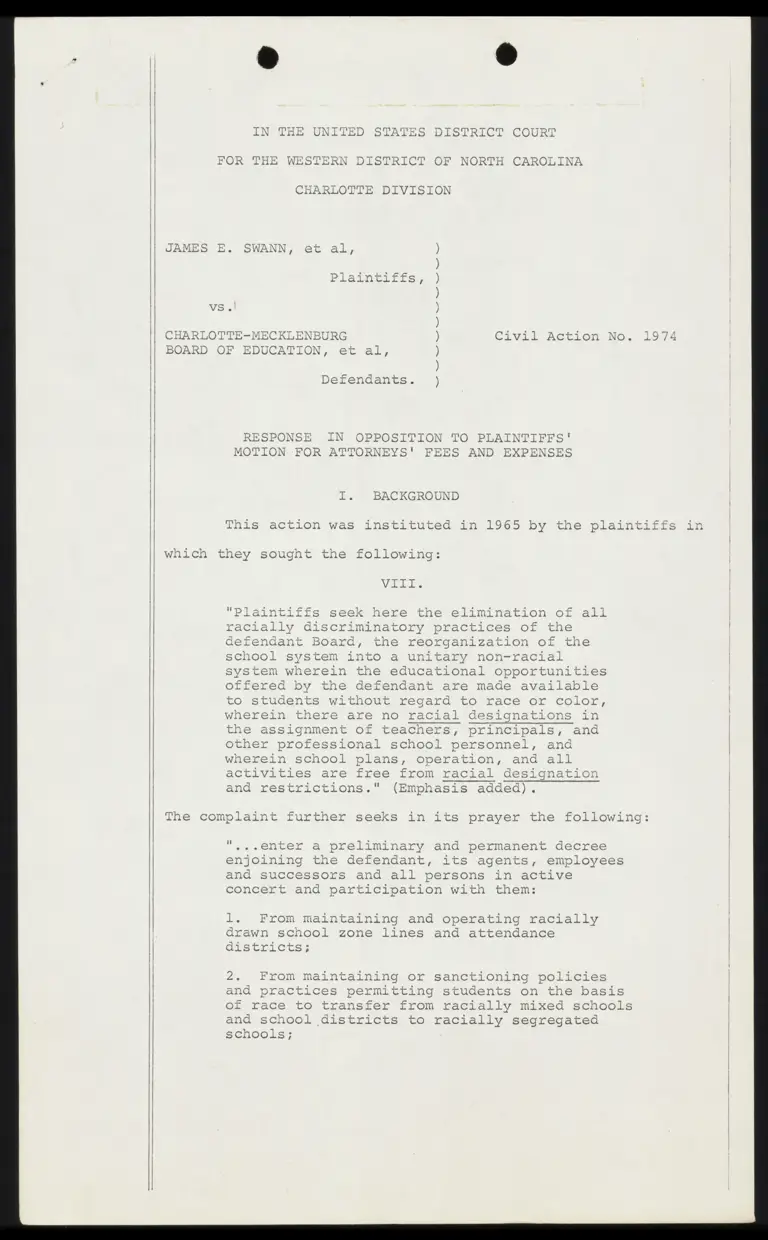
Response in Opposition to Plaintiffs' Motion for Attorneys' Fees and Expenses
Public Court Documents
January 20, 1972
25 pages
-
Case Files, Swann v. Charlotte-Mecklenburg Hardbacks. Response in Opposition to Plaintiffs' Motion for Attorneys' Fees and Expenses, 1972. 990ee68f-2d34-f111-88b4-0022482cdbbc. LDF Archives, Thurgood Marshall Institute. https://ldfrecollection.org/archives/archives-search/archives-item/d888a38d-8303-4dd7-aa45-2f61487286cd/response-in-opposition-to-plaintiffs-motion-for-attorneys-fees-and-expenses. Accessed October 16, 2026.
Copied!
     [||0235eba6-9da9-4137-a59a-8a4c12286f47||] Vv

CHARLO

BOARD

by 9p,

io

m

i

~\

uv

OR THE WESTERN DISTRICT OF NORTH CAROLINA

CHARLOTTE DIVISION

. SWANN, et al, )

)

Piaintifiey,.)
\

)
\

° /
\

)
TE-MECKLENBURG ) Civil Action No. 1574
IF EDUCATION, et al, )

Defendants. )

RESPONSE IN DEPOSITION TO PLAINTIFFS?

MOTION FOR ATTORNEYS' FEES AND EXPENSES

. BACKGROUND -

This action was instituted in 1965 by the plaintiffs

they sought the following:

Viil.

"Plaintiffs seek here the elimination of all
racially discriminatory practices of the
defendant Board, the reorganization of the
school system into a unitary non-racial
system where Ln the educational opportunities

Y defendant are made available
to students without regard to race or color,
wherein there are no racial designations in
the assignment Of teachers, principals, and
other professional school personnel, and

wherein school plans, operation, and all
activities are free from racial designation

and restrictions." (Emphasis added).


The complaint further seeks in its prayer the following:

"ess@nNter a prelim inary and permanent decree
enjoining the defendant, its agents, employees
and successors and all persons in active
concert and participation with them:

l1.- Prom main ‘taining and operating racially
drawn school zone lines and attendance
districts;

2. From maintaining or sanctioning policies
and practices permitting students on the basis
of race to transfer from racially mixed school
and school districts to racially segregated
schools;

p
s


La


Y

~
~
 1)

0
UA

ot
4J

1)
U4

®)
@

Q
0

0)
-

5
0

-
S
E
R
A


a
H

3
U4

Q
4

or
io

0
“r

8
 |

0
Q

oF
0

Q
.

.
C

Oo
Uy

on
0

4
J

Xx]
>

a
:

0
0

42
un

0
jo

OF
Q

+
GQ

4
Yq

.
-r4

~r]
=

-


Q
Oy

=
0)

0)
O

n
+
H


Ke
Q

0
yy

+H
co

SQ
UY

=
T

wl
Q

£2
+

@
o

+
E

Q
Q

0
“a

is
0

:
g
c


Jf S


y,
r—

fo
o
H


0
~

Ta
Q

(0)
a

4
O
P


OD
=

Pd
0

o
g
o
e
d


0)
g
e


a
-

(30
»

CG
Cul.

0
2a

5
!

0)
Oy

.
U4

hi
0

+


0
=

a
rf

Q
n


wm
cl

x
.

0
0)

Q
3

0)
|


AB)
<4

A
[3

E
n
o


KB I
0

Y
0

4
4


Q
nS

a
-


pS
O
c


©
0

H
O


©
0)

~
~

>
0)

0
3

4
“rq

®)
1]

—
=r

LN]
wn

>
Q

Oo
>

0
«4

-
0)

©
Q

(0)
a

0
fo

©
a Jl =

4
©

Y
EH

a
(0)

0
0}

—
(¢))

4


Lo
0

4
(OF

a
-

-—
3

-r
gpl

©
5

£
4
4


=
0

+
(y)

Ei
pS

0
-

(0)
1

Oo
0

O
S


0
ON

{
a
c


Q
—

Q
+H

©
0

0)!
U4

4
-

0]
U4

Q
0
.
0


-
o
P


TJ
P
y


+)
OF

0]
(oF

H
rd

Q
A

jo!
Q

O
-
H
Y


©
.


(OI)
4

0
5

mn
0

0
=

Oo
Q,

TI
2:

I
.


n
H

@
3

Q
0

0
S

O00
a
d


0)
1]

>
Q

0
Ke;

=
Q

4


a
4

U4
(

a
0

“4
(VEERING)!

--
G

wn
n

o
Oy

0
0

4d
Q

©
U4

Q
-r

UA
0

1
4

O
MT

S
W


0
0}

0)!
U4

©
1X

+
U4

-
S|

&
4

>
Oo

m
E


w
m


Q
C


©
Q

Q
pe

0]
0

0
+

oo
>

+
U4

o
g


QO
0)

Q
ps

Fu
0)

-
a

Hy
—

HP
AH

S
D


Q
Ri

ol
0)

+
+d

Q
G

io)
=

-r
Q

0
+

0
—

-~
4
0


OF
H
H


.0
Tein

in
H

4
(3)

©
©

£
0

4
a

(VERY
TC

Gg
©

0
-
0


A


U4
=

Q
Oo

—


—~
AS

i


0
=
m


1


Di-rd
ri

o
N


0)
-r

0)
lo)

Q
g

(
3

-
i

o
Y


-r
4+

0)
©


r
2

R
a
e


0)
ko

rl
S
4
0
0


3
ed

0
0

A
(ONO)

0)
|


+H
bE

3
Q

Q
Q

0,
a.

a
H


i


Roe
5

0
o
n


0)
o

Q
po

0}
Q

;
oO=

S
5

D
i
r
e


dd
o
d


O
A
R
H


L
c


-
0]

fo
er

c
=

4)
o

(0)
Q

U4
©

—

0
H


0]
Y
M


Q
0

+H
oF

+H
0)

Q
NH

4
£

0
0
D


0;
|

U4
oO

Oo
a

©
(00

Oy
Q

+H
0

Oo
O
-
-


a
o
m


Ke
U4

ord
on

=
\o

>
Hy

S
J]

Kal
~
0


-


C
0

oO
[0]

jo
())

Q
0

=
0

a
oO

OO
0
T


n
a

a
0

(
a

-
0

-
2

0)
-

o
H


m
d


S
HM

0
0

£3:
eed

£3
dd

ed
J

©)
HP

4
3


SG
©

O
BH

-4
0

a
0

®)
YH

Oo
~

©
U4

S
on

.
®)

H
O


H
P


x
4d

rd
L

-
4

-


eo]
Q

0
©

@
=

~
GT

0
O
T


wn
D
o


@
43

Q
0)

.
43

[oF
0,

rd
Q

0
a

|
aq

M
e


i
YR

x
-


0
0)

[oF
4

“dq
+I

+
-r

J
-+

TC
i
H


0
J

O
a
,


4
G

+
0

3
Sa

+
REG

—
Q

TRE
~

£
+H

0-H
P
H
-
H
Q


5
0]

+H
Q

0)
Q

I
1;

-
5

>
5

©
-H

OO
-


43
O
4
0
"


37
Io)

0
ps

M
(US

U4
rq

Q
0

n
@)

YH
—~

OY
3

~
a

©
a
l


o
PI

si
SRE

0}
0)

+
or

Mm
0

-~
Tg

oS
.Q

n
g
a
a
o


0
0)

0)!
Q

©
(0)

Q
H

42
—

a
0

pn
I

=
Oar)

O
V


r
a

aan
D>

0
0


Gg)
on

o
g


H
H
a

E
B
T


+
a

P
i
t
a


9
.
0


MN
e
n


i
i


O
H


C
oF

S
I
E


h
f


©
@

-
3

G
3

Q
a

Rw
-

]
Q
C


oO
4.

5
S
0
0
4


~
HM

Pe
H

o
3

a
0

.
£

-
5

SRS
0

0
0


£
0
0


™


0
O
H


H
O
P


0
,
0
0


-H
t
a


Q


+3
¢

~
IS 6

a
.

HH
—


43
jo

A
(

H
H


n
EH

i


=
Z
H


ce
J
J


O
D
O


®)
0

J
14]

~
©

on
+


~
©

Q
Q

4
wn

-


-


a
8

a
—

0)
i


S|
Q

>


3
4

Q
~

0
0)

0,
Re

ef
-

3
m

J
3

a
U4

4
=

Qy
-

~
go!

Q
on

Dy
0

x
44

H
0

4
SH

=
~

oH
=

=
3


~
Io]

=
—

3
S|

Uy
+

L&
HJ

«d
0

0
0)

-


a
a

Lan
U4

0
0

U4
U4

U4
bh.

©
0

2
0

0
me

CJ)
}

4
O

0
UY

U4
Q

(0)
0]


Weve Wwocation of schools in Charlotte has
following the local pattern of residential
development, including its de facto patterns
of segregation..."

| "The percentage racial mix. Counsel: for
plaintiffs say that since the ratio of

| white to black students is about 70/30,
the School Board should assign the children

| on a basis of 70% white and 30% black and
I bug: them ‘to all the schools. The Court

| doeg not feel that it has the power LO
| make such a specific order." (Emphasis added)

|
This Court found with respect to the motives
and judgment of the School Board as follows:

A word about the School Board - the observations
| in this opinion are not intended to reflect upon
I the motives or the judgment of the School Board

members. They have operated for four years under
| a Court order which reflected the general

understanding of 1965 about the law regarding


whee

desegregation. They have achieved a degree
1 and volume of desegregation of schools appar
I EE 32 these part and have exceeded

= a J


H AY


i 5 0 0 ®


i
 QQ
,

0}


Q =
 Q
l


|
1

4)
 Hs RR


n | a

‘e
y Q
L


i oH


TH
0


®
O
R


O
H

9
nn


IQ


M
D


O
 ~3

C
EE

4 -

-


&
o
O


Wn


. New Kent County

game have changed
phies which in

Hh


    i
P
 2;


—


hb
 |

O th


a


(
0
 aN


[O
F

h
o
o
t


0}


F
J

4 |
 C

¢)]


99]


0 [V)


  nger adequate to complete the Ss which
courts now AS must be done "now"

t=
 H G ry


jo
) n F
i]

wn


(0
) a


1 The Court after commenting on the excellent progress

|| achieved by this school system concluded:

| "The School Board has an affirmative duty
I to promote faculty desegregation and

1 desegregation of pupils and deal with
ll the problem of the all black schools.” |

(Emphasis added). |

| It is noted that the Board of Education was simply

| admonished to deal with the problem of the all black schools

rather than going to the substantial racial balance ultimately

| ordered by the Court.

The plan submitted by the Board of Education on June 20

1969 is not dissimilar in scope and effect from the one approved |

July 19, 1871 for the Austin, Texas school district in United |

States vs. Texas Education Agency, et al (Austin Independent |


eSchool District) F.Supp. (W.D. Texas No. A-70-CA-80).


Nas mst ao ni pil eT ad Ei se <a
UL Ly “lilo kK Yri1ioa Che 1L.aw agaln chiang 20 TN) 0 hw J 8

=” y - no = ~~ Py pe Ta a - " - 1.9 - pi! Nr Pr Tos 2 ns NOT Ty yA IG oO) or Ale I, WF pie Ts ol SY ity ifs
vs. Wi Ll Ll Onmery 7 Fe S . PAPAS To Me £0 he, 1.7 WAaAlLCH TOY Fae L1rs<tT dle

indlicarcted ililmlivced IracClal ratlos 1n faculty Could De

Lhe Courts.

7.e11 A bly nf Ty 2 we i] IR LOST el Rl I A EA YE Tin omy]
UgUBT 2, The Board suoliield a new p.alnl wnicih

nw ~ ~
substantial IaculLy ana stucent desegregation Iorf the sC

7% Ph a a E50] A "71 - n oe Bak of Cio as elms 2 EARL Tote CO, he year 1970-71, ‘It was estimated that the study would

~~ VN XS - Tx ~1v marth oe Fae wiryws J 7 dpe mls a IPR ~
approxliiia Ce.lY SiX mnmoncns =O conmp.ie LC. ils Lourt encerc


3

cgramacl=-

4%


the Fourth Circuit of the Briggs vs, Elliott Dictum. Th

Court further found that the defendant had acknowledged

affirmative duty to desegregate pupils, teachers, princi

and staff members at the earliest possible date and had

cally exceeded its goal in desegregating former all blac

faculties. It further approved the reassignment of cons

inter-city black students to outlying white schools for

mh A =D o£ ~N1 J dely yi TEER ws 33 a IL REE The Board found that it was impossible to complet

AT 1

ucturing of attendance lines within the t

tae

3 TY fy

ATS

limited and so advised the Court. Nevertheless, the Board was

overlooked the fac

black

BE SHS WE BY 3 Te ret i A - L. a a 4 on wn yd re
S80 CO submit an incomp.lieie p.L.an but contained proj

This Court in its order of November 7, 1969, apparently

students" to outlying predominantly white schools

that the Board proposed to assign "consenting

condemned the Board for not carrying out the plan as

[ 1

tised and pointing out that the performance gap is

Qifficult to reconcile the Court's criticism in view of

istrict Court's previous defense of the right of the Board

Q


n
 3

oO
 H t

Q oO


=


n
 MD


#3
 ct = I WQ
 O =


4)


Q oy


figures estimated by the Board. The reversal of the

appears unwarranted.

students to outlying schools and


Ox
wr lt Ey LE pt [San Tie Ea 0 ZC I a The District Court Further reversed a prior finding

(8 LacCilo pacterns Ol segregation noted in 1s orcer or April 23

wt} SE wt. gr yy — “AT I= 3 der ]y fe - 1 ” - roy Jos iy - po wo of
anc substi ituredG a new Finding Lat sul segregation was nol

~~ 7 ~~ fo ~~ mix a dem mA T MY sles A NT adv ~~ 4= “11TH oS
LODNnocenc. or ce acc. Alp aan ZiNGLNC OL CNe LISTIrICT CLOUT was

1 ATRIA. i .: [ENCOUN = 3=1n 7 CS ym wr mn A (Sq pf a oF ule ory Py ut oy LI Sa. ~ ht -
not considered oy the oUupr 2ne. UCOoUY A RE 1SPOSI TION OJ «lls

PRE | i ~ 7 rn yap oie TS J Eg men. gg te on. wy “ d
Case as 1he suprelie LOUrT Jle.lled entirely uUpoll prior state

Ais RPC PT Ta EARL Le BR Ee EE wt day ym at Pe hl Yu rp
LEW , i ita A UME Wh) 4, reg Ad LE separa +00. OF recess 1n che scnool .

ANAr= = A cat1ihad+anrnd=- a MATA AC “ ThA MNT ad mb FFE oN ad ~ ~ > ~~ d= ~ d= ~
Afaln, substantial energle oO Che pialntliil were daevolted Lo

Nactiers comple etely excranecus anc unnecessary TOY decision an

thls Case.

Ia = a oo PPV ev dr 3-1 1 EE Po 00 | EE A
dae court -misconscruin che yu gency i J immedi ace

0 an THIER Eh © SRR J ry i, re ££ pp TN I PET LS
ese jredation adva nce LY ne “Our | ofr Appeals 10) 0% BR DG OB 8 I

a i - J he Tn "Voy 3 pen a um af i phe - - 4-1 AY iy uf —
“ilXCUl ana the oupreme COoOuUurc ecilined Co glLve il ICL LCL ed Td

TT 2 + Toa LF ge Ri x Th So : Tn Sat
Xtenslon OL Time Lo Llie 11s Dilan, apparently perce. ivi ng aac

Anal ~L1 a «11 MT CO oT AN = de 1 jr " +7 A - 21 J J He mirmard oda
aclay 1D SUOMI S8S1IONn OF ac P Hh wou..d u uly Gelay Se aMAEICA el

~~ are cm dem Aaa TH = aA Lin nd £7 7 Tre +h ~-ax7 OF
desegregaclion’ . LT LS ted that ToLlowing the Par ial sia O

K SAR iT 3 , , 4 me, rhea Ne I hil ON Khor
ce Dls WR A I Dl Cour S-Oorcer wiih refer nce tO ee. .enfien LaYy SCNOo0LS

x +ha Court ££ Arnrmeoalc ~m~d +hae St ramae C Mart 'e rafiiea =~ 0 Che COU OL ADDea.LS ang The bprene OLr C'S retusa. CO oad »

or ry odie ray is HE my ve RIES 3s ; 1 ny die i 2 Al of sgt ofr IE a Wi, Ws. ed
nteriere with the determination of the Court of Appeals, this

he

Court 1 a +a nn 971 +9 at Tafarred I 1 em E £4 “ £ +h a
LOLLY ON iC own: inlioiaclive ererxrxed implementca 30nNn. or-cne

Xioy ip mn 8 1 Finger rian.

cT


il


y
O

ct


cb


4)
 0 ct

by dee 1
Gil

February 2, 1

e NAACP and

hich provides:

970 is not dissimilar

tted by the Mobile Board

approved by th

by ne


[0]


Cc
 O =


F
 (MD


oe
J

3
4
1
-
0
0
 tn


D Be
 O
H


Ls
 i |


ad


fl u
d

£0)


V)


ystem which provided for 10

1/ The Courtwill recall. tha
with ety for argument bef
controlling principles i
the Mobile school system.

n Swann apply with equal force
re the Supreme Court. The

303-63). i/

-t.0.  W1L TG
|

the Charlotte- Mecklenbuy

1 Veni} : _ ER Sl BE A TI La chools having similar ratios.

the Mobile case was consolidated |

tO |


Ty 5 wes ohn TN 2 VY —— | PE NMA 1 p wn TT nian J a) PP = we 2 py ode ee -— Ty = x 7 PEE. WE
Jurtinermore, the MOoplie Pp.L.an aoe hic expect TO acalieve 11S


projected percentages until three years hence.

1T 18 therelrorec apparent that even tO this day, ower

Ry h. St Ngee, "rh ar i rp wy f= od — PPL I - —~ o 4- ops Ti ao om Via 9° ET
KNOw Tne necessary ing redien LS Of a unltaly system. LalLs Cour

| haa Aackno ~Yelot~Te = aa —oarran -T x7 - TiIINe 28 QO "7 nas acknowledged as mucili as recencdly 5. June Fil Bl ELAR TU

1

mh RE WCE. 2 ya ot on EOE Ty Aue pe my be nl % i
<11l8 18 fNaraiLy a case Ox obdurate onstlnacy niiere

Te ESE Sel, Wiel papi Wh Loe re a gr aa a Lg rd et Bet A on Ay Pp ve oh ve = 7:
SCRO0O.L pDOaAYOG Nas oper aceq nce tne law a8 LUNGeYys oo 7 QSL LE

{ BS SN CL YS ne rn A A Eo a Se AE ns y ly RNASE HR ret SRE Re AT rT ne ent dias
}] unsurpassed ln these parts, na Proposed plzarre anc Grascic

{

| enevoienc gerrymandering Of SCIoo0L aviendance Zones anc nas

tel an 7. AEA 3 Th seh BER Se Sl I SIR Lan el ea BIN ht TS ee ns A]
i Q1 chan} LLY lmplerl nen Ted SLL pians wie cher pIoyp LOS eC. RY Xted 2 LINC 4 \A

|  ArAarad Wh la NDT adm ~- C om de TY rn f= 7 pn 2 = wn A A i = TE ~ Tm -~ =
rT=oraeredc Y he DiS Cricth Our tLe. SeLOoYe ant arcer cle oroer orn

he ~ AN XP TY EN wm pm mm
(Wg al} ally Major

Ty J a po - dT = - 1 1 Tam am (17 d=
1@ QeCision in this case py the Supreme Court, tr

i 0 a
 0 3 j

=
.


4 f

dln 2 ~ = wm aN xre cA whee ~ a ET PR -— es ory Fa A RE et”
Lie board advised tne Lourc thac 1lT was considering changes tO,

J

I i IEEE oy fey nr A A ne oe te aL ry SR in re SY ai Cp gy pr Ete
implemen ted and -raiLcnii dy adliinlsctered yy lie Bo alll OL HOC a Tilo.

| 1 Taper. SI Slr yy fo mm > JAI Wh ny ap oe BN Spode aa vi ay pie 5 SY Vena Subsequent tO the entry of the Supreme Court order in

EEG ml Lied i Th Pais oo SR AT Su a ga a ag 1 LAals case, tne ierK ‘of tne Supreme Court, responded tO an inguiry

| | 1 Form Tl amd FF ld ~ ~~ AXTT Mr 1 ‘ P- ~~ if LIOM bL.ialntlilis counsel advising counsel that costs were not

I "The judgment of this Court, entered April 20,
| 1971, by its term affirms the judgment of |
| the United States Court of Appeals for the
I F th Circult. Under Rule 57{(2), costs are Y lrcult

allowed the appellant when the judgment of
rt low 1s reversed or vacated which

t the case here. It appears, therefore,
lgment was entered in accordance

ed a motion to tax costs, a

|| copy of which is appended hereto marked Exhibit "A". The Board

of Education's response to the motion to tax costs is appended

as Exhibit "B". The plaintiffs were given recovery of one-half

I of the total costs which amounted to $7,127.52 which has been |

paid by the Board of Education.

|

i

|


|
|

|

|

|
|


mls ~ (YA v= Ey Bh ~~ J ly yj =] C 179% TT ONTYS 2 POR WI Foret [NL SRR Ce
Re: Con will noe That Ch oupremne Court had before

LTR SE Re BATE : ge de ide MER, vie a} int) RALAASL
wl. rar J nents with Tespeclt To Costs wnich are supstantclaLrly

nny od - 1 dom TM Ae PEN mm me J 19Y + d= Tn CY om 1 me Je - wn mn ~~ T NA LIE Bi PN Ldentical to tnose now urgeC upon the Court in connection wich

ME HE i = de dem VS AA i <r aS MEIER SR RE i I allowance of attorneys’ fees and expenses. As pointed out in

} - LL fi nNvas afr haf By py Cir rm ram al gy of nl o~ vm PR (JL. RSE. (iy | x7
Mad il WT TG diel before cae OU reme COU (1 COS LS alt QLGUllladl id)

. WE a, BRL, Sn SSR Ne ren ~ in on em 4 on i TE md Mma
awarded as a matter olf course To The DIrevalilng pariy. ine

pecularity of the Supreme Court rule prevented automatic

application of this principle. After consideration of these

same arguments, the Supreme Court concluded that plaintiffs

and defendants should split the costs in connection with

plaintiffs’ appeal. Obviously, the Supreme Court was of the

i Bd EN a GL Hs AR, -
LS S1TOU C.LY lad ilbadlliiilyy

) 1 a

= I -E-k a TJ t= Ing “A JAA 4 Ea rt ~ ri Wy PR Nam am um 1a (~~
J eG 8 Ration. iC 1S. .0eyOon GQOUDT, hat il the Supreme COurc

IT CYNON dn ~ Ju Jy 3 _. fo men Yi a. Ta F. WE SRI) a PR ESR iC SI

suspected tile sCcnoolL system or plaln odstinancCy, reCaisClrirance

fl

been advanced by the plaintiffs,

ml Ty wy oh af my = fn wy « 1 2 ay |g (rnd ~~ Ry ry ~~ cs 4 PRR IG The matter of attorneys'fees and expenses (as distinguished

pr ma Yr “x En pa | — “11 p- WSR ori. RIRTRR [7 v = from allowable costs) requires a Iinding Or

before such charges may be levied against the Board. It 1s

submitted that the voluminous record before the Supreme Court |

did not support such a finding and the Supreme Court took the |

equitable position of dividing the costs on plaintiffs' appeal.

Similarly, this Court should assume the equitable

position employed by the Supreme Court. The Board has experienced

substantial legal fees and expenses and to call upon it to bear

the fees and expenses of counsel representing the plaintiffs

~111 A 1 Sn - EP Ang Sg. w= elie 3 A 2 + Crhnraml RAaarA in A would place a disproportionate’ burden upon the School Board. The

err dr Ty 1 nec tes £ +h ITY + 17 arilil rae +h aaah equitable position of the Supreme Court would require that each

of the parties bear their own fees and expenses, a disposition

ly 1 he " ANA Jo} rN id ES, i Re EA er ale oy ie ey A a et Vo Ti ing 0 Ep Te po AY rb nc UlLCTlng Yom the app.ilcation of rational and ecuiiso.e premises.


AW DOES NOT PERMIT THE AWARD

EYys''r FEES IN THE INSTANT

The first case found by Defendant dealing with the

allowance of attorneys' fees in civil rights cases, under the

equal protection clause of the l4th Amendment, is Bell v.

-


J


School Board of Powhatan County, Virginia, 321 F.2d 494 (1963) ,]

\ fn — a. | BN - ~= I on Jinn vn] y= vl Ar NTT ~ f= After a careful TevView OL tne ractual Lackgrouna oc

W vo ny 2 ts ed tie en
speciousness”,

1 "the long continued pattern of evasion ai = r+ OHSTYUCCTIONn, CACTl1LCS

+ + . instantly recognized as discreditable", "discouraging rumprs | 2 1G
{|

| I |
| were spread in the Negro community, raising fears that by press

ing for their altogether valid rights they would bring about a

shutdown in the county schools", "making it difficult, if not

with" and finally re-

guiring a court injunction "from acting directly or indirectly

| :
1 to close the schools of their County"; the Circuit Court over-

ruled the District Court and declared "(t)he equitable remedy

| would be far from complete and justice would not be attained.
|

| if reasonable counsel fees were not awarded in a case sO extreme.

{Ccitations)” (Emphasis added). |

-


Ci
 When the question was next raised in our Circuit,

was in Bradley v. School Board of City of Richmond, Virginia, |


34! Ul


br


[\
) 1 310 (1965). There, despite the granting of substantial

| and position and refused to expand the rule.

"It is only in the extraordinary case that

such an award of attorneys' fees is requisite.

In school cases throughout the country, Pl
| have been obtaining very substantial relief but |
I the only case in which an appellate court has

|

|


1 yi TAG ARP Cc : : SR J £25 108 i As distinguished from the Civil Rights Act of 1964.
15 Am. Jur. 24 Civil Rights, §$70.5 (Supplement)


Q
Oo


directed an award of attorneys' fees is the Bell

case in this Circuit. Such an award is not com-

manded by the fact that substantial relief is

obtained. Attorneys' fees are appropriate only

when it is found that the bringing of the action

should have been unnecessary and was compelled by

the school board's unreasonable, obd te obstinacy."

Bradley, supra. 'p. 321.

The phrase or rule of "obdurate obstinacy"* has now

been adopted by other circuit courts in considering the pro-

priety of allowing attorneys' fees in 14th Amendment, Civil

Rights cases. ‘See; Williams v. Kimbrough, 5 Cir. 1969, 415

F.28.874, cert. denied 396, 8. 1061, 90 8. Ct. 753, 24 1.Z4.

2811755 -{Pabruary 2, 1970): Cato v. Parham, 8. Cir., 1968, 403

F.2d 12, 16; Hill 'v, Franklin County Board -of Education, 6 Cir.

1968, 390. F.28 583: Kemp v, Beasley, 8 Cir., 1965, 352 7.28 14;

Bradley v. The School Board of City of Richmond, Virginia, 4

1965, 345 F.26 310: Rogers v. ul;8: Cir. +1965, 345 P.24 117;

Ball v. School Board of Powhatan County, Virginia, 4 Clr. 1963

321 F.2d 494; Newman v. Piggie Park Enterprises, Inc. 390 U.S.

00,402, 88 S.Ct. 964, 19: L.EG., 24 1263 (1963): Sancers Vv.

Russell, 5 Cir. 1968, 401 F.2d 241; Lee v. Southern Home Sites

420 FP.24 290


Whatever

be sufficient findings of

to review the lower court’

As pointed out by

assess fees in

when the legislative body has refrained from providing for

this specific relief, the Court should only grant it in com;


1 OBDURATE: (1)

stubbor

Web

hardhearted;

rough;

also,

intractable;


(1970) ,:({C. A. 5th).

the District Court's decision,

fact to enable

s ruling on attorneys’

the cases,

its equitable jurisd

Hardened in feelings,

against moral or mollifying influences; unyielding; persiste

nly wicked; (2): hard: harsh: rug

ster's New International Dict

the appel

ther

-

the power of the

3 du -
1CT10nh.,

fees.

a TRY
Cc LILAO

=

court

3

11 C


24 Ed., Unabridged (1955)

9

|

T Se 77
ee , SUL

However,

|

|

|

|

q

ged;
ionary,

de

~
CA


ay [BANE ll. der I WE TA PARLE -~ ovii¥
+lLlgantc attorneys


fees as a part of the costs, has not been favored by American

a we - A kale 'Qy - i T 17 3 wy Courts. 8. IL Ed. 24 894, 898; 77 Harv, L. Rev. 1135, and

therein.

the defense of valid intimidate

For the same reason, the taking of an appeal, in an

area of the law, should not be done under threat of

Or punitive damages in the form of attorneys' fees.

The Plaintiffs contend in their brief that

now become an

decree." Defendant's

only District Court case aj} pa

EOaT

been able to find implying such a conclusion is the

by Judge Merhige in Bradley v. School Board, 53 RD


authorities is, without

Judge Merhige.?

equlty and faced with exceptional circumstances,

attorneys' fees in order to do justice between the

Snoot v..%fox, 6 Cir, 1965, 353 F.2d 3830, 832; Rolax


actions being termed fraudulent,

vexatious. 8:'led. 26 912, All the casas

between the allowance of attorneys' fees in this

and those where equity)

vided for by statute or


Nesbitt v. Statesville City Board of

with the District Court

essential

research of th

to reveal a single case by an appellate court

LT NOR TER SR
elcner MAL CY

groundless, oppressive

Te 1 meg
CiLalsS .

TPN et rade Tp
unsettled

Wy ls side =
WildaT Was

Wi Til

he | -— a » Io — ~

.qaAW Nas

$0 holding

Aa
& ZZ

Dace
hho ad [= 7

exception,

cases where the court, sitting in

can award

Fi Bh La 1

- A de} om yy if
Vie. ACLNICIC

Po yr] vy me a Tl. ARN, 1
Education 418


T

Curiam decision involving five


2G 1040 (1969) 4th Cir. Per dif-
ferent desegregation cases on appeal from North Carolina and |
Virginia decided after Alexander v. Holmes County Board of Educg-
tion, 396 U.S. 19, 90 8.Ct.29, 24 L, ed, 26 41 (1969): Th
granted attorneys' fees and costs, to be determined by the

trict Judge, in two'of the cases and allowed costs only in

h! , - — ~

ne cases. - 10 -


of attorneys' fees has been applied or ruled upon in civil righk


0


0 ctions, the courts have almost uniformly abided by the Fourth |

However,


|

|

| Circuit's rule or test as get forth in Bell, supra.

|
|
| a reading of the cases reveals that the court, before 2} 1 qr aliOwlng

NY H rendered against a school board, but whether or not the schoo

|| board's conduct was of such extraordinary nature as to render |
| |
1 the litigation or commencement of litigation? Or in some cases, |
i | |

| . 2 -~ —~ od ym four — ry. . (4 I AN re 1 appeal” completely unnecessary. A further reading of these |

-
—
 cases reveals the court's refusal to assess attorneys' fees because

|

II a school board seeks to litigate the constitutionality of a par-

1 4 hy wl “3 hd » 4 r~ = = hy ticular plan, as contradistinguished from a board's desire to

|
fe ~ I 1 : : In Betts v. County 8chool Board of Halifax County


Virginia, 269, *..Bupp. 593,604 W, D. Va. 1967), plaintiffs |

moved for the defendants to be required to pay their attorneys’

{
| | fees. |

| "7Phis is not a case of deliberate |
I intransigence and foot-dragging on the |
I part of the school board." |


im)
This case concerns only the constitu-

tional sufficiency of existing desegregation

plan which the plaintiffs attack primarily on |

| the ground that freedom of choice is per se
| unconstitutional. Under the circumstances,

an award of fees is not justified. . (Citations.)"


ley v. School Board of City of Richmond, Va. 345

21 965) "In school cases throughout the country

have been obtaining very substantial relief, but the

in which an appellate court has directed an award of |

attorneys' fees is the Bell case in this Circuit. Such an award]

| is not commanded by the fact that substantial relief is obt tained.

Attorneys' fees are appropriate only when it is found that the |

bringing of the action should have been unnecessary and was com-

pelled by the school board's unreasonable, obdurate Shetingcy. * |

(Emphasis added). |


|
{

|

| 2 See: Felder v. Harnett County Board of Education, nk
| ho bs To aN Ls k) 1 y ’ 1 na -

| .284 1070, 1075, (1969) Although the court held it had "seen mox|
| . . ~ i yw

| meritorious appeals, we do not think this one may be characterizp 2G
| fairly as groundless or vexatious. (Emphasis supplied). There is

|
|


not present here the pattern of evasion and obstruction


| extreme" in Bell v. School Board of Powahatan County, Conia”

Lt (Citation)


/

|

|
|

| |
1

|

|

-
unc \

J

-
he


9)
A)

1}
£)

Q
-A

Og
~

1


Q
o
O


O
pean}

3


?


'
</

-
~
~


r—
n
y


:
n

Tr
/

.
-

0)
»

O
0)

»


0)
<

Ug
gq

r
“


~
~


3


3


a)
~~

—t
ved

~


—
~
4


0
44

J
Hl

5

Gree

allow

5
ila

S

I

1

LX

CO

d

atio

Uy O
.

Q


-
>


a
—


(
P
g

I
n


O


0


0


Cc
4


-
H


=


Qo
-
A


~
\O

P
=


sc
O
O


nn
P

00 B

Va.

On for

denie

nvolves

Ss sim

OF the

d and

3

3

in
1

e
where cou

rt


0)
P
O


T
l
H


a
0

n
0
.
0


>
a


M
i


.
=

1
OO

©
1
0


H
C


Sy
Ea]

4
+
4


Ol
0

~
Y


~N
a5

-
4H

PY
M
i
»


~


©
WY

f]
~

0
S

0,
O

3,
[®]

0


“3
=

=
O

00
44

1


EE
|

0
™

-~
0

@
O

1
3
4
)


0


.
~

HT
¢)

0


SR

>
0

{1
WH

G
pi

10]
H
O
M


6 5
{Y)

~
~


—


0


9d

mE
0;

a
u4

QJ

oO
.

0
"r}

~


OF
13

ell
o
u


[oH
J
a
r


<


Lowe

O


n F.
+d ade

in
he .

4d
Ox

— bi; | i

100 J

co

~
NN

d
LN

oO
oN

10]
~


(


*

C
0]

<0
r=


wpe (a. we
LLL,


THE FINDINGS BY THE DISTRICT, APPELLATE AND

1 SUPREME COURT IN THIS CASE PRECLUDE
[ ib T ™ NT ™

ALLOWANCE OF ATTORNEYS' FEES

¥ A review of the litigation of this case cannot help

| Pyyg Te ow pr oy . RSE Ty ITI ROA NEL oy. - EEE Wy ond m og TELS WEE WW, A Se 2 ve. 0 pms: abe Pen but reveal to even the casual student, the fact that this system

vy fm ~~ ~ - ~~ = = = Ee a + | SW 2] ~ = ~ T 1949 ~ ££
ell Torever 1in he forefront of the legal evo ution Or

our national desegregation law. This fact cannot be the basis

i | fe s fe To 28 T =v £ +h ~ Se PERS, YUE TEN NER WE MRA Wy ge
1 It 1s the law of this case that Defendants 4&0 WITHOUT

| court or plaintiff intervention, in the desegregation of its
Nl

1 schools. {369 F.2n8 .29,:30),

icular case, the Supreme Court granted ct


In this part


"... to review important issues as to the
luties of school authorities and the scope
of powers of federal courts under this court's

| mandates to eliminate racially separate public |
I schools established and maintained by state
| action.”

| "These cases present us with the problem of
defining in more precise terms than heretofore

S duty of scnool authorities and
ts an implementing Brown I and

liminate dual systems and establish
once. Meanwhile, Jisurie:

f appeals have struggl in
1 ith a multitude and Sp |
| of problems under this Court's general directive.

Enders t anda, in an area of evolving remedies,

the mandate {
hy gas ot ell ny os | unitary Sys tems at

| courts and cour
I

+

hundreds of case


those courts had to improvise and experiment without
| detailed or specific guidelines. This Court,
I in Brown I appropriately dealt with the large
1 constitutional principles; other federal courts
i had to grapple with the flinty intractable |
| realities of day-to-day implementation of those |
| constitutional commands. Their efforts, of |

| necessity, embraced a process of "trial and |
error" and our effort to formulate guidelines |

1 must take into account their experience."
| Swann, supra. p. . (Emphasis added).


I The following are also a part of the record of this

| Since this case was last before this court in |
1965, the law (or at least the understanding

I of the law) has changed. April 23,1969,

| %. v.the School Board." "... have operated |
| for four years under a court order which |
| reflected the general understanding of 1965 |
I about the law regarding desegregation. They |
ll : have achieved a degree and volume of desegregation
I of schools apparently unsurpassed in these parts,

1 and have exceeded the performance of any school |
I board whose actions have been reviewed in appellate
| court decisions." Ivhid.

-13=


Snently

1969 and to be completed

I
e


a
 Oo

St time

9

ipals and
le date.’ On

filed in connection
as conducted on August

Ye the court for

O
O


~
0 f 5

s plan includes both sub-

t compliance with the law of

an of operation for 1969-70
1 as indicated below a

Lescted to prepare and fil

i
it


'

(D H
R


QO 5)


0
)
.


f
Su


en


L(V


S
o


0 MD


i (0
)

h
n


i
h
e
 0)


I" Ct


n
o


4 H D

A
O
D


H
H


= (s
o)


0


~
 ©)


0)


i
 November 17,

for completion of the rity of desegregating the
chools effective in September,1970." Ibid.

"The most obvious and constructive element in
this plan is that the School Board has reversed
its field and has accepted its affirmative
constitutional duty to desegregate pupils,

teachers, principals, and staff members "at the
earliest possible date.” Ibid.

In the second place, by the following actions the

Board has demonstrated its acceptance of its
stated new policies:

"a) The desegregation of faculties and the
non-raclial reassignment of principals an
employees from newly closed schools. In the
formerly all-black faculties the Board has
dramatically exceeded its goal. It is
assumed by the court that this process of
faculty desegregation will continue and that
the goal for 1970-71 will be that faculties
in all schools will approach a ratic under
which all schools in the system will have
approximately the same proportion of black
and white teachers."

"o) The closing of seven schools and the
reassignment of 3,0~-0 black pupils to schools

wi
’

offering better education.

"c) The reassignment of 1,245 students from
several overcrowded primarily black schools to
a number of outlying predominantly white schools."

"d) The announced re-evaluation of the program
of locating and building and improving schools,
so that each project or site will produce the
"greatest degree of desegregation possible."

o>


approval.

nd genuine assurance of sustained
od

ho

led plans and undertakings


| e) The Board correctly and constructively
|] concluded that the so-called "anti-bussing
H law" adopted by the General Assembly of North
H Carolina on June 24, 1969, does not inhibit the
i Board in carrying out its constitutional duties
| and should not hamper the Board in its future

| actions. Leaving aside its dubious constitutionality
(if it really 4id what its title claims) the

1 statute contains an express exception which
| renders it ineffectual in that it does not
1 prevent "any transfer necessitated by over-
[| crowded conditions or other circumstances

which in the sole discretion of the school
1 Board require reassignment.”

| “£) The elimination without objection of
the former provision which had the effect of
inhibiting transfer rights of black would-be
athletes."

"g) Quite significantly, the Board calls
| upon the Planning Board, the Housing Authority,
| the Redevelopment Commission and upon real estate
I interests, local government and other interested
1 parties to recognize and share their responsibility

| for dealing with problems of segregation in the
community at large as well as in the school system.”

of "compensatory
acher orientation

lack and white

t these somewhat

4. emenced with

3

leclsion b the Supreme Court in this case,

PR Try: ty “1.7 var ms ni a Irani Ta SURE SERIE A 1€ court has allowed and approved (wilt modlricactions,) a nlan

| schools for the 1971-72 school year.

On August 27, 1971, the plaintiff again petitioned the

my a ud His Fl a Wy ~~ : io -} ~~ wy det EP ~ ~~ TT 17 8 ay mg omen” hm’ crn Court Ior Iurtner relierl allllg wit anotner group oI parents

- » - | "The further relief sought by plaintiffs and by the intervenors

is denjed...". Order, October 21, 197%.

The one "bell-weather" fact of this case that stands |

| out and clearly shows the real intentions and motivations of the

| School Board is its reaction to the "Anti-Busing" statute iH

{}

IT =~ A I =} a Ta EE oT ap “~ 4- . J 1 a J A del mn 4m mp ae ie of fw ap bi 80 The adecencants sougnt OO Ge ay and ae YY Lic MLdill CLL LS
|

{

their clear constitutional rights, they could have attempted


to abide by or hide behind such legislation in an effort to


J A Ep. JT a Mm] mT mts FE edo k he Two aeny Or aelLay b ELT) a a den f1.CL) Lo. J.T)

CIS Li Re ee HR vyio ay he
con cence na Che enactmenc J.C 10. a

- Tr AT uli wn FE a En Sy gy oft yo 22 vr a proceeded to provide, maintain and ope

Ar +Fha ANITA c Aa WE TR SO Wt I Tne
LOL AC purtg OSe OL acy l1eVvV.ing a 1 I cary

the: SCROo0L  BOaTrC

P LOlLOTLIILS 7

"The Board correctly and constructively
concluded that the so-called "Anti-Busing"
law adopted by the General Assembly of
North Carolina on June 24, 1969 does not
inhibit the Board in carrying out its
constitutional duties and should not hamper
the Board in its fubkure actions.” (Citation)

well as

date has been of

had — =~ 7 fA = d= = 1 TNT TO remarkable that all concernecd

many

aden mp vn Re fp
CI ele nous

TE TE 7. SUT Same, SH Ba sD
4.3.05, cS OF dl Iaclicira.

+: MEAS IER, RENNER TENE ma —
a1] 14 Giles a1

comply with the

0 a V e

unrorcunace

recorded in the press and cases, dealing with this difficult

field.

A ruling by the Court

important issue of attorneys' fees

school official's,

Court's efforts and orders,

and emotional change without total

! V) H ruling by the Court

oe
efendant,

N Q ( cr


))


5


and the community that it was wrong

to continue

School Board's and

to bring about a

chaos.

t would require a finding that

1ts £24 Sli we on Tl ar vee 4
rinanclal support,

workable,

This is because such

amounts

supported by the

the community who would have to
.


Las cances


Iv.


TR VDD TVUATTD 7A ATTO CTNTRATY COONCTDM ™ Thi PL i FW TORNEY GENERAL ONCEPT OF
— 1 TITLE II AND TITLE VII OF THE CIVIL

Hl RIGHTS ACT DOES NOT APPLY TO
1] SCHOOL DESEGREGATION CASES

D1 Jed mam PRE 4 To hl meta EN LL I Mat WS
rla intiffs Seek CO DY 1ng cO Our snores ER : LOC LLSH

{ ™94 1 LL] alia TY shot 1 ode wy _— wn ee of iar ~ ¥ of goa ony T am (| Rule" which permits routine recovery of attorneys' fees. In

wn ie si SA 9 4 4 ys pi Pop
regsed 1Licseltr CO The gues tion Or


| oy of dn 3 ES Ti a 3 af Si RT nm 2 i ak put po 1 attorneys' fees in Fleischman Distilling vs. Maier Brewing
bi

| "3 Q - 5086 7) 1 ps : alata 4-1 | Company, 87 S.Ct.1404 (1967) wherein it stated the American

11 a £711 ° | rule as follows:

[ "ml m1 v 1 ei) T vy res La a RT TE PT TO EGE Sl, SEV J ( The rule has long been that attorneys' fees
-— ~ = - J ym T am = 3 11 ~~ " a Nan are not ordinarily recoverable in the absence

| Bond — hes d= ~ - -— vn - 1 a de ma J 1 OI a statute or an enforceable contrac
- a am SR PR ao - n

{ rrovidaling ISLS rOT .

1 We, of course, recognize that a court exception has -


yr . ry Sh NS A wv 3 “3 "1 fA oie In Yo et
ley vg, Richmond, 345 pr.2nd.310 (4th Cif,


Lon mes a n7 dm oy oo ] 3 mn
ees 1h eXcradcrainarx Y F

od


0


(0
)

Un


{i


107
2

(()


@)


&)


C


H
 ct
 zg O on


-
—


(o
F

[4
]

Le
,

Wg


[ o < O®


jo)


ct


ct


O =
 wn


cases where a Board of Education persisted in a continuing

face of known constitutional requirements.

i Plaintiffs now seek to circumvent the requirements for

an award of attorneys' fees in this Circuit by urging upon the
1
I Court that it adopt the "Private Attorney General" theory, a

| |
i theory growing out of Title II and Title IV of the Civil Rights]

iccomodation and employment practices. -


[=


Q (4
) I Act relating to pu

» 5 xy - 1 The Court of Appeals for the Eighth Circuit squarely

met this argument in Kemp vs. Beasley, 352 F.2nd. 14 (1965).


There the Eighth Circuit held: |


I "...this act (public accomodations) provides |
| no legal basis for attorneys' fees in school
1 segregation cases. Congress by specifically
H authorizing WEL fees in public accomodation
I cases and not making allowance in school |
| segregation cases 1 indicated that |
I insofar as the Civil Rights Act is concerned,
1 1t does not authorize the sanctioning of
I legal fees in this type of action. The
| doctrine of Expressio Unis Est Exclusio
I Alterius applies here and is dispositive
1 £ this contention.”


quoting: «oe a Nios Bal I ae Ge El
EeiLnanc rac. ey 7

Fhe

Ioxr 1urther

that a

in good

¢ : C \'4

nnecessary and was compelled by
1 r e nable obdurat

Board's

the question:

Yelliel conpelled by

Court of Appeals for the

0)


or YAT =~
was

Vi IA
AC

4-1 = 1
OS I A I 1 inacy? We

school TAS YS PATS pros Ld yA
AOArG. operating

faith under an adjudication of compliance with the

TY il (= w~ “Tn = a

Fourth Circuit


, MEd SEC So 3 ial NV o 3 — v1 TI 9% dn gm ppp 2 Tw Plaintiffs cite Newman vs. Piggie Park Enterprises, Inc.

390 3 S 10 N —- ey ny ry ey “ = Ta Pr TAT = 4-1 A Ade §
90 De &UU as thely najor au CACY 1 Y We Call Tine Courc's

attention to the fact that this was T

accomodations, action which expressly provides that

fees may be awarded to the prevailing party. In school

aesegregation cases, should a citizen claiming discrimination

simply because he misjudged the facts and

a board of

the law

therefore unsuccessful? We think not, absent an obvious

Erivolous action instituted in bad faith. Extension of

plaintiffs' argument would clearly

a prevailing board of education to

from unsuccessful plaintiffs.

General" The "Private Attorney

fails under the express

Pourth. Cirouil and upon r

-] Go

recover attorneys’

holdings

command a result entitling

fees

theory in school

Of the Court of

and logic.


m

+rasciirr ge mi ds dee 3 7 5

Liao uly WEL 0 JES SER 1 WEI I RR

'

Case l1lnvolving a constir

NES ein zn] TL rs 8 es oe -
Pers Ona. OF proper CY » -_

MEL it RP Pra PT WO ea a LE
DUT an eXamnpie Of Je exp

mia z 3 OS rae
+e Tae ln Chas

PEE, J BEI dey SE
-— AO LC oTnierwlse,

o b

ures wiil open

a ~ "oly TR ee aR RE
CLaINs "TOY acorn 2Y

oY ps wie Hp 4 oy sf: =. 7 uo a of
ageplrivacion oO;

a - Cvs i= my =n. 3 7 ZA
iiiternalL Reven

a


le xe g Vila lll0D

reasury.

e circumvented bootstrap


! hk


PAYMENT OF FEES TO PLAINTIFFS' COUNSEL PROHIBITED BY |

ORGANIZATIONAL RULES AND REGULATIONS OF THE

| NAACP AND BY THE CANONS OF ETHICS

brief, plain

|| "The plaintiffs in this case did not undertake
H to pay the attorne for representing them.
1 The local counsel
H their out-of-pocket expenses by the NAACP
H Legal Defense and Educational Fund, Inc. of

H New York City, a non-profit legal aid organi-
1 zation, which has as its primary purpose the

vindication of the rights of black people in
the courts." |

vs

have been reimbursed for
1.
.

It is important for the Court to keep in mind that this

is a case where there is no obligation of the plaintiffs to

pay their attorneys. Payment of counsel fees and expenses is

a matter of contract between plaintiffs' counsel and the NAACP

for which they have received payment of all bills submitted.

| The plaintiffs have paid nothing and have not contracted for

payment of any counsel fees or expenses.

The organization of the NAACP and its Legal Defense

and Education Fund, its objectives, methods, compensation

arrangements and position as a non-profit organization is

clearly detailed in NAACP vs, Button, 271 U.S. 415 (1963).
    In cases assisted by the NAACP, plaintiffs are nominal

plaintiffs and may withdraw from the case at any time. However,|

control of the case remains in the lay organization which

employed plaintiffs' counsel. In effect, it is a suit which |

is owned by a private organization utilizing nominal plaintiffs

to attain its objectives. It is to be further noted that

the NAACP is not a party to this suit.

By seeking to reach lawful constitutional goals and

I the complete absence of profit from its organization, the NAACP

~~

|| escapes the normal rule prohibiting the solicitation for legal

Il services. Indeed, the Supreme Court commenting upon the non-

Hh


profit aspect of the operations of the NAACP stated:

"...there has been no showing of a serious |
| danger here of professionally reprehensible
| conflicts of interest which rules against
| solicitation frequently seek to prevent.

This is so partly because no monetary
stakes are involved, and so there is no
danger that the attorney will desert or |
subvert the paramount interest of his
client to enrich himself or an outside

Sponsor..."


-20=—-


| 1 Mha OAT o EE Ea es ¥~ T a4 144 £
1 4i0e LoOUurtT’'s granting orl LEXINCILLILS 3

would clearly result in the NAACP and/or the Legal Defense and

[ 1 1 Tq whe of pa IG a - ow ed » jon ~ 1.1 ~ fn a LTR Tl |
! In the Button case, the Supreme Court noted that counsel |

|| employed by the NAACP generally were paid on a per diem basis

Il plus out-of-pocket expenses at a rate ordinarily smaller than

that received for equivalent private professional work. The

V ~~ an] Ame
> counsel Dears

1 It is obvious that plaintiffs' counsel was employed by

| the NAACP at a rate of compensation which was then satisfactory.

Now, upon prevailing on certain principal points, plaintiffs’

counsel seeks a new and different arrangement, enlarging the

charge for services and seeking to impose the obligation

I of payment upon the Board. Obviously, for the Court to award |

1 plaintiffs' fees against the Board, the Court would enrich the

NAACP and perhaps plaintiffs' counsel if the rate of compensation

exceeded the amount fixed by contract between plaintiffs’

counsel and the NAACP. Presumably, plaintiffs' counsel would

be required to reimburse the NAACP and thereby indirectly put

the Court in position of recovering legal fees for a lay

For the Court to award fees to Mr. James M. Nabrit, IIL,

a salaried employee of the Legal Defense Fund, the Court would

again be awarding legal fees, not to an attorney, but to a

[ lay intermediary.

I Furthermore, plaintiffs' motion seeks to recover fees

over and beyond the actual salary of Mr. Nabrit which again

would permit the Legal Defense Fund to profit from its financing

of private litigation.
|

l "2l-


ore,


QO
0

x!
{

oO
U4

5

-
Q

0
&

0
—

)
=

ao
.

©
Q

3
.

Q
L

in
—


}4
9)

1
1)

J
J


(o
t

>
U4

)
Q

©
ye

na
;

4

1
c

U4
a

+
on

fo!

0,
0

O
|

R——
ex

Co R
E


EE
©

2
©

™N
Q

-
on

a
1)

i)
~~

r
rd

Pr
a
3


od
0)

Ww
of

=


+H
4


5


Ww
5


1d
T

5


Q
©

O
(OF

=
©

on
©

+
Q

rd
4d

1
oo

PH

=
0

v
4


S
o
d


.
Q

0
+

oN
42

~~
>


X
a

=
It]

(
O


Ie;
—


0


®]
1]

C
H
O


A
e
r
e


rlovadd
+H

o
+H

.
+H

0]
go!

a
X

.rd
he

Q
3

©
>


=
Q

>


Q
~~

E

s C

Edu

0

11a

kc

nge

a

»

ni

O CO

£ hi

‘of

aymen

t ne

ra

termed

£

NAACP

North Caro

S

i

0

P

n

Tx
a

Cc

od

at

oa

ox

i

CS

ra

it

he

0
0

c
h


EL
Se

YR
TRE

o
r


-
—


=


©


k
a


fod
©


™
M


ed
0

Q
B

DR
+4

0
—


mn
Lon

0)
ie

0,
=

0
>

M
0]

0
J

~

~
O

13
a

©
4

wn
=r

0
<<

®
0

Ca
Ee

Ee
1

5
Oo

.
~

9
Yi

Oi
Gi

od

0

9

y-
Ae

S

-22=

7

(=)

~

1

u

2e

4

n

£

a

L

St

Cano

tl

1

Ss

Cc
£

Canon 28,

%)

pS |
(s}

Oo
on

P=
~~

rd

O
=


>


o
ed

®)
U

Q
uy

0


U
4

oF
Ud

0
QO

“
Gy

uy
Q

=
Q

O
5

>
Oy

“
4


nN
nN

~
(6)

r
d


p
(T

ord
jo

Q
4

3


C
0

0
Q

C
A
R
s


E
L


OR
Tat

EET
0

WW
Ww

4
©

-r4
Ma

0
0

2
EA

S
o

Sort
-

{|
a

j
{

~

~


yi
r

r
‘

oO
u

T
-

.
O


nN
1
]


r
—

¥
nN

~~

nN
31)

ct
7)

©


4


«3
w
d


Q


1)
4


Q
ot

WY
a

Sen
el

el
a

~
O

x


©
a

©
oo

C
JJ

O


JJ
te}

—


mn
-


—


=


3


Gy
(®)

a
©

0
(J

3

7
-

oO

"8

e

7

:
i

a1.

O

0


Oo

t

Vv

£

P

Vv


Al

5 Oo Cr
 ft Wh


() .
 = n

for the three-judge court, particip

TIT ATTY Tr LY AN?
NT OF FEE ANI

time involved, without regard to whether or

ervices were material

court and similar preparation

Court. Assessment of fees and expenses

Similarly, plaintiffs’

Court actions were

again it would be most inequitable to impose fees and expens

arising in connection

totally irreleva

fees and expenses o

did not materia

=

F

under standards

The fac

Ft


-

S
Ht


wn


counsel for their convenience and should not be imposed

Lea =
iia tters bey

Fees and expenses for Messrs. Green

to the decision

advance the litigation

plans did not show prospects of creating

now known.

Charlotte and New York, creating substantial travel

again an expense which was

the Board of Education.

3

question of the

Wo iN NTE 0 i Ee a a Se
FL SW J WE OSL CLON.

to the issues or advanced

Board's actions.

HIRE RES a CT ©
uostctanctlad

aration

appearances in the Supreme

most unjust and violate |

Cctions with reference

the control

OD


therewith.

Rabin were

in this Likewise,

Drs. Passy and

hag J SC OT YET = f= qa
el Y agcsegregacion

unitary system

counsel were located

the election of plai


ael
-
A ur

P


4


ot
y

.
C

-
O


"
C


4
)


+4
(
pA

~
1


$ -

3
[®

a
0

1)
Q

2
®)

.
’

1)
bP

.
C

N
==!

D
~

1)
-+

nN
C
y


rr]
J

-
Vd

~~
"

nN
ord

($)]
-

¢
4

r
r


fu
0


a


OQ
(1)

\
a


Pe
(4)

Q


$x
“
r


4


1
Q,

3g
0)

o
NA

{
N


str

J
(®

be

S

=
jo

0)
o

.


GQ
J

Ro
()

ne
: |

na.

®)

.

should

to

Ss

ng

1

pose

er

t

a

p

S11

110

Ua]

.

Q
0

©
4)

~
~

S
RN]

ct
0}

Q
0]

4
)

0)
Re

N
Q

0
d

1
™

iv;
a

Xz
5

po
4

~
4d

Oo
=

=
Q

4
=

©
U4

am
0

~
U4

0
+

0
|

0
4

Je
0

0
aq

0)
i%

==
GS

C
4H

Q
1)

JJ
O

a

3 J
OC

3G
I

B,

:
whee

n

fe
LW)

n

Ad

duce

Cc

e

u

e

Lo

x

7
C

©
Li

U4
Mn

Oo
0

le
eg

T
R


ba
Hee

or
=


0}
J

3g
(0)

+J

L
o


0
«©

N
a
g


3
an

{

il
|

|


CONCLUSION


assignments.

order racial

Of this Court, there is no basis

ought a remedy wherein faculty,

operation of schools would

rein there are no racial

n of the law, plaintiffs have

as its basic precept, racial

not believe

ratios in 1969. TY am A oT
rrom acne

=

f the degree in volume of

i 1

forts of the School Board

in

fraudulent, groundless, oppressive conduct or "obdurate

Obstinacy" which is the law of this Circuit and controls the

decisions of this Court. The fact that this case has been

used by the Supreme Court of the United States as a vehicle

upon which to express the public policy of this nation on a

no basis upon which to award cou

Furthermore, the Supreme Court i

has unequivoc

Court, a course whi

counsel fees and expenses.

Respectfully submitted th

oF


[0]


Xi


O ( 5)


u T U LJ
 nsel fees and

] n splitting the

ably charted the course for

ch must result in denial of

is 20th day of


pe 0 |

William J. Waggoner

Ao 3% "a Nn” | i hc \Q Yr \ <5 |

re TT ern, — , a a ee

Emil PB. Kratt

Waggoner, Hasty & Kratt |
723 Law Building
Charlotte, North Carolina 28202

Attorneys for Defendants | [||0235eba6-9da9-4137-a59a-8a4c12286f47||]