Staff Report on the Use of Deadly Force by Law Enforcement Agencies
Unannotated Secondary Research
May 18, 1981
80 pages
-
Case Files, Garner Working Files. Staff Report on the Use of Deadly Force by Law Enforcement Agencies, 1981. 65345b97-35a8-f011-bbd3-000d3a53d084. LDF Archives, Thurgood Marshall Institute. https://ldfrecollection.org/archives/archives-search/archives-item/d8a33324-8a89-4962-a831-16d5abc3d9d6/staff-report-on-the-use-of-deadly-force-by-law-enforcement-agencies. Accessed September 25, 2026.
Copied!
STATE OF MICHIGAN
COMMISSION
Gilberto G. Ibarra, Chairperson
Catherine C. Blackwell, Vice Chairperson
Paul P. Harbrecht, Secretary-Treasury
Beatrice Banks
Carole L Chlamp
Berry C. Goodlett
Fr. Theodore E. LaMarre
Dr. Frederick G. Sampson
WILLIAM G. MILLIKEN, Governor
CIVIL RIGHTS COMMISSION
Senate Office Building 125 W, Allegan St.
Lansing, Michigan 48913
RUTH RASMUSSEN, DIRECTOR
TELEPHONE (517) 373-7634
May 18, 1981
DETROIT OFFICE
State of Michigan Plaza Bldg.
1200 Sixth Avenue
Detroit. Michigan 48226
Telephone (313) 256-2570
TO: The Commission
FROM: Ruth Rasmussen
Director
SUBJECT: DEADLY FORCE REPORT
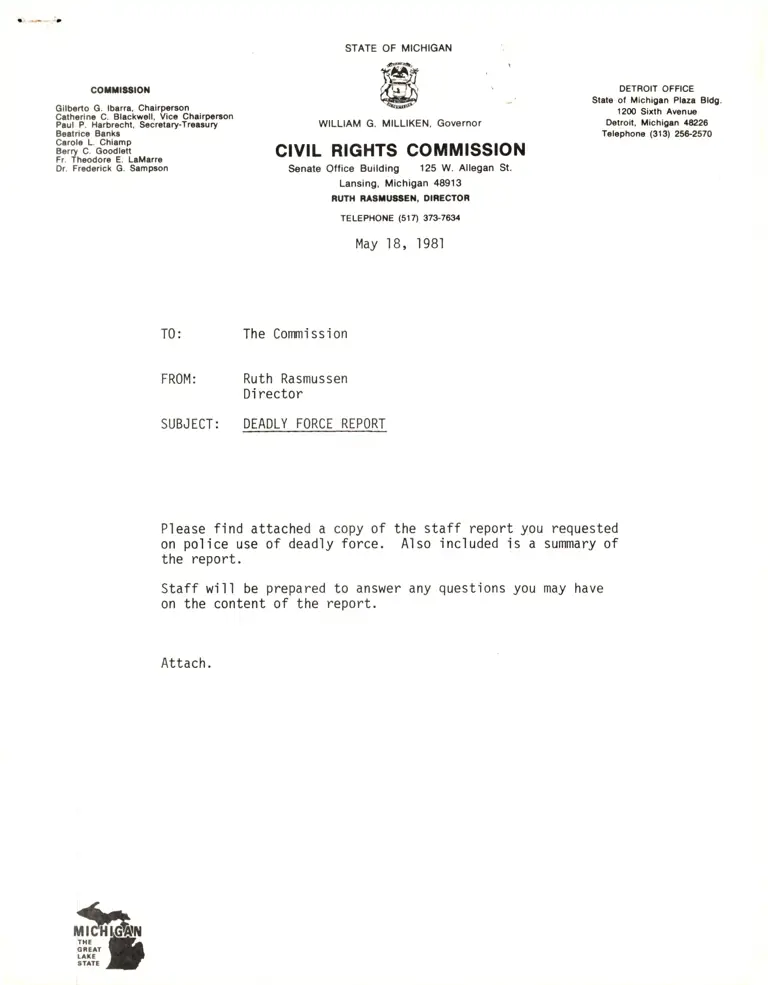
Please find attached a copy of the staff report you requested
on police use of deadly force. Also included is a summary of
the report.
Staff will be prepared to answer any questions you may have
on the content of the report.
Attach.
m iChlgwn
THE
GREAT
LAKE
STATE
.
SUMMARY OF DEADLY FORCE REPORT
The report was written as a result of continuing concern over deaths of
minority persons in Michigan cities. It is written for two purposes:
(a) to establish a position and a rationale for the position; and (b) to
provide staff with a document which can be used in working with local law
enforcement officials.
Staff undertook the following steps in preparing the report: (a) survey
of literature on the subject; (b) a survey and analysis of 82 police
department policies and (c) discussion of the issue with several local
community and law enforcement officials.
As a result of staff activity, staff found that:
- The law governing deadly force in this state is based solely
on court cases, and is frequently confusing.
- The fleeing felon rule, which permits officers to use deadly
force against persons accused of any felony, has the effect
of imposing the death penalty for felonies which do not involve
any physical force, particularly crimes against property.
- While there is no Michigan racial data available, it is estimated,
on a national basis, about 50 percent of all persons killed by
police action are minority persons.
- The policies reviewed indicated a varied pattern of inconsistent,
sometimes confusing or contradictory, standards within the same
document and great disparity among departments. Some policies
only "follow state law."
- There is a great deal of concern within the policy community
over the deadly force issue because of recent court cases
creating civil liability as a result of police use of deadly
force.
Data on citizens shot within the state is difficult to obtain.
Data is kept only on police officers shot. There is also no
data on citizens killed during police auto pursuits.
Few officers are ever prosecuted under criminal laws as a
result of police use of deadly force. In some cases, this may
be because the individual policies have only a vague requirement
that such force was necessary or perhaps because of reluctance
of prosecutors to prosecute.
Training of officers on deadly force may not occur after
completion of the state-required hours for certification as an
officer. Aids which provide training in situational discretion
are limited. Training budgets have been cut badly in the current
budget crunch.
Security guards receive no mandatory training in firearms, and
have been involved in shooting situations.
-2-
- There are few, if any, support services available to officers
wlio are involved in shootings.
Based on these conclusions, staff has recommended:
- Adoption of a model policy for local police agencies.
- Elimination of the fleeing felon rule (by statute).
- Restriction, by statute, of the deadly force use in those
situations in which there is a "reasonable belief that there is
an immediate threat" to the life of the officer, another officer
or a member of the public.
- Statutory mandates which will require additional training in the
use of deadly force, particularly in the use of discretion.
- Statutory enactment which would require reporting of shooting
incidents to the Attorney General, who would be authorized to
investigate situations in which there may be criminal liability
questions.
STAFF REPORT ON
THE 1 ^ ̂ DEADLY FORCE
BY LAW ENFORCEMENT AGENCIES
Submitted to the
Civil Rights Commission
May 18, 1981
C O N T E N T S
I. OVERVIEW
Page
1
II. HISTORICAL & CURRENT DEVELOPMENT
A. Background
B. Legal
III. SURVEY
A. Process Used
B. Definitions
C. Factors
D. General Analysis
E. Clarity of Policies
F. Grounds for Belief - the evi'
G • Felonies Involved
H. Analysis of Categories
IV. CONSTITUTIONAL ISSUES
A. Capital Punishment
B. Equal Protection
C. Due Process
D. Cruel & Unusual Punishment
V. TRAINING
12
34
VI. RELATED ISSUES
VII. CONCLUSIONS & RECOMMENDATIONS
VIII. DRAFT POLICY
FOOTNOTES
39
42
46
50
52
ATTACHMENTS
A. Survey Table
B. Samples of Policies
1. Battle Creek
2. Kalamazoo
3. Saginaw
4. Genessee County
I. OVERVIEW
Incidents involving the use of deadly force against citizens by law
enforcement officers have occurred with alarming frequency in recent years.
Since these incidents very often involve minority citizens, the Civil Rights
Commission has been faced with a repetitive pattern which also may entail an
escalation in community-police tension.
Concern for the tension situations and tremendous human cost which these
continuing incidents cause led the commission to request a full report on the
issue in August, 1980. The present report is an attempt to respond to this
request. The department has attempted to present an objective analysis of the
issue and suggest a series of steps for future efforts in abating the causes
of conflict on this issue.
Staff undertook a series of activities in the preparation of this report,
including the following: (a) review and analysis of available studies, reports
and the existing Michigan law; (b) a survey of deadly force policies among
law enforcement agencies; (c) analysis of 82 internal policies which were
received by our district offices, and (d) discussion with community leaders
and law enforcement officials.
Following completion of these steps, the present report was drafted.
Focus in the report centers upon several areas: (a) analysis of the adequacy
of present standards and practices, and (b) development of policy and criteria
which can be used for a consistent, strong set of standards which are protective
of life and workable for enforcement officials and officers. From this report,
we hope to draw a rationale for proposing a limitation on the present law and
a set of materials which can be used by our staff, in working with community
groups and police organizations, as part of departmental program efforts.
-2-
We have attempted to limit our report to those issues which bear directly
on the deadly force issue. For this reason, the report does not delve into
gun control, police use of non-deadly force, treatment of citizens by police,
or the entire issue of self-defense by anyone.
Staff has found the issue a complex one with deeply entrenched thinking
on the part of both police and community. It is also an area which is subject
to significant changes in legal standards, including the liability of officers,
police departments and municipalities. There is a tremendous amount of research,
discussion and development on the entire deadly force issue, which may be
utilized by everyone who is working with deadly force problems.
Cooperation and recognition of honestly held differences is essential if
constructive resolution to the issue is to be achieved. Civil Rights groups
cannot assume traditionally adversarial roles if change is to be achieved.
The police community must respect the opinion of minority groups and seek to
reverse the existing distrust of the police. Staff has been very impressed
with the attitude which both community and law enforcement officials have shown
in working with staff on this report. It is the intent of both the department
and commission to play an active, constructive role in seeking solutions to
what we regard as a major problem in this state.
-3-
II. HISTORICAL & CURRENT DEVELOPMENT
To better understand the deadly force issue, it is helpful to review its
development to the present time and the legal issues from which have evolved
the present standards.
A. Background. During the last decade, over 278 persons were killed by
police fire, many of them black and Hispanic people. In addition, 49 Michigan
police officers were killed by citizens while acting as officers. The FBI's
Uniform Crime Reports (UCR) show the following national figures for officers killed
in the line of duty:
U.S. Michigan
1970 100
1971 129 13
1972 116 6
1973 134 5
1974 132 12
1975 129 5
1976 111 3
1977 93 2
1978 93 2
1979 106 1
1,143 49
Information on Michigan citizens killed is difficult to obtain. The staff
survey reflected 278 citizens killed, but the survey was not a statewide survey.
The following data for Detroit indicates a significant part of the staff survey
totals for both officer and citizen deaths:
-4-
Police Citizens
1970 4 1970 15
1971 6 1971 41
1972 3 1972 35
1973 3 1973 27
1974 5 1974 26
1975 0 1975 25
1976 0 1976 22
1977 0 1977 19
1978 0 1978 15
1979 0 1979 15
The ratio for Detroit is roughly 12 citizens to one police officer death,
a ratio significantly higher than the 6 to 1 ratio found in Chicago.^
Other statistics bear on the issue. Several studies support the conclusion
that about half the citizens were black. The figures vary according to the
study with some figures as high as 80 percent minority for several large urban
O
areas. The difficulty in obtaining data on the number of Hispanics killed is
based on the fact that racial data are frequently not reported and Hispanics
were counted as "white" prior to 1970 statistics.^ An overwhelming number of
5the officers involved in shootings were white. There are conflicting statements
as to whether the presence of minority officers lessen the incidence of citizen
deaths.
The absence of statistics is an area of critical need. Police agencies
apparently do not publish racial data, and the OCR statistics do not reflect
any racial data. Further, UCR statistics are apparently gathered only for
police officers shot, not for citizens shot.
A Police Foundation staff person has been recently quoted as stating that
0
police account for 3.8 percent of the nation's homocides each year.
The dimensions of the problem may also be seen in the following incidents:
• 5 -
Situation A . Two officers respond to a telephone call that four black
teen-agers are burglarizing a house. Upon arrival at the address, the officers
search the driveway and yard surrounding the house. A 15-year-old black youth
emerges from the house, runs and is shot dead. The subsequent police and
prosecutorial review clears the officer. A subsequent investigation by the
city ombudsman raises questions as to the accuracy of the officer's version of
the events, including a question of whether the youth could have been stopped
without the use of the weapon. A taped conversation of the officers' report
to the dispatcher reveals that the dispatching officer congratulated the officers
for the shooting. An extremely strong community reaction occurs and litigation
is initiated. The police department is critical of the ombudsman's investigatic.i
as "unprofessional," and lacking in knowledge of homicide investigations.
Situation B. An officer is sent to an apartment building in response to
a domestic violence call. When the officer knocks on the door, an occupant
opens the door and fires a fatal shot at the officer. The officer has no warning
or indication that the occupants may have a gun.
Situation C. An officer stops a car on a routine traffic violation. As
the officer approaches the car, the occupant opens fire and kills the officer.
The occupant has a police record. Again, there is no warning of difficulty.
Situation D. A young Hispanic man is involved in a barroom fight and
flees the bar as law enforcement officers arrive. He turns around, the officer
orders him to stop, but he turns and runs again. The officer shoots and kills
the man on the grounds that he believed the man was reaching for a weapon. The
young man had no weapon, and witnesses stated that there was nothing done by
the man which would have indicated he had a weapon. The resulting litigation
was recently settled with a substantial payment to the estate of the young man.
-6-
Situation E. An off-duty sheriff calls his office to report a suspicious
car in a grocery store parking lot. When the sheriff's car arrives, the car
leaves, with a 22-year-old black man at the wheel. A brief chase ensues, the
police force the man's car to stop. The young man then jumps out and runs.
An officer shoots and kills the man. Subsequently, the department and prosecutor
investigate, and the officer is charged with involuntary manslaughter. He is
tried and acquitted. Several black community leaders voice their concern over
the manner in which the situation is handled, and community tension escalates.
Several problems may be identified in the above which are perhaps broadly
representative of many other situations:
1. Officers frequently are called upon to make decisions in a split-
second, and failure to react may cost their lives.
2. Subsequent analysis of officers' actions involve what is essentially
a difficult review of whether the officer used reasonable judgment.
This "second guessing" was a concern voiced by several police command
officers during staff interviews.
3. The review of police actions may be a complex one and a difficult one
for the prosecutor who is "on the same side" of law enforcement as
the police officer.
4. The shooting incident may elevate existing community distrust of police,
particularly where the individual officer's judgment appears unreasonable
in retrospect. These problems are further discussed in the survey
analysis in this report.
Staff found interest and activity on the deadly force are widespread.
Current projects are under way in which the National Urban League, national
NAACP and national LaRaza Unida are working with the International Chiefs of
Police Association, the Police Foundation and the University of California at
Irvine. These reports are due in the next few months. These projects are
somewhat controversial in the police community.
-7-
Two documents have provided an interesting perspective on the progress
of this issue. (A 1926 Hamtramck Police Department policy reflects virtually
the same policy and standards as exist in other departments today, though the
current Hamtramck policy reflects changes from the 1926 version.)
A second document was developed by a group of Flint citizens in 1970. A
1963 survey is referenced in the report which indicates that only 27 of 49
police departments surveyed had no policies, a situation which is somewhat
improved today. Other references to the report are contained in this report,
g
which staff found very relevant to today's concerns.
B. Development of the Law. There is no statute in Michigan to govern
the use of deadly force by police officers. The law governing police use of
deadly force is based on the common law of the state as developed by court
decisions. The basic rule is that a law enforcement officer may, upon reasonable
belief, defend herself or himself or another person from the use of deadly
force and may shoot a fleeing felon. If an officer fails to meet the evidence
standard, usually a reasonable belief, the shooting would not be considered a
"justifiable" homicide and would be murder. The issue must be examined as both
a self-defense issue and a fleeing felon issue. The rule is the same as that
which originated in the common law in England. The basic Michigan rule was
enunciated in Delude v. Raasaka, a 1974 Michigan Supreme Court case and in
People V . Gonsler, a 1930 case.
The original policy behind the fleeing felon rule was two-fold. First,
escape was tantamount to receipt of no punishment since there was no communication
system and no technology to assist in capturing a felon who left the area. A
second basis lay in the fact that all common law felonies (murder, rape, assault,
robbery, sodomy) were capital offenses and death would result upon conviction.
The number of common law felonies was very much limited.
-8-
Current Michigan law lists several hundred crimes as felonies. Included
in this list are a large number of offenses which involve no violence or physical
harm to others. Some of these felonies are: Bookmaking, embezzlement, possession
of stolen property, bribery, and some forms of grand theft, i.e., shoplifting,
if over $100 is involved.
The picture which emerges from the evolution of the fleeing felon rule is
that its original basis is no longer relevant and that expansion of the number
and type of offenses make the present "all felons" rule unjust and unworkable.
The courts have made some incursions on the rule, particularly at the
federal level. The general trend during recent years has been to limit the
rule to violent or "forcible" felonies. This trend is reflected in many of the
policies staff examined in its survey.
Most of the thrust to modify the fleeing felon rule lies in the development
of the liability standards for police officers, departments and municipalities.
The cases have arisen under state wrongful death and negligence statutes and
through federal civil rights and constitutional standards.
The leading case on the extent of liability appears to be Monel 1 v.
Department of Social Services, which is cited below. The court stated that a
municipality could be liable under 42 US 1983 when the unconstitutional action
implements or executes a policy statement, ordinance, regulation, or decision
officially adopted and promulgated' by municipal officers. The liability extends
to a "custom" which does not have formal approval, including 'persistent and
widespread discriminatory practices of state officials.' The policy or custom
could be set by a police department as well as a city council under this standard.
There have been a number of efforts to change or clarify the fleeing felon
and deadly force rules. In 1962, the American Law Institute adopted the following
recommended standard, which has been incorporated into many of the police policies
of the state. Deadly force may be used when "the arresting officer believes
-9-
(1) that the crime for which the arrest is made involved conduct including the
use of deadly force, or (2) there is substantial risk that the person to be
9
arrested will cause death or serious injury if his apprehension is delayed."
Eight states have adopted this form of the rule by statute. The general
rule is followed nationally. Twenty-four states have enacted statutes on the
use of deadly force, but only seven have limited the fleeing felon rule.
The Michigan Bar Association adopted what is only a small change from the
common law rule in its draft Revised Penal Code.
Sec. 631. (1) Except as provided in subsection (2), a peace officer
is justified in using physical force upon another person when and to
extent that he reasonably believes it necessary under either of the
following conditions;
(a) To effect an arrest or to prevent the escape from custody of an
arrested person unless he knows that the arrest is unauthorized.
(b) To defend himself or a third person from what he reasonably
believes to be the use or imminent use of physical force while effec-
ing or attempting to effect such an arrest or while preventing or
attempting to prevent such an escape.
(2) A peace officer is justified in using deadly physical force upon
another person for a purpose specified in subsection (1) only when
he reasonably believes that it is necessary under any of the follow
ing conditions:
(a) To defend himself or a third person from what he reasonably
believes to be the use of imminent use of deadly physical force.
(b) To effect an arrest or to prevent the escape from custody of a
person whom he reasonably believes has committed a felony involving
force against either person or property.
(c) To lawfully suppress a riot or insurrection.
The Legislature has also been active in the area of fleeing felon rule
reform. HB 6027 of 1980 was introduced by Representative Joseph Conroy of
Flint as a result of his work with Flint citizens. The bill died at the end
of the 1979-80 legislature. The key provision in his bill was the following:
Sec. 2. A police officer or security guard may use a firearm against
another person under the following circumstances:
(a) When there is or reasonably appears to be danger to the life of
the police officer, security guard, or another person.
(b) When the police officer, security guard, or another person is or
reasonably appears to be subject to a felonious assault.
-10-
(c) To effect an arrest for the commission of a felony only when all
other efforts to effect the arrest have failed; except that a firearm
shall not be used because a person is fleeing the police officer or
security guard and is only suspected of having committed^ felony, or
because the person fails to stop at the command of a police officer
or security guard, or the person runs a blockade.
During the present legislative session. Senator Harry Gast from the St.
Joseph-Benton Harbor area introduced SB 34, which is presently before the Senate
Judiciary Committee. The bill is essentially a modification of the common law
rule. It does not qualify "felony" in any way but permits deadly force if
"alternate measures would be unreasonably dangerous," plus one of a list of
additional conditions: (a) offense was a felony; (b) person is armed;
(c) person threatens or uses deadly force.
Legislation provides a significant part of the staff recommendations,
listed later in this report. Several cases bear on related questions regarding
the use of deadly force, as discussed by the Lawyers' Guild handbook.
1. Most felonies cannot be punished by death, Coker v. Georgia,
975 set 2861 (1977).
2. There is a fundamental due process right to life; Mattes v. Schnarr
502 F 2d 588 (8th Cir) 1974; Contra, Jones v. Marshal 1 528 F 2d 132
(2d Cir 1975).
3. Right to life without deprivation of due process-use deadly force
only when:
(a) felony suspect cannot otherwise be apprehended;
(b) suspect used deadly force in commission of felony or there is
reason to believe he will employ deadly force if not immediately
apprehended;
Landrum v. Moats 576 F 2d 1320 (8th Cir. 1978) ____
Contra: Wiley v. Memphis Police Department 548 F 2d 1247 (6th Cir. 1977)
Qual1s V . Parrish 534 F 2d 690 (6th Cir. 1976)
4. Officer can raise good faith defense when local police manual
misinterprets state law;
Landrum, Supra
5. Officer held to local department standard which was higher than
that of the state law;
Peterson v. City of Long Beach 594 P 2d 477 (SCt Calif 1979)
Also, Garner v. Memphis Police Department 600 F 2d 52 (6th Cir. 1979)
6. City may be liable for actions of police officers and officials;
Monel 1 V . Department of Social Services 436 US 658 (1978)
7. Racially motivated police misconduct is subject to liability under
42 US 1981; , ^
Mahone v. Waddle, 564 F 2d 1018 (3d Cir. 1977) cert den 438 US 904 (1978)
■11
8. Use of hollow point ammunition;
Garner, Supra
9. No liability because of city policy requiring officers to carry
weapon off-duty and outside city;
LaRocco V . City of New York, 468 F Supp 218 (E.D.N.4. 1979)
10. Inadequate training and supervision may create municipal liability;
Owens V . Haas, 601 F 2d 1242 (2d Cir. 1979)
Turpin v. Mai let, 619 F 2d 196 (2d Cir. 1980)
Leite v. City of Providence, 463 F Supp 585 (D.R.I. 1978)
Knight v. Carlson, 478 F Supp 55 (E.D. Calif 1979)
11. Supervisor may be liable for failure to train subordinates;
McClelland v. Facteau, 610 F 2d 693 (10th Cir. 1979)
Michigan standards are enunciated in the following cases:
1. "Necessary" force. Delude v. Raasakka, 391 Mich 296 (1974);
2. "Honestly appeared to him at the time to be reasonable and right,"
Firestone v. Rice, 71 Mich 377 (1888); People v. Gonsler, 251 Mich
443 (1930);
3. Can't use deadly force if not needed. People v. McCord, 76 Mich 200 (1889;
4. Self-defense justification "is based on circumstances as they appe irGd
to the victim, and not as they actually existed." Must result in
reasonable belief that victim is in danger of death;
People V . Perez, 66 Mich App 685.
5. Police have the right to use "that force reasonable under the
circumstances" to make the arrest; Reasonableness of the force
used must be judged "in the light of the circumstances as they
appeared to the officer at the time he acted;" General standard
is that of an "ordinary prudent and intelligent person."
People V . Doss, 406 Mich 90.
6. People V . Burt, 51 Mich 199.
•12-
III. SURVEY
A. Process Used. Many of the concerns developed in this report arose
from the survey of police department policies by Community Relations Bureau
staff. Over 100 letters were sent by staff to police departments, all of which
are located in areas of minority population or in areas which border areas of
significant minority population. Departments were asked for three things:
(a) a copy of the departmental policy on the use of deadly force; (b) the
number of citizens killed by police action in the last ten years; (c) the
number of police officers killed by citizens in the last ten years. The latter
two categories were discussed earlier in the report. Most of the inquiries and
responses were made in September and October, 1980. A number of departments
sent policies, departmental procedures manuals, command orders and training
materials. It is possible that some departments did not send all parts of
their policies which pertain to the use of deadly force, which may limit the
accuracy of our evaluation. It also should be noted that a number of departments
indicated that they are revising their policies.
As reflected in the attached table, 82 policies were received and evaluated.
Several areas were assessed by the survey, including the following: (a) whether
a policy existed; (b) the strength of the legal standards used; (c) clarify of
the standard as a guide to conduct; (d) consistency of the standards, both
internally and as compared to other policies, and (e) substantive areas covered
by the policies, as suggested by an 11-factor list. The list borrows most of
the items from elements used by the Police Foundation Report. A large number
of blank spaces are apparent in categories other than arrest, fleeing felon
and defense of persons. Since staff did not specifically request information
on these areas, it is possible that departments address these points in other
parts of their policies and the blank space may not always accurately reflect
actual department policy for the category.
-13-
B. Definitions. The power of arrest was divided into three categories:
arrest, fleeing felon rule and defense of self and others. The remaining
categories were found in the Police Foundation Report. All categories were
found as sources of deadly force concerns in the foundation report.
For purposes of the evaluation, deadly force is force which could or is
likely to cause death or serious bodily harm. It includes deadly weapons (guns,
knives, explosives, blades) and the use of any instrument which is deadly
because of the manner in which it is used, such as a blunt instrument, fists,
or an automobile. The use also includes attempts to kill or cause serious bodily
harm. In the remainder of this analysis section, the report will examine the
general issues identified with the policies.
C. The factors as set forth on the table, are:
1. Arrest. Used for the act of arresting a suspect, but used on
many policies as a generic term to include arrest, fleeing felon
and defense of person.
2. Fleeing felon. Used to distinguish the common law rule.
3. Defense of self, others. Applies to the right of self-defense
and the officer's duty to protect others from similar threat
to life or person.
4. Moving vehicles. Used to examine the specific problems arising
primarily from the use of automobiles.
5. Innocent bystanders. Indicates the concern for protection of
persons not involved in the confrontation between citizen and
police.
6. Warning shots. Applies to the practice of firing a shot before
aiming further shots to kill.
' Off-duty. Involves practices authorizing the use of weapons
while not actually in uniform or on duty.
8. Second guns. Reflects the practice of carrying second guns on
the officer's person, both on duty and off, and includes shotguns.
9. Juveniles. Reflects the distinction drawn in the law for juveniles.
10. Drawing & displaying. Applies to when a weapon may be unholstered
and pointed (displayed).
11. Reporting. Covers the accountability procedures used after weapons
are fired.
-14-
D. General Analysis. The primary issue in analyzing the policies lies in
determining what standard for use of deadly force each department uses. For
this reason, we divided the policies into groups; (a) limitation to defense
of person; (b) a modified fleeing felon rule; (c) open policies, which are
simply following the common law, (d) those which are not readily categorized.
1. The first category limits the use of deadly force to self-defense or
defense of others. Thirteen policies fall into this category. The Battle
Creek policy is perhaps the best example of this policy. The policy follows
closely the parameters established by the Police Foundation. The policy limits
the use of deadly force to those situations where there is a "reasonable
perception that there is an immediate threat" to the life of the officer or
other person. While "perception" may be problematic as a negligence standard,
the policy is generally a comprehensive policy which warrants study by all
departments.
Other departments which have clearly defined policies are Wayne County,
Redford Township, Genessee County and Grand Rapids. The "desperately attempting
to elude capture" language of the Dearborn Heights policy may remove it from
this category, but other language appears to be clearly within the area. Several
others use the Model Penal Code threat of deadly force/substantial risk standard.
The Grand Rapids policy is one which is apparently unique. It requires an
"overt threat to life, clear and present."
The Genessee County policy is significant because of the coupling of
"virtual certainty" to the fleeing felon category.
2. The second level of policies make some modification on the common law,
by limiting the use to defense of persons and to felonies which would be classed
as violent, major crimes involving the use of force. Staff placed 37 policies
in this category. There are several policies which staff feels are well-
developed policies employing this standard. Included are Kalamazoo, Washtenaw
County and Saginaw, all of which have well-developed statements of policy.
-15-
The Kalamazoo policy merits comment. The policy imposes a "confrontation
situation" standard with a self-defense standard included, but also ties in a
limited fleeing felon rule which includes murder, first and second degree sexual
misconduct, robbery and felonious assault.
3. A third category centers in those with no policy, a statement that
they follow the common law, or which have standards which are the same as the
common law. Staff placed 17 policies in this category.
4. A fourth category arises because staff encountered difficulty in
identifying what the standard was, or is. Staff placed four policies in this
category. The language used by these policies is frequently duplicative or
contradictory, totally lacking in a legal standard, or simply ambiguous. The
placement of some policies in the first three categories may have been somewhat
charitable because some of these policies have similar failings.
E. Clarity of Policies. Specific concerns on clarity center in the
following:
1. Most policies fail to develop a standard for conduct in clear, concise
language. For example, the phrase "and the like" fails to establish either a
legal standard or any common sense limit on which crimes are involved. Phrasing
is frequently stilted, ambiguous and excessively legalistic.
2. Legal standards used in the policies are frequently conflicting, even
within the same paragraph or policy. The same problem occurred in the transition
from policy to procedures or training manuals. The result is confusion and an
absence of internal logic within the documents.
3. Some standards purport to establish a standard but provide no inkling
of what the standard really is. For example, "when such action can be justified
in accordance with the use of force granted an officer to effect an arrest."
Another example arises in one policy where the "authority granted a police
officer" standard is used, but later in the policy the "virtual certainty"
standard is required even though this standard is higher than the common law.
-16-
other examples are the "socially unacceptable" and "unless it would impede
on the nature of their activity," found under the off-duty category. The "final
defense of life" standard is also somewhat unclear as to what point officers'
conduct may begin.
4. Some policies are placed in manuals in totally illogical manner, or
are mislabeled.
5. Some policies inaccurately state the law in their policies.
There are many implications for the use of poorly worded policies, particularly
in liability. The department submits that the absence of a clear statement of
policy is indefensible.
F. Grounds for Belief. A basic requirement in establishing a standard
of conduct, particularly for negligence, is that there be some element of
reasonable belief shown. Several observations may be made of the policies reviewed
regarding this requirement, including:
1. Several policies have no standard, or limit the language to a prohibition
against "mere suspicion."
2. The levels which are present vary greatly:
a. "reasonable perception"
b. "reasonable belief"
c. "when necessary"
d. "virtual certainty"
e. "bear in mind" (innocent bystanders category)
f. "clear and sufficient reason to believe"
g. "wanton disregard" (innocent bystanders)
h. "sound discretion"
i. "known to have committed"
j. "ordinary prudent man"
k. "wise and careful"
l. "must consider"
m. "seems necessary"
n. "honestly appeared to him"
0. "beyond reasonable doubt"
p. "actual and reasonable belief"
q. "reasonable certainty"
r. "conscientious discretion"
-17-
Many of the standards are similar. However, there is sufficient disparity
to create confusion for officers in the state. A particular problem arises in
the use of the "honest belief" standard, which is based on an old Michigan
Supreme Court case. This standard may mean that an officer is never evaluated
on any question of conduct beyond the question of whether he or she in fact
honestly believed in the need for the use of force. "Honest belief" is relevant
to specific criminal intent, but precludes operation of the normal civil
negligence standard, the ordinary prudent person. It may permit examination
of criminal purpose or knowledge, but may not permit review of other forms of
criminal intent.
In general, the department recommends a high standard of belief for the
actions.
G. A similar problem occurs in determining to which felonies the arrest
and fleeing felon rules standard should be applied, including:
1. "forcible felony"
2. "extreme cases"
3. "or the like"
4. "major felony"
5. "more atrocious felonies"
6. "serious crime"
7. "any other felony involving use of physical force or violence"
8. "dangerous felony"
9. "serious or aggressive felony"
10. "felonious crime of violence"
11. "violent" felony
These are in addition to the life-threatening qualification or the ones
which simply refer to "state law."
H. Category Analysis
ARREST. Most of the primary problems which arise in the review of specific
standards are discussed in the above general problems: the conflicting standards
and the confusion over the extent to which some felonies should be the subject
of deadly force and which should not.
There are other problems, however.
-18-
Most policies join the areas of arrest and escape. There are examples
in which differing standards are set for each category. The City of Inkster
limits the use of force to felonies in the general arrest area to "murder, rape,
robbery, burglary, arson or the 1ike." The underlined phrase is not included
in the fleeing felon standard.
FLEEING FELON. Many of the most complex police-community relations in
the last few years have sprung from this rule. The survey table reflects a
number of problems, including: (a) the level of belief required varies widely;
(b) the scope of the rule and the specific limits to the types of felonies
subject to the rule; (c) random standards which are inserted into individual
department policies and, (d) whether the punishment is consistent with our
established principles of crime punishment.
The problem of belief and evidentiary standards was discussed above. The
standards may be summarized as inconsistent and frequently vague.
Most of the policies in the largest departments reflect an encroachment
on the traditional common law rule in the form of limiting the types of felonies
in which deadly force can be used. Some policies limit the felonies to four
major groups: murder, common law rape, robbery and felonious assault. All
involve violence and the use of force. If the standard is applied on a blanket
basis, there may be cases in which the "necessary" force standard is not met,
particularly in certain crimes. For example, a barroom fight which is classed
as felonious assault may arise in fact situations which are problematic. Property
crimes may involve no violence to persons. This raises a philosophical question:
is the taking of life by the state through its police ever valid when the crime
involves only property? The problem of limiting the use of the rule through
blanket designation of class of crime is thus fraught with both inconsistencies
and serious social undercurrents.
-19-
A particular concern to the department is the fact that property crimes
frequently place police officers in the position of defending the rights of
those who own property. Since the white majority controls an overwhelming part
of the property, the application of deadly force when property is involved takes
on a class and, frequently, a racial implication. It is this tradition of
"haves versus have nots" which may feed a widespread resentment when a shooting
incident occurs.
A related problem lies in the degree of punishment delivered for what may
otherwise be a minor offense. If a person would receive a relatively minor
penalty for the offense, and the effect of the fleeing felon rule is to impose
a death penalty for a minor offense, this overkill again places the police
department squarely in the tradition of the heavy handed oppressor.
A further question arises regarding the excessive punishment issue: dues
such a punishment achieve its purpose/ A brief review of the purpose of
criminal punishment may prove helpful. Punishment is intended to do several
things, including; (a) punish; (b) deter others from similar conduct in the
future; (c) rehabilitate, and (d) to pay a debt to society (retribution).
If deadly force results in death, the felon is clearly punished.
Rehabilitation is precluded. The debt to society for the offense is obviously
paid. The sole social basis on which punishment occurs, then, must be based on
its impact as a deterrent. Society has established a set of penalties which
are clearly less severe than death, presumably on the theory that greater
punishment will not deter. For example, grand theft of a purse may lead to
probation or a short prison term.
What is really being punished, then, is the act of fleeing from arrest.
The legislature has not treated this act alone as a major offense, unless there
is an assault involved. For example, failure to stop a vehicle as directed by
an officer is a misdemeanor. Again, the quality of excessiveness is present,
and raises the constitutional problems discussed elsewhere in this report.
-20-
Any standard which is used should thus focus on conduct which threatens
the safety of the officer or other person rather than a technical definition
of a felony.
Police officers interviewed by staff raised a number of questions in
responding to a proposal that deadly force be limited to situations where life
is threatened, including;
-If an officer comes upon a scene where the felon has just murdered three
persons, but drops his weapon and runs, should society permit the felon
to escape?
-Won't criminals take advantage of the rule once they realize they won't
be stopped?
Both questions raise legitimate issues, particularly for the minority
community which is disproportionately victimized by crime. Staff received
widely differing responses to these questions from both law enforcement officials
and members of the community. These responses may be summarized as:
-Some persons agreed that the answer to each should be "no."
-Others suggested that in the first question, there may be an immediacy
to the situation which would permit application of the rule, and that
in some instances the person might escape, but the value of life was
still placed as paramount even though life was taken. One person
challenged staff to show an actual case where this situation had
occurred. Time between offense and capture is also a recurring
problem with the existing fleeing felon rule. For example, if the
attempt is to arrest for a burglary committed six months before and
the person flees, there is a significant time gap between offense and
escape.
-In the second question, there does not appear to have been a signifi
cant increase in murders or rapes in situations where the fleeing
felon rule has been greatly restricted. ̂Some data suggests that some
types of property crimes have risen in the same jurisdictions.^^
The Kalamazoo policy attempts to deal with the above by limiting the rule
to situations where there is no alternative and safety of bystanders will not
be affected and a confrontation situation exists or the subject has just
committed an offense.
•21
Most policies have a variety of standards which assist in determining when
force is necessary, including the requirement that alternatives be examined
and exhausted as required by the Michigan Supreme Court case of People v.
McCord. Since many of the shooting situations may require split-second decisions,
this requirement varies with the case. The addition of "mere suspicion"
limitations and the requirement that several factors be present, i.e., no danger
to bystanders, "immediate" threat.
The presence of terms like "extreme cases," "or the like," "serious crimes"
or "if he may go unpunished" do not really help the effectiveness of the standard
and may endanger the officer's life while he or she attempts to ascertain whether
the standard is met.
The Flint citizens group which met with staff strongly urged the use of
the "virtual certainty" standard as an effective limitation on the fleeing felon
situation. The same standard is present in several other policies and should
be utilized in the absence of the life-threatening limitation.
WARNING SHOT. The theory behind the use of warning shots presumably is
that a person who is predisposed to flee will stop at the point a warning shot
is fired because he or she will know that the officer isn't "kidding around,"
or it will frighten the person fleeing into stopping. The standard applies to
warning shots fired straight into the air, into the ground or over the head of
the person fleeing.
No other category was as clearly developed as this issue. Of the 82
policies, 35 policies contained clear prohibitions on their use. Where rationale
was offered, it fell into two categories: (a) the shots may ricochet;
(b) there is a risk of injury to third persons. One command officer pointed to
the primary question as one of accountability, and he voiced the feeling that
"warning" shots were simply "missed" shots.
-22-
The Oakland County policy discusses the possibility that, contrary to
frightening the fleeing person into stopping, warning shots will have the effect
of making the person run faster.
Use of warning shots would be very difficult in those situations where
officers wers heltl to the life-threatening situation.
Several policies tied other issues and restrictions into the warning shot
standard, primarily in discussion of the general fleeing felon situation.
The policies reviewed would suggest that the only remaining questions
relate to the remaining policies which have not completely prohibited the
practice.
Several departments specifically permit the use of shots as a means of
signalling an emergency, and at least one discusses the problems of firing
straight in the air or in a direction where ricocheting may occur.
DEFENSE OF SELF, OTHERS. This category includes any situation in which
the officer defends himself or herself from deadly force. Since the officer
has a legal duty to protect others from threats to person, the officer may also
act for other persons.
No distinction is made in felony and misdemeanor situations, since the
nature of the crime committed is superseded by the threat to life.
Some departments do not reference this issue in their policies. Others
apply a wide variety of standards, including:
-"reasonable perception of immediate threats"
-"when necessary" - repeated frequently .
-"reasonable belief that deadly force is necessary to defend from immediate
threat," no alternative available and bystanders not endangered - Kalamazoo
-if "human life endangered"
-"loss of life threatened"
-"life in jeopardy" . . ^
-"clear and sufficient reason" to believe "there is an immediate threat
-"must be resistence"
-"extreme cases"
-"self-defense"
-"final defense of life"
-"legally justifiable reason to believe life in danger
-"actual and reasonable belief"
-23-
Most policies state that an officer may defend himself or herself and
that the same right extends to others. Several policies refer to the right of
an officer to come to protect another officer from attack. The sentence "That
which he is authorized to do in his own defense he is compelled to do for
others" occurs repeatedly in the policies.
There can be no question that the officer should retain this right to
defense of self and others. Failure to do so would provide a lower legal
standard of protection for the officer than any other person in the state enjoys.
Further, the defense of others is a necessary part of the officers role,
although the department suggests continued use of "last resort" requirements
before shooting.
A number of policies stress that an officer may use deadly force in self-
defense even where the original offense was a misdemeanor, if the person being
arrested places the officer in a self-defense situation.
MOVING VEHICLE. There are two primary problems which relate to firing at
or from a moving vehicle: (a) the problems of shooting accurately from or at
a moving vehicle; (b) the danger to innocent persons from shots which are fired
inaccurately.
Most department policies do not appear to deal with the question. Fifty-five
policies did not specifically refer to this issue, while four policies referenced
shooting "at" a moving vehicle, and nine policies have a standard for firing
"from" moving vehicles. Only five agencies refer to both areas.
The Attorney General has issued an opinion (OAG #5086) which greatly limits
the authority of officers to fire at a moving vehicle, but this opinion was not
mentioned in any policy. The relevant parts of the opinion:
-24-
Mi chi gan law makes it a one year misdemeanor to refuse to stop a motor
vehicle upon the lawful command of a police officer, MCLA 750.479A...
Michigan has long recognized that in a situation where a police officer
seeks to arrest a felon, he may use deadly force to effect such an
arrest. People v. Gonsler, 251 Mich 443, 446 (1930). However, if a
safe and speedy capture can be made without using deadly force, and such
force is used, the arresting officers may be subject to criminal
liability if the arrestee is harmed. People v. McCord, 76 Mich 200.206
(1889)...
In summary, it is clear that where an officer seeks to stop or arrest a
known misdemeanant, deadly force may not be used. While the law allows
police officers to use deadly force in attempting to arrest a felon,
this course may only be taken when other methods have either failed or
cannot succeed without endangering the lives of innocent citizens or
the officers involved.
However, when an officer seeks to arrest the driver or the occupants of
a fleeing vehicle for a felony he knows, or has probable cause, to
believe to have committed, the situation changes.
The officer would be authorized to use deadly force:
(1) Only to control or stop the fleeing vehicle but not to intentionally
harm the occupants therein.
(2) Only when safer alternative measures prove to be useless, or
unreasonably dangerous to the officers or bystanders.
Your second question asks whether Michigan statutes clarify the amount
of force a police officer may use to stop a fleeing vehicle. Presently,
they do not.
At least three departments refer to the problems involved in stolen or
"hot" cars, which are felonies, but do not present any threat to the safety of
the officers unless the person was otherwise armed.
Staff received little comment concerning the use of the car as a weapon,
an issue which is referenced in the Police Foundation Report, One police
department official mentioned the idea that a car driven in a chase situation
may present a threat to life if driven recklessly. This must be balanced against
the concern for innocent members of the public mentioned in two of the policies.
Where a rationale was offered for the limitation on use, it was limited
to the accuracy or public safety issue.
One chief discussed the problem in firing at a moving car in which persons
not involved in the felony may be riding.
-25-
staff felt that the Washtenaw County Sheriff's policy was particularly
sound and comprehensive on this issue. Its standard states that:
Deputies are prohibited from discharging firearms at a moving vehicle
or from a moving vehicle except under circumstances of extreme
necessity, and unless the occupant(s) of the vehicle or a suspect(s)
represents a direct threat to the life or safety of the Deputy or
other innocent persons, and then only as a last resort. Extreme
necessity exists only if the risk of serious injury or death to
others is greater if apprehension is delayed, than it is if deadly
force is used. It should be considered that such firing adversely
affects accuracy and increases the ever-present possibility of
hitting an innocent bystander or destroying property.
It is significant that no data is kept in Michigan on persons killed
during police chases if death occurs while the person who is fleeing is in an
automobile. The death is reported as a traffic death. While it is difficult
to write standards which would apply to all chase situations, it is clear that
an auto may become a form of deadly force in some situations and should be
regulated as a form of deadly force. The wisdom of when to chase is dependent
upon the judgment of the officer, but consideration should be given to the
effect a chase will have upon an innocent bystander. Like the firing of the
warning shot, the chase may increase danger to the public by virtue of the
officer's decision to act.
OFF-DUTY. While weapons are an accepted part of an officer's on-duty
equipment, additional issues are raised as a result of widespread use of similar
weapons while the officer is not officially on duty.
The survey showed that eight departments permitted the use of weapons
while off-duty, while six policies required that weapons be worn while off-duty.
Most detailed policies discussed the need for carrying the guns out of view of
the public.
-26-
The rationale offered during discussions with police officials was:
(a) crimes may occur in the officer's presence while off duty and a state law
requires an officer to enforce the law; (b) persons with whom officers have
negative contact may search out off-duty officers to gain revenge in an unguarded
moment and, (c) bargaining agreements in which officers demand and receive a
daily payment for wearing the gun. During ^n interview with staff, a community person
inquired as to data which supports the effectiveness of the policy rationale.
Staff suggests further analysis may be needed on this question.
The language found in most policies is very general, and the exceptions to
the requirement are not clear. For example, two policies discuss an exception
to the requirement when it is "socially unacceptable." Other policies apply
an exception when the officer is out of police jurisdiction where he or she is
employed, or is at home.
There are two major issues which arise from this practice: (a) difficulties
arising from second jobs and, (b) situations arising from social occasions,
including drinking. A study of New York City police practices showed that 25
percent of off-duty discharges were not directly related to law enforcement
purposes. Other data from this study are cited as: accidental, 12.6 percent,
14
and 3.8 percent were suicide attempts.
In the first issue, officers may be permitted in some police departments
to have second jobs which are similar in nature to police enforcement, i.e.,
security guards. Since an officer may be authorized to wear a weapon and effect
an arrest while off duty, a security guard agency has effectively purchased the
services of an officer who retains police authority. A specific problem may
arise in the situation where bonding and licensing is done by the police
department, and litigation occurs against the security guard agency and the off-
duty officer. Some departments prohibit outside employment, while others limit
work to that which is unrelated to police work. One command officer stated he
■ 11 -
distinguished those situations in which the police directly regulated, i.e.,
bartender, from those which would otherwise permit employment. An Attorney
General opinion indicates that outside employment is subject to collective
bargaining agreements (OAG #4975).
It is apparent that officers could not literally follow some of the
general policies requiring wearing of weapons at all times while off-duty. A
particular problem arises in social situations or others where consumption of
alcohol may be involved. One police official cited a state law which prohibits
the consumption of liquor while armed. Another, perhaps more troublesome issue,
arises when an officer over-indulges or becomes involved in a physical altercation.
If the result is the drawing, display or use of the weapon, serious concerns
about the propriety of the practice may arise.
In the absence of clear state law prohibiting outside employment, officials
may have difficulty in imposing a strict standard on either area above.
JUVENILE. The Michigan Juvenile Code and the Court Rules provide that a
juvenile in this state is not treated as a criminal for purposes of sentencing
and trial unless waived into circuit court from probate court. Thus, a juv
who commits a felony, particularly one not involving use of deadly force is
usually treated as a juvenile.
If the fleeing felon rule is applied as defined by the common law, juveniles
can be shot for offenses which would be relatively minor and which would other
wise be considered as a juvenile court matter. Some of the theft felonies, i.e.,
purse snatching and breaking and entering, are committed by juveniles in over
half of all cases. If the fleeing felon rule is applied, it can and has led to
loss of life, which is difficult to square with the severity of offense. One
example which was brought to the attention of staff was a case in another state
in which 16-year-old twins were involved in a relatively minor theft offense.
-28-
One of the twins ran, and was killed by the pursuing police officer. The other
was placed in the juvenile justice system and received two years of probation
because he was a juvenile who had no previous record.
Most departments do not deal with the issue. Only 12 policies reflect any
attention to this area, several of which caution officers that juveniles
represent as great a danger as adults.
The juvenile area may present a strong argument for restricting the use
of deadly force to only life-threatening situations. Since offenses short of
life-threatening raise the question of the juvenile code application, there are
potential legal issues in the use of deadly force against juveniles. If a
juvenile utilizes deadly force or engages in life-threatening conduct, these
arguments should not be used to jeopardize an officer's life simply because the
gun wielder is juvenile.
DRAWING & DISPLAYING OF WEAPONS. The basis for regulating the drawing and
displaying of weapons is that a weapon which is drawn is more likely to be used,
and more likely to be used unnecessarily. Chevigny points to this question as
a critical one:
The most widespread if not the most serious abuse of firearms is in
drawing the weapon unnecessarily; for every time it is fired, the gun
is probably drawn many times.
The Police Foundation survey found few formal policies.
Most departments, taking the view that there are circumstances when
drawing or displaying (pointing) a firearm is reasonable and firing
it is not, have omitted the subject from their firearms policies
altogether.16
A similar pattern appears from the department's survey. Of the department
policies reviewed, 61 contained no statements on drawing or displaying. Nine
stated that the weapon should be drawn for inspection or use.
The difficulty in developing a standard for what is essentially a matter
of judgment is clear. If the actual use of deadly force is limited to life-
threatening situations, then the drawing and displaying standard presumably
-29-
must be tied to those situations which may effect an officer's safety or the
safety of others. An additional factor to consider may be those situations in
which the suspect may have a weapon.
One command officer with whom staff spoke pointed to the role of training
as the key to this issue. He suggested that an officer who is well trained in
the use and standards for the weapon will have more confidence and will not
draw the weapon needlessly. The converse would also then apply, i.e., a poorly
trained officer is more likely to draw and use the weapon. The official
characterized the situation as "The biggest problem is officers are not sure of
their ability to hit (the target) so they shoot too soon."
While actual policy statements may be limited on this issue, training
materials are clearly needed.
SECOND GUNS. Although all departments issue standard issue revolvers,
most departments permit the use of a weapon which is selected by the officer.
In most instances, the weapon is the officer's own weapon. We also included
department-issued shotguns in this category, which are standard issue in many
departments. The second weapon may be used while on duty, or in off-duty
situations where carrying a weapon is authorized.
In general, the policies which we received did not cover this concern.
Shotguns are a major concern in this area. Many policies have sections dealing
with their storage, but few reflect a standard for when a shotgun instead of a
si dearm is to be used. There is an element of "overkill" in their use, which
does not appear to be regulated. One official offered as a rationale for their
use the relatively lower risk which shotguns create for innocent bystanders.
Concern here is with the unregulated nature of their use. Some departments
provide shotguns simply by qualification in range firing. Other departments
limit their use to officers who are specifically trained in their use. Shotguns
also present specific problems in the deadly force issue because the ballistics
tests are more difficult for shotguns if an investigation is ordered.
-30-
Registration is a particular problem. Most departments do not require
that a weapon be licensed through the state's weapon's registration process.
Further, some policies do not even require registration within the department.
Thus, there is no record of serial number for the weapon. Shotguns are not
required to be registered.
A few departments require that a bullet from each second weapon be kept
in department files so that ballistics tests can later be performed even if the
weapon is not available.
Most departments which submitted policies in this area have an established
qualification procedure and require qualification with this weapon at the same
time qualification occurs for the officer's regularly issued weapon.
Several policies reflect a different standard for plain clothes or under
cover officers, and grant greater freedom in obtaining permission to use their
own weapons.
REPORTING & INVESTIGATION PROCEDURE. Since most police agencies are organized
along military reporting lines, reporting is emphasized. The phrase
"through the chain of command" recurs through many policies which deal with
deadly force usage.
A substantial number of policies have reporting requirements. Others may
address reporting procedures through separate directives. However, specific
requirements are necessary for accountability and should be part of the actual
policy.
The specific procedure utilized is dependent upon the size and organizational
structure of the individual department. Most departments require reports on
all shots which are fired with approved weapons unless the shots were fired as
part of training or qualification exercises.
-31-
Some smaller departments require that the chief be contacted immediately
after a shooting incident. Others require notice to shift commanders, bureau
chiefs or deputy chiefs. Most require written reports, both by the officer
and supervising officer, which are eventually reviewed by the chief, sheriff
or command officer with ultimate responsibility for department discipline.
Some policies also handle reports of shots fired differently from situations
where shots are fired and injury or death occurs.
Staff suggest several criteria by which reporting requirements can be
evaluated:
- Immediate notification of command officers should be required;
- The command officer with ultimate supervisory authority should
review reports and
- Written reports should be required from the officer and his or her
supervisor.
In most policies, there is no reference to further reporting requirements
beyond the command level unless an investigation into the incident is conducted.
A second aspect of the reporting process is the command response which is
required. Some policies require only a review of the reports. Others provide
discretion at various levels of command for an investigation of the situation
if they believe a review is warranted, while others require an investigation
automatically. Most policies have a different procedure for situations
involving injury or death, with investigation more likely in situations
involving injury or death.
The larger departments may require investigation of the injury or fatal
shooting by an internal affairs unit, and some departments have review boards.
At least two department command officers stressed the importance of "outside"
personnel doing the review.
-32-
A number of policies describe the disciplinary process, including
suspension of the officer for the period in which an investigation occurs.
One command officer discussed with staff the necessity for the temporary
suspension procedure, because of the potential psychological impact which a
shooting may have on the officer. Thus, an officer would be suspended or
simply reassigned, pending investigation or clearance of the incident.
Several policies refer to conditions under which officers would be
referred to the county prosecutor for possible prosecution. This process
raises another problem. Several community persons and two command officers
pointed to the rarity of prosecution for misuse of firearms, and suggested
that a prosecutor who is "on the same side" as the police department cannot
perform an impartial review and authorize prosecution, except in the most
extreme cases.
Fyfe suggests that a similar pattern exists on a national level:
"The only version of a police shooting that some to court attention,
therefore, is likely to be that of the police officer involved.
Further, even where alternative versions are offered, the prosecutor
must decide to take action if a case is to go to trial. Several
reasons have been proposed to explain the reluctance of district
attorneys to take these cases to trial. Rhine (1968:856) suggests
that it is very difficult to prove criminal intent in police killings.
Harding and Fahey (1973:298, 299) point out that elected prosecutors
may find that both constituent concern with law and order and the
need to maintain a cooperative relationship with police militate
against such prosecutions."^^
The above does not preclude a fair and balanced judgment by a prosecutor,
but these points do illustrate the strong pressures which may be faced by
prosecutors in specific cases.
Because of this apparent weakness, department staff suggest that a
statutory procedure be developed which:
(a) mandates a review of reports in which either a citizen or officer
is shot or killed by the Department of Attorney General;
(b) authorizes the Attorney General to investigate those cases in which
a violation of state law may have occurred in the shooting of a
citizen.
As an alternative to this procedure, a panel composed of the Attorney
General's representative, prosecutor's representative and a citizen should
review the reports involving injury or death. Staff discussed the former
idea with several persons and received mixed reactions. Several supported the
idea, while three officials raised a concern about the length of time the
procedure would take.
Until these statutory changes are made, police agencies should require an
obligatory investigation of all incidents in which a citizen or officer is
injured or killed.
The weaknesses in the fleeing felon rule as reflected in police policies
is apparent here. Where the standard is based on the "honest belief" of the
officer, prosecution is unlikely to ever occur. Where the policy reflects
state law or generally describes the authority to shoot a felon, even the most
outrageous cases of killing for a relatively minor felony are justifiable under
-33-
this standard as long as an honest belief is established. This standard may
totally ignore reckless or negligent conduct which may meet criminal intent
standards.
The City of Los Angeles has inaugurated a program in which the prosecutor's
office investigates shooting incidents on a priority basis with a team of
investigators. The process of "rolling out" for a citizen shooting has been
18endorsed by community leaders.
-34-
IV. CONSTITUTIONAL ISSUES
While this area of concern is not the focal point of this report, some
discussion may contribute to a full perspective of the deadly force issue.
Following is a brief outline of the issues which may be raised concerning
constitutional questions.
The starting point is recognition that the fleeing felon rule has existed
in this state as part of the common law. There is, therefore, an established,
tested body of law which must be weighed in any analysis.
Capital Punishment. Michigan has prohibited capital punishment through
its Constitutions since 1847. Lawrence Sherman of the Police Foundation argues
that the use of deadly force to kill a fleeing felon is in effect, punishment
for a crime and therefore should be subject to the constitutional limitations
which govern criminal punishment. In those situations where an officer
shoots and kills a fleeing felon, the state is imposing a penalty, either for
20
the original crime, the act of fleeing or a combination of both. Regardless
of which act serves as the basis for firing the weapon, the result is the
same: a life is taken by an officer of the state for a criminal act. This
amounts to capital punishment.
There may also be serious questions about the relationship of the fleeing
or "all" felon rule to the U. S. Supreme Court decision in Furman v. Georgia,
the 1972 case which limited the use of capital punishment because of its
disproportionate impact on minority people.
Significantly, several of the police policies reviewed by staff noted the
Michigan rule on capital punishment as a basis for restricting use of deadly
force-
-35-
Equal Protection. This issue is close to the heart of the
minority people. Laws which result in an adverse impact on a particular
group without some compelling state interest to justify the effect, are
violative of equal protection standards.
While no racial data is yet available in Michigan, there is some data
which indicates that the national ratio of minority people killed by police
use of deadly force is disproportionately high. In a 1979 article written
by a former director of the National Conference of Black Lawyers, the following
data are presented:
In the most recent data (1977) of the police killings of civilians,
white males continue to be killed at a consistent rate of 0.2 per
100,000 males aged nine or over. The rate of black males aged nine
and over killed by the police continues to increase, a trend first
noted in 1962; it reached an all-time high of 2.4 per 100,000 in 1969
and continues to rise.
The rate of blacks killed by police remained at least nine times higher
over the last 18 years in which the statistics have been evaluated.
Although blacks only comprise 12 to 14 percent of the nation's popula
tion, they comprise at least 50 percent of those killed by the police.
Even that statistic can be misleading considering that nearly 90
percent of those killed by the Philadelphia police force were black in
the years studies between 1960-1970, when the black community accounted
for 22 percent of that population. During the same period, a review of
police killings in eight American cities....found that the ratio of
black victims to white victims ranged from 6 to 1 (in Akron) to 30 to 1
(in Milwaukee)---
A recent study of Los Angeles shootings reflects a significantly
higher rate of death for blacks and Hispanics, and a rate greatê Ô'̂ '
fatal shootings against blacks than their percentage of arrests.
Those incidents which have been brought to the commission's attention
involve, of course, minority people. More studies are needed to develop the
relationship between arrest and deadly force deaths among minorities in the
state.
The state's interest in continuing this type of practice must be examined.
Presumably, there are several arguments for the fleeing felon rule: (a) it
provides a deterrent to persons running from the scene of a crime; (b) it
punishes a person who commits a crime, and who might otherwise go unpunished;
(c) it protects the officer and the community from felons. While each
justification may have some validity, it is impossible for staff to give equal
weight to a standard which inflicts an impact disproportionately and which
takes human life so readily.
The deterrence idea may be refuted. Andrew Rodez cites Dorfman for the
position: "In considering the use of deadly force within the philosophies of
individual and general deterrence, it often occurs that the effect of such
police action fails significantly to reduce crime or contribute to citizens'
23
respect or admiration for the police."
The disparity of this type of impact may raise a conflict with Article II,
Section 5 of the Michigan Constitution if a disproportionate pattern is
developed in Michigan. This provision, which prohibits discrimination because
of race, color, national origin, may be applicable if future data reflects
national patterns.
Discriminatory impact may have an effect on the work of the commission
and department, which are mandated by Article V, Section 29 of the Constitution
and Section 302 of the El 1iott-Larsen Civil Rights Act to address this issue.
A police department which enforces a strict common law rule may also be
"acting under color or custom of state law," which would exjpose a department
or officer to federal civil rights litigation.
Due Process. This issue evolves from the right to all citizens to be
afforded a level of fairness in the procedure by which he or she is charged,
tried and sentenced for a crime. The rights of due process arise from the
fifth and fourteenth amendments to the federal Constitution. Due process
encompasses the right to confront witnesses, right to a fair and impartial
trial by jury, and the right to be apprised of the charges being brought
against the accused. If a person flees from the scene of the crime (or
-36-
-37-
simply runs to avoid arrest), and the person is killed by a police officer,
the result may be punishment without resorting to any of the above guarantees.
The Lawyers Guild Handbook cites two cases as supportive of the majority
position that use of deadly force is privileged: Jones v. Marshal 1 , 528 F 2d
132 (2d Cir 1975) and Wiley vs. Memphis Police Dept., 548 F 2d 1247 (6th Cir
1977).^^ Courts in general have permitted state laws to stand.
There are, however, several cases which limit this general position. In
a 1978 U. S. Court of Appeals case, the Eighth Circuit Court reviewed a
situation in which the deceased was shot and killed fleeing from a burglary
(Landrum v. Moats, 576 F 2d 1320). The suspect had not used violence in the
commission of the crime nor did he use violence in any way as he fled.
The Handbook cites this case for the idea that deadly force may be used "only
when: (1) a felony suspect cannot otherwise be apprenhended and (2) the
suspect has used deadly force in the commission of the felony or there is
reason to believe that he will employ deadly force if not immediately
apprehended. See also Hayes v. Memphis Police Department, 571 F 2d 357 (6th
26Cir 1978). The court upheld a Section 1983 action in the former case.
Another case is cited for the same position, and "the fundamental due
process right to life" (Mattis v. Schuarr 542 F 2d 1007 (8th Cir 1977). This
case is also cited for the position a state statute permitting the use of
deadly force to effect on arrest of nonviolent felons was unconstitutional
"because it created a presumption that all fleeing felons posed a serious
26threat of physical harm."
The analysis of police policies which is developed in this report
indicates several agencies have standards which permit the use of deadly force
"if the person is likely to go unpunished." This standard, although it may be
supported by Michigan case law, raises several troubling problems. The officer
-38-
is placed in a position of dete^iining whether punishment is appropriate and
whether the death penalty can be invoked. This is a role traditionally reserved
for courts under the various due process guarantees. It would appear that
the officer is thus "judge, jury and excutioner," a process which is very
difficult to align with traditional social and political policies.
The problem can be demonstrated by examining the punishment which the
person who was shot or killed would have received if convicted of the crime
from which he or she is fleeing. Where the penalty would have been probation,
or a light prison sentence, infliction of lethal force presents a very
provocative due process issue, as well as a cruel and unusual punishment
question. This is particularly troublesome when dealing with juveniles, who
may never really be treated as felons under Michigan juvenile court process.
It should be noted that the constitutionality of the Ann Arbor policy is
currently being challenged on constitutional grounds, including several of
the above.
Cruel and Unusual Punishment. The act of imposing what is, in effect, a
death penalty for a felony may amount to violation of the Eighth Amendment to
27
the Constitution, although this is not the position of all courts.
This is a particularly releva^it question when assessing the punishment
which a fleeing felon would have received if convicted of the felony which is
the justification for application of deadly force. If a person is killed for
a relatively minor felony, or for running from an officer, and the punishment
would have been probation, for example, the punishment appears as unjust.
-39-
TRAINING
Adequate training is absolutely vital to the process of developing an
effective system of law enforcement, including the use of deadly force.
While a strong policy may provide basic direction for officers, training is
the process of implementing the policy and is as important as the policy.
During the course of the interviews with police officials, training was
repeatedly identified as the primary concern of law enforcement. Since dis
cretion and sound judgment are necessary for any officer to act in situations
involving deadly force, department staff examined training practices of several
state and local agencies.
Staff found that little training occurs in most departments after
completion of the basic training course required to be certified in this state.
Specifically, training is limited to:
- Several hours of training in basic weapon safety and in simulated
situations in which deadly force is used: both of which may be
offered during state-required entry certification training;
- In-service training which is not required by state law and varies
widely with local departments who reflect a variety of budget
capabilities and commitment to training;
- Many departments have little or no training beyond markmanship
training on an ongoing basis. Some departments have extensive
training programs in care of weapons;
- Training aids for simulation practice are expensive and in short
supply;
-40-
- Security guards have no state training requirements, carry weapons
and occasionally they use them. Unless a security guard employer
has a training program as a condition of employment, no training is
given in the use of the weapons which they wear. They have limited
arrest authority, but may arrest if a felony or misdemeanor is
committed in the presence of a security guard. The policy of the
State Police applies to security guards, but there is no specific
training requirement in the policy for security guards.
Both Lansing and Flint police officials stressed the need for training
and indicated their departments have monthly firearm training requirements,
including marksmanship, safety and discretion training.
The training of law enforcement officers is regulated by the Michigan law
Enforcement Officers Training Council (MLEOTC) under P.A. 330 of 1968. The
Act establishes a council which develops the standards for 240 hours of police
training. A small number of hours in the use of deadly force, and simulated
situation practice is included in this training. Regional training schools
carry out most of the training. A written state examination is a prerequisiuc
for certification as a law enforcement officer. It should also be noted that
the Headlee Amendment requires state funds for standards imposed on local
communities, a factor which is relevant to increasing state-required training.
The MLEOTC has made a very small number of training aids ("Shoot-Don't
Shoot") which are used in recruit schools as simulated training aids, but
would not be effective if used repeatedly. Other materials are available
through the FBI but are expensive.
The budget cuts faced by all units of government have forced severe cuts
in training programs in most police departments. In a budget crunch, training
programs have not been given a priority. Smaller departments may have little,
if any, funds available for training.
-41-
Several command officers stated that training is the most effective
response to civil liability actions.
The Governor's Advisory Commission on Criminal Justice placed training
as the top program priority for the present budget year.
The need for an effective law enforcement officer training program is
imperative. Officers literally hold the lives of citizens in their hands
and the fortunes of their cities may suffer if training is inadequate to
prepare them. This may represent a very significant answer to the entire
deadly force issue. Training cannot be ignored, de-prioritized or abandoned
if effective enforcement of laws is to continue as an objective of the Michigan
criminal justice system.
-42-
VI. RELATED ISSUES
There are a number of issues which relate directly to the use of deadly
force and which local staff may encounter in their work with police departments.
A. The Officer. Frequently, the perspective of the officer who must
carry out the deadly force policy is ignored. Since the officer is the person
who must ultimately make the deadly force policy work, this perspective should
be an important part of any analysis of the issue. The need for effective
judgment in the use of weapons must be developed through training and effective
management.
Staff found a number of concerns in this area, including:
1. A lack of sufficient training in deadly force at the local level
in many departments both at the entry level and as an in-service
process.
2. A number of departments indicated that they make psychological
counselling available for their employees. If an officer needed
counselling after a shooting incident, the service would be made
available to him or her. This service is not available to officers
in all departments, however. Obtaining services from existing
community resources may be difficult for some officers because of
publicity given the shootings or community attention to the fact
he or she is seeking assistance.
3. The shooting situation may create tremendous pressure on the
individual officer involved. Several command officers expressed
concern over the welfare of the officer and indicated that a
variety of steps may be taken after a shooting, including removal
from regular job responsibilities.
-43-
4. One former officer who was involved in a fatal shooting suggested
that peer counselling may be effective in serving the needs of an
officer involved in a shooting. Officers who have been involved
in shootings may be able to relate to officer stress which even
professional psychologists would not be able to. Several command
officers suggested chaplain services as another alternative in
counselling.
5. The provision of counselling and other support services may prevent
future behavior caused by an officer's inability to resolve the
emotional stress induced by a shooting. If effective police officers
can be developed through the process, it is a legitimate concern for
community support.
6. It was suggested in one interview that there is a very high incidence
of officer resignation after shooting incidents. Staff did not
establish the source of the statement, but it may involve legitimate
research questions.
It has been suggested that while data is gathered on police officer deaths,
there has been little study in how to prevent such deaths. Patrick Murphy,
of the Police Foundation, suggests that his experience as New York City shows
that limitation of the use of deadly force resulted not only in a dramatic
decrease in citizen deaths, but also a significant decrease in the number of
officer deaths.^® Data for New York City shows that one police officer was
killed every five weeks before a restrictive deadly force policy was enacted
by Murphy in 1972, and a rate of one officer lost every 20 weeks by 1975. While
the shooting policy may not be the sole factor in this decrease, the policy
29
did not lead to additional officer deaths as was feared.
B. Alternatives to Deadly Force. Disarming a person in a deadly force
situation is, of course, a preferable alternative to taking a life. Alterna
tives may lie in tactical techniques and in the use of physical devices which
are non-lethal.
1. Tactical Alternatives. Several techniques were suggested by command
officers, including surrounding a building in which a burglar is reported
and sending in a trained dog and development of response techniques
to alarm systems in banks. The use of sound tactical alternatives is
limited only by the imagination and wisdom of police management and
represents an area which professional enforcement persons can utilize
their technical background to develop.
2. Devices. A number of techniques were suggested, including a
current program in the Jackson Police Department for disarming indivi-
30
duals without deadly force, the use of nets, and taser devices.
C. Selection Criteria. Several command officers related the use of
deadly force to the need for more effective screening methods, including
psychological and polygraph testing, which are covered by amendments to the
El 1iott-Larsen Act. The psychological screening need was particularly
emphasized as a method of identifying personalities who are unable to manage
the intense stress of a deadly force situation if they are hired.
This issue is a continuing one, and one which may merit continued
discussion. The alternative method appears to be the in-depth background
check, which is used by the Michigan State Police. For smaller departments,
background checks are a costly, time consuming activity. The validity and
cost of psychological testing were raised as negative factors. A standardized,
validated test is a prerequisite to any use.
-45-
D. The Security Guard Issue. Earlier comments were directed to training
requirements for security guards. There are a number of issues arising from
the fact that security guards carry deadly weapons. Licensing requirements are
minimal, consisting of age and education standards and a fingerprint check.
There is no further training and little ongoing regulation.
There have been situations in which security guards have been involved in
shooting incidents. Security guards must witness a felony to effect an arrest,
which is the same authority all citizens have. The security guard has authority
to arrest for a misdemeanor and has the same right to use deadly force as a
citizen, i.e, the right of self-defense. Industrial security guards are a second
group and do have a 140 hour training requirement. Legislation to more care
fully regulate the industry has been repeatedly introduced but never passed.
This area is one which merits continuing concern.
-46-
VII. Conclusions and Recommendations
A. Conclusion. Half of all people in the United States who are
killed by police use of deadly force in the country are minority
people, a share which is far greater than their percentage in the
population. The primary source of death is application of the fleeing
felon rule, which permits the killing of persons for all felonies in
this state. The fleeing felon rule imposes the death penalty for
minor felonies, even though capital punishment is constitutionally
prohibited in this state. Even though the courts have imposed some
limitations on the rule, police policies reflect inconsistent and unclear
standards in implementing the rule. Application of the policies may
mean that a person is killed when the original crime for which he
would be stopped would receive relatively little punishment.
Recommendation #1. The Commission should support the elimination of
the common law fleeing felon rule through legislation.
B. Conclusion. The use of deadly force for situations other than
defense of the officer's life or the life of a citizen results in the
death of a disproportionate number of minority people. Coupled with
the value for human life, strong policy arguments support a limitation
to only life-threatening situations in which there is a reasonable
belief deadly force is needed and alternative methods will not be
successful.
Recommendation #2. Legislation should be enacted which would limit
the use of deadly force to those situations in which the officer
reasonably believes her or his own life, another officer's life or the
life of a member of the public is immediately threatened, and
alternatives are exhausted or clearly won't work.
Recommendation #3. Police department policies should be changed to
reflect the limitation to life-threatening situations. All departments
which do not have written deadly force policies should be encouraged to
adopt policies.
C. Conclusion. There is an absence of data on the number and race of
persons killed each year by police and security guards' use of deadly
force. Further, there is no information on the number of persons
killed in police chases. The FBI maintains information on the number
of officers killed. No information on the number of police prosecutions
is available. No information on how many persons are unarmed is available.
Recommendation #4. All police departments should be required to submit
data on the number and race of persons killed by law enforcement and
security guards, as well as that gathered on officer deaths. Prosecutors
should also be required to submit data on the number of police officers
they have prosecuted.
D. Conclusion. The standards applied to moving vehicles as reflected
in 82 department policies are inconsistent and unclear. Pursuit of
vehicles by police officers does not appear as a potential form of
deadly force, even though persons lose their lives each year in this
way.
-48-
Recommendation #5. Departments should be encouraged to develop specific
standards and training materials on the use of deadly force from or
at a vehicle and in situations where innocent bystanders may be
endangered by police decisions to change a suspect.
E. Conclusion. Training in the controlled use of deadly force is
not adequate, particularly after an officer completes his or her initial
training. Training which simulates actual situations should be
emphasized. The exercise of sound judgment should be the objective of
training in the use of deadly force.
Recommendation #6. The Law Enforcement Officers Training Council Act
should be amended to require additional in-service training for all
police officers on a yearly basis. The impact of the Headlee amendment
must be recognized in imposing this standard.
Recommendation #7. Local police agencies should undertake in-service
training in the use of deadly force in systematic, frequent, programs
which emphasize safety and sound judgment as well as markmanship.
F. Conclusion. Procedures identified by police agencies in their
policies do not reflect maximum accountability for situations involving
the firing of weapons and review of situations in which police use has
resulted in injury or death. Few prosecutions ever occur involving use
of deadly force by an officer.
-49-
Recommendation #8. Legislation should be enacted which would require
police departments to report all situations in which a citizen or
officer was wounded or killed by law enforcement use of deadly force,
including automobiles. These reports should be reviewed by the
Department of Attorney General and an investigation authorized by
statute if there is reason to believe the officer's action was
excessive. Racial data should be included.
Recommendation #9. Legislation should be enacted to require all
situations in which a security guard kills or wounds a member of the
public to be reviewed by the Department of Attorney General and
investigated by the Attorney General if there is reason to believe
the use of deadly force was excessive. Racial data should be included.
G. Conclusion. Police officers have not received sufficient assistance
in the form of counselling or other support services which they may
want or need after officers have been involved in shootings.
Recommendation #10. All local law enforcement agencies should be
required to make available the assistance of counselling and other
support services to an officer involved in a shooting.
H. Conclusion. There is a need for department staff to work with
community groups and law enforcement agencies on the deadly force issue.
Recommendation #11. Local staff should work with law enforcement agencies
and community groups in developing a workable, consistent deadly force
policy which will encourage community support for the policy.
-50-
VIII. Draft Policy
It is the policy of this department to place the highest priority on
human life in its programs. For this reason, all officers subject to this
policy shall use deadly force only where the officer reasonably believes
there is an immediate threat to the life of the officer, another officer or
a member of the public and there is no alternative to the use of force.
The officer must also consider:
1. Michigan law does not impose a death penalty for any offense.
Therefore, it is unreasonable to take the life of a fleeing
offender unless the person poses an immediate threat to the
life of the officer, other officers or member of the public.
2. The officer must consider alternatives to deadly force and
use deadly force only as a last resort.
3. Warning shots are strictly prohibited under any circumstances.
4. The officer must consider whether the safety of bystanders
will be unreasonably jeopardized by the officer's action.
5. Discharge of a weapon at or from a vehicle is prohibited unless
the occupants of the vehicle are using deadly force against the
officer by means other than the vehicle.
6. Officers should draw and display weapons only where: (a) an
ordinary, prudent officer would reasonably fear for her or his
own safety or the safety of others; (b) the offender is
reasonably suspected of having a weapon in his or her possession.
7. All incidents in which shots are fired must be reported immediately
to the officer’s supervisor. The supervisor shall investigate the
situation immediately and submit a written report of the incident
to the chief of police. If necessary, a Board of Inquiry may be
authorized by the chief.
-51-
Weapons may be worn off-duty unless sound judgment dictates
otherwise and officers should exercise extreme caution in situations
where alcoholic beverages are being consumed.
The standard which governs deadly force actions will normally be
that which an ordinary prudent officer would do under the same or
similar circumstances. This standard does not preclude application
of criminal law standards to a particular case.
-52-
FOOTNOTES
1. "The Police Use of Excessive and Deadly Force," by Lennox S. Hinds in
A Community Concern: Police Use of Deadly Force, National Institute of
Law Enforcement & Criminal Justice, Washington, D. C., 1979 (p.4).
2. Ibid, p. 4, See also: "Deadly Force" Police Magazine, March, 1981; "Time
for a Truce" by Vernon Jordan, Flint Journal, May 5, 1980; "Police Shootings
at Minorities" by Marshall W. Meyer in Annals, November, 1980, p. 102.
3. Ibid, p. 4. See Also: Milton, Walleck, Lardner & Abrect, Police Use of
Deadly Force, Police Foundation, Washington, D. C., 1977.
4. "Deadly Force as a Deterrent to Felony Crimes Against Property: An
Analysis of Michigan Police Officer Attitudes Toward Statutory Limitations
on Their Use of Discretion," Andrew Lamare Rodez (unpublished doctoral
thesis), Michigan State University, 1980.
5. Ibid.
6. Ibid.
7. Michigan Chiefs of Police, Newsletter, August 22, 1980. Also, Pol ice
Magazine, Supra.
8. "Evaluation of Firearms Policies," by the Citizens Resources of Flint
(Interfaith Action Council).
9. American Law Institute, Model Penal Code Section 302, 1962.
10. Michigan Bar Association, 1979 Report, Draft Revised Penal Code.
11. Police Misconduct Law & Litigation, National Lawyers Guild, 1980 (p. 11).
12. "Administrative Interventions On Police Shooting Discretion: An Empirical
Examination," James J. Fyfe, Journal of Criminal Justice, Vol. 7, 1979.
13. Ibid.
14. Milton, Walleck, Lardner & Abrect, Supra.
15. Chevigny, Paul, Police Power: Police Abuses in New York City, Pantheon
Books, New York, 1969.
16. Milton, et al, Supra.
17. Fyfe, Supra.
18. "When L.A. Police Shoot, the D.A. 'Rolls Out' Police Magazine,
March, 1971, p. 17.
19. "Excution Without Trial," Lawrence W. Sherman, Vanderbilt Law Review,
Vol. 33, January, 1980.
-53-
20. Ibid.
21. "Police Shooting At Minorities: The Case of Los Angeles," Marshall W.
Meyer, Annals, November, 1980.
22. Ibid.
23. Rodez, Supra.
24. Handbook, Supra.
25. Ibid.
26. Ibid.
27. Sherman, Supra.
28. Fyfe, Supra.
29. Ibid.
30. "Stop Or I'll Throw My Net At You," Police Magazine, New York, March,
1981, p. 23.
SUMMARY OF DEADLY FORCE POLICIES
DEPARTMENT ARREST
BATTLE CRE IK DISTRICT
City of
Battle
Creek
Mere suspicion
prohibited.
Page 1
Calhoun
County
FLEEING FELON
DEFENSE OF
SELF, OTHERS
Limited to reasonabl
perception that then
is an immediate
threat.
When necessary to
save life or prevent
felonious assault.
MOVING VEHICLE
Prohibited at or
from unless
occupants are
using against
officer - by
other than the
vehicle.
INNOCENT
BYSTANDERS
WARN ING
SHOT
Extreme
caution.
OFF
DUTY
frohibi- "Encour-
ited tie aged"
Ito by-
Istandersl
SECOND
GUNS
Shot
guns
JUVE
NILE
DRAWING/
DISPLAY INC PORT
Only ill If sound
size
bears
on
capa
city.
judgment
means
reason
RE- COM- 1
MEI, n
Inves-j
Liga
tion I
by
able fearsuper-|
for
personal
safety -
includes
burglary
& robben
situa
tions anc
if offen
der is
suspectec
of havint
a weapon
visor
& not
to
Chief
Reasonable belief
necessary and ex
haustion must be
forcible felony if
will endanger life
unless arrested.
Escape by deadly
weapon.
Permitted Must
be
autho
rized
City of
Kalamazoo
Reasonable belief:
1. No apparent
alternative;
2. Safety of by
standers and
a. confrontation
situation or
b. probable
cause to believe
subject just com
mitted or known to
have committed
Reasonable belief:
1. Necessary to
defend from immediate
threat; 2. No alter
native; 3. Bystanders
not endangered.
Immediate threat:
ability, opportunity,
jeopardy.
From - prohibi
ted;
At - prohibited
unless "confron
tation"
Part of con
frontation.
Prohibi
ted
Hold
ready butjl
not
pointed
on block
ade.
Must
be to
com
mand
officer.
Report
sent
to
Chief
SUMMARY OF DEADLY FORCE POLICIES Page 2
DEPARTMENT ARREST FLEEING FELON
DEFENSE OF
SELF, OTHERS MOVING VEHICLE
■ i n nocent “ ■■
BYSTANDERS
WARN ING
SHOT
OF'F
DUTY
SECOND
GUNS
JUVE
NILE
DRAWING/
DISPLAYINC
RE
PORT
COM-
MENil
BATTLE CRE :K d i s t r i c t , cont'd
—
City of Ka lamazoo, cont'd. murder, rape, armed
robbery, felonious
assault.
Kalamazoo
County
Necessary to effec
an arrest and
Person
--is committing
forcible entry;
--escape by deadly
weapon.
If will endanger
human life unless
arrested.
■
'
1
1
!
1
1_________ 1_______
BENTON HAR BOR DISTRICT
One
citi
zen,
one
offi
cer
death
Benton
Township
Only to prevent
escape of person
charged with or
convicted of if
person is reason
ably believed to
have committed.
Same standard as for
self-defense.
Must be con
sidered.
Prohi
bited
Only for
use.
Must
report
in
writ
ing tc
com-
nand-
ing
offi
cer.
VanBuren
County
Sheriff
Only if escape
would endanger
1 ife of others.
Limited to situations
in which loss of life
threatened.
!
1
i
1
1
Dowaqiac HAS NO POLICY IND FEELS NO NEED F( R ONE 1
Eau
Clai re
Authorized if
during the commis
sion of felony.
Authorized If officers life in
jeopardy or citizen
may suffer death or
bodily harm.
Berrien
County
Sheriff
Must exhaust;
justified if con
sistent with
authority granted
a police officer.
Must be more than
mere suspicion.
When necessary to
save life, or defend
against great bodily
harm.
SUMMARY OF DEADLY FORCE POLICIES Rage
1EPARTMENT
BENTON HARBOR DISTRICT. cont'U.
Limited to situa
tion where felon
known to have com-
;mitted an offense
Benton
Harbor
Cass. Co.
Sheriff
Berrien
Springs
Oronoko
Township
Niles
St.
Joseph
ARREST
Must be virtual
certainty that
offender committed
crime involving
deadly force,
except burglary.
FLFEIHCi FELON
NO POLICY
Use in escape
situation if
likely to go
unpunished.
involving deadly
force - if delay
may result in
further injury -
if no likelihood o
later apprehension
"OUR POLICY ON
CAN USE DEADLli
w i t h o u t the u ;
Can't be mere sus
picion or when
fails to stop, or
at blockade - must
use to prevent
escape in arrest
situation.
Only if would have
authority to arres
for the felony;
Not mere suspicion
- failure to halt
- running blockade
Must use to pre
vent escape from
arrest if would go
unpunished.
THE USE OF DEADLY
FORCE IN THE APPR
lE OF FORCE." Lettt
DEFENSE OF
SELF, OTHERS
Authorized
When necessary to
protect self, others
When necessary.
If others, must be
in presence.
MOVING VEHICLE
From -
Prohibited
INNOCENT
BYSTANDERS
FORCE IS THE SAME AS
;h e n s i o n of a per s o n
r - no policy submit
DESCRIBED IN MICI
NVOLVED IN A FELC)!
,ed.
Prohibited if
danger to by
standers.
WARNING
SHOT
Prohi
bited
OFF
DUTY
Higan s t a t u t e ,
NY ACT ONLY WHERE
ERE A
APPRE
PJ
SECOND
GUNS
LICE OFF
Nens i o n i:;
Limitec
to sell
defense
-injury
to
others
-later
appre-
hensior
Last
CER BY
q u e s t :
JUVE
NILE
DRAWING/
DISPLAY INC
Resort
LAW
ONABLE
Inspec
tion &
use
RE
PORT
Reporl
in
writitjg
to
commatjd-
ing
officer.
COM
MENT
SUMMARY OF DEADLY FORCE POLICIES Page 4
DEPARTMENT
BENTON HAR30R DISTRICT, cont' I
Three
Rivers
Hartford
DETROIT DISTRICT
Detroit
Wayne
County
Sheriff
Ecorse
ARREST
NO POLICY
NO WRITTEN POLICY
FLEEING FELON
Not on mere suspicfon, must be virtua
certainty or witnessed may use to
arrest or prevent ijscape if murder,
rape, robbery, felonious breaking &
entering, arson.
Limited to situa- Only where clear
tions where office' and present dange ■
is defending him
self or herself
from death or
serious injury.
Only in extreme
cases - must
actually see crime
such as murder,
rape, burglary,
arson or the like;
he should shoot hiip
rather than permit
him to escape -
especially if he
doesn't know person
DEFENSE OF
SELF, OTHERS
Permitted
When necessary
MOVING VEHICLE
From - only in
extreme neces
sity.
INNOCENT
BYSTANDERS
Must consider
"substantial
danger" to.
WARNING
SHOT
OFF
DUTY
Prohibi
ted
Prohibi
ted
Must "bear in
mind"
SECOND
GUNS
JUVE
NILE
DRAWING/
DISPLAY INC
RE
PORT
Written
report
by super-
visorJ
Homoctde
section
if death.
COM
MENT
i Tie t(
'death
pen-
' a 1 ty.
Must I
notify
officer
in chi.
■SUMWRY OF i)EW)LT- FORCE PCL1CIC5 ■' i - Pa^e
:XPARTMENT
DETROIT DISTRICT, conf d.
Ecorsc, ctirt^.
Redford
Township
ARREST
C U y of
Livonia
City of
Riverview
Extreme cases.
Only amount
necessary.
FLEEING FELON
of if he may go
unpunished. Not on
mere suspicion - nit
person who offers io
resistance but run:.
only to avoid arrest.
DEFENSE OF
SELF, OTHERS
Only if threat to
life - same stan
dard as in defense
category.
Limited to crimes
"such as murder,
rape, burglary,
arson or the like;
"he should shoot
him rather than per
mit him to escape,
especially if he
doesn't know crimital
and may go unpunished;
should not fire on
mere suspicion - i
call to halt and rilns
only to avoid arre:t,
doesn't offer
resistance.
Only where: -clear S
sufficient reason to
believe person about
to be killed or
greviously injured;
-clear S sufficient
reason to believe
person poses an
immediate threat to
the safety of others
When necessary.
MOVING VCH igE
At - only if
life threaten
ing standard is
met.
ŴNdCENt
BYSTAIgERS
Poor judgment
involving
"wanton dis
regard for
public safety"
is subject to
discipline.
SHOT
Pro
hibited
Must bear in
mind.
TRJTYr
^ c t s u t
Required
V-S,"
Autho
rized,
must bd
approved
shotgur s
JSVE-
jilLE
POLICY RECEIVED DEALS PRIMARILY WITH TREATMENT OF PRISONERS
RE- t?iSM'
PORT HiEilT!
Writt^
report-
mjst also
notify
chief
Official
investiga
tion ^f
someone
shot, 'j____
IBeing
|re-
Ivised
SUMMARY OF DEADLY FORCE POLICIES Page 6
lEPARTMENT ARREST
DETROIT DI
_j___FLET lUG FELON
Allen Park
[STRICT, cont'd.
"DEPARTMENT POLlCY IS GOVERNED BY
City of General - limited
Inkster to murder, rape,
I robbery, burglary,! only way to pre
I arson or the like.j vent escape of
j person known to
I have committed
.murder, rape,
I robbery, burglary
& arson." Not when
known to officer
or witnesses &
subsequent arrest
can be made.
DEFENSE OF
SELF, OTHERS
STATE LAW.
MOVING VEHICLE
INNOCENT
BYSTANDERS
WARNING
SHOT
OFF
DUTY
SECOND
GUNS
JUVE
NILE
DRAWING/
OISPLAYINC
RE
PORT
COM
MENT
!Use "when in sound
j discretion," is
Must be resistence
threat of serious
bodily injury.
Must be involvec
in a serious
felony.
May be
"extremely
dangerous" -
Better to let
go than risk
injury to by
stander.
Pro
hibited
Reject'
'[reasor
able
dause"
dule;
ties tc
iapital
punish-
itient.
River
Rouge
Last resort - woul
officer shoot? Mus
burglary, arson or
Not on mere suspi
resistance.
ordinary prudent
: see murder, rape,
a major felony,
on - use only if
Extreme cases -
Protection of life.
Subject
to Stan
dards of
arrest.
Report
[Death
i'nn
com
mand
officer.
City of
Flat Rock
Extreme cases only
Not on mere sus
picion.
Last resport - mus
be serious crime &
who may go unpun
ished if allowed td
flee because no
description or
identification.
When necessary. "Must bear in
mind"
City of
Grosse
Pointe
Exhaustion; if nec
resistance must be}
must be strong and}
not on mere suspic|i
virtual certainty b
rape, robbery, felp
entering resulting
i harm or death.
ssary to overcome
wise and careful,
compelling need;
on; must know with
r witness murder,
nious breaking &
in serious bodily
From - only in
extreme
necessity.
Can't fire if
substantial
risk to inno
cent by
standers.
Pro
hibited
ricoche
ing
bullet
Idea
of
capi
tal
punish
ment.
SUWARY OF DEADLY FORCE POLICIES Page j__
JEPARTMENT
DETROIT DIITRICT, cont'd.
Garden
City
Dearborn
Heights
Woodhaven
ARREST
Exhaustion.
FLEEING FELON
"When such action
accordance with th?
granted an officer
Must consider subs
person will cause
delayed; can't if
apprehended reason.i
use of deadly force
picion, must either
as virtual certain
mitted an offense
force can be used.
Not on mere sus
picion; not failure
to halt; not
running blockade.
can be justified in
use of force
to effect an arres^;
antial risk that
death, harm if
.uspect can be
bly soon without
not mere sus-
witness or know
;y that person com-
or which deadly
Limited to clear &
to believe officer
about to be grevioi
killed or is an im
the safety of othej'
armed person despe
to elude capture.
Exhaustion.
Limited to necessa
death or serious i
prevent escape wheh
use or threat or
-there is a substa?ti
will cause death
harm if delayed.
sufficient reason
or someone else is
sly injured or
lediate threat to
s, such as an
•ately attempting
■y defense from
iijury; effect arres
-crime involved
adly force and
tial risk person
serious bodily
DEFENSE OF
SELF, OTHERS MOVING VEHICLE
When necessary to From - only in
save life or prevent^ extreme emer-
serious injury. i gency.
May act in self-
defense but can't
retaliate - should be
aware when murder,
assault, rape, bur
glary because apt to
be armed.
Only if immediatje
threat of death
or grevious injutry.
Discussion of
"hot car"
INNOCENT
BYSTANDERS
Must consider
substantial
danger.
WARNING
SHOT
Pro
hibited
OFF
DUTY
Pro
hibited
Pro
hibited
Ricochel
SECOND
GUNS
Must
registe
& be
checkec
with
MDSP
Must be
approved.
JUVE
NILE
DRAWING/
OISPLAYINC
Should
not
fire.
Writ
ten
repor
to
super
visor
investji
gates
writte
Div Cni
or Chi
ûst
iotif>
chief
offi
cial
invesH
tigatlon
if I
someorte
shot.
COM
MENT
Capi
tal
t Punish
ment
n
dr
ef.
List
of
dis
cip
line r>
Never Writ- Alarm
point ten Shot
unless report
there is Command
a right officer
to shoot;investi-
never gates &
shoot reports to
unless Chief Bd. ot
there is Review for
SUMMARY OF DEADLY FORCE POLICIES Page 8
DEPARTMENT
DETROIT DISTRICT, cont'd.
Woodhaven,
ARREST
cont'd.
Separate section
states can take a
person's life if a
felony is involved
FLEEING FELON
Separate section
states can kill
while arresting; |
for "more atrocioui
DEFENSE OF
SELF, OTHERS
felonies"; states
that limit is to
"like murder or
rape, but not thef . <1 • >
later section -
shooting at a flee ng
felon may be justi ied.
MOVING VEHICLE
INNOCENT
BYSTANDERS
WARNING
SHOT
OFF
DUTY
SECOND
GUNS
JUVE
NILE
DRAWING/
DISPLAYINC PORT
a right
to kill.
RE-
each c is-
chargt.
"Get everly adve
you can dver a
who is about tc
at you. Ete fir
draw, fir
do not gi
necessary
St to
ve any
warn
COM
MENT
ntage
persor
fire
to
fire;
un-
i ng.."
St
North-
vi 1 le
Grosse
Pointe
Farms
Limited to clear &
believe that he or
to be greviously i
poses an immediate
others, such as an
tely attempting to
sufficient reason to
someone else is abiut
ijured or killed or|
threat to safety o
lied person despera-
elude capture.
At - must be
threat to life,
injury standard
Pro
hibited
Required
while in
township
unless
"imprac
tical"
If
approvdd
Inspec
tion or
use.
Offi
cial
inves
tiga-
■tion ^
report
required.
Dis
cip
linary
st
Amount officer rea
necessary to arres
of a reasonably suj
Exhaustion - limit
to murder, rape,
robbery, felonious
breaking & entering
arson, felonious
assaults which migjit
lead to serious
bodily harm or dea
lonably believes
or prevent "escap^
pected felon"
Must be directly
endangering human
life.
Must consider Pro
hibited
Inspec- Only
ted, if
regis- self'
tered I defen:
̂ iapproved.
Inspect!
or use
on
se
SUMMARY OF DEADLY FORCE POLICIES Page 9
DEPARTMENT
DETROIT DISTRICT, cont'd.
Hamtramck
Dearborn
ARREST
Exhaustion - "last
compelling need, a
escape if persons
to have committed
-lesser force poss
apprehend reasonab
bystanders; must
sufficient informa
believe based on p
committed; traini
murder, rape, robb^
arson.
w
ng
Exhaustion
To effect arrest o
committed a violen
deadly force - mus
sufficient informa;
virtual certainty
FLEEING FELON
resort", strong &
■rest or prevent
-easonably believed
‘elony unless:
ble; -belief can
y soon; -danger to
tness or have
ion to reasonably
-obable cause persoi
bulletin limits to
ry, burglary or
Escape - not if
known to officer
can later be
effected.
- person who
felony involving
witness or have
ion to know as
inspect committed.
DEFENSE OF
SELF, OTHERS
Must use threat, must
be immediate.
When the officer must
defend himself or
another person from
death or serious
injury.
MOVING VEHICLE
From - extreme
necessity -
training bulleti
applies to "movi ng"
INNOCENT
BYSTANDERS
At - only if Not un-
defense of per- less
son or violent must de-
felony involved. fend or
violent
felony
situa
tions.
WARNING
SHOT
Pro
hibited
OFF
DUTY
SECOND
GUNS
JUVE
NILE
DRAWING/
d i s p l a y i n g
Never poi nt
"unless you
intend to
shoot"
RE
PORT
COM-
MENi:
Capi
tal
pun
ish
ment.
flrit-iSeries
ten lof
det- jOrders
ailed'
immed
iate !i
■)pt ti>
Div.
Com, I
Det
ective
3ur. I
if death or
injury
TevieU Bd.
Grosse
Pointe
Shores
"STATE LAW PREVAILS"
SUMMARY OF DEADLY FORCE POLICIES Rage 10
DEPARTMENT
DETROIT DHTRICT. cont'd.
City of
Westland
City of
Wyandotte
Highland
Park
City of
Wayne
City of
Grosse
Pte. Park
Grosse lie
Township
ARREST
- use or threat of
FLEEING FELON
Exhaustion - use when crime included:
deadly force;
- substantial riskjperson will cause
death or injury ifI apprehension
delayed.
Only in extreme sijiuations.
Based on amount of Must see committitg
resistance; if nonfe"murder, rape, arm^d
then can't stop if robbery or other
only trying to major felony,"
DEFENSE OF
SELF, OTHERS MOVING VEHICLE
When necessary to
defend from death or
serious injury.
Only where self-
defense.
When necessary to
save life.
flee.
Exhaustion
especially "if
doesn't know
identity and crime
may go unpunished.
Last Resort.
Must know person
committed "murder,
rape, robbery,
arson or the like"
I not on mere
1 suspicion._____ _
COMPLIES "WITH STATE LAWS AND LOCAL ORDINANCES"
Only for felon
"involved in a ser
crime"
Extreme cases.
Authorized
ous
Must actually see
crime of "murder,
rape, burglary,
arson, or the like'
especially if don’t
know identity and may
go unpunished -
When necessary -
life or serious injurl
INNOCENT
BYSTANDERS
WARNING
SHOT
Pro
hibited
OFF
DUTY
'SECOND
GUNS
JUVE
NILE
DRAWING/
DISPLAYINC
Should bear
in mind the
danger.
Should bear in
mind.
Must bear in
mind.
Must
meet
extreme
situa
tions
standards.
Pro-
hibi ted
Prohibited
unless
self- j
[defense!
"known lor
suspecte
to be
juveni It
Must be
registeji
with chi
red
ief
ed
Only if
in imme|-
jdiate
[danger
|include|s
women. '
RE
PORT
kj .**.,alarm Written
jreporl
jcopy 1o
[inspec
[tor;
investii-
COM-
MENT
gati ve
bureai
to "fqllow
up"
*1ust
report
imme
diate
to CO.
Revis
ing
ORM
'lust
notify
officer
in charge
immedfately.
SUMMARY OF DEADLY FORCE POLICIES Page II
DEPARTMENT
DETROIT DI STRICT, cont'd.
Grosse lie
FLINT DISTUCT
FI int
ARREST FLEEING FELON
Township, cont'd.jCan't shoot if:
!-irere suspicion &
I-runs away without
'resistance to avoic
I arrest.
DEFENSE OE
SELF, OTHERS MOVING VEHICLE
INNOCENT
BYSTANDERS
WARNING
SHOT
Reasonably necessary. Exhaustion or
if other means cleirly ineffective.
Only in extreme |0nly where officer
situations where [has probable cause
protecting officerito believe person
or citizens. iperpetuated a life
[threatening assaull
lor homocide.
I
Genessee
County
Sheriff
Grand Rapi
Reasonable & necesiary.
[Virtual certainty
I that person per-
Ipetuated or is
Icharged with a 1ife
1 threatening assauli
'or homocide.
DON'T USE IF CAN ACCOMPLISH BY OTHER MEANS.
Reasonable &
necessary.
At - only when 1 "Precautions
fired upon - [ must be taken
driver can't to protect"
fire unless he
or she is alone.
Not compelled if
defense can be
accomplished by othe
means.
From - not under
any circumstances
GRAND RAPI )S DISTRICT
is Must be an "overt threat to life,
clear 8 present"[Mere suspicion
does not justify.'
Authorized
OFF
DUTY
SECOND
GUNS
JUVE
NILE DISPLAY INC PORT
Should
not be
fired.
Must consider
lAutho- I
rized, [
Iregis- i
ter witjh
depart
ment.
Pro-
h i b i ted
DRAWING/ RE-
Wri t-
ten tc
super-
who
nust
inves
COM-:
m e n , I
Only
in
ex
visor ,treme
cases'
Facts
1 imi-
tigatdted tc
.those
:known
I'tO
,offi-
;cers .
Vrit- Aim at
ten !lar-
'•eportgest
:o
lom-
nand
affi-
:er,
then
to
Sher
iff.
'ex
posed
por
tion
of
;per-
'son's
body
Limit
to
facts
known
to
offi
cer.
SUMMARY OF DEADLY FORCE POLICIES Page 12
lEPARTMENT
GRAND RAPnS DISTRICT, cont'd
Kent
County
Sheriff
Walker
(draft)
ARRFST FLEEING FELON
Reasonable belief hecessary to pre
vent escape and - person committed
forcible felony ori- person has indi
cated he will endahger human life.
Forcible felony in
voluntary manslaug
kidnapping, feloni
other felony invol
force or violence.
;ludes murder,
iter, robbery, arsoifi,
ius assault, and any
/ing use of physica
DEFENSE OF
SELF, OTHERS
When necessary
Limited to defense oT
self, others.
MOVING VEHICLE
INNOCENT
BYSTANDERS
WARNING
SHOT
Pro
hibited
OFF
DUTY
rrr
SECOND
GUNS
JUVE
NILE
DRAWING/
DISPLAYINC PORT
RE-
To
Chief
COM-
MENi
Dis
cus
sion
of
hos
tage
situa
tion.
Wyoming Amount reasonable
to effect arrest.
Only where would
constitute an
immediate danger
to society.______
Authorized Writtdn
report
to Chief.
JACKSON DISTRICT
City of
Jackson
Not for property
crime unless
threat to life.
Exhaustion.
Not because of
failure to halt or
running blockade.
City of
Adrian
W1STATES THAT
USE OF DEADLY
WHERE LIFE IS
When necessary to
protect life against
felonious assault.
Also from dangerous
felony in his pre
sence, likely to
result in serious
injury.
Not when pur
suing.
Not when
danger exists.
Pro
hibited II
Required
except i
own home
when soc
unaccept^
Registra
required
Use only.
or
ally
ble.
ion
ITTEN POLICY LIMIT!
FORCE TO SITUATIONS
IN JEOPARDY.
Pro
hibited
Can draw i
arrest or
investigal
when neces
for his ov
safety, Cc
cock it.
Must tie
reported to
Commapder S
Chief^ writ
ten report
superyiser
to investi
gate,pubmit
written
chief) then
assigns
investigator
n
ion
sary
n
n't
‘Letter
' only
SUMMARY OF DEADLY FORCE PCLICIiS Page 13
DEPARTMENT
JACKSON DI
City of
Ypsilanti
ARREST
STRICT, cont'd.
Exhaustion-If
reasonable cause
to believe person
committing or com
mitted felony
involving threat
or use of deadly
force or if be!ief
substantial risk
if delay
FLEEING FELON
Exhaustion-
Suspicion or fligh ;
alone are not
enough. Must be
firmly based know
ledge that suspect
committed felony
involving serious
or aggressive.
■ DEFENSE OF
SELF, OTHERS
Exhaustion - When
necessary to protect
life - amount to
overcome resistance.
INNOCENT
MOVING VEHICLE i BYSTANDERS
Not auto theft-
exhaustion -
From - only in j
self-defense. i
"Must exercise
caution"
I
WARNING
SHOT
Never
over
person'
head or
into gr
to frig
- ricoc
shot.
)und
iten
let
OFF
DUTY
SECOND
GUNS
JUVE
NILE
"Applids
equal1j
to, but
1imitec
to 1 i f£
protect i
DRAWING/
DISPLAYINC
RE
PORT
mg.
COM
MENT
Alarm
shot
per
mittee
Monroe
County
Sheriff
When such action
can be justified
in accordance with
the use of force
granted an officer
to effect an
arrest.
Not on mere sus
picion - Not
failure to halt or
running blockade.
When necessary to
protect life.
Report
requited.
Lenawee
County
Sheriff
Exhaustion - "When
such action can be
justified in
accordance with
the use of force
granted an officer
to effect an arrest
Not on mere sus
picion - Not
failure to halt or
running blockade.
When necessary to
save own life, other;
or protect from
felonious assault.
Washtenaw
County
Sheriff
Must be strong and:
May use to effect
escape of person kh
-murder, kidnapping
armed robbery, ars
must see or know a^
-must be in plain
compelling need,
rrest or prevent
own to have:
forcible rape,
an. Exhaustion -
virtual certainty
iew.
Need
Exhaustion
Last Resort
At or From -
prohibited
unless extreme
necessity and
direct threat tc
life - last
resort. Extremt
necessity means j
risk of death, |
injury greater j
if delay.
Can't fire if
substantial
danger to -
ties to other
categories.
Being
re
vised
Pro
hibited
Permitted
must qua ify.
Must
evalu
ate
age.
Must be
reason
able
belief,
substan
tial risk
will
escalate
to use of
deadly
force.
to
commar-must
der.
Immed
reportwea-
A11
pons
be
regis
tered
with
DSP.
Double
action
in
stan
dard.
SUMMARY OF DEADLY FORCE POLICIES Page 14
DEPARTMENT ARREST
JACKSON DI STRICT, cont'd.
Ann Arbor
Jackson
County
Sheriff
LANSING DI5TRICT
Ingham
County
Sheriff
When necessary to
protect self from
FLEEING FELON
save life or
'elonious assault.
Only when lawful
authority to arrest,
only if exhaustion
or felon likely to
go unpunished.
Permitted for
felony.
Not on mere sus
picion - may use to
prevent escape
"particularly when
such a person has
committed a
felonious crime of
violence.
Must be a
"dangerous" felon
(violent) Must
exhaust.
DEFENSE OF
SELF, OTHERS MOVING VEHICLE
INNOCENT
BYSTANDERS
Permitted - but may
not do so
arbitrarily.
Only in the "final
defense of the life"
WARNING
SHOT
ieqired Only
unless when
would un- orderec
•easonablyMust b(
mpede nafregistgred
ure of
activity
of where
10 safe place
or stora 'e
"Not expected to
fire..at unless
positive of
identity of all
occupants and
dangerous felon
or final defense!,
OFF
DUTY
SECOND
GUNS
Pro
hibited
Requi red
unless or
vacation
Must be
for pro
tection
of life,
interrup
tion or
iserious
felony.
JUVE
NILE
DRAWING/
DISPLAYINC
Never un
less nec-
iessary-
;inspection(,
|range, use|
cleaning
RE
PORT
COM-.
MEN. I
Being
re
vised
.No
istan-
Idard
Ifor
jreasor
lor
belief
Written
Report,
I
nvest i-
atior by
uperior
fficer to
hief; offi-
ial inves-
igation; if
someone in
jured or
SUMMARY OF DEADLY FORCE POLICIES Page J5_
DEPARTMEUT
LANSING DI STRICT, cont'd.
Ingham Couity Sheriff, cont'di
ARREST FLEEING FELON
DEFENSE OF
SELF, OTHERS MOVING VEHICLE
INNOCENT
BYSTANDERS
WARNING
SHOT
OFF
DUTY
SECOND
GUNS
JUVE
NILE
DRAWING/
DISPLAYINC PORT
RE- COM
MENT
killed.
Internal
Affai ijs
Unit inves-
tiqatilon
East
Lansing
When the officer has lawful authority
to arrest for felohy involving vio
lence & felon is attempting to
escape S re-apprehpnsions would be
impossible or very]difficult.
"When necessary" "Wien
the officer discover; a
person committing or about
to cornnit a felony dargerous
to human life & all ether
means of prevention vould
be too slow, ineffective or
hazardous to the vicilim or
nffir.er."____________
Special sec
tion on shot
guns relates
to bystanders.
Pro
hibited
Being
re
vised
Vrit
ten
de
tail ec
rpt. 'uper-
visor shall
initic te.
Notify Chf.
f injury
Eaton
County FOLLOWS STATEjLAW
tjn
MUSKEGON DISTRICT
Muskegon
Heights
Limited to situati
tor threatened use
if substantial ris
harm if delayed;
cion - must witnes$
certainty" - not i
reasonably soon af
N)
)ns where perpetra-
of deadly force or
of death, serious
t on mere suspi-
or have "virtual
can be apprehende|
er.
"Necessary force" From - pro
hibited -
"never"
Can't use if
"substantial
danger"
Pro
hibited
Vri tte
detailed
report
by super-
Muskegon
Township
"Such force as
seems to him" to bb
necessary; Supreme
Ct. opinion cited,
honestly appeared
to him at time to
be reasonable &
right.
Must exercise
reasonable care
to prevent with
out force; only
where "killing is
necessary to pre
vent escape."
Amount "necessary"
SUMMARY OF DEADLY FORCE POLICIES Page 16
JEPARTMENT
MUSKEGON DISTRICT, cont'd.
Lake
County
Sheriff
Muskegon
County
City of
Muskegon
ARREST
Natl Assn, of
Chiefs of Police
form "last resort;
person must be
1- "known to be a
danger;" 2-"armed;
3- committed vio
lent crime;
4- threat to life.
_L
seems necessary
Not on suspicion
only; quotes State
Supreme Ct. "what
honestly appeared
to him at time to
be reasonable and
right"
FLEEING FELON
Not on mere suspi
cion or because of
failure to halt or
running blockade.
Must be necessary
required to reason
able care to pre
vent.
DEFENSE OF
SELF, OTHERS
"When necessary"
MOVING VEHICLE
At - only when
necessary to
defend life and
other means have
failed.
INNOCENT
BYSTANDERS
Yes - have to
allow escape
rather than
endanger.
If "seems"
"necessary"
Norton i Policy submitted d6es not discuss -
Shores I required to exercise "utmost care &
precaution in presirvation and use.
WARNING
SHOT
Pro
hibited
Pro
hibited
OFF
DUTY
Permitted
but not
required
SECOND
GUNS
Required Author
unless i1 ized
would im
pede on
the natuije
of their
activity.
JUVE
NILE
DRAWING/
DISPLAYINC
Inspectlor
or use. I
RE
PORT
Only for
official
use.
COM
MENT
'Same
!as
|Muske-
gon
.Town
ship
I
I
Rdquirec
td re-
c6rd
serial
#'jof 2nc
weapon.
SUMMARY OF DEADLY FORCE POLICIES Page 17
DEPARTMENT ARREST FLEEING FELON
DEFENSE OF
SELF, OTHERS MOVING VEHICLE
INNOCENT
BYSTANDERS
WARN ING
SHOT
OFF
DUTY
SECOND
GUNS
JUVE
NILE
DRAWING/
DISPLAYINC
RE
PORT
COM- ■
MEi.il
PONTIAC DI
Macomb
County
Sheriff
STRICT
Gillespie's Mich,
as seen reasonably
for arrest & preve
reasonable care to
suspicion only.
llrim. Law - amount
necessary to him
iting escape -
prevent - not on
Exhaustion flee
ing felon must be
known dangerous
felon.
When reasonable S
necessary - may use
to prevent a felony
in which human life
■is in jeopardy.
Generally, pro
hibited except
"emergency condi
tions" which incl
robbery, homocide
serious assault;
would not include
auto theft.
udes
9
Pro
hibited
Reviev
Bd. m<
appoir
Bd. SI
repori
Sherii
y be
ted;
bmits
to
f
St. Clair
County
Sheriff
BEING DEVELOP ;d
Port Huron Can fire if fleein
from murder, rape,
robbery, burglary
& arson if it
appears as only
way to prevent
escape.
That which he may dc
for himself, he may
do for others.
1
Bloomfield
Hills LIMITED TO Cl Y COMMISSION POLIC ON BRUTALITY - PROHl BITS "UNNECESSARY FORCE"
1
1
Pontiac Last resort - Offi
cer must know per
son committed the
felony or legally
acceptable probabl
cause to believe
person committed.
Must have legally
justifiable reason
to believe life in
danger.
i
Must give
maximum con
sideration to
safety.
Only
where
they
would be
legally
justifie
in shoot
ing.
Required
in City
of
Pontiac.
1
Require
shotgur
authori
if appr
d
s
zed
oved.
Must
sub
mit
writ-.
ten
rept.
to
Bureai
Com
mander
One
offi
cer,
8 cit
izens
killec
2nd
weapor
must
be
regis
tered.
lis-
ges.
Warren Gillespie Force whi
seems necessary for
arrest or preventin
escape - Must exhau
not on suspicion
:h
3
S t
^hen reasonable and '
lecessary.
Generally prohi
bited" - May per
mit deviation if
"emergency
conditions."
Pro
hibited iot whe
reasona
grounds
believe
suspect
1
Die
to
is
All
char
juvenile.
SUMMARY OF DEADLY FORCE POLICIES Page J8_
DEPARTMENT
Oakland
County
Sheriff
ARREST
PONTIAC DISTRICT, cont'd.
Birmingham
Royal Oak
SAGINAW DISTRICT
City of
Saginaw
Must exhaust all
reasonable means
of apprehension;
not on suspicion;
minimal amount of
force sufficient
to accomplish
mission; depends
on size, weapon.
Would the ordinary
prudent officer do
under similar cir
cumstances; can't
shoot on mere sus
picion.
FLEEING FELON
Arrest - after
exhaust.
-murder, -robbery,
-burglary,
-kidnapping.
Limits non-violent
felony use.
DEFENSE OF
SELF, OTHERS
If al1 other means
have failed, use "in
necessary defense"
If officer sees:
-murder
-rape
-burglary
-arson
-major felony;
must appear to be
only way to escape
When necessary.
To effect arrest ô - prevent escape of
felon who commits offense in
presence of office'
Must exhaust.
Forcible felony; -
armed robbery & fe
not mere suspicion
committed a forcib
reason to believe
murder, rape,
onious assault;
Last Resort; has
e felony & must corlsider
;till armed; continued
pursuit would endanger officer; serious
ness requires apprehension; whether felon
i known; must know biyond reasonable doubt
person fleeing committed offense or witnessed.
May use when
necessary.
Actual &
belief.
reasonable
MOVING VEHICLE
INNOCENT
BYSTANDERS
WARNING] OFF
SHOT I DUTY
Can't discharge
if sole offense
is auto theft.
From - limit to
situations where
a) no danger to
others and
b) occupants
firing at
officer.
From - only wherje
"extraordinary
circumstances or
self-defense;
At - must considler
innocent occupanjts
of other car.
Must exercise
precaution -
shouldn't be
used if will
endanger.
Must "bear in
mind"
danb(
Hold fire "if
there is a
of a ricochet.
Great caution
area crowded.
Never over
someonejs
head or
into ground
just to
frighten.
Pro
hibited
er
tif
SECOND
GUNS
Applies May draw Writ- Permit
if nec- ten dis-
essary rpt. icharge
for |to !for
to
juve
niles.
Pro
hibited
Must be
register d. if
Autho
rized;
same rul^s
apply.
Authorized
appreved.
JUVE
NILE
DRAWING,.
DISPLAYIl
RE
PORT
COM-
MEN1
I safety; |superJalarm:
shall nobvisor.
be cocked.
Must be
for use.
"If ir
doubt,
don' t
fire"
T ies
to
death
pen
alty
Com- I MuSt
Hand- regis-
ing I ter;
offi-Imay
cer fire
T!ust ifor
com- jalarm
plete
form
Display onjly
when use
immediatelly
called for
or nature
incident ray
necessi tate.
I
of
Must
say
"Poltc
Halt"
Train
ing
once c
quar
ter.
SUMMARY OF DEADLY FORCE POLICIES Page 19
DEPARTMENT
SAGINAW PI STRICT, cont'd.
City of Sajinaw, cont'd.
Bay City
Bay County
Sheriff
ARREST FLEEING FELON
Must exhaust - when Can't be on mere
can be'Sustified ih suspicion or
accordance with
use of force
granted an officer
to effect an
arrest in a felony
NO WRITTEN POIICY - "OUR PEOPLE ARE INSTRUCTED ALONG THE PERIMETERS OF
failure to halt
or runs blockade.
DEFENSE OF
SELF, OTHERS
When necessary to sa\je
life or protect from
felonious assault.
MOVING VEHICLE
INNOCENT
BYSTANDERS
WARNING
SHOT
THE LAW IN THE WSE OF F
OFF
DUTY
REARMS"
SECOND
GUNS
JUVE
NILE
DRAWING/
DISPLAYINC
RE
PORT
Immed
supen
must <
mit wr
rpt.,
to Ch ̂
staff
inspe
to in\
gate
neces
41Initia
rpt.
station com-
mandei ;
immedi a
to ch'
COM-.
MErr;
■ ate
isor
ub-
itten
sent
ef;
dticons
esti-
f
jary.
to
ately
■ ef.
Saginaw
County
Sheriff
Minimum degree
necessary to effec
Must exhaust - mus
be more than mere
an arrest or escapesuspicion - must
-must be murder,
forcible rape,
armed robbery,
felonious breaking
and/or entering, arson
or felonious assau t which
might lead to serious
injury or death.
witness or know
with reasonable
certainty.
From - only
extreme
emergency.
Not where
there is a
substantial
risk of
injury.
Pro
hibited
Must be
carried
incon
spic
uously.
Must
qua 1 if)
must
registe
with ddi
r
pt.
Must 'Ties
noti- Ito
fy
com
mand
ing
offi
cer
writ
ten
rpt. to
Div. (om-
mandei.
capi
tal
punist
ment.
Must
use
good
judg-
SUMMARY OF DEADLY FORCE POLICIES Page 2^
SUMMARY OF DEADLY FORCE POLICIES Page
DEPARTMENT
REPORT
(Folley)
U.S. JUSTIjCE I
department] Necessary to effect Must be virtually
arrest or prevent i certain has com
escapes; "justified mitted a forcible
in extreme cases | felony & freedom
when the apprehen-j threatens life.
Sion is paramount to
public safety;" mubt be restraint S
conscientious discretion."
Chicago
Police
Dept.
ARREST FLEEING FELON
DEFENSE OF
>ELF, OTHERS
"That force which ht
reasonably believes
necessary; must
exhaust or be
clearly ineffective
MOVING VEHICLE
INNOCENT
BYSTANDERS
WARNING
SHOT
Pro
hibited
ncouragef
?xcept
social
iffront;
nust be a
)ualified
weapon.
OFF
DUTY
SECOND
GUNS
Must
qual i
te
lied.
JUVE
NILE
DRAWING/
DISPLAYING
Limits
unnecessc
RE
PORT
COM
MENT
ry.
"Reasonable belief
to prevent death o
1) necessary to pr
E) person has commn
felony" or will end
(Illinois Statute)
force is necessary
;vent escape and
tted a "forcible
anger human life.
Pro
hibited
unless
likeli
of seri
injury
other
h)od
)US
;o
jrsons.
SUMMARY OF DEADLY FORCE POLICIES Page 22
DEPARTMENT
Mich. Dept
of State
Pol ice
Mich. Dept
of
Natural
Resources
ARREST
Reasonably
necessary.
FLEEING FELON
Can't fire on mere
suspicion or for
running blockade.
Can't if misde-
meanor.
DEFENSE OF
SELF. OTHERS
When necessary to sai
life or protect agair|st
a felonious assault.
Must be an honest
belief in immediate
danger to self, otheij-s;
no way to retreat if
long arm.
MOVING VEHICLE
INNOCENT
BYSTANDERS
WARNING
SHOT
OFF
DUTY
Requi red
except
while
off-duty
(DSP onT
SECOND
GUNS
Must b«
author ■ zed.
JUVE
NILE
DRAWING/
DISPLAYINC
RE
PORT
COM
MENT
la icy
gov
erns
all
secu
rity
offi
cers.
Ap-
pl ies
mis-
de-
meanoi
stan
dards
only