Defendants' Application for Order
Public Court Documents
March 2, 1970
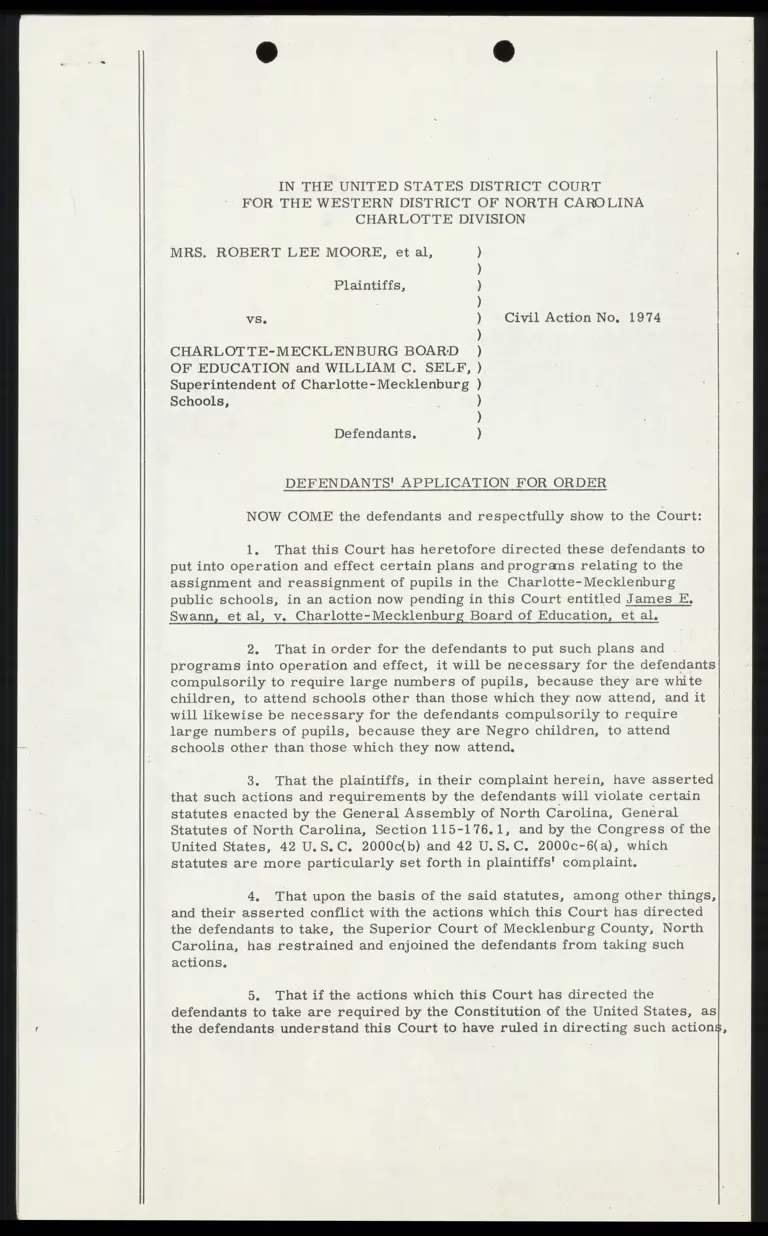
3 pages
-
Case Files, Swann v. Charlotte-Mecklenburg Hardbacks. Defendants' Application for Order, 1970. 2aa84f38-2e34-f111-88b4-7c1e527f53b4. LDF Archives, Thurgood Marshall Institute. https://ldfrecollection.org/archives/archives-search/archives-item/d8b38ecc-4012-444e-b212-3691c8eca1da/defendants-application-for-order. Accessed October 15, 2026.
Copied!
     [||f342466d-853a-459a-a173-36d0691fc870||] IN THE UNITED STATES DISTRICT COURT

FOR THE WESTERN DISTRICT OF NORTH CAROLINA

CHARLOTTE DIVISION

MRS. ROBERT LEE MOORE, et al,

Plaintiffs,

VS. Civil Action No. 1974

)
)
)
)
)
)

CHARLOTTE-MECKLENBURG BOARD )

OF EDUCATION and WILLIAM C. SELF, )

Superintendent of Charlotte-Mecklenburg )

Schools, )

)
) Defendants.

DEFENDANTS' APPLICATION FOR ORDER


NOW COME the defendants and respectfully show to the Court:

1. That this Court has heretofore directed these defendants to

put into operation and effect certain plans and programs relating to the

assignment and reassignment of pupils in the Charlotte-Mecklenburg

public schools, in an action now pending in this Court entitled James E.

Swann, et al, v. Charlotte-Mecklenburg Board of Education, et al.


2. That in order for the defendants to put such plans and .

programs into operation and effect, it will be necessary for the defendants
compulsorily to require large numbers of pupils, because they are white

children, to attend schools other than those which they now attend, and it

will likewise be necessary for the defendants compulsorily to require
large numbers of pupils, because they are Negro children, to attend

schools other than those which they now attend.

3. That the plaintiffs, in their complaint herein, have asserted

that such actions and requirements by the defendants will violate certain

statutes enacted by the General Assembly of North Carolina, General
Statutes of North Carolina, Section 115-176.1, and by the Congress of the

United States, 42 U.S.C. 2000c(b) and 42 U.S.C. 2000c-6(a), which

statutes are more particularly set forth in plaintiffs' complaint.

4, That upon the basis of the said statutes, among other things,

and their asserted conflict with the actions which this Court has directed

the defendants to take, the Superior Court of Mecklenburg County, North

Carolina, has restrained and enjoined the defendants from taking such

actions.

5. That if the actions which this Court has directed the

defendants to take are required by the Constitution of the United States, as

the defendants understand this Court to have ruled in directing such actions,


% » ~

then the aforesaid statutes conflicting with this Court's ruling are also in
conflict with the Constitution of the United States.

6. That the defendants do not know where the law rightly and

truly is upon this conflict, and in an effort to resolve this dilemma, the
‘defendants respectfully call upon the Court for an injunctive order

enjoining and restraining the enforcement, operation and execution of the
aforesaid statutes, and any action by State or Federal officers in the

enforcing or executing or carrying out of said statutes, the ground of

such injunctive order being the unconstitutionality of the said statutes.

7. The plaintiffs in the Swann case now seek to enjoin the

enforcement of State court order which would have the effect of enjoining

the enforcement and execution of said state statute on the grounds of its

supposed unconstitutionality, which must be passed upon by a three-judge

district court pursuant to 28 U.S.C. 22 81 et seq.

8. The desegregation order of this court in the Swann case

does not effectively charge the defendant Board of Education with the

daily task of going forward with plans for implementation of the Court
directed plan; rather it specifies results to be accomplished on days

certain, The order of the Superior Court specifically and directly pro-

hibits any further action by the Board of Education with reference to

implementation of the Court directed plan. The defendant Board of

Education is therefore unable to proceed unless and until the order of the

Honorable Frank Snepp is vacated, modified or dissolved. By virtue of

removal, the Superior Court Judge is without power to take such action,

9. The United States District Court of the Western District of
North Carolina is the only court that can resolve the defendants' dilemma

by modifying, amending or vacating such order, To do so, in view of the

plain meaning of the North Carolina General Statute 115-176.1, the

United States District Court would be required to hold the North Carolina
statute unconstitutional or inapplicable. In view of the action of this

Court in the Swann case in convening a three-judge court for this very

purpose, the North Carolina statute cannot be considered inapplicable.

10. The defendants are not privileged to ignore any order

issued by any court until such time as such orders may be lawfully

modified, vacated or reversed. It appears that the most reasonable action

would lie in bringing this matter on for hearing before a threes judge

court pursuant to 28 U.S. C. 22 81 et seq.

11, In view of the fact that any relief to the defendants from the

conflicting orders of this Court and of the Superior Court of Mecklenburg

County, North Carolina, will involve consideration by the District Court
of the constitutionality of said State statute and if same is determined to

be unconstitutional, the issuance of restraining order in connection there-

with, theh only a three-judge court may properly proceed.


- ‘ ' w pS %


WHEREFORE, the defendants respectfully request the convening

of a three-judge district court to pass upon the constitutionality of North

Carolina General Stamute 115-176.1 and 42 U.S.C. 2000c(b) and 42 U.S, C.

2000 c - 6(a) and further to pass upon the issuance of any interlocutory or

permanent injunction restraining the enforcement, operation or execution

thereof,

Respectfully submitted this 2nd day of March, 1970,


William J. Waggoner

Weinstein, Waggoner, Sturges, Odom

and Bigger

1100 Barringer Office Tower
Charlotte, North Carolina


Benj. S. Horack
Ervin, Horack and McCartha
806 East Trade Street

Charlotte, North Carolina [||f342466d-853a-459a-a173-36d0691fc870||]