Geraldine Sumter Interview transcript
Oral History
May 1, 2025
44 pages
This item is featured in:
-
Interview with Geraldine Sumter for the Legal Defense Fund Oral History Project,, conducted by Melody Hunter-Pillion on May 1, 2025 Conducted in collaboration with the Southern Oral History Program at University of North Carolina at Chapel Hill.
Copied!
    Legal Defense Fund Oral History Project


Geraldine Sumter

Interviewed by Melody Hunter-Pillion

May 1, 2025

Charlotte, North Carolina

Length: 02:25:25


Conducted in collaboration with the Southern Oral History Program at University of North Carolina

at Chapel Hill

LDF Archives, Thurgood Marshall Institute, NAACP Legal Defense & Educational Fund, Inc.


2


This transcript has been reviewed by Geraldine Sumter the Southern Oral History Program, and

LDF. It has been lightly edited, in consultation with Geraldine Sumter, for readability and clarity.

Additions and corrections appear in both brackets and footnotes. If viewing corresponding video

footage, please refer to this transcript for corrected information.


3


[START OF INTERVIEW]

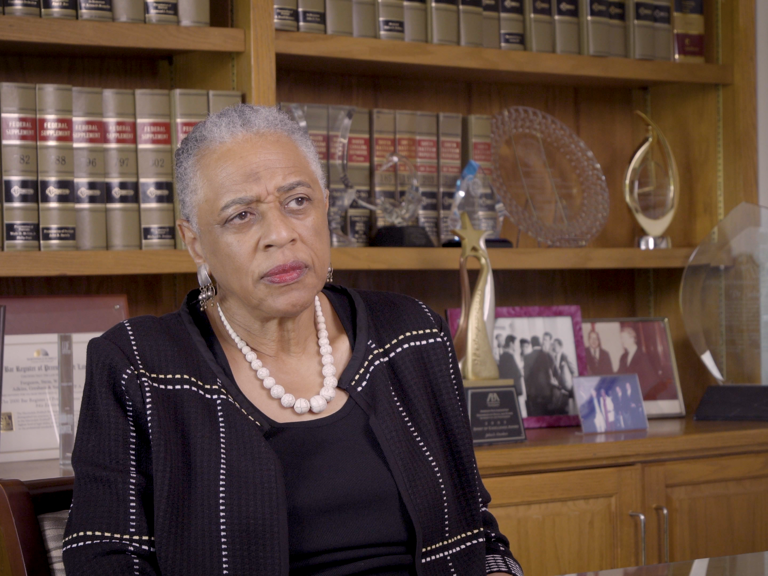
Melody Hunter-Pillion: [00:00:00] This is Melody Hunter-Pillion with the Southern Oral

History Program at the University of North Carolina at Chapel Hill. It is May 1st, 2025. I'm here in

Charlotte, North Carolina with Geraldine Sumter in the law offices of Ferguson, Chambers and

Sumter to conduct an interview for the LDF Oral History Project. Ms. Sumter, do we have your

permission to record this interview?

Geraldine Sumter: [00:00:23] Yes.

MHP: [00:00:24] All right. Thank you very much for allowing us to be here and for sharing

your story. Now, early in your law career you joined what [is] arguably, I would say, the most

historic civil rights firm in North Carolina, and we're going to discuss what it meant to join Julius

Chambers and other legendary civil rights attorneys, and also what that continued legacy means for

you now as a managing partner, but we want to start with who you are. So, tell us about where you

were born and raised.

GS: [00:00:54] I was born in Columbia, South Carolina, but raised about 20 miles east of

that in a small area called Gadsden, G-A-D-S-D E-N, South Carolina. So small it didn't have a stop

light. It did have stop signs, but not stop lights, in a predominantly African American community,

really predominantly African American community. Very few white people lived around us at all.

MHP: [00:01:31] Describe your community for me, the community of your childhood.

Walk us through the neighborhood, tell us about it, the people and the neighbors who were there.

GS: [00:01:45] I think we moved to Gadsden from another rural area called Hopkins, where

we didn't really have any neighbors. We lived close to where my mother grew up. I think I was

maybe four or five when we moved to Gadsden. It was a rural community. At the time that we

moved there, the road was a dirt road. We lived maybe a quarter of a mile on one side from the

nearest house, but then the houses to the right of us were closer. The man and the family who lived

to the right of us had the remnants of a real farm. They grew crops, they grew gardens, one of the

women, one of the daughters, was very knowledgeable of herbs and remedies and potents and all of


4


that. There were farmers, there was a lot of farming around where I grew up. I went to Gadsden

Elementary School, which was an al Black elementary school. [It] didn't have kindergarten —first

through sixth grade, but, in the African American community, people then were very encouraging,

so my older sister was two years older than I was, and the principal allowed younger children to tag

along with older students as long as they were behaved, right? We knew you get to go to school two

days a week or whatever your family decided, and I think my mother allowed me to go two days a

week, maybe it was three, I don't know, but it was not every day. So, you could sit in the classroom

and as long you behave, you can listen, you can learn, and I wasn't the only one who did that. Other

people did it as well, and the principals and the teachers encouraged it. They would give you paper

and tell you what to do. So, I started learning at an earlier age. If there had been a kindergarten, I

would have been in a kindergarten, but that just was not available then. I enjoyed school a lot. If

somebody told me if I had time now, I'd be in a classroom taking some courses now. Because I'm

one of those people who enjoys school for all of the reasons, for the socialization, for the learning,

everything. So, everyone in the community knew everyone. There were different churches that

people were members of, or their families were members of, and so you went to church with some

of the same people you went school with, interacted with, and what have you.

MHP: [00:05:17] Tell me about your parents, what are their names and their professions,

and how did the way they live their lives, and also their work experience, influence you eventually,

and maybe the groups that you've [been a part of]?

GS:[00:05:34] My father was J.D. Sumter. There's no name. It's J.D. Sumter. He was the

oldest child of his mother and father who separated after him, and they both went and had other

spouses and children. There's a huge number of them, actually, on my grandfather William Sumter's

side. There were 12 children on his mother's side, there were eight in addition to him. I had a lot of

aunts and uncles on that side. In fact, my father had two brothers named Joseph and two sisters

named Sally. [Laughter]. Yes. As it turned out, William Sumter's father had two large families, one

from his first wife and one from his second wife. The first wife's children were old enough almost


5


to be parents to the second group of children. It's just a lot of them. So much so that there's small

connections. Now on my mother's side–

MHP: [00:07:09] And your mom's name?

GS: [00:07:10] Lurie Deen, L-U-R-I-E D-E-E N, Robertson, Sumter. I need to back up. You

asked me what my father did. I didn't tell you that. So, my father went into the Service, truth be

told. I think he lied about his age so that he could get into the Service sooner. Korean War vet, and

when he was in the Service, I don't think he was artillery, I think he did support services and food

service and what have you. That's the kind of work that he did basically all of his life. He worked,

and my father worked really hard and long, a full-time job, and if he could find a part-time, he did

so, which was not uncommon for Black men then because the wages were not substantial. He did

that and his mother was a domestic worker. His father did farming and a lot of his brothers were

craftsmen, tradesmen, craftsmen. Bricklayers, that builder industry stuff. They all hunted and fished

and farmed. My mother's family, as opposed to my father's family, initially we're not, on his

mother's side, we're not landowners. His father's side was. My mother was one of seven children.

She had an older sister, and then she and all the rest were brothers. She was second from the

youngest child, grew up in Hopkins, South Carolina. Her father was a carpenter. Her mother

worked at Fort Jackson, my grandfather worked at Fort Jackson also as a carpenter, but he also did

other carpentry work, and he farmed. So, his mother had 44 or 45 acres of land and had two

children. I think it was [19]44, I think they each got 22 acres of land and my grandfather farmed,

farmed, farmed. My mother says that the only thing that they bought was salt, coffee, flour, and

sometimes sugar. Everything else was raised. They raised corn to feed the livestock. They raised

corn that was taken to a grits mill and milled for cornmeal and grits. It was not mechanical farming.

It was the mule and the cows and all of this. And I know this property, relatives still live there, I

own a part of it now, and when I think of this long drive going back along that property line, and

they would have rows of crops this long way. So, it was interesting, but you know. They survived.

They raised the livestock, raised the crop.


6


MHP: [00:11:27] I'm just really amazed at this story, because your folks were rural, very,

very hardworking, farming, self-reliant, they did all that. I think that's an amazing story. Tell me a

bit about, because now I'm having a better understanding of how you grew up, the sort of work

ethic that you saw and the self-reliance that you saw. You said you went to an all Black elementary

school. What was the cultural climate like as you were coming of age and your experiences of

understanding your own racial and socio-economic background?

GS: [00:12:11] I would say that our category would have been poor, even though I didn't

know it at the time. My father worked for Borden's Ice Cream Company, and we had a deep freezer,

and back in that day, it was a chest-sized deep freezer, not an upright. There was a motor in the

deep freezer that took up a part of one side of it. Well, the half—we used to call it the half side of

the freezer—was always filled with ice cream. So, the way I grew up, it wasn't a question of "could

you have ice cream," it was, "don't open another box of ice cream until you finish the one that

you've already opened." [laughter] I thought I was living large, and I probably was. I was raised in a

family that was conscious of political events and the challenges that Black people lived through. My

mother often told us stories about how she and her relatives had to walk to get to a one-room wood

schoolhouse. I mean, she showed it to us when we were growing up. Now, parents can exaggerate,

my mother used to say, "Oh, we had to walk four miles to school."  That was not a four-mile walk.

I'm telling you, that was not a four-mile walk, it just, no, it wasn't! But they did have to walk, and

they were walking on dirt roads and what have you, and white children were riding school buses to

go to school, and when it rained, she talked about how the school bus would drive close to the mud

to splash mud on them, right? So, we were conscious of that. My mother always emphasized

education, and my mother and my father emphasized education. When we were going to Gadsden

Elementary School, my mother was a volunteer at the school often, and very active in the PTA. She

always knew that, back in that day, our books were hand-me-down books from white schools, that

we didn't have the same facilities that they did. When I was in elementary school, the desegregation

effort nationwide had taken place. People knew about Brown, and we knew from our teachers that


7


we had to study hard. We always knew that we had to work twice as hard, be twice as good. There

were, in my whole time, in the six years that I was there, there was one white student who came

through that school, one. There was a time when national standardized tests were given, I guess, to

every student in schools. One of the years that we were given a test, it wasn't given every year. I

think it was given every other year. I could be wrong about that. But one of years, a class scored

two points above the national average on the test. The white people accused the Black teachers of

teaching the test, so after those results came out, we had to be retested. With the testing being

monitored by white people, and the results were even better! So there were several components,

there was math and reading, I think. I don't, at this moment, remember if the scores were above

average on both the math and the reading, but the test was given again, and white people were there

monitoring. The teachers told us, "Now you know y'all did good on the test, but you better do

better, because these people are accusing us of teaching you the test." And they hadn't, they were

just teaching us.

MHP: [00:17:14] You had good teachers.

GS: [00:17:16] Oh, I had really, really great teachers. Those teachers were just some of the

best. Not only did they want you to learn the academic part, but they taught morals. They nurtured

us. No child really went hungry. No child needed anything. A teacher would always find a way to

help a child. I remember when one of my classmates' mother died. Her father had already died. The

mother died, and the oldest of, I don't know, six or seven children was somebody in high school.

The school rallied behind that family, which lived maybe less than a quarter of a mile from the

school. And it was the teachers. This is how they did things and this is how it was done. So, I was

rich. I might have been in the poor class economically, but I was rich in every other aspect of life.

MHP: [00:18:30] And I think you pretty much answered this part, but just in case there's

anything we missed there, I was saying that in this question, your law partners were activists in their

teens, coming of age really before the Civil Rights Movement and during it. How does your


8


trajectory towards civil rights differ from theirs as a preteen teenager in the 1970s. How do you feel

like it kind of differed from this?

GS: [00:18:58] Actually it differed probably in instances of severity, but it was otherwise

similar. I went to Gadsden Elementary and then it fed into what was called Hopkins Junior High

and Hopkins High School. No problem with that transfer. While we were at Hopkins. This is after

Swann and bussing became, well, let me back up. While I was at Gadsden, the Richland County

School District, to comply with Brown, instituted freedom of choice. So, "freedom of choice" meant

that you could enroll your child in another school if you wanted to, but you had to be responsible

for transporting the child there and what have you. And some of the people who attended my church

lived within a mile, maybe even less than a mile of Horrell Hill Elementary School. They were,

instead of assigned to that school, had been assigned to Gadsden Elementary, which was probably

nine or ten miles from them. They were bused. And some of those people, I grew up in church with

them, so I knew them. Their parents put them at Horrell Hill. Some people who were closer to

Gadsden than they were also put their children in Horrell Hill, so they were test cases going into

these schools, which made all the sense in the world. I mean, those children could practically walk

to the schools, and they should have been assigned to those schools all along. One of my cousins,

my mother's family and the property that I discussed earlier was very close to that school. I went to

and grew up in a church called the New Light Beulah Baptist Church. There might be some dispute,

the oldest Black Baptist church in South Carolina, like other churches, formed in, on the side of a

white church or up in the balcony or what have you. But when Dylann Roof, who also lived not far

from Horrell Hill, decided on his rampage initially, that church was his first target because it was

the oldest. But he thought, I'm sure, that he could get more bang for his buck by going to

Charleston, and doing New Bethel, taking out that action against the minister and the parishioners at

New Bethel. As I said, my mother's side grew up not far from Horrell Hill. I remember the grits mill

was not far from Horrell Hill elementary school, it's just there. One of my cousins, one of my uncles

also sent his children to that school. Those were test case children. They didn't have the encounters


9


that Dorothy Counts-Scoggins had here, but it was a challenge for them. So I went to Hopkins

Junior High School, and I guess it was during my years [as a] ninth grader, the school district

decided that it was going to bus us to Lower Richland, that it was going close the Black high school

and ship the Black students to Lower Richland. There's no equal sharing of this bussing. The white

children get to keep their school, their alma mater, their football, da-da-da. In rural communities,

high schools are a common meeting place and it's a catalyst for a lot of things. And so that was

being taken out of the community. I, along with other students, organized protests at the school

board, attended school board meetings, worked with two African American lawyers from

Columbia, John Roy Harper, who was himself a cooperating attorney with LDF, and Matthew J.

Perry, who was a practitioner at Jenkins, Perry, and Pride, a Black law firm in Columbia. Matthew

J. Perry had done lots of cases, did one of the first bussing desegregation cases, got it thrown out in

the District Court in Columbia, the Fourth Circuit Court of Appeals, said that his client should have

a day in court. He got to try the case the jury ruled against him. This was all before Rosa Parks.

Matthew J. Perry and John Roy Harper represented us before the school board, and before then I

had seen, you know, Perry Mason shows and thought being a criminal lawyer would be a great

thing, but once I saw them I thought, "Oh, I need to do, this is what I really need to do." They were

both lawyers and eloquent and smart. Matthew Perry was not conservative in the sense of right-

wing politics conservative, but he was conservative in terms of how lawyers acted. John Roy

Harper on the other side was a member of the Black Nation and was as militant as he could get and

had red, black, and green flags and what have you around him. So, I had two different personas to

gauge what I wanted to do and I thought I like both of these I got to figure out how to do this.

MHP: [00:26:06] Wait I'm so sorry, this is amazing, and they both worked on the case

together?

GS: [00:26:10] Sure! Sure, they were excellent. Both of them provided excellent counsel

they came in together. I'm not sure but we had a very active parent group in the NAACP, and my

mother and father were dues-paying NAACP people, but not active in going to meetings or what


10


have you. But a woman named Hattie Fruster was a very active NAACP member, and I don't know

if she pulled Matthew Perry in, but she also knew John Roy Harper. I don't know how they got

together, but they worked together with us on this case. It involved us going up to HEW in DC to

meet with some undersecretaries. We weren't able to stop the plan, but we were protesting and

raising claim and marching all summer long, and going forward with a lot of reluctance to this

school. That's similar to some of the experiences, particularly [James Ferguson II] Fergie's

experience in Asheville. So, after that, I knew that I was going to do civil rights work. I wasn't sure

if I was going to do criminal, even through the time that I was in law school. By the time I finished

law school, I knew I didn't want to do criminal.

MHP: [00:27:51] But certainly, as you're headed into college, into undergrad, you're an

activist by then. You understand civil rights and you are willing to be an advocate at that point.

GS: [00:28:06] So let me tell you this, so this merger of a bunch of Black students in white

schools, at this white school, the white kids say, "Well, welcome to our school." They didn't say

"Welcome to your school, da da da." There were issues in that process. In my first year, the football

team was, with the exception of two or three people, all white. And the cheerleading squad didn't

invite a lot of people in. I think Cathy Ward, one of those students that I told you about earlier, was

on the team, and maybe one other person. But they just did not embrace all of these other students.

So, we had at Hopkins, all of the officers in student government, all of those positions of leadership

that students would otherwise have, there was no place for them at Lower Richland. We started

raising issues with that, with the principal, and so he called a meeting in the school cafeteria, and as

we are raising our concerns with him, the back door of the cafeteria burst in. All of these football

players and the coach, yes, with bats and boards. Yeah. Now, people at the front, seeing this chaos

kind of spilled out of the front doors of the cafeteria, but they literally came in under those

circumstances, and some African American students were assaulted. There were some fights, some

confrontations. It got under some kind of control. So, for at least a week, maybe more, there was a

police presence on the school campus. Of course, we contacted Harper and Matthew Perry. None of


11


our students were charged with any offenses, although some were threatened, I believe, but we also

got assistance from a fellow named Hayes Meisel, who was a white man connected with the ACLU,

which had printed for students a guide to their rights. We distributed that, and after that issue, there

was, I think, still some reluctance, but an acceptance that the Black students were going to be

involved in things. We put up candidates for student council and all of that. I ended up being the

student council president. They had, at that school, they had a more formal AP program than we did

at Hopkins. The teachers at Hopkins would just identify students put them a grade ahead. Like when

I was in eighth grade, I got into ninth grade math and English classes or what have you. But when

we went to Lower Richland, nobody told us about the AP classes. So, for my 10th grade year, at

least the first semester, I don't think I got into any AP classes. Those students who were in the AP

classes before, they missed out on some of those AP classes, and it affected our GPAs going

forward. Two of us were in top 10. That's debatable, but we felt cheated, right? That progression

and those experiences at Lower Richland helped me understand the importance of voting. So before

I was eligible to vote myself, I started holding voting registration in my community. There was a

magistrate, Ms. Simms, Margaret Simms, who had, in South Carolina, I don't know that they do it

so much now, the magistrate, once elected or appointed, had to build their own office, and so she

built an office. It was a little brick building. She conducted her hearings, and they took care of

traffic tickets and that kind of stuff. I called her and asked her if I could get the voter registration

folks to come down, could we use her office? She said, "By all means."

MHP: [00:33:40] What grade are you in at this point? Junior in high school?

GS: [00:33:46] Probably a junior, 10th or 11th grade. I did it more than once, and I know I

did it as a senior, because you could register at age 18, or if you were going to be 18 by the time of

the next election, you could register before. You need to be close to 18 in order to get that

registration in, but that was the rule. I knew those registration rules down pat. So, I got on the phone

and I called everybody I knew and I told them from 9 to 12 on that Saturday morning, I was going

to be down there. The people from the voter registration office would be there and we would be


12


registering people to vote, and I think we registered 22 or 23 people, which was, the registrars told

me, was just excellent, and that they would come back any time. So, I did another one, and then

once I realized how many seniors were turning 18, oh, I did this in my junior year. So, I started it at

the high school in my junior year. Before I think I may have been in the 10th grade, but so my

junior year and senior year, I did them on the campus. I had the registrars come out, got the

principal's approval, I was in student government. I said, "this is a student government project,

we're going to do this." I went around and I told everybody, "You're 18, you're going to be 18, you

need to go register," and people could get out of class and go register to vote. So, we registered a lot

of people to vote!

MHP: [00:35:35] I'm just amazed at how strong-willed you were. Can I just ask you, what

were your parents saying or thinking?

GS: [00:35:42] Oh, they were supportive. They were supportive, except, my father was a

little chauvinistic, but he only had daughters. So, he had his idea about what his daughters were

supposed to be and how their lives were supposed go. Mine was different. But he didn't stand in my

way.

MHP: [00:36:00] Well, no doubt, you have this very early on, developed this political

consciousness. You're an activist who is really engaged and a leader very early. Then you attend

Howard, is that right?

GS: [00:36:17] Yes.

MHP: [00:36:17] For your undergraduate studies. Graduating Phi Beta Kappa in 1978? Is

that right, [19]78?

GS: [00:36:25] Yeah, [19]78.

MHP: [00:36:25] What was your major at Howard and tell us what that experience was like

and sort of how that, even though it sounds to me like you already knew you wanted to go into law

and a particular type of law, but what did that experience at Howard add to your movement forward

for that?


13


GS: [00:36:45] So, at Howard, I completed the requirements for two majors. Howard did

not give, quote, "double majors." So, on the paper, it says political science, but I also completed the

requirement for economics. In my first year at Howard, during freshman orientation you're exposed

to a lot of different campus organizations, and the one which resonated the most with me was

something called the DC Survival Project. That project was headed by some graduate students, but

had a lot of undergraduate students as well. And the other one that resonated with me was the

February First Movement. The February First Movement was named the February First Movement

in commemoration of, and in solidarity with, the sit-ins at A&T. It was purely political theoretical.

The DC Survival Project was a much more hands-on activist group, engaging students in the

political process and the community efforts. It had a history of doing, we would now call it election

protection work, campaign work, get-out-the-vote work, in local DC politics. The year that I went

there, they wanted to expand their get-out-the-vote efforts by looking at areas across the country, or

throughout the South, not across the whole country, but in the South, where students could serve as

volunteers in a get-out-the-vote effort. So, this was in 1974. Between my graduation in May or June

of [19]74 and the time that I went to Howard, I worked on a political campaign for Matthew Perry,

who was running for Congress for the Second Congressional District in South Carolina, a heavy

Republican district that nobody gave him a chance, and no white person had ever won. But he had

done better in the final analysis than anybody else. So, when they started talking about going down

South to do voter mobilization, registration of what have you, I told them about that campaign. And

they said, "Well, that's one that we know about and we are considering." I said, "Well, if you decide

to go, I want to go." Two weeks before the election, we took off, some of us ended up in South

Carolina, some ended up Louisiana, some ended up in Georgia. We were all doing the same thing.

MHP: [00:40:16] This is your freshman year?

GS: [00:40:18] Yeah. So, I got permission, I went around, I told all of the professors what I

was going do and got permission. So, I think there were four people in Columbia, and I didn't stay

at home, we stayed in dorms at Benedict College. The folk had made all of those arrangements.


14


From early in the morning, as early as we could get up and get over to the campaign, we were either

preparing materials to send out, at a decent hour we were canvassing and phone banking, and we

did that through Election Day. And then we went back to school. The DC City Council elections,

like most City Council elections across the country, are an odd number of years. So, in 1975, I

think, a fellow named Clifford Alexander ran against Mayor Washington for Mayor. Now,

Washington won, he was old school, but we were more focused on District 2 that had a woman

named Nadine Winter. Oh, how do I remember these names? But she was phenomenal, and she was

so hands-on. A lot of people know Marion Barry. Well, Marion Barry was on the City Council at

that time, and he was a phenomenal constituent advocate. A lot of City Council and County

Commission people interact with their constituents differently, but the ones who are always

knocking on their constituents' doors, always asking what they need, always going to their churches,

are the ones that I think do the greatest service. And Nadine Winter was one of those, Marion Barry

was one those. Here in Charlotte, he's dead and gone now, but, why did I [forget] his name will

come back to me, but, he was very good like that. I mean, if you wrote him a letter, he'd write you a

letter back. People called and said, "I can't pay my electricity bill." Now, what does the county

commission have to do with electricity? But he would get on the phone and use his power and find

somebody to help get those bills paid. Bob Walton was his name. It was so that process at the

beginning of my tenure at Howard was exciting. I stayed with the DC Survival Project and all of its

projects through the time that I graduated. We did community action stuff, food stuff. We had a

tutorial program, all of it. It was one of the more radical groups on the campus. There were other

service projects, and there were sororities and fraternities. But it was the more radical, more

educational in terms of political ideology. So, I was grateful for that. Just exposure on different

political theories, and so that just reinforced my interest in being an activist. I mean, it was like a

powerful course, really.

MHP: [00:44:27] You've already talked about what really inspired you to become a litigator

when you were talking about Perry and Harper. So, you're at Howard. You graduate from Howard


15


and then you decide to obviously get your JD, you go to Duke Law in [19]81. Does that sound

right?

GS: [00:44:53] Graduated.

MHP: [00:44:53] Okay, graduated in [19]81, but what was it like to be in law school at that

time? A very different type of campus, a very different type of place, North Carolina, than being in

DC at Howard. But how did being at Duke Law influence your thinking about being a civil rights

lawyer, and tell us about any particular classes or professors who stood out, also, if you don't mind.

GS: [00:45:19] So when I went to Duke, I knew that I would be in a predominantly white

environment. I knew there weren't any tenured faculty of color. And in my class, maybe 160 people,

there were five African Americans. At no time during my tenure there were there more than 18

African American students in the first, second, and third class. I mean, total was 18. Now, I went

back 15, 20 years after I graduated. There were so many Black people. I was like, "Wait, how many

people in your class? Well, this is phenomenal." I was happy. [Laughter] No, seriously, I saw Black

students all lined up. I said, "Well, sometimes undergraduates would go to the law school to study,

or the law students would go over to the engineering library to study or whatever." And I said "How

many, how many people in your class?" And in one class, there were 24. I was like, "Whoa!" I was

like, "God, that's more Black people than the whole time I was here." So I was, at Howard,

encouraged to think, to reason. At Duke, I think we were being prepared to serve corporate masters.

In fact, there was very little in way of public interest law at Duke when I was there. They now have

a decent program. They had a trial [advocacy] program. Which had, I think, one faculty member,

maybe one or two faculty members, but they taught other courses as well. And one of the people

that they brought in was a man named Charles Becton. He's an African American. The Duke Trial

Advocacy Program was largely staffed by people who were associated with the National Institute of

Trial Advocacy, which was established in 1971 after then-Chief Justice Berger, in conversations

with ABA, American Bar Association, leadership, bemoaned the lack of experience among trial

lawyers. So, NEDA, as we call it, which still exists today, set about trying to figure out how to


16


educate lawyers in trial advocacy skills. It was a trial by doing. They videotaped lawyers. They

gave feedback. They took them through the drills, everything. That was the model for a lot of the

trial ad programs all across the country that were being brought into law schools. It was not a part of

the core curriculum. So, if you thought you were going to do corporate work, you didn't go through

a trial ad program. Primarily people who thought they wanted to do criminal law or knew that they

wanted to do litigation either in mass torts or personal injury, domestic, what have you, that was the

avenue through which you would get basic trial skills, courtroom skills. So, I did that and was

active in the Black Law Students Association then, was cognizant of the issues involving the

admission even of Black students to Duke initially. I believe the man's name is Vernon Robinson

was the first Black student admitted to Duke, and during my tenure there, BLSA had a reunion

meeting of sorts. We reached out to the 40 or so graduates and asked them to come back and meet

with us. It was a good turnout. I understand that they recently had another meeting and that man

was present there. Charles Becton went to Duke Law. His wife went to Duke Law, she had gone to

Duke undergrad and, so there have been moments of activism on the Duke campus around race

issues before I got there. But otherwise, you now, most of my professors, I was planning to take the

South Carolina Bar. And in 1977, maybe [19]78, the South Carolina State Bar decided that in order

to take the bar, there had to be certification that you had taken certain courses. They had to show up

on your transcript. And if they didn't show up in your transcript, then there had to a letter from some

professor saying that those materials were covered. And I think there were 14 or 15 core courses

that you have to have. So, my choice of courses was guided in large part by that, and they were the

very traditional courses, property, constitutional law and what have you, none of which I regret

taking, but wish that there were more opportunities for other courses. I did take a constitutional law

seminar slash civil rights seminar under a man named [William] Van Alstyne, [the] program had

maybe eight students in it, and every week we produced a paper, a brief, on some constitutional

issue or a civil rights issue, section 1981, 83, immunity and that stuff. The experience at Duke was

challenging in a lot of ways, but it was a tremendous period of growth.


17


MHP: [00:52:12] But the trial ad program that you talked about, that was taught by Becton?

GS: [00:52:21] He taught some of the classes, but the professor, the two people on the staff

at Duke, see, he was adjunct. He was a practitioner, one of the practitioners who came in, and he

was associated with NEDA. He was known and is still known for his opening statement lecture. But

Beskind, [Donald Beskind] and Adrienne Fox were the professors. And there was a fellow who was

an adjunct there, Tony Bocchino. They wrote trial ad books. At some point, they were in that

process.

MHP: [00:53:05] But you would continue to go on to truly learned from Charles Becton, as

you clerked for him, is that right? So, tell me about that experience of clerking with the Honorable

Charles Becton, North Carolina Court of Appeals, and how that, as well as being a staff attorney for

Palmetto Legal Services, how did that sort of lay that foundation for the work that you're doing

now? I know those are two different [roles]

GS: [00:53:37] So I should back up and tell you that between my first year and second year

in law school, I clerked for the firm. So that's how I met Becton. He and Adam Stein were in the

Chapel Hill office. I passed the interview down there and got referred up to Charlotte because they

already had someone who was clerking for them full-time down in that office. So, the internships

were available here. I clerked that summer.

MHP: [00:54:13] Between L1 and L2?

GS: [00:54:19] Mm-hmm. Between L2 and L3, since I always thought I was going to South

Carolina to do work for Legal Services, that was what I had envisioned, there was a woman down

there who was doing really good work. What happened? Ronald Reagan got elected as president in

1980. I graduated in 1981. He was installed in 1981, and one of the first things that the Congress

did under Reagan was limited the scope of work that Legal Services corporation offices could do.

Previously, they had done the full gambit of poor people's work, including class actions and

housing, just all economic development, everything. Anything a poor person who met the eligibility

requirements brought to them, they could have done. Well, it restricted their practice to landlord-


18


tenant, domestic, and some consumer stuff. Maybe some issues involving land, quieting title and

what have you, doing deed work and wills and what-have-you. So, that was a little disappointing

because it was really in full swing. It wasn't so much when I clerked at an office in Sumter, South

Carolina, between my second and third year, but when I got the job as a lawyer in 1981, those

regulations had been approved and so there was a retrenchment in the scope of practice for legal

services. And I would have stayed with legal services, except I became active in the North Carolina

Association of Black Lawyers student division when I was at Duke. It was a division of students

from North Carolina Central, UNC Chapel Hill, and Duke. So much so that there were students

from those schools, and we met, we had an agenda, we did things. I would say to people, "Oh yeah,

I was in school with so-and-so, I was in school with so-so." So, one of my friends, Anthony Fox,

married a woman named Selma Fox. And at some point, Selma was in a session or somewhere with

me and they said that I went to Duke Law School. So, she came up to me and she said, "Geraldine, I

thought you said you were in school with Anthony." I said, "Yeah, I was. We were classmates."

"But he went to Central, and you went to Duke." And I said, "Yeah, but we were in the same deal."

We considered ourselves classmates. That was true of all the people who interacted with that group.

I just considered them to be my law school classmates. So, we were at one of those, the Black

Lawyers Association met as a full body three times a year back then, October, January, and June.

So, I'm leaving South Carolina to go join them for their October meeting in Raleigh. I'm just driving

up, I'm going back to see folk, right? I'm sitting down talking to somebody, and Chambers walks by

and said, "Hey, how you doing? What you doing?" And I told him I was at legal services, and he

said, "Well, you need to call me. I got something for you to do." So, I called him and he said, "You

need to come up here and interview, these people need to interview you. When can you come? Can

you come on a Sunday?" And I said, "Well, yeah, I guess so." So, that meeting was near the end of

October. I am sure probably before Thanksgiving, I know before Christmas. I meet up here on a

Sunday afternoon. Chambers was late, he'd been out playing golf. But the other people had started

the interview, and he came in and a few days later, I get a call from Fergie. Was it Fergie? I think it


19


was Fergie saying, "Okay, we're going to offer you a position and this is going to be the salary. This

is what we can pay you. Is that going to all right?" Well, it was a whole lot more money than I was

making at legal services. So, I said, "Oh yeah, that's fine." [Laughter]

MHP: [00:59:23] Let me step back a little bit. When, again, you're sitting there and Julius

Chambers comes by and says, "Hey, I want to talk to you. I might have something for you." What is

going on? I'm just trying to have a sense of you know who he is.

GS: [00:59:39] Yeah, because I'd worked for him. I'd done work with him when I was here

that summer.

MHP: [00:59:45] So what were you thinking? Because that seems like a big deal, and you

had worked for them, you know what the firm has done. So maybe we should start there, just from

knowing how much of the history, even having worked for [them]. Did you understand about the

the magnitude of the history of this firm?

GS: [01:00:04] I didn't know all of it before I started, but I knew Chambers was associated

with Swann. I mean, that was just such common knowledge, I think, among people who were in law

school or who were about law school. Actually, a woman who was in the law school, two classes

ahead of me, Rhonda [Winston] had also clerked for the firm, and she told me that I should apply.

I'm so sorry, I can't remember Rhonda's name, but she's now, I think, a magistrate judge in DC. It's

going to bother me that I can't remember her name. She's from Chester, South Carolina. [Laughter]

But in any event, I applied and I knew generally that it was a civil rights firm. I also knew of James

Ferguson because while I was at Howard, my younger sister was also there, and she was a TV and

film major. She worked with a filmmaker who came out of UCLA when they were doing activist

filming, his name is Haile Gerima, and he was working on a project, "Wilmington 10 - USA

10,000." So, Haile's Friday afternoon classes were open to anybody on the campus, and if they were

screening pieces of work and getting feedback on it, anybody could come. So, I enjoyed it, so I

would go down and sit and listen to them talk film talk. It was by going to those sessions that I

learned about the Wilmington 10, and I saw footage of Fergie that they had shot as he's talking


20


about his police misconduct cases and about the Wilmington 10 case. So, I felt like I knew Fergie. I

didn't know anybody else before I went to law school, and the film came out in the fall of [19]78.

We arranged a screening at, I got the Duke undergrad and the BLSA, we arranged the screening

over at North Carolina Central, and Ben Chavis, who was one of the Wilmington 10, had been

released on a study parole to attend Duke's divinity school. So, we had a session at Duke's divinity

school with Ben Chavis and members of the film crew and da da da, before we went over to do the

screening of the film.

MHP: [01:03:10] So when you had your interview, was James Ferguson, was he there for

that interview?

GS: [01:03:16] For the Sunday interview, yes.

MHP: [01:03:18] Oh my goodness.

GS: [01:03:19] I knew of the firm from mostly that. I didn't connect Fergie and Chambers

until I was in law school, and I didn't connect Becton until I was in law school. How did I know

about Becton? Somehow or another I knew about Becton because I called Becton to say, "We're

doing the screening, you want to come, da da da da," so that's a long story to tell you what I knew

about the firm then. But certainly when I got here, there may have been 15, as a student, I think

there were 15 lawyers. There were two women. The first one was Yvonne Mims Evans, and the

second one was Leslie Winner. Leslie Winner came after I went back to school, and the rest were

men. I worked on different projects with a lot of them, Mel Watt, Karl Adkins. I don't know that I

worked with Fergie that summer, but I did sit through a trial that he was doing. Jonathan Wallace,

John Gresham. I think I did some work with Jim Fuller also.

MHP: [01:04:58] Adam Stein, was he [there]?

GS: [01:05:01] He was in Chapel Hill.

MHP: [01:05:05] Talk about if you will, so you've started, you're at the firm, and just sort of

those first two–


21


GS: [01:05:10] Oh, the question you asked me was, what was I thinking when Chambers

came up and asked me?

MHP: [01:05:16] Right, was it like you were like, "Whoa, this might be a great

opportunity?"

GS: [01:05:19] Oh, of course, I thought if Chambers wanted me to come work for him, I

would do that. Especially since at the time that he asked me, my very first client at legal services in

Lexington, South Carolina was a white woman who came in seeking to have a legal separation

because her husband had beat her, and when she got to me, her bruises were three or four days old,

and they were turning green and brown. I don't know if that's right, purple, green, brown, whatever.

It was badly discolored, bad discoloration and swollen, and she said, "I want a legal separation."

Then she described what all this torture this man had put her through, and I said, "Well, why don't

you want a divorce?" She said, "Well, all the other lawyers were men," [and they] told her that she

couldn't get a divorce, in the state of South Carolina at that time, you had to present enough

evidence to convince a judge that you were in threat of imminent danger to your life, not just to

your body, but to your live. So, I say, "Well, we're going for a divorce, and if the judge doesn't give

us a divorce then you can get your legal separation, but we're going for a divorce." At that point, her

husband had beaten her. He had harassed her so much on one of her jobs, she had two jobs, on one

her jobs that the company got a restraining order against him. He had cut her fuel line to her car. It

was really bad. But he had moved out and he was living in Richland County. I lived in Richland

County, I worked in Lexington. She lived in Saluda. I file the papers, and back at that time, a

hearing on a divorce couldn't be granted until 90 days after service of the complaint, but you could

the hearing anytime between 80 and 90 days so that the order would be ready for the judge to sign

on the 90th day. So, I notice this hearing for Saluda. We're in a courtroom not much bigger than this

room. Judge's desk is over in the corner, the clerk is somewhere near there in a desk the size of one

of those old elementary school teacher desks, and there is a table maybe four, five, six feet long to

which both the lawyers had to sit. Now this man didn't have a lawyer, he didn't respond to the


22


complaint, but I still had to up evidence, [the] judge agrees, somewhat reluctantly, somewhat

reluctantly, that yes, he would grant the divorce. Now, there's one door in and one door out of this

courtroom, except the little one that goes back to the judge's office. So, I go out, and my client and I

look, I said, "You see any cars that look like his?" She said, "No." But she was so happy, she got in

her little Volkswagen and drove off, went back to work. That was on a Tuesday. On Saturday

morning, a paralegal calls me, Well, not morning, but noon-ish, and says, "Geraldine, did you hear

what happened to [REDACTED]?" Her name was [REDACTED]. I said, "No, what happened?" I

said, "We got the divorce." She said, "No, her husband went to– " between the time that I filed the

papers, he burned the house down. So, her people moved her, helped her buy a trailer, and put it on

property that they had there. This man goes to her house on a Saturday morning and pulls out a

revolver. She's getting ready to go to one of her part-time jobs. He pulls a revolver and starts

shooting her. Her eight-year-old daughter from a previous marriage and their four-year-old daughter

are in the house. The eight-year-old daughter takes out, runs, gets halfway to the great-aunt's house

and realizes that the four-year-old is not behind her. I think about this child all the time, this eight-

year-old child went back into the house to get her four-year-old sister and she finds the husband has

the four-year-old under one arm and he is trying to reload the pistol. She grabs this child, wrestles

this child away from him, and runs and escapes. He then shoots another round of bullets into this

woman and escapes. So, when I get this call, this man is on the loose, for all I know. He also lived

in Richland County, so I'm thinking, "Oh, is this man now coming after me?" So, I'm waiting and

waiting for some word. The next day around lunchtime, I call the sheriff's office to see if he's been

apprehended. I tell the story, "I am the lawyer, da, da, da, da." Everybody says, "Oh okay, hold on."

And I go through four people. Finally, I get to the sheriff himself, and I tell the sheriff the story, and

he says, "Yes, he's been apprehended." I said, "Oh, thank you." I said "Now I need to know when

he's going to be arraigned, da-da, the bail or da-da-da." You know how you can tell people are not

listening to you? He let me talk. He said, "Okay." Later that night, I get another call from a different

paralegal, and she says, "Geraldine, you heard about [REDACTED]?" I said, "Yes, he got


23


apprehended." She said, "No, he hung himself in his jail cell around lunchtime." So, he apparently

had just hung himself when I'm making the calls, and I knew then I'd never do any more domestic

work. Because after they told me this man hung himself, I said, "Thank you, Jesus." Now, you

know a man just hung himself and I'm saying "Thank you, Jesus," and I meant "Thank you, Jesus,"

at that moment in time. I'm not proud of that fact, but that's what I said. So that plus another of our

clients, not mine personally, had been shot and killed. Then another of my clients had been killed

and stuffed in the trunk of her car. So, when Chambers said, "I might have a project for you," just

the opportunity to work again with the firm was enough motivation, but yeah, that was good.

[Laughter] And that weekend, to solidify it, by the time I came to the interview, another woman

who had been killed, one of our clients, not mine, had been killed in some girlfriend domestic

dispute, had been buried in a cemetery, and was one of the graves that some people had vandalized

and exhumed some bodies in the Elmwood Cemetery in Columbia, South Carolina, that caused an

FBI investigation and all of that. So, when they came, whatever that money was, was fine. They

could have paid me less, I would have gone. [Laughter]

MHP: [01:13:12] So you start working, and as you say, by now you do have some

background on [them] they have the Wilmington 10 case, the Swann case, all of that. You're in a

really important firm that's doing really important civil rights work, working with LDF.  Tell me

about just sort of your impressions of the first few months. Like, how was it working with them and

what kind of cases did you get, or what was that like at just the beginning?

GS: [01:13:45] I started work technically on December 31st, 1982. Literally on December

31st, 1982. Ella Hand was the office manager and she told me that I needed to be in the office on

December 31th, 1982 so that she could put me in the profit sharing pension plan effective January

1. If not, I'd have to wait until July 1, so I showed up and Mr. Chambers showed up, or Mr.

Chambers was here, and he said that I had to come to work the next day. So, I worked on January

1st, 1983 as well. Mr. Chambers assigned me to a case in Fayetteville, North Carolina that he had

brought against Fort Bragg, a purported class action, that he brought on behalf of Fort Bragg


24


[African American employees]. So, on January 2nd, I was driving, either 2nd or 3rd, I driving down

to Fayetteville in Fort Bragg to [defend,] I was defending depositions. I want you to know, when I

said to him, "How am I to get there?" He said, "Take 74 and 401 bypass and then get on that and

then you'll figure it out." So, I understood, back then it was called South Independence Boulevard,

is what 74 was, and I said, "Now, which way am I supposed to turn on 74?" [Laughter] I said, "Now

let me get my bearings." I don't know that I'd ever been to Fayetteville, but I'm sure that I had seen

some signs maybe off of 95. I'm sure I'd heard of it, and I had heard of Fort Bragg. But I remember

sitting there at the intersection where the parking lot was in 74 and thinking, "Am I going to go

right?" I could only go right, but then I didn't know if I was going to have to make a U-turn to go to

the left or to the right. Then I said, "Well Fayetteville is in the east, so I need to be going 74 East."

And this is dark. It's dark when I'm leaving. I'm going to a hotel. What was that hotel? The Heart of

Fayetteville? No, it wasn't the Heart of Fayetteville. That was the second hotel that we were in. It

was some hotel not far from Womack Hospital. I'm going with all of these boxes and all of this

stuff, and I'm trying to get up to speed. I'm trying to understand these employment cases. We'd

covered a few employment cases in law school, but he got this long list of cases, and somebody's

copying these cases. So, once I get there, I need to be reading these cases and preparing for the

depositions, and then getting my clients prepared for the depositions. So, it was pretty intense. I

didn't find a place to live in Charlotte until maybe April or May.

MHP: [01:17:34] My goodness. Because you came in and you hit the ground running and

they sent you straight to Fort Bragg.

GS: [01:17:41] So my mother lived in Columbia then, so sometimes I would go to her house

and change the clothes and then get back on the road. I'd spend the night in a hotel. If I were in

Charlotte for two or three days, I'd stay in a hotel. Then one of my friends from law school, Shirley

Fulton, said, "Oh, Geraldine, you can stay at my house." So, when I had a few days here, I would

stay at Shirley's house, and she was very resourceful. So, she helped me find a place finally.


25


MHP: [01:18:10] At what point did you begin working on any cases that had to do with

LDF or also just sort of your awareness of how well LDF was involved?

GS: [01:18:20] Well, LDF was involved in that case.

MHP: [01:18:21] In that particular case? Do you recall the LDF attorneys that you worked

with on that case? But that was your first?

GS: [01:18:28] Yeah, Chambers was not Director Counsel at that point. He was on the

board of LDF. So, he would just find whoever, I can't remember all of them. But there was one

woman, Gail Wright, who did a lot of work on the case. I think Penda Hair did some work. But in

addition to that case, Chambers had a number of other cases that he had either tried or were on

appeal that were class actions also associated with LDF. One of which was, as I was here that

summer, it was called Norwood v. Charlotte Memorial Hospital. Later named Oliphant v. Charlotte

Memorial Hospital. He had Chisholm v. United States Postal Service. I didn't do any work on that.

John Wallace was the primary lawyer on that, so I came back, I did some more work, not as much

on the Charlotte Memorial case. He had these cases against, [American Tobacco Company]. There

was a tobacco company in Reidsville, North Carolina. I didn't do a lot, I helped with the

disbursements. That was easy work, you're giving people their checks, and then Chambers had

some education cases representing teachers. I don't remember the woman's name, but it was a

promotion case. She was a long time assistant principal, either a teacher trying to get an assistant

principal position or an assistant principle trying to get a principal position, he had me work on that

case. We actually tried that before, I think it was Judge, either Judge Gordon or Judge Hiram Ward

in the Middle District of North Carolina. It was a non-jury case as Title VII cases were back then.

So those were the early cases that I remember working on. Now, [Thornburg v. Gingles] was going

on simultaneously. I did not work on the Gingles, did no significant work on the Gingles case, but

subsequent to that, there was [Shaw v. Hunt] And Shaw v. Reno and all of those cases. Gingles was

the redistricting case for the North Carolina General Assembly, and then we had the congressional

races involved as well. Everett Robinson, who was a professor at Duke and who was thought to be a


26


sort a liberal dude, really challenged voting districts since then. So then you had the Shaw case to

come up. It was [Shaw v. Hunt] and Shaw v. Reno. The challenge, the congressional districts. So,

Mel Watts' District, the district that was created for the 12th Congressional District and the First

Congressional District. At first, the General Assembly, North Carolina General Assembly, said,

"Oh, we can do one congressional district for Black people." But then there were those of us who

were on the mindset, and there was not unanimity within the firm, as to whether we ought to stick

with this one district or not. But I remember saying to Mel, "So what, let's go get two districts. If

they're going to rule that it's illegal, then at least we will have some incumbency on our side." So

the firm ultimately voted that we should be advising clients to go for two congressional districts,

and that's how we got the first, because there's a huge Black population in the northeastern part of

North Carolina, and what they did to get the critical mass of Black voters was, they strung the

district from Durham through Greensboro and Winston into Charlotte and parts of Gastonia to

collect enough people, so that you have the "one man, one vote" criteria met per congressional

district and people criticize that district because it wasn't cohesive and it wasn't compact, but the

argument was, that it was in fact cohesive, because it was connecting urban areas and that was the

commonality when it came to that district, and, as it turned out, the district the second time was

upheld. I wasn't happy with the explanation that was given to defeat the reverse race discrimination

claim, because a part of that was that the General Assembly wanted to preserve incumbency and

wanted to preserve the delegation as it stood. At that point, it was pretty even. It was either six or

seven Republicans or six or seven Democrats, whichever. But my fear was that if you started

protecting incumbency, then that would lead to so many other excuses, and we see that now in big,

big, measure. But I was delighted that we had won these two congressional seats and they still exist,

except the first got redistricted in 2020, in 2020 got redistricted in such a way that it was a

Republican-leaning district, even though there were a lot of African Americans in the district, there

was no way for them, because of that redistricting, to return an African American to the Congress.

That's why G.K. Butterfield did not seek re-election, because he had held the seat after Frank


27


Balance. No, Eva Clayton had it first, [she] was the first person elected from North Carolina after

Reconstruction. George H. White was in the Congress and the Reconstruction came and his re-

election didn't happen. Eva Clayton went into office because the incumbent retired or died or

somehow or another left before the term and because she had already won the seat, she was

appointed to the seat, and then Mel Watt, of course, won the election for the 12th Congressional

District. So, he became the second [African American] person from North Carolina to sit in the

Congress after Reconstruction.

MHP: [01:26:29] George White, right, almost 100 years later, almost a hundred years later.

GS: [01:26:33] Mm-hmm.

MHP: [01:26:34] Something to say.

GS: [01:26:41] So now, on these LDF cases?

MHP: [01:26:44] Yes, yes.

GS: [01:26:46] So, LDF, I should say, was involved in many more cases associated with

this firm than I know about, even during the time that I was here, because they were involved in

some of Fergie's police misconduct cases. They obviously were involved in the Swann case, and

they were involved in Capacchione, which is the case that sought to have Charlotte-Mecklenburg

Schools declared a unitary school system and therefore remove the dictates of desegregation that

were imposed under Judge McMillan's orders. So, LDF was very involved in that and had local

counsel associated with it. LDF involved in all of the voting rights cases from Gingles through

Shaw. We had a lot of school desegregation cases that were still open. We still have some that are

still, two or three, that are down east which have not yet been declared unitary status. LDF was

involved in those. LDF was involved in redistricting cases at the local level. So, in school board

races, in city council races, and in county commission races, when we had those disputes, we often

had LDF support on that.

MHP: [01:28:17] Let me ask you about a specific school desegregation case, Burris v. Rock

Hill, because you practice in North Carolina and South Carolina.


28


GS: [01:28:27] Correct.

MHP: [01:28:27] Is that right? So, talk to me, sort of walk us through that case. What was it

about? How did you prepare? How did you work with LDF attorneys?

GS: [01:28:40] LDF actually was contacted by the plaintiff in that case whose name I

cannot know, not Burris, it was another woman who was active in NAACP work, about her

children's placements. So, it was about districting where children went to school. LDF filed a

lawsuit. I was local counsel. I was admitted to the federal court in South Carolina at that point and

had practiced there. Dennis Parker was the senior-most LDF lawyer on that case, and with him, I

think this man's first name was David, but his last name was Douglas, and then there was Chinh Le,

two lawyers who were younger than I was. I was young then too. [Laughter] But they were younger

than I was! The complaint was filed, and who is the judge on the case? Matthew Perry, [Laughter]

who himself had been a cooperating attorney for LDF, but, his trajectory after he lost that

congressional race, he was appointed to the U.S. Military Court of Appeals. So, he had all of this

judicial experience, and when a vacancy came, there was considerable political pressure to appoint

an African American to the bench, and he was appointed. By the way, the federal courthouse in

Columbia is named the Matthew J. Perry United States District Courthouse, and it was a brand-new

courthouse. In any event, that's a digression. So we go, I think we were at a status conference, and

Judge Perry told us, we talked about discovery. We didn't get to do a lot of discovery in that case

because he talked to us about early mediation and the parties agreed to early mediation. It took us

two sessions. There were some parents, white parents, I think, somebody down there intervened,

and a fellow named Parks, I can't remember, white man named Parks. I can remember his first name

now, but he was with the Southern Economic Foundation, and they were bringing a lot of reverse

discrimination cases. So, I saw him in that case, and there was a fellow named Billups who worked

with him. But it took us two sessions to negotiate a response, and we did. We had a mediator down

in Columbia. The last session, I think we left there 11 o'clock at night, but we had an agreement.

The agreement was accepted by the Court and by the parties. Specifically related to pupil


29


assignment, and I think some issues of teacher assignment also. But it was these two younger

lawyers who were doing all of the grunt work and filing all of their papers. One of them said, "Oh,

we need to have something filed in Columbia by tomorrow." I said, "Well, we can overnight it," and

he said, "You know, I can drive it down there, I could drive it down there," and I said, "So go on

and drive it," you know, from Charlotte, it was only, at best, two hours drive. I think even back

then, we had late night drop boxes so you could drop your pleadings in the box overnight, anyway,

it got there. But they were very energetic. I'm not supposed to talk about what happens during a

mediation session, but I will tell you, I was so proud of them, I mean really, really proud of them.

At one point, mediator comes back with some statement and response from the other side and Chinh

Le just went off on the mediator, and "we're not doing this, and you tell him to do this, and that and

la la la la!" I was like, "Okay!" And, David Douglas then chimes in, kind of suave and debonair and

states our position and said, "So we could do this and we can do that," and "But no, they need to do

this…" [REDACTED].

MHP: [01:34:27] But the LDF attorneys, they were?

GS: [01:34:32] [Laughter] And then the mediator looked at me like, "Can you help me out

here?" I said, "I'm a part of this team, and I'm a part of this team." I'll never forget, that was so

delightful and refreshing. So that day, I don't have contact with Douglas much. I think he went more

into politics, but Chinh Le left LDF at some point. He married a woman who had been an LDF

lawyer, Vanita Gupta, who at one point was head of Civil Rights at Justice [Department], really a

very smart woman. She did a lot of work with police reform, but he went and headed up a legal

Services office in Arlington, I think maybe in DC And then worked for them and then went to

Arlington, Virginia. That was a wonderful, wonderful experience. All of my experiences with LDF

lawyers have been remarkable. We represented a group of people who, in 2020, were doing a get-

out-to-vote rally in a march. No, this was [20]22 Against Alamance Sheriff's Office and Burlington

Police Department, I think.

MHP: [01:36:08] So is this Allen v. City of Graham?


30


GS: [01:36:10] It was Graham. So, these people were creating a rally of sorts to encourage

people to get out to vote. This is the last day of early voting, which is the same day voter

registration voting. So, they wanted to march down to the police department, because you know,

this after George Floyd and people are still dealing with police brutality issues and so at some point,

near the police station, they do the kneel, they were going to kneel for eight minutes and 46

seconds, I think it was, and pray. The police come out trying to disperse it, but just start spraying

pepper spray all on them and manhandling them, arresting them, everybody who was at the march.

That day [all of whom were] pepper sprayed, with the exception of one person, had already

registered to vote, but by the time all of this ended, this is on a Saturday, usually the Saturday

voting ends at one o'clock or so, so they don't get to do early voting. One person was going to

register and vote that day. He missed his registration day, so he couldn't even vote in the general

election. So, that case had LDF. I think Covington and Burling was involved. There were two

parallel cases. There was something, just for the next generation. It was an organization that was

also involved there. We sued on behalf of those people under Section 1985, the Anti-Klan Statute,

under the Voting Rights Act, under the North Carolina Constitution, speech, freedom of speech and

assembly articles, and for assault and battery because these people were assaulted. We had, I think,

nine individuals who were victims of assault. We sued for compensatory and punitive damages for

them. We sued the sheriff, the police department, police, the chief of police. We sued the city and

the county. We did early discovery because we didn't know the names of all of the [officers], and of

course individual officers, but we didn’t know the name of all the officers, and again, court talked

about mediation. So we did what was called early mediation, agreed on a mediator, a fellow out of

Durham, North Carolina, I believe it was. We were able to do the mediation, I think in one day, all

day [Laughter] all day long.

MHP: [01:39:50] And who were you working with from LDF?

GS: [01:39:52] So in that case, Leah Aden, Natasha Merle, who is now United States

District Court judge in New York. Anuja [Thatte], that is another one. [Ashok] Chandran, what is


31


his first name? Anyway, that was that group. Oh, I have it written down, Ashok Chandran,

representing the people in that parallel case was a woman named Elizabeth Haddix with the

Lawyers Committee at that time, formerly the Julius Chambers Center for Civil Rights, which UNC

had decided could no longer litigate. So that, again, was a very, very good experience.

MHP: [01:41:09] How did the mediation go?

GS: [01:41:13] My clients were very, our clients were very, very happy. They got monetary

relief, they got injunctive relief, they got what we call non-economic relief in changes in training

from both the sheriff department and the police department. Both settlements were approved by

both political parties, and they both paid 50% of the settlement.

MHP: [01:41:45] Strikes me how this goes to how you first started as an activist though,

right? That's a voting rights thing and trying to get people registered to vote and educating people

and then in the middle of these folks trying to reach that goal, they're assaulted and pepper sprayed.

But with you and LDF attorneys through mediation, you win. It's a victory. Who approached

whom? Was it that LDF said, "We're going to take this case," or you guys, they came to you?

GS: [01:42:17] They came to us.

MHP: [01:42:18] And then you approached LDF?

GS: [01:42:20] No, no, no. The clients got to LDF first. Well, am I saying this right? I think

this is a case that the client got to LDF before it got to us. I could be wrong about that. I'm not sure

that case didn't come in through Fergie, and he referred it down. My memory is not great on that.

MHP: [01:42:53] And then the other case I want to ask you about and then if there are

others you want to add, please do because you you have many many here, but we've you talked

about redistricting. Stevenson v. Bartlett, but that is not one that had anything to do with the Shaw

cases, though.

GS: [01:43:16] No, it was separate. So that one would have been, I think, after the 2000

census and redistricting for the North Carolina General Assembly, House and Senate. We

represented the NAACP. There were some individual voters from different districts who were


32


complaining. Primarily, the Republicans were arguing that the General Assembly's plans violated

the North Carolina Constitution that said that for seats for the General Assembly, county boundaries

were to be respected and not divided. That provision did not apply to the congressional seats.

MHP: [01:44:16] And that's that whole county provision.

GS: [01:44:18] Yes, yes. So in addition to some Republican people who were supported by

the Republican Party, the NAACP, there was a county, Pender County, had fewer residents, like

less than 50,000 residents, and in order for the one-person-one-vote distribution to work, their

county was really split among seven, eight, six, seven, eight different legislative districts. They

argued that their county should not have been split as such. So the ultimate result was that the

Supreme Court, this case is titled differently. It's Bartlett v. Stevenson in the United States Supreme

Court, I believe, and Stevenson v. Bartlett in the North Carolina courts. But the Supreme Court

upheld the Superior Court that ruled on a summary judgment in favor of the plaintiffs. That case

came, that case interestingly, was tried in Johnston County, outside of Raleigh. It's the county next

to Raleigh, which until sometime in the mid [19]70s, had a big Klan sign that said, "Welcome to

Johnston County." So, we went down there. We were basically aligned with the Board of Elections

and the North Carolina General Assembly, whose attorney general, I think, at that time, was

represented by Edwin Speas. We were aligned on the same side. At that time, Shelby had not come

out, the case out of Arizona that did away with the Section 5 pre-clearance requirement, the

NAACP needed to be in that case because we needed to be sure that even though the whole county

requirement was a part of the North Carolina Constitution, there have been cases that said, that

federal law on pre-clearance preempted that. If it were necessary to get pre-clearance through the

Justice Department, that would be fine. Now, the Justice Department, at some point in history, had

issued a letter before this case, saying that the whole county provision would not, in and of itself,

violate Section 5. We ended up with the whole rule, the whole county rule, in effect, at that point.

Critical in the discussions on how they maneuvered after the decisions were how did they redraw

lines. I was involved with people like Jim Richardson, Charlie Dannelly, [Mickey Michaux] out of


33


Durham, because there was so much potential for us to lose some ground in the Senate and the

House because of some of the redistricting that the whole county rule would have insisted upon. So

that was one case. There were other cases. I did not involve LDF in, I don't think, any of my

individual employment cases, but some of them were ripe for class action, just on racial harassment,

but I did not have clientele who were ready to sign on. I sued Sara Lee [Knit Products Corporation]

out of Rutherfordton, North Carolina, on behalf of one man named Eddie McIntyre. He was a

member of the maintenance department. In the maintenance department, I've had many Black

people who work in maintenance, not pushing the broom, but the mechanical maintenance part of

these big companies who have experienced such harassment. You know, "n****r this, n****r that,"

noose drawings in the workplace, it's just been horrific. But the overall amount of oppression that

people in those small communities experience, many of them did not have the courage to go

forward. So when you get a client, like an Eddie McIntyre, who goes forward, or who, like one of

my witnesses, Jeffrey Hemphill, suffer retaliation for standing up as a witness, you recognize the

strength and the courage of people like that in those communities where they lived. Where I'm

driving up to Rutherfordton, taking depositions in a bank conference center during winter months.

When, five o'clock, it's dark and I'm traveling out of these areas going by places like Ellerbe where

some of these purported Klansmen lived and where they are telling me, "Be sure just keep driving,

don't go through Ellerbe," and I was cautious, but I didn't have sense enough to be really really

afraid then. This day and time now, with all the "stand your ground" and firearms being so prolific,

I think I'd be a little more cautious. I then sued the same company for retaliation and harassment

against Jeffrey Hemphill. Now both of those cases settled.

MHP: [01:51:08] So in both cases, it was Sara Lee [Knit Products]?

GS: [01:51:11] Both of them settled. After discovery, mediation was par for course after

summary judgment motions were denied. I had another case against R.J. Reynolds involving a man

who worked in their marketing department. He was the only African American his entire time with

that company. He was subjected to the same kind of harassment, nooses in the workplace, people


34


calling him "Booger" and "Bubba," and just a lot of stuff. His work involved doing promotional

stuff at these racetracks. So, he's told he can't go into certain areas in the racetrack, or he can't wear

certain paraphernalia. They had all of the swag that went with it, and it was just a mess. [The] Judge

denied summary judgment on that case, and then we settled it, as well. But in 1998, within two

months, I had two Black men come to my office with nooses, the actual nooses. Those cases got

resolved, but one of them had a wife and she absolutely refused to have the noose back in her

house. I think I still have that noose back down in my office. I mean, I laid it out on this table, and

I'm going to tell you, I had seen photographs of nooses and probably seen some in some museums,

but to have one, the first man when he brought his in, I laid it out on the table and photographed it

because he didn't want to leave it. In another case I learned, this one was against Duke Power, a

man worked in maintenance at a coal-powered plant in Belmont. He's off for his Christmas break

and he comes back and hanging from one of these ceiling tiles, low enough to hit somebody who's

between five and six feet almost in the face, put up by one of his co-workers, a little figurine stick

man with a noose around its neck. The thing was about so big, I took color photographs and

submitted it to the court, and a white woman said, "y'all better take [that and tell] management,"

they had a safety meeting in this area every morning. "Y'all had better take this down before Leeper

comes back, he's not going to like this." So in the course of that case, I learned [a] quote "bonafide"

noose has 13 rings on it.

MHP: [01:54:34] I'd never know that.

GS: [01:54:35] Right. So it's not a lasso, it is not a this, but if you got the 13 rings on it, you

got a bona fide noose. If I had this back, I'm going to show you that noose, but I was

discombobulated by the sight of it in my office. I'm in the safety and security of my office and I was

discombobulated. I don't know how these people dealt with it, and then another, the other man

worked for--

MHP: [01:55:04] Can I ask you though first, in those cases, do they continue to work where

they work?


35


GS: [01:55:12] Leeper stayed until he retired. Cuthbertson left, and Kason was fired. Alex

Kason, was fired, he complained and he was fired but he had been subjected to all of these racial

jokes, this was after Obama got elected. "Where are all the people going to be who go to the

inauguration for Obama? Kentucky Fried Chicken." You know, the noose and calling people

"n****r this," and "why can't, if they say "n***a" on the radio, why can I say "n****r" to you?

Why can't I call you "n****r?" And just a lot of stuff. So that case settled also. We did some

discovery, but we went through mediation and it settled. So when I saw the second one, I thought,

"Oh my God, we are in for bad times." Because now, remember, I started in earnest in [19]83. It's

15 years before I see a live noose. Now, some other clients had talked about nooses in the

workplace, or drawings of nooses, in the work place.

MHP: [01:56:40] But even as you talk about nooses, that seems like something that would

have been, right, during the Jim Crow era, the era of lynchings. So it's so disturbing and

disheartening, right, to hear it in very current times.

GS: [01:57:00] I'm sure there are, and since then, since those two, I have had other cases

where, not a full-blown noose of rope with sufficient strength to hang a person was used. So I've

seen other things and photographs that people have taken of pictures of nooses or pictures with a

person with a noose around it being posted on walls and what have you.

MHP: [01:57:34] I have a few wrap-up questions, but I think since we're sort of coming out

of the cases now, I do want to ask you, when I think back to you watching Harper, is that Harper?

And those two, those first two [lawyers]

GS: [01:57:49] John Roy Harper and Matthew Perry, mm-hmm.

MHP: [01:57:52] What are you like in the courtroom? Are you Harper or Perry?

GS: [01:57:55] I'm both. So, and I think Harper's style in the courtroom was similar to

Matthew Perry's style in the courtroom, but outside it was different. Perry said to us, when we were

organizing, "This is the rule: you're always calm. You lose your cool, you lose you case." Chambers

never raised his voice. I have raised my voice a few times in the courtroom, but, I'm a steady


36


litigator. I'm matter of fact. I'm not overly dramatic or overly emotional. I tell my story, my client's

story, in a way that has themes beyond just my client, so that I am resonating with the judge and the

jury on how this is wrong and how my client has been wronged. Employment discrimination cases

are extremely difficult, because we are expected to prove some direct evidence of discrimination

when generally that does not exist, although now we see more of it because people are more

careless and feel, now, bold and empowered to say and do what they want, but I'm respectful of the

court. I'll tell you this story about this case that I had with Chambers. It was down in Fayetteville in

federal court, and the judge would come in every morning and say, "Good morning, gentlemen,"

and there were two women at the table, sometimes three, with Mr. Chambers. So I wouldn't speak. I

mean, I just wouldn't respond, and the women would look around. I went to the clerk, his clerk. I

said, "The judge comes in and says, good morning, gentlemen. And we're standing up here wearing

dresses and suits. We are women." So the judge keeps doing it, and at some point, the judge has a

conference in chambers with the lawyers. We get to the chambers and he says, "Oh, gentlemen,

come in." I turned to the clerk and I said, "You've got to do something about this." So the next day,

the judge comes in and he says, "Good morning, counsel." And he says to me, "Now, Ms. Sumter, I

want you to know that I have a female law clerk and my daughter is a lawyer. So I have utmost

respect for women practicing law. So, from now on, it will be 'Good morning, counsel,'" and it was,

from there on. But it was just simple things, because there weren't that many women practicing

then. [The] Women Lawyers Association might have had a hundred people across the state of North

Carolina at that time, probably as few as Black women, as Black people. My demeanor is always

kind of matter of fact, I'm prepared, I know my facts, I know the law, I'm ready to argue. In a case

that I think the opposing side is going to argue, I read, I study, I probably prepare more than I

should, but I don't want a judge to ask me something that I don't know. Now, you might ask me

something I don't remember, at which point I will say, "Judge, I know the answer to that, they're not

coming to me now." After I got gray hair, I felt confident enough to say that, and I said, "but I'm


37


going to tell you, I get it." And sure enough, it comes to me. Or I said "just give me a minute, I'll

find it for you."

MHP: [02:02:00] What would you want the public to know about LDF and your work with

incorporating with LDF that maybe they don't know now?

GS: [02:02:15] Well, it does not matter to me if the public knows about my work with LDF,

quite honestly, but what I would want the public to know is that LDF has had a long history of

cooperating attorneys across the South who have assisted in cases either by bringing cases to LDF

or joining LDF once cases have been brought to LDF's attention. The body of cooperating lawyers

has dwindled substantially because the lawyers who first came in have retired or died or moved on.

So, there aren't very many of us left from the old days. Oh, my goodness, I said old days!

[Laughter] You know, LDF has a Civil Rights Training Institute, and last year, at that institute, they

asked all of the cooperating attorneys to come and stand and take a picture, and I think there were

seven of us. Back in the day, I mean, that would have been 50, 60, 70 people. What LDF is doing

now, it has opened an office in Atlanta, a regional office in Atlanta. It is building out the

infrastructure for more cooperation and collaboration. I noticed that in South Carolina, they filed a

lawsuit challenging the General Assembly's admonition or restrictions on what people could teach

about race and all of this stuff that ALEC came up with saying, "You can't make somebody feel bad

because you're teaching history around me." You know we feel bad being the descendants of

enslaved people. I noticed that there's a young lawyer down there that they have partnered with. So

we remain cooperating attorneys. My last case with them was [the Hannah Nichol-Jones], issued at

[UNC.] That was a lot of hard work, but we never actually filed a lawsuit in that case. The Board of

Trustees eventually offered her the job and she declined it and went and taught, now teaches, at

Howard, but I do think that the public would want to know that LDF is still in the South. It has

refocused its efforts in the South on race issues. It has been the recipient of a major [donation] from

a private donor to establish what is called the Marshall Motley Scholars Program. You may be

familiar with it. It is in its fifth year. I have had such an honor to have been asked to sit in on the


38


panels to interview these young people who will commit to 13 years of civil rights related work,

two years in non-profit, either foundations or work with people who do civil rights-related work

related to race. Civil rights is a very broad umbrella, but this program focuses on issues of race

discrimination. This year will be the second year of graduates from law school and will be the fifth

year of cohorts, which will probably be announced before the end of May. So, they aren't

cooperating attorneys as we know them, but after their 10-year commitment, they very well could

be and hopefully will be, but in the meantime, I know that LDF wants to have a deeper bench of

cooperating attorneys, and I've been an advocate for that for years.

MHP: [02:07:16] How do you think LDF, in your opinion, can continue to do meaningful

work in the 21st century? Besides making sure they have this pipeline, right, of bright young

attorneys who want to do this type of work?

GS: [02:07:33] LDF sent me a questionnaire asking me what I thought, and not just me, but

other people as well, what I though LDF should do and what they should concentrate on. My

response to them was, in these trying times, with this political climate as we have, most of my life I

had just dealt with discrimination. I have not dealt with this level of oppression by government, it's

unparalleled in my lifetime, but from the mid or early [19]50s through the mid-[19]60s, there was

this thing called McCarthyism. What we have now is a convergence of that McCarthyism era with

the worst of the Jim Crow, almost the worst of the Jim Crow. We aren't seeing lynchings as such,

but we're seeing shootings. We're seeing, we went from enslavement to mass incarceration. We're

seeing police brutality. We're seeing harmless, unarmed people shot and killed by police who say

they are afraid, and a Supreme Court who says, "Well, it would have been reasonable in that split

section for him to feel that his life was endangered." I mean, the police academies have taught

people how to de-escalate matters, and they have taught them how to be safe for themselves. So if

you open yourself up to shootings, then what are you expecting? We had two shootings here. Where

Black officers involved did not shoot but white officers did. Now I think a part of that is training. I

think that young white officers have drank the Kool-Aid of an extra-violent, young Black male


39


always being armed and is their greatest enemy [stereotype]. I just think that that is ingrained in

them. So when they come to these situations, like the shooting of the young man who [was]

involved in a one-car accident and was trying to get some help but was disoriented, was shot by a

young white man who was not convicted. And I understood why he was not convicted, because he

was in a situation where he had been trained that if non-lethal action had not been effective, then

they should go to lethal. Then you'll just immediately go to lethal. So he did as he had been trained,

but better training is necessary. Plus, I represent police officers. I represented African-American,

and I represented white law enforcement officers in connection with their employment, one to get

benefits for disability and another in an ADA claim, because he was prior military with PTSD and

was hired with the department knowing he had PTSD, and then all of a sudden when he asked for

an accommodation they said "we can't accommodate you." But in any event, I said to LDF, or my

response to the survey was, that they needed, even in this time when there's so many things that are

going wrong, that we need to be champions of democracy because Black people have always been,

we have undergirded this notion of democracy, because without it we really don't stand a chance.

Minority representation depends on strong democracy, and that it should focus on three or four

areas. We can't be everything to everybody. We can sign on to other people's pleadings, but we

need to focus on the issue of race in voting, in education, in employment, in police misconduct.

MHP: [02:12:10] Is there anything else you wanted to add that my questions didn't address?

GS: [02:12:15] No, but I will tell you that I am extremely excited by what I see coming out

of LDF now. Sherrilyn Ifill followed John Payton and Teddy Shaw, and boy, did she do a job. I

mean, it's just outstanding, and along the way, her Associate General Counsel or Assistant General

Counsel, I don't know what her title was, Janai Nelson, was brought along and nurtured such that

she was the natural successor for the position, and she too has done a phenomenal job. I mean, the

depth of what LDF has accomplished is amazing to me. When Sherrilyn first assumed the position,

I was talking to her one night about some case. I don't remember what case it was, but she said,

"Yes, we're doing this, that or the other." She said, "And you know, Geraldine," and we're talking


40


late at night, she's saying, "you know, I've got to go do a press release about something." I don't

know if it was Shelby or what have you, and I said, "Sherrilyn, you should not be writing press

releases. You need to have somebody on staff. You reorganize your staff, you get somebody on

your staff to do [that]." They have got an outstanding communications department. I mean, it is so,

so, on the money, and just putting in place an infrastructure that allows for growth, infrastructure in

terms of all of the back office work in terms of maintaining the archives and the legacy material.

Donna the librarian has been there forever and she's just phenomenal. You just don't ask for

anything and she can't go put her hands on it. Also building a cadre of lawyers who have not just the

inclination but the energy. This work requires a lot of personal sacrifice. We want people to have as

balanced lives as possible, and LDF I think is recognizing that in a way that, you know, Chambers

had a family, but it was not a balanced life. His children will tell you that. They loved him, but they

saw him when they saw him. So that was a sacrifice not only for him but also for his family to

make. So I am hoping that the staffing will be adequate to take on their priorities without overtaxing

the personnel we have because I think the greatest resource in an organization like LDF is its human

capital. The fundraising is good, the money in the bank or wherever they get money from is good.

But it is the human capital, the ingenuity, the determination and the actual implementation of

whatever strategies they come up with is done through people. That is what I would leave you with.

MHP: [02:15:48] Well, I just want to say thank you as one of those people who is added to

this history of the work, of the body of work. I want to thank you for sharing your story today so

that it can be preserved and tell the story of all this work that has been done for all of us.

GS: [02:16:08] I did this because I was asked to do it. It's not something that I seek. I mean,

in fact, years ago, just took the position that I don't do awards, so don't ask me to come to

something and get an award. I'm not doing it.

MHP: [02:16:24] I read that on a website somewhere, it was something about an award that

was being given to you and in your speech they were like, "Well, and she said, she doesn't want [it]"

I would say, and Jesse, I'm sure has seen this many times, everyone we spoke with, a lot of them are


41


that same way, and just very humble about not wanting the attention and always understanding that

this is a larger, bigger thing.

GS: [02:16:51] We are a part of a struggle because we lose cases, we get kicked out of

court, we win cases, yes, but trust me, there are losses, losses, losses along the way, and when they

were dedicating this courthouse to Matthew Perry, they had a CLE where Black lawyers in South

Carolina who had done civil rights work talked about how they didn't get paid fees and how they

were married to teachers and their teacher salaries were sometimes necessary to pay the secretaries

in the law firms and what have you, and when they talked about Matthew Perry what they said was,

"He may not have had those blockbuster cases, but what he was doing on a daily basis was hitting at

the foundation of discrimination, he was chiseling away at stuff." And that is really how this

struggle, this litigation struggle progressed. So, we went from Plessy v. Ferguson in 1896 to Brown

v. Board of Education in 1954. Along the way, there was a chartered strategy. Go back and look at

Sweatt v. Painter, and all of those other cases where individual states were challenged on not

allowing people into graduate schools and what have you. In the state of South Carolina, the first

instance of school desegregation by an African American person into a public institution was when

Harvey Gantt integrated Clemson University, and Matthew Perry was a cooperating attorney and

his attorney on that case.

MHP: [02:18:38] You know what? I interviewed Harvey Gantt about that and I forgot that

name because he mentions him in that, in fact, I, it was the first interview that I did, even before I

came here to interview Mr. Ferguson and Ms. Ella Hand, we interviewed Harvey Gantt.

GS: [02:19:00] So you have interviewed Ella?

MHP: [02:19:02] We did.

GS: [02:19:02] Good, good, good.

MHP: [02:19:03] Oh yes, we interviewed Ms. Ella.


42


GS: [02:19:04] Oh my God, oh my goodness. You want to talk about history. When

Thurgood Marshall used to call the office for Chambers, he talked to Ella first. She answered the

phone.

MHP: [02:19:17] [I was telling] Jesse, she's the glue that, she's held this whole thing

together for all, since it started.

GS: [02:19:22] Yeah, man, it's amazing.

MHP: [02:19:25] Oh, Jesse, did you have any questions?

GS: [02:19:30] So, that whole progression of cases that started with Briggs and Brown and

all the nine cases combining into Brown. A part of the strategy was they don't want the children to

go to school, so let's try desegregation at the graduate school, graduate and professional school

level. Well, the thing through the South was they didn't let people into graduate and professional

schools. They would give them tuition to go to a Northern school. So, a whole lot of Black people

got degrees from Columbia and Boston and Wesleyan and all of those places and NYU, paid for by

the Southern segregationists. Then eventually when Harvey gets into Clemson, by then, gets into

Clemson, there are other avenues and people are trying to implement Brown, but it was like they

didn't want young Black boys in elementary school with young white girls. The question in my

mind was, "but it was all right for grown white women to be in classrooms and grown Black men?"

That whole strategy was time consuming, 60 years almost, and that was just to get to Brown. So

Swann was in 1971. Right, almost another 20 years, and even after Swann, school districts all over

the country, we think of the South as being racist, and it deserves that connotation, but what some

people get confused about is the level of racist behavior in Northern states. Look at Baltimore.

Theoretically, you'd think Baltimore would be a little bit over the Mason-Dixon line, but Maryland

is Southern. The thing that struck me most during the turbulent [19]70s and school desegregation

was nothing that I experienced. It was a cover. I think it was Look, it may have been Life magazine.

In Boston, the white man with the U.S. Flag daring a Black man, pointing it as a spear. That to me

was the most troubling image of all. Out of all of the things that I saw, I remember the King riots


43


and all of that. For me it was the most troubling thing. I was shocked. I said, "This is Boston." And

what we didn't know and appreciate from the South is how racist and protected and segregated

some of those immigrant neighborhoods were. To some degree, some of them still are. In the South,

it was Black and white. Now we're Black, brown, yellow, and white, and sometimes that gets a little

convoluted in terms of just racial dynamics. Look, I can honestly say, as far as I knew, white people

were white people. I later learned, like when I was in high school, that Jews were a different class of

white people, because I couldn't tell the difference. They all looked white to me. Antisemitism was

just not heard of. I knew I was in high school, maybe college, probably in my senior year in high

school before I even heard of anything about antisemitism, but now we studied World War II and

the Holocaust and so I knew the Jews were persecuted, but still to me they were white people

because I couldn't tell the difference between them.

MHP: [02:23:50] For many of us in rural communities, we really didn't have Jewish

families in southern rural communities.

GS: [02:23:56] Not that many, yeah. Yeah, there were some in Columbia.

MHP: [02:24:00] Not growing up in rural North and South Carolina, we wouldn't have,

yeah.

GS: [02:24:05] Although it's a cross they bear, too. I had this white man once tell me he was

Catholic, right? Here in Charlotte, a lawyer, he said, "Now Geraldine, you probably don't know

this," and I did not. I appreciated him telling me. He said, "So you know the white power structure

in the South had a pecking order. Black people, then Jews, then Catholics." He was Catholic. I said,

"Really?" He said, "Oh yeah, we get beat up." He said, "Me and my Catholic friends would get beat

by white people because we were Catholic." This is the Baptist Bible Belt, and this was here in

Mecklenburg County.

MHP: [02:25:01] I can believe that.


44


GS: [02:25:05] So, discrimination can be nuanced, racism can be nuanced, but when it

comes to African Americans, the descendants of enslaved people who did not come here by choice,

there's a difference for me.

MHP: [02:25:19] Thank you.

GS: [02:25:19] Sure!

[END OF INTERVIEW]