Memorandum of Law in Support of Motions
Public Court Documents
January 1, 1972
4 pages
-
Case Files, Milliken Hardbacks. Memorandum of Law in Support of Motions, 1972. 63b62e19-53e9-ef11-a730-7c1e5247dfc0. LDF Archives, Thurgood Marshall Institute. https://ldfrecollection.org/archives/archives-search/archives-item/dc6b1f97-f062-4b78-afb5-2b92ac777dc7/memorandum-of-law-in-support-of-motions. Accessed October 05, 2026.
Copied!
UNITED STATES DISTRICT COURT
EASTERN DISTRICT OF MICHIGAN
SOUTHERN DIVISION
RONALD BRADLEY, et al., )
)
Plaintiffs, )
)
-vs- )
)
WILLIAM Go MILLIKEN, et al., )
)
Defendants, )
)
DETROIT FEDERATION OF TEACHERS, )
LOCAL #231, AMERICAN FEDERATION )
OF TEACHERS, AFL-CIO, )
)
- Defendant- )
Intervenor, )
)and )
)
DENISE MAGDOWSKI, et al., )
)
Defendants- )
Intervenor, )
)et al. )
_____________________________________ )
CIVIL ACTION
NO. 35257
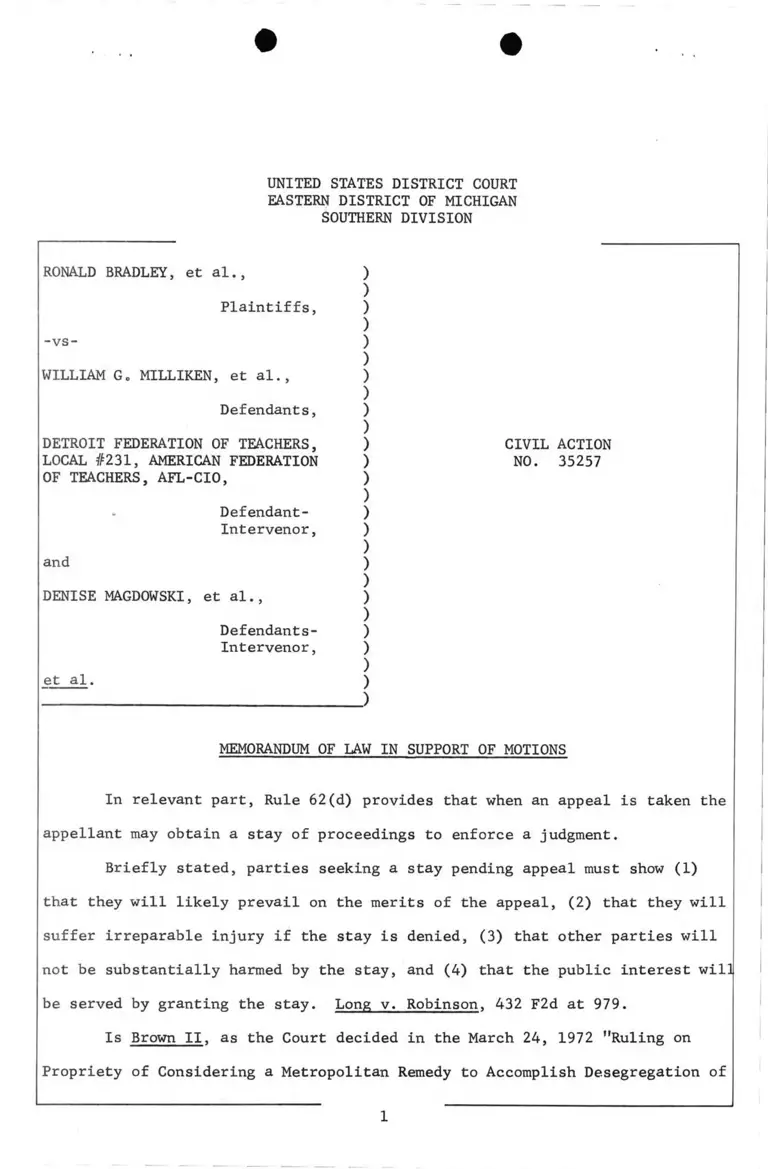
MEMORANDUM OF LAW IN SUPPORT OF MOTIONS
In relevant part, Rule 62(d) provides that when an appeal is taken the
appellant may obtain a stay of proceedings to enforce a judgment.
Briefly stated, parties seeking a stay pending appeal must show (1)
that they will likely prevail on the merits of the appeal, (2) that they will
suffer irreparable injury if the stay is denied, (3) that other parties will
not be substantially harmed by the stay, and (4) that the public interest will
be served by granting the stay. Long v. Robinson, 432 F2d at 979.
Is Brown II, as the Court decided in the March 24, 1972 ’’Ruling on
Propriety of Considering a Metropolitan Remedy to Accomplish Desegregation of
1
the Public Schools of the City of Detroit”, dispositive of the unprecedented,
threshold and landmark question number 3 for briefing in the Court's March 6,
1972 "Notice to Counsel"?
The Court of Appeals and the Supreme Court, as the case may be, are
likely to say "no” not only for the reasons set forth in the "Objections by
Defendants-Intervenor Kerry Green et al. to Testimony and Exhibits Concerning
Metropolitan Remedy”, filed on May 4, 1972, but also for the reason that the
alternative metropolitan desegregation area and plan remedy as now granted is
inconsistent with and contrary to the admonitions in Swann at 22-23:
The constant theme and thrust of every holding from
Brown I to date is that state-enforced separation of
races in public schools is discrimination that violates
the Equal Protection Clause. The remedy commanded was
to dismantle dual school systems.
We are concerned in these cases with the elimination
of the discrimination inherent in the dual school sys
tems, not with myriad factors of human existence which
can cause discrimination in a multitude of ways on rac
ial, religious, or ethnic grounds. The target of the
cases from Brown I to the present was the dual school
system. The elimination of racial discrimination in
public schools is a large task and one that should not
be retarded by efforts to achieve broader purposes
lying beyond the jurisdiction of school authorities.
One vehicle can carry only a limited amount of baggage.
It would not serve the important objective of Brown I
to seek to use school desegregation cases for purposes
beyond their scope, although desegregation of schools
ultimately will have impact on other forms of discrim
ination. . . .
Our objective in dealing with the issues presented by
these cases is to see that school authorities exclude no
pupil of a racial minority from any school, directly or
indirectly, on account of race; it does not and cannot
embrace all the problems of racial prejudice, even when
those problems contribute to disproportionate racial
concentrations in some schools.
and at 24:
. . .The constitutional command to desegregate schools
does not mean that every school in every community must
always reflect the racial composition of the school sys
tem as a whole. . . .
2
Litigant prudence and judicial prudence, at the very least, together
caution an appropriate stay of proceedings to enforce the possible fall 1972
term metropolitan desegregation plan as ordered pending a timely and secure
appellate review of the unprecedented, threshold and landmark questions of
law and fact upon which the ultimate fall 1973 term plan as ordered in this
action is predicated.
The national significance of the action at bar is no less than this:
If Brown II is dispositive of the question of propriety of the metropolitan
remedy as ordered, then Brown I will at once thereby have been rewritten. If
this Court is affirmed on appeal, then every district court, relying upon the
Brown II instrument of equity alone, may consider and enforce an enlargement
of the desegregation area beyond which a Brown I constitutional violation is
claimed, shown and found.
All key issues are formulated and decided.
Do the unprecedented, threshold and landmark questions of law and fact
at bar sound in "remedy” or in "right and violation"?
The Court says "remedy"; we say "right and violation".
The Court's rationale is explicit.
So too is the litigant challenge.
Equity follows the law.
Equity does not create new rights. In Re Bowman, 24 F. Supp. at 384.
Where there is no legal liability, equity can create none; and equity
cannot apply a remedy where there is no right. Pewitt v. Pewitt, 240 SW2d
at 528.
Thus far the Court alone has shouldered all the burden of the momentous
question of metropolitan remedy propriety. Who is there to gainsay that the
time is now for the Court, without slightest offense to any Supreme Court
mandate, to share that lonely burden with appellate courts?
3
Nor can a moderate fall 1972 term stay be casually or cynically equated
with inequitable and insensitive delay in the vindication of the plaintiffs'
constitutional rights. Nothing militates against a stay order so fashioned
so as to permit both the unhurried continuity of committee preparation of the
fall 1973 term metropolitan plan as well as implementation of the plaintiffs'
Detroit-only plan on an interim basis pending appeal.
Appeals will surely move on apace.
A problem of responsible advocacy at bar is selecting, with the Court's
assistance, a route of timely law and fact appeal secure from another round
of appeal challenge and possible dismissal.
Citizen to citizen, in good faith, we call upon the plaintiffs and
their able counsel, in the light of the totality of public interest in this
action, to consider realistically what if any substantial harm can result if
a stay is granted as moderately suggested. Realities being what they are, is
there not as much danger of substantial harm to the cause itself of vindicat
ing constitutional rights if a prudent stay is not granted merely for lack of
the plaintiffs' consent?
Respectfully submitted,
ROBERT J. LORD
Attorney for Defendants-Intervenor
Kerry Green, et al.
8388 Dixie Highway
Fair Haven, Michigan 48023
Telephone: 725-4231
4