Reply Brief
Public Court Documents
August 27, 1976
13 pages
-
Case Files, Henry v. Clarksdale Hardbacks. Reply Brief, 1976. 529d5167-8418-f111-8342-0022482cdbbc. LDF Archives, Thurgood Marshall Institute. https://ldfrecollection.org/archives/archives-search/archives-item/dd398ab5-6f5d-420a-b4e6-59b6e3d27521/reply-brief. Accessed September 28, 2026.
Copied!
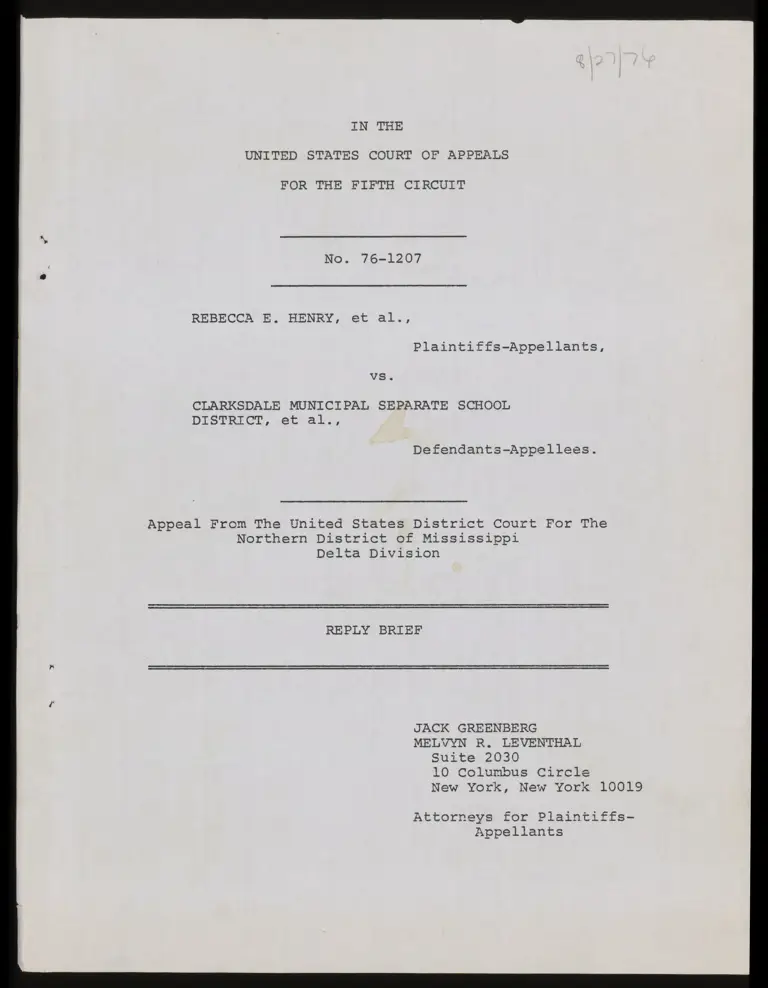
     [||c7f01d8d-8b66-4281-922c-7e9ee1359a97||] IN THE

UNITED STATES COURT OF APPEALS

FOR THE FIFTH CIRCUIT

No. 76-1207

REBECCA E. HENRY, et al.,

Plaintiffs-Appellants,

vs.

CLARKSDALE MUNICIPAL SEPARATE SCHOOL

DISTRICT, et al.,

Defendants-Appellees.

Appeal From The United States District Court For The
Northern District of Mississippi

Delta Division

REPLY BRIEF

JACK GREENBERG

MELVYN R. LEVENTHAL

Suite 2030
10 Columbus Circle
New York, New York 10019

Attorneys for Plaintiffs-
Appellants


IN THE

UNITED STATES COURT OF APPEALS

FOR THE PIPFTH CIRCUIT

No. 76-1207

REBECCA E. HENRY, et al.,

Plaintiffs-Appellants,

vs.

CLARKSDALE MUNICIPAL SEPARATE SCHOOL
DISTRICT, et al,.,

Defendants-Appellees.

Appeal From The United States District Court For The
Northern District of Mississippi

Delta Division

REPLY BRIEF

l. Whether defendants' conduct must be held "obdurately

obstinate."

The parties apparently agree on the standard control-

ling the issue of whether defendants' conduct may be found

"obdurately obstinate." Brief of Appellees, pp. 50-51.

A summary of Supreme Court precedent has recently been

undertaken by a district court and confirms that the critical

question is whether plaintiffs were required to litigate to


obtain rights plainly due them. Parker v Shonfeld, 409

F. Supp. 876, 883, n.8 (N.D Cal. 1976).

A. Pre-Clarksdale I litigation.

Defendants do not contest that: (a) plaintiffs’

petitions to obtain compliance with Brown were ignored by

defendants thereby necessitating this litigation in the

first instance; (b) that "a report of the State of

Mississippi Department of Education indicated that the

defendant Clarksdale M.S.S.D., expended $146.06 above mini-

mum appropriations for each white child and only $25.07 for

each Negro child," (A.282) and that despite this and find-

ings of the district Court of Plessy violations, defendants

not only resisted plaintiffs' effort to equalize black and

white schools but filed a motion to strike our allegations

of such inequalities; (c¢) Judge Clayton found racial

gerrymandering in defendants' plan of pupil assignment.

The only basis for a finding that the foregoing

blatant violations of entrenched judicial doctrine do not con-

stitute a clear basis for requiring an award of atttorneys' fees

is a holding that because all school districts of the region were

engaged in such recalcitrance each school district may

be excused; that plaintiffs right to an award of fees is


1/
attenuated by everyone doing wrong.

B. Post Clarksdale I litigation.

While defendants repeat their standard 50 page

lecture on the history of desegregation law to obscure

their pre-Clarksdale I recalcitrance, this Court should

carefully note that they offer virtually no defense for

their adamant refusal to submit a new plan of pupil assign-

ment after Clarksdale I. They say only that the law was

"uncertain" and that they were duty bound to resist the HEW

plan "since disaster was certain to follow [its implementa-

tion]." Brief of Appellees, p.50. As this Court subsequent-

ly observed, the "state of the law" in Clarksdale, Mississippi

was a mandate from this Court with all appeals therefrom

l/ Defendants self-righteous assertion- made in every
brief they have ever filed- is that their geographic zoning
plan distinguished them from their neighbors. We are
asked to believe that while the entire state of Mississippi
was up in arms over a single black child attending any
white school, ( a result not possible under their plan
except through special transfers), while the Governor of
Mississippi was standing in the school house door, while
interposition and nullification resolutions rang through the
Mississippi legislature and the Congress, while tuition grant
legislation was enacted (counsel opposite was a leading spokes-
man for Mississippi's version), Clarksdale defendants "[f]rom
the very beginning of this litigation ... have tried to respond
to the requirements of the Constitution and laws of this
nation, and to meet their responsibilities under the decisions
of the courts ...." (Brief of Appellees, p.51l.)

In fact, over the years Clarksdale has had one of the
strongest civil rights movements in the State it being the home
of Aaron Henry, head of the NAACP in Mississippi and a national
figure in human rights. Freedom of choice in Clarksdale would
undoubtedly have resulted in more desegregation than geographic
zoning. See footnote 6, page 12 of Brief for Appellants. In
a comparable community, Holmes County, Mississippi, 200 black
children enrolled in white schools in 1965 under freedom of
choice,or fully 20% of all such black children in the State of

Mississippi during that year.


exhausted by defendants. Clarksdale III, 433 F.3d at 388-89.

As to white flight which, we are told, proved the unwork-

ability of the HEW plan and defendants' duty to resist, the

Court should note that under such reasoning the defendants’

geographic zoning plan fares much worse. All whites south

of the railroad tracks assigned to the one black elementary

~ school withdrew therefrom upon implementation of defendants’

plan. We must ask these sanctimonious defendants how they

defend their plan in light of the "disaster" it accordingly

Sonsad is Moreover, if the Court accepts defendants’

rationale, every school district experiencing white flight

may defend its contempt of judicial orders and standards on

the basis of a "duty" to resist.

Defendants also remind us in their brief that

although they admitted to this Court at oral argument in

April, 1966 that faculty desegregation was required (Brief

of Appellees, p.34, bottom), they took no action to remedy

such deficiencies as late as January, 1970. (A.216-17)

Defendants also fail to offer any response to

plaintiffs’ need to file and litigate a Motion for Supple-

mental Relief (in effect, for contempt judgment), arising

2/ Of course, white flight has little to do with the
educational soundness of a plan. See, Fulfilling the Letter
and Spirit of the Law, Desegregation of the Nation's Public
Schools, A Report of the United States Commission on Civil
Rights, August, 1976.


from defendants' failure to comply with Singleton faculty

requirements, which motion was granted by the district court.

(A.225, 228, Brief for Appellants, n.8, p.1l3)

Defendants argue that Rule 52(a) requires affirmance.

Of course, our principle argument here is that the court

below applied the wrong standard. In addition, the litmus

test for appellate review under Rule 52 (a) should be whether

the reviewing court is able, under any reasonable review of

all the facts and the full record, to write an opinion up-

holding the trial court. Plaintiffs challenge this Court

to write such an opinion here; it cannot be done.

2. Whether plaintiffs must be awarded attorneys' fees

under §1617 for time expended prior to the effec-

tive date of that statute.

Defendants argue that Bradley can be read as autho-

rizing a fee award only where, first, "the propriety of the

... award was pending on appeal when the statute boosie law, "

and, second, only for "services performed subsequent to the

date of the filing of the motion for ... fees." Brief of

Appellees, pp. 26-27.

Such a reading of Bradley is unreasonably restrictive.

First, when the Court recites that on the effective date of

§1617 the propriety of a fee award was pending on appeal, it

obviously is merely reasoning therefrom that the litigation


was "active" on that critical date. Defendants cannot

seriously argue that a motion for fees pending in a district

court at the time of §1617's enactment or subsequent thereto

is distinguishable from Bradley. Secondly, Bradley does not

hold or even suggest that a request for fees must be entered

prior to the substantive litigation. Rather, while an

inquiry into "timeliness" may be appropriate (see discussion

below, p. O ), such particular notice to defendants in

anticipation of litigation on the merits was held unnecessary.

416 U.S. at 720 (last paragraph) - 721.

The "anchor" of Bradley is that a court must "apply

the law in effect at the time it renders its decision, un-

less doing so would result in manifest injustice or there

is statutory direction or legislative history to the con-

trary.” “4le U.S. 8t 711, The Court reviewed the legis-

lative history of §1617 and found that, if anything, it

supports the application of the statute to actions pending

on its effective date. 416 U.S. 716 n.23. And in school

desegregation cases, compelling reasons require a holding

that no "manifest injustice" results from applying the

statute to pending cases. 416 U.S. at 716-22. It concluded

that §1617 was controlling and fees recoverable for pre-Act

services as long as the given case was "pending on [its

effective] date." 416 U.S. at 721. In addition to this

"pendency" requirement, it is reasonable to construe Bradley

as requiring that the motion seeking fees be "timely"

presented and advanced.


(A) Was the Clarksdale case "pending" on the effective

date of §1617? It was, given the nature of school desegre-

gation cases generally and events in this litigation.

"School desegregation cases can be expected to

involve relief of an injunctive nature that must prove its

efficacy only over a period of time and often with frequent

modifications...." Bradley, supra, 416 U.S. at 722-23.

Thus, a school desegregation case remains "pending" through

stages of litigation and is not brought to an end, as defen-

dants argue, upon the entry of an order attempting to estab-

lish a unitary system. For this reason this Court has spoken

of a period of three years following the entry of a "terminal

plan," during which jurisdiction is retained, periodic reports

are received and evaluated, and modifications to the plan and

unanticipated issues are considered and resolved, i.e., during
3/

which the case remains pending. Brown, Green, Swann, Steele

v. Board of Public Instruction of Leon County, Florida, 488

F.2d 767 (5th Cir. 1971); Wright v. Board of Public Instruc-

tion of Alachua County, Florida, 445 F.2d 1397 (5th Cir. 1971).

Youngblood v. Board of Public Instruction of Bay County, Florida,

448 P.24 770 (5th Cir. 1971).

The instant litigation was in the midst of precisely

this process when §1617 became law. The case proceeded

3/ A Motion to dismiss this case was filed by defendants,
not after the district court entered an order approving a
terminal plan, but after this appeal was perfected. That Motion
is pending in the district court.


through a "terminal plan" entered by the district court on

May 27, 1971, (A.230); through a modification thereto on

September 7, 1971 (A.231); through defendants' February 16,

1972 petition to sell lands (A.232), which was successfully

resisted by plaintiffs and denied by the district court on

March 31, 1972 as "contrary to the affirmative duty of the

Board of Trustees to select future school sites in such

manner as to prevent the recurrence of one-race schools"

(A.240); through reconsideration of that petition to sell

lands after the effective date of §l6l17, (A.250-51), which

reconsideration was agreed to by plaintiffs under certain

conditions which resulted in an August 9, 1972 order autho-

rizing the sale of lands (A.252-53); through plaintiffs’

August 1, 1972, motion to obtain transportation (A.256),

which was resisted by defendants who, the district court and

this Court found, sought to reinstate the dual system under

the guise of a defense thereto (A.274); Clarksdale IV, 480

F.2d at 585 (first full paragraph).

In summary, this case was "pending" on July 2, 1972,

because the court had properly retained jurisdiction through

that date and the critical issues of new construction and

pupil transportation arose and were litigated after July 2,
4/

1972.

4/ The district court reasoned that if new construction
and pupil transportation issues are grounds for holding a case
"pending" then "it would be a very simple matter for plaintiffs
to re-activate post-school desegregation cases on the filing of
motions relating to the unlawful discharge of a single teacher,
or a bus driver, or racially-motivated discharge of students in
disciplinary actions." (A307-08) The district court's quoted


B. Timeliness.

It is true that plaintiffs' first motion for

fees was addressed to this Court in Clarksdale IV. IL

is also true that all we sought from this Court, at that

time, was an interim award for services performed in the

context of that appeal. (Brief for Appellees, pp. 2-3)

In plaintiffs' judgment a motion for fees would have been

most timely after a decision of this Court on transporta-

tion and defendants' request for modifications to their

plan of pupil assignment, i.e., after Clarksdale IV. The

mandate of Clarksdale IV, however, shifted responsibility

for implementation of plaintiffs' entitlement to fees to

the district court. And the district court evidently

aware of the pendency of Bradley deferred action on the

issue until September 18, 1974, when it called for a motion

4/ contd.

misgivings relate to timeliness, discussed below p.9,

and not to Bradley's pendency requirement. Moreover,
the analogy between the issues litigated here and those
suggested by the district court is tenuous. Pupil
transportation and new construction are issues vital to
the creation and perpetuation of a unitary system while
litigation by individuals charging invidious discrimini-
nation is somewhat remote. Swann v. Charlotte Mecklenburg
Board of Education, 402 U.S.L, 20-21 (1971) (on the importance
of school site selection), and United States v. Greenwood
M.§.S.D,, 460 P.24 1205. 1207 (5th Cir. 1973) (on the impor-
tance of transportation for children assigned to schools out-
side their neighborhoods). Finally, there is no suggestion
anywhere by anyone that plaintiffs contrived to keep this
case active to recover attorneys' fees.


2/
and affidavits from plaintiffs.” (A.280)

We cannot quarrel with the district court's asser-

tion that a motion for fees must be "timely" and that a

request cannot be entered many years after the litigation

has ended; nor can plaintiffs contrive to reactivate a

closed case, under the guise of some minor violation of the

final order and then seek attorneys' fees for all time ex-

pended throughout the history of the litigation. See foot-

note 4, above. But that's not this case.

We have already demonstrated that this litigation

was not merely pending but that it was active through

Clarksdale IV. A motion seeking attorneys' fees at each

stage of the litigation would have periodically diverted the

court's and the parties attention from the critical and

sensitive substantive issues attending school desegregation.

A motion for fees at each point along the long way of these

proceedings would have proved "unmanageable," and it would

have been "undesirable" to "delay the implementation of a

desegregation plan in order to resolve the question of fees

5/ After obtaining extension of time, plaintiffs duly
filed their affidavits. Defendants assertion that we did
not file a motion until October 10, 1975 is grossly mislead-
ing. On that date we filed a motion stating that we had
"inadvertently" failed to file a motion coincidentally with
the filing of affidavits in support (O.R. Vol. IV, p.5).
The affidavits filed in response to the court's direction
on January 10, 1975, are styled "Affidavit in Support of Motion
for Award of Attorney's Fees." (A.281)

- 10 =


simultaneously." Bradley, 416 U.S. 722-23. Only after

the Clarksdale IV opinion quieted this litigation could

the parties properly address the ancillary question of attorneys’

fees. Although §1617, does not require indefinite delays in

the awarding of fees, Bradley, 416 U.S. at 421-24, that statute

by calling for an award to the "prevailing party," upon the

entry of a "final order," suggests that the approach taken by

plaintiffs was proper.

Accordingly, the requirement of "timeliness" must

here respond to the nature of school desegregation litigation

generally, the fact that the Clarksdale litigation was a

continuum without significant breach prior to the request for

fees and finally, it must respond to the language of §l617.

And we are entitled to fees both under traditional

equity principles and 20 U.S.C. §l6l7.

Respectfully submitted,

JACK, GREENBERG

MELVYN R. LEVENTHAL

Suite 2030
10 Columbus Circle
New York, New York 10019

Attorneys for Plaintiffs-
Appellents.

- 11


CERTIFICATE OF SERVICE

The undersigned certifies that copies of the

foregoing Reply Brief was served on counsel for

the defendants by United States mail, postage pre-

paid, this 27th day of August, 1976, as follows:

Semmes Luckett, Esq.
121 Yazoo Avenue

Clarksdale, Mississippi 38614

\ . ‘ IN -

Attorney for Plaintiffs [||c7f01d8d-8b66-4281-922c-7e9ee1359a97||]