Brunson v Board of Trustees of School District No 1 of Clarendon County South Carolina Brief and Appendix for Appellees
Public Court Documents
September 19, 1962
21 pages
-
Brief Collection, LDF Court Filings. Brunson v Board of Trustees of School District No 1 of Clarendon County South Carolina Brief and Appendix for Appellees, 1962. 2e4d20f4-b69a-ee11-be36-6045bdeb8873. LDF Archives, Thurgood Marshall Institute. https://ldfrecollection.org/archives/archives-search/archives-item/dd6d4ec0-ce6f-4e15-ad67-da37f4a4acac/brunson-v-board-of-trustees-of-school-district-no-1-of-clarendon-county-south-carolina-brief-and-appendix-for-appellees. Accessed October 05, 2026.
Copied!
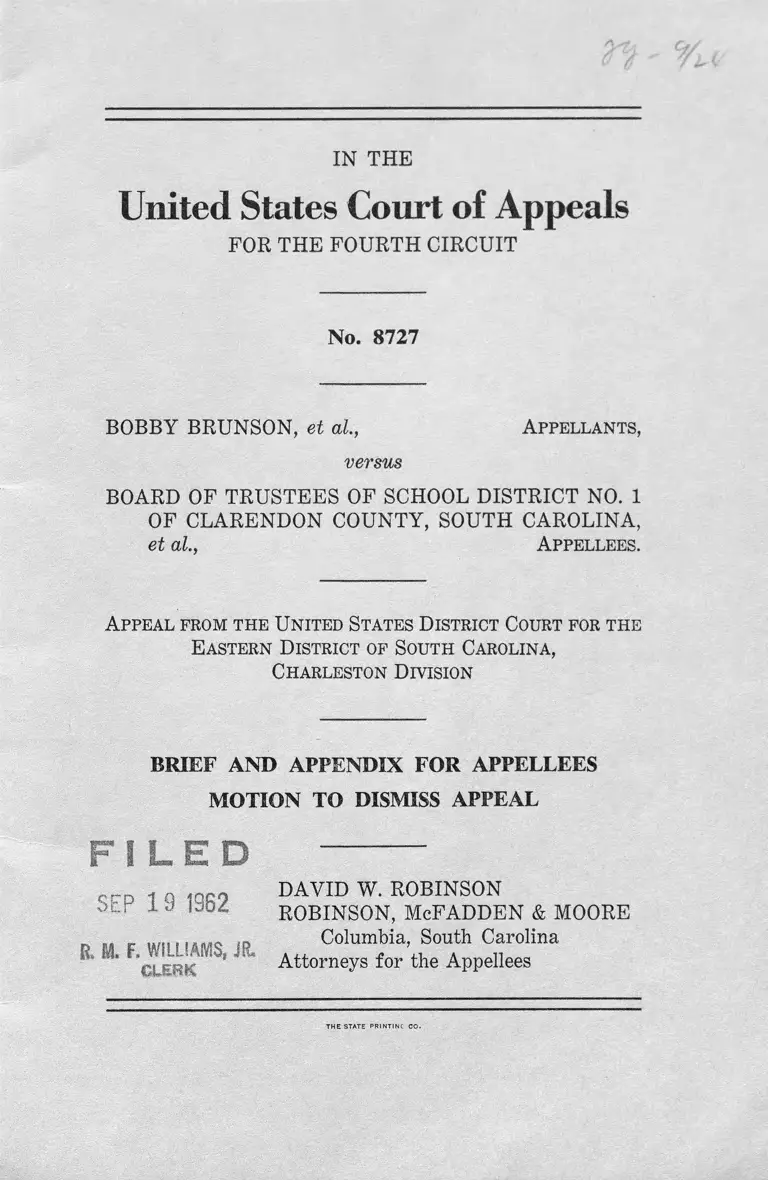
IN THE
United States Court of Appeals
FOR THE FOURTH CIRCUIT
No. 8727
BOBBY BRUNSON, et al., A ppellants,
versus
BOARD OF TRUSTEES OF SCHOOL DISTRICT NO. 1
OF CLARENDON COUNTY, SOUTH CAROLINA,
et al, A ppellees.
A ppeal from the United States District Court for the
Eastern District of South Carolina,
Charleston Division
BRIEF AND APPENDIX FOR APPELLEES
MOTION TO DISMISS APPEAL
F I L E D
SEP 13 1362
R, Rg. F. WILL!AMS, JR.
CLERK
DAVID W. ROBINSON
ROBINSON, McFADDEN & MOORE
Columbia, South Carolina
Attorneys for the Appellees
TH E STATE 1C CO.
TABLE OF CONTENTS
Page
Statement of the Case_______________________________ 1
I. The Order of the District Court is Not Appealable 1
II. The Suit is Not a Proper Class A ction___________ 5
Conclusion _________________________________________ 12
Appendix __________________________________________ 21a
Motion to Dismiss Appeal__________________________ lb
Cases Page
All-American Airways v. Eldred, 209 F 2d 247
(2nd Cir.) _____________________________________ 2, 3
American Broadcasting Co. v. Wahl, 121 F. 2d 412
(2nd Cir.) _____________________________________ 4
Atwater v. North American Coal Co., I l l F. 2d 125
(2nd Cir.) _____________________________________ 4
Baltimore Contractors v. Bodinger, 348 U. S. 176___ 5
Bedser v. Horton, 122 F. 2d 406 (4th Cir. 1941) ___ 9
Briggs v. Elliott, 98 F. Supp. 529 (1951), 342 U. S.
350 (1952) ; 103 F. Supp. 920 (1952) ; 347 U. S.
483 (1954; 349 U. S. 294 (1955) ; 132 Supp 776
(1955) ----------------------------------------------------- 6 ,7 ,8 ,9 ,1 0
Brown v. Board, 347 U. S. 483 (1954) ; 349 U. S. 294
(1955) _________________________________________ 7-9
Carson v. Board, 227 F. 2d 789 ____________________ 8
Carson v. Warlick, 238 F. 2d 724, c.d. _____________ 8
Clark v. Kansas City, 172 U. S. 334 (1899) _________ 4
Collins v. Metro-Goldwyn, 106 F. 2d 8 3 _____________ 9
Collins v. Miller, 252 U. S. 364 __ ______ __________ 5
Covington v. Edwards, 264 F. 2d 780 _______________ 8
Davis v. Prince Edward, 142 F. Supp. 616 _________ 8
Davis v. Yellow Cab Co., 220 F. 2d 790 (5th Cir.
1955) ___________________________________________ 9
Gillette v. Northern Oklahoma, 179 F. 2d 711 (10th
Cir. 1950) ______________________________________ 9
Henderson v. U. S., 339 U. S. 8 1 6 _________________ 7
Hohorst v. Hamburg, 148 U. S. 261__________ _____ 4
Holt v. Raleigh, 265 F. 2d 98, c .d .__________________ 8
Hood v. Board. 232 F. 2d 626, 286 F. 2d 236 ______ _ 8, 9
International Machinists v. Street, 367 U. S. 740 ___ 7
Joham v. Roger, 296 F. 2d 119 12nd Cir.) _______ 4
Jumps v. Leverone, 150 F. 2d 876 (7th Cir.) _______ 2
Kansas City v. Williams, 205 F. 2d 47 (8th Cir.) c.d. 9
TABLE OF CITATIONS
ii
TABLE OF CITATIONS— Continued
Cases Page
Kennedy v. Bethlehem Steel Co., 102 F. 2d 141
(3rd Cir.) _____________________________________ 5
Markham v. Kasper, 152 F. 2d 270 (7th Cir.) ______ 4
Martinez v. Maverick, 219 F. 2d 666 (5th C ir.)__ 9
Metropolitan v. Banion, 86 F. 2d 886 ( 10th Cir.) __ 4
McCabe v. Atcheson, 235 U. S. 151_________________ 7
McLaurin v. Oklahoma, 339 U. S. 637 _______________ 7
Missouri, ex rel. Gaines v. Canada, 305 U. S. 337 ___ 7
Mitchell v. U. S., 313 U. S. 8 0 ______________________ 7
Oppenheimer v. Young, 144 F. 2d 387, 3 F.R.D.
(2nd Cir.) _____________________________________ 2
Reddix v. Lucky, 252 F. 2d 930 (5th Cir. 1958) ____ 8
Rogers v. Alaska Steamship Lines, 249 F. 2d 646
(9th Cir.) ______________________________________ 2
Shultz v. Manufacturers & Traders, 103 F. 2d 771
(2nd Cir.) _____________________________________ 4
Shuttleworth v. Birmingham, 358 U. S. 101 (1958)__ 8
Skirvin v. Mesta, 141 F. 2d 668 (10th Cir.) _________ 4
U. S. v. Shaughnessy, 178 F. 2d 756 (2nd Cir.) ____ 4
U. S. Plywood Corp. v. Hudson, 210 F. 2d 462
(2nd Cir.) _____________________________________ 5
Whiteman v. Pitrie, 220 F. 2d 914 (5th Cir. 1955) __ 9
Statutes
Fair Labor Standards A c t _________________________ 3
South Carolina Code 1952
Section 21-230 ________________________________ 21a
Section 21-230(9) _____________________________8-21a
Section 21-230.2 _____________________________ 21a
Section 21-247 ________________________________ 8-21a
Section 21-247.2 _____________________________ 22a
Section 21-247.3 _____________________________ 22a
Section 21-247.4 _____________________________ 22a
Section 21-247.5 _____________________________ 22a
28 U.S C A. 1291__________________________________ 2-5
28 U.S.C.A. 1292__________________________________ 2
iii
IN THE
United States Court of Appeals
FOR THE FOURTH CIRCUIT
No. 8727
BOBBY BRUNSON, et al, A ppellants,
versus
BOARD OF TRUSTEES OF SCHOOL DISTRICT NO. 1
OF CLARENDON COUNTY, SOUTH CAROLINA,
et al., A ppellees.
A ppeal from the United States District Court for the
Eastern District of South Carolina,
Charleston Division
STATEMENT OF THE CASE
The plaintiffs appeal from the order of the District Court
in which it determined that “ this action is not properly-
brought as a class action under Rule 23 (a) 3.” It there
fore struck from the complaint the names of all of the
plaintiffs except the one first named and all allegations
in the complaint inappropriate to a personal cause of action
in behalf of that plaintiff. The plaintiff was given leave
to file an amended complaint. (18a-19a) I
I
The Order of the District Court is Not Appealable
It is our position that the order of the District Court is
not a final decision from which an appeal is authorized
2 Bobby Brunson, et al. v. Board of T rustees, et al.
under Title 28 Section 1291.1 Since the appellate jurisdic
tion of this Court is statutory, the appeal does not lie un
less this Court concludes that the District order is a final
judgment. Orders striking the class character of pleadings
are not final decisions within the meaning of Section 1291.
Oppenheimer v. Young, 144 F. 2d 387, 3 F.R.D. (2nd Cir.) ;
Jumps v. Leverone, 150 F. 2d 876, 877 (7th Cir.) ; All-
American Airways v. Eldred, 209 F. 2d 247 (2nd Cir.) ;
Rogers v. Alaska Steamship Lines, 249 F. 2d 646 (9th
Cir.).
In Oppenheimer the Court stated the facts of that case
and the applicable law in these words:
This suit was brought as a spurious class action
and is sought to be sustained under Federal Rule
23(a) (3) 28 U.S.C.A. following section 723c. The
plaintiffs, after two unsuccessful attempts to set forth
their claim in the form of a spurious class action, filed
a second amended complaint which was dismissed by
the District Court on the ground that the plaintiffs
and the parties whom they sought to represent had
divergent interests, with leave, however, to serve a
further amended complaint in their own behalf; but,
because of failure to amend, as permitted, a judgment
was entered dismissing the second amended complaint
in its entirety. The plaintiffs have appealed from
both the order and the judgment. Inasmuch, however,
as the order provided for an amendment, it did not
dispose of the litigation and it was not final. The in
dividual claims of the tivo plaintiffs asserted in the
second amended complaint, and sustained by the inter
locutory order, arose out of the same matters as those
upon which the class action was founded, and there
must be finality in the disposition of both in order that
an appeal may lie.1 2 Audi Vision, Inc. v. RCA Mfg.
1 While appeals from some interlocutory orders are permitted, the order
here in issue does not come within the purview of 28 U. S. C. A. 1292.
2 Emphasis supplied in this brief.
Bobby Brunson, et al. v. Board of T rustees, et al. 3
Co., 2 Cir., 136 F. 2d 621, 147, A.L.R. 574; Western
Elec. Co. v. Pacent Reproducer Corp., 2 Cir., 37 F. 2d
14. The appeal from the interlocutory order must,
therefore, be dismissed.
In the Jumps case the five plaintiffs sued for themselves
and as representatives of a great number of other
employees to recover wages and overtime under the provi
sions of the Fair Labor Standards Act. The Seventh Cir
cuit in dismissing an appeal questioning the District
Court’s order striking from the complaint “ all reference
to other establishments and to employees therein,” said:
Whether the proceeding be looked upon as a statu
tory proceeding to liberalize the joinder of parties un
der Section 16 of the Fair Labor Standards Act, or
as a spurious class suit pursuant to the Federal Rules
of Civil Procedure, Rule 23(a) (3), the District Court
had a wide discretion in shaping up the limits of the
suit.
Congress intended to liberalize and relax the pro
cedure for bringing suits to enforce the sanctions of
the Act. The procedure was left to the Court’s discre
tion in order that they might control the limits of such
suits in the interest of justice to the parties under the
Act. When one contemplates the scope of the suit en
visaged by the attorneys for the plaintiffs, and the
ramifications of a suit of that size, purporting to affect
the rights of thousands of persons in ten or more
states, we think that where the Court attempted to
reasonably limit the scope of the suit it was exercising
its discretion and the order made and sought to be
appealed from is interlocutory and not final, and
therefore is not appealable. The motion of the defend
ants to dismiss this appeal is sustained and the appeal
is dismissed.
In the All-American Airways case ten airlines sued the
officials of the town of Cedarhurst to have its ordinance
4 Bobby Brunson, et al. v . Board of T rustees, et al.
prohibiting low flying of planes taking off and landing at
Idlewild declared invalid and for appropriate injunctive
relief. These town officials in behalf of themselves indi
vidually as property owners and in behalf of other property
owners counterclaimed to enjoin low flying by the plain
tiffs.
The District Court granted the plaintiffs’ motion “ to dis
miss the counterclaims as to the so-called ‘related defend
ants’ and order the answer amended accordingly, i.e., by
the elimination of all allegations of a class suit.” From a
reading of the opinion it is obvious that the Court of Ap
peals disagreed with the merits of the District order. How
ever the Court held: “ In any event the non-appealability of
the order in this type of class action is apparent.”
These decisions as to the non-appealability of orders re
lating to class actions are consistent with the holding of the
various circuits that orders granting motions to dismiss
with leave to plead anew are not appealable. (Atwater v.
North American Coal Co., I l l F. 2d 125 (2nd Cir.) ; Amer
ican Broadcasting Co. v. Wahl, 121 F. 2d 412 (2nd Cir.) ;
U. S. v. Shaughnessy, 178 F. 2d 756, 757 (2nd Cir.) ; Clark
v. Kansas City, 172 U.S. 334 (1899).) An order dismissing
a complaint unless the plaintiff produced its managing of
ficer for examination within ninety davs is not an appeal-
able final judgment even at the end of the ninety-day pe
riod. (Joham v. Roger, 296 F. 2d 119 (2nd Cir.).)
Orders granting or denying consolidation under Rule
42 (a) where there is a common question of law or fact are
not appealable. Skirvin v. Mesta, 141 F. 2d 668, 671 (10th
Cir.). Orders striking allegations of a complaint are not
appealable since they are not final judgments. (Metro
politan v. Banion, 86 F. 2d 886 (10th Cir.) ; Shultz v. Man
ufacturers & Traders, 103 F. 2d 771 (2nd Cir.) ; Markham
v. Kasper, 152 F. 2d 270 (7th Cir.).) Unappealable are
orders determining the issues as to some but not all of the
parties. (Atwater v. North American Coal, 111 F. 2d
125 (2nd Cir.) ; Hohorst v. Hamburg, 148 U. S. 261.) An
Bobby Brunson, et al. v. Board of T rustees, et al. 5
order granting summary judgment for the plaintiff on the
defendant’s counterclaim is not appealable. ( U. S. Ply
wood Corp. v. Hudson, 210 F. 2d 462 (2nd C ir.).) An order
dismissing a petition to intervene is not appealable. [Ken
nedy v. Bethelhem Steel Co., 102 F. 2d 141, 142 (3rd C ir.).)
There Circuit Judge Maris pointed out that, “ Not only is
it a discretionary order but it leaves the petitioner at full
liberty to assert his rights in any other appropriate form
of proceeding.”
Section 22 of the Judiciary Act of 1789, 1 Stat., 73,
84 provided that appeals in civil actions should be
taken to the circuit courts only from final decrees and
judgments. That requirement of finality has remained
a part of our law ever since, and now appears as Sec
tion 1291 of the Judicial Code.
Baltimore Contractors v. Bodinger, 348 U. S. 176, 178. Cf.
7ollins v. Miller, 252 U. S. 364, 370.
When we consider the district order in the light of these
Gcisions it is clear that it lacks the finality contemplated
b Section 1291. The cause has not been terminated. The
piintiff Bobby Brunson is still in court with the right to
fil an amended complaint. The order does two things: (1)
It'trikes from the body of the complaint certain allega-
tios. Such an order is clearly not appealable. (2) It
str-es from the caption and the body of the complaint eer-
taimamed plaintiffs. Since these plaintiffs are free to
purie an appropriate remedy in another action and since
Bobr Brunson’s cause is still before the court, the order
is indocutory. Therefore the appeal should be dismissed.
II
The Suit Is Not a Proper Class Action
Theefendant School District No. 1 (Summerton) of
Clarentn County is a rural school district in lower South
Carolinlying along the Santee-Cooper reservoir and the
6 Bobby Brunson, et al. v. Board of T rustees, et al.
lower Santee River. The latest available figures of school
enrollment (1961-1962) showed 326 white pupils, 2,572
Negro.
It is the same school district before the Court in Briggs v.
Elliott.3 Brunson v. Board is a companion case to Briggs.
The defendants in both are the school authorities in the
Summerton District. The complaint in Brunson alleges
that some but not all of the plaintiffs are the same. (8a ).
Both Briggs and Brunson seek relief from alleged discrimi
nation in the providing of school facilities. While Briggs
is still on the district calendar the issue as to whether a
class action under Rule 23(a) (3) is presented here in
Brunson. On that issue, however, it is important to see
what the Court has said in Briggs.
On remand from the Supreme Court, the District Court
thus stated the “governing constitutional principles” for
the guidance of the Summerton trustees:
Having said this, it is important that we point ou'
exactly what the Supreme Court has decided and wha
it has not decided in this case. It has not decided ths
the federal courts are to take over or regulate the pu-
lic schools of the states. It has not decided that te
states must mix persons of different races in te
schools or must require them to attend schools or mst
deprive them of the right of choosing the sch>ls
they attend. What it has decided, and all iat
it has decided, is that a state may not deny tomy
person on account of race the right to attend any siool
that it maintains. This, under the decision othe
Supreme Court, the state may not do directly oindi-
rectly; but if the schools which it maintains aropen
to children of all races, no violation of the Constfition
is involved even though the children of differerffaces
voluntarily attend different schools, as they attd dif-
8 Briggs V. Elliott, 98 F. Supp. 529 (1951); 342 U. S. 350 (195,103 F.
Supp. 920 (1952); 347 U. S. 483 (1954); 349 U. S. 294 (1955); i f 7- Supp.
776 (1955).
Bobby Brunson, et al. v. Board of T rustees, et al.
ferent churches. Nothing in the Constitution or in
the decision of the Supreme Court takes away from
the people freedom to choose the schools they attend.
The Constitution, in other words, does not require in
tegration. It merely forbids discrimination. It does
not forbid such segregation as occurs as the result of
voluntary action. It merely forbids the use of govern
mental power to enforce segregation. The Fourteenth
Amendment is a limitation upon the exercise of power
by the state or state agencies, not a limitation upon
the freedom of individuals. 132 F. Supp. 766, 767
(1955).
Admittedly the constitutional right of equal protection
is a personal individual right which the person entitled
thereto may enforce or waive as he sees fit. No one else
can enforce it for him. “ It was as an individual that he
was entitled to the equal protection of the laws. . . .” Mis
souri, ex rel. Gaines v. Canada, 305 U. S. 337, 351; Mc-
Laurin v. Oklahoma, 339 U. S. 637, 642. McCabe v. Atche-
son, 235 U. S. 151, Mitchell v. U. S., 313 U. S. 80, Hender
son v. U. S., 339 U. S. 816, International Machinists v.
Street, 367 U. S. 740, 774. Indeed the “ spurious” class
action authorized by the third subdivision of Rule 23 (a)
which the plaintiffs here invoke applies only where the right
of each member of the class is “ several.” The class action
joinder is allowed only when there is “ a common question
of law or fact.”
When the Supreme Court in the companion cases (of
which Briggs v. Elliott was one), generally cited as Brown
v. Board, 347 U. S. 483 (1954); 349 U. S. 294 (1955), de
cided that a state could not satisfy its obligation to provide
equal protection by requiring pupils of different races to
seek education in separate public schools, it invalidated
South Carolina laws to the contrary. In so doing it resolved
any question of law common to the several plaintiffs. In
fact, in limiting relief to the “ parties to these cases” (349
U. S. 301), the Court ended the availability of the spurious
8 Bobby Brunson, et al. v. Board of T rustees, et al.
class action insofar as this school district is concerned.
There is left for decision only the factual question of
whether the school trustees have, in assigning one of the
plaintiffs, deprived him of equal protection. This factual
question depends on many non-racial criteria and must be
resolved separately as to each pupil asking reassignment.
Shuttleworth v. Birmingham, 358 U. S. 101 (1958).4
On remand the District Court held that the common ques
tion of law had been resolved in the Briggs litigation and
since this last order of the District Court spelled out the
rights and obligations of the parties there is no unresolved
common question of law present in the Brunson case. (17a).
Briggs v. Elliott, 132 F. Supp. 776-777 (1955). Confirma
tion is found in the order dissolving the three-judge district
court in Davis v. Prince Edward, 142 F. Supp. 616, 619.
As we read plaintiffs’ brief it does not question the cor
rectness of our view that the common question of law (sep
arate schools vel non) has been resolved by the decisions in
Briggs v. Elliott, supra. Seemingly it claims that the ade
quacy of the administrative remedy provided in South Car
olina raises a common question of law justifying a spurious
class action.
In order to assure to every child aggrieved by his assign
ment to a particular school an adequate administrative
remedy for the resolution of his request for a different as
signment, South Carolina provides an appropriate proce
dure. 1952 Code 21-230 (9), 21-247. (21a-22a) Hood
v. Board, 232 F. 2d 626, 286 F. 2d 236.5 The plaintiffs’
brief seems to recognize that this procedure is fair and ade
4 Circuit Judge Tuttle recognized the applicable principle in Reddix v.
Lucky, 252 F. 2d 930, 938 (5th Cir 1958), where he said: “We think this
is not a proper case for a class action. Obviously the right of each voter
depends upon the actions taken with respect to his own case.”
'T h e South Carolina procedure is similar to that of North Carolina which
has been sustained here in numerous cases. Carson v. Board, 227 F 2d 789
Carson v. Warlick, 238 F. 2d 724, c. d., Covington v. Edwards, 264 F. 2d 78o’,
Holt v. Raleigh, 265 F. 2d 98, c. d. The Supreme Court has found that such
administrative procedures are valid in the field of pupil placement Shuttle-
worth v. Birmingham, 358 U. S. 101 (1958) affirming 162 F. Supp. 372.
Bobby Brunson, et al. v . Board of T rustees, et al. 9
quate on its face and that this Court has so ruled in Hood.
(Brief 10, footnote 2.)
The question of whether school trustees will fairly admin
ister such a statute cannot be reached under a complaint
asserting that the plaintiffs “have not exhausted the admin
istrative remedy provided by the South Carolina School
L a w s ....” (9a)
In the administration of the Buies of Civil Procedure it
was contemplated that the District Courts would exercise
broad discretion in applying these rules and that discretion
will not be disturbed here unless there is an abuse. This
policy of leaving the application of the rules to district
courts is particularly appropriate in the field of permissive
joinder contemplated by Rule 23(a) (3). Martinez v. Mav
erick, 219 F. 2d 666, 673 (5th Cir.) ; Kansas City v. Wil
liams, 205 F. 2d 47 (8th Cir.), c. d.®
Finally, it should be borne in mind that it is the District
Court to whom the Supreme Court entrusted the review of
school board action in applying the principles of Briggs v.
Elliott, 349 U. S. 294, 299. This is so because “ of their
proximity to local conditions.” It is obvious that the gov
erning constitutional principles must be applied differently
to a rural school district where the Negro school children
are a majority of eight to one, than in a cosmopolitan com
munity like Norfolk or Baltimore or New Orleans or to an
area where the Negro is a small minority.
The reasoning of the Court in Brown v. Board, 347 U. S.
483, 493-4, is that state law requiring the racial minority
to go to a school separate from the majority may create in
the members of this minority an inferiority complex, there
fore such law deprives the members of the minority of equal
protection. Here we have members of the majority race
attempting through the prayer of this class action to force
_8 The District Court’s discretion here is similar to that exercised under
kindred rules 42, 20, 22, 24. Collins v. Metro-Goldwyn, 106 F. 2d 83, 85,
Bedser v. Horton, 122 F. 2d 406, 407 (4th Cir. 1941), Gillette v. Northern
Oklahoma, 179 F. 2d 711 (10th Cir. 1950), Davis v. Yellow Cab Co., 220
F. 2d 790 (5th Cir. 1955), Whiteman v. Pitrie, 220 F. 2d 914 (5th Cir. 1955).
10 Bobby Brunson, et ai. v . Board of T rustees, et al.
the minority to be engulfed in the eight to one majority.
Such relief ( lOa-lla) would necessarily injure the person
ality of the minority and so deprive them of equal protec
tion.
As stated above, this is the school district before the
Court in Briggs v. Elliott, supra. 347 U. S. 495. In the
opinion filed May 31, 1955, the Court stated:
Full implementation of these constitutional principles
may require solution of varied local school problems.
School authorities have the primary responsibility for
elucidating, assessing and solving these problems;
courts will have to consider whether the action of school
authorities constitutes good faith implementation of
the governing constitutional principles. Because of
their proximity to local conditions and the possible
need for further hearings, the courts which originally
heard these cases can best perform this judicial ap
praisal. 349 U. S. 249.
On remand the three judge District Court, on July 15,
1955, in an opinion intended for the guidance of the trus
tees of the school district here involved, after observing
that “ no violation of the Constitution is involved even
though the children of different races voluntarily attend
different schools,” and that the Constitution [and, of course,
the Court] “ does not forbid such segregation as occurs as
the result of voluntary action,” but “merely forbids the use
of governmental power to enforce segregation,” filed an
order pursuant to the mandate from the Supreme Court in
which the defendants were “ enjoined from refusing on ac
count of race to admit to any school under their supervision
any child qualified to enter such school.” 132 F. Supp.
777, 778.
The problem of desegregation in this school district, while
not unique, was and is as difficult of solution as any in the
country. Without the understanding and cooperation of
the parents of both races in the district, it appeared in
Bobby Brunson, et al. v. Board of Trustees, et al. 11
surmountable. There was no immediate crisis because the
parents of the district continued to send their children to
the schools which they were attending, and to enroll new
students in the schools in which they would formerly have
been enrolled.
It thus appears that the trustees were warranted in per
mitting the parents of the district to continue voluntarily to
patronize its schools as they had in the past. In the mean
time, the placement procedure amended in 1956 provided
an efficient remedy to any who claimed the personal right
to attend a different school.
The three schools which the Negro children continued to
attend were and are the largest, the last constructed, and
most modern in the district. In location they cover the dis
trict’s area. By means of these schools the Negro school
children of the district have been receiving educational ad
vantages apparently still satisfactory to the overwhelming
majority of the Negro parents. The one white school is
smaller, older and located in the town of Summerton. The
majority of the white school children live in the town, and
nearer this school. The other three are more conveniently
located for the greater number of the Negro children.
Under the three judge Court’s order dated July 15, 1955,
the district’s school authorities were warranted in contin
uing to operate the schools as they had theretofore been
operated, in accordance with the demonstrated wishes of
the parents, and in relying upon the State’s placement pro
cedure legislation to afford an effective remedy for any
who claimed the right to attend another school. Such rem
edy has not as yet been invoked by a single school child or
parent, not even by the plaintiffs.
The District Judge, under these circumstances, was not
required to entertain another class action attack upon the
district’s school system; and his holding that the personal
rights claimed by the several plaintiffs should be asserted
by them severally and not jointly finds abundant support
in the history of the past litigation.
12
CONCLUSION
We submit that this cause is not a final judgment now
i eviewable here. Therefore the appeal should be dismissed.
In the alternative we ask affirmance.
DAVID W. ROBINSON
ROBINSON, McFADDEN & MOORE
Columbia, South Carolina
Attorneys for the Appellees
September 1962
Bobby Brunson, et al. v. Board of T rustees, et al.
21a
APPENDIX
Code of Laws of South Carolina 1952
Section 21-230. General powers and duties of school trus
tees.
The board of trustees shall also:
# * • * # * #
(9) Transfer pupils and designate schools attend.
Transfer any pupil from one school to another so as to
promote the best interests of education and determine the
school within its district in which any pupil shall enroll.
Section 21-230.2 Rules and regulations; hearings.
The boards of trustees of the several school districts may
prescribe such rules and regulations not inconsistent with
the statute law of this State as they may deem necessary
or advisable to the proper disposition of matters brought
before them. This rulemaking power shall specifically
include the right, at the discretion of the board, to desig
nate one or more of its members to conduct any hearing
in connection with any responsibility of the board and to
make a report on this hearing to the board for its deter
mination.
Section 21-247. May appeal decision of trustees to county
board of education.
Subject to the provisions of §21-230, any parent or per
son standing in loco parentis to any child of school age,
the representative of any school or any person aggrieved
by any decision of the board of trustees of any school dis
trict in any matter of local controversy in reference to the
construction or administration of the school laws or the
placement of any pupil in any school within the district
may appeal the matter in controversy to the county board
of education by serving a written petition upon the chair
man of the board of trustees, the chairman of the county
board of education and upon the adverse party within ten
22a
days from the date upon which a copy of the order or
directive of the board of trustees was delivered to him by
mail or otherwise. The petition shall be verified and shall
include a statement of the facts and issues involved in the
matter in controversy.
Section 21-21*7.2. Hearing; dispose of each school age
child separately.
The parties shall be entitled to a prompt and fair hearing
by the county board of education which shall try the matter
de novo and in accordance with its rules and regulations.
The county board of education may designate one of its
members to conduct the hearing and report the matter to
it for determination. When individual children of school
age are involved in the matter in controversy, the case of
each child shall be heard and disposed of separately.
Section 21-21*7.3. Appearance of parties; evidence.
At any such hearing the parties may appear in person
or through an attorney licensed to practice in this State and
may submit such testimony, under oath, or other evidence
as may be pertinent to the matter in controversy.
Section 21-21*7.1*. Decision of board; service.
After the parties have been heard, the county board of
education shall issue a written order disposing of the mat
ter in controversy, a copy of which shall be mailed to each
of the parties at interest.
Section 21-21*7.5. Appeal from decision of board to circuit
court.
Any party aggrieved by the order of the county board
of education may appeal to the court of common pleas of
the county by serving a written verified petition upon the
chairman of the county board of education and upon the
adverse party within ten days from the date upon which
copy of the order of the county board of education was
mailed to the petitioner. The parties so served shall have
23a
twenty days from the date of service, exclusive of the date
of service, within which to make return to the petition or
to otherwise plead, and the matter in controversy shall be
tried by the circuit judge de novo with or without reference
to a master or special referee. The county board of edu
cation shall certify to the court the record of the proceed
ings upon which its order was based and the record so cer
tified shall be admitted as evidence and considered by the
court along with such additional evidence as the parties
may desire to present. The court shall consider and dis
pose of the cause as other equity cases are tried and dis
posed of, and all parties at interest shall have such rights
and remedies, including the right of appeal, as are provided
by law in such cases.
lb
IN THE
United States Court of Appeals
FOR THE FOURTH CIRCUIT
No. 8727
BOBBY BRUNSON, et al, A ppellants,
versus
BOARD OF TRUSTEES OF SCHOOL DISTRICT NO. 1
OF CLARENDON COUNTY, SOUTH CAROLINA,
et A ppellees.
A ppeal from the United States District Court for the
Eastern District of South Carolina,
Charleston Division
MOTION TO DISMISS APPEAL
The defendants move that this appeal be dismissed be
cause the order from which the appeal is taken is not a
final decision within the meaning of 28 U. S. C. A. 1291
and is not the type of interlocutory order from which an
appeal may be taken under 28 U. S. C. A. 1292.
September 1962
DAVID W. ROBINSON
ROBINSON, McFADDEN & MOORE
Columbia, South Carolina
Counsel for the Defendants