Memorandum for the United States as Amicus Curiae
Public Court Documents
April 7, 1970
23 pages
-
Case Files, Swann v. Charlotte-Mecklenburg Hardbacks. Memorandum for the United States as Amicus Curiae, 1970. a2497712-2e34-f111-88b4-7c1e526962fd. LDF Archives, Thurgood Marshall Institute. https://ldfrecollection.org/archives/archives-search/archives-item/dea5fa38-abe6-4667-8cda-c2f92e27b680/memorandum-for-the-united-states-as-amicus-curiae. Accessed October 15, 2026.
Copied!
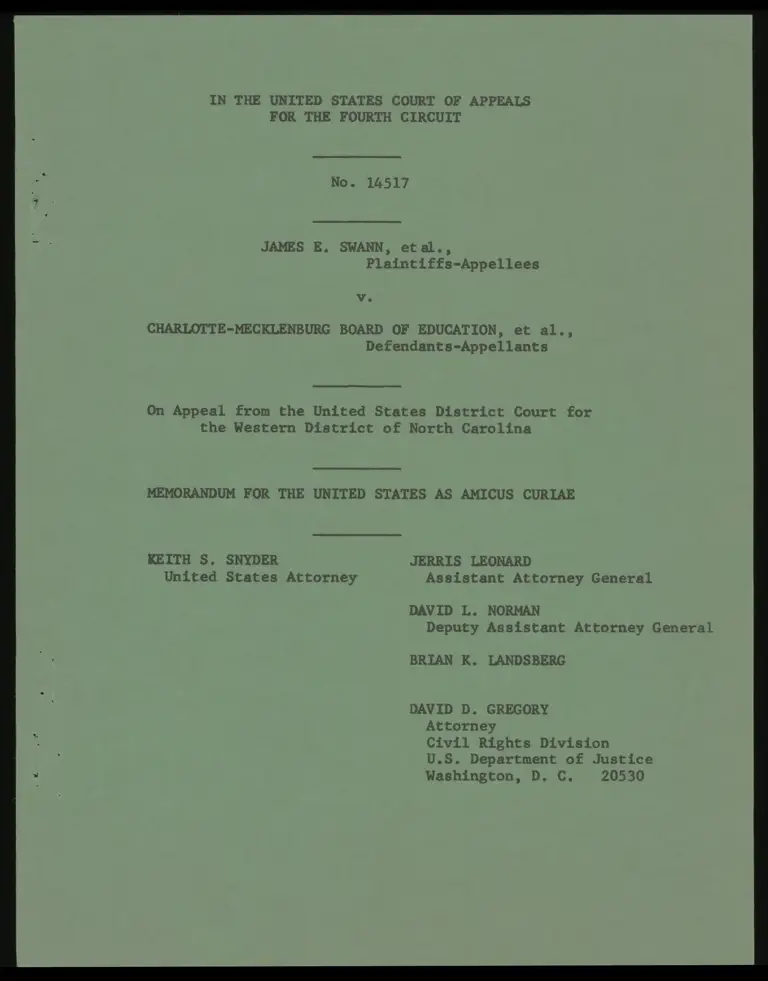
     [||2f6f69d0-a49b-4982-8e6e-d4ac1d812b97||] IN THE UNITED STATES COURT OF APPEALS
FOR THE FOURTH CIRCUIT


No. 14517


Ri JAMES E. SWANN, etal.,
Plaintiffs-Appellees

Ve

CHARLOTTE-MECKLENBURG BOARD OF EDUCATION, et al.,
Defendants-Appellants


On Appeal from the United States District Court for

the Western District of North Carolina


MEMORANDUM FOR THE UNITED STATES AS AMICUS CURIAE


KEITH S. SNYDER JERRIS LEONARD
United States Attorney Assistant Attorney General

DAVID L. NORMAN

Deputy Assistant Attorney General

BRIAN K. LANDSBERG

DAVID D. GREGORY
Attorney

Civil Rights Division
U.S. Department of Justice

Washington, D. C. 20530


TABLE OF CONTENTS

INTRODUCTORY NOTE 4 ves venrnninesddssense

DISCUSSION . ccc vvrnsssrvnsieroneenivns ® & @& 0 0 0 0

Map - Marie Davis Zone ee oo ee 000000 00 4

Map - Negro Elementary School Zones ....cce..


TABLE OF CITATIONS

Alexander v. Holmes County Board of
Education, 396 U.S. 19 (1969)
(per curiam)

Board of Education of Oklahoma City
v. Dowell, 375 F.2d 158 (10th Cir.
1967)

Brewer v. School Board of Norfolk, 397
F.2d 37 (4th Cir. 1968) (en banc)

Brown v. Board of Education, 349 U.S.
294 (1955)

Carter v. Jury Commission, 396 U.S. 320
(1970)

Carter v. West Feliciana Parish School
Board, 38 U.S.L.W. 3265 (U.S.,
Jan. 14, 1970)

Ellis v. Board of Public Instruction of
Orange County, No. 29,124 (5th Cir.,
Feb. 17, 1970)

Felder v. Harnett County Board of Education
409 F.2d 1070 (4th Cir. 1969)

Green v. County School Board, 391 U.S.
430 (1968)

Griffin v. County School Board, 377 U.S.
218 (1964)

Hall v. St. Helena Parish School Board,
417 F.2d 801 (5th Cir. 1969)

Page

12, 15. 16

11

12

12, 15

5,8, 11.12, 17


Henry v. Clarksdale Municipal Separate
School District, 409 F.2d 682 (5th Cir.
1969)

Jones v. School Board of Alexandria, 278
F.2d 72 (4th Cir. 1960)

Kemp v. Beasley, No. 19,782 (8th Cir.,
Mar. 17, 1970)

Lee v. Macon County Board of Education,
C.A. No. 604-E (M.D. Ala., April 3, 1970)

Monroe v. Board of Commissioners, 391
U.S. 450 (1968)

Nesbit v. Statesville City Board of
Education, 419 F.2d 1040 (4th Cir.
1969) (en banc) (per curiam)

Raney v. Board of Education, 391 U.S.
430 (1968)

Singleton v. Jackson Municipal Separate
School District, No. 26,285 (5th Cir.,
Dec. 1, 1969) (en banc) (per curiam)

Stanley v. Darlington County School District,
No. 13,904 (4th Cir., Jan. 19, 1970)

Turner v. Fouche, 396 U.S. 346 (1970)

United States v. Choctaw County Board
of Education, 417 F.2d 838
(5th Cir. 1969)

United States v. Greenwood Municipal
Separate School District, 406 F.2d
1086 (5th Cir. 1969)

United States v. Greenwood Municipal
Separate School District, No. 28,690
(5th Cir., Jan. 8, 1970) (per curiam)


United States v. Hinds County School
Board, 417 F.2d 852 (5th Cir. 1969)
(per curiam)

United States v. Indianola Municipal

Separate School District, 410 F.2d
626 (5th Cir. 1969)

United States v. Jefferson County Board
of Education, 372 F.2d 836
(5th Cir. 1966)

United States v. Montgomery County Board
of Education, 395 U.S. 225 (1969)

United States v. School District 151,
404 F.2d 1125 (7th Cir. 1968)

Valley v. Rapides Parish School Board,
No. 29,237 (5th Cir., Mar. 6, 1970)

Whittenberg v. Greenville County School
District, 298 F. Supp. 784
(D.S.C. 1969)


IN THE UNITED STATES COURT OF APPEALS
FOR THE FOURTH CIRCUIT


No. 14517


JAMES E. SWANN, et al.,

Plaintiffs-Appellees

Ve.

CHARLOTTE-MECKLENBURG BOARD OF EDUCATION, et al.,
Defendants-Appellants


On Appeal from the United States District Court
for the Western District of North Carolina


MEMORANDUM FOR THE UNITED STATES AS AMICUS CURIAE


INTRODUCTORY NOTE

This memorandum is submitted in response to this

Court's order of March 6, 1970, designating the United

States as amicus curiae and inviting submission of a brief

and participation in oral argument. The government has

not previously participated in the case.


We understand that the record in the case is

voluminous, and we would note at the outset that we

have been unable to analyze the record as a whole.

Although we have carefully examined the district

court's various opinions and orders, the school board's

plan, and those pleadings readily available to us, we

feel that we are not conversant with all of the factual

considerations which may prove determinative of this

appeal. Accordingly, we here attempt, not to deal

extensively with factual matters, but rather to set

forth some legal considerations which may be helpful

to the Court.


DISCUSSION

We think that the principal problems which this

Court may need to address concern the adequacy of the

desegregation plan proposed by the school board and re-

jected in part by the district court and the appropriate

ways in which a district court might respond to a school

board's profferring unacceptable plans and proposals over

an extended period of litigation.

A. As we understand it, the school board's plan

here relies wholly on unitary, contiguous zoning and would

make all schools to which white students are assigned no

more than 40 percent Negro, leaving nine elementary schools

(enrolling over one-half of the district's Negro ele-

mentary students) and one junior high school virtually all-

Negro. It appears that the zones of all but two Negro

schools adjoin zones served by predominantly white schools.

Marie Davis Elementary School, for example, is one of the


__/ See maps, infra pp. 4-5.


Marie Davis Zone


Wilmer

2 Wo;
| 25¢ 3g

Ame James

N w IM = =
40 169 75

Jd @ 1


— =|

:


  Cothinsooed

N WwW “nN

AY 448 33


; . LP

D ) 5 tan 2. B. twee. nN Mar i € Da Vv i S and

Barringer - 0.) wm

Wilmore - iil m

Sedgetield- 2 m

Amay James - 1.4 rm.

Co i ns a I. 4 mm

Ashley Park - A m

Yo I< Read High Ochoel -0. 1 m,

Hop. CX mic te , sta fi. €. ) ie w - Fly, os ay] ved F IPs |

C. Fy CF & hes lo rte

3 tree ; IY]a £ O J


  Necro ELeme NTARY Scoot

Zones

  WE 3
( Cx “cpt 1 ]ee eo de vi Ss Lon e)


Oakdale

@
Statesv. |e. Roa.<l


Lincoln

Height Droid Hi ls

Univers tb 2

Tyron Hills

0.4 m,


gh lend   H

rt A :


q on Oo. ] nm, —@ 8% uns JS Vi | la He. ( i ; 1 Pla wl hd , ros Reac
/ A venue

Fi Shem Te cK #

I 4 , sgt ising Wow I Por} y

/ 2/ frst Ward. = Pp

\4
D. STarces She wn Between Dilwerth

Schoo J 5 Are App 7 CK 1 male

As lhe Crew }lies, Di stances


schools which would be nearly all-Negro (enrolling 662

Negro and 82 white students) under the school board's

proposed plan. Five other element ary schools (together

enrolling 978 Negroes and 1803 whites) serve zones adjacent

to the Marie Davis zone. Each of those schools would be

between 62 and 73 percent white. The same would be true

of Piedmont Junior High School scheduled to be 90 percent

Negro while no other junior high school in the system

would be more than 39 percent Negro.

This plan, of course, like any other desegregation

plan, must be measured in terms of its effectiveness when

viewed in light of such alternatives as may be available.

Green v. County School Board, 391 U.S. 430, 439, 441 (1968);


Raney v. Board of Education, 391 U.S. 443, 447-48 (1968);


Monroe v. Board of Commissioners, 391 U.S. 450, 459 (1968).


Unitary zoning in our view, does go far toward disestablishing

a racially segregated, dual school system, see Ellis v.

Board of Public Instruction of Orange County, No. 29,124


(5th Cir., Feb. 17, 1970), for it would eliminate dual,

overlapping attendance areas, ''[t]he central vice in a

formerly de jure segregated public school system,' United

- Bi


States v. Jefferson County Board of Education, 372 F.2d


836, 867 (5th Cir. 1966), aff'd on rehearing, 380 F.2d


385 (5th Cir. 1967) (en banc) (per curiam), cert. denied


sub nom. Caddo Parish School Board v. United States, 389


U.S. 840 (1967); see Jones v. School Board of Alexandria,


278 F.2d 72, 76 (4th Cir. 1960). Indeed, it seems apparent

here that many of the school board's proposed zones were

so drawn as to maximize desegregation, and that goal is

consistent with our view of a school board's constitutional

obligations. Felder v. Harnett County Board of Education,


409 F.2d 1070, 1074-75 (4th Cir. 1969) (en banc); United

States v. Indianola Municipal Separate School District,


410 F.2d 626, 628-29 (5th Cir. 1969); Henry v. Clarksdale


Municipal Separate School District, 409 F.2d 682 (5th Cir.


1969); United States v. Greenwood Municipal Separate School


District, 406 F.2d 1086, 1092-93 (5th Cir. 1969); United


States v. Greenwood Municipal Separate School District,


No. 28,690 (5th Cir., Jan. 8, 1970) (per curiam); Valley v.

Rapides Parish School Board, No. 29,237 (5th Cir., Mar. 6,


1970); cf. Brewer v. School Board of Norfolk, 397 F.2d 37


(4th Cir. 1968) (en banc).

-


Nevertheless, there are two aspects of the school

board's plan which are not without difficulty. First,

the school board categorically declined to consider al-

tering any school's grade structure, ruling out such

techniques as pairing, grouping, and clustering or using

a '"home-base' method of combining existing facilities.

But, as a legal matter, the courts have held that pairing

is a legitimate tool of accomplishing complete desegre-

gation. See, e.g., Green v. County School Board, supra,


at 442 n.6; Board of Education of Oklahoma City v. Dowell,


375 F.2d 158 (10th Cir. 1967), cert. denied, 387 U.S. 931


(1967); Felder v. Harnett County Board of Education, supra


at 1074; Nesbit v. Statesville City Board of Education, 418


F.2d 1040, 1042 (4th Cir. 1969) (en banc) (per curiam);

Hall v. St. Helena Parish School Board, 417 F.2d 801, 809


(5th Cir. 1969); United States v. Choctaw County Board of


Education, 417 F.2d 838, 842 (5th Cir. 1969). Accordingly,


if it appears that the racial characteristics of the re-

maining Negro schools can be eradicated by pairing, the

decisions suggest that a school board is obligated to ex-

plore that possibility. See Nesbit v. Statesville City


-B im


Board of Education, supra; Kemp v. Beasley, No. 19,782

(8th Cir., Mar. 17, 1970); Valley v. Rapides Parish School


Board, No. 29,237, at n.2 (5th Cir., Mar. 6, 1970).

The second difficulty is with the school board's use

of a limitation that '"[n]o school district to which white

students are assigned should have less than 60 percent

white student population.' Amendment to Plan for Further

Desegregation of Schools, Nov. 17, 1969, at 2. It seems

apparent that, wherever unitary zoning would produce a school

which is more than 40 percent Negro, this limitation and

a prohibition on pairing inevitably require perpetuation

of an all-Negro school. As the district court observed,

such a use of a "60-40 ratio is a one-way street." Opinion

and Order, Dec. 1, 1969, at 3. While such a ratio may be

acceptable in some circumstances, we do not believe that

it can be used to perpetuate segregation. See Lee v.


Macon County Board of Education, C. A. No. 604-E (M.D.


Ala., April 3, 1970) (Conecuh County). fd


__/ Three cases in which the United States is an appellant
are now pending before this Court and involve a similar use
of racial percentages limiting desegregation: United
States v. School Board of Franklin City, No. 14,276; United
States v. County School Board of Southampton, No. 14,278;
Beckett & United States v. School Board of Norfolk, (not
yet docketed).


10


B. In reviewing district courts' remedial

decisions in school-desegregation cases, appellate courts

should consider the function of the district court as

enunciated in Brown II:


School authorities have the primary
responsibility for elucidating, assessing,
and solving these problems; courts will

have to consider whether the action of
school authorities constitutes good
faith implementation of the governing

constitutional principles. Because of

their proximity to local conditions and
the possible need for further hearings,
the courts which originally heard these
cases can best perform this judicial

appraisal. . . .

In fashioning and effectuating the
decrees, the courts will be guided by
equitable principles. Traditionally,
equity has been characterized by a
practical flexibility in shaping its
remedies and by a facility for adjusting
and reconciling public and private needs.
These cases call for the exercise of
these traditional attributes of equity

power.

Brown v. Board of Education, 349 U.S. 294, 299-300 (1955).


Subsequent decisions of the Supreme Court in school-desegre-

gation cases have adhered to the principle that district

courts have wide discretion in fashioning appropriate

remedies. See, e.g., Green v. County School Board, 391 U.S.


31 =


430, 438 n.4, 439, 442 n.6 (1968); Griffin v. County

School Board, 377 U.S. 218, 232-34 (1964); cf. Carter


v. Jury Commission, 396 U.S. 320, 336-37 (1970); Turner


v. Fouche, 396 U.S. 346, 355 (1970). Most recently, in

United States v. Montgomery County Board of Education,


395 U.S. 225 (1969), while not holding that school boards

have a constitutional duty to racially balance faculties,

the Supreme Court held that it was fully within a district

court's discretion to require compliance with such a

standard; and in Alexander v. Holmes County Board of


Education, 396 U.S. 19 (1969) (per curiam), the Court


authorized requiring implementation of educator-devised

desegregation plans although the Court recognized that

those plans were not the exclusive means of carrying out

constitutional mandates.

Yet district courts are commissioned by Brown II


to give weight to "public and private considerations,"

349 U.S. at 300; Green v. County School Board, supra


speaks in terms of plans that are ''reasonally available"

and "feasible," 391 U.S. 441, 439; and Mr. Justice Harlan

in Carter v. West Feliciana Parish School Board,


38 U.S.L.W. 3265 (U.S., Jan. 14, 1970) refers to

X30


the "workability" of proposed desegregation plans. Such

references suggest that district courts should be appropri-

ately guided by considerations of educational soundness

administrative feasibility, and the resources available

to defendant school boards.

References in the Civil Rights Act of 1964 to busing

for the purpose of achieving racial balance, 42 U.S.C.

§2000c-6(a), may have a similar utility. Those provisions

are not, of course, prohibitions on either school boards

or federal courts, for they were designed simply to

remove any implication that the Civil Rights Act conferred

new jurisdiction on courts to deal with the constitutionally

unsettled question of whether school boards were obligated

to overcome purely adventitious, de facto segregation.

See, e.g., 110 Cong. Rec. 2280 (Congressman Cramer), 13820

(Senator Humphrey), 13821 (Senator Javits); United States


v. School District 151, 404 F.2d 1125, 1130 (7th Cir.


1968); United States v. Jefferson County Board of Educa-


tion, 372 F.2d 836, 886 (5th Cir. 1966). The references

suggest however, that courts might carefully consider

whether, for the purpose of achieving a precise, system-

wide racial balance, a plan would require a school board

«13 =


involuntarily to make unreasonable increments in trans-

portation expenditures, the number of students bused,

distances traveled, and the like. Thus, we think that

the question facing this Court is whether, in view

of the district court's supplemental findings, the

circumstances of the case, and the alternatives reason-

ably available, the court below invoked a remedy so

extreme as to constitute an abuse of discretion. The

difficulty in measuring the court's decree against the

above considerations is the absence of any other accept-

able plan in the record.


C. This Court, then, may want to consider what

options are now available to the district court as a

result of changes in practical considerations of

timing. The district court, in its February 1970

decision, considered the mandates of the Supreme Court

in Alexander v. Holmes County Board of Education, supra,


and Carter v. West Feliciana Parish School Board, supra,


and subsequent decisions of this Court, Nesbit v. States-

ville City Board of Education, supra; Stanley v.


Darlington County School District, No. 13,904 (4th Cir.,


Jan. 19, 1970), as requiring immediate implementation of

a desegregation plan and, therefore, directed the school

board to implement the available plan which, in the

Court's view, was consistent with the board's constitutional

obligations. As a practical matter, the stays recently

granted by this Court and the district court have obviated

the urgency in adopting a plan occasioned by the need for

implementation during this school year. Consequently, the

district court now has an opportunity to increase the

options available to it.


We would suggest that the district court's earlier

suggestion that the school board consult educational

experts from the Office of Education of the United States

Department of Health, Education and Welfare now be made

a mandatory requirement. See Alexander v. Holmes County


Board of Education, supra; United States v. Hinds County


School Board, 417 F. 2d 852 (5th Cir. 1969) (per curiam);


Whittenberg v. Greenville County School District, 298 F.


Supp. 784 (D. S.C. 1969); Singleton v. Jackson Municipal


Separate School District, No. 26,285 (5th Cir., Dec. 1,


1969) (en banc) (per curiam). We think that, in the

event that the case is remanded for that purpose, it would

be appropriate for this Court to indicate some guidelines

for the formulation of a new plan, including, for example,

directives to consider techniques of drawing zone lines

to promote rather than frustrate desegregation and

pairing, grouping, clustering, and school consolidation;

any new plan should also take into account such resources

as may be available to the school board to desegregate

its system more fully. It would be appropriate for this

Court to provide a reasonable timetable within which a

- 16%


final plan is to be approved well before commencement of

the 1970-1971 school year. Moreover, the district court

should retain jurisdiction until such time as "it is

clear that state-imposed racial segregation has been


completely removed." Green v. County School Board, supra

at 439.

Respectfully submitted,

JERRIS LEONARD
Assistant Attorney General

DAVID L. NORMAN
Deputy Assistant Attorney General

BRIAN K. LANDSBERG

Ww],
DAVID D. GREGORY) |

Attorneys

Civil Rights Division
U.S. Department of Justice

Washington, D. C. 20530


CERTIFICATE OF SERVICE


I hereby certify that on April 7, 1970, I

served the foregoing Memorandum for the United States

as Amicus Curiae on the parties to this appeal by mailing

two copies to each of the attorneys of record named

below by United States air mail, special delivery, postage

prepaid:

Julius Levonne Chambers
216 West Tenth Street

Charlotte, N. C.

William J. Waggoner
1100 Barringer Office Tower

426 N. Tryon Street
Charlotte, N. C.

Benjamin S. Horack
806 E. Trade Street
Charlotte, N. C.

Gaston H. Gage
1014 Law Building

Charlotte, N, C.

Whiteford S. Blakney
North gerolins National Bank Building

Charlotte,

MY
DAVID D. GRE /

Attorney
Department of Justice
Washington, D. C. 20530 [||2f6f69d0-a49b-4982-8e6e-d4ac1d812b97||]