Human Rights and the Ninth Amendment: A New Form of Guarantee (Draft)
Working File
January 31, 1975
33 pages
-
Case Files, Garner Working Files. Human Rights and the Ninth Amendment: A New Form of Guarantee (Draft), 1975. 0d05f369-33a8-f011-bbd3-000d3a53d084. LDF Archives, Thurgood Marshall Institute. https://ldfrecollection.org/archives/archives-search/archives-item/debafadc-f351-4f91-b27a-9e540b850df4/human-rights-and-the-ninth-amendment-a-new-form-of-guarantee-draft. Accessed October 19, 2026.
Copied!
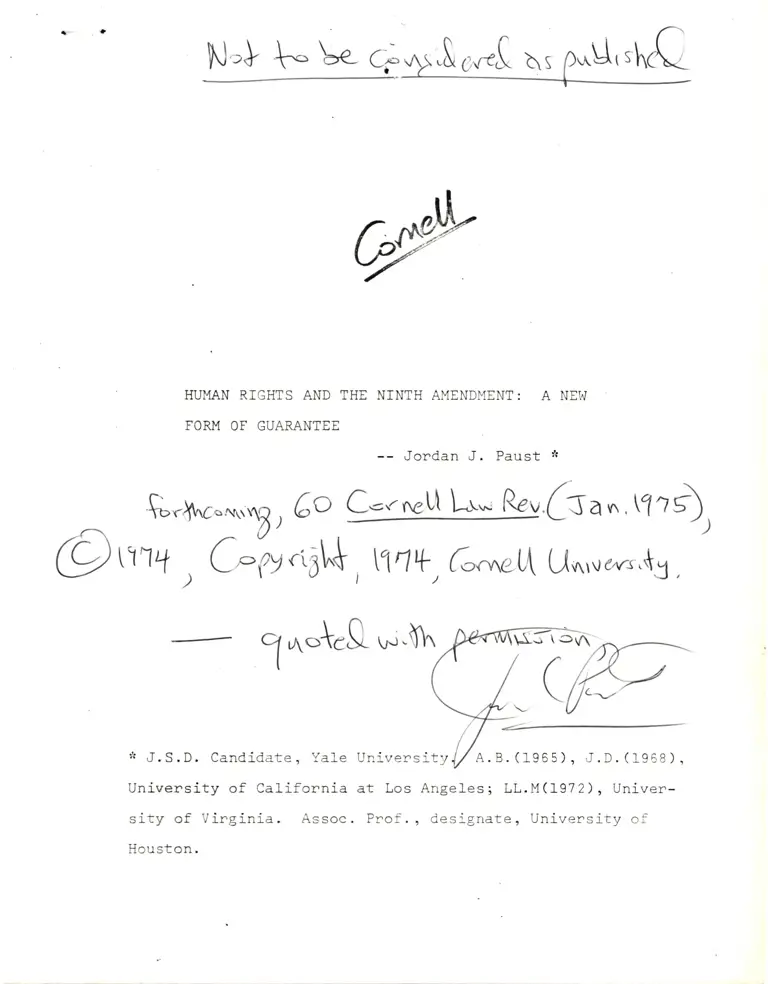
HUMAN RIGHTS AND THE NINTH AMENDMENT: A NEW
FORM OF GUARANTEE
-- Jordan J. Paust *
̂ C -^N ^lf\eU L .W a VN A 1 ^ ^
0'TV\£l\ ^m f̂ 11U4- r:̂
J
" (
1^0' S I VyO V. ''Ha
* J.S.D. Candidate, Yale University^ A .B.(1965), J.D.(1968),
University of California at Los Angeles; LL.M(1972), Univer
sity of Virginia. Assoc. Prof. , designate. University of
Houston.
We hold these truths to be self-evident, that all men are
created equal, that they are endowed by their Creator with
certain unalienable Rights, that among these are Life,
Liberty, and the pursuit of Happiness.
The Declaration of Independence, 1776
Even those who are only aware of the two instances of
substantial and violent human rights deprivations which occurred
recently in Bangladesh and over a quarter of a century ago in
much of Nazi controlled Europe should readily recognize the
intense interdependency that exists between peace and the effective
realization of fundamental human values. Such a recognition has
been made by the United Nations,^ and the United Nations Charter
contains a related pledge of the United States and all other
member nations to take joint and separate action in cooperation
with the U.N. for the effective implem.entation of a "universal
respect for, and observance of, human rights and fundamental
2freedoms for all." Not only has it been recognized that human
rights and peace are interdependent, but many have also recognized
that there exists an increasing interdependency among all people
which should form the basis for a cooperative concern for the
rights of others. Thomas Paine had expressed this same principle
of interdependence when he declared:
He that would make his own liberty secure must guard even his
enemy from oppression; for if he violates this duty he
establishes a precedent that will reach to himself.'^
Indeed, by failing to effectuate the basic human rights of all
members of our society, we are coddling a deprivation which can
reach to ourselves and which can eventually destroy the very
acceptance of the human values that we now cherish.
These are recognitions of importance to international lawyers.
. - 1-
but they are also important to those who feel that they are
primarily concerned with the guarantee of civil liberties, the
continuation of a viable democracy or the curtailment of violence
in America. For even then, a proper and comprehensive inquiry
into those problems should cause one to ask whether there are
shared and interdependent polioies(goal-values) and expectations
that are documented in our Constitution, the early writings of
our Forefathers, the outcomes of a dynamic judicial applicatory
process("case law"), and the international human rights instruments-
if not elsewhere. One should ask whether there are substantive
and procedural guarantees in U.S. law for the universal respect
and observance of such fundamental human values. And we need
to discover how and where each of these shared values have actually
been implemented in the social process, for if basic human values
have not been guaranteed to each member of our society, then all
5of us remain in a tenuous peace with tenuous liberties.
Others, who were perhaps aware of these interdependencies and
the dangers to a free society and the value of each person, had
sought to secure a continuance of our inherited civil liberties
and to guarantee the internationally recognized Rights of Man
by arguing that the international law of human rights has become
part of our law through the ratification of the United Nations
6Charter. This attempt to bring internationally recognized
human rights into our domestic legal process as treaty law and,
thus, part of the "supreme" law of the land through Article VI
of the U.S. Constitution did not succeed, and human rights
activists still seem intent on continuing the quest for an Article
VI form of guarantee instead of exploring the several other bases
7
for human value recognition and implementation. It is the
- 2-
purpose of this article, however, to focus on an alternative
form of guarantee and to analyze the problems which have impaired
its utility in the past. Hopefully, this focus will contribute
to an ongoing and efficacious expectation of what, otherwise,
would have to be considered a tautology--that human rights must
necessarily be our own.
A New Form of Guarantee
A. The Ninth Amendment.
The new form of human value guarantee considered here is not
really a new form at all. It is merely a form of guarantee that
has suffered from a lack of juridical use and from several
misconceptions as to its nature and purpose. The alternative basis
for the protection of fundamental human values is the Ninth
Amendment to our Constitution. And its utility lies not with
questions as to how internationally recognized rights can be
"implemented" into our domestic law, but with the recognition
that basic human rights are already a viable part of the
Constitutionally guaranteed rights of Americans. Perhaps it is
true that our courts have either not recognized the existence of
such a Constitutional protection or have been unwilling to make
use of it for fear of being criticized by some as the expounders
g
of arbitrary and personal social preferences. But it seems,
nevertheless, that our Forefathers definitely expected that the
Rights of Man would be guaranteed under the Ninth Amendment. And
it also appears that we can recapture this intended utility of the
Ninth, since a more broadly documented enumeration of the Rights
of Man is now available for judicial discovery and use.
To the extent that the general boundaries and the criteria
needed for the discovery of the content of each type of right become
- 3-
identifiable in different arenas of the legal process, they
should be utilized by the courts to effectuate shared expectations
of "right" and should not simply be ignored. Indeed, the
Declaration of Independence expressed to the world the expectation
that all governmental bodies(and, thus, the members of the judiciary)
were to function so as "to secure these rights" which are
fundamental for all. The judiciary should recognize that it will
directly affect the realization of fundamental human expectations
by its action or its inaction. Human rights policies are at stake
in every form of human interaction and are relevant to every
instance of authoritative decision. The judiciary cannot avoid
its responsibility for rational and policy-serving decision by
simplistic notions of noninvolvement. Action or inaction will
have its effect, so it might just as well seek to be rational
and comprehensive in its decisional efforts, to affirmatively
discover and protect these Rights of Man and not continue to
ignore them with an egregious and only self-deceiving claim of
unfamiliarity with fundamental and continuous expectations that,
9as it happened, were not soecifically listed some 200 years ago.
Indeed, rational and policy-serving judicial decision can only
occur where effort is made to enrich decisional awareness of
and responsiveness to policy and context through a systematic
exploration of all of the policies at stake and all of the
relevant features of context which will condition the effects of
decision and the serving of legal policy in social process.
B. The Need For A More Comprehensive Focus.
In a sense, part of the failure of our legal applicatory process
in guaranteeing a full range of fundamental human values to all
persons in our society extends from a simplistic and formalistic
jurisprudential inheritance of the 19th Century that can be
generalized as legal "positivism." It replaced the naturalist
school of thought which was dominant at the time of the Revolution
and the signing of our Constitution; and, thus, it was not a
relevant focus for the sorts of Constitutional interpretations
that the Framers of the Constitution would have held in common.
In practice, legal "positivism" has actually become a form of
legal negativism, since it demands of its adherents a simple,
myopic and inhibiting reference to the words of ennacted law
rather than to the entirety of legal process and a more compre
hensive contextual orientation which is far more rational, relevant
and responsive to the whole range of policies, needs and shared
10expectations which stand behind.a set of printed words. This is
not the place to expand upon the evils of formalistic and unrespon
sive legal thinking, and jurisprudential perspectives would not
even be mentioned here except for the fact that they underlie each
lawyers conception of the juridical utility of a now dormant
Ninth Amendment. They underlie as well the court's conception of
its role in the implementation of law, the securing of fundamental
rights and the discovery of a shared content for these rights. Thus,
in a very real sense, a second form of guarantee that is interconnected
with the utility of the Ninth Amendment would stem from a judicial
orientation in a broader jurisprudential focus--a focus, as it
turns out, which is more compatible with that of the Framers than
that of the legal "positivists."
With a comprehensive focus, the courts could more easily and
more rationally discover the content of rights which are not
specifically enumerated in the'Constitution but which are, never
theless, rooted in the expectations of the people and in documented
policy. A court that uses these sorts of indicia of "rights"
content would not be acting arbitrarily, deferring to transcendental
- 5-
sources or expounding a personal social preference. On the
contrary, it would be rationally implementing social demands and
expectations which are generally shared and are empirically
discernible. Anything less would only be less rational and
less responsive to overall legal policy and human needs. And a
court which sought to be more comprehensive would be performing
the constituted function which is primary to any governmental
entity— the securing of rights which the people expect and a
government not of words but of men. Furthermore, such a court
can recapture the broader jurisprudential focus thought necessary
by the Framers of the Constitution without resorting to the evils
of a naturalist schooKe.g., ad hocery, autonomous concepts,
personal viewpoints, arbitrary decision-making, and so forth) or
a newer and more egregious form of sensualist jurisprudence(the
I know it when I feel it school). In a sentence, the courts can
use a wider juristic focus to regain the original Constitutional
construct and to utilize international human rights as an inter
pretive aid for a proper application of the Ninth Amendment and
the universal implementation of human rights as called for by the
United Nations Charter.
The Constitutional Role of the Ninth Amendment
The Ninth Amendment is one of the shortest but, perhaps, one
of the most important declarations in the Constitution. It states:
The enumeration in the Constitution,of certain rights, shall
not be construed to deny or disparage others retained by the
people.
It seems clear from the language that certain rights exist even
though they are not enumerated in the Constitution, that these
rights are retained by the people, and that by express command these
unenumerated r̂ ights should not be denied or disparaged by any
governmental body.^^ It would also appear to be a truism that
- 6-
"it cannot be presumed that any clause in the constitution is
12intended to be without effect." The only problem, then, would
appear to involve the development of some useful, rational and
policy-serving methodology for the discovery of the actual
content of these rights. But no matter how clear these tenents
seem to be, there are those who would obfuscate the role of the
Ninth Amendment in the scheme developed for the constitutional
protection of human values and liberties.
The several obfuscating misconceptions that exist in the
writings are generally classifiable into four main arguments:
(1) The Ninth is a mere statement of "policy;"
(2) The Ninth merely cuts back on the grant of "power" to
the federal government;
(3) The Ninth is merely a "rule of construction;"
(4) The Ninth is no longer needed in view of the Fifth and
Fourteenth.
The main difficulty with the first view, that the Ninth Amendment
was a mere statement of "policy" and not a constitutional guarantee
13of unenumerated rights, is that whether one calls it a "policy"
or a protective amendment the intent still seems clearly expressed.
That intent was specified in the language which states that certain
unenumerated rights exist and which demands that these rights shall
14
not, under any circumstances, be denied or disparaged. A court
that did not. seek comprehensive awareness and application of
human rights policies would be, in effect, denying their existence
or relevance and disparaging their efficacious role in social process.
And clearly this, by command of the Constitution, is what a court
must not do. The very fact that there are human rights "policies"
makes it necessary to serve these policies through an integrative
decisional effort.
- 7-
A second misconception, which also ignores the plain wording
of the amendment, is that the Ninth was established merely as a
cut back on the grant of power to the federal government and
was not established to guarantee rights against a denial or
15disparagement. Two types of adherents to this misconception
seem possible. The first might affirm that unenumerated rights
do indeed exist, but they are only "rights" against the power of
the federal government and are not inherent rights of man which
exist against the state governments or the conduct of other men
(of a nongovernmental sort). We shall consider this first approach
in greater detail below. The second, which seems to pose the most
dangerous threat to inherited goal-values today, might affirm
that the unenumerated rights are the equivalent of a constitutional
scheme which grants and withholds federal powers. In other words,
the "rights" which are retained are the same as the remaining
"powers" or are the same as those which were not granted to the
federal government--which are few indeed. And, the adherents to
this misconception would affirm, there are no rights except those
which relate to the governmental process, so the whole knotty
question of the difference between rights and powers simply disappears.
This sort of claim would seem to reveal an underlying dependence
of its adherents upon an unquestioned assumption that where the
federal government posseses a "power" it is held in the absolute--
that the interests of the government are to prevail in any
16balance with individual interests(jointly held or separate). It
is not an assumption which is easily perceived, especially when
the misGonceivers blur the distinctions between "power" and "right;"
but if one seeks to explore the imposed construct of "power" and'
"right" a bit further, one runs ultimately into an overall question
- 8-
of authority, since it is not really raw power that is involved
with their consideration but granted or authorized power(delegated
authority). And the adherents are not really concerned with "rights"
but are concerned(if that is a proper term) with a retained
authority of the people. They assume, rather simply, that when
some authority for a particular governmental functioning has
been delegated that that is the end of the question. Nothing
needs to be balanced since, it is assumed, authority was given up
(i.e., not conditionally granted) and any authority that was not
given up is what the Ninth Amendment mentioned and not some notion
of "right" outside of a hierarchy of governmental and nongovern
mental "power." But, as we shall see, if there had been no
difference between retained rights and retained powers, there
would have been no need for the Ninth Amendment at all since the
Tenth Amendment had already recognized a retained power in the
people. Furthermore, this sort of misconception hinges upon an
egregious blurring of the distinction between delegated competence
to make authoritative decision(i.e. , power) and the legal policies
which are at stake(i.e., shared policies or expectations of the
existence of "rights" and "duties"). Contrary to what some might
hold, competence is not at all the same thing as "right;" and a
delegated power of decision is not the same as a set of policies
which should guide rational decision.
And the danger to a free society which is inherent in this sort
of misconception probably wouldn't even be worth mentioning here,
but interrelated with this danger is the fact that the whole
inherited approach to authority and the retained Rights of Man is
under attack in this country just two hundred years after our
independence. _ To put it bluntly, this misconception opens the
door to a false concept of authority which has allowed the growth
- 9-
of totalitarianism and "machine" oriented societies in several
nations of divergent ideological background. This false and
subversive concept of authority, simply stated, is that authority
17exists with the government and not with the people. It may
be difficult for some to accept in this age of the super-industrialized
societyCwith its increasing deference to conformity and power and
a lessening of the value of the Individual, if not an outright
rejection of the value of certain persons and ideas as "marginal"
or superfluous) but the founders of our own Constitution rejected
the view that authority comes from the government. It was simple
enough to affirm then that all authority is derived from the people
and that primary authority(which remains in the people) is at all
times superior to representative authorityCor to authoritative
competence to make decisions which is conditionally granted to
the Legislature, the Executive and the Judiciary). And how
unnatural it would have been to even suggest that a sovereign
King was beyond the law, that he could protect himself or any
violator of criminal law from punishment by arbitrary methods or
the mere referral to the nature and povjers of an office, or that
he could obstruct the administration of justice and the due process
18
of government at his own discretion.
Indeed, in the Declaration of Independence these very sorts
of attempts to usurp authority or to obstruct what was considered
to be the proper functioning of the criminal process were specified
in charges against the King of England. And it was no accident
that such a King was denounced, for this and similar conduct, as a
"tyrant" and "unfit to be the ruler of a free People." It was no
accident that, with these charges in mind, those who had formulated
the Declaration of Independence had expressly declared that
- 10-
governments are constituted in order "to secure" the unalienable
Rights of Man, that governments derive "their just powers from the'
consent of the governed," and that it is a right of the people to
alter or abolish any form of government which "becomes destructive
19of these ends." Nor was it an accident that the preamble of the
Constitution declares that the People... do ordain and establish
this Constitution..."(emphasis added), and not we the states, we
the super magnanimous elite or we the sycophantish bureaucracy.
And it wasn't a mishappenstance that the Tenth Amendment expressly
referred to the retained power of the peopleCas well as that of
the states) but the Ninth Amendment expressly referred to the
20retained rights of the people. In point of fact, Thomas Paine,
in a widely circulated book. The Rights of Man, had exposed the
basis of the distinctions and the inherited expectations of
our Forefathers when he wrote that the "authority of the people"
is "the only authority on which government has a right to exist
in any country," that the "end of all political association is
the preservation of the natural and imperscriptible rights of
man...," and that the government "has of itself no rights: they
20aare altogether duties."
How jarringly inappropriate would have been the argument then
that when the Executive had decided that a particular criminal
investigation or prosecution should not continue because it was
claimed to be contrary to "Governmental interests," a court could
not at all interfere and a people should not complain. In fact,
the expectation of the contemporary framers of state constitutions
was clear, that if any laws we-re to be suspended or their
esecution curtailed it was to be the legislative branch and not •
the executive which would make such a decision. And this sort of
decisionCto suspend investigation, prosecution or execution of the
- 11-
law) is not at aLl synonymous with the competence to grant a
21pardon after conviction. Moreover, to juxtapose "Governmental
interests" with the consent of the governed, the interests of the
people, the objective and just administration of the criminal law
or the constituted and independent judicial power of the courts
would not only have been unacceptable but unthinkable.
Now, it seems, claims have openly been made that in the sphere
of delegated powers, or conditionally gtanted authority, the "govern
mental interests" are the same as or superior to the interests of
the people and irhat it is by protecting "governmental interests"
22that we serve the nation. To this sort of claim, the drafters
of nearly all of the state constitutions that had been written prior
to the enactment: of the United States Constitution had expressed a
proper reply. They affirmed that a:
government is, or ought to be, instituted for the common
benefit, protection and security of the people, nation or
commt^nity; and not for the particular emolument or advantage
of any single man, family, or sett of men, who are a part only
of that community; And that the community hath an indubitable,
unalienable and indefeasible right to reform, alter, or abolish
government in such manner as shall be by that community judged
most conducive to the ■oublic weal. 23
Supplementing this declaration was the widely shared expectation
that when the government was being administered for the benefit of
"those who are employed in the legislative and executive business...,
the people have a right, at such periods as they may think proper, to
reduce their public officers to a private station, and supply the
24vacancies by certarn and regular elections." Thomas Paine had
expressed the contemporary view on reformation of the federal
government while also recognizing the right of removal from office,
and he stated:
The right of reform is in the nation in its original charactEr,
and the constitutional method would be by a general convention
elected for the purpose. There is moreover a paradox in the idea
of vitiated bodies reforming themselves. 2*+̂^
- 12-
No man or group of men was to be above the law, public interests
were to be the measure of public decisions, and authorityCjust power)
was derived from and ultimately retained by the people. As
Hamilton expressed so well and so concisely, "The people
25surrender nothing.
This not only meant that delegatedi^representative) authority
was subject to the ultimate authority of the people, but that
delegated authority was subject to retained "rights"(including
expectations of right involving all social interactions) and to
retained "power"(i.e., a competence to act or an authority of the
people to restrict, alter or abolish governmental institutions and,
presumably, to make sure that governments which are not altered
or abolished strive to make governmental decisions in the public
interest). In contrast, v;hat the exponents of the second
misconception(that the Ninth merely cut back on federal powers) seem
to place^^rimary reliance upon is a statement of Madison that "if
a line can be drawn between the powers granted and the rights
2 6retained, it would seem to be the same thing." Thus, they
conclude, there are no^rights" and Madison was only concerned with
the cut back of federal power and not with the protectidn and
implementation of rights which were not snecifically enumerated
elsewhere (again, alm.ost as if the language of the Ninth did not exist)
Well, retained powers and the efficacious protection of rights may
have seemed to be the same thing in the 18th Century, but this
view does not similarly compel'us to leave to "nature" the
protection of those same or other unenumerated rights in the 20th
Century. The better view seems to be that Madison was interested
both in rights and powers but had thought' that the Rights of Man
were already guaranteed by what had been specified and by the
' - 13-
- 14-
limits on federal power in the context of a preindustrial society
of 18th Century America. What the propounders of the misconception
leave out, however, is the significant
fact that Madison was responding to Governor Randolph of Virginia
who had made the prophetic criticism of Madison's assertions that
the Ninth would be sufficient, since there *̂ no criterion by
which it could be determined whether any other particular right
was retained or not."' Thus, Randolph warned, the federal
government might someday deny the existence of, encroach upon or
disparage civil liberties that were not specifically listed in
the Constitution some two hundred years ago with the self-deceiving
statement that it cannot find any criterion for their discovery(the
I see nothing--or nothing else--interpretive approach).
Actually, Madison, like Hamilton and Justice Wilson, had
feared that a
specific enumeration, of rights might someday be interpreted so as to
deny or disparage others^ But he was persuaded by Jefferson and the
general demands of the states that a bill of rights should be added to the
Constitution along with some form of caveat to cover the danger^® Indeed,
Madison did not juxtapose ^''implied powers against unenumerated rights.
On the contrary, he indicated that he thought a line could be drawn between
a<7 .
them.' Madison (stated before the assem.blage of the first House of
Representatives that the argument tha^ specification of some rights
be misinterpreted to imply a denial of others was the best argument
he had heard against the enumeration of any rights in the Constitution, but
he felt confident that his new proposalfthe predecessor to the Ninth) would
"30sufficiently guard against such attempted abuses of right. Madison knew
that ^̂ no language is so copious as to supply words and phrases for every
31
complex idea;" and he apparently knew that a list of words would be
"inadequate to express all the rights found in a free society ."^ He
- 15-
expressed a similar view to Jefferson when he noted that a bill of rights
could not guarantee even "the most essential rights” with "the requisite
latitude, " and he added:
I am sure that the rights of conscience, in particular, if submitted
to public definition would be narrowed much more than they are
likely to be by an assumed power. 33
With this recognition by a primary drafter of the Constitution that words
or lists of words are imperfect symbols for a complete expression or
"enumeration" of all societal expectations of the existence of rights or
values, it would seem incredulous to assume that the fi-amers felt that
the first eight amendments were to contain all of the fundamental human
values of the day, would preclude the vitality of future values ,
and would only operate as a cut back on federal powers. Indeed, as one
author correctly asserts, the Ninth Amendment specifies that certain
rights exist and the Tenth Amendment specifies that certain powers
remain, and it must be ^^evident that there was some distinction in the
minds of the framers of those amendments between declarations of right
and limitations on or prohibitions of power" or the Ninth would have been_
completely unnecessary. Furthermore, to Madison^rights could exist
in "areas totally outside the province of government, " and could become
operable on an independent foundation or one separate from the question
of federal powers. Though at times the concepts of rights and pov/ers
remain close, it is important to consider how each is to be exercised.
Therein lies 3. difference between "rights" retained by the people(Ninth)
and "powers'' retained by states and the peonle (Tenth) , for it
seems evident that the rights are to be exercised regardless of
the retained powers of a retained competence to act(representative vs
primary authority to act) and that these rights are to be secured
for the people by all governmental bodiesd.e., not "denied or
- 16-
37disparaged"). .The express declaration that "powers" are
reserved to the people seems to imply the popular expectation
that governments, when they deny the existence of these Rights
of Man or do not secure them for the people, can be altered or
disolved by the people either peacefully or by revolution. One
holder of the second misconception. Professor Redlich, had
3 9discovered this difference between retained rights and powers,
but he seemed content to ignore its potential use in the discovery
of a broad constitutional scheme for rights protection set up by
the Framers. Quite curiously, he concluded that rights which
were expressly retained "by the people" could be circumscribed by
the states(though this could not be done by the federal government)
Others have also gone astray on related misconception that the
rights of men which are expressly retained "by the people" were not so
40
retained against another governmental entity set up by men--the states.
That this is nothing but a misconception, however, is evident from the
context in which our nation w as founded and the popular expectations of h
̂ -iVivV)
, legal right. We had just expressed to the worldjcertain expectations
were "self-evident" truths. Among these were
the fundamental expectations that "a ll men'"'' have '^certain unalienable Rights"
and that all governments(or "any Form of Government") are created "to
secure these rights"--not to ignore them or to be immune from the express
»2
duty to protect and secure them for the people. In view of this historic
declaration^ it would be incredulous to postul?.te that the state governments
set up by these same men after the Revolution were to be immune and could
circumscribe the fundamental ^ghts of |i/̂ an. It would be more accurate
to assume that these rights were to be recognized, respected and protected
by all governments or branches of government that these men would create.
Indeed, Jefferson had written to Madison that a "b ill of rights is what
the people are entitled to against every government on earth, general or
- 17-
particular; and what no just government should refuse or rest on inferences."
The state of Virginia had ratified the Constitution with an "im pression"
understanding that certain "essential and unalienable rights of the people"
44remained. And this expectation of a continued existence of the
Rights of Man which can be enforceable even against the state(although
they are not enumerated in state constitutive instruments) must
have prevailed, since the people of several states found no need
at all to specify that even one right of the people continued to
45exist after the formation of the state government.
In fact, the application of the Ninth Amendment to the states
would have been completely consistent with the general expecta
tions of the ̂ ^Founders pertaining to the relationship between
governments and the rights of men. This can be readily seen in
the early v/ritings and is expressly recognized in several of the
early state constitutions which-affirm that state governments are
bound by the Rights of j^an^not only in the sense that these rights
constitute a restraint upon state power but also in the sense that
rights of m^n and the public interest shall guide the govern
mental functionaries in proper governmental decision-making and
require action to promote these rights as well as the general
protection, security and common benefit of all of the people. The
earlxest constitution ,^f Virginia, had clearly expressed these
expectations, It also declared:
That .all men are by nature equally free and independent,
and have certain inherent rights, of which, when they enter
into a state of society, they cannot, by any compact, deprive
or divest their posterity. *+6
The constitutions of Pennsylvania and Vermont repeated this
expectancy while adding that the inherent rights were natural
and inalienable. 47 Similarly, the constitution of Massachusetts
referred to ’’certain natural, essential, and unalienable rights,"
while the Constitution of Nev; Hampshire referred to "certain
48
- 18-
l4 g »natural, essential and inherent rights," contemporaneous
reference to the "invaluable rights of man" appeared in the
5 0Pennsylvania Declaration of Rights of 1790. Since the natural,
essential, inherent and unalienable rights of man were binding on
the states by express recognition in most of the state constitutions,
their recognition in the Ninth Amendment must have been, as
Jefferson would declare, rights "against every government on earth"
and what "no just government should refuse."
Moreover, as even Kelly recognizes, at "the time the Constitution was
drafted, nearly every political leader in the country was a disciple of the
natural law school'^ of juristic thought and was greatly influenced by the
writings of Locke and Coke. Kelley points out that these juristic expecta
tions of the day held that the natural rights of men "were inalienable.. .
could not be affected by governmental action. . . could not be given
up and were not subject to the political authority v/hich men established.
But later on Kelly concluded that the states could subjugate those
same human values and that federal courts could not protect them
unless they were enumerated somewhere in the federal Constitution
or could somehow fit under the "due process" clause. In view of
the naturalist philosophy, this would have been an impossible
perception since even the "due process" concept seems limited by
its terms to some governmental process. And to the naturalist
oriented Framers, these Rights of Man simply could not be given up,
nor could they be subject to constraint by the political frameworks
which men created(whether these frameworks happened to be state or
5 3federal). Redlich completely misconstrues the nature of these
juristic expectations and he tries to argue that the states must
not have been restrained at all by repeating an unsupportable myth
that "men looked to the states as the chief guardians of individual
„ sa
rights" and not to themselves. But even this statement, that the
states were to be "guardians" of these rights, implies that they
cannot abrogate them and that the rights must be protected even
when they do. Redlich also argues that it would be "unrealistic
to attribute... an intent to impose ill-defined legally enforceable
restraints on the states in light of "a rejection of some of
Madison's proposals for additional amendments, but the relevance
of this argument seems hidden and, perhaps, relates to the
confusion between grants of power and the retention of rights which
the holders of this misconception seem to share.
What emerges from expectations of the gamers disclosed above
is a scheme of rights and power,s that can be briefly articulated
in the following sentences. First, ultimate authority comes from
the people(the aggregate of all individuals) or from the full and
55free sharing and shaping of power by all of the people. Some
of this authority is delegated(conditionally) from the people to
governmental entities and becomes representative authority
through a process that constitutes the governmental structure and
its processes(the dynamic constitutive process). With the conditional
transfer of this authority, there is the creation of authoritative
"power"(i.e., competence) in the governmental entities to the
extent so constituted; but the persons entrusted with governmental
powers are the trustees and servants of the public and they remain
fully accountable to the public. Second, when the federal govern
ment was constituted certain state powers were also retained for
a comprehensive system of authoritative government. Third, the
proper function of all government(the purpose and condition of
the grant of authority and power) is to secure the rights of the
populace. Fourth, certain fundamental rights of the populace
- 19 -
(joint and individual) are expressly recognized in both federal and
state constitutive instruments, but others that are not enumerated'
are expressly retained
by the people despite the transfer of a certain measure of
authority and power to the constituted governmental entities. In
fact, as stated, that transfer is conditioned upon the continuous
fulfillment of rights--a fact which relates to the full meaning of
"authority" and which is of increasing significance to the expansion
of Presidential powers, the relative aloofness of certain
Congressional perspectives, the continued entrenchment of a
fourth branch of government(bureaucracy) and the diminishing
effort expended by the judiciar-y for the promotion of human dignity
and the maintenance of an ideological or policy matrix for which
our forebearers fought and which is truly still at issue around
the globe.
The third main argument against a broad role of the Ninth
Amendment in the guarantee of fundamental human values and liberties
is the notion that the Ninth was merely adopted as a "rule of
construction" or a "rule" for the interpretation of the rest of the
o • • 56Constxtutxon. Some of the holders of this misconception add,
however, that the Ninth is useful in "pointing" to the utility of
the "due process" clauses of the Fifth and Fourteenth Amendments.
And this supplemental view is actually the foundation for the fourth
main argument against a greater use of the Ninth, which is that
the Ninth is now of little importance since the Fifth and Fourteenth
57can cover the field. But, as noted, the phrase "due process"
seems limited to some form of governmental activity. But it is
not entirely limited to restrictions upon'actions of the govern
mental bodies , because a due process of government would also
- 20-
entail the promotion of the Rights of Man in view of the fundamental
expectation that government is constituted in order to "secure"
these rights. However, even then the "due process" language may
not be broad enough to guarantee the effective respect for,
protection of, and observance of fundamental human rights which
seems required by the language of the Ninth Amendment which prohibits
any denial or disparagement of their effective existence in ongoing
social process. Moreover, these last two transpositive notions
not only ignore the plain fact that the term "others" in the Ninth
Amendment must refer to rights other than those found within the
first eight amendments(or to rights other than the specifically
enumerated rights--such as the right of "due process"), but they
also ignore the nature of the jurisprudential expectations of the
Framers and the human context which existed at the time of the
adoption of the Ninth Amendment.
In view of what has been disclosed above, these third and
fourth arguments are simply incorrect and we need not explore
the questions further; but in the interest of thorough inquiry
we might still consider them a bit further. As incredible as
it may seem, Kelley has stated that the Ninth Amendment is:
only a rule of construction. . . not a source of these rights^ nor is it
a vehicle for protecting them. Rather, it points to other parts of
the Constitution--particularly the due process clauses of the fifth
and fourteenth amendments--as the contexts within which unenumerated
rights are to be determined.
Although it is true that the Ninth is not the ultimate source of these rights,
his other statements are clearly wrong on at least two counts: (1) the Ninth
doesn’ t "point” to tlie Fifth or any other amendment^but seems expressly
detached from the specific language of any of them or any other rights, and
(2) it could certainly not have pointed to the Fourteenth since that amend
ment did not come into existence for another hundred years. The express
detachment from the specific language of any other amendment seems to
- 21-
mean that the Ninth was adopted not as a mere ’ 'rule of construction" of
the enumerated rights or the other provisions of the Constitution, but as
c«?
a recognition of the existence of "others" not listed, a recognition that
these other rights are retained by the people, and an express comm*and
that these rights are not to be denied or disparaged merely because they
are not enumerated in the Constitution.
■ - 22-
What Are These Unenumerated Rights?
There should be no debate as to whether fundamental rights of men
exist; there should merely be questions concerning the proper identifica
tion of tne boundaries and content of those rights. In our juristic records
there have been demonstrations of certain views about these rights. Ther<
have been statements that the first ten amendments did not create new
rights but provided a constitutional scheme for the guarantee of older
ancient rights of the people. There have been statements that the Bill
of Rights includes those rights "arising out of ’ Natural Laws, ' inherent in
€1the structure of any society or at least any civilized society, " and
statements that these retained rights of men are "natural, inherent, and
fundamental rights. C2 Other descriptions of these human expectancies
have been couched in terms of "the traditions and collective conscience
of our people, " or shared values v/hich can gain content for rights identifica-
tion from specific guarantees and fro m l" experience with the requirements
of a free society." Chaffe has added that "a ll rights in the Constitution
are really human rights, since they are exercised by human beings against
human beings^" f^nd in tne past courts have not merely used American
values to discover the content of these riglits, but have also used a test
based upon a dynamic and "universal sense of ju stice ."'^ Indeed, many
commentators have considered that international human rights(as they
are found to have a universally shared content) are "the main core of
rational objectives not only of the United Nations but of all democratic
- 23-
;s IS
governments.” What is surprising, however, is not that this inter
relationship between human rights and the Ninth Amendment exists, but
that it has to be explained to certain Americans in the 20th Century.
We sometimes forget that certain rights did not have to be enumerated
in the I8th Century with particularity but could be covered by language
in the Ninth since those rights and values were almost ’ ’guaranteed” by
the expectations of the people and man’ s environmental contex^hey were
’ ’natural” rights of man and ’ ’self evident” truths, Bertrand Russell
the "eighteenth-century doctrine of natural right;
a search for Euclidean axioms in politics,’' by which it "appeared
to be possible to discover things about the actual world by first
noticing what is self-evident and then using deduction." Sir
Lauterpacht adds;
From, the very inception the theories of nf^ural^law^were^^^
generaliza-feions from aCLual experi_noe j
to put in the form of general law the fact of a uniformity
as ascertained by observation and study of evidence... Their
authors endeavoured to form laws of conduct by reference to
the nature of man, to his physical and mental constitution
as they saw it, and to his station and purpose in the scheme
of creation as they perceived it from the contemplation of
the world around them...
The authors of the Declaration of Independence referred
to its principles as expressive of self-evident truths.
There is, in that confident application of the Euclidian
principle of self-evident truths to the notion of natural
rights of man, an assertion, which is far from being arbitrary,
of a direct relation between natural rights and scientific
laws.6 9
Hamilton had stated that the "sacred rights of mankind are not
to be rumaged for among old parchments or musty records" (a
favorite sport of the later legal "positivists"), but "are
written, as with a sunbeam, in the whole volume of human nature..
But as technological and sociological developments altered the
human context and precipitated new human needs or affected old
needs, those "natural" guarantees had sometimes lost their effect
or disappeared; and if we are to guarantee to ourselves and our
,70
Children these inherited values and the fur.da-er.'
in the modern context ,
then it seems that the courts are going to have to stop be:
q£ value and. right deprivations and tahe an af£irmative a —
of developed human values and the protection of funca.-.ie-
’*"We must never forget, ” Justice Marshall warned, "tha.
we are expounding. . . a constitution, intended to endure :
and consequently, to be adapted to the various crises rf
The Ninth Amendment, as part of that dynamic instrume
- 24-
?.i = r-3 of hi.in
■ rerm issive
in the application
.1 expectations.
i£ a constitution
ftr ares to come,
-uan affairs.”
must(similarl^be/utilized to meet contemporary nee;
73of fundamental rights.
To the author^ it seems quite proper for e I'.":
Court to have rejected phrases such as "natural 1
rights," a "sense of justice," or "exDerier.ae
V\v’yV\l̂of a free society" as (gYtw-wiMi.y useful or
references for the identification of the ccr.ta~r ■
rights(although they use these sorts of refarr~;a
rights)# ̂ t it does not seem proper to ha-.-e :;r-a-
of these rights^and the Ninth Amendment it sal' "-a.,
positivismjsubsequently(and improperly) demariai ■
enumerated words. Each of the above phrase? .'Ife.
referrent and one open to a great deal of ar?-sra.
leev/ay. It is not that thev are incorrect, b-U r
insufficient in themselves to provide guidaaar
policy—responsive decision-making. Thev aua a
for those purposes. In the a£g.regate, hov.’e 'a. - t
kind of inquiry a court might properly make. 1:
in a dynamic social process, "natural" to- a s-
on a "universal sense of justice," or tied i: una
of a free society, the court need not hide ?
: z the people,
expectancies
tu--- VI- r
"inherent
: requirements
.serial
.enumerated
■ enum.erated
she existence
because legal
.lance upon
inccm.plet e
;cis ional
:hey are
:icnal and
:ss useful
rcint to the
;s are "inherent"
society, based
:;ing "experience"
'.erelv because
these phrases are ■ themselves too general. The decision-maker needs,
instead, a set of criterial referents to pull the shared content
of these rights out of the social process in which they are emerged,
and an initial effort by the courts has been made with the attempts
to identify "the traditions and collective conscience of our neotle"
(shared expectations) as they intertwine with an "experience with
the requirements of a free society"(actual context and the inter
connected social, legal and political processes).
In more general terms, these two indicia of the content of
rights(shared subjectivities and actual operations) can be
referred to as patterns of authority(which include
empirically demonstrable subjectivities of the people) and patterns
of control— the mergeance of which has been insightfully recognized
as law in social process. Not only are the perspectives of the
people important(their identifications, demands for value outcomes
and expectations) but the social context as a whole("experience")
is also relevant for a mapping of the intertv;ined patterns of
authority and control or of efficacious law. Even this, hovzever,
is only a beginning of the more comprehensive (inquiry v/hich is
needed; but this beginning points to the great utility of documented
international human rights as one set of indicia of the shared
■subjectivities and experience of mankind--an indicia which is useful,
as well, in a comprehensive inquiry into the types of policies
(goal-values) v;hich the Constitution seeks to protect, the tyoes
of policies which^nder the U.N. Charter and other treaty la^^
the United States must also seek to respect and observe, the other
types of shared subjectivities that our own people posses, and the
kind of "experience" that our society has participated in and is
continuing. Documented human rights, it is alleged, are sufficiently
particularized for such a judicial discovery and are sufficiently
- 25-
part icularized to give a more detailed and useful content to
expressions such as "the traditions and collective conscience of
our people" or a "universal sense of justice" which our courts
are already applying. Indeed, it would seem impossible to consider
the traditions and collective conscience of this nation, not to
mention universal norms, without systematic reference to the
Rights of Man.
Furthermore, the discovery and interpretation of the funda
mental Rights of Man is a proper judicial function. For that
purpose, the courts can find empirical referents to shared legal
expectation in
human declarations, practice, court decisions, legislation, the writings
of legal scholars, and in universally accepted standards of human rights. '
In utilizing standards of fundamental human rights, such as the 1948
VS
Universal Declaration of Human Rights, as a means of interpreting
- 26-
the nature of rights which already exist and are retained by the people
under the Ninth Amendment a court would not violate recoanized lecralO t>
principles concerning "political questions," judicial intervention, or the
doctrinal hurdle of " self-executing treaties" since these rights of m.en
already exist and are merely being protected by the court through
a more rational, policy-serving decisional effort. No affirmative
or particularized mode of implementation or any "operationalizing" of
these rights would be demanded; the court would merely strike down
governmental modes which do not conform(i. e . , there would be no
judicial "intervention" into the legislative discretion to select a particular
mode from among the proper types available, but there would be a judicial
.^7 ^guarantee against legislative or other infringement of basic human rightsV 3Ln<x
a more rational, policy-serving application of human right policies
to all decision.
Amendment^and which
A Sketch of the Types of Discoverable Rights
A. Inherited Expectations.
Besides the fundamental rights which have been protected under notions
of due process, several documentations of basic human values and liberties
which were most likely among those cherished by the framers of the Ninth
still seem to be standards of great juridical
utility ̂exist for court and scholar to discover alike. For example, Kelsey
lists certaia discovered "natural rights"JtncTuding the rights of; personal
liberty, personal security, property, religious freedom, freedom of
conscience, freedom to contract, freedom to v/ork, the right of privacy,
resistance to arbitrary authority, the pursuit of happiness and safety,
and the enjoyment of life and liberty. ' Rogge would add the freedom
of movement and rights of knowledge, confrontation, political activity,
%0use of the mails, and peaceful picketing or protest; and Call would
add the important right of the people to have the government function
in the public interest and for the common good. This last recognized
right to have public interest as the measure of public action seems related
to the naturalist fram er's concept that each citizen has an equal political
interest in public questions and has equal political rights including access
to the governmental process and an equal voice in its affairs. It also
seems related to the concept that any effective denial of the individual's
right to political participation in governmental decisional functions through
the undue deference to minority wills(or special interest groups) by those
who hold public office or public responsibilities is itself a denial or disparage
ment by decisional bodies of the equal protection of individual political
rights and a denial of an aggregate of individual trust{or a denial of the
public trust and an "undue" process of law and government)."^
Thomas Paine had expresslv recognized this right of full participa
tion as Phe-saving quality of a representative democracy and added
an interrelated "right to know:"
- 27-
In the representative system, the reason fo r every thinq; must
p u b lic ly appear. Every man is a proprietor in government, and
considers i t a necessary part of his business to understand ...
There can be no m ystery .. . 81a
Corwin made a thorough study of our inherited values and expectations^
- 28-
and within his work one can also discover the basic human expectations
of hetman equality, human dignity, the sanctity of the home, the
binding force of contracts, property rights, popular sovereignty,
the right to have governmental decisions conform to the public interest,
and the fundamental expectancy that justice is not to be tied to the written
word. Today, in view of our inherited values and present human needs.
Justice Douglas would wish to add the rights to recreation, clean air and
clean water. Since the framers looked upon Locke as an authoritative
source, great weight ^gpuld also be given to his identification of the
following types of rights of men; liberty and freedom, equality, life,
limb, health, property, peace, safety, governmental functioning according
to laws and in the public interest and common good, and the right of
revolution where the government does not effectuate these rights of
As Locke said, however, this right of revolution is not for the minority
of an identifiable society who see’' to come to power or to destroy the
social compact based upon the will of the community as a whole, but that
this right of revolution is a right of the majority.
B. Value Categories.
As one can readily see, the deeper one explores the more our
inherited goal—values come into focus. A most useful and compre
hensive overview of the types of values discoverable, however, has
already been provided by the value matrix worked out by Professors
McDougal
and Lasswell in reference fo ’’man's long struggle:"
for participation in the processes by which he is
governed, equality before the law, and that wide sharing
of power, both formal and real, which we call democracy^
for sanctity of person, fo'r freedom from arbitrary re
straints _ and cruel and inhuman punishments, and for positive
opportunity to develop latent talents for the enrichment and
well-being of personality;
f̂ or the enlightenment by which rational decisions can be
made and for freedom of inquiry and oninion;
for that fundamental respect for human dignity which both
precludes discrimination based on race, sex, color, religion,
political opinion, or other ground irrelevant to capacity
and provides positive recognition of common merit as a human
being and special merit as an individual;
for access to resources to produce goods and services
necessary to maintain rising standards of living and comfort;
for acquisition of the skills necessary to express talent
and to achieve individual and community values to the fullest;
for freedom to explain life, the universe, and values, to
fix standards of rectitude, and to worship God or gods as may
seem best;
_for affection, fraternity, and congenial personal relation
ships in groups freely chosen;
for, in sum, a security which includes not only freedom from
violence and threats of violence but also full opportunity to
preserve and increase all values by peaceful, noncoercive
procedures.
is for values such as these that men have always framed
constitutions, established governments, and sought that delicate
balancing of power and formulation of fundamental principle
necessary to preserve human rights against all possible
- 21-
aggressors, governmental and other. 95
The use of these eight values(power, well-being, enlightenment,
respect, wealth, skill, rectitude, affection) provides a m.anageable
reference to the types of goal-values expected or claimed and to
the values involved in a given social interaction. When integrated
into the McDougal-Lasswell methodology, they take on a significant
utility for systematic and comprehensive exploration of context
and the content of law. Moreover, in their role as references to
policy and context they perform, with other tools of the methodology,
a most useful role in the interpretation of agreements or constitu
tions by aiding the decision-maker in his general effort to utilize
context as a whole for the ascertaining of shared expectations and
all relevant content of the words to be interpreted.
C. Universal Expectations. -3d-
Many of the same goal-values identified above are not only
... 95 .identifiable in historic works and declarations, but are also
to be found in the long history of mankind a n d c o m p a t i b l e
with developed human values and liberties discoverable in con
temporary documentations of international human rights and
96
expectations. Indeed, the international rights and developed
norms are in many cases more specific and empirically demonstrable
97 A,for juridical use# fundamental source of the content of
present human rights law has been the 1948 Universal Declaration
of Human Rights, ^Ithough not part of treaty law directly^
has been widely accepted as binding, as an authoritative instrument
for interpretation of the United Nations Charter(which is treaty law),
and as a document which partially evinces certain general principles
of law recognized by civilized nations and certain general content
of a customary international character. An example of its greater
detail can be seen in connection with the question of remedies
for rights deprivation. The basic human right articulated in
Article 8 of the Universal Declaration provides:
Everyone has one right to an effective remedy by the competent
national tribunals for acts violating the fundamental rights
granted him by the constitution or by law.
.Article 10 supplements this individually instigated sanctioning
process as follows:
Everyone is entitled in full equality to,a fair and public
hearing by an independent and impartial tribunal, in the
determination of his rights and obli.gations. . .
And Article 28 adds:
Everyo.ne is entitled to a social and international order
in which the rights and freedoms set forth in this Dec
laration can be fully rea'lized.
An international expectation of particular importance to the
prior discussion of authority and to the contemporary question of
a calculated interference with the due proces.s of governmental
elections, the free expression of the will of the people, and a
claimed right of the Executive to treat such a matter as an
ordinary criminal matter and to bind the courts to an unoffensive
posture in contrast to an equal protection of law and the protection
of the full and free expression of the authority of the people is
contained in Article 21:
Everyone has the right to take part in the government of
his country...The will of the people shall be the basis of
the authority of government; this will shall be expressed'
in periodic and genuine elections...^̂
Moreover, since the expected right to a full participation in
the governmental process or the full sharing and shaping of power
is a human right, since all persons are entitled to an effective
remedy by a competent national tribunal and to a full hearing in
that regard (Art ides 8 and 10), and since Ov)i^ human rights
slsoare involved in such a question butŷ Jihe claimed subversion of
the authority of the people and the due process of government
itself, this type of guarantee takes on a significance of far
greater import than the mere words of the 15th Amendment to
the U.S. Constitution would seem to suggest. It binds the court
to action and it takes on a significance not at all unlike the
inherited expectations found in the Declaration of Independence
and the state constitutions considered above. Furthermore,
the subversion of the authority of the people and the due process
of government is involved^ there is ever a time for the
Vexercise of judicial power it is at such a time. The alternarive
is clearly expressed in the early state constitutions, the Dec
laration of Independence and elsewhere(including President
Lincoln's Inaugural Address): the reform, alteration or abolishment
of government or the less drastic response of impeachment, removal
from office And new elections.
- 31 -
When the courts attempt to map out the full range of rights
content in connection with any matter, however, they should inquire
into both the domestic and the universal normative content for
a more complete identification of the boundaries and content of
each type of right^ ^ r although it is true that universal
values must necessarily be our own^there may be fundamental
domestic norms which supplement or affect the complete meaning
of those rights within our society. Furthermore, in some cases
the actual content of the developing international rights may
not be sufficiently clear or uniform so as to conclude that
nation-states are in agreement on the particularized content
of a right or are much beyond a state of rhetorical unification.
The point, however, is that there is a large documentation
available for —7
- 3 ^ -
100
judicial use which generally exceeds that of the normative values which
the courts do not hesitate to apply under notions of ” due process” and
"equal protection^" ^nd it seems that the judicial branch no longer has
an excuse for failing to protect these rights against abuse, and that to
preserve peace and their own liberties the courts must even guard
against oppressions of the people and the coddling of denials of right
which can destroy the highest form of laws and order--the Rights of
^ a n and the order of human dignity.