Memo from Bell to Winter and Greenberg Re: Injunctive Relief
Correspondence
1977
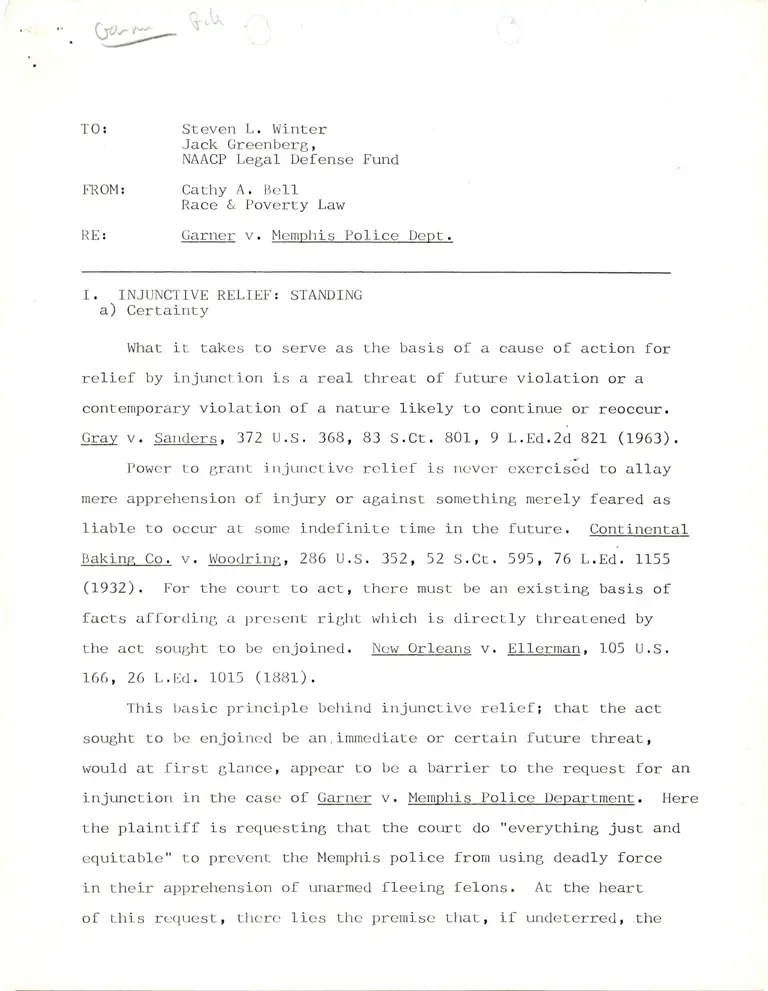
8 pages
-
Case Files, Garner Hardbacks. Memo from Bell to Winter and Greenberg Re: Injunctive Relief, 1977. 8b241a51-27a8-f011-bbd3-000d3a53d084. LDF Archives, Thurgood Marshall Institute. https://ldfrecollection.org/archives/archives-search/archives-item/dfb70acc-05a6-4fe4-9eef-cf8de5220d64/memo-from-bell-to-winter-and-greenberg-re-injunctive-relief. Accessed September 25, 2026.
Copied!
{jÔ
TO!
FROM!
RE:
Steven L. Winter
Jack Greenberg,
NAACP Legal Defense Fund
Cathy A. Bell
Race & Poverty Law
Garner v . Memphis Police Dept
I. INJUNCTIVE RELIEF: STANDING
a) Certainty
What it takes to serve as the basis of a cause of action for
relief by injunction is a real threat of future violation or a
contemporary violation of a nature likely to continue or reoccur.
Gray v. Sanders. 372 U.S. 368, 83 S.Ct. 801, 9 L.Ed.2d 821 (1963).
Power to grariL injunctive relief is never exercised to allay
mere apprehension of injury or against something merely feared as
liable to occur at some indefinite time in the future. Continental
Bakinp, Co. v. Woodrinp,. 286 U.S. 352, 52 S.Ct. 595, 76 L.Ed. 1155
(1932) . For the court to act, there must be an existing basis of
facts affording a ])resent riglit whicli is directly threatened by
ti:e act sought to be enjoined. Now Orleans v. Ellerman, 105 U.S.
166, 26 L.Ed. 1015 (1881).
This basic principle behind injunctive relief; that the act
sought to be enjoined be an.immediate or certain future threat,
would at first glance, apjiear to be a barrier to the request for an
injunction in the case of Garner v. Memphis Police Department. Here
the plaintiff is requesting that the court do "everything just and
equitable" to prevent the Memphis police from using deadly force
in their apprehension of unarmed fleeing felons. At the heart
of this request, there lies the premise that, if undeterred, the
- 2 -
Memphis police will coiiLinue i.o shoot and kill fleeing felons
under cpiesl. ionabl c' circumstances, such as those present in
Garner. In seeking an injunction against the police, barring
their use of excessive deadly force, this question of whether
the action complained of is certain to reoccur, without a court
order to the contrary, must be determined before standing to
persvie such an order will be granted.
A 1975 decision, Warth v. Seldin, 422 U.S. 490, 95 S.Ct.
2197, d5 L.Ed. 343, denied standing to three groups of plaintiffs
seeking to challenge a zoning ordinance in a suburb of Rochester,
New York; zoning alleged to prevent poor and minority groups from
moving into the suburb.
The first set of plaintiffs in Warth were persons ̂,who claimed
that they were being exclude from the suburb by the lack of low-
cost housing caused by such zoning restrictions. These plaintiffs
were deined standing because they made no showing that they would
be able to move into the suburb were the zoning restrictions lift
ed. The second group of plaintiffs were taxpayers from Rochester
who claimed they paid higher taxes because more poor people stayed
in Rochester rather than move to the suburb. They were denied
standing because the Court felt the impact of suburban zoning on
Rochester taxes was too conjectural. The third set of plaintiffs
were builders who claimed that zoning restrictions reduced con
struction in tlio suburl) - Llicir standing was denied because they
made no showing that they would have built specific projects if
the zoning restrictions were lifted.
As to all throe giroups of plaintiffs, the Warth Cou2.'t rein-
terated the proposition tliat sl:anding requires the showing of a
specific injury which is the consequence of the defendant's actions
and that judicial relief will remove or comensate for that injury.
A 1976 decision, Simon v. Eastern Kentucky Welfare Rights
Qrp^anization, 426 IJ.S. 26, took the same approach to a challenge
by indigents to an Internal Revenue Service ruling reducing the
amount of services tliat iiospitals had to give indigents in order
to qualify as charitable institutions (to which gifts deductible
from income could be given). Here standing was denied because
there was no certainty that a change in the tax status of these
hospitals would result in greater services being made available
to plaintiffs.
As to the plaintiff's standing in the Garner case, the threat
of future unconstitiational deprivations of life is based upon the
use of deadly force under circumstances which are presumably part
of normal police practice in Memphis. This fact of continuing
police practice should satisfy the Court that the threatened vio
lation complained of here is not speculative but instead a very
real probability that can only be prevented by the requested relief,
b) Personal Stake
The basis for injunctive relief must be interference with a
legal right of the plaintiff, not of a third party, for the com
plainant cannot succeed because someone else may be hurt. McCabe
V. Atchison Topeka A Santa l̂ ĉ Railway Co.. 235 U.S.151, 35 S.Ct.
69, 59 L.Ed. 169 (1914). An injunction will issue only at the
instance of a suitor who has sufficient interest or title in the
right or property sought to be protected. New Orleans v. Ellerman.
105 U.S. 166, 26 L.Ed. 1015 (1881).
With regards to a citizen seeking an injunction against city
- 4 -
employees or lanits, Llie general rule is that a private person who
wishes to restrain an official act must allege and prove damage
to himself different in character from that sustained by the public
generally. Perkins v. Luskens Steel Co., 310 U.S. 113, 60 S.Ct.
869, 84 L.Ed. 234 (19d6). Stated simply, a basic standing require
ment for injunctive relief is that the plaintiff allege "injury-
in-fact". See United States v. Scrap, 412 U.S. 669 (1973).
In a case quite sumilar to Garner, Mattis v. Schnarr. 502
F.2d 588 (1974), the 8th Circuit reversed a lower court decision
which denied standing to a father, whose son had been shot and
killed while attempting to escape arrest, in an action seeking
damages and declaratory relief. The father sought a declaratory
judgment regarding the constitutionality of state stafCites under
which the offending officers acted.
In its opinion, the 8th Circuit examined the standing require
ment in a two-step analysis. First the Court stated that a party
seeking relief must show that he is sufficently affected by the
action he is challenging to warrant consideration by the Court of
the validity of the action, and secondly, that the action must
violate the rights of the particular party who is attacking it
and not of some third party. 502 F.2d 588, 592-93.
In holding that these two preliminary inquiries were satisfied
by the plaintiff, the Court stated that "the plaintiff showed that
he was sufficiently affected by the killing of his son to fulfill
the first aspect of standing. The state Wrongful Death statute
(cited in appellant's brief) creates a vested right in the plain
tiff to bring suit for the death of his minor son. The plaintiff
is an injured parly under §1983, he is suing in his own right for
J -
injuries personally sustained", and that as to the second aspect,
"parenthood is a substantial interest of surp<assing value and is
protected from deprivation without due process of law. The actiop
of the police in shooting and killing a minor who was attempting
to escape arrest denied the minor's father the fundamental right
to raise his son". 502 F.2d 588, 593-95.
Upon remand, the District Court for the Eastern District of
Missouri held that the officers' good faith defense precluded the
granting of damages and that because the authorizing statutes were
constitutional, a declaratory judgment to the contrary was un
warranted. The plaintiff appealed only the denial of declaratory
relief - a tactical error which resulted in the United States
Supreme Court's dismissal of the action on the ground that no live
"case or controversy" existed.
In a per curiam opinion, the Supreme Court refused to consider
the merits of the case, stating that once the issue of the police
officers' liability for the death of appellee's son had been
decided, there was no longer any possible basis for a declaratory
judgment because "no present right of the appellee was at stake".
431 U.S. 171, 97 S.Ct. 1739, 52 L.Ed.2d 219 (1977).
It is relevant for our purposes that the Supreme Court never
passed upon the 8th Circuit's rationale for granting the father
standing in Mattis. Its innovative and meritorious approach,
holding that the right to parenthood is fundamental and therefore
encompasses the right of a parent to raise the issue of his child's
right to life and to challenge to constitutionality of statutes
which permit the use of deadly force against his child, is worth
pursuing. If the 6th Circuit can be persuaded as to the legitimacy
- 6 -
of this argument, initial inquiries into certainty and personal
injury-in-fact will In; sufficiently satisfied to grant the plain
tiff standing.
In the alternative to a finding that it is plaintiff's right
to parenthood which is being asserted in Garner. standing may be
claimed on the ground that it would be impossible for the person
whose right is being asserted to present his grievance before the
court - as that person whose right to life is at issue is deceased.
This simple logic has proven a valid contention in many cases
where the Court has been convinced that there is no plaintiff
closer to the matter sought to be adjudicated than the party before
it, and has, accordingly, allowed that person standing to assert
the rights of another. Buchanan v. War lev. 245 U.S. 60., 38 S.Ct.
16, 62 L.Ed. 149 (1917); Pierce v. Society of Sisters. 268 U.S. 510,
45 S.Ct. 571, 69 L.Ed. 1070 (1925); Barrows v. Jackson. 346 U.S.249,
73 S.Ct. 1031, 97 L.Ed. 1586 (1953).
In Barrows. a white defendant was allowed to assert, as a
defense in an action for damages for breach of a racially restric
tive convenant, that to enforce the covenant would be unconstitu
tional state action. The defendant was found to have standing even
though it was clear that the constitutional right involved was not
his own but that of unidentified non-whites who, in the future,
would find it more difficult to buy property if their vendor would
be required to respond in damages. 346 U.S. at 255. The Court
there said that the rule against relying on the constitutional
rights of another is not part of the constitutional requirement of
standing, but is a rule of self-restraint that the courts have
developed for their own governance, and thus is merely a rule of
- 7 -
practice not to be applied where, as in this case, it would be
difficult if not impossible for the person's whose rights are
asserted to present their grievance before any court". 346 U.S.
at 255-257.
This rationale would appear clearly applicable to Garner for
similar reasons. Unless a family member of the deceased is allowed
to bring suit to vindicate his rights, there can never be a final
determination of the legalities involved.
II. INJUNCTIVE RELIEF: PLEADINGS
The usual requirement that a complaint, petition,’ or bill in
equity contain an appropraite prayer for relief must bS'' observed
in a suit for injunction. The prayer should not be too broad and
general, however as a general rule, the demand for relief is not
determinative of the right to relief or the character or extent
thereof. 42 Am.Jur.2d, Injunctions §275.
Although the Federal Rules of Civil Procedure (Rule 8A) re
quires that the pleader make a demand for the relief to which he
deems himself entitled, the failure to pray for an injunction is not
fatal to the power to grant it where the complainant states facts
showing the right to relief and prays for restitution, for example,
and for any other relief which the court may deem just and proper.
United States v. White County Bridge Commission. 275 F.2d 529 (7th
V *
Cir.1960), cert. den. 364 U.S. 818, 81 S.Ct. 50, 5 L.Ed.2d 48. In
addition. Federal Rule 54C provides that every final judgment shall
grant the relief to which the party whose favor it is rendered is
entitled, even if the party has not demanded such in his pleadings.
■ 8 -
As far as declaratory judgments are concerned, the general
rule is that the prayer for reliei must state with precision the
declaratory judgment desired and must be based upon the facts
alleged in the complaint or petition. 22 Am.Jur.2d, Declaratory
Judgments §88.
This requirement of specificity regarding the type of
declaratory relief sought is satisfied in Garner by the fact
that the appeal and supplemental brief submitted by the plaintiff
ask the Court to decide the constitutionality of the Memphis
liberal use of deadly force policy (Plaintiff's response to
Defendant's supplemental memorandum, p. 4). Whether the court
will issue both an injunction and a declaratory judgment (or
either) cannot be assured, although to do so would be quite per
missible where the pleadings and proof warrant such relief.
Perkins v. Elg, 307 U.S. 325, 59 S.Ct. 884, 83 L.Ed. 1320 (1939)
(declaration of citizenshp and injunction against deportation);
Alston V. School Board. 112 F.2d 992 (4th Cir.1940), cert, den.
311 U.S. 693, 61 S.Ct. 75, 85 L.Ed. 448 (declaration of rights
of Negro Teachers and injunction against further discrimination).