Fourth Circuit Court of Appeals Judgment
Public Court Documents
October 24, 1966
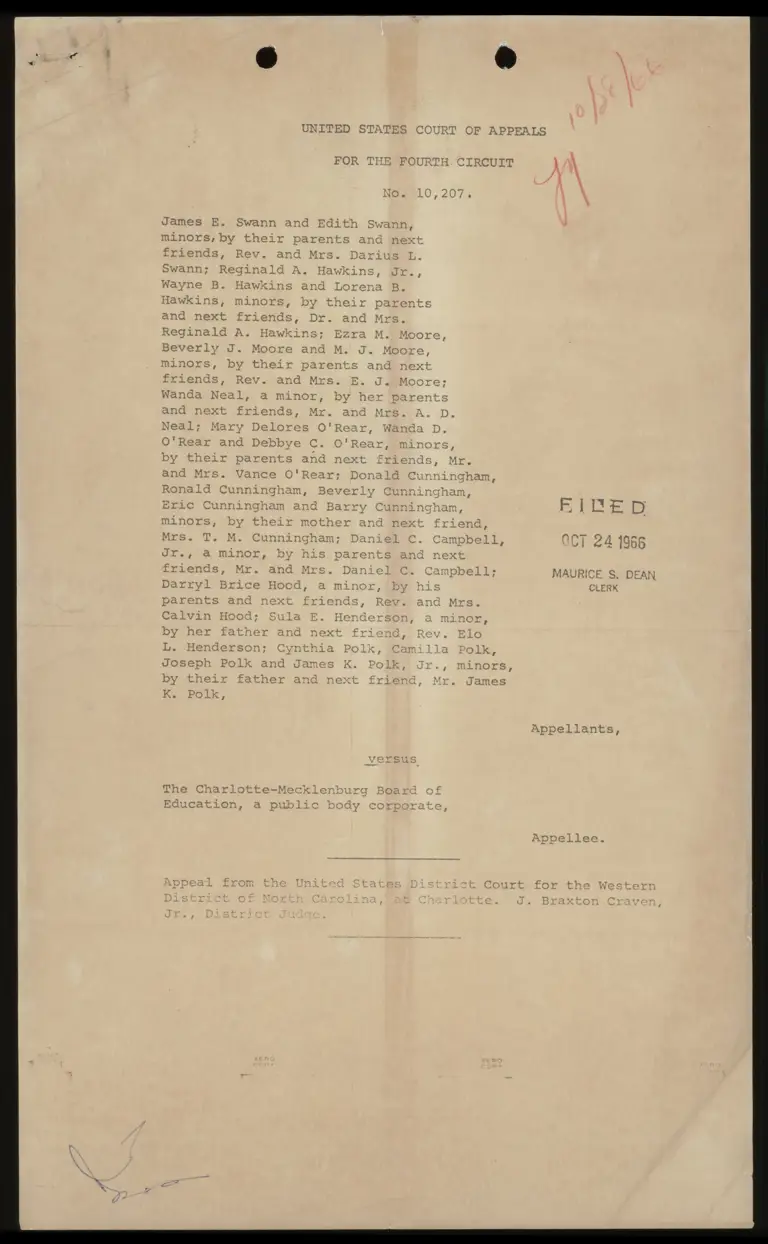
11 pages
-
Case Files, Swann v. Charlotte-Mecklenburg Hardbacks. Fourth Circuit Court of Appeals Judgment, 1966. 302f8a09-2e34-f111-88b4-7c1e527f53b4. LDF Archives, Thurgood Marshall Institute. https://ldfrecollection.org/archives/archives-search/archives-item/dff4a257-3c91-4b90-ad2e-d8c977620189/fourth-circuit-court-of-appeals-judgment. Accessed October 16, 2026.
Copied!
     [||a313615f-dcb5-4b42-8c5a-2b41cd31f530||] 3
x


:
pe

T
Y


|
F
R
E


»
£
)


2


I
Y
:


x


said

,
.

2
i

J
i

i
C

<<
-<

un

4)
i

he
I

hd

2


~
N


A


(=H 3
[=
al

.
AT]

N
“

r
t


[=

bed
*

o

0
= - Ii!

r
d


i
n


-


.

"
4
%


"
t


bo
¢

»
~

$V
ix

\.J/
L
_
—


a


0


—
O

ri
J

Q
Lo

o
y


Nb}
~

63)
Ly

’
’

2p
:

|

[2]
0

co
(

\
¢)

ol}
[

>
™


i


£
}

=


as
<4

ha
Wend

(a0
bd

“4
:

)
>

3
:

mt
F

r—i
0


R
E


0


~
~

’

a
C


N
4

r


b-
r.

L
d


3
75 SE

[
=


0
EH

Q
8


—
“

TT
m

e
=


0
e
e


m
s


3
y

=


7)
oS

©
vy

i
ri

£
A


I)
Pal

I.
—~

Ss
Md

w .
Mw

O
:

-
nt

0
H
A


g
i
,


hs’
S

4
.
"


;


Cd
LJ

Wn
<

:
oom,

£


.
’

O


:
M
O


w]
"

=
]


v
3


3
~

LA
r
r


x.
)

[03]

0
c

4
i

H
.

Q
Q

18]
0

i
~

3


:
3

0
0

|
Vv

>


Q


C


=
0

m
©

:
&

.

v
/


Fd 2 me
- - yo. 4 J

ry eur) T Hy 1 ol] 1d a [Ae ats ™ \rgued November 1, 1965. Decided _kLCA-ten


Before Haynsworth, Ch


l hes Y AEE d Sobeloff, Boreman, x J

Bryan and J. Spencer Bell, Circuit Judges, sitting


Lb } 1 Fa \ yoo PY Te po
J. LeVonne Chambers (Conrad O. Pearson, Jac] Kk Greenberg

and Derrick A. Bell, Jr., on brief) for Appellants, and
- | a!


i

pd
Al


HA YNSWORTH, Chief Judge:


In this school case, the plaintiffs have appealed

+} AT 4 Be rn ep lee mel Ye PAA he denial of certain affirmative re elief which they

sought in the District Court. We think the District Court's

| disposition of the matter was co

Prior to 1962, the School Board had purported to

were affirmatively made under

that Act, school assignments were controlled by a system of

dual attendance zones, a method of assignment which is clearly

unconstitutional. In 1962, however, the School Board affirma-

tively resolved to do something about it.

Coincident to the adoption of a school construction

program, involving the expenditure of $30,000,000 over a

five-vear period, to replace old and inadequate buildings and
Y ’ on . 3

to care for areas of rapidly expanding school population, the

School Board adopted a plan of single school zoning. The

rezoning was to be accomplished over a period of years, however,

J \ and coordinated with the construction program so as to avoid,

wherever possible, multiple pupil transfers and general

rearrangement of the attendance zones.

For the school year 1962-1963, such attendance zones

were establishe for two schools only. For the next year,

1963-1964, twelve re schools were zoned, making a total of

fourteen. In 1964-19¢ " 1 the zoned schools rose

forty-three, in the : 1965-1966 ninety-nin

yf the one hundred and nine school the system had been

zoned.


rity in a particular school to transfer to a school in

1 Tad - x i -  ) id tw — dem : : : = his race was in the majority. Later, this right of

made available to all pupils, so that, as applied,

TE Yor ~~ IT - ta evs] - TIN 4 ray. +ho i : vy very pupil in the schools, whatever the basis of his initial

assignment, has an unqualified right of transfer to any other

school in the system, subject only to space limitations in the

~ school to which transfer is sought. In pract

ace limitation has not proved

an obstacle in the effective exercise of the right.

jer the geographic zoning of the ninety-nine

year 1965-1966, 1,955 Negro pupils

were initially assigned to schools in which white pupils were

predominant. Ninety-one of those exercised their transfer

rights and were retransferred to schools of their choice which

were largely attended by Negroes. Two hundred and sixty-two

Negro pupils exercised their right to transfer from schools

attended entirely or predominantly by Negroes to schools Lie J

populated principally by whites. Thus, in the school year

1964-1965, 2,126 Negroes actually attended schools in which

white pupils constituted the majority, or a substantial

proportion of the school's population.

Three hundred and ninety-six white children were

lly assigned under the geographic zoning plan to schools

Tal ~ dn -y yf P| \ : 3 fg - i

n Negro pupils constituted a majority of the population.

: % ~ 7 ~ oO +r 11 ~ J - vy " -~ + ~

Most, but not quite all,' of those three hundred and ninety-six 4 3

. Toyo TE TE Tada ~ ~ -

eme rs was later held to


ol EE IVER PEE AEE ~~ Po y PEO Pa |
-ory and unconstitutional. Goss v. Board


ir transfer rights and were


a
52


4:


0 .
i


b gE
 0,


[3


D = - 2)


oe


® H 0 F
Je

o

0) D ct


8
i


® i
.


~ “$+ s a ~~} 3 4 “ N assigned to schools in which white students p redominated.

The number of white schools integrated and the

number of Negroes attending those schools has

increased, the la .argest increase occurring in 1964-1965. It

CERN RL
is ‘expected R

S
 hat there will be still larger increases in the 1 bY

coming year, particularly as a res: AA
1 4+
of of the elimination of

schools.

The ten unzoned schools are entirely Negro. They

rural schools, and their pupil populations are drawn from

wide areas which overlap the established zones of other schools.

This, of course, is not an acceptable basis for the initial

Pils. This, the Board recognized, however,

but it asked approval of its procedures upon the ground that

~

those ten, physically inferior, schools were going to be

it was impractical to establish

geographic zones for them and felt 1it unwise to reassign

students in those schools to other schools when, under the

progressing construction program program, those same pupils would

OO SY 1 y ee vTaoanmcoctTooned + c+ 117
necessarily be reassigned TO S Ed WL 3 other schools after only

a year or two. Meanwhile, it thought that the fact that each

student attending those ten schools had an unrestricted right

to transfer to any school of his choice was a sufficient

approval of the Board's operation for

~<a - 3 2 :

the short interim period. It represented to the District

: " 33 : %
Court that it expected to have established geographic zones

1 ~ + - 1 1 =  ~ 1 1

for the assignment of pupils to all schools in the system


1 TV. 3 y 3 AL ™ ~ Aa

stesville City Bd. of Educ., 4 Cir., 345 F.2d

: prey ~~ pw HP. - y

. Durham City Bx C Educ. 4 Cir., 309 'F.28
ya =

- A \ ) -


oe school year 1966-1967, and, in all events, no later

3
n 1967-1968.

C i &

Under these circumstances, we think the District

urt's approval of the Board's procedures for the year

1964-1965 was within the bounds of its discretion. The Board

appears to have been busily engaged in the elimination of

vestiges of the discriminatory system of assignments which had

prevailed earlier. There was a rational basis for not

undertaking geographic rezoning of those ten antiquated schools,

and, in light of the unfettered right of transfer available

to each of the pupils in those ten schools, delay of the one

year in their involuntary transfer to other schools was not

unwarranted, when the delay would avoid successive transfers

for a substantial portion of them.

This appeal did not reach us until the 1965-1966

school year was well underway when transfers for that year

would have been most undesirable. Now that the operation of

the ten schools without geographic zoning has been eliminated

for the school year 1966-1967, the plaintiffs' complaint

about the operation of the ten Shached schools last year has

become largely academic.

The plaintiffs complain about some of the boundaries

between established school zones. The District Judge found

none of these complaints justified. In a number of instances,

possible changes in the boundaries, as suggested by the


of April 22, 1966 (page Bl) reported
of resolutions fully complying with

court and providing for the

ng for each school in the


Ri
2] <

Q


ffs, would not have affected the make-up of the school

3) O | 4 Lation, but would have operated only to transfer white

pils from one school predominantly attended by whites to

another school predominantly attended by whites. In the

remaining instances, the lines drawn by the School Board were

found to follow natural boundaries and to be entirely reasonable.

In one instance of which the plaintiffs particularly complain,

the line runs along the survey route of a major Belt highway

to be constructed, running through an uninhabited area crossed

by no other streets or roads. If the line were moved to

McAlway Road, it would bring into the Billingsville School

attendance zone a residential area from which there is no

direct access to the Billingsville School, though pupils in

that area live in very close proximity to Cotswold School,

in which zone they now are. Clearly, the School Board's

boundary is the more reasonable.

On this phase of the case, the principal complaint

of the plaintiffs appears to be that the zoning of the schools

has not produced a greater mixture of the races than it has.

There are still some all white schools; there are still some

all Negro schools, and, though the number of those have been

declining, there is no reason to think that some of them

will not remain in the school year 1966-1967. The plaintiffs

contend the lines should have been drawn with the conscious

purpose of eliminating as many of such schools as possible

and of achieving a maximum intermixture of the races.

Whatever the Board may do in response to its own rhe

.
hy initiative or that of the community, we have held that there

is no constitutional requirement that it act with the conscious

C0 copy XR


ose of achieving the maximum mixture of races in the

- . 4

ol population. The Constitution permits the Board to

nsider natural geographic boundaries, accessibility of

particular schools and many other factors which are unrelated

to race. So long as the boundaries are not drawn for the

purpose of maintaining racial segregation, the School Board

is under no constitutional requirement that it effectively

and completely counteract all of the effects of segregated

housing patterns.

The School Board does provide some permissive

amelioration of the effects of segregated housing patterns

through its granting of free transfer rights. No geographic

boundaries could be drawn which would result in the geographic

assignment of Negro pupils living in the Western and North-

western portions of Charlotte to integrated schools, but each

of those pupils does have an absolute right to attend an

integrated school if he wishes under the free choice option.

Nevertheless, the plaintiffs also complain that

white pupils assigned to predominantly Negro schools have a

transfer option, which has been exercised by most of them.

A substantial number of Negroes in the same minority situation

have exercised their options, too, and, as pointed out above,


4. Wheeler v. Durham City Bd. of Educ., 4 Cir., 346 F.24

768; Bradley v. School Board of City of Richmond, 4 Cir.,

345 F.24 310, 316; Jeffers wv. Whitley, 4 Cir., 309 F.24

621; Evers v. Jackson Municipal Separate School District,

5 Cir., 328 F.2d 408; Cohen v. Public Housing Administration,

5.Cir., 257 F.24 73; Avery w. Wichita Falls Ind. School Dist.,

5 Cir., 241 F.24 230; Ripvpy vs. Borders, 5 Cir., 250 F.248

690; Bell v. School City of Ge sary, Indiana, 7 Cir., 324 F.28

209. See also Singleton v. Jackson Municipal Separate

School District, 5.:Cir., 348 F.28 729.


sy«tem of free transfers is the only means by which many

es can attend integrated schools. Since each pupil in

Ud
 ystem has the option, we think the existence of the right

un


transfer is constitutionally permissible.

As part of its plan, the School Board had adopted

a resolution looking toward the "ultimate™ integration of the

faculty and staff. The District Court required an amendment

of that resolution to make it immediately effective. No one

has complained of its action requiring that amendment, but

it is appropriate to mention it here, since it tends to com-

plete the picture of the Board's ultimate purposes and to

show the care with which the District Court considered the

Board's operations and plans in light of the plaintiffs’

complaints.

If, in light of any development or circumstance

occurring since the hearing of this case, any party shall

have any reason to apply to the District Court for further

relief or for any modification of its order, leave is granted

for such application whether or not a certified copy of the

judgment of this Court in lieu of its mandate has been lodged

in the District Court.

Affirmed.


5..' Bradley v. School Board of City of Richmond, 4 Cir.,
345 F.24 310; Jeffers v. Whitley, 4 Cir., 309 F.24 621;

Dillard v. School Board of City of Charlottesville,

4 Cir., 308 F.2d 920, 923-24; see also Goss v. Board of

Educ. of City of knoxville, 373 U.S. 683, 687.


NY
L
O


P
e
t


L
L


[{y}
Q


y.3
74

o
3

i
x

0


x


O


r
e
}


<f
Ail

0)
oN

=~
O

0

F
i


Q


1]
.

~
~


r
f


-

I

he
"

())
=


un
+


Lo)

|
7]

ri
=

-
f~-

on
4

)
&

¥
e

C
E


nw
O

>


:
Tg)

on
0

ho]
|

3
O

OU
g
M


I
er

(1)
<<

ri
0,

0
on

go!
et

=
0

A
r
-
H

>
o
n


0
WH

a


H
5

™
~


Mm
lo)

&
E

U4
1

0
0

UO
0

M
P
O


r
r


|


+


2


jo
«1

OO
U
r


0


o
g


+


C


4


QO
9

~~
OO

+


Mw
OO

-H
4]

(o)

a
~

u
Sg

rl
0

©
~
~


B
D
O


~
~~

H
0

3
4
0


4
OQ

>
>
»


0


O
H

>
0
0
0


5

0
 &

’
(Q

jot
D

M
y


3
U0

M
A


0
—~

OU
O
A


O
P
n


ie
OD

OO
OO

M
+


PP
H
O


ol
e
T


I
VE

Y
i
,


jo
0

2,
oN

+H
0

O
0

ff
H
+


©
4

OQ
Q
Q


>
3

DD
0

+
U
P
A


D
W
H
W
H


O
H
A


C
U


MH
le!

P
=


OQ
0

[o)
+

Mm
O

wil
&

HK Cl
20

0 BE
E

Oi,
CY

om
$d

H
d


©
Q
D
S


B
o
D


P
o
r


Oy
oO

0
©

0
O
H


oO
0

po
O

CT
4

©
g

AQ
3

D
e


H
O
C
O
0
O
H
T


ITH
W
U


O
3
P

g
d


0
;


P
o
o
p


0
H


J
oN

Oo
0

oligo
Tvs

TIRELL
£3.

ceri
1
0


0
jo

O
P


0
0

PY
M
h


Q
0
C
H


Y4
or

0
®

~
a

.
P
o
P


o
w


4
%


o
m


0
C
4
4


3
A


00
@

00
0

O
P


0,
-


J
0
4
3
5


OO
O
u


Q
s


'
~
Q


0)
Ro

[c3
o

Q
))

0}
Yq

£
uw

L
4
5
0

0
0
r
d


—~
g
O


0
WH

J
V
M


Dy
rl

+
nw
H
Y


0
C

A
O
C

H
P

O
O
M


H
N


3
+

“
S
e


peAd
O
P


3
H


0
0


O
0
P


E
H


H
y


©
0

$
0

UV
4

C
~

OU
Tg)

0h!
+

INIT
8

ol)
-

BN
T

O
-
H


N
Q
Q


£
QU

EE
d
P


O
G


>
TQ

L
Y


i

T
o

wn
<3!

3
.

O
+H

©
O

0
0
3


E
OO

3
H


5
0

H
O
w


P
r


©
0

.
x

E
mn

on
:

T
E

£
Q
P


u
D
>
o
o
0
o
T
o
w
H
o


HA
~
P
p
g
P
L
r
a
o
A
R
c
g
l


0
"0

»
.

(
—~

ri
Q

T


-r
O
H


H
.
C


M0
WH

4
a

-+4
©

01
©

Ns!
4

7g
C

rg
—


to}
w
v


mo
P

E
M
4


o
u
d


Wn
©

)
L
O


--
o
H


0

3)
r

1s
0)

i


3
©

0
0;

0)
QO

&
©

—


>y
C

~~
U4

3
A

-
0

-
P
r


H
O


B
Q

e
A


g
o
»


0,
WH

+
©

$
0
5


3
ye

Q
0)

0)
c
+


0
D
W
H


0


Dy
e
e


ey
0

F
>

J

0
£


Fi
(®

=
O
P


0
O
W


nn
uw

ft
Kt

L
A
E
R


~


©
rd

4
>

H
P

©
0

-
BP
O
P
O


wn
ro

0
g-ri

g
0


0
+H

+H
—

1
er

rd
on

or
C5

Talal: FO
0

OV
MH

£
0

o
d


O
O


08°F
is

&
le

0
c

Po
of

i.
W
H


0
Hq

0
0
5


P
o
O


0
3

I

rd
Tr

—


o
o


iS)
m
=


C
0


LY
ot)

0
Oy

S
V


5,

~
_

ol
0.0

«
g
H


o
Ra

N
g


©
N
T


>
0

VQ
:

|

=
+H

KS
|

H
B


O
C


H
H


+
O
Q


HA
a
i
g


+P
0)

C
e


—
1

Hi
on

i


Q
0,

O
Ra

wh
OF

33.
C
V
)


TY
Ke

U
4

[63
3

.
2

m
y


oO
cg

O
0
0


&


u
r
d


0
4320)

L
r


i


m
n

6)
>

Q
J J

RT I
0

E
M
e
.


0
0
3
4
8
0
0


mM
2

a
y
O


Q
+

>
QQ

»
UO

©
E

—~
MC

Y-
C

O
H


Mm
©

M
:

a
H

a
E

i
H

T
TT

A
+L

0
Q

O
r

E
D
O


A
M


£
+

0

fd
oO

©
U
H


n
o


Wi
5

Cape
b
p
)


oll
40)

gc
uv

0
o

0)
or

HW
O
H


O
P


ri
Sg

Rl
Co

wl
w
R


0
.C
i
Y


-r
Hd

fe
0d

rs
Fw

0)
Cc

»
O
C
.


O
+
~
"
0


~~
3
.
0
0

H
O
S


3
®)

=
5

Ered

€3)
+

ii
0

d
+H

T


(8)
19]

Ia!
Gg

g
0

0
HH

4

0,
eo

«rd
OU

«an
£

0
Q
H
A
P
e
—
H
0
U
C


(0)
>

O

wn
or

-

B
T


Q
3

i
o
e


iS
re

Q
-~

Q
P

GQ)
sil)

he
kK:

~~
0

>
oi

B
U
T


4
7
0


pig
0

0
o
o
,


»
3

4


A
r
s


N
M


Uy
3

Q
A


nn
0

CC
~

Oo
(4)

+H
2


&

LP
H

O
®

3
4

H
P
O


WW
Q
T


nn
32
a
0


YP
U

I.
"

!
0

oF
£

©
£

0
O
r


Gl)
H
O


+
Le

£
3
.


XO

ie
$)

c
Ri

1s}
D
H


=
0

O
d

0
0
0
0


3
N
B
O


NW
to}

I
Ea

k

Oo
|

C
U4

—
QO

f
u
e

O
w
e
n

O
r


D
+

in ME

5
po

0
©

oi
=

P
O
U
E
M
O
V
P


P
O
U
L


MCC
E

0
m
p


E

0
L

0,
i

O

|
~

O

CG
=

0
ri

HP
Q

HJ

53
+


Y
PI

oO
£3

he
“/

5


in


8
))

py
a J

{
v


Q


0
i ~

»


>


OO
5

O


jo)
r
r


~
+


= [ea
4

~

|


1
0)

uv
Q


»y nl
"

ag
mw

»
prot

. 0
-
0


{3
0


A


4
0

racial n no


ly onal.
oy af
tuts

-
tunity oppor

d


s a legiti- }
o
r [||a313615f-dcb5-4b42-8c5a-2b41cd31f530||]