Memorandum Opinion
Public Court Documents
November 7, 1969
7 pages
-
Case Files, Swann v. Charlotte-Mecklenburg Working Files. Memorandum Opinion, 1969. 4ae3c8ba-3134-f111-88b4-7c1e526962fd. LDF Archives, Thurgood Marshall Institute. https://ldfrecollection.org/archives/archives-search/archives-item/e0915292-482c-484b-a3e5-815ce0c169a2/memorandum-opinion. Accessed October 15, 2026.
Copied!
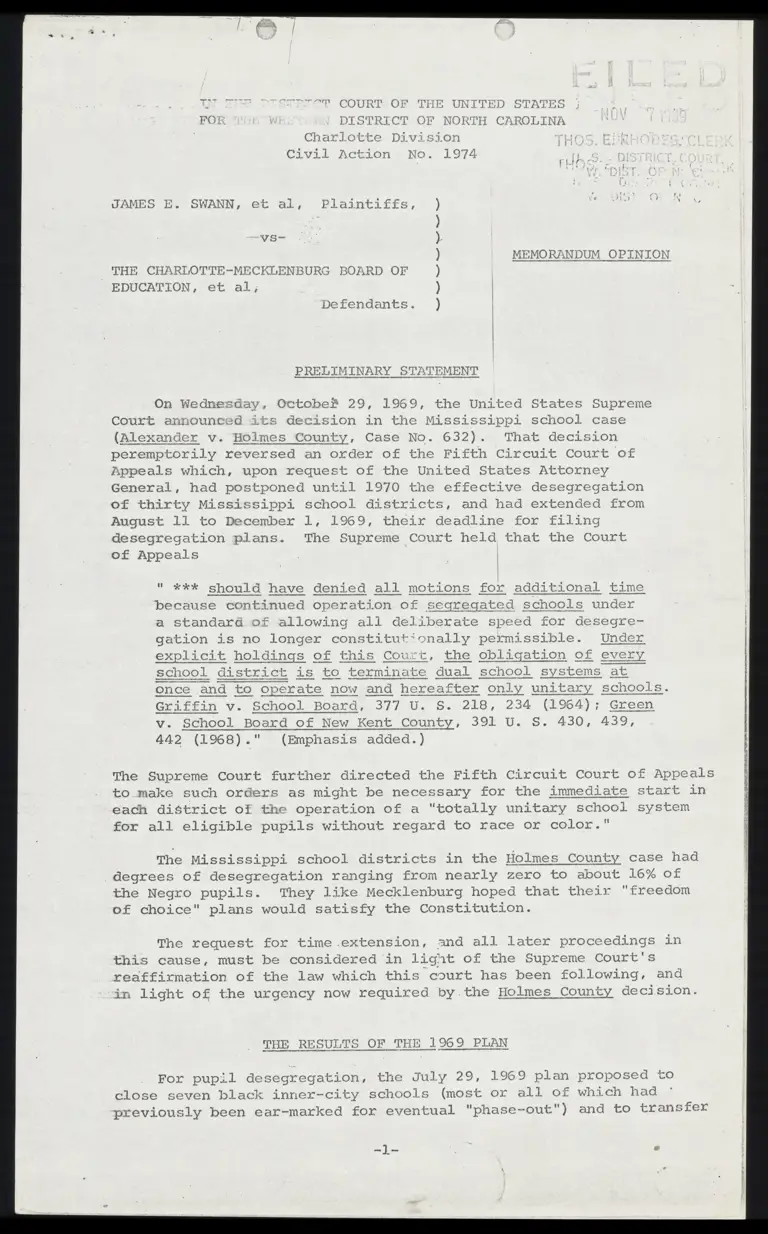
     [||814d893d-0e96-4e02-af19-ccdf4cd5169d||] TTT COURT OF THE UNITED STATES
FOL DISTRICT OF NORTH CAROLINA

: Charlotte Division
Civil Action No. 1974

PAW


PLAYS

JAMES E. SWANN, et al, Plaintiffs, ) Pol
)

VS— )

) MEMORANDUM OPINION

THE CHARLOTTE-MECKLENBURG BOARD OF ) |
EDUCATION, et al, ) |

Defendants. ) |

|

PRELIMINARY STATEMENT


On Wednesday, Octtobe® 29, 1969, the United States Supreme

Court announced its decision in the Mississippi school case

(Alexander v. Holmes County, Case No. 632). That decision

peremptorily reversed an order of the Fifth Circuit Court of

Appeals which, upon request of the United States Attorney

General, had postponed until 1970 the effective desegregation

of thirty Mississippi school districts, and had extended from

August 11 to December 1, 1969, their deadline for filing

desegregation plans. The Supreme Court held that the Court

of Appeals |


" %%% should have denied all motions for additional time

because continued operation of segregated schools under

a standard of allowing all deliberate speed for desegre-

gation is no longer constitutionally permissible. Under


school district is to terminate dual school systems at

once and to operate now and hereafter only unitary schools.

Griffin v. School Board, 377 U. S. 218, 234 (194): Green
v. School Board of New Kent County, 391 U. S. 430, 439,

442 (1968)." (Emphasis added.)


The Supreme Court further directed the Fifth Circuit Court of Appeals

to make such orders as might be necessary for the immediate start in

each district of the operation of a "totally unitary school system

for all eligible pupils without regard to race or color.”


The Mississippi school districts in the Holmes County case had

degrees of desegregation ranging from nearly zero to about 16% of

the Negro pupils. They like Mecklenburg hoped that their "freedom

of choice" plans would satisfy the Constitution.


The request for time .extension, and all later proceedings in

this cause, must be considered in light of the Supreme Court's

reaffirmation of the law which this court has been following, and

in light of the urgency now required by.the Holmes County decision.


THE RESULTS OF THE 199 PLAN

For pupil desegregation, the July 29, 1969 plan proposed to

close seven black inner-city schools (most or all of which had

previously been ear-marked for eventual "phase~out") and to transfer

~] - ®


=

their 3,000 students in specified numbers to named suburban

schools. All the transferee schools except West Charlotte

were white. In addition, 1,245 black students, in specified

numbers, were to be transferred from eight black or largely

black schools to other designated suburban white schools.

The plan was accepted and approved because of its apparent

promise to extend the opportunities of a desegregated education

to over 4,000 new black students. :

The plan has not been carried out as advertised: (a) Only

73 of the 1,245 scheduled for transfer from overcrowded black

schools have been so transferred; those 73 were transferred not

to the schools designated, but to other schools not mentioned

in the plan. (b) It is now revealed that the closed schools,

which were billed in July to produce 3,000 black students for

transfer, actually had only 2,627 students in them when the

schools closed in June. (c) The Board allowed full freedom

of choice for students from the closed schools, and those

students in large numbers elected to go to Harding High School, and to

williams Junior High, Northwest Junior High and other black

schools, instead of to the assigned white schools. As a result,

Harding High School was transformed immediately from 17% black

to 47% black. This produced community consternation but no

racial disorder among the students. The result may be deplorable,

but the fact that the students at Harding High School have

adjusted peaceably to the situation (like others before them

at Cornelius, Davidson, Olympic, Randolph Road, Hawthorne and

Elizabeth, and like the people of Anson and other North Carolina

counties) shows that Mecklenburgers can live with desegregated

schools. (d) The transfers proposed simply appear never to have

been made to most of the suburban schools named-in- the plan.

(e) The plan therefore transferred to white schools only 1,315

instead of the promised 4,245 black pupils! From closed schools,

the elementary transferees numbered 463 instead of the advertised

1,235; junior high transferees were 273 instead of 630; and senior

high transferees were 506 instead of 1,135; and from overcrowded

schools 73 instead of 1,245. If Harding (47% black, 630 Negro

students), Olympic (42% black, 376 Negro students), and Wilmore

(49% black, 228 Negro students) should be allowed to continue

their rapid shift from white to black, the net result of the

1969 pupil plan would be nearly zero.


Faculty desegregation has significantly and commendably

improved since the April 27 order. Nevertheless, only six

"black" schools and one "black" kindergarten have predominantly

white faculties; and 98 out of the 106 schools and kindergartens

in the system are today readily and obviously identifiable by

the race of the heavy majority of their faculties.

The "performance gap" is wide.


THE SITUATION TODAY


The following table illustrates the racial distribution of

the present school population:

SCHOOLS READILY IDENTIFIABLE AS WHITE


NUMBER OF NUMBERS OF STUDENTS


% WHITE SCHOOLS WHITE BLACK TOTALS
100% 9 6,605 2 6,607

98-99% 9 4,801 | 49 4,850

95-97% 12 10,836 505 11,341

90-94% 17 14,070 1,243 15,313

86-8 9% 10 _8,700 1,169 _9,869
57 45,012 2,98 47,980

SCHOOLS READILY IDENTIFIABLE AS BLACK

NUMBER OF NUMBERS OF STUDENTS

% BLACK SCHOOLS WHITE BLACK TOTALS

100% 11 2 9,216 9,218

98-99% 5 41 3,432 3,473

90-97% 3 121 1,297 1,418

56-89% aa = 689 2,252 3,24]

25 1.153 16,197 17.350

SCHOOLS NOT READILY IDENTIFIABLE BY RACE

NUMBER OF NUMBERS OF STUDENTS

% BLACK SCHOOLS WHITE BLACK TOTALS

32-49% 10 4,320 2,868 7.188

17-20% 8 5,363 X:230 6,593

22-29% 6 3,980 1,451 _5,431
24 13,663 5,549 19,212

TOTALS : 106 59,828 24,714 84,542

- some of the data from the table, re-stated, is as follows:

Number Of schOOlS ...ciceeeccenccccnes Chlie eee one wie 106

Number of white pupils ..cceeccececcecceccnee ow eine «as 59,828

Number of black pupils ...... “vows nn ee vs Caceres . 24,714

Total PUPilsS .c.eceeerecccccnces I en be GPR 84,542

Per cent of white pupils «.cecececcccess ceive iy “oe neas 71%

Per cent of black pupils «ccc... Creve vs wa ee seit 29%

Number of "white” schools ....cce.e sates ua ie ei ee ie 57

Number of white pupils in those SOROOLE tins to veevine 845,012

Number of "black" schools ..cecececceccnn NILA EI AE 25

Number of black pupils in those B8CHOOLS «asec vo vee 16,197

Number of schools not readily identifiable by race . 24

Number of pupils in those SChOOlS cevescee Sie ee wein v2 49,212

Number of schools 98-100% black .ececececcece .iv'u mies 16

Negro pupils in those schools cece... Fesews TRIER LL

Number of schools 98-100% white ..... seed sii ..s 18

11,406
White pupils in those SCHOOLS tceevccsscssavecsnance

A
A


SEAT
AP


E
N
S


SA

G
W


Of the 24,714 Negroes in the schools, something above 8,500

are attending "white" schools or schools not readily identifiable

by race. More than 16,000, however, are obviously still in all-

black or predominantly black schools. The 9,216 in 100% black

situations are considerably more than the number of black students

in Charlotte in 1954 at the time of the first Brown decision. The

black school problem has not been solved.

The schools are still in major part segregated or. "dual'

rather than desegregated or "unitary."

The black schools are for the most part in black residential

areas. However, that does not make their segregation constitu-

tionally benign. In previous opinions the facts respecting their

locations, their controlled size and their population have already

been found. Briefly summarized, these facts are that the present

location of white schools in white areas and of black schools in

black areas is the result of a varied group of elements of public

and private action, all deriving their basic strength originally

from public law or state OX local governmental action. These

elements include among others the legal separation of the races in

schools, school busses, public accomodations and housing; racial

restrictions in deeds to land; zoning ordinances; city planning:

urban renewal; location of public low rent housing; and the actions

of the present School Board and others, before and since 1954, in

locating and controlling the capacity of schools so that there

would usually be black schools handy to black neighborhoods and

white schools for white neighborhoods. There is so much state

action embedded in and shaping these events that the resulting

segregation is not innocent ox "de facto," and the resulting

schools are not "unitary" or desegregated:

FREEDOM OF CHOICE


Freedom of choice has tended to perpetuate segregation by

allowing children to get out of schools where their race would

be in a minority. The essential failure of the Board's 1969

pupil plan was in good measure due to freedom of choice.

As the court recalls the evidence, it shows that no white

students have ever chosen to attend any of ‘the "black schools.


Freedom of choice does not make a segregated school system

lawful. As the Supreme Court said in Green V. New Kent County,

391 U0. 8.430 (1968):


n %x%% Tf there are reasonably available other ways.

such for illustration as zoning, promising speedier

and more effective conversion to a unitary, nonracial

school system, 'freedom of choice' must be held

unacceptable.”

Redrawing attendance lines is not. likely to accomplish

anything stable toward obeying the constitutional mandate as

long as freedom Of choice or freedom of transfer is retained.

The operation of these schools for the foreseeable ture should

not include freedom of choice or transfer except to the extent

that it reduces segregation, although of course the Board under

its statutory power of assignment can assign any pupil to any

school for any lawful reason. tp

=f


of

THE “NATIONAL STANDINGS"


The defendants filed some statistics concerning the one

hundred largest school systems in the country, and say that

Ccharlotte-Mecklenburg desegregation compares favorably with

that in most of those systems. That may well be so. The

court is not trying cases involving the other ninety-nine

school boards, and has not studied any evidence about them

and does not know their factual nor legal problems. The

court in its first order of April 23, 1969 has noted the

substantial desegregation achieved in certain areas in the

Charlotte-Mecklenburg system, and is still aware of iL. The

fact that other communities might be more backward in observing

the Constitution than Mecklenburg would hardly seem to support

denial of constitutional rights to Mecklenburg citizens. The

court doubts that a double standard exists. The Attorney

General of the United States has filed suit for desegregation

in Connecticut as well as in the whole State of Georgia. One

of the most stringent..desegregation orders on record was entered

recently against a school board in the City of Chicago. Con-

stitutional rights will not be denied here simply because they

may be denied or delayed elsewhere. There is no "Dow-Jones

average" for such rights. With all due deference to the

complexities of this school system, which have already been

fully noted in previous opinions, the Board and the community

must still observe the Constitution. The fact that the school

system ranks high in some artificial "national standings" or

that one-third of the Negro students do attend desegregated

schools or predominantly white schools is no answer to the

constitutional problems presented by sixteen thousand black

Mecklenburgers still going to all-black or largely black

schools in this predominantly white community.

THE PROSPECTS FOR THE FUTURE


The second part of the Board's report is answers to the

court's questions designed tO determine whether the Board has

made the hard decision! necessary to desegregate the schools.

The answers show that those decisions have not been made.

The computer expert has been given restrictions which,

taken at face value, indicate that his work will not lead to

desegregation of 311 the schools. One such restriction has

the apparent effect of limiting attendance to those who live

a maximum of roughly'a mile and a half from the school. (This

is the requirement that all grids or areas must be "contiguous

+o the home grid ox to grids which are contiguous to the home

grid.") Another is the 1imitation that no school attended by

whites should have less than a 60% white student population.

(Unless this were coupled with a further requirement that no

school attended by blacks shall have more than a 40% black

student population, this appears to put the black schools

"off limits" for his study. The oricinal verified motion

of the School Board contained two other limitations. Those

were that "a ‘'desirable’ racial balance should be obtained"

and that "reasonable limitation on distance of travel for a

child has been imposed." The record is silent on what these

limitations mean and whether they are still in effect.


The Board has not accepted pairing and grouping and clustering

of schools as legitimate techniques, but has simply indicated that

it will "consider" those techniques where they offer "reasonable |

prospects of producing stable desegregation *¥* _% (Emphasis added.) | able


approach will not produce desegregation of all schools
by September, 1970. Dramatic results are expected.

It is hoped that the number of all white and all black

schools will be substantially reduced. The number of

such schools cannot be determined at this time."

(Emphasis added.)


The report also says that: : |


" %%% The Board of Education does not feel that it will

be possible to produce pupil desegregation in each school !

by September, 1970. It is expected that faculties will 3

fairly represent a cross section of the total faculty so: 7° 3

that most and possibly all schools will not have a racially

identifiable faculty. Furthermore, the restructuring of :

attendance lines coupled with faculty desegregation ma :

satisfy constitutional requirements.” (Emphasis added.)


    The School Board is sharply divided in the expressed views i

of its members. From the testimony of its members, and from the

latest report, it cannot be concluded that a majority of its.

members have accepted the court's orders as representing the

law which applies to the local schools. By the responses to

the October 10 questions, the Board has indicated that its mem-

bers do not accept the duty to desegregate the schools at any :

ascertainable time; and they have clearly indicated that they

intend not to do it effective in the fall of 1970. They have

also demonstrated a yawning gap between predictions and performance.

Withholding or dele ring the constitutional rights of children

to equal educational opportunity on such vague terms as these is

not the province of the School Board nor of this court.

x |

Furthermore, since the Supreme Court has now prohibited

lower courts from granting extensions of time, it may well be

that the gradual time table laid down by this court's April 23,

1969 order (contemplating substantial progress in 1969 and com-

plete desegregation by‘ September 1970) was and is too lenient.

If the plan tendered by the School Board on November 17,

1969 is thorough and informative, and sufficiently shows an

unconditional purpose on the part of the Board to complete its

job effective by September, 1970, the Board may perhaps be allowed

to adhere to the existing time table. Certainly a Mecklenburg

plan ought if possible to be prepared by the Mecklenburg School

Board and its large and experienced staff, rather than by outside

experts. Decision on that and other pending questions must await

further developments, including the Board's November 17, 1969

report.


The school system is still discriminatorily segregated by

race and maintained that way by state action. In many ways

it is not in compliance with the Constitution. The Board has

not shown a valid basis for an extension of time to comply with

the court's judgment iil] shown no intention to comply by

any particeimesihme sexth od constitutional mandate to desegre-

gate the schools: and it has suggested its intention not to

comply by September, 1970. In spite of those facts the court

would like ms..a matter of discretion to grant some of the time

extension reguested. but is of the considered opinion that in

Alexander v. Holmes County the Supreme Court has prohibited the

exercise of such discretion. The findings of fact in this

opinion will be considered, along with facts found in previous

orders, opinions and memoranda, as the basis for such future

judgments and orders as may be appropriate, including such

judgments and orders as may be appropriate upon receipt of

the Board's Nowvemier 17, 1969 plan. All statements Of Fact

in this memorandms opinion, whether or not labeled as such,

shall be deemed Findings of fact, as necessary to support such

judgments and orders.


This the 7th day of November, 1969.


J / ames B. McMillan

Ynited States District Judge [||814d893d-0e96-4e02-af19-ccdf4cd5169d||]